
Article

Elemental and Isotopic Characterization of Tobacco from Umbria
1
Research and Innovation Centre, Fondazione Edmund Mach (FEM), Via E. Mach 1, 38098 San Michele all’Adige, Italy
2
Technology Transfer Centre, Experiment and Technological Services Department, Fondazione Edmund Mach (FEM), Via E. Mach 1, 38098 San Michele all’Adige, Italy
3
Fattoria Autonoma Tabacchi Soc. Coop Agricola, Via G. Oberdan, 06012 Città di Castello, Italy
*
Author to whom correspondence should be addressed.
Metabolites 2021, 11(3), 186; https://doi.org/10.3390/metabo11030186

Submission received: 11 February 2021 / Revised: 12 March 2021 / Accepted: 19 March 2021 / Published: 22 March 2021

Abstract

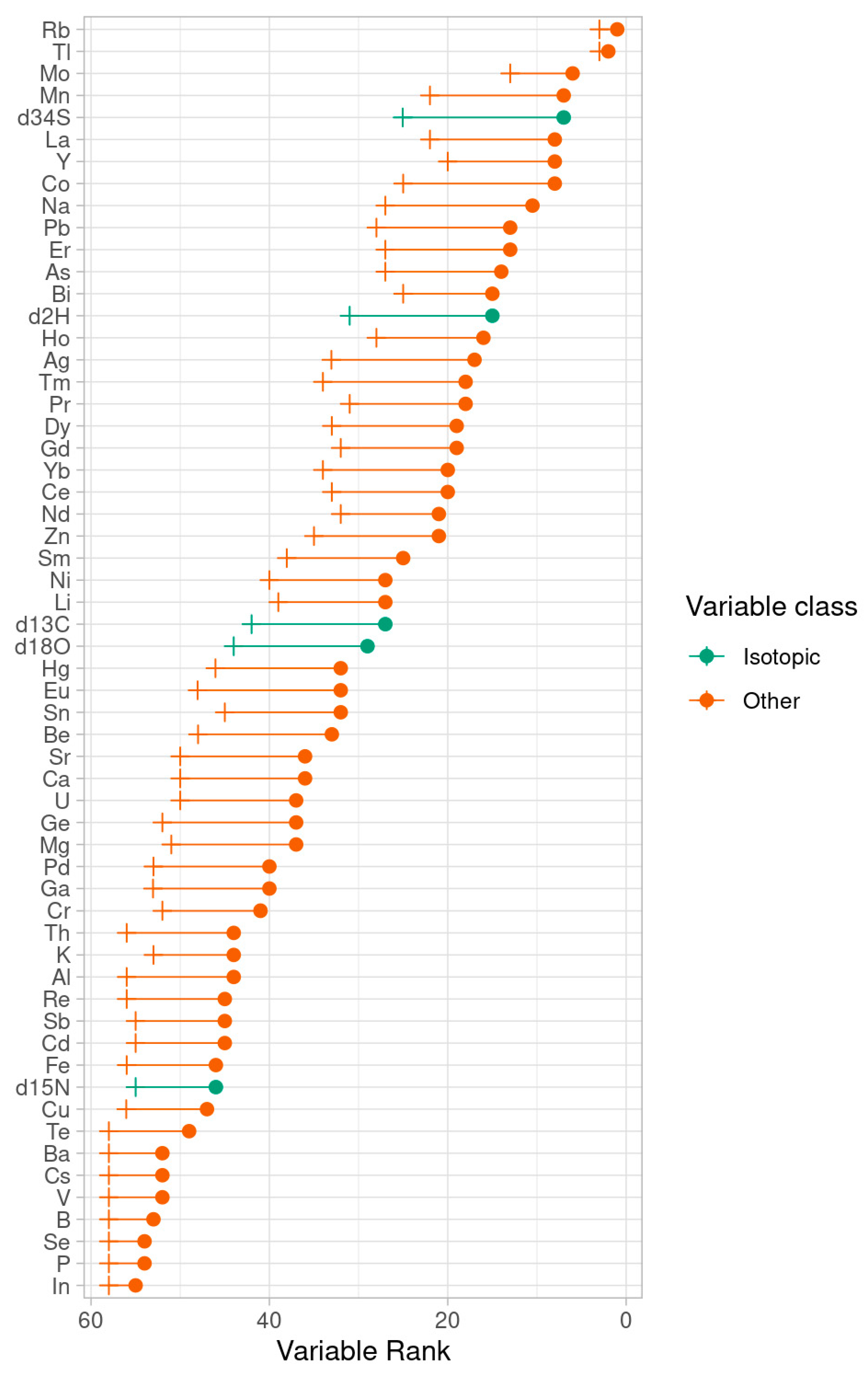
Umbrian tobacco of the Virginia Bright variety is one of the most appreciated tobaccos in Europe, and one characterized by an excellent yield. In recent years, the Umbria region and local producers have invested in introducing novel practices (for production and processing) focused on environmental, social, and economic sustainability. Due to this, tobacco from Umbria is a leading commodity in the global tobacco industry, and it claims a high economic value. The aim of this study is then to assess if elemental and isotopic compositions can be used to protect the quality and geographical traceability of this particular tobacco. For the first time the characteristic value ranges of the stable isotope ratios of the bio-elements as a whole (δ2H, δ13C, δ15N, δ18O, and δ34S) and of the concentration of 56 macro- and micro-elements are now available, determined in Virginia Bright tobacco produced in two different areas of Italy (Umbria and Veneto), and from other worldwide geographical regions. The ranges of variability of elements and stable isotope ratios had slightly different results, according to the three geographical origins considered. In particular, Umbria samples presented significantly lower content of metals potentially dangerous for human health. The results of this first exploratory work highlight the possibility of characterizing tobacco from Umbria, and suggest widening the scope of the survey throughout Italy and foreign regions, in order to be used to describe the geographical origin of tobacco in general and verify the origin of the products on the market.
Keywords: stable isotope ratios; elemental composition; tobacco; geographical origin stable isotope ratios; elemental composition; tobacco; geographical origin
Graphical Abstract