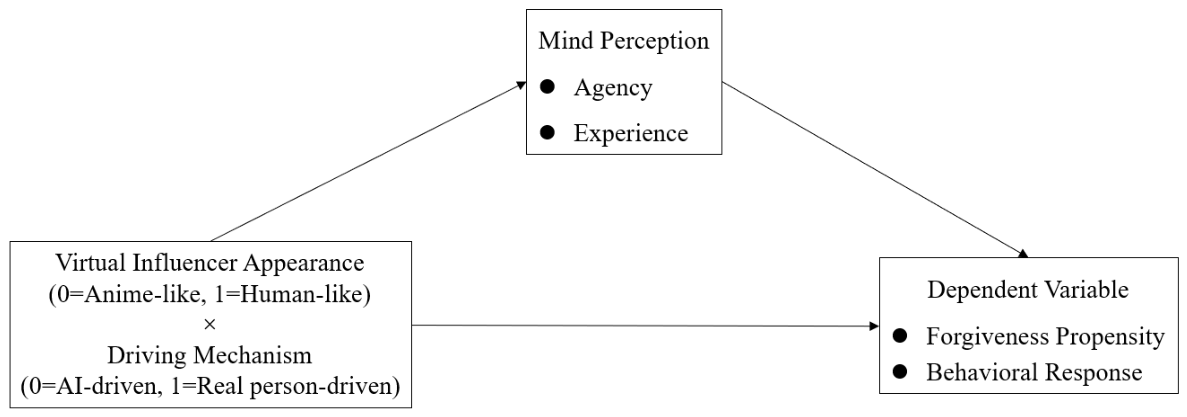


Consumer Reactions to Virtual Influencer Transgressions: How Anime-Looking and AI-Driven Influencers Are Less Vulnerable

Abstract
1. Introduction
2. Theoretical Background and Hypotheses Development
2.1. Human-like Versus Anime-like Virtual Influencers
2.2. Virtual Influencer Transgressions and User Reactions
2.3. Virtual Influencer Appearance and Mind Perception
2.4. Driving Mechanism as Boundary Condition
3. Study One: Consumer Reactions to Transgressions Based on Virtual Influencer Appearance
3.1. Participants and Design
3.2. Procedure
3.3. Results
3.4. Discussion
4. Study Two: Main Effects Based on Virtual Influencer Gender
4.1. Participants and Design
4.2. Procedure
4.3. Results
4.4. Discussion
5. Study Three: Moderating Effects of Driving Mechanism and Mediating Effects of Mind Perception
5.1. Participants and Design
5.2. Procedure
5.3. Results
5.4. Discussion
6. General Discussion
6.1. Theoretical Implications
6.2. Practical Implications
6.3. Limitations and Future Research Directions
Author Contributions
Funding
Institutional Review Board Statement
Informed Consent Statement
Data Availability Statement
Acknowledgments
Conflicts of Interest
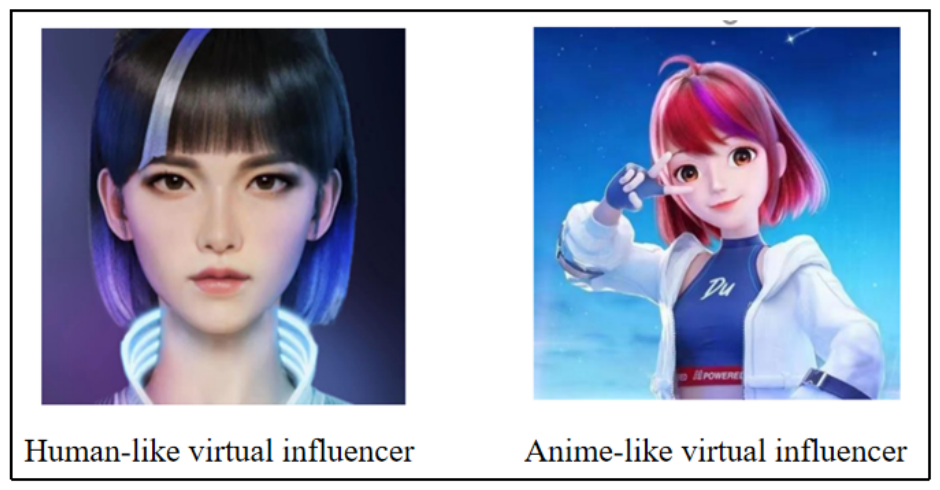
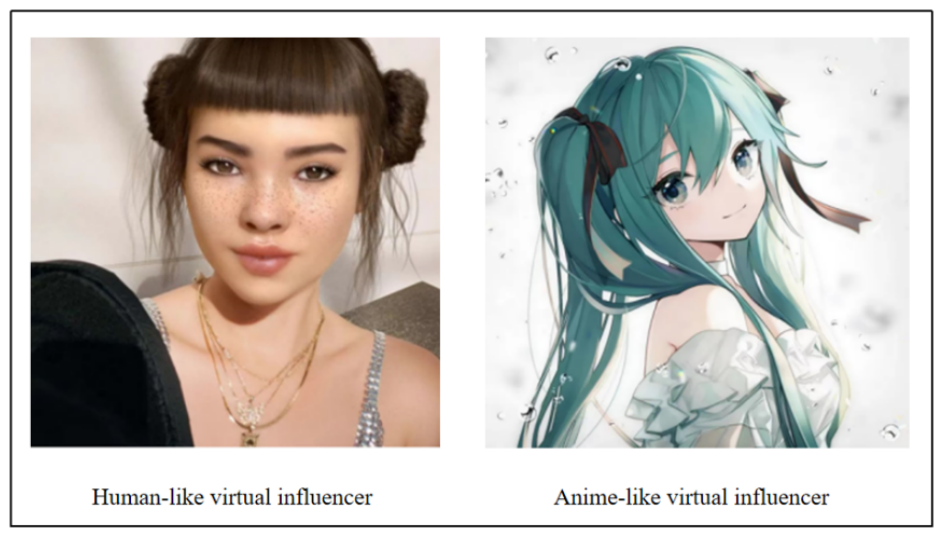
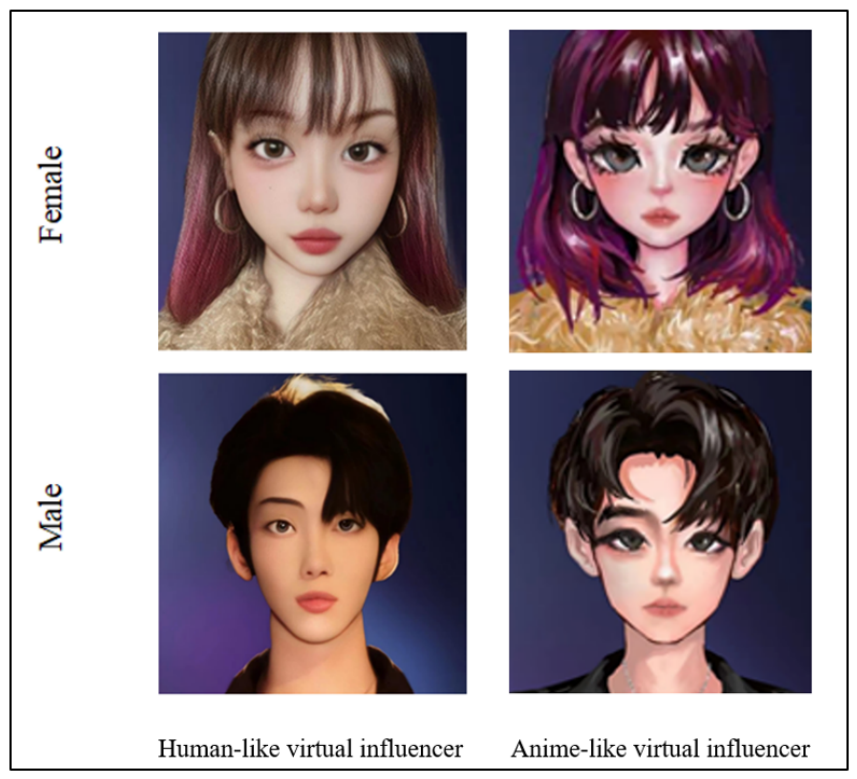
Appendix A. Cover Story for Manipulating Virtual Influencers’ Appearance (Used in Study 1 and Study 2)
Appendix B. Transgression Scenarios
- (1)
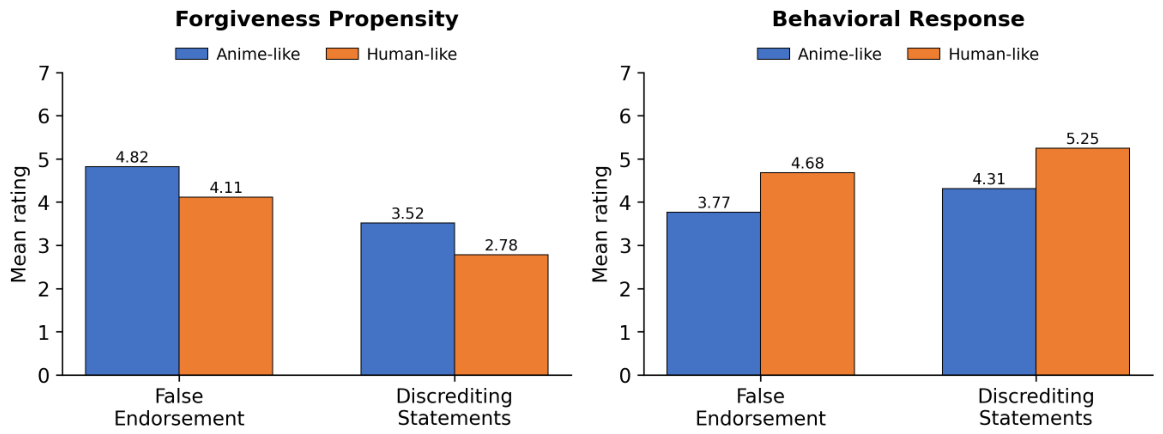
- Transgression based on the false endorsement (used in Study 1 and Study 2): The influencer claimed to have selected an exclusive coffee cup with exquisite design for her fans and recommended them to buy it. However, after the fans bought the product, they found that the coffee cup was not as exquisite as the influencer claimed, and the quality was poor, far from the fans’ expectations.
- (2)
- Transgression based on discrediting statements (used in Study 1): The influencer made discriminatory comments about disabled people during a live broadcast, which made followers feel very uncomfortable.
- (3)
- Transgression based on discrediting statements (used in Study 3): Imagine you have followed Yuki for a long time. Recently, you noticed that Yuki regularly posted, liked and commented on Instagram posts related to antisemitism and supported for racism publicly. While some people pointed out that this is inappropriate behavior, Yuki replied that she is just joking and talking for fun, which have caused an outcry from her fans and the public.
Appendix C. Manipulation of Types of Virtual Influencers in Study 3
- (1)
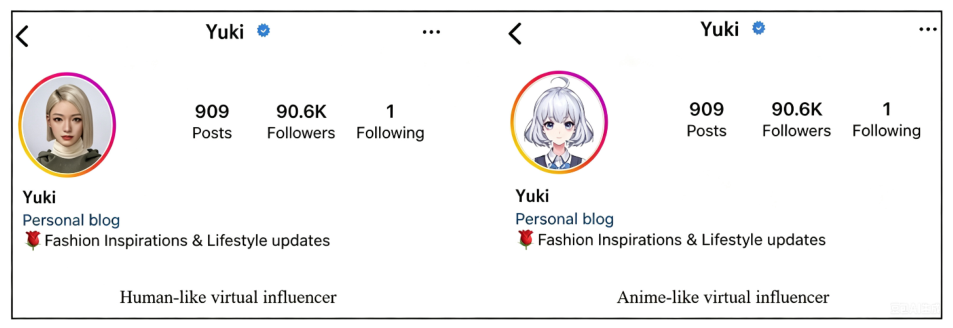
- Cover story for manipulating virtual influencers’ appearance. Yuki is a virtual influencer on Instagram with a “human-like” image (vs. cartoon image). Virtual influencers are computer-generated characters with social media presence. They are not real people, but usually run by a specialized technical and commercial team.
- (2)
- Cover story for manipulating virtual influencers’ driving mechanism. Yuki is driven by a real person behind the scenes (vs. by AI), who wears a full set of body and facial motion capturing equipment, combined with voice synthesis technology (vs. formed by high-precision multimodal technology that restores movement transformations through the use of artificial intelligence and deep learning). Therefore, people visually see the virtual appearance as presented in the picture. Her actions are actually exhibited by the real person inside the holster (vs. actually ran through the complex algorithms) and the sounds she makes are also virtually processed. Recently, like human influencers, she is often active on various social media platforms, sharing her life and outfits, occasionally endorsing some products, and also liking and commenting to her fans.
References
- Hollebeek, L.D.; Macky, K. Digital content marketing’s role in fostering consumer engagement, trust, and value: Framework, fundamental propositions, and implications. J. Interact. Mark. 2019, 45, 27–41. [Google Scholar] [CrossRef]
- Drenten, J.; Brooks, G. Celebrity 2.0: Lil Miquela and the rise of a virtual star system. Fem. Media Stud. 2020, 20, 1319–1323. [Google Scholar] [CrossRef]
- Molenaar, K. Discover the Top 12 Virtual Influencers for 2024—Listed and Ranked! Influencer Marketing Hub. 29 March 2024. Available online: https://influencermarketinghub.com/virtual-influencers/ (accessed on 15 December 2025).
- Deng, F.; Jiang, X. Effects of human versus virtual human influencers on the appearance anxiety of social media users. J. Retail. Consum. Serv. 2023, 71, 103233. [Google Scholar] [CrossRef]
- Lim, R.E.; Lee, S.Y. “You are a virtual influencer!”: Understanding the impact of origin disclosure and emotional narratives on parasocial relationships and virtual influencer credibility. Comput. Hum. Behav. 2023, 148, 107897. [Google Scholar] [CrossRef]
- You, L.; Liu, F. From virtual voices to real impact: Authenticity, altruism, and egoism in social advocacy by human and virtual influencers. Technol. Forecast. Soc. Change 2024, 207, 123650. [Google Scholar] [CrossRef]
- Allal-Chérif, O.; Puertas, R.; Carracedo, P. Intelligent influencer marketing: How AI-powered virtual influencers outperform human influencers. Technol. Forecast. Soc. Change 2024, 200, 123113. [Google Scholar] [CrossRef]
- Ozdemir, O.; Kolfal, B.; Messinger, P.R.; Rizvi, S. Human or virtual: How influencer type shapes brand attitudes. Comput. Hum. Behav. 2023, 145, 107771. [Google Scholar] [CrossRef]
- Mouritzen, S.L.T.; Penttinen, V.; Pedersen, S. Virtual influencer marketing: The good, the bad and the unreal. Eur. J. Mark. 2023. [Google Scholar] [CrossRef]
- Sands, S.; Ferraro, C.; Demsar, V.; Chandler, G. False idols: Unpacking the opportunities and challenges of falsity in the context of virtual influencers. Bus. Horiz. 2022, 65, 777–788. [Google Scholar] [CrossRef]
- Mrad, M.; Ramadan, Z.; Nasr, L.I. Computer-generated influencers: The rise of digital personalities. Mark. Intell. Plan. 2022, 40, 589–603. [Google Scholar] [CrossRef]
- Mustak, M.; Salminen, J.; Mäntymäki, M.; Rahman, A.; Dwivedi, Y.K. Deepfakes: Deceptions, mitigations, and opportunities. J. Bus. Res. 2023, 154, 113368. [Google Scholar] [CrossRef]
- Koebler, J. A Computer-Generated, Pro-Trump Instagram Model Said She Hacked Lil Miquela, Another CGI Instagram Model. Vice, 17 April 2018. Available online: https://www.vice.com/en_us/article/43bp79/lil-miquela-instagram-allegedly-hacked-bermuda (accessed on 15 December 2025).
- Raphael, S. Meet Bermuda, the Most Controversial CGI Influenceron Instagram. Refinery 29, 20 December 2018. Available online: https://www.refinery29.com/en-gb/bermuda-instagram-cgi-influencer (accessed on 15 December 2025).
- Thomas, V.L.; Fowler, K. Close encounters of the AI kind: Use of AI influencers as brand endorsers. J. Advert. 2021, 50, 11–25. [Google Scholar] [CrossRef]
- Zhao, T.; Ran, Y.; Wu, B.; Wang, V.L.; Zhou, L.; Wang, C.L. Virtual versus human: Unraveling consumer reactions to service failures through influencer types. J. Bus. Res. 2024, 178, 114657. [Google Scholar] [CrossRef]
- Park, S.; Sung, Y. The interplay between human likeness and agency on virtual influencer credibility. Cyberpsychol. Behav. Soc. Netw. 2023, 26, 764–771. [Google Scholar] [CrossRef] [PubMed]
- Arsenyan, J.; Mirowska, A. Almost human? A comparative case study on the social media presence of virtual influencers. Int. J. Hum.-Comput. Stud. 2021, 155, 102694. [Google Scholar] [CrossRef]
- Ma, Y.; Li, J. How humanlike is enough? Uncover the underlying mechanism of virtual influencer endorsement. Comput. Hum. Behav. Artif. Hum. 2024, 2, 100037. [Google Scholar] [CrossRef]
- Yang, J.; Chuenterawong, P.; Lee, H.; Chock, T.M. Anthropomorphism in CSR endorsement: A comparative study on humanlike vs. cartoonlike virtual influencers’climate change messaging. J. Promot. Manag. 2023, 29, 705–734. [Google Scholar] [CrossRef]
- Jiang, K.; Zheng, J.; Luo, S. Green power of virtual influencer: The role of virtual influencer image, emotional appeal, and product involvement. J. Retail. Consum. Serv. 2024, 77, 103660. [Google Scholar] [CrossRef]
- Kim, E.; Kim, D.; E, Z.; Shoenberger, H. The next hype in social media advertising: Examining virtual influencers’ brand endorsement effectiveness. Front. Psychol. 2023, 14, 1089051. [Google Scholar] [CrossRef] [PubMed]
- Appel, G.; Grewal, L.; Hadi, R.; Stephen, A.T. The future of social media inmarketing. J. Acad. Mark. Sci. 2020, 48, 79–95. [Google Scholar] [CrossRef] [PubMed]
- Shin, M.; Song, S.W.; Chock, T.M. Uncanny valley effects on friendship decisions in virtual social networking service. Cyberpsychol. Behav. Soc. Netw. 2019, 22, 700–705. [Google Scholar] [CrossRef] [PubMed]
- Yan, J.; Xia, S.; Jiang, A.; Lin, Z. The effect of different types of virtual influencers on consumers’ emotional attachment. J. Bus. Res. 2024, 177, 114646. [Google Scholar] [CrossRef]
- Qu, Y.; Baek, E. Let virtual creatures stay virtual: Tactics to increase trust in virtual influencers. J. Res. Interact. Mark. 2024, 18, 91–108. [Google Scholar] [CrossRef]
- Crolic, C.; Thomaz, F.; Hadi, R.; Stephen, A.T. Blame the bot: Anthropomorphism and anger in customer–chatbot interactions. J. Mark. 2022, 86, 132–148. [Google Scholar] [CrossRef]
- Johnson, R.D.; Marakas, G.M.; Palmer, J.W. Differential social attributions toward computing technology: An empirical investigation. Int. J. Hum.-Comput. Stud. 2006, 64, 446–460. [Google Scholar] [CrossRef]
- Edwards, C.; Edwards, A.; Stoll, B.; Lin, X.; Massey, N. Evaluations of an artificial intelligence instructor’s voice: Social Identity Theory in human-robot interactions. Comput. Hum. Behav. 2019, 90, 357–362. [Google Scholar] [CrossRef]
- Quach, S.; Cheah, I.; Thaichon, P. The power of flattery: Enhancing prosocial behavior through virtual influencers. Psychol. Mark. 2024, 41, 1629–1648. [Google Scholar] [CrossRef]
- Xie-Carson, L.; Magor, T.; Benckendorff, P.; Hughes, K. All hype or the real deal? Investigating user engagement with virtual influencers in tourism. Tour. Manag. 2023, 99, 104779. [Google Scholar] [CrossRef]
- Xu, H.; Wu, Y. Do virtual endorsers have a country-of-origin effect? From the perspective of congruent explanations. Technol. Forecast. Soc. Change 2024, 206, 123530. [Google Scholar] [CrossRef]
- Kuchmaner, C.A.; Wiggins, J.; Grimm, P.E. The role of network embeddedness and psychological ownership in consumer responses to brand transgressions. J. Interact. Mark. 2019, 47, 129–143. [Google Scholar] [CrossRef]
- Lo, C.J.E.; Tsarenko, Y.; Tojib, D. Same scandal, different moral judgments: The effects of consumer-firm affiliation on weighting transgressor-related information and post-scandal patronage intentions. Eur. J. Mark. 2021, 55, 3162–3190. [Google Scholar] [CrossRef]
- Theodorakis, I.G.; Painesis, G. Ad eroticism from a psychological distance perspective: Investigating its effects in light of consumers’ sex, ethical judgments, and moral attentiveness. J. Bus. Res. 2022, 142, 524–539. [Google Scholar] [CrossRef]
- Reinikainen, H.; Tan, T.M.; Luoma-Aho, V.; Salo, J. Making and breaking relationships on social media: The impacts of brand and influencer betrayals. Technol. Forecast. Soc. Change 2021, 171, 120990. [Google Scholar] [CrossRef]
- Von Mettenheim, W.; Wiedmann, K.P. Influencer transgressions: The impacts on endorser and brand. J. Media Econ. 2023, 35, 28–62. [Google Scholar] [CrossRef]
- Zheng, B. Streamers, Virtual Nationalists and Soft Power: China vs. the World? China Studies. 30 October 2020. Available online: https://www.bakerinstitute.org/research/streamers-virtual-nationalists-and-soft-power-china-vs-world (accessed on 15 December 2025).
- Aw, E.C.X.; Labrecque, L.I. Celebrities as brand shields: The role of parasocial relationships in dampening negative consequences from brand transgressions. J. Advert. 2023, 52, 387–405. [Google Scholar] [CrossRef]
- Wang, S.; Kim, K.J. Consumer response to negative celebrity publicity: The effects of moral reasoning strategies and fan identification. J. Product. Brand Manag. 2020, 29, 114–123. [Google Scholar] [CrossRef]
- Yang, Y.; Hu, J. Self-diminishing effects of awe on consumer forgiveness in service encounters. J. Retail. Consum. Serv. 2021, 60, 102491. [Google Scholar] [CrossRef]
- Kennedy, A.; Baxter, S.M.; Ilicic, J. Celebrity versus film persona endorsements: Examining the effect of celebrity transgressions on consumer judgments. Psychol. Mark. 2019, 36, 102–112. [Google Scholar] [CrossRef]
- Rifon, N.J.; Jiang, M.; Wu, S. Consumer response to celebrity transgression: Investigating the effects of celebrity gender and past transgressive and philanthropic behaviors using real celebrities. J. Product. Brand Manag. 2023, 32, 517–529. [Google Scholar] [CrossRef]
- Kim, Y.; Ho, T.H.; Tan, L.P.; Casidy, R. Factors influencing consumer forgiveness: A systematic literature review and directions for future research. J. Serv. Theory Pract. 2023, 33, 601–628. [Google Scholar] [CrossRef]
- Sinha, J.; Lu, F.C. “I” value justice, but “we” value relationships: Self-construal effects on post-transgression consumer forgiveness. J. Consum. Psychol. 2016, 26, 265–274. [Google Scholar] [CrossRef]
- Liu, F.; Lee, Y.H. Virtually responsible? Attribution of responsibility toward human vs. virtual influencers and the mediating role of mind perception. J. Retail. Consum. Serv. 2024, 77, 103685. [Google Scholar] [CrossRef]
- Yan, X.; Mo, T.; Zhou, X. The influence of cultural differences between China and the West on moral responsibility judgments of virtual humans. Acta Psychol. Sin. 2024, 56, 161. [Google Scholar] [CrossRef]
- Gray, H.M.; Gray, K.; Wegner, D.M. Dimensions of mind perception. Science 2007, 315, 619. [Google Scholar] [CrossRef] [PubMed]
- Tzelios, K.; Williams, L.A.; Omerod, J.; Bliss-Moreau, E. Evidence of the unidimensional structure of mind perception. Sci. Rep. 2022, 12, 18978. [Google Scholar] [CrossRef] [PubMed]
- Gray, K.; Wegner, D.M. Feeling robots and human zombies: Mind perceptionand the uncanny valley. Cognition 2012, 125, 125–130. [Google Scholar] [CrossRef] [PubMed]
- Waytz, A.; Gray, K.; Epley, N.; Wegner, D.M. Causes and consequences of mind perception. Trends Cogn. Sci. 2010, 14, 383–388. [Google Scholar] [CrossRef] [PubMed]
- Li, H.; Lei, Y.; Zhou, Q.; Yuan, H. Can you sense without being human? Comparing virtual and human influencers endorsement effectiveness. J. Retail. Consum. Serv. 2023, 75, 103456. [Google Scholar] [CrossRef]
- Luo, X.M.; Tong, S.L.; Fang, Z.; Qu, Z. Frontiers: Machines vs. humans: The impact of artificial intelligence chatbot disclosure on customer purchases. Mark. Sci. 2019, 38, 937–947. [Google Scholar] [CrossRef]
- Kevin, K.; Jaime, B. It feels, therefore it is: Associations between mind perception and mind ascription for social robots. Comput. Hum. Behav. 2024, 153, 108098. [Google Scholar] [CrossRef]
- Küster, D.; Swiderska, A.; Gunkel, D. I saw it on YouTube! How online videos shape perceptions of mind, morality, and fears about robots. New Media Soc. 2021, 23, 3312–3331. [Google Scholar] [CrossRef]
- Swiderska, A.; Küster, D. Avatars in pain: Visible harm enhances mind perception in humans and robots. Perception 2018, 47, 1139–1152. [Google Scholar] [CrossRef] [PubMed]
- Park, S.; Kim, S.P.; Whang, M. Individual’s social perception of virtual avatars embodied with their habitual facial expressions and facial appearance. Sensors 2021, 21, 5986. [Google Scholar] [CrossRef] [PubMed]
- Ham, J.; Li, S.; Looi, J.; Eastin, M.S. Virtual humans as social actors: Investigating user perceptions of virtual humans’ emotional expression on social media. Comput. Hum. Behav. 2024, 155, 108161. [Google Scholar] [CrossRef]
- Yang, D.; Zhang, J.; Sun, Y.; Huang, Z. Showing usage behavior or not? The effect of virtual influencers’ product usage behavior on consumers. J. Retail. Consum. Serv. 2024, 79, 103859. [Google Scholar] [CrossRef]
- Gray, K.; Young, L.; Waytz, A. Mind perception is the essence of morality. Psychol. Inq. 2012, 23, 101–124. [Google Scholar] [CrossRef] [PubMed]
- Sullivan, Y.W.; Wamba, F.S. Moral judgments in the age of artificial intelligence. J. Bus. Ethics 2022, 178, 917–943. [Google Scholar] [CrossRef]
- Arikan, E.; Altinigne, N.; Kuzgun, E.; Okan, M. May robots be held responsible for service failure and recovery? The role of robot service provider agents’ human-likeness. J. Retail. Consum. Serv. 2023, 70, 103175. [Google Scholar] [CrossRef]
- Seymour, M.; Riemer, K.; Kay, J. Actors, avatars and agents: Potentials and implications of natural face technology for the creation of realistic visual presence. J. Assoc. Inf. Syst. 2018, 19, 4. [Google Scholar] [CrossRef]
- Tang, M.T.; Zhu, V.L.; Popescu, V. Alterecho: Loose avatar-streamer coupling for expressive vtubing. In Proceedings of the 2021 IEEE International Symposium on Mixed and Augmented Reality (ISMAR), Bari, Italy, 4–8 October 2021; pp. 128–137. [Google Scholar] [CrossRef]
- Hoyer, W.D.; Kroschke, M.; Schmitt, B.; Kraume, K.; Shankar, V. Transforming the customer experience through new technologies. J. Interact. Mark. 2020, 51, 57–71. [Google Scholar] [CrossRef]
- Roman, D. Virtual Influencers: The Power of AI-Generated Influencer Marketing. Tech, Trends & Market Insights. 15 February 2024. Available online: https://wearebrain.com/blog/ai-generated-virtual-influencers (accessed on 15 December 2025).
- Von der Pütten, A.M.; Krämer, N.C.; Gratch, J.; Kang, S.H. “It doesn’t matter what you are!” Explaining social effects of agents and avatars. Comput. Hum. Behav. 2010, 26, 1641–1650. [Google Scholar] [CrossRef]
- Nowak, K.L.; Fox, J. Avatars and computer-mediated communication: A review of the definitions, uses, and effects of digital representations. Rev. Commun. Res. 2018, 6, 30–53. [Google Scholar] [CrossRef]
- Seymour, M.; Yuan, L.; Riemer, K.; Dennis, A.R. Less Artificial, More Intelligent: Understanding Affinity, Trustworthiness, and Preference for Digital Humans. Inf. Syst. Res. 2024, online. [Google Scholar] [CrossRef]
- Pavone, G.; Meyer-Waarden, L.; Munzel, A. Rage against the machine: Experimental insights into customers’ negative emotional responses, attributions of responsibility, and coping strategies in artificial intelligence–based service failures. J. Interact. Mark. 2023, 58, 52–71. [Google Scholar] [CrossRef]
- Garvey, A.M.; Kim, T.; Duhachek, A. Bad news? Send an AI. Good news? Send a human. J. Mark. 2023, 87, 10–25. [Google Scholar] [CrossRef]
- Faul, F.; Erdfelder, E.; Buchner, A.; Lang, A.G. Statistical power analyses using G Power 3.1: Tests for correlation and regression analyses. Behav. Res. Methods 2009, 41, 1149–1160. [Google Scholar] [CrossRef] [PubMed]
- Bigman, Y.E.; Gray, K. People are averse to machines making moral decisions. Cognition 2018, 181, 21–34. [Google Scholar] [CrossRef] [PubMed]
- Hayes, A.F. Introduction to Mediation, Moderation, and Conditional Process Analysis: A Regression-Based Approach; Guilford Press: New York, NY, USA, 2013. [Google Scholar]
- Yoo, J.W.; Park, J.; Park, H. How can I trust you if you’re fake? Understanding human-like virtual influencer credibility and the role of textual social cues. J. Res. Interact. Mark. 2025, 19, 730–748. [Google Scholar] [CrossRef]
- Epley, N. A mind like mine: The exceptionally ordinary underpinnings of anthropomorphism. J. Assoc. Consum. Res. 2018, 3, 591–598. [Google Scholar] [CrossRef]
- Zhou, X.; Yan, X.; Jiang, Y. Making sense? The sensory-specific nature of virtual influencer effectiveness. J. Mark. 2023, 88, 84–106. [Google Scholar] [CrossRef]
- De Cicco, R.; Iacobucci, S.; Cannito, L.; Onesti, G.; Ceccato, I.; Palumbo, R. Virtual vs. human influencer: Effects on users’ perceptions and brand outcomes. Technol. Soc. 2024, 77, 102488. [Google Scholar] [CrossRef]
- Yim, A.; Liska, L.; Mu, Y.; Thakkar, M. I feel no empathy toward AI: The effects of AI vs human spokespersons on advertisement effectiveness. J. Res. Interact. Mark. 2026, 20, 108–122. [Google Scholar] [CrossRef]
- Sun, C.; Ye, C.; Li, C.; Liu, Y. Virtual ideality vs. virtual authenticity: Exploring the role of social signals in interactive marketing. J. Res. Interact. Mark. 2024, 18, 430–445. [Google Scholar] [CrossRef]
- Chopdar, P.K.; Paul, J. The impact of brand transparency of food delivery apps in interactive brand communication. J. Res. Interact. Mark. 2024, 18, 238–256. [Google Scholar] [CrossRef]
- Shen, P.; Nie, X.; Tong, C. Does disclosing commercial intention benefit brands? Mediating role of perceived manipulative intent and perceived authenticity in influencer hidden advertising. J. Res. Interact. Mark. 2025, 19, 673–693. [Google Scholar] [CrossRef]
- Xin, B.; Hao, Y.; Xie, L. Virtual influencers and corporate reputation: From marketing game to empirical analysis. J. Res. Interact. Mark. 2024, 18, 759–786. [Google Scholar] [CrossRef]
- Fârte, G.; Obadă, D.R.; Gherguţ-Babii, A.; Dabija, D. Building corporate immunity: How do companies increase their resilience to negative information in the environment of fake news? J. Res. Interact. Mark. 2025, 19, 1260–1277. [Google Scholar] [CrossRef]
- Yang, J.; Basile, K.; Zhao, X. Examining CSR communication on social media during a victim crisis: A machine learning based text analytics approach. J. Res. Interact. Mark. 2025, 19, 840–860. [Google Scholar] [CrossRef]
- Shao, Z. Understanding the switching intention to virtual streamers in live streaming commerce: Innovation resistances, shopping motivations and personalities. J. Res. Interact. Mark. 2025, 19, 333–357. [Google Scholar] [CrossRef]
- Wei, Y.; Syahrivar, J.; Simay, A.E. Unveiling the influence of anthropomorphic chatbots on consumer behavioral intentions: Evidence from China and Indonesia. J. Res. Interact. Mark. 2025, 19, 132–157. [Google Scholar] [CrossRef]
- Zheng, X.; Cui, C.; Zhang, C.; Li, D. Who says what? How message appeals shape virtual- versus human-influencers’ impact on consumer engagement. J. Res. Interact. Mark. 2026, 20, 199–214. [Google Scholar] [CrossRef]
- Cheng, J.; Wang, J. Influencer-product attractiveness transference in interactive fashion marketing: The moderated moderating effect of speciesism against AI. J. Res. Interact. Mark. 2025, 19, 712–729. [Google Scholar] [CrossRef]
- Peltier, J.W.; Dahl, A.J.; Schibrowsky, J.A. Artificial intelligence in interactive marketing: A conceptual framework and research agenda. J. Res. Interact. Mark. 2024, 18, 54–90. [Google Scholar] [CrossRef]
- Wang, C.L. Editorial: The changing landscape of marketing research in the AI era: Prospects and challenges. J. Res. Interact. Mark. 2026, 20, 1–10. [Google Scholar] [CrossRef]
- Labrecque, L.I.; Peña, P.Y.; Leonard, H.; Leger, R. Not all sunshine and rainbows: Exploring the dark side of AI in interactive marketing. J. Res. Interact. Mark. 2024, 18, 970–999. [Google Scholar] [CrossRef]





| Demographic Variable | Category | Number (Proportion) |
|---|---|---|
| Age | 18–24 | 40 (20%) |
| 25–34 | 124 (62%) | |
| 35–44 | 27 (13.5%) | |
| 45–54 | 9 (4.5%) | |
| Gender | Male | 70 (35%) |
| Female | 130 (65%) | |
| Education Background | High school or lower | 17 (8.5%) |
| Some college | 31 (15.5%) | |
| College graduate | 92 (46%) | |
| Postgraduate | 60 (30%) |
| Demographic Variable | Category | Number (Proportion) |
|---|---|---|
| Age | 18–24 | 47 (23.5%) |
| 25–34 | 106 (53%) | |
| 35–44 | 37 (18.5%) | |
| 45–54 | 7 (3.5%) | |
| 55–64 | 2 (1%) | |
| Gender | Male | 88 (44%) |
| Female | 112 (56%) | |
| Education Background | High school or lower | 11 (5.5%) |
| Some college | 37 (18.5%) | |
| College graduate | 94 (47%) | |
| Postgraduate | 58 (29%) |
| Demographic Variable | Category | Number (Proportion) |
|---|---|---|
| Age | 18–24 | 34 (17.4%) |
| 25–34 | 67 (34.4%) | |
| 35–44 | 41 (21%) | |
| 45–54 | 34 (17.4%) | |
| 55–64 | 11 (5.6%) | |
| >65 | 8 (4.1%) | |
| Gender | Male | 103 (52.8%) |
| Female | 89 (45.6%) | |
| Non-binary/Third gender | 3 (1.5%) | |
| Education Background | High school or lower | 18 (9.2%) |
| Some college | 44 (22.6%) | |
| College graduate | 88 (45.1%) | |
| Postgraduate | 45 (23.1%) | |
| Region | Australia/Oceania | 71 (36.4%) |
| Africa | 10 (5.1%) | |
| North America | 73 (37.4%) | |
| Europe | 39 (20%) | |
| Asia | 2 (1%) | |
| Social Media Usage Frequency | Less than once a week | 5 (2.6%) |
| Once a week | 2 (1.0%) | |
| A few times a week | 16 (8.2%) | |
| Once a day | 28 (14.4%) | |
| Several times a day | 144 (73.8%) |
| Dependent Variables | Mediation | Moderation | Effect | BootSE | BootLLCI | BootULCI |
|---|---|---|---|---|---|---|
| Forgiveness Propensity | Agency | AI-driven | 0.10 | 0.12 | −0.13 | 0.37 |
| Real person-driven | −0.23 | 0.10 | −0.45 | −0.04 | ||
| Experience | AI-driven | 0.003 | 0.04 | −0.08 | 0.09 | |
| Real person-driven | −0.11 | 0.10 | −0.34 | 0.06 | ||
| Behavioral Response | Agency | AI-driven | −0.06 | 0.09 | −0.27 | 0.09 |
| Real person-driven | 0.14 | 0.08 | 0.03 | 0.04 | ||
| Experience | AI-driven | −0.003 | 0.03 | −0.07 | 0.06 | |
| Real person-driven | 0.09 | 0.08 | −0.04 | 0.27 |
Disclaimer/Publisher’s Note: The statements, opinions and data contained in all publications are solely those of the individual author(s) and contributor(s) and not of MDPI and/or the editor(s). MDPI and/or the editor(s) disclaim responsibility for any injury to people or property resulting from any ideas, methods, instructions or products referred to in the content. |
© 2026 by the authors. Licensee MDPI, Basel, Switzerland. This article is an open access article distributed under the terms and conditions of the Creative Commons Attribution (CC BY) license.
Share and Cite
Song, W.; Wei, S.; Li, Z.; Deng, S.; Du, Y. Consumer Reactions to Virtual Influencer Transgressions: How Anime-Looking and AI-Driven Influencers Are Less Vulnerable. J. Theor. Appl. Electron. Commer. Res. 2026, 21, 219. https://doi.org/10.3390/jtaer21070219
Song W, Wei S, Li Z, Deng S, Du Y. Consumer Reactions to Virtual Influencer Transgressions: How Anime-Looking and AI-Driven Influencers Are Less Vulnerable. Journal of Theoretical and Applied Electronic Commerce Research. 2026; 21(7):219. https://doi.org/10.3390/jtaer21070219
Chicago/Turabian StyleSong, Wei, Siyuan Wei, Zinuo Li, Shengliang Deng, and Yuqi Du. 2026. "Consumer Reactions to Virtual Influencer Transgressions: How Anime-Looking and AI-Driven Influencers Are Less Vulnerable" Journal of Theoretical and Applied Electronic Commerce Research 21, no. 7: 219. https://doi.org/10.3390/jtaer21070219
APA StyleSong, W., Wei, S., Li, Z., Deng, S., & Du, Y. (2026). Consumer Reactions to Virtual Influencer Transgressions: How Anime-Looking and AI-Driven Influencers Are Less Vulnerable. Journal of Theoretical and Applied Electronic Commerce Research, 21(7), 219. https://doi.org/10.3390/jtaer21070219