Article

The Strategic Interplay Between Return Insurance and Augmented Reality in Live-Streaming Commerce Considering Consumer Search Effort

School of Economics and Management, Beijing University of Posts and Telecommunications, Beijing 100876, China
*
Author to whom correspondence should be addressed.
J. Theor. Appl. Electron. Commer. Res. 2026, 21(6), 192; https://doi.org/10.3390/jtaer21060192
Submission received: 14 March 2026 / Revised: 12 June 2026 / Accepted: 16 June 2026 / Published: 19 June 2026
(This article belongs to the Section Immersive Commerce and Emerging Technologies)

Abstract

Product mismatch, arising from consumers’ inability to physically experience products before purchase, is a major cause of returns in e-commerce, eroding e-tailer profits and intensifying consumers’ concerns about returns. To alleviate these concerns, e-tailers have increasingly adopted return insurance (RI), which reduces consumers’ return freight costs. However, RI may encourage consumers to defer product selection from the pre-purchase search stage to the post-purchase evaluation stage, thereby exacerbating mismatch and increasing return rates. As a countermeasure in live-streaming commerce, augmented reality (AR) provides an immersive product experience that can reduce mismatch and returns. This study develops a game-theoretic model to analyze the strategic interplay between an e-tailer’s RI decision and a live streamer’s AR decision while incorporating consumer search effort. The results show that consumer search effort changes the relationship between the two strategies. When search effort is low, RI and AR function as strategic substitutes; when search effort is high, they function as strategic complements. These findings indicate that the value of a return-management strategy depends on consumer behavior and on the presence of the partner’s AR strategy. The study contributes to the literature on interdependent return-management strategies and provides actionable insights for e-commerce practitioners.

1. Introduction

In recent years, live-streaming sales have rapidly emerged as a new marketing model and have become an important bridge between e-tailers and consumers. E-tailers generally prefer to partner with live streamers who have extensive live-streaming experience. In this cooperative mechanism, the live streamer is responsible for live-streaming operations, whereas the e-tailer pays the streamer a portion of sales revenue as a commission fee. Research by the China Academy of Social Sciences shows that in 2024, China’s live-streaming e-commerce market exceeded 4.3 trillion RMB.
Despite its rapid growth, live-streaming commerce continues to face persistently high return rates. Product mismatch—the discrepancy between consumer expectations and actual product attributes—is the primary reason for returns [1,2]. Consumers can ascertain product fit only after physical inspection upon delivery; mismatched products are then returned, and return freight must be paid [3,4].
According to the Report on Data of China E-commerce Platforms during Double 11 in 2024, the return rate is typically 50–60%. Self-optimizing consumers actively search for product information before purchase to reduce the risk of product mismatch [5,6]. Although product search requires effort, it helps consumers assess product–need fit. Consumers therefore trade off search effort and search costs against the hassle of returns, which explains why they still search even though many products are ultimately returned [6]. Such search behavior is also shaped by external e-commerce market institutions, such as whether a platform imposes a free seven-day no-questions-asked return policy. In addition to product search, consumers are concerned about return costs. According to Narvar’s “Consumer Report Return Policy in 2023,” 72% of consumers consider return freight costs when making purchase decisions. E-tailers have therefore widely adopted return insurance (RI), which primarily reduces consumers’ concerns about return costs. Existing research has mainly focused on how RI boosts consumer purchases [7] while overlooking the possibility that free and convenient returns may make customers reluctant to undertake laborious information gathering and comparison. Jiang et al. find that, consistent with the cognitive miser perspective, when sellers provide low-cost pictorial information rather than high-cost text information, consumers tend to rely on the low-cost information and make more impulsive purchase decisions, ultimately increasing product mismatch [8]. This finding supports our assumption that when RI is offered, consumers prefer a lower-effort purchasing route: ordering multiple candidate products, comparing them after delivery, and returning the unwanted items. In other words, RI weakens consumers’ motivation to search for information, induces impulsive buying, and raises return rates. However, existing e-commerce research has paid limited attention to how RI affects consumer search behavior.
Elevated return rates attributable to RI also erode live streamers’ revenues, prompting streamers to use techniques that reduce information asymmetry before sales [9]. Augmented reality (AR) overlays digital information onto the physical environment in real time, allowing consumers to visualize products on themselves before purchasing [10]. For example, a cosmetics brand may use AR filters during live streaming to facilitate virtual try-ons of lipsticks and eyeshadow palettes. Specifically, AR provides information that deepens consumers’ understanding of product attributes, helping them identify mismatches before purchase and avoid buying unsuitable products [11]. Thus, AR helps reduce product returns without affecting the ultimate product-match probability. In contrast, consumer search effort broadens the scope of candidate products. By comparing more products, consumers increase the probability of finding a well-matched product, thereby both enhancing the ultimate product match and reducing returns [6]. Niu et al. show that AR adoption can reduce return rates and improve profits for both e-tailers and live streamers [12]. However, AR adoption entails considerable costs and creates a “diseconomies of scale” challenge [13]. The China Online Performance (Live Stream and Short Video) Industry Development Report (2024–2025) shows that in 2024, top-tier anchor organizations that achieved 5% annual GMV growth also experienced a 72% increase in marketing expenditures. Therefore, live streamers must balance AR’s benefits in reducing return rates against its technical cost.
Existing research has three major limitations. First, the mechanism of return insurance is often conceptualized too narrowly as a reduction in consumers’ return costs. This view overlooks RI’s indirect effect through the cognitive miser mechanism: suppressing consumers’ pre-purchase search effort, triggering impulse buying, and consequently increasing return rates. Second, prior studies often conflate the distinct mechanisms through which consumers’ search behavior and sellers’ information disclosure (e.g., AR) shape product-match probability. They fail to distinguish between the breadth of information generated by consumer search and the depth of information enabled by AR adoption. Moreover, the moderating role of consumer heterogeneity in search behavior is largely ignored. Third, even when consumer search behavior is considered, the joint effect of combining RI and AR remains unexplored in e-commerce. These gaps motivate the present study.
This study addresses these gaps by examining three research questions:
(1)
How does consumer search effort affect the decision thresholds for the e-tailer’s RI strategy and the live streamer’s AR strategy, given the counterpart’s strategic choice?
(2)
How does consumer search effort alter the strategic interplay between the e-tailer’s RI strategy and the live streamer’s AR strategy?
(3)
How does the equilibrium arising from the strategic interaction between the e-tailer and the live streamer shift as consumer search effort varies?
To answer these questions, we construct a game-theoretic model consisting of an e-tailer and a live streamer. The e-tailer decides whether to adopt RI, and the live streamer decides whether to adopt AR technology. These decisions yield four scenarios: {No RI, No AR} (NN), {RI, No AR} (RN), {No RI, AR} (NA), and {RI, AR} (RA). We incorporate consumer search effort and distinguish the mechanisms through which consumer search and AR affect consumers’ understanding of products. In the extension, we further introduce consumer heterogeneity. With return insurance in place, diligent consumers (hereafter, rational consumers) remain incentivized to search, whereas low-effort consumers (hereafter, non-rational consumers) opt out of search altogether. To the best of our knowledge, this study is the first to examine how consumer search behavior moderates the strategic interaction between RI and AR within a coordinated framework of RI and AR strategies. The analysis provides theoretical foundations and actionable managerial insights for return management in live-streaming commerce. The key findings are as follows:
First, consumer search effort has an asymmetric effect on the adoption thresholds of the two strategies. For the e-tailer’s RI strategy, regardless of whether the streamer adopts AR, the maximum premium the e-tailer is willing to pay increases with consumer search effort. In contrast, for the streamer’s AR strategy, the effect of search effort critically depends on whether RI is offered. When the e-tailer does not offer RI, the AR technology cost that the streamer is willing to bear decreases as search effort increases. Once consumer heterogeneity is introduced, this conclusion becomes more nuanced. In our extension (Section 6.1), where rational and non-rational consumers coexist, higher search effort still reduces the streamer’s willingness to pay for AR even when RI is offered.
Second, consumer search effort transforms the strategic relationship between RI and AR. When search effort is low, the two strategies act as substitutes: adopting one suppresses the profitability of the other. By contrast, when search effort is high, RI and AR become complements: the presence of one strategy enhances the value of the other. To the best of our knowledge, this substitution-to-complement transition has not been identified in prior game-theoretic models of return management, which typically treat return policies and technological services as independent levers.
Third, the equilibrium probabilities of the four strategic scenarios shift systematically with consumer search effort. As search effort increases, the likelihood of the {No RI, No AR} equilibrium rises because consumers’ own search reduces mismatch even without seller-side interventions. The probability of the {RI, No AR} equilibrium also increases because higher search effort amplifies the relative benefit of RI. Most notably, the probability of the {RI, AR} equilibrium increases as well, reflecting the complementarity effect that emerges at high levels of search effort. In contrast, the probability of the {No RI, AR} (NA) equilibrium declines monotonically, as the standalone value of AR is gradually eroded by consumers’ own search.
The remainder of this paper is organized as follows. Section 2 reviews the relevant literature. Section 3 develops the model. Section 4 derives the equilibrium results. Section 5 discusses the equilibrium results. Section 6 extends the baseline model by considering consumer heterogeneity and AR with partial misfit reduction. Section 7 concludes the paper.

2. Literature Review

This study adopts game theory as its dominant lens. Game theory provides the foundational framework for analyzing strategic interactions among multiple decision-makers who pursue the maximization of their own objectives. In the context of live-streaming e-commerce, game-theoretic models have been widely applied to examine service strategy choices of e-tailers and live streamers under competition, as well as consumer behavior in related subdomains. Our study is mainly related to three streams of the literature: (1) product returns in live-streaming, (2) AR-driven sales service, and (3) consumer search effort.

2.1. Product Returns in Live-Streaming

Prior research has extensively examined product returns in online retail, with recent extensions to live-streaming contexts. Information asymmetry between sellers and consumers drives returns because consumers can verify fit only after delivery [14,15]. Live-streaming introduces new dynamics to this traditional problem through real-time interaction and enhanced information transmission [16,17]. Stakeholders adopt various strategies. Consumers trade off search effort against additional product information [5]. Live streamers employ presales techniques ranging from verbal descriptions to immersive technologies [18,19,20], including AR [21], metaverse applications [22], and digital twins [23], to reduce product mismatch.
For e-tailers, after-sales operational solutions are central to managing returns. Return insurance has attracted considerable scholarly attention because it reduces return costs and increases consumers’ willingness to buy [24], especially by alleviating consumers’ concerns about product misfit and boosting sales [25,26,27,28]. Researchers have also examined RI adoption [11]. Ren et al. developed a Stackelberg game model consisting of a manufacturer and a retailer to examine how different decision-makers—whether the manufacturer or the retailer offers return insurance—affect pricing and channel profits. This work has served as a major reference and foundation for subsequent research [29]. Later studies have employed game-theoretic models to examine whether return insurance is purchased by retailers on behalf of consumers or by consumers themselves [4,7,30], as well as its comparative effectiveness relative to alternative policies such as e-coupon compensation [31]. Extending e-commerce supply chain game models to live-streaming contexts, Chen et al. explore how e-tailers decide whether to adopt a live-streaming strategy in conjunction with RI offerings [24]. Existing game-theoretic models have generally overlooked the role of consumer search effort and implicitly assumed that RI and AR are independent. This paper addresses these limitations by incorporating consumer search effort and constructing a bilateral game between an e-tailer’s RI decision and a streamer’s AR decision.
In the prior literature, RI is viewed merely as a tool that lowers return costs and enhances consumer utility. Under this view, the e-tailer weighs only the trade-off between increased sales and higher RI costs [32]. However, this perspective ignores that higher post-purchase utility expectations may lead non-rational consumers to forgo pre-purchase search, thereby inducing impulse buying and increasing return rates. Drawing on cognitive miser theory [8], we argue that consumers tend to choose lower-cost options. RI provides exactly such a low-cost alternative: purchasing without searching and returning mismatched items for free afterward. Most research on product returns constructs a seller-consumer game model in which the consumer optimally decides search effort, and the seller adjusts return policies to shape search behavior [6]. However, these studies do not examine how RI interacts with AR in live streaming. Moreover, our baseline model assumes that external factors reducing consumer costs or return risks induce non-rational behavior among all consumers; therefore, RI and consumer search effort cannot coexist, which limits the scope of the analysis. As a conceptual extension, we relax this assumption and allow RI and consumer search to coexist. In the extension, the market contains both rational and non-rational consumers. When RI is offered, rational consumers continue to decide whether to search based on their own utility, whereas non-rational consumers place orders directly. This coexistence aligns with real-world observations.
Service management theory emphasizes that service strategies are not isolated functional modules but are provided through coordination among multiple agents. Their overall value depends on the fit and interaction among service elements [33]. From this perspective, we extend the research boundary from unilateral service decisions to multi-party strategic coupling, revealing that the optimal configuration of a service bundle depends on the dynamic environmental variable of consumer search behavior.

2.2. AR-Driven Sales Service

Augmented reality (AR) has emerged as a transformative technology in e-commerce, enabling consumers to visualize products before purchase [34]. Previous research has mainly focused on enhancing market competitiveness [22] and on AR’s role in disclosing product information [21,29].
In the current e-commerce market, live-streaming has become an important advertising method. Recent studies have begun to link AR services to product return management. Liu et al. explore the cooperation mechanism between retailers and social media influencers who use AR services, finding that AR services can support higher prices by reducing product returns and can improve market competitiveness [35]. Zhang and Abdullah find that AR technology enhances consumer engagement more significantly than AI chatbots and strengthens the competitiveness of e-commerce platforms by enhancing consumers’ hedonic experiences [36]. However, existing studies primarily analyze how AR improves decision-makers’ market competitiveness through information disclosure, while ignoring the behavioral characteristic that consumers can actively search for information.
Traditional models of consumer search behavior typically assume that consumers independently acquire information by reading product pages, browsing reviews, and performing related activities [6]. In these models, firms cannot actively influence whether consumers search or what they search for. However, this assumption faces fundamental challenges in emerging e-commerce modes such as live-streaming sales. The streamer becomes an independent decision-maker who can choose whether to adopt AR technology in the pre-purchase stage to enhance consumers’ product perception. Li et al. explore optimal cooperation mechanisms between streamers and product suppliers, focusing on the role of AR services and return policy. Their analysis implies that the product information perceived by consumers is no longer exogenous to the firm but is endogenously affected by the AR adoption decision [21]. However, existing game-theoretic models in e-commerce mainly focus on the strategic interaction between AR adoption and return policy decisions. Research on consumer self-optimization shows that consumers strategically optimize their experience during pre-purchase interactions; when maximizing utility, they consider not only firm strategies but also their own behavioral characteristics [5]. Duan and Song study the strategic interaction between a streamer’s AR strategy and a retailer’s return insurance strategy while accounting for impulse buying induced by live streaming [37]. Their analysis examines how AR technology affects consumers’ understanding of product information but does not reveal how consumer search behavior shapes consumers’ understanding of product match or how it reshapes the strategic interaction between RI and AR. We extend this model by distinguishing two mechanisms through which consumer search and AR affect product returns. AR directly reduces product mismatch, whereas consumer search behavior enhances product match while simultaneously reducing mismatch. This distinction is consistent with real-world observations.

2.3. Consumer Search Behavior

Existing research on consumer product-information acquisition in e-commerce mainly follows two mechanisms: consumer search effort and seller-disclosed information. The former captures how consumers actively search for product information and broaden the scope of information acquisition. By comparing multiple products, they improve match probability and reduce mismatch simultaneously [6]. The latter, exemplified by AR in live-streaming, enhances information depth without expanding the set of products considered. AR enables consumers who anticipate a mismatch to withhold purchase, thereby lowering the return rate [11]. However, little research considers both mechanisms simultaneously. We extend the analysis by distinguishing their impact pathways. This distinction is critical for understanding how RI interacts with AR when consumer search behavior is considered.
Most existing analytical studies on RI assume that the presence of RI does not alter consumer behavior, treating search effort as exogenous to policy changes [1,24]. However, consumer search behavior in e-commerce is systematically shaped by external policies. Drawing on the cognitive miser perspective [8], we assume that RI, by reducing the return cost associated with mismatched purchases, can systematically discourage search behavior and induce impulse buying. Consumer heterogeneity significantly affects responses to live e-commerce strategies. Duan and Song find that impulsive consumers are easily stimulated by streamers and tend to buy impulsively, leading to a higher willingness to return products afterward. Non-impulsive consumers, by contrast, rationally evaluate product value and make more prudent purchase decisions [37]. However, most existing return insurance models assume homogeneous consumer responses to RI [3], thereby overlooking how rational and non-rational consumers may respond differently to return insurance. To fill this gap, our extension posits that the consumer market consists of two coexisting types: rational consumers, who continue to engage in information search even when RI is offered, as in prior studies, and non-rational consumers, for whom RI triggers an impulsive purchase decision without pre-purchase search. This extended model reveals that the strategic interplay between RI and AR depends critically on consumer composition, a dimension absent from prior analytical models.
Table 1 outlines the differences between our study and similar previous studies.

3. Model Framework

3.1. Problem Description and Assumptions

This research considers two strategies in an e-commerce channel: (1) the e-tailer (denoted as E) decides whether to adopt RI, and (2) the live streamer (denoted as H) decides whether to adopt AR. Game-theoretic research in e-commerce provides the theoretical framework for analyzing the strategic interaction between the e-tailer and the streamer. Within the game-theoretic model, we draw on service management theory to examine the strategic interplay between the e-tailer’s RI strategy and the streamer’s AR strategy. Moreover, based on cognitive miser theory and consumer self-optimization theory, we analyze how consumer search behavior affects this strategic interplay in Section 3. Finally, incorporating consumer heterogeneity, we extend the baseline model in Section 6 by considering two types of consumers who differ in their search behavior. Through these analyses, this study introduces a novel research perspective and makes valuable theoretical contributions.
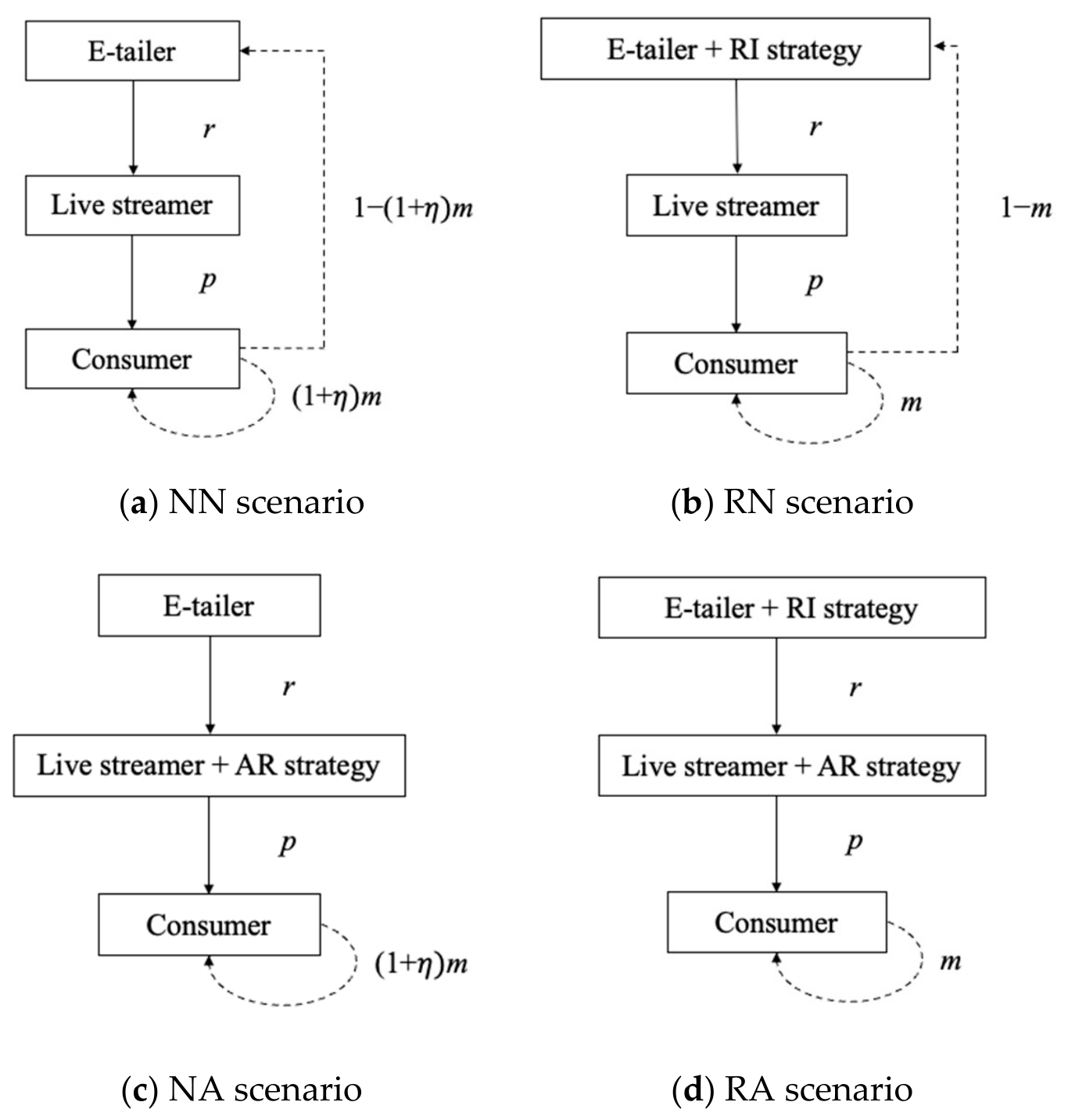
We assume that the e-tailer and streamer make decisions at the same time. The adoption of RI by the e-tailer or AR by the streamer is strategic and may cost a lot. The simultaneous move assumption avoids artificially granting a first mover advantage to either strategy and provides a more in-depth discussion. The simultaneous decisions generate four scenarios, as illustrated in Figure 1: {No RI, No AR}, denoted as NN; {RI, No AR}, denoted as RN; {No RI, AR}, denoted as NA; and {RI, AR}, denoted as RA. We use k = 1 to represent “adopting RI” and k = 0 to represent “not adopting RI.” Similarly, y = 1 represents “adopting AR,” and y = 0 represents “not adopting AR.”
(1)
Consumer
Following prior studies, we assume that the consumer’s perceived value for a product, denoted by v, is uniformly distributed between 0 and 1 [38]. The probability that a product matches a consumer’s expectations is m; 1 − m represents the probability that the product mismatches the consumer, in which case the consumer returns the product [11]. When consumers return the product, they incur a hassle cost (h). If the e-tailer offers RI, consumers obtain return compensation i (where ih) [39], effectively reducing their hassle cost to hi. Before making a purchase, consumers typically expend effort searching for product information. We assume that consumer search expands the breadth of product comparisons. Accordingly, consumer search effort, denoted by η (where 0 < η < 1 m m ), helps improve the product matching probability to ( 1 + η ) m . The associated effort cost incurred by consumers is 1 2 η 2 .
(2)
Live streamer
When the e-tailer cooperates with the live streamer in live-streaming sales, the e-tailer pays the live streamer a commission fee r for each sale [40]. The live streamer can enhance presales service by adopting AR technology. AR provides information depth about the specific product (e.g., virtual try-on). It enables consumers to visualize product attributes accurately and recognize potential mismatches before purchase. Consequently, consumers who recognize a mismatch do not purchase [41]. We assume that AR adoption reduces product return rates to zero and that the live streamer bears a quadratic AR cost, 1 2 θ 2 , where θ denotes the technology cost coefficient. In Section 6.2, we relax this assumption to allow partial misfit reduction.
(3)
E-tailer
The e-tailer must pay the insurance premium when adopting the RI strategy, denoted as f . The e-tailer’s unit handling cost for a returned product is denoted as s . To simplify the e-tailer’s profit function, both the product cost and the salvage value of the product are assumed to be zero, and both parameters enter profits additively and do not alter the relative profitability of RI and AR strategies.
When the e-tailer does not offer RI (k = 0), consumers typically expend effort to search ( η ) for product information before purchase, and the product matching probability and return rate are, respectively:
m 0 y = ( 1 + η ) m ,
1 m 0 y = 1 ( 1 + η ) m
RI has a dual effect. It boosts sales by alleviating return concerns. However, consistent with cognitive miser theory [8], individuals tend to minimize cognitive effort. By reducing the post-purchase cost of returns, RI encourages consumers to forgo effortful information search and adopt an impulse-buying pattern. To capture this trade-off, we model consumer search effort (η) as reducing to zero when RI is adopted. As a result, when the e-tailer adopts the RI strategy (k = 1), the product matching probability and return rate are, respectively:
m 1 y = m ,
1 m 1 y = 1 m

3.2. Modeling

The consumer’s expected utility from buying the product can be expressed as
U k y = m k y ( v p k y ) ( 1 y ) ( 1 m k y ) ( h k i ) 1 2 ( 1 k ) η 2
Let v ¯ denote the indifference point between purchasing and not purchasing the product. We then have v ¯ k y = p k y + ( 1 y ) ( 1 m k y ) ( h k i ) + 1 2 ( 1 k ) η 2 m k y . Thus, product demand is
D k y = 1 v ¯ k y
where
D N N = 1 p N N ( 1 m N N ) h + 1 2 η 2 m N N
D R N = 1 p A N ( 1 m R N ) ( h i ) m R N
D N A = 1 p N A 1 2 η 2 m N A
D R A = 1 p R A 1 m R A
The objective functions of the e-tailer and the live streamer are as follows:
π E = ( p k y r ) m k y D k y s ( 1 y ) ( 1 m k y ) D k y k f D k y ,
π H = r m k y D k y 1 2 y θ 2
Table 2 shows all notations.
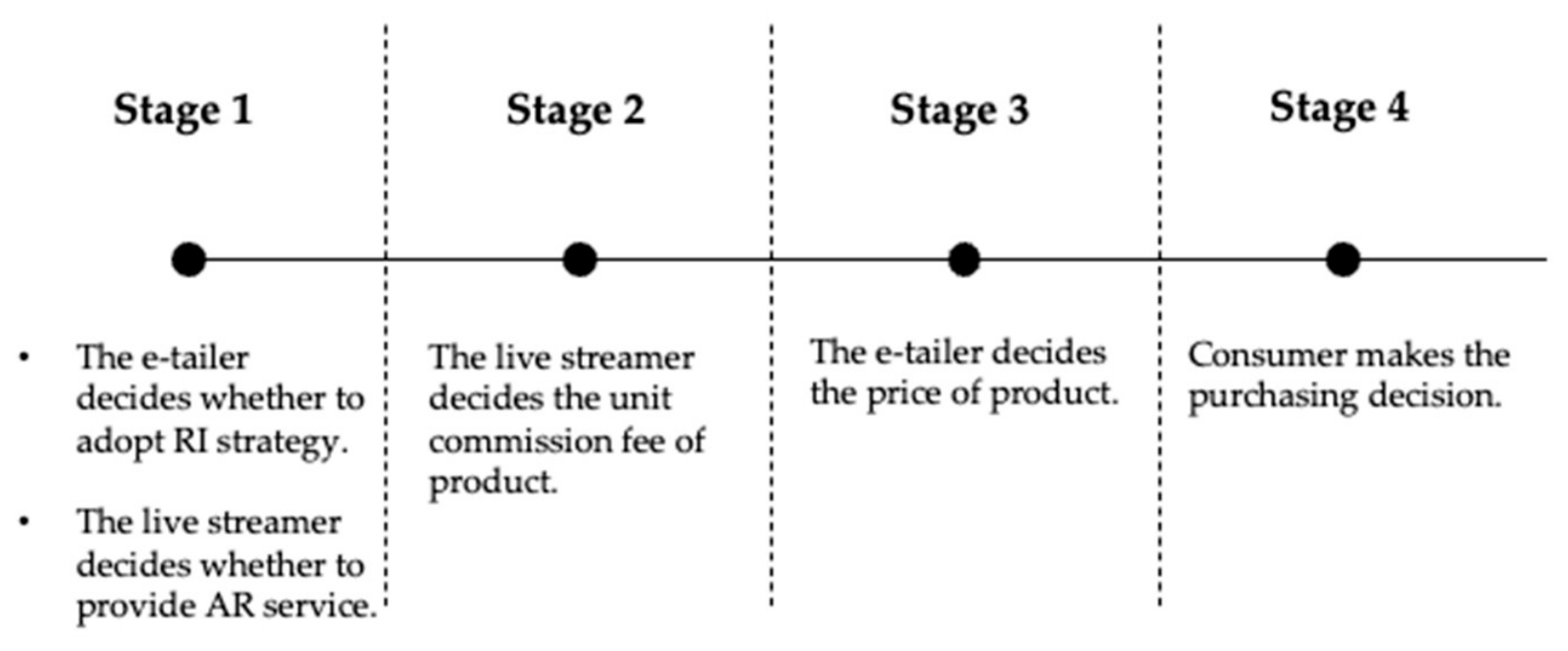
This study uses a sequential game-theoretic approach, shown in Figure 2.
Step 1: The e-tailer decides whether to adopt RI. Simultaneously, the live streamer decides whether to provide AR service.
Step 2: The live streamer decides the commission fee.
Step 3: The e-tailer decides the product price.
Step 4: Consumers decide whether to buy or not.

4. Modeling and Results

Based on the e-tailer’s RI decision (k = 1 or k = 0) and the live streamer’s AR decision ( y = 1 or y = 0), the profit functions of the e-tailer and the live streamer are provided in Section 3. Using backward induction, we derive the equilibrium results under the four scenarios in Lemma 1. Detailed derivations are provided in Appendix A.
Lemma 1.
The subgame equilibrium outcomes for each scenario are as follows:
(1) 
Case NN:
  • The optimal commission fee is  r N N * = 2 m 2 h 2 s + 2 η m + 2 h m + 2 m s η 2 + 2 η h m + 2 η m s 4 m + 4 η m , and the optimal price is  p N N * = 6 m 6 h + 2 s + 6 η m + 6 h m 2 m s 3 η 2 + 6 η h m 2 η m s 8 m η + 1 .
(2) 
Case RN:
  • The optimal commission fee is  r R N * = i + m + m s + h m s i m f h 2 m , and the optimal price is  p R N * = f 3 h + 3 i + 3 m s + 3 h m 3 i m + m s 4 m .
(3) 
Case NA:
  • The optimal price is  p N A * = 3 η 2 + 6 m η + 6 m 8 m η + 1 , and the optimal commission fee is  r N A * = η 2 + 2 m η + 2 m 4 m + 4 η m .
(4) 
Case RA:
  • The optimal commission fee is  r R A * = m f 2 m , and the optimal price is  p R A * = f + 3 m 4 m .
Proof. 
See Appendix A.1. □
Proposition 1.
The relationships between equilibrium solutions and the probability of product match (m) are as follows:
(i)  r N N * ,   r N A * ,   r R N * a n d   r R A *  are positively correlated with m. For  r R N * , when  f + h i s > 0 , it is positively correlated with m; otherwise,  r R N *  is negatively correlated with m.
(ii)  p N N *  is positively correlated with m when  6 h 2 s + 3 η 2 > 0 ; otherwise,  p N N *  is negatively correlated with m. When  s + 3 h 3 i f > 0 p R N *  is positively correlated with m; otherwise,  p R N *  is negatively correlated with m.  p N A *  is positively correlated with m, whereas  p R A *  is negatively correlated with m.
From Proposition 1(i), in the NN, NA, and RA scenarios, product demand and profits rise as m increases. The live streamer can share in this profit by increasing the commission fee. Therefore, r increases with m. In the RN scenario, however, the relationship between r and m depends on the e-tailer’s handling cost for a returned product (s). When  s < f + h i , an increase in m raises the marginal profit of products, allowing the live streamer to share the profit by increasing the commission fee. When s > f + h i , even if an increase in m reduces the return rate, the e-tailer still needs to control commission-fee costs carefully, limiting the live streamer’s ability to raise r.
From Proposition 1(ii), in the NN scenario, a higher m generally supports a higher price, but this effect can be offset when η2 > (6h − 2s)/3. A substantial consumer search cost depresses demand and forces the e-tailer to lower prices. In the RN scenario, RI stimulates purchase intention but reduces the matching probability (m). An increase in m may offset the disadvantage of RI and support a price increase. However, a high insurance premium ( f > s + 3 h 3 i ) depresses demand and offsets the upward pressure on price. In the NA scenario, AR eliminates returns. As m increases, demand rises without return risk, so the e-tailer has an incentive to increase the price to obtain higher profits. In the RA scenario, a strategic trade-off emerges. Although AR eliminates returns, the e-tailer bears a fixed insurance premium (f) per unit. The equilibrium price, p = f 4 m + 3 4 , decreases with m because the fixed cost (f) must be spread across demand. A higher m expands the potential consumer base, incentivizing the e-tailer to lower prices to attract more consumers and dilute the per-unit insurance burden. Thus, the benefit of higher m is passed to consumers through lower prices—a strategic choice distinct from the other scenarios, where higher m supports price increases.

5. Comprehensive Analysis

We analyze the strategic decisions of both players under the influence of consumer search effort. Section 5.1 examines the e-tailer’s RI adoption condition with and without AR. Section 5.2 examines the live streamer’s AR adoption condition with and without RI. Section 5.3 then integrates these analyses to characterize the equilibrium outcomes under strategic interplay.

5.1. The E-Tailer’s Optimal RI Decision

Lemma 2.
Conditions under which the e-tailer adopts RI with and without AR:
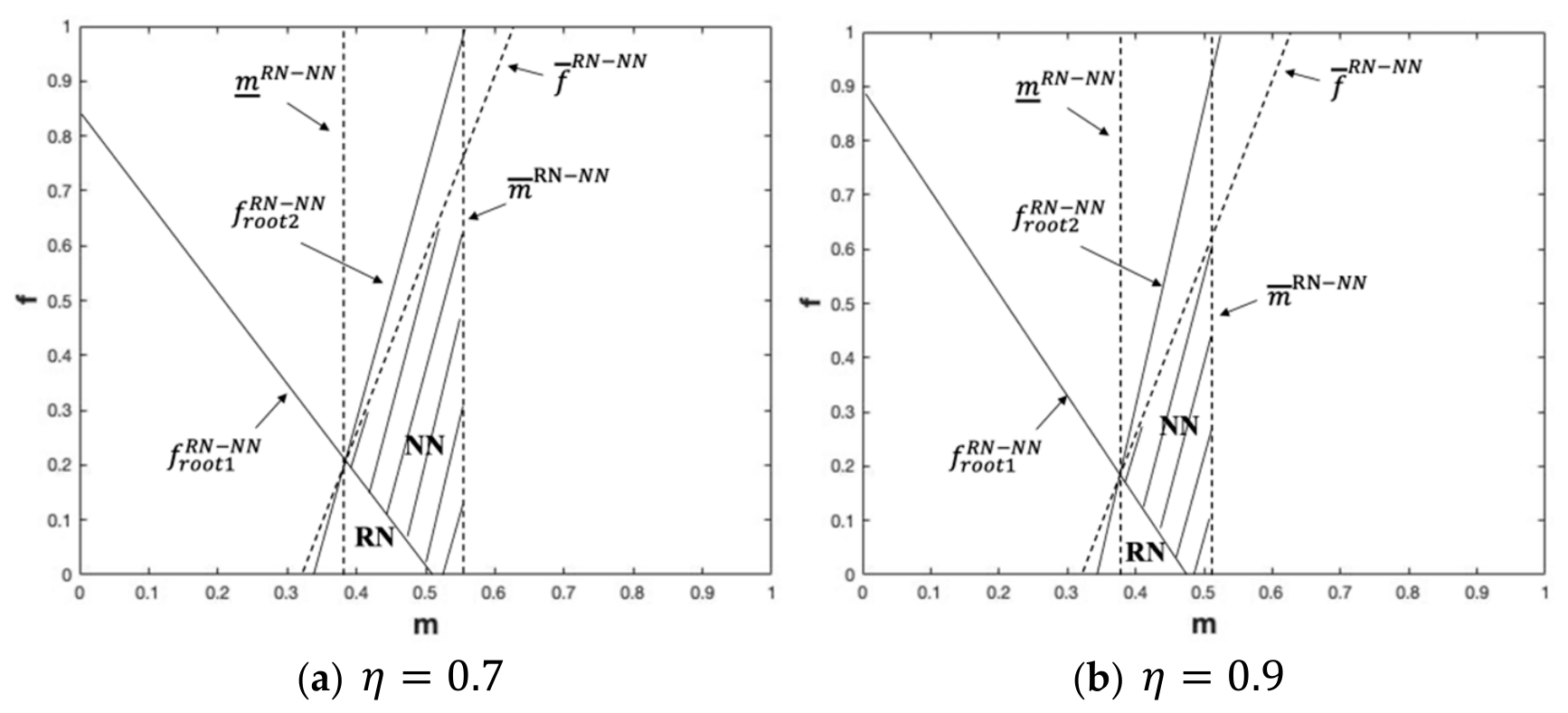
Without the live streamer’s AR strategy, when  f <   f ¯ R N N N  and  m _ R N N N < m < m ¯ R N N N , the e-tailer adopts the RI strategy if  f <   f r o o t 1 R N N N ; otherwise, the e-tailer does not adopt the RI strategy if  f r o o t 1 R N N N < f < f r o o t 2 R N N N .
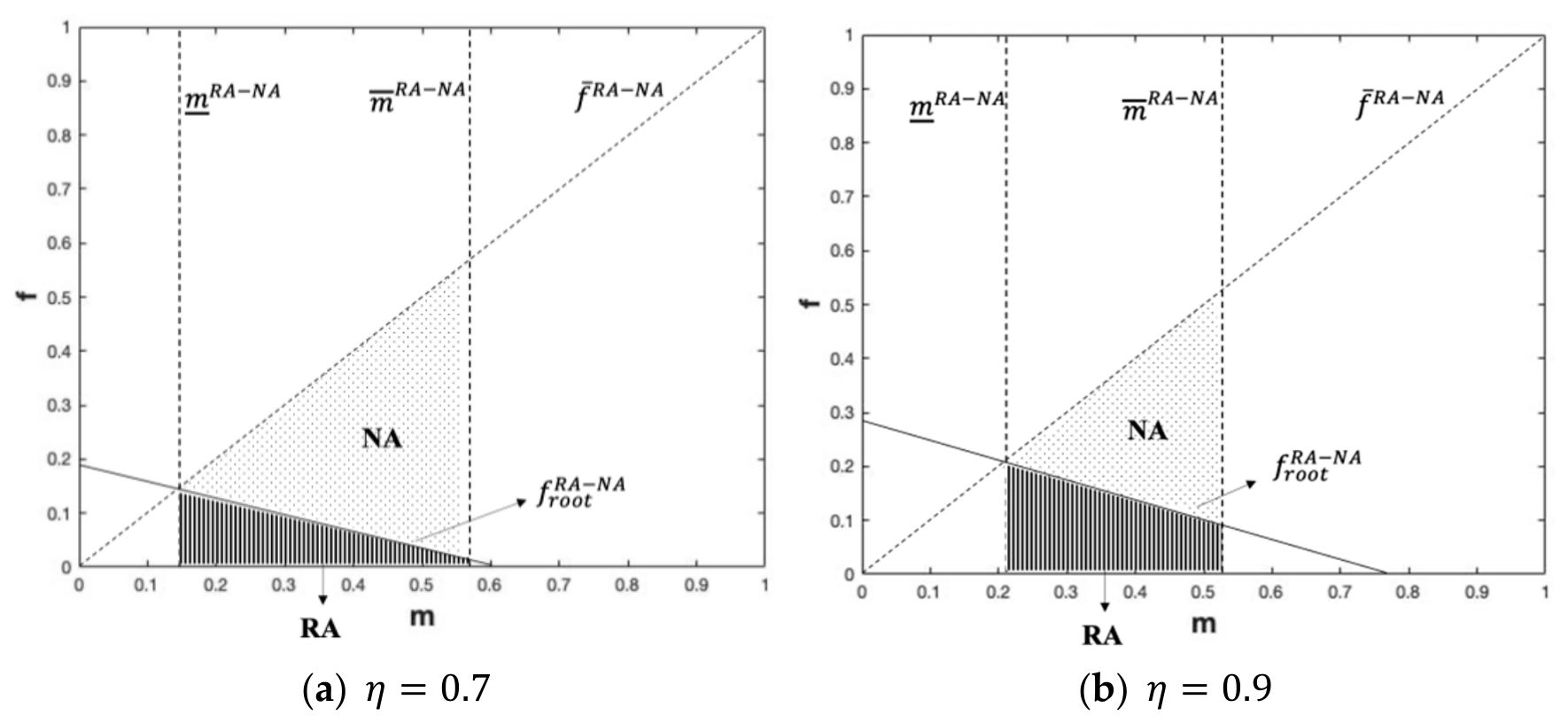
With the live streamer’s AR strategy, when  f < f ¯ R A N A  and  m _ R A N A < m < m ¯ R A N A , the e-tailer adopts the RI strategy if  f < f r o o t R A N A ; otherwise, the e-tailer does not adopt the RI strategy if  f > f r o o t R A N A .
Proof. 
See Appendix A.2. □
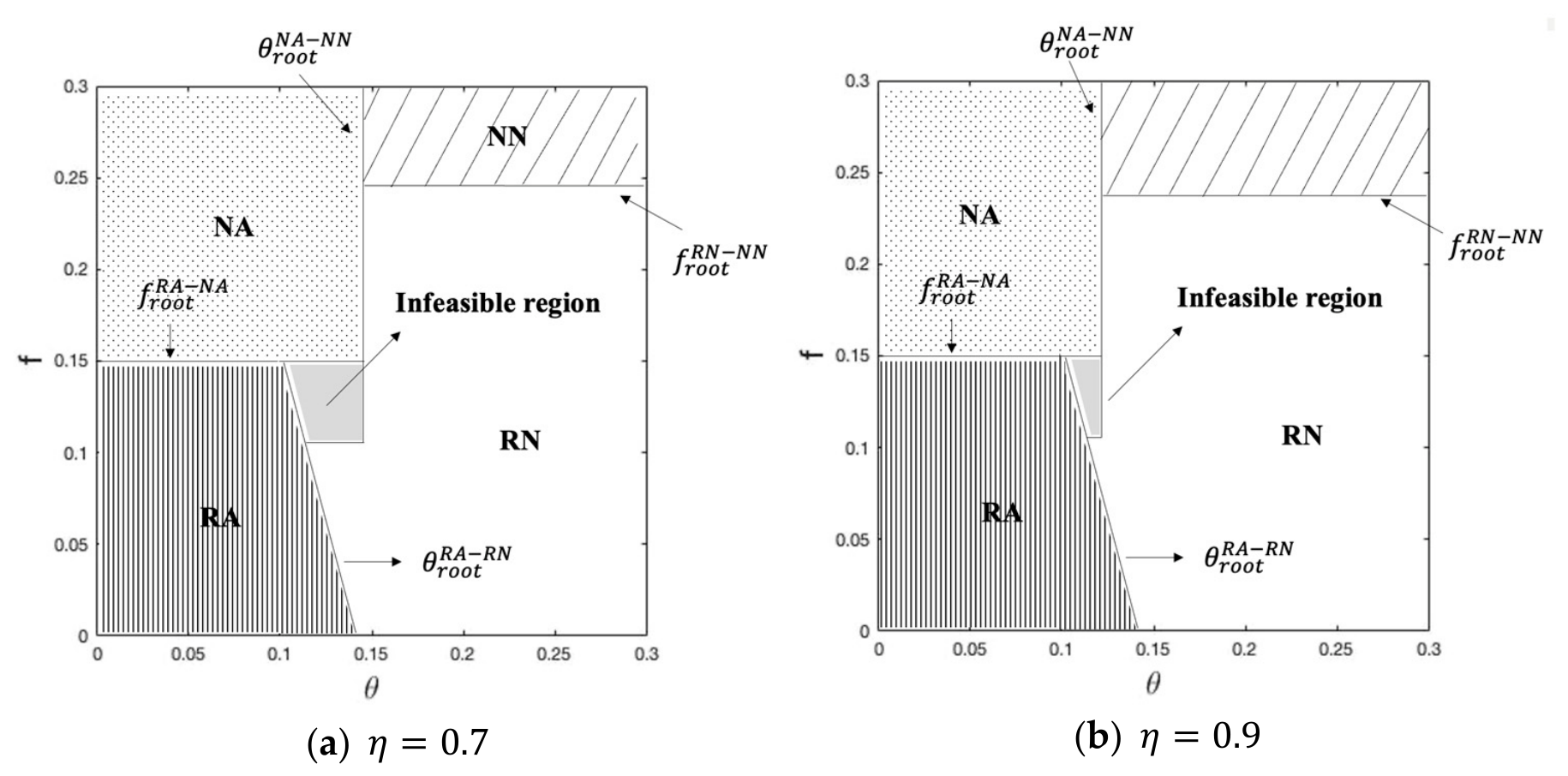
Lemma 2 outlines the conditions under which the e-tailer adopts RI. In the scenario without AR, to ensure positive demands ( D N N * > 0 , D R N * > 0 ) and 0 < ( 1 + η ) m < 1 , we need f < f ¯ R N N N and m _ R N N N < m < m ¯ R N N N . When the insurance premium (f) is low ( f < f r o o t 1 R N N N ), the e-tailer adopts RI; otherwise, the e-tailer opts out of RI, as illustrated in Figure 3a. A lower f reduces the cost pressure associated with RI adoption. RI increases purchase intention and sales volume by reducing consumers’ misfit concerns, thereby increasing the e-tailer’s profit. When f is high ( f > f r o o t 1 R N N N ), however, the cost of RI may exceed its sales-promotion benefit, reducing the e-tailer’s profit; therefore, the e-tailer prefers not to adopt RI.
In the scenario with AR, to ensure positive demands ( D N A * > 0 , D R A * > 0 ) and 0 < ( 1 + η ) m < 1 , we need f < f ¯ R A N A and m _ R A N A < m < m ¯ R A N A . The same conclusion applies when the live streamer adopts AR, so we do not repeat the explanation.
Proposition 2.
The impact of consumer search effort on the e-tailer’s RI adoption threshold:
(1) 
Without the live streamer’s AR strategy f r o o t 1 R N N N η > 0 ; the threshold for adopting RI ( f r o o t 1 R N N N ) that the e-tailer is willing to bear increases with consumer search effort.
(2) 
With the live streamer’s AR strategy f r o o t R A N A η > 0 ; the threshold for adopting RI ( f r o o t R A N A ) that the e-tailer is willing to bear increases with consumer search effort.
Proof. 
See Appendix A.3. □
Proposition 2 reveals that a higher consumer search effort η increases the RI premium threshold f r o o t 1 R N N N that the e-tailer is willing to bear (Figure 4a). That is, RI is more likely to be adopted when η is high. A higher search effort (η) means that consumers already incur substantial cognitive costs to evaluate products before purchase. In the absence of RI, the e-tailer’s profit is adversely affected in two ways: (1) consumers demand lower prices to compensate for their search costs, and (2) some consumers may abandon purchases when search costs exceed perceived benefits. RI removes these barriers. Therefore, the relative benefit of offering RI becomes larger when η is high, allowing the e-tailer to tolerate a higher insurance premium f. This logic holds regardless of AR adoption.
In practice, e-tailers selling product categories in which consumers typically invest high search effort (e.g., electronics and furniture with complex specifications) should be more willing to offer RI even at relatively high premium rates. In contrast, for low-search-effort categories (e.g., low-cost impulse purchases), RI is valuable only when premiums are very low.

5.2. The Live Streamer’s Optimal AR Decision

Lemma 3.
By comparing the live streamer’s profits with and without AR, the conditions under which the live streamer adopts AR are as follows:
(1) Without the e-tailer’s RI strategy, when  m a x ( m _ 1 N A N N ,   m _ 2 N A N N ) < m < m ¯ N A N N , the live streamer adopts AR if  θ < θ r o o t N A N N ; otherwise, the live streamer does not adopt AR if  θ > θ r o o t N A N N .
(2) With the e-tailer’s RI strategy, when  m > m a x ( m _ 1 R A R N ,   m _ 2 R A R N ,   m _ 3 R A R N ) , the live streamer adopts AR if  θ < θ r o o t R A R N ; otherwise, the live streamer does not adopt AR if  θ > θ r o o t R A R N .
Proof. 
See Appendix A.4. □
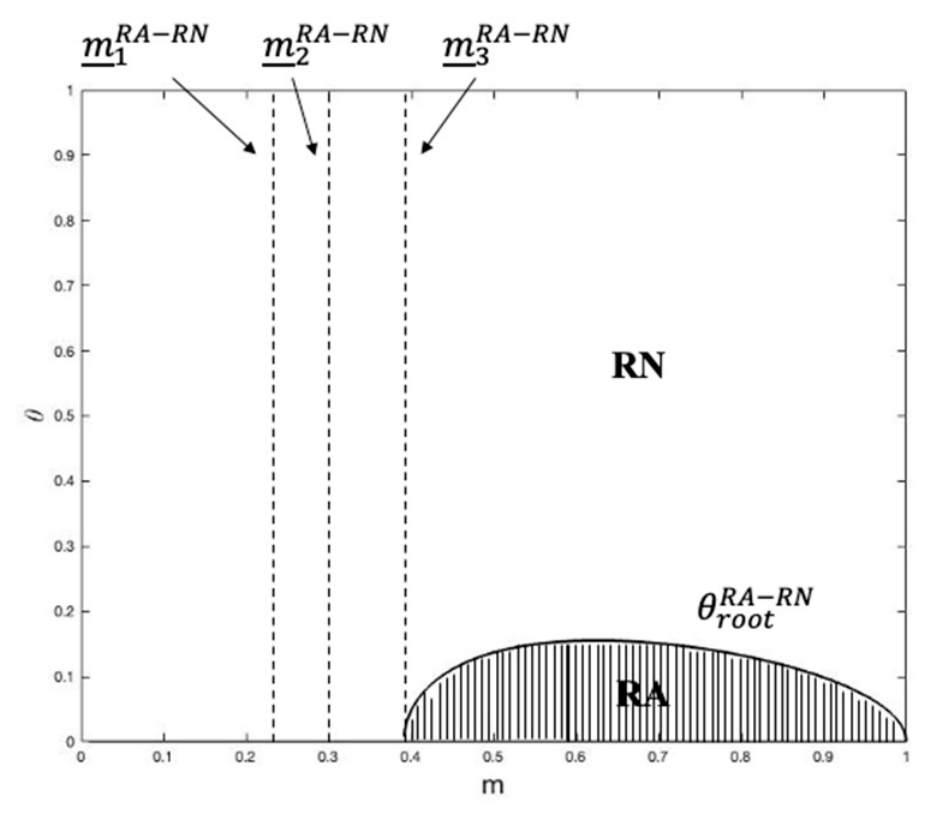
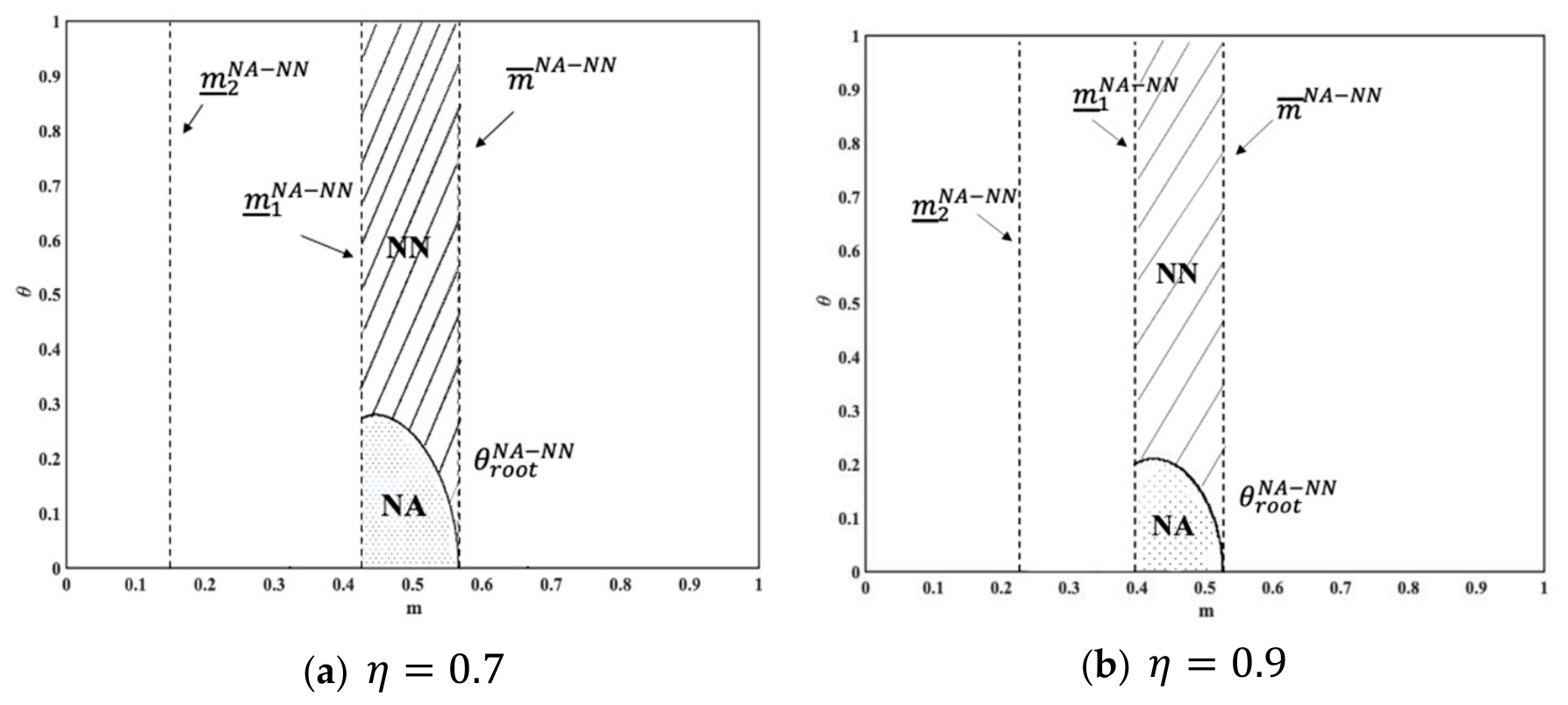
Lemma 3 outlines the conditions under which the live streamer adopts AR. In the scenario without RI, to ensure positive demands ( D N N * > 0 , D N A * > 0 ) and 0 < ( 1 + η ) m < 1 , we need ( m _ 1 N A N N , m _ 2 N A N N ) < m < m ¯ N A N N . When the AR cost coefficient is low ( θ < θ r o o t N A N N ), the live streamer adopts AR; otherwise, the live streamer does not adopt AR, as illustrated in Figure 5.
The same conclusion applies to the RN and RA scenarios. To ensure positive demands ( D R N * > 0 , D R A * > 0 ), we need m > m a x ( m _ 1 R A R N , m _ 2 R A R N ) . When the AR cost coefficient is low ( θ < θ r o o t R A R N ), the live streamer adopts AR; otherwise, the live streamer does not adopt AR. To ensure θ r o o t R A R N > 0 , we have m > m _ 3 R A R N .
Proposition 3.
The impact of consumer search effort on the live streamer’s AR adoption threshold:
(1) Without the e-tailer’s RI strategy,  θ r o o t N A N N η < 0 ; the threshold for adopting AR ( θ r o o t N A N N ) that the live streamer is willing to bear decreases as consumer search effort increases.
(2) With the e-tailer’s RI strategy, the AR adoption threshold that the live streamer is willing to bear is not affected by consumer search effort.
Proof. 
See Appendix A.5. □
Proposition 3 reveals that when RI is absent, the live streamer’s technology-cost threshold θ r o o t N A N N for adopting AR decreases as consumer search effort η increases. However, when RI is present, this threshold is independent of η (Figure 6). A higher search effort ( η ) means that consumers already acquire substantial product information through their own costly pre-purchase search. In the absence of RI, consumers bear the full cost of mismatch avoidance. AR provides additional information, but its marginal returns diminish. As η increases, consumers’ own search becomes more effective, so the incremental value of AR decreases. Consequently, the live streamer’s willingness to pay for AR—captured by the maximum affordable technology cost θ r o o t —falls. When RI is present, however, the cognitive miser effect eliminates consumer search entirely. AR then becomes the primary source of pre-purchase fit information, and its value no longer depends on how much consumers would otherwise have searched. Hence, θ r o o t remains constant with respect to η .
In practice, live streamers selling high-search-effort categories without RI should adopt AR only if the technology is inexpensive. For example, personal shopping agents provide one-to-one customized purchasing services. They do not offer return insurance and may even require that purchases cannot be returned after delivery. Therefore, consumers typically search for information carefully before purchasing and then decide whether to place an order. Personal shopping agents often film the purchasing process at very low cost and use AR technology to render videos for promotion.

5.3. Equilibrium Under the Interplay Between RI and AR

Based on the interplay between RI and AR strategies, we obtain the final equilibrium (Proposition 4) and summarize its characteristics in Propositions 5 and 6.
Proposition 4.
The equilibrium outcomes of the e-tailer and the live streamer under the interplay of RI and AR strategies are as follows:
(1) 
The equilibrium is NN if  f > f r o o t R N N N  and  θ > θ r o o t N A N N .
(2) 
The equilibrium is RN if 0 <  f < f r o o t R N N N  and  θ > m a x ( θ r o o t N A N N ,   θ r o o t R A R N ) .
(3) 
The equilibrium is NA if  f > f r o o t R A N A  and  θ < θ r o o t N A N N .
(4) 
The equilibrium is RA if: (a)  0 < f < f r o o t R A N A  and  θ < θ r o o t N A N N ; (b)  0 < f <   f r o o t R N N N  and  θ r o o t N A N N < θ < θ r o o t R A R N .
From Proposition 4, we derive the following conclusions. First, regardless of whether AR is adopted, the e-tailer prefers to adopt RI when the insurance premium is relatively low and not to adopt RI when the premium is relatively high. Second, regardless of whether RI is adopted, the live streamer prefers to adopt AR when the technology cost is relatively low and not to adopt AR when the cost is relatively high. These results are consistent with Lemmas 2 and 3.
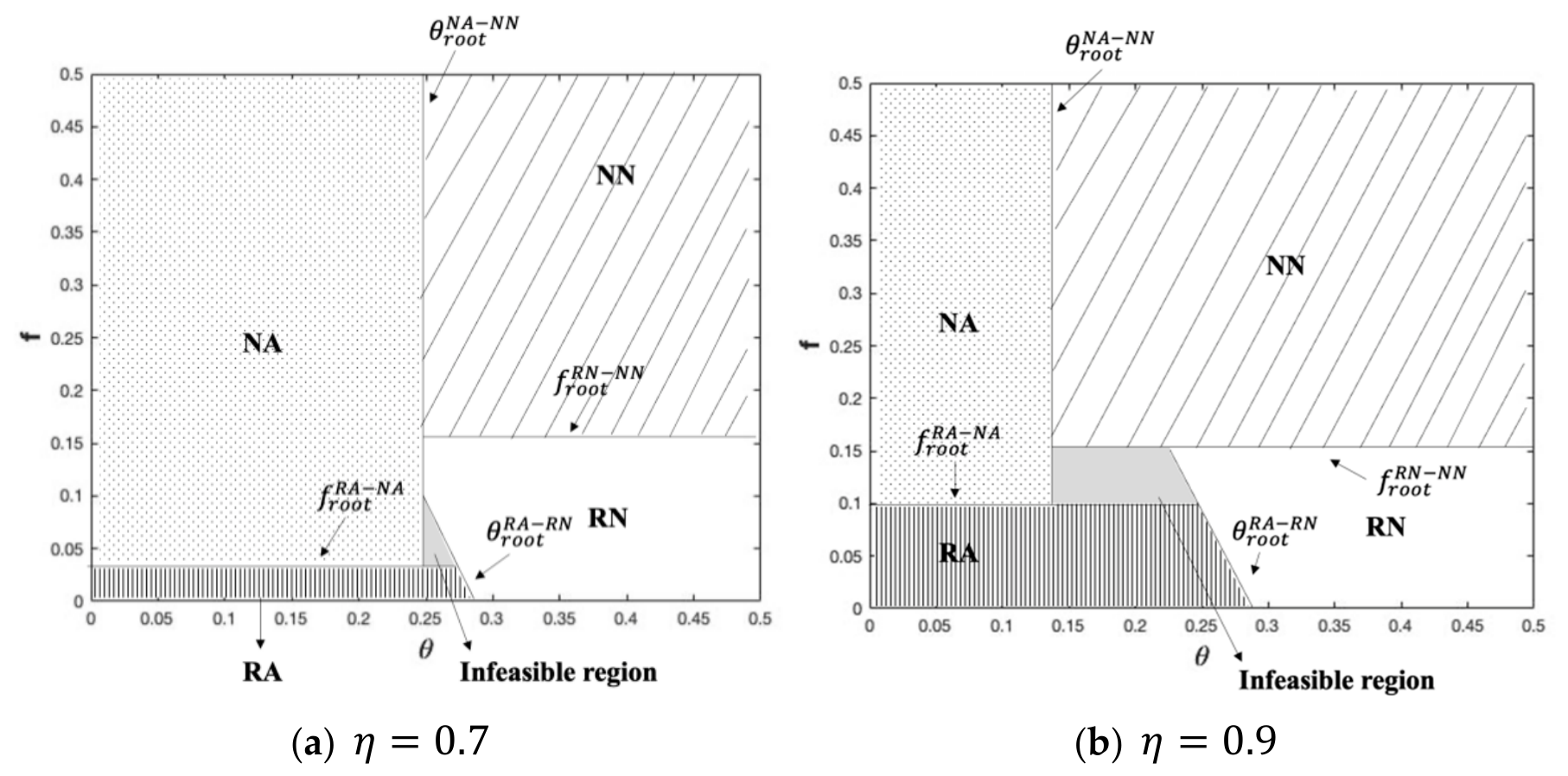
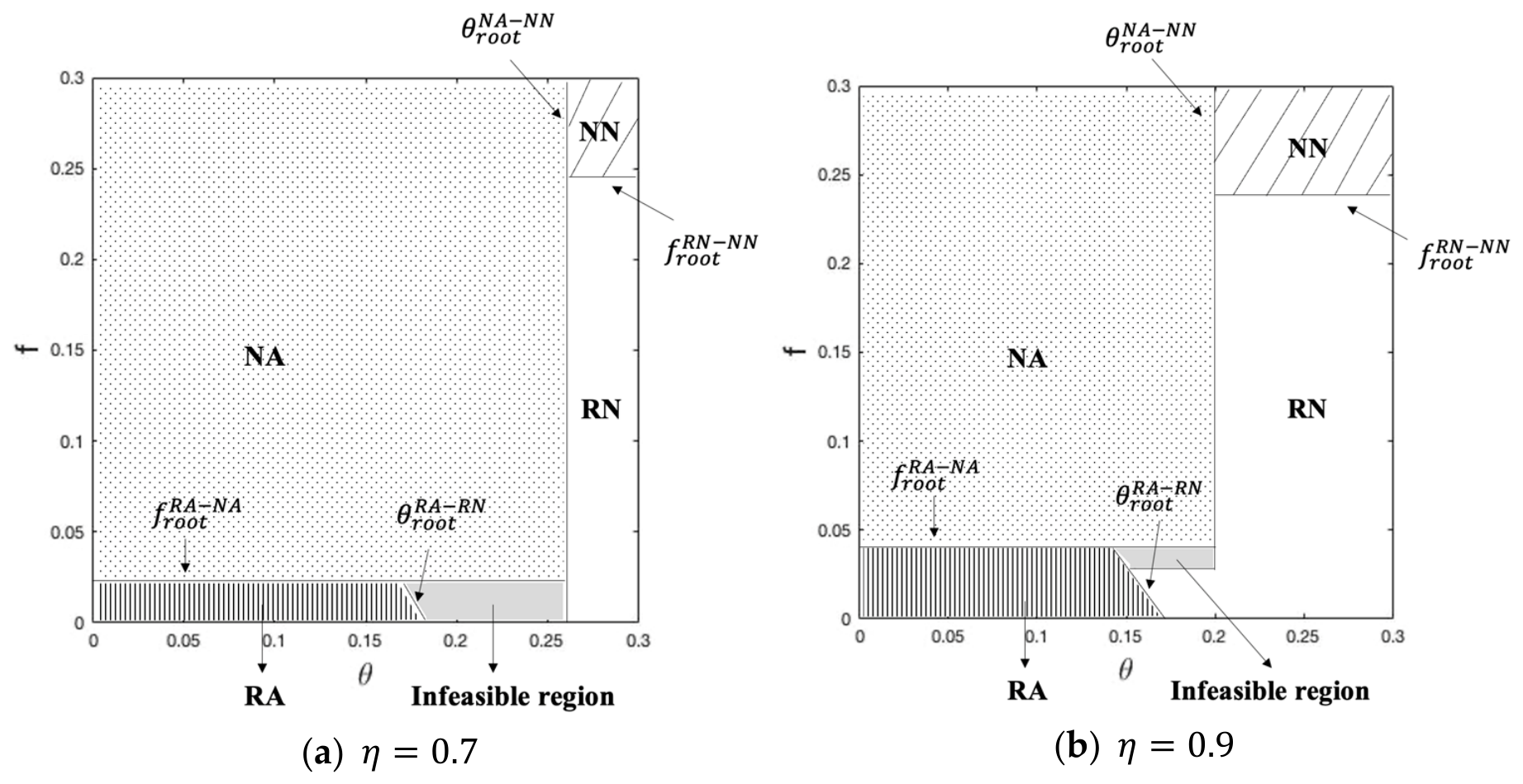
Figure 7 provides a numerical illustration of the equilibrium decisions based on Proposition 4 under the parameter setting m = 0.4, h = 0.5, i = 0.4, and s = 0.2. According to the Report on Data of China E-commerce Platforms during Double 11 in 2024, the return rate is typically 50–60%. Therefore, the product return rate is set to 0.6, and the product match is set to 0.4.
Proposition 5.
Consumer search effort (η) transforms the strategic interplay between the e-tailer’s RI strategy and the live streamer’s AR strategy:
(1) When consumer search effort is low, the RI and AR function as strategic substitutes; that is, the adoption of one strategy suppresses the other.
(2) When consumer search effort is high, the RI and AR function as strategic complements; that is, the adoption of one strategy fosters the other.
Proposition 5 provides insights into how consumer search effort influences strategic interplay. Figure 7 visually illustrates Proposition 5.
In Figure 7a, by comparing the sizes and proportions of the regions representing different strategies, we obtain R A R A + N A < R N R N + N N . This means that when the streamer adopts AR, the probability that the e-tailer adopts RI is lower than when the streamer does not adopt AR. Meanwhile, R A R A + R N < N A N A + N N also holds, meaning that when the e-tailer adopts RI, the probability that the streamer adopts AR is lower than when the e-tailer does not adopt RI. Hence, when η is small, adoption of one strategy suppresses adoption of the other. In Figure 7b, we have R A R A + N A > R N R N + N N and R A R A + R N > N A N A + N N . Therefore, when η is large, adoption of one strategy fosters adoption of the other. This pattern is consistent with information overload theory, which suggests that the marginal return on consumer search effort in live-streaming e-commerce decreases as effort increases.
When η is small, consumers invest limited effort in comparing products; instead, they rely on peripheral cues such as streamer recommendations and intuitive visual information. In this case, the information overload effect has not yet materialized. Consumers mainly face the return cost arising from post-purchase dissatisfaction. Both RI and AR can reduce this cost. Therefore, the two strategies form a substitute relationship. For example, in apparel retail, especially women’s clothing, consumers typically exert low search effort and adopt a “try-and-return” mentality. In response, fast-fashion giants such as ZARA and SHEIN have heavily invested in AR virtual try-on technology for live-streaming channels. At the same time, sellers have imposed stricter conditions for offering RI. Taobao launched a “High Refund Rate Consumer Shielding” feature, and Alibaba’s 88VIP program capped annual return-shipping subsidies. Conversely, some e-tailers that are willing to offer RI are reluctant to invest further in AR technology for live-streaming channels. For example, sellers of traditionally crafted handicrafts are often individual operators who lack the capacity to scale AR investments; however, their low product recovery and resale costs make RI provision more attractive. These practices show that at lower η , AR and RI act as strategic substitutes, consistent with Proposition 5(1).
When η is large, consumers exert substantial effort in comparing products. At this point, the information overload effect gradually dominates. Consumers incur high information-processing costs ( 1 2 η 2 ), but the improvement in match probability approaches saturation. Through the cognitive miser mechanism, RI eliminates the need for consumers to engage in excessive pre-purchase search, thereby reducing the negative impact of information overload. Nevertheless, consumers still want better-matched products. AR replaces active consumer search by providing an immersive product experience and product information at a lower cost. In this case, RI and AR form a complementary relationship. For products such as electronics and home appliances, consumers must invest significant search effort by comparing specifications, reading reviews, and evaluating prices and after-sales service. JD.com launched the “Worry-Free Buy PLUS” return service while also vigorously promoting AR/VR technology to assist shopping. Digital products can be examined in 3D, and furniture and appliances can be placed virtually via AR. This example aligns with the complementary relationship in Proposition 5(2).
This finding departs from existing studies that treat consumer search behavior as exogenously given and implicitly assume that RI and AR operate independently [3,35]. We show that the strategic relationship between RI and AR is not fixed but shifts from substitutes to complements as consumer search effort varies. Building on the above results, we further discuss the practical implications. Firms can infer consumer search effort from behavioral metrics such as average product-page dwell time, specification-tab click-through depth, and pre-purchase Q&A interaction rates. High-η categories (e.g., electronics and furniture) should adopt both RI and AR to exploit complementarity, whereas low-η categories (e.g., fast fashion and beauty) need only one strategy: RI if return logistics are inexpensive, and AR if visual try-on is effective.
Proposition 6.
As consumer search effort increases, the probabilities of the NN, RN, and RA equilibria increase, whereas the probability of the NA equilibrium decreases.
Proposition 6 follows directly from the asymmetric effects of η on the adoption thresholds established in Propositions 2 and 3, combined with the shift from substitution to complementarity in Proposition 5.
Figure 7 illustrates that the scope of NA decreases as η increases. This follows directly from Propositions 2 and 3: the threshold for adopting RI that the e-tailer is willing to bear increases with η ( f r o o t R A N A η > 0 ), whereas the threshold for adopting AR that the live streamer is willing to bear decreases with η ( θ r o o t N A N N η < 0 ). Therefore, as η increases, the probability that NA becomes the equilibrium decreases, while the probability of RN increases. In the RA scenario, the threshold for adopting RI that the e-tailer is willing to bear increases with η . At the same time, according to Proposition 5, when η is high, RI and AR function as strategic complements. Therefore, η increases the probability of RA. In the NN scenario, because neither RI nor AR is provided, the outcome depends entirely on consumer search effort to reduce product misfit. Therefore, an increase in η can directly improve the competitiveness of NN.
Intuitively, a higher η might allow consumers to benefit more from search, thereby crowding out both RI and AR and causing only the NN region to expand. However, our model shows that the probabilities of NN, RN, and RA all increase, while the probability of NA decreases. This asymmetric result departs from traditional service-management adoption logic. Conventional service-management models typically treat services as variables determined independently by retailers. In contrast, our model treats the e-tailer’s RI and the streamer’s AR as a strategically coupled bundle. Proposition 6 shows that changes in η reconfigure the optimal service-strategy portfolio, moving beyond single-strategy research boundaries and revealing how service combinations evolve dynamically with market conditions.
These results have several managerial implications for e-commerce supply chains. When η is low, sellers prefer to adopt only one of the two strategies (RI or AR). However, when η increases over time—for example, when consumers spend more time asking customer-service questions or raise more professional inquiries about product details—sellers should dynamically adjust their strategy portfolios. If the initial strategy is AR-only (NA), then as η rises, sellers should increase the use of RI to cope with growing consumer search behavior and should phase out the AR-only strategy. This is because the threshold for adopting RI rises with higher η , while the threshold for adopting AR without RI falls. Once η exceeds a certain level, RI and AR shift from substitutes to complements, and sellers should adopt the combined RA strategy. This dynamic path, NA → RN → RA, is efficient. Alternatively, sellers may keep the strategy portfolio unchanged but actively guide consumer search behavior. For instance, if the initial strategy is RI-only (RN), sellers can encourage consumers to invest more search effort, thereby raising the RI adoption threshold. Ways to reduce search costs include integrating specification comparison tables, user-review summaries, and AI-powered Q&A tools on the live-streaming page to shorten information-acquisition time.

6. Extensions

6.1. The Role of Consumer Heterogeneity

In the baseline model, RI induces irrational consumer behavior through the cognitive miser mechanism and eliminates pre-purchase search for all consumers. In this subsection, we relax this assumption and consider a market consisting of two consumer types: rational consumers (proportion λ) and non-rational consumers (proportion 1 − λ). Unlike the baseline setup, when RI is offered, rational consumers remain cautious and continue to search for product information before making a purchase. Their utility function is given by:
U λ = m 0 y v p 1 y 1 m 0 y h i 1 2 η 2 ,   y = 0.1
Similar to the baseline assumption, when RI is offered by the seller, non-rational consumers engage in impulsive purchasing. Their utility function is given by:
U λ ¯ = m 1 y ( v p ) ( 1 l ) ( 1 m 1 y ) ( h i )
Given the computational complexity, we conduct a numerical study to analyze the results (setting m = 0.4 , h = 0.5 , i = 0.4 , s = 0.2 , λ = 0.3 ).
From Figure 8, we observe that RI and AR act as substitutes when η is small and as complements when η is large. Moreover, as η increases, the equilibrium probabilities of NN, RN, and RA increase, while that of NA decreases. This confirms the robustness of the baseline results. Furthermore, when return insurance is offered, the live streamer’s threshold for adopting augmented reality, denoted θ r o o t R A R N , decreases in η . In the baseline model, θ r o o t R A R N is independent of search effort η (Proposition 3(ii)). In Section 6.1, as η increases, rational consumers continue to invest search effort even under RI, thereby reducing the value of AR as an information source. Consequently, the maximum technology cost that makes AR profitable falls.

6.2. AR with Partial Misfit Reduction

In the baseline model, we assume that AR fully reveals product match or mismatch. In this section, we relax this assumption and consider that AR reduces the probability of product misfit by enhancing product-information disclosure, captured by a decrease coefficient, δ [11]. This means that δ ( 1 m ) of consumers become aware of the mismatch and forgo the purchase, whereas ( 1 δ ) ( 1 m ) of consumers purchase a mismatched product and return it later. Thus, when AR is adopted, the consumer’s utility function is given by:
U k 1 = m k 1 v p k 1 1 δ 1 m k 1 h k i 1 2 1 k η 2 , k = 0.1
The profit functions of the e-tailer and the live streamer are as follows:
π E = ( p k 1 r ) m k 1 D k 1 s ( 1 δ ) ( 1 m k 1 ) D k 1 k f D k 1
π H = r m k 1 D k 1 1 2 θ 2
Considering the computational complexity, we also conduct a numerical study to analyze the results (setting m = 0.4 , h = 0.5 , i = 0.4 , s = 0.2 , δ = 0.5 ). From Figure 9, we observe that RI and AR act as substitutes when η is small and as complements when η is large. Moreover, as η increases, the probabilities of the NN, RN, and RA equilibria increase, whereas the probability of NA decreases. This confirms the robustness of the baseline model results.

7. Conclusions

This study develops a game-theoretic model consisting of an e-tailer and a live streamer to investigate the interplay between the e-tailer’s RI decision and the live streamer’s AR decision while considering consumer search effort. We analyze four scenarios: {No RI, No AR}, {RI, No AR}, {No RI, AR}, and {RI, AR}. Using game theory and numerical analysis, we derive several notable conclusions and managerial insights. Our research provides guidance for RI and AR strategy decisions under consumer search effort. The findings enrich the literature on return management in live-streaming commerce and offer valuable managerial insights.

7.1. Discussion

The main conclusions and managerial insights derived from our study are as follows:
First, conditional on the counterpart’s strategy, consumer search effort exerts asymmetric effects on adoption thresholds. For the e-tailer’s RI strategy, whether or not the live streamer adopts AR, the RI adoption threshold that the e-tailer is willing to bear increases with consumer search effort. For the live streamer’s AR strategy, without the e-tailer’s RI strategy, the AR adoption threshold that the live streamer is willing to bear decreases with consumer search effort. With the e-tailer’s RI strategy, the AR adoption threshold is not affected by consumer search effort. However, after the extended model (Section 6.1) considers the coexistence of rational and non-rational consumers in the market, we find that higher search effort still reduces the streamer’s willingness to pay for AR even when return insurance is offered. These findings indicate that consumer search effort is not an exogenous parameter but fundamentally shapes the adoption feasibility of each strategy.
Second, consumer search effort transforms the strategic interplay between the e-tailer’s RI strategy and the live streamer’s AR strategy. When consumer search effort is low, RI and AR function as substitutes; that is, adopting one strategy suppresses the other. When consumer search effort is high, RI and AR function as complements; that is, adopting one strategy fosters the other. This substitution-to-complement transition is the central insight of our study.
Finally, as consumer search effort increases, the probabilities of the {No RI, No AR}, {RI, No AR}, and {RI, AR} equilibria increase, while the probability of the {No RI, AR} equilibrium decreases. This trend reflects the changing relative attractiveness of each strategy combination as consumers become more active in pre-purchase search.
This study not only answers the research questions raised in the Introduction Section but also provides a clear foundation for the subsequent theoretical and practical implications.

7.2. Theoretical Implications

This study makes systematic theoretical advances within a game-theoretic framework, integrating domain-specific theories from live-streaming e-commerce and consumer behavior. Game theory provides the foundational logic for analyzing strategic interactions among multiple decision-makers who pursue their own payoff maximization. Within this framework, we draw on service management theory, cognitive miser theory, and consumer heterogeneity to clarify the strategic interplay between RI and AR by considering consumer search effort.
First, service management theory emphasizes that the value of a service strategy depends on the interactions among multiple agents [33]. However, prior e-commerce research has largely treated RI and AR as independent decisions, overlooking their strategic interdependence [21,24]. By embedding both strategies into a game-theoretic framework and integrating them into a unified service portfolio, we show that the optimal strategy mix depends on consumer search effort: RI and AR act as substitutes when search effort is low, but become complements when search effort is high. This finding extends service management theory in the context of live-streaming commerce from “unilateral service decisions” to “multi-party strategic coupling”, thereby filling a long-overlooked gap in return management—namely, the interdependence between return service strategies and live-streaming service strategies.
Second, drawing on cognitive miser theory, we reshape the mechanism through which RI affects consumer behavior in the return-management game. This theory was originally developed to explain how consumers rely on low-cost information and make impulsive decisions when search costs are reduced [8]. We extend the theory to the return insurance context and demonstrate that RI, by lowering the cost of product mismatch, leads consumers to abandon costly pre-purchase search and adopt a “buy-and-try” pattern. This not only uncovers the critical moderating role of consumer search effort but also goes beyond the conventional view that RI merely reduces return costs. It provides a consumer-behavior explanation for the finding that the interplay between RI and AR depends on consumer behavior.
Third, based on consumer heterogeneity theory, we extend the baseline game-theoretic model (Section 3) beyond its original boundaries. Prior studies typically assume homogeneous consumer responses to RI [3]. In contrast, we distinguish between rational and non-rational consumers according to their different responses to RI (Section 6.1). We find that the presence of rational consumers weakens the cognitive miser effect and thereby moderates the intensity of the strategic interplay between RI and AR. This refinement enables the game-theoretic model to more realistically capture the diversity of consumer composition in actual markets.
In summary, adopting game theory as the overarching framework and incorporating complementary perspectives from service management theory, cognitive miser theory, and consumer heterogeneity, this study extends the scope of game theory in live-streaming e-commerce to the domain of consumer search behavior and multi-party strategic coupling. Our findings fill a critical gap in the return-management literature concerning the coupling of service strategies and reveal how consumer search effort reshapes the optimal service portfolio in live-streaming commerce.

7.3. Practical Implications

Based on the above findings, we derive several actionable insights for e-commerce practitioners. First, consistent with the model’s core result, consumer search effort fundamentally changes the strategic relationship between RI and AR. E-commerce supply chains can quantify search effort using three observable metrics: average product-page dwell time, specification-tab click-through depth, and pre-purchase Q&A interaction frequency. These metrics are readily available from standard seller dashboards (e.g., Douyin and Taobao Live). Second, strategy portfolios can be tailored by market segment. For low-search-effort categories (e.g., fast fashion, beauty, and accessories), RI and AR are strategic substitutes, so sellers should choose only one. If the unit return handling cost is below the insurance premium threshold, sellers should adopt RI; if the AR technology cost coefficient is below its threshold, they should adopt AR. For example, beauty live-streaming benefits more from AR virtual try-on, which directly addresses color-matching uncertainty, whereas offering RI adds limited value because consumers in low-effort environments are less inclined to search beforehand. Conversely, for high-search-effort categories (e.g., electronics, furniture, and high-value durables), RI and AR are strategic complements. The optimal strategy is to offer both simultaneously. Finally, as consumer search effort rises, sellers should proactively adapt their strategy portfolios. In emerging markets where search effort is low, sellers can parallel-test AR-only and RI-only strategies and retain the more profitable one. In growth markets where consumers increasingly search for information, sellers may switch strategies depending on the costs of adopting RI and AR. In mature markets where products are widely used and consumers demand detailed pre-purchase information, managers should adopt both RI and AR.
This study not only establishes a novel multi-party strategic-coupling framework in theory but also provides actionable guidance for e-commerce platforms seeking to optimize service configurations in live-selling scenarios. By implementing the above recommendations, e-tailers and live streamers can avoid wasteful dual investments in low-search-effort segments and capture synergistic gains in high-search-effort segments, thereby improving the return on investment in return insurance and augmented reality technologies.

7.4. Limitations and Future Research

This study has several limitations that suggest directions for future research. First, platforms often act as rule setters that influence both e-tailers’ and streamers’ strategic choices. Moreover, dynamic competition among platforms—such as competing commission caps, subsidy policies, or mandatory return insurance requirements—could be modeled as an additional layer of decision-making, extending our single-platform analysis to a multi-platform competitive setting. Second, our model primarily focuses on operational decisions within a live-streaming channel. In practice, e-tailers often operate multiple channels. Consumer experiences and return behaviors in live-streaming may spill over to offline channels, affecting brand image and sales. Future research could examine cross-channel spillover effects in a multichannel framework. Moreover, we focus on a supply chain consisting of an e-tailer and a live streamer, whereas real markets feature multiple competing e-tailers and streamers. Future research could extend the model to a competitive setting and examine how the strategic interaction between RI and AR changes in platform-based ecosystems with multiple agents. Finally, our study develops a game-theoretic model and derives equilibrium results under theoretically grounded assumptions. However, the model remains purely analytical without empirical testing. Future research could apply structural equation modeling or econometric analyses to test the causal relationships proposed in our model.

Author Contributions

Conceptualization, methodology, software, validation, formal analysis, investigation, data curation, writing—original draft preparation, and visualization, K.D.; validation, writing—review and editing, K.D. and T.Y.; resources, supervision, project administration, and funding acquisition, T.Y. All authors have read and agreed to the published version of the manuscript.

Funding

This research received no external funding.

Institutional Review Board Statement

Not applicable.

Informed Consent Statement

Not applicable.

Data Availability Statement

The original contributions presented in this study are included in the article. Further inquiries can be directed to the corresponding author.

Acknowledgments

The authors express their gratitude to the anonymous reviewers for their valuable suggestions and comments on improving this manuscript.

Conflicts of Interest

The authors declare no conflicts of interest.

Abbreviations

The following abbreviations are used in this manuscript:
RIReturn Insurance
ARAugmented Reality

Appendix A

Appendix A.1. Proofs of Lemma 1

In the NN model, we have
D N N = 1 p N N ( 1 m N N ) h + 1 2 η 2 m N N
π E N N = ( p N N r ) ( 1 + η ) m D N N s ( 1 ( 1 + η ) m ) D N N
π H N N = r ( 1 + η ) m D N N
The optimal price p N N depends on the given commission fee r and can be expressed as p N N ( r ) . Then, the live streamer determines the commission fee r to maximize its profit. By substituting p N N ( r ) into π H N N , we obtain the optimal commission fee r N N * = 2 m 2 h 2 s + 2 η m + 2 h m + 2 m s η 2 + 2 η h m + 2 η m s 4 m + 4 η m . By substituting r N N * into p N N ( r ) , we obtain:
p N N * = 6 m 6 h + 2 s + 6 η m + 6 h m 2 m s 3 η 2 + 6 η h m 2 η m s 8 m η + 1
Then, by substituting r N N * and p N N ( r ) into the demand function and the e-tailer’s and live streamer’s profit functions, we obtain:
D N N * = 2 m 2 h 2 s + 2 η m + 2 h m + 2 m s η 2 + 2 η h m + 2 η m s 8 m η + 1
π E N N * = 2 m 2 h 2 s + 2 η m + 2 h m + 2 m s η 2 + 2 η h m + 2 η m s 2 64 m η + 1
π H N N * = 2 m 2 h 2 s + 2 η m + 2 h m + 2 m s η 2 + 2 η h m + 2 η m s                             * m h s + η m + h m + m s η 2 2 + η h m + η m s 16 m η + 1
Similar to the NN model, we obtain the outcomes for the RN, NA, and RA scenarios, which are summarized in Table A1.
Table A1. Subgame equilibrium outcomes.
ScenariosOutcomes
NN r N N * = 2 m 2 h 2 s + 2 η m + 2 h m + 2 m s η 2 + 2 η h m + 2 η m s 4 m + 4 η m
p N N * = 6 m 6 h + 2 s + 6 η m + 6 h m 2 m s 3 η 2 + 6 η h m 2 η m s 8 m η + 1
D N N * = 2 m 2 h 2 s + 2 η m + 2 h m + 2 m s η 2 + 2 η h m + 2 η m s 8 m η + 1
π E N N * = 2 m 2 h 2 s + 2 η m + 2 h m + 2 m s η 2 + 2 η h m + 2 η m s 2 64 m η + 1
π H N N * = 2 m 2 h 2 s + 2 η m + 2 h m + 2 m s η 2 + 2 η h m + 2 η m s                             * m h s + η m + h m + m s η 2 2 + η h m + η m s 16 m η + 1
RN r R N * = f h + i + m s + h m i m + m s 2 m
p R N * = f 3 h + 3 i + 3 m + s + 3 h m 3 i m m s 4 m
D R N * = f h + i + m s + h m i m + m s 4 m
π E R N * = f + h i m + s h m + i m m s 2 16 m
π H R N * = f + h i m + s h   m + i   m m   s                                           *   f 2 + h 2 i 2 m 2 + s 2 h   m 2 + i   m 2 m   s 2 4   m
NA r N A * = η 2 + 2 m η + 2 m 4 m + 4 η m
p N A * = 3 η 2 + 6 m η + 6 m 8 m η + 1
D N A * = η 2 + 2 m η + 2 m 8 m η + 1
π E N A * = η 2 + 2 m η + 2 m 2 64 m η + 1
π H N A * = η 4 4 η 3 m + 4 η 2 m 2 4 η 2 m + 8 η m 2 16 η m θ 2 + 4 m 2 16 m θ 2 32 m η + 1
RA r R A * = m f 2 m
p R A * = f + 3 m 4 m
D R A * = m f 4 m
π E R A * = f m 2 16   m
π H R A * = f 2 + 2   f   m m 2 + 4   m   θ 2 8 m

Appendix A.2. Proofs of Lemma 2

To ensure positive demands ( D N N * > 0 , D R N * > 0 ), we need m > m _ R N N N and f < f ¯ R N N N . Then, we set π R N N N as the difference between the e-tailer’s profits in RN and NN ( π R N N N = π R N * π N N * ). π R N N N is convex in f because π R N N N 2 2 f = 1 8 m > 0 . Moreover, π R N N N f = 2 h m + 2 h m 2 2 i + 2 s + 2 f 2 m s 2 i 16 m . When π R N N N f = 0 , we derive f m i n , which equals f ¯ 2 R N N N . When f = f m i n , π R N N N achieves the minimum and m i n π R N N N = ( 2 m 2 h 2 s + 2 η m + 2 h m + 2 m s η 2 + 2 η h m + 2 η m s ) 2 64 m ( 1 + η ) < 0 . Therefore, there is at most one root when m > m _ R N N N and f < f ¯ R N N N . The expressions are summarized in Table A2.
When π R N N N = 0 , we derive two roots, f r o o t 1 R N N N and f r o o t 2 R N N N , where f r o o t 1 R N N N is the smaller root. Furthermore, 0 < f r o o t 1 R N N N < f m i n if and only if m < m ¯ R N N N .
Thus, as stated in Lemma 2, the e-tailer adopts RI if f < m i n ( f ¯ R N N N , f r o o t 1 R N N N ) and m _ R N N N < m < m ¯ R N N N .
In the NA scenario, to ensure positive demand ( D N A * > 0 ), we need m > m _ R A N A . In the RA scenario, to ensure positive demand ( D R A * > 0 ), we need 0 < f < f ¯ R A N A . The expressions are summarized in Table A2.
We set π R A * N A * as the difference between the e-tailer’s profits in RA and NA ( π R A N A = π R A * π N A * ). π R A N A is convex in f because π R A N A 2 2 f = 1 8 m > 0 . When f = f ¯ R A N A , π achieves the minimum and m i n π R A * N A * = ( f m ) 2 16 m ( 2 m + 2 η m η 2 ) 2 64 m ( 1 + η ) < 0 .
When f = 0 , π R A N A > 0 if and only if m > m _ R A N A . Therefore, when m > m _ R A N A and f < m i n ( f ¯ R A N A , f r o o t R A N A ) , the e-tailer adopts RI. f r o o t R A N A is the root of π R A N A = 0 .
The expression outcomes are summarized in Table A1.

Appendix A.3. Proofs of Proposition 2

(1) In the NN and RN scenarios, from Lemma 2, f r o o t 1 R N N N = i h + m + s + h m i m m s + 2 m 2 h 2 s + 2 m η + 2 h m + 2 m s η 2 + 2 h m η + 2 m s η 2 1 + η .
We have f r o o t 1 R N N N η = 3 2 η 2 + ( 1 2 B 2 ) η + ( B 1 2 A ) 2 ( 1 + η ) 3 2
Where A = 2 m 2 h 2 s + 2 h m + 2 m s , B = 2 m + 2 h m + 2 m s
When f r o o t 1 R N N N η = 0 , we derive two roots as follows.
η r o o t R N N N = Q Q 2 + 6 P 3
η r o o t R N N N = Q + Q 2 + 6 P 3 > 1 m m
where P = B 1 2 A , Q = 1 2 B 2 .
When η = 0 , f r o o t 1 R N N N η = m + h m + m s + h + s 2 > 0 .
Thus, as stated in Proposition 2(1), when η < η r o o t R N N N , we have f r o o t 1 R N N N η > 0 , and the probability that the e-tailer adopts RI increases. When η > η r o o t R N N N , we have f r o o t 1 R N N N η < 0 , and the probability that the e-tailer adopts RI decreases.
In addition, it is necessary to ensure that f r o o t 1 R N N N is greater than 0. We find that f > 0 , η < η r o o t R N N N always holds. That is, when the situation in which f r o o t 1 R N N N decreases with η is outside the feasible region, f r o o t 1 R N N N always increases with η . The proof is as follows:
Given f r o o t 1 R N N N > 0 , we need to prove that η r o o t R N N N = Q Q 2 + 6 P 3 .
P = B 1 2 A , Q = 1 2 B 2
A = 2 m 2 h 2 s + 2 h m + 2 m s , B = 2 m + 2 h m + 2 m s
Let
M = m ( 1 + h + s )
Then
B = 2 M , A = 2 M 2 h 2 s
Thus
P = B 1 2 A = 2 M 1 2 ( 2 M 2 h 2 s ) = 2 M M + h + s = M + h + s
Q = 1 2 B 2 = M 2
Substituting into η r o o t R N N N :
η r o o t R N N N = M 2 M 2 ) 2 + 6 ( M + h + s 3
From the previous derivation:
f r o o t 1 R N N N = m ( 1 + h i s ) + i h + s + m ( 1 + h + s ) 1 + η 2 h + 2 s + η 2 2 1 + η
Define
D = 1 + h i s , C = 1 + h + s , K = i h + s
Then
f r o o t 1 R N N N = m D + K + m C 1 + η 2 h + 2 s + η 2 2 1 + η
Let f r o o t 1 R N N N = 0 ; simplifying yields
m D + K + m C 1 + η = 2 h + 2 s + η 2 2 1 + η
Multiplying both sides by 2 1 + η :
2 ( m D + K ) 1 + η + 2 m C ( 1 + η ) = 2 h + 2 s + η 2
Let y = 1 + η ; then η = y 2 1 , η 2 = y 4 2 y 2 + 1 :
2 ( m D + K ) y + 2 M y 2 = 2 h + 2 s + y 4 2 y 2 + 1
y 4 ( 2 + 2 M ) y 2 2 ( m D + K ) y + ( 2 h + 2 s + 1 ) = 0
Substituting y 2 = 1 + η
η 3 + 3 η 2 + ( 2 6 M 6 h 6 s ) η + ( 2 M 2 + 8 M + 2 h + 2 s + 1 ) = 0
M = m ( 1 + h + s )
Substituting η = η r o o t R N N N :
f r o o t 1 R N N N ( η root RN NN ) = 0 ,
Therefore, when f r o o t 1 R N N N > 0 , it follows that η must be less than η root . Hence, η < η root holds universally.
(2) In the NA and RA scenarios, from Lemma 2,
f r o o t R A N A = m + η 2 2 m η 2 m 2 1 + η
f r o o t R A N A η = 2 η 2 m 2 1 + η η 2 2 m η 2 m 4 ( 1 + η ) 3 2
When f r o o t R A N A η = 0 , we derive two roots as follows.
η r o o t R A N A = 2 m 4 + 2 ( 1 + m ) 2 + 3 6
η r o o t R A N A = 2 m 4 2 ( 1 + m ) 2 + 3 6 < 0
Thus, as stated in Proposition 2(2), when 0 < η < η r o o t R A N A , we have f r o o t R A N A η < 0 , and the probability that the e-tailer adopts RI decreases. When η r o o t R A N A < η , f r o o t R A N A η > 0 , and the probability that the e-tailer adopts RI increases.
In addition, it is necessary to ensure that f r o o t R A N A is greater than 0. Therefore, when f r o o t R A N A = m 2 m + 2 m η η 2 2 1 + η > 0 , the condition on m is obtained as follows:
m < η 2 2 1 + η ( 1 + η 1 )
We find that m < η 2 2 1 + η ( 1 + η 1 ) ,   η > η r o o t R A N A always holds. That is, when the situation in which f r o o t R A N A decreases with η is outside the feasible region, f r o o t R A N A always increases with η . The proof is as follows:
According to f r o o t R A N A > 0
m < η 2 2 1 + η 1 + η 1
Required to prove
η > m 2 + 1 + m 2 + 3 3
Assume that
t = 1 + η > 1 , η = t 2 1 .
Then inequality (1) becomes
m < t 1 t + 1 2 2 t
Let
R t = t 1 t + 1 2 2 t .
Inequality (A2) becomes
t 2 1 > m 2 + 1 + m 2 + 3 3
Let
Q m = m 2 + 1 + m 2 + 3 3
The first derivative of Q m is
Q m = 1 + 1 + m 1 + m 2 + 3 3 > 0 ,
so Q m is monotonically increasing.
From Equation (A3) we know m < R t , hence
Q m < Q R t
If we can prove
Q R t t 2 1
then Q m < t 2 1 always holds.
Substituting R = R t into Equation (A6):
R 2 + 1 + R 2 + 3 3 t 2 1
Simplifying yields
3 t 2 1 R 1 + R 2 + 3
Let
L ( t ) = 3 t 2 1 R = 5 t 3 t 2 t + 1 2 t
Let
p t = 5 t 3 t 2 t + 1
p 1 = 4 > 0
p t = 15 t 2 2 t 1
When t 1 , p t > 0
Therefore, L ( t ) > 0
Squaring both sides of Equation (A7) gives
3 t 2 1 R 2 1 + R 2 + 3
Substituting the expression of R
2 t 4 t 3 t 2 + t 1 0
Let
H t = 2 t 4 t 3 t 2 + t 1
When t 1
H t H 1 = 8 3 2 + 1 = 4 > 0
H t H 1 = 24 6 2 = 16 > 0
And
H ( 1 ) = 0
It is obvious that t 1 , H t 0
Therefore, the Equations (A6)–(A8) hold whenever
In conclusion, when f r o o t R A N A > 0 , η > η r o o t R A N A = m 2 + 1 + m 2 + 3 3 .

Appendix A.4. Proofs of Lemma 3

(1) In the NN scenario, to ensure positive demand ( D N N * > 0 ), we need m > m _ 1 N A N N . In the NA scenario, to ensure positive demand ( D N A * > 0 ), we need m > m _ 2 N A N N . The expressions are summarized in Table A2.
We set π N A N N as the difference between the live streamer’s profits in NA and NN ( π N A N N = π N A * π N N * ). π N A N N θ = 32 m + 32 η m 32 m η + 1 < 0 , and π N A N N is concave in θ because π N A N N 2 2 θ = 32 m + 32 η m 32 m η + 1 < 0 . When θ = 0 , π N A N N > 0 if and only if m > m a x ( m _ 1 N A N N , m _ 2 N A N N ) . Therefore, when m > m a x ( m _ 1 N A N N , m _ 2 N A N N ) and θ < θ r o o t N A N N , the live streamer adopts AR. θ r o o t N A N N is the root of π N A N N = 0 .
(2) In the RN scenario, to ensure positive demand ( D R N * > 0 ), we need m > m _ 1 R A R N . In the RA scenario, to ensure positive demand ( D R A * > 0 ), we need m > m _ 2 R A R N . The expressions are summarized in Table A2.
We set π R A R N as the difference between the live streamer’s profits in RA and RN ( π R A R N = π R A * π R N * ). π R A R N θ = θ < 0 , and π R A R N is concave in θ because π R A R N 2 2 θ = 1 < 0 .
We derive θ r o o t R A R N , where π R A R N ( θ r o o t R A R N ) = 0 . Furthermore, 0 < θ r o o t R A R N if and only if m > m _ 3 R A R N .
Therefore, when m > m a x ( m _ 1 R A R N , m _ 2 R A R N , m _ 3 R A R N ) , the live streamer adopts AR if θ < θ r o o t R A R N .

Appendix A.5. Proofs of Proposition 3

In the NN and NA scenarios, from Lemma 3, θ r o o t N A N N = h + s 1 m 1 + η m 1 + η 2 + h + s h + s + η 2 4 m 1 + η .
We have
θ r o o t N A N N η = 1 2 F d F d η
where F = h + s 1 m 1 + η m 1 + η 2 + h + s h + s + η 2 4 m 1 + η
d F d η = h + s 4 m ( 1 + η ) 2 ( ( h + s 2 η η 2 ) ( 1 m ( 1 + η ) ) m ( 1 + η ) ( m ( 1 + h + s ) ( 1 + η ) ( h + s + η 2 ) ) )
In the feasible domain of η , θ r o o t N A N N η = 0 has no real root and is always negative. Thus, as stated in Proposition 3, the probability that the live streamer adopts AR decreases.
Table A2. Expressions.
ScenarioThresholdExpression
RN-NN f ¯ 1 R N N N m ( 1 + h i s ) ( h i s )
f ¯ 2 R N N N m h i + 1 s h i + 2 h 2 m 2 η m 2 h m + η 2 2 η h m 2 m 1 + η 2
f m i n m ( 1 + h i s ) ( h i s )
f r o o t 1 R N N N i h + m + s + h m i m m s                                                       + 2 m 2 h 2 s + 2 m η + 2 h m + 2 m s η 2 + 2 h m η + 2 m s η 2 1 + η
f r o o t 2 R N N N i h + m + s + h m i m m s                                                       2 m 2 h 2 s + 2 m η + 2 h m + 2 m s η 2 + 2 h m η + 2 m s η 2 1 + η
m _ R N N N η 2 + 2 h + 2 s 2 ( 1 + η ) ( 1 + h + s )
m ¯ R N N N = m ¯ R A N A = m ¯ N A N N 1 1 + η
RA-NA m _ R A N A η 2 2 ( 1 + η )
f ¯ R A N A m
f r o o t R A N A m 2 m + 2 m η η 2 2 1 + η
NA-NN m _ 1 N A N N η 2 + 2 h + 2 s 2 η + 2 h + 2 s + 2 η h + 2 η s + 2
m _ 2 N A N N η 2 2 η + 2
θ r o o t N A N N h + s 1 m 1 + η m 1 + η 2 + h + s h + s + η 2 4 m 1 + η
RA-RN m _ 1 R A R N f + h s i h s + 1 i
m _ 2 R A R N f
θ r o o t R A R N m 1 h i + s 2 f 2 m m 1 h i + s 4 m
m _ 3 R A R N 2 f + h + s i 2 + h + s i

References

  1. Bian, Y.Q.; Xiao, T.J. Return Freight Insurance Strategy and Price Decisions for a Dual-Channel Supply Chain in the Presence of Showrooming. IEEE Trans. Eng. Manag. 2024, 71, 3741–3754. [Google Scholar] [CrossRef]
  2. Zhang, C.; Zhu, Y.; Zhang, Y.; Ma, Y. Private brand encroachment and channel structure in a hybrid platform. Eur. J. Oper. Res. 2025, 331, 77–91. [Google Scholar] [CrossRef]
  3. Chen, Z.; Fan, Z.-P.; Zhao, X. Offering return-freight insurance or not: Strategic analysis of an e-seller’s decisions. Omega 2021, 103, 102447. [Google Scholar] [CrossRef]
  4. Li, Y.; Li, G.; Pan, X.A. Optimal return shipping insurance policy with consumers’ anticipated regret. Prod. Oper. Manag. 2023, 32, 3209–3226. [Google Scholar] [CrossRef]
  5. Cao, Y.N.; Ding, R.L.; Yu, Y.G.; Yin, Z. Consumer self-optimization in a virtual showroom experience and its implications on online product return strategies. Transp. Res. Pt. E-Logist. Transp. Rev. 2025, 194, 19. [Google Scholar] [CrossRef]
  6. Janssen, M.; Williams, C. Consumer Search and Product Returns in E-Commerce. Am. Econ. J.-Microecon. 2024, 16, 387–419. [Google Scholar] [CrossRef]
  7. Li, X.; Gao, J.; Bian, Y. Return freight insurance strategies for the online retailer and insurance company. Int. J. Prod. Econ. 2023, 256, 108752. [Google Scholar] [CrossRef]
  8. Jiang, D.L.; Ye, S.; Zhao, L.; Gu, B. Do Reductions in Search Costs for Partial Information on Online Platforms Lead to Better Consumer Decisions? Evidence of Cognitive Miser Behavior from a Natural Experiment. Inf. Syst. Res. 2025, 36, 20. [Google Scholar] [CrossRef]
  9. Zhang, Q.; Xiao, T. Incentive strategies of an e-tailer considering online reviews: Rebates or services. Electron. Commer. Res. Appl. 2024, 68, 101453. [Google Scholar] [CrossRef]
  10. Le, G.; Hoang, V.T.; Ferdousi, S.; Marotta, A.; Xu, S.; Hirota, Y.; Awaji, Y.; Tornatore, M.; Mukherjee, B. Reliable provisioning of low-latency and high-bandwidth extended reality live streams. IEEE J. Sel. Areas Commun. 2025, 99, 1. [Google Scholar] [CrossRef]
  11. Chen, Z.; Ji, C.; Zhang, L.; Zhang, J. Strategic choices in live-streaming e-commerce: Balancing live-streaming selling mode and return-freight insurance strategy. J. Retail. Consum. Serv. 2025, 86, 104347. [Google Scholar] [CrossRef]
  12. Niu, B.; Dong, J.; Yu, X.; Wang, Y. Online quality endorsement to improve consumer trust: Blockchain or self-hosted livestream? Eur. J. Oper. Res. 2026, 328, 545–559. [Google Scholar] [CrossRef]
  13. Huberts, N.F.; Wen, X.; Dawid, H.; Huisman, K.J.; Kort, P.M. Double marginalization because of external financing: Capacity investment under uncertainty. Manag. Sci. 2025, 71, 3749–3767. [Google Scholar] [CrossRef]
  14. Chen, Z.; Fan, Z.-P.; Zhang, J.; Zhu, S.X. Navigating Live Streaming: Retailers’ Strategies in Online–Offline Competition. IEEE Trans. Eng. Manag. 2025, 72, 3138–3150. [Google Scholar] [CrossRef]
  15. Xu, W.; Zhang, X.; Chen, R.; Yang, Z. How do you say it matters? A multimodal analytics framework for product return prediction in live streaming e-commerce. Decis. Support. Syst. 2023, 172, 113984. [Google Scholar] [CrossRef]
  16. Guo, X.; Chen, J. Manufacturer’s quality improvement and Retailer’s In-store service in the presence of customer returns. Transp. Res. Part. E Logist. Transp. Rev. 2023, 177, 103218. [Google Scholar] [CrossRef]
  17. Xu, X.; Chen, D.; Cheng, T.; Choi, T.-M. When should metaverse technology be adopted in live streaming considering consumer returns? Eur. J. Oper. Res. 2026, 330, 487–511. [Google Scholar] [CrossRef]
  18. Baek, K.D.; Hwang, E.; Lee, J. The Influence of the Valence and Evaluation Type of Social Feedback on Game Streamers’ Emotion, Attention, and Performance. Int. J. Hum.-Comput. Interact. 2025, 41, 12895–12911. [Google Scholar] [CrossRef]
  19. Song, Y.; Li, G.; Zhu, H. Multisource data driven product ranking model with heterogeneous customers. IEEE Trans. Eng. Manag. 2023, 71, 9440–9459. [Google Scholar] [CrossRef]
  20. Zhang, W.; Yu, L.; Wang, Z. Live-streaming selling modes on a retail platform. Transp. Res. Part. E Logist. Transp. Rev. 2023, 173, 103096. [Google Scholar] [CrossRef]
  21. Li, Z.; He, P.; Xu, H. Optimizing cooperation mechanisms for augmented reality (AR) services: Balancing product returns, pricing, and customer satisfaction. J. Retail. Consum. Serv. 2025, 85, 104263. [Google Scholar] [CrossRef]
  22. Guo, S.; Xu, X.; Cheng, T.; He, P. When should the internal or external anchor be selected to conduct live-streaming considering metaverse technology? Transp. Res. Part. E Logist. Transp. Rev. 2025, 200, 104174. [Google Scholar] [CrossRef]
  23. Yang, Q.; Sun, L.; Wu, X.; Li, Y. Implications of retailer-owned digital twins services: The trade-offs between customer experience, misfit returns reduction, and investment costs. J. Retail. Consum. Serv. 2026, 88, 104478. [Google Scholar] [CrossRef]
  24. Chen, X.H.; Tan, J.T.; Wang, F.Q.; Guo, X.L. Return freight insurance strategy in a hybrid selling mode of online retail platforms. Eur. J. Oper. Res. 2026, 329, 591–606. [Google Scholar] [CrossRef]
  25. Guo, X.; Chen, J.; Wu, J.; Zhang, T.; Zhang, H. Returns policy, in-store service, and contract strategies in the presence of customer returns. Transp. Res. Part. E Logist. Transp. Rev. 2024, 186, 103520. [Google Scholar] [CrossRef]
  26. Li, Y.; Li, G.; Tayi, G.K.; Cheng, T. Return shipping insurance: Free versus for-a-fee? Int. J. Prod. Econ. 2021, 235, 108110. [Google Scholar] [CrossRef]
  27. Xiong, H.; Liu, J. Return insurance in a competitive market: Benefiting the high-quality or low-quality retailer? Int. J. Prod. Econ. 2023, 255, 108719. [Google Scholar] [CrossRef]
  28. Mao, R.; Chen, H.; Shen, H.; Zhang, L. How pricing interacts with return insurance in dual-channel retailing. IEEE Trans. Eng. Manag. 2025, 72, 966–979. [Google Scholar] [CrossRef]
  29. Ren, M.; Liu, J.; Feng, S.; Yang, A. Pricing and return strategy of online retailers based on return insurance. J. Retail. Consum. Serv. 2021, 59, 102350. [Google Scholar] [CrossRef]
  30. Li, H.; Yang, K.; Yao, Y.; Zhang, G. Selling mode choice and return policy for advance selling in an e-commerce platform with social influence. Comput. Ind. Eng. 2024, 197, 110620. [Google Scholar] [CrossRef]
  31. Tian, B.; Wang, H. E-coupon or return-freight insurance? Selection of the online retailer’s return-freight compensation policy. Electron. Commer. Res. 2025, 1–23. [Google Scholar] [CrossRef]
  32. Yang, X.Y.; Dai, X.P.; Liu, Z.Y. The Impact of Return Shipping Insurance on a Retailer Based on Restricting Rights. J. Theor. Appl. Electron. Commer. Res. 2023, 18, 706–724. [Google Scholar] [CrossRef]
  33. Zhao, S.S. Managing Service-Level Returns in E-Commerce: Joint Pricing, Delivery Time, and Handling Strategy Decisions. J. Theor. Appl. Electron. Commer. Res. 2025, 20, 26. [Google Scholar] [CrossRef]
  34. Zhou, Q.; Guo, X.; Sun, C. The value of Augmented Reality on platform-based supply chains: Impact of Accuracy Effect and Entertainment Effect. Transp. Res. Part. E Logist. Transp. Rev. 2025, 194, 103953. [Google Scholar] [CrossRef]
  35. Liu, Q.; Ma, N.; Zhang, X. Can AI-virtual anchors replace human internet celebrities for live streaming sales of products? An emotion theory perspective. J. Retail. Consum. Serv. 2025, 82, 104107. [Google Scholar] [CrossRef]
  36. Zhang, Q.; Abdullah, F. Hedonic Beats Utilitarian: Differential Effects of AI Chatbots and AR/VR on Consumer Engagement in E-Commerce. J. Theor. Appl. Electron. Commer. Res. 2026, 21, 20. [Google Scholar] [CrossRef]
  37. Duan, Y.R.; Song, J. The adoption of live streaming channel considering impulse buying and product returns. Int. J. Prod. Econ. 2024, 274, 19. [Google Scholar] [CrossRef]
  38. Ma, R.; Yang, T. E-commerce channel encroachment and logistics integration strategies considering product quality differences. Electron. Commer. Res. 2025, 1–47. [Google Scholar] [CrossRef]
  39. Li, Q.; Fang, Y.; Chen, Y. Return strategies of competing e-sellers: Return freight insurance vs. return pickup services. Mathematics 2025, 13, 296. [Google Scholar] [CrossRef]
  40. Xu, X.; Chen, X.; Cheng, T.; Choi, T.-M.; Yang, Y. Should blockchain be used to eliminate greenwashing for green and live-streaming platform operations under carbon trading systems? Eur. J. Oper. Res. 2025, 324, 1017–1034. [Google Scholar] [CrossRef]
  41. Dong, D.; Deng, G.; Qie, X.; Ralescu, D.; Miao, E. Interactive Effects of Live Streaming Modes and Return Policies: A Game-Theoretic Analysis of Manufacturers’ Pre-Sale Decisions. J. Theor. Appl. Electron. Commer. Res. 2026, 21, 27. [Google Scholar] [CrossRef]
Figure 1. Model scenarios.
Jtaer 21 00192 g001
Figure 2. Game sequence.
Jtaer 21 00192 g002
Figure 3. Conditions under which the e-tailer adopts RI without the live streamer’s AR strategy.
Jtaer 21 00192 g003
Figure 4. Conditions under which the e-tailer adopts RI with the live streamer’s AR strategy.
Jtaer 21 00192 g004
Figure 5. Conditions under which the live streamer adopts AR without the e-tailer’s RI strategy.
Jtaer 21 00192 g005
Figure 6. Conditions under which the live streamer adopts AR with the e-tailer’s RI strategy.
Jtaer 21 00192 g006
Figure 7. Equilibrium outcomes under the interplay between RI and AR.
Jtaer 21 00192 g007
Figure 8. Equilibrium outcomes considering consumer heterogeneity.
Jtaer 21 00192 g008
Figure 9. Equilibrium outcomes considering AR with partial misfit reduction.
Jtaer 21 00192 g009
Table 1. Comparison of this study with the related literature.
Related WorksLive-StreamingProduct ReturnsProduct MismatchAR-Driven ServiceReturn InsuranceSearch EffortConsumer Heterogeneity
Chen et al. [24]YesYesYesNoYesNoNo
Li et al. [21] YesYesYesYesNoNoNo
Cao et al. [5] NoYesNoYesNoYesNo
Xu et al. [17] YesYesYesNoNoNoNo
Li et al. [30] YesYesNoNoYesNoNo
Yang et al. [23]NoYesYesYesNoNoNo
Jiang et al. [8]NoYesYesNoYesYesYes
This studyYesYesYesYesYesYesYes
Table 2. Notations and definitions.
VariableDefinition
mThe probability of product match
hConsumer’s hassle cost per product return
iUnit return compensation by return insurance (i < h)
pThe product price
θ The technology cost coefficient of AR
sThe e-tailer’s handling cost per returned product
fUnit RI premium
rCommission fee
η Consumer search effort
E, HE-tailer, live streamer
Disclaimer/Publisher’s Note: The statements, opinions and data contained in all publications are solely those of the individual author(s) and contributor(s) and not of MDPI and/or the editor(s). MDPI and/or the editor(s) disclaim responsibility for any injury to people or property resulting from any ideas, methods, instructions or products referred to in the content.