
How Social Media Content Shapes Destination Image and eWOM: The Moderating Role of Personality in Lesser-Known Tourism Destinations




Abstract
1. Introduction
2. Literature Review and Development of Hypotheses
2.1. User-Generated Content
2.2. Perceived Experience of Destination-Generated Social Media Content
2.3. Personality Traits
3. Methodology
4. Analysis of Results
5. Discussion and Implications
5.1. Theoretical Implications
5.2. Practical Implications
6. Limitations and Future Research
7. Conclusions
Author Contributions
Funding
Institutional Review Board Statement
Informed Consent Statement
Data Availability Statement
Acknowledgments
Conflicts of Interest
References
- Hussein, H.; Albadry, O.M.; Mathew, V.; Al-Romeedy, B.S.; Alsetoohy, O.; Abou Kamar, M.; Khairy, H.A. Digital Leadership and Sustainable Competitive Advantage: Leveraging Green Absorptive Capability and Eco-Innovation in Tourism and Hospitality Businesses. Sustainability 2024, 16, 5371. [Google Scholar] [CrossRef]
- Mandić, A.; Garbin Praničević, D. Progress on the role of ICTs in establishing destination appeal: Implications for smart tourism destination development. J. Hosp. Tour. Technol. 2019, 10, 791–813. [Google Scholar] [CrossRef]
- Wang, J.; Li, Y.; Wu, B.; Wang, Y. Tourism destination image based on tourism user generated content on internet. Tour. Rev. 2021, 76, 125–137. [Google Scholar] [CrossRef]
- Beerli-Palacio, A.; Martín-Santana, J.D. Explaining the gap in the image of tourist destinations through the content of and exposure to secondary sources of information. Curr. Issues Tour. 2020, 23, 2572–2584. [Google Scholar] [CrossRef]
- Schivinski, B.; Dabrowski, D. The effect of social media communication on consumer perceptions of brands. J. Mark. Commun. 2016, 22, 189–214. [Google Scholar] [CrossRef]
- Bataoui, S. When e-commerce becomes more human by transposing the hospitality concept to merchant websites. J. Retail. Consum. Serv. 2022, 65, 102831. [Google Scholar] [CrossRef]
- Platov, A.V.; Litvinova, O.I.; Troitskaya, N.G. The structure of the online reputation analysis in tourism. In Proceedings of the 2nd International Scientific and Practical Conference “Modern Management Trends and the Digital Economy: From Regional Development to Global Economic Growth”(MTDE 2020), Yekaterinburg, Russia, 16–17 April 2020; Atlantis Press: Dordrecht, The Netherlands, 2020; pp. 813–816. [Google Scholar] [CrossRef]
- Baber, R.; Baber, P. Influence of social media marketing efforts, e-reputation and destination image on intention to visit among tourists: Application of S-O-R model. J. Hosp. Tour. Insights 2023, 6, 2298–2316. [Google Scholar] [CrossRef]
- Guerreiro, M.M.; Pinto, P.S.; Ramos, C.; Matos, N.; Golestaneh, H.; Sequeira, B.; Pereira, L.N.; Agapito, D.L.; Martins, R.; Wijkesjö, M. The online destination image as portrayed by the user-generated content on social media and its impact on tourists’ engagement. Tour. Manag. Stud. 2024, 20, 1–15. [Google Scholar] [CrossRef]
- Stojanovic, I.; Andreu, L.; Curras-Perez, R. Social media communication and destination brand equity. J. Hosp. Tour. Technol. 2022, 13, 650–666. [Google Scholar] [CrossRef]
- Moradi, E. Mapping of journal of hospitality and tourism insights themes: A retrospective overview. J. Hosp. Tour. Insights 2024, 7, 1211–1237. [Google Scholar] [CrossRef]
- Ramos, C.M.; Casado-Molina, A.M. Online corporate reputation: A panel data approach and a reputation index proposal applied to the banking sector. J. Bus. Res. 2021, 122, 121–130. [Google Scholar] [CrossRef]
- Hassenzahl, M.; Tractinsky, N. User experience—A research agenda. Behav. Inf. Technol. 2006, 25, 91–97. [Google Scholar] [CrossRef]
- Verhulsdonck, G.; Shalamova, N. Creating Content That Influences People: Considering User Experience and Behavioral Design in Technical Communication. J. Tech. Writ. Commun. 2020, 50, 376–400. [Google Scholar] [CrossRef]
- Grosso, F.O.; Rodriguez-Molina, M.Á.; Castañeda-Garcia, J.A. The impact of destination-brand social media content on consumer online brand-related activities (COBRAs). Tour. Manag. Perspect. 2024, 51, 101239. [Google Scholar] [CrossRef]
- Chen, J.; Becken, S.; Stantic, B. Assessing destination satisfaction by social media: An innovative approach using Importance-Performance Analysis. Ann. Tour. Res. 2022, 93, 103371. [Google Scholar] [CrossRef]
- Fanea-Ivanovici, M.; Baber, H.; Salem, I.E.; Pana, M.-C. What do you value based on who you are? Big five personality traits, destination value and electronic word-of-mouth intentions. Tour. Hosp. Res. 2025, 25, 104–119. [Google Scholar] [CrossRef]
- Hu, Y.; Kim, H.J. Positive and negative eWOM motivations and hotel customers’ eWOM behavior: Does personality matter? Int. J. Hosp. Manag. 2018, 75, 27–37. [Google Scholar] [CrossRef]
- Moisa, D. Reframing Tourist Segmentation: A Personality-Based Approach to Enhance Sustainable Destination Management. Ph.D. Thesis, University of Cumbria, Carlisle, UK, 2025. [Google Scholar]
- Dedeoğlu, B.B.; Okumus, F.; Yi, X.; Jin, W. Do tourists’ personality traits moderate the relationship between social media content sharing and destination involvement? J. Travel Tour. Mark. 2019, 36, 612–626. [Google Scholar] [CrossRef]
- Tešin, A.; Kovačić, S.; Obradović, S. The experience I will remember: The role of tourist personality, motivation, and destination personality. J. Vacat. Mark. 2024, 30, 713–730. [Google Scholar] [CrossRef]
- Kvasova, O. The Big Five personality traits as antecedents of eco-friendly tourist behavior. Personal. Individ. Differ. 2015, 83, 111–116. [Google Scholar] [CrossRef]
- Kim, M.J.; Hall, C.M.; Han, H. Behavioral Influences on Crowdfunding SDG Initiatives: The Importance of Personality and Subjective Well-Being. Sustainability 2021, 13, 3796. [Google Scholar] [CrossRef]
- Moghavvemi, S.; Woosnam, K.M.; Hamzah, A.; Hassani, A. Considering Residents’ Personality and Community Factors in Explaining Satisfaction with Tourism and Support for Tourism Development. Tour. Plan. Dev. 2021, 18, 267–293. [Google Scholar] [CrossRef]
- Mehrabian, A.; Russell, J.A. An Approach to Environmental Psychology; The MIT Press: Cambridge, MA, USA, 1974. [Google Scholar]
- Rodrigues, S.; Correia, R.; Gonçalves, R.; Branco, F.; Martins, J. Digital marketing’s impact on rural destinations’ image, intention to visit, and destination sustainability. Sustainability 2023, 15, 2683. [Google Scholar] [CrossRef]
- Martín-Delgado, L.M.; Sánchez-Martín, J.M.; Rengifo-Gallego, J.I. An analysis of online reputation indicators by means of geostatistical techniques—The case of rural accommodation in Extremadura, Spain. ISPRS Int. J. Geo-Inf. 2020, 9, 208. [Google Scholar] [CrossRef]
- Oliver, R.L. A Cognitive Model of the Antecedents and Consequences of Satisfaction Decisions. J. Mark. Res. 1980, 17, 460–469. [Google Scholar] [CrossRef]
- Chaoyi, C.; Huijuan, L.; Zhenbin, W. Influencing factors of tourist loyalty in China camping destinations based on Expectation Confirmation Theory: The mediating role of satisfaction and well-being. Humanit. Soc. Sci. Commun. 2025, 12, 1418. [Google Scholar] [CrossRef]
- Davis, F.D. Perceived Usefulness, Perceived Ease of Use, and User Acceptance of Information Technology. Manag. Inf. Syst. Q. 1989, 13, 319–340. [Google Scholar] [CrossRef] [PubMed]
- Ramadhani, D.P.; Alamsyah, A.; Febrianta, M.Y.; Damayanti, L.Z.A. Exploring Tourists’ Behavioral Patterns in Bali’s Top-Rated Destinations: Perception and Mobility. J. Theor. Appl. Electron. Commer. Res. 2024, 19, 743–773. [Google Scholar] [CrossRef]
- Wunsch-Vincent, S.; Vickery, G. Participative Web and User-Created Content: Web 2.0, Wikis and Social Networking; Organization for Economic Cooperation and Development (OECD): Paris, France, 2007. [Google Scholar]
- Juliana, J.; Sihombing, S.O.; Antonio, F. Systematic literature review analysis of positive e-WOM on the tourist future behavior in tourism village marketing. J. Ilm. Glob. Educ. 2023, 4, 2140–2152. [Google Scholar] [CrossRef]
- Santos, M.L.B.D. The “so-called” UGC: An updated definition of user-generated content in the age of social media. Online Inf. Rev. 2022, 46, 95–113. [Google Scholar] [CrossRef]
- Thao, T.; Shurong, T. Is it possible for electronic word-of-mouth and user-generated content to be used interchangeably. J. Mark. Consum. Res. 2020, 65, 41–48. [Google Scholar] [CrossRef]
- Wolf, L.; Madlberger, M. The Influence of Submission Devices on User-Generated Content—A Systematic Literature Review and Meta-Analysis. Int. J. Consum. Stud. 2025, 49, e70003. [Google Scholar] [CrossRef]
- Cox, C.; Burgess, S.; Sellitto, C.; Buultjens, J. The role of user-generated content in tourists’ travel planning behavior. J. Hosp. Mark. Manag. 2009, 18, 743–764. [Google Scholar] [CrossRef]
- Phua, J.; Jin, S.V.; Kim, J. Pro-veganism on Instagram: Effects of user-generated content (UGC) types and content generator types in Instagram-based health marketing communication about veganism. Online Inf. Rev. 2020, 44, 685–704. [Google Scholar] [CrossRef]
- Xu, H.; Cheung, L.T.O.; Lovett, J.; Duan, X.; Pei, Q.; Liang, D. Understanding the influence of user-generated content on tourist loyalty behavior in a cultural World Heritage Site. Tour. Recreat. Res. 2023, 48, 173–187. [Google Scholar] [CrossRef]
- Castellano, S.; Dutot, V. Investigating the influence of E-word-of-mouth on E-reputation. Int. Stud. Manag. Organ. 2017, 47, 42–60. [Google Scholar] [CrossRef]
- Moliner-Tena, M.Á.; Hernández-Lobato, L.; Fandos-Roig, J.C.; Solís-Radilla, M.M. Destination image and tourist motivations as antecedents of tourist engagement. Int. J. Tour. Cities 2024, 10, 662–681. [Google Scholar] [CrossRef]
- Llopis-Amorós, M.P.; Gil-Saura, I.; Molina, M.E.R. The role of marketing communications in generating brand equity for an event. Event Manag. 2018, 22, 825–848. [Google Scholar] [CrossRef]
- Aaker, D.A. Managing Brand Equity; Free Press: New York, NY, USA, 1991. [Google Scholar]
- Baber, H.; Pană, M.C.; Fanea-Ivanovici, M. Predicting Romanian tourism e-WOM intentions using value and personality theories. Eur. J. Innov. Manag. 2024, 27, 628–647. [Google Scholar] [CrossRef]
- Zhao, Y.; Zhan, Q.; Du, G.; Wei, Y. The effects of involvement, authenticity, and destination image on tourist satisfaction in the context of Chinese ancient village tourism. J. Hosp. Tour. Manag. 2024, 60, 51–62. [Google Scholar] [CrossRef]
- Adam, M.; Ibrahim, M.; Putra, T.; Yunus, M. The effect of e-WOM model mediation of marketing mix and destination image on tourist revisit intention. Int. J. Data Netw. Sci. 2023, 7, 265–274. [Google Scholar] [CrossRef]
- Šerić, M.; Došen, Đ.O.; Mikulić, J. Antecedents and moderators of positive word of mouth communication among tourist destination residents during the COVID-19 pandemic. Curr. Issues Tour. 2023, 26, 224–241. [Google Scholar] [CrossRef]
- Le, H.T.P.M.; Ryu, S. The eWOM adoption model in the hospitality industry: The moderating effect of the vlogger’s review. J. Hosp. Tour. Technol. 2023, 14, 225–244. [Google Scholar] [CrossRef]
- Cheung, C.M.; Lee, M.K. What drives consumers to spread electronic word of mouth in online consumer-opinion platforms. Decis. Support Syst. 2012, 53, 218–225. [Google Scholar] [CrossRef]
- Fournier, S.; Mick, D.G. Rediscovering Satisfaction. J. Mark. 1999, 63, 5–23. [Google Scholar] [CrossRef]
- Yi, Y. A critical review of consumer satisfaction. In Review of Marketing 1990; Zeithaml, V.A., Ed.; Marketing Classics Press: Decatur, GA, USA, 1990; pp. 68–123. [Google Scholar]
- Gnanapala, W.A. Tourists perception and satisfaction: Implications for destination management. Am. J. Mark. Res. 2015, 1, 7–19. [Google Scholar]
- Meneses, R.; Brito, C.; Lopes, B.; Correia, R. Satisfaction and Dissatisfaction in Wine Tourism: A User-Generated Content Analysis. Tour. Hosp. Res. 2025, 25, 120–134. [Google Scholar] [CrossRef]
- Jebbouri, A.; Zhang, H.; Imran, Z.; Iqbal, J.; Bouchiba, N. Impact of destination image formation on tourist trust: Mediating role of tourist satisfaction. Front. Psychol. 2022, 13, 845538. [Google Scholar] [CrossRef]
- Prayag, G.; Ryan, C. Antecedents of tourists’ loyalty to Mauritius: The role and influence of destination image, place attachment, personal involvement, and satisfaction. J. Travel Res. 2012, 51, 342–356. [Google Scholar] [CrossRef]
- Marques, C.; da Silva, R.V.; Antova, S. Image, satisfaction, destination and product post-visit behaviors: How do they relate in emerging destinations? Tour. Manag. 2021, 85, 104293. [Google Scholar] [CrossRef]
- Harrigan, P.; Evers, U.; Miles, M.; Daly, T. Customer engagement with tourism social media brands. Tour. Manag. 2017, 59, 597–609. [Google Scholar] [CrossRef]
- Arasli, H.; Abdullahi, M.; Gunay, T. Social Media as a Destination Marketing Tool for a Sustainable Heritage Festival in Nigeria: A Moderated Mediation Study. Sustainability 2021, 13, 6191. [Google Scholar] [CrossRef]
- Barnum, C.M. Establishing the essentials. In Usability Testing Essentials: Ready, Set—Test; Morgan Kaufmann Publishers: Burlington, MA, USA, 2021; pp. 9–33. [Google Scholar] [CrossRef]
- Hartson, H.R. What Are UX and UX Design? In The UX Book: Process and Guidelines for Ensuring a Quality User Experience; Morgan Kaufmann: Burlington, MA, USA, 2019; pp. 3–25. [Google Scholar] [CrossRef]
- Albert, B.; Tullis, T. Measuring the User Experience: Collecting, Analyzing, and Presenting UX Metrics; Morgan Kaufmann: Burlington, MA, USA, 2022; pp. 54–98. [Google Scholar]
- Nielsen, J. A 100-Year View of User Experience. 2017. Available online: https://www.nngroup.com/articles/100-years-ux/ (accessed on 8 May 2026).
- Mlekus, L.; Bentler, D.; Paruzel, A.; Maier, G.W. How to raise technology acceptance: User experience characteristics as technology-inherent determinants. Group Interact. Organ. Res. 2020, 51, 273–283. [Google Scholar] [CrossRef]
- Mani, Z. Les Dimensions de L’hospitalité Virtuelle: Le Cas des Sites Web Touristiques. Doctoral Dissertation, Aix-Marseille Université, Marseille, France, 2012. [Google Scholar]
- Piccoli, G.; Brohman, M.K.; Watson, R.T.; Parasuraman, A. Net-Based Customer Service Systems: Evolution and Revolution in Web Site Functionalities. Decis. Sci. 2004, 35, 423–455. [Google Scholar] [CrossRef]
- Manna, A.; Chakraborty, D.; Cheah, J.H.; Sigala, M. The digital tourist: Examining user experience in travel apps using machine learning approach. Tour. Recreat. Res. 2025, 1–18. [Google Scholar] [CrossRef]
- Martínez-Sala, A.M.; Monserrat-Gauchi, J.; Alemany-Martínez, D. User Usable Experience: A three-dimensional approach on usability in tourism websites and a model for its evaluation. Tour. Manag. Perspect. 2020, 33, 100579. [Google Scholar] [CrossRef]
- Lam, J.M.; Ismail, H.; Lee, S. From desktop to destination: User-generated content platforms, co-created online experiences, destination image and satisfaction. J. Destin. Mark. Manag. 2020, 18, 100490. [Google Scholar] [CrossRef]
- Jiménez-Barreto, J.; Rubio, N.; Campo, S.; Molinillo, S. Linking the online destination brand experience and brand credibility with tourists’ behavioral intentions toward a destination. Tour. Manag. 2020, 79, 104101. [Google Scholar] [CrossRef]
- Abbasi, A.Z.; Tsiotsou, R.H.; Hussain, K.; Rather, R.A.; Ting, D.H. Investigating the impact of social media images’ value, consumer engagement, and involvement on eWOM of a tourism destination: A transmittal mediation approach. J. Retail. Consum. Serv. 2023, 71, 103231. [Google Scholar] [CrossRef]
- Chrismardani, Y.; Iriani, S.S.; Artanti, Y. How Tourist Destination Online Content and Social Media Interaction Influence Tourist’s Visit Intention? In Proceedings of the International Joint Conference on Arts and Humanities 2024 (IJCAH 2024), Surabaya, Indonesia, 26 August–10 September 2024; Atlantis Press: Dordrecht, The Netherlands, 2025; pp. 166–180. [Google Scholar] [CrossRef]
- Montero, A.A.; Sales, L.H.; Idrissi, M.Y.; Benabbou, M. Web accessibility and inclusivity of tourist destinations in social media management: An intercultural analysis of Andalusia and Northern Morocco. Univers. Access Inf. Soc. 2025, 24, 249–265. [Google Scholar] [CrossRef]
- Armutcu, B.; Tan, A.; Amponsah, M.; Parida, S.; Ramkissoon, H. Tourist behavior: The role of digital marketing and social media. Acta Psychol. 2023, 240, 104025. [Google Scholar] [CrossRef]
- Loureiro, S.M.C. The Role of Website Quality on PAD, Attitude and Intentions to Visit and Recommend Island Destination. Int. J. Tour. Res. 2015, 17, 545–554. [Google Scholar] [CrossRef]
- Saleem, M.; Kamarudin, S.; Shoaib, H.M.; Nasar, A. Retail Consumers’ Behavioral Intention to Use Augmented Reality Mobile Apps in Pakistan. J. Internet Commer. 2022, 21, 497–525. [Google Scholar] [CrossRef]
- Al-Gasawneh, J.A.; Al-Adamat, A.M. The relationship between perceived destination image, social media interaction and travel intentions relating to Neom city. Acad. Strateg. Manag. J. 2020, 19, 1–12. [Google Scholar]
- Ghazali, R.M.; Cai, L. Social media sites in destination image formation. In Tourism Social Media: Transformations in Identity, Community and Culture; Munar, A.M., Gyimóthy, S., Cai, L., Eds.; Emerald Group Publishing: Leeds, UK, 2013; Volume 18, pp. 73–86. [Google Scholar] [CrossRef]
- Lee, C.S.; Ma, L. News sharing in social media: The effect of gratifications and prior experience. Comput. Hum. Behav. 2012, 28, 331–339. [Google Scholar] [CrossRef]
- Lai, I.K.W.; Liu, Y.; Lu, D. The effects of tourists’ destination culinary experience on electronic word-of-mouth generation intention: The experience economy theory. Asia Pac. J. Tour. Res. 2021, 26, 231–244. [Google Scholar] [CrossRef]
- Kim, J.Y.; Hwang, J. Who is an evangelist? Food tourists’ positive and negative eWOM behavior. Int. J. Contemp. Hosp. Manag. 2022, 34, 555–577. [Google Scholar] [CrossRef]
- Setiawan, P.Y.; Purbadharmaja, I.B.P.; Widanta, A.A.B.P.; Hayashi, T. How electronic word of mouth (e-WOM) triggers intention to visit through destination image, trust and satisfaction: The perception of a potential tourist in Japan and Indonesia. Online Inf. Rev. 2021, 45, 861–878. [Google Scholar] [CrossRef]
- Hur, K.; Kim, T.T.; Karatepe, O.M.; Lee, G. An exploration of the factors influencing social media continuance usage and information sharing intentions among Korean travellers. Tour. Manag. 2017, 63, 170–178. [Google Scholar] [CrossRef]
- Pourjahanshahi, F.; Mollahosseini, A.; Dehyadegari, S. Website quality and users’ intention to use digital libraries: Examining users’ attitudes, online co-creation experiences, and eWOM. J. Retail. Consum. Serv. 2023, 74, 103393. [Google Scholar] [CrossRef]
- Li, J.; Xu, L.; Tang, L.; Wang, S.; Li, L. Big data in tourism research: A literature review. Tour. Manag. 2018, 68, 301–323. [Google Scholar] [CrossRef]
- Yang, X.; Zhang, L.; Feng, Z. Personalized Tourism Recommendations and the E-Tourism User Experience. J. Travel Res. 2024, 63, 1183–1200. [Google Scholar] [CrossRef]
- Martínez-González, J.A.; Álvarez-Albelo, C.D. Influence of Site Personalization and First Impression on Young Consumers’ Loyalty to Tourism Websites. Sustainability 2021, 13, 1425. [Google Scholar] [CrossRef]
- Jeong, M.; Shin, H.H. Tourists’ Experiences with Smart Tourism Technology at Smart Destinations and Their Behavior Intentions. J. Travel Res. 2020, 59, 1464–1477. [Google Scholar] [CrossRef]
- Yoon, N.; Lee, H.-K. AI Recommendation Service Acceptance: Assessing the Effects of Perceived Empathy and Need for Cognition. J. Theor. Appl. Electron. Commer. Res. 2021, 16, 1912–1928. [Google Scholar] [CrossRef]
- Kumar, P.; Mishra, J.M.; Rao, Y.V. Analysing tourism destination promotion through Facebook by Destination Marketing Organizations of India. Curr. Issues Tour. 2022, 25, 1416–1431. [Google Scholar] [CrossRef]
- Sharafuddin, M.A.; Madhavan, M.; Wangtueai, S. Assessing the Effectiveness of Digital Marketing in Enhancing Tourist Experiences and Satisfaction: A Study of Thailand’s Tourism Services. Adm. Sci. 2024, 14, 273. [Google Scholar] [CrossRef]
- Nguyen, H.K.T.; Tran, P.T.K.; Tran, V.T. The relationships among social media communication, brand equity and satisfaction in a tourism destination: The case of Danang city, Vietnam. J. Hosp. Tour. Insights 2024, 7, 1187–1210. [Google Scholar] [CrossRef]
- Narangajavana Kaosiri, Y.; Callarisa Fiol, L.J.; Moliner Tena, M.Á.; Rodríguez Artola, R.M.; Sánchez García, J. User-generated content sources in social media: A new approach to explore tourist satisfaction. J. Trav. Res. 2019, 58, 253–265. [Google Scholar] [CrossRef]
- Hanaysha, J.R. Impact of social media marketing, price promotion, and corporate social responsibility on customer satisfaction. Jindal J. Bus. Res. 2017, 6, 132–145. [Google Scholar] [CrossRef]
- Verhagen, T.; Van Dolen, W. The influence of online store beliefs on consumer online impulse buying: A model and empirical application. Inf. Manag. 2011, 48, 320–327. [Google Scholar] [CrossRef]
- McAlexander, J.H.; Schouten, J.W.; Koenig, H.F. Building brand community. J. Mark. 2002, 66, 38–54. [Google Scholar] [CrossRef]
- Molinillo, S.; Liébana-Cabanillas, F.; Anaya-Sánchez, R.; Buhalis, D. DMO online platforms: Image and intention to visit. Tour. Manag. 2018, 65, 116–130. [Google Scholar] [CrossRef]
- Wang, S.; Kirillova, K.; Lehto, X. Reconciling unsatisfying tourism experiences: Message type effectiveness and the role of counterfactual thinking. Tour. Manag. 2017, 60, 233–243. [Google Scholar] [CrossRef]
- Shenghir, N.M.S. The Role of Electronic Marketing in Activating Tourism and Hospitality in Libya. Doctoral Dissertation, Sebelas Maret University, Surakarta, Indonesia, 2025. [Google Scholar]
- Abbasi, A.Z.; Rather, R.A.; Hooi Ting, D.; Nisar, S.; Hussain, K.; Khwaja, M.G.; Shamim, A. Exploring Tourism-Generated Social Media Communication, Brand Equity, Satisfaction, and Loyalty: A PLS-SEM-Based Multi-Sequential Approach. J. Vacat. Mark. 2024, 30, 93–109. [Google Scholar] [CrossRef]
- Kang, J. Effective marketing outcomes of hotel Facebook pages: The role of active participation and satisfaction. J. Hosp. Tour. Insights 2018, 1, 106–120. [Google Scholar] [CrossRef]
- Seow, A.N.; Foroughi, B.; Choong, Y.O. Tourists’ Satisfaction, Experience, and Revisit Intention for Wellness Tourism: E Word-of-Mouth as the Mediator. Sage Open 2024, 14, 21582440241274049. [Google Scholar] [CrossRef]
- Talaee Malmiri, A.R.; Norouzi Isfahani, R.; BahooToroody, A.; Abaei, M.M. A systematic approach for predicting loyalty behavior of tourist destinations. J. Tour. Futures 2026, 12, 23–37. [Google Scholar] [CrossRef]
- Yang, X.; Mohammad, J.; Quoquab, F. A study of cultural distance, eWOM and perceived risk in shaping higher education students’ destination image and future travel plan. J. Tour. Futures 2024, 10, 165–184. [Google Scholar] [CrossRef]
- Alhumaid, M.T.A. Effects of Twitter Multimodal EWOM Content Approaches on Product Purchase Intention in Saudi Arabia. Doctoral Dissertation, Victoria University, Melbourne, Australia, 2023. [Google Scholar]
- Akgün, A.E.; Senturk, H.A.; Keskin, H.; Onal, I. The relationships among nostalgic emotion, destination images and tourist behaviors: An empirical study of Istanbul. J. Destin. Mark. Manag. 2020, 16, 100355. [Google Scholar] [CrossRef]
- Baloglu, S.; McCleary, K.W. A model of destination image formation. Ann. Tour. Res. 1999, 26, 868–897. [Google Scholar] [CrossRef]
- Goyal, C.; Taneja, U. Electronic word of mouth for the choice of wellness tourism destination image and the moderating role of COVID-19 pandemic. J. Tour. Futures 2025, 11, 349–368. [Google Scholar] [CrossRef]
- Xu, Y.; Shiau, W.-L. Moderation analysis in business and management research: Common issues, solutions, and guidelines for future research. Int. J. Inf. Manag. 2026, 86, 102995. [Google Scholar] [CrossRef]
- Kovačić, S.; Jovanović, T.; Vujičić, M.D.; Morrison, A.M.; Kennell, J. What Shapes Activity Preferences? The Role of Tourist Personality, Destination Personality and Destination Image: Evidence from Serbia. Sustainability 2022, 14, 1803. [Google Scholar] [CrossRef]
- Beerli, A.; Martín, J.D. Factors influencing destination image. Ann. Tour. Res. 2004, 31, 657–681. [Google Scholar] [CrossRef]
- Vecchione, M.; Alessandri, G.; Roccas, S.; Caprara, G.V. A look into the relationship between personality traits and basic values: A longitudinal investigation. J. Personal. 2019, 87, 413–427. [Google Scholar] [CrossRef]
- Kovačić, S.; Šagovnović, I. Exploring the relationship between tourists’ emotional experience, destination personality perception, satisfaction and behavioral intentions. Psihologija 2023, 56, 371–398. [Google Scholar] [CrossRef]
- d’Ament, G.; Nayeem, T.; Saliba, A.J. Personality, mood, or emotion? Influence of customer trait and state during the cellar door experience on sales and word-of-mouth intention: A Bayesian approach. Wine Econ. Policy 2024, 13, 49–62. [Google Scholar] [CrossRef]
- Lin, H.; Wang, C.; Sun, Y. How big five personality traits influence information sharing on social media: A meta analysis. PLoS ONE 2024, 19, e0303770. [Google Scholar] [CrossRef]
- Kordzadeh, N.; Bozan, K. The Influence of the Big Five Personality Traits and Propensity to Trust on Online Review Behaviors: The Moderating Role of Gender. J. Theor. Appl. Electron. Commer. Res. 2024, 19, 1442–1470. [Google Scholar] [CrossRef]
- Yadav, N.; Verma, S.; Chikhalkar, R.D. eWOM, destination preference and consumer involvement—A stimulus-organism-response (SOR) lens. Tour. Rev. 2022, 77, 1135–1152. [Google Scholar] [CrossRef]
- Palos-Sanchez, P.; Saura, J.R.; Correia, M.B. Do tourism applications’ quality and user experience influence its acceptance by tourists? Rev. Manag. Sci. 2021, 15, 1205–1241. [Google Scholar] [CrossRef]
- Cheung, M.L.; Ting, H.; Cheah, J.H.; Sharipudin, M.N.S. Examining the role of social media-based destination brand community in evoking tourists’ emotions and intention to co-create and visit. J. Prod. Brand Manag. 2021, 30, 28–43. [Google Scholar] [CrossRef]
- Afshardoost, M.; Eshaghi, M.S. Destination image and tourist behavioral intentions: A meta-analysis. Tour. Manag. 2020, 81, 104154. [Google Scholar] [CrossRef]
- Picazo-Vela, S.; Chou, S.Y.; Melcher, A.J.; Pearson, J.M. Why provide an online review? An extended theory of planned behavior and the role of Big-Five personality traits. Comput. Hum. Behav. 2010, 26, 685–696. [Google Scholar] [CrossRef]
- Hsiao, T.Y.; Chuang, C.M.; Huang, L. The contents, determinants, and strategic procedure for implementing suitable green activities in star hotels. Int. J. Hosp. Manag. 2018, 69, 1–13. [Google Scholar] [CrossRef]
- Ahmed, I.; Abdul Manab, N. Moderating effects of board equity ownership on the relationship between enterprise risk management and firms performance: Data screening and measurement model. Res. J. Financ. Account. 2016, 7, 62–70. [Google Scholar]
- Podsakoff, P.M.; MacKenzie, S.B.; Lee, J.-Y.; Podsakoff, N.P. Common method biases in behavioral research: A critical review of the literature and recommended remedies. J. Appl. Psychol. 2003, 88, 879–903. [Google Scholar] [CrossRef] [PubMed]
- Lowry, P.B.; Gaskin, J. Partial least squares (PLS) structural equation modeling (SEM) for building and testing behavioral causal theory: When to choose it and how to use it. IEEE Trans. Prof. Commun. 2014, 57, 123–146. [Google Scholar] [CrossRef]
- Hair, J.; Hollingsworth, C.L.; Randolph, A.B.; Chong, A.Y.L. An updated and expanded assessment of PLS-SEM in information systems research. Ind. Manag. Data Syst. 2017, 117, 442–458. [Google Scholar] [CrossRef]
- Faul, F.; Erdfelder, E.; Buchner, A.; Lang, A.G. Statistical power analyses using G* Power 3.1: Tests for correlation and regression analyses. Behav. Res. Methods 2009, 41, 1149–1160. [Google Scholar] [CrossRef] [PubMed]
- Cohen, J. Statistical Power Analysis for the Behavioral Sciences, 2nd ed.; Lawrence Erlbaum Associates: Mahwah, NJ, USA, 1988. [Google Scholar] [CrossRef]
- Henseler, J.; Ringle, C.M.; Sarstedt, M. Testing measurement invariance of composites using partial least squares. Int. Mark. Rev. 2016, 33, 405–431. [Google Scholar] [CrossRef]
- Tiwari, P.; Kaurav, R.P.S.; Koay, K.Y. Understanding travel apps usage intention: Findings from PLS and NCA. J. Mark. Anal. 2024, 12, 25–41. [Google Scholar] [CrossRef]
- Efron, B.; Tibshirani, R. Bootstrap methods for standard errors, confidence intervals, and other measures of statistical accuracy. Stat. Sci. 1986, 1, 54–75. [Google Scholar] [CrossRef]
- Hair, J.; Alamer, A. Partial Least Squares Structural Equation Modeling (PLS-SEM) in second language and education research: Guidelines using an applied example. Res. Methods Appl. Linguist. 2022, 1, 100027. [Google Scholar] [CrossRef]
- Bissonnette, V.; Ickes, W.; Bernstein, I.; Knowles, E. Personality moderating variables: A warning about statistical artifact and a comparison of analytic techniques. J. Personal. 1990, 58, 567–587. [Google Scholar] [CrossRef]
- Hair, J.F., Jr.; Hult, G.T.M.; Ringle, C.M.; Sarstedt, M.; Danks, N.P.; Ray, S. An introduction to structural equation modeling. In Partial Least Squares Structural Equation Modeling (PLS-SEM) Using R; Hair, J.F., Jr., Hult, T.M., Ringle, C.M., Sarstedt, M., Danks, N.P., Ray, S., Eds.; Springer: Berlin/Heidelberg, Germany, 2021; pp. 1–29. [Google Scholar] [CrossRef]
- Sarstedt, M.; Cheah, J.H. Partial least squares structural equation modeling using SmartPLS: A software review. J. Mark. Anal. 2019, 7, 196–202. [Google Scholar] [CrossRef]
- Wu, Q.; Sun, Y.; Lei, P. Evaluating a Brief Big Five Personality Test in a Diverse Chinese Sample: The Role of Midpoint Designs and Reversely-Worded Items. J. Personal. Assess. 2023, 106, 301–313. [Google Scholar] [CrossRef] [PubMed]
- Fassott, G.; Henseler, J.; Coelho, P.S. Testing moderating effects in PLS path models with composite variables. Ind. Manag. Data Syst. 2016, 116, 1887–1900. [Google Scholar] [CrossRef]
- Henseler, J.; Chin, W.W. A Comparison of Approaches for the Analysis of Interaction Effects Between Latent Variables Using Partial Least Squares Path Modeling. Struct. Equ. Model. Multidiscip. J. 2010, 17, 82–109. [Google Scholar] [CrossRef]
- Churchill, G.A. A Paradigm for Developing Better Measures of Marketing Constructs. J. Mark. Res. 1979, 16, 64–73. [Google Scholar] [CrossRef]
- Nunnally, J.C.; Bernstein, I.H. Psychometric Theory; MacGraw-Hill: New York, NY, USA, 1994. [Google Scholar]
- Chin, W.W. The partial least squares approach to structural equation modeling. Mod. Methods Bus. Res. 1998, 295, 295–336. [Google Scholar] [CrossRef]
- Fornell, C.; Larcker, D.F. Evaluating structural equation models with unobservable variables and measurement error. J. Mark. Res. 1981, 18, 39–50. [Google Scholar] [CrossRef]
- Henseler, J.; Ringle, C.M.; Sarstedt, M. A new criterion for assessing discriminant validity in variance-based structural equation modeling. J. Acad. Mark. Sci. 2015, 43, 115–135. [Google Scholar] [CrossRef]
- Ringle, C.M.; Wende, S.; Becker, J.M. SmartPLS, version 4.1.1.2; SmartPLS GmbH: Oststeinbek, Germany, 2015. Available online: http://www.smartpls.com (accessed on 8 May 2026).
- Hair, J.F., Jr.; Sarstedt, M.; Ringle, C.M.; Gudergan, S.P. Advanced Issues in Partial Least Squares Structural Equation Modelling (PLS-SEM); Sage: Thousand Oaks, CA, USA, 2018. [Google Scholar]
- Filieri, R. What makes online reviews helpful? A diagnosticity-adoption framework to explain informational and normative influences in e-WOM. J. Bus. Res. 2015, 68, 1261–1270. [Google Scholar] [CrossRef]
- Filieri, R.; Hofacker, C.F.; Alguezaui, S. What makes information in online consumer reviews diagnostic over time? The role of review relevancy, factuality, currency, source credibility and ranking score. Comput. Hum. Behav. 2018, 80, 122–131. [Google Scholar] [CrossRef]
- Fodness, D.; Murray, B. A Model of Tourist Information Search Behavior. J. Travel Res. 1999, 37, 220–230. [Google Scholar] [CrossRef]
- Bigne, E.; Ruiz, C.; Curras-Perez, R. How consumers process online review types in familiar versus unfamiliar destinations. A self-reported and neuroscientific study. Technol. Forecast. Soc. Change 2024, 199, 123067. [Google Scholar] [CrossRef]
- Bigne, E.; Chatzipanagiotou, K.; Ruiz, C. Pictorial content, sequence of conflicting online reviews and consumer decision-making: The stimulus-organism-response model revisited. J. Bus. Res. 2020, 115, 403–416. [Google Scholar] [CrossRef]
- Azmi, E.; Che Rose, R.A.; Awang, A.; Abas, A. Innovative and Competitive: A Systematic Literature Review on New Tourism Destinations and Products for Tourism Supply. Sustainability 2023, 15, 1187. [Google Scholar] [CrossRef]
- Chaturvedi, R.; Verma, S.; Ali, F.; Kumar, S. Reshaping Tourist Experience with AI-Enabled Technologies: A Comprehensive Review and Future Research Agenda. Int. J. Hum. Comput. Interact. 2023, 40, 5517–5533. [Google Scholar] [CrossRef]
- Kim, J.M.; Kim, M.; Key, S. When profile photos matter: The roles of reviewer profile photos in the online review generation and consumption processes. J. Res. Interact. Mark. 2020, 14, 391–412. [Google Scholar] [CrossRef]
- Tunjungsari, H.K.; Willyanto, V.; Hoo, W.C.; Wolor, C.W. How User-Generated Content Affects Tourist Loyalty Behaviour at Cultural Heritage Sites in Indonesia. Int. J. Sustain. Dev. Plan. 2025, 20, 1243–1252. [Google Scholar] [CrossRef]
- Hu, J.; Wan, L.C. How tourism memory boosts creativity? The role of openness to experience. Tour. Manag. 2024, 100, 104833. [Google Scholar] [CrossRef]
- Ferreira, D.F.S.; da Costa, R.A.; Chim-Miki, A.F.; Kozak, M. What Emotions Trigger the Perceived Destination Image and Word-of-Mouth Recommendation in World Heritage Sites? Int. J. Tour. Res. 2025, 27, e70065. [Google Scholar] [CrossRef]
- Goffi, G.; Cucculelli, M. Explaining tourism competitiveness in small and medium destinations: The Italian case. Curr. Issues Tour. 2019, 22, 2109–2139. [Google Scholar] [CrossRef]
- Fedyk, W.; Sołtysik, M.; Bagińska, J.; Kołodziej, M.; Cieśliński, W.; Borzyszkowski, J. Organizational Orientation and the Effectiveness of Regional DMOs. J. Qual. Assur. Hosp. Tour. 2025, 1–41. [Google Scholar] [CrossRef]
- Brown, D.H.; Kaewkitipong, L. Relative size and complexity: E-business use in small and medium sized tourism enterprises in Thailand. J. Enterp. Inf. Manag. 2009, 22, 212–231. [Google Scholar] [CrossRef]
- Christou, E.; Giannopoulos, A.; Simeli, I. The Evolution of Digital Tourism Marketing: From Hashtags to AI-Immersive Journeys in the Metaverse Era. Sustainability 2025, 17, 6016. [Google Scholar] [CrossRef]
- Kraus, S.; Gast, J.; Schleich, M.; Jones, P.; Ritter, M. Content is king: How SMEs create content for social media marketing under limited resources. J. Macromark. 2019, 39, 415–430. [Google Scholar] [CrossRef]
- Chauhan, R.; Shaktan, A.; Shukla, A.; Khunsathitchai, K.; Yadav, N.; Savanurmath, J. Influencer Marketing in Rural Tourism: Enhancing Destination Image and Encouraging Homestay Choices. F1000Research 2026, 15, 32. [Google Scholar] [CrossRef]
- Seo, I.T.; Liu, H.; Li, H.; Lee, J.S. AI-infused video marketing: Exploring the influence of AI-generated tourism videos on tourist decision-making. Tour. Manag. 2025, 110, 105182. [Google Scholar] [CrossRef]
- Li, C.; Cao, Q.; Hua, S.; Tao, C.-W. When AI takes the wheel: The effectiveness of AI versus human-generated content in tourism marketing. J. Vacat. Mark. 2025, 13567667251393512. [Google Scholar] [CrossRef]
- Schnell, S.M. Deliberate identities: Becoming local in America in a global age. J. Cult. Geogr. 2013, 30, 55–89. [Google Scholar] [CrossRef]
- Marti, C.L.; Liu, H.; Kour, G.; Bilgihan, A.; Xu, Y. Leveraging artificial intelligence in firm-generated online customer communities: A framework and future research agenda. J. Serv. Manag. 2024, 35, 438–458. [Google Scholar] [CrossRef]


| Construct | Operational Definition in This Study | Source | Scale |
|---|---|---|---|
| User-generated content (UGC) | Tourists’ perceptions of the informativeness, credibility, usefulness, and attractiveness of online content generated by other users about the destination. | Yadav et al. [116] and Schivinski and Dabrowski [5] | 7-point Likert scale (1 = strongly disagree; 7 = strongly agree) |
| Perceived experience of destination-generated social media content | Tourists’ context-specific perceived experience derived from interacting with official destination social media content, particularly its hedonic, informational, interactive, and participatory characteristics. | Guerreiro et al. [8], reinterpreted as a bounded, context-specific experiential construct, in line with Martínez-Sala et al. [67] and Lam et al. [68]. | 7-point Likert scale (1 = strongly disagree; 7 = strongly agree) |
| UGC satisfaction | Tourists’ satisfaction with the UGC available about the destination. | Schivinski and Dabrowski [5] | 7-point Likert scale |
| DGC satisfaction | Tourists’ satisfaction with the communication generated by the destination itself on social media. | Schivinski and Dabrowski [5] | 7-point Likert scale |
| Perceived destination image | Tourists’ overall positive cognitive evaluation and general impression of the destination. | Schivinski and Dabrowski [5] | 7-point Likert scale |
| eWOM intention | Tourists’ intention to communicate their opinions and recommendations about the destination online. | Cheung et al. [118], Afshardoost and Eshaghi [119] | 7-point Likert scale |
| Personality traits | Individual personality characteristics used as grouping variables in the multigroup moderation analysis. | Picazo-Vela et al. [120], Hu and Kim [18] | 7-point Likert scale |
| Gender | % | Age | % | Occupation | % | Studies | % | Motivation of the Journey | % | Frequency of Travel per Year | % |
|---|---|---|---|---|---|---|---|---|---|---|---|
| Male | 32% | 18–23 | 15.00% | Student | 17.6% | Primary | 2.7% | Holidays | 88% | ≤1 times | 32.4% |
| Female | 68% | 24–38 | 23.33% | Employee | 52.3% | Secondary | 12.3% | Business | 1% | 2–4 times | 53.3% |
| 39–58 | 36.00% | Self-employed | 12.6% | Higher vocational training | 17.3% | Others | 11% | >4 times | 14.3% | ||
| 59–72 | 24.33% | Unemployed | 3.6% | University | 67.7% | ||||||
| >72 | 1.33% | Retired | 9% | ||||||||
| Other | 3.6% |
| Constructs/Indicators | Loading | T | Cronbach’s α | CR | AVE |
|---|---|---|---|---|---|
| User-generated content | |||||
| UGC1 Online reviews are informative | 0.834 ** | 34.856 | 0.942 | 0.950 | 0.637 |
| UGC2 Online reviews are reliable | 0.813 ** | 36.037 | |||
| UGC3 Online reviews are up to date | 0.774 ** | 29.784 | |||
| UGC4 Online reviews are relevant | 0.882 ** | 51.457 | |||
| UGC5 Online reviews are convincing | 0.828 ** | 34.839 | |||
| UGC6 Online reviews are persuasive | 0.660 ** | 16.511 | |||
| UGC7 Online reviews are useful | 0.899 ** | 76.374 | |||
| UGC8 Online reviews are comprehensive | 0.788 ** | 25.837 | |||
| UGC9 The more contrasting online reviews are, the more likely I believe in these reviews | 0.731 ** | 18.094 | |||
| UGC10 I believe in online reviews if majority of reviewers recommend them | 0.743 ** | 20.713 | |||
| UGC11 The content generated by other users about the destination is very attractive | 0.800 ** | 33.864 | |||
| Perceived experience of destination-generated social media content | 0.880 | 0.905 | 0.546 | ||
| PEdgc1 Using tourism destinations’ social media is fun | 0.789 ** | 33.135 | |||
| PEdgc2 The content of tourism destinations’ social media seems interesting | 0.788 ** | 32.950 | |||
| PEdgc3 Tourism destinations’ social media enables information sharing with others | 0.785 ** | 26.601 | |||
| PEdgc4 Conversation or opinion exchange with others is possible through tourism destinations’ social media | 0.787 ** | 27.576 | |||
| PEdgc5 It is easy to give my opinion through tourism destinations’ social media | 0.696 ** | 17.904 | |||
| PEdgc6 The content of tourism destinations’ social media is the newest information | 0.717 ** | 20.638 | |||
| PEdgc7 Using tourism destinations’ social media is very trendy | 0.631 ** | 14.133 | |||
| PEdgc8 I would like to pass information from tourism destinations’ social media to my friends | 0.702 ** | 20.994 | |||
| User-generated content (UGC) satisfaction | 0.893 | 0.949 | 0.903 | ||
| UGCsat1 I am satisfied with the content generated on social media sites by other users about the destination | 0.950 ** | 104.037 | |||
| UGCsat2 The level of the content generated on social media sites by other users about the destination meets my expectations | 0.951 ** | 95.762 | |||
| Destination-generated content online (DGC) satisfaction | |||||
| DGCsat1 I am satisfied with the communication of the destination on social networks | 0.880 ** | 59.034 | 0.888 | 0.922 | 0.748 |
| DGCsat2 The level of communication of the destination on social media meets my expectations | 0.874 ** | 39.732 | |||
| DGCsat3 The destination’s communications on social networks are very attractive | 0.855 ** | 42.132 | |||
| DGCsat4 The content generated on social networks by the destination itself performs well compared to other destinations | 0.850 ** | 41.333 | |||
| Perceived destination image | |||||
| IMG1 I have a pleasant idea of the destination | 0.931 ** | 82.399 | |||
| IMG2 The destination has a good reputation | 0.933 ** | 88.838 | |||
| IMG3 I associate positive characteristics with the destination | 0.943 ** | 90.333 | |||
| Electronic word of mouth (eWOM) | |||||
| eWOM1 I will express my personal needs on this destination’s online platforms | 0.889 ** | 64.705 | 0.865 | 0.909 | 0.714 |
| eWOM2 I will look for solutions to my problems on this destination’s online platforms | 0.771 ** | 26.323 | |||
| eWOM3 I will recommend the place I have visited on this destination’s online platforms | 0.878 ** | 44.562 | |||
| eWOM4 I will spread this destination to my friends through online media | 0.838 ** | 34.527 |
| 1 | 2 | 3 | 4 | 5 | 6 | |
|---|---|---|---|---|---|---|
| 1. User-generated content (UGC) | — | |||||
| 2. Perceived experience of destination-generated social media content | 0.324 | — | ||||
| 3. UGC satisfaction | 0.891 | 0.388 | — | |||
| 4. DGC satisfaction | 0.318 | 0.881 | 0.411 | — | ||
| 5. Perceived destination image | 0.334 | 0.694 | 0.331 | 0.683 | — | |
| 6. eWOM intention | 0.227 | 0.728 | 0.313 | 0.690 | 0.493 | — |
| Causal Relationship | Hypothesis | Standardized Beta | t | f2 | |
|---|---|---|---|---|---|
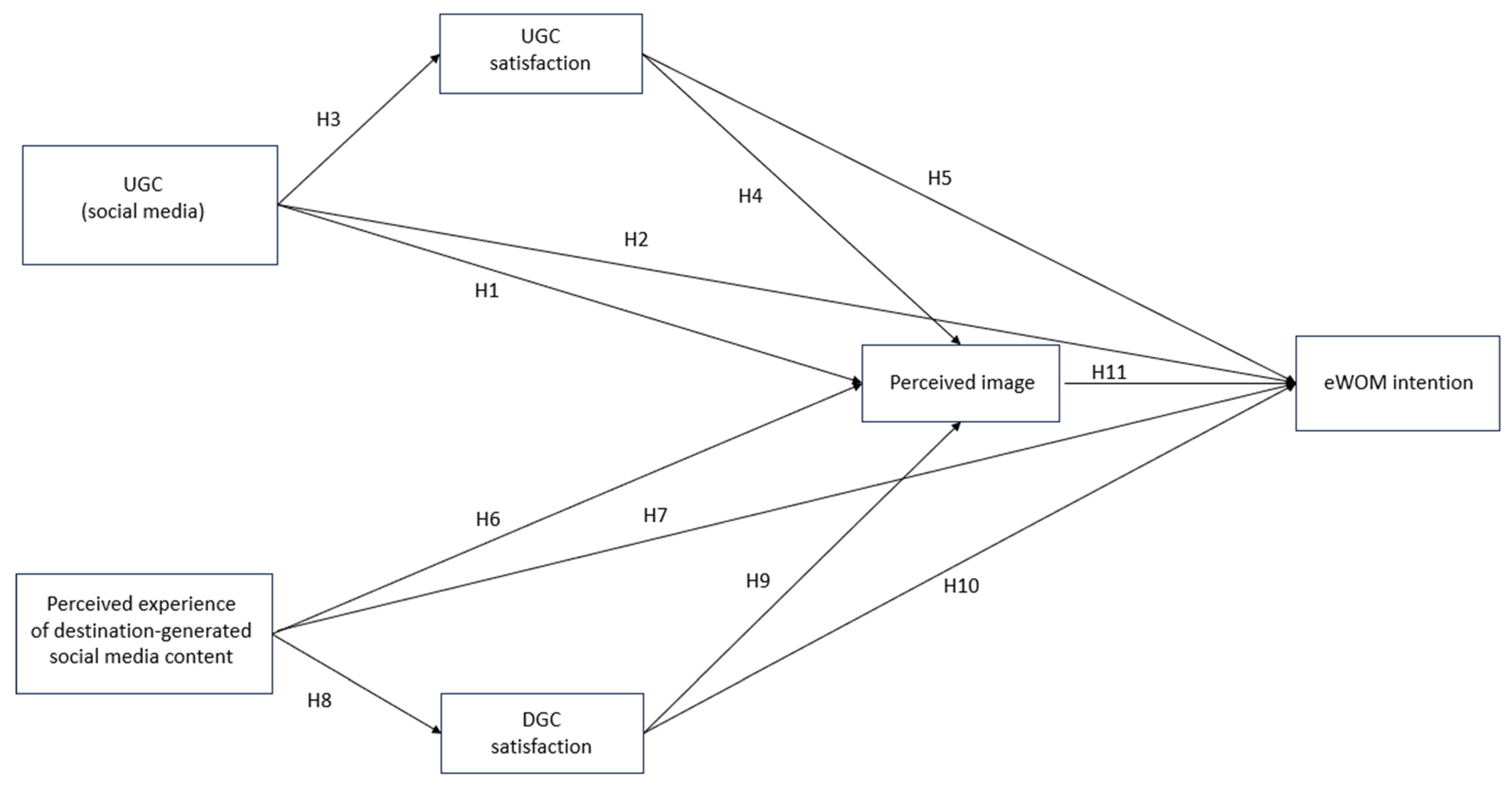
| H1 | UGC → Image | Supported | 0.201 * | 2.201 | 0.024 |
| H2 | UGC → eWOM | Not supported | −0.072 ns | 0.896 | 0.003 |
| H3 | UGC → UGC satisfaction | Supported | 0.822 ** | 31.766 | 2.087 |
| H4 | UGC satisfaction → Image | Not supported | −0.105 ns | 1.111 | 0.006 |
| H5 | UGC satisfaction → eWOM | Not supported | 0.089 ns | 1.079 | 0.004 |
| H6 | PEdgc → Image | Supported | 0.350 ** | 4.357 | 0.086 |
| H7 | PEdgc → eWOM | Supported | 0.421 ** | 5.255 | 0.112 |
| H8 | PEdgc → DGC satisfaction | Supported | 0.783 ** | 28.707 | 1.582 |
| H9 | DGC satisfaction → Image | Supported | 0.327 ** | 4.030 | 0.074 |
| H10 | DGC satisfaction → eWOM | Supported | 0.261 ** | 2.981 | 0.043 |
| H11 | Image → eWOM | Not supported | 0.010 ns | 0.160 | 0.000 |
| Step 2 | Step 3 | ||||||||||||
|---|---|---|---|---|---|---|---|---|---|---|---|---|---|
| Factors | Step I Conf. Inv. | C | 5% Quantile of Cu | p-Value | Comp. Inv. | Mean Diff. | 95% Confidence Interval | p-Value | Equal Mean | Variance Diff. | 95% Confidence Interval | p-Value | Equal Variance |
| User-generated content (UGC) | Yes | 0.999 | 0.999 | 0.112 | Yes | −0.973 | [−0.229; 0.244] | 0.000 | No | 1.149 | [−0.408; 0.335] | 0.000 | No |
| Perceived experience of destination-generated content | Yes | 0.999 | 0.998 | 0.463 | Yes | −0.152 | [−0.263; 0.244] | 0.231 | Yes | 0.098 | [−0.349; 0.324] | 0.589 | Yes |
| UGC satisfaction | Yes | 1.000 | 1.000 | 0.667 | Yes | −0.800 | [−0.245; 0.240] | 0.000 | No | 0.784 | [−0.341; 0.277] | 0.000 | No |
| DGC satisfaction | Yes | 1.000 | 0.999 | 0.202 | Yes | −0.127 | [−0.242; 0.239] | 0.302 | Yes | −0.029 | [−0.340; 0.310] | 0.854 | Yes |
| destination image | Yes | 1.000 | 1.000 | 0.937 | Yes | −0.177 | [−0.243; 0.241] | 0.157 | Yes | 0.297 | [−0.419; 0.349] | 0.111 | Yes |
| eWOM intention | Yes | 0.998 | 0.997 | 0.104 | Yes | 0.274 | [−0.243; 0.246] | 0.025 | No | −0.110 | [−0.267; 0.254] | 0.419 | Yes |
| Hypothesis | Relationships | β Low Openness | β High Openness | β Difference | PLS-MGA p-Value | |
|---|---|---|---|---|---|---|
| H12a | Not supported | UGC → Image | 0.074 ns | 0.277 ** | −0.203 | 0.395 ns |
| H12b | Not supported | UGC → eWOM intention | −0.187 ns | −0.028 ns | −0.159 | 0.343 ns |
| H12c | Supported | UGC → UGC satisfaction | 0.858 ** | 0.719 ** | 0.139 | 0.019 * |
| H12d | Not supported | UGC satisfaction → Image | −0.045 ns | 0.097 ns | −0.142 | 0.831 ns |
| H12e | Not supported | UGC satisfaction → eWOM intention | 0.080 ns | 0.056 ns | 0.024 | 0.924 ns |
| H12f | Not supported | PEdgc → Image | 0.370 * | 0.321 ** | 0.049 | 0.799 ns |
| H12g | Not supported | PEdgc → eWOM intention | 0.223 ns | 0.504 ** | −0.281 | 0.090 ns |
| H12h | Not supported | PEdgc → DGC satisfaction | 0.792 ** | 0.781 ** | 0.011 | 0.829 ns |
| H12i | Not supported | DGC satisfaction → Image | 0.279 ns | 0.324 ** | −0.045 | 0.825 ns |
| H12j | Supported | DGC satisfaction → eWOM intention | 0.548 ** | 0.139 ns | 0.409 | 0.018 * |
| H12k | Not supported | Image → eWOM intention | −0.069 ns | 0.053 ns | −0.122 | 0.369 ns |
Disclaimer/Publisher’s Note: The statements, opinions and data contained in all publications are solely those of the individual author(s) and contributor(s) and not of MDPI and/or the editor(s). MDPI and/or the editor(s) disclaim responsibility for any injury to people or property resulting from any ideas, methods, instructions or products referred to in the content. |
© 2026 by the authors. Licensee MDPI, Basel, Switzerland. This article is an open access article distributed under the terms and conditions of the Creative Commons Attribution (CC BY) license.
Share and Cite
Hervás-Cortina, C.-M.; Ruiz-Molina, M.-E.; Gil-Saura, I.; Bordian, M. How Social Media Content Shapes Destination Image and eWOM: The Moderating Role of Personality in Lesser-Known Tourism Destinations. J. Theor. Appl. Electron. Commer. Res. 2026, 21, 164. https://doi.org/10.3390/jtaer21060164
Hervás-Cortina C-M, Ruiz-Molina M-E, Gil-Saura I, Bordian M. How Social Media Content Shapes Destination Image and eWOM: The Moderating Role of Personality in Lesser-Known Tourism Destinations. Journal of Theoretical and Applied Electronic Commerce Research. 2026; 21(6):164. https://doi.org/10.3390/jtaer21060164
Chicago/Turabian StyleHervás-Cortina, Carmen-María, María-Eugenia Ruiz-Molina, Irene Gil-Saura, and Mariia Bordian. 2026. "How Social Media Content Shapes Destination Image and eWOM: The Moderating Role of Personality in Lesser-Known Tourism Destinations" Journal of Theoretical and Applied Electronic Commerce Research 21, no. 6: 164. https://doi.org/10.3390/jtaer21060164
APA StyleHervás-Cortina, C.-M., Ruiz-Molina, M.-E., Gil-Saura, I., & Bordian, M. (2026). How Social Media Content Shapes Destination Image and eWOM: The Moderating Role of Personality in Lesser-Known Tourism Destinations. Journal of Theoretical and Applied Electronic Commerce Research, 21(6), 164. https://doi.org/10.3390/jtaer21060164