


Internet Advertising Falsity and Consumer Harm: A Moderated Mediation Analysis of Consumer Cognitive Processes and Consumer Vulnerability



Abstract
1. Introduction
2. Theoretical Background and Literature Review
2.1. Internet Advertising Falsity
2.2. Types of Internet Advertising Falsity
2.3. Dark Patterns and Deceptive Interface Design
2.4. Consumer Cognitive Processes
2.5. Consumer Harm
2.6. Consumer Vulnerability
3. Research Model and Hypotheses
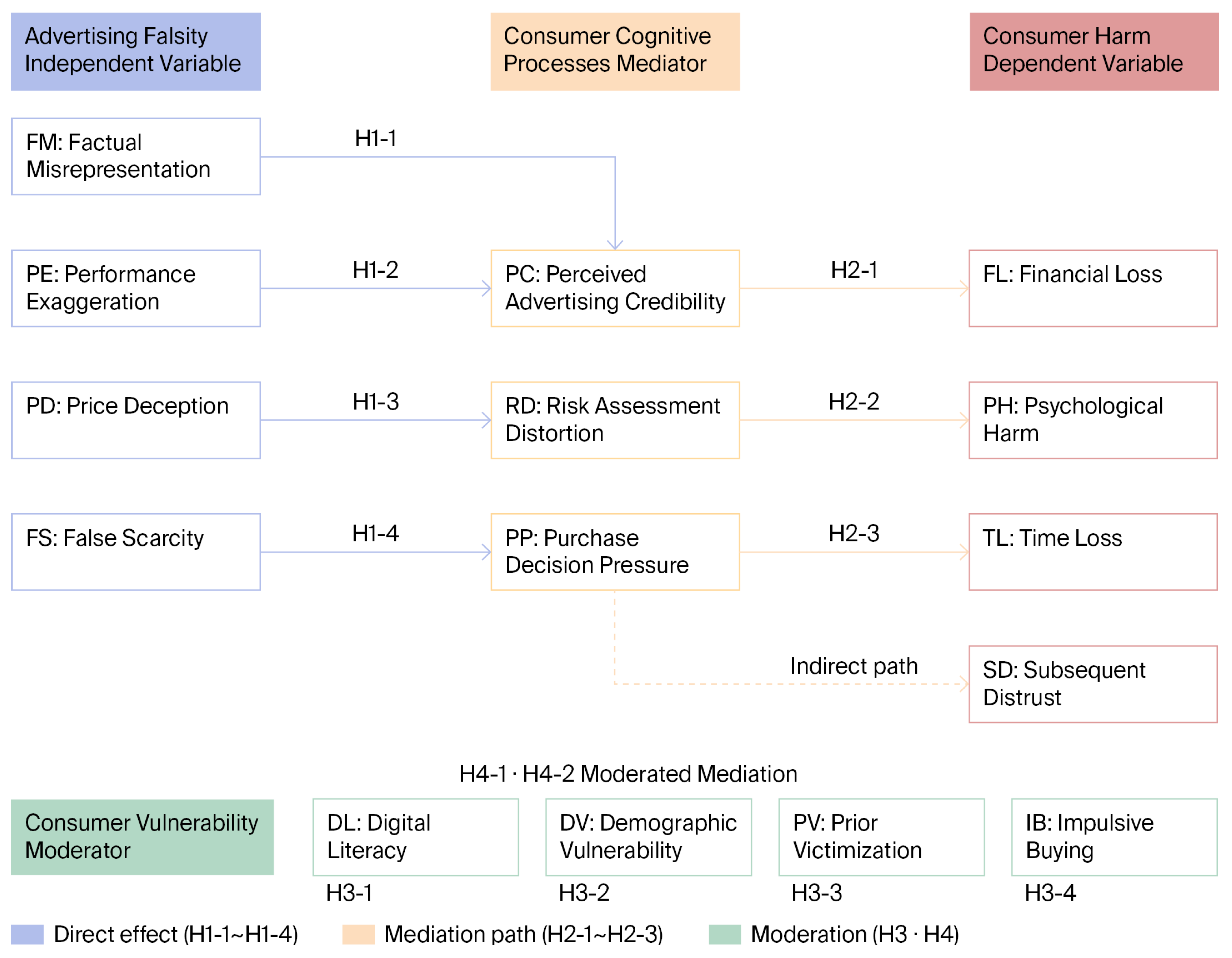
3.1. Research Model
3.2. Research Hypotheses
4. Methodology
4.1. Research Design
4.2. Data Collection
Respondent Characteristics
4.3. Measurement Instruments
4.4. Analytical Methods
5. Results
5.1. Reliability and Validity Analysis
5.2. Structural Model Analysis
5.2.1. Hypothesis Testing: Direct Effects (H1-1–H1-4)
5.2.2. Hypothesis Testing: Mediation Effects (H2-1–H2-3)
5.2.3. Hypothesis Testing: Moderating Effects (H3-1–H3-4)
5.2.4. Hypothesis Testing: Moderated Mediation Effects (H4-1: Existence Test; H4-2: Dose–Response Pattern)
5.2.5. Summary of Hypothesis Testing Results
6. Discussion and Conclusions
6.1. Summary of Findings
6.2. Theoretical Implications
6.3. Practical Implications
6.4. Limitations and Directions for Future Research
Author Contributions
Funding
Institutional Review Board Statement
Informed Consent Statement
Data Availability Statement
Conflicts of Interest
Appendix A. Statistics of the Construct Items
| Construct | Sub-Construct | Survey Measures |
| Advertising falsity | Factual misrepresentation | I frequently encounter descriptions in internet advertising that are inconsistent with the actual product or service. |
| Internet advertising often does not accurately represent the actual characteristics or functions of a product. | ||
| Internet advertising tends to intentionally conceal the major defects or shortcomings of a product. | ||
| Performance exaggeration | Internet advertising tends to excessively exaggerate the performance or effects of products. | |
| The efficacy or effects claimed in internet advertising often fail to align with actual experience. | ||
| Internet advertising creates unrealistic expectations about product usage outcomes. | ||
| Price deception | Internet advertising tends to exaggerate discounts, misrepresent original prices, or hide additional costs. | |
| I have encountered advertising claiming significant discounts that were inconsistent with actual pricing. | ||
| Hidden fees or charges not disclosed in internet advertising have been revealed at the point of payment. | ||
| False scarcity | Internet advertising frequently creates urgency to purchase by emphasizing limited product availability. | |
| Phrases such as ‘today only’ or ‘last chance’ in internet advertising are often inconsistent with the actual situation. | ||
| Internet advertising exaggerates time limits to induce consumers’ immediate purchase decisions. | ||
| Consumer cognitive processes | Perceived advertising credibility | I generally trust the content of internet advertising. |
| I believe that the information presented in internet advertising is generally factually based. | ||
| I believe I have the ability to judge the credibility of internet advertising. | ||
| Risk assessment distortion | I tend to underestimate the risks that could arise when purchasing products based on internet advertising. | |
| Under the influence of internet advertising, I have overlooked potential negative outcomes associated with a purchase. | ||
| Because of the flashy expressions or images in internet advertising, it is difficult to recognize the actual risks of a product. | ||
| Purchase decision pressure | Because of time-limited or quantity-limited messages in internet advertising, I have made purchase decisions without sufficient deliberation. | |
| I have rushed purchase decisions under the influence of ‘buy now or miss out’ messages in internet advertising. | ||
| Under the influence of internet advertising, I have made purchase decisions without adequately considering alternatives. | ||
| Consumer harm | Financial loss | I have experienced financial losses from products or services I purchased based on internet advertising. |
| I have paid more in the end than the price presented in internet advertising. | ||
| Due to advertising falsity, I have purchased unnecessary products and experienced economic waste. | ||
| Psychological harm | After discovering the falsity of internet advertising, I have felt disappointment or betrayal. | |
| I have experienced psychological stress when purchased products failed to meet expectations formed through internet advertising. | ||
| Following a harmful experience caused by internet advertising falsity, I experienced a decline in confidence in my own judgment. | ||
| Time loss | Due to internet advertising falsity, I have spent considerable time processing returns, exchanges, or refund requests. | |
| Due to false information from internet advertising, I spent considerable time on additional searches or verification processes. | ||
| I experienced time loss in the process of resolving harm caused by internet advertising falsity. | ||
| Subsequent distrust | After experiencing internet advertising falsity, my distrust toward online advertising in general has increased. | |
| Due to experiencing internet advertising falsity, my trust in online shopping itself has decreased. | ||
| Following an experience of internet advertising falsity, I developed distrust toward specific brands or sellers. | ||
| Consumer vulnerability | Digital literacy level | I find it difficult to determine the authenticity of internet advertising. |
| I am well-informed about how to evaluate the reliability of information provided online. | ||
| I understand the marketing techniques and strategies used in internet advertising. | ||
| Demographic vulnerability | I believe that factors such as age, gender, and education level influence my judgment regarding internet advertising. | |
| I believe that my socioeconomic situation influences my vulnerability to internet advertising. | ||
| I believe that my level of education affects my ability to judge the deceptiveness of internet advertising. | ||
| Prior victimization experience | I have previously experienced harm from the falsity of internet advertising. | |
| Past victimization experiences influence the way I currently evaluate internet advertising. | ||
| After past victimization experiences, my vigilance toward internet advertising has increased. | ||
| Impulsive buying tendency | I tend to make spontaneous purchase decisions when I see internet advertising. | |
| I am easily influenced by time-limited or special-offer messages in internet advertising. | ||
| Even for products I had not planned to purchase, I feel an impulse to buy when I see attractive internet advertising. |

| Construct | Sub-Construct | Item | Std. Loading | AVE | CR | Cronbach’s α |
|---|---|---|---|---|---|---|
| Advertising falsity | Factual misrepresentation | FM1 | 0.841 | 0.702 | 0.876 | 0.891 |
| FM2 | 0.802 | |||||
| FM3 | 0.870 | |||||
| Performance exaggeration | PE1 | 0.847 | 0.706 | 0.878 | 0.904 | |
| PE2 | 0.824 | |||||
| PE3 | 0.850 | |||||
| Price deception | PD1 | 0.818 | 0.710 | 0.880 | 0.887 | |
| PD2 | 0.844 | |||||
| PD3 | 0.866 | |||||
| False scarcity | FS1 | 0.791 | 0.694 | 0.872 | 0.876 | |
| FS2 | 0.837 | |||||
| FS3 | 0.870 | |||||
| Consumer cognitive processes | Perceived advertising credibility | PC1 | 0.825 | 0.691 | 0.870 | 0.867 |
| PC2 | 0.806 | |||||
| PC3 | 0.861 | |||||
| Risk assessment distortion | RD1 | 0.801 | 0.699 | 0.874 | 0.883 | |
| RD2 | 0.835 | |||||
| RD3 | 0.870 | |||||
| Purchase decision pressure | PP1 | 0.817 | 0.704 | 0.877 | 0.892 | |
| PP2 | 0.840 | |||||
| PP3 | 0.859 | |||||
| Consumer harm | Financial loss | FL1 | 0.844 | 0.700 | 0.875 | 0.901 |
| FL2 | 0.811 | |||||
| FL3 | 0.855 | |||||
| Psychological harm | PH1 | 0.803 | 0.696 | 0.873 | 0.912 | |
| PH2 | 0.849 | |||||
| PH3 | 0.850 | |||||
| Time loss | TL1 | 0.808 | 0.694 | 0.872 | 0.878 | |
| TL2 | 0.831 | |||||
| TL3 | 0.859 | |||||
| Subsequent distrust | SD1 | 0.844 | 0.704 | 0.877 | 0.895 | |
| SD2 | 0.810 | |||||
| SD3 | 0.862 | |||||
| Consumer vulnerability | Digital literacy level | DL1 | 0.777 | 0.663 | 0.855 | 0.856 |
| DL2 | 0.823 | |||||
| DL3 | 0.842 | |||||
| Demographic vulnerability | DV1 | 0.795 | 0.635 | 0.839 | 0.834 | |
| DV2 | 0.763 | |||||
| DV3 | 0.831 | |||||
| Prior victimization experience | PV1 | 0.814 | 0.650 | 0.848 | 0.847 | |
| PV2 | 0.778 | |||||
| PV3 | 0.826 | |||||
| Impulsive buying tendency | IB1 | 0.831 | 0.695 | 0.872 | 0.869 | |
| IB2 | 0.802 | |||||
| IB3 | 0.866 |
References
- Statista Research Department. Digital Advertising Spending Worldwide; Statista: Hamburg, Germany, 2024. [Google Scholar]
- Federal Trade Commission. Bringing Dark Patterns to Light: An FTC Staff Report; Federal Trade Commission: Washington, DC, USA, 2022.
- Rhodes, A.; Wilson, C.M. False Advertising. RAND J. Econ. 2018, 49, 348–369. [Google Scholar] [CrossRef]
- Mathur, A.; Acar, G.; Friedman, M.J.; Lucherini, E.; Mayer, J.; Chetty, M.; Narayanan, A. Dark Patterns at Scale: Findings from a Crawl of 11K Shopping Websites. Proc. ACM Hum.-Comput. Interact. 2019, 3, 81. [Google Scholar] [CrossRef]
- ICPEN (International Consumer Protection and Enforcement Network). ICPEN–GPEN 2024 Sweep: Dark Patterns and Subscription Services; ICPEN: London, UK, 2024. [Google Scholar]
- OECD. Consumer Vulnerability in the Digital Age; OECD Digital Economy Papers, No. 355; OECD Publishing: Paris, France, 2023. [Google Scholar]
- Baker, S.M.; Gentry, J.W.; Rittenburg, T.L. Building Understanding of the Domain of Consumer Vulnerability. J. Macromark. 2005, 25, 128–139. [Google Scholar] [CrossRef]
- Helberger, N.; Sax, M.; Strycharz, J.; Micklitz, H.-W. Choice Architectures in the Digital Economy: Towards a New Understanding of Digital Vulnerability. J. Consum. Policy 2022, 45, 175–200. [Google Scholar] [CrossRef]
- Nessah, I. Theoretical Study on Advertising Deception and Its Impact on Consumers. Int. J. Econ. Perform. 2024, 7, 141–156. [Google Scholar] [CrossRef]
- Xie, G.X.; Madrigal, R.; Boush, D.M. Disentangling the Effects of Perceived Deception and Anticipated Harm on Consumer Responses to Deceptive Advertising. J. Bus. Ethics 2015, 129, 281–293. [Google Scholar] [CrossRef]
- Bothma, M.; van Staden, B. The Influence of Perceived Deceptive Advertising on Consumer Behaviour in the Online Fashion Environment: A Stimulus–Organism–Response Perspective. S. Afr. J. Econ. Manag. Sci. 2025, 28, 6398. [Google Scholar] [CrossRef]
- Mende, M.; Scott, M.L.; van Doorn, J.; Grewal, D.; Shanks, I. Consumer Vulnerability Dynamics and Marketing. J. Acad. Mark. Sci. 2024, 52, 1301–1322. [Google Scholar] [CrossRef]
- Hayes, A.F. Introduction to Mediation, Moderation, and Conditional Process Analysis, 2nd ed.; Guilford Press: New York, NY, USA, 2018. [Google Scholar]
- Wang, X.; Ashraf, A.R.; Thongpapanl, N.; Wang, K.-Y. Perceived Deception and Online Repurchase Intention: The Moderating Effect of Product Type and Consumer Regulatory Orientation. J. Consum. Behav. 2022, 21, 1522–1539. [Google Scholar] [CrossRef]
- Wei, K.; Li, Y.; Zha, Y.; Ma, J. Trust, Risk and Transaction Intention in Consumer-to-Consumer E-Marketplaces: An Empirical Comparison between Buyers’ and Sellers’ Perspectives. Ind. Manag. Data Syst. 2019, 119, 331–350. [Google Scholar] [CrossRef]
- Akerlof, G.A. The Market for “Lemons”: Quality Uncertainty and the Market Mechanism. Q. J. Econ. 1970, 84, 488–500. [Google Scholar] [CrossRef]
- Nebenzahl, I.D.; Jaffe, E.D. Ethical Dimensions of Advertising Executions. J. Bus. Ethics 1998, 17, 805–815. [Google Scholar] [CrossRef]
- Friestad, M.; Wright, P. The Persuasion Knowledge Model: How People Cope with Persuasion Attempts. J. Consum. Res. 1994, 21, 1–31. [Google Scholar] [CrossRef]
- Rahmani, V. Persuasion Knowledge Framework: Toward a Comprehensive Model of Consumers’ Persuasion Knowledge. AMS Rev. 2023, 13, 12–33. [Google Scholar] [CrossRef]
- Lynn, M. Scarcity Effects on Value: A Quantitative Review of the Commodity Theory Literature. Psychol. Mark. 1991, 8, 43–57. [Google Scholar] [CrossRef]
- Brignull, H. Dark Patterns: Deception vs. Honesty in UI Design. Interact. Des. Usability 2010, 338, 2–4. Available online: https://alistapart.com/article/dark-patterns-deception-vs-honesty-in-ui-design/ (accessed on 13 March 2025).
- Narayanan, A.; Mathur, A.; Chetty, M.; Kshirsagar, M. Dark Patterns: Past, Present, and Future. Queue 2020, 18, 67–92. [Google Scholar] [CrossRef]
- Di Geronimo, L.; Braz, L.; Fregnan, E.; Palomba, F.; Bacchelli, A. UI Dark Patterns and Where to Find Them: A Study on Mobile Applications and User Perception. In Proceedings of the 2020 CHI Conference on Human Factors in Computing Systems; ACM: New York, NY, USA, 2020; pp. 1–14. [Google Scholar]
- Petty, R.E.; Cacioppo, J.T. The Elaboration Likelihood Model of Persuasion. Adv. Exp. Soc. Psychol. 1986, 19, 123–205. [Google Scholar]
- Liu, D.; Wang, H.; Zhu, Y. You Plan to Manipulate Me: A Persuasion Knowledge Perspective for Understanding the Effects of AI-Assisted Selling. J. Bus. Res. 2025, 200, 115598. [Google Scholar] [CrossRef]
- MacKenzie, S.B.; Lutz, R.J. An Empirical Examination of the Structural Antecedents of Attitude toward the Ad in an Advertising Pretesting Context. J. Mark. 1989, 53, 48–65. [Google Scholar] [CrossRef]
- Bleier, A.; Eisenbeiss, M. The Importance of Trust for Personalized Online Advertising. J. Retail. 2015, 91, 390–409. [Google Scholar] [CrossRef]
- Kahneman, D.; Tversky, A. Prospect Theory: An Analysis of Decision under Risk. Econometrica 1979, 47, 263–291. [Google Scholar] [CrossRef]
- Cialdini, R.B. Influence: Science and Practice, 5th ed.; Pearson Education: New York, NY, USA, 2009. [Google Scholar]
- Xie, G.-X.; Boush, D.M. How Susceptible Are Consumers to Deceptive Advertising Claims? A Retrospective Look at the Experimental Research Literature. Mark. Rev. 2011, 11, 293–314. [Google Scholar] [CrossRef]
- Darke, P.R.; Ritchie, R.J.B. The Defensive Consumer: Advertising Deception, Defensive Processing, and Distrust. J. Mark. Res. 2007, 44, 114–127. [Google Scholar] [CrossRef]
- Basu, R.; Kumar, A.; Kumar, S. Twenty-Five Years of Consumer Vulnerability Research: Critical Insights and Future Directions. J. Consum. Aff. 2023, 57, 673–695. [Google Scholar] [CrossRef]
- van Berlo, Z.M.C.; Bock, H. A Serial Mediation of Deceptive Discount Advertising Effects. Cyberpsychol. Behav. Soc. Netw. 2023, 26, 281–288. [Google Scholar] [CrossRef]
- OECD. Dark Commercial Patterns; OECD Digital Economy Papers, No. 336; OECD Publishing: Paris, France, 2022. [Google Scholar]
- Sin, R.; Harris, T.; Nilsson, S.; Beck, T. Dark Patterns in Online Shopping: Do They Work and Can Nudges Help Mitigate Impulse Buying? Behav. Public Policy 2022, 9, 61–87. [Google Scholar] [CrossRef]
- Chen, S.J.; Rana, N.P.; Dwivedi, Y.K. Consumer Vulnerability: Understanding Transparency and Control in the Online Environment. Inf. Syst. Front. 2024, 26, 215–234. [Google Scholar]
- Stewart, K.; Yap, S.F. Low Literacy, Policy and Consumer Vulnerability. J. Public Policy Mark. 2020, 39, 190–208. [Google Scholar]
- Edwards, J.R.; Lambert, L.S. Methods for Integrating Moderation and Mediation: A General Analytical Framework Using Moderated Path Analysis. Psychol. Methods 2007, 12, 1–22. [Google Scholar] [CrossRef]
- Korea Internet and Security Agency (KISA). 2023 Internet Usage Survey; KISA: Naju, Republic of Korea, 2024.
- Hair, J.F.; Black, W.C.; Babin, B.J.; Anderson, R.E. Multivariate Data Analysis, 8th ed.; Cengage Learning: Mason, OH, USA, 2019. [Google Scholar]
- Armstrong, J.S.; Overton, T.S. Estimating Nonresponse Bias in Mail Surveys. J. Mark. Res. 1977, 14, 396–402. [Google Scholar] [CrossRef]
- Brislin, R.W. Back-Translation for Cross-Cultural Research. J. Cross-Cult. Psychol. 1970, 1, 185–216. [Google Scholar] [CrossRef]
- Podsakoff, P.M.; MacKenzie, S.B.; Lee, J.-Y.; Podsakoff, N.P. Common Method Biases in Behavioral Research: A Critical Review of the Literature and Recommended Remedies. J. Appl. Psychol. 2003, 88, 879–903. [Google Scholar] [CrossRef]
- Williams, L.J.; McGonagle, A.K. Four Research Designs and a Comprehensive Analysis Strategy for Investigating Common Method Variance with Self-Report Measures Using Latent Variables. J. Bus. Psychol. 2016, 31, 339–359. [Google Scholar] [CrossRef]
- Lindell, M.K.; Whitney, D.J. Accounting for Common Method Variance in Cross-Sectional Research Designs. J. Appl. Psychol. 2001, 86, 114–121. [Google Scholar] [CrossRef]
- Fornell, C.; Larcker, D.F. Evaluating Structural Equation Models with Unobservable Variables and Measurement Error. J. Mark. Res. 1981, 18, 39–50. [Google Scholar] [CrossRef]
- European Commission. Regulation (EU) 2022/2065 of the European Parliament and of the Council of 19 October 2022 on a Single Market for Digital Services (Digital Services Act). Off. J. Eur. Union 2022, L 277, 1–102. [Google Scholar]
- Boerman, S.C.; van Reijmersdal, E.A.; Neijens, P.C. Sponsorship Disclosure: Effects of Duration on Persuasion Knowledge and Brand Responses. J. Commun. 2018, 68, 1047–1066. [Google Scholar] [CrossRef]
- Luguri, J.; Strahilevitz, L.J. Shining a Light on Dark Patterns. J. Leg. Anal. 2021, 13, 43–109. [Google Scholar] [CrossRef]
- Zarouali, B.; Boerman, S.C.; de Vreese, C.H. Is This Recommended by an Algorithm? The Development and Validation of the Algorithmic Media Content Awareness Scale (AMCA-Scale). Telemat. Inform. 2021, 62, 101607. [Google Scholar] [CrossRef]
| Variable | Category | Frequency (n) | Percentage (%) |
|---|---|---|---|
| Gender | Male | 294 | 49.0 |
| Female | 306 | 51.0 | |
| Age | 20s | 132 | 22.0 |
| 30s | 156 | 26.0 | |
| 40s | 168 | 28.0 | |
| 50s and older | 144 | 24.0 | |
| Education | High school diploma or below | 84 | 14.0 |
| University (enrolled) | 72 | 12.0 | |
| University (graduated) | 318 | 53.0 | |
| Graduate school or above | 126 | 21.0 | |
| Monthly income | <2,000,000 KRW | 108 | 18.0 |
| 2,000,000–3,000,000 KRW | 132 | 22.0 | |
| 3,000,000–4,000,000 KRW | 168 | 28.0 | |
| 4,000,000–5,000,000 KRW | 102 | 17.0 | |
| ≥5,000,000 KRW | 90 | 15.0 | |
| Total | 600 | 100.0 |
| Fit Index | Obtained Value | Recommended Criterion | Judgment |
|---|---|---|---|
| χ2 (df) | 2942.35 (1146) | p > 0.05 [large N; use χ2/df, RMSEA, CFI] | Acceptable |
| χ2/df | 2.57 | <3.0 | Acceptable |
| RMSEA | 0.051 | <0.08 | Acceptable |
| CFI | 0.942 | >0.90 | Acceptable |
| TLI | 0.936 | >0.90 | Acceptable |
| R2 (consumer harm) | 0.584 | ≥0.20 (medium) | Substantial |
| R2 (mediators) | 0.312–0.447 | ≥0.20 | Acceptable |
| Path | β | S.E. | C.R. | p |
|---|---|---|---|---|
| H1-1: Factual misrepresentation → Consumer harm | 0.187 | 0.041 | 4.561 | <0.001 |
| H1-2: Performance exaggeration → Consumer harm | 0.224 | 0.038 | 5.895 | <0.001 |
| H1-3: Price deception → Consumer harm | 0.198 | 0.040 | 4.950 | <0.001 |
| H1-4: False scarcity → Consumer harm | 0.156 | 0.043 | 3.628 | <0.001 |
| Controls (covariates) | ||||
| Ad exposure frequency → Consumer harm | 0.032 | 0.041 | 0.780 | 0.435 (n.s.) |
| Platform type → Consumer harm | 0.018 | 0.038 | 0.474 | 0.635 (n.s.) |
| Product category → Consumer harm | 0.025 | 0.043 | 0.581 | 0.561 (n.s.) |
| Mediation Path | Indirect Effect | LLCI | ULCI | Result |
|---|---|---|---|---|
| H2-1: Falsity → Ad credibility → Harm | 0.089 | 0.062 | 0.121 | Supported |
| H2-2: Falsity → Risk assessment distortion → Harm | 0.156 | 0.118 | 0.198 | Supported |
| H2-3: Falsity → Purchase decision pressure → Harm | 0.112 | 0.081 | 0.148 | Supported |
| Moderating Variable | Low Group β | High Group β | Δχ2(1) | p | Result |
|---|---|---|---|---|---|
| H3-1: Digital literacy | 0.312 | 0.178 | Δχ2(1) = 12.45 *** | <0.001 | Supported |
| H3-2: Demographic vulnerability | 0.287 | 0.196 | Δχ2(1) = 9.87 ** | <0.01 | Supported |
| H3-3: Prior victimization experience | 0.298 | 0.189 | Δχ2(1) = 8.92 ** | <0.01 | Supported |
| H3-4: Impulsive buying tendency | 0.324 | 0.201 | Δχ2(1) = 11.23 *** | <0.001 | Supported |
| Vulnerability Level | Conditional Indirect Effect | LLCI | ULCI | Significance |
|---|---|---|---|---|
| Low-vulnerability group (−1SD) | 0.087 | 0.058 | 0.121 | Significant |
| Mean group | 0.142 | 0.104 | 0.184 | Significant |
| High-vulnerability group (+1SD) | 0.198 | 0.152 | 0.249 | Significant |
| Index of moderated mediation | 0.078 | 0.042 | 0.118 | Significant |
| Hypothesis | β/IE | Result |
|---|---|---|
| H1-1: Factual misrepresentation → Consumer harm (+) | 0.187 *** | Supported |
| H1-2: Performance exaggeration → Consumer harm (+) | 0.224 *** | Supported |
| H1-3: Price deception → Consumer harm (+) | 0.198 *** | Supported |
| H1-4: False scarcity → Consumer harm (+) | 0.156 *** | Supported |
| H2-1: Mediating effect of perceived ad credibility | 0.089 | Supported |
| H2-2: Mediating effect of risk assessment distortion | 0.156 | Supported |
| H2-3: Mediating effect of purchase decision pressure | 0.112 | Supported |
| H3-1: Moderating effect of digital literacy | Δχ2(1) = 12.45 *** | Supported |
| H3-2: Moderating effect of demographic vulnerability | Δχ2(1) = 9.87 ** | Supported |
| H3-3: Moderating effect of prior victimization experience | Δχ2(1) = 8.92 ** | Supported |
| H3-4: Moderating effect of impulsive buying tendency | Δχ2(1) = 11.23 *** | Supported |
| H4-1: Existence of moderated mediation (IMM ≠ 0, CI excludes zero) | Index = 0.078 | Supported |
| H4-2: Monotonically increasing dose–response pattern of conditional indirect effects | High: 0.198/Low: 0.087 | Supported |
Disclaimer/Publisher’s Note: The statements, opinions and data contained in all publications are solely those of the individual author(s) and contributor(s) and not of MDPI and/or the editor(s). MDPI and/or the editor(s) disclaim responsibility for any injury to people or property resulting from any ideas, methods, instructions or products referred to in the content. |
© 2026 by the authors. Licensee MDPI, Basel, Switzerland. This article is an open access article distributed under the terms and conditions of the Creative Commons Attribution (CC BY) license.
Share and Cite
Zhao, D.; Jin, X.; Ren, W.; Dong, K.; Jin, C.-H. Internet Advertising Falsity and Consumer Harm: A Moderated Mediation Analysis of Consumer Cognitive Processes and Consumer Vulnerability. J. Theor. Appl. Electron. Commer. Res. 2026, 21, 133. https://doi.org/10.3390/jtaer21050133
Zhao D, Jin X, Ren W, Dong K, Jin C-H. Internet Advertising Falsity and Consumer Harm: A Moderated Mediation Analysis of Consumer Cognitive Processes and Consumer Vulnerability. Journal of Theoretical and Applied Electronic Commerce Research. 2026; 21(5):133. https://doi.org/10.3390/jtaer21050133
Chicago/Turabian StyleZhao, Dongze, Xuxu Jin, Wenjing Ren, Ke Dong, and Chang-Hyun Jin. 2026. "Internet Advertising Falsity and Consumer Harm: A Moderated Mediation Analysis of Consumer Cognitive Processes and Consumer Vulnerability" Journal of Theoretical and Applied Electronic Commerce Research 21, no. 5: 133. https://doi.org/10.3390/jtaer21050133
APA StyleZhao, D., Jin, X., Ren, W., Dong, K., & Jin, C.-H. (2026). Internet Advertising Falsity and Consumer Harm: A Moderated Mediation Analysis of Consumer Cognitive Processes and Consumer Vulnerability. Journal of Theoretical and Applied Electronic Commerce Research, 21(5), 133. https://doi.org/10.3390/jtaer21050133

