Article

The Effects of Chatbot Characteristics on Satisfaction and Continuance Intention: The Moderating Role of the Need for Human Interaction †

by
Mutlu Yüksel Avcılar
and
Gülhan Yenilmez
*
Department of Business Administration, Faculty of Economics and Administrative Sciences, Osmaniye Korkut Ata University, 80000 Osmaniye, Türkiye
*
Author to whom correspondence should be addressed.
This study is an extended and revised version of the paper presented at the 28th Marketing Congress, held in Fethiye, Muğla, between 8–11 October 2025, and has been developed by taking the reviewers’ recommendations into consideration. Prior to the study, ethical approval was obtained from the Social Sciences Scientific Research and Publication Ethics Committee of Osmaniye Korkut Ata University Rectorate, dated 29 November 2023 and numbered 2023/14/7.
J. Theor. Appl. Electron. Commer. Res. 2026, 21(4), 122; https://doi.org/10.3390/jtaer21040122
Submission received: 27 February 2026 / Revised: 10 April 2026 / Accepted: 12 April 2026 / Published: 17 April 2026
(This article belongs to the Section Digital Marketing and the Evolving Consumer Experience)

Abstract

This study investigates how two key characteristics of AI-enabled chatbots in mobile banking applications—perceived intelligence and perceived anthropomorphism—influence users’ cognitive and hedonic evaluations, namely perceived usefulness, confirmation, and perceived enjoyment, and how these evaluations subsequently shape user satisfaction and continuance intention. Grounded in the Expectation–Confirmation Model (ECM), the study also examines the moderating role of users’ need for interaction with service employees in these relationships. Using a quantitative research design, data were collected through a structured survey from 402 users of AI-enabled mobile banking applications in Türkiye. The proposed model was tested using partial least squares structural equation modeling (PLS-SEM), and moderated mediation effects were analyzed using Hayes’ PROCESS Macro (Model 58). The results reveal that perceived intelligence positively affects perceived anthropomorphism, perceived usefulness, perceived enjoyment, and confirmation, while perceived anthropomorphism further reinforces these effects. Cognitive and emotional evaluations significantly enhance user satisfaction, which in turn strongly predicts continuance intention toward chatbot usage. Moreover, the need for interaction with service employees significantly moderates the indirect effects of perceived usefulness, perceived enjoyment, and confirmation on satisfaction and continuance intention. By extending the expectation–confirmation model with both cognitive and emotional dimensions, this study offers novel insights into user-centered chatbot design in mobile banking and highlights the importance of individual differences in shaping sustained technology use.

1. Introduction

Digital transformation has accelerated the adoption of digital technologies in the banking sector, and mobile banking applications have become fundamental components of rapidly evolving financial services [1,2]. The digital (mobile) banking market is expected to grow by 6.80% between 2025 and 2029, reaching a volume of USD 2.09 trillion [3]. According to a report published by Juniper Research in 2021, it is projected that by 2026, 53% of the global population will use digital banking services, and the number of users will exceed 4.2 billion [4].
When developments in artificial intelligence technologies, changing consumer preferences, and the widespread adoption of mobile banking are considered together, it is evident that they have facilitated the integration of AI into banking applications [1,5,6]. Driven by artificial intelligence, mobile banking applications enhance user convenience and efficiency by offering advanced services, such as real-time transaction processing, personalized financial recommendations, automated customer support via chatbots, and intelligent fraud detection [1,6]. Users can conveniently and quickly perform transactions, make investments, and carry out various non-financial activities anytime and anywhere [1,5,6]. From the banks’ perspective, mobile banking reduces operational costs and enhances competitive advantage [6].
However, the integration of AI into mobile banking cannot be explained solely by the simultaneous proliferation of these technologies. The widespread adoption of mobile banking has increased transaction volume, making the financial environment more vulnerable, increasing fraudulent activities, and rendering traditional detection systems inadequate [7]. In this context, AI has become a critical tool in the banking sector due to its ability to analyze large datasets, detect anomalies, and monitor transactions in real time [7,8]. The literature emphasizes that AI is widely used in areas such as fraud detection, risk management, process automation, and enhancing customer experience [5,9,10]. In addition, AI enables the provision of personalized services by analyzing customer data, thereby increasing customer interaction [6,9,11,12]. However, from a consumer perspective, the acceptance of artificial intelligence (AI) in mobile banking is shaped not only by such institutional and operational benefits but also by the extent to which these technologies improve users’ everyday banking experiences. Users evaluate AI-enabled services based on the level of convenience, speed, and accessibility they provide in daily financial activities; in this respect, AI-based applications offer continuous access (24/7), reduce waiting times through real-time responses, and enable faster and more efficient transaction completion [13,14,15]. In addition, AI-driven personalization allows users to receive tailored financial recommendations based on their spending patterns, thereby facilitating more effective financial planning and enhancing perceived usefulness [11,16]. Furthermore, the ability of AI systems to simplify complex banking processes—such as biometric authentication or automated credit evaluation— enhances both ease of use and transactional efficiency (speed), thereby significantly enhancing the overall user experience [17,18,19]. In addition, trust plays a critical role in shaping user acceptance in the financial context [20,21]. AI technologies that detect suspicious transactions and prevent fraud strengthen users’ perceptions of security, leading these systems to be viewed not as a source of risk but rather as a protective and beneficial mechanism [19,22,23,24,25]. Moreover, interactions with AI systems may be perceived as less judgmental than those with human agents, particularly in sensitive financial matters, which can create a more comfortable experience for users [26,27]. Therefore, the adoption of AI in mobile banking is considered to be a multidimensional process shaped not only by the operational needs of banks but also by users’ perceived usefulness, trust, and overall experience quality.
Within this framework, it is important to conceptually clarify the role of AI technologies in banking services. Within the scope of this study, AI is defined as systems that exhibit human-like behavior and advanced machine intelligence to enhance users’ experiences in banking services [28]. The integration of AI transforms traditional mobile banking into smart mobile banking by meeting users’ fundamental needs for personalized and intelligent services and improving the overall user experience [6]. In this framework, AI-based technologies such as chatbots play a critical role in enhancing customer satisfaction and optimizing interactions, and they are also considered a strategic tool in terms of banks’ competitive advantage and sustainability [2,29]. Indeed, the literature highlights that continuance intention is a key determinant for the sustainable success of AI-enabled mobile banking applications [6,30,31].
However, despite the critical importance of continuance intention, users’ acceptance of AI-enabled services and, in particular, their post-adoption behaviors have not yet been fully explained. This situation makes it an important research issue to understand users’ evaluations and responses to AI-enabled services beyond technological and operational requirements. From a consumer perspective, although the adoption of mobile banking reflects the general acceptance of digital financial services, it does not necessarily imply the unconditional acceptance of AI-based features [32]. Concerns related to privacy, data security, and the lack of human interaction may lead users to approach these services cautiously or resist them [33,34,35]. Therefore, the adoption of AI in mobile banking should be considered not merely as a technological necessity but as a multidimensional process shaped by trust, risk, perceived value, and user experiences [9,34].
In this context, the literature shows that cognitive-based approaches such as the technology acceptance model (TAM) and the unified theory of acceptance and use of technology (UTAUT) are frequently used to explain user acceptance. These models demonstrate that when AI applications are perceived as useful, reliable, and easy to use, they enhance user experience and satisfaction, thereby facilitating acceptance [32,36]. However, these models primarily focus on initial adoption and provide a limited explanation of users’ post-usage evaluations. In contrast, AI-enabled mobile banking applications are based on repeated usage experiences rather than one-time adoption decisions. Therefore, the expectation confirmation model (ECM), which explains processes such as confirmation of expectations, satisfaction formation, and continuance intention, provides a more appropriate theoretical framework [37]. In this regard, ECM was selected due to its strong theoretical relevance in explaining post-adoption behavior and continuance intention. ECM clearly explains how users’ experiences—through confirmation, perceived usefulness, and satisfaction—shape their intention to continue using a system [37,38]. Thus, ECM is considered to provide a more appropriate theoretical framework for examining systems that require repeated use, such as AI-enabled mobile banking chatbots.
Nevertheless, a significant limitation of existing ECM-based studies is their predominant focus on cognitive (utilitarian) evaluations, largely neglecting the emotional dimension of user experience. However, recent studies indicate that emotional responses, particularly perceived enjoyment, play a decisive role in user satisfaction and continuance intention in interactive and AI-based service environments [39,40]. Accordingly, this study extends ECM by incorporating perceived enjoyment into the model, thereby including the hedonic dimension of user experience.
Furthermore, the nature of AI-enabled services is not limited to emotional experiences; rather, it is also shaped by the human-like and technological characteristics of these systems [6,41,42,43]. In the context of chatbots, perceived intelligence denotes the system’s capacity to demonstrate efficient and autonomous functioning that enables users to complete banking transactions, whereas anthropomorphism refers to the extent to which chatbots exhibit human-like characteristics to assist users in task completion [31]. Due to the nature of AI-enabled services, human-like interaction and adaptive intelligence become prominent compared to traditional information systems, making these variables critical for understanding user evaluations. However, the literature shows that studies integrating perceived intelligence and anthropomorphism into post-adoption behavior models, particularly within the ECM framework, are quite limited [6,42]. Therefore, this study incorporates these AI-specific characteristics into the ECM framework to fill this gap and enhance the explanatory power of the model.
Although businesses have increasingly adopted chatbots in recent years, research shows that factors such as insufficient human empathy constitute major challenges that organizations face in the use of chatbot services [35,44,45]. In a study conducted by Katana [45], it is reported that approximately 49% of consumers prefer interacting with a real person rather than an AI chatbot for customer support, whereas only 12% prefer engaging with an AI chatbot. For individuals who prefer interacting with humans rather than technology-based services [46,47], interacting with a chatbot may eliminate the opportunity for human contact, which in turn can lead them to perceive technology-based services as less useful and less enjoyable [48,49]. This suggests that a high need for human interaction may negatively influence users’ satisfaction with chatbots as well as their intentions to continue using such systems. A review of the literature shows that, within the framework of the expectation–confirmation model, there is a very limited number of studies examining whether the need for interaction with a service employee moderates the effects of perceived usefulness, expectation–confirmation, and perceived enjoyment on satisfaction, as well as the effect of satisfaction on continuance intention to use chatbots [44,50]. To address this gap in the literature, the present study incorporates the need for interaction with a service employee into the model as a moderating variable.
In light of this information, it becomes important to empirically examine users’ satisfaction with chatbots embedded in mobile banking applications and their intentions to continue using them. Understanding the antecedents of chatbot satisfaction and continuance intention not only contributes to the expanding body of literature on chatbots within service contexts but is also expected to assist marketers and developers in designing more effective chatbot systems. Therefore, the primary aim of this study is to examine the effects of chatbot characteristics (perceived anthropomorphism and perceived intelligence) on perceived usefulness, confirmation, and perceived enjoyment; the effects of perceived usefulness, confirmation, and perceived enjoyment on satisfaction; and, in turn, the effect of satisfaction on users’ intention to continue using the chatbot.
Moreover, the study examines the moderating role of the need for interaction with a service employee in the relationships proposed in the conceptual model. Rather than assuming a uniform effect across all users, this study argues that individuals differ in their preferences for human interaction when engaging with chatbot technologies, and that these differences play a determining role in how the relationships within the model operate. For instance, users who are more technologically experienced and actively use digital banking channels may require less human support in routine financial transactions (e.g., balance inquiries or bill payments) and may perceive chatbot-based interactions as sufficient and efficient [48,51]. In contrast, users with lower familiarity with digital banking applications and those who have concerns about making errors in financial transactions may prefer human interaction in order to ensure the accuracy and reliability of their actions [35,44,46,50]. Accordingly, the need for interaction with a service employee is considered an important individual difference variable that shapes how users evaluate chatbot experiences and how these evaluations translate into satisfaction and continuance intention. Therefore, the relationships proposed in the model are expected to vary across individuals depending on their level of need for interaction with a service employee.
In this context, the present study not only applies ECM but also reconceptualizes and extends it. By integrating cognitive (perceived usefulness, confirmation), emotional (perceived enjoyment), technological (perceived intelligence, anthropomorphism), and individual (need for interaction with a service employee) dimensions into a unified model, the study contributes to a more comprehensive understanding of user behavior in AI-enabled service environments. In this respect, the study advances the literature by moving beyond fragmented approaches and offering a more holistic and contemporary theoretical framework.

2. Theoretical Background and Hypothesis Development

2.1. Expectation–Confirmation Model

Bhattacherjee [37] developed the expectation–confirmation model, which incorporates the core components of both expectation–confirmation theory [52] and the technology acceptance model [36,38]. The expectation–confirmation model focuses on the fundamental roles of confirmation and satisfaction in explaining users’ intention to continue using information technologies, adopting the same conceptual approach as Expectation–Confirmation Theory [38]. According to Expectation–Confirmation Theory, customers form their expectations based on their prior experiences, marketing communications, and interactions with service providers [52]. These expectations are variable and change depending on whether the service performance is confirmed or disconfirmed. In the context of chatbots used in mobile banking applications, customers form their initial expectations based on factors such as system responsiveness, information quality, and overall user experience [37,53]. The model strengthens its explanatory logic regarding the effects of confirmation and satisfaction on the intention to continue using a new technology by emphasizing perceived usefulness as a functional attribute of the technology [38].
The ECM comprises four core variables: confirmation, perceived usefulness, satisfaction, and continuance intention [42]. According to Venkatesh and Davis [54], perceived usefulness is defined as “the degree to which a person believes that using a particular technology will enhance their job performance.” When an individual perceives that a new technology reduces the effort required to complete a specific task, its perceived usefulness increases. However, a review of the literature shows that perceived enjoyment provides a stronger explanatory power for information technology acceptance than perceived usefulness [36,55,56,57,58]. Therefore, perceived enjoyment was included in the expectation–confirmation model as an additional post-usage expectation (belief), together with perceived usefulness, to explain consumers’ satisfaction with information technology. This is consistent with the extrinsic—intrinsic motivation perspective proposed by Davis et al. [59], which posits that perceived usefulness represents an extrinsic motivation, whereas perceived enjoyment reflects an intrinsic motivation toward technology adoption [58].
Satisfaction was initially defined by Locke [60] as a pleasurable or positive emotional state resulting from the evaluation of one’s experience; subsequent studies have extended this concept to the context of consumer behavior and service experiences, with Oliver [61] conceptualizing satisfaction as a pleasurable fulfillment response arising from the evaluation of consumption experiences. Although this definition originates from organizational psychology, the concept has been widely adopted across different domains, including information systems and technology usage. In this study, within the framework of the expectation–confirmation model, satisfaction is understood as users’ overall affective evaluation of their experience with chatbots, which is shaped by the extent to which their initial expectations are met and by their perceptions of system performance [29,37]. “According to Bhattacherjee [37], confirmation is defined as “a psychological or affective state associated with, and resulting from, the cognitive evaluation of expectation—performance discrepancy.” Lower expectations and/or higher performance lead to greater confirmation, which in turn positively influences customer satisfaction and continuance intention. Conversely, disconfirmation results in dissatisfaction and a decreased intention to continue using the technology. Therefore, expectation–confirmation is inversely proportional to expectations and directly related to perceived performance [37]. When an individual holds high expectations for a technology, the level of performance required to achieve strong confirmation likewise increases. That is, lower levels of expectation are more likely to result in higher levels of confirmation [38].
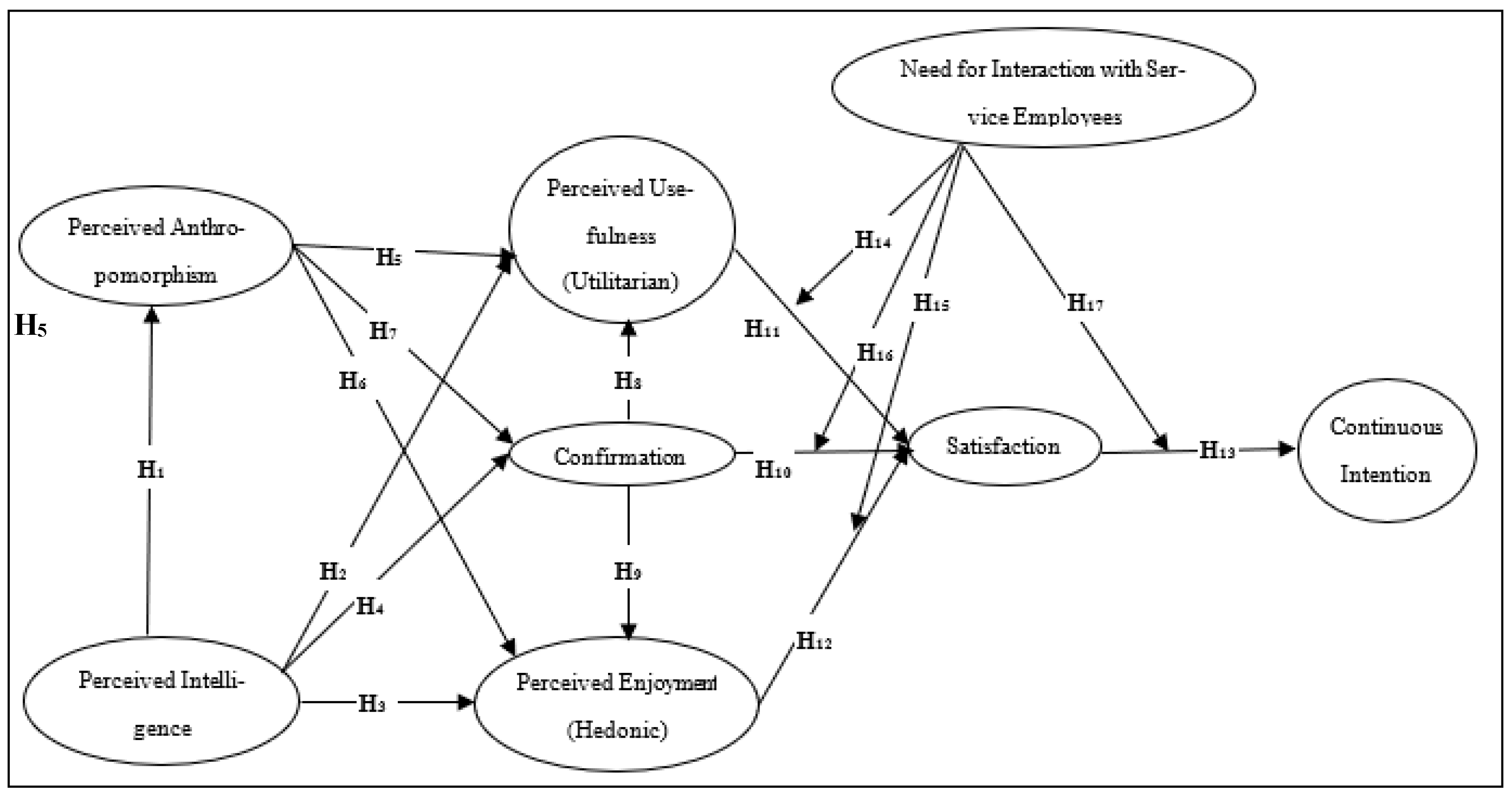
The ECM has been applied across various sectors to assess chatbot satisfaction and continuance intention, including e-commerce [29,62,63], banking [42,64,65,66,67,68], and mobile application usage [69]. In this study, the expectation–confirmation model is extended with artificial intelligence attributes (perceived intelligence and perceived anthropomorphism) and the dimension of perceived enjoyment to investigate bank users’ intentions to continue using chatbot services. Perceived intelligence and perceived anthropomorphism are employed as the artificial intelligence determinants, whereas the variables of the expectation–confirmation model consist of perceived usefulness, perceived enjoyment, confirmation, satisfaction, and continuance intention. The conceptual model of the study is presented in Figure 1.

2.2. Hypothesis Development

2.2.1. Perceived Intelligence

Perceived intelligence refers to the extent to which users believe that an AI-enabled system can perform a task intelligently [42]. In AI-enabled mobile banking applications, intelligence and anthropomorphism complement one another. When users interact with the applications, the intelligent features exhibited by the AI may be perceived as a form of friendly and respectful behavior, reflecting users’ perception of the humanization of these applications [6]. When chatbots display intelligent features, such as offering personalized financial management plans, providing banking services derived from AI algorithms, or communicating through natural language, users tend to perceive them as resembling real humans, believing they can interact with them and receive assistance [70]. Existing research on mobile banking indicates that the function of intelligence can enhance anthropomorphism [1,6,28,31,42,70]. Therefore, perceived intelligence is expected to positively influence perceived anthropomorphism. Accordingly, the following hypothesis is proposed in this study:
H1. 
Perceived intelligence has a positive and statistically significant effect on perceived anthropomorphism.
The perception of intelligence is a salient characteristic of AI-enabled information technologies and contributes to the development of a more positive cognitive experience during interactions between humans and artificial intelligence [42]. Chatbots embedded in mobile banking applications can provide useful suggestions and effective, personalized responses based on user input and users’ needs [70]. At the same time, chatbots can remember users’ names and past behaviors, actively inquire about their needs, assist in automatically completing forms, and provide personalized support [70]. Moreover, the benefits of intelligence lead users to believe that using the applications can help resolve issues during transactions and enable them to complete various tasks quickly, thereby enhancing the overall effectiveness of mobile banking [6]. A review of the literature indicates that when users perceive a high level of intelligence in an AI system, they are more likely to find it useful because it aligns with their task requirements and expectations [1,6,31,42,70]. Therefore, perceived intelligence is expected to have a positive effect on perceived usefulness. Accordingly, the following hypothesis is proposed in this study:
H2. 
Perceived intelligence has a positive and statistically significant effect on perceived usefulness.
When using a chatbot, perceived intelligence can enhance the autonomy and efficiency of banking services and provide users with assistance and guidance through natural language, expressions, and dialogue that elevate their emotional experience [70]. Thanks to their ability to understand commands, complete desired tasks rapidly, and communicate effectively while delivering personalized content that deeply engages users, it becomes possible to have an emotionally evocative interaction with chatbots; consequently, users can derive experiential value from the conversation [71]. The appeal of artificial intelligence lies not only in its ability to respond to users’ needs but also in its capacity to dynamically interpret users’ emotions through appropriate interpersonal responses, address their functional and emotional requirements, and enhance their affective experience. This capability allows users to feel respected, understood, and valued when interacting with a chatbot, perceive the conversation as enjoyable, and consequently experience enhanced interaction quality, which can strengthen their intention to continue using the chatbot [70]. A review of the literature shows that when users perceive a high level of intelligence in an AI system, they are more likely to find the interaction enjoyable, as the system makes them feel special and meets their emotional needs [70,72]. Therefore, perceived intelligence is expected to have a positive effect on perceived enjoyment. Accordingly, the following hypothesis is proposed in this study:
H3. 
Perceived intelligence has a positive and statistically significant effect on perceived enjoyment.
Customers indicate that when they perceive artificial intelligence to be sufficiently intelligent, they are more willing to have their expectations met or exceeded [42]. Chatbots embedded in mobile banking applications, through their intelligence capabilities, are able to meet users’ expected financial needs and goals while they perform mobile banking transactions. When users perceive that the services provided through the application’s intelligence functions meet their expectations, their post-usage confirmation is achieved [6]. A review of the literature indicates that perceived intelligence has a statistically significant and positive effect on user confirmation [1,6,42]. Therefore, perceived intelligence is expected to have a positive effect on user confirmation. Accordingly, the following hypothesis is proposed in this study:
H4. 
Perceived intelligence has a positive and statistically significant effect on user confirmation.

2.2.2. Perceived Anthropomorphism

Perceived anthropomorphism involves attributing human-like characteristics, emotions, intentions, and behaviors to nonhuman entities such as robots, virtual assistants, or other digital technologies [42]. Chatbots are able to communicate in human-like ways by using simple and easy-to-understand language resembling human dialogue to assist users in completing difficult processes and tasks and to guide them through these activities [6]. Moreover, by simulating a real person to replicate face-to-face service, chatbots can respond effectively to issues that arise during the transaction process and accommodate users’ service requests [6,28,31]. Accordingly, due to the influence of anthropomorphic features, users believe that chatbots can address problems more flexibly from a human-like perspective and evaluate their utility more favorably, which in turn enhances users’ perceived usefulness of mobile banking [6,42,73]. The literature shows that anthropomorphism enables users to have their financial needs met and facilitates the successful completion of financial tasks when using chatbots embedded in AI-enabled mobile banking applications [6,28,31,42,71]. However, recent studies suggest that the effects of anthropomorphism are not universally positive and may vary depending on the context of interaction. In particular, anthropomorphic chatbots may lead to negative outcomes in certain service situations. For example, when users are in an emotionally negative state such as anger, anthropomorphism may increase expectations regarding the chatbot’s capabilities, which can result in expectancy violations and subsequently reduce evaluations, and may also trigger frustration and even aggressive responses when expectations are not met [74,75]. Similarly, excessive levels of anthropomorphism may be perceived as inappropriate or unsettling in high-stakes service contexts, thereby diminishing trust and perceived effectiveness [76]. Nevertheless, in the context of routine and goal-oriented interactions such as mobile banking, where users primarily seek efficiency and task completion, anthropomorphic features are expected to facilitate communication and enhance problem-solving capabilities, thereby increasing perceived usefulness in a context-dependent manner. Accordingly, the following hypothesis is proposed in this study:
H5. 
Perceived anthropomorphism has a positive and statistically significant effect on perceived usefulness.
Perceived anthropomorphism fills the interactional need between consumers and digital services, thereby addressing a psychological gap. Perceived anthropomorphism can make the digital banking interaction conducted through a chatbot more empathetic, trustworthy, and satisfying, thereby contributing to the formation of a more fulfilling user experience [42]. Research has shown that users place greater trust in technologies that possess human-like characteristics [77,78]. Chatbots embedded in mobile banking applications likewise gain users’ trust by communicating with them and fostering emotional bonds, thereby strengthening the relationship between the chatbot and the user [6,28,42]. By employing AI technologies that appear more “human” to users, banks are able to provide more personalized and intuitive banking services and enhance the efficiency and effectiveness of their service delivery models [42]. However, studies in the literature have concluded that chatbots with higher levels of anthropomorphism are perceived as more enjoyable, thereby generating greater enjoyment and increasing user acceptance [71,79,80,81,82,83]. Nevertheless, recent studies indicate that the effects of anthropomorphism on user experience are not always positive and may vary depending on the level of human-likeness and the interaction context. In particular, excessive anthropomorphism may lead to discomfort, unrealistic expectations, and adverse emotional responses, especially when chatbots fail to meet users’ expectations or deliver unfavorable outcomes [74,76]. In this context, anthropomorphic features may increase users’ expectations; when these expectations are not fulfilled, they may lead to disappointment, cognitive dissonance, and negative emotional reactions [75]. Such responses may, in turn, indirectly reduce enjoyment derived from the interaction. This is consistent with the “uncanny valley” perspective, which suggests that overly human-like agents may evoke feelings of unease and discomfort [84,85]. However, in high-risk service contexts such as mobile banking, where financial accuracy and reliability are critical, users may seek not only functional support but also emotional reassurance during their interactions. In such situations, chatbots that exhibit anthropomorphic characteristics, such as expressing empathy, using natural language, and establishing warm and socially engaging interactions, can help reduce users’ uncertainty and psychological discomfort [9,86,87]. By fostering a sense of social presence and emotional connection, these features make the interaction more natural, engaging, and emotionally satisfying, thereby increasing perceived enjoyment depending on the interaction context. Accordingly, the following hypothesis is proposed in this study:
H6. 
Perceived anthropomorphism has a positive and statistically significant effect on perceived enjoyment.
With the support of artificial intelligence, people believe that the anthropomorphic elements perceived in chatbots can provide them with friendly service in a manner similar to what they would receive from real humans in a face-to-face setting. Accordingly, their actual usage of chatbots increases, and they become more inclined to confirm that mobile banking services meet their expectations [6]. In their study, Bhatnagr and Rajesh [1] state that the concept of expectation confirmation strengthens the relationship between anthropomorphism and confirmation; that satisfaction arises when initial expectations are validated through experience; and that the use of anthropomorphic elements enables users, who expect chatbots to be not only efficient but also visually appealing and human-like, to have these expectations more clearly confirmed, thereby leading to a more favorable reassessment of the chatbot. In other words, anthropomorphism can help chatbots meet users’ usage-related expectations and promote a coherent perception of the alignment between those expectations and the actual performance of mobile banking services [6]. A review of the literature indicates that perceived anthropomorphism has a statistically significant and positive effect on user confirmation [1,6,42]. However, recent research suggests that anthropomorphism may lead to inflated expectations regarding the chatbot’s capabilities, thereby increasing the risk of expectation disconfirmation when performance falls short [74,76]. In this regard, anthropomorphic features may elevate users’ expectations, and when these expectations are not fulfilled, they may result in cognitive dissonance and negative evaluative responses [75]. This indicates that the effect of anthropomorphism on confirmation is not always uniformly positive but may vary depending on users’ expectations and the service context. Nevertheless, in service contexts such as mobile banking, where users interact with AI systems to perform specific transactions, anthropomorphic features contribute to making the interaction more understandable, predictable, and aligned with user expectations. Chatbots that exhibit anthropomorphic characteristics—such as expressing empathy, using natural language, and providing human-like responses—enable users to interpret how the system operates more accurately and to form more realistic expectations [1,6,9,42]. Accordingly, anthropomorphic features are expected to strengthen the alignment between perceived performance and user expectations, thereby increasing the level of confirmation. Accordingly, the following hypothesis is proposed in this study:
H7. 
Perceived anthropomorphism has a positive and statistically significant effect on user confirmation.

2.2.3. Expectation–Confirmation

In the context of chatbots embedded in digital banking applications, confirmation generates a sense of benefit when users’ expectations regarding the chatbot’s functionality, response speed, and overall experience are met or exceeded [42]. Yuan et al. [88] note that an individual’s expectations are confirmed when those expectations align with the expected benefit or performance of the banking services provided by the chatbot [6]. A review of the literature confirms the effect of user confirmation on perceived usefulness in the context of mobile banking [6,29,40,42,64,66,88,89,90,91,92,93,94,95,96]. In this study, drawing on Expectation—Confirmation Theory (ECT) [61], the proposed hypothesis suggests that the confirmation of prior expectations leads to the chatbot embedded in mobile banking applications being perceived as useful. Therefore, user confirmation is expected to have a positive effect on perceived usefulness. Accordingly, the following hypothesis is proposed in this study:
H8. 
User confirmation has a positive and statistically significant effect on perceived usefulness.
However, perceived enjoyment is an intrinsic motivation fueled by positive emotional experiences and capable of influencing users’ intentional behaviors. When users confirm that the features of the chatbot embedded in mobile banking applications meet their expectations, they may perceive the chatbot as enjoyable, which in turn can trigger their intention to continue using it [97]. A review of the literature confirms the effect of user confirmation on perceived enjoyment in the context of mobile banking [39,40,92,96,97,98]. Therefore, user confirmation is expected to have a positive effect on perceived enjoyment. Accordingly, the following hypothesis is proposed in this study:
H9. 
User confirmation has a positive and statistically significant effect on perceived enjoyment.
When expectations are confirmed, users believe that using chatbots can meet their needs for banking services or financial transactions; that the chatbot helps them resolve problems; that it is flawless and friendly; and that it provides personalized service—ultimately leading to a pleasant usage experience and increased satisfaction [6,42,99]. Accordingly, when users’ expectations are confirmed, their satisfaction with chatbots will increase [39,100,101]. Customer satisfaction increases when the chatbot delivers a superior experience, adheres to the promised level of service, and meets user expectations [29]. In this study, drawing on expectation—confirmation theory (ECT) [61], the proposed hypothesis suggests that the confirmation of prior expectations increases users’ satisfaction with the chatbot embedded in mobile banking applications. A review of the literature confirms the effect of user confirmation on satisfaction in the context of mobile banking [6,29,38,39,42,64,66,88,90,91,92,93,94,95,96,97,98,102]. Therefore, user confirmation is expected to have a positive effect on satisfaction. Accordingly, the following hypothesis is proposed in this study:
H10. 
User confirmation has a positive and statistically significant effect on satisfaction.

2.2.4. Perceived Usefulness and Perceived Enjoyment

The ECM posits that perceived usefulness has a positive effect on user satisfaction [6,37,103]. However, Wang [58] notes that since both perceived usefulness and perceived enjoyment are regarded as post-usage expectations in the Expectation—Confirmation Model, it is possible for a user to experience satisfaction when they hold expectations regarding either usefulness or enjoyment. In the context of mobile banking, if users feel that chatbots are helpful and beneficial in performing banking tasks, they will experience pleasant interactions [6]. Users tend to report higher levels of satisfaction when chatbots handle their questions and complaints effectively and quickly, and they perceive their interactions with chatbots as valuable and enjoyable when the chatbot successfully completes these tasks [29]. In other words, the more users perceive the chatbot embedded in AI-enabled mobile banking applications as valuable to use, the greater their satisfaction with the chatbot becomes [6]. Researchers have concluded that users’ perceived usefulness [6,29,44,64,66,88,93,95,104,105] and perceived enjoyment [39,44,58,70] have a significant effect on their satisfaction with the services provided by chatbots. Therefore, perceived usefulness and perceived enjoyment are expected to have positive effects on satisfaction. Accordingly, the following hypothesis is proposed in this study:
H11. 
Perceived usefulness has a positive and statistically significant effect on satisfaction.
H12. 
Perceived enjoyment has a positive and statistically significant effect on satisfaction.

2.2.5. Satisfaction

However, as suggested in the ECM [6,37,39,106], when users are satisfied with the services provided by chatbots embedded in mobile banking applications, they tend to continually adopt and use these chatbots [6]. Therefore, satisfaction is expected to have a positive effect on continuance intention. Accordingly, the following hypothesis is proposed in this study:
H13. 
Satisfaction has a positive and statistically significant effect on users’ continuance intention to use chatbots.

2.2.6. The Moderating Role of the Need for Interaction with a Service Employee

Today, chatbots frequently replace human service employees [73]. Dabholkar and Bagozzi [46] defined the need for interaction with a service employee as “the importance of human interaction to the customer during service encounters.” The need for human interaction can be summarized as the desire to personally interact with a service provider and to benefit from customer service [73]. Ashfaq et al. [44] found that the need for interaction with a service employee has a moderating effect on both the relationship between perceived usefulness and satisfaction and the relationship between perceived enjoyment and satisfaction. Researchers have noted that users with a higher need for interaction with a service employee may have very low expectations regarding chatbot services; therefore, enhancing these users’ perceptions of usefulness—for example, by providing highly relevant information, offering personalized recommendations, and resolving issues promptly and efficiently—can increase their satisfaction. However, Pereira et al. [50] found that, in the context of chatbots, the need for interaction with a service employee plays a moderating role only in the relationship between perceived enjoyment and satisfaction, and has no moderating effect on the relationship between perceived usefulness and satisfaction. Accordingly, the following hypothesis is proposed in this study:
H14. 
The need for interaction with a service employee has a moderating effect on the relationship between perceived usefulness and satisfaction.
H15. 
The need for interaction with a service employee has a moderating effect on the relationship between perceived enjoyment and satisfaction.
Chatbots can enhance the sense of “human connection” by filtering out questions that can be answered quickly, thereby allowing live agents to assist customers in more complex situations that require human interaction. However, a chatbot with highly anthropomorphic features may appear human enough for consumers to associate it with a real person [73]. As a result, for users who have initially low expectations but a high need for interaction with a service employee, their expectations regarding chatbot services may become aligned with actual performance, thereby increasing the likelihood that their expectations will be confirmed [40,99]. Confirmation increases perceived enjoyment and usefulness, whereas disconfirmation reduces them [107]. Therefore, for users with a higher need for interaction with a service employee, greater perceived usefulness will lead to higher satisfaction. For users with a lower need for interaction with a service employee, such a positive effect will be less pronounced. Accordingly, the following hypothesis is proposed in this study:
H16. 
The need for interaction with a service employee has a moderating effect on the relationship between expectation–confirmation and satisfaction.
A review of the literature shows that customers who are satisfied with chatbots are more likely to continue using them [6,42,69,108,109]. Ashfaq et al. [44] further noted that less experienced chatbot users may find it safer and more comfortable to interact with a human service employee rather than a chatbot and may feel more confident in doing so. Choi et al. [107] found in their study that the quality of services provided by humans results in more favorable relational outcomes than those provided by robotic services. This finding indicates that a user with a higher need for interaction with a service employee requires greater satisfaction to continue using the chatbot embedded in mobile banking applications compared to a user with a lower need for such interaction [110]. Accordingly, the following hypothesis is proposed in this study:
H17. 
The need for interaction with a service employee has a moderating effect on the relationship between satisfaction and the intention to continue using chatbots.

3. Method

3.1. Pretest and Pilot Study

As the original measurement instruments used in the model were developed in English, the back-translation method was applied to translate them into Turkish, and a preliminary Turkish questionnaire form was developed accordingly. To ensure face and content validity of the questionnaire, it was evaluated by three experts in the fields of mobile banking and artificial intelligence. Several revisions were made to the questionnaire based on the experts’ suggestions. Subsequently, 30 users of AI-enabled mobile banking applications participated in the pilot study, and the questionnaire was finalized based on their feedback.

3.2. Sample and Data Collection

The target population of the study consists of consumers in Türkiye who use chatbots embedded in banks’ mobile applications. Given time and cost constraints, a convenience sampling method was employed. The data were collected through face-to-face surveys between 19 February 2025 and 2 April 2025. A total of 402 responses were obtained and used for further analysis. No missing data were observed in the dataset, and all responses were complete.
Before data collection, ethical approval for the study was obtained from the Social Sciences Scientific Research and Publication Ethics Committee of Osmaniye Korkut Ata University (Decision Date: 29 November 2023; Decision No: 2023/14/7).

3.3. Procedure and Measures

From a procedural perspective, before data collection, participants were informed about the purpose and scope of the study, and their voluntary participation was secured through an informed consent form. Participation was entirely voluntary, and respondents were assured of the confidentiality and anonymity of their responses. Following this, the concept of a chatbot was briefly introduced at the beginning of the questionnaire to ensure that respondents had a clear and consistent understanding of the concept. Participants were then asked a dichotomous question (Yes/No) regarding whether they had previously used a chatbot to perform banking and financial transactions. Only participants who indicated prior chatbot experience were allowed to proceed with the survey. Participants were initially asked demographic questions, followed by general questions regarding their familiarity with and use of chatbots. The measurement items were presented in a structured sequence. Specifically, perceived anthropomorphism and perceived intelligence were measured first, followed by perceived usefulness and confirmation. Subsequently, perceived enjoyment, need for interaction with a service employee, and privacy concern constructs were assessed. Finally, satisfaction and continuance intention were measured. All constructs were measured using a seven-point Likert scale ranging from “strongly disagree” to “strongly agree.”

3.4. Measures

Within the scope of the study, perceived anthropomorphism was measured using four items adapted from Ghaniabadi [111]; perceived intelligence was measured using six items adapted from the studies of Moussawi et al. [112] and Bhatnagr and Rajesh [1]; perceived usefulness was measured using six items adapted from Ghaniabadi [111], Moussawi et al. [112], and Bhatnagr and Rajesh [1]; user confirmation (expectation–confirmation) was measured using three items adapted from Sundjaja et al. [29]; perceived enjoyment was measured using four items adapted from Ghaniabadi [111]; satisfaction was measured using four items adapted from Sundjaja et al. [29]; continuance intention to use chatbots was measured using five items adapted from Moussawi et al. [112] and Bhatnagr and Rajesh [1]; and the need for interaction with a service employee was measured using four items adapted from Dabholkar and Bagozzi [46]. A seven-point Likert scale (1 = Strongly disagree and 7 = Strongly agree) was used to measure all constructs included in the study.

3.5. Data Analysis Method

The research hypotheses were tested using the PLS-SEM method. The first reason for selecting PLS-SEM for the analysis is that, as a variance-based approach, PLS-SEM is more suitable than CB-SEM (a covariance-based approach) for identifying and predicting the key driving forces within the structural model [80]. Another reason is that PLS-SEM is capable of handling complex models that include both formative and reflective measurement models, and it can manage such complex structures with fewer restrictions compared to CB-SEM. [113]. The conceptual model of the study is complex and includes numerous constructs, indicators, and model relationships; these factors, along with the other reasons mentioned, indicate that the use of the PLS-SEM method is more appropriate for testing the research hypotheses [114]. Hayes’ [115] PROCESS Model 58 was employed to assess the moderating effects of the need for interaction with a service employee. The analysis was conducted using SmartPLS 4 and SPSS 25.0 software.

4. Research Findings

4.1. Demographic Characteristics of the Participants

Of the 402 participants in the study, 52% were female and 48% were male. 31% of the respondents reported being in the 18–25 age group. 60% of the participants stated that they are university graduates. Civil servants constitute 26% of the respondents who participated in the survey. 40% of the participants reported that their monthly household income ranges between 22,104 TL and 50,000 TL. 78% of the participants stated that they are knowledgeable about chatbots, while 22% indicated that they are only partially informed; additionally, 57% of the respondents reported that they have been aware of chatbots for six months or less. 52% of the participants indicated that their source of information about chatbots is friends or family, while 33% stated that their source of information is social media. 44% of the respondents stated that they use chatbots several times a week.

4.2. Common Method Bias

In this study, the potential presence of common method bias (CMB) arising from the data collection process was assessed based on the procedure developed by Podsakoff et al. [116]. Harman’s single-factor test was conducted, and the principal component analysis revealed that the first factor accounted for 45.5% of the total variance. Since this ratio is below the 50% threshold commonly accepted in the literature, it can be inferred that the results are not adversely affected by common method bias.

4.3. Evaluation/Assessment of the Measurement Model

Within the scope of the study, using PLS-SEM analysis, the internal consistency, convergent validity, and discriminant validity of the constructs in the measurement model were first assessed. Subsequently, the relationships specified in the model were examined, and the proposed hypotheses were evaluated. The results of the PLS-SEM analysis conducted are presented in Table 1.
As a result of the analysis, it was observed that the composite reliability and Cronbach’s alpha values for each construct exceeded the threshold of 0.70, as presented in Table 2. This indicates that the observed variables exhibit high internal consistency [117,118]. The analyses revealed that the standardized factor loadings for each variable exceeded 0.70. Furthermore, it was determined that the average variance extracted (AVE) values exceeded the threshold of 0.50. These results indicate that the measurement model satisfies convergent validity [117]. To assess the discriminant validity of the measurement model, the correlation coefficients between the constructs were compared with the square roots of the average variance extracted (AVE) for each construct. This comparison is presented in Table 2.
For the measurement model to satisfy discriminant validity, the square roots of the average variance extracted (AVE) for each construct must be higher than the correlation coefficients between that construct and the other constructs [119]. It can be seen in Table 2 that the square roots of the AVE values, highlighted in bold, are higher than the inter-construct correlation coefficients. Additionally, the analysis revealed that the heterotrait—monotrait (HTMT) ratios were below 0.85. Therefore, it can be concluded that the measurement model satisfies discriminant validity [118].

4.4. Evaluation of the Structural Model

The relationships specified in the conceptual model of the study were tested using PLS-SEM analysis. To obtain the statistical significance levels of the beta coefficients and the R2 values for evaluating the relationships in the model, the bootstrap technique (resampling method with 5000 resamples) was employed [117]. To comprehensively evaluate the overall quality and fit of the model, the SRMR and NFI values recommended for PLS-SEM analyses were used [42]. An SRMR value below 0.08 is generally considered an indicator of good model fit. The analysis revealed an SRMR value of 0.076, and since this value is lower than the 0.08 threshold, it indicates an acceptable level of fit between the model and the observed data. The NFI value is expected to fall within the range of 0 to 1. An NFI value closer to 1 indicates a better model fit. For the model in this study, the NFI value was calculated as 0.865. Due to the reflective nature of the model, the inner Variance Inflation Factor (VIF) values were examined to assess multicollinearity within the inner model. Hair et al. ([113]) state that in PLS-SEM analyses, VIF values below 3.3 in the inner model indicate that multicollinearity is not a serious concern. In this study, all inner VIF values were also found to be below 3.3, indicating that multicollinearity is not an issue in the model (Table 3). Therefore, it can be concluded that the proposed model exhibits a good fit with the observed data. The values identified for the direct and indirect effects in the model, along with the hypothesis testing results, are presented in Table 4.
Upon examining the analysis results, it was determined that perceived intelligence has a positive and statistically significant effect on perceived anthropomorphism (β = 0.470, SE = 0.037, p < 0.001), perceived usefulness (β = 0.239, SE = 0.035, p < 0.001), expectation–confirmation (β = 0.421, SE = 0.040, p < 0.001), and perceived enjoyment (β = 0.125, SE = 0.049, p < 0.05). Accordingly, the hypotheses H1, H2, H3 and H4 developed within the scope of the research were supported. Similarly, it was found that perceived anthropomorphism has a positive and statistically significant effect on perceived usefulness (β = 0.203, SE = 0.041, p < 0.001), expectation–confirmation (β = 0.426, SE = 0.040, p < 0.001), and perceived enjoyment (β = 0.327, SE = 0.052, p < 0.001). Accordingly, the hypotheses H5, H6 and H7 developed within the scope of the research were supported. According to the analysis results, the expectation–confirmation construct was found to have a statistically significant effect on perceived usefulness (β = 0.485, SE = 0.046, p < 0.001) and perceived enjoyment (β = 0.361, SE = 0.059, p < 0.001). Accordingly, the hypotheses H8 and H9 developed within the scope of the research were supported. Similarly, it was found that expectation–confirmation (β = 0.441, SE = 0.065, p < 0.001), perceived usefulness (β = 0.322, SE = 0.053, p < 0.001), and perceived enjoyment (β = 0.108, SE = 0.053, p < 0.001) have statistically significant effects on satisfaction. Accordingly, the hypotheses H10, H11 and H12 developed within the scope of the research were supported. Finally, it was determined that the satisfaction construct has a statistically significant effect on continuance intention (β = 0.726, SE = 0.020, p < 0.001). Accordingly, the hypothesis H13 developed within the scope of the research was supported.
The moderating—mediating (moderated mediation/conditional effect) role of the need for interaction with service employees in the relationships specified in the research model was simultaneously tested using Hayes’ [115] SPSS PROCESS Macro Version 3.5.3 (Model 58; 5000 bootstrap resamples and a 95% confidence interval). The conditional effect analysis results for the need for interaction with service employees on the relationships specified in the model are presented in Table 4.
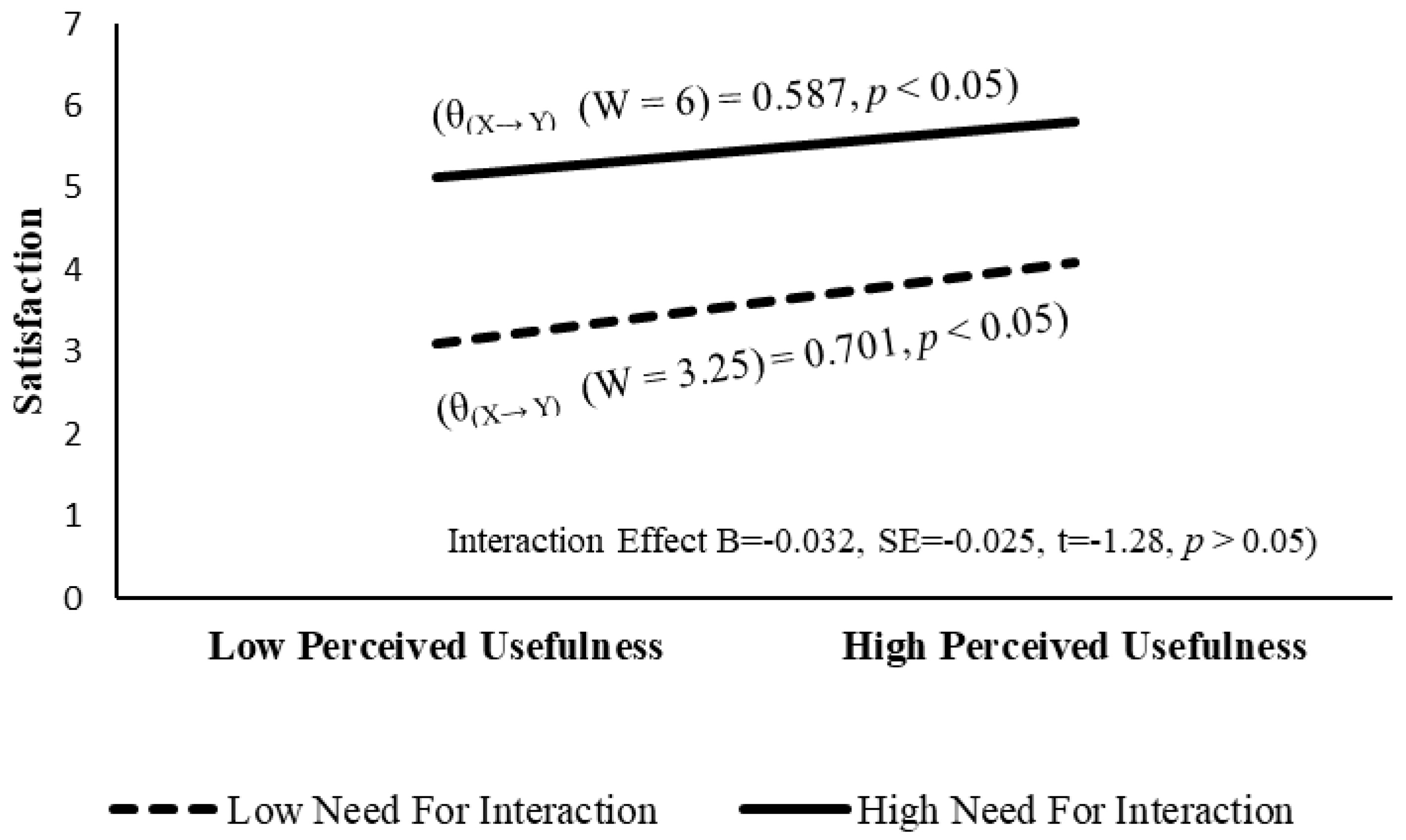
As shown in Table 4, the interaction effect between perceived usefulness and the need for interaction with a service employee (B = −0.0317, SE = −0.0248, t = −1.280, and p > 0.05) was found to be statistically non-significant. However, although the interaction effect itself was not statistically significant, the results of the conditional effects analysis revealed that different levels of the need for interaction with a service employee (low, medium, and high) produced significant effect sizes in the relationship between perceived usefulness and satisfaction (Table 5). This indicates that, although the moderator variable does not produce an overall interaction effect, the conditional effects are statistically significant; therefore, Hypothesis H14 is partially supported. Although the interaction term is not significant in the overall model, the conditional indirect effects are significant in the pick-a-point analysis, and statistically significant differences are observed across the levels of the moderator. The analysis results are presented in Table 5.
When Table 5 is examined, it is observed that the conditional effect of perceived usefulness of chatbots on satisfaction—evaluated as a function of the need for interaction with service employees (low, medium, and high)—is positive and statistically significant (p < 0.001). This finding indicates that as the need for interaction with service employees increases, the conditional effect of perceived usefulness gradually decreases, although it remains significant. To determine the level of need for interaction with service employees at which the perceived usefulness of chatbots significantly influences satisfaction, the conditional effect was examined using the Pick-a-Point approach. This method was chosen because it is one of the most widely used techniques for analyzing interaction effects. To identify the low, medium, and high levels of the moderator variable, the 16th, 50th, and 84th percentiles recommended by Hayes [115] were used. The analysis results are presented in Figure 2.
Upon examining Figure 2, it is observed that the conditional effect of perceived usefulness on satisfaction is statistically significant at both the low level (θ(X→Y) (W = 3.25) = 0.7006, p < 0.05) and the high level (θ(X→Y) (W = 6) = 0.5870, p < 0.05) of the need for interaction with service employees. When comparing the magnitudes of the conditional effects, it is observed that the effect is stronger among users with a low need for interaction with service employees. This result indicates that individuals with a lower need for interaction with service employees experience greater satisfaction from using chatbots as their perceived usefulness increases.
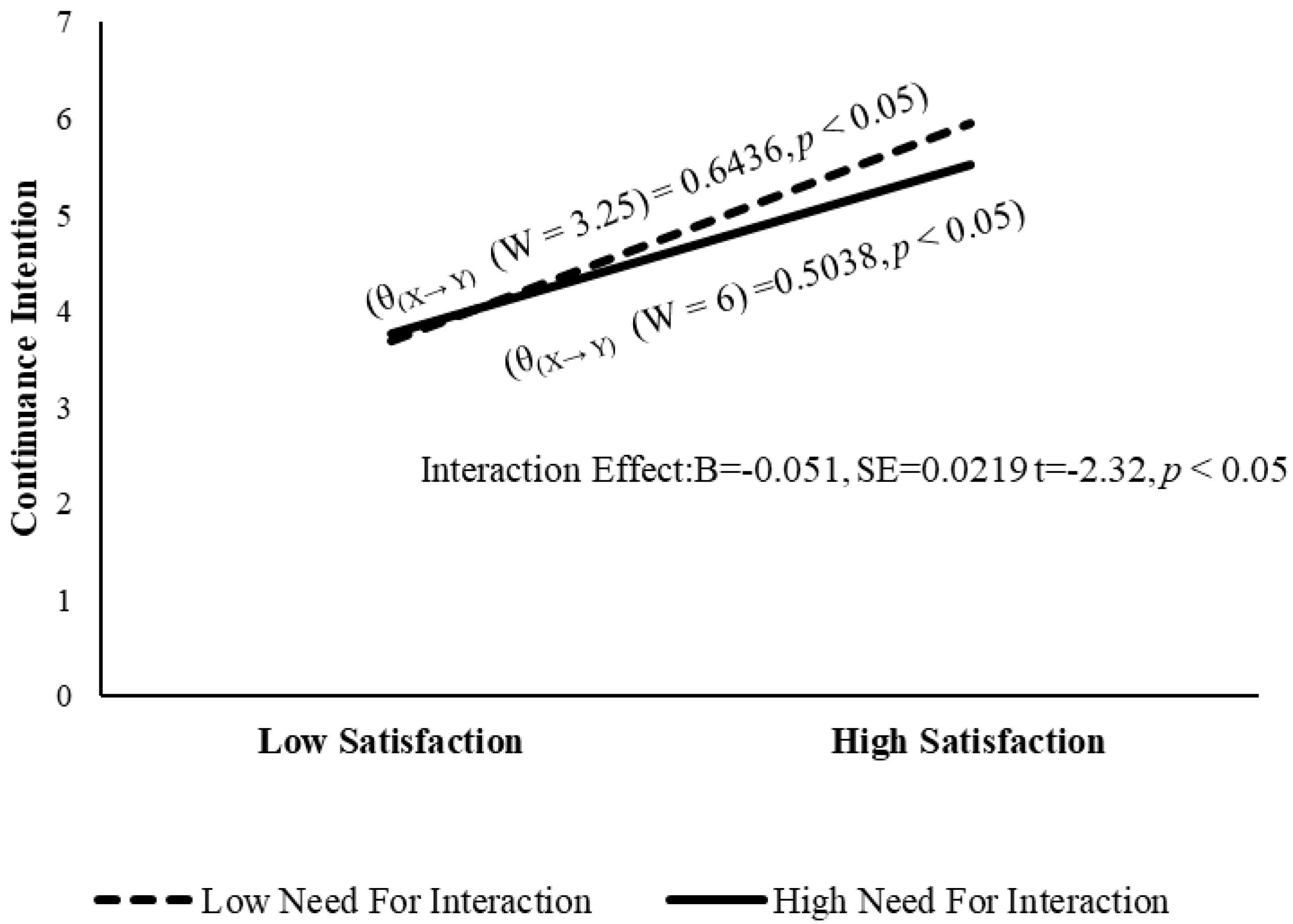
As a result of the analysis conducted for the perceived usefulness model, the interaction effect of satisfaction and the need for interaction with service employees on the intention to continue using chatbots was found to be statistically significant and negative (B = −0.0508, SE = 0.0219, t = −2.32, p < 0.05). Based on the statistical significance of the interaction effect, Hypothesis H17 is supported. Based on this finding, it can be stated that the need for interaction with service employees exerts a negative moderating effect on the positive relationship between satisfaction and continuance intention. The analysis results for the conditional effect levels of different degrees of need for interaction with service employees (low, medium, and high) on the relationship between satisfaction and continuance intention are presented in Table 6.
When Table 6 is examined, it is observed that the conditional effect of satisfaction with chatbots on the intention to continue using them—evaluated as a function of the need for interaction with service employees (low, medium, and high)—is positive and statistically significant (p < 0.001). Therefore, it can be stated that as the need for interaction with service employees increases, the conditional effect of satisfaction with chatbots on the intention to continue using them decreases. To determine the levels at which satisfaction with chatbots significantly influences the intention to continue using them as a function of the need for interaction with service employees, the conditional effect was examined using the pick-a-point method. To identify the low, medium, and high levels of the moderator variable, the 16th, 50th, and 84th percentiles recommended by Hayes [115] (2022) were used. The analysis results are presented in Figure 3.
When Figure 3 is examined, it is observed that the conditional effect of satisfaction on continuance intention is statistically significant at both the low level of the need for interaction with service employees (θ(X→Y) (W = 3.25) = 0.6436, p < 0.05) and the high level (θ(X→Y) (W = 6) = 0.5038, p < 0.05). When comparing the magnitudes of the conditional effects, it is observed that the effect is stronger among users with a low need for interaction with service employees. Furthermore, the interaction effect being negative and statistically significant (B = −0.051, t = −2.32, p < 0.05) indicates that the influence of satisfaction on continuance intention is relatively stronger among individuals with a low need for interaction with service employees. It can therefore be stated that the need for interaction with service employees functions as a moderating variable that reduces the effect of satisfaction on the intention to continue using the chatbot.
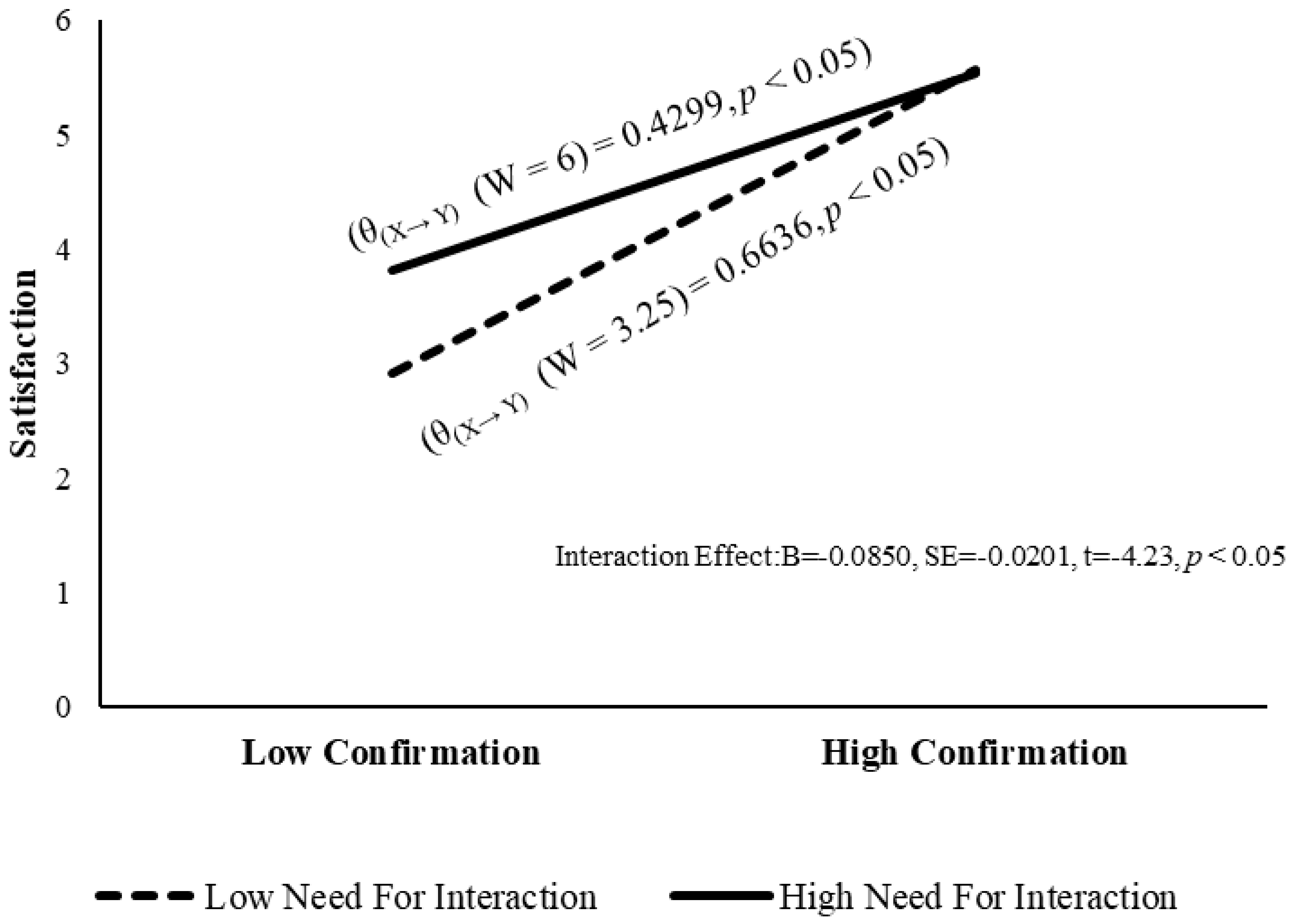
When Table 4 is examined, it is observed that the interaction effect between expectation–confirmation and the need for interaction with service employees is statistically significant (B = −0.0850, SE = 0.0201, t = −4.23, p < 0.05). The interaction effect was statistically significant; therefore, Hypothesis H16 is supported. The analysis results for the conditional effect levels of the relationship between expectation–confirmation and satisfaction—across different levels (low, medium, and high) of the need for interaction with service employees—are presented in Table 7.
When Table 7 is examined, it is observed that the conditional effect of perceived expectation–confirmation of chatbots on perceived satisfaction, as a function of the need for interaction with service employees (low, medium, and high), is positive and statistically significant (p < 0.001). Therefore, it can be stated that as the need for interaction with service employees increases, the conditional effect of perceived expectation–confirmation of chatbots on perceived satisfaction decreases. To determine the levels at which expectation–confirmation significantly influences satisfaction as a function of the need for interaction with service employees, the conditional effect was examined using the pick-a-point method. To identify the low, medium, and high levels of the moderator variable, the 16th, 50th, and 84th percentiles recommended by Hayes [115] were used. The analysis results are presented in Figure 4.
As shown in Figure 4, the conditional effect of expectation–confirmation on satisfaction is statistically significant both at low levels of the need for interaction with a service employee (θ(X→Y) (W = 3.25) = 0.6636, p < 0.05) and at high levels (θ(X→Y) (W = 6) = 0.4299, p < 0.05). When the conditional effect sizes are compared, it is observed that the conditional effect is higher among users with a low need for interaction with a service employee. Moreover, the interaction effect being negative and statistically significant (B = −0.0850, SE = −0.0201, t = −4.23, p < 0.05) indicates that the effect of expectation–confirmation on satisfaction is relatively stronger among individuals with a low need for interaction with a service employee. In other words, when the need for human interaction is high, the effect of expectation–confirmation on satisfaction becomes weaker. It can thus be stated that the need for interaction with service employees’ functions as a moderating variable that reduces the effect of expectation–confirmation on satisfaction with chatbot use.
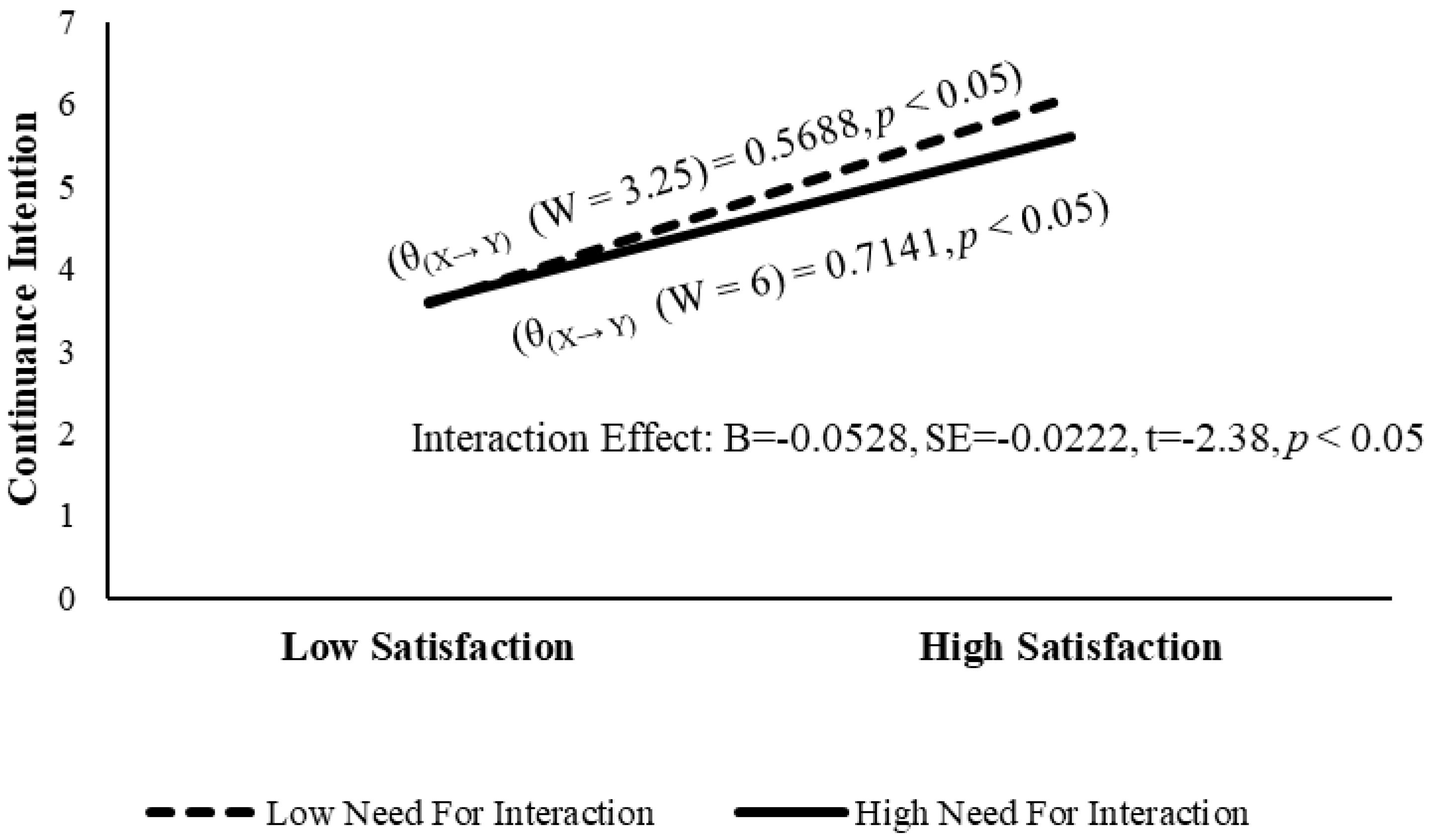
As a result of the conditional effect analysis (Model 58, see Table 4), it was determined that, within the expectation–confirmation model, the interaction effect of satisfaction and the need for interaction with service employees on the intention to continue using chatbots is statistically significant and negative (B = −0.0528, SE = 0.0222, t = −2.38, p < 0.05). Based on the statistical significance of the interaction effect, Hypothesis H17 is supported. Based on this finding, it can be stated that the need for interaction with service employees exhibits a negative moderating effect on the positive relationship between satisfaction and the intention to continue using the chatbot. The analysis results for the conditional effect levels of the relationship between satisfaction and continuance intention, across different levels (low, medium, and high) of the need for interaction with service employees, are presented in Table 8.
When Table 8 is examined, it is observed that the conditional effect of perceived satisfaction with chatbots on the intention to continue using them, as a function of the need for interaction with service employees (low, medium, and high), is positive and statistically significant (p < 0.001). Therefore, it can be stated that as the need for interaction with service employees increases, the conditional effect of satisfaction with chatbots on the intention to continue using them decreases. To determine the levels at which satisfaction with chatbots significantly influences the intention to continue using them as a function of the need for interaction with service employees, the conditional effect was examined using the pick-a-point method. To identify the low, medium, and high levels of the moderator variable, the 16th, 50th, and 84th percentiles recommended by Hayes [115] were used. The analysis results are presented in Figure 5.
When Figure 5 is examined, it is observed that the conditional effect of user satisfaction on the intention to continue using the application is statistically significant at both the low level of interaction need (θ(X→Y) (W = 3.25) = 0.7141, p < 0.05) and the high level (θ(X→Y) (W = 6) = 0.5688, p < 0.05). When the conditional effect sizes are compared, it is observed that the conditional effect is higher among users with a low need for interaction with a service employee. Moreover, the interaction effect being negative and statistically significant (B = −0.0528, t = −2.38, p < 0.05) indicates that the effect of satisfaction on continuance intention is relatively stronger among individuals with a low need for interaction with a service employee. In other words, when the need for human interaction is high, the effect of perceived satisfaction on continuance intention becomes weaker. It can thus be stated that the need for interaction with a service employee functions as a moderating variable that diminishes the effect of satisfaction with chatbot use on continuance intention.
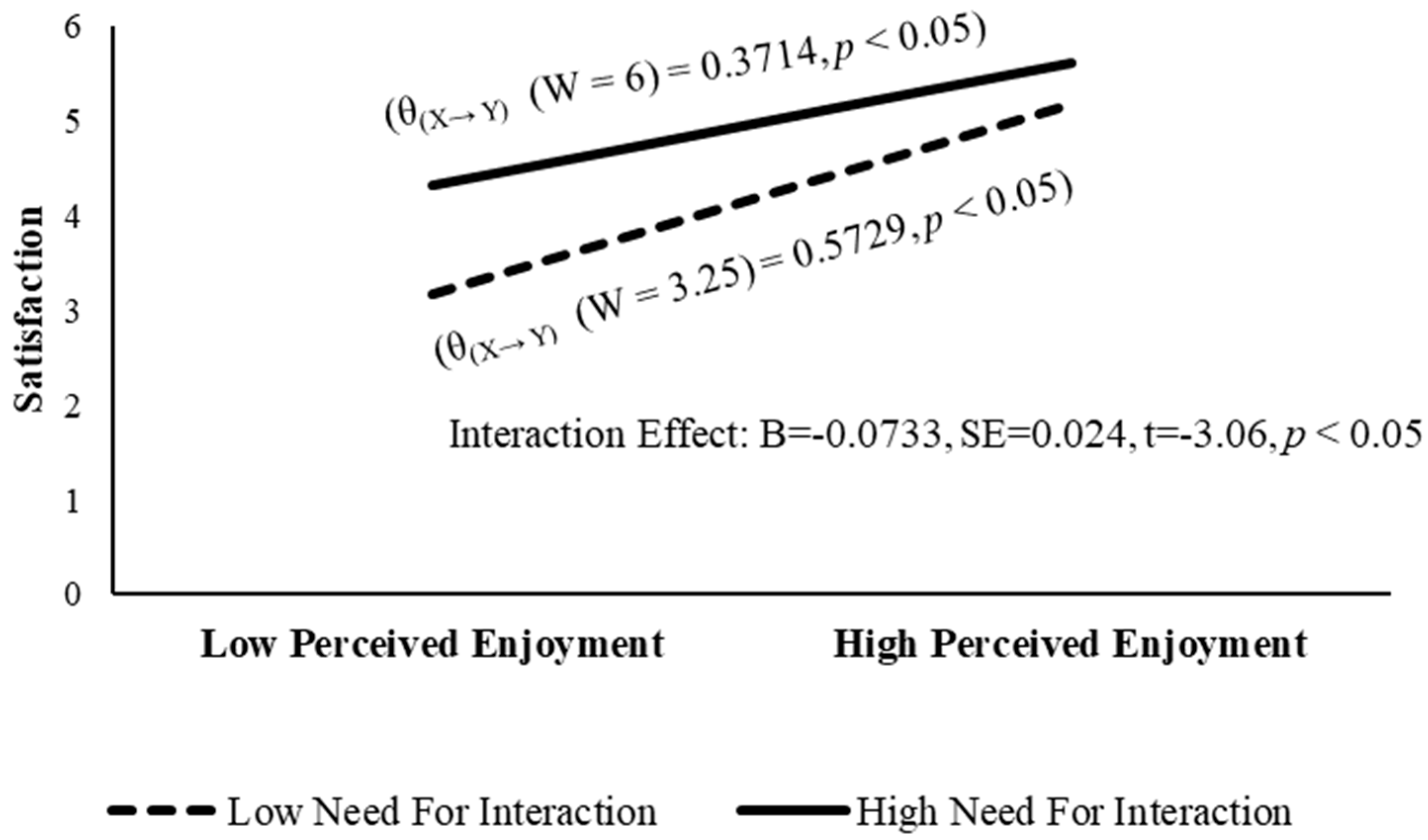
When Table 4 is examined, it is observed that the interaction effect between perceived enjoyment and the need for interaction with service employees is statistically significant (B = −0.0733, SE = 0.0239, t = −3.06, p < 0.05). Since the interaction effect is statistically significant, Hypothesis H15 is supported. The analysis results for the conditional effect levels of the relationship between perceived enjoyment and satisfaction, across different levels (low, medium, and high) of the need for interaction with service employees, are presented in Table 9.
When Table 9 is examined, it is observed that the conditional effect of perceived enjoyment of chatbots on perceived satisfaction, as a function of the need for interaction with service employees (low, medium, and high), is positive and statistically significant (p < 0.001). Therefore, it can be stated that as the need for interaction with service employees increases, the conditional effect of perceived enjoyment of chatbots on perceived satisfaction decreases. To determine the levels at which perceived enjoyment of chatbots significantly influences perceived satisfaction as a function of the need for interaction with service employees, the conditional effect was examined using the pick-a-point method. To identify the low, medium, and high levels of the moderator variable, the 16th, 50th, and 84th percentiles recommended by Hayes [115] were used. The analysis results are presented in Figure 6.
When Figure 6 is examined, it is observed that the conditional effect of perceived enjoyment on satisfaction is statistically significant at both the high level of the need for interaction with service employees (θ(X→Y) (W = 6) = 0.3714, p < 0.05) and the low level (θ(X→Y) (W = 3.25) = 0.5729, p < 0.05). When the magnitudes of the conditional effects are compared, it is found that the effect size is larger among users with a low need for interaction with service employees. The interaction effect being statistically significant and negative (B = −0.0733, t = −3.06, p < 0.05) indicates that the influence of perceived enjoyment on satisfaction is relatively stronger among individuals with a low need for interaction with service employees. In other words, when the need for interaction with a human is high, the effect of perceived enjoyment on satisfaction becomes weaker. It can therefore be stated that the need for interaction with service employees operates as a moderating variable that diminishes the effect of perceived enjoyment of chatbot use on perceived satisfaction.
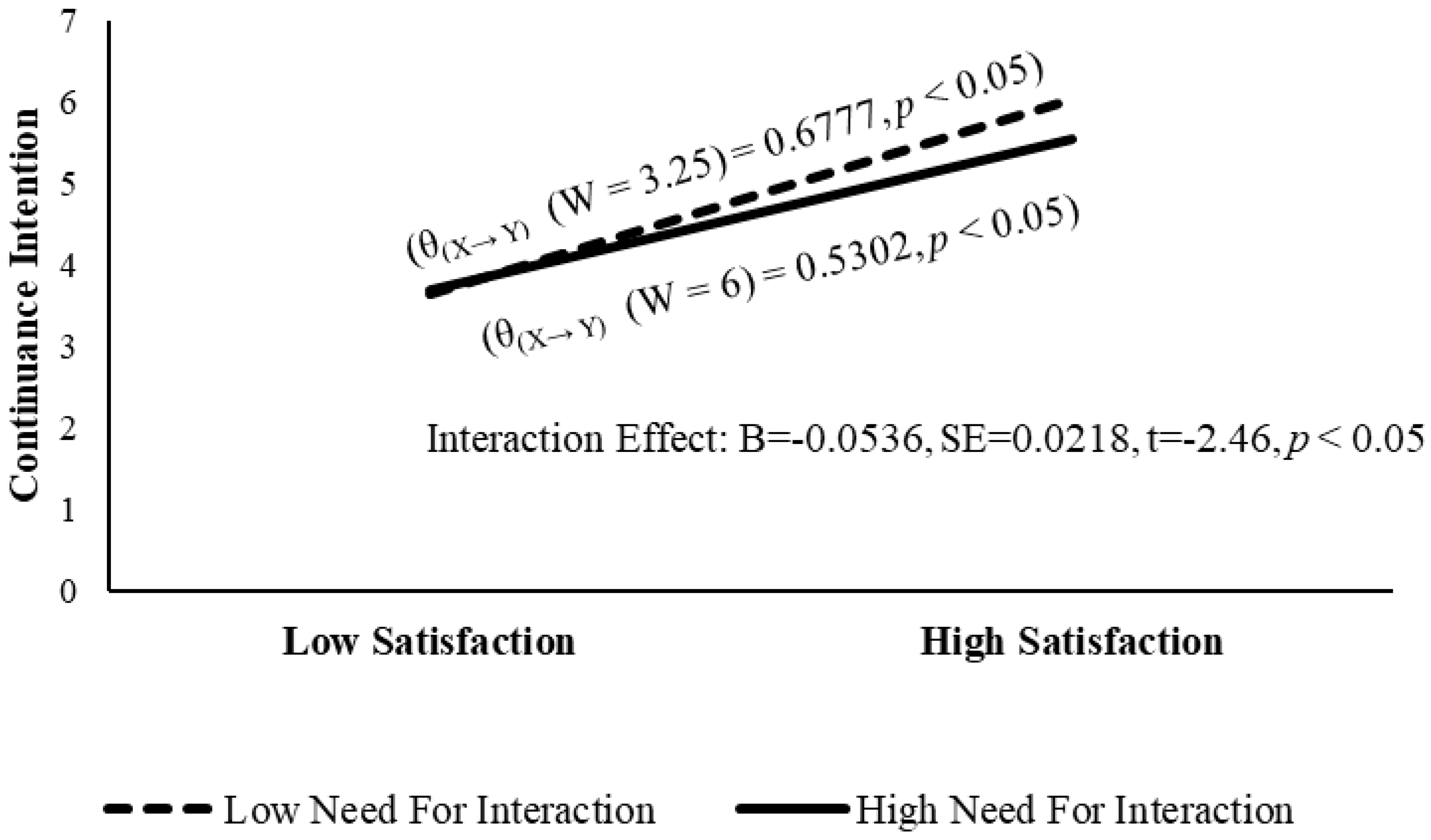
As a result of the conditional effect analysis (Model 58, see As a result of the conditional effect analysis (Model 58, see Table 4), it was determined that the interaction effect of satisfaction and the need for interaction with service employees on the intention to continue using chatbots in AI-enabled mobile banking applications is statistically significant and negative (B = −0.0536, SE = 0.0218, t = −2.46, p < 0.05). Based on the statistical significance of the interaction effect, Hypothesis H17 is supported. Based on this finding, it can be stated that the need for interaction with service employees exhibits a negative moderating effect on the positive relationship between satisfaction and the intention to continue using the chatbot. The analysis results for the conditional effect levels of the relationship between satisfaction and continuance intention—across different levels (low, medium, and high) of the need for interaction with service employees—are presented in Table 10.
Upon examining Table 10, the conditional effect of satisfaction with Chatbots on the intention to continue using them—as a function of the need for interaction with service employees (low, medium, and high)—is positive and statistically significant (p < 0.001). Therefore, it can be stated that as the need for interaction with service employees increases, the conditional effect of satisfaction with chatbots on the intention to continue using them decreases. To determine the levels at which satisfaction with chatbots significantly influences the intention to continue using them as a function of the need for interaction with service employees, the conditional effect was examined using the pick-a-point method. To identify the low, medium, and high levels of the moderator variable, the 16th, 50th, and 84th percentiles recommended by Hayes [115] were used. The analysis results are presented in Figure 7.
As shown in Figure 7, the conditional effects of consumers’ satisfaction level and their need for interaction with a service employee on continuance intention are statistically significant both at low levels of interaction need (θ(X→Y) (W = 3.25) = 0.6777, p < 0.05) and at high levels of interaction need (θ(X→Y) (W = 6) = 0.5302, p < 0.05). When the conditional effect sizes are compared, it is observed that the conditional effect is higher among users with a low need for interaction with a service employee. Moreover, the interaction effect being negative and statistically significant (B = −0.0528, t = −2.38, p < 0.05) indicates that the effect of satisfaction on continuance intention is relatively stronger among individuals with a low need for interaction with a service employee. In other words, when the need for human interaction is high, the effect of perceived satisfaction on continuance intention becomes weaker. It can thus be stated that the need for interaction with a service employee functions as a moderating variable that diminishes the effect of satisfaction with chatbot use on continuance intention.
In Model 58, where multiple direct and indirect conditional effects are tested simultaneously, the moderating variable (W) functions as the moderator of more than one path that defines the indirect effect (see Figure 1). Therefore, the conditional indirect effect becomes a nonlinear function of the moderator variable W [115]. This situation prevents the calculation of the index of moderated mediation, a resampling-based conditional indirect effect statistic that can be used to test the statistical significance of the conditional mediation effect for the model. In this regard, to test the conditional mediation effect, it is recommended to examine whether the 95% confidence interval of the pairwise differences in the conditional indirect effects includes zero or not [115]. In the final stage of the analysis process, to test the conditional mediation effect, the direct and indirect effects of perceived usefulness, expectation–confirmation, and perceived enjoyment on continuance intention at low, medium, and high levels of the need for interaction with a service employee (W) are presented in Table 11.
According to Table 11, the need for interaction with a service employee creates significant differences in both the direct relationships between perceived usefulness, expectation–confirmation, perceived enjoyment, and continuance intention, and in the indirect relationships mediated by satisfaction. The fact that the 95% confidence intervals obtained for the different levels (low, medium, high) do not include zero indicates the presence of significant conditional indirect effects in these relationships. Furthermore, the fact that the confidence intervals for the pairwise differences across the low, medium, and high levels do not include zero indicates that the effect of the moderating variable is statistically significant. These findings demonstrate that the need for interaction with a service employee exerts a moderating effect on the indirect relationships within the model, thereby indicating the presence of a moderated mediation structure.

5. Discussion and Conclusions

The primary aim of this study is to determine the effects of chatbot characteristics (perceived anthropomorphism and perceived intelligence) on perceived usefulness, confirmation, and perceived enjoyment; the effects of perceived usefulness, confirmation, and perceived enjoyment on satisfaction; and the effect of satisfaction on continuance intention to use chatbots. In addition, the study aims to examine the moderating role of the need for interaction with a service employee in the effects of perceived usefulness, confirmation, and perceived enjoyment on satisfaction, as well as in the effect of satisfaction on continuance intention to use chatbots. In line with this, the analyses first revealed that the perceived intelligence dimension positively and statistically significantly influences perceived anthropomorphism, perceived usefulness, expectation–confirmation, and perceived enjoyment. These results indicate that when users perceive a chatbot as possessing the ability to think, learn, and respond like a human, they are more likely to evaluate it as being more “human-like. “In addition, the results show that when users perceive a chatbot as intelligent, they tend to believe that its functionality, response accuracy, and ability to resolve user issues are enhanced, which in turn leads them to perceive the chatbot as more useful. Moreover, the findings indicate that when a chatbot provides intelligent and natural responses, it can facilitate the user experience and make it more enjoyable. When the findings are evaluated within the framework of expectation–confirmation theory, it appears that a chatbot perceived as intelligent by users is more capable of meeting their expectations, which in turn enables users to confirm those expectations. These findings are also consistent with the results reported in previous studies in the literature on this topic [1,42,43,70,112]. Beyond merely corroborating prior findings, this study advances the literature by identifying perceived intelligence as a foundational mechanism that concurrently shapes both cognitive evaluations (i.e., usefulness and confirmation) and affective responses (i.e., enjoyment) in AI-enabled service contexts. By explicitly incorporating AI-specific perceptual characteristics into the post-adoption phase, the study extends the expectation–confirmation model beyond its traditional boundaries and offers a more nuanced, process-oriented account of user evaluation. In doing so, it provides a theoretically enriched framework for understanding how AI-enabled systems’ intelligence reconfigures user behavior in digital service environments.
Another finding obtained in the study is that the perceived anthropomorphism dimension positively and statistically significantly influences perceived usefulness, perceived enjoyment, and expectation–confirmation. These findings indicate that the human-like qualities of a chatbot create an impression of being more understandable, empathetic, and context-sensitive, which in turn may enhance the perception that it is more capable of solving real-life problems and thereby increase users’ perceived usefulness. These findings indicate that a chatbot possessing human-like attributes creates the impression of being more understandable, empathetic, and context-sensitive, which in turn may lead users to believe that it is more capable of solving real-life problems, thereby enhancing their perceptions of usefulness. The results also show that users perceive a human-like system as more “understandable” and “compatible,” which consequently increases the extent to which their expectations are met. These findings are also consistent with the results reported in previous studies on the subject in the literature [1,42,80]. Building on prior research, this finding contributes to the literature by demonstrating that anthropomorphic design elements enhance not only users’ emotional engagement but also their cognitive evaluations, such as usefulness and expectation–confirmation. This suggests that anthropomorphism serves as a key mechanism that bridges affective and cognitive responses, thereby strengthening the explanatory power of technology acceptance models in AI-driven service environments.
According to another finding obtained from the analysis results, the expectation–confirmation dimension was found to positively and statistically significantly affect the perceived usefulness and perceived enjoyment dimensions. This finding indicates that when users’ expectations of the chatbot are met, the system is perceived as both more useful and more enjoyable. These findings are also consistent with those reported in previous studies conducted on the topic in the existing literature [1,29,39,42,97,106,114,120]. Similarly, expectation–confirmation, perceived usefulness, and perceived enjoyment were found to positively and statistically significantly affect the satisfaction construct. This finding indicates that the high perceptions of usefulness and enjoyment that arise when expectations are met directly contribute to user satisfaction. In other words, when users experience both functional and emotional satisfaction, their level of overall satisfaction increases. These findings are also consistent with those reported in previous studies conducted on the topic in the existing literature [1,29,39,42,97,106,114,120]. Finally, the satisfaction dimension was found to have a positive and statistically significant effect on the intention dimension. This finding indicates that users’ satisfaction with their interaction with the chatbot increases their intention to reuse the technology. This finding is also consistent with the results reported in previous studies on the topic in the existing literature [1,29,42,106,114,120]. Beyond supporting prior ECM-based research, these findings contribute to the literature by demonstrating that expectation–confirmation not only strengthens cognitive evaluations, such as perceived usefulness, but also enhances affective responses, such as perceived enjoyment. This finding indicates that post-adoption evaluations in AI-based services are shaped by both utilitarian and affective dimensions, thereby extending the explanatory scope of the expectation–confirmation model.
As a result of the conditional effect analysis, it was found that the effect of perceived usefulness on satisfaction is stronger among individuals with a low need for interaction with a service employee. This indicates that individuals who have a lower need for human interaction experience greater satisfaction with chatbot use as their perceived usefulness increases. In addition, the results show that individuals who have a low need for interaction with a service employee and a high level of perceived satisfaction exhibit a high intention to reuse the chatbot. Based on the analysis results, it can be stated that the level of satisfaction is the fundamental determinant of continuance intention to use the chatbot. Similarly, it can be stated that the level of satisfaction is the primary determinant of continuance intention to use chatbots. This finding suggests that users with a lower need for human interaction are more likely to evaluate chatbot performance based on its functional benefits, thereby strengthening the effect of perceived usefulness on satisfaction. In contrast, users with a higher need for human interaction may place greater value on human contact, thereby weakening the impact of system-related factors on their satisfaction. Thus, the results highlight that individual differences in interaction preferences play a critical role in shaping post-adoption evaluations of chatbot technologies.
When the conditional effect analysis results for the expectation–confirmation model are evaluated, the findings show that the effect of expectation–confirmation on satisfaction is stronger among individuals with a low need for interaction with a service employee. This indicates that users with a lower need for human interaction experience greater satisfaction with chatbot use when their level of expectation–confirmation is high. Moreover, the results show that as users’ satisfaction levels increase, their intention to reuse the chatbot increases consistently. It is observed that users who have a low need for interaction with a human service provider and high levels of satisfaction also exhibit a high intention to reuse the chatbot. Based on the results of the analysis, it can be stated that the level of satisfaction is the fundamental determinant of continuance intention to use chatbots. Furthermore, it can be stated that the need for interaction with a human moderates this relationship in a negative direction. This finding indicates that expectation–confirmation is more effective for users with a lower need for human interaction, as these users tend to evaluate chatbot performance based on the extent to which their expectations are met. In contrast, users with a higher need for human interaction may place greater emphasis on social and emotional signals specific to human interaction (such as empathy and emotional feedback) rather than system-based confirmation, which, in turn, weakens the effect of expectation-confirmation on satisfaction. Therefore, the results suggest that the explanatory power of the expectation–confirmation model depends on users’ interaction preferences and highlight the importance of incorporating individual differences into post-adoption models in AI-based service contexts.
When the conditional effect analysis results for the perceived enjoyment model are evaluated, the findings show that the effect of perceived enjoyment on satisfaction is stronger among individuals with a low need for interaction with a service employee. The results of the conditional effect analysis for the perceived enjoyment model show that the effect of perceived enjoyment on satisfaction is stronger among individuals with a low need for interaction with a service employee. Based on the analysis, it can be stated that perceived enjoyment is a critical determinant for enhancing chatbot satisfaction. This finding suggests that users with a lower need for human interaction are more likely to engage with chatbot systems by focusing on the perceived enjoyment of the interaction, which strengthens the effect of perceived enjoyment on satisfaction. In contrast, users with a higher need for human interaction may place greater importance on human contact, thereby reducing the relative importance of enjoyment in shaping satisfaction. Therefore, these results indicate that the effect of perceived enjoyment is contingent upon users’ interaction preferences. Moreover, the results show that as users’ satisfaction levels increase, their intention to reuse the chatbot increases consistently. It is observed that users with a low need for interaction with a human service provider and a high level of perceived satisfaction have a high intention to reuse the chatbot. Based on the analysis results, it can be stated that the level of satisfaction is the fundamental determinant of continuance intention to use the chatbot. Moreover, it is possible to state that the need for interaction with a human moderates this relationship in a negative direction. These findings are also consistent with the results reported in previous studies on the subject in the literature [44,50]. This finding suggests that although satisfaction is a strong predictor of continuance intention, its effect is not uniform across all users. Specifically, users with a lower need for human interaction are more likely to translate their satisfaction with chatbot use into continued usage, whereas users with a higher need for human interaction may rely more on human contact, which weakens this relationship. Therefore, these results highlight that the satisfaction—continuance intention relationship is contingent upon users’ interaction preferences, emphasizing the importance of individual differences in AI-based service adoption.

5.1. Theoretical Contributions

This study provides several important theoretical contributions by extending the expectation confirmation model (ECM) and offering a deeper understanding of chatbot-driven user experiences in mobile banking.
First, this study expands the classical ECM by integrating both a hedonic variable (perceived enjoyment) and AI-specific perceptual constructs (perceived intelligence and perceived anthropomorphism). In doing so, it provides a more comprehensive explanation of user behavior by capturing not only cognitive evaluations but also emotional and AI-driven experiential factors. This extended framework enables a more holistic understanding of chatbot usage by incorporating both functional and experiential dimensions. Importantly, the findings reveal that different determinants exert varying levels of influence on user satisfaction and continuance intention. Among these, satisfaction exhibits a strong effect on continuance intention, highlighting its central role as the primary driver of sustained chatbot usage. This finding reinforces the core premise of ECM while also demonstrating that satisfaction remains the dominant mechanism linking user evaluations to behavioral outcomes in AI-based service contexts.
In addition, confirmation was identified as one of the strongest antecedents of satisfaction, compared to perceived usefulness and perceived enjoyment. This indicates that users’ post-usage evaluation of the extent to which their expectations are met plays a more critical role than purely functional or hedonic perceptions. From a theoretical perspective, this finding strengthens the central position of expectation–confirmation theory within AI-enabled service environments. Moreover, the relatively weaker effect of perceived enjoyment suggests that, in utilitarian service contexts such as mobile banking, cognitive and confirmation-based evaluations outweigh affective responses. This finding contributes to the ongoing debate in the literature by showing that, although emotional factors are relevant, their impact remains secondary compared to cognitive evaluations in financial service settings.
Another important contribution of this study lies in the incorporation of the need for interaction with a service employee as a moderating variable. While prior research has predominantly focused on cognitive and affective determinants of technology usage, this study demonstrates that users’ preference for human interaction plays a critical role in shaping behavioral outcomes. The findings indicate that users with a higher need for human interaction are less likely to translate satisfaction into continuance intention. This result suggests that positive evaluations of chatbot performance do not automatically lead to continued usage, particularly for users who value human contact. In this respect, the study contributes to the technology acceptance and self-service technology literature by highlighting the importance of individual differences in human interaction preferences. It provides empirical evidence that the effectiveness of AI-based services is contingent not only on system-related factors but also on users’ inherent expectations regarding human interaction.
Finally, this study offers a sector-specific contribution by examining chatbot usage within the context of mobile banking. While prior research has largely focused on e-commerce and general service environments, relatively limited attention has been given to high-risk and trust-sensitive domains such as financial services. By focusing on mobile banking, this study provides unique insights into how users evaluate and adopt AI-based services in contexts where reliability, security, and trust are critical. The findings demonstrate that, in such contexts, cognitive evaluations—particularly confirmation and perceived usefulness—play a more dominant role than affective responses. This suggests that user behavior in financial service environments follows different dynamics compared to other digital service contexts. Accordingly, the study highlights the importance of contextualizing technology adoption models and cautions against generalizing findings across different sectors without considering domain-specific characteristics. Overall, by integrating ECM, TAM, and AI experience literature and by incorporating both effect size interpretations and contextual insights, this study provides a comprehensive and nuanced theoretical framework that advances the understanding of sustained technology use in AI-enabled service environments.

5.2. Managerial Implications

This study is expected to contribute to practice by providing a roadmap for practitioners regarding the strategic use of artificial intelligence in digital banking, enabling the optimization of user satisfaction, the strengthening of customer loyalty, and more effective competition within the increasingly dynamic digital banking landscape. The advancement of perceived intelligence, which lies at the core of AI-enabled mobile banking applications, requires the development of systems that not only execute transactions successfully but also anticipate and respond to individual customer needs, providing personalized financial services and tailored support. Such systems enhance users’ trust in digital platforms and encourage user engagement, as they offer a personalized banking experience aligned with customers’ financial goals [42,121]. Perceived anthropomorphism is considered a fundamental component in humanizing digital interactions, as it can make the user experience more enjoyable and engaging [42,122]. Therefore, it is argued that systems simulating human-like interactions—such as those based on natural language processing or affective artificial intelligence—may significantly enhance the attractiveness and efficiency of digital banking services [9,78,123]. The findings indicate that users perceive chatbots not only as functional tools but also as service channels that provide enjoyable and human-like experiences. In line with these findings, practitioners may enhance chatbot interfaces with human-like qualities—such as the ability to demonstrate empathy—thus designing systems that enable users to feel valued. However, managers should carefully calibrate the level of anthropomorphism, as excessive or poorly implemented human-like features may undermine credibility and trust. Therefore, a balanced approach that combines functional efficiency with appropriate social cues is recommended.
An examination of the study’s results reveals that perceived usefulness, perceived enjoyment, and confirmation emerge as strong determinants of satisfaction, while satisfaction itself exerts a significant and positive influence on continuance intention. In digital banking applications, beyond the chatbot’s usefulness and the convenience it provides, its ability to entertain users through personalized services is regarded as a fundamental factor influencing users’ adoption of the chatbot and their intention to continue using it. Nevertheless, the digital services offered through chatbots must be perceived by users as efficient, secure, and accessible in a clear and trustworthy manner. This not only refers to the provision of such features, but also to meeting users’ financial needs in a secure and practical manner. In this context, practitioners are advised to place greater emphasis on user feedback mechanisms and to develop a range of services that meet—and even exceed—user expectations. This will help create an environment of trust and satisfaction that fosters long-term relationships with digital banking platforms [42]. These findings provide a more nuanced understanding of chatbot usage by demonstrating that both cognitive and affective evaluations jointly shape user satisfaction and continuance intention. These findings suggest that managers should not rely solely on performance-oriented improvements but also prioritize experience-driven service design. In this regard, integrating functional service quality with experience-enhancing features—such as personalization, interactive communication, and emotionally engaging interfaces—can significantly improve user outcomes. By highlighting the simultaneous role of perceived usefulness, perceived enjoyment, and confirmation, this study contributes to practice by offering a more comprehensive framework for designing AI-enabled services that address both efficiency and user experience. Such an integrated approach is particularly critical for ensuring long-term user retention in increasingly competitive digital banking environments.
It was found that, during interactions with chatbots, individuals with a low need for human interaction experience stronger effects of perceived usefulness, perceived enjoyment, and expectation–confirmation on satisfaction. Based on this finding, it is possible to state that perceived usefulness, perceived enjoyment, and expectation–confirmation are critical determinants for enhancing chatbot satisfaction. Offering flexible solutions tailored to users’ need for interaction, such as optimizing autonomous use for individuals with a low need for human interaction by providing advanced self-service options and automated solution suggestions, and incorporating human-assisted transition mechanisms for those with a high need for interaction, including features like a “connect to live support” button, together with developing strategies that enhance chatbot functionality (e.g., delivering personalized responses and rapid problem resolution), can increase perceived usefulness. This, in turn, may positively influence perceived satisfaction and thereby enrich the overall chatbot experience in accordance with users’ interaction needs [42,44,50]. Similarly, developing strategies that enhance the level of perceived enjoyment, such as implementing loyalty programs with dynamic, interactive, gamified rewards for users who experience low perceived enjoyment, and designing humorous, personalized, and interactive responses, can increase perceived enjoyment. This, in turn, may positively influence perceived satisfaction and thereby enrich the overall chatbot experience in line with users’ interaction needs [42,44,50]. These findings highlight the critical importance of user heterogeneity in AI-enabled service environments and demonstrate that a one-size-fits-all service approach may not be effective. Instead, managers should adopt segmentation-based strategies that differentiate users according to their interaction preferences. In particular, developing hybrid service models that combine AI-driven automation with human support options can better address diverse user expectations. This implies that allowing seamless transitions between chatbot and human assistance, while maintaining consistency in service quality, can enhance both satisfaction and continuance intention. By explicitly incorporating the need for interaction as a moderating factor, the study contributes to practice by offering a more nuanced framework for designing flexible and user-adaptive service systems in digital banking contexts.
Moreover, offering flexible solutions tailored to users’ need for interaction, such as optimizing autonomous use and providing automated solution suggestions for users with a low need for human interaction, and employing transparent communication and clear service commitments, enabling access to live support without long waiting times, and incorporating human-assisted one-to-one support and feedback mechanisms for users with a high need for interaction, along with developing strategies aimed at increasing the level of expectation–confirmation, may positively influence perceived satisfaction. In turn, this can enrich the overall chatbot experience in accordance with users’ interaction needs [42,44,50,124]. An examination of the analysis results indicates that users who have a low need for interaction with service employees and who exhibit high levels of satisfaction are more likely to demonstrate a strong intention to reuse the chatbot. Based on the analysis results, it is possible to state that the level of satisfaction is the primary determinant of users’ intention to continue using the chatbot. Implementing targeted strategies that integrate satisfaction with usefulness, enjoyment, and confirmation for users with different levels of interaction need—such as providing real-time support lines, empathy-based responses, traceable feedback loops, and personalized, functionally enriched interactions for users with a high need for human interaction; and offering personalized, creative, and humorous responses, entertaining informational elements within the chatbot interface, financial tips, or mini-tasks such as a “transaction of the week,” along with gamified rewards for low-interaction-need users who exhibit low satisfaction—can enhance satisfaction and help prevent loyalty loss [37,52,124]. These findings further underline the strategic importance of aligning chatbot design with varying levels of user interaction needs and satisfaction drivers. Rather than treating satisfaction as a uniform outcome, managers should recognize it as a dynamic construct shaped by different combinations of usefulness, enjoyment, and confirmation across user segments. This implies that developing adaptive service strategies—such as tailoring interaction styles, response types, and support mechanisms to different user profiles—can significantly enhance both satisfaction and continuance intention. In this context, integrating real-time personalization, proactive support features, and differentiated engagement strategies can help organizations not only improve user experience but also reduce potential loyalty loss. By linking satisfaction management with user heterogeneity, this study contributes to practice by offering a more strategic and flexible framework for sustaining long-term user engagement in AI-enabled service environments.

5.3. Limitations and Future Research

The most significant limitation of this study is that the data were obtained through a survey using a convenience sampling method. Therefore, the findings cannot be generalized to the entire population. In future studies, the research model may be tested using probabilistic sampling methods and by taking into account different demographic groups, cultural contexts, and sectors.
Second, while responding to the survey, participants based their answers on their own experiences with different chatbot systems available in mobile banking applications. This situation indicates that participants may have evaluated chatbots with different characteristics in terms of technological sophistication, functionality, and interface design. Such differences may have affected user evaluations and led to heterogeneity in the data. In future studies, this limitation can be addressed by focusing on a single chatbot system or by comparing different chatbot designs in controlled environments.
Third, this study is limited to the context of mobile banking. Financial services have a structure that includes high levels of perceived risk, trust, and sensitivity [20,67]. In such high-risk contexts, trust, privacy concerns, and perceived risk are known to play an important role in user behavior [20,67,125]. However, these variables were not included in the current research model. This situation is considered an important limitation of the study, and it is recommended that future studies include contextual variables such as trust, privacy concerns, and perceived risk in the model and examine these relationships more comprehensively. In addition, although the variables included in the model are important, other factors that may affect chatbot usage behavior should also be taken into consideration. In this context, in future studies, variables such as perceived timeliness [126], perceived warmth and perceived competence [62], technology anxiety [29] technology readiness [127], and interaction quality and customer experience dimensions [42] can be included in the model, which may contribute to explaining user behavior more comprehensively. In addition, by using qualitative research methods, users’ emotional and social experiences can be examined in greater depth, providing richer insights into human–artificial intelligence interaction.
However, the literature shows that chatbot usage has different dynamics across various sectors [29,50,67,72,128]. In this context, although the basic structure of the model can be applied to different sectors, it is considered that the relative importance of cognitive (e.g., perceived usefulness and confirmation), emotional (e.g., enjoyment), and contextual variables may vary depending on the type of service. In addition, the moderating role of the need for interaction with a service employee may vary depending on the context. Especially in high-risk services such as banking and finance, users’ need for human interaction may be more pronounced, whereas in more routine and low-risk services such as e-commerce, users may be more inclined toward automated systems [50]. Therefore, it is recommended that future studies test the proposed model in different sectors such as e-commerce, finance, healthcare, and tourism in order to examine the effects of contextual factors on user behavior more comprehensively [29].
Another important limitation of this study is that it is based on cross-sectional data. This limits the ability to strongly establish causal relationships between variables. In future studies, the use of experimental or longitudinal research designs will contribute to testing these relationships in a more robust and reliable manner.

6. Conclusions

In conclusion, this study demonstrates that both cognitive and emotional evaluations play a crucial role in shaping user satisfaction and continuance intention toward the use of AI-enabled chatbots in mobile banking. The findings indicate that perceived intelligence and anthropomorphism enhance users’ evaluations, which, in turn, strengthen satisfaction and foster continuance intention. Moreover, the results highlight that individual differences, particularly the need for interaction with service employees, serve as a key boundary condition influencing these relationships. Taken together, the study advances a more comprehensive understanding of chatbot adoption by integrating functional, emotional, and individual-level factors and offers valuable insights for both researchers and practitioners.

Author Contributions

Conceptualization, G.Y.; methodology, M.Y.A.; software, G.Y.; validation, G.Y. and M.Y.A.; formal analysis, M.Y.A.; investigation, M.Y.A.; resources, G.Y.; data curation, G.Y.; writing—original draft preparation, G.Y.; writing—review and editing, G.Y.; visualization, G.Y.; supervision, G.Y.; project administration, G.Y.; funding acquisition, G.Y. and M.Y.A. All authors have read and agreed to the published version of the manuscript.

Funding

This research received no external funding.

Institutional Review Board Statement

The study was conducted in accordance with the Declaration of Helsinki and approved by the Social Sciences Scientific Research and Publication Ethics Committee of Osmaniye Korkut Ata University Rectorate (protocol code 2023/14/7, 29 November 2023).

Informed Consent Statement

Informed consent was obtained from all subjects involved in the study.

Data Availability Statement

The data presented in this study are not publicly available due to privacy and ethical restrictions.

Conflicts of Interest

The authors declare no conflicts of interest.

References

  1. Bhatnagr, P.; Rajesh, A. Artificial Intelligence Features and Expectation Confirmation Theory in Digital Banking Apps: Gen Y and Z Perspective. Manag. Decis. 2024, 63, 3642–3675. [Google Scholar] [CrossRef] [Scilit]
  2. Le, X.C.; Nguyen, T.H. The Effects of Chatbot Characteristics and Customer Experience on Satisfaction and Continuance Intention toward Banking Chatbots: Data from Vietnam. Data Brief 2024, 52, 110025. [Google Scholar] [CrossRef] [Scilit]
  3. Statista Digital Banks—Worldwide. Available online: https://www.statista.com/outlook/fmo/banking/digital-banks/worldwide (accessed on 6 March 2025).
  4. Juniper Research. Over Half of Global Population to Use Digital Banking in 2026. Available online: https://www.juniperresearch.com/press/over-half-global-population-digital-banking/ (accessed on 6 March 2025).
  5. Jang, M.; Jung, Y.; Kim, S. Investigating Managers’ Understanding of Chatbots in the Korean Financial Industry. Comput. Hum. Behav. 2021, 120, 106747. [Google Scholar] [CrossRef] [Scilit]
  6. Lee, J.C.; Tang, Y.; Jiang, S. Understanding Continuance Intention of Artificial Intelligence (AI)-Enabled Mobile Banking Applications: An Extension of AI Characteristics to an Expectation Confirmation Model. Humanit. Soc. Sci. Commun. 2023, 10, 333. [Google Scholar] [CrossRef] [Scilit]
  7. Serifat, O.A.; Igah, R.C.; Balogun, K.M.; Mensah, G.R.; Odai, E.N. AI-Driven Fraud Detection in Digital Banking: ML Approach for Secure and Transparent Financial Transactions. Am. J. Financ. Technol. Innov. 2025, 3, 177–187. [Google Scholar] [CrossRef] [Scilit]
  8. Ryman-Tubb, N.; Krause, P.; Garn, W. How Artificial Intelligence and Machine Learning Research Impacts Payment Card Fraud Detection: A Survey and Industry Benchmark. Eng. Appl. Artif. Intell. 2018, 76, 130–157. [Google Scholar] [CrossRef] [Scilit]
  9. Huang, M.-H.; Rust, R.T. Engaged to a Robot? The Role of AI in Service. J. Serv. Res. 2021, 24, 30–41. [Google Scholar] [CrossRef] [Scilit]
  10. Rodríguez-Espíndola, O.; Chowdhury, S.; Dey, P.K.; Albores, P.; Emrouznejad, A. Analysis of the Adoption of Emergent Technologies for Risk Management in the Era of Digital Manufacturing. Technol. Forecast. Soc. Change 2022, 178, 121562. [Google Scholar] [CrossRef] [Scilit]
  11. Ashrafuzzaman, M.; Parveen, R.; Sumiya, M.A.; Rahman, A. AI-Powered Personalization in Digital Banking: A Review of Customer Behavior Analytics and Engagement. Am. J. Interdiscip. Stud. 2025, 6, 40–71. [Google Scholar] [CrossRef] [Scilit]
  12. Ikhsan, R.B.; Fernando, Y.; Prabowo, H.; Gui, A.; Kuncoro, E.A. An Empirical Study on the Use of Artificial Intelligence in the Banking Sector of Indonesia by Extending the TAM Model and the Moderating Effect of Perceived Trust. Digit. Bus. 2025, 5, 100103. [Google Scholar] [CrossRef] [Scilit]
  13. Osuma, G.; Nzimande, N. Disaggregated Effects of Artificial Intelligence, Online and Mobile Banking on Customer Satisfaction in Banks: An Analysis Using Structural Equation Modelling. J. Infrastruct. Policy Dev. 2024, 8, 9941. [Google Scholar] [CrossRef] [Scilit]
  14. Schrank, J. The Impact of Artificial Intelligence on Behavioral Intentions to Use Mobile Banking in the Post-COVID-19 Era. Front. Artif. Intell. 2025, 8, 1649392. [Google Scholar] [CrossRef] [Scilit]
  15. Venkatesh, V.; Thong, J.Y.L.; Xu, X. Consumer Acceptance and Use of Information Technology: Extending the Unified Theory of Acceptance and Use of Technology. MIS Q. 2012, 36, 157–178. [Google Scholar] [CrossRef] [Scilit]
  16. Teepapal, T. AI-Driven Personalization: Unraveling Consumer Perceptions in Social Media Engagement. Comput. Hum. Behav. 2025, 165, 108549. [Google Scholar] [CrossRef] [Scilit]
  17. Reddy, J.K.; Syed, W.K.; Mohammed, A.; Jiwani, N.; Kiruthiga, T. AI-Based Behavioral Biometrics for Enhanced Authentication in Mobile Banking. In Proceedings of the 2025 3rd International Conference on Intelligent Cyber Physical Systems and Internet of Things (ICoICI), Coimbatore, India, 17–19 September 2025; IEEE: New York, NY, USA, 2025; pp. 595–599. [Google Scholar] [CrossRef] [Scilit]
  18. Kuraku, C.; Gollangi, H.K. Biometric Authentication in Digital Payments: Utilizing AI and Big Data for Real-Time Security and Efficiency. Educ. Adm. Theory Pract. 2020, 26, 954–964. [Google Scholar] [CrossRef] [Scilit]
  19. Azhari, S.C.; Permatasari, A.; Angelus, M. Implementation of Biometric Technology in Indonesian Mobile Banking: A TAM Perspective on Enhancing Transaction Security and Enjoyment. In Proceedings of the 2025 International Conference on Inventive Computation Technologies (ICICT), Kirtipur, Nepal, 23–25 April 2025; IEEE: New York, NY, USA, 2025; pp. 152–158. [Google Scholar] [CrossRef] [Scilit]
  20. Guo, Y.; Waked, H.N. Trust-Mediated Adoption of AI Robo-Advisors in Inland China: An Extended UTAUT Perspective. J. Financ. Serv. Mark. 2026, 31, 11. [Google Scholar] [CrossRef] [Scilit]
  21. Manser Payne, E.; Peltier, J.W.; Barger, V.A. Mobile Banking and AI-Enabled Mobile Banking: The Differential Effects of Technological and Non-Technological Factors on Digital Natives’ Perceptions and Behavior. J. Res. Interact. Mark. 2018, 12, 328–346. [Google Scholar] [CrossRef] [Scilit]
  22. Vieras, B.; Mark, D.; John, A.; Martin, T. The Impact of Real-Time Financial Fraud Detection on Financial Institutions’ Reputation and Customer Trust. 2025. Available online: https://www.researchgate.net/publication/388068563 (accessed on 31 March 2026).
  23. Kapale, R.; Deshpande, P.; Shukla, S.; Kediya, S.; Pethe, Y.; Metre, S. Explainable AI for Fraud Detection: Enhancing Transparency and Trust in Financial Decision-Making. In Proceedings of the 2024 2nd DMIHER International Conference on Artificial Intelligence in Healthcare, Education and Industry (IDICAIEI), Wardha, India, 29–30 November 2024; IEEE: New York, NY, USA, 2024; pp. 1–6. [Google Scholar] [CrossRef] [Scilit]
  24. Mollik, E.; Majeed, F. AI-Driven Cybersecurity in Mobile Financial Services: Enhancing Fraud Detection and Privacy in Emerging Markets. J. Cybersecur. Priv. 2025, 5, 77. [Google Scholar] [CrossRef] [Scilit]
  25. Gefen, D.; Karahanna, E.; Straub, D.W. Trust and TAM in Online Shopping: An Integrated Model. MIS Q. 2003, 27, 51–90. [Google Scholar] [CrossRef] [Scilit]
  26. Bojd, B.; Garimella, A.; Yin, H. Stigma Reduces AI Aversion: A Tradeoff Between Judgment and Misinformation Concerns; SSRN: Rochester, NY, USA, 2025. [Google Scholar] [CrossRef] [Scilit]
  27. Croes, E.A.; Antheunis, M.L.; Van Der Lee, C.; De Wit, J.M. Digital Confessions: The Willingness to Disclose Intimate Information to a Chatbot and Its Impact on Emotional Well-Being. Interact. Comput. 2024, 36, 279–292. [Google Scholar] [CrossRef] [Scilit]
  28. Lee, J.C.; Chen, X. Exploring Users’ Adoption Intentions in the Evolution of Artificial Intelligence Mobile Banking Applications: The Intelligent and Anthropomorphic Perspectives. Int. J. Bank Mark. 2022, 40, 631–658. [Google Scholar] [CrossRef] [Scilit]
  29. Sundjaja, A.M.; Utomo, P.; Colline, F. The Determinant Factors of Continuance Use of Customer Service Chatbot in Indonesia E-Commerce: Extended Expectation Confirmation Theory. J. Sci. Technol. Policy Manag. 2025, 16, 182–203. [Google Scholar] [CrossRef] [Scilit]
  30. Banerjee, S.; Sreejesh, S. Examining the Role of Customers’ Intrinsic Motivation on Continued Usage of Mobile Banking: A Relational Approach. Int. J. Bank Mark. 2022, 40, 87–109. [Google Scholar] [CrossRef] [Scilit]
  31. Lin, R.; Zheng, Y.X.; Lee, J.C. Artificial Intelligence-Based Pre-Implementation Interventions in Users’ Continuance Intention to Use Mobile Banking. Int. J. Mob. Commun. 2023, 21, 518–540. [Google Scholar] [CrossRef] [Scilit]
  32. Venkatesh, V.; Morris, M.G.; Davis, G.B.; Davis, F.D. User Acceptance of Information Technology: Toward a Unified View. MIS Q. 2003, 27, 425–478. [Google Scholar] [CrossRef] [Scilit]
  33. Belanche, D.; Casaló, L.V.; Flavián, C. Artificial Intelligence in FinTech: Understanding Robo-Advisors Adoption among Customers. Ind. Manag. Data Syst. 2019, 119, 1411–1430. [Google Scholar] [CrossRef] [Scilit]
  34. Lappeman, J.; Marlie, S.; Johnson, T.; Poggenpoel, S. Trust and Digital Privacy: Willingness to Disclose Personal Information to Banking Chatbot Services. J. Financ. Serv. Mark. 2022, 28, 337–352. [Google Scholar] [CrossRef] [Scilit]
  35. Luo, X.; Tong, S.; Fang, Z.; Qu, Z. Machines vs. Humans: The Impact of Artificial Intelligence Chatbot Disclosure on Customer Purchases. Mark. Sci. 2019, 38, 937–947. [Google Scholar] [CrossRef] [Scilit]
  36. Davis, F.D. Perceived Usefulness, Perceived Ease of Use, and User Acceptance of Information Technology. MIS Q. 1989, 13, 319–340. [Google Scholar] [CrossRef] [Scilit]
  37. Bhattacherjee, A. Understanding Information Systems Continuance: An Expectation-Confirmation Model. MIS Q. 2001, 25, 351–370. [Google Scholar] [CrossRef] [Scilit]
  38. Cho, J. The Impact of Post-Adoption Beliefs on the Continued Use of Health Apps. Int. J. Med. Inform. 2016, 87, 75–83. [Google Scholar] [CrossRef] [Scilit] [PubMed]
  39. Huang, A.; Ozturk, A.B.; Zhang, T.; de la Mora Velasco, E.; Haney, A. Unpacking AI for Hospitality and Tourism Services: Exploring the Role of Perceived Enjoyment on Future Use Intentions. Int. J. Hosp. Manag. 2024, 119, 103693. [Google Scholar] [CrossRef] [Scilit]
  40. Oghuma, A.P.; Libaque-Saenz, C.F.; Wong, S.F.; Chang, Y. An Expectation-Confirmation Model of Continuance Intention to Use Mobile Instant Messaging. Telemat. Inform. 2016, 33, 34–47. [Google Scholar] [CrossRef] [Scilit]
  41. Balakrishnan, J.; Abed, S.S.; Jones, P. The Role of Meta-UTAUT Factors, Perceived Anthropomorphism, Perceived Intelligence, and Social Self-Efficacy in Chatbot-Based Services. Technol. Forecast. Soc. Change 2022, 180, 121692. [Google Scholar] [CrossRef] [Scilit]
  42. Bhatnagr, P.; Rajesh, A.; Misra, R. Continuous Intention Usage of Artificial Intelligence Enabled Digital Banks: A Review of Expectation Confirmation Model. J. Enterp. Inf. Manag. 2024, 37, 1763–1787. [Google Scholar] [CrossRef] [Scilit]
  43. Moussawi, S.; Koufaris, M. Perceived Intelligence and Perceived Anthropomorphism of Personal Intelligent Agents: Scale Development and Validation. In Proceedings of the 52nd Hawaii International Conference on System Sciences, Maui, HI, USA, 8–11 January 2019. [Google Scholar] [CrossRef] [Scilit]
  44. Ashfaq, M.; Yun, J.; Yu, S.; Loureiro, S.M.C. I, Chatbot: Modeling the Determinants of Users’ Satisfaction and Continuance Intention of AI-Powered Service Agents. Telemat. Inform. 2020, 54, 101473. [Google Scholar] [CrossRef] [Scilit]
  45. Katana 1 in 2 Customers Prefer a Real Human over an AI Chatbot when Chatting Online. Available online: https://katanamrp.com/blog/customers-prefer-a-real-human-over-an-ai-chatbot/ (accessed on 6 March 2025).
  46. Dabholkar, P.A.; Bagozzi, R.P. An Attitudinal Model of Technology-Based Self-Service: Moderating Effects of Consumer Traits and Situational Factors. J. Acad. Mark. Sci. 2002, 30, 184–201. [Google Scholar] [CrossRef] [Scilit]
  47. Demoulin, N.T.M.; Djelassi, S. An Integrated Model of Self-Service Technology (SST) Usage in a Retail Context. Int. J. Retail Distrib. Manag. 2016, 44, 540–559. [Google Scholar] [CrossRef] [Scilit]
  48. Dabholkar, P.A. Consumer Evaluations of New Technology-Based Self-Service Options: An Investigation of Alternative Models of Service Quality. Int. J. Res. Mark. 1996, 13, 29–51. [Google Scholar] [CrossRef] [Scilit]
  49. Evanschitzky, H.; Iyer, G.R.; Pillai, K.G.; Kenning, P.; Schütte, R. Consumer Trial, Continuous Use, and Economic Benefits of a Retail Service Innovation: The Case of the Personal Shopping Assistant. J. Prod. Innov. Manag. 2015, 32, 459–475. [Google Scholar] [CrossRef] [Scilit]
  50. Pereira, T.; Limberger, P.F.; Ardigó, C.M. The Moderating Effect of the Need for Interaction with a Service Employee on Purchase Intention in Chatbots. Telemat. Inform. Rep. 2021, 1, 100003. [Google Scholar] [CrossRef] [Scilit]
  51. Meuter, M.L.; Ostrom, A.L.; Roundtree, R.I.; Bitner, M.J. Self-Service Technologies: Understanding Customer Satisfaction with Technology-Based Service Encounters. J. Mark. 2000, 64, 50–64. [Google Scholar] [CrossRef] [Scilit]
  52. Oliver, R.L. A Cognitive Model for the Antecedents and Consequences of Satisfaction. J. Mark. Res. 1980, 17, 460–469. [Google Scholar] [CrossRef] [Scilit]
  53. Castillo, D.; Farrugia Caruana, L. Unveiling Customer Expectations of Chatbot Interactions: A Systematic Literature Review and Research Agenda. Int. J. Hum.-Comput. Interact. 2025, 1–28. [Google Scholar] [CrossRef] [Scilit]
  54. Venkatesh, V.; Davis, F.D. A Theoretical Extension of the Technology Acceptance Model: Four Longitudinal Field Studies. Manag. Sci. 2000, 46, 186–204. [Google Scholar] [CrossRef] [Scilit]
  55. Kang, Y.S.; Hong, S.; Lee, H. Exploring Continued Online Service Usage Behavior: The Roles of Self-Image Congruity and Regret. Comput. Hum. Behav. 2009, 25, 111–122. [Google Scholar] [CrossRef] [Scilit]
  56. Thong, J.Y.L.; Hong, S.J.; Tam, K.Y. The Effects of Post-Adoption Beliefs on the Expectation-Confirmation Model for Information Technology Continuance. Int. J. Hum.-Comput. Stud. 2006, 64, 799–810. [Google Scholar] [CrossRef] [Scilit]
  57. van der Heijden, H. User Acceptance of Hedonic Information Systems. MIS Q. 2004, 28, 695–704. [Google Scholar] [CrossRef] [Scilit]
  58. Wang, M.C. Determinants and Consequences of Consumer Satisfaction with Self-Service Technology in a Retail Setting. Manag. Serv. Qual. 2012, 22, 128–144. [Google Scholar] [CrossRef] [Scilit]
  59. Davis, F.D.; Bagozzi, R.P.; Warshaw, P.R. Extrinsic and Intrinsic Motivation to Use Computers in the Workplace. J. Appl. Soc. Psychol. 1992, 22, 1111–1132. [Google Scholar] [CrossRef] [Scilit]
  60. Locke, E.A. The Nature and Causes of Job Satisfaction. In Handbook of Industrial and Organizational Psychology; Dunnette, M.D., Ed.; Holt, Rinehart & Winston: New York, NY, USA, 1976; pp. 1297–1349. [Google Scholar]
  61. Oliver, R.L. Whence Consumer Loyalty? J. Mark. 1999, 63, 33–44. [Google Scholar] [CrossRef] [Scilit]
  62. Cheng, X.; Bao, Y.; Zarifis, A.; Gong, W.; Mou, J. Exploring Consumers’ Response to Text-Based Chatbots in E-Commerce: The Moderating Role of Task Complexity and Chatbot Disclosure. Internet Res. 2022, 32, 496–517. [Google Scholar] [CrossRef] [Scilit]
  63. Ruan, Y.; Mezei, J. When Do AI Chatbots Lead to Higher Customer Satisfaction than Human Frontline Employees in Online Shopping Assistance? Considering Product Attribute Type. J. Retail. Consum. Serv. 2022, 68, 103059. [Google Scholar] [CrossRef] [Scilit]
  64. Choi, Y.S.; Lee, S.Z.; Choi, J. A Study on Factors Influencing Continuous Usage Intention of Chatbot Services in South Korean Financial Institutions. Int. J. Financ. Stud. 2025, 13, 56. [Google Scholar] [CrossRef] [Scilit]
  65. Gurung, D.; Parajuli, P. Impact of Chatbot in Operational Efficiency in Banking Sector in Nepal. LBEF Res. J. Sci. Technol. Manag. 2024, 6, 82–105. [Google Scholar]
  66. Habib, A.; Pramana, E.; Junaedi, H.; Ronando, E. Extending the Expectation Confirmation Model to Examine Continuous Use of Mobile Banking: Security, Trust, and Convenience. INTENSIF J. Ilm. Penelit. Penerapan Teknol. Sist. Inf. 2025, 9, 76–96. [Google Scholar] [CrossRef] [Scilit]
  67. Mehrolia, S.; Alagarsamy, S.; Moorthy, V.; Jeevananda, S. Will Users Continue Using Banking Chatbots? The Moderating Role of Perceived Risk. FIIB Bus. Rev. 2023, 1–19. [Google Scholar] [CrossRef] [Scilit]
  68. Misra, R.; Malik, G.; Singh, P. A Localized and Humanized Approach to Chatbot Banking Companions: Implications for Financial Managers. Manag. Decis. 2025, 63, 3756–3785. [Google Scholar] [CrossRef] [Scilit]
  69. Tam, C.; Santos, D.; Oliveira, T. Exploring the Influential Factors of Continuance Intention to Use Mobile Apps: Extending the Expectation Confirmation Model. Inf. Syst. Front. 2020, 22, 243–257. [Google Scholar] [CrossRef] [Scilit]
  70. Lin, R.R.; Lee, J.C. The Supports Provided by Artificial Intelligence to Continuous Usage Intention of Mobile Banking: Evidence from China. Aslib J. Inf. Manag. 2024, 76, 293–310. [Google Scholar] [CrossRef] [Scilit]
  71. Mpinganjira, M.; Dlodlo, N.; Idemudia, E.C. Perceived Experiential Value and Continued Use Intention of E-Retail Chatbots. Int. J. Retail Distrib. Manag. 2024, 52, 121–135. [Google Scholar] [CrossRef] [Scilit]
  72. Song, X.; Gu, H.; Li, Y.; Leung, X.Y.; Ling, X. The Influence of Robot Anthropomorphism and Perceived Intelligence on Hotel Guests’ Continuance Usage Intention. Inf. Technol. Tour. 2024, 26, 89–117. [Google Scholar] [CrossRef] [Scilit]
  73. Priya, B.; Sharma, V. Exploring Users’ Adoption Intentions of Intelligent Virtual Assistants in Financial Services: Anthropomorphic and Socio-Psychological Perspectives. Comput. Hum. Behav. 2023, 148, 107912. [Google Scholar] [CrossRef] [Scilit]
  74. Crolic, C.; Thomaz, F.; Hadi, R.; Stephen, A.T. Blame the Bot: Anthropomorphism and Anger in Customer–Chatbot Interactions. J. Mark. 2022, 86, 132–148. [Google Scholar] [CrossRef] [Scilit]
  75. Xi, Y.; Ji, A.; Yu, W. Enhancing or Impeding? Exploring the Dual Impact of Anthropomorphism in Large Language Models on User Aggression. Telemat. Inform. 2024, 95, 102194. [Google Scholar] [CrossRef] [Scilit]
  76. Mulcahy, R.F.; Riedel, A.; Keating, B.; Beatson, A.; Letheren, K. Avoiding Excessive AI Service Agent Anthropomorphism: Examining Its Role in Delivering Bad News. J. Serv. Theory Pract. 2023, 34, 98–126. [Google Scholar] [CrossRef] [Scilit]
  77. Belk, R.W. Understanding the Robot: Comments on Goudey and Bonnin (2016). Rech. Appl. Mark. (Engl. Ed.) 2016, 31, 83–90. [Google Scholar] [CrossRef] [Scilit]
  78. Sheehan, B.; Jin, H.S.; Gottlieb, U. Customer Service Chatbots: Anthropomorphism and Adoption. J. Bus. Res. 2020, 115, 14–24. [Google Scholar] [CrossRef] [Scilit]
  79. Cai, D.; Li, H.; Law, R. Anthropomorphism and OTA Chatbot Adoption: A Mixed Methods Study. J. Travel Tour. Mark. 2022, 39, 228–255. [Google Scholar] [CrossRef] [Scilit]
  80. Moussawi, S.; Koufaris, M.; Benbunan-Fich, R. How Perceptions of Intelligence and Anthropomorphism Affect Adoption of Personal Intelligent Agents. Electron. Mark. 2021, 31, 343–364. [Google Scholar] [CrossRef] [Scilit]
  81. Qiu, L.; Benbasat, I. Online Consumer Trust and Live Help Interfaces: The Effects of Text-to-Speech Voice and Three-Dimensional Avatars. Int. J. Hum.-Comput. Interact. 2005, 19, 75–94. [Google Scholar] [CrossRef] [Scilit]
  82. van Pinxteren, M.M.E.; Wetzels, R.W.H.; Rüger, J.; Pluymaekers, M.; Wetzels, M. Trust in Humanoid Robots: Implications for Services Marketing. J. Serv. Mark. 2019, 33, 507–518. [Google Scholar] [CrossRef] [Scilit]
  83. Wang, P.; Kwon, S.; Zhang, W. A Study on the Effect of Anthropomorphism, Intelligence, and Autonomy of IPAs on Continuous Usage Intention: From the Perspective of Bi-Dimensional Value. Asia Pac. J. Inf. Syst. 2022, 32, 125–150. [Google Scholar] [CrossRef] [Scilit]
  84. Kim, B.; de Visser, E.; Phillips, E. Two Uncanny Valleys: Re-Evaluating the Uncanny Valley across the Full Spectrum of Real-World Human-Like Robots. Comput. Hum. Behav. 2022, 135, 107340. [Google Scholar] [CrossRef] [Scilit]
  85. Mori, M.; MacDorman, K.F.; Kageki, N. The Uncanny Valley [From the Field]. IEEE Robot. Autom. Mag. 2012, 19, 98–100. [Google Scholar] [CrossRef] [Scilit]
  86. Waytz, A.; Cacioppo, J.T.; Epley, N. Who Sees Human? The Stability and Importance of Individual Differences in Anthropomorphism. Perspect. Psychol. Sci. 2010, 5, 219–232. [Google Scholar] [CrossRef] [Scilit]
  87. Epley, N.; Waytz, A.; Cacioppo, J.T. On Seeing Human: A Three-Factor Theory of Anthropomorphism. Psychol. Rev. 2007, 114, 864–886. [Google Scholar] [CrossRef] [Scilit]
  88. Yuan, S.; Liu, Y.; Yao, R.; Liu, J. An Investigation of Users’ Continuance Intention towards Mobile Banking in China. Inf. Dev. 2016, 32, 20–34. [Google Scholar] [CrossRef] [Scilit]
  89. Ayyoub, A.A.M.; Eidah, B.A.A.; Khlaif, Z.N.; El-Shamali, M.A.; Sulaiman, M.R. Understanding Online Assessment Continuance Intention and Individual Performance by Integrating Task–Technology Fit and Expectancy Confirmation Theory. Heliyon 2023, 9, e21325. [Google Scholar] [CrossRef] [Scilit]
  90. Cheng, Y.M. Which Quality Determinants Cause MOOCs Continuance Intention? A Hybrid Extending the Expectation-Confirmation Model with Learning Engagement and Information Systems Success. Libr. Hi Tech 2023, 41, 1748–1780. [Google Scholar] [CrossRef] [Scilit]
  91. Hidayat-Ur-Rehman, I.; Ahmad, A.; Khan, M.N.; Mokhtar, S.A. Investigating Mobile Banking Continuance Intention: A Mixed-Methods Approach. Mob. Inf. Syst. 2021, 2021, 9994990. [Google Scholar] [CrossRef] [Scilit]
  92. Jia, J.; Chen, L.; Zhang, L.; Xiao, M.; Wu, C. A Study on the Factors That Influence Consumers’ Continuance Intention to Use Artificial Intelligence Chatbots in a Pharmaceutical E-Commerce Context. Electron. Libr. 2025, 43, 303–321. [Google Scholar] [CrossRef] [Scilit]
  93. Kumar, R.R.; Israel, D.; Malik, G. Explaining Customer’s Continuance Intention to Use Mobile Banking Apps with an Integrative Perspective of Expectation–Confirmation Theory and Self-Determination Theory. Pac. Asia J. Assoc. Inf. Syst. 2018, 10, 5. [Google Scholar]
  94. Li, L.; Wang, Q.; Li, J. Examining Continuance Intention of Online Learning during COVID-19 Pandemic: Incorporating the Theory of Planned Behavior into the Expectation–Confirmation Model. Front. Psychol. 2022, 13, 1046407. [Google Scholar] [CrossRef] [Scilit]
  95. Nguyen, D.M.; Chiu, Y.T.H.; Le, H.D. Determinants of Continuance Intention towards Banks’ Chatbot Services in Vietnam: A Necessity for Sustainable Development. Sustainability 2021, 13, 7625. [Google Scholar] [CrossRef] [Scilit]
  96. Park, E. User Acceptance of Smart Wearable Devices: An Expectation–Confirmation Model Approach. Telemat. Inform. 2020, 47, 101318. [Google Scholar] [CrossRef] [Scilit]
  97. Huang, F.; Liu, S. If I Enjoy, I Continue: The Mediating Effects of Perceived Usefulness and Perceived Enjoyment in Continuance of Asynchronous Online English Learning. Educ. Sci. 2024, 14, 880. [Google Scholar] [CrossRef] [Scilit]
  98. Shiau, W.L.; Luo, M.M. Continuance Intention of Blog Users: The Impact of Perceived Enjoyment, Habit, User Involvement and Blogging Time. Behav. Inf. Technol. 2013, 32, 570–583. [Google Scholar] [CrossRef] [Scilit]
  99. Sinha, N.; Singh, N. Revisiting Expectation Confirmation Model to Measure the Effectiveness of Multichannel Bank Services for Elderly Consumers. Int. J. Emerg. Mark. 2023, 18, 4457–4480. [Google Scholar] [CrossRef] [Scilit]
  100. Bhattacherjee, A.; Barfar, A. Information Technology Continuance Research: Current State and Future Directions. Asia Pac. J. Inf. Syst. 2011, 21, 1–18. [Google Scholar]
  101. Tang, Y.; Jiang, S.; Lee, J.C. Continuous Usage Intention of Artificial Intelligence (AI)-Enabled Mobile Banking: A Preliminary Study. In Proceedings of the 2022 2nd International Conference on Economic Development and Business Culture (ICEDBC 2022), Dali, China, 31 December 2022; Atlantis Press: Paris, France, 2022; pp. 135–139. [Google Scholar] [CrossRef] [Scilit]
  102. Alnaser, F.M.; Rahi, S.; Alghizzawi, M.; Ngah, A.H. Does Artificial Intelligence (AI) Boost Digital Banking User Satisfaction? Integration of Expectation Confirmation Model and Antecedents of Artificial Intelligence Enabled Digital Banking. Heliyon 2023, 9, e18930. [Google Scholar] [CrossRef] [Scilit]
  103. Franque, F.B.; Oliveira, T.; Tam, C.; Santini, F.D.O. A Meta-Analysis of the Quantitative Studies in Continuance Intention to Use an Information System. Internet Res. 2021, 31, 123–158. [Google Scholar] [CrossRef] [Scilit]
  104. Alsharo, M.; Khwaileh, J.; Al-Essa, M. Examining Consumers’ Continuance Intention to Use P2P Mobile Payment Systems: An Extended TPB Approach. J. Theor. Appl. Electron. Commer. Res. 2026, 21, 61. [Google Scholar] [CrossRef] [Scilit]
  105. Susanto, A.; Chang, Y.; Ha, Y. Determinants of Continuance Intention to Use the Smartphone Banking Services: An Extension to the Expectation-Confirmation Model. Ind. Manag. Data Syst. 2016, 116, 508–525. [Google Scholar] [CrossRef] [Scilit]
  106. Rahi, S.; Othman Mansour, M.M.; Alharafsheh, M.; Alghizzawi, M. The Post-Adoption Behavior of Internet Banking Users through the Eyes of Self-Determination Theory and Expectation Confirmation Model. J. Enterp. Inf. Manag. 2021, 34, 1874–1892. [Google Scholar] [CrossRef] [Scilit]
  107. Choi, Y.; Wen, H.; Chen, M.; Yang, F. Sustainable Determinants Influencing Habit Formation among Mobile Short-Video Platform Users. Sustainability 2021, 13, 3216. [Google Scholar] [CrossRef] [Scilit]
  108. Albashrawi, M.; Motiwalla, L. Privacy and Personalization in Continued Usage Intention of Mobile Banking: An Integrative Perspective. Inf. Syst. Front. 2019, 21, 1031–1043. [Google Scholar] [CrossRef] [Scilit]
  109. Sharma, S.K.; Sharma, M. Examining the Role of Trust and Quality Dimensions in the Actual Usage of Mobile Banking Services: An Empirical Investigation. Int. J. Inf. Manag. 2019, 44, 65–75. [Google Scholar] [CrossRef] [Scilit]
  110. Pereira, T.; Limberger, P.F.; Minasi, S.M.; Buhalis, D. New Insights into Consumers’ Intention to Continue Using Chatbots in the Tourism Context. J. Qual. Assur. Hosp. Tour. 2024, 25, 754–780. [Google Scholar] [CrossRef] [Scilit]
  111. Ghaniabadi, M. Factors That Impact Users’ Attitudes Toward Chatbots and Their Intentions to Use Chatbot in Online Services. Doctoral Dissertation, Vilniaus Universitetas, Vilnius, Lithuania, 2023. [Google Scholar]
  112. Moussawi, S.; Koufaris, M.; Benbunan-Fich, R. The Role of User Perceptions of Intelligence, Anthropomorphism, and Self-Extension on Continuance of Use of Personal Intelligent Agents. Eur. J. Inf. Syst. 2023, 32, 601–622. [Google Scholar] [CrossRef] [Scilit]
  113. Hair, J.F.; Hult, G.T.M.; Ringle, C.M.; Sarstedt, M. A Primer on Partial Least Squares Structural Equation Modeling (PLS-SEM), 2nd ed.; Sage Publications: Thousand Oaks, CA, USA, 2017. [Google Scholar]
  114. Shiau, W.L.; Yuan, Y.; Pu, X.; Ray, S.; Chen, C.C. Understanding Fintech Continuance: Perspectives from Self-Efficacy and ECT-IS Theories. Ind. Manag. Data Syst. 2020, 120, 1659–1689. [Google Scholar] [CrossRef] [Scilit]
  115. Hayes, A.F. Introduction to Mediation, Moderation, and Conditional Process Analysis: A Regression-Based Approach, 3rd ed.; The Guilford Press: New York, NY, USA, 2022. [Google Scholar]
  116. Podsakoff, P.M.; MacKenzie, S.B.; Lee, J.Y.; Podsakoff, N.P. Common Method Biases in Behavioral Research: A Critical Review of the Literature and Recommended Remedies. J. Appl. Psychol. 2003, 88, 879–903. [Google Scholar] [CrossRef] [Scilit]
  117. Hair, J.F.; Black, W.C.; Babin, B.J.; Anderson, R.E. Multivariate Data Analysis; Pearson: New York, NY, USA, 2014. [Google Scholar]
  118. Henseler, J.; Hubona, G.; Ray, P.A. Using PLS Path Modeling in New Technology Research: Updated Guidelines. Ind. Manag. Data Syst. 2016, 116, 2–20. [Google Scholar] [CrossRef] [Scilit]
  119. Fornell, C.; Larcker, D.F. Evaluating Structural Equation Models with Unobservable Variables and Measurement Error. J. Mark. Res. 1981, 18, 39–50. [Google Scholar] [CrossRef] [Scilit]
  120. Vafaei-Zadeh, A.; Nikbin, D.; Loo, J.; Hanifah, H. Unlocking Generation Y’s Continuance Intentions in Personal Cloud Storage Services: An Extended Expectation Confirmation Model Analysis. Electron. Libr. 2024, 42, 827–847. [Google Scholar] [CrossRef] [Scilit]
  121. Mbama, C.I.; Ezepue, P.O. Digital Banking, Customer Experience and Bank Financial Performance: UK Customers’ Perceptions. Int. J. Bank Mark. 2018, 36, 230–255. [Google Scholar] [CrossRef] [Scilit]
  122. Chinmulgund, A.; Khatwani, R.; Tapas, P.; Shah, P.; Sekhar, R. Anthropomorphism of AI-Based Chatbots by Users during Communication. In Proceedings of the 2023 3rd International Conference on Intelligent Technologies (CONIT), Hubli, India, 23–25 June 2023; IEEE: New York, NY, USA, 2023; pp. 1–6. [Google Scholar] [CrossRef] [Scilit]
  123. Xu, Y.; Shieh, C.-H.; van Esch, P.; Ling, I.-L. AI Customer Service: Task Complexity, Problem-Solving Ability, and Usage Intention. Australas. Mark. J. 2020, 28, 189–199. [Google Scholar] [CrossRef] [Scilit]
  124. Xu, Y.; Zhang, J.; Deng, G. Enhancing Customer Satisfaction with Chatbots: The Influence of Communication Styles and Consumer Attachment Anxiety. Front. Psychol. 2022, 13, 902782. [Google Scholar] [CrossRef] [Scilit]
  125. Ng, M.; Coopamootoo, K.P.; Toreini, E.; Aitken, M.; Elliot, K.; van Moorsel, A. Simulating the Effects of Social Presence on Trust, Privacy Concerns and Usage Intentions in Automated Bots for Finance. In Proceedings of the 2020 IEEE European Symposium on Security and Privacy Workshops (EuroS&PW), Genoa, Italy, 7–11 September 2020; IEEE: New York, NY, USA, 2020; pp. 190–199. [Google Scholar] [CrossRef] [Scilit]
  126. McLean, G.; Osei-Frimpong, K. Chat Now… Examining the Variables Influencing the Use of Online Live Chat. Technol. Forecast. Soc. Change 2019, 146, 55–67. [Google Scholar] [CrossRef] [Scilit]
  127. Parasuraman, A. Technology Readiness Index (TRI): A Multiple-Item Scale to Measure Readiness to Embrace New Technologies. J. Serv. Res. 2000, 2, 307–320. [Google Scholar] [CrossRef] [Scilit]
  128. Silva, S.C.; De Cicco, R.; Vlačić, B.; Elmashhara, M.G. Using Chatbots in E-Retailing—How to Mitigate Perceived Risk and Enhance the Flow Experience. Int. J. Retail Distrib. Manag. 2023, 51, 285–305. [Google Scholar] [CrossRef] [Scilit]
Figure 1. Conceptual Model.
Jtaer 21 00122 g001
Figure 2. The Conditional Effect of Perceived Usefulness on Satisfaction.
Jtaer 21 00122 g002
Figure 3. Conditional Effect of Satisfaction on Continuance Intention in the Perceived Usefulness Model.
Jtaer 21 00122 g003
Figure 4. Conditional Effect of Expectation–Confirmation on Satisfaction.
Jtaer 21 00122 g004
Figure 5. Conditional Effect of Satisfaction on Continuance Intention in the Expectation—Confirmation Model.
Jtaer 21 00122 g005
Figure 6. Conditional Effect of Perceived Enjoyment on Satisfaction.
Jtaer 21 00122 g006
Figure 7. Conditional Effect of Satisfaction on Continuance Intention in the Perceived Enjoyment Model.
Jtaer 21 00122 g007
Table 1. Measurement Model PLS-SEM Analysis Results.
Observed Variables for Each ConstructFactor LoadStandard Errort-Statistic Valuep-ValueCronbach’s AlphaComposite Reliability (CR)Average Variance Extracted (AVE)
Perceived AnthropomorphismI feel that my interaction with the chatbot in the mobile banking application is similar to having a conversation with a real human being.0.8670.0127.0180.0000.9070.9110.782
I perceive the chatbot in the mobile banking application as possessing human-like characteristics (e.g., happy, friendly, humorous, helpful).0.9060.0099.5560.000
I feel that the chatbot in the mobile banking application behaves as if it has human-like characteristics (e.g., happy, friendly, humorous, helpful).0.9120.0079.5230.000
I believe that my conversations with the chatbot in the mobile banking application are natural rather than artificial.0.8500.0158.4310.000
Perceived EnjoymentI believe that my interaction with the chatbot in the mobile banking application while using it is enjoyable.0.9040.0096.6110.0000.9360.9370.840
I believe that my interaction with the chatbot in the mobile banking application while using it is interesting.0.8990.0108.2040.000
I believe that my interaction with the chatbot in the mobile banking application while using it is entertaining.0.9350.0065.1510.000
I believe that my interaction with the chatbot in the mobile banking application while using it is exciting.0.9260.0089.0800.000
Perceived UsefulnessI find that performing my banking transactions using the chatbot in the mobile banking application helps me complete my transactions more quickly.0.9020.0109.0630.0000.9480.9490.793
I find that performing my banking transactions using the chatbot in the mobile banking application enables me to meet my needs more quickly.0.9030.0109.9170.000
I find that performing my banking transactions using the chatbot in the mobile banking application increases my productivity.0.8960.0109.3000.000
I find that performing my banking transactions using the chatbot in the mobile banking application enhances my effectiveness.0.9090.0109.3310.000
I find that performing my banking transactions using the chatbot in the mobile banking application increases my chances of accomplishing banking tasks that are important to me.0.8390.0219.3050.000
I find that performing my banking transactions using the chatbot in the mobile banking application is generally useful.0.8930.0099.7910.000
SatisfactionI think that the chatbot in the mobile banking application being able to meet my personal needs makes me satisfied.0.9310.0066.7440.0000.9540.9550.879
I am satisfied with the solution provided by the chatbot in the mobile banking application.0.9500.0055.4260.000
I think that I am quite satisfied with my overall experience with the chatbot in the mobile banking application.0.9420.0067.4040.000
I am satisfied with the implementation of the chatbot system in mobile banking applications.0.9260.0087.5390.000
Continuance Intention/IntentionWhile performing my banking transactions, I think that I will continue to use the chatbot in mobile banking applications.0.9300.0098.7460.0000.9670.9680.883
While performing my banking transactions, I plan to continue using the chatbot in mobile banking applications.0.9400.0058.9500.000
While performing my banking transactions, I want to continue using the chatbot in mobile banking applications as much as possible.0.9540.0058.8120.000
While performing my banking transactions, I think that I will continue using the chatbot in mobile banking applications rather than using any alternative tool (i.e., instead of using human personnel).0.9270.0068.5040.000
While performing my banking transactions, I think that I will continue using the chatbot in mobile banking applications rather than stopping using it.0.9450.0059.1660.000
ConfirmationI think that my experience of using the chatbot in mobile banking applications is better than I expected.0.9640.0045.3340.0000.9590.9600.825
I think that the level of service provided by the chatbot in mobile banking applications is better than I expected.0.9590.0045.1300.000
Overall, I think that most of my expectations regarding the use of the chatbot in mobile banking applications have been met.0.9620.0044.2380.000
Perceived IntelligencePerceived I think that the chatbot in the mobile banking application is able to understand my commands.0.8860.0105.6680.0000.9540.9550.793
I think that the chatbot in the mobile banking application is able to communicate with me in a way that I can understand.0.8680.0184.1000.000
I think that the chatbot in the mobile banking application is able to complete tasks quickly.0.9010.0085.5820.000
I think that the chatbot in the mobile banking application is able to find the information necessary to complete its tasks.0.9190.0104.3220.000
I think that the chatbot in the mobile banking application is able to process the information necessary to complete its tasks.0.8490.0126.1570.000
I think that the chatbot in the mobile banking application is able to provide me with a useful response.0.9180.0073.3660.000
Table 2. Discriminant Validity Analysis Results.
Perceived AnthropomorphismPerceived EnjoymentPerceived UsefulnessSatisfactionContinuance Intention/IntentionConfirmationPerceived Intelligence
Perceived Anthropomorphism0.884
Perceived Enjoyment0.6110.916
Perceived Usefulness0.6180.6490.891
Satisfaction0.5830.6010.7280.937
Continuance Intention/Intention0.5120.5490.6200.7260.939
Confirmation0.6240.6430.7600.7560.5820.962
Perceived Intelligence0.4700.5030.6350.7430.6840.6210.891
Table 3. PLS-SEM Analysis Results.
HypothesesBeta
Coefficient
Standard
Error
t-Statistic
Value
p
Value
F2R2VIFHypothesis
Test
Result
Direct Effects
H1Perceived Intelligence → Perceived Anthropomorphism0.4700.03712.5800.0000.2840.2191.000Supported
H2Perceived Intelligence → Perceived Usefulness0.2390.0356.7280.0000.0970.6431.659Supported
H5Perceived Anthropomorphism → Perceived Usefulness0.2030.0414.9170.0000.0701.667Supported
H8Expectation–Confirmation → Perceived Usefulness0.4850.04610.6400.0000.3142.116Supported
H3Perceived Intelligence → Expectation–Confirmation0.4210.04010.6150.0000.2920.5251.284Supported
H6Perceived Anthropomorphism → Expectation–Confirmation0.4260.04010.6190.0000.2991.284Supported
H7Perceived Anthropomorphism → Perceived Enjoyment0.3270.0526.3380.0000.1270.4911.667Supported
H4Perceived Intelligence → Perceived Enjoyment0.1250.0492.5740.0100.0191.659Supported
H9Expectation–Confirmation → Perceived Enjoyment0.3610.0596.1650.0000.1222.116Supported
H10Expectation–Confirmation → Satisfaction0.4410.0656.8120.0000.2040.6302.606Supported
H11Perceived Benefit → Satisfaction0.3220.0536.0680.0000.1072.642Supported
H12Perceived Enjoyment → Satisfaction0.1080.0492.2080.0270.0171.902Supported
H13Satisfaction → Intention0.7260.0207.1790.0001.1130.5511.000Supported
Table 4. Conditional Impact Analysis Results.
SatisfactionContinuance Intention/Intention
Independent VariablesCoefficientStandard Errort-Statistic Valuep95% Confidence Interval of the Effect Size/LevelCoefficientStandard Errort-Statistic Valuep95% Confidence Interval of the Effect Size/Level
Lower Bound/LevelUpper Bound/Level Lower Bound/LevelUpper Bound/Level
Conditional Effect Analysis Results for the Perceived Usefulness Model
Fixed/Constant Effect−1.2700.5486−2.31490.021−2.348−0.1910.56350.49751.13280.2580−0.41451.5415
Perceived Benefit (X)0.80800.11636.95000.0000.5791.0360.20670.05683.63730.00030.09500.3184
Need for Interaction with Service Employees (W)0.43450.11153.89710.00010.21530.65370.15100.09171.64700.10040.3312−0.0292
Need for Interaction with Service Employees * Perceived Usefulness (X * W)−0.0317−0.0248−1.28090.201−0.08050.0170
Satisfaction (M) 0.80880.10737.53810.00000.59791.0197
Need for Interaction with Service Employees * Satisfaction (X * W) −0.05080.0219−2.32220.0207−0.0939−0.0078
R2 = 0.63; F (8, 393) = 83.401, p < 0.001R2 = 0.55; F (9, 392) = 53.68, p < 0.001
Conditional Effect Analysis Results for the Expectation—Confirmation Model
Fixed/Constant Effect0.19140.41240.46410.6428−0.61941.00221.14210.47462.40650.01660.20902.0752
Expectation–Confirmation (X)0.93980.09729.67280.0000.7488−1.13090.08110.04801.69110.0916−0.01320.1754
Need for Interaction with Service Employees (W)0.49940.07776.42310.00000.34650.65230.14300.09301.53760.1249−0.03980.3258
Need for Interaction with Service Employees * Expectation–Confirmation (X * W)−0.08500.0201−4.23270.000−0.1245−0.0455
Satisfaction (M) 0.88580.10728.26260.00000.67511.0966
Need for Interaction with Service Employees * Satisfaction (X * W) −0.05280.0222−2.38200.0177−0.0965−0.0092
R2 = 0.64; F (8, 393) = 86.354, p < 0.001R2 = 0.54; F (9, 392) = 51.19, p < 0.001
Conditional Effect Analysis Results for the Perceived Enjoyment Model
Fixed/Constant Effect−0.33760.5143−0.65650.5119−1.34870.67350.78360.47691.64300.1012−0.15401.7212
Perceived Enjoyment (X)0.81090.11626.97900.00000.58251.03940.18370.04623.97680.0001 0.0929−0.2744
Need for Interaction with Service Employees (W)58210.09056.43340.00000.4042 0.76000.14550.0914 1.59230.1121 −0.03420.3252
Need for Interaction with Service Employees * Perceived Enjoyment (X * W)−0.07330.0239−3.06020.0024−0.1203−0.0262
Satisfaction (M) 0.85210.1032 8.26010.0000 0.64931.0549
Need for Interaction with Service Employees * Satisfaction (X * W) −0.05360.0218 −2.45810.0144 −0.0966−0.0107
R2 = 0.54; F (8, 393) = 57.205, p < 0.001R2 = 0.55; F (9, 392) = 54.30, p < 0.001
Table 5. The Conditional Effect of Perceived Usefulness on Satisfaction.
Need for Interaction with Service EmployeesImpact LevelStandard Errort-Statistic Valuep Value95% Confidence Interval of the Effect Size/Level
Lower Bound/LevelUpper Bound/Level
LevelValue
Low3.25000.70060.051813.52610.00000.59880.8024
Medium4.75000.63880.042714.94440.00000.55470.7228
High6.00000.58720.056210.44150.00000.47670.6978
Table 6. The Conditional Effect of Satisfaction on Continuance Intention for the Perceived Usefulness Model.
Need for Interaction with Service EmployeesImpact LevelStandard ErrorT-Statistic Valuep Value95% Confidence Interval of the Effect Size/Level
Lower Bound/LevelUpper Bound/Level
LevelValue
Low3.25000.64360.058511.00610.00000.52860.7586
Medium4.75000.56730.055710.19270.00000.45790.6768
High6.00000.50380.06697.52910.00000.37230.6354
Table 7. Conditional Effect of Expectation–Confirmation on Satisfaction.
Need for Interaction with Service EmployeesImpact LevelStandard ErrorT-Statistic Valuep Value95% Confidence Interval of the Effect Size/Level
Lower Bound/LevelUpper Bound/Level
LevelValue
Low3.25000.66360.042415.63610.00000.58020.7471
Medium4.75000.53620.033915.82530.00000.46960.6028
High6.00000.42990.04469.64000.00000.34220.5176
Table 8. Conditional Effect of Satisfaction on Continuance Intention in the Expectation—Confirmation Model.
Need for Interaction with Service EmployeesImpact LevelStandard ErrorT-Statistic Valuep Value95% Confidence Interval of the Effect Size/Level
Lower Bound/LevelUpper Bound/Level
LevelValue
Low3.25000.71410.058212.26840.00000.59970.8285
Medium4.75000.63480.056211.30600.00000.52450.7452
High6.00000.56880.06828.34250.00000.43480.7028
Table 9. Conditional Effect of Perceived Enjoyment on Satisfaction.
Need for Interaction with Service EmployeesImpact LevelStandard ErrorT-Statistic Valuep Value95% Confidence Interval of the Effect Size/Level
Lower Bound/LevelUpper Bound/Level
LevelValue
Low3.25000.57290.051611.09600.00000.47140.6744
Medium4.75000.46300.041811.07820.00000.38080.5452
High6.00000.37140.05436.83790.00000.26460.4782
Table 10. The Conditional Effect of Satisfaction on Continuance Intention within the Perceived Enjoyment Model.
Need for Interaction with Service EmployeesImpact LevelStandard ErrorT-Statistic Valuep Value95% Confidence Interval of the Effect Size/Level
Lower Bound/LevelUpper Bound/Level
LevelValue
Low3.25000.67770.052212.97840.00000.57500.7804
Medium4.75000.59720.049712.02290.00000.49960.6949
High6.00000.53020.06248.50190.00000.40760.6528
Table 11. Direct and Indirect Effects.
Conditional Direct Effect: Perceived Usefulness → Continuance Intention
Need for Interaction with Service EmployeesImpact LevelStandard ErrorT-Statistic Valuep Value95% Confidence Interval of the Effect Size/Level
LevelValueLower Bound/LevelUpper Bound/Level
Low3.250.64360.058511.00610.0000 0.52860.7586
Medium4.750.56730.055710.19270.0000 0.45790.6768
High6.000.50380.06697.52910.0000 0.37230.6354
Conditional Indirect Effect: Perceived Usefulness → Satisfaction → Continuance Intention
Need for Interaction with Service EmployeesImpact LevelResampling Standard Error95% Confidence Interval of the Effect Size/LevelPairwise Comparison DifferencesPairwise Differences
(95%
Confidence Interval)
LevelValueLower Bound/LevelUpper Bound/LevelDifferences Between LevelsDifference LevelSELower Bound/LevelUpper Bound/Level
Low3.250.45360.0469 0.36740.5543Medium-Low−0.08080.0298−0.1451−0.0290
Medium4.750.37280.04150.28990.4553High-Low−0.14250.0498−0.2480−0.0546
High6.000.31110.04830.20920.4008High-Medium−0.06170.0201−0.1027−0.0255
Conditional Direct Effect: Expectation–Confirmation → Continuance Intention
Need for Interaction with Service EmployeesImpact LevelStandard ErrorT-Statistic ValueValue95% Confidence Interval of the Effect Size/Level
LevelValueLower Bound/LevelUpper Bound/Level
Low3.250.71410.058212.26840.00000.59970.8285
Medium4.750.63480.056211.30600.00000.52450.7452
High6.000.56880.06828.34250.00000.43480.7028
Conditional Indirect Effect: Expectation–Confirmation → Satisfaction → Continuance Intention
Need for Interaction with Service EmployeesImpact LevelResampling Standard Error95% Confidence Interval of the Effect Size/LevelPairwise Comparison DifferencesPairwise Differences
(95%
Confidence Interval)
LevelValueLower Bound/LevelUpper Bound/LevelDifferences Between LevelsDifference LevelSELower Bound/LevelUpper Bound/Level
Low3.250.47390.04740.38550.5703Medium-Low−0.1335 0.0278 −0.1922 −0.0809
Medium4.750.34040.03870.26620.4171High-Low−0.2294 0.0451 −0.3225 −0.1432
High6.000.24450.04110.16110.3233High-Medium−0.0958 0.0175 −0.1318 −0.0618
Conditional Direct Effect: Perceived Enjoyment → Continuance Intention
Need for Interaction with Service EmployeesImpact LevelStandard ErrorT-Statistic ValuepValue95% Confidence Interval of the Effect Size/Level
LevelValueLower Bound/LevelUpper Bound/Level
Low3.250.6777 0.052212.9784 0.00000.57500.7804
Medium4.750.5972 0.049712.0229 0.00000.49960.6949
High6.000.5302 0.06248.5019 0.00000.40760.6528
Conditional Indirect Effect: Perceived Enjoyment → Satisfaction → Continuance Intention
Need for Interaction with Service EmployeesImpact LevelResampling Standard Error95% Confidence Interval of the Effect Size/LevelPairwise Comparison DifferencesPairwise Differences
(95%
Confidence Interval)
LevelValueLower Bound/LevelUpper Bound/LevelDifferences Between LevelsDifference LevelSELower Bound/LevelUpper Bound/Level
Low3.250.38820.04710.29990.4865Medium-Low−0.11170.0308−0.1772−0.0557
Medium4.750.27650.03610.20420.3478High-Low−0.19130.0502−0.2968−0.0993
High6.000.19690.04020.11380.2723High-Medium−0.07960.0195−0.1204−0.0434
Disclaimer/Publisher’s Note: The statements, opinions and data contained in all publications are solely those of the individual author(s) and contributor(s) and not of MDPI and/or the editor(s). MDPI and/or the editor(s) disclaim responsibility for any injury to people or property resulting from any ideas, methods, instructions or products referred to in the content.