1. Introduction
Immersive technologies such as augmented and virtual reality environments are considered an impactful trend in the digital e-commerce retail method. Such integration carries the potential for amazing transformation and development of superior customer interaction and enhanced organizational performances [
1]. The growth of E-commerce market value has been exponential and is continuing. Worth over
$5.7 trillion as of 2024, organizations are increasingly adopting AI-enabled chatbots and AR/VR technology on e-commerce platforms across the world to be different and best. According to the report, the above technologies will truly revolutionize our shopping experience [
2,
3,
4]. In fact, our e-commerce experience has already changed from straightforward online interfaces to immersive, intelligent environments that have radically affected online customer search evaluation and purchase behavior and experiences.
The introduction of AI chatbots has helped improve customer service of online e-commerce platforms. Furthermore, research suggests that more than 67% of the global population has used chatbots for online e-commerce-related tasks recently [
5,
6]. Artificial intelligence chatbots are complex software applications that can interact with users with chat functionality and are enabled through natural language processing. They work on machine learning algorithms and give personalized customer services, recommendations, and online transactions on a round-the-clock online platform. Advancements from rule-based chatbots to AI chatbots that can generate text have enabled more complex and contextual conversations, thereby improving customer and brand conversations [
7,
8,
9,
10]. There is evidence that chatbots can potentially decrease business operation costs by as much as 30% and customer dissatisfaction by 35% [
11,
12,
13,
14].
At the same time, AR/VR technology has recently proven to be an effective way of addressing the natural restrictions posed by online shopping, as these technologies enable shoppers to visualize products in realistic settings and explore virtual store environments. AR technology, especially concerning products such as furniture, clothing, and beauty items, enables consumers to have a ‘try-before-they-buy’ experience [
15], thereby eliminating any uncertainty and building more trust and confidence towards purchases. VR technology enables ‘immersive’ shopping experiences that go beyond physical restrictions, as these platforms enable virtual ‘showrooms’ and ‘product demonstration’ experiences that could previously not be achieved through online shopping [
16]. Market observations have recently shown that consumers experience, on average, a 40% improvement in conversion and a 64% decrease in returns on average in retailers that have adopted AR/VR technology [
17,
18].
With consumer engagement on digital platforms becoming an integrated and multimodal concept comprising cognitive processing, affective engagement, and behavioral outcomes, it has come to be regarded as a key determinant of customer lifetime value and platform success. The entire retail experience has changed with the digital revolution. Consumers now demand personalized, engaging, and seamless experiences on all fronts [
19]. Present-day metrics of consumer engagement have evolved away from mere transactional or two-way interactions to now include elements of social sharing, content creation, and community engagement that have become necessary due to the participatory spirit of digital marketplaces [
20]. Despite the growing recognition and validation of consumer engagement, the functioning of consumer engagement remains unclear. This is particularly true as new-age technologies set engagement parameters, especially on integrated technological platforms [
21].
The majority of previous works on AI chatbots and AR/VR technology in e-commerce have focused on fragmented research methodologies, thereby conducting studies on these two technologies separately, without any emphasis on potential complementarities and interaction effects of these two technologies, despite their vast potential [
22,
23]. Although adoption and user satisfaction measures of chatbots have received consolidated attention, very little work has been performed on its intelligence and personalization effects on more extensive engagement behavior [
24]. Conversely, research on AR/VR technology has been primarily focused on adoption and technology acceptance, and very little has been explored on sustaining engagement and its behavioral effects.
There exist large research gaps concerning contextual elements and boundary conditions influencing technology engagement relationship issues within e-commerce platforms [
25,
26]. Individual differences as moderators, like technology readiness and digital literacy, need serious research efforts aimed at the development of more complex theoretical frameworks. Moreover, characteristics, design, and cultures could be considerable determinants of AI and immersive technology engagement on the consumer side, and these issues have yet to be fully examined and integrated into theoretical concepts. Recent changes due to the COVID-19 pandemic have significantly driven digital technology adoption, thus resulting in a shift regarding consumer expectations, as they require theoretical notions based on post-pandemic consumption patterns and technology behavior [
27,
28].
Despite growing research attention, critical gaps remain underexplored in the existing literature. Most prior studies have examined AI chatbots and AR/VR technologies in isolation, neglecting their potential complementary or differential effects when deployed on the same platform [
22,
23]. The way these technologies affect consumer experience altogether remains unclear with fragmented analysis. In addition to this, the Technology Acceptance Model (TAM), which has been previously widely used, does not clarify which route is more important for stimulating the use of emerging technologies, hedonic or utilitarian. This is mostly in regard to e-commerce, which utilizes both [
24]. Theoretically, some boundary conditions such as technology readiness or product type have been established as moderators of technology-engagement relationships, but rarely have they been empirically tested. As such, practitioners have little guidance with regard to technology deployment strategies for different consumer segments and product types [
25,
26].
This study seeks to address these critical knowledge gaps by conducting a comprehensive empirical investigation into the influence of AI chatbots and AR/VR technologies on consumer interaction on prominent e-commerce sites. There are three research questions that this research tries to answer through its empirical analysis: (1) How do AI chatbot attributes affect consumer interaction on cognitive, affective, and behavioral levels? (2) What is the bearing of AR/VR technology on consumer interaction on e-commerce sites? (3) What mediating and boundary conditions can explain these interactions of technology and consumer interaction on e-commerce sites?
The theoretical framework used in this research incorporates concepts from the Technology Acceptance Model (TAM) and the Stimulus–Organism–Response (S-O-R) model, as it assists in designing a broader framework that can be used for better comprehension of technology-enabled consumer engagement. By using combined concepts, certain theoretical problems that could be posed through reliance on a solitary model have been sidestepped because this combined model assists in examining both hedonic and utilitarian paths, via which AI and immersive technology enable the creation of consumer engagement behavior, says one research article.
Research Contribution: There is theoretical, methodological, and practical contribution to this research. From a theoretical point of view, this research supports the IS and marketing body of knowledge by presenting an integrated framework that articulates multidimensional characteristics of technology-enabled engagement on digital commerce platforms. Discussion on interaction effects of AI and AR/VR technology helps comprehend complementarity and substitution effects of technology used on multi-technology settings. Methodologically, this research applies a two-phased research strategy that incorporates large-scale survey research and semi-structured interviews, and this enhances internal and external validity of this research, as commonly reported on technology studies [
29]. Practice-wise, research output helps online e-commerce platforms develop informed technology investment and engagement strategy on increasingly competitive digital platforms [
30].
The empirical research is based on three prominent e-commerce platforms operating in China, namely, Taobao, JD.com, as well as Pinduoduo, contributing more than 80% of all e-commerce activities in China and demonstrating different levels of AI and AR/VR technology adoption. Additionally, this issue is of more relevance as China is currently viewed as having the world’s biggest e-commerce market, and its uptake of digital innovation has never been replicated before. To address these research questions, this research uses a stratified sampling method that would cover all dimensions, thereby improving external validity [
31]. Additionally, this research would be carried out for a span of three months, involving cross-sectional studies as well as interviews that would enable all aspects of technology-facilitated engagement behavior to be covered.
2. Materials and Methods
2.1. Research Design
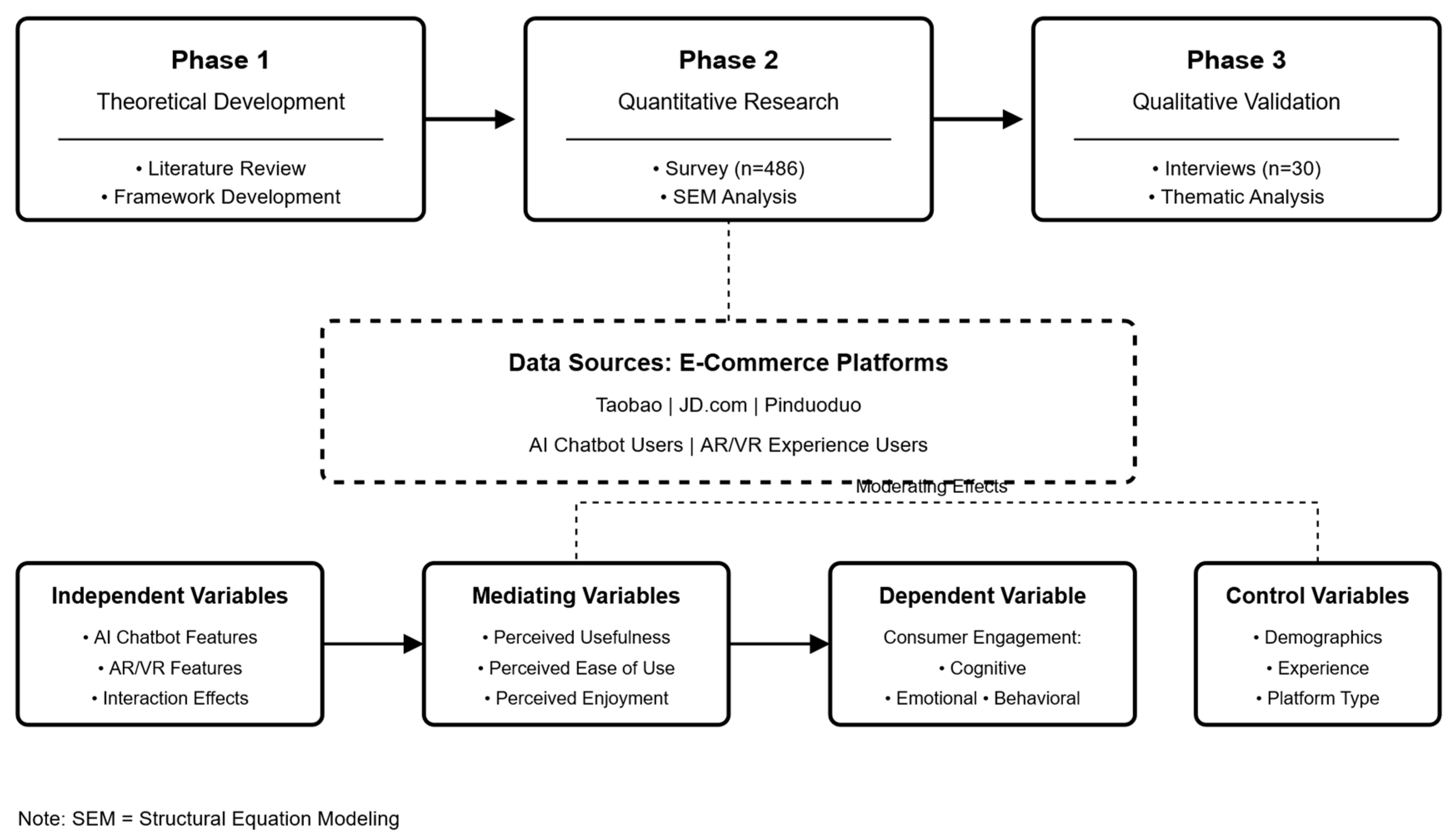
This research is executed through an integrated research methodology comprising qualitative and quantitative research approaches to find out the impact of AI chatbots and AR/VR on consumer engagement in e-commerce platforms. A methodological framework has been established. It involves three stages of research: concept development, empirical research, and verification. This is illustrated in
Figure 1. In this quantitative study, a cross-sectional survey research design is applied. It targets consumers who have used AI chatbots and AR/VR on Taobao, JD, and Pinduoduo. These are the three most widely used e-commerce platforms in China. SEM is used as the primary research tool for hypothesis testing of theoretical assumptions on dimensions of customer engagement (response variable) and technology attributes (independent variable). The qualitative phase entails conducting semi-structured interviews on 30 purposive participants aimed at affirming and situating quantifiable findings. In this regard, this research adopts an explanatory sequential design that helps address complex associations linking technology and engagement, all along ensuring high research rigor. Furthermore, gathering information will encompass three months (October–December, 2024), during which time respondents will answer online questionnaires, and video conferencing will be used for conducting interviews. Moreover, combining quantifiable and qualitative findings adopts a convergent strategy that helps synthesize findings regarding technology-enabled consumer engagement means within digital commerce settings.
The figure above illustrates the three-phase research design with variable relationships and data sources.
2.2. Data Collection
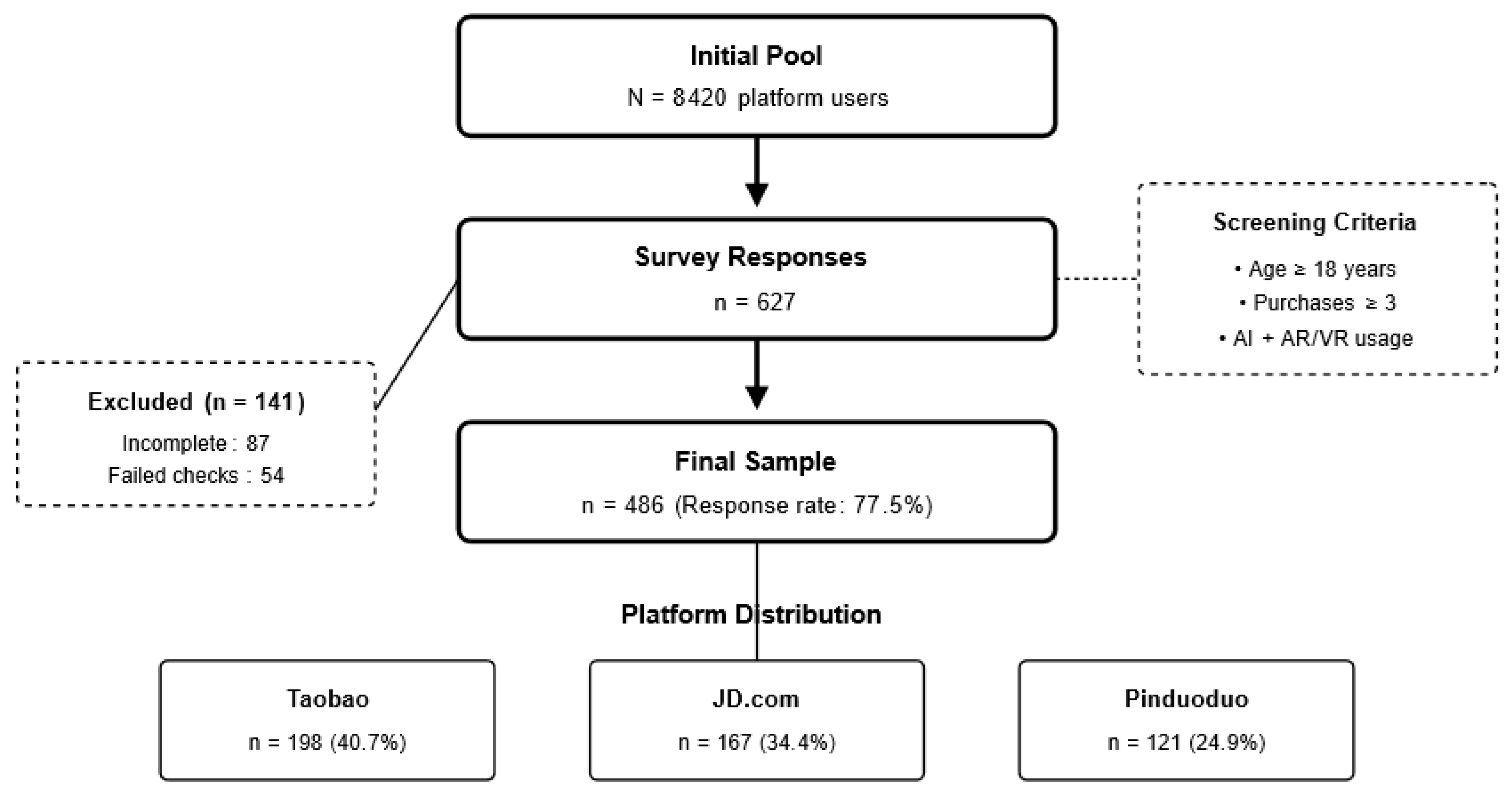
To accumulate data, multi-stage research was conducted from October to December of 2024 on three popular e-commerce sites used commonly in China, namely, Taobao, JD, and Pinduoduo. Based on
Figure 2, a preliminary list of potential participants was narrowed down from an original list of 8420 eligible platform users, surveyed via notification platforms, as well as external survey communities (Wenjuanxing and Credamo), resulting in a respondent list of 627 participants after weeding out non-qualified participants based on three criteria: (1) participants should be aged at least 18, (2) participants should have made at least three purchases on the platform, and (3) participants should have accessed AI chatbots and AR/VR technology on the platform. Based on data quality checks, a total of 141 responses were removed because they were incomplete (
n = 87) or because of attention check failures (
n = 54), leaving a final sample of 486 completed responses (77.5% completion rate). Sample stratification by platforms was proportional to market shares, Taobao (40.7%,
n = 198), JD.com (34.4%,
n = 167), and Pinduoduo (24.9%,
n = 121). Purposive sampling was used where 30 participants, stratified on engagement and technology usage, underwent semi-structured interviews. Monetary compensation (RMB 20–30) was used as an incentive to prevent biased attrition and enhance response quality.
2.3. Variable Measurement
All of these scales have been used before and have been adapted to suit this e-commerce environment. Except where noted, all survey items utilize a seven-point response scale with 1 denoting “strongly disagree” and 7 signifying “strongly agree”. To verify that each item had equal meaning in both English and Chinese, a back-translation approach was used, and content validity was verified through a panel of experts (n = 5). There was minor revision on some items after pilot testing (n = 50).
As reflected in
Table 1, the independent variables included features of AI chatbots and AR/VR technology. AI chatbot characteristics were assessed through a five-item instrument adapted from the work of Jiang et al. [
32], indicating speed of response, personalization, problem-solving ability, naturalness of conversation, and accuracy of recommendations (α = 0.89). Features of AR/VR technology were measured using a scale of six items developed based on Kumar et al. [
33], including immersion, interactivity, realism, ease of navigation, visualization, and sensorial interaction (α = 0.91).
Consumer engagement, as a dependent variable, was measured as a more complex construct consisting of three dimensions based on Hollebeek and Clark [
34]. Three dimensions of engagement were measured: cognitive engagement encompassed mental processing and absorption through 4 indicators (Cronbach’s α = 0.87), emotional engagement captured affective bonds and enthusiasm via 4 indicators (Cronbach’s α = 0.88), and behavioral engagement assessed participatory actions and interactive behaviors using 4 indicators (Cronbach’s α = 0.86). The study incorporated three mediating constructs: perceived usefulness (comprising 4 indicators, α = 0.87), perceived ease of use (consisting of 4 indicators, α = 0.85), and perceived enjoyment (containing 4 indicators, α = 0.88), with all scales derived from the work of Venkatesh and Davis [
35]. Technology readiness, as a moderator, was measured by using four items of an optimized scale provided by Parasuraman (α = 0.86). Product type was dummy coded (0 = search goods and 1 = experience goods). Product type was operationalized based on Nelson’s (1970) classification framework [
36]. The quality of search goods can be assessed through objective specifications before purchase. They include electronic goods, books, household appliances, and others. Similarly, experience goods are the products whose quality can be judged only through direct sensory experience. Examples include clothing, cosmetics, and food items. Participants were asked to recall the last time they had made a purchase that involved an AI chatbot or AR/VR technology. They were presented with a pre-defined list of categories to select from, which was subsequently coded by the researchers. The final sample consisted of 52.3% experience goods (
n = 254) and 47.7% search goods (
n = 232), which suffices for moderation analysis. Additionally, control variables included demographics (age, gender, education, and income), online shopping experience (in years), frequency of platform usage (times per month), and familiarity with technology, some of which are coded as single indicators or categorical indicators.
The validation of scales used was based on confirmatory factor analysis (CFA). All of the factor loadings were above the cut-off point of 0.70, and this indicated that there was convergent validity of scales. Discriminant validity was established by adopting Fornell and Larckers criteria, and this demonstrated that the correlation values of each of the constructs was smaller than the square root of average variance extracted (AVE). To overcome possible common method bias (CMB) in the study, both procedural and statistical remedies were used. Procedural remedies included guaranteeing participants’ anonymity, randomizing survey items, and embedding attention check questions throughout the questionnaire. The predictor and criterion variables were separated by placing intervening questions between them in different sections. For statistical control, Harman’s single-factor test indicated that the first factor explains 34.2% of total variance, which is lower than 50%. According to the marker-variable approaches, which made use of a theoretically unconnected variable, no results of practical significance were obtained between either of the study variables (r < 0.10). According to the unmeasured latent method construct (ULMC) approach, the proportion of variance attributable to the method was 8.3%, thus confirming that CMB is not a serious issue.
2.4. Data Analysis Methods
Structural equation model analysis was enacted through a two-step process. Initial analyses on SPSS 26.0 included descriptive statistics, tests of normality, and correlation analysis. Confirmatory factor analysis (CFA) was used on AMOS 26.0 through maximum likelihood methods to confirm the measurement model. To define model fitness, a series of criteria had to be met, namely, that χ2/df < 3, CFI > 0.90, TLI > 0.90, RMSEA < 0.08, and finally that SRMR < 0.08. In regard to hypotheses, testing of these occurred through model implementation, addressing platform and demographic controls simultaneously. Additionally, bias-corrected bootstrapping tests (resampling, N = 5000) through bootstrapping methods accessed mediating effects, utilizing 95% C.I. for demarcating signification. Moderation effects were explored through multi-group analysis and interaction terms. Median split group comparison was utilized for technology readiness, and dummy coding was used for product type moderation. Alternative model specifications were evaluated based on AIC and BIC values for model parsimony. Endogeneity was checked through instrumental variables, and non-linear effects were explored through quadratic terms. Thematic analysis of interview texts was conducted through Nvivo 12 software for qualitative verification of quantitative evidence.
3. Results
3.1. Sample Characteristics Description
Table 2 presents the demographic characteristics and technology adoption patterns of the final sample (
n = 486). The gender distribution was relatively balanced, with females comprising 52.3% of respondents (
n = 254) and males representing 47.7% (
n = 232). Mainland Chinese e-commerce participants tend to be quite young, and this was reflected in this research, as a large majority of participants belonged to this younger age range (18–35 years), consisting of two age ranges (18–25 and 26–35, as above). Furthermore, as expected, this research showed that participants had reached a high educational level, as indicated by having a bachelor’s or postgraduate degree (bachelor’s and above, as above).
As
Table 2 shows, the monthly household income was middle and upper-middle class, as most participants had a monthly income of 5000–15,000 RMB (61.7%,
n = 300). Online shopping experience was relatively average, as most participants had online shopping experience of about 6.8 years (SD = 3.2), and most (82.5%) reported daily visits to online platforms. Technology familiarity was quite advanced, as most participants had used AI chatbots for more than six months (71.4%,
n = 347), while AR/VR was more varied (less than 3 months, 38.7%,
n = 188, and 35.8). There was an average of 8.3 purchases per month (SD = 4.7), and experience goods (fashion, cosmetics) made up 57.2% of purchases, followed by search goods (electronics, books) at 42.8%. Moreover, the technology readiness score (M = 5.12, SD = 1.08) was above the scale median, indicating a positive orientation towards technology. All of these point towards a technology-oriented consumer segment that is typical of China’s online commercial environment.
3.2. Measurement Model Assessment
To validate this measurement model, a confirmatory factor analysis (CFA) was conducted through maximum likelihood estimation techniques. Good model fitness was indicated by these criteria: χ
2(df = 278) = 651.12,
p < 0.001, χ
2/df = 2.34, CFI = 0.94, TLI = 0.93, RMSEA = 0.053 (90%CI (047, 0.059)), and SRMR = 0.048, all of which exceeded the cut-off criteria, as shown in
Table 3.
The factor loadings on these standardized variables indicated adequate levels, all of which exceeded 0.70, ranging from 0.71 to 0.91, thus indicating that each of these indicators was reliable. There was internal consistency indicated by Cronbach’s alpha, indicating adequate performance on each of these scales of 0.85–0.92. Values of composite reliability exceeded the cut-off of 0.70, ranging from 0.87 to 0.93, and average variance extracted exceeded 0.50, ranging from 0.63 to 0.72, thus indicating convergent validity as a whole. Of all these scales, AR/VR had the highest value of composite reliability.
To check discriminant validity, two techniques, namely, Fornell and Larcker criteria and HTMT ratio, were employed. As can be seen from
Table 3, all square roots of the AVE values exceeded correlation coefficients, and all HTMT values were below 0.85, though the highest value of 0.82 was observed for AR/VR features and consumer engagement variables. To check common method variance, Harman’s single-factor test was used, and it was observed that only 34.2% of total variance was accounted for by the first unrotated factor, which is below the critical value of 50%. Moreover, tests of the unmeasured latent method construct (ULMC) showed that there was no significant improvement in model fitness through accounting for common methods (Δχ
2 = 8.73,
p > 0.05).
3.3. Structural Model Assessment
To examine whether proposed paths existed in this research or not, Structural model empirical testing was conducted on proposed paths by considering demographics as control variables and platform effects. The structural model demonstrated adequate fit indices: χ
2(312) = 748.37,
p < 0.001, χ
2/df Ratio = 2.40, CFI = 0.93, TLI = 0.92, RMSEA = 0.054 (90% CI = (0.049, 0.060)), and SRMR of 0.051.
Table 4 is shown below.
Analysis of results showed that functionality of the AI chatbot had a positive and significant impact on consumer engagement (β = 0.35, p < 0.001), which supports hypothesis H1. Again, functionality of AR/VR had a more positive and significant impact on consumer engagement (β = 0.42, p < 0.001), thus supporting hypothesis H2. Furthermore, some differences existed between the paths of mediating variables, as utility perception (β = 0.28, p < 0.001), usability perception (β = 0.19, p < 0.01), and enjoyment perception (β = 0.31, p < 0.001) had all shown positive and significant paths on consumer engagement, thereby supporting hypotheses H3–H5, respectively.
Significant mediated pathways were established through indirect effects tests via bootstrap analysis (5000 resamples). The indirect effects of AI chatbot features on engagement via utility perception (indirect effect = 0.12, 95% CI [0.07, 0.18]) and enjoyment perception (indirect effect = 0.14, 95% CI [0.08, 0.21]) were significant, as was that of AR/VR platform features via enjoyment perception (indirect effect = 0.18, 95%CI [0.11, 0.26]). Substantial explained variance was achieved for consumer engagement (R2 = 0.62) and its dimensions, namely, cognitive engagement (R2 = 0.58), emotional engagement (R2 = 0.61), and behavioral engagement (R2 = 0.56). There was little empirical support for control variables as only age (β = −0.08, p < 0.05) and frequency of platform use (β = 0.11, p < 0.01) reached statistical.
3.4. Mediation Effects Analysis
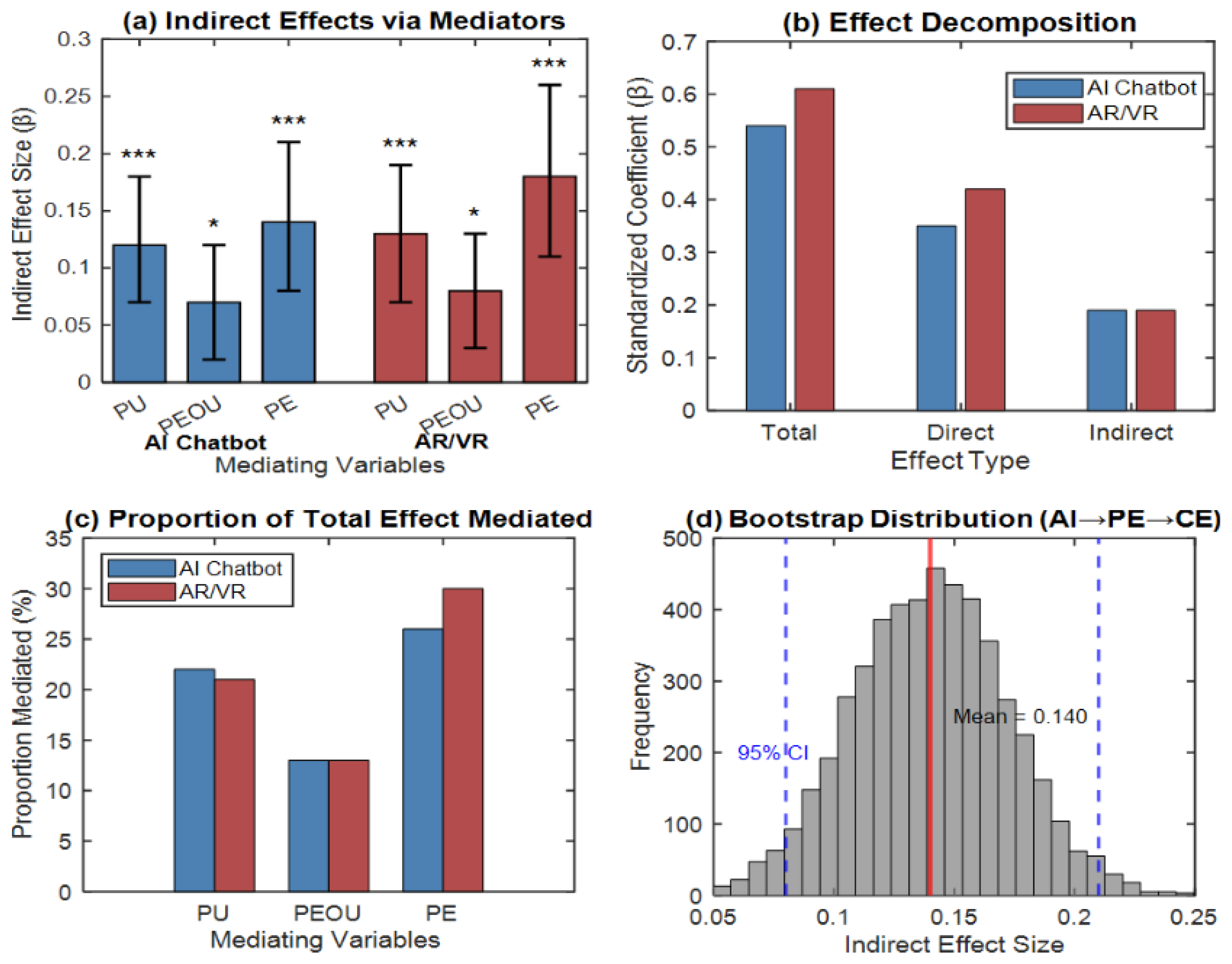
Bootstrap methodology was employed for mediation analysis, utilizing 5000 resampling iterations to examine the indirect pathways through which AI chatbot and AR/VR functionality influence consumer engagement via specific mediating variables. The proposed mediation pathways all demonstrated significant indirect effects, with their respective 95% bias-corrected confidence intervals excluding zero, as illustrated in
Figure 3a In AI chatbot functionality, perceived enjoyment was identified as the most influential mediator (β = 0.14, 95% CI [0.08, 0.21]), followed by perceived usefulness (β = 0.12, 95% CI [0.07, 0.18]) and perceived ease of use (β = 0.07, 95% CI [0.02, 0.12]). Total indirect effect was estimated as 0.19, explaining 35.2% of the total effect. AR/VR functionality showed comparable results but larger effects, especially through perceived enjoyment (β = 0.18, 95% CI [0.11, 0.26]), marking the most considerable indirect effect within this model as well.
Figure 3b breaks down the total effects into their direct and indirect parts, and it is observed that both technologies retain strong direct effects on engagement, even when considering mediation (AI: β = 0.35, AR/VR: β = 0.42). The percentage of mediation analysis, as represented in
Figure 3c, shows that enjoyment has mediated 26% and 30% of total effects for AI chatbot and AR/VR technology, respectively, signifying that hedonic experiences have played a critical role in mediating engagement through technology.
Figure 3d shows the result of the bootstrap distribution for the most prominent mediated path (AI→PE→CE). All mediations showed significant Sobel z-values (2.80 to 4.86,
p < 0.05). There was support for the notion of partial mediation, indicating that all three pathways (UI, EU, and E) have a part to play but that there are still some directly significant pathways, possibly suggesting other, as-yet unidentified, pathways requiring future research.
3.5. Moderation Effects Analysis
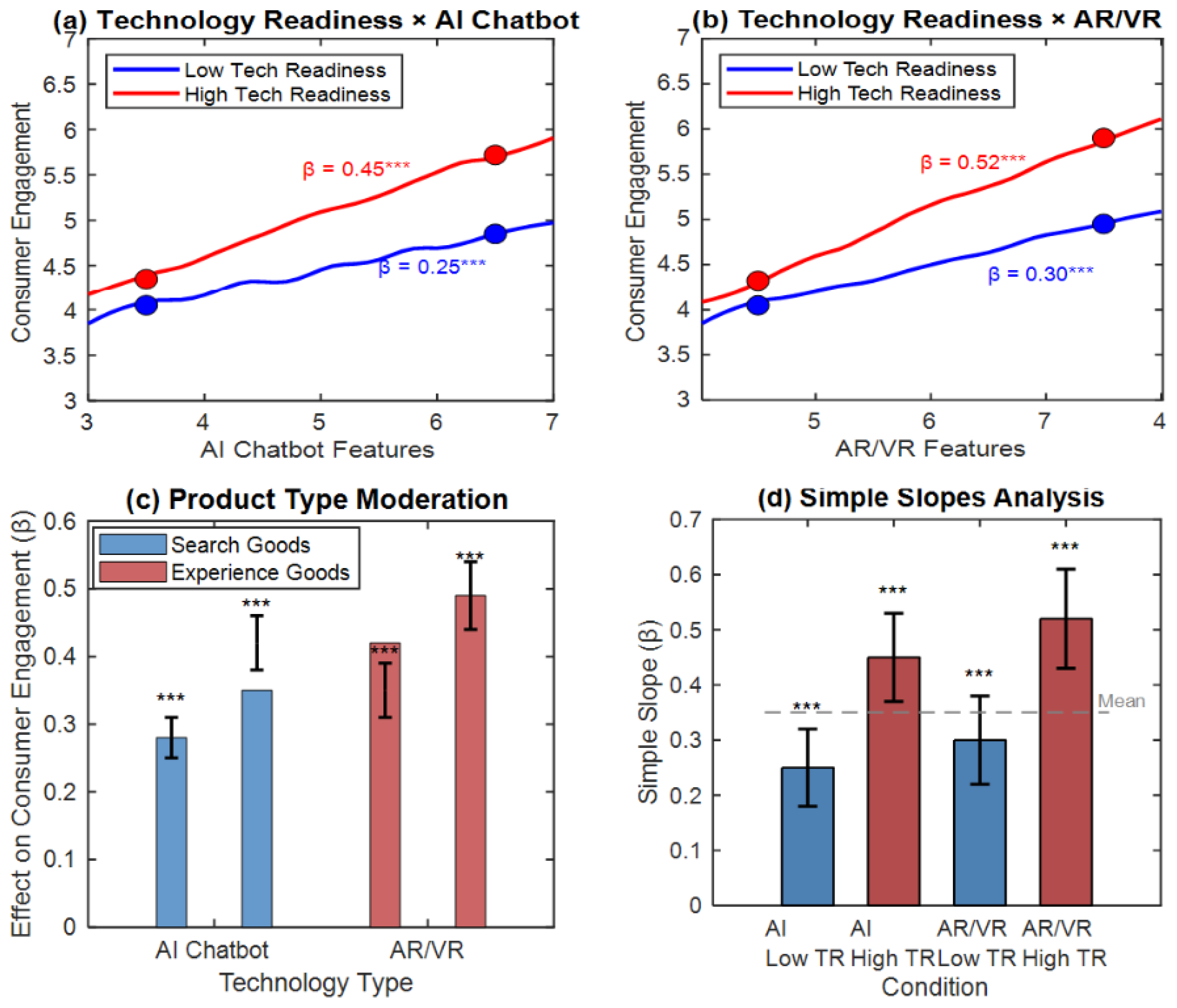
Moderation analysis was used to explore boundary assumptions of the technology effect on engagement, and technology readiness was observed as a significant moderator for AI chatbot technology (β = 0.20,
p < 0.001), as well as AR/VR technology (β = 0.22,
p < 0.001). Based on
Figure 4a,b, it was observed that technology readiness had positively affected the relationship of technology and engagement, and this relationship was stronger for high technology readiness consumers compared to low technology readiness ones.
Results of simple slopes tests showed that there was a difference in effects across technology readiness levels. In regard to AI chatbots’ features, there was a significant but less pronounced effect on engagement for low technology readiness consumers (β = 0.25, p < 0.001) than for high technology readiness consumers (β = 0.45, p < 0.001), and this was significantly different (Δβ = 0.20, p < 0.001). The effect on engagement for AR/VR features was more significantly differentiated, with slopes of β = 0.30 (p < 0.001) and β = 0.52 (p < 0.001) for low vs. high technology readiness, and this was significantly different (Δβ = 0.22, p < 0.001).
The moderating influence of product type, as illustrated in
Figure 4c, revealed that both technologies exerted greater impact on experience goods compared to search goods. There was an increment in effect from β = 0.28 (search goods) to β = 0.42 (experience goods) for AI chatbots and from β = 0.35 to β = 0.49 for AR/VR technology. Both interaction terms were significant (AI × Product Type, β = 0.14,
p < 0.01, and AR/VR × Product Type, β = 0.14,
p < 0.01).
Figure 4d reveals a summary of simple slopes for all conditions, indicating that only high technology readiness and experience goods showed significant engagement effects. These results highlight and verify the role of consumer and product variables relative to technology effectiveness.
3.6. Supplementary Analysis
3.6.1. Multi-Group Analysis
To investigate platform user groups’ invariance in structural parameters, multi-group analysis was used. By testing measurement invariance, this study adopted a hierarchical strategy, successively confirming configural, metric, and partial scalar invariant testing via model comparison (Δχ
2 = 12.47,
p > 0.05, Δχ
2 = 18.23,
p > 0.05, and Δχ
2 = 24.68,
p > 0.05, respectively), indicating that valid comparisons could be made across groups. As shown in
Table 5, there was variance of each of these paths across platforms. Taobao users, having available comprehensive AI and AR/VR technology, showed more notable technology-use associations (AI, β = 0.41,
p < 0.001; AR/VR, β = 0.48,
p < 0.001). Both JD and Taobao consumers shared equal coefficients (JD, AI, β = 0.35,
p < 0.001, and AR/VR, β = 0.43,
p < 0.001), and Pinduoduo consumers showed more pronounced AI effects (β = 0.38,
p < 0.001) but relatively lesser effects of AR/VR (β = 0.28,
p < 0.01). Chi-square difference tests indicated that path coefficients significantly differ between groups (Δχ
2 = 37.82, df = 10,
p < 0.001). There was a consistency in the mediating mechanism, and perceived enjoyment continued to have the most prominent indirect effects (ranged between 0.14 and 0.19). These results indicate that while basic paths remain stable across platforms, differences lie in their magnitudes.
3.6.2. Robustness Checks
To ascertain that these findings remain stable under alternative settings, comprehensive robustness tests have been conducted.
Table 6 below shows the results of these tests on this study: First, alternative methods of model testing, namely, maximum likelihood and Bayesian structural equation modeling, showed that each corresponding path coefficient was consistent, despite small variations of less than 3%. Second, testing for common method variance through unmeasured latent method constructs was invariant on all path coefficients as well. Third, applying IV analysis through each technology adoption rate on platforms showed that endogeneity is not a concern, as Wu and Hausman tests showed non-significance (F = 1.87,
p-value > 0.10). Fourth, non-linear effects were explored via quadratic expressions, and these showed marginal diminishing returns for AI chatbot functionality (β
2 = −0.08,
p < 0.05) but not AR/VR technology. Fifth, alternative model specifications—testing for perfect mediation and reversed causality—showed significantly poorer model fit (ΔAIC > 20 and ΔBIC > 25), indicating that the proposed theoretical model is appropriate and valid. Moreover, subsampling analyses, employing random splits of 50% of observations, showed that all estimates remained stable (difference of coefficients < 0.05).
4. Discussion
In this current research, we explored the effects of AI-powered chatbots and AR/VR technology on consumer engagement on e-commerce sites, and this research has provided some valuable theoretical and practical implications. This research has indicated that AI chatbot functionality (β = 0.35,
p < 0.001) and AR/VR functionality (β = 0.42,
p < 0.001) are highly influential on consumer engagement, and AR/VR functionality has more potential than AI chatbots on e-commerce sites, as shown in this research output. Recent studies have indicated that AI chatbots positively influence customer satisfaction [
32], but this research has provided more comprehensive and meaningful theoretical and practical reflections that have indicated AR/VR technology to have more potential than AI chatbots on influencing consumer engagement on e-commerce sites, departing from the popular trend of ‘Conversational Commerce’ [
37].
By far, the mediating role of perceived enjoyment was most prominent, through which the largest indirect effects existed for both technologies (AI, β = 0.14; AR/VR, β = 0.18). Contrary to more traditional TAM studies, which have continuously stressed more practical considerations, this indicates a paradigm shift towards hedonic value for consumer technology adoption as a whole. Although studies like that of Barta et al. [
38] have recently established some non-rational, emotional channels of effect for AR technology, this observation shows that this trend applies generally to AI chatbots as well and thereby suggests an overall paradigm shift on the part of retail consumers concerning retail technology adoption as a whole. According to this, enjoyment eclipsed usefulness (β = 0.12) and ease of use (β = 0.07).
The findings strengthen and complement previous studies in significant ways. In keeping with recent work on AR from Barta et al. [
38] in retail, hedonic pathways are prominent, and the findings show this hedonic dominance extends to other technologies like AI chatbots as well, which is something not reported before. Although prior TAM studies have emphasized utilitarian factors, including perceived usefulness, the findings show a possible shift occurring in consumer technology adoption in e-commerce where experiential value increasingly supersedes functional value. This observation is in line with digital marketing literature that highlights ‘the experience economy’ as a competitive differentiator [
21]. Nonetheless, those results are different from the study by Hsu and Lin [
10], which discovered perceived usefulness as the reason for adoption. The dissimilarities may reflect contextual differences. The difference in context may explain this discrepancy: The former study was in the context of customer service, where the resolution of problems was the main focus. The present e-commerce study, however, covers a broader shopping experience in which enjoyment and exploration play a greater role. The finding that AR has a greater effect on hedonic than utilitarian behaviors is also supported by analysis of the meta-analytic evidence showing that AR technologies enhance behavioral intentions through principally hedonic value pathways, with enjoyment a stronger predictor than the utilitarian one [
39].
Technology readiness was identified as a prominent boundary condition, and for high-readiness consumers, there was a significantly stronger response to AI (β = 0.45) and AR/VR (β = 0.52) than for low-readiness consumers (β = 0.25, AI, and β = 0.30, AR/VR). This asymmetrical boundary condition, more dramatically observed for AR/VR, can be considered an extension of Parasuraman’s model [
40], consistent with recent findings demonstrating that technology readiness influences adoption through dual pathways of perceived benefits and perceived sacrifices [
41]. Additionally, under the umbrella of boundary conditions, product type non-linear interactions reinforced that experience goods have a stronger technology effect than search goods (β = 0.42, AI, and β = 0.49, AR/VR), complementing previous research by Whang et al. [
42].
New theoretical findings arise from observing that chatbots’ effects are characterized by diminishing returns (β
2 = −0.08,
p < 0.05), but this is not the case for AR/VR platforms. Such non-linear effects point towards potential chatbot fatigue effects and contradict linear assumptions made by Adam et al. [
37]. The AR and VR platforms may be new or sufficiently diverse so that over a longer period, a linear relationship holds, which affords these platforms protection from potential habituation effects. According to the theoretical propositions of Li et al., there are differences across platforms, and Taobao has the greatest impact, suggesting that the successful implementation and integration of platforms are critical to technology success [
43].
Artificial Intelligence chatbots suffer from diminishing returns while AR/VR technologies experience linear effects. This asymmetry needs further theorization. Based on this theory, chatbots could impose a cumulative information processing load on users, even when they seem like chatting. As users interact with chatbots more frequently, they may experience cognitive overload due to the chatbot’s complexity, which reduces the engagement benefits on the margin. In contrast, the visual and spatial processing channels used by AR and VR technologies may be less prone to fatigue effects. The relatively new use of AR and VR in e-commerce may keep users interested when they use it for long. Studies suggest that consumers become used to chatbots faster than more immersive technologies that continually provide new sensations, like virtual reality, which keeps on adding sensations at the sensory level [
37].
The results help e-commerce platform managers in the real world. Because of the greater engagement effects of AR/VR technologies compared to AI chatbots (particularly for experience goods (β = 0.49)), platforms should invest in this immersive visualization capability for product categories where virtual try-on and product demonstration is most relevant. AI chatbots are exhibiting signs of diminishing returns. This suggests that platforms must optimize the quality and variation of their chatbot service rather than increase the frequency of chatbot engagements. Excessive chatbot interaction is what we have also predicted may lead to user fatigue. Moreover, the technology readiness to moderate strongly implies that platforms with diverse users should have adaptive interfaces with features whose complexity changes with respect to individual users’ profiles in order to make it easy to access by less technology-savvy consumers. At the same time, it should provide advanced functionalities for those who are more technology-savvy and use many of those functionalities.
Several limitations of this study should be acknowledged. The sample was taken only from Chinese e-commerce platforms where respondents are mostly young, well-educated, and technologically savvy. As a result, the findings may not be generalizable to other markets and demographic segments. Future research should replicate these findings in different cultures and consumer groups. The cross-sectional design limits definitive causal conclusions, with longitudinal examinations of engagement trajectories over time serving to strengthen causal inferences. Comprehensive measures for common method bias were employed, but a reliance on self-reports may affect the accuracy of recall. Future research may use objective measures of behavior in addition to surveys, such as clickstream data. The mechanisms underlying diminishing returns for AI chatbots are poorly understood. Therefore, direct measures of cognitive load and habituation constructs should be employed to gain insights into these mechanisms. Ultimately, we considered AI chatbots and AR/VR as different stimuli; there is opportunity for future research to look at their combined effect when deployed together along various product categories and purchase stages.