1. Introduction
As consumers grow more interested in seamless experiences across all available channels, omnichannel retailing is evolving rapidly. In recent years, various forms of omnichannel retailing have emerged in practice. One of the most prominent forms is “buy online and pick up in store” (BOPS), which allows consumers to purchase products online and then collect them at a nearby store [
1,
2,
3]. According to one survey, BOPS accounted for nearly one-third (30.2%) of Sam’s Club e-commerce sales in 2015 [
4]. To meet consumers’ growing demand for diversified shopping experiences and expand their market, some online retailers with limited resources prefer to partner with offline physical retailers to offer BOPS services. For example, JD Supermarket partners with 87,000 physical stores in China—such as Walmart and Yonghui—to provide instant consumption services like online purchases and offline pickup. Customers can place orders on the JD Home platform and then use Walmart’s one-hour delivery or in-store pickup service. During JD’s 618 shopping festival in 2022, JD Supermarket’s omnichannel sales increased by 77%. Similarly, Meituan has partnered with community shops to provide BOPS services for local residents.
In practice, cooperation among retailers in implementing BOPS channels has created a new environment where channel cooperation and competition coexist. On one hand, online retailers offer commissions to incentivize offline retailers to handle pickups for online purchases, thereby promoting online–offline channel integration. On the other hand, the BOPS model creates a seamless shopping process for customers. It offers convenience to online consumers by reducing delivery wait times and privacy concerns. This convenience may attract both online and offline consumers to switch to BOPS purchases, which can lead to channel cannibalization and intensify competition between channels.
Channel pricing is a commonly used method in channel competition [
5,
6,
7,
8]. Advertising campaigns also serve as an important tool for enhancing competitiveness and stimulating market demand, a topic widely discussed in academia. Numerous empirical and experimental studies have confirmed the relationship between advertising and channel competition. Specifically, advertising can alter consumers’ perceived utility of purchasing through different channels, thereby influencing the competitive position of each channel [
9,
10,
11]. In particular, BOPS offers customers the convenience of shopping online and picking up in-store, enhancing their shopping experience. Studying the effects of the BOPS cooperation on advertising can help retailers understand how to effectively advertise their BOPS services to attract more customers across multiple channels and increase satisfaction. However, most existing research on pricing and advertising competition strategies focuses on dual-channel systems where online and offline channels operate independently. There is limited literature discussing omnichannel operations in which channel cooperation and advertising competition coexist. Furthermore, when introducing new channels like BOPS, retailers’ pricing flexibility is influenced by multiple factors. These include brand positioning, consumer perception, operational costs, and market competition. This study specifically distinguishes and examines two representative pricing strategies: fixed pricing and optimized pricing, implemented before and after BOPS cooperation [
12].
Specifically, under a fixed pricing strategy, retailers maintain their original retail prices after implementing BOPS cooperation. This strategy aims to preserve brand price stability and avoid consumer confusion that may arise from frequent price changes. In this case, the introduction of the BOPS channel mainly influences consumer channel choice and demand allocation by adjusting advertising investment. In contrast, under an optimized pricing strategy, retailers re-optimize their retail prices following BOPS cooperation. This approach is suitable for retailers with strong pricing autonomy and responsive market capabilities, or those who proactively adjust prices during new channel launches to maximize overall profitability. Currently, there is a lack of systematic research on whether competing retailers should adopt a fixed or an optimized pricing strategy after BOPS cooperation, as well as how pricing flexibility moderates the impact of such cooperation.
Thus, we pose the following research questions for omnichannel retailing with BOPS cooperation:
- (1)
How does BOPS cooperation affect the optimal advertising and pricing strategies of two competing retailers, and how is this influence moderated by pricing flexibility (i.e., fixed versus optimized pricing)?
- (2)
Under what conditions does implementing BOPS cooperation increase or decrease the profits of online and offline retailers, considering the roles of BOPS commission, convenience coefficient, and advertising competition?
- (3)
How should competing retailers choose between maintaining fixed prices and adopting optimized pricing after BOPS cooperation?
Considering that under different operating environments, implementing BOPS cooperation may yield different effects for different retailers, in this paper, we focus on exploring the impact of BOPS cooperation in three cases, namely, (1) benchmark in the absence of BOPS cooperation (BN), (2) fixed online and offline pricing after BOPS cooperation (FY), (3) optimized online and offline pricing after BOPS cooperation (OY). Based on this framework, we conducted a comparative study of the two pricing strategies before and after BOPS cooperation (cases BN and FY, BN and OY, FY and OY), discussing which strategy is the most preferable for the online and offline retailers.
Our investigation yields several key findings. First, under a fixed pricing strategy, the BOPS commission primarily serves as a profit-transfer mechanism and reduces advertising investments for both retailers. Under an optimized pricing strategy, however, the commission does not directly affect advertising. Instead, a higher convenience coefficient leads the offline retailer to raise both advertising and price. Second, BOPS cooperation does not always improve profits for both retailers. Its impact depends on multiple factors combined, such as the commission rate, convenience coefficient, advertising cost, and offline hassle cost. Third, when the commission is high and the offline hassle cost is low, an optimized pricing strategy generates higher profits for both retailers. This highlights the strategic value of pricing flexibility in omnichannel retailing.
This study contributes to the literature in two main ways. First, by capturing the demand characteristics of all channels, it develops an omnichannel model that simultaneously considers the advertising competition and pricing strategies of the two retailers. This model reveals how post-BOPS pricing modes—fixed or optimized—systematically affect competing retailers’ decisions and profits. It addresses a research gap, as prior studies often examine only one strategy or a single firm. Second, the study integrates channel cooperation and advertising competition within a unified framework. This allows us to examine the interaction between BOPS parameters and pricing strategies, offering a new theoretical lens for understanding synergy and conflict among competing retailers in omnichannel settings.
The rest of this study is organized as follows:
Section 2 reviews the related literature. In
Section 3, we describe our modeling framework and characterize the consumer surplus of each channel. In
Section 4, the benchmark model is presented in the absence of BOPS cooperation. Then we examine the effects of BOPS cooperation on advertising levels, prices, demand, and profits under cases FY and OY in
Section 5. Furthermore, we compare the two cases to assess retailers’ preferences for the two pricing strategies.
Section 6 concludes our results and suggests some future research directions. All proofs are given in
Appendix A.
2. Literature Review
This study is related to two areas of research, namely, the management of omnichannel retailing and advertising competition.
2.1. The Literature on Omnichannel Retailing
The first literature stream relevant to our study is omnichannel retailing. Since its introduction in 2010, the omnichannel concept has attracted considerable attention from both academia and economists. “Buy online and pick up in store” (BOPS) represents one of the earliest omnichannel forms and continues to draw scholarly interest (e.g., [
13,
14,
15,
16,
17]). Research on BOPS retailing can be grouped into three main streams. The first stream examines retailers that operate both online and offline channels. It empirically investigates how BOPS influences consumer channel-switching behavior (e.g., [
18,
19]). These studies find that the impact of omnichannel integration on purchase behavior is partly moderated by factors such as product variety and competitive intensity. The second stream employs optimization theory to analyze the operational decisions of a single retailer adopting BOPS. For example, Cao et al. (2016) [
12] incorporate heterogeneous product values and offline hassle costs to study optimal pricing when products are sold only online versus both online and in-store. Niu et al. (2019) [
20] compare two omnichannel models—uniform pricing and online-to-store—and their effects on traffic congestion. They show that when online hassle costs are low, uniform pricing leads to lower online demand and higher prices. Kong et al. (2020) [
21] explore how BOPS adoption influences optimal operational decisions under consistent and inconsistent pricing strategies. Ge and Zhu (2023) [
2] and Wang et al. (2023) [
22] extend this line by studying price and channel strategies in settings with two competing retailers implementing BOPS. Additionally, some scholars study the retailer’s joint decisions on prices and coupons, such as Li et al. (2022) [
23], who studied omnichannel operations with coupon promotions, treating coupons as an important pricing instrument. By introducing brand competition and a platform-based supply chain, Yu et al. (2024) [
24] analyzed strategic interactions between a national brand manufacturer and an e-platform that sells both national and private-label brands. Their work examines how the choice of omnichannel strategy—BOPS versus ship-from-store—and commission rates affect competitive equilibrium and profitability. This shifts the focus from purely operational pricing and channel decisions to the strategic interplay between cooperating and competing actors in an omnichannel system.
The third research stream differs from the two described above by focusing on online and offline channels operated by separate entities. It examines optimal operational decisions in BOPS cooperation. For instance, Fan et al. (2019) [
25] studied a supply chain where online and offline retailers collaborate to implement BOPS, analyzing omnichannel inventory optimization under different models. Li et al. (2020) [
26] and Jiang and Wu (2024) [
3] developed an omnichannel supply chain structure in which a manufacturer and a retailer jointly operate BOPS and explored their respective optimal strategies. In contrast, our study extends the analysis to a more general scenario involving two cooperating retailers.
This third stream closely aligns with the BOPS structure considered in our paper. However, it primarily investigates pricing, inventory, and cooperative advertising decisions within a supply chain. Research on operational strategies through joint pricing and advertising competition is limited. Our paper addresses this gap by introducing advertising as a tool that actively shapes consumer utility, thereby influencing channel choice and demand allocation—a dimension rarely integrated into prior BOPS operational models. In addition, our work is closely related to the studies by Cao et al. (2016) [
12] and Kong et al. (2020) [
21], which both assume that online and offline channels adopt inconsistent pricing strategies and only consider a single retailer operating both channels. In contrast, we model two independent, competing retailers who decide whether to cooperate by introducing a BOPS channel alongside their existing online and offline operations. This structure allows us to analyze how BOPS implementation affects optimal advertising levels and pricing strategies when two decision-makers interact across three distinct channels—an interaction not captured in earlier single-retailer frameworks. Moreover, we develop a comparative model to examine how BOPS cooperation influences omnichannel prices and advertising levels under fixed and optimal pricing strategies. We also assess retailers’ preferences between these two pricing strategies, which have rarely been explored in related studies. These findings provide practical guidance for managers on when to adopt flexible pricing and how to negotiate BOPS terms under different competitive and operational conditions.
2.2. The Literature on Advertising Competition
Advertising competition is the second area of the literature related to our paper. Existing research classifies advertising primarily into three roles: informative, complementary, and persuasive [
27,
28]. Our work aligns with the persuasive view, which posits that advertising can alter consumer preferences and valuations, thereby differentiating products across channels [
29,
30]. From this perspective, prior studies have examined how advertising functions in product competition between firms or across channels, typically assuming a fixed consumer base (e.g., [
10,
31,
32]). For example, Bloch and Manceau (1999) [
31] argue that advertising competition between brands does not increase total demand but shifts consumers between brands. Using a Hotelling model, they show that advertising can influence consumer distribution across products. Their findings indicate that advertising reduces the price of the advertised product when sold by different retailers. Chen et al. (2009) [
32] assumed that advertising helps firms reach more consumers and analyzed its competitive effects. Their results suggest that advertising may lead to either anticompetitive or procompetitive outcomes, depending on how consumers respond. Furthermore, Jiang and Srinivasan (2016) [
10] studied how consumer preferences and advertising efficiency affect retailers’ pricing and advertising decisions. They found that as horizontal differentiation increases, the retailer offering a lower-value product should raise advertising, while its competitor should reduce it. Similar to these studies, we focus on how persuasive advertising influences omnichannel competition and BOPS cooperation between two retailers. Like Bloch and Manceau (1999) [
31], Chen et al. (2009) [
32], and Jiang and Srinivasan (2016) [
10], we examine how advertising shapes optimal strategies for competing retailers. Their models suggest that if only one retailer advertises, it can increase its own demand. However, if both competitors advertise, total demand remains unchanged.
Other research studies, such as those employing empirical methods, optimal control theory, or perspectives different from ours [
11,
33], have not yet examined how introducing a BOPS channel and the nature of BOPS cooperation affect the pricing and advertising levels of competing retailers. The literature on channel structures is extensive (e.g., [
30,
34,
35,
36,
37,
38]). However, most prior studies have focused on advertising competition and pricing within a single channel—typically between one manufacturer and one retailer—rather than in an omnichannel setting involving BOPS cooperation.
This study focuses on how persuasive advertising affects omnichannel competition and interacts with BOPS channel cooperation. Similar to [
10,
31,
32], we conduct an equilibrium analysis involving two competing retailers who simultaneously set their advertising levels and prices. Furthermore, we contribute to the literature by performing a more detailed and comprehensive equilibrium analysis in a novel operational context. This context includes omnichannel pricing and advertising equilibria both before and after implementing BOPS cooperation. Our analysis explicitly examines the effects of adding a BOPS channel on the advertising competition strategies of online and offline retailers.
We present the major literature and make a comparison with our work in
Table 1.
3. Model
3.1. Retailers
We consider two competing retailers (, ): the online retailer and the offline retailer. They are represented by the subscripts (online) and (offline), respectively. First, we assume that two retailers sell the same category of products. Retailer sells her products at an online price to consumers. Retailer sells the same products through its offline store at price . Meanwhile, the online retailer, , cooperates with retailer to provide BOPS and pays retailer a per-unit commission, , for the offline pickup service, and is exogenous, as it typically reflects a pre-negotiated, stable contract term in practice (e.g., platform–retailer agreements). To ensure the long-term development of the BOPS channel, it is assumed that .
To compete for the market, both retailers (
,
) place ads for their products and increase consumers’ willingness to pay for them [
10,
43] because well-conducted advertising can increase the customer surplus, such as by creating a higher social reputation [
44]. The level of advertising is set at
and
by the online retailer and the offline store, respectively. Considering that the marginal cost of the advertising level is incremental, we assume the advertising costs are
for
,
denotes the cost coefficient of advertising, and
should not be too small for a stable competitive equilibrium, which is widely applied in the advertising literature [
10,
43].
3.2. Customers
Each consumer can only purchase one product at most. Consumers choose one of the three alternative channels (online, offline, and BOPS) to maximize their surplus. For each consumer, the initial valuation of the product is
. Consistent with Chiang et al. (2003) [
45] and Li et al. (2019) [
46], given that consumers cannot directly touch or experience products in the online channel, the valuation of online products is relatively lower. Therefore, we assume that the product valuation for the online channel is
,
. As the BOPS channel is based on the online channel, we denote
as the product valuation for the BOPS channel. One consumer who purchases across different channels will incur different hassle costs. When choosing the online channel, the consumer incurs a hassle cost,
(e.g., browsing numerous websites and placing an order or waiting for logistics delivery). Considering that customers are heterogeneous in their perceptions of online hassle costs, reflecting differences in sensitivity to waiting, security, and privacy concerns. Similar to Li et al. (2020) [
26] and Balakrishnan et al. (2014) [
41], we assume that the online hassle cost,
, is a random variable distributed uniformly over
. When purchasing in store, the consumer incurs a positive hassle cost,
(e.g., visiting stores or searching for the product on shelves). When customers buy via BOPS, they incur the hassle costs of online ordering and store visits because they need to place the order online and then visit the store to pick it up. Considering that offline pickup reduces the waiting cost for consumers, we assume that consumers purchasing via BOPS incur a hassle cost of
, where
represents the online hassle cost when purchasing via BOPS,
represents the convenience of no waiting provided by BOPS, and
represents the convenience coefficient. For simplicity, we denote the offline, online, and BOPS channels as
,
,
. Thus, given retailers’ advertising, we can specify the customer surplus for each channel option as follows:
We assume that the size of potential consumers in the market is 1. Consumers will choose the channel that provides the highest non-negative utility for purchasing the product. To avoid unnecessary discussion, we propose the following three assumptions: (1) First, following Jiang and Srinivasan (2016) [
10], we assume the advertising levels of the retailers are not too low. If the advertising level,
is too low, both retailers will be in a local monopoly respectively, which implies that in equilibrium, the market will not be fully covered. Our study focuses primarily on the interesting scenario of a competitive market with full coverage, subject to the condition that retailers’ advertising levels are not too low. (2) We assume that
, because otherwise, there is no consumer to purchase from the store. (3) We assume that
, that is,
. When
, we have
,
, which implies that the convenience level of buying from BOPS does not cover the hassle cost of shopping at the store, meaning that no consumer chooses BOPS to buy.
While the BOPS retail model enhances cross-channel convenience for consumers and improves market efficiency, cooperation between retailers to provide BOPS services inevitably increases operational pressure on the offline retailer. This includes higher operating costs, which in turn influence advertising and pricing strategies. For example, when the same product is sold both online and in-store, the offline price is often higher due to factors such as staff salaries and store rents. Additionally, offline advertising expenditures tend to exceed those for online advertising. Therefore, it is important to clarify whether retailers should offer BOPS services and to identify the conditions under which BOPS cooperation is most appropriate.
3.3. Retailer and Customer Decisions
Consumers are sensible and will choose one of the available channels that maximizes their net surplus. Retailers (
,
) maximize their own profits by choosing the optimal advertising levels (
,
) and prices (
,
). In reality, advertising decisions are often made earlier than price decisions, while price decisions may be more easily changed (e.g., [
47,
48]). Therefore, we assume that setting advertising strategies precedes setting price strategies, and the two retailers play a Nash game in two stages. In stage 1, the retailers simultaneously decide their advertising levels, and in stage 2, they decide the product prices.
4. Benchmark in the Absence of BOPS Cooperation: Case BN
We first consider the case in which customers buy products only through online or offline channels in the absence of BOPS cooperation, and the market is fully covered. Consumers make purchase decisions based on the principle of utility maximization
. When
and
, they choose the online channel; when
and
, they choose the offline channel. Setting
gives the indifference point:
Given that is uniformly distributed over , the demand for the online channel is and for the offline channel is . To ensure positive demand in both channels, we require: .
Moreover, to ensure non-negative utility for consumers in their chosen channel:
For the offline channel, implies .
For the online channel, at , since , the condition is equivalent to ; and because decreases in , holds for all .
Therefore, under full market coverage with positive demand in both channels, we obtain and .
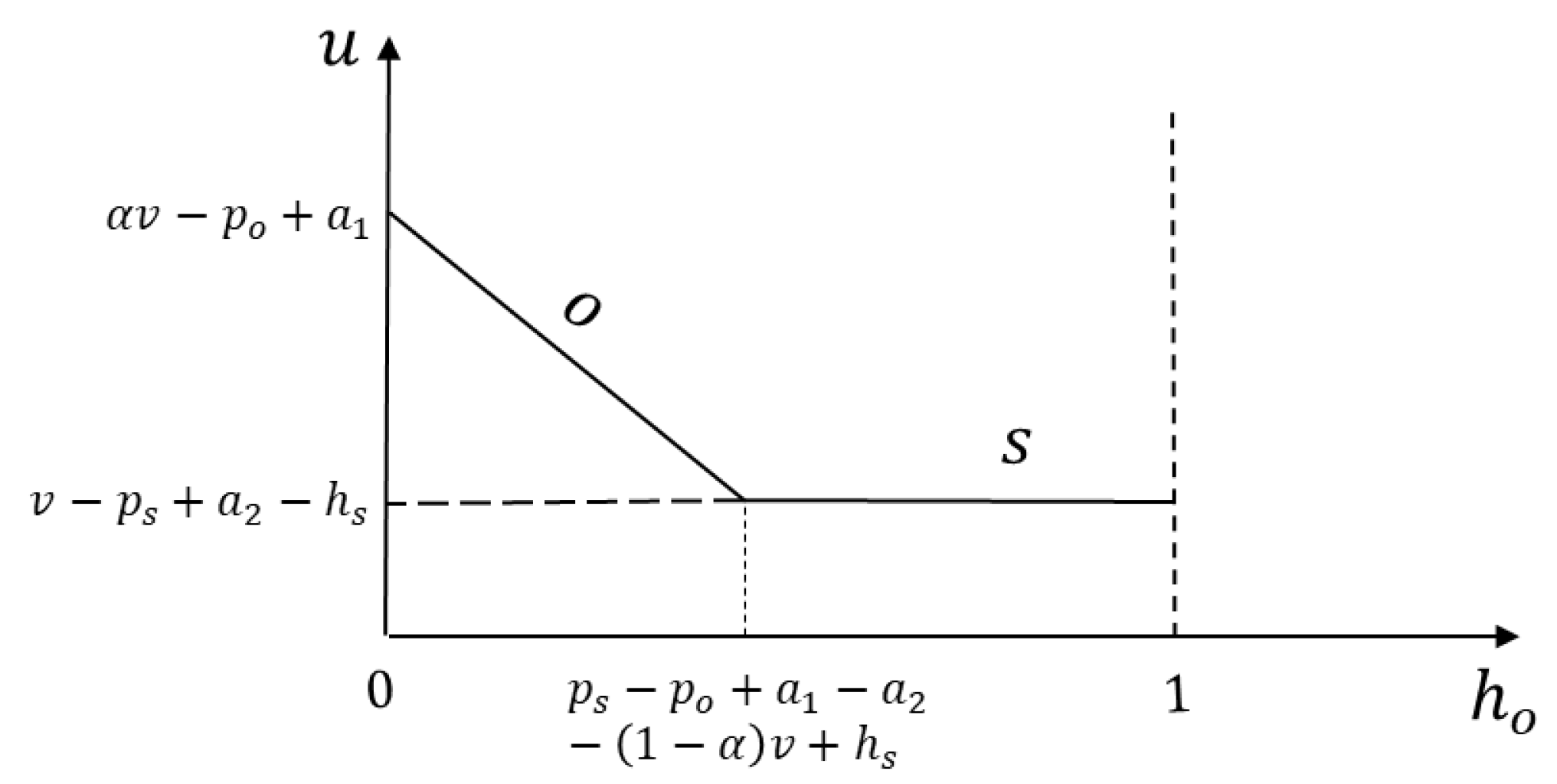
The resulting consumer purchase decisions under these conditions are illustrated in
Figure 1.
Combining the principles discussed above, in this situation, when the market is fully covered by two retailers, we have derived the demands functions for the online and offline channels, respectively:
Hence, the online and offline retailers’ profit functions are given as follows:
According to the game sequence above, in stage 1, both retailers simultaneously set their advertising levels, and in the second stage, they simultaneously set the online and offline prices. Using backward induction, we obtain the following results on the equilibrium strategies for both retailers:
Theorem 1. Assume that the online and offline retailers do not cooperate to provide BOPS services (i.e., case BN). Given that the market is fully covered by two retailers, namely, , , we obtain the equilibrium strategies:
- (1)
The equilibrium advertising levels are given as follows: - (2)
The equilibrium prices are given as follows:
The proof for Theorem 1, as well as other theorem and proposition proofs, is given in
Appendix A.
Using Theorem 1, we can analyze the impacts of product valuations and channel experience differences on optimal solutions and obtain the following propositions:
Proposition 1. Changes in consumers’ product valuation have opposite effects on the advertising and pricing of online and offline retailers. When the product valuation,
, increases and advertising is inefficient (i.e.,
), the offline retailer should increase its advertising and prices, while the online retailer should reduce both.
An increase in product valuation naturally strengthens purchase intentions. Intuitively, one might expect a retailer to cut costly advertising and raise prices when valuation is high, especially when advertising is inefficient or expensive (i.e., ). Yet Proposition 1 shows that this does not hold in a competitive setting. The reason lies in the different strategic incentives of the two retailers, driven by their distinct channel advantages.
The offline retailer benefits from an in-store experience. A high product valuation, , provides a solid demand foundation. Even when advertising is costly (), the offline retailer adopts a value-enhancement strategy: it increases advertising to further raise perceived product value and uses its experiential advantage to support a higher price. This allows it to capture greater surplus from high-value consumers.
In contrast, the online retailer faces an inherent valuation discount (). As the offline retailer aggressively builds value and raises prices, the online retailer turns to a value-for-money strategy. Competing in expensive advertising becomes ineffective. Instead, it reduces advertising to lower costs and cuts prices to attract price-sensitive consumers or those unwilling to pay the offline premium. In equilibrium, the advertising and pricing responses of online and offline retailers move in opposite directions as product valuation changes. This result illustrates that in a competitive market with asymmetric channels, a retailer may still invest heavily in advertising to strengthen its strategic position, even when advertising is relatively inefficient.
Proposition 2. The greater the differences in channel experience (i.e., as
decreases, then increases), the smaller the difference between the online and offline retailers’ advertising levels and prices: (, ).
Intuitively, as channel experience differences widen (i.e., as decreases, then increases), one might expect the gaps in advertising and pricing between the two competing retailers to increase as well. Proposition 2, however, indicates that this is not always the case. In fact, greater differences in channel experiences can negatively affect the divergence in retailers’ advertising and prices. A larger experience gap amplifies the difference in how consumers value the product across channels. The disadvantaged online retailer feels pressured to increase its advertising aggressively in order to narrow the perceived value gap. In reaction, the offline retailer also increases advertising to protect its advantage. This mutual escalation brings their advertising levels closer together. It also heightens competition for the same marginal consumers, which weakens both sides’ market power and restricts their ability to set widely different prices. Thus, although the underlying valuation difference grows, the strong competitive response it provokes counteracts that effect. As a result, the equilibrium price dispersion ends up being smaller than initially expected.
5. The Effects of BOPS Cooperation
5.1. The Effects of BOPS Cooperation Under Fixed Online and Offline Pricing
For cases BN and FY, the online and offline prices are fixed before and after implementing the BOPS cooperation, that is, In this section, we analyze the effects of BOPS cooperation on the two competing retailers’ advertising levels, demands and profits in case FY compared to BN and examine the conditions under which the retailers can benefit more from BOPS cooperation.
5.1.1. Case FY: After BOPS Cooperation
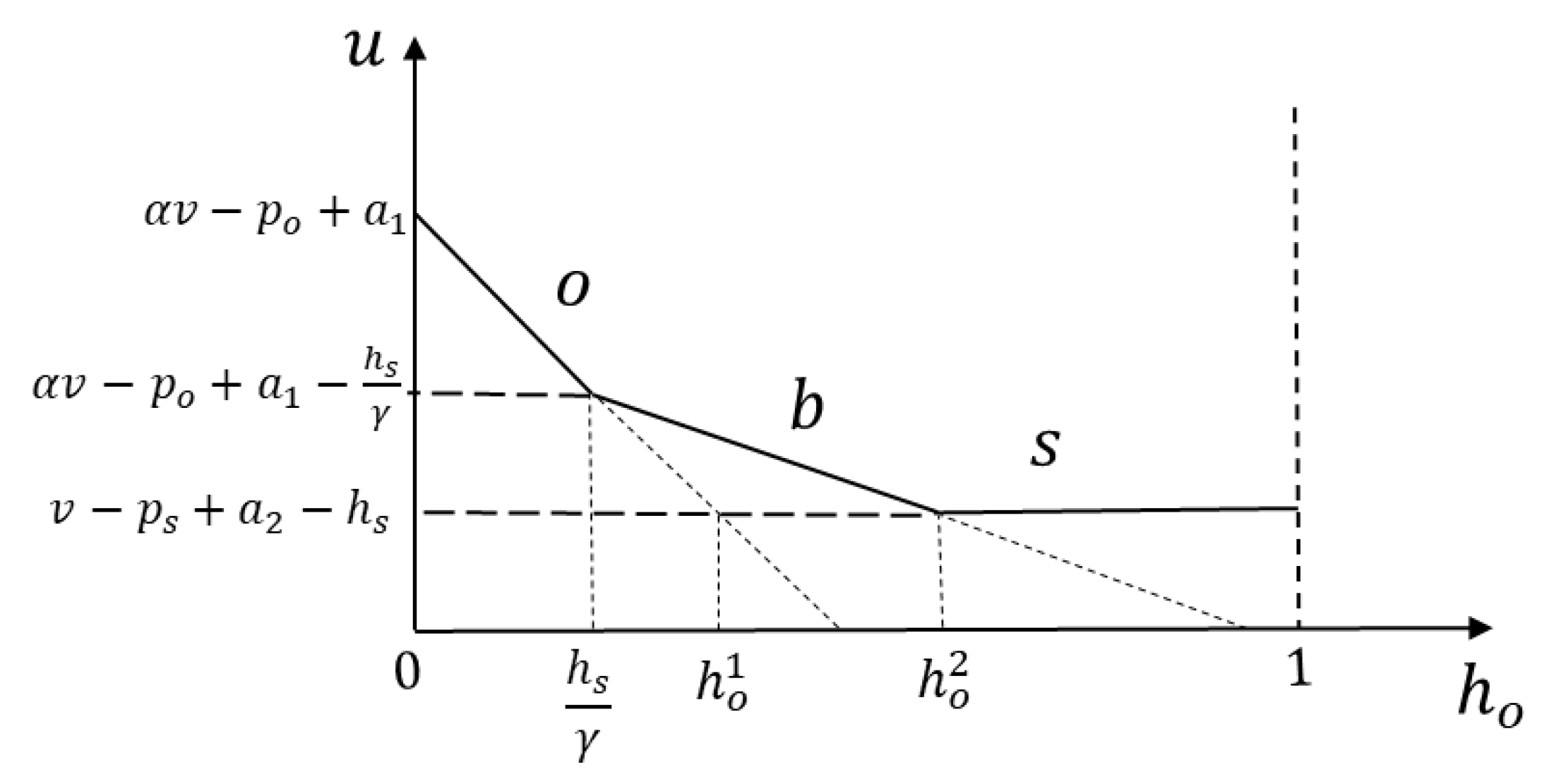
In case FY, the prices of online and offline channels are fixed after implementing BOPS cooperation compared with case BN. In this case, the utility of offline, online, and BOPS channels, respectively, is , , . Consumers make optimal purchase decisions by maximizing . First, when , , , consumers purchase through the online channel, which implies that . Second, when , , , consumers purchase through the BOPS channel, implying that . Third, when , , , consumers purchase through the offline channel, implying that .
When the BOPS channel is offered, customers can choose to purchase from any of the online, offline and BOPS channels. The demands of online, offline and BOPS channels are positive. When , we have , . Therefore, the demand for the BOPS channel is obtained using . When , we obtain the demand for the online channel, i.e., . It is evident that if , , then no one purchases through BOPS. When , we get the demand for the offline channel, obtained using . Note that if , it implies that , indicating that there is no demand from the BOPS channel.
Based on the assumption of a uniform distribution for
, we get the distribution of consumer purchase decisions as shown in
Figure 2, where
,
. The purchasing preference for the customers can be analyzed using three utility functions: (
s), (
o) and (
b).
In summary, for case FY, given that all channels have positive demands, namely,
,
, we have derived the demands of the online, BOPS, and offline channels, respectively:
As a result, the online and offline retailers’ profit functions are given as follows:
Consequently, we obtain the following theorem:
Theorem 2. Assume that the online and offline retailers cooperate to provide BOPS services in case FY, where the online and offline prices are fixed before and after BOPS cooperation, . Given that all three available channels have non-zero demands, namely,
,
, we have obtained the following equilibrium advertising and pricing strategies:
- (1)
The equilibrium advertising levels are given as follows: - (2)
The equilibrium prices are given as follows:
From Theorem 2, we find that the equilibrium prices are independent of the BOPS commission, and the convenience coefficient, when the prices are fixed before and after the BOPS cooperation. We further analyze the impact of the BOPS commission, and the convenience coefficient, on the optimal advertising levels in case FY via Theorem 2 and obtain Proposition 3.
Proposition 3. Assume the same regularity conditions as in Theorem 2. The impacts of BOPS on advertising levels of online and offline retailers are as follows:
- (1)
Taking the first derivative of , with respect to , we have
- (2)
Taking the first derivative of , with respect to , we have ;
Proposition 3 shows that implementing BOPS cooperation affects the advertising levels of both online and offline retailers. Intuitively, a higher BOPS commission, , should benefit the offline retailer and reduce the online retailer’s profits. One might then expect the offline retailer to increase advertising and the online retailer to decrease it. However, Proposition 3(1) reveals that this is not completely accurate. When prices are fixed, advertising becomes the main tool for managing profitability and demand. A higher commission, , directly reduces the online retailer’s unit margin. Facing this tighter margin and unable to raise prices, the online retailer lowers advertising to control costs. For the offline retailer, although it earns extra commission income, increasing advertising would intensify competition with the online channel—including the shared BOPS channel—and could erode its own in-store demand. Since it cannot adjust prices to offset this competitive effect, the safer response is also to reduce advertising. Therefore, a higher BOPS commission tends to weaken advertising competition under fixed pricing conditions.
According to Proposition 3(2), the BOPS convenience coefficient, , positively influences the advertising levels of both retailers. As BOPS becomes more convenient, the channel attracts more consumers, drawing them away from pure online and offline channels. To protect its core in-store demand, the offline retailer increases advertising. The online retailer, although it benefits from BOPS growth, faces this defensive move from its rival. Without the option to adjust prices, it must also increase advertising to maintain the BOPS channel’s appeal and its competitive position. As a result, unlike the commission effect, a higher convenience coefficient intensifies advertising competition in a fixed-price setting.
5.1.2. Comparative Analysis Under Fixed Online and Offline Pricing Conditions
We now compare the equilibrium outcomes before (BN) and after (FY) implementing BOPS cooperation under the fixed pricing strategy. The focus is on how the BOPS commission, , influences the retailers’ advertising levels, demands and profits. The analysis involves comparing the equilibrium advertising levels: and (). The difference, , is a linear function of . Therefore, the sign of this difference (i.e., whether advertising increases or decreases) changes at a specific threshold value of . We define these critical thresholds below and present the formal results in Propositions 4 and 5.
Proposition 4. Under the regularity conditions of Theorems 1 and 2, the change in equilibrium advertising levels after implementing BOPS cooperation (with fixed prices) is as follows:
- (1)
For the online retailer ():
It increases its advertising () if the BOPS commission is sufficiently low: . It decreases its advertising () if .
The threshold is as follows: - (2)
For the offline retailer ():
It increases its advertising () if . It decreases its advertising () if .
The threshold is as follows: Proposition 4 describes how BOPS cooperation affects online and offline advertising levels in cases BN and FY. Compared to case BN, when the BOPS commission, , is sufficiently small, both retailers increase their advertising after adopting BOPS. Conversely, when is relatively large, both reduce their advertising investment. This occurs because a low BOPS commission gives the online retailer a competitive advantage, encouraging it to invest more in advertising. In response, the offline retailer also raises advertising to remain competitive. In contrast, a high commission increases costs for the online retailer, which then leads it to cut advertising to offset this expense. Although the offline retailer gains additional commission revenue, increasing advertising further is not optimal in this scenario. These results emphasize that under fixed pricing conditions, the BOPS commission, , does more than redistribute profit—it also regulates advertising competition. A low value intensifies such competition, whereas a high value weakens it. In essence, the commission contract reallocates the value created by the BOPS channel, influencing which retailer benefits and how aggressively they compete in advertising.
Proposition 5. Assume the same regularity conditions as in Theorems 1 and 2. Comparing the demands and profits before and after BOPS cooperation when prices are fixed, we obtain the results below:
- (1)
(Demands) The demand of the online channel decreases if and only if , where . The demand of the offline channel decreases when the store visit cost is sufficiently high, i.e., . The demand for the BOPS channel is .
- (2)
(Profits) The online retailer’s profit increases only when . The offline retailer’s profit increases only when . The omnichannel total profit increases only when .
Note: The thresholds , , and are derived from profit difference analysis; their forms are provided in the proof of Proposition 5.
Proposition 5(1) examines the impact of BOPS cooperation on demand in cases BN and FY. Once BOPS is introduced, some customers may switch from the pure online or offline channel to BOPS to obtain a higher surplus. Intuitively, this would reduce demand in both original channels. However, this is not always the case. Specifically, the online channel experiences a decrease in demand only when the BOPS convenience coefficient satisfies . In this situation, some online consumers shift to the BOPS channel. Similarly, the offline channel experiences reduced demand only when the offline hassle cost, , exceeds a certain threshold, obtained via . Therefore, in some situations, the implementation of BOPS channel cooperation between online and offline retailers can result in a positive demand for BOPS.
Proposition 5(2) further demonstrates that under fixed pricing conditions, the profitability of BOPS cooperation depends critically on the commission, , as a transfer mechanism. Since prices are fixed, the added value created by the BOPS channel is redistributed between the retailers only through the commission contract. The online retailer bears the commission cost. Its profit therefore improves only when the unit BOPS commission, , is below the threshold, . In contrast, the offline retailer earns revenue from the commission. Its profit increases only when exceeds the threshold, , ensuring it captures a sufficient share of the channel’s added value. Regarding total profit, BOPS cooperation raises the overall omnichannel profit only when the BOPS convenience coefficient, , is higher than the threshold, . This indicates that the BOPS channel must generate enough added value—through high convenience such as shorter travel distances or enhanced privacy—to offset any competitive friction or inefficiency arising from the cooperation, thereby improving combined profitability.
To further explore the effect of BOPS cooperation in cases BN and FY, where prices are fixed, we conduct a numerical study. According to the constraints, we set
,
,
and examine the changes in the online and offline optimal advertising levels, demands and profits for various values of
,
and
.
Table 2 contains the results.
Observation 1. Compared to case BN, after implementing BOPS cooperation and optimizing the advertising levels, we observe from the information in Table 2 that - (1)
The offline advertising levels always increase (i.e., ). The online advertising level decreases when is high and increases when is low.
- (2)
The online channel demand decreases, and the offline channel demand increases when is low and is high (where satisfies ).
- (3)
The online retailer’s profit decreases, and the offline retailer’s profit increases when is low and is high.
The first two sections of
Table 2 present the changes in optimal advertising levels following BOPS cooperation, assuming fixed online and offline prices. When prices are fixed, and the BOPS channel is introduced, retailers can only boost demand by optimizing their advertising strategies. Regarding optimal online advertising—consistent with Proposition 4—the online retailer may raise its advertising investment after adding the BOPS channel. This increase is more pronounced when the commission,
, is lower, or when the offline hassle cost,
, or the convenience coefficient,
, is higher. However, higher BOPS demand does not fully translate into greater profit. As shown in the third and fifth sections of
Table 2, online channel demand falls while BOPS demand rises, leading to lower profit for the online retailer after cooperation (see the sixth section of
Table 2). This occurs mainly because relatively high advertising costs and BOPS commissions can outweigh the profit gains from increased demand. Therefore, it is not recommended for the online retailer to implement BOPS cooperation when advertising costs and BOPS commissions are high.
To capture market share, the offline retailer consistently increases its optimal advertising level after BOPS implementation. This increase is larger when
or
is lower, or when
is higher, confirming the finding in Proposition 4(2) (i.e.,
). However, offline demand rises only when
is low and
is high (see the fourth section of
Table 2). This is because, under these conditions, fewer consumers switch from offline to BOPS (see the fifth section of
Table 2), which helps protect the offline retailer’s profit. Moreover, when
is sufficiently low and
is sufficiently high, the increase in BOPS commission,
will bring the offline retailer additional profit after the BOPS cooperation. The combined effect of the two aspects mentioned above results in an increased profit for the offline retailer (see column 3 of section 7 in
Table 2).
5.2. The Effects of BOPS Cooperation Under Optimal Online and Offline Pricing
Next, we analyze the effects of BOPS cooperation on the two competing retailers’ optimal advertising levels, prices, demands and profits in cases BN and OY. For case OY, the prices are optimized after the addition of the BOPS channel cooperation.
5.2.1. Case OY: After BOPS Cooperation
Following the analysis of
Section 5.1.1, for case OY, if
,
, we can derive the demands for the online, BOPS, and offline channels, respectively, given as follows:
The online and offline retailers’ profit functions are given as follows:
Similarly, applying the backward induction, we obtain the optimal advertising levels (, ) and prices (, ).
Theorem 3. In case OY, where retailers cooperate to provide BOPS and can adjust their prices, and assuming all three channels have positive demand, i.e., , , the equilibrium advertising levels and prices are as follows:
- (1)
The equilibrium advertising levels: - (2)
The detailed derivation is in the proof of Theorem 3.
Using Theorem 3, we can analyze the impacts of the BOPS commission, and the convenience coefficient, on the optimal advertising levels and prices in case OY, where the prices are optimized before and after the BOPS cooperation, generating the proposition below.
Proposition 6. Assume the same regularity conditions as in Theorem 3. Then we have the following results on the impacts of BOPS on advertising levels and prices of online and offline retailers:
- (1)
Impact of BOPS commission, :
The equilibrium prices of both retailers increase with .
- (2)
Impact of BOPS convenience coefficient, :
, , Furthermore, if , .
Proposition 6(1) addresses case OY, where prices are optimized before and after BOPS cooperation. In this scenario, advertising strategies are independent of the BOPS commission, , but the commission level positively affects both retailers’ pricing. This highlights a key difference from the fixed-price case (FY): price becomes a flexible, endogenous decision variable. As rises, the online retailer increases its online price to offset higher cross-channel service costs. The offline retailer, benefiting from greater commission income, also raises its offline price. This joint adjustment resembles a form of tacit, collusive pricing, made possible by the pricing flexibility in the OY case.
Proposition 6(2) examines the impact of the BOPS convenience coefficient, . As increases, the online retailer lowers both its advertising level and its online price . In contrast, the offline retailer increases its advertising and offline price . Thus, a higher convenience coefficient adversely affects the online retailer’s advertising and price while positively influencing those of the offline retailer. The reason is that greater convenience makes BOPS more attractive to online shoppers. The online retailer can therefore compete in terms of value and convenience, relying less on advertising. Meanwhile, the offline retailer shifts toward a premium experience strategy, using more advertising and higher prices to target consumers who value in-store service over convenience. These results suggest that the BOPS convenience coefficient can partly substitute for the online retailer’s advertising in driving competition.
Overall, under optimized pricing conditions, BOPS cooperation not only redistributes value through commissions but also enables strategic channel differentiation. Each retailer leverages its inherent strengths: the online channel competes in terms of value and convenience, while the offline channel emphasizes a premium in-store experience.
5.2.2. Comparative Analysis Under Optimal Online and Offline Pricing Conditions
Considering the situation before and after BOPS cooperation, where online and offline prices are optimized, we derive the following propositions in cases BN and OY. Assume the same regularity conditions as in Theorems 1 and 3.
Proposition 7. Comparing the changes in the optimal advertising levels between cases BN and OY:
- (1)
If
, the online retailer increases its advertising (), while the offline retailer decreases its advertising ().
- (2)
If
, the opposite holds: the online retailer decreases its advertising, and the offline retailer increases its advertising.
The threshold is .
Proposition 8. Comparing the changes in the optimal prices between cases BN and OY:
- (1)
When
, the online retailer raises its online price. When
, the offline retailer raises its offline price as well.
- (2)
When
, the online retailer lowers its online price. When
, the offline retailer also lowers its offline price.
The threshold is defined as , .
Propositions 7 and 8 examine how the offline hassle cost and BOPS commission affect the advertising levels and prices of online and offline retailers in cases BN and OY.
Proposition 7 specifies the conditions under which adding the BOPS channel influences the retailers’ advertising strategies. Specifically, if the offline hassle cost, , is below the threshold, , the BOPS channel incentivizes the online retailer to increase advertising. In this case, the offline retailer reduces its advertising due to its relative advantage in hassle cost. Conversely, when is relatively high, the online retailer—now facing a competitive disadvantage—invests less in advertising, while the offline retailer increases advertising to attract more consumers to purchase offline.
Proposition 8 clarifies an important finding: a higher commission leads both retailers to raise their prices. However, the offline retailer requires an additional commission increment () to offset the competitive pressure created by the newly introduced BOPS channel.
According to the results presented in Propositions 7 and 8, we can further analyze the influence of implementing the BOPS channel on omnichannel demands and profits. Define the following threshold parameters:
Proposition 9. Assume the same regularity conditions as in Theorems 1 and 3. Comparing cases BN and OY, where the prices are optimized before and after BOPS cooperation, then
- (1)
(Demands) There exists a threshold,
, defined above, such that the demand of online channel increases whenever
and decreases otherwise.
When
, the offline channel demand increases. Otherwise, it decreases.
The demand for the BOPS channel is .
- (2)
(Profits) There exist thresholds, , and , defined above, such that the online retailer’s profit increases () only when and the offline retailer’s profit increases () only when . Furthermore, there exists a threshold, , such that the omnichannel total profit increases () if and only if .
Proposition 9(1) examines the impact of BOPS cooperation on omnichannel demand in cases BN and OY. Similar to Proposition 5(1), when BOPS is available, some consumers shift to this channel, which may reduce demand in the pure online or offline channels. However, online channel demand increases when and decreases when . This occurs for two reasons. First, a lower BOPS convenience coefficient, , reduces the utility of purchasing through BOPS, so fewer online consumers switch to it. Second, as shown in Proposition 6(2), the online retailer increases advertising when is small in case OY. This higher advertising investment helps boost online demand after the BOPS cooperation. For the offline retailer, whether its demand grows depends on whether its post-cooperation advantages in advertising and price can offset the cannibalization effect from the new BOPS channel.
Proposition 9(2) shows that the online retailer’s profit increases only when the BOPS commission, , exceeds the threshold, . A higher value is passed on to consumers through a higher online price, , as established in Proposition 6. This suggests that online retailers should not automatically resist higher commissions. Instead, they should strategically raise prices and evaluate whether the additional BOPS demand justifies the commission cost. The offline retailer’s profit rises only when is above the threshold . This aligns intuitively because the commission represents direct revenue for providing in-store pickup. A higher value better compensates the offline retailer for its operational costs and potential loss of traditional store sales. For total omnichannel profit, the analysis indicates an increase only when the commission exceeds the composite threshold, . This means that the BOPS cooperation creates net value for the system only when the commission is set high enough to properly incentivize both retailers.
To further explore the effect of BOPS cooperation in cases BN and OY, we perform a numerical study. According to the constraints, we set
,
, and
and examine the changes in the retailers’ optimal online and offline advertising levels, prices, demands and profits for various values of
,
and
. The results are encompassed within
Table 3.
Observation 2. After implementing the BOPS and optimizing the advertising levels and prices, we observe from the information in Table 3 that - (1)
The optimal online advertising level decreases (i.e.,
), and the offline advertising level increases (i.e.,
) when it satisfies
.
- (2)
When
is high, the optimal online price increases; the offline price increases when
is low and
is high.
- (3)
The online channel demand decreases, and the offline channel demand increases.
- (4)
The online retailer’s profit increases when
is low and
and
are high; the offline retailer’s profit increases when
is high.
In
Table 3, we see that the initial four sections demonstrate the influence of BOPS cooperation on the optimal advertising levels and prices. When the BOPS commission,
, is high, the online retailer reduces its advertising investment and raises its online price (see sections 1 and 3). In contrast, the offline retailer increases both advertising and offline price only when
is high and the convenience coefficient,
, is low (see sections 2 and 4). These responses occur because the online retailer gains additional demand through BOPS. It lowers advertising (section 1), which leads to a decline in online demand and a rise in BOPS demand (sections 5 and 7). Meanwhile, to offset the cost of the BOPS service, the online retailer increases its price (section 3). However, the profit gained from higher prices is outweighed by the combined effects of lower advertising and the BOPS commission, resulting in lower overall profit for the online retailer (section 8).
Conversely, the offline retailer finds it optimal to raise advertising and lower its price when is high, attracting more consumers to purchase offline and further increasing offline demand. When is very low and is very high (as shown in the third column of section 4), the offline retailer raises its price while still seeing higher demand, leading to increased profit (section 9). Whether the total omnichannel profit rises depends on several factors. Specifically, when the offline hassle cost, , is large and is small, the BOPS pickup service is less attractive, so fewer consumers switch from offline to BOPS. In cases where and are high and is small (in the third and sixth columns of sections 8 and 9), the offline retailer’s profit increase exceeds the online retailer’s loss, increasing the total omnichannel profit. Otherwise, when is large and is negligible, the total profit declines.
5.3. Comparison Under Different Pricing Strategies
In this section, we compare cases FY and OY to assess the retailer’s preference for the two pricing strategies. We set
,
, and
and vary the values of
,
and
, calculating the retailers’ optimal advertising levels, prices, demands and profits in the abovementioned cases. We compare changes in the optimal advertising levels, prices, demands and profits after the BOPS cooperation between cases FY and OY, generating the comparative results of the fixed and optimized pricing strategies after BOPS cooperation in
Table 4.
Observation 3. Comparing the optimal advertising levels, prices, demands and profits between the two pricing strategies after BOPS cooperation, we observe from the information in Table 4 that - (1)
When is high, compared to the fixed pricing strategy, the optimal online advertising level is higher in the optimized pricing strategy; the optimal offline advertising level is lower in the optimized pricing strategy compared to the fixed pricing strategy.
- (2)
Whenis low, in contrast to the fixed pricing strategy, the online price is relatively lower in the optimized pricing strategy; whenis low andis high, the optimal offline price is higher in the optimized pricing strategy compared to the fixed pricing strategy.
- (3)
The online channel demand remains unchanged in the optimized and fixed pricing strategies; compared to the fixed pricing strategy, the offline channel demand is higher, and the BOPS channel demand is lower in the optimized pricing strategy.
- (4)
Whenis high andis low, the online and offline retailers’ profits are higher in the optimized pricing strategy compared to the fixed pricing strategy.
The first four sections of
Table 4 compare optimal advertising levels and prices under the two pricing strategies after BOPS cooperation. When the commission,
, is high, the online retailer advertises more under the optimized pricing strategy than under fixed pricing, while the offline retailer advertises less. However, both online and offline prices are higher under optimized pricing only when
is high and the convenience coefficient,
, is low. This occurs because a high BOPS commission,
, forces the online retailer to raise its online price to cover pickup costs when pricing is flexible. According to the base model, a consumer’s utility from using BOPS is
. Thus, a customer will choose BOPS only if
. When
is relatively small, the online retailer has a stronger incentive to increase its price. Due to competitive interaction, a higher online price,
, then pushes the offline price,
, upward under optimized pricing conditions. Therefore, a higher optimal offline price emerges only when
is sufficiently high and
is sufficiently low. Given these pricing adjustments, the online retailer increases advertising to capture a larger market share, while the offline retailer reduces advertising to ease competitive tension, even though it may earn higher margins from sales. Conversely, when
is low, both retailers tend to lower advertising and prices under the optimized strategy. Overall, optimized pricing offers retailers greater flexibility to jointly adjust advertising intensity and channel prices.
The results above indicate that under an optimized pricing strategy, the lower offline price leads to higher offline channel demand compared to a fixed pricing strategy (see section 6 of
Table 4). When the BOPS commission,
, is high, it contributes to higher profit under optimized pricing, which is a logical outcome, since fixed pricing is essentially a constrained case of optimized pricing. For the online retailer, online channel demand remains the same under both pricing strategies, as it depends only on the external factors
and
. However, offline demand is higher under optimized pricing conditions. This implies that some BOPS consumers switch to offline purchases when pricing is optimized (see sections 5, 6, and 7 of
Table 4).
Interestingly, when the commission, , is low and the offline hassle cost, , is high, both retailers earn higher profits under fixed pricing conditions. Conversely, when is high and is low, they benefit more from optimized pricing. The reason is that under the latter conditions, retailers set higher online and offline prices in the optimized strategy, which yields larger margins. This contrast stems from the fundamentally different competitive logics under the two pricing strategies.
In the FY (fixed price) scenario, advertising is the only lever retailers can use to shift demand and improve margins. In the OY (optimized price) scenario, pricing and advertising are jointly optimized, providing a more flexible strategic toolkit. For example, when is low—giving the offline channel an inherent advantage—the offline retailer in the OY case may reduce advertising, since it can profit directly through its offline channel with less competitive pressure from BOPS. This contrasts sharply with the FY case, where the offline retailer would typically increase advertising to defend its position.
6. Conclusions
As consumers increasingly value the convenience offered through different channels, many online retailers have begun collaborating with offline retailers to provide “buy online, pick up in store” (BOPS) services. This cooperation inevitably creates a market structure in which collaboration and competition coexist. The new environment poses challenges for retailers in terms of advertising competition and omnichannel pricing. To address these issues, we examine an omnichannel system where online and offline retailers sell products through three channels: online, offline, and BOPS. By capturing the key features of each channel, we develop a model to analyze how BOPS cooperation affects retailers’ advertising levels, prices, demand, and profits in two scenarios: (1) fixed pricing before and after BOPS cooperation (cases BN and FY) and (2) optimized pricing before and after BOPS cooperation (cases BN and OY). We further compare the two pricing strategies after BOPS cooperation (FY vs. OY) to determine which is more favorable for the competing retailers. Our main findings are summarized below.
Regarding question (1), optimal strategies after BOPS cooperation: In case FY (fixed pricing), advertising becomes the only competitive lever. The BOPS commission mainly serves as a profit-transfer mechanism and reduces advertising for both retailers. In contrast, a higher BOPS convenience coefficient intensifies competition and increases advertising investments. This shows that under fixed pricing conditions, BOPS parameters significantly influence advertising intensity. Retailers must carefully consider both commission and convenience when planning their post-cooperation advertising strategies.
In case OY (optimized pricing), the BOPS commission raises both online and offline prices, while advertising strategies are independent of the commission. A higher convenience coefficient lowers the online retailer’s advertising and price but raises the offline retailer’s advertising and price. These results differ from those of prior studies (e.g., [
26]), which assumed equal consumer utility across channels. Our model imposes stricter conditions, showing that greater BOPS convenience can lead to higher offline advertising and prices.
Regarding question (2), effects of implementing BOPS cooperation: BOPS cooperation does not always benefit both retailers. Comparing cases BN and FY, when advertising costs and BOPS commissions are high, the online retailer’s profit may decline because higher demand is outweighed by increased advertising and commission expenses. Interestingly, in this situation, the offline retailer increases its advertising. Offline demand rises only when the convenience coefficient is low and the offline hassle cost is high, which reduces the shift from offline to BOPS. Additionally, a higher BOPS commission further boosts the offline retailer’s profit.
Comparing cases BN and OY, when the BOPS commission is high, the online retailer tends to reduce advertising and raise its online price. According to Proposition 9, the online retailer’s profit increases only if the commission exceeds a certain threshold, allowing the higher price to offset advertising and commission costs. Otherwise, profit declines. Thus, the online retailer may prefer not to adopt BOPS under these conditions. Meanwhile, the offline retailer increases advertising to stimulate offline demand. When the convenience coefficient is low and the commission is high, the offline retailer also raises its price, leading to higher profits. Therefore, the offline retailer should implement BOPS when the convenience coefficient is low and the commission exceeds a threshold.
Managerial Implications: Our results show that the impact of BOPS cooperation depends heavily on pricing flexibility. Under fixed pricing, the BOPS commission is the main tool for redistributing value, so negotiations should focus on the commission level. Under optimized pricing conditions, BOPS can be used for strategic channel differentiation: the online channel can emphasize convenience, while the offline channel highlights the in-store experience. Managers should assess their pricing capability—if prices are fixed, prioritize the commission contract; if prices can be adjusted, use BOPS to create complementary value across channels.
Finally, for question (3), the choice of pricing flexibility for competing retailers. When the BOPS commission is high, compared to fixed pricing, optimized pricing leads the online retailer to advertise more and the offline retailer to advertise less. Online and offline prices are higher under optimized pricing conditions only when the commission is sufficiently high and the convenience coefficient is low. Optimized pricing is generally preferable, especially when the commission is high and the offline hassle cost is low. In this case, both retailers benefit because flexible pricing allows them to set higher prices and earn larger margins. This finding is consistent with earlier research (e.g., [
12]).
For managers, pricing flexibility is a strategic asset in omnichannel retailing. Before adopting BOPS, retailers should evaluate operational conditions—under high commission and low offline hassle cost conditions, flexible pricing can turn BOPS into a profit-enhancing tool. While Kong et al. (2020) [
21] noted that optimized pricing benefits a single retailer introducing BOPS, our study extends this insight to a competitive setting with two retailers, showing how strategic interaction shapes pricing decisions after BOPS adoption.
There are several interesting directions for future research. First, BOPS can facilitate cross-selling (e.g., encouraging in-store purchases during pickup), which particularly benefits offline retailers. Future studies could incorporate cross-selling effects into BOPS models. Second, inventory management is crucial in omnichannel operations, as BOPS pickup may increase pressure on offline inventory and lead to surplus stock. Research could examine omnichannel inventory decisions under different operating conditions. Third, in addition to BOPS, other cross-channel models exist, such as reserve online, pick up and pay in store (ROPS) or showrooming (evaluate offline, buy online). Future work could explore advertising and pricing strategies in these alternative cross-channel settings.