Article

Membership Bundling in Platform Competition: To Bundle Add-Ons Together or Separately?

International Business School, Hainan University, Haikou 570228, China
*
Author to whom correspondence should be addressed.
J. Theor. Appl. Electron. Commer. Res. 2026, 21(2), 54; https://doi.org/10.3390/jtaer21020054
Submission received: 19 July 2025 / Revised: 15 December 2025 / Accepted: 20 January 2026 / Published: 3 February 2026

Abstract

Platforms are increasingly adopting membership bundling strategies to strengthen competitiveness. This paper explores how duopoly platforms bundle their membership services (the base products) with those provided by other platforms (add-ons) through a game-theoretic lens. We focus on the competing platforms’ strategic decisions to bundle different add-ons together or separately by examining three key determinants: the quality gap between the base products, the quality of versus consumer preference for the add-ons, and the profit-sharing ratio to partners who offer the add-ons. First, with comparable base-good qualities, symmetric bundling emerges in equilibrium. Specifically, simultaneously bundling add-ons together (or separately) dominates when the add-on quality (or the consumers’ preference) mainly drives purchase. Second, significant quality disparity in the base goods leads to asymmetric equilibria: the high-quality platform strategically selects the bundling mode, together or separately, that minimizes the profit-sharing payouts, forcing the low-quality rival to adopt a different strategy. Finally, when the base goods have similar quality, the platform competition can largely yield optimal welfare outcomes. With a significant quality disparity, however, the equilibrium strategies may deviate from social efficiency. Our study advances understanding of platform competition with membership bundling and offers regulatory insights for social planners to strategically intervene in platforms’ membership bundling decisions.

1. Introduction

Digital platforms are continuously pursuing new growth opportunities within their ecosystems [1,2], experimenting with diverse sales strategies to explore consumption potentials. With the widespread acceptance of membership-based services [3], membership bundling—the practice of marketing two or more membership-based products (or services) as a combined package selling at a special price—has become particularly prominent, especially in a competitive context.
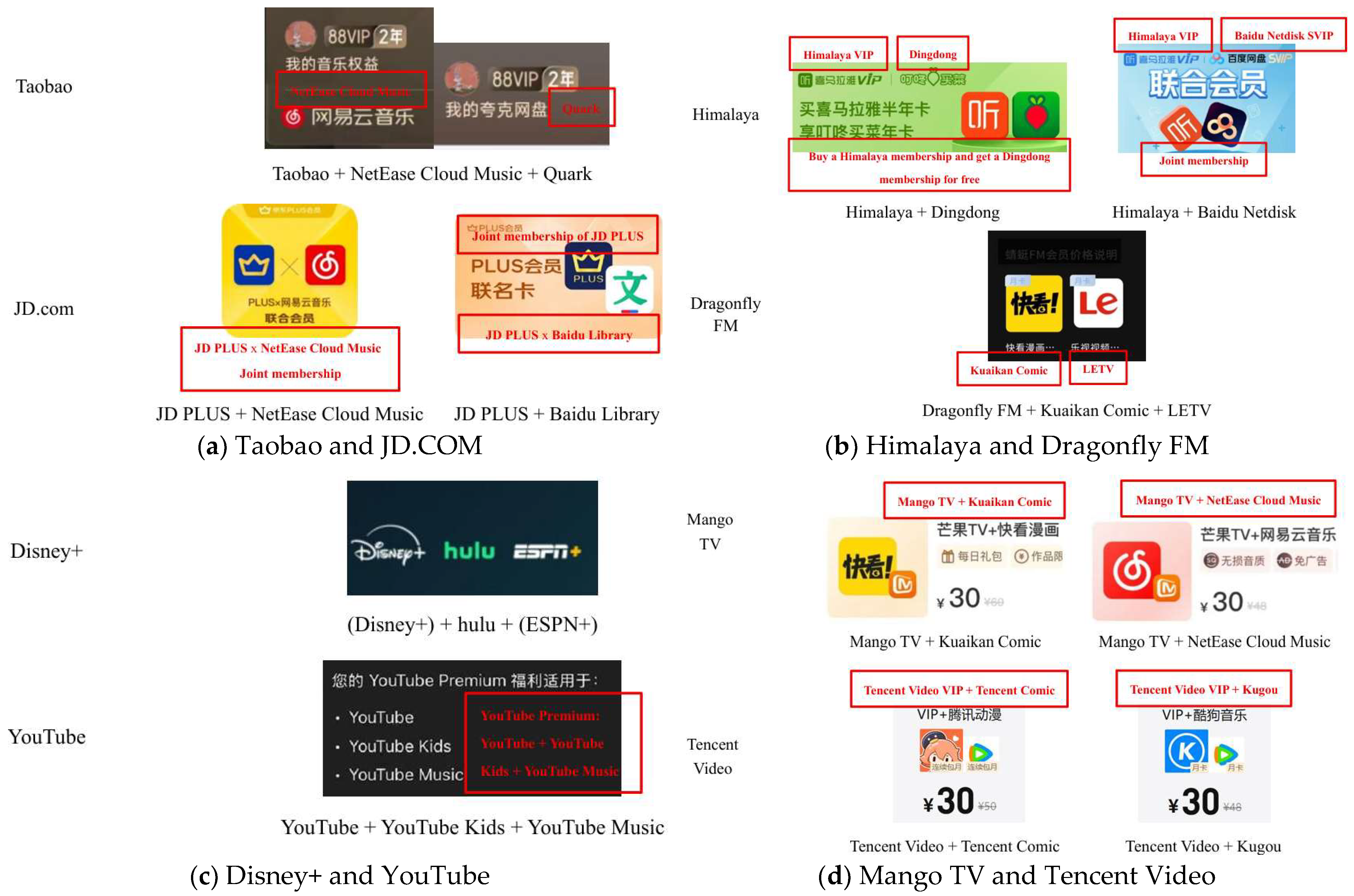
For example, as shown in Figure 1, Taobao and JD.COM are two main e-commerce platforms in the Chinese market. While Taobao bundles its membership service with those of NetEase Cloud Music and Quark together for sales, JD.COM bundles its membership service, JD PLUS, with the membership services of NetEase Cloud Music and Baidu Library separately. In the audio streaming industry, Himalaya’s service is bundled with the services of Dingdong (an e-commerce platform) and Baidu Netdisk separately, while its competitor Dragonfly FM bundles its own service with those from LETV and Kuaikan Comic together. In the video streaming market, Disney+ and YouTube are competitors in North America. While Disney+ is bundled with the memberships of Hulu and ESPN+ together, YouTube is also bundled with YouTube Music and YouTube Kids together. On the other hand, in the Chinese market, Mango TV bundles its membership service with Kuaikan Comic and NetEase Cloud Music separately, and its competitor Tencent Video similarly bundles its membership service with Tencent Comic and Kugou separately.
As observed, the ways in which the competing platforms bundle product (or service) portfolios may diverge. This paper aims to answer the following questions: What are the key influencing factors that determine the bundling strategies of competing platforms, i.e., to bundle add-on services together or to bundle them separately? When would competing platforms adopt the same or different bundling strategies? How do the bundling strategies of competing platforms affect consumer surplus and social welfare?
We focus on how the qualities of products (including the platforms’ base products and the add-ons), consumer preference, and the profit-sharing arrangements with add-on partners jointly shape the platforms’ bundling strategies. First, consumers generally exhibit a strong preference for high-quality products, and bundling various add-ons can enhance the overall quality of the product package. However, bundling different products together may also amplify the degree of horizontal product differentiation [4]. While it can improve quality, it may simultaneously raise misfit costs for consumers if the resulting bundle deviates from their ideal preferences. Platforms must therefore balance these two aspects. We conjecture that if consumers value product quality more than product fit, bundling all add-ons with the base product would likely be the optimal strategy. Second, whether competing platforms adopt the same or different bundling strategies may depend on their inherent competitive advantages. As indicated by Zhang et al. [5], the qualities of core products could significantly influence firms’ strategic choices—when core product qualities were similar, adopting identical strategies often proved advantageous. We thus examine whether a narrow quality gap between base goods leads competing platforms to choose the same bundling approach, that is, to simultaneously bundle all add-ons together or to simultaneously bundle them separately. Third, since platforms share profits from bundled sales with add-on providers, the profit-sharing arrangement can also critically affect their bundling decisions. Generally, if one platform holds a competitive edge (e.g., with a higher-quality base product), it may opt for the bundling strategy with the lower profit-sharing ratio to further increase profit, thereby compelling the rival platform to pursue a different bundling strategy for differentiation. Finally, in terms of consumer surplus and social welfare, if consumers prioritize product quality over horizontal preferences, bundling add-ons together may better satisfy their needs as compared to separate add-on sales, or vice versa if preference fit dominates. Moreover, once platforms incorporate profit-sharing into their strategic decision-making considerations, their competitive behavior may deviate from socially efficient outcomes, as the distribution of profits within the ecosystem may not necessarily be aligned with overall social welfare.
To systematically address the previously mentioned questions and to examine the above conjectures, we use a game-theoretic model to conduct in-depth discussions on how the qualities of products, consumer preference, and profit-sharing patterns shape the bundling strategies employed by two competing platforms. The platforms respectively bundle their base products (or services) with the products (or services) offered by other platforms (i.e., the add-on products). We find that the strategy equilibrium between the two platforms depends largely on the quality gap between their base goods, the quality of the add-ons, the consumers’ preference for the add-ons, and the profit-sharing ratio to the add-on partners. Specifically, with a low gap in the quality of the base products, the two platforms indeed will adopt identical bundling strategies. In particular, if the quality of the bundled products plays a dominant role in consumers’ purchase decisions, both platforms prefer to bundle their base goods with the two add-ons together. For instance, Disney+ bundles its services with those of Hulu and ESPN+ together, while YouTube bundles YouTube Music and YouTube Kids together as well. When consumers have relatively homogeneous preferences for add-ons, product quality becomes a key factor affecting the purchase decision, and thus the strategy that bundles all add-ons together becomes an equilibrium choice for both parties. On the contrary, if consumers exhibit strong and differentiated preferences for the add-ons, the platforms are more inclined to choose to bundle the add-ons separately. This outcome helps explain the example of Mango TV vs. Tencent Video: as consumers have a strong preference for different add-ons, both platforms adopt separate-bundling strategies. On the other hand, in the presence of a large quality gap between their base goods, the high-quality platform preferentially selects the superior strategy with the lower profit-sharing ratio to partners, and the low-quality platform, accordingly, will choose a different strategy to ease the competition. For instance, the advantageous platform JD.COM cooperates with platforms like NetEase Cloud Music and Baidu Library, which may agree with lower profit-sharing ratios when bundled separately. Meanwhile, its competitor Taobao has launched the 88VIP membership package with different add-ons bundled together to enhance consumer benefits. In this circumstance, equilibrium is manifested as advantageous platforms choosing to bundle separately, while disadvantaged platforms choose to bundle together. Likewise, the equilibrium where disadvantaged platforms choose to bundle separately while advantageous platforms choose to bundle together can be seen in the example of Himalaya vs. Dragonfly FM. Furthermore, when the base goods have similar qualities, the platforms’ competition can largely yield optimal welfare outcomes. With significant quality disparity, however, the profit-driven competition strategies may deviate from social efficiency.
The rest of the paper is organized as follows. Section 2 provides the related literature. Section 3 describes the model setup. Equilibrium results for different bundling cases are presented in Section 4. In Section 5, we derive the corresponding conditions under which different bundling strategies of the platforms can appear as an equilibrium. We also compare the consumer surplus and social welfare under different strategies of the platforms. Section 6 concludes the paper. All proofs are presented in Appendix B.

2. Literature Review

This paper mainly relates to four streams of research: (1) platform competition, (2) product (or service) bundling, (3) product differentiation, and (4) platform governance.
The first related research stream is concerned with platform competition. For example, Zhang et al. [5] examined duopoly platforms that selected between freemium and premium service strategies. Zennyo [6] studied ad-sponsored platforms that introduced freemium models and indicated that the fixed costs for introducing a premium service were the key factor influencing their choices in equilibrium. Adner et al. [7] studied the effects of software compatibility on the competition between two hardware platforms. Li et al. [8] examined platform competition in live-streaming sales with network effects. Bernstein et al. [9] discovered that, in the sharing economy, platform competition would lower the price that the customer paid for using the platform, reduce congestion, and benefit consumers. Xu et al. [10] presented an analysis of blockchain adoption and price competition between two platforms. Yue et al. [11] investigated the reusable packaging adoption strategies for two competing e-commerce platforms in the presence of green consumers.
The second related research stream involves studies on bundling strategies [12,13]. Moon and Shugan [14] found that a monopolist had an incentive to bundle add-on products with core products only if the add-on products were popular, while niche sellers avoided bundling to prevent revenue loss. Zhang et al. [15] studied how a monopolist’s bundling strategy for core and ancillary services—bundling one or multiple ancillary services—varied with market heterogeneity and the correlation between ancillary service valuations. Jang and Chung [16] provided application developers with substantive guidelines on optimizing the pricing of base products and the add-ons under different levels of product popularity. Jin et al. [17] investigated how piracy disrupted the effectiveness of bundling for information goods. Bhargava [18] designed an optimal bundled product line for digital products consumed on multiple devices. Chung et al. [4] explored the competition between a multi-product firm adopting a bundling strategy and a single-product firm. Lin et al. [19], Du et al. [20], and Guo et al. [21] all examined product bundling strategies for duopoly platforms. Jena and Ghadge [22] found that in Retailer Stackelberg and Vertical Nash, the manufacturer’s bundling strategy was significantly superior to the retailer’s bundling strategy. Zhang et al. [23] indicated that the bundling strategy influenced the manufacturer’s decision to expand into multichannel operations. Zhang [24] explored how correlated preferences for add-ons influence optimal bundling formats and revealed that the optimal bundling strategy depended on market structure.
Our work contributes to exploring the bundling decisions of duopolistic platforms with the consideration of the influence of the quality gap between the base products of the platform, the quality level of the add-ons, the consumer preferences for different add-ons, and the profit-sharing ratio to the add-on partners. Specifically, a game-theoretic model is constructed to identify the key motivations behind the platforms’ decisions to bundle add-ons together or separately. To the best of our knowledge, rare studies examine bundling base product (service) with multiple add-ons together or separately, except Zhang et al. [15] and Zhang [24]. However, while the studies of Zhang et al. [15] and Zhang [24] were closely related to our study, both of them focused on a monopolistic firm, but our study explores the bundling decisions of duopolistic platforms, in the absence and presence of network effects, respectively. Moreover, considering platforms’ bundling decisions, while the studies by Lin et al. [19], Du et al. [20] and Guo et al. [21] were also closely related to our study, Lin et al. [19] examined competing platforms bundling their own platform access and their own content together, and Guo et al. [21] focused on competing platforms jointly launching a membership bundle. Our study differs from these studies in that we consider the duopoly platforms to bundle their membership services with the services offered by other platforms, as exemplified by the examples in the introduction. Specifically, we examine the influences of the quality gap between the base products of the platforms, the quality level of and the consumer preferences for different add-ons, and the profit-sharing ratio to the add-on partners, which is different from the work in Du et al. [20], who considered the effect of profit-sharing ratio but ignored the quality difference and the horizontal differentiation of the products.
The third related research stream is on product differentiation [25,26,27]. Tookanlou and Wong [28] considered the optimal product line design when consumers are heterogeneous in both horizontal and vertical dimensions. Manda and Jain [29] discussed the relationship among product quality, product differentiation, and demand outsourcing. Bai et al. [30] discussed the noteworthy gaps in the existing livestreaming literature, including the strategy of differentiation of products among livestreaming platforms. Liu et al. [31] examined the quality-differentiated strategies across livestreaming and online channels and pointed out that manufacturers should focus on product types and the capabilities of influencers when choosing and allocating differentiation strategies. Du et al. [32] examined how value-added services enhanced e-commerce platforms’ competitiveness.
While the study in Du et al. [32] was closely related to our study, Du et al. [32] focused on the quality differentiation between bundled products. In contrast, in addition to quality differentiation, this study also takes into account the horizontal differentiation between the platforms’ base products as well as the differentiation between the add-ons that are bundled with the base products. Specifically, the differentiation level between different add-ons is reflected by consumers’ preference (weak or strong) for the add-ons. We explore the competing platforms’ decisions to bundle the add-ons together or separately, and offer insights for social planners to guide the platforms’ decisions.
The last stream of relevant literature examines platform governance. Several studies have focused on the governance of fraudulent reviews [33,34]. Papanastasiou et al. [35] indicated that some degree of decentralization may be beneficial for resolving a broader range of disputes in online platforms. Huang et al. [36] conducted research on quality regulation strategies of platforms and found that a subsidization strategy could be effective and always improve social welfare. He et al. [37] showed that the introduction of algorithm-based content moderation into platform governance could help sustain content management of digital communities. Kim et al. [38] proposed a detection model integrating agenda-setting theory, specifically designed to understand hate speech content within Korean news platforms, urging media editors to follow ethical agendas to reduce emotional incitement. While these studies predominantly examine platform governance strategies from the perspective of the platforms themselves, this paper considers platforms to expand their ecosystems via bundling add-on services from other platforms and adopts a governmental standpoint to explore how governments can guide platforms’ membership bundling strategies to enhance overall social welfare.

3. Model

Let i ( i = l , h ) denote the two platforms (e.g., Himalaya and Dragonfly in the audio streaming industry) and their corresponding base goods that offer different qualities, with v h > v l > 0 . Let v d = ( v h v l ) denote the quality difference. Both platforms would like to introduce different add-ons from other platforms to stimulate purchase, such as Himalaya’s service, which is bundled with the services of Dingdong and Baidu Netdisk separately, while its competitor Dragonfly FM bundles its own service with those from LETV and Kuaikan Comic together.
We focus on the platforms faced with two bundling options, namely, (i) bundling the base good with different add-ons together (denoted by T ) and (ii) bundling the base good with different add-ons separately (denoted by S ). For ease of exposition, we consider two add-on products, named as s k ( k = 1,2 ). Without loss of generality, we assume the quality of the two add-ons is the same and is denoted as v 0 . Four market configurations are possible, that is, the Case T T in which both platforms bundle the base good and the two add-ons together; the Case T S in which Platform l offers the bundle with the base good and the two add-ons together while Platform h offers two bundled products that bundle its base good with the two add-ons respectively (i.e., separately); and Case S T and Case S S can be interpreted similarly.
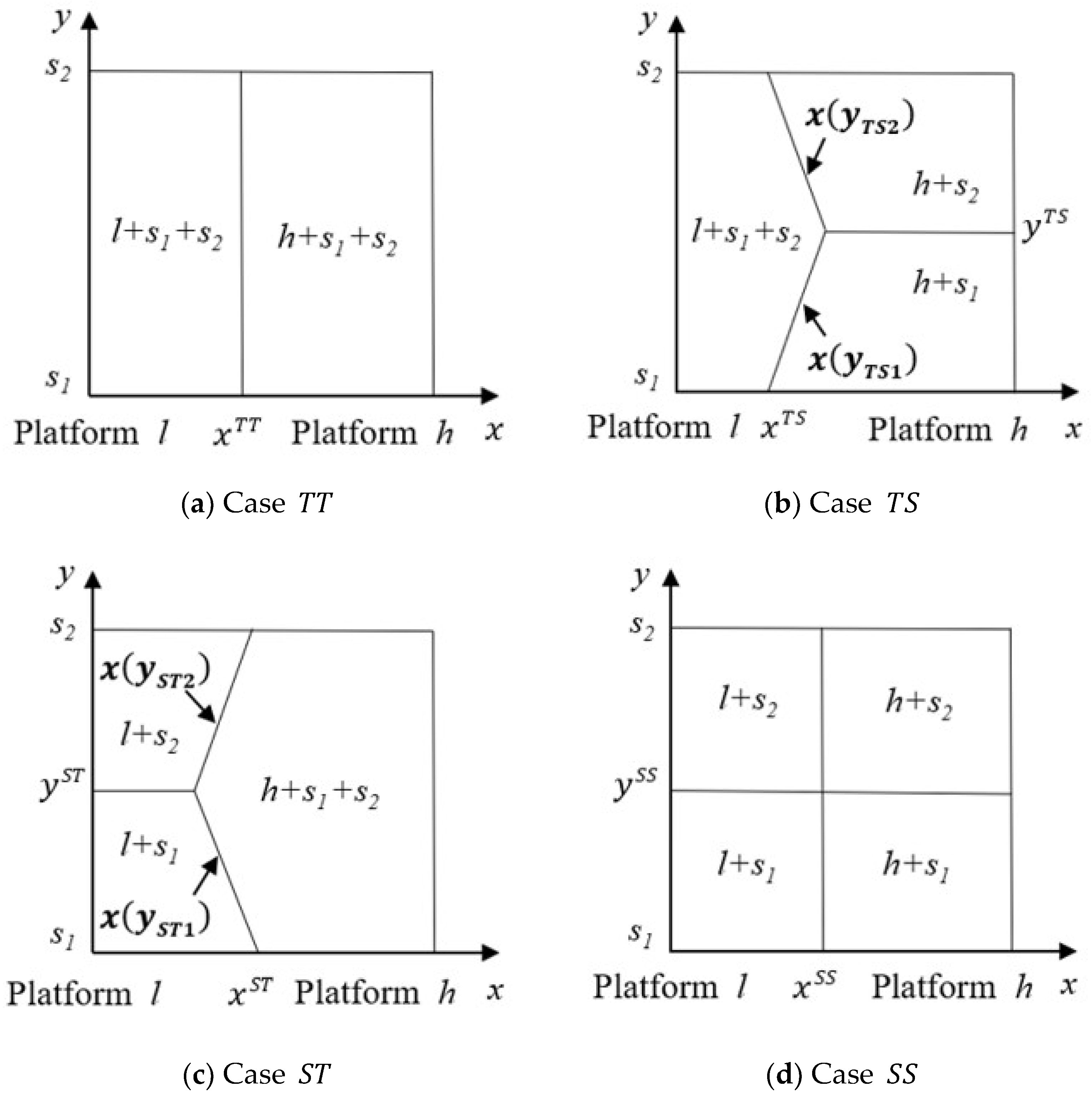
Note that the add-ons are provided by other platforms, which would extract a fraction of the revenue from the bundled products. We use γ T or γ S to denote the corresponding fraction in the case in which the platforms use the T or the S strategy, respectively. Because the two competing platforms can differ in interface or design, and the add-ons can differ in content or service, consumers would have different preferences for the two base goods as well as for the two add-ons. We thus consider a two-dimensional horizontal differentiation model, which helps to measure the consumers’ preference [39], as shown in Figure 2.
Platform l is located at ( 0 ,   0 ) while Platform h is located at ( 1 ,   0 ). The location of the add-on s 1 is at ( 0 ,   0 ) while s 2 is located at ( 0 ,   1 ). Each consumer is characterized by a two-dimensional location ( x , y ), where x ∈ [ 0 ,   1 ] and y ∈ [ 0 ,   1 ]. The x dimension represents the consumer’s preference for the base goods of the platforms while the y dimension represents his/her preference for the add-on products. The degree of misfit in the base good (or the add-on) is measured by the distance between the consumer and the base good (or the add-on product) along the x (or y ) dimension. Denote the unit misfit cost for the base good (the add-on) as t x ( t y ). The greater the value of t x ( t y ), the stronger is the consumer’s preference for their ideal products. The misfit cost for the consumer at ( x , y ) to use the base good l (or h ) can be expressed as t x   x (or t x ( 1 x )), and the misfit cost to use the add-on s 1 (or s 2 ) can be expressed as t y   y (or t y ( 1 y )). Specifically, we consider that the preference for the base goods plays a more important role than the preference of the add-ons in determining consumers’ purchase decisions, that is, t x t y [7].
Although bundling both add-ons with the base good together can significantly enhance the overall product quality, it may also lead to a higher misfit cost. Therefore, the platform must strike a balance between the quality of the add-ons and the misfit cost. Additionally, since the add-ons are provided by other platforms, the bundling profits are also affected by the profit-sharing mechanism with the partners. Thus, this study aims to explore the possible bundled equilibrium outcomes that can be achieved under the joint effects of the three key factors: the quality of the add-ons, the misfit cost of the add-ons, and the profit-sharing ratio to partners who offer the add-ons.
Denote U T i as the utility for the consumer located at ( x , y ) to buy from Platform i when Platform i chooses to bundle the two add-ons together (i.e., adopts T strategy). Denote U S i k as the utility for the consumer located at ( x , y ) to buy from Platform i when Platform i chooses to bundle the two add-ons separately (i.e., adopts S strategy) ( i = l , h ; k = 1,2 ). Thus, we have the following consumer utility functions (We assume each consumer purchases only one bundle, excluding the option of buying the base product alone. This approach allows us to examine platform competition in markets where bundled offerings are predominant. In practice, mandatory bundling is widely adopted. For example, Taobao’s “88VIP”—with over 53 million members as of October 2025—requires consumers to purchase the bundled package including all add-ons, and consumers cannot opt to buy the core Taobao membership service alone. Furthermore, platforms have now tended to guide consumers in their ecosystems to choose the bundles as their first choice, making a standalone subscription economically unattractive. For example, the annual fee of JD PLUS alone (¥198) is the same as the price of the bundle of JD PLUS and Baidu Library, which positions the Baidu Library membership as a zero-cost add-on, making the bundled option more attractive to consumers. Likewise, the bundled membership package of Tencent Video and Kugou is priced at ¥30 per month, while the standalone Tencent Video subscription costs ¥30 per month as well. This effectively encourages consumers to choose the package as their most rational and preferred option (See Table A2 in Appendix A.4 for details). Accordingly, our study focuses on the competition between platforms through bundled products. This also simplifies the model by avoiding the complexity of accounting for competition between the bundled and the standalone offerings, emphasizing the competing platforms’ bundling strategies).
U T l = θ v l + 2 v 0 t x x t y p T l
U S l 1 = θ v l + v 0 t x x t y y p S l 1
U S l 2 = θ v l + v 0 t x x t y ( 1 y ) p S l 2
U T h = θ v h + 2 v 0 t x ( 1 x ) t y p T h
U S h 1 = θ v h + v 0 t x ( 1 x ) t y y p S h 1
U S h 2 = θ v h + v 0 t x ( 1 x ) t y ( 1 y ) p S h 2
where Equation (1) (or Equation (4)) is the consumer utility from buying from Platform l (or Platform h ) when it chooses to bundle the base good with the two add-ons together; Equations (2) and (3) (or Equations (5) and (6)) are the consumer utility from buying from Platform l (or Platform h ) when it chooses to bundle the base good with the two add-ons separately. Specifically, θ represents consumers’ willingness to pay for unit quality, and the final terms in the equations indicate the prices of the product bundles.
Table A1 in Appendix A.1 summarizes all the notations.

3.1. Case T T

In this scenario, both platforms adopt T strategy. The utility for the consumer located at ( x , y ) to buy from Platform l (denoted by U l T T ) or from Platform h (denoted by U h T T ) are given by (1) and (4), respectively.
By setting U l T T = U h T T , we can derive the indifferent consumer’s location as follows:
x T T = p h T T p l T T + θ v l v h 2 t x + 1 2 .
As shown in Figure 2a, the market is divided into two regions. Consumers located on the left-hand side of x T T purchase from Platform l , whereas those on the right-hand side purchase from Platform h .
Without loss of generality, the marginal cost of the base good is normalized to zero for both platforms [7,40]. Then, the profit functions for the platforms can be specified as follows:
π l T T   = 1 2 γ T D l T T p l T T π h T T   = 1 2 γ T D h T T p h T T ,
where D l T T = x T T and D h T T = 1 D l T T .

3.2. Case T S

In this scenario, consumers can either purchase a bundled product that consists of the base good l and both the add-ons from Platform l , or select between the two bundled products on Platform h that only contain one add-on. The utility for the consumer located at ( x , y ) to purchase from Platform l (denoted by U l T S ) or from Platform h (denoted by U h T S 1 and U h T S 2 , respectively) are given by (1), (5), and (6), respectively.
Letting U l T S = U h T S 1 , U l T S = U h T S 2 and U h T S 1 = U h T S 2 , we obtain the indifferent curves as follows:
x y T S 1 = θ v l + v 0 v h + p h T S 1 p l T S + t x t y 2 t x + t y 2 t x · y x y T S 2 = θ v l + v 0 v h + p h T S 2 p l T S + t x 2 t x t y 2 t x · y , y T S = 1 2 + p h T S 2 p h T S 1 2 t y
where x y T S 1 is the curve in which the consumers are indifferent between purchasing ( l + s 1 + s 2 ) and purchasing ( h + s 1 ), x y T S 2 is the curve in which the consumers are indifferent between purchasing ( l + s 1 + s 2 ) and purchasing ( h + s 2 ), and y T S is the curve in which the consumers are indifferent between purchasing ( h + s 1 ) and purchasing ( h + s 2 ), as shown in Figure 2b. Therefore, we can formulate the demand functions for the bundled products as follows:
D l T S = 0 y T S x y T S 1 d y +   y T S 1 x y T S 2 d y D h T S 1 = 0 y T S 1 x y T S 1 d y D h T S 2 = y T S 1 1 x y T S 2 d y .
The profit functions of the two platforms can thus be specified as:
π l T S   = 1 2 γ T D l T S p l T S π h T S   = π h T S 1   + π h T S 2   = 1 γ S D h T S 1 p h T S 1 + 1 γ S D h T S 2 p h T S 2 .
To simplify the following analysis, p h T S 1 and p h T S 2 are assumed to be equal given the equal qualities of the two add-ons [7]. This is also in line with the reality that a real-world platform would like to offer different bundled products with the same price. For example, in the video streaming market, Mango TV offers “Mango TV + Kuaikan Comic” and “Mango TV + NetEase Cloud Music” at the same price, while Tencent Video also provides “Tencent Video + Tencent Comic” and “Tencent Video + Kugou” with an equivalent price. In the presence with p h T S 1 = p h T S 2 , we have y T S = 1 2 .

3.3. Case S T

In case S T , Platform l adopts the S strategy, whereas Platform h opts for the T strategy. The utility for the consumer located at ( x , y ) to purchase from Platform l (denoted by U l S T 1 and U l S T 2 , respectively) or Platform h (denoted by U h S T ) are given by (2), (3), and (4), respectively.
As formulated in Figure 2c, consumers are divided into three segments according to their preferences. Solving the indifference equations U h S T = U l S T 1 , U h S T = U l S T 2 and U l S T 1 = U l S T 2 , respectively, we can have three indifferent curves as follows:
x y S T 1 = θ v l v 0 v h + p h S T p l S T 1 + t x + t y 2 t x t y 2 t x · y x y S T 2 = θ v l v 0 v h + p h S T p l S T 2 + t x 2 t x + t y 2 t x · y y S T = 1 2 + p l S T 1 p l S T 2 2 t y ,
Thus, we can formulate the demand functions for the two platforms as follows:
D l S T 1 = 0 y S T x y S T 1 d y D l S T 2 = y S T 1 x y S T 2 d y D h S T = 0 y S T ( 1 x y S T 1 ) d y + y S T 1 ( 1 x y S T 2 ) d y .
The profit functions can be specified as:
π l S T   = π l S T 1   + π l S T 2   = 1 γ S D l S T 1 p l S T 1 + 1 γ S D l S T 2 p l S T 2 π h S T   = 1 2 γ T D h S T p h S T .
Similar to Case T S , we let p l S T 1 = p l S T 2 and thus y S T = 1 2 .

3.4. Case S S

When both platforms adopt the S strategy, the utility for the consumer located at ( x , y ) to buy from Platform l (denoted by U l S S 1 and U l S S 2 , respectively) or from Platform h (denoted by U h S S 1 and U h S S 2 , respectively) are given by (2), (3), (5), and (6), respectively.
Letting U l S S 1 = U l S S 2 , U h S S 1 = U h S S 2 , U l S S 1 = U h S S 1 and U l S S 2 = U h S S 2 , as shown in Figure 2d, we can derive two indifferent curves as follows:
x S S = 1 2 + θ v l v h + p h S S 1 p l S S 1 2 t x y S S = 1 2 + p l S S 2 p l S S 1 2 t y .
Thus, we can formulate the demand functions for the two platforms as follows:
D l S S   = D l S S 1   + D l S S 2   = x S S y S S + x S S ( 1 y S S ) D h S S   = D h S S 1   + D h S S 2   = ( 1 x S S ) y S S + ( 1 x S S ) ( 1 y S S ) .
Then, the profit functions of the two platforms can be specified as:
π l S S   = π l S S 1   + π l S S 2   = 1 γ S D l S S 1 p l S S 1 + 1 γ S D l S S 2 p l S S 2 π h S S   = π h S S 1   + π h S S 2 = 1 γ S D h S S 1 p h S S 1 + 1 γ S D h S S 2 p h S S 2 ,
Considering p l S S 1 = p l S S 2 and p h S S 1 = p h S S 2 , we have y S S = 1 2 .

3.5. Timeline of the Game

The timeline of the two-platform game is as follows. In stage 1, the platforms simultaneously decide their bundling strategies, which are the primary decisions that the platforms have to make. In stage 2, the platforms simultaneously price their bundled products. In stage 3, consumers make their purchase decisions.

4. Equilibrium Analysis

We solve the two-platform game using backward induction. Based on the decisions in stage 1, there are four possible subgames in stage 2: the Cases T T , T S , S T , and S S . We first derive the equilibrium for each subgame and then analyze the equilibrium strategies for the platforms in the next section.
The subgame equilibria are provided in Appendix A.2. Comparing the equilibrium prices in the four subgames yields the following results.
Proposition 1.
(Effects on Equilibrium Prices)
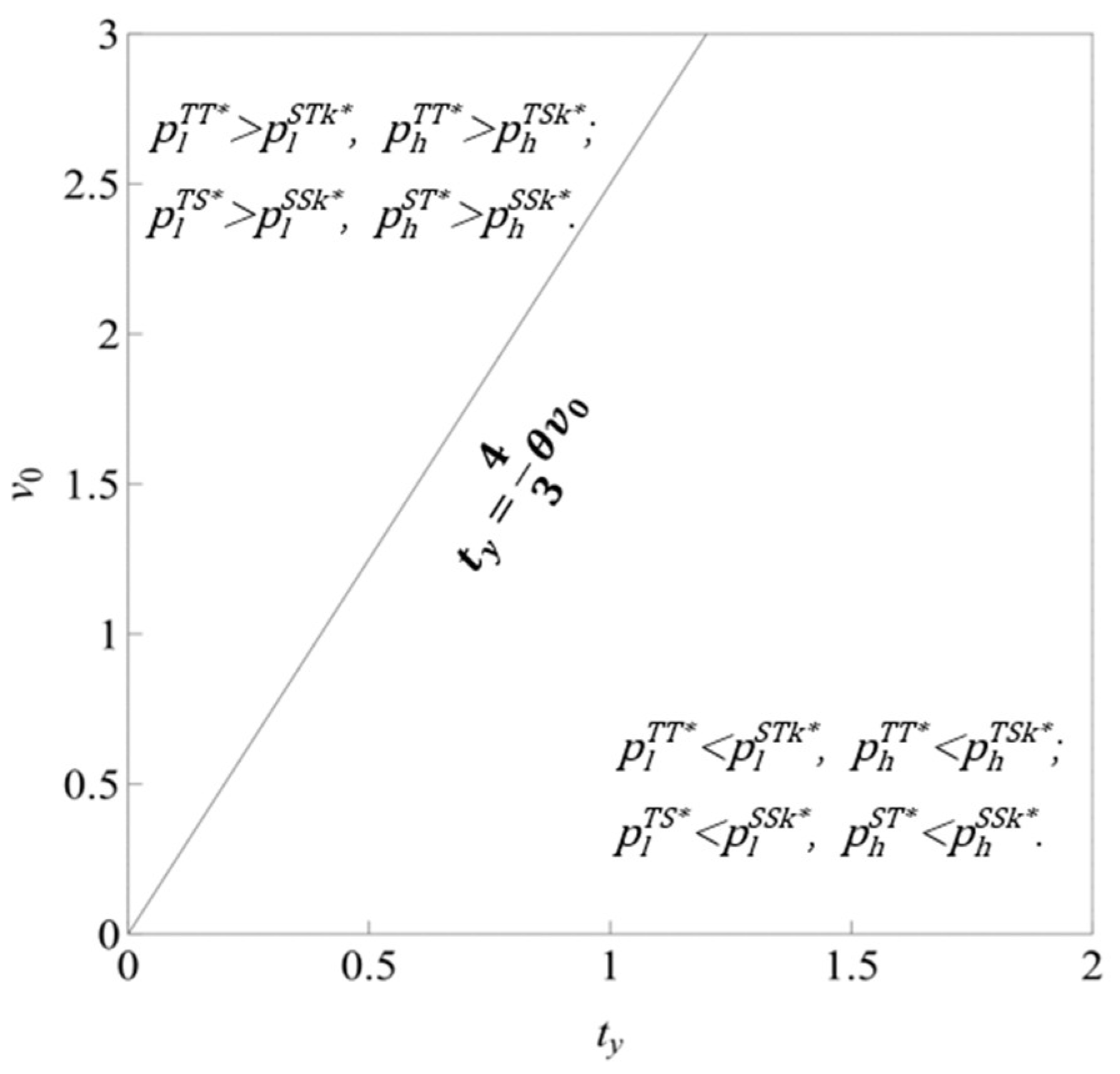
The platforms can charge a higher price by bundling the base good with the two add-ons together than by bundling the base good with the two add-ons separately (i.e.,   p l T T > p l S T k ,   p l T S > p l S S k ,   p h T T > p h T S k   and   p h S T > p h S S k   ( k = 1 ,   2 ), if and only if the consumers’ preference for the add-ons is weak, i.e.,   t y < 4 3 θ v 0 .
Proposition 1 indicates that whether the platforms charge higher or lower prices by using the T strategy than by using the S strategy depends on the consumers’ preference for and the quality of the add-ons, as illustrated in Figure 3. Specifically, if t y is high enough such that t y > 4 3 θ v 0 , i.e., consumers have a strong preference for the add-on products, the advantage of the bundled products in terms of quality only has a limited influence on the consumers’ purchase decision, which prompts the platforms to set a lower price when choosing the T strategy. On the other hand, when t y is low such that t y < 4 3 θ v 0 , the quality of the products dominates the consumers’ preference in their purchase decision, and the platforms tend to set a higher price when choosing the T strategy rather than choosing the S strategy.
Proposition 2.
(Effects on Equilibrium Profits)
(a) 
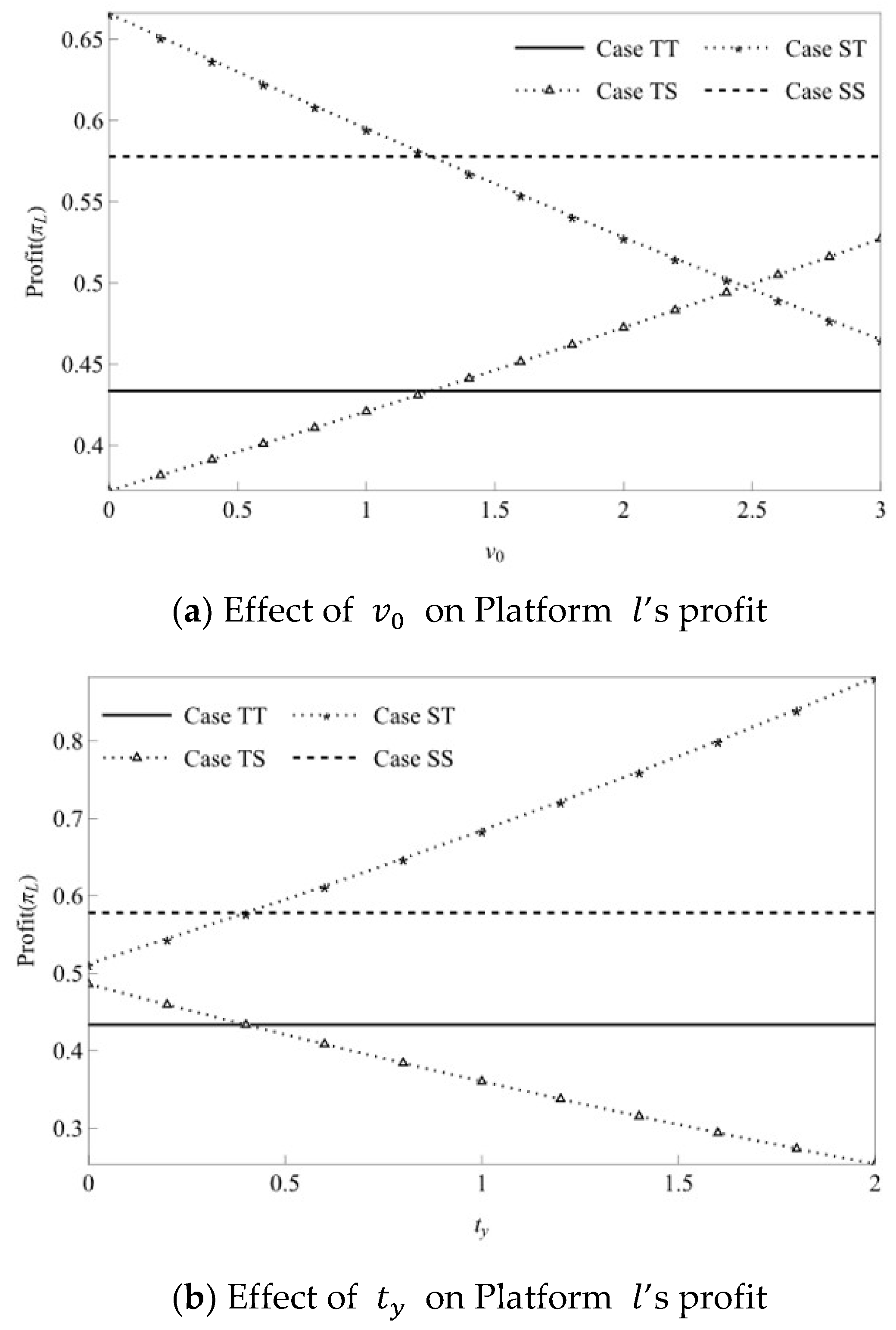
In Case   T S   or Case   S T   , the platform that chooses to bundle with the two add-ons together (or separately) always benefits (or encounters a loss) from an increase in   v 0 , but encounters loss (or benefits) from an increase in   t y .
(b) 
In Case   T T   and Case   S S , neither the quality (i.e.,   v 0 ) nor the consumers’ preference for the add-ons (i.e.,   t y ) affects the profits of both platforms.
Proposition 2 indicates the impact of the quality of and the consumers’ preference for the add-ons on the platforms’ profits. In Case T S , as the quality of the add-ons (or the consumers’ preference for the add-ons) is strengthened, Platform l achieves greater (or lower) profit, as shown in Figure 4. Similar observations can also be obtained for Platform h in Case S T . In contrast, in Case S T , Platform l ’s profit always increases (or decreases) as the consumers’ preference for the add-ons (or the quality of the add-ons) increases. Similar effects are observed for Platform h in Case T S .
The intuition behind the results is as follows. In Case T S , as v 0 increases, compared to Platform h choosing to bundle its base good with the two add-ons separately, Platform l can significantly increase its service quality by bundling its base good with the two add-ons together. As a result, Platform l ’s competitive advantage increases, which can ensure it charges a higher price and increases its market demand at the same time, ultimately leading it to a higher profit. In contrast, Platform h can only charge lower prices and earn less market demand, which reduces its profit. On the other hand, as the value of t y becomes higher, the consumers’ preference for their ideal add-ons becomes stronger. In other words, the higher t y leads to greater disutility that the consumers would suffer if they buy the add-on that is different from their preferred one. As a result, when Platform l chooses the T strategy, the consumers purchasing the bundled product from Platform l would incur a higher disutility, and thus the price and demand of Platform l would both decrease in t y , followed by a decrease in its profit. Although the consumer’s stronger preference for the add-on also adversely affects the utility of buying from Platform h , Platform h can slightly increase its prices and demands in the competition, leading to an increase in its profit. Similar explanations can also apply to Case S T .
Interestingly, we find that in both Case T T and Case S S , the profits of the two platforms do not vary with the quality of or with the consumers’ preference for the add-ons. The reason lies in the fact that when the two platforms offer symmetric bundled products to consumers—that is, simultaneously bundling their own base good with the two add-ons together or separately—competition becomes independent of the add-ons.

5. Equilibrium Bundling Decisions

5.1. Equilibrium Strategy

Proposition 3.
(Equilibrium Bundling Strategy)
(a) 
Case   T T   can be sustained as the equilibrium when  v 0 > m a x 3 4 θ t y 3 θ t x γ 2 γ 1 γ 1 + γ 2 γ 1 γ 1 v d , 3 4 θ t y 3 θ t x γ 2 γ 1 γ 1 γ 2 γ 1 γ 1 v d .
(b) 
Case   T S   can be sustained as the equilibrium when   3 4 θ t y + 3 θ t x γ 1 γ 2 γ 2 γ 1 γ 2 γ 2 v d < v 0 < 3 4 θ t y 3 θ t x γ 2 γ 1 γ 1 γ 2 γ 1 γ 1 v d   (i.e., if   γ S 2 < γ T   and   v d > m a x 3 t y 4 θ v 0 4 θ γ 1 γ 2 γ 2 + 3 t x θ , 3 t y 4 θ v 0 4 θ γ 2 γ 1 γ 1 3 t x θ ).
(c) 
Case   S T   can be sustained as the equilibrium when   3 4 θ t y + 3 θ t x γ 1 γ 2 γ 2 + γ 1 γ 2 γ 2 v d < v 0 < 3 4 θ t y 3 θ t x γ 2 γ 1 γ 1 + γ 2 γ 1 γ 1 v d (i.e., if   γ T γ S 2   and   v d > m a x 3 t y + 4 θ v 0 4 θ γ 2 γ 1 γ 1 + 3 t x θ , 3 t y + 4 θ v 0 4 θ γ 1 γ 2 γ 2 3 t x θ ).
(d) 
Case   S S   can be sustained as the equilibrium when   v 0 < m i n 3 4 θ t y + 3 θ t x γ 1 γ 2 γ 2 γ 1 γ 2 γ 2 v d , 3 4 θ t y + 3 θ t x γ 1 γ 2 γ 2 + γ 1 γ 2 γ 2 v d   (i.e.,   t y > m a x 4 θ 3 v 0 4 γ 1 γ 2 γ 2 t x + 4 θ 3 γ 1 γ 2 γ 2 v d , 4 θ 3 v 0 4 γ 1 γ 2 γ 2 t x 4 θ 3 γ 1 γ 2 γ 2 v d ).
where   γ 1 1 γ S , γ 2 1 2 γ T .
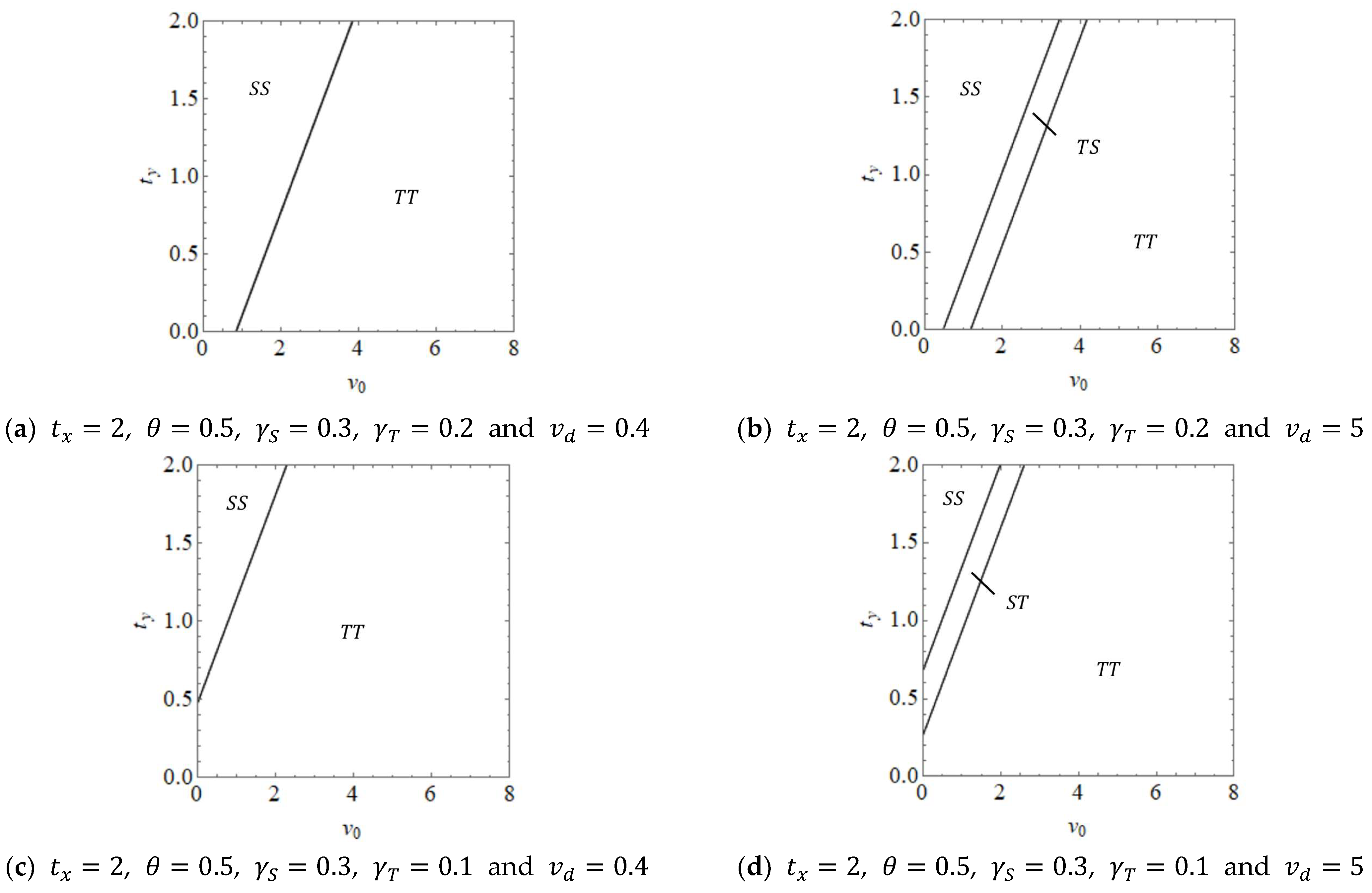
Proposition 3 implies that platforms should take into account the quality of the add-on products and the consumers’ preferences when deciding whether to bundle the two add-ons separately or together. In addition, we find that the quality difference between the two base goods as well as the profit-sharing ratio also have important impacts on the platforms’ equilibrium strategy. Figure 5 shows the conditions for the different equilibria.
As illustrated in Figure 5a,c, platforms must weigh the relative importance of the quality of the add-ons versus the consumer’s preference for the add-ons in determining whether to bundle the add-ons together (Case T T ) or to bundle them separately (Case S S ). When the quality of the add-ons is high enough such that it plays a more important role in consumers’ purchase decisions, the dominant strategy for both platforms is to bundle the base good with the two add-ons together (as indicated in Proposition 3(a)). Specifically, Platform h has a quality advantage when competing with Platform l , and it tends to adopt the T strategy in order to strengthen its competitiveness in the market. For Platform l , to avoid excessive loss of consumers due to a possible increase in the quality gap against Platform h , which may lead to significant profit reduction in the competition, it will also adopt the T strategy.
On the other hand, when consumer preference for the add-ons is strong enough such that consumers’ preference for the add-ons plays a more important role in their purchase decisions than the quality of the add-ons does, consumers attach greater importance to the degree of misfit between the provided products and their desired ones. When both platforms choose to bundle their own base goods with the add-ons separately, consumers have more choices for the bundled products, which can be conducive to reducing the degree of misfit and promoting the sales of the bundled products. Thus, the dominant strategy for both platforms is to bundle the base good with two add-ons separately (as indicated in Proposition 3(d)).
In Figure 5b,d, the cases with both platforms simultaneously choosing the T strategy or simultaneously choosing the S strategy follow the same intuitions. On the other hand, a new case, Case T S , arises in Figure 5b while another new case, Case S T , arises in Figure 5d. In these two cases, neither the quality of nor the consumers’ preference for the add-ons plays a dominant role in the consumers’ purchase decisions. As a result, the two competing platforms strategically consider different bundling strategies, especially when the quality difference in their base goods is significant (as illustrated by v d = 5 in Figure 5b,d).
Specifically, when the profit-sharing ratio by adopting the T strategy is high, but that by adopting the S strategy is low, such that 1 2 γ T < ( 1 γ s ) , Figure 5b shows that T S is likely to arise as an equilibrium. This is because, with an advantage in the quality of the base good, Platform h would preferentially select the S strategy as the preferred choice. In this case, for Platform l , bundling the two add-ons together to improve the quality of its offering can benefit it with a higher price in the competition. As a result, T S arises as the equilibrium. On the contrary, if 1 2 γ T > ( 1 γ s ) , as shown in Figure 5d, S T is likely to arise as an equilibrium. On one hand, Platform h has an incentive to adopt the T strategy because of the lower profit-sharing ratio. Platform l , on the other hand, adopts the S strategy to ease the direct competition with its competitor’s bundled product.
To sum up, the equilibrium strategies of the platforms depend not only on the add-ons and the quality difference in the platforms’ base goods, but also on the profit-sharing ratios.
Proposition 4.
(Possible Equilibrium Combinations)
(a) 
If   γ T γ S 2 ,
(a.1) 
Case   T T   or Case   S S   can become the equilibrium if   v d < 3 t x θ ( γ 1 γ 2 2 γ 1 γ 2 ) .
(a.2) 
Case   T T   , Case   S T , or Case   S S   can become the equilibrium if   3 t x θ ( γ 1 γ 2 2 γ 1 γ 2 ) < v d .
(b) 
If   γ S 2 < γ T ,
(b.1) 
Case   T T   or Case   S S   can become the equilibrium if   v d < 3 t x θ ( γ 1 γ 2 2 γ 2 γ 1 ) .
(b.2) 
Case   T T , Case   T S , or Case   S S   can become the equilibrium if   3 t x θ ( γ 1 γ 2 2 γ 2 γ 1 ) < v d .
where   γ 1 1 γ S , γ 2 1 2 γ T .
As illustrated in Figure 5, different combinations of market equilibria appear. According to Proposition 4(a,b), if v d is small (i.e., v d < 3 t x θ ( γ 1 γ 2 2 γ 1 γ 2 ) or v d < 3 t x θ ( γ 1 γ 2 2 γ 2 γ 1 ) ), only Case T T or Case S S can arise as an equilibrium. On the other hand, if v d is high enough such that 3 t x θ ( γ 1 γ 2 2 γ 1 γ 2 ) < v d , Case S T can also arise as an equilibrium when γ T is smaller than γ S 2 . However, when γ T is larger than γ S 2 , Case T S instead can arise as an equilibrium in addition to Case T T and Case S S , if v d is high enough such that 3 t x θ ( γ 1 γ 2 2 γ 2 γ 1 ) < v d .
The reason for Case S T not emerging as an equilibrium, e.g., in Figure 5b, is that, due to the relatively high profit-sharing ratio to the add-on partners with the T strategy, i.e., γ S 2 < γ T , π h S T > π h S S cannot be satisfied for Platform   h , who has a competitive edge in implementing bundling because of its superior base good. Similarly, the absence of the equilibrium T S in Figure 5d follows the same logic. That is, due to the relatively high profit-sharing ratio in the S strategy, i.e., γ T γ S 2 , Platform h is unlikely to adopt the S strategy in that the T strategy yields higher profit for Platform h given Platform l adopting the T strategy.

5.2. Comparison of Consumer Surplus and Social Welfare

Next, we examine which bundling case can generate the highest level of consumer surplus and social welfare. Consumer surplus is the total consumer net utility from purchasing the bundled products, and social welfare is defined as the sum of the consumer surplus and the platforms’ profits (more details can be found in the Appendix B.9 and Appendix B.10). By comparing the values of the consumer surpluses and social welfares in the four scenarios, we derive the following two propositions.
Proposition 5.
(Comparison in Consumer Surplus)
(a) 
The consumer surplus is higher in Case   T T   than in Case   S S   if and only if   t y < 4 3 θ v 0 .
(b) 
The consumer surplus is higher in Case   S T   than in Case   T S   if and only if   t y < 4 3 θ v 0 .
(c) 
When   t y < 4 3 θ v 0 , there exists a threshold   v d , such that Case   T T   will generate a higher consumer surplus than Case   S T   if and only if  v d < v d
(d) 
When   t y > 4 3 θ v 0 , there exists a threshold   v d , such that Case   S S   will generate a higher consumer surplus than Case   T S   if and only if   v d < v d .
From Proposition 5(a), when the consumers’ preference for the add-ons is relatively weak (i.e., t y < 4 3 θ v 0 ), product quality plays an important role in consumers’ purchase decisions, and, in such a case, the consumer surplus in Case T T is higher than that in Case S S . The reason is that the total value of the base good bundled with the two add-ons together is always higher than that bundled with only one add-on. However, when the consumers’ preference is strong (i.e., t y > 4 3 θ v 0 ), consumers are more willing to purchase products that are more consistent with their own preferences. Although the bundled products under the T strategy have higher quality, the bundled products under the S strategy have significantly lower misfit cost for the consumers. Therefore, Case S S can generate a higher consumer surplus than Case T T .
Similarly, from Proposition 5(b), consumer surplus in Case S T is also higher than that in Case T S when t y < 4 3 θ v 0 . This is mainly because the quality of Platform h ’s bundled products in Case S T is superior to that of Case T S , which leads to a higher surplus for consumers purchasing from Platform h . Conversely, when t y > 4 3 θ v 0 , Case T S instead generates higher consumer surplus than Case S T . Due to the consumers’ strong preference for the add-ons, Platform h , who owns the superior base good, can effectively improve the consumers’ benefit by adopting the S strategy rather than by adopting the T strategy, in that a lower mismatching cost can significantly increase the consumer surplus as long as the consumers’ preference for the add-ons is strong.
From Proposition 5(c), when t y < 4 3 θ v 0 , Case T T rather than Case S T brings higher consumer surplus if and only if v d < v d . That is, the small gap in the quality of the base goods ensures a higher consumer benefit when the two platforms adopt the symmetric bundling strategies T T rather than when they adopt the asymmetric bundling ones S T . This observation also holds in the case of consumers’ strong preference for the add-ons, i.e., t y > 4 3 θ v 0 , in which Case S S will generate a higher consumer surplus than Case T S if and only if v d < v d (Proposition 5(d)). On the other hand, in the presence of a large gap in the quality of the base goods, i.e., v d > v d (or v d > v d ), asymmetric bundling strategies S T (or T S ) bring in a higher consumer surplus in that the consumers can benefit from predominantly purchasing from Platform h .
Proposition 6.
(Comparison in Social Welfare)
(a) 
The social welfare in Case   T T   is higher than that in Case   S S   if and only if   t y < 4 3 θ v 0 .
(b) 
The social welfare in Case   S T   is higher than that in Case   T S   if and only if   t y < 4 3 θ v 0 .
(c) 
When   t y < 4 3 θ v 0 , there exists a threshold,   v d , such that Case   T T   will bring a higher social welfare than Case   S T   if and only if   v d < v d .
(d) 
When   t y > 4 3 θ v 0 , there exists a threshold,   v d , such that Case   S S   will bring a higher social welfare than Case   T S   if and only if   v d < v d .
It is clear in Proposition 6 that the comparison of the social welfare in the four scenarios leads to similar results to those in the comparison of the consumer surplus. When the consumers’ preference for the add-ons is relatively weak, Case T T can lead to both higher consumer surplus and higher profits. Therefore, the social welfare is higher in Case T T than in Case S S . On the other hand, when the consumers’ preference for the add-ons is strong, because consumers can have the options to choose the bundle products that better fit their preferences in Case S S , which significantly decreases the misfit cost, Case S S generates relatively high social welfare. The comparison between Case S T and Case T S follows the same logic.
In the existence of the consumers’ weak (or strong) preference for the add-ons, from Proposition 6(c) (or 6(d)), the social welfare under Case T T (or Case S S ) is further greater than that under Case S T (or Case T S ) if and only if v d < v d (or v d < v d ). The reason for the higher social welfare under the platforms’ symmetric bundling strategies than under the asymmetric bundling ones lies in the fact that the symmetrically bundled products can significantly decrease the misallocation cost when the platforms’ base products have comparable qualities.

5.3. Extension with Consideration of Network Effects

In this subsection, we further examine the influences of network effects on the platforms’ bundling decisions. Specifically, following the literature [5,21], consumers would derive an additional utility α N i m from Platform i   ( i = h ,   l ) , where α is the intensity of network effects and N i m represents the expected size of demand of Platform i in a rational expectation equilibrium. Therefore, the higher the demand of Platform i , the higher the additional value delivered to the consumers. This is in line with the reality that a platform’s value to each user increases with the size of its user base, say, through user communication within the platform.
We examine how the inclusion of this consumer-side network effects affects the results, ceteris paribus. We observe that a stronger network effect (an increased α ) would intensify the price competition and lower the equilibrium prices of the platforms. Aside from this, the extended model shows qualitatively similar results to those obtained in the main model (see Propositions (A1)–(A3) in Appendix A.3), which supports the robustness and relevance of the findings regarding the platforms’ bundling strategies.

6. Conclusions and Implications

6.1. Key Findings

This study explores the membership bundling decisions of two competing platforms. We first find that, in equilibrium, in the presence of a low quality gap between their base goods, the two platforms tend to adopt symmetric bundling strategies. Specifically, they will bundle their base goods with both add-ons together if consumers have a weak preference for the add-ons, but the quality of the add-on is sufficiently high to become the decisive factor in consumers’ purchase decision. Otherwise, the platforms are willing to bundle their base goods with the two add-ons separately. In the presence of a high quality gap between their base goods, the high-quality platform strategically chooses the bundling strategy to minimize profit-sharing payouts, forcing the low-quality platform to adopt a divergent strategy. Similar to the platforms’ equilibrium strategies, the comparisons in the consumer surplus as well as in the social welfare across different bundling cases also depend on the quality of the add-on, the consumers’ preference for the add-ons, and the quality gap between the base goods. We can also verify that the results are robust with the consideration of network effects (see Appendix A.3).

6.2. Implications

The findings of this study offer guidance on whether competing platforms should bundle their base goods (or services) with different add-ons together or separately. In particular, we provide specific insights that competing platforms should implement the same bundling strategies if and only if the quality gap between their base goods is not too large. With comparable qualities in base goods, on one hand, both platforms should implement the T strategy when consumers exhibit weak preference for the add-ons such that the quality of the add-ons plays a dominant role in the consumers’ purchase decision. On the other hand, when consumers exhibit a strong preference for the add-ons, the S strategy should be adopted by both platforms.
For example, the fact that both Disney+ and YouTube choose the T strategy (as shown in Table 1) may be because consumers comparably value the video services provided on Disney+ and YouTube, and, meanwhile, consumers have similar preferences for the different entertainment programs provided by Hulu and ESPN+ as well as by YouTube Music and YouTube Kids. On the other hand, the underlying reason for the S strategy adopted by Mango TV and Tencent Video may be attributed to the consumers’ distinct preferences for the services bundled with Mango TV or Tencent Video. For example, for the two services bundled with Tencent Video, Tencent Comic provides a wide range of domestic and international animation content, while Kugou offers digital music streaming services. These two add-ons offer diversified services for which consumers may have distinct preferences. To attract consumers and meet their diversified needs, bundling the add-ons separately is thus likely to facilitate a win–win scenario.
Nevertheless, when the qualities of the base goods vary significantly between the two competing platforms, it is better for the two platforms to adopt different bundling strategies. As shown in Table 1, JD.COM, as a high-quality platform, enjoys superior resource endowments, which ensure its market competitiveness. It is easier for other platforms, such as NetEase Cloud Music and Baidu Library, to expand when their membership services are bundled with JD PLUS. Hence, these platforms, which offer the add-ons, may be willing to negotiate with JD.COM at a relatively low profit-sharing ratio in the bundling cooperation, leading JD.COM to be inclined to bundle with these platforms separately. In response, Taobao offers a single package that bundles all the third-party memberships together to bring greater benefits to its consumers.
On the other hand, Dragonfly FM is renowned for its high-quality content, which attracts users who have requirements for in-depth content. Furthermore, both LETV and Kuaikan Comic are actively working to develop their own content ecosystems and expand their market influence. As a result, both of them are willing to be bundled with Dragonfly FM at a lower profit-sharing ratio, incentivizing Dragonfly FM to bundle these add-on services together into a single package to form a vast ecosystem. Himalaya, however, attracting users who are seeking diverse entertainment categories, chooses to bundle different partners’ services separately to distinguish itself from Dragonfly FM (see Table 1).
Overall, our research demonstrates that the quality difference of base products, consumer preference, and profit-sharing ratios are critical factors influencing the bundling strategies of competing platforms. Platform managers should undertake comprehensive market research to better understand competitors’ product positioning, delineate the distinctions between their own offerings and those of rivals, systematically assess consumer preference, and explore feasible profit-sharing models, which will aid in formulating more targeted market strategies—particularly in light of the current advantageous environment encouraging data sharing. For example, Article 6(11) of the EU Data Markets Act (DMA) [41] requires a platform to provide other parties with access to ranking, query, click, and view data. In addition to the paradigm of data sharing advocated by DMA, the EU Digital Services Act (DSA) also emphasizes enhancing data sharing through enhanced “transparency” [42].
Furthermore, as regulatory restrictions imposed by the DMA require digital platforms to unbundle their own products or services (Article 5(8) [41], “prohibits a gatekeeper from requiring business or end-users to subscribe to one of its CPS as a condition to access another of its CPS”), bundling with services from other platforms represents a promising alternative. According to U.S. antitrust provisions on bundling, which require bundling to follow the “reasonableness principle”, the bundling behavior should not harm consumer welfare. Therefore, it is essential to develop bundling strategies that essentially incorporate the aforementioned factors, with particular emphasis on consumer preference. Since regulatory frameworks require “explicit consent” of consumers for bundled offerings, proactively integrating consumer preferences not only supports compliance but also serves as a self-verification mechanism to enhance strategic alignment and market acceptance.
Our study also has implications for social planners, such as policymakers in the government economic agencies. Notably, it can be considered to enhance the assessment of the core/base service qualities of digital platforms. This can more effectively identify whether there exists “significant difference” in the quality of the base services provided by competing platforms in the market, thereby allowing for a clearer distinction regarding the intensity of intervention in the platforms’ ecosystem development strategies—such as through bundling add-ons from other platforms. Specifically, when competing platforms offer base services of comparable qualities, their strategic bundling choices can largely coincide with the welfare-enhancing outcomes (considering both consumer surplus and social welfare). In such cases, the economic agencies should primarily adopt an observant approach. However, when significant quality disparity exists between the competing platforms’ base services, their strategic decisions would be predominantly influenced by the profit-sharing arrangements with the add-on partners, which may substantially deviate from the welfare optimization. Policymakers should prioritize regulatory attention to the latter scenario to ensure societal interests. More specifically, when one platform’s base service is clearly superior to its competitor’s, policymakers should encourage the leading platform to bundle add-ons—either jointly or separately—depending on whether add-on quality or consumer preference is the main driver of purchase. Simultaneously, the competitor should be guided to adopt a differentiated strategy.

6.3. Limitations

Our model presents several limitations. First, our analysis focuses solely on the competition between the platforms that offer the base goods or services. In fact, the platforms that provide the add-ons can also be competitors against each other. Second, our research considers a predetermined profit-sharing mechanism between the platforms that offer the base goods and the platforms that offer the add-ons. However, the cooperation between these platforms does not always involve pre-agreed profit-sharing arrangements; in practice, these mechanisms are often subject to, say, negotiation. Third, our paper focuses primarily on platforms’ one-period (or static) bundling decisions but does not consider lock-in effects, which would necessitate a shift to a multi-period framework where consumers may purchase bundled products from different platforms over time.

6.4. Future Directions

This paper can be extended for future research in the following aspects: first, the analysis could be extended to account for multi-tier competition, particularly that among platforms offering base goods and that among platforms offering add-ons. Second, future work could examine the negotiation process between base-good and add-on platforms and their influence on equilibrium bundling strategies. Finally, integrating lock-in effects into platforms’ bundling decisions is also a direction worthy of future research. Investigating these aspects would contribute to a more comprehensive understanding of bundling decisions in complex platform ecosystems.

Author Contributions

Conceptualization, J.Z. and W.Z.; methodology, J.Z. and W.Z.; formal analysis, J.Z.; investigation, J.Z.; writing—original draft preparation, J.Z.; writing—review and editing, W.Z.; visualization, J.Z.; supervision, W.Z.; project administration, W.Z.; funding acquisition, W.Z. All authors have read and agreed to the published version of the manuscript.

Funding

This research was supported by the National Natural Science Foundation of China (Grant No. 72262013), “Nan Hai Xin Xing” Education Platform Project of Hainan Province, China, and Natural Science Foundation of Hainan Province, China (Grant No. 721RC1045).

Institutional Review Board Statement

Not applicable.

Informed Consent Statement

Not applicable.

Data Availability Statement

No new data were created or analyzed in this study. Data sharing is not applicable to this article.

Acknowledgments

This article is a revised and expanded version of a paper entitled “Membership Bundling Strategy for Digital Platforms Based on Consumer Preferences” [39], which was presented at the CSWIM2024 Conference, Xiamen, China, on 29–30 June 2024.

Conflicts of Interest

The authors declare no conflicts of interest.

Appendix A. Supplementary Details to the Main Paper

Appendix A.1. Summary of Key Notations

Table A1. Summary of key notations.
ScenarioNotationDescription
i Platform   i   ( i = l ,   h )
j Strategy   j   ( j = T ,   S )
m Case   m ( m = T T ,   T S ,   S T ,   and   S S )
v i The   quality   for   Platform   i s   base   good   ( i = l ,   h )
v d The quality difference in the two base goods
v 0 The quality of the add-on
s k The kth add-on  ( k = 1,2 )
t x ,   t y Unit misfit cost for using the base good and the add-on, respectively
γ j The   ratio   of   revenue   that   a   third - party   platform   can   gain   from   the   bundled   products   ( j = T ,   S )
π o m The   profits   of   the   partner   platforms   under   Case   m ( m = T T ,   T S ,   S T ,   and   S S )
T T p i T T ,   D i T T ,   π i T T Price ,   demand ,   and   profit   of   Platform   i   ( i = l ,   h )
U i T T The   utility   that   the   consumer   obtains   from   purchasing   the   bundled   product   of   Platform   i   ( i = l ,   h )
T S p l T S ,   D l T S ,   π l T S Price ,   demand ,   and   profit   of   Platform   l
U l T S The   utility   that   the   consumer   obtains   from   purchasing   the   bundled   product   of   Platform   l
p h T S k ,   D h T S k ,   π h T S k Price ,   demand ,   and   profit   of   the   product   that   bundles   h   with   s k   ( k = 1,2 )
U h T S k The   utility   that   the   consumer   obtains   from   purchasing   the   product   that   bundles   h   with   s k   ( k = 1,2 )
S T p l S T k ,   D l S T k ,   π l S T k Price ,   demand ,   and   profit   of   the   product   that   bundles   l   with   s k   ( k = 1,2 )
U l S T k The   utility   that   the   consumer   obtains   from   purchasing   the   product   that   bundles   l   with   s k   ( k = 1,2 )
p h S T ,   D h S T ,   π h S T Price ,   demand ,   and   profit   of   Platform   h
U h S T The   utility   that   the   consumer   obtains   from   purchasing   the   bundled   product   of   Platform   h
S S p i S S k ,   D i S S k ,   π i S S k Price ,   demand ,   and   profit   of   the   product   that   bundles   i   with   s k   ( i = l ,   h ;   k = 1,2 )
U i S S k The   utility   that   the   consumer   obtains   from   purchasing   the   product   that   bundles   i   with   s k   ( i = l ,   h ;   k = 1,2 )

Appendix A.2. Equilibrium Prices and Profits

Case   T T . When both platforms choose to bundle their base good with the two add-ons together, solving the first-order conditions for the two profit-maximizing platforms yields the equilibrium prices, demands, and profits as summarized by the following Lemma A1.
Lemma A1.
In Case   T T , the equilibrium prices for the two bundled products on the two platforms are
p l T T = t x 1 3 θ v h v l p h T T = t x + 1 3 θ v h v l ,
the equilibrium demands for the bundled products are
D l T T = 1 2 1 6 t x θ v h v l D h T T = 1 2 + 1 6 t x θ v h v l ,
and the equilibrium profits for the two platforms are
π l T T = 1 2 γ T 3 t x θ v h v l 2 18 t x π h T T = 1 2 γ T 3 t x + θ v h v l 2 18 t x ,
It can be seen from Lemma A1 that, in equilibrium, p h T T > p l T T , D h T T > D l T T and π h T T > π l T T . This result is intuitive because v h v l = v d > 0 . That is, the base good in Platform h has a valuation advantage over its competitor. Thus, Platform h can charge a higher price as well as gain a larger market share, and consequently earn more profit than Platform l (To ensure that both platforms have positive demands (i.e., 0 < D i T T < 1 for i = l , h ), it is required that 0 < v d < 3 t x θ ).
Case   T S . When Platform l chooses to bundle the base good with the add-ons together while Platform h chooses to bundle separately, solving the first-order conditions for the two profit-maximizing platforms yields the equilibrium prices, demands, and profits as summarized by the following Lemma A2.
Lemma A2.
In Case   T S , the equilibrium prices for the bundled products on the two platforms are
p l T S = t x 1 3 θ v h v l v 0 + 1 4 t y p h T S 1 = p h T S 2 = t x + 1 3 θ v h v l v 0 + 1 4 t y ,
the equilibrium demands for the bundled products on the two platforms are
D l T S = 1 2 t y 8 t x θ v h v 0 v l 6 t x D h T S 1 = D h T S 2 = 1 4 + t y 16 t x + θ v h v 0 v l 12 t x ,
and the equilibrium profits are
π l T S = 1 2 γ T 12 t x 3 t y + 4 θ v l v h + v 0 2 288 t x π h T S = π h T S 1 + π h T S 2 = 1 γ S 12 t x + 3 t y 4 θ v l v h + v 0 2 288 t x .
Case   S T . When Platform l chooses to bundle separately while Platform h chooses to bundle together, solving the first-order conditions yields the equilibrium prices, demands, and profits as summarized by the following Lemma A3.
Lemma A3.
In Case   S T , the equilibrium prices for the bundled products on the two platforms are
p l S T 1 = p l S T 2 = t x 1 3 θ v h v l + v 0 1 4 t y p h S T = t x + 1 3 θ v h v l + v 0 1 4 t y ,
the equilibrium demands for the bundled products on the two platforms are
D l S T 1 = D l S T 2 = 1 4 + t y 16 t x θ v h v l + v 0 12 t x D h S T = 1 2 t y 8 t x + θ v h v l + v 0 6 t x ,
and the equilibrium profits are
π l S T = π l S T 1 + π l S T 2 = 1 γ S 12 t x + 3 t y 4 θ v h v l + v 0 2 288 t x π h S T = 1 2 γ T 12 t x 3 t y + 4 θ v h v l + v 0 2 288 t x .
Case   S S . When both platforms choose to bundle separately, solving the first-order conditions leads to the equilibrium prices, demands, and profits as summarized by the following Lemma A4.
Lemma A4.
In Case   S S , the equilibrium prices for the bundled products on the two platforms are
p l S S 1 = p l S S 2 = t x 1 3 θ v h v l p h S S 1 = p h S S 2 = t x + 1 3 θ v h v l ,
the equilibrium demands for bundled products on the two platforms are
D l S S 1 = D l S S 2 = 1 4 1 12 t x θ v h v l D h S S 1 = D h S S 2 = 1 4 + 1 12 t x θ v h v l ,
and the equilibrium profits are
π l S S = π l S S 1 + π l S S 2 = 1 γ S 3 t x θ v h v l 2 18 t x π h S S = π h S S 1 + π h S S 2 = 1 γ S 3 t x + θ v h v l 2 18 t x .
Note that in this case, in equilibrium, because consumers’ purchase decisions are no longer related to the add-ons, the equilibrium prices are independent of v 0 and t y .

Appendix A.3. Extension: Influences of Network Effects

This extension considers the influences of network effects on the platforms’ bundling decisions. We assume a consumer would derive an additional utility α N i m from Platform i   ( i = h ,   l ) , where α is the intensity of network effects and N i m represents the expected size of demand of Platform i in a rational expectation equilibrium.
(1)
Case TT
In this scenario, both platforms adopt T strategy. The utility for the consumer located at ( x , y ) to buy from Platform l (denoted by U l T T ) or from Platform h (denoted by U h T T ) can be respectively derived as:
U l T T = θ v l + 2 v 0 + α N l T T t x x t y p l T T U h T T = θ v h + 2 v 0 + α N h T T t x ( 1 x ) t y p h T T .
in which p l T T and p h T T are the bundled product prices of Platform l and Platform h with network effects, respectively. By setting U l T T = U h T T , we can derive the indifferent consumer’s location as follows:
x T T = α N h T T + α N l T T + p h T T p l T T + t x θ v h + θ v l 2 t x .
In the fulfilled expectation equilibrium, the realized demand of platforms equals the expected market size of consumers: N i T T = D i T T ( i = l , h ). Then, letting N l T T = D l T T = x T T and N h T T = D h T T = ( 1 x T T ) .
We have:
D l T T = α + p h T T p l T T + t x θ v h + θ v l 2 ( α t x ) D h T T = α p h T T + p l T T + t x + θ v h θ v l 2 ( α t x ) .
The profit functions for the platforms can be specified as follows:
π l T T   = 1 2 γ T D l T T p l T T π h T T   = 1 2 γ T D h T T p h T T .
Solving the first-order conditions for the two profit-maximizing platforms yields the equilibrium prices, demands, and profits as summarized as follows:
p l T T = 1 3 ( 3 α + 3 t x θ v h + θ v l ) p h T T = 1 3 ( 3 a + 3 t x + θ v h θ v l ) ,
D l T T = 3 α 3 t x + θ v h θ v l 6 α 6 t x D h T T = 3 α 3 t x θ v h + θ v l 6 α 6 t x ,
π l T T   = ( 1 2 r T ) ( 3 α 3 t x + θ v h θ v l ) 2 18 ( t x α ) π h T T = ( 1 2 r T ) ( 3 α 3 t x θ v h + θ v l ) 2 18 ( t x α ) .
(2)
Case TS
In this scenario, consumers can either purchase a bundled product that consists of the base good l and both the add-ons from Platform l , or select between the two bundled products on Platform h that only contain one add-on. The utility for the consumer located at ( x , y ) to purchase from Platform l (denoted by U l T S ) or from Platform h (denoted by U h T S 1 and U h T S 2 , respectively) can be written as:
U l T S = θ v l + 2 v 0 + α N l T S t x x t y p l T S U h T S 1 = θ v h + v 0 + α N h T S t x 1 x t y y p h T S 1 U h T S 2 = θ v h + v 0 + α N h T S t x 1 x t y 1 y p h T S 2 ,
in which p l T S is the bundled product price of Platform l considering network effects, and p h T S 1 (or p h T S 2 ) represents the price of the product that bundles the base good h with the add-on s 1 (or s 2 ) considering network effects.
Letting U l T S = U h T S 1 , U l T S = U h T S 2 and U h T S 1 = U h T S 2 , we obtain the indifferent curves as follows:
x y T S 1 = α N h T S + α N l T S + p h T S 1 p l T S + t x t y + y t y + θ v 0 θ v h + θ v l 2 t x x y T S 2 = α N h T S + α N l T S + p h T S 2 p l T S + t x y t y + θ v 0 θ v h + θ v l 2 t x y T S = 1 2 + p h T S 2 p h T S 1 2 t y .
To simplify the following analysis, p h T S 1 and p h T S 2 are assumed to be equal given the equal valuations of the two add-ons [7]. In the fulfilled expectation equilibrium, the realized demand of platforms equals the expected market size of consumers: N i T S = D i T S ( i = l , h ). Then, letting N l T S = D l T S = 0 y T S x y T S 1 d y + y T S 1 x y T S 2 d y and N h T S = D h T S = D h T S 1 + D h T S 2 = 0 y T S ( 1 x y T S 1 ) d y + y T S 1 ( 1 x y T S 2 ) d y .
We have:
D l T S = 4 α + 4 p h T S 1 4 p l T S + 4 t x 3 t y + 4 θ v 0 4 θ v h + 4 θ v l 8 ( α t x ) D h T S = D h T S 1 + D h T S 2 = 4 α 4 p h T S 1 + 4 p l T S + 4 t x + 3 t y 4 θ v 0 + 4 θ v h 4 θ v l 8 ( α t x ) .
Then, the profit functions for the platforms can be specified as follows:
π l T S   = 1 2 γ T D l T S p l T S π h T S   = π h T S 1   + π h T S 2   = 1 γ S D h T S 1 p h T S 1 + 1 γ S D h T S 2 p h T S 2 .
Solving the first-order conditions for the two profit-maximizing platforms yields the equilibrium prices, demands, and profits as summarized as follows:
p l T S = 1 12 ( 12 α + 12 t x 3 t y + 4 θ v 0 4 θ v h + 4 θ v l ) p h T S 1 = p h T S 2 = 1 12 ( 12 α + 12 t x + 3 t y 4 θ v 0 + 4 θ v h 4 θ v l ) ,
D l T S = 12 α 12 t x + 3 t y 4 θ v 0 + 4 θ v h 4 θ v l 24 α 24 t x D h T S = D h T S 1 + D h T S 2 = 12 α 12 t x 3 t y + 4 θ v 0 4 θ v h + 4 θ v l 24 α 24 t x ,
π l T S = ( 1 2 r T ) ( 12 α 12 t x + 3 t y 4 θ v 0 + 4 θ v h 4 θ v l ) 2 288 ( t x α ) π h T S   = ( 1 r S ) ( 12 α 12 t x 3 t y + 4 θ v 0 4 θ v h + 4 θ v l ) 2 288 ( t x α ) .
(3)
Case ST
In case S T , Platform l adopts the S strategy, whereas Platform h opts for the T strategy. The utility for the consumer located at ( x , y ) to purchase from Platform l (denoted by U l S T 1 and U l S T 2 , respectively) or Platform h (denoted by U h S T ) can be written as:
U l S T 1 = θ v l + v 0 + α N l S T t x x t y y p l S T 1 U l S T 2 = θ v l + v 0 + α N l S T t x x t y 1 y p l S T 2 U h S T = θ v h + 2 v 0 + α N h S T t x 1 x t y p h S T ,
in which p h S T is the bundled product price of Platform h considering network effects, and p l S T 1 (or p l S T 2 ) represents the price of the bundled product that bundles the base good l with the add-on s 1 (or s 2 ) considering network effects.
Solving the indifference equations U h S T = U l S T 1 , U h S T = U l S T 2 and U l S T 1 = U l S T 2 , respectively, we can have three indifferent curves as follows:
x y S T 1 = α N h S T + α N l S T + p h S T p l S T 1 + t x + t y y t y θ v 0 θ v h + θ v l 2 t x x y S T 2 = α N h S T + α N l S T + p h S T p l S T 2 + t x + y t y θ v 0 θ v h + θ v l 2 t x y S T = 1 2 + p l S T 1 p l S T 2 2 t y ,
Similar to Case T S , we let p l S T 1 = p l S T 2 and thus y S T = 1 2 . In the fulfilled expectation equilibrium, the realized demands of platforms equal the expected market sizes: N i S T = D i S T ( i = l , h ). Then, letting N l S T = D l S T = D l S T 1 + D l S T 2 = 0 y S T x y S T 1 d y + y S T 1 x y S T 2 d y and N h S T = D h S T = 0 y S T ( 1 x y S T 1 ) d y + y S T 1 ( 1 x y S T 2 ) d y .
We have:
D l S T = D l S T 1 + D l S T 2 = 4 α + 4 p h S T 4 p l S T 1 + 4 t x + 3 t y 4 θ v 0 4 θ v h + 4 θ v l 8 ( α t x ) D h S T = 4 α 4 p h S T + 4 p l S T 1 + 4 t x 3 t y + 4 θ v 0 + 4 θ v h 4 θ v l 8 ( α t x ) .
Then, the profit functions for the platforms can be specified as follows:
π l S T   = π l S T 1   + π l S T 2   = 1 γ s D l S T 1 p l S T 1 + 1 γ s D l S T 2 p l S T 2 π h S T   = 1 2 γ T D h S T p h S T .
Solving the first-order conditions for the two profit-maximizing platforms yields the equilibrium prices, demands, and profits as summarized as follows:
p l S T 1 = p l S T 2 = 1 12 ( 12 α + 12 t x + 3 t y 4 θ v 0 4 θ v h + 4 θ v l ) p h S T = 1 12 ( 12 α + 12 t x 3 t y + 4 θ v 0 + 4 θ v h 4 θ v l ) ,
D l S T = D l S T 1 + D l S T 2 = 12 α 12 t x 3 t y + 4 θ v 0 + 4 θ v h 4 θ v l 24 α 24 t x D h S T = 12 α 12 t x + 3 t y 4 θ v 0 4 θ v h + 4 θ v l 24 α 24 t x ,
π l S T = ( 1 r S ) ( 12 α 12 t x 3 t y + 4 θ v 0 + 4 θ v h 4 θ v l ) 2 288 ( t x α ) π h S T   = ( 1 2 r T ) ( 12 α 12 t x + 3 t y 4 θ v 0 4 θ v h + 4 θ v l ) 2 288 ( t x α ) .
(4)
Case SS
When both platforms adopt the S strategy, the utility for the consumer located at ( x , y ) to buy from Platform l (denoted by U l S S 1 and U l S S 2 , respectively) or from Platform h (denoted by U h S S 1 and U h S S 2 , respectively) can be written as:
U l S S 1 = θ v l + v 0 + α N l S S t x x t y y p l S S 1 U l S S 2 = θ v l + v 0 + α N l S S t x x t y 1 y p l S S 2 U h S S 1 = θ v h + v 0 + α N h S S t x 1 x t y y p h S S 1 U h S S 2 = θ v h + v 0 + α N h S S t x 1 x t y 1 y p h S S 2 ,
in which p l S S 1 or p l S S 2 represents the price of the bundled product containing the add-on s 1 or s 2 on Platform l considering network effects, respectively. Similarly, p h S S 1 or p h S S 2 represents the prices of the bundled products on Platform h considering network effects.
Letting U l S S 1 = U l S S 2 , U h S S 1 = U h S S 2 , U l S S 1 = U h S S 1 and U l S S 2 = U h S S 2 , we can derive two indifferent curves as follows:
x S S = α N h S S + α N l S S + p h S S 1 p l S S 1 + t x θ v h + θ v l 2 t x y S S = 1 2 + p l S S 2 p l S S 1 2 t y .
Considering p l S S 1 = p l S S 2 and p h S S 1 = p h S S 2 , we have y S S = 1 2 . In the fulfilled expectation equilibrium, the realized demands of platforms equal the expected demands: N i S S = D i S S ( i = l , h ). Then, letting N l S S = D l S S = D l S S 1 + D l S S 2 = x S S y S S + x S S ( 1 y S S ) and N h S S = D h S S = D h S S 1 + D h S S 2 = ( 1 x S S ) y S S + ( 1 x S S ) ( 1 y S S ) .
We have:
D l S S = D l S S 1 + D l S S 2 = α + p h S S 1 p l S S 1 + t x θ v h + θ v l 2 ( α t x ) D h S S = D h S S 1 + D h S S 2 = α p h S S 1 + p l S S 1 + t x + θ v h θ v l 2 ( α t x ) .
Then, the profit functions for the platforms can be specified as follows:
π l S S   = π l S S 1   + π l S S 2   = 1 γ s D l S S 1 p l S S 1 + 1 γ s D l S S 2 p l S S 2 π h S S   = π h S S 1   + π h S S 2   = 1 γ s D h S S 1 p h S S 1 + 1 γ s D h S S 2 p h S S 2 .
Solving the first-order conditions for the two profit-maximizing platforms yields the equilibrium prices, demands, and profits as summarized as follows:
p l S S 1 = p l S S 2 = 1 3 ( 3 α + 3 t x θ v h + θ v l ) p h S S 1 = p h S S 2 = 1 3 ( 3 α + 3 t x + θ v h θ v l ) ,
D l S S = D l S S 1 + D l S S 2 = 3 α 3 t x + θ v h θ v l 6 α 6 t x D h S S = D h S S 1 + D h S S 2 = 3 α 3 t x θ v h + θ v l 6 α 6 t x ,
π l S S = ( 1 r S ) ( 3 α 3 t x + θ v h θ v l ) 2 18 ( t x α ) π h S S   = ( 1 r S ) ( 3 α 3 t x θ v h + θ v l ) 2 18 ( t x α ) .
Based on the above results, we can have the following propositions on equilibrium bundling strategies, consumer surplus, and social welfare.
Proposition A1.
(Equilibrium Bundling Strategy Considering Network effects)
(a) 
Case   T T   can be sustained as the equilibrium when  v 0 > m a x 3 4 θ t y 3 θ ( t x α ) γ 2 γ 1 γ 1 + γ 2 γ 1 γ 1 v d ,   3 4 θ t y 3 θ ( t x α ) γ 2 γ 1 γ 1 γ 2 γ 1 γ 1 v d .
(b) 
Case   T S   can be sustained as the equilibrium when  3 4 θ t y + 3 θ ( t x α ) γ 1 γ 2 γ 2 γ 1 γ 2 γ 2 v d < v 0 < 3 4 θ t y 3 θ ( t x α ) γ 2 γ 1 γ 1 γ 2 γ 1 γ 1 v d
(c) 
Case   S T   can be sustained as the equilibrium when  3 4 θ t y + 3 θ ( t x α ) γ 1 γ 2 γ 2 + γ 1 γ 2 γ 2 v d < v 0 < 3 4 θ t y 3 θ ( t x α ) γ 2 γ 1 γ 1 + γ 2 γ 1 γ 1 v d
(d) 
Case   S S   can be sustained as the equilibrium when  v 0 < m i n 3 4 θ t y + 3 θ ( t x α ) γ 1 γ 2 γ 2 γ 1 γ 2 γ 2 v d , 3 4 θ t y + 3 θ ( t x α ) γ 1 γ 2 γ 2 + γ 1 γ 2 γ 2 v d
where  γ 1 1 γ S , γ 2 1 2 γ T .
The equilibrium strategies in Proposition A1 show that, regardless of whether the network effects are considered or not, our main conclusion in Proposition 3 remains qualitatively the same. In both cases, platforms should take into account the quality of the add-on products, the consumers’ preferences, and the profit-sharing ratios when deciding whether to bundle the two add-ons separately or together.
Next, we examine which bundling case can generate the highest level of consumer surplus and social welfare. The consumer surplus generated in the Case T T can be formulated as follows:
C S T T = 0 1 0 x T T U l T T d x d y + 0 1 x T T 1 U h T T d x d y = 0 1 0 3 α 3 t x + θ v h θ v l 6 α 6 t x ( α t x x t x t y + 2 θ v 0 + θ v h 3 + 2 θ v l 3 + α ( 3 α 3 t x + θ v h θ v l ) 6 ( α t x ) ) d x d y + 0 1 3 α 3 t x + θ v h θ v l 6 α 6 t x 1 ( α 2 t x + x t x t y + 2 θ v 0 + 2 θ v h 3 + θ v l 3 + α ( 3 α 3 t x θ v h + θ v l ) 6 ( α t x ) ) d x d y = 1 36 ( α t x ) 2 ( 45 t x 3 + 18 α 2 ( 3 α 2 t y + 4 θ v 0 + θ v h + θ v l ) + 18 t x 2 ( 8 α 2 t y + 4 θ v 0 + θ v h + θ v l ) + t x ( 153 α 2 + 72 α t y 144 α θ v 0 36 α θ v h + θ 2 v h 2 36 α θ v l 2 θ 2 v h v l + θ 2 v l 2 ) ) ,
Similarly, we can derive the consumer surplus generated for the remaining three cases as follows.
C S T S = 0 1 2 0 x y T S 1 U l T S d x d y + 1 2 1 0 x y T S 2 U l T S d x d y + 0 1 2 x y T S 1 1 U h T S 1 d x d y + 1 2 1 x y T S 2 1 U h T S 2 d x d y = 1 576 ( α t x ) 2 t x ( 720 t x 4 + 3 α 2 t y 2 4 t x 2 ( 612 α 2 3 t y 2 4 θ 2 v 0 2 + 144 α θ v h 4 θ 2 v h 2 + 144 α θ v l + 8 θ 2 v h v l 4 θ 2 v l 2 + 8 θ v 0 ( 54 α + θ v h θ v l ) 6 t y ( 30 α θ v 0 + θ v h θ v l ) ) + 6 α t x ( 60 α t y t y 2 + 48 α ( 3 α + 3 θ v 0 + θ v h + θ v l ) ) + 72 t x 3 ( 5 t y + 4 ( 8 α + 3 θ v 0 + θ v h + θ v l ) ) ) ,
C S S T = 0 1 2 0 x y S T 1 U l S T 1 d x d y + 1 2 1 0 x y S T 2 U l S T 2 d x d y + 0 1 2 x y S T 1 1 U h S T d x d y + 1 2 1 x y S T 2 1 U h S T d x d y = 1 576 ( α t x ) 2 t x ( 720 t x 4 + 3 α 2 t y 2 4 t x 2 ( 612 α 2 3 t y 2 4 θ 2 v 0 2 + 144 α θ v h 4 θ 2 v h 2 + 144 α θ v l + 8 θ 2 v h v l 4 θ 2 v l 2 + 8 θ v 0 ( 54 α θ v h + θ v l ) 6 t y ( 30 α θ v 0 θ v h + θ v l ) ) + 6 α t x ( 60 α t y t y 2 + 48 α ( 3 α + 3 θ v 0 + θ v h + θ v l ) ) + 72 t x 3 ( 5 t y + 4 ( 8 α + 3 θ v 0 + θ v h + θ v l ) ) ) ,
C S S S = 0 1 2 0 x S S U l S S 1 d x d y + 1 2 1 0 X s s U l S S 2 d x d y + 0 1 2 x S S 1 U h S S 1 d x d y + 1 2 1 x S S 1 U h S S 2 d x d y = 1 36 ( α t x ) 2 ( 45 t x 3 + 9 α 2 ( 6 α t y + 4 θ v 0 + 2 θ v h + 2 θ v l ) + t x ( 153 α 2 + 18 α t y 72 α θ v 0 36 α θ v h + θ 2 v h 2 36 α θ v l 2 θ 2 v h v l + θ 2 v l 2 ) + 9 t x 2 ( t y + 2 ( 8 α + 2 θ v 0 + θ v h + θ v l ) ) ) .
By comparing the values of the consumer surpluses in the four scenarios, we can derive the following proposition.
Proposition A2.
(Comparison in Consumer Surplus Considering Network Effects)
(a) 
The consumer surplus is higher in Case   T T   than in Case   S S   if and only if  t y < 4 3 θ v 0 .
(b) 
The consumer surplus is higher in Case   S S   than in Case   T S   if and only if  t y < 4 3 θ v 0 .
(c) 
When  t y < 4 3 θ v 0 , there exists a threshold   v d 1 , such that Case   T T   will generate a higher consumer surplus than Case   S T   if and only if  v d < v d 1
(d) 
When  t y > 4 3 θ v 0 , there exists a threshold   v d 2 , such that Case   S S   will generate a higher consumer surplus than Case   T S   if and only if  v d < v d 2 .
From Proposition A2, the results of the comparison of consumer surplus among the four cases with network effects are also similar to those without, as shown in Proposition 5.
Note that social welfare is given by S W m = π l m + π h m + π o m + C S m . Thus, we can obtain the social welfare as follows:
S W T T = 1 36 ( α t x ) 2 ( 9 t x 3 + 18 t x 2 ( 2 α 2 t y + 4 θ v 0 + θ v h + θ v l ) t x ( 45 α 2 72 α t y + 144 α θ v 0 + 36 α θ v h 5 θ 2 v h 2 + 36 α θ v l + 10 θ 2 v h v l 5 θ 2 v l 2 ) + 2 α ( 9 α 2 18 α t y + 36 α θ v 0 + 9 α θ v h 2 θ 2 v h 2 + 9 α θ v l
S W T S = 1 576 ( α t x ) 2 t x ( 144 t x 4 + 3 α 2 t y 2 + 72 t x 3 ( 5 t y + 4 ( 2 α + 3 θ v 0 + θ v h + θ v l ) ) + 2 α t x ( 21 t y 2 12 t y ( 15 α 4 θ v 0 + 4 θ v h 4 θ v l ) + 16 ( 9 α 2 2 θ 2 v 0 2 2 θ 2 v h 2 + 9 α θ v l 2 θ 2 v l 2 + θ v 0 ( 27 α + 4 θ v h 4 θ v l ) + θ v h ( 9 α + 4 θ v l ) ) ) 8 t x 2 ( 6 t y 2 15 t y ( 6 α θ v 0 + θ v h θ v l ) + 2 ( 45 α 2 5 θ 2 v 0 2 5 θ 2 v h 2 + 36 α θ v l 5 θ 2 v l 2 + 2 θ v 0 ( 54 α + 5 θ v h 5 θ v l ) + 2 θ v h ( 18 α + 5 θ v l ) ) ) )
S W S T = 1 576 ( α t x ) 2 t x ( 144 t x 4 + 3 α 2 t y 2 + 72 t x 3 ( 5 t y + 4 ( 2 α + 3 θ v 0 + θ v h + θ v l ) ) + 2 α t x ( 21 t y 2 12 t y ( 15 α 4 θ v 0 4 θ v h + 4 θ v l ) + 16 ( 9 α 2 2 θ 2 v 0 2 2 θ 2 v h 2 + 9 α θ v l 2 θ 2 v l 2 + θ v h ( 9 α + 4 θ v l ) + θ v 0 ( 27 α 4 θ v h + 4 θ v l ) ) ) 8 t x 2 ( 6 t y 2 15 t y ( 6 α θ v 0 θ v h + θ v l ) + 2 ( 45 α 2 5 θ 2 v 0 2 5 θ 2 v h 2 + 36 α θ v l 5 θ 2 v l 2 + 2 θ v h ( 18 α + 5 θ v l ) + 2 θ v 0 ( 54 α 5 θ v h + 5 θ v l ) ) ) )
S W S S = 1 36 ( α t x ) 2 ( 9 t x 3 + 9 t x 2 ( 4 α t y + 4 θ v 0 + 2 θ v h + 2 θ v l ) t x ( 45 α 2 18 α t y + 72 α θ v 0 + 36 α θ v h 5 θ 2 v h 2 + 36 α θ v l + 10 θ 2 v h v l 5 θ 2 v l 2 ) + α ( 9 α t y + 2 ( 9 α 2 + 18 α θ v 0 + 9 α θ v h 2 θ 2 v h 2 + 9 α θ v l + 4 θ 2 v h v l 2 θ 2 v l 2 ) ) )
Proposition A3.
(Comparison in Social Welfare Considering Network Effects)
(a) 
The social welfare in Case   T T   is higher than that in Case   S S   if and only if  t y < 4 3 θ v 0 .
(b) 
The social welfare in Case   S T   is higher than that in Case   T S   if and only if  t y < 4 3 θ v 0 .
(c) 
When  t y < 4 3 θ v 0 , there exists a threshold,   v d 3 , such that Case   T T   will bring a higher social welfare than Case   S T   if and only if  v d < v d 3 .
(d) 
When   t y > 4 3 θ v 0 , there exists a threshold,   v d 4 , such that Case   S S   will bring a higher social welfare than Case   T S   if and only if  v d < v d 4 .
Similarly, we can observe that the comparison of social welfare in the four cases leads to similar results in the absence of and in the presence of network effects (as shown in Propositions 6 and A3). Therefore, the main insights derived from our main model are robust with network effects.

Appendix A.4. Details of Membership Subscription Prices

Table A2. Illustration of the same prices for standalone subscriptions and bundled options.
MembershipOriginal PriceWebpage Screenshot
JD.PLUS¥198 per year (https://plus.jd.com/index (accessed on 15 December 2025))Jtaer 21 00054 i001
Baidu Library¥138 per year (https://wenku.baidu.com/ndwelfare/browse/vipcenter?_wkts_=1765659061108&bdQuery=%E7%99%BE%E5%BA%A6%E6%96%87%E5%BA%93 (accessed on 15 December 2025))Jtaer 21 00054 i002
JD.PLUS + Baidu Library¥198 per yearJtaer 21 00054 i003
Tencent Video¥30 per month (https://m.film.qq.com/magic-act/dfwcp7agtt4wa009utf2yrpz65/index_index.html?ovscroll=0&page=index&__no_magic_qrcode=1 (accessed on 15 December 2025))Jtaer 21 00054 i004
Kugou¥15 per month (https://vip.kugou.com/recharge.html?from=music&version=7713&action=newSuperVipType&entrance=2001 (accessed on 15 December 2025))Jtaer 21 00054 i005
Tencent Video + Kugou¥30 per month (https://m.film.qq.com/magic-act/dfwcp7agtt4wa009utf2yrpz65/index_index.html?ovscroll=0&page=index&__no_magic_qrcode=1 (accessed on 15 December 2025))Jtaer 21 00054 i006

Appendix B. Proofs of Lemmas and Propositions

In this appendix, we present the mathematical proofs of all results in the paper. Specifically, we assume that the values of the base products of the platforms are high enough, so the consumer market can be fully covered.

Appendix B.1. Proof of Lemma A1

In Case T T , by computing and substituting D l T T and D h T T into π l T T   and π h T T   in Equation (8) and using the first-order conditions:
π l T T p l T T = 1 2 γ T p h T T 2 p l T T + t x θ ( v h v l ) 2 t x = 0 π h T T p h T T = 1 2 γ T p l T T 2 p h T T + t x + θ ( v h v l ) 2 t x = 0 .
We can derive p i T T   ( i = l , h ) as:
p l T T = t x 1 3 θ v h v l p h T T = t x + 1 3 θ v h v l .
We can verify that the second-order derivatives of the profit functions are negative. Based on the equilibrium prices, we can derive the equilibrium demands and equilibrium profits in Lemma A1.
In equilibrium, when both Platform l and Platform h bundle base goods with two add-ons together, the condition that consumers have positive demand for each bundled product should be satisfied to ensure the effectiveness of the strategy. That is, 0 < D i T T < 1 for i = l , h , which is equivalent to 0 < x T T < 1 . Therefore, 0 < v d < 3 t x θ is required.
The proof of Lemma A1 is completed. □

Appendix B.2. Proof of Lemma A2

In Case T S , to simplify the following analysis, p h T S 1 and p h T S 2 are assumed to be equal, given the equal values of the two add-on products. Substituting x y T S 1 , x y T S 2 and y T S in Equation (9) into D l T S , D h T S 1 and D h T S 2 in Equation (10), and then substitute the obtained results into π l T S   and π h T S   in Equation (11). Using the first-order conditions:
π l T S p l T S = 1 2 γ T 4 p h T S 1 8 p l T S + 4 t x 3 t y + 4 θ v 0 θ v h v l 8 t x = 0 π h T S p h T S 1 = π h T S p h T S 2 = 1 γ S 8 p h T S 1 + 4 p l T S + 4 t x + 3 t y 4 θ v 0 + θ v h v l 8 t x = 0 .
We can derive p l T S   and p h T S k   ( k = 1,2 ) as:
p l T S = t x 1 3 θ v h v l v 0 + 1 4 t y p h T S 1 = p h T S 2 = t x + 1 3 θ v h v l v 0 + 1 4 t y .
We can verify that the second-order derivatives of the profit functions are negative.
Based on the equilibrium prices, we can derive the equilibrium demands and equilibrium profits in Lemma A2.
In equilibrium, the condition that consumers have positive demand for each bundled product should be satisfied to ensure the effectiveness of the strategy. That is, 0 < D l T S < 1 , 0 < D h T S 1 < 1 , and 0 < D h T S 2 < 1 . Therefore, 3 t y 12 t x < 4 θ v 0 v d < 3 t y + 12 t x is required.
The proof of Lemma A2 is completed. □

Appendix B.3. Proof of Lemma A3

Similar to Case T S , in Case S T we let p l S T 1 = p l S T 2 . Substituting x y S T 1 , x y S T 2 and y T S in Equation (12) into D l S T 1 , D l S T 2 and D h S T in Equation (13), and then substitute the obtained results into π l S T and π h S T   in Equation (14). Using the first-order conditions,
π l S T   p l S T 1   = π l S T   p l S T 2   = 1 γ S 4 p h S T   8 p l S T 1   + 4 t x + 3 t y 4 θ v 0 θ v h v l 8 t x = 0 π h S T   p h S T   = 1 2 γ T 8 p h S T   + 4 p l S T 1   + 4 t x 3 t y + 4 θ v 0 θ v h v l 8 t x = 0 .
We can derive p l S T k   and p h S T   ( k = 1,2 ) as
p l S T 1 = p l S T 2 = t x 1 3 θ v h v l + v 0 1 4 t y p h S T = t x + 1 3 θ v h v l + v 0 1 4 t y .
We can verify that the second-order derivatives of the profit functions are negative. Based on the equilibrium prices, we can derive the equilibrium demands and equilibrium profits in Lemma A3.
In equilibrium, the condition that consumers have positive demand for each bundled product should be satisfied to ensure the effectiveness of the strategy. That is, 0 < D l S T 1 < 1 , 0 < D l S T 2 < 1 , and 0 < D h S T < 1 . Therefore, 3 t y 12 t x < 4 θ v 0 + v d < 3 t y + 12 t x is required.
The proof of Lemma A3 is completed. □

Appendix B.4. Proof of Lemma A4

Considering p l S S 1 = p l S S 2 and p h S S 1 = p h S S 2 in Case S S . Substituting x S S and y S S into D l S S k and D h S S k ( k = 1,2 ) in Equation (16), and then substituting the outcomes of D l S S k and D h S S k ( k = 1,2 ) into Equation (17). Using the first-order conditions,
π l S S p l S S 1 = π l S S p l S S 2 = 1 γ S p h S S 1 2 p l S S 1 + t x θ v h v l 2 t x = 0 π h S S p h S S 1 = π h S S p h S S 2 = 1 γ S 2 p h S S 1 + p l S S 1 + t x + θ v h v l 2 t x = 0 .
We can derive p i S S k   ( i = l , h ) ( k = 1,2 ) as
p l S S 1 = p l S S 2 = t x 1 3 θ v h v l p h S S 1 = p h S S 2 = t x + 1 3 θ v h v l .
We can verify that the second-order derivatives of the profit functions are negative. Based on the equilibrium prices, we can derive the equilibrium demands and equilibrium profits in Lemma A4.
In equilibrium, when both Platform l and Platform h bundle base goods with two add-ons separately, the condition that consumers have positive demand for each bundled product should be satisfied to ensure the effectiveness of the strategy. That is, 0 < D i S S k < 1 for i = l , h and k = 1,2 , which is equivalent to 0 < x S S < 1 . Therefore, 0 < v d < 3 t x θ is required.
The proof of Lemma A4 is completed. □

Appendix B.5. Proof of Proposition 1

According to Lemmas A1 and A3, we have p l T T p l S T k = 1 3 θ v 0 1 4 t y , where k = 1,2 . Therefore, p l T T > p l S T k if and only if t y < 4 3 θ v 0 .
Similarly, according to Lemmas A1–4, we have:
p l T S p l S S k = 1 3 θ v 0 1 4 t y p h T T p h T S k = 1 3 θ v 0 1 4 t y p h S T p h S S k = 1 3 θ v 0 1 4 t y .
Therefore, p l T S > p l S S k , p h T T > p h T S k and p h S T > p h S S k if and only if t y < 4 3 θ v 0 .
The proof of Proposition 1 is completed. □

Appendix B.6. Proof of Proposition 2

(a)
According to Equations (A6) and (A9), we can derive the partial derivatives as follows (As mentioned before, to ensure that each bundled product has positive demand in Case T S , it is required that 3 t y 12 t x < 4 θ v 0 v d < 3 t y + 12 t x . To ensure that each bundled product has positive demand in Case S T , it is required that 3 t y 12 t x < 4 θ v 0 + v d < 3 t y + 12 t x . Accordingly, the signs of the derivatives can be determined as in Equation (A58)).
π l T S v 0 = ( 1 2 γ T ) θ ( 12 t x 3 t y + 4 ( v 0 v d ) θ ) 36 t x > 0 π l T S t y = ( 1 + 2 γ T ) θ ( 12 t x 3 t y + 4 ( v 0 v d ) θ ) 48 t x < 0 π h T S v 0 = ( 1 + γ S ) θ ( 12 t x + 3 t y 4 ( v 0 v d ) θ ) 36 t x < 0 π h T S t y = ( 1 γ S ) θ ( 12 t x + 3 t y 4 ( v 0 v d ) θ ) 48 t x > 0 π l S T v 0 = ( 1 + γ S ) θ ( 12 t x + 3 t y 4 ( v 0 + v d ) θ ) 36 t x < 0 π l S T t y = ( 1 γ S ) θ ( 12 t x + 3 t y 4 ( v 0 + v d ) θ ) 48 t x > 0 π h S T v 0 = ( 1 2 γ T ) θ ( 12 t x 3 t y + 4 ( v 0 + v d ) θ ) 36 t x > 0 π h S T t y = ( 1 + 2 γ T ) θ ( 12 t x 3 t y + 4 ( v 0 + v d ) θ ) 48 t x < 0 .
Therefore, in Case T S and Case S T , the larger the value of v 0 ( t y ), the more favorable (unfavorable) it is for the profit growth of platforms adopting the T strategy.
(b)
According to Equations (A3) and (A12), we find that the equilibrium profits in Case T T and Case S S are independent of v 0 and t y .
The proof of Proposition 2 is completed. □

Appendix B.7. Proof of Proposition 3

(a)
In Case T T , for Platform l , it has no incentive to deviate when π l T T > π l S T   , while for Platform h , it has no incentive to deviate when π h T T > π h T S   . According to Lemmas A1 and A3, we have π l T T π l S T   = 1 2 γ T 3 t x θ v h v l 2 18 t x 1 γ S 12 t x + 3 t y 4 θ v h v l + v 0 2 288 t x = 1 2 γ T 3 t x θ v d 2 18 t x 1 γ S 12 t x + 3 t y 4 θ v d + v 0 2 288 t x .
Therefore, π l T T > π l S T   if and only if v 0 > 3 4 θ t y 3 θ ( 1 2 γ T 1 γ S 1 ) t x + ( 1 2 γ T 1 γ S 1 ) v d .
According to Lemmas A1 and A2, we have π h T T π h T S   = 1 2 γ T 3 t x + θ v h v l 2 18 t x 1 γ S 12 t x + 3 t y 4 θ v l v h + v 0 2 288 t x = 1 2 γ T 3 t x + θ v d 2 18 t x 1 γ S 12 t x + 3 t y 4 θ v 0 v d 2 288 t x .
Therefore, π h T T > π h T S   if and only if v 0 > 3 4 θ t y 3 θ ( 1 2 γ T 1 γ S 1 ) t x ( 1 2 γ T 1 γ S 1 ) v d .
Thus, Case T T can be sustained as the equilibrium when v 0 > m a x 3 4 θ t y 3 θ t x γ 2 γ 1 γ 1 + γ 2 γ 1 γ 1 v d , 3 4 θ t y 3 θ t x γ 2 γ 1 γ 1 γ 2 γ 1 γ 1 v d , where γ 1 1 γ S , γ 2 1 2 γ T .
(b)
In Case T S , for Platform l , it has no incentive to deviate when π l T S > π l S S   , while for Platform h , it has no incentive to deviate when π h T S > π h T T   . According to Lemmas A2 and A4, we have π l T S π l S S   = 1 2 γ T 12 t x 3 t y + 4 θ v l v h + v 0 2 288 t x 1 γ S 3 t x θ v h v l 2 18 t x = 1 2 γ T 12 t x 3 t y + 4 θ v 0 v d 2 288 t x 1 γ S 3 t x θ v d 2 18 t x .
Therefore, π l T S > π l S S   if and only if v 0 > 3 4 θ t y + 3 θ ( 1 γ S 1 2 γ T 1 ) t x ( 1 γ S 1 2 γ T 1 ) v d .
According to Lemmas A1 and A2, we have π h T S π h T T   = 1 γ S 12 t x + 3 t y 4 θ v l v h + v 0 2 288 t x 1 2 γ T 3 t x + θ v h v l 2 18 t x = 1 γ S 12 t x + 3 t y 4 θ v 0 v d 2 288 t x 1 2 γ T 3 t x + θ v d 2 18 t x .
Therefore, π h T S > π h T T   if and only if v 0 < 3 4 θ t y 3 θ ( 1 2 γ T 1 γ S 1 ) t x ( 1 2 γ T 1 γ S 1 ) v d .
Thus, Case T S can be sustained as the equilibrium when 3 4 θ t y + 3 θ t x γ 1 γ 2 γ 2 γ 1 γ 2 γ 2 v d < v 0 < 3 4 θ t y 3 θ t x γ 2 γ 1 γ 1 γ 2 γ 1 γ 1 v d . (i.e., if γ S 2 < γ T and v d > m a x 3 t y 4 θ v 0 4 θ γ 1 γ 2 γ 2 + 3 t x θ , 3 t y 4 θ v 0 4 θ γ 2 γ 1 γ 1 3 t x θ ), where γ 1 1 γ S , γ 2 1 2 γ T .
(c)
In Case S T , for Platform l , it has no incentive to deviate when π l S T > π l T T   , while for Platform h , it has no incentive to deviate when π h S T > π h S S   . According to Lemmas A1 and A3, we have π l S T π l T T = 1 γ S 12 t x + 3 t y 4 θ v h v l + v 0 2 288 t x 1 2 γ T 3 t x θ v h v l 2 18 t x = 1 γ S 12 t x + 3 t y 4 θ v d + v 0 2 288 t x 1 2 γ T 3 t x θ v d 2 18 t x .
Therefore, π l S T > π l T T   if and only if v 0 > 3 4 θ t y + 3 θ ( 1 γ S 1 2 γ T 1 ) t x + ( 1 γ S 1 2 γ T 1 ) v d .
According to Lemmas A3 and A4, we have π h S T π h S S   = 1 2 γ T 12 t x 3 t y + 4 θ v h v l + v 0 2 288 t x 1 γ S 3 t x + θ v h v l 2 18 t x = 1 2 γ T 12 t x 3 t y + 4 θ v d + v 0 2 288 t x 1 γ S 3 t x + θ v d 2 18 t x .
Therefore, π h S T > π h S S   if and only if v 0 < 3 4 θ t y 3 θ ( 1 2 γ T 1 γ S 1 ) t x + ( 1 2 γ T 1 γ S 1 ) v d .
Thus, Case S T can be sustained as the equilibrium when 3 4 θ t y + 3 θ t x γ 1 γ 2 γ 2 + γ 1 γ 2 γ 2 v d < v 0 < 3 4 θ t y 3 θ t x γ 2 γ 1 γ 1 + γ 2 γ 1 γ 1 v d . (i.e., if   γ T γ S 2 and   v d > m a x 3 t y + 4 θ v 0 4 θ γ 2 γ 1 γ 1 + 3 t x θ , 3 t y + 4 θ v 0 4 θ γ 1 γ 2 γ 2 3 t x θ ), where γ 1 1 γ S , γ 2 1 2 γ T .
(d)
In Case S S , for Platform l , it has no incentive to deviate when π l S S > π l T S   , while for Platform h , it has no incentive to deviate when π h S S > π h S T   . According to Lemmas A2 and A4, we have π l S S π l T S   = 1 γ S 3 t x θ v h v l 2 18 t x 1 2 γ T 12 t x 3 t y + 4 θ v l v h + v 0 2 288 t x = 1 γ S 3 t x θ v d 2 18 t x 1 2 γ T 12 t x 3 t y + 4 θ v 0 v d 2 288 t x .
Therefore, π l S S > π l T S   if and only if v 0 < 3 4 θ t y + 3 θ ( 1 γ S 1 2 γ T 1 ) t x ( 1 γ S 1 2 γ T 1 ) v d .
According to Lemmas A3 and A4, we have π h S S π h S T = 1 γ S 3 t x + θ v h v l 2 18 t x 1 2 γ T 12 t x 3 t y + 4 θ v h v l + v 0 2 288 t x = 1 γ S 3 t x + θ v d 2 18 t x 1 2 γ T 12 t x 3 t y + 4 θ v d + v 0 2 288 t x .
Therefore, π h S S > π h S T   if and only if v 0 < 3 4 θ t y + 3 θ ( 1 2 γ T 1 γ S 1 ) t x + ( 1 2 γ T 1 γ S 1 ) v d .
Thus, Case   S S   can be sustained as the equilibrium when   v 0 < m i n 3 4 θ t y + 3 θ t x γ 1 γ 2 γ 2 γ 1 γ 2 γ 2 v d , 3 4 θ t y + 3 θ t x γ 1 γ 2 γ 2 + γ 1 γ 2 γ 2 v d . (i.e.,   t y > m a x 4 θ 3 v 0 4 γ 1 γ 2 γ 2 t x + 4 θ 3 γ 1 γ 2 γ 2 v d , 4 θ 3 v 0 4 γ 1 γ 2 γ 2 t x 4 θ 3 γ 1 γ 2 γ 2 v d ), where γ 1 1 γ S , γ 2 1 2 γ T .
The parameter settings of all the figures in Figure 5 are consistent with the model analysis. Notably, in Figure 5a, that is, γ S 2 < γ T , when all the parameter conditions are satisfied, there exists a scenario where two equilibria can coexist—both adopting the T strategy (i.e., Case T T ) or both adopting the S strategy (i.e., Case S S ). According to Lemmas A1 and A4, we can derive that π l S S π l T T = 1 γ S 3 t x θ v h v l 2 18 t x 1 2 γ T 3 t x θ v h v l 2 18 t x = 2 γ T γ S 3 t x θ v h v l 2 18 t x > 0 and π h T T π h S S = 1 γ S 3 t x + θ v h v l 2 18 t x 1 2 γ T 3 t x + θ v h v l 2 18 t x = 2 γ T γ S 3 t x + θ v h v l 2 18 t x > 0 . Thus, the equilibrium where both platforms adopt the S strategy makes them more profitable than when both adopt the T strategy.
The proof of Proposition 3 is completed. □

Appendix B.8. Proof of Proposition 4

Based on the analysis and results of Proposition 3, and on the premise of satisfying the basic assumptions of the model, we can obtain the conditions for the market equilibrium of different combinations in Proposition 4. □

Appendix B.9. Proof of Proposition 5

Consumer surplus is the total consumer net utility from purchasing the bundled products; thus, we can derive the consumer surplus in the four cases as follows:
C S T T = 0 1 0 x T T U l T T d x d y + 0 1 x T T 1 U h T T d x d y = 0 1 0 p h T T p l T T + θ v l v h 2 t x + 1 2 θ v l + 2 v 0 t x x t y p l T T d x d y + 0 1 p h T T p l T T + θ v l v h 2 t x + 1 2 1 θ v h + 2 v 0 t x ( 1 x ) t y p h T T d x d y = 1 36 45 t x 36 t y + 18 ( 4 v 0 + v h + v l ) θ + ( v h v l ) 2 θ 2 t x ,
C S T S = 0 1 2 0 x y T S 1 U l T S d x d y + 1 2 1 0 x y T S 2 U l T S d x d y + 0 1 2 x y T S 1 1 U h T S 1 d x d y + 1 2 1 x y T S 2 1 U h T S 2 d x d y = 1 144 t x 180 t x 2 + 3 t y 2 6 θ t y ( v 0 v h + v l ) + 4 θ 2 ( v 0 v h + v l ) 2 + t x 90 t y + 72 θ ( 3 v 0 + v h + v l ) ,
C S S T = 0 1 2 0 x y S T 1 U l S T 1 d x d y + 1 2 1 0 x y S T 2 U l S T 2 d x d y + 0 1 2 x y S T 1 1 U h S T d x d y + 1 2 1 x y S T 2 1 U h S T d x d y = 1 144 t x 180 t x 2 + 3 t y 2 6 θ t 2 v 0 + v h v l + 4 θ 2 v 0 + v h v l 2 + t x 90 t y + 72 θ 3 v 0 + v h + v l ,
C S S S = 0 1 2 0 x S S U l S S 1 d x d y + 1 2 1 0 X s s U l S S 2 d x d y + 0 1 2 x S S 1 U h S S 1 d x d y + 1 2 1 x S S 1 U h S S 2 d x d y = 1 36 45 t x 9 t y + θ 2 ( v h v l ) 2 t x + 18 θ ( 2 v 0 + v h + v l ) .
Therefore, we have C S T T C S S S = 1 36 45 t x 36 t y + 18 4 v 0 + v h + v l θ + v h v l 2 θ 2 t x 1 36 45 t x 9 t y + θ 2 v h v l 2 t x + 18 θ 2 v 0 + v h + v l = 3 t y 4 + θ v 0 and C S T S C S S T = 1 144 t x 180 t x 2 + 3 t y 2 6 θ t y v 0 v h + v l + 4 θ 2 v 0 v h + v l 2 + t x 90 t y + 72 θ 3 v 0 + v h + v l 1 144 t x 180 t x 2 + 3 t y 2 6 θ t 2 v 0 + v h v l + 4 θ 2 v 0 + v h v l 2 + t x 90 t y + 72 θ 3 v 0 + v h + v l = θ ( 3 t y 4 θ v 0 ) ( v h v l ) 36 t x .
(a)
C S T T > C S S S if and only if t y < 4 3 θ v 0 .
(b)
C S S T > C S T S if and only if t y < 4 3 θ v 0 .
(c)
When t y < 4 3 θ v 0 , compare C S T T and C S S T , we have C S T T C S S T = 1 144 t x 3 t y 2 + t x 54 t y + 72 θ v 0 4 θ 2 v 0 v 0 + 2 v h 2 v l + 6 θ t y v 0 + v h v l = 1 144 t x 3 t y 2 + t x ( 54 t y + 72 θ v 0 ) 4 θ 2 v 0 ( v 0 + 2 v d ) + 6 θ t y ( v 0 + v d )
Consequently, if v d < 54 t x t y 3 t y 2 + 72 θ t x v 0 + 6 θ t y v 0 4 θ 2 v 0 2 2 θ ( 3 t y + 4 θ v 0 ) (i.e., v d < v d ), then C S T T > C S S T , otherwise C S T T C S S T .
(d)
When t y > 4 3 θ v 0 , compare C S S S and C S T S , we have C S S S C S T S = 1 144 t x 3 t y 2 + 18 t x 3 t y 4 θ v 0 + 6 θ t y v 0 v h + v l 4 θ 2 v 0 v 0 2 v h + 2 v l = 1 144 t x 3 t y 2 + 18 t x ( 3 t y 4 θ v 0 ) + 6 θ t y ( v 0 v d ) 4 θ 2 v 0 ( v 0 2 v d ) .
Consequently, if v d < 54 t x t y + 3 t y 2 + 72 θ t x v 0 6 θ t y v 0 + 4 θ 2 v 0 2 2 θ ( 3 t y + 4 θ v 0 ) (i.e., v d < v d ), then C S S S > C S T S , otherwise C S S S C S T S .
The proof of Proposition 5 is completed. □

Appendix B.10. Proof of Proposition 6

Social welfare is defined as the sum of the consumer surplus and the platforms’ total profits; thus, we can derive the social welfare in four cases as follows:
S W T T = π l T T + π h T T + π o T T + C S T T = 3 t x θ v h v l 2 18 t x + 3 t x + θ v h v l 2 18 t x 1 36 45 t x + 36 t y 18 4 v 0 + v h + v l θ v h v l 2 θ 2 t x = 1 36 9 t x 36 t y + 18 ( 4 v 0 + v h + v l ) θ + 5 ( v h v l ) 2 θ 2 t x ,
S W T S = π l T S + π h T S + π o T S + C S T S = 12 t x 3 t y + 4 θ v l v h + v 0 2 288 t x + 12 t x + 3 t y 4 θ v l v h + v 0 2 288 t x + 1 144 t x 180 t x 2 + 3 t y 2 6 θ t y ( v 0 v h + v l ) + 4 θ 2 ( v 0 v h + v l ) 2 + t x 90 t y + 72 θ ( 3 v 0 + v h + v l ) = 18 t x 2 45 t x t y + 6 t y 2 15 t y ( v 0 v h + v l ) θ + 36 t x ( 3 v 0 + v h + v l ) θ + 10 ( v 0 v h + v l ) 2 θ 2 72 t x ,
S W S T = π l S T + π h S T + π o S T + C S S T = 12 t x + 3 t y 4 θ v h v l + v 0 2 288 t x + 12 t x 3 t y + 4 θ v h v l + v 0 2 288 t x + 1 144 t x 180 t x 2 + 3 t y 2 6 θ t 2 v 0 + v h v l + 4 θ 2 v 0 + v h v l 2 + t x 90 t y + 72 θ 3 v 0 + v h + v l = 18 t x 2 45 t x t y + 6 t y 2 15 t y ( v 0 + v h v l ) θ + 36 t x ( 3 v 0 + v h + v l ) θ + 10 ( v 0 + v h v l ) 2 θ 2 72 t x ,
S W S S = π l S S + π h S S + π o S S + C S S S = 3 t x θ v h v l 2 18 t x + 3 t x + θ v h v l 2 18 t x + 1 36 45 t x 9 t y + θ 2 ( v h v l ) 2 t x + 18 θ ( 2 v 0 + v h + v l ) = 1 36 9 t x 9 t y + 18 ( 2 v 0 + v h + v l ) θ + 5 ( v h v l ) 2 θ 2 t x .
Therefore, we have S W T T S W S S = 1 36 9 t x 36 t y + 18 4 v 0 + v h + v l θ + 5 v h v l 2 θ 2 t x 1 36 9 t x 9 t y + 18 2 v 0 + v h + v l θ + 5 v h v l 2 θ 2 t x = 3 t y 4 + θ v 0 and S W T S S W S T = 18 t x 2 45 t x t y + 6 t y 2 15 t y v 0 v h + v l θ + 36 t x 3 v 0 + v h + v l θ + 10 v 0 v h + v l 2 θ 2 72 t x 18 t x 2 45 t x t y + 6 t y 2 15 t y v 0 + v h v l θ + 36 t x 3 v 0 + v h + v l θ + 10 v 0 + v h v l 2 θ 2 72 t x = 5 v h v l θ 3 t y 4 θ v 0 36 t x .
(a)
S W T T > S W S S if and only if t y < 4 3 θ v 0 .
(b)
S W S T > S W T S if and only if t y < 4 3 θ v 0 .
(c)
When t y < 4 3 θ v 0 , compare S W T T and S W S T , we have S W T T S W S T = 6 t y 2 15 t y v 0 + v h v l θ + 10 v 0 v 0 + 2 v h 2 v l θ 2 + 9 t x 3 t y 4 θ v 0 72 t x = 6 t y 2 15 t y ( v 0 + v d ) θ + 10 v 0 ( v 0 + 2 v d ) θ 2 + 9 t x ( 3 t y 4 θ v 0 ) 72 t x .
Consequently, if v d < 27 t x t y 6 t y 2 + 36 θ t x v 0 + 15 θ t y v 0 10 θ 2 v 0 2 5 θ ( 3 t y + 4 θ v 0 ) (i.e., v d < v d ), then S W T T > S W S T , otherwise S W T T S W S T .
(d)
When t y > 4 3 θ v 0 , compare S W S S and S W T S , we have S W S S S W T S = 6 t y 2 + 15 t y ( v 0 v h + v l ) θ 10 v 0 ( v 0 2 v h + 2 v l ) θ 2 + 9 t x ( 3 t y 4 θ v 0 ) 72 t x = 6 t y 2 + 15 t y ( v 0 v d ) θ 10 v 0 ( v 0 2 v d ) θ 2 + 9 t x ( 3 t y 4 θ v 0 ) 72 t x .
We can derive that the condition S W S S > S W T S is equivalent to v d < 27 t x t y + 6 t y 2 + 36 θ t x v 0 15 θ t y v 0 + 10 θ 2 v 0 2 5 θ ( 3 t y + 4 θ v 0 ) (i.e., v d < v d ).
The proof of Proposition 6 is completed. □

Appendix B.11. Proof of Extension

Appendix B.11.1. Proof of Case T T

In Case T T , by computing and substituting D l T T and D h T T into π l T T   and π h T T   in Equation (A16) and using the first-order conditions:
π l T T p l T T = 1 2 γ T ( α p h T T + 2 p l T T t x + θ v h θ v l ) 2 ( a t x ) = 0 π h T T p h T T = 1 2 γ T ( α + 2 p h T T p l T T t x θ v h + θ v l ) 2 t x = 0 .
We can derive p i T T   ( i = l , h ) as:
p l T T = 1 3 ( 3 α + 3 t x θ v h + θ v l ) p h T T = 1 3 ( 3 a + 3 t x + θ v h θ v l ) .
We can verify that the second-order derivatives of the profit functions are negative. Based on the equilibrium prices, we can derive the equilibrium demands and equilibrium profits in Case T T .
The proof of Case T T is completed. □

Appendix B.11.2. Proof of Case T S

In Case T S , to simplify the following analysis, p h T S 1 and p h T S 2 are assumed to be equal, given the equal values of the two add-on products. Substituting D l T S and D h T S in Equation (A22) into π l T S   and π h T S   in Equation (A23). Using the first-order conditions:
π l T S p l T S = ( 1 2 r T ) ( 4 α 4 p h T S 1 + 8 p l T S 4 t x + 3 t y 4 θ v 0 + 4 θ v h 4 θ v l ) 8 ( α t x ) = 0 π h T S p h T S 1 = π h T S p h T S 2 = 1 γ S ( 4 α + 8 p h T S 1 4 p l T S 4 t x 3 t y + 4 θ v 0 4 θ v h + 4 θ v l ) 8 ( α t x ) = 0 .
We can derive p l T S   and p h T S k   ( k = 1,2 ) as:
p l T S = 1 12 ( 12 α + 12 t x 3 t y + 4 θ v 0 4 θ v h + 4 θ v l ) p h T S 1 = p h T S 2 = 1 12 ( 12 α + 12 t x + 3 t y 4 θ v 0 + 4 θ v h 4 θ v l ) .
We can verify that the second-order derivatives of the profit functions are negative.
Based on the equilibrium prices, we can derive the equilibrium demands and equilibrium profits.
The proof of Case T S is completed. □

Appendix B.11.3. Proof of Case S T

Similar to Case T S , in Case S T we let p l S T 1 = p l S T 2 . Substituting D l S T and D h S T in Equation (A29) into π l S T and π h S T   in Equation (A30). Using the first-order conditions:
π l S T   p l S T 1   = π l S T   p l S T 2   = 1 γ S ( 4 α 4 p h S T   + 8 p l S T 1   4 t x 3 t y + 4 θ v 0 + 4 θ v h 4 θ v l ) 8 ( α t x ) = 0 π h S T   p h S T   = 1 2 γ T ( 4 α + 8 p h S T   4 p l S T 1   4 t x + 3 t y 4 θ v 0 4 θ v h + 4 θ v l ) 8 ( α t x ) = 0 .
We can derive p l S T k   and p h S T   ( k = 1,2 ) as:
p l S T 1 = p l S T 2 = 1 12 ( 12 α + 12 t x + 3 t y 4 θ v 0 4 θ v h + 4 θ v l ) p h S T = 1 12 ( 12 α + 12 t x 3 t y + 4 θ v 0 + 4 θ v h 4 θ v l ) .
We can verify that the second-order derivatives of the profit functions are negative. Based on the equilibrium prices, we can derive the equilibrium demands and equilibrium profits.
The proof of Case T S is completed. □

Appendix B.11.4. Proof of Case S S

Considering p l S S 1 = p l S S 2 and p h S S 1 = p h S S 2 in Case S S . Substituting D l S S and D h S S in Equation (A36) into Equation (A37). Using the first-order conditions:
π l S S p l S S 1 = π l S S p l S S 2 = 1 γ S ( α p h S S 1 + 2 p l S S 1 t x + θ v h θ v l ) 2 ( α t x ) = 0 π h S S p h S S 1 = π h S S p h S S 2 = 1 γ S ( α + 2 p h S S 1 p l S S 1 t x θ v h + θ v l ) 2 ( α t x ) = 0 .
We can derive p i S S k   ( i = l , h ) ( k = 1,2 ) as:
p l S S 1 = p l S S 2 = 1 3 ( 3 α + 3 t x θ v h + θ v l ) p h S S 1 = p h S S 2 = 1 3 ( 3 α + 3 t x + θ v h θ v l ) .
We can verify that the second-order derivatives of the profit functions are negative. Based on the equilibrium prices, we can derive the equilibrium demands and equilibrium profits.
The proof of Case S S is completed. □

Appendix B.11.5. Proof of Proposition A1

(a)
In Case T T , for Platform l , it has no incentive to deviate when π l T T > π l S T   , while for Platform h , it has no incentive to deviate when π h T T > π h T S   . According to the equilibrium outcomes in Case T T and Case S T , we have π l T T π l S T   = ( 1 2 r T ) ( 3 α 3 t x + θ v h θ v l ) 2 18 ( t x α ) ( 1 r S ) ( 12 α 12 t x 3 t y + 4 θ v 0 + 4 θ v h 4 θ v l ) 2 288 ( t x α ) = ( 1 2 r T ) ( 3 α 3 t x + θ v d ) 2 18 ( t x α ) ( 1 r S ) ( 12 α 12 t x 3 t y + 4 θ v 0 + 4 θ v d ) 2 288 ( t x α ) .
Therefore, π l T T > π l S T   if and only if v 0 > ( 3 4 θ t y 3 θ ( 1 2 γ T 1 γ S 1 ) ( t x α ) + ( 1 2 γ T 1 γ S 1 ) v d ) .
According to the equilibrium outcomes in Case T T and Case T S , we have π h T T π h T S   = ( 1 2 r T ) ( 3 α 3 t x θ v h + θ v l ) 2 18 ( t x α ) ( 1 r S ) ( 12 α 12 t x 3 t y + 4 θ v 0 4 θ v h + 4 θ v l ) 2 288 ( t x α ) = ( 1 2 r T ) ( 3 α 3 t x θ v d ) 2 18 ( t x α ) ( 1 r S ) ( 12 α 12 t x 3 t y + 4 θ v 0 4 θ v d ) 2 288 ( t x α ) .
Therefore, π h T T > π h T S   if and only if v 0 > ( 3 4 θ t y 3 θ 1 2 γ T 1 γ S 1 t x α ( 1 2 γ T 1 γ S 1 ) v d ) .
Thus, Case T T can be sustained as the equilibrium when v 0 > m a x 3 4 θ t y 3 θ ( t x α ) γ 2 γ 1 γ 1 + γ 2 γ 1 γ 1 v d , 3 4 θ t y 3 θ ( t x α ) γ 2 γ 1 γ 1 γ 2 γ 1 γ 1 v d , where γ 1 1 γ S , γ 2 1 2 γ T .
(b)
In Case T S , for Platform l , it has no incentive to deviate when π l T S > π l S S   , while for Platform h , it has no incentive to deviate when π h T S > π h T T   . According to the equilibrium outcomes in Case T S and Case S S , we have π l T S π l S S   = ( 1 2 r T ) ( 12 α 12 t x + 3 t y 4 θ v 0 + 4 θ v h 4 θ v l ) 2 288 ( t x α ) ( 1 r S ) ( 3 α 3 t x + θ v h θ v l ) 2 18 ( t x α ) = ( 1 2 r T ) ( 12 α 12 t x + 3 t y 4 θ v 0 + 4 θ v d ) 2 288 ( t x α ) ( 1 r S ) ( 3 α 3 t x + θ v d ) 2 18 ( t x α ) .
Therefore, π l T S > π l S S   if and only if v 0 > ( 3 4 θ t y + 3 θ ( 1 γ S 1 2 γ T 1 ) ( t x α ) ( 1 γ S 1 2 γ T 1 ) v d ) .
According to the equilibrium outcomes in Case T T and Case T S , we have π h T S π h T T   = ( 1 r S ) ( 12 α 12 t x 3 t y + 4 θ v 0 4 θ v h + 4 θ v l ) 2 288 ( t x α ) ( 1 2 r T ) ( 3 α 3 t x θ v h + θ v l ) 2 18 ( t x α ) = ( 1 r S ) ( 12 α 12 t x 3 t y + 4 θ v 0 4 θ v d ) 2 288 ( t x α ) ( 1 2 r T ) ( 3 α 3 t x θ v d ) 2 18 ( t x α ) .
Therefore, π h T S > π h T T   if and only if v 0 < ( 3 4 θ t y 3 θ 1 2 γ T 1 γ S 1 t x α ( 1 2 γ T 1 γ S 1 ) v d ) .
Thus, Case T l , S h can be sustained as the equilibrium when 3 4 θ t y + 3 θ ( t x α ) γ 1 γ 2 γ 2 γ 1 γ 2 γ 2 v d < v 0 < 3 4 θ t y 3 θ ( t x α ) γ 2 γ 1 γ 1 γ 2 γ 1 γ 1 v d , where γ 1 1 γ S , γ 2 1 2 γ T .
(c)
In Case S T , for Platform l , it has no incentive to deviate when π l S T > π l T T   , while for Platform h , it has no incentive to deviate when π h S T > π h S S   . According to the equilibrium outcomes in Case T T and Case S T , we have π l S T π l T T = ( 1 r S ) ( 12 α 12 t x 3 t y + 4 θ v 0 + 4 θ v h 4 θ v l ) 2 288 ( t x α ) ( 1 2 r T ) ( 3 α 3 t x + θ v h θ v l ) 2 18 ( t x α ) = ( 1 r S ) ( 12 α 12 t x 3 t y + 4 θ v 0 + 4 θ v d ) 2 288 ( t x α ) ( 1 2 r T ) ( 3 α 3 t x + θ v d ) 2 18 ( t x α ) .
Therefore, π l S T > π l T T   if and only if 3 4 θ t y + 3 θ ( t x α ) γ 1 γ 2 γ 2 + γ 1 γ 2 γ 2 v d < v 0 .
According to the equilibrium outcomes in Case S T and Case S S , we have π h S T π h S S   = ( 1 2 r T ) ( 12 α 12 t x + 3 t y 4 θ v 0 4 θ v h + 4 θ v l ) 2 288 ( t x α ) ( 1 r S ) ( 3 α 3 t x θ v h + θ v l ) 2 18 ( t x α ) = ( 1 2 r T ) ( 12 α 12 t x + 3 t y 4 θ v 0 4 θ v d ) 2 288 ( t x α ) ( 1 r S ) ( 3 α 3 t x θ v d ) 2 18 ( t x α ) .
Therefore, π h S T > π h S S   if and only if v 0 < 3 4 θ t y 3 θ ( t x α ) γ 2 γ 1 γ 1 + γ 2 γ 1 γ 1 v d .
Thus, Case S T can be sustained as the equilibrium when 3 4 θ t y + 3 θ ( t x α ) γ 1 γ 2 γ 2 + γ 1 γ 2 γ 2 v d < v 0 < 3 4 θ t y 3 θ ( t x α ) γ 2 γ 1 γ 1 + γ 2 γ 1 γ 1 v d , where γ 1 1 γ S , γ 2 1 2 γ T .
(d)
In Case S S , for Platform l , it has no incentive to deviate when π l S S > π l T S   , while for Platform h , it has no incentive to deviate when π h S S > π h S T   . According to the equilibrium outcomes in Case T S and Case S S , we have π l S S π l T S   = 1 γ S 3 t x θ v h v l 2 18 t x 1 2 γ T 12 t x 3 t y + 4 θ v l v h + v 0 2 288 t x = 1 γ S 3 t x θ v d 2 18 t x 1 2 γ T 12 t x 3 t y + 4 θ v 0 v d 2 288 t x .
Therefore, π l S S > π l T S   if and only if v 0 < 3 4 θ t y + 3 θ ( t x α ) γ 1 γ 2 γ 2 γ 1 γ 2 γ 2 v d .
According to the equilibrium outcomes in Case S T and Case S S , we have π h S S π h S T   = 1 γ S 3 t x + θ v h v l 2 18 t x 1 2 γ T 12 t x 3 t y + 4 θ v h v l + v 0 2 288 t x = 1 γ S 3 t x + θ v d 2 18 t x 1 2 γ T 12 t x 3 t y + 4 θ v d + v 0 2 288 t x .
Therefore, π h S S > π h S T   if and only if v 0 < 3 4 θ t y + 3 θ ( t x α ) γ 1 γ 2 γ 2 + γ 1 γ 2 γ 2 v d .
Thus, Case S S can be sustained as the equilibrium when v 0 < m i n 3 4 θ t y + 3 θ ( t x α ) γ 1 γ 2 γ 2 γ 1 γ 2 γ 2 v d , 3 4 θ t y + 3 θ ( t x α ) γ 1 γ 2 γ 2 + γ 1 γ 2 γ 2 v d , where γ 1 1 γ S , γ 2 1 2 γ T .
The proof of Proposition A1 is completed. □

Appendix B.11.6. Proof of Proposition A2

According to the values of the consumer surpluses in the four scenarios, we have C S T T C S S S = ( 1 36 α t x 2 45 t x 3 + 18 α 2 3 α 2 t y + 4 θ v 0 + θ v h + θ v l + 18 t x 2 8 α 2 t y + 4 θ v 0 + θ v h + θ v l + t x 153 α 2 + 72 α t y 144 α θ v 0 36 α θ v h + θ 2 v h 2 36 α θ v l 2 θ 2 v h v l + θ 2 v l 2 ) ( 1 36 α t x 2 45 t x 3 + 9 α 2 6 α t y + 4 θ v 0 + 2 θ v h + 2 θ v l + t x 153 α 2 + 18 α t y 72 α θ v 0 36 α θ v h + θ 2 v h 2 36 α θ v l 2 θ 2 v h v l + θ 2 v l 2 + 9 t x 2 t y + 2 8 α + 2 θ v 0 + θ v h + θ v l ) = 3 t y 4 + θ v 0 and C S T S C S S T = ( 1 576 α t x 2 t x 720 t x 4 + 3 α 2 t y 2 4 t x 2 612 α 2 3 t y 2 4 θ 2 v 0 2 + 144 α θ v h 4 θ 2 v h 2 + 144 α θ v l + 8 θ 2 v h v l 4 θ 2 v l 2 + 8 θ v 0 54 α + θ v h θ v l 6 t y 30 α θ v 0 + θ v h θ v l + 6 α t x 60 α t y t y 2 + 48 α 3 α + 3 θ v 0 + θ v h + θ v l + 72 t x 3 5 t y + 4 8 α + 3 θ v 0 + θ v h + θ v l ) ( 1 576 α t x 2 t x 720 t x 4 + 3 α 2 t y 2 4 t x 2 612 α 2 3 t y 2 4 θ 2 v 0 2 + 144 α θ v h 4 θ 2 v h 2 + 144 α θ v l + 8 θ 2 v h v l 4 θ 2 v l 2 + 8 θ v 0 54 α θ v h + θ v l 6 t y 30 α θ v 0 θ v h + θ v l + 6 α t x 60 α t y t y 2 + 48 α 3 α + 3 θ v 0 + θ v h + θ v l + 72 t x 3 5 t y + 4 8 α + 3 θ v 0 + θ v h + θ v l ) = θ t x ( 3 t y + 4 θ v 0 ) ( v h v l ) 36 ( α t x ) 2 .
(a)
C S T T > C S S S if and only if t y < 4 3 θ v 0 .
(b)
C S S T > C S T S if and only if t y < 4 3 θ v 0 .
(c)
When t y < 4 3 θ v 0 , compare C S T T and C S S T , we have C S T T C S S T = 1 576 ( α t x ) 2 t x ( 3 α 2 t y 2 72 t x 3 ( 3 t y 4 θ v 0 ) + 6 α t x ( 36 α t y + t y 2 + 48 α θ v 0 ) + 4 t x 2 ( 3 t y 2 4 θ v 0 ( 36 α + θ v 0 + 2 θ v d ) + 6 t y ( 18 α + θ v 0 + θ v d ) ) ) . This difference is a linearly decreasing function of v d . Therefore, if v d < ( 3 α 2 t y 2 72 t x 3 ( 3 t y 4 θ v 0 ) + 6 α t x ( 36 α t y + t y 2 + 48 α θ v 0 ) + 4 t x 2 ( 3 t y 2 + 6 t y ( 18 α + θ v 0 ) 4 θ v 0 ( 36 α + θ v 0 ) ) ) ( 8 θ t x 2 ( 3 t y + 4 θ v 0 ) )   (i.e., v d < v d 1 ), then C S T T > C S S T , otherwise C S T T C S S T .
(d)
When t y > 4 3 θ v 0 , compare C S S S and C S T S , we have C S S S C S T S = 1 576 ( α t x ) 2 t x ( 3 α 2 t y 2 + 72 t x 3 ( 3 t y 4 θ v 0 ) + 6 α t x ( 36 α t y + t y 2 48 α θ v 0 ) 4 t x 2 ( 3 t y 2 + 6 t y ( 18 α θ v 0 + θ v d ) + 4 θ v 0 ( 36 α + θ v 0 2 θ v d ) ) ) . This difference is a linearly decreasing function of v d . Therefore, if v d < ( 3 α 2 t y 2 72 t x 3 ( 3 t y 4 θ v 0 ) 6 α t x ( 36 α t y + t y 2 48 α θ v 0 ) + 4 t x 2 ( 3 t y 2 + 6 t y ( 18 α θ v 0 ) + 4 θ v 0 ( 36 α + θ v 0 ) ) ) ( 8 θ t x 2 ( 3 t y + 4 θ v 0 ) )   (i.e., v d < v d 2 ), then C S S S > C S T S , otherwise C S S S C S T S .
The proof of Proposition A2 is completed. □

Appendix B.11.7. Proof of Proposition A3

According to the values of the social welfare in the four scenarios, we have S W T T S W S S = 3 t y 4 + θ v 0 and S W T S S W S T = θ t x 3 t y + 4 θ v 0 v h v l 36 α t x 2 .
(a)
S W T T > S W S S if and only if t y < 4 3 θ v 0 .
(b)
S W S T > S W T S if and only if t y < 4 3 θ v 0 .
(c)
When t y < 4 3 θ v 0 , compare S W T T and S W S T , we have S W T T S W S T = 1 576 ( α t x ) 2 t x ( 3 α 2 t y 2 72 t x 3 ( 3 t y 4 θ v 0 ) + 8 t x 2 ( 6 t y 2 2 θ v 0 ( 36 α + 5 θ v 0 + 10 θ v d ) + 3 t y ( 18 α + 5 θ v 0 + 5 θ v d ) ) + 2 α t x ( 21 t y 2 + 16 θ v 0 ( 9 α + 2 θ v 0 + 4 θ v d ) 12 t y ( 9 α + 4 θ v 0 + 4 θ v d ) ) ) . This difference is a linearly decreasing function of v d . Therefore, if v d < 3 α 2 t y 2 72 t x 3 ( 3 t y 4 θ v 0 ) + 2 α t x ( 21 t y 2 + 16 θ v 0 ( 9 α + 2 θ v 0 ) 12 t y ( 9 α + 4 θ v 0 ) ) + 8 t x 2 ( 6 t y 2 + 3 t y ( 18 α + 5 θ v 0 ) 2 θ v 0 ( 36 α + 5 θ v 0 ) ) 8 θ t x ( 4 α + 5 t x ) ( 3 t y + 4 θ v 0 ) (i.e., v d < v d 3 ), then S W T T > S W S T , otherwise S W T T S W S T .
(d)
When t y > 4 3 θ v 0 , compare S W S S and S W T S , we have S W S S S W T S = 1 576 ( α t x ) 2 t x ( 3 α 2 t y 2 + 72 t x 3 ( 3 t y 4 θ v 0 ) + 2 α t x ( 21 t y 2 + 12 t y ( 9 α 4 θ v 0 + 4 θ v h 4 θ v l ) + 16 θ v 0 ( 9 α + 2 θ v 0 4 θ v h + 4 θ v l ) ) 8 t x 2 ( 6 t y 2 + 3 t y ( 18 α 5 θ v 0 + 5 θ v h 5 θ v l ) + 2 θ v 0 ( 36 α + 5 θ v 0 10 θ v h + 10 θ v l ) ) ) . This difference is a linearly decreasing function of v d . Therefore, S W S S > S W T S is equivalent to v d < 3 α 2 t y 2 72 t x 3 ( 3 t y 4 θ v 0 ) 2 α t x ( 21 t y 2 + 12 t y ( 9 α 4 θ v 0 ) + 16 θ v 0 ( 9 α + 2 θ v 0 ) ) + 8 t x 2 ( 6 t y 2 + 3 t y ( 18 α 5 θ v 0 ) + 2 θ v 0 ( 36 α + 5 θ v 0 ) ) 8 θ t x ( 4 α + 5 t x ) ( 3 t y + 4 θ v 0 ) (i.e., v d < v d 4 ).
The proof of Proposition A3 is completed. □

References

  1. Li, G.; Aisaiti, G. The formation mechanism of social media platform brand value under the prosumption logic from the perspective of value co-creation. Kybernetes 2024, 54, 6742–6763. [Google Scholar] [CrossRef]
  2. Xu, H.; Wang, J. Knowledge sharing decision-making under stochastic factors in platform ecosystems: The diversified participants’ perspective. Kybernetes 2024, 54, 7336–7356. [Google Scholar] [CrossRef]
  3. Hu, L.; Zhang, W.; Du, S.; Sun, X. How to achieve targeted advertising with the e-commerce platform’s membership system? Omega 2025, 130, 103156. [Google Scholar] [CrossRef]
  4. Chung, H.; Lin, Y.; Shih, P.C. Bundling and horizontally differentiated innovation. Manag. Decis. Econ. 2024, 45, 1611–1617. [Google Scholar]
  5. Zhang, Z.; Nan, G.; Li, M.; Tan, Y. Duopoly Pricing Strategy for Information Products with Premium Service: Free Product or Bundling? J. Manag. Inf. Syst. 2016, 33, 260–295. [Google Scholar] [CrossRef]
  6. Zennyo, Y. Freemium competition among adsponsored platforms. Inf. Econ. Policy 2020, 50, 100848. [Google Scholar] [CrossRef]
  7. Adner, R.; Chen, J.; Zhu, F. Frenemies in Platform Markets: Heterogeneous Profit Foci as Drivers of Compatibility Decisions. Manag. Sci. 2020, 66, 2432–2451. [Google Scholar] [CrossRef]
  8. Li, Z.; Liu, D.; Zhang, J.; Wang, P.; Guan, X. Live streaming selling strategies of online retailers with spillover effects. Electron. Commer. Res. Appl. 2024, 63, 101330. [Google Scholar] [CrossRef]
  9. Bernstein, F.; Decroix, G.A.; Keskin, N.B. Competition between two-sided platforms under demand and supply congestion effects. Manuf. Serv. Oper. Manag. 2021, 23, 1043–1061. [Google Scholar] [CrossRef]
  10. Xu, B.; Li, H.; Zhang, X.; Alejandro, T.B. Equilibrium blockchain adoption strategies for duopolistic competitive platforms with network effects. J. Bus. Res. 2023, 164, 113953. [Google Scholar] [CrossRef]
  11. Yue, R.; Xu, X.; Li, Z.; Bai, Q. Reusable Packaging Adoption in E-commerce Markets with Green Consumers: An Evolutionary Game Analysis. J. Retailing. Consum. Serv. 2024, 81, 103818. [Google Scholar] [CrossRef]
  12. Adams, W.J.; Yellen, J.L. Commodity Bundling and the Burden of Monopoly. Q. J. Econ. 1976, 90, 475–498. [Google Scholar] [CrossRef]
  13. Razeghian, M.; Weber, T.A. The Advent of the Sharing Culture and Its Effect on Product Pricing. Electron. Commer. Res. Appl. 2019, 33, 100801. [Google Scholar] [CrossRef]
  14. Moon, J.; Shugan, S.M. Explaining Bundle-Framing Effects with Signaling Theory. Mark. Sci. 2018, 37, 668–681. [Google Scholar] [CrossRef]
  15. Zhang, J.; Chen, Y.; Wu, C. Bundling Ancillary Services: Going Vertical or Horizontal? In Proceedings of the 12th Production And Operations Management Society-Hong Kong (POMS-HK) Chapter International Conference, Hong Kong, China, 1 January 2022. [Google Scholar]
  16. Jang, S.S.; Chung, J.H. What drives add-on sales in mobile games? The role of inter-price relationship and product popularity. J. Bus. Res. 2021, 124, 59–68. [Google Scholar] [CrossRef]
  17. Jin, C.; Wu, C.; Lahiri, A. Piracy and Bundling of Information Goods. J. Manag. Inf. Syst. 2022, 39, 906–933. [Google Scholar] [CrossRef]
  18. Bhargava, H.K. Multi-Device Consumption of Digital Goods: Optimal Product Line Design with Bundling. J. Manag. Inf. Syst. 2023, 40, 724–751. [Google Scholar] [CrossRef]
  19. Lin, X.; Zhou, Y.; Xie, W.; Zhong, Y.; Cao, B. Pricing and Product-bundling Strategies for E-commerce Platforms with Competition. Eur. J. Oper. Res. 2020, 283, 1026–1039. [Google Scholar] [CrossRef]
  20. Du, S.; Li, Z.; Choi, T.; Hu, L. Optimal Bundling Cooperation Strategies for Online Paid Membership Programs. Nav. Res. Logist. 2024, 72, 390–408. [Google Scholar] [CrossRef]
  21. Guo, T.; Zhong, S.; Wang, X.; Ma, S. When to Share My First-party Content: The Role of Membership Bundles in Content Platforms. Inf. Syst. Front. 2025, 27, 301–324. [Google Scholar] [CrossRef]
  22. Jena, S.K.; Ghadge, A. Product bundling and advertising strategy for a duopoly supply chain: A power-balance perspective. Ann. Oper. Res. 2022, 315, 1729–1753. [Google Scholar] [CrossRef]
  23. Zhang, Y.; Wang, X.; Zhi, B.; Sheng, J. Channel and Bundling Strategies: Forging a “win-win” Paradigm in Product and Service Operations. Decis. Support. Syst. 2024, 187, 114325. [Google Scholar] [CrossRef]
  24. Zhang, J. Strategic Approaches to Service and Retailing Operation. Doctoral Thesis, The Hong Kong University of Science and Technology, Hong Kong, China, 2025. [Google Scholar]
  25. Lin, S. Add-on Policies Under Vertical Differentiation: Why Do Luxury Hotels Charge for Internet While Economy Hotels Do Not? Mark. Sci. 2017, 36, 610–625. [Google Scholar]
  26. Amaldoss, W.; He, C. Reference-Dependent Utility, Product Variety, and Price Competition. Manag. Sci. 2018, 64, 4302–4316. [Google Scholar] [CrossRef]
  27. Wang, X. The impact of technology transfer on managerial delegation under vertical product differentiation. Manag. Decis. Econ. 2024, 45, 1718–1737. [Google Scholar] [CrossRef]
  28. Tookanlou, P.B.; Wong, H.W. Product line design with vertical and horizontal consumer heterogeneity: The effect of distribution channel structure on the optimal quality and customization levels. Eur. J. Mark. 2020, 55, 95–131. [Google Scholar] [CrossRef]
  29. Mandal, P.; Jain, T. Partial outsourcing from a rival: Quality decision under product differentiation and information asymmetry. Eur. J. Oper. Res. 2021, 292, 886–908. [Google Scholar] [CrossRef]
  30. Bai, X.; Cheng-Xi Aw, E.; Wei-Han Tan, G.; Ooi, K.-B. Livestreaming as the next frontier of e-commerce: A bibliometric analysis and future research agenda. Electron. Commer. Res. Appl. 2024, 65, 101390. [Google Scholar] [CrossRef]
  31. Liu, J.; Yuan, R.; Feng, S.; Wang, G. Quality-differentiated distribution strategies between live streaming and online channels. J. Retail. Consum. Serv. 2025, 82, 104056. [Google Scholar] [CrossRef]
  32. Du, X.; Li, W.; Cui, L.; Jia, Y.; Wu, L. Value-added services and e-commerce platform competitiveness: A game theoretic approach. Kybernetes 2024, 54, 6321–6340. [Google Scholar] [CrossRef]
  33. Mayzlin, D.; Dover, Y.; Chevalier, J.A. Promotional reviews: An empirical investigation of online review manipulation. Am. Econ. Rev. 2014, 104, 2421–2455. [Google Scholar] [CrossRef]
  34. Luca, M.; Zervas, G. Fake it till you make it: Reputation, competition, and yelp review fraud. Manag. Sci. 2016, 62, 3412–3427. [Google Scholar] [CrossRef]
  35. Papanastasiou, Y.; Yang, S.A.; Zhang, A.H. Improving dispute resolution in two-sided platforms: The case of review blackmail. Manag. Sci. 2023, 69, 6021–6037. [Google Scholar] [CrossRef]
  36. Huang, P.; Lyu, G.Y.; Xu, Y. Quality regulation on two-sided platforms: Exclusion, subsidization, and first-party applications. Manag. Sci. 2022, 68, 4415–4434. [Google Scholar] [CrossRef]
  37. He, Q.L.; Hong, Y.L.; Raghu, T.S. Platform governance with algorithm-based content moderation: An empirical study on reddit. Inf. Syst. Res. 2024, 36, 1078–1095. [Google Scholar] [CrossRef]
  38. Kim, S.S.; Kim, S.B.; Kim, H.W. Hate speech detection on online news platforms: A deep-learning approach based on agenda-setting theory. J. Manag. Inf. Syst. 2025, 42, 673–705. [Google Scholar] [CrossRef]
  39. Zhou, J.; Zeng, W. Membership Bundling Strategy for Digital Platforms Based on Consumer Preferences. In Proceedings of the CSWIM2024 Conference, Xiamen, China, 29–30 June 2024. [Google Scholar]
  40. Nie, T.; Song, B.; Zhang, J. Sales pricing models based on returns: Bundling vs. add-on. Omega 2024, 125, 103038. [Google Scholar] [CrossRef]
  41. Europarl, Digital Markets Act. Available online: https://www.europarl.europa.eu/thinktank/en/document/EPRS_BRI(2021)690589 (accessed on 27 September 2025).
  42. Europarl, Digital Services Act. Available online: https://www.europarl.europa.eu/thinktank/en/document/EPRS_BRI(2021)689357 (accessed on 27 September 2025).
Figure 1. Examples of bundled membership services.
Jtaer 21 00054 g001
Figure 2. Market segmentations under the four different bundling scenarios.
Jtaer 21 00054 g002
Figure 3. Impact of the misfit cost ( t y ) and quality ( v 0 ) of the add-ons on prices.
Jtaer 21 00054 g003
Figure 4. Impacts of the quality ( v 0 ) and the misfit cost ( t y ) of the add-ons on Platform l ’s profit.
Jtaer 21 00054 g004
Figure 5. The illustration for different equilibria.
Jtaer 21 00054 g005
Table 1. Mapping the bundling strategies to real-world examples.
ExamplesBundled ProductsStrategy Cases
Disney+Disney+ + Hulu + ESPNCase T T
YouTubeYouTube + YouTube Music + YouTube Kids
TaobaoTaobao + NetEase Cloud Music + QuarkCase T S
JD.COMJD PLUS + NetEase Cloud Music;
JD PLUS + Baidu Library
HimalayaHimalaya + Dingdong;
Himalaya + Baidu Netdisk
Case S T
Dragonfly FMDragonfly FM + LETV + Kuaikan Comic
Mango TVMango TV + Kuaikan Comic;
Mango TV + NetEase Cloud Music
Case S S
Tencent VideoTencent Video + Tencent Comic;
Tencent Video + Kugou
Disclaimer/Publisher’s Note: The statements, opinions and data contained in all publications are solely those of the individual author(s) and contributor(s) and not of MDPI and/or the editor(s). MDPI and/or the editor(s) disclaim responsibility for any injury to people or property resulting from any ideas, methods, instructions or products referred to in the content.