Article

What Does Bullet Screen Bring to Video Platform? A Theoretical Analysis Comparing Different Bullet Screen Modes


1
Business School, Yangzhou University, Yangzhou 225127, China
2
School of Economics and Management, Nanjing University of Science and Technology, Nanjing 210094, China
*
Author to whom correspondence should be addressed.
J. Theor. Appl. Electron. Commer. Res. 2025, 20(4), 338; https://doi.org/10.3390/jtaer20040338 (registering DOI)

Submission received: 23 August 2025 / Revised: 19 October 2025 / Accepted: 14 November 2025 / Published: 2 December 2025

Abstract

Many video platforms (e.g., TikTok and Bilibili) choose to provide bullet screens on their video content. With the different types of bullet screen features, platforms face the challenge of choosing an appropriate bullet screen strategy, especially when consumers have different preferences for bullet screens. To address this challenge, this paper constructs a game-theoretic model to analyze the optimal bullet screen strategy for video platforms with two-sided market characteristics. Although there are some arguments that bullet screens can be detrimental to the platform’s advertising business, our study shows that when the bullet screen feature can attract more consumers, it is beneficial for both the platform and the advertisers. Additionally, we found that as consumers’ attention levels toward bullet screens increase or the proportion of bullet screen preference consumers rises, the video platform will enhance the quality of bullet screens provided to consumers and raise advertising pricing for advertisers. However, the platform’s profits do not necessarily increase accordingly and are also influenced by the platform’s bullet screen cost coefficient. Our comparative analysis of the three bullet screen models reveals that when consumers in the market are ad-fatigued, the model that allows bullet screens to cover ads is the optimal choice for the platform, and when there are differences in the cross-side network effects of advertiser to consumers, the model that maximizes the platform’s profits depends on the size of the cross-side network effects of advertiser to consumers. Our study provides important managerial insights for video platforms, especially on how to provide bullet screens under two-sided market structures. In future research, we will strive to better integrate consumer attention theory with theoretical modeling.

1. Introduction

In recent years, the online video industry has become increasingly competitive. YouTube, for example, has 250 million users in the United States as of February 2025, accounting for 81.5% of the total number of Internet users in the United States (See https://www.statista.com/statistics/1219589/youtube-penetration-worldwide-by-country/ (accessed on 6 March 2025)). And as of December 2024, China’s online video users reached 1.085 billion, accounting for 96.7% of China’s total Internet users (See https://www.cnnic.net.cn/n4/2025/0721/c88-11328.html (accessed on 8 March 2025)). In many countries or regions, the market expansion of online video has reached a bottleneck. In order to increase competitiveness, video platforms are trying to attract consumers’ attention in various ways, and bullet screens are one of the new features emerging on video websites.
Specifically, bullet screens are video sites that allow consumers to post their real-time feelings or comments about videos as they watch them, and these real-time comments float like bullets across the video interface as other consumers watch the video [1]. Bullet screens are very popular in China, Japan, etc, and are also known as “danmaku” or “bullet comments”. China’s bullet screen site Bilibili, for example, reached 103 million daily active users in 2024 (See https://www.bilibili.com/opus/1036301739430510597 (accessed on 11 March 2025)), with a significant portion of consumers preferring the bullet screen video site. In addition, TikTok, Twitch, Tencent Video, and other sites with a large number of users offer bullet screen functions.
There are differences in consumers’ attitudes towards bullet screens. Some studies have shown that bullet screens have some positive effects on engaging consumers, such as helping consumers pay attention to video highlights [2], increasing consumers’ willingness to interact [3], and even influencing consumers’ willingness to pay [4]. In practice, however, bullet screens are not always embraced by consumers or platforms. For example, YouTube and Netflix websites, which have a wide reach, do not offer bullet screens. Some scholars have argued that an important reason for the lack of acceptance of bullet screens is the differences in video viewing habits among consumers in different regions [5], and for other consumers, bullet screens obscure the video content (as shown in Figure 1), interfering with their attention to the video content, which may affect their viewing experience. From the perspective of cognitive load, some scholars have argued that overlapping bullet screens and video content on the same screen may increase their cognitive load, which can lead to consumers’ inability to focus on the video [6,7].
Thus, the value that bullet screens bring may be different for different types of consumers. For consumers who like to interact, bullet screens may increase the value that these individuals derive from watching the video, enticing them to visit the video site more enthusiastically. On the other hand, for consumers who are more interested in video content, bullet screens may detract from their viewing of video content, leaving these individuals dissatisfied. From the perspective of video platforms, the different attitudes of consumers towards bullet screen features make it necessary for platforms to be more cautious when offering them. To our knowledge, few scholars have studied the role of bullet screens on the profitability of video platforms, especially considering the different attitudes of consumers towards bullet screens.
More importantly, video platforms are typically characterized by two-sided markets, connecting different user groups (e.g., consumers and advertisers). The bullet screen function, as a part of the platform’s decision-making, will have an impact on different user groups through the two-sided market structure. For example, if a platform attracts consumers by improving the quality of bullet screens, such as optimizing the display of bullet screens, increasing the interactivity of the bullet screen format, and improving the filtering quality of the bullet screens, it may need to bear more operational costs, and in order to compensate for this cost, the platform needs to increase the charges from the other side of users (e.g., advertisers). Therefore, the bullet screen function will affect the original video platform operation logic, and it is important for the platform to find a balance in the two-sided structure under the influence of the bullet screen function.
In previous research, we explored the conditions under which video platforms should provide bullet screens [8], but only considered the base model of platforms providing bullet screens. In practice, bullet screens in video platforms have evolved into a variety of modes in addition to the base case (Figure 1). For example, in some platforms, in order to enhance consumer interaction, the platform will likewise allow bullet screens to appear when ads are aired in the video, i.e., a model that allows bullet screens to cover ads (as shown in Figure 2a). There are also some platforms that will use the bullet screen as the ad carrier, i.e., a model that places ads in the bullet screen (Figure 2b). Therefore, the question we need to discuss further is how video platforms should choose the appropriate bullet screen function to improve their competitiveness.
Motivated by the above discussion, we construct a game-theoretic model that aims to address the following research questions:
  • How the video platform should formulate its bullet screen and advertising strategies under the bilateral market structure? In particular, how should the platform make decisions when consumers have different preferences for bullet screens?
  • How do platform strategies change under different bullet screen models?
  • How should the video platform choose the right bullet screen features?
To address the above problem, we construct a game-theoretic model to analyze the bullet screen strategies of a two-sided video platform. As the level of consumers’ attention to bullet screens or the proportion of bullet screen-preferring consumers increases, the video platform will increase the quality of the bullet screens provided to consumers and the pricing of advertisements to advertisers, but the platform’s profit does not necessarily increase, and it is also affected by the cross-side network effects of advertisers to consumers. We compare the equilibrium strategies of the three bullet screen models and find that when consumers in the market are “ad-fatigued”, the platform can make the most profit under the model that allows bullet screens to cover advertisements, while the platform provides the highest quality of bullet screens to consumers and charges advertisers the highest advertisement price. In contrast, when there are differences in consumers’ cross-side network effects to advertisers, the model that maximizes the platform’s profit depends on the magnitude of consumers’ cross-side network effects to advertisers. Our study provides some new insights into the impact of different bullet screens on video platforms and how platforms should choose the right one.
Based on the two-sided market theory, our paper constructs a two-sided platform connecting consumers and advertisers and portrays the relationship between the two parties through the cross-network effect, which is an extension of the application of the two-sided market theory. In addition, we consider the different preferences of consumers for bullet screens, supplementing the study of product differentiation theory in the field of video bullet screens.
The rest of the paper is organized as follows. In Section 2, we review the relevant literature. In Section 3, we describe the specific problem and construct the base and extended models. In Section 4, we compare platform strategies under different bullet screen models and propose conditions for platforms to choose optimal bullet screen strategies. Section 5 presents the main conclusions of the paper.

2. Literature Review

This study covers the literature on three areas: bullet screens in video platforms, pricing strategies of video platforms, and two-sided markets. In the following, we explain the contribution of our work by reviewing the literature in these three areas.

2.1. Bullet Screens in Video Platforms

The bullet screen feature in videos first appeared in Japan and then became popular in East Asian countries. As an emerging video feature, the impact of the bullet screen function on viewers is the focus of scholars’ attention.
Many scholars focus on the positive impact of bullet screens. For example, Chen et al. [2] studied the motivation of viewers to watch bullet screens through a survey of viewers and found that viewers watched bullet screens for the purpose of information, entertainment, and social connection. Yuan et al. [3] analyzed the impact of bullet screens on user engagement by collecting behavioral data from audiences in bullet screen websites and found that the number of bullet screens had a more positive impact on user engagement than the effect of bullet screens. Wu et al. [9] also came to a similar conclusion by comparing user data from bullet screens comments and regular comments, and found that bullet screens significantly contributed to user engagement.Lin et al. [10] and Zhang et al. [11] also studied the impact of bullet screens on learning outcomes and found that bullet screens can enhance learner interaction, increase course engagement and improve the learning experience. Other scholars have studied the impact of bullet screens on business sales. For example, Zhao et al. [4] studied the collection of bullet screen data from TikTok and found that the number and length of bullet screens had an inverted U-shaped effect on online product sales. Wang et al. [12] found that the number of bullet screens and the effect of live broadcasting showed a positive correlation. Wei et al. [13] found that the use of bullet screens as an advertising tool can cultivate a more favorable consumer attitude towards advertisements, brands, and advertised products by increasing social influence, which in turn leads to better sales results. Li et al. [14] found that platforms can increase household engagement through bullet screens, which in turn increases advertising revenue.
In addition to the positive effects of bullet screens, other scholars have focused on the reasons why consumers refuse to use them. For example, the visual clutter caused by bullet screens [2] and the limited attention span of consumers [5]. Some researchers believe that viewers’ attention is limited [15], so when video viewers are faced with multitasking with video content and bullet screen content, it reduces viewers’ ability to comprehend the information [16].
Combined with the above studies, researchers have found that bullet screens may have positive or negative effects on consumers. This is because consumers must switch back and forth between video and bullet screen content, as well as the fact that consumer attention is limited. Based on this, we analyze the impact of different consumer attitudes towards bullet screens on the operational strategies of video platforms in our paper.

2.2. Pricing Strategies for Video Platforms

Many scholars have already studied the pricing strategies of video platforms. The focus of the scholars’ attention centers firstly on the pricing of subscription fees charged to consumers. For example, Kwark et al. [17] discusses how pricing strategies should be developed for consumers in ugc video platforms. Amaldoss et al. [18] compares and analyzes the business models of several video platforms and gives the prerequisites for charging subscription fees to consumers.
As the media industry evolved, the model of embedding advertisements instead of charging consumers directly began to emerge: video platforms charge advertisers but are free to consumers. For example, Anderson and Coate [19] raises questions about pricing in the broadcast market and finds that the equilibrium level of advertising on the platform depends on the viewer’s aversion to advertising. The relationship between consumers and advertisers was further discussed, with consumers averse to advertising [18] and advertisers preferring to reach consumers [20]. Since then, the question of charging consumers or free (charging advertisers for ads) has been discussed, and video platforms should find a pricing strategy that suits the media industry [21,22,23].
Combining these studies, we find that scholars have focused on two main aspects of pricing strategies for video platforms: subscription fee pricing and advertising fee pricing. This study focuses on setting advertising fees to advertisers, but we are more interested in what differences exist in the platform’s advertising fee pricing when the video platform chooses different bullet screen modes.

2.3. Two-Sided Market Theory

Video platforms connect consumers and advertisers and are typically characterized as two-sided markets. The core concept of two-sided markets is the network effect (also called network externality), which is regarded as the key to the existence of a relationship between the revenue of one side of the two-sided market and the scale of participation of the other side of the platform [24,25]. It is divided into same-side network effects, where users on the same side interact with each other, and cross-side network effects, where two-sided users interact with each other [26]. Thus, the platform pricing problem in two-sided markets is distinguished from other types of pricing problems. Armstrong [26] found that when the cross-side network effects between two-sided users are asymmetric, the pricing of the platform will appear as a “see-saw” phenomenon. Scholars have widely studied pricing in two-sided markets for different types of markets, such as magazine companies [27], network platforms [28,29], and media platforms [30], and so on.
In two-sided markets, platforms may also use “divide and conquer” strategies [31], i.e., giving away free or even subsidized products to one side of the market while charging users on the other side. For example, Parker and Van Alstyne [32] examines how platforms can profitably give away free products to consumers, a pricing strategy common to operating systems, Internet browsers, games, music, and video companies [33]. Charging advertisers and giving free products to consumers is also a common divide-and-conquer strategy that has been extensively studied by scholars. This pricing strategy is mainly applied in two-sided markets with cross-side network effects, focusing on the pricing strategy of one side, while the other side relies mainly on the attraction of cross-side network effects [34,35]. Our study references this idea in two-sided market theory and applies it to bullet screen video websites for the first time, which is an extension of the scope of application of two-sided market theory.

2.4. Comparison and Contribution

Table 1 summarizes the most relevant literature and highlights the contribution of this paper.
The first theoretical contribution of this study is to use game theory to analyze the video platform’s bullet screen strategy and explore its implications for platform decision-making. Nowadays, bullet screen is one of the most important ways for video platforms to attract consumers, and for video platforms’ operation strategies, previous studies have mainly focused on subscription fee pricing based on network effects [17,18] and advertising fee pricing [20,34,35]. Our study extends these studies by emphasizing platforms’ use of bullet screens as operational strategies to enhance their own profitability, and we analyze why some platforms offer basic bullet screen functionality while others offer other modes of bullet screens. Focusing on the impact of bullet screens as a video platform strategy on platform operations, our findings suggest that video platforms need to pay attention to consumer preferences for bullet screen functionality and differences in cross-side network effects between different modes when deciding which mode of bullet screen to choose.
The second theoretical contribution of this study is that we consider the impact of consumers’ preferences and attention to bullet screens on video platform decisions. Established research confirms that consumer preference and attention lead to differences in consumer attitudes toward bullet screens [2,5], but no research has yet focused on how these different types of consumers influence video platform decisions. Our study finds that providing consumers with bullet screens is not necessarily beneficial to platforms, even if the percentage of consumers who enjoy bullet screens is high in the market, and that the strength of cross-side network effects also needs to be considered. In addition, while the intuition is that placing ads in bullet screens generates more revenue for the platform, we find that platforms and even advertisers do not necessarily prefer the model of placing ads in bullet screens because it may lead to consumer loss.

3. Model Description and Solution

3.1. Problem Description

Market structure: Consider a video platform that connects two-sided users in a market, where the platform provides consumers ( C ) with videos containing ads for free on the one hand, and attracts advertisers ( A ) to enter the platform to place their ads on the other hand, and where there are cross-side network effects between the consumers and the advertisers, i.e., the utility gained by the users on one side of the market for joining the platform is correlated with the number of users on the other side of the market. Advertisers placing ads in videos through the platform will make consumers bored [21]. For consumers, more advertisers joining the platform means that consumers need to watch more ads, and the utility obtained by consumers will be lower, i.e., advertisers have cross-side network effects to consumers, denoted by α j (In model base j = 0 , in model cover, j = c , and in model ad j = a ). For advertisers, the more consumers the platform has, the more attractive the platform is to advertisers, i.e., there are positive cross-side network effects of consumers to advertisers, denoted by β . The total number of consumer and advertiser users on the platform is represented by N C and N A , respectively. The interaction between two-sided users of this video platform is shown in Figure 3.
Role of the bullet screen: Based on the above assumptions, video platforms provide the bullet screen function in order to attract more consumers. Combined with the fact that consumers’ attention is limited, on the same screen, the bullet screen content will affect consumers’ attention to the video content. We use r to reflect the relationship between the bullet screen content and the video content, where r is the proportion of consumers’ weight to the bullet screen content and the video content. Larger r indicates that consumers pay more attention to bullet screens, and correspondingly smaller r indicates that consumers pay more attention to video content. r reflects that consumers’ attention is limited, and if bullet screens bring higher utility to consumers, it will correspondingly lower the utility that video content brings to consumers. In practical terms, we consider it unrealistic for consumers to allocate their attention in an extreme manner—that is, focusing almost entirely on either the bullet screen or the video content without being influenced by the other. Therefore, we assume r [ ε , 1 ε ] , where ε ( 0 , 1 2 ) , to ensure that consumer attention allocation avoids such extreme scenarios.
Type of consumers: Considering consumers’ attitudes towards bullet screens, two types of consumers are considered: bullet screen preference ( P C ) and bullet screen resistance ( R C ) . Assume that the proportion of bullet screen preferring consumers is θ , θ 0 , 1 , and the corresponding proportion of bullet screen resisting consumers is 1 θ . Assuming that the number of bullet screen preferring consumers is N P C and that the number of bullet screen resisting consumers is N R C , then N C = N P C + N R C .
Time sequence: The platform decides the level of quality of bullet screens q offered to consumers and the advertising price p charged to advertisers. In the first stage, the platform decides q and p. In the second stage, consumers and advertisers decide whether to enter the platform based on their utility.
Table 2 provides a summary of the notation used in our model.

3.2. Model and Analysis

3.2.1. Base Model

First, we consider the basic case when the bullet screen feature is provided as a basis for subsequent model expansion. For consumers, there is a difference in the utility gained by the two types of consumers accessing the platform. Assuming that the consumers are both rational, for the bullet screen-resistant consumers ( R C ) , this type of consumer will turn off the bullet screen feature, and hence their utility will not be affected by the bullet screen. Consumers gain from video content λ v , where λ is the coefficient of consumers’ perception of video content, which is used to portray the heterogeneity of consumers and obeys a uniform distribution on the interval [ 0 , 1 ] . The base utility that consumers obtain from video content is v. Consumer utility is also affected by advertisers, denoted as α 0 N A , where N A denotes the size of advertisers. Therefore, the utility function of the bullet screen-resistant consumers ( R C ) can be expressed as Equation (1).
U R C = λ v α 0 N A
For the bullet screen preference consumer ( P C ) , the consumer derives benefits from both video content and bullet screen content, but subject to limited attention, the benefits such consumers derive from video content are denoted as 1 r λ v , and the benefits from bullet screen content are denoted as r q . Therefore, the utility function of the bullet screen preference consumer ( P C ) can be expressed as Equation (2).
U P C = 1 r λ v + r q α 0 N A
For advertisers, they want ads to be seen by more consumers, and the utility gained by advertisers by placing ads is denoted by β N C , where β denotes the cross-side network effects generated by consumers to advertisers, and N C is the total size of consumers ( N C = N P C + N R C ) . f is the preference cost paid by advertisers to enter the platform, which obeys uniform distribution on the interval [ 0 , 1 ] . Then the advertiser’s utility function can be expressed as follows:
U A = β N C p f
For most video platforms, the main revenue of the platform comes from advertising revenue, and in this paper, the profit function of the platform consists of advertising revenue and the cost incurred by providing the bullet screen function. The parameter k denotes the bullet screen cost coefficient. The profit function of the platform is denoted as Equation (4).
Π = N A p k 2 q 2
Consumers join only when U 0 , i.e., when the consumer’s utility is non-negative. Let U R C b a s e λ 1 = 0 , U P C b a s e λ 2 = 0 , and solve for λ 1 = α 0 N A v and λ 2 = α 0 N A r q ( 1 r ) v , i.e., consumers entering the platform satisfy: the perception coefficient of R C type consumers λ > λ 1 , and the perception coefficient of P C type consumers λ > λ 2 . It is known that λ obeys a uniform distribution on the interval [ 0 , 1 ] , so the market size of the consumers is expressed as follows:
N C = N P C + N R C = 1 θ 1 α 0 N A v + θ ( 1 α 0 N A r q ( 1 r ) v )
Similarly, advertisers enter the platform only when their utility is non-negative. Let U A b a s e = 0 and solve for f = β N C p , i.e., the preference cost of advertisers entering the platform satisfies f < β N C p . Similarly, the market size of advertisers is shown as follows:
N A = β N C p
Associative Equations (5) and (6) can be obtained as Equation (7).
N C = 1 r v + p α 0 + r q + p α 0 θ 1 r v + α 0 β + r α 0 β θ N A = q r β θ 1 r v p β 1 r v + α 0 β + r α 0 β θ
Thus, the objective function of the video platform can be expressed.
max q , p Π b a s e = q r β θ 1 r v p β 1 r v + α 0 β + r α 0 β θ p k 2 q 2 s . t . 0 < α 0 N A v < 1 , 0 < α 0 N A r q ( 1 r ) v < 1 , 0 < β N C p < 1
The game is solved by using backward induction. In the second stage, users and advertisers decide which platform to join. In this order, the user demand and the number of advertisers on the platform are shown in Equation (7). Next, in the first stage, the platform determines advertiser pricing by maximizing profits, as shown in Equation (8).
Find the first-order derivatives with respect to q and p for Equation (8), respectively.
Π q = k q + p r β θ v r v + α 0 β ( 1 r ( 1 θ ) ) Π p = 2 p 1 r v ( 1 r ) v β q r β θ ( 1 + r ) ( v + α 0 β ) r α 0 β θ
Solving Π q = 0 and Π p = 0 simultaneously yields Lemma 1.
Lemma 1. 
Let M 1 = 2 k ( 1 r ) v ( 1 r v + α 0 β + r α 0 β θ ) r 2 β 2 θ 2 when M 1 > 0 , at this point, the nonlinear programming has an optimal solution. The optimal decision of the platform is shown as follows:
q b a s e = ( 1 r ) r v β 2 θ M 1 p b a s e = k v β ( 1 r ) ( 1 r v + α 0 β + r α 0 β θ ) M 1 N C b a s e = k v ( 1 r ) ( ( 1 r ) ( 2 v + α 0 β ) + r α 0 β θ ) M 1 N A b a s e = k v 2 β ( 1 r ) 2 M 1 Π b a s e = k v 2 β 2 ( 1 r ) 2 2 M 1
Note. All proofs are shown in Appendix A and Appendix B.
To ensure the results are reasonable, it is necessary to ensure that equilibrium solutions, demands, and profits are positive. That is, q b a s e > 0 , p b a s e > 0 , 0 < N C b a s e < 1 , 0 < N A b a s e < 1 and Π b a s e > 0 . Thus, we can derive Condition 1. M 1 > max k v ( 1 r ) ( ( 1 r ) ( 2 v + α 0 β ) + r α 0 β θ ) , k v 2 β ( 1 r ) 2 , and min k v ( 1 r ) ( ( 1 r ) ( 2 v + α 0 β ) + r α 0 β θ ) , k v 2 β ( 1 r ) 2 > 0 .
Further, we analyze the impact of consumers’ level of attention to bullet screens r and the proportion of bullet screen preference consumers θ on the platform’s equilibrium strategy, and detailed results are shown in Table 3.
Note. Where k 1 b a s e = r θ β ( 4 ( 1 r ) v + α 0 ( 2 ( 1 r ) + r θ ) β ) 2 ( 1 r ) 2 v 2 α 0 , k 2 b a s e = r θ β ( 1 r ) v α 0 . Easy to know k 1 b a s e > r θ β ( 4 ( 1 r ) v ) 2 ( 1 r ) 2 v 2 α 0 , then r θ β ( 4 ( 1 r ) v ) 2 ( 1 r ) 2 v 2 α 0 k 2 b a s e = 2 r β θ α 0 v 1 r > 0 , therefore k 1 b a s e > k 2 b a s e .
By summarizing, Corollary 1 can be obtained.
Corollary 1. 
In the base model, as r or θ increases:
(a) 
The platform’s bullet screen quality ( q b a s e ) and ad pricing ( p b a s e ) will both rise.
(b) 
When k < k 1 b a s e , the platform’s consumer size ( N C b a s e ) will increase. Conversely, when k > k 1 b a s e , the consumer size decreases.
(c) 
When k < k 2 b a s e , the advertiser size ( N A b a s e ) and profit level ( Π b a s e ) of the platform will increase. Conversely, when k > k 2 b a s e , advertiser size and profit level decrease.
Corollary 1 reflects the impact of the level of consumer attention to bullet screens and the proportion of bullet screen preferring consumers θ on the platform’s equilibrium strategy. The quality of bullet screens offered by platforms and the level of ad pricing increase with r or θ . For platforms, an increase in r or θ means that consumers care more about bullet screens, and platforms are always willing to improve the quality of bullet screens to attract consumers. At the same time, since improving the quality of bullet screens brings more costs to the platform, the platform needs to provide advertisement pricing to balance the revenue. The scale of consumers on the platform is also influenced by the bullet screen quality cost coefficient k. Only when k falls below a certain threshold ( k < k 2 b a s e ) will the consumer base expand accordingly. This occurs because when k is high ( k > k 2 b a s e ), the platform’s bullet screen costs increase. This diminishes the platform’s incentive to provide high-quality bullet screen effects, thereby reducing the willingness of consumers who prioritize this feature to join the platform. Consequently, the overall consumer base shrinks. As k increases further ( k > k 1 b a s e ), the platform must bear substantial costs to attract consumers through bullet screen features, resulting in reduced platform profits.

3.2.2. Platform Allows Bullet Screens to Cover Ads

We further assume that the platform allows consumers’ bullet screens to cover ads in the video, which is more common in some TV dramas and variety shows with implanted ads, where the boundary between the video content and the ad content is not obvious, and the ad content is covered by consumers’ bullet screens just like the video content (as shown in Figure 2).
Therefore, for the bullet screen preference type consumers ( P C s ) , their attention r will not only affect the video content and bullet screen content, but also the ad content. Additionally, since the platform allows bullet screens to cover ads, consumers’ attention will be attracted by the bullet screens, which may reduce the negative effects that advertisers have on consumers, so we assume that the cross-side network effects from advertisers to consumers ( α c ) are different from those in the base model. The utility of the bullet screen preference type consumer can be expressed as Equation (11).
U P C = 1 r λ v α c N A + r q
The bullet screen-resistant consumers’ ( R C ) and advertisers’ utility function is consistent with the baseline model.
Similarly, consumer size and advertiser size can be obtained as follows:
N C = 1 r v + p α c + q r θ ( 1 r ) ( v + α c β ) N A = 1 r v + q r θ β p 1 r v ( 1 r ) ( v + α c β )
Thus, the objective function of the video platform can be expressed.
max q , p Π c o v e r = 1 r v + q r θ β p 1 r v ( 1 r ) ( v + α c β ) p k 2 q 2 s . t . 0 < α c N A v < 1 , 0 < α c N A 1 r q r ( 1 r ) v < 1 , 0 < β N C p < 1
Find the first-order derivatives with respect to q and p for Equation (14), respectively.
Π q = k q p r θ β ( 1 + r ) ( v + α c β ) Π p = 2 p ( 1 + r ) v + ( ( 1 + r ) v q r θ ) β ( 1 + r ) ( v + α c β )
Solving Equation (14) yields Lemma 2.
Lemma 2. 
Let M 2 = 2 k ( 1 r ) 2 v ( v + α c β ) r 2 θ 2 β 2 when M 2 > 0 , at this point, the nonlinear programming has an optimal solution. The optimal decision of the platform is shown as follows:
q c o v e r = r v θ β 2 ( 1 r ) M 2 p c o v e r = k v β ( 1 r ) 2 ( v + α c β ) M 2 N C c o v e r = k v ( 1 r ) 2 ( 2 v + α c β ) M 2 N A c o v e r = k v 2 β ( 1 r ) 2 M 2 Π c o v e r = k v 2 β 2 ( 1 r ) 2 2 M 2
To ensure the results are reasonable, it is necessary to ensure that equilibrium solutions, demands, and profits are positive. That is, q c o v e r > 0 , p c o v e r > 0 , 0 < N C c o v e r < 1 , 0 < N A c o v e r < 1 and Π c o v e r > 0 . Thus, we can derive Condition 2. M 2 > max k v ( 1 r ) 2 ( 2 v + α c β ) , k v 2 β ( 1 r ) 2 , and min k v ( 1 r ) 2 ( 2 v + α c β ) , k v 2 β ( 1 r ) 2 > 0 .
By analyzing Lemma 2, Corollary 2 is obtained.
Corollary 2. 
With allowing bullet screens to cover ads, as r or θ increases, platform’s bullet screen quality ( q c o v e r ) , ads pricing ( p c o v e r ) , consumer size ( N C c o v e r ) , advertiser size ( N A c o v e r a s t ) and profit level ( Π c o v e r ) all increase.
Corollary 2 reflects the effect of r and θ on the platform’s equilibrium strategy when the platform allows bullet screens to cover ads. As with the base model, platforms similarly increase bullet screen quality and ad pricing as r or θ increases. At this time, changes in consumer scale also increase with increases in r or θ . Contrary to intuition, allowing bullet screens to cover ads may reduce the platform’s ad placement rate, yet as r or θ increases, the scale of advertisers actually grows. This may stem from the platform’s enhanced appeal to consumers under this model, which in turn boosts its attractiveness to advertisers. Correspondingly, the platform’s revenue increases due to the expanded scale of advertisers.

3.2.3. Platforms Allow Ads in Bullet Screens

Next, we consider another model. Some platforms use bullet screens as a kind of vehicle for recommending ads, i.e., in addition to the ads in the video content, the platform also advertises in the bullet screens (as shown in Figure 2). This model consumers are influenced by advertisers in two ways: video content and bullet screen content. Similarly, we consider the cross-side network effects from advertisers to consumers ( α a ) at this point to be distinct from the first two models. The bullet screen preference consumer ( P C ) utility can be expressed as follows:
U P C = 1 r λ v + r q α a N A α a N A
The bullet screen-resistant consumers’ ( R C ) and advertisers’ utility function is consistent with the baseline model.
Similarly, consumer size and advertiser size can be obtained.
N C = 1 r v + p α a + r ( q + 2 p α a ) θ ( 1 r ) v + α a ( 1 r + 2 r θ ) β N A = ( 1 r v + q r θ ) β p 1 r v ( 1 r ) v + α a ( 1 r + 2 r θ ) β
At this time, the objective function of the platform can be expressed as follows:
max q , p Π a d = ( 1 r v + q r θ ) β p 1 r v ( 1 r ) v + α a ( 1 r + 2 r θ ) β p k 2 q 2 s . t . 0 < α a N A v < 1 , 0 < α a N A 1 + r q r ( 1 r ) v < 1 , 0 < β N C p < 1
Find the first-order derivatives with respect to q and p for Equation (18), respectively.
Π q = k q + p r θ β v r v + α a ( 1 r + 2 r θ ) β Π p = 2 p ( 1 + r ) v + ( ( 1 + r ) v q r θ ) β ( 1 + r ) v + α a ( 1 + r 2 r θ ) β
Solving Equation (19) yields Lemma 3.
Lemma 3. 
Let M 3 = 2 k ( 1 r ) v ( 1 r v + α a β + 2 r θ α a β ) r 2 θ 2 β 2 when M 3 > 0 , at this point, the nonlinear programming has an optimal solution. The optimal decision of the platform is shown as follows:
q a d = r v θ β 2 ( 1 r ) M 3 p a d = k v β ( 1 r ) ( 1 r v + α a β + 2 r θ α a β ) M 3 N C a d = k v ( 1 r ) ( 1 r 2 v + α a β + 2 r θ α a β ) M 3 N A a d = k v 2 β ( 1 r ) 2 M 3 Π a d = k v 2 β 2 ( 1 r ) 2 2 M 3
To ensure the results are reasonable, it is necessary to ensure that equilibrium solutions, demands, and profits are positive. That is, q a d > 0 , p a d > 0 , 0 < N C a d < 1 , 0 < N A a d < 1 and Π a d > 0 . Thus, we can derive Condition 3. M 3 > max k v ( 1 r ) ( 1 r 2 v + α a β + 2 r θ α a β ) , k v 2 β a ( 1 r ) 2 , and min k v ( 1 r ) ( 1 r 2 v + α a β + 2 r θ α a β ) , k v 2 β ( 1 r ) 2 > 0 .
The effects of r and θ on the platform equilibrium strategy are further analyzed to obtain Corollary 3.
Corollary 3. 
In the base model, as r or θ increases:
(a) 
Both the platform’s bullet screen quality ( q a d ) and ad pricing ( p a d ) will increase.
(b) 
When k < k 1 a d , the platform’s consumer size ( N C a d ) increases. Conversely, when k > k 1 a d , the consumer size decreases.
(c) 
When k < k 2 a d , the platform’s advertiser size ( N A a d ) and profit level ( Π a d ) will increase. Conversely, when k > k 2 a d , advertiser size and profit level will decrease.
Note. Where k 1 a d = r θ β ( 2 ( 1 r ) v + α a ( 1 r ( 1 θ ) ) β ) 2 ( 1 r ) 2 v 2 α a , k 2 a d = r θ β 2 α a v 1 r , k 1 a d > k 2 a d .
Corollary 3 reflects the fact that r and θ have similar effects on the platform’s equilibrium strategy as in the base model under the model where the platform places ads in bullet screens. As the level of consumer attention to bullet screens and the proportion of bullet screen preference consumers increase, both the quality of the platform’s bullet screens and the pricing of ads increase, whereas the platform’s consumer size, advertiser size, and the platform’s profits increase only when the bullet screen cost coefficient k is below a certain level. Counterintuitively, while the platform has increased its advertising spending, an excessive advertising burden may lead to consumer attrition. This would result in a decline in advertisers’ actual returns, prompting them to leave the platform. The platform’s profits would also decrease due to the loss of advertisers.

4. Comparative Analysis

In this section, we compare and analyze the platform equilibrium strategies as well as consumer surplus and advertiser surplus under the three models, and thus obtain more in-depth management insights. We will refer to the base model as “Model Base”. The model where the platform allows bullet screens to cover ads is referred to as “Model Cover”. The model that allows ads to be placed in bullet screens is called “Model Ad”. To ensure our analysis is conducted under conditions where all models are satisfied with equilibrium solutions, we proceed with the analysis only when Conditions 1–3 are satisfied simultaneously.

4.1. Comparative Analysis of Equalization Strategies for Platforms

First, we consider a special case. When consumers in a market are exposed to too many ads, the “ad-fatigued” phenomenon may occur, at which time consumers’ attitudes towards all types of ads do not differ much or tend to be the same. Let’s assume that the cross-side network effects of consumers to advertisers are the same in all three models, i.e., α 0 = α c = α a . In this case, we make α j = α . By comparing the equilibrium strategies of the platforms in all three models at this point in time, Proposition 1 can be obtained.
Proposition 1. 
When α 0 = α c = α a , the platform equalization strategies in the three models are q c o v e r > q b a s e > q a d , p c o v e r > p b a s e > p a d , Π c o v e r > Π b a s e > Π a d .
Proposition 1 reflects that, in the ad-fatigued case, platforms get the most revenue when they allow bullet screens to cover ads. At the same time, platforms will provide consumers with the highest quality bullet screens and charge advertisers the highest ad prices. This is due to the fact that consumers are exposed to the least amount of ads when allowing bullet screens to cover ads, which helps the platform attract more consumers. At this point, although advertisers have to pay the highest price for advertisements, advertisers are still willing to enter the platform to place advertisements due to the increase in the number of consumers. Proposition 1 suggests that out for the platform, when consumers in the market are generally ad-fatigued with ads, the strategy that is most able to attract consumers brings the most revenue for the platform.
We then consider the case where there are differences in the cross-side network effects of advertisers to consumers, when the optimal choice of platform is affected by the cross-side network effects α j ( j = 0 , c , a ) . The comparative analysis leads to Proposition 2.
Proposition 2. 
There is a profit comparison between the platforms under the three models:
(a) 
In base mode, the platform achieves maximum profit:
(i) 
When 1 + 2 r θ 1 r α a > α c > 1 + r θ 1 r α 0 , then Π b a s e > Π c o v e r > Π a d ,
(ii) 
When α c > 1 + 2 r θ 1 r α a > 1 + r θ 1 r α 0 , then Π b a s e > Π a d > Π c o v e r .
(b) 
In cover mode, the platform achieves maximum profit:
(i) 
When 1 + 2 r θ 1 r α a > 1 + r θ 1 r α 0 > α c , then Π c o v e r > Π b a s e > Π a d ,
(ii) 
When 1 + r θ 1 r α 0 > 1 + 2 r θ 1 r α a > α c , then Π c o v e r > Π a d > Π b a s e .
(c) 
In ad mode, the platform achieves maximum profit:
(i) 
When α c > 1 + r θ 1 r α 0 > 1 + 2 r θ 1 r α a , then Π a d > Π b a s e > Π c o v e r ,
(ii) 
When 1 + r θ 1 r α 0 > α c > 1 + 2 r θ 1 r α a , then Π a d > Π c o v e r > Π b a s e .
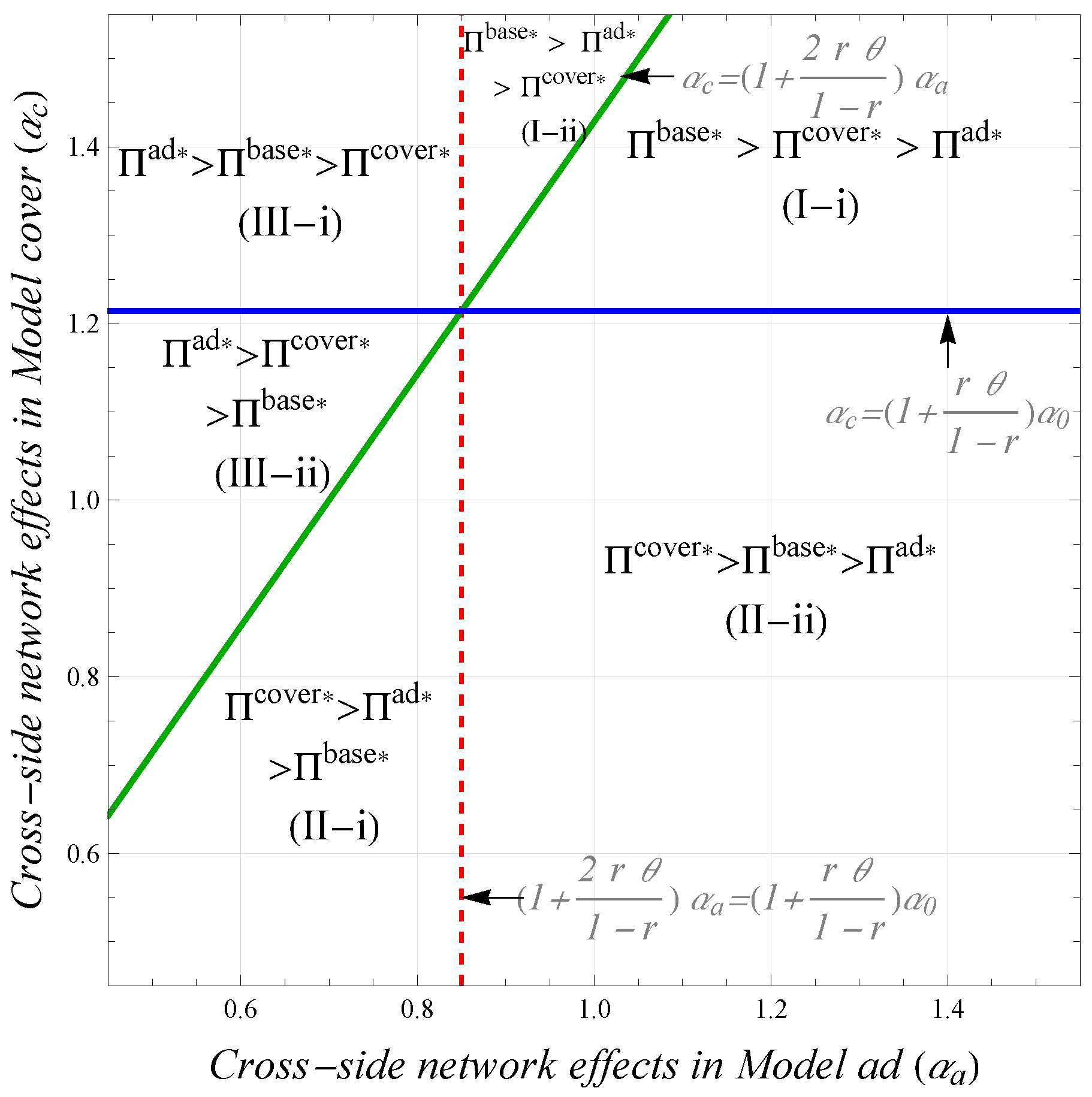
To visualize Proposition 2 more clearly, we show the effect of α c and α a changes on the platform’s optimal strategy in Figure 4. Provided that an equilibrium solution exists, where r = 0.3 , θ = 0.5 , α 0 = 1 .
Consistent with Proposition 2, when 1 + r θ 1 r α 0 < m i n 1 + 2 r θ 1 r α a , α c , the platform derives maximum benefit from providing the base model bullet screen (Region I). When α c < m i n 1 + 2 r θ 1 r α a , 1 + r θ 1 r α 0 , allowing bullet screens to cover ads is the optimal strategy (Region II). When 1 + 2 r θ 1 r α a < m i n α c , 1 + r θ 1 r α 0 , allowing ads in bullet screens is the optimal strategy (Region III).
Proposition 2 reflects that when advertisers in a given model exhibit lower cross-side network effects for consumers, the platform can achieve maximum profits under that model. Lower cross-side network effects α j means consumers can derive higher utility, thereby enhancing the platform’s appeal to consumers. Combined with 2, it can be seen that when cross-side network effects α j are not different, the platform allows bullet screens to cover ads, which is more advantageous than the other two cases. When cross-side network effects exhibit differences, allowing bullet screen cover ads remains advantageous when these differences are relatively minor compared to the other two cases. Only as the differences grow larger do the other two cases potentially gain an advantage.

4.2. Comparative Analysis of Advertiser Surplus

To further analyze the impact of the platform’s bullet screen strategy for advertisers, we compare and analyze the advertiser surplus ( A S ) under the three models, denoted as follows.
A S = 0 β N C p ( β N C p f ) d f
Substituting the equilibrium solutions for the three models separately, the corresponding advertiser surplus can be obtained.
A S b a s e = k 2 ( 1 r ) 4 v 4 β 2 2 ( M 1 ) 2 A S c o v e r = k 2 ( 1 r ) 4 v 4 β 2 2 ( M 2 ) 2 A S a d = k 2 ( 1 r ) 4 v 4 β 2 2 ( M 3 ) 2
Similarly, we consider the case of “ad-fatigued” first. By comparing Equation (22), Proposition 3 can be obtained.
Proposition 3. 
When α 0 = α c = α a , the advertiser residuals in the three scenarios are A S c o v e r > A S b a s e > A S a d .
Proposition 3 reflects that in the case of ad-fatigued, the advertiser’s residual is maximized when the platform allows bullet screens to cover ads, while the minimum is reached when ads are allowed within bullet comments. Combining this with Proposition 1, we can see that although platforms charge higher ad fees when bullet screens are allowed to cover ads, advertisers can still obtain higher residuals from this model because platforms are able to attract the largest number of consumers at this time. Instead, the advertiser’s surplus is the lowest in the model that allows advertisements in bullet screens, and thus, at this point, the platform has the smallest number of consumers, making it difficult for advertisers to reap the benefits of good advertising.
Then we consider the case where cross-side network effects α j differ. Through comparative analysis, we get Proposition 4.
Proposition 4. 
The comparison of advertiser surplus across the three models is as follows:
(a) 
The surplus of advertisers in base mode is maximized:
(i) 
When 1 + 2 r θ 1 r α a > α c > 1 + r θ 1 r α 0 , then A S b a s e > A S c o v e r > A S a d ,
(ii) 
When α c > 1 + 2 r θ 1 r α a > 1 + r θ 1 r α 0 , then A S b a s e > A S a d > A S c o v e r .
(b) 
The surplus of advertisers in cover mode is maximized:
(i) 
When 1 + 2 r θ 1 r α a > 1 + r θ 1 r α 0 > α c , then A S c o v e r > A S b a s e > A S a d ,
(ii) 
When 1 + r θ 1 r α 0 > 1 + 2 r θ 1 r α a > α c , then A S c o v e r > A S a d > A S b a s e .
(c) 
The surplus of advertisers in ad mode is maximized:
(i) 
When α c > 1 + r θ 1 r α 0 > 1 + 2 r θ 1 r α a , then A S a d > A S b a s e > A S c o v e r ,
(ii) 
When 1 + r θ 1 r α 0 > α c > 1 + 2 r θ 1 r α a , then A S a d > A S c o v e r > A S b a s e .
Proposition 4 clearly shows that the conditions for maximizing advertiser surplus are identical to those for maximizing platform profit across all three models. Since platform revenue primarily originates from advertisers, the platform’s attractiveness to advertisers directly impacts its profit level. Therefore, the conditions for maximizing advertiser surplus and maximizing platform profit are consistent.

4.3. Comparative Analysis of Consumer Surplus

Similarly, we obtain the consumer surplus ( C S ) under each of the three models from the equilibrium solution.
C S b a s e = θ α 0 n A r q ( 1 r ) v 1 ( ( 1 r ) λ v + r q α 0 N A ) d λ + 1 θ α 0 N A v 1 ( λ v α 0 N A ) d λ = θ ( 1 r ) v ( M 1 + β ( r 2 β θ k ( 1 r ) v α 0 ) ) 2 2 ( M 1 ) 2 + ( 1 θ ) v ( M 1 k ( 1 r ) 2 v α 0 β ) 2 2 ( M 1 ) 2 C S c o v e r = θ q r α c N A + r α c N A ( 1 + r ) v 1 ( ( 1 r ) ( λ v α c N A ) + r q ) d λ + 1 θ α c N A v 1 ( λ v α c N A ) d λ = θ ( 1 r ) v ( M 2 + β ( r 2 θ β k ( 1 r ) 2 v α c ) ) 2 2 ( M 2 ) 2 + ( 1 θ ) v ( M 2 k ( 1 r ) 2 v α c β ) 2 2 ( M 2 ) 2 C S a d = θ q r α a N A r α a N A ( 1 + r ) v 1 ( ( 1 r ) λ v + r ( q α a N A ) α a N A ) d λ + 1 θ α a N A v 1 ( λ v α a N A ) d λ = θ ( 1 r ) v ( M 3 + β ( r 2 θ β k ( 1 r 2 ) v α a ) ) 2 2 ( M 3 ) 2 + ( 1 θ ) v ( M 3 k ( 1 r ) 2 v α a β ) 2 2 ( M 3 ) 2
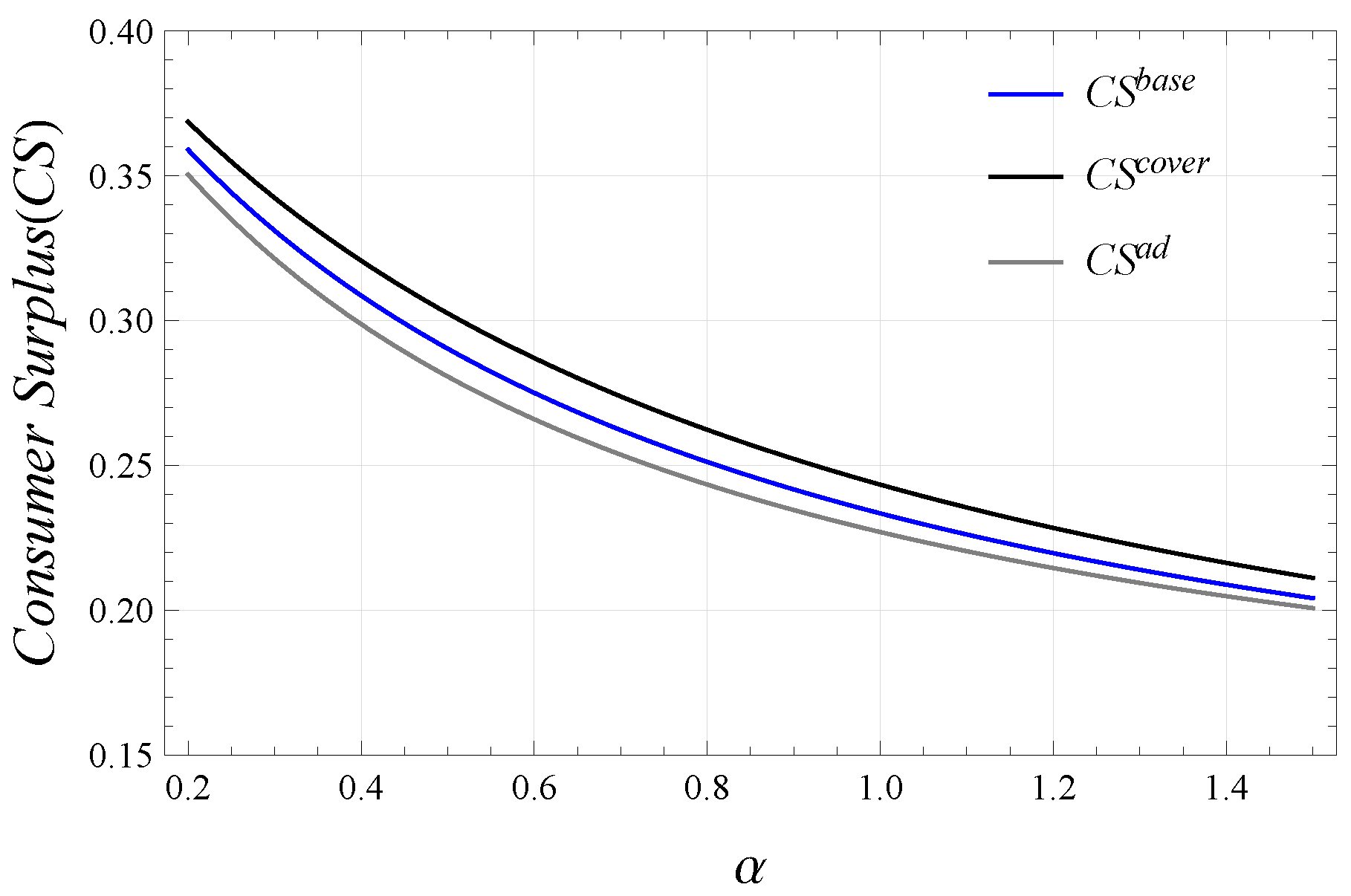
Similarly, we obtain the consumer surplus under three models separately from the equilibrium solution. In order to observe the comparison of consumer surplus more intuitively, we use the form of a simulation. First, in the case of “ad-fatigued”, let v = 1 , k = 1.5 , β = 1 , r = 0.3 , θ = 0.5 , the results are shown in Figure 5. Figure 5 shows that in the case of “ad-fatigued”, consumers always get higher residuals in Model Cover, followed by Model Base, and the lowest residuals in Model Ad. As the cross-side network effects α increase, consumer surplus will decrease under all three modes. Figure 5 reflects that the relationship between consumer surplus, advertiser surplus, and platform profit is consistent across the three modes when ad-fatigued.
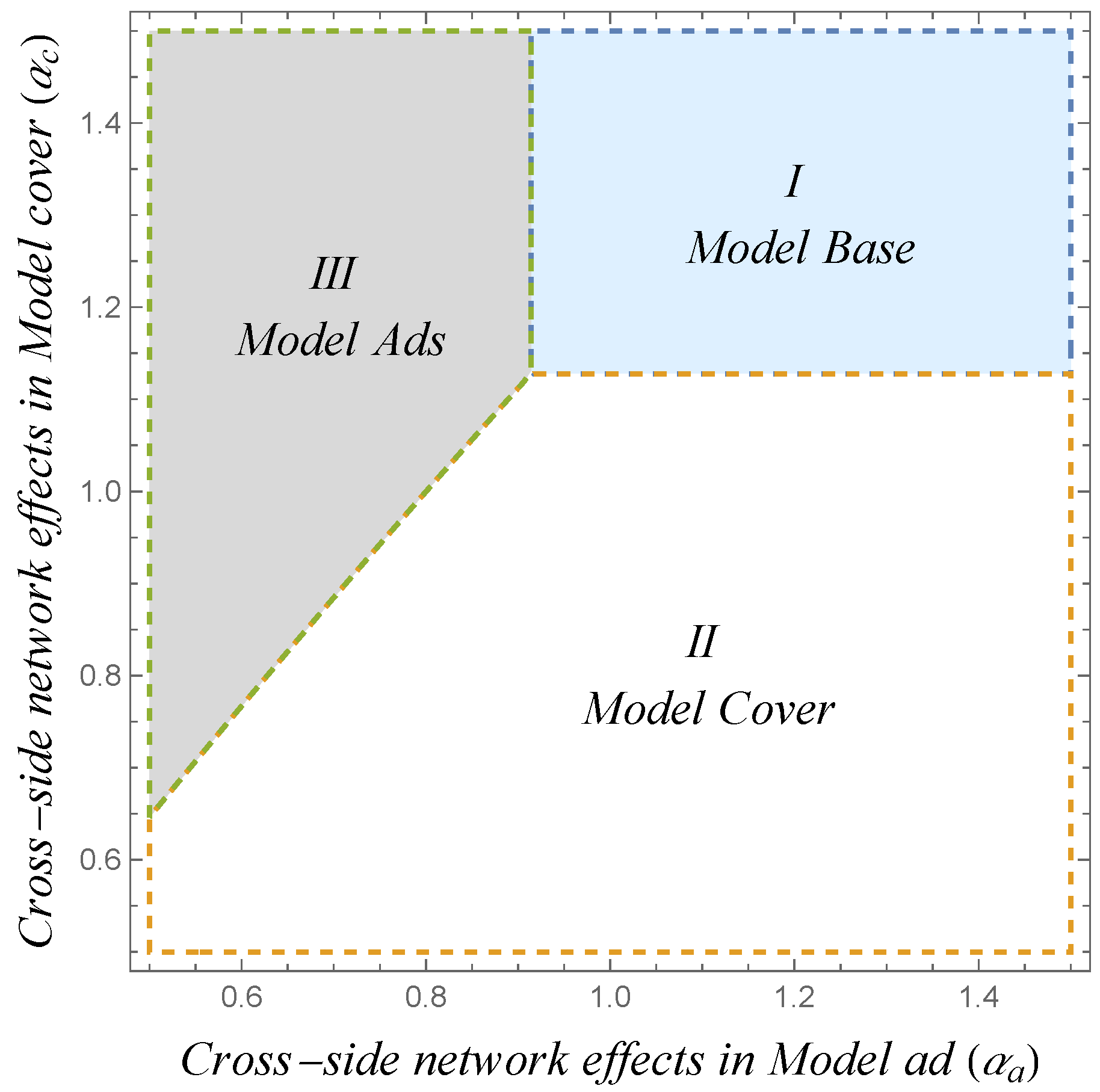
When there are differences in cross-side network effects α j , the model that maximizes consumer surplus is similarly affected by the differences in cross-side network effects α 0 , α c , and α a . Let β = 1 , v = 1 , k = 1.5 , α 0 = 1 , r = 0.3 , θ = 0.5 . As shown in Figure 6, when α a > 0.93 and α c > 1.12 , the advertiser’s surplus is maximized in Model Base. When α c < 1.12 and α c < 0.516 α a + 0.64 , advertiser surplus is maximized in Model Cover. Conversely, when α a < 0.93 and α c > 0.516 α a + 0.64 , advertiser surplus is maximized in model Ads.

5. Concluding Remarks and Managerial Implications

Based on two-sided market theory, we construct a two-sided video platform connecting consumers and advertisers. By portraying the relationship between the two sides through the cross-network effect, we introduce two-sided market theory to the study of video bullet screens. In addition, we consider the different consumer preferences for bullet screens in the market and comparatively analyze the optimal strategies of video platforms under three bullet screen models. Our study provides some new insights into the impact of different bullet screens on video platforms and how platforms should choose the appropriate ones.

5.1. Main Conclusions

We find that as the level of consumer attention to bullet screens or the proportion of bullet screen preference consumers increases, video platforms increase the level of quality of the bullet screens they offer to consumers and ad pricing to advertisers. However, the platform’s profits do not necessarily increase as a result, and are also affected by the bullet screen cost coefficient. We compare the equilibrium strategies of three bullet screen models and find that when consumers in the market are ad-fatigued, platforms maximize their revenue by allowing bullet screens to cover ads. At the same time, the platforms provide consumers with the highest quality bullet screens and charge advertisers the highest ad prices. And when there is a difference in cross-side network effects of consumers to advertisers, the pattern that maximizes the platform’s profit depends on the cross-side network effects of advertisers to consumers. A comparison of advertiser surplus under different models reveals that the model that maximizes advertiser surplus converges with the platform’s optimal strategy. Comparing advertiser surplus across different models reveals that advertiser surplus also achieves maximum returns when bullet screens are allowed to cover ads.

5.2. Managerial Implications

Our findings provide important managerial insights for video platforms (e.g., TikTok, Bilibili, Twitch), in particular, on how platforms should contextualize their choice of appropriate bullet screen models. Specifically, our findings suggest that as consumers become more receptive to bullet screens, platforms need to attract consumers by enhancing their bullet screen services. For example, through some incentives and guidance, users are encouraged to post high-quality bullet screens, and the quality of bullet screens is ensured through enhanced review and screening. However, the type of bullet screen model a platform chooses needs to take into account the consumer acceptance of bullet screens in the marketplace, as well as the effectiveness of advertising under different models. The platform should also monitor the threshold at which consumers become ad-fatigued based on certain advertising performance metrics. When all forms of advertising yield unsatisfactory results, attempting to “lighten the load” for consumers within the platform may be a better option.
Although the revenue source of video platforms mainly comes from advertisers, platforms need to choose their advertising strategies carefully, as consumers are averse to advertisers. This is because excessive advertising burdens may cause consumers to leave, which in turn affects advertisers’ willingness to advertise and reduces the platform’s revenue stream. While the video platforms we are considering provide content free of charge to consumers, maximizing the consumer experience and engaging consumers remains at the core of the video platform’s operations. It is central to the platform’s ability to realize profitable growth.
For advertisers, although bullet screens that cover ads may reduce advertisers’ per-unit advertising effectiveness, advertisers may instead derive higher revenue from this model due to the increased size of the consumers. Therefore, when choosing a platform, advertisers should focus on the platform’s ability to attract consumers in addition to the platform’s advertising effect.
Overall, our study provides some new insights into the impact of different bullet screens on video platforms and how platforms should choose the right one.

5.3. Future Research

Different video platforms adopt varying approaches toward bullet screen comments, exemplified by YouTube and Bilibili. We focus on how consumer preferences and attention allocation influence platform strategies for bullet screen features. However, the reasons behind this impact are likely multifaceted, potentially influenced by cultural differences or platform operational philosophies. We believe future discussions should explore this topic through more diverse perspectives.
There are several potential research directions for future research. First, this paper considers a monopolized video platform and does not consider the market environment under competition. Second, for some large advertisers, they often have the decision-making power over ad prices or ad placement levels, which is another aspect not yet considered in this paper. In subsequent studies, further research can be attempted from the above perspectives. Finally, our current characterization of consumer attention is linear. In future research, we will try to depict consumer attention in a manner more consistent with reality. The dynamic nature of consumer preferences and personalized bullet screens are also factors we consider for the future.

Author Contributions

Conceptualization, X.Z. and L.L.; methodology, X.Z. and L.L.; validation, L.L.; formal analysis, X.Z.; writing—original draft preparation, X.Z.; writing—review and editing, X.Z. and L.L.; supervision, L.L. All authors have read and agreed to the published version of the manuscript.

Funding

This research is supported in part by the National Natural Science Foundation of China (No. 72472136); The Natural Science Foundation of Jiangsu Province (No. BK20240897); The MOE (Ministry of Education in China) Project of Humanities and Social Sciences (24YJC630068).

Institutional Review Board Statement

Not applicable.

Informed Consent Statement

Not applicable.

Data Availability Statement

No new data were created or analyzed in this study. Data sharing is not applicable to this article.

Conflicts of Interest

We declare that we have no financial and personal relationships with other people or organizations that can inappropriately influence our work; there is no professional or other personal interest of any nature or kind in any product, service, and/or company that could be construed as influencing the position presented in, or the review of, the manuscript entitled.

Appendix A. Proofs of Lemmas and Corollaries

Appendix A.1. Proof of Lemma 1

Find the first-order derivatives with respect to q and p for Equation (8), respectively.
Π q = k q + p r β θ v r v + α 0 β ( 1 r ( 1 θ ) ) Π p = 2 p 1 r v ( 1 r ) v β q r β θ ( 1 + r ) ( v + α 0 β ) r α 0 β θ
The concavity of the multivariate nonlinear programming is determined by the Hessian matrix, and further second-order derivatives of q and p are obtained as follows:
H 1 = k r β θ v 1 r + α 0 β ( 1 r ( 1 θ ) ) r β θ v 1 r + α 0 β ( 1 r ( 1 θ ) ) 2 ( 1 r ) v 1 r v + α 0 β + r α 0 β θ
It can be shown that the first-order sequential principal subequation of H 1 is k < 0 , and the second-order sequential principal subequation is H 1 = 2 k ( 1 r ) v ( 1 r v + α 0 β + r α 0 β θ ) r 2 β 2 θ 2 ( 1 r v + α 0 β + r α 0 β θ ) 2 . It is easy to know that the condition to satisfy the Hessian matrix negative definite is H 1 > 0 , that is, when 2 k ( 1 r ) v ( 1 r v + α 0 β + r α 0 β θ ) r 2 β 2 θ 2 > 0 , the Hessian matrix H 1 is negatively determined, at which point the nonlinear programming has optimal solutions. Let the first-order derivative be 0, the joint solution yields the optimal level of bullet screen quality and advertisement price of the platform, which further yields the optimal market size and profit level of the platform.

Appendix A.2. Proof of Collary 1

  • Based on the results in Lemma 1, for the effect of r on the platform’s equilibrium strategy, we can derive that q b a s e r = v β 2 θ ( 2 k ( 1 r ) 2 v ( v + α 0 β ) + r 2 β 2 θ 2 ) ( M 1 ) 2 > 0 . p b a s e r = k r v β 3 θ 2 ( 2 ( 1 r ) ( v + α 0 β ) + r α 0 β θ ) ( M 1 ) 2 > 0 . N C b a s e r = k v β θ ( r β θ ( 4 ( 1 r ) v + α 0 β ( 2 r ( 2 θ ) ) ) 2 k 1 r 2 v 2 α 0 ) ( M 1 ) 2 , When k < r θ β ( 4 ( 1 r ) v + α 0 ( 2 ( 1 r ) + r θ ) β ) 2 ( 1 r ) 2 v 2 α 0 = k 1 b a s e , N C b a s e r > 0 , and vice versa, N C b a s e r < 0 . N A b a s e r = 2 k ( 1 r ) v 2 β 2 θ ( r β θ k 1 r v α 0 ) ( M 1 ) 2 , Π b a s e r = k ( 1 r ) v 2 β 3 θ ( r β θ k 1 r v α 0 ) ( M 1 ) 2 . When k < r β θ α 0 v ( 1 r ) = k 2 b a s e , N A b a s e r > 0 , Π b a s e r > 0 , and when k > k 2 b a s e then the reverse is true.
  • Based on the results in Lemma 1, for the effect of θ on the platform’s equilibrium strategy, we can derive that q b a s e θ = ( 1 r ) r v ( 2 k ( 1 r ) 2 v β 2 ( v + α 0 β ) + r 2 β 4 θ 2 ) ( M 1 ) 2 > 0 . p b a s e θ = k ( 1 r ) r 2 v β 3 θ ( 2 1 r v + α 0 β + r α 0 β θ ) ( M 1 ) 2 > 0 . N C b a s e θ = k ( 1 r ) r v β ( r β 0 θ ( 4 ( 1 r ) v + α 0 β ( 2 r ( 2 θ ) ) ) 2 k 1 r 2 v 2 α 0 ) ( M 1 ) 2 , When k < k 1 b a s e , N C b a s e θ > 0 , and vice versa, N C b a s e θ < 0 . N A b a s e θ = 2 k 1 r 2 r v 2 β 2 ( r β θ k 1 r v α 0 ) ( M 1 ) 2 . Π b a s e θ = k 1 r 2 r v 2 β 3 ( r β 0 θ k 1 r v α 0 ) ( 2 k ( 1 + r ) v ( v r v + α 0 β ( 1 + r ( 1 + θ ) ) ) + r 2 β 2 θ 2 ) 2 . When k < k 2 b a s e , N A b a s e θ > 0 , Π b a s e θ > 0 , and when k > k 2 b a s e then the reverse is true.
  • From k 1 b a s e = r θ β ( 4 ( 1 r ) v + α 0 ( 2 ( 1 r ) + r θ ) β ) 2 ( 1 r ) 2 v 2 α 0 , we know that k 1 b a s e > r θ β ( 4 ( 1 r ) v ) 2 ( 1 r ) 2 v 2 α 0 , and r θ β ( 4 ( 1 r ) v ) 2 ( 1 r ) 2 v 2 α 0 k 2 b a s e = 2 r β θ α 0 v 1 r > 0 , therefore k 1 b a s e > k 2 b a s e .

Appendix A.3. Proof of Lemma 2

Find the first-order derivatives with respect to q and p for Equation (14), respectively.
Π q = k q p r θ β ( 1 + r ) ( v + α c β ) Π p = 2 p ( 1 + r ) v + ( ( 1 + r ) v q r θ ) β ( 1 + r ) ( v + α c β )
The concavity of the multivariate nonlinear programming is determined by the Hessian matrix, and further second-order derivatives of q and p are obtained as follows:
H 2 = k r θ β ( 1 r ) ( v + α c β ) r θ β ( 1 r ) ( v + α c β ) 2 v v + α c β
It can be shown that the first-order sequential principal subequation of H 2 is k < 0 , and the second-order sequential principal subequation is H 2 = 2 k ( 1 r ) 2 v ( v + α c β ) r 2 θ 2 β 2 ( 1 r ) 2 ( v + α c β ) 2 . It is easy to know that the condition to satisfy the Hessian matrix negative definite is H 2 > 0 , that is, when 2 k ( 1 r ) 2 v ( v + α c β ) r 2 θ 2 β 2 > 0 , the Hessian matrix H 2 is negatively determined, at which point the nonlinear programming has optimal solutions. Let the first-order derivative be 0, the joint solution yields the optimal level of bullet screen quality and advertisement price of the platform, which further yields the optimal market size and profit level of the platform.

Appendix A.4. Proof of Collary 2

  • Based on the results in Lemma 2, for the effect of r on the platform’s equilibrium strategy, we can derive that q c o v e r r = v θ β 2 ( 2 k ( 1 r ) 2 v 2 + 2 k ( 1 r ) 2 v α c β + r 2 θ 2 β 2 ) ( M 2 ) 2 > 0 , p c o v e r r = 2 k ( 1 r ) r v θ 2 β 3 ( v + α c β ) ( M 2 ) 2 > 0 , N C c o v e r r = 2 k ( 1 r ) r v θ 2 β 2 ( 2 v + α c β ) ( M 2 ) 2 > 0 , N A c o v e r r = 2 k ( 1 r ) r v 2 θ 2 β 3 ( M 2 ) 2 > 0 , Π c o v e r r = k ( 1 r ) r v 2 θ 2 β 4 ( M 2 ) 2 > 0 .
  • Based on the results in Lemma 2, for the effect of θ on the platform’s equilibrium strategy, we can derive that q c o v e r θ = ( 1 r ) r v β 2 ( 2 k ( 1 r ) 2 v 2 + 2 k ( 1 r ) 2 v α c β + r 2 θ 2 β 2 ) ( M 2 ) 2 > 0 , p c o v e r θ = 2 k ( 1 r ) 2 r 2 v θ β 3 ( v + α c β ) ( M 2 ) 2 > 0 , N C c o v e r θ = 2 k ( 1 r ) 2 r 2 v θ β 2 ( 2 v + α c β ) ( M 2 ) 2 > 0 , N A c o v e r θ = 2 k ( 1 r ) 2 r 2 v 2 θ β 3 ( M 2 ) 2 > 0 , Π c o v e r θ = k ( 1 r ) 2 r 2 v 2 θ β 4 ( M 2 ) 2 > 0 .

Appendix A.5. Proof of Lemma 3

Find the first-order derivatives with respect to q and p for Equation (20), respectively.
Π q = k q + p r θ β v r v + α a ( 1 r + 2 r θ ) β Π p = 2 p ( 1 + r ) v + ( ( 1 + r ) v q r θ ) β ( 1 + r ) v + α a ( 1 + r 2 r θ ) β
The concavity of the multivariate nonlinear programming is determined by the Hessian matrix, and further second-order derivatives of q and p are obtained as follows:
H 3 = k r θ β 1 r v + α a β + 2 r θ α a β r θ β 1 r v + α a β + 2 r θ α a β 2 ( 1 r ) v 1 r v + α a β + 2 r θ α a β
It can be shown that the first-order sequential principal subequation of H 3 is k < 0 , and the second-order sequential principal subequation is H 3 = 2 k ( 1 r ) v ( 1 r v + α a β + 2 r θ α a β ) r 2 θ 2 β 2 ( 1 r v + α a β + 2 r θ α a β ) 2 . It is easy to know that the condition to satisfy the Hessian matrix negative definite is 2 k ( 1 r ) v ( 1 r v + α a β + 2 r θ α a β ) r 2 θ 2 β 2 > 0 , the Hessian matrix H 3 is negatively determined, at which point the nonlinear programming has optimal solutions. Let the first-order derivative be 0, the joint solution yields the optimal level of bullet screen quality and advertisement price of the platform, which further yields the optimal market size and profit level of the platform.

Appendix A.6. Proof of Collary 3

  • Based on the results in Lemma 3, for the effect of r on the platform’s equilibrium strategy, we can derive that q a d r = v θ β 2 ( 2 k ( 1 r ) 2 v 2 + 2 k ( 1 r ) 2 v α a β + r 2 θ 2 β 2 ) ( M 3 ) 2 > 0 . p a d r = 2 k r v θ 2 β 3 ( v ( 1 r ) + α a ( 1 r ( 1 θ ) ) β ) ( M 3 ) 2 > 0 . N C a d r = 2 k v θ β ( r θ β ( 2 ( 1 r ) v + α a ( 1 r ( 1 θ ) ) β ) 2 k 1 r 2 v 2 α a ) ( M 3 ) 2 , when k < r θ β ( 2 ( 1 r ) v + α a ( 1 r ( 1 θ ) ) β ) 2 ( 1 r ) 2 v 2 α a = k 1 a d , N C a d r > 0 . N A a d r = 2 k ( 1 r ) v 2 θ β 2 ( r θ β 2 k ( 1 r ) v α a ) ( M 3 ) 2 , Π a d r = k ( 1 r ) v 2 θ β 3 ( r θ β 2 k ( 1 r ) v α a ) ( M 3 ) 2 , when k < r θ β 2 α a v 1 r = k 2 a d , N A a d r > 0 , Π a d r > 0 .
  • Based on the results in Lemma 3, for the effect of θ on the platform’s equilibrium strategy, we can derive that q a d θ = ( 1 r ) r v β 2 ( 2 k ( 1 r ) 2 v 2 + 2 k ( 1 r ) 2 v α a β + r 2 θ 2 β 2 ) ( M 3 ) 2 > 0 . p a d θ = 2 k ( 1 r ) r 2 v θ β 3 ( v ( 1 r ) + α a ( 1 r ( 1 θ ) ) β ) ( M 3 ) 2 > 0 . N C a d θ = 2 k r v β ( 1 r ) ( r θ β ( 2 ( 1 r ) v + α a ( 1 r ( 1 θ ) ) β ) 2 k 1 r 2 v 2 α a ) ( M 3 ) 2 , when k < k 1 a d , N C a d θ > 0 . N A a d θ = 2 k 1 r 2 r v 2 β 2 ( r θ β 2 k ( 1 r ) v α a ) ( M 3 ) 2 , Π a d θ = k ( 1 r ) 2 r v 2 β 3 ( r θ β 2 k ( 1 r ) v α a ) ( M 3 ) 2 , when k < k 2 a d , N A a d θ > 0 , Π a d θ > 0 .
  • From k 1 a d , we know that k 1 a d > r θ β ( 2 ( 1 r ) v ) 2 ( 1 r ) 2 v 2 α a , and r θ β ( 2 ( 1 r ) v ) 2 ( 1 r ) 2 v 2 α a k 2 a d = r θ β 2 v α a ( 1 r ) > 0 , therefore k 1 a d > k 2 a d .

Appendix B. Proofs of Propositions

Appendix B.1. Proof of Proposition 1

From q c o v e r q b a s e = 2 k ( 1 r ) 2 r 2 v 2 α β 3 θ 2 M 1 M 2 > 0 , q b a s e q a d = 2 k 1 r 2 r 2 v 2 α β 3 θ 2 M 1 M 3 > 0 , it can be determined that q c o v e r > q b a s e > q a d .
From p c o v e r p b a s e = k 1 r r 3 v α β 4 θ 3 M 1 M 2 > 0 , p b a s e p a d = k 1 r r 3 v α β 4 θ 3 M 1 M 3 > 0 , it can be determined that p c o v e r > p b a s e > p a d .
From N C c o v e r N C b a s e = k 1 r r v α β θ 2 k 1 r 2 v 2 + r 2 β 2 θ 2 M 1 M 2 > 0 , N C b a s e N C a d = k ( 1 r ) r v α β θ ( 2 k 1 r 2 v 2 + r 2 β 2 θ 2 ) M 1 M 3 > 0 , it can be determined that N C c o v e r > N C b a s e > N C a d .
From N A c o v e r N A b a s e = 2 k 2 ( 1 r ) 3 r v 3 α β 2 θ M 1 M 2 > 0 , N A b a s e N A a d = 2 k 2 ( 1 r ) 3 r v 3 α β 2 θ M 1 M 3 > 0 , it can be determined that N A c o v e r > N A b a s e > N A a d .
From Π c o v e r Π b a s e = k 2 ( 1 r ) 3 r v 3 α β 3 θ M 1 M 2 > 0 , Π b a s e Π a d = k 2 ( 1 r ) 3 r v 3 α β 3 θ M 1 M 3 > 0 , it can be determined that Π c o v e r > Π b a s e > Π a d .

Appendix B.2. Proof of Proposition 2

From Π b a s e Π c o v e r = k ( 1 r ) 2 v 2 β 2 4 k ( 1 r ) v β ( α 0 + r α 0 ( 1 θ ) + ( 1 r ) α c M 1 M 2 , we can determine that when α c > 1 + r θ 1 r α 0 , there is Π b a s e > Π c o v e r . Conversely when α c < 1 + r θ 1 r α 0 there is Π b a s e < Π c o v e r .
From Π b a s e Π a d = k ( 1 r ) 2 v 2 β 2 4 k ( 1 r ) v β ( α 0 + r α 0 ( 1 θ ) + ( 1 r + 2 r θ ) α a M 1 M 3 , we can determine that when 1 + 2 r θ 1 r α a > 1 + r θ 1 r α 0 , there is Π b a s e > Π a d .
From Π c o v e r Π a d = k ( 1 r ) 2 v 2 β 2 4 k ( 1 r ) v β ( ( 1 r + 2 r θ ) α a ( 1 r ) α c M 2 M 3 , we can determine that when Π c o v e r > Π a d , there is 1 + 2 r θ 1 r α a > α c .
Based on the above conditions, we can conclude Proposition 2.

Appendix B.3. Proof of Proposition 3

When α 0 = α c = α a , there are M 1 M 2 = 2 k 1 r r v α β θ > 0 and M 3 M 1 = 2 k 1 r r v α β θ > 0 , so M 3 > M 1 > M 2 . Can obtain A S c o v e r > A S b a s e > A S a d .

Appendix B.4. Proof of Proposition 4

From M 1 M 2 = 2 k 1 r v β 1 r 1 θ α 0 1 r α c , we can determine that when 1 + r θ 1 r α 0 > α c , there is M 1 M 2 > 0 , then A S b a s e < A S c o v e r . Conversely when α c > 1 + r θ 1 r α 0 there is A S b a s e > A S c o v e r .
From M 1 M 3 = 2 k ( 1 r ) v β ( ( 1 r ( 1 θ ) ) α 0 ( 1 r + 2 r θ ) α a ) , we can determine that when 1 + r θ 1 r α 0 > 1 + 2 r θ 1 r α a , there is M 1 M 3 > 0 , then A S b a s e < A S a d . Conversely there is A S b a s e > A S a d .
From M 2 M 3 = 2 k ( 1 r ) v β ( ( 1 + r ( 1 + 2 θ ) ) α a ( 1 r ) α c ) , we can determine that when 1 + 2 r θ 1 r α a > α c , there is M 2 M 3 > 0 , then A S c o v e r < A S a d . Conversely there is A S c o v e r > A S a d .
Based on the above conditions, we can conclude Proposition 4.

References

  1. Li, Y.; Guo, Y. Virtual gifting and danmaku: What motivates people to interact in game live streaming? Telemat. Inform. 2021, 62, 101624. [Google Scholar] [CrossRef]
  2. Chen, Y.; Gao, Q.; Rau, P.L.P. Watching a movie alone yet together: Understanding reasons for watching Danmaku videos. Int. J.-Hum.-Comput. Interact. 2017, 33, 731–743. [Google Scholar] [CrossRef]
  3. Yuan, H.; Lu, K.; Ausaf, A.; Zhu, M. Constant or inconstant? The time-varying effect of danmaku on user engagement in online video platforms. Internet Res. 2025, 35, 771–797. [Google Scholar] [CrossRef]
  4. Zhao, J.; Zhou, J.; Wu, P.; Liang, K. Boosting e-commerce sales with live streaming: The power of barrages. Electron. Commer. Res. 2024. [Google Scholar] [CrossRef]
  5. Wan, A.; Moscowitz, L.; Wu, L. Online social viewing: Cross-cultural adoption and uses of bullet-screen videos. J. Int. Intercult. Comm. 2020, 13, 197–215. [Google Scholar] [CrossRef]
  6. Yang, T.; Yang, F.; Men, J. The impact of Danmu technological features on consumer loyalty intention toward recommendation vlogs: A perspective from social presence and immersion. Inform. Technol. People 2022, 35, 1193–1218. [Google Scholar] [CrossRef]
  7. Shang, S.; Wu, J.; Qu, H.; Zeng, Q. Danmaku in the serious live streaming context: The mediating roles of self-determination and cognitive load. Inf. Technol. Manag. 2025, 26, 593–608. [Google Scholar] [CrossRef]
  8. Zhu, X.; Li, L.; Li, J. To offer or not to offer? Bullet screen strategies for competing video platforms with vertical differentiation. J. Retail. Consum. Serv. 2025, 82, 104083. [Google Scholar] [CrossRef]
  9. Wu, Q.; Sang, Y.; Huang, Y. Danmaku: A new paradigm of social interaction via online videos. ACM Trans. Soc. Comput. 2019, 2, 1–24. [Google Scholar] [CrossRef]
  10. Lin, X.; Huang, M.; Cordie, L. An exploratory study: Using Danmaku in online video-based lectures. Educ. Media Int. 2018, 55, 273–286. [Google Scholar] [CrossRef]
  11. Zhang, Y.; Qian, A.; Pi, Z.; Yang, J. Danmaku related to video content facilitates learning. J. Educ. Technol. Syst. 2019, 47, 359–372. [Google Scholar] [CrossRef]
  12. Wang, K.; Pan, Z.; Lu, Y.; Gupta, S. What motives users to participate in danmu on live streaming platforms? The impact of technical environment and effectance. Data Inf. Manag. 2019, 3, 117–134. [Google Scholar] [CrossRef]
  13. Wei, L.; Sun, T.; Liu, B. Exploring the effect of incorporating danmaku into advertising. J. Interact. Advert. 2020, 20, 31–46. [Google Scholar] [CrossRef]
  14. Li, Z.; Duan, S.; Li, R. Dynamic advertising insertion strategy with moment-to-moment data using sentiment analysis: The case of danmaku video. J. Electron. Commer. Res. 2022, 23, 160–176. [Google Scholar]
  15. Kanfer, R.; Ackerman, P. Motivation and cognitive abilities: An integrative/aptitude-treatment interaction approach to skill acquisition. J. Appl. Psychol. 1989, 74, 657–690. [Google Scholar] [CrossRef]
  16. Hayashi, Y.; Cothron, S.; Toyama, M. Role of delay discounting in resisting in-class media multitasking under contextual control: A cluster analysis. Behav. Inform. Technol. 2024, 43, 4246–4256. [Google Scholar] [CrossRef]
  17. Kwark, Y.; Chen, J.; Raghunathan, S. User-generated content and competing firms’ product design. Manag. Sci. 2018, 64, 4608–4628. [Google Scholar] [CrossRef]
  18. Amaldoss, W.; Du, J.; Shin, W. Media platforms’ content provision strategies and sources of profits. Market. Sci. 2021, 40, 527–547. [Google Scholar] [CrossRef]
  19. Anderson, S.; Coate, S. Market provision of broadcasting: A welfare analysis. Rev. Econ. Stud. 2005, 72, 947–972. [Google Scholar] [CrossRef]
  20. Wilbur, K. A two-sided, empirical model of television advertising and viewing markets. Market. Sci. 2008, 27, 356–378. [Google Scholar] [CrossRef]
  21. Crampes, C.; Haritchabalet, C.; Jullien, B. Advertising, competition and entry in media industries. J. Ind. Econ. 2009, 57, 7–31. [Google Scholar] [CrossRef]
  22. Reisinger, M. Platform competition for advertisers and users in media markets. Int. J. Ind. Organ. 2012, 30, 243–252. [Google Scholar] [CrossRef]
  23. Shi, Z.; Zhang, K.; Srinivasan, K. Freemium as an optimal strategy for market dominant firms. Market. Sci. 2019, 38, 150–169. [Google Scholar] [CrossRef]
  24. Rochet, J.C.; Tirole, J. Cooperation among competitors: Some economics of payment card associations. Rand J. Econ. 2002, 33, 549–570. [Google Scholar] [CrossRef]
  25. Rochet, J.C.; Tirole, J. Platform competition in two-sided markets. J. Eur. Econ. Assoc. 2003, 1, 990–1029. [Google Scholar] [CrossRef]
  26. Armstrong, M. Competition in two-sided markets. Rand J. Econ. 2006, 37, 668–691. [Google Scholar] [CrossRef]
  27. Jeon, D.S.; Rochet, J.C. The pricing of academic journals: A two-sided market perspective. Am. Econ. J. Microeconomics 2010, 2, 222–255. [Google Scholar] [CrossRef]
  28. Bakos, Y.; Katsamakas, E. Design and ownership of two-sided networks: Implications for Internet platforms. J. Manag. Inf. Syst. 2008, 25, 171–202. [Google Scholar] [CrossRef]
  29. Economides, N.; Tåg, J. Network neutrality on the Internet: A two-sided market analysis. Inf. Econ. Policy 2012, 24, 91–104. [Google Scholar] [CrossRef]
  30. Peitz, M.; Valletti, T. Content and advertising in the media: Pay-TV versus free-to-air. Int. J. Ind. Organ. 2008, 26, 949–965. [Google Scholar] [CrossRef]
  31. Evans, D.S. Some empirical aspects of multi-sided platform industries. Rev. Netw. Econ. 2003, 2, 192–209. [Google Scholar] [CrossRef]
  32. Parker, G.G.; Van Alstyne, M.W. Two-sided network effects: A theory of information product design. Manag. Sci. 2005, 51, 1494–1504. [Google Scholar] [CrossRef]
  33. Cao, K.; Xu, X.; Bian, Y.; Sun, Y. Optimal trade-in strategy of business-to-consumer platform with dual-format retailing model. Omega 2019, 82, 181–192. [Google Scholar] [CrossRef]
  34. Jung, D.; Kim, B.C.; Park, M.; Straub, D.W. Innovation and policy support for two-sided market platforms: Can government policy makers and executives optimize both societal value and profits? Inf. Syst. Res. 2019, 30, 1037–1050. [Google Scholar] [CrossRef]
  35. Lin, X.; Zhou, Y.W.; Xie, W.; Zhong, Y.; Cao, B. Pricing and product-bundling strategies for e-commerce platforms with competition. Eur. J. Oper. Res. 2020, 283, 1026–1039. [Google Scholar] [CrossRef]
  36. Zhou, P.; Xu, T.; Yin, Z.; Liu, D.; Chen, E.; Lv, G.; Li, C. Character-oriented video summarization with visual and textual cues. IEEE Trans. Multimed. 2019, 22, 2684–2697. [Google Scholar] [CrossRef]
  37. Zeng, Q.; Guo, Q.; Zhuang, W.; Zhang, Y.; Fan, W. Do real-time reviews matter? Examining how bullet screen influences consumers’ purchase intention in live streaming commerce. Inform. Syst. Front. 2023, 25, 2051–2067. [Google Scholar] [CrossRef]
  38. Carroni, E.; Madio, L.; Shekhar, S. Superstar exclusivity in two-sided markets. Manag. Sci. 2024, 70, 991–1011. [Google Scholar] [CrossRef]
Figure 1. Bullet screens in the video.
Jtaer 20 00338 g001
Figure 2. Different modes of bullet screens.
Jtaer 20 00338 g002
Figure 3. The relationship between the participants.
Jtaer 20 00338 g003
Figure 4. Comparison of platform profits in three models with different cross-side network effects.
Jtaer 20 00338 g004
Figure 5. Effects of α on C S in the case of Ad-Fatigued.
Jtaer 20 00338 g005
Figure 6. Comparison of CS in three models with different cross-side network effects.
Jtaer 20 00338 g006
Table 1. Relevant literature and the contribution.
LiteratureBullet ScreenPricingTwo-Sided MarketsMain Studies
Wan et al. [5]××Bullet screen effects on attention span
Li et al. [14]×Bullet screens’ impact on ad revenues
Amaldoss et al. [18]×Comparison of three pricing models
Crampes et al. [21]××Advertising in media platforms
Zhou et al. [36]××Character-oriented video summarization
Zeng et al. [37]×Bullet screen’s influence
Carroni et al. [38]×Exclusivity in two-sided markets
Present studyCompetitive bullet screen strategies
Table 2. Notations of parameters and variables.
SymbolDescription
α j Cross-side network effects from advertisers to consumers, j { 0 , c , a }
β Cross-side network effects from consumers to advertisers
rConsumer attention on bullet screen, r [ ε , 1 ε ] , where ε ( 0 , 1 2 )
θ Proportion of consumers who prefer bullet screen, θ ( 0 , 1 )
vBase quality for consumer gets from video content
N C Consumer size, N C = N P C + N R C
N P C Number of consumers with bullet screen preferences
N R C Number of consumers resistant to bullet screens
N A Size of advertisers
λ Consumer perceived value factor, λ ( 0 , 1 )
fCost of advertisers’ preferences, f ( 0 , 1 )
kPlatform’s bullet screen cost factor
Decision variablesDescription
pAdvertising price of platform
qQuality of the bullet screens of the platform
Table 3. The effect of r and θ on platform equilibrium strategies.
Condition q b a s e r , q b a s e θ p b a s e r , p b a s e θ N C b a s e r , N C b a s e θ N A b a s e r , N A b a s e θ Π b a s e r , Π b a s e θ
k < k 2 b a s e
k 2 b a s e < k < k 1 b a s e
k 1 b a s e < k
Disclaimer/Publisher’s Note: The statements, opinions and data contained in all publications are solely those of the individual author(s) and contributor(s) and not of MDPI and/or the editor(s). MDPI and/or the editor(s) disclaim responsibility for any injury to people or property resulting from any ideas, methods, instructions or products referred to in the content.