
Some Biomechanical and Anthropmetric Differences Between Elite Swimmers with Down Syndrome and Intellectual Disabilities

 ,
,  ,
,  , and
, and 
Abstract
1. Introduction
2. Materials and Methods
2.1. Participants
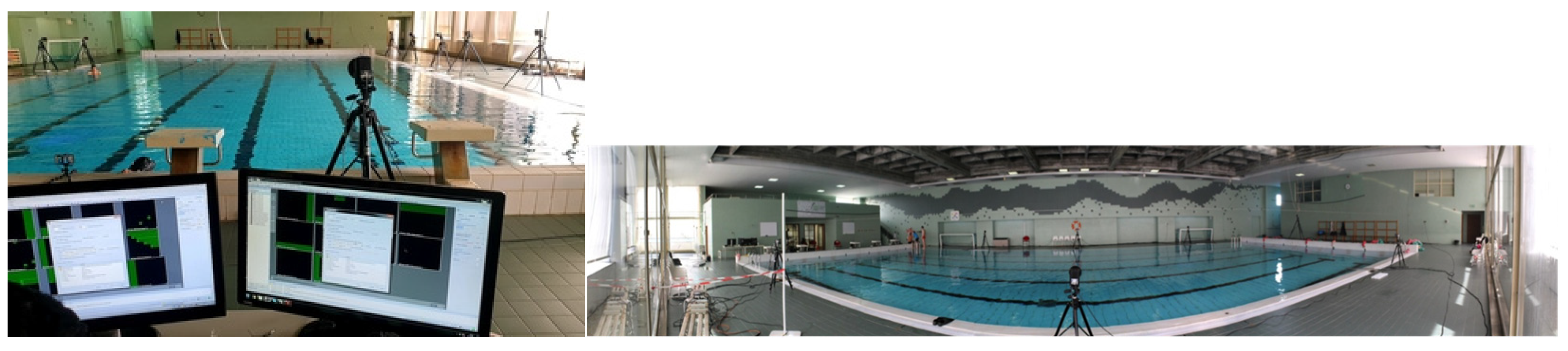
2.2. Experimental Procedure
2.3. Statistical Analysis
3. Results
4. Discussion
5. Conclusions
Author Contributions
Funding
Institutional Review Board Statement
Informed Consent Statement
Data Availability Statement
Conflicts of Interest
Abbreviations
| BMI | Body Mass Index |
| IPC | International Paralympic Committee |
| V | Velocity |
| SR | Stroke Rate |
| SL | Stroke Length |
| IdC | Index of Coordination |
| IVV | Intracyclic Velocity Variation |
| PBF | Body Fat Percentage |
| WHR | Waist–Hip Ratio |
References
- Burns, J. The impact of intellectual disabilities on elite sports performance. Int. Rev. Sport. Excer Psy 2015, 8, 251–267. [Google Scholar] [CrossRef]
- Tweedy, S.M.; Vanlandewijck, Y.C. International Paralympic Committee position stand-background and scientific principles of classification in Paralympic sport. Br. J. Sports Med. 2011, 45, 259–269. [Google Scholar] [CrossRef]
- Antonarakis, S.E.; Lyle, R.; Dermitzakis, E.T.; Reymond, A.; Deutsch, S. Chromossome 21 and Down syndrome: From genomics to pathophysiology. Nat. Rev. Genet. 2004, 5, 725–738. [Google Scholar] [CrossRef]
- González-Agüero, A.; Vicente-Rodríguez, G.; Moreno, L.A.; Guerra-Balic, M.; Ara, I.; Casajús, J.A. Health-related physical fitness in children and adolescents with Down syndrome and response to training. Scan. J. Med. Sci. Sports 2010, 20, 716–724. [Google Scholar] [CrossRef] [PubMed]
- Henderson, A.; Lynch, S.A.; Wilkinson, S.; Hunter, M. Adults with Down’s syndrome: The prevalence of complications and health care in the community. Br. J. Gen. Pract. 2007, 57, 50–55. [Google Scholar] [PubMed]
- Asim, A.; Kumar, A.; Muthuswamy, S.; Jain, S.; Agarwal, S. Down syndrome: Ain insight of the disease. J. Biomed. Sci. 2015, 22, 41. [Google Scholar] [CrossRef]
- De Graaf, G.; Buckley, F.; Skotko, B.G. Estimation of the number of people with Down syndrome in Europe. Eur. J. Hum. Genet. 2021, 29, 402–410. [Google Scholar] [CrossRef]
- Kyriakidou, G.; Tsalis, G.; Evaggelinou, C. Impact of a Three-Month Training Break on Swimming Performance in Athletes with Intellectual Disability. Sports 2024, 12, 330. [Google Scholar] [CrossRef]
- Giagazoglou, P.; Arabatzi, F.; Dipla, K.; Liga, M.; Kellis, E. Effect of a hippotherapy intervention program on static balance and strength in adolescents with intellectual disabilities. Res. Dev. Disabil. 2012, 33, 2265–2270. [Google Scholar] [CrossRef] [PubMed]
- Fragala-Pinkham, M.A.; Haley, S.M.; O’Neil, M.E. Group aquatic aerobic exercise for children with disabilities. Dev. Med. Child. Neurol. 2008, 50, 822–827. [Google Scholar] [CrossRef]
- Yilmaz, I.; Ergu, N.; Konukman, F.; Agbuga, B.; Zorba, E.; Cimen, Z. The effects of water exercises and swimming on physical fitness of children with mental retardation. J. Hum. Kinet. 2009, 21, 105–111. [Google Scholar] [CrossRef]
- González-Ravé, J.M.; Turner, A.P.; Phillips, S.M. Adaptations to swimming training in athletes with Down’s syndrome. Int. J. Environ. Res. Public. Health 2020, 17, 9175. [Google Scholar] [CrossRef] [PubMed]
- Querido, A.; Costa, M.J.; Araújo, D.; Sampaio, A.R.; Vilas-Boas, J.P.; Corredeira, R.; Daly, D.J.; Fernandes, R.J. Swimmers with Down syndrome are healthier and physically fit than their intrained peers. Healthcare 2023, 11, 482. [Google Scholar] [CrossRef]
- Van de Vliet, P.; Rintala, P.; Fröjd, K.; Verellen, J.; Van Houtte, S.; Daly, D.J.; Vanlandewijck, Y.C. Physical fitness profile of elite athletes with intellectual disability. Scand. J. Med. Sci. Sports 2006, 16, 417–425. [Google Scholar] [CrossRef]
- Marques-Aleixo, I.; Querido, A.; Figueiredo, P.; Vilas-Boas, J.P.; Corredeira, R.; Daly, D.; Fernandes, R.J. Intracyclic velocity variation and arm coordination assessment in swimmers with Down syndrome. Adapt. Phys. Active Q. 2013, 30, 70–84. [Google Scholar] [CrossRef]
- Angelopoulou, N.; Matziari, C.; Tsimaras, V.; Sakadamis, A.; Souftas, V.; Mandroukas, K. Bone mineral density in adults with Down’s syndrome. Calcif. Tissue Int. 2000, 66, 176–180. [Google Scholar] [CrossRef]
- Izquierdo-Gomez, R.; Martínez-Gómez, D.; Villagra, A.; Fernhall, B.; Veiga, Ó.L. Associations of physical activity with fatness and fitness in adolescents with Down syndrome: The UP&DOWN study. Res. Dev. Disabil. 2015, 36, 428–436. [Google Scholar] [CrossRef]
- Matute-Llorente, Á.; González-Agüero, A.; Gómez- Cabello, A.; Vicente-Rodríguez, G.; Casajús, J. Decreased levels of physical activity in adolescents with Down syndrome are related with low bone mineral density: A cross-sectional study. BMC Endocr. Disord. 2013, 13, 22. [Google Scholar] [CrossRef]
- Boer, P.H. The effect of 8 weeks of freestyle swim training on the functional fitness of adults with Down syndrome. J. Intellect. Disabil. Res. 2020, 64, 770–781. [Google Scholar] [CrossRef]
- Boer, P.H.; deBeer, Z. The effect of aquatic exercises on the physical and functional fitness of adults with Down syndrome: A non-randomised controlled trial. J. Intellect. Disabil. Res. 2019, 63, 1453–1463. [Google Scholar] [CrossRef] [PubMed]
- Emara, H. Effects of whole body vibration on body composition and muscle strength of children with Down syndrome. Int. J. Ther. Rehabil. Res. 2016, 5, 1. [Google Scholar] [CrossRef]
- Naczk, A.; Gajewska, E.; Naczk, M. Effectiveness of swimming program in adolescents with Down syndrome. Int. J. Environ. Res. Public. Health 2021, 18, 7441. [Google Scholar] [CrossRef]
- Ordoñez, F.; Rosety, M.; Rosety-Rodriguez, M. Influence of 12-week exercise training on fat mass percentage in adolescents with Down syndrome. Med. Sci. Monit. 2006, 12, CR416-9. [Google Scholar] [PubMed]
- Rimmer, J.H.; Heller, T.; Wang, E.; Valerio, I. Improvements in physical fitness in adults with Down syndrome. Am. J. Ment. Retard. 2004, 109, 165–174. [Google Scholar] [CrossRef]
- Shields, N.; Taylor, N.; Fernhall, B. A study protocol of a randomized controlled trial to investigate if a community based strength training programme improves work task perfomance in young adults with Down syndrome. BMC Pediatr. 2010, 10, 17. [Google Scholar] [CrossRef]
- Einarsson, I.P.; Johannsson, E.; Daly, D. Between and within race changes in race parameters in swimmers with intellectual disabilities. In Proceedings of the 1st International Scientific Conference of Aquatic Space Activities, Ibaraki, Japan, 25–28 March 2008; Nomura, T., Ungerechts, B.E., Eds.; University of Tsukuba: Ibaraki, Japan, 2008; pp. 153–158. [Google Scholar]
- Alberty, M.; Sidney, M.; Huot-Marchand, F.; Hespel, J.M.; Pelayo, P. Intracyclic velocity variations and arm coordination during exhaustive exercise in front crawl stroke. Int. J. Sports Med. 2005, 26, 471–475. [Google Scholar] [CrossRef]
- Schnitzler, C.; Seifert, L.; Ernwein, V.; Chollet, D. Arm coordination adaptations assessment in swimming. Int. J. Sports Med. 2008, 29, 480–486. [Google Scholar] [CrossRef]
- Chollet, D.; Chalies, S.; Chatard, J. A new index of coordination for the crawl: Description and usefulness. Int. J. Sports Med. 2000, 21, 54–59. [Google Scholar] [CrossRef]
- Millet, G.; Chollet, D.; Chalies, S.; Chatard, J. Coordination in front crawl in elite triathletes and elite swimmers. Int. J. Sports Med. 2002, 23, 99–104. [Google Scholar] [CrossRef]
- Seifert, L.; Boulesteix, L.; Carter, M.; Chollet, D. The spatial-temporal and coordinative structures in elite male 100-m front crawl swimmers. Int. J. Sports Med. 2005, 26, 286–293. [Google Scholar] [CrossRef] [PubMed]
- Seifert, L. Inter-limb coordination in swimming. In Biomechanics and Medicine in Swimming XI 2010; Kjendlie, P., Stallman, R., Cabri, J.P., Eds.; Nordberg Trykk: Oslo, Norway, 2010; pp. 35–38. [Google Scholar]
- Seifert, L.; Chollet, D.; Bardy, B. Effect of swimming velocity on arm coordination in the front crawl: A dynamic analysis. J. Sports Sci. 2004, 22, 651–660. [Google Scholar] [CrossRef]
- Silva, A.F.; Seifert, L.; Fernandes, R.J.; Vilas-Boas, J.P.; Figueiredo, P. Front crawl swimming coordination: A systematic review. Sports Biom 2022, 24, 127–146. [Google Scholar] [CrossRef]
- Miller, D.I. Biomechanics of swimming. Exerc. Sci. Sport Rev. 1975, 3, 219–248. [Google Scholar] [CrossRef]
- Fujishima, M.; Miyashita, M. Velocity degradation caused by its fluctuation in swimming and guidelines for improvement of average velocity. In Biomechanics and Medicine in Swimming VIII; Keskinen, K., Komi, P.V., Hollander, A.P., Eds.; Jyvaskyla: Jyväskylän yliopisto, Finland, 1999; pp. 41–45. [Google Scholar]
- Schnitzler, C.; Seifert, L.; Alberty, M.; Chollet, D. Hip velocity and arm coordination in front crawl swimming. Int. J. Sports Med. 2010, 31, 875–881. [Google Scholar] [CrossRef] [PubMed]
- Querido, A.; Marques-Aleixo, I.; Figueiredo, P.; Soares-Miranda, L.; Vilas-Boas, J.P.; Corredeira, R.; Fernandes, R.J. Coordinative characterization of front crawl swimmers with Down syndrome. Arch. Exerc. Health Dis. 2010, 1, 58–62. [Google Scholar] [CrossRef]
- Seifert, L.; Chollet, D.; Rouard, A. Swimming constrains and arm coordination. Hum. Mov. Sci. 2007, 26, 68–86. [Google Scholar] [CrossRef] [PubMed]
- Morais, J.E.; Jesus, S.; Lopes, V.; Garrido, N.; Silva, A.; Marinho, D.; Barbosa, T.M. Linking selected kinematic, anthropometric and hydrodynamic variables to young swimmer performance. Pediatr. Exerc. Sci. 2012, 24, 649–664. [Google Scholar] [CrossRef] [PubMed]
- Almeida, G.L.; Corcos, D.M.; Hasan, Z. Horizontal-plane arm movements with direction reversals performed by normal individuals and individuals with Down syndrome. J. Neurophys 2000, 84, 1949–1960. [Google Scholar] [CrossRef]
- Pelayo, P.; Sidney, M.; Kherif, T.; Chollet, D.; Tourny, C. Stroking characteristics in freestyle swimming and relationships with anthropometrics characteristics. J. Appl. Biomech. 1996, 12, 197–206. [Google Scholar] [CrossRef]
- Grimston, S.K.; Hay, J.G. Relationships among anthropometric and stroking characteristics of college swimmers. Med. Sci. Sports Exerc. 1986, 18, 60–68. [Google Scholar] [CrossRef]
- Alves, M.; Carvalho, D.D.; Fernandes, R.J.; Vilas-Boas, J.P. How anthropometrics of young and adolescent swimmers influence stroking parameters and performance? A systematic review. Int. J. Environ. Res. Public Health 2022, 19, 2543. [Google Scholar] [CrossRef]
- Chatard, J.C. Influence of morphological factors and training on energy efficiency. In Les Messages de l’Association Reflection Natation, Compte Rendue des Journées Natation; L’Association: Paris, France, 1985; pp. 53–63. (In French) [Google Scholar]
- Toussaint, H.M.; Hollander, A.P. Mechanics and Energetics of Front Crawl Swimming. In The Elite Young Athlete; Karger, A.G.S., Ed.; Karger Publishers: Basel, Switzerland, 2015; Volume 39, pp. 107–116. [Google Scholar]
- Boulgakova, N. Sélection et Préparation des Jeunes Nageurs; Vigot: Paris, France, 1990. [Google Scholar]
- Figueiredo, P.; Morais, P.; Vilas-Boas, J.P.; Fernandes, R.J. Changes in arm coordination and stroke parameters on transition through the lactate threshold. Graefe’s Arch. Clin. Exp. Ophthalmol. 2013, 113, 1957–1964. [Google Scholar] [CrossRef] [PubMed]
- Carvalho, D.D.; Soares, S.; Zacca, R.; Sousa, J.; Marinho, D.A.; Silva, A.J.; Vilas-Boas, J.P.; Fernandes, R.J. Anaerobic Threshold Biophysical Characterisation of the Four Swimming Techniques. Int. J. Sports Med. 2020, 41, 318–327. [Google Scholar] [CrossRef]
- Fernhall, B.; Pitetti, K.H. Limitations to physical work capacity in individuals with mental retardation. J. Clin. Exerc. Physiol. 2001, 3, 176–185. [Google Scholar]
- Pitetti, K.; Baynard, T.; Agiovlasitis, S. Children and adolescents with Down syndrome, physical fitness and physical activity. J. Sport Health Sci. 2013, 2, 47–57. [Google Scholar] [CrossRef]
- World Health Organization. WHO Guidelines on Physical Activity and Sedentary Behaviour; World Health Organization: Geneva, Switzerland, 2020. [Google Scholar]
- Lerda, R.; Cardelli, C. Breathing and propelling in crawl as a function of skill and swim velocity. Int. J. Sports Med. 2003, 24, 75–80. [Google Scholar] [CrossRef]
- Lahtinen, U.; Rintala, P.; Malin, A. Physical performance of individuals with intellectual disability: 30 year follow-up. Adapt. Phys. Activ. Q. 2007, 24, 125–143. [Google Scholar] [CrossRef]
- Latash, M.L. Motor coordination in Down syndrome: The role of adaptive changes. In Perceptual-Motor Behavior in Down Syndrome; Weeks, D.J., Chua, R., Elliott, D., Eds.; Human Kinetics: Urbana, IL, USA, 2000; pp. 199–223. [Google Scholar]


| Parameters | S21 (n = 4) | S14 (n = 5) |
|---|---|---|
| Height (cm) | 147.6 ± 5.7 * | 174.0 ± 7.9 |
| Acromion height (cm) | 120.1 ± 6.2 * | 141.8 ± 5.0 |
| Sitting height (cm) | 78.2 ± 2.5 * | 90.6 ± 4.7 |
| Arm span (cm) | 138.8 ± 6.2 * | 174.6 ± 8.7 |
| Hand length (cm) | 15.2 ± 0.7 * | 17.9 ± 0.6 |
| Hand width (cm) | 7.5 ± 0.3 * | 8.4 ± 0.3 |
| Foot length (cm) | 19.4 ± 1.0 * | 23.5 ± 1.3 |
| Foot width (cm) | 7.7 ± 0.5 * | 9.2 ± 0.2 |
| Body mass (kg) | 51.7 ± 9.3 * | 66.3 ± 3.1 |
| BMI (kg/m2) | 23.1 ± 3.4 | 22.1 ± 2.9 |
| PBF (%) | 24.1 ± 12.7 | 20.7 ± 10.1 |
| WHR | 0.9 ± 0.0 | 0.8 ± 0.0 |
| Training sessions a week (h) | 12.5 ± 1.9 | 10.0 ± 1.4 |
| S21 (n = 4) Mean ± SD | S14 (n = 5) Mean ± SD | Group S21 vs. S14 | Repetition | Group * Repetition | |||||||||||
|---|---|---|---|---|---|---|---|---|---|---|---|---|---|---|---|
| 1 | 2 | 3 | T | 1 | 2 | 3 | T | 1 | 2 | 3 | 1 vs. 2 | 1 vs. 3 | 2 vs. 3 | ||
| Speed (m/s) | 1.04 ± 0.21 | 1.06 ± 0.15 | 1.05 ± 0.11 | 1.05 ± 1.13 * | 1.32 ± 0.23 | 1.31 ± 0.13 | 1.35 ± 0.22 | 1.33 ± 1.19 | 0.098 | 0.02 * | 0.04 * | S21 = 1.000 S14 = 1.000 | S21 = 1.000 S14 = 1.000 | S21 = 1.000 S14 = 1.000 | 0.898 |
| SR (cycles/min) | 49.65 ± 11.09 | 45.09 ± 7.81 | 42.99 ± 9.60 | 45.91 ± 8.77 | 50.07 ± 8.76 | 53.22 ± 4.61 | 52.24 ± 3.91 | 51.84 ± 5.52 | 0.951 | 0.091 | 0.088 | S21 = 0.194 S14 = 0.403 | S21 = 0.369 S14 = 1.000 | S21 = 1.000 S14 = 1.000 | 0.071 |
| SL (m/cycle) | 1.31 ± 0.27 | 1.33 ± 0.17 | 1.33 ± 0.24 | 1.32 ± 0.22 | 1.51 ± 0.08 | 1.49 ± 0.01 | 1.52 ± 0.09 | 1.51 ± 0.05 | 0.144 | 0.072 | 0.134 | S21 = 1.000 S14 = 1.000 | S21 = 1.000 S14 = 1.000 | S21 = 1.000 S14 = 1.000 | 0.782 |
| IdC (%) | −5.78 ± 9.51 | 4.18 ± 13.46 | −6.70 ± 7.05 | −2.77 ± 6.87 | −2.24 ± 9.58 | 2.54 ± 7.13 | 3.80 ± 4.94 | 1.37 ± 6.38 | 0.598 | 0.820 | 0.03 * | S21 = 0.512 S14 = 1.000 | S21 = 1.000 S14 = 0.155 | S21 = 0.214 S14 = 1.000 | 0.236 |
| IVV (%) | 23.00 ± 7.57 | 24.75 ± 3.20 | 20.75 ± 9.43 | 22.83 ± 6.01 | 17.20 ± 6.42 | 19.00 ± 7.42 | 17.00 ± 4.00 | 17.73 ± 5.82 | 0.253 | 0.195 | 0.443 | S21 = 1.000 S14 = 1.000 | S21 = 0.687 S14 = 1.000 | S21 = 0.757 S14 = 1.000 | 0.799 |
Disclaimer/Publisher’s Note: The statements, opinions and data contained in all publications are solely those of the individual author(s) and contributor(s) and not of MDPI and/or the editor(s). MDPI and/or the editor(s) disclaim responsibility for any injury to people or property resulting from any ideas, methods, instructions or products referred to in the content. |
© 2026 by the authors. Licensee MDPI, Basel, Switzerland. This article is an open access article distributed under the terms and conditions of the Creative Commons Attribution (CC BY) license.
Share and Cite
Querido, A.; Sampaio, A.R.; Silva, A.; Corredeira, R.; Daly, D.; Fernandes, R.J. Some Biomechanical and Anthropmetric Differences Between Elite Swimmers with Down Syndrome and Intellectual Disabilities. Sports 2026, 14, 28. https://doi.org/10.3390/sports14010028
Querido A, Sampaio AR, Silva A, Corredeira R, Daly D, Fernandes RJ. Some Biomechanical and Anthropmetric Differences Between Elite Swimmers with Down Syndrome and Intellectual Disabilities. Sports. 2026; 14(1):28. https://doi.org/10.3390/sports14010028
Chicago/Turabian StyleQuerido, Ana, António R. Sampaio, Ana Silva, Rui Corredeira, Daniel Daly, and Ricardo J. Fernandes. 2026. "Some Biomechanical and Anthropmetric Differences Between Elite Swimmers with Down Syndrome and Intellectual Disabilities" Sports 14, no. 1: 28. https://doi.org/10.3390/sports14010028
APA StyleQuerido, A., Sampaio, A. R., Silva, A., Corredeira, R., Daly, D., & Fernandes, R. J. (2026). Some Biomechanical and Anthropmetric Differences Between Elite Swimmers with Down Syndrome and Intellectual Disabilities. Sports, 14(1), 28. https://doi.org/10.3390/sports14010028