
Effect of Nanofillers on Properties and Pervaporation Performance of Nanocomposite Membranes: A Review


 ,
, 
Abstract
1. Introduction
- Dehydration of aqueous-organic mixtures;
- Organics removal from aqueous-organic mixtures; and
- Separation of organic-organic mixtures.
2. Nanocomposite Membranes Used in the PV Process
3. Fabrication Methods of Nanocomposite Membranes
3.1. Solution Blending
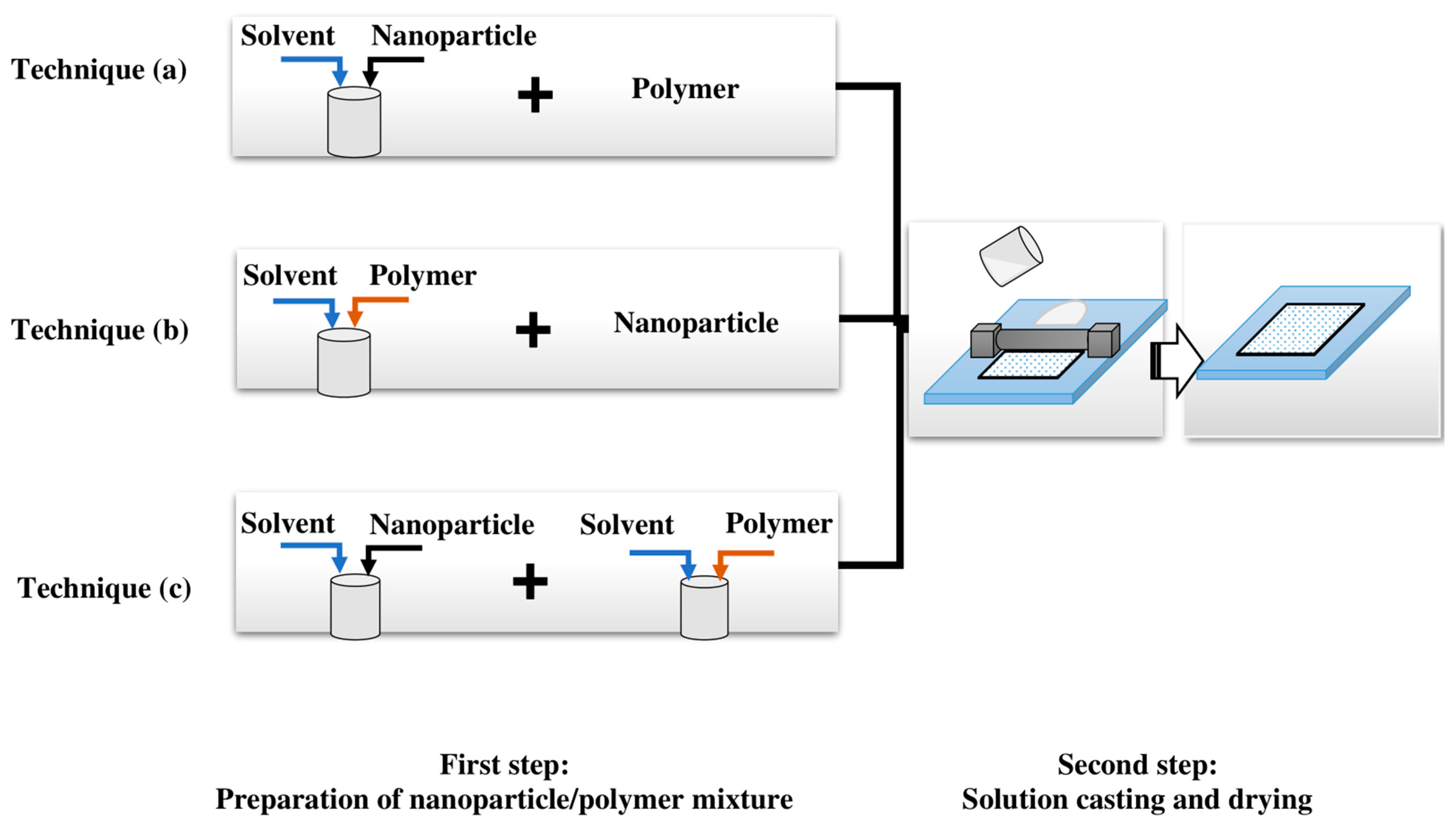
- (a)
- Dispersion of nanoparticles into the solvent and addition of polymer
- (b)
- Polymer dissolution in the solvent and the addition of nanoparticles
- (c)
- Dispersion of nanoparticles and mixing it with a solution of the polymer in the solvent
3.2. In Situ and Interfacial Polymerization
3.3. Sol-Gel Method
3.4. Other Methods
4. Effect of the Nanoparticles on Membrane Properties
4.1. Membrane Structure
4.1.1. Membrane Free Volume
4.1.2. Membrane Crystallinity
4.2. Swelling Degree
4.3. Water Contact Angle Parameter
5. The PV Separation Performance of Nanocomposite Membranes
5.1. Dehydration of Aqueous-Organic Mixtures by Hydrophilic Nanocomposite Membranes
5.1.1. PVA Nanocomposite Membranes
5.1.2. CS Nanocomposite Membranes
5.1.3. PI and PA Nanocomposite Membranes
5.1.4. SA Nanocomposite Membranes
5.2. Removal of Organics from Aqueous-Organic Mixtures by Hydrophobic Nanocomposite Membranes
5.3. Organic-Organic Separation by Target-Organophilic Nanocomposite Membranes
6. Conclusions and Future Directions
Author Contributions
Funding
Institutional Review Board Statement
Conflicts of Interest
References
- Figoli, A.; Vandezande, P.; Galiano, F.; Zereshki, S. Pervaporation as Sustainable Process; Membrane Processes for Sustainable Growth, Nova Science Publishers: New York, NY, USA, 2013; pp. 65–99. [Google Scholar]
- Liu, C.; Kulprathipanja, S.; Hillock, A.M.; Husain, S.; Koros, W.J. Recent Progress in Mixed-Matrix Membranes. Adv. Membr. Technol. Appl. 2008, 787–819. [Google Scholar] [CrossRef]
- Jiang, L.Y.; Chung, T.S.; Rajagopalan, R. Matrimid®/MgO mixed matrix membranes for pervaporation. AIChE J. 2007, 53, 1745–1757. [Google Scholar] [CrossRef]
- Dudek, G.; Gnus, M.; Turczyn, R.; Strzelewicz, A.; Krasowska, M. Pervaporation with chitosan membranes containing iron oxide nanoparticles. Sep. Purif. Technol. 2014, 133, 8–15. [Google Scholar] [CrossRef]
- Gongping, L.; Wang, W.; Wanqin, J.; Nanping, X. Polymer/ceramic composite membranes and their application in pervaporation process. Chin. J. Chem. Eng. 2012, 20, 62–70. [Google Scholar]
- Pabby, A.K.; Rizvi, S.S.; Requena, A.M.S. Handbook of Membrane Separations: Chemical, Pharmaceutical, Food, and Biotechnological Applications; CRC Press: Boca Raton, FL, USA, 2015. [Google Scholar]
- Bakhtiari, O.; Mosleh, S.; Khosravi, T.; Mohammadi, T. Mixed matrix membranes for pervaporative separation of isopropanol/water mixtures. Desalination Water Treat. 2012, 41, 45–52. [Google Scholar] [CrossRef]
- Ong, Y.K.; Shi, G.M.; Le, N.L.; Tang, Y.P.; Zuo, J.; Nunes, S.P.; Chung, T.-S. Recent membrane development for pervaporation processes. Prog. Polym. Sci. 2016, 57, 1–31. [Google Scholar] [CrossRef]
- Baker, R.W. Membrane Technology and Applications; John Wiley & Sons, Ltd.: Hoboken, NJ, USA, 2004; pp. 96–103. [Google Scholar]
- Fathizadeh, M.; Aroujalian, A.; Raisi, A.; Fotouhi, M. Preparation and characterization of thin film nanocomposite membrane for pervaporative dehydration of aqueous alcohol solutions. Desalination 2013, 314, 20–27. [Google Scholar] [CrossRef]
- Feng, X.; Huang, R.Y. Liquid separation by membrane pervaporation: A review. Ind. Eng. Chem. Res. 1997, 36, 1048–1066. [Google Scholar] [CrossRef]
- Sunitha, K.; Rani, K.Y.; Moulik, S.; Satyanarayana, S.; Sridhar, S. Separation of NMP/water mixtures by nanocomposite PEBA membrane: Part, I. Membrane synthesis, characterization and pervaporation performance. Desalination 2013, 330, 1–8. [Google Scholar] [CrossRef]
- Adoor, S.G.; Rajineekanth, V.; Nadagouda, M.N.; Rao, K.C.; Dionysiou, D.D.; Aminabhavi, T.M. Exploration of nanocomposite membranes composed of phosphotungstic acid in sodium alginate for separation of aqueous–organic mixtures by pervaporation. Sep. Purif. Technol. 2013, 113, 64–74. [Google Scholar] [CrossRef]
- Dirin, A.M.; Saljoughi, E.; Mousavi, S.M.; Kiani, S. Pervaporation separation of isopropylbenzene from water using four different polymeric membranes: Membrane preparation, modification, characterization, and performance evaluation. J. Taiwan Inst. Chem. Eng. 2020, 114, 67–80. [Google Scholar] [CrossRef]
- Vandezande, P. Next-Generation Pervaporation Membranes: Recent Trends, Challenges and Perspectives. Pervaporation, Vapour Permeation and Membrane Distillation: Principles and Applications, 1st ed.; Elsevier: Amsterdam, The Netherlands, 2015; pp. 107–141. [Google Scholar]
- Figoli, A.; Santoro, S.; Galiano, F.; Basile, A. Pervaporation Membranes: Preparation, Characterization, and Application. Pervaporation, Vapour Permeation and Membrane Distillation, Principles and Applications; Woodhead Publishing: Oxford, UK, 2015; pp. 19–63. [Google Scholar]
- Afsar, F.; Saljoughi, E.; Mousavi, S.M. Poly (caprolactone)/poly (ethylene glycol) pervaporation blend membranes: Synthesis, characterization, and performance. Polym. Adv. Technol. 2018, 29, 2467–2476. [Google Scholar] [CrossRef]
- Langari, S.; Saljoughi, E.; Mousavi, S.M. Chitosan/polyvinyl alcohol/amino functionalized multiwalled carbon nanotube pervaporation membranes: Synthesis, characterization, and performance. Polym. Adv. Technol. 2018, 29, 84–94. [Google Scholar] [CrossRef]
- Miranmousavi, H.S.; Saljoughi, E.; Mousavi, S.M.; Kiani, S. Preparation and hydrophobicity modification of poly (vinylidene fluoride-co-hexafluoropropylene) membranes for pervaporation separation of volatile organic compound from water. Polym. Compos. 2021, 42, 4684–4697. [Google Scholar] [CrossRef]
- Bruggen, B.; Luis, P. Pervaporation. Progress in Filtration and Separation; Academic Press: London, UK, 2015; pp. 101–154. [Google Scholar]
- Casado-Coterillo, C.; Andrés, F.; Téllez, C.; Coronas, J.; Irabien, Á. Synthesis and characterization of ETS-10/chitosan nanocomposite membranes for pervaporation. Sep. Sci. Technol. 2014, 49, 1903–1909. [Google Scholar] [CrossRef]
- Salehian, P.; Chua, M.L.; Askari, M.; Shi, G.M.; Chung, T.-S. In situ regulation of micro-pore to design high performance polyimide membranes for pervaporation dehydration of isopropanol. J. Membr. Sci. 2015, 493, 299–310. [Google Scholar] [CrossRef]
- Bakhshandeh Rostami, S.; Saljoughi, E.; Mousavi, S.M.; Kiani, S. Preparation of polyphenylsulfone/graphene nanocomposite membrane for the pervaporation separation of cumene from water. Polym. Adv. Technol. 2022, 33, 340–352. [Google Scholar] [CrossRef]
- Jose, T.; George, S.C.; Thomas, S. 1—Polymer Nanocomposite Membranes for Pervaporation: An Introduction. In Polymer Nanocomposite Membranes for Pervaporation; Thomas, S., George, S.C., Jose, T., Eds.; Elsevier: Amsterdam, The Netherlands, 2020; pp. 1–16. [Google Scholar]
- Lakshmy, K.S.; Lal, D.; Nair, A.; Babu, A.; Das, H.; Govind, N.; Dmitrenko, M.; Kuzminova, A.; Korniak, A.; Penkova, A. Pervaporation as a Successful Tool in the Treatment of Industrial Liquid Mixtures. Polymers 2022, 14, 1604. [Google Scholar] [CrossRef]
- Shirazi, Y.; Ghadimi, A.; Mohammadi, T. Recovery of alcohols from water using polydimethylsiloxane–silica nanocomposite membranes: Characterization and pervaporation performance. J. Appl. Polym. Sci. 2012, 124, 2871–2882. [Google Scholar] [CrossRef]
- Amirilargani, M.; Tofighy, M.A.; Mohammadi, T.; Sadatnia, B. Novel poly (vinyl alcohol)/multiwalled carbon nanotube nanocomposite membranes for pervaporation dehydration of isopropanol: Poly (sodium 4-styrenesulfonate) as a functionalization agent. Ind. Eng. Chem. Res. 2014, 53, 12819–12829. [Google Scholar] [CrossRef]
- Chen, S.-H.; Liou, R.-M.; Lai, C.-L.; Hung, M.-Y.; Tsai, M.-H.; Huang, S.-L. Embedded nano-iron polysulfone membrane for dehydration of the ethanol/water mixtures by pervaporation. Desalination 2008, 234, 221–231. [Google Scholar] [CrossRef]
- Penkova, A.V.; Polotskaya, G.A.; Gavrilova, V.A.; Toikka, A.M.; Liu, J.-C.; Trchová, M.; Šlouf, M.; Pientka, Z. Polyamide membranes modified by carbon nanotubes: Application for pervaporation. Sep. Sci. Technol. 2009, 45, 35–41. [Google Scholar] [CrossRef]
- Shen, J.-N.; Chu, Y.-X.; Ruan, H.-M.; Wu, L.-G.; Gao, C.-J.; Van der Bruggen, B. Pervaporation of benzene/cyclohexane mixtures through mixed matrix membranes of chitosan and Ag+/carbon nanotubes. J. Membr. Sci. 2014, 462, 160–169. [Google Scholar] [CrossRef]
- Bai, L.; Qu, P.; Li, S.; Gao, Y.; Zhang, L.P. Poly (vinyl alcohol)/cellulose nanocomposite pervaporation membranes for ethanol dehydration. In Materials Science Forum; Trans Tech Publ.: Zurich, Switzerland, 2011; pp. 383–386. [Google Scholar]
- Garg, P.; Singh, R.; Choudhary, V. Pervaporation separation of organic azeotrope using poly (dimethyl siloxane)/clay nanocomposite membranes. Sep. Purif. Technol. 2011, 80, 435–444. [Google Scholar] [CrossRef]
- Magalad, V.T.; Gokavi, G.S.; Ranganathaiah, C.; Burshe, M.H.; Han, C.; Dionysiou, D.D.; Nadagouda, M.N.; Aminabhavi, T.M. Polymeric blend nanocomposite membranes for ethanol dehydration—Effect of morphology and membrane–solvent interactions. J. Membr. Sci. 2013, 430, 321–329. [Google Scholar] [CrossRef]
- Peng, F.; Pan, F.; Sun, H.; Lu, L.; Jiang, Z. Novel nanocomposite pervaporation membranes composed of poly (vinyl alcohol) and chitosan-wrapped carbon nanotube. J. Membr. Sci. 2007, 300, 13–19. [Google Scholar] [CrossRef]
- Le, N.L.; Wang, Y.; Chung, T.-S. Pebax/POSS mixed matrix membranes for ethanol recovery from aqueous solutions via pervaporation. J. Membr. Sci. 2011, 379, 174–183. [Google Scholar] [CrossRef]
- Lokesh, B.; Rao, K.K.; Reddy, K.M.; Rao, K.C.; Rao, P.S. Novel nanocomposite membranes of sodium alginate filled with polyaniline-coated titanium dioxide for dehydration of 1, 4-dioxane/water mixtures. Desalination 2008, 233, 166–172. [Google Scholar] [CrossRef]
- Wang, Y.-C.; Fan, S.-C.; Lee, K.-R.; Li, C.-L.; Huang, S.-H.; Tsai, H.-A.; Lai, J.-Y. Polyamide/SDS–clay hybrid nanocomposite membrane application to water–ethanol mixture pervaporation separation. J. Membr. Sci. 2004, 239, 219–226. [Google Scholar] [CrossRef]
- Krishnan, J.N.; Venkatachalam, K.R.; Ghosh, O.; Jhaveri, K.; Palakodeti, A.; Nair, N. Review of thin film nanocomposite membranes and their applications in desalination. Front. Chem. 2022, 10. [Google Scholar] [CrossRef]
- Al Harby, N.F.; El-Batouti, M.; Elewa, M.M. Prospects of Polymeric Nanocomposite Membranes for Water Purification and Scalability and their Health and Environmental Impacts: A Review. Nanomaterials 2022, 12, 3637. [Google Scholar] [CrossRef] [PubMed]
- Kim, W.-g.; Nair, S. Membranes from nanoporous 1D and 2D materials: A review of opportunities, developments, and challenges. Chem. Eng. Sci. 2013, 104, 908–924. [Google Scholar] [CrossRef]
- Beltran, A.B.; Nisola, G.M.; Choi, S.S.; Kim, Y.; Chung, W.J. Surface-functionalized silica nanoparticles as fillers in polydimethylsiloxane membrane for the pervaporative recovery of 1-butanol from aqueous solution. J. Chem. Technol. Biotechnol. 2013, 88, 2216–2226. [Google Scholar] [CrossRef]
- Shirazi, Y.; Tofighy, M.A.; Mohammadi, T. Synthesis and characterization of carbon nanotubes/poly vinyl alcohol nanocomposite membranes for dehydration of isopropanol. J. Membr. Sci. 2011, 378, 551–561. [Google Scholar] [CrossRef]
- Tewari, P. Nanocomposite Membrane Technology: Fundamentals and Applications; CRC Press: Boca Raton, FL, USA, 2015. [Google Scholar]
- Liu, G.; Yang, D.; Zhu, Y.; Ma, J.; Nie, M.; Jiang, Z. Titanate nanotubes-embedded chitosan nanocomposite membranes with high isopropanol dehydration performance. Chem. Eng. Sci. 2011, 66, 4221–4228. [Google Scholar] [CrossRef]
- Guo, R.; Ma, X.; Hu, C.; Jiang, Z. Novel PVA–silica nanocomposite membrane for pervaporative dehydration of ethylene glycol aqueous solution. Polymer 2007, 48, 2939–2945. [Google Scholar] [CrossRef]
- Hu, S.Y.; Zhang, Y.; Lawless, D.; Feng, X. Composite membranes comprising of polyvinylamine-poly (vinyl alcohol) incorporated with carbon nanotubes for dehydration of ethylene glycol by pervaporation. J. Membr. Sci. 2012, 417, 34–44. [Google Scholar] [CrossRef]
- Jose, T.; George, S.C.; Maya, M.; Thomas, S. Functionalized MWCNT and PVA Nanocomposite Membranes for Dielectric and Pervaporation Applications. J. Chem. Eng. Process Technol. 2015, 6, 1. [Google Scholar]
- Ong, Y.T.; Ahmad, A.L.; Zein, S.H.S.; Sudesh, K.; Tan, S.H. Poly (3-hydroxybutyrate)-functionalised multi-walled carbon nanotubes/chitosan green nanocomposite membranes and their application in pervaporation. Sep. Purif. Technol. 2011, 76, 419–427. [Google Scholar] [CrossRef]
- Panahian, S.; Raisi, A.; Aroujalian, A. Multilayer mixed matrix membranes containing modified-MWCNTs for dehydration of alcohol by pervaporation process. Desalination 2015, 355, 45–55. [Google Scholar] [CrossRef]
- Penkova, A.; Polotskaya, G.; Toikka, A. Pervaporation composite membranes for ethyl acetate production. Chem. Eng. Process. Process Intensif. 2015, 87, 81–87. [Google Scholar] [CrossRef]
- Penkova, A.V.; Acquah, S.F.; Dmitrenko, M.E.; Sokolova, M.P.; Mikhailova, M.E.; Polyakov, E.S.; Ermakov, S.S.; Markelov, D.A.; Roizard, D. Improvement of pervaporation PVA membranes by the controlled incorporation of fullerenol nanoparticles. Mater. Des. 2016, 96, 416–423. [Google Scholar] [CrossRef]
- Sardarabadi, H.; Mousavi, S.M.; Saljoughi, E. Removal of 2-propanol from water by pervaporation using poly (vinylidene fluoride) membrane filled with carbon black. Appl. Surf. Sci. 2016, 368, 277–287. [Google Scholar] [CrossRef]
- Shirazi, Y.; Mohammadi, T. Effects of CNTs content on physicochemical and pervaporation separation properties of PVA membranes. Sep. Sci. Technol. 2013, 48, 716–727. [Google Scholar] [CrossRef]
- Sudhakar, H.; Chowdoji Rao, K.; Sridhar, S. Effect of multi-walled carbon nanotubes on pervaporation characteristics of chitosan membrane. Des. Monomers Polym. 2010, 13, 287–299. [Google Scholar] [CrossRef]
- Yeang, Q.W.; Zein, S.H.S.; Sulong, A.B.; Tan, S.H. Comparison of the pervaporation performance of various types of carbon nanotube-based nanocomposites in the dehydration of acetone. Sep. Purif. Technol. 2013, 107, 252–263. [Google Scholar] [CrossRef]
- Gao, B.; Jiang, Z.; Zhao, C.; Gomaa, H.; Pan, F. Enhanced pervaporative performance of hybrid membranes containing Fe3O4@ CNT nanofillers. J. Membr. Sci. 2015, 492, 230–241. [Google Scholar] [CrossRef]
- Bhat, S.; Naidu, B.; Shanbhag, G.; Halligudi, S.; Sairam, M.; Aminabhavi, T. Mesoporous molecular sieve (MCM-41)-filled sodium alginate hybrid nanocomposite membranes for pervaporation separation of water–isopropanol mixtures. Sep. Purif. Technol. 2006, 49, 56–63. [Google Scholar] [CrossRef]
- Liu, X.; Li, Y.; Liu, Y.; Zhu, G.; Liu, J.; Yang, W. Capillary supported ultrathin homogeneous silicalite-poly (dimethylsiloxane) nanocomposite membrane for bio-butanol recovery. J. Membr. Sci. 2011, 369, 228–232. [Google Scholar] [CrossRef]
- Lu, S.-Y.; Huang, H.-Y.; Wu, K.-H. Silicalite/poly (dimethylsiloxane) nanocomposite pervaporation membranes for acetic acid/water separation. J. Mater. Res. 2001, 16, 3053–3059. [Google Scholar] [CrossRef]
- Nourani, E.A.; Mortaheb, H.R.; Ehsani, M.R. Pervaporative performances of mixed matrix membranes filled with silica/silicalite-1 particles for purification of toluene from dilute aqueous solution. J. Environ. Chem. Eng. 2014, 2, 888–898. [Google Scholar] [CrossRef]
- Yadav, A.; Lind, M.L.; Ma, X.; Lin, Y. Nanocomposite silicalite-1/polydimethylsiloxane membranes for pervaporation of ethanol from dilute aqueous solutions. Ind. Eng. Chem. Res. 2013, 52, 5207–5212. [Google Scholar] [CrossRef]
- Amirilargani, M.; Sadatnia, B. Poly (vinyl alcohol)/zeolitic imidazolate frameworks (ZIF-8) mixed matrix membranes for pervaporation dehydration of isopropanol. J. Membr. Sci. 2014, 469, 1–10. [Google Scholar] [CrossRef]
- Hua, D.; Ong, Y.K.; Wang, Y.; Yang, T.; Chung, T.-S. ZIF-90/P84 mixed matrix membranes for pervaporation dehydration of isopropanol. J. Membr. Sci. 2014, 453, 155–167. [Google Scholar] [CrossRef]
- Liu, X.; Jin, H.; Li, Y.; Bux, H.; Hu, Z.; Ban, Y.; Yang, W. Metal–organic framework ZIF-8 nanocomposite membrane for efficient recovery of furfural via pervaporation and vapor permeation. J. Membr. Sci. 2013, 428, 498–506. [Google Scholar] [CrossRef]
- Shi, G.M.; Chen, H.; Jean, Y.; Chung, T.S. Sorption, swelling, and free volume of polybenzimidazole (PBI) and PBI/zeolitic imidazolate framework (ZIF-8) nano-composite membranes for pervaporation. Polymer 2013, 54, 774–783. [Google Scholar] [CrossRef]
- Shi, G.M.; Yang, T.; Chung, T.S. Polybenzimidazole (PBI)/zeolitic imidazolate frameworks (ZIF-8) mixed matrix membranes for pervaporation dehydration of alcohols. J. Membr. Sci. 2012, 415, 577–586. [Google Scholar] [CrossRef]
- Wang, N.; Shi, G.; Gao, J.; Li, J.; Wang, L.; Guo, H.; Zhang, G.; Ji, S. MCM-41@ ZIF-8/PDMS hybrid membranes with micro-and nanoscaled hierarchical structure for alcohol permselective pervaporation. Sep. Purif. Technol. 2015, 153, 146–155. [Google Scholar] [CrossRef]
- Wang, X.; Chen, J.; Fang, M.; Wang, T.; Yu, L.; Li, J. ZIF-7/PDMS mixed matrix membranes for pervaporation recovery of butanol from aqueous solution. Sep. Purif. Technol. 2016, 163, 39–47. [Google Scholar] [CrossRef]
- Yan, H.; Li, J.; Fan, H.; Ji, S.; Zhang, G.; Zhang, Z. Sonication-enhanced in situ assembly of organic/inorganic hybrid membranes: Evolution of nanoparticle distribution and pervaporation performance. J. Membr. Sci. 2015, 481, 94–105. [Google Scholar] [CrossRef]
- Zhang, Y.; Wang, N.; Ji, S.; Zhang, R.; Zhao, C.; Li, J.-R. Metal–organic framework/poly (vinyl alcohol) nanohybrid membrane for the pervaporation of toluene/n-heptane mixtures. J. Membr. Sci. 2015, 489, 144–152. [Google Scholar] [CrossRef]
- Aminabhavi, T.M.; Patil, M.B. Nanocomposite membranes of poly (vinyl alcohol) loaded with polyaniline-coated TiO2 and TiO2 nanoparticles for the pervaporation dehydration of aqueous mixtures of 1,4-dioxane and tetrahydrofuran. Des. Monomers Polym. 2010, 13, 497–508. [Google Scholar] [CrossRef]
- Jullok, N.; Van Hooghten, R.; Luis, P.; Volodin, A.; Van Haesendonck, C.; Vermant, J.; Van der Bruggen, B. Effect of silica nanoparticles in mixed matrix membranes for pervaporation dehydration of acetic acid aqueous solution: Plant-inspired dewatering systems. J. Clean. Prod. 2016, 112, 4879–4889. [Google Scholar] [CrossRef]
- Khoonsap, S.; Supanchaiyamat, N.; Hunt, A.J.; Klinsrisuk, S.; Amnuaypanich, S. Improving water selectivity of poly (vinyl alcohol) (PVA)–Fumed silica (FS) nanocomposite membranes by grafting of poly (2-hydroxyethyl methacrylate) (PHEMA) on fumed silica particles. Chem. Eng. Sci. 2015, 122, 373–383. [Google Scholar] [CrossRef]
- Li, J.; Zhang, G.; Ji, S.; Wang, N.; An, W. Layer-by-layer assembled nanohybrid multilayer membranes for pervaporation dehydration of acetone–water mixtures. J. Membr. Sci. 2012, 415, 745–757. [Google Scholar] [CrossRef]
- Lin, W.; Zhu, T.; Li, Q.; Yi, S.; Li, Y. Study of pervaporation for dehydration of caprolactam through PVA/nano silica composite membranes. Desalination 2012, 285, 39–45. [Google Scholar] [CrossRef]
- Mandal, M.K.; Sant, S.B.; Bhattacharya, P.K. Dehydration of aqueous acetonitrile solution by pervaporation using PVA–iron oxide nanocomposite membrane. Colloids Surf. A Physicochem. Eng. Asp. 2011, 373, 11–21. [Google Scholar] [CrossRef]
- Olukman, M.; Şanlı, O. A novel in situ synthesized magnetite containing acrylonitrile and 2-hydroxyethyl methacrylate grafted poly (vinyl alcohol) nanocomposite membranes for pervaporation separation of acetone/water mixtures. Chem. Eng. Process. Process Intensif. 2015, 98, 60–70. [Google Scholar] [CrossRef]
- Pandey, R.P.; Shahi, V.K. Functionalized silica–chitosan hybrid membrane for dehydration of ethanol/water azeotrope: Effect of cross-linking on structure and performance. J. Membr. Sci. 2013, 444, 116–126. [Google Scholar] [CrossRef]
- Peng, P.; Shi, B.; Lan, Y. Preparation of PDMS—Silica nanocomposite membranes with silane coupling for recovering ethanol by pervaporation. Sep. Sci. Technol. 2011, 46, 420–427. [Google Scholar] [CrossRef]
- Sabetghadam, A.; Mohammadi, T. Effect of annealing temperature and time on structure and performance of poly (vinyl) alcohol nanocomposite membranes. Polym. Eng. Sci. 2010, 50, 2392–2399. [Google Scholar] [CrossRef]
- Sairam, M.; Naidu, B.V.K.; Nataraj, S.K.; Sreedhar, B.; Aminabhavi, T.M. Poly (vinyl alcohol)-iron oxide nanocomposite membranes for pervaporation dehydration of isopropanol, 1, 4-dioxane and tetrahydrofuran. J. Membr. Sci. 2006, 283, 65–73. [Google Scholar] [CrossRef]
- Sun, D.; Li, B.-B.; Xu, Z.-L. Pervaporation of ethanol/water mixture by organophilic nano-silica filled PDMS composite membranes. Desalination 2013, 322, 159–166. [Google Scholar] [CrossRef]
- Tamaddondar, M.; Pahlavanzadeh, H.; Hosseini, S.S.; Ruan, G.; Tan, N.R. Self-assembled polyelectrolyte surfactant nanocomposite membranes for pervaporation separation of MeOH/MTBE. J. Membr. Sci. 2014, 472, 91–101. [Google Scholar] [CrossRef]
- Tancharernrat, T.; Rempel, G.L.; Prasassarakich, P. Preparation of styrene butadiene copolymer–silica nanocomposites via differential microemulsion polymerization and NR/SBR–SiO 2 membranes for pervaporation of water–ethanol mixtures. Chem. Eng. J. 2014, 258, 290–300. [Google Scholar] [CrossRef]
- Tang, X.; Wang, R.; Xiao, Z.; Shi, E.; Yang, J. Preparation and pervaporation performances of fumed-silica-filled polydimethylsiloxane–polyamide (PA) composite membranes. J. Appl. Polym. Sci. 2007, 105, 3132–3137. [Google Scholar] [CrossRef]
- Torabi, B.; Ameri, E. Methyl acetate production by coupled esterification-reaction process using synthesized cross-linked PVA/silica nanocomposite membranes. Chem. Eng. J. 2016, 288, 461–472. [Google Scholar] [CrossRef]
- Tripathi, B.P.; Kumar, M.; Saxena, A.; Shahi, V.K. Bifunctionalized organic–inorganic charged nanocomposite membrane for pervaporation dehydration of ethanol. J. Colloid Interface Sci. 2010, 346, 54–60. [Google Scholar] [CrossRef]
- Wang, L.; Han, X.; Li, J.; Zhan, X.; Chen, J. Hydrophobic nano-silica/polydimethylsiloxane membrane for dimethylcarbonate–methanol separation via pervaporation. Chem. Eng. J. 2011, 171, 1035–1044. [Google Scholar] [CrossRef]
- Wang, L.; Han, X.; Li, J.; Zhan, X.; Chen, J. Separation of azeotropic dimethylcarbonate/methanol mixtures by pervaporation: Sorption and diffusion behaviors in the pure and nano silica filled PDMS membranes. Sep. Sci. Technol. 2011, 46, 1396–1405. [Google Scholar] [CrossRef]
- Yang, D.; Li, J.; Jiang, Z.; Lu, L.; Chen, X. Chitosan/TiO 2 nanocomposite pervaporation membranes for ethanol dehydration. Chem. Eng. Sci. 2009, 64, 3130–3137. [Google Scholar] [CrossRef]
- Zhao, Q.; Qian, J.; Zhu, C.; An, Q.; Xu, T.; Zheng, Q.; Song, Y. A novel method for fabricating polyelectrolyte complex/inorganic nanohybrid membranes with high isopropanol dehydration performance. J. Membr. Sci. 2009, 345, 233–241. [Google Scholar]
- Zhou, H.; Shi, R.; Jin, W. Novel organic–inorganic pervaporation membrane with a superhydrophobic surface for the separation of ethanol from an aqueous solution. Sep. Purif. Technol. 2014, 127, 61–69. [Google Scholar] [CrossRef]
- Das, P.; Ray, S.K. Synthesis and characterization of biopolymer based mixed matrix membranes for pervaporative dehydration. Carbohydr. Polym. 2014, 103, 274–284. [Google Scholar] [CrossRef]
- Jose, T.; George, S.C. Induced Hydrophilicity of the Nanoclay on the Pervaporation Performance of Cross-Linked Poly (vinyl alcohol) Nanocomposite Membranes. Polym. -Plast. Technol. Eng. 2016, 55, 1266–1281. [Google Scholar] [CrossRef]
- Samanta, H.S.; Ray, S.K. Separation of ethanol from water by pervaporation using mixed matrix copolymer membranes. Sep. Purif. Technol. 2015, 146, 176–186. [Google Scholar] [CrossRef]
- Samanta, H.S.; Ray, S.K.; Das, P.; Singha, N.R. Separation of acid–water mixtures by pervaporation using nanoparticle filled mixed matrix copolymer membranes. J. Chem. Technol. Biotechnol. 2012, 87, 608–622. [Google Scholar] [CrossRef]
- Naidu, B.V.K.; Sairam, M.; Raju, K.; Aminabhavi, T.M. Pervaporation separation of water+ isopropanol mixtures using novel nanocomposite membranes of poly (vinyl alcohol) and polyaniline. J. Membr. Sci. 2005, 260, 142–155. [Google Scholar]
- Polotskaya, G.; Meleshko, T.; Sushchenko, I.; Yakimansky, A.; Pulyalina, A.Y.; Toikka, A.; Pientka, Z. Membranes based on polyimide–polyaniline nanocomposites for pervaporation of organic mixtures. J. Appl. Polym. Sci. 2010, 117, 2175–2182. [Google Scholar] [CrossRef]
- Huang, Y.; Zhang, P.; Fu, J.; Zhou, Y.; Huang, X.; Tang, X. Pervaporation of ethanol aqueous solution by polydimethylsiloxane/polyphosphazene nanotube nanocomposite membranes. J. Membr. Sci. 2009, 339, 85–92. [Google Scholar] [CrossRef]
- Narkkun, T.; Jenwiriyakul, W.; Amnuaypanich, S. Dehydration performance of double-network poly (vinyl alcohol) nanocomposite membranes (PVAs-DN). J. Membr. Sci. 2017, 528, 284–295. [Google Scholar] [CrossRef]
- Shameli, A.; Ameri, E. Synthesis of cross-linked PVA membranes embedded with multi-wall carbon nanotubes and their application to esterification of acetic acid with methanol. Chem. Eng. J. 2017, 309, 381–396. [Google Scholar] [CrossRef]
- Ravindra, S.; Rajinikanth, V.; Mulaba-Bafubiandi, A.F.; Vallabhapurapu, V.S. Performance enhancement of the poly (vinyl alcohol) (PVA) by activated natural clay clinoptilolite for pervaporation separation of aqueous–organic mixtures. Desalination Water Treat. 2016, 57, 4920–4934. [Google Scholar] [CrossRef]
- Lecaros, R.L.G.; Mendoza, G.E.J.; Hung, W.-S.; An, Q.-F.; Caparanga, A.R.; Tsai, H.-A.; Hu, C.-C.; Lee, K.-R.; Lai, J.-Y. Tunable interlayer spacing of composite graphene oxide-framework membrane for acetic acid dehydration. Carbon 2017, 123, 660–667. [Google Scholar] [CrossRef]
- Khoonsap, S.; Rugmai, S.; Hung, W.-S.; Lee, K.-R.; Klinsrisuk, S.; Amnuaypanich, S. Promoting permeability-selectivity anti-trade-off behavior in polyvinyl alcohol (PVA) nanocomposite membranes. J. Membr. Sci. 2017, 544, 287–296. [Google Scholar] [CrossRef]
- Asvadi, F.; Raisi, A.; Aroujalian, A. Preparation of multi-layer pervaporation membrane by electro-spraying of nano zeolite X. Microporous Mesoporous Mater. 2017, 251, 135–145. [Google Scholar] [CrossRef]
- Liu, Q.; Wang, H.; Wu, C.; Wei, Z.; Wang, H. In-situ generation of iron-dopamine nanoparticles with hybridization and cross-linking dual-functions in poly (vinyl alcohol) membranes for ethanol dehydration via pervaporation. Sep. Purif. Technol. 2017, 188, 282–292. [Google Scholar] [CrossRef]
- Wu, Y.; Xie, Z.; Ng, D.; Shen, S.; Zhou, Z. Poly (ether sulfone) supported hybrid poly (vinyl alcohol)–maleic acid–silicone dioxide membranes for the pervaporation separation of ethanol–water mixtures. J. Appl. Polym. Sci. 2017, 134, 44839. [Google Scholar] [CrossRef]
- Wang, J.; Li, M.; Zhou, S.; Xue, A.; Zhang, Y.; Zhao, Y.; Zhong, J.; Zhang, Q. Graphitic carbon nitride nanosheets embedded in poly (vinyl alcohol) nanocomposite membranes for ethanol dehydration via pervaporation. Sep. Purif. Technol. 2017, 188, 24–37. [Google Scholar] [CrossRef]
- Wu, G.; Jiang, M.; Zhang, T.; Jia, Z. Tunable pervaporation performance of modified MIL-53 (Al)-NH 2/poly (vinyl alcohol) mixed matrix membranes. J. Membr. Sci. 2016, 507, 72–80. [Google Scholar] [CrossRef]
- Gao, B.; Jiang, Z.; Liu, G.; Xing, R.; Wu, H.; Pan, F.; Wang, B.; Cao, X. Enhanced pervaporative performance of hybrid membrane by incorporating amphiphilic carbonaceous material. J. Membr. Sci. 2016, 520, 951–963. [Google Scholar] [CrossRef]
- Zhao, J.; Zhu, Y.; He, G.; Xing, R.; Pan, F.; Jiang, Z.; Zhang, P.; Cao, X.; Wang, B. Incorporating zwitterionic graphene oxides into sodium alginate membrane for efficient water/alcohol separation. ACS Appl. Mater. Interfaces 2016, 8, 2097–2103. [Google Scholar] [CrossRef]
- Wang, M.; Xing, R.; Wu, H.; Pan, F.; Zhang, J.; Ding, H.; Jiang, Z. Nanocomposite membranes based on alginate matrix and high loading of pegylated POSS for pervaporation dehydration. J. Membr. Sci. 2017, 538, 86–95. [Google Scholar] [CrossRef]
- Xing, R.; Pan, F.; Zhao, J.; Cao, K.; Gao, C.; Yang, S.; Liu, G.; Wu, H.; Jiang, Z. Enhancing the permeation selectivity of sodium alginate membrane by incorporating attapulgite nanorods for ethanol dehydration. RSC Adv. 2016, 6, 14381–14392. [Google Scholar] [CrossRef]
- Suratago, T.; Taokaew, S.; Kanjanamosit, N.; Kanjanaprapakul, K.; Burapatana, V.; Phisalaphong, M. Development of bacterial cellulose/alginate nanocomposite membrane for separation of ethanol–water mixtures. J. Ind. Eng. Chem. 2015, 32, 305–312. [Google Scholar] [CrossRef]
- Lin, Y.-K.; Nguyen, V.-H.; Yu, J.C.-C.; Lee, C.-W.; Deng, Y.-H.; Wu, J.C.; Wu, K.C.; Tung, K.-L.; Chen, C.-L. Biodiesel production by pervaporation-assisted esterification and pre-esterification using graphene oxide/chitosan composite membranes. J. Taiwan Inst. Chem. Eng. 2017, 79, 23–30. [Google Scholar] [CrossRef]
- Wu, K.C.-W.; Kang, C.-H.; Lin, Y.-F.; Tung, K.-L.; Deng, Y.-H.; Ahamad, T.; Alshehri, S.M.; Suzuki, N.; Yamauchi, Y. Towards Acid-Tolerated Ethanol Dehydration: Chitosan-Based Mixed Matrix Membranes Containing Cyano-Bridged Coordination Polymer Nanoparticles. J. Nanosci. Nanotechnol. 2016, 16, 4141–4146. [Google Scholar] [CrossRef]
- Sokolova, M.P.; Smirnov, M.A.; Geydt, P.; Bugrov, A.N.; Ovaska, S.-S.; Lahderanta, E.; Toikka, A.M. Structure and Transport Properties of Mixed-Matrix Membranes Based on Polyimides with ZrO2 Nanostars. Polymers 2016, 8, 403. [Google Scholar] [CrossRef]
- Boffa, V.; Etmimi, H.; Mallon, P.; Tao, H.; Magnacca, G.; Yue, Y. Carbon-based building blocks for alcohol dehydration membranes with disorder-enhanced water permeability. Carbon 2017, 118, 458–466. [Google Scholar] [CrossRef]
- Wu, J.-K.; Ye, C.-C.; Liu, T.; An, Q.-F.; Song, Y.-H.; Lee, K.-R.; Hung, W.-S.; Gao, C.-J. Synergistic effects of CNT and GO on enhancing mechanical properties and separation performance of polyelectrolyte complex membranes. Mater. Des. 2017, 119, 38–46. [Google Scholar] [CrossRef]
- Shams, I.; Mortaheb, H.R. Performance of silica-filled hybrid membranes dispersed by applying mediating surfactant in pervaporative removal of toluene from water. Desalination Water Treat. 2016, 57, 6852–6862. [Google Scholar] [CrossRef]
- Yin, H.; Lau, C.Y.; Rozowski, M.; Howard, C.; Xu, Y.; Lai, T.; Dose, M.E.; Lively, R.P.; Lind, M.L. Free-standing ZIF-71/PDMS nanocomposite membranes for the recovery of ethanol and 1-butanol from water through pervaporation. J. Membr. Sci. 2017, 529, 286–292. [Google Scholar] [CrossRef]
- Azimi, H.; Tezel, F.H.; Thibault, J. Effect of embedded activated carbon nanoparticles on the performance of polydimethylsiloxane (PDMS) membrane for pervaporation separation of butanol. J. Chem. Technol. Biotechnol. 2017, 92, 2901–2911. [Google Scholar] [CrossRef]
- Najafi, M.; Mousavi, S.M.; Saljoughi, E. Preparation and characterization of poly (Ether block amide)/graphene membrane for recovery of isopropanol from aqueous solution via pervaporation. Polym. Compos. 2016, 39, 2259–2267. [Google Scholar] [CrossRef]
- Nigiz, F.U.; Hilmioglu, N.D. Fabrication of a novel polyhedral oligomeric silsesquioxanes/polyether-block-amide nano-hybrid membrane for pervaporative separation of model fuel butanol. J. Appl. Polym. Sci. 2017, 134, 45211. [Google Scholar] [CrossRef]
- Alberto, M.; Luque-Alled, J.M.; Gao, L.; Iliut, M.; Prestat, E.; Newman, L.; Haigh, S.J.; Vijayaraghavan, A.; Budd, P.M.; Gorgojo, P. Enhanced organophilic separations with mixed matrix membranes of polymers of intrinsic microporosity and graphene-like fillers. J. Membr. Sci. 2017, 526, 437–449. [Google Scholar] [CrossRef]
- Ding, H.; Pan, F.; Mulalic, E.; Gomaa, H.; Li, W.; Yang, H.; Wu, H.; Jiang, Z.; Wang, B.; Cao, X. Enhanced desulfurization performance and stability of Pebax membrane by incorporating Cu+ and Fe 2+ ions co-impregnated carbon nitride. J. Membr. Sci. 2017, 526, 94–105. [Google Scholar] [CrossRef]
- Dorraji, M.S.; Vatanpour, V. Organice-inorganic composite membrane preparation and characterization for biorefining. Membr. Technol. Biorefining 2016, 85. [Google Scholar] [CrossRef]
- Yin, J.; Deng, B. Polymer-matrix nanocomposite membranes for water treatment. J. Membr. Sci. 2015, 479, 256–275. [Google Scholar] [CrossRef]
- Arya, R.K. Drying Induced Phase Separation. J. Chem. Eng. 2013, 27, 12–20. [Google Scholar] [CrossRef]
- Zhang, W.; Ying, Y.; Ma, J.; Guo, X.; Huang, H.; Liu, D.; Zhong, C. Mixed matrix membranes incorporated with polydopamine-coated metal-organic framework for dehydration of ethylene glycol by pervaporation. J. Membr. Sci. 2017, 527, 8–17. [Google Scholar] [CrossRef]
- Cong, H.; Radosz, M.; Towler, B.F.; Shen, Y. Polymer–inorganic nanocomposite membranes for gas separation. Sep. Purif. Technol. 2007, 55, 281–291. [Google Scholar] [CrossRef]
- Wu, L.-G.; Shen, J.-n.; Du, C.-H.; Wang, T.; Teng, Y.; Van der Bruggen, B. Development of AgCl/poly (MMA-co-AM) hybrid pervaporation membranes containing AgCl nanoparticles through synthesis of ionic liquid microemulsions. Sep. Purif. Technol. 2013, 114, 117–125. [Google Scholar] [CrossRef]
- Mascia, L.; Lavorgna, M. Nanostructured Polymer Composites by Sol–Gel Method. Wiley Encycl. Compos. 2012. [CrossRef]
- Moermans, B.; De Beuckelaer, W.; Vankelecom, I.F.; Ravishankar, R.; Martens, J.A.; Jacobs, P.A. Incorporation of nano-sized zeolites in membranes. Chem. Commun. 2000, 2467–2468. [Google Scholar] [CrossRef]
- Beltran, A.B.; Nisola, G.M.; Cho, E.; Lee, E.E.D.; Chung, W.-J. Organosilane modified silica/polydimethylsiloxane mixed matrix membranes for enhanced propylene/nitrogen separation. Appl. Surf. Sci. 2011, 258, 337–345. [Google Scholar] [CrossRef]
- Aroon, M.; Ismail, A.; Matsuura, T.; Montazer-Rahmati, M. Performance studies of mixed matrix membranes for gas separation: A review. Sep. Purif. Technol. 2010, 75, 229–242. [Google Scholar] [CrossRef]
- Li, B.; Xu, D.; Zhang, X.; Jiang, Z.; Wang, Y.; Ma, J.; Dong, X.; Wu, H. Rubbery polymer− inorganic nanocomposite membranes: Free volume characteristics on separation property. Ind. Eng. Chem. Res. 2010, 49, 12444–12451. [Google Scholar] [CrossRef]
- Razavi, S.; Sabetghadam, A.; Mohammadi, T. Dehydration of isopropanol by PVA–APTEOS/TEOS nanocomposite membranes. Chem. Eng. Res. Des. 2011, 89, 148–155. [Google Scholar] [CrossRef]
- Gao, R.; Zhang, Q.; Lv, R.; Soyekwo, F.; Zhu, A.; Liu, Q. Highly efficient polymer–MOF nanocomposite membrane for pervaporation separation of water/methanol/MTBE ternary mixture. Chem. Eng. Res. Des. 2017, 117, 688–697. [Google Scholar] [CrossRef]
- Bera, A.; Trivedi, J.S.; Kumar, S.B.; Chandel, A.K.S.; Haldar, S.; Jewrajka, S.K. Anti-organic fouling and anti-biofouling poly(piperazineamide) thin film nanocomposite membranes for low pressure removal of heavy metal ions. J. Hazard. Mater. 2018, 343, 86–97. [Google Scholar] [CrossRef] [PubMed]
- Bhalani, D.V.; Singh Chandel, A.K.; Trivedi, J.S.; Roy, S.; Jewrajka, S.K. High molecular weight poly(vinyl pyrrolidone) induces hierarchical surface morphology in poly(vinylidene fluoride) membrane and facilitates separation of oil-water emulsions. J. Membr. Sci. 2018, 566, 415–427. [Google Scholar] [CrossRef]
- Wang, Y.; Widjojo, N.; Sukitpaneenit, P.; Chung, T.-S. Membrane pervaporation. In Separation and Purification Technologies in Biorefineries; John Wiley & Sons: West Sussex, UK, 2013; pp. 259–299. [Google Scholar]
- Goh, P.; Ismail, A.; Sanip, S.; Ng, B.; Aziz, M. Recent advances of inorganic fillers in mixed matrix membrane for gas separation. Sep. Purif. Technol. 2011, 81, 243–264. [Google Scholar] [CrossRef]
- Shao, P.; Huang, R. Polymeric membrane pervaporation. J. Membr. Sci. 2007, 287, 162–179. [Google Scholar] [CrossRef]
- Chapman, P.D.; Oliveira, T.; Livingston, A.G.; Li, K. Membranes for the dehydration of solvents by pervaporation. J. Membr. Sci. 2008, 318, 5–37. [Google Scholar] [CrossRef]
- Yen, H.-W.; Chen, Z.-H.; Yang, I.-K. Use of the composite membrane of poly (ether-block-amide) and carbon nanotubes (CNTs) in a pervaporation system incorporated with fermentation for butanol production by Clostridium acetobutylicum. Bioresour. Technol. 2012, 109, 105–109. [Google Scholar] [CrossRef] [PubMed]



| Dehydration of Aqueous-Organic Mixtures |
| Poly (vinyl alcohol) (PVA)/iron oxide [76,81], PVA/SiO2 [45,73,75,86,100], PVA/CNTs [27,42,47,49,53,101], PVA/titanium dioxide (TiO2) [71], PVA/ZIF [62], PVA/nanoclay [94,102], PVA/fullerenol [51], Poly (vinyl amine)-PVA/CNTs [46], PVA-g-acrylonitrile/2-hydroxyethyl methacrylate (HEMA)/iron oxide [77], Crosslinked PVA/N-p-carboxy benzyl chitosan/Sulfonated SiO2 [87], PVA/graphene oxide-framework (GOF) [103], PVA/poly(HEMA) grafted SiO2 nanospheres [104], PVA-polyethersulfone (PES)/nano zeolite X/PVA [105], PVA-hydroxyethyl cellulose (HEC)/nanoclay [93] PVA/iron-dopamine (Fe-DA) nanoparticles [106], PVA-maleic acid (MA)/SiO2 [107], PVA/graphitic carbon nitride [108], PVA/MOF [109] Sodium alginate (SA)/CNTs [56], SA/TiO2 [36], SA/PTA [13], SA/amphiphilic carbonaceous material (ACM) [110], SA/zwitterionic GO [111], SA/POSS [112], SA/attapulgite nanorods [113], SA/bacterial cellulose [114] Chitosan (CS)/CNTs [48,54,55], CS/TiO2 [90], CS/iron ferroferric oxides [4], CS/SiO2 [78] CS/GO [115], CS/PVA-multiwalled carbon nanotubes (MWCNTs) [55], CS/prussian blue nanoparticles [116], CS/titanate nanotubes (TNTs) [44], CS/titanosilicate [21] PA/nanoclay [37], PA/zeolite [10] PI/SiO2 [7], PI/zeolite [7], PI/magnesium oxide (MgO) [3], PI/iron oxide [22], PI/ZIF [63], PI/zirconium dioxide (ZrO2) nanostars [117] Polysulfone (PSU)/nano-iron [28] Acrylonitrile-butyl acrylate copolymer/nanoclay [96] Polybenzimidazole (PBI)/ZIF [65,66] Polyphenylsulfone (PPSU)/SiO2 [72] Humic acid-like polymer (HAL)/GO [118] Polyelectrolyte complex (PEC)/GO-CNT nanofillers [119] |
| Organics removal from aqueous-organic mixtures |
| Poly (dimethylsiloxane) (PDMS)/silica (SiO2) [26,41,60,69,79,82,92,120], PDMS/silicalite [58,59,60,61], PDMS/zeolite imidazolate framework (ZIF) [67,68,69,121], PDMS/ polyphosphazene nanotube (PZSNTs) [99], PDMS-Polyamide (PA)/SiO2 [85], PDMS/activated carbon nanoparticles [122] Poly (ether block amide) (PEBA)/zeolite [12], PEBA/graphene [123], PEBA/polyhedral oligomeric silsesquioxane (POSS) [35,124] Natural rubber (NR)/SiO2 [84] PVDF/carbon black [52] Poly (methylphenylsiloxane) (PMPS)/ZIF [64] Butyl acrylate-styrene copolymer/nanoclay [95] Polymer of intrinsic microporosity (PIM)/graphene oxide (GO) derivatives [125] Poly (2,6-dimethyl-1,4-phenylene oxide) (PPO)/fullerene [50] |
| Separation of organic-organic mixtures |
| PVA/carbon nanotubes (CNTs) [34], PVA/MOF [70] PDMS/SiO2 [88,89], PDMS/nanoclay [32] CS/CNTs [30] Poly (phenylene isophtalamide)/CNT [29] Polyimide (PI)/polyaniline (PANI) [98] PEBA/carbon nitride nanosheets [126] Polyelectrolyte surfactant complex (PELSC)/SiO2 [83] |
| Polymer | Nanofiller | Casting Method | Blending Technique | Description | Ref. |
|---|---|---|---|---|---|
| PDMS | Silicalite | Dry | (a) | Drying in a vacuum oven at 120 °C | [59] |
| PEBA | Zeolite | Dry | (a) | Drying at room temperature initially and then heating in a vacuum oven at 70 °C | [12] |
| PI | Aerosil SiO2 | Dry | (a) | After solvent evaporation, films were peeled at 170 °C to avoid film rapture and then they were placed between two stainless steel meshes on oven | [7] |
| Zeolite | (a) | ||||
| PI | MgO | Dry | (a) | High-processing temperature was applied during membrane formation (drying at 170 °C in a vacuum oven under N2 flow and heating up to 200 °C, and then annealing at 250 °C) | [3] |
| PEBA | Graphene | Dry | (a) | Drying in an oven at 60 °C for 24 h | [123] |
| PDMS | SiO2 | Dry | (b) | Drying at room temperature initially and then in a vacuum oven at 80 °C | [92] |
| PVA | SiO2 | Dry | (b) | Drying at room temperature initially and then in a vacuum oven at 140 °C | [86] |
| PVA | ZIF | Dry | (b) | Drying in an oven at 40 °C | [62] |
| PDMS-PA | Fumed-SiO2 | Dry | (b) | Drying at room temperature initially and then in a vacuum oven at 60 °C | [85] |
| PVA | Acid functionalized MWCNTs | Dry | (b) | Drying at 40 °C | [47] |
| PVA | Bentonite clay | Dry | (b) | Drying in a hot air oven at 40 °C | [94] |
| SA | PANI-TiO2 | Dry | (b) | Drying at room temperature, then immersion in a bath for crosslinking, washing with distilled water and again drying at room temperature | [36] |
| CS | MWCNTs | Dry | (b) | Drying at room temperature | [54] |
| PI | Iron oxide | Dry | (b) | Drying at 50 °C and then at 70 °C in a vacuum oven | [22] |
| SA/poly (vinyl pyrrolidone) blend polymers | PTA nanoparticles | Dry | (b) | Drying at room temperature | [33] |
| PDMS | Activated carbon | Dry | (b) | Drying under vacuum conditions first at room temperature for 30 min and then at 90 °C for 3 h | [122] |
| PVA | Poly (HEMA)-grafted SiO2 nanospheres | Dry | (b) | Drying at 70 °C in an oven for 2 h | [104] |
| PVA | SiO2 | Dry | (b) | Dry slowly in a dust-free atmosphere at ambient temperature | [75] |
| PEBA | POSS | Dry | (b) | Drying at room temperature and then in an oven at 120 °C for 3 h | [124] |
| PVA | MOF | Dry | (b) | Drying in an oven at 40 °C overnight | [109] |
| CS | Cyano-bridged coordination polymer nanoparticles | Dry | (b) | Drying in an oven at 45 °C overnight | [116] |
| PDMS | Modified fumed SiO2 particles | Dry | (c) | Drying at room temperature initially and then in an oven at 80 °C | [79] |
| PVA | CNTs | Dry | (c) | Drying at room temperature initially and then annealing | [42] |
| PVA | Poly (sodium 4-styrenesulfonate) (PSS)-wrapped MWCNTs | Dry | (c) | Drying at room temperature and then annealing at 90 °C | [27] |
| PVA | CNTs | Dry | (c) | Drying at room temperature and In situ crosslinking | [53] |
| PVA | Pure MWCNTs, functionalized MWCNTs, TiO2-MWCNTs | Dry | (c) | Drying in an oven at 80 °C initially and then heating at 150 °C | [49] |
| PDMS | ZIF | Dry | (c) | Drying at room temperature initially and then heating at 80 °C for further crosslinking | [68] |
| PVA | PANI-TiO2 | Dry | (c) | Drying at room temperature, then cross-linking in a bath, soaking in distilled water after cross-linking | [71] |
| PDMS | PZSNTs | Dry | (c) | Drying at room temperature, crosslinking at room temperature, and then under vacuum at 50 °C | [99] |
| PPO | Fullerene (C60) | Dry | (c) | Drying in a vacuum oven at 40 °C | |
| PEBA | POSS nanoparticles | Dry | (c) | Drying at room temperature initially and then heating in a vacuum oven at 50 °C | [35] |
| SA | PTA in unmodified and modified form (by ammonium carbonate) | Dry | (c) | Drying at room temperature, immersion in a cross-linking solution bath, washing with deionized water and again drying in hot air oven at 40 °C | [13] |
| CS | Titanosilicate | Dry | (c) | Drying at room temperature initially and then heating in a vacuum oven at 120 °C | [21] |
| CS | Poly (aspartic acid)-modified TNTs | Dry | (c) | Drying at room temperature | [44] |
| HAL | GO | Dry | (c) | Drying at room temperature for three days and then in a vent oven at 45 °C for 24 h | [118] |
| PEBA | Cu+ and Fe2+ ions co-impregnated carbon nitride | Dry | (c) | Drying overnight at 30 °C and then at 60 °C for 24 h | [126] |
| cardo polyetherketone (PEK-c) | ZIF nanocrystals | Dry | (c) | Drying at 60 °C for 36 h and further drying in a vacuum oven at 120 °C for 12 h | [110] |
| PVA | Fe-DA nanoparticles | Dry | (c) | Drying at room temperature for 24 h and then at 120 °C for 1 h in a vacuum oven | [106] |
| PVA | SiO2 nanospheres | Dry | (c) | Drying at room temperature for 24 h and then in an oven at 40 °C for 18 h. | [100] |
| PVA | Graphitic carbon nitride | Dry | (c) | - | [108] |
| PI | ZrO2 nanostars | Dry | (c) | Drying for 12 h at 80 °C | [117] |
| PVA | Acid-treated MWCNTs | Dry | (c) | Drying at room temperature for 48–72 h and heating in a vacuum oven at 150 °C for 1 h | [101] |
| PSU | Bentonite clay | Dry | _-* | Drying in an oven at 80 °C initially and then in a vacuum oven | [28] |
| CS | Ag+/CNTs | Dry | - | Drying at room temperature initially and then at 40 °C | [30] |
| PVA | CS-wrapped CNT | Dry | - | Drying at room temperature | [34] |
| PVA | Cellulose nanocrystals | Dry | - | Drying at room temperature | [31] |
| PVA | Low-hydroxylated fullerenol (C60(OH)12) | Dry | - | Physically cross-linked by heating at 140 °C and chemically cross-linked by heating at 110 °C | [51] |
| PDMS | MCM-ZIF hybrid particles | Dry | - | Drying at room temperature initially and then in a vacuum oven at 90 °C for complete cross-linking | [67] |
| PDMS | Organophilic SiO2 | Dry | - | Drying at room temperature | [82] |
| NR | Styrene butadiene copolymer (SBR)-SiO2 nanoparticle | Dry | - | Heating in an oven at 40 °C | [84] |
| PELSC | SiO2 | Dry | - | Drying at 50 °C | [83] |
| PDMS | Functionalized fumed SiO2 | Dry | - | Drying at room temperature initially and then in a vacuum oven at 80 °C | [41] |
| PEC | SiO2 | Dry | - | Drying at 60 °C | [91] |
| PDMS | SiO2 | Dry | - | Drying at room temperature initially and then at 120 °C for complete cross-linking | [88] |
| PI | PANI | Dry | - | Drying in vacuum at 50 °C | [98] |
| PIM | Functionalized GO | Dry | - | Drying at room temperature in a drying cabinet with continuous flow of N2 | [125] |
| PSU | Iron | Dry | - | The cast film was kept in an oven for 2 h at 80 °C and then in a vacuum oven for 24 h | [28] |
| PVA-HEC | Hydrophilic bentonite | Dry | - | Drying at room temperature and then at 110 °C in a hot air oven for crosslinking reaction | [93] |
| PDMS | SiO2 | Dry | - | Drying slowly under ambient conditions for 48 h and then in an oven at 85 °C for 2 h | [26] |
| PDMS | Two commercial clays (functionalized with polar and nonpolar surfactants) | Dry | - |
| [32] |
| PVDF | Carbon black | Dry-wet | (a) | Drying at room temperature initially, immersion in three precipitation baths, and again drying at room temperature | [52] |
| PDMS | SiO2/Silicalite-1 particles | Dry-wet | (b) | Drying at room temperature initially and then in an oven at 70 °C for complete cross-linking, immersion in water bath and again drying in the oven at 70 °C | [60] |
| SA | Mesoporous molecular sieve (MCM) | Dry-wet | (c) | Immersion in a crosslinking bath, washing with deionized water and then drying in an oven at 40 °C | [57] |
| PBI | ZIF | Dry-wet | (c) | Drying in a vacuum oven at 75 °C and cooling down, then further drying in a vacuum oven at 200 °C, and solvent-exchanging with methanol and again drying in a vacuum oven at 200 °C | [65] |
| PBI | ZIF | Dry-wet | (c) | Two steps heating in vacuum oven and cooling down naturally, then solvent-exchange with methanol, and heating in vacuum oven once more | [66] |
| PI | ZIF | Dry-wet | (c) | Heating in an oven at 60 °C and then solvent-exchange with methanol and again drying in a vacuum oven at 60 °C | [63] |
| CS | PVA-MWCNT | Dry-wet | - | Drying at room temperature initially and then immersion in an alkaline solution followed by washing with deionized water and again drying at room temperature | [55] |
| PPSU | SiO2 | Wet | (a) | Immersion in a non-solvent (water) | [72] |
| PVA | Polydopamine-coated MOF | Wet | - | Drying at room temperature for 24 h and then drying at 80 °C under vacuum for 36 h | [130] |
| PDMS | ZIF | Wet | - | Drying at room temperature for 48 h and then heating at 100 °C for 15 h under vacuum | [121] |
| SA | MWCNT decorated by Fe3O4 nanoparticles | Wet | Spin-coating | Spin-coating of a blend of SA solution containing Fe3O4-CNT nanofillers onto PAN membranes | [56] |
| Polyvinylamine-PVA | CNTs | Wet | Solution coating technique | Heating in an oven at 55 °C after solution coating | [46] |
| SA | Attapulgite nanorods | Wet | Blending and spin coating methods | - | [113] |
| PDMS | SiO2 | Wet | Sonication-enhanced in situ assembly | Drying at the ambient temperature initially and then in a convection oven at 80 °C | [69] |
| ZIF | |||||
| PDMS | Silicalite | Wet | Dip-coating process | Heating the casting solution to 65 °C with continuous mixing for 180 min and then cooling to 25 °C for dip-coating | [61] |
| Polymer | Nanofiller | Polymerization Method | Description | Ref. |
|---|---|---|---|---|
| PVA | PANI | In situ polymerization | Polymerization of aniline in PVA matrix in acidic media | [97] |
| PA | Zeolite | Interfacial polymerization | - * | [10] |
| Poly (methyl methacrylate (MMA)-co-acrylamide (AM)) | AgCl nanoparticles | In situ microemulsion polymerization | - | [132] |
| Poly (AN-co-BA) | Sodium montmorilonite | Emulsion polymerization | Drying at 60 °C and then annealing at 80 °C | [96] |
| SBR | Organophilic clay | Emulsion polymerization | Incorporating the clay in the polymer during its synthesis from the butyl acrylate and styrene monomer by emulsion polymerization in water | [95] |
| PA | SDS-clay | Direct polycondensation | Direct polycondensation in the presence of organo-modified montmorillonite (organo-clay) in N-methyl-2-pyrrolidinone (NMP) | [37] |
| Polymer | Nanofiller | Description | Ref. |
|---|---|---|---|
| Cross-linked PVA-(N-o-sulphonic acid benzyl chitosan) (NSBC) | Sulfonated SiO2 | Using the sol-gel method followed by oxidation of the thiol group into the sulfonic acid group | [87] |
| PVA | SiO2 | Drying at room temperature initially and then at higher temperatures (80 °C and 150 °C respectively) | [80] |
| N-p-carboxy benzyl chitosan (NCBC) | Functionalized SiO2 Sodium 2-formylbenzenesulfonatepolysiloxane (SBAPTS) | Sol-gel followed by cross-linking under different reaction conditions | [78] |
| PVA | Mercaptopropyltrimethoxysilane (MPTMS) | Drying at room temperature, annealing at 80 °C, then heating at 150 °C and oxidizing by hydrogen peroxide in an acetone solution, then washing the resulting membranes with distilled water | [45] |
| CS | TiO2 | Drying at room temperature and then annealing at 120 °C | [90] |
| PVA | Iron oxide | The reaction of oxide formation taking place inside the polymer matrix itself | [76] |
| PVA-g-acrylonitrile/HEMA | Iron oxide | Adding Fe2+ and Fe3+ solutions into PVA-g-acrylonitrile/HEMA polymer solution, stirring and then casting onto rimmed round glass dishes, drying at 80 °C, immersion in a bath containing KOH solution for 24 h for in situ synthesis of Fe3O4 in the membrane matrix, washing with distilled water repeatedly until neutrality | [77] |
| PVA | Iron oxide | Filtering an aqueous solution containing FeSO4 and FeCl3to remove iron hydroxide and adding the solution to PVA aqueous solution and then stirring at ambient temperature. casting the resultant solution, drying at ambient temperature followed by immersion in a bath containing KOH solution for 24 h. Finally washing repeatedly by immersion in double distilled water until neutrality and drying at the ambient temperature | [81] |
| PEC | GO-CNT | - * | [119] |
| PVA-MA | SiO2 | Drying in air and then heating in an oven at 140 °C for 2 h | [107] |
| Polymer | Nanofiller | Preparation Method | Description | Ref. |
|---|---|---|---|---|
| PDMS | Silicalite | packing-filling | Silicalite nanocrystals were deposited onto a porous alumina capillary support using dip-coating technique (packing); then, the interspaces among the nano-crystals were filled with PDMS phase (filling) | [58] |
| PVA | MOF-based CU3(BTC)2 (BTC = benzene-1,3,5-tricarboxylate) | pressure-driven assembly | The Cu3(BTC)2/PVA membrane solution was assembled onto amino ceramics substrate | [70] |
| Poly (phenylene isophtalamide) | CNT | solid phase interaction | Mixing of powders of PA and nanotubes In porcelain mortar and after the solid-phase interaction, Dissolving the composites in solvent, Drying at room temperature initially and then heating in a vacuum oven | [29] |
| Silicone rubber | ZIF | plugging-filling method | Plugging the holes in the top layer of the hierarchically ordered stainless steel mesh (HOSSM) with ZIF nanoparticles, and then filling the spaces between the nanoparticles and mesh wires with PMPS silicone rubber | [64] |
| CS | Poly (3-Hydroxybutyrate) (PHB)-functionalized MWCNTs | filtration method | The bulk alignment of PHB-MWCNT in the CS matrix by filtering the PHB-MWCNT/chloroform solution through a polytetrafluoroethylene (PTFE) membrane and then coating the membrane filter with the CS solution and drying at room temperature | [48] |
| SA | Zwitterionic GO | spin-coating method | - | [111] |
| SA | POSS | spin-coating method | - | [112] |
| Poly (diallyl dimethyl ammonium chloride) (PDDA)/PSS and poly (ethyleneimine)/polyacrylic acid | ZrO2 and Al2O3 nanoparticles | layer-by-layer assembly method | Incorporation of single-component nanoparticles into both the polycation and polyanion layers, and assembly of nanohybrid multilayer on both flat sheets and hollow fiber porous substrates | [74] |
| Polymer | Nanoparticle | Main Effects of Nanoparticles on Membrane Morphology | Changes in the Swelling Degree of Nanocomposite Membranes | Changes in Contact Angle of Nanocomposite Membranes | Ref. |
|---|---|---|---|---|---|
| PVA | Silica |
| Swelling degree: From ~27% for pure membrane to ~40% | — * | [86] |
Description:
| |||||
| Destroying the formation of crystalline regions | — | Water contact angle: From 58.58° for pure membrane to 46.91° | [45] | ||
| — | Water contact angle: From 66.8° for pure membrane to 64.8° | [80] | ||
| Description: Increase in the hydrophilicity of membrane due to the higher number of hydroxyl groups attached to the polymer-silica matrix | |||||
| PVA | sulfonated silica | Reduction in void porosity in the membrane matrix | Less swelling ratio in comparison with pristine membrane Description: Decrease in the mobility of polymer chains in water | Lower contact angle for water (68–70°), in comparison with ethanol (85–87°) | [78] |
| PVA | Iron oxide | More compact structure and increase in the amorphous characteristics of the membranes with iron contents | ~10% for nanocomposite membrane | — | [76] |
| Swelling degree:
| — | [81] | ||
| Description: Each iron ion formed a network structure with hydroxyl groups of PVA so that the membrane swelling reduced | |||||
| PVA | MWCNT | Formation of a network-like structure | — | Water contact angle: from 72° for pure membrane to 63° | [47] |
| Description: Reduction in the hydrophobic nature of the cross-linked PVA membranes | |||||
| PVA | CS -wrapped CNTs |
| — | — | [34] |
| PVA | PSS wrapped MWCNTs | More rigid polymer matrix | Swelling degree: From ~35% for pure membrane to ~25% | — | [27] |
| Description: Decrease in the polymer chain mobility as a result of the good interaction between PVA and MWNTs | |||||
| PVA | PANI | Increase in the free volume space | Equilibrium swelling (g): from 0.114 for pure membrane to 0.084 | — | [97] |
| Description: Increase in void spaces in the nanocomposite membranes and the water-adsorptive nature of the PANI particles | |||||
| PVA | Cellulose | Proficient adhesion between the two constituents and no extra sieve-in-a-cage phenomena formed in the film | — | — | [31] |
| PVA | Nanoclay |
| Swelling degree: 102 ± 2% | Water contact angle: From 63.00 ± 2 for pure membrane to 58.66 ± 2 | [94] |
| CS | TiO2 | Increase in the flexibility of polymer chains | Swelling degree: From 6% for pure membrane to ~9.5% | From 42° for pure membrane to 56° | [90] |
| Description: Increase in the interaction between water molecules and nanoparticles so that the adsorption of hybrid membranes increased for water molecules | |||||
| CS | Iron oxide | Formation of the three-dimensional network structure of iron with hydroxyl and amine groups of chitosan | Swelling degree: From ~67% for pure membrane to ~10% | — | [4] |
| Description: Change in the hydrophilic–hydrophobic balance of the polymer matrix resulting a reduction in membrane swelling | |||||
| CS | PHB-functionalized MWCNTs |
|
| — | [48] |
| Description: Restricted sorption capacity due to the reduction in the flexibility and increase in the hardness of the nanocomposite membrane | |||||
| CS | MWNTs–Ag+ |
| From ~4% for pure membrane to ~9.2% | — | [30] |
| CS/PVDF | PVA–MWCNT | Decrease in the flexibility of polymer chains and reduction in the free volume of the polymer matrix | Swelling degree: From ~0.05 for pure membrane to ~0.025 (g/g membrane) | — | [55] |
| CS | Description: Decrease in the sorption capacity of the nanocomposite membrane due to the ability of PVA–MWCNT to restrain the mobility of the polymer chains through the interaction between the functional groups of PVA–MWCNT and the polymer molecules | ||||
| SA | Bacterial cellulose |
| 44.2% | 53 | [114] |
| SA | Fe3O4@CNT | Decrease in the mobility of polymer chains and larger interaction between the polymer and inorganic particles | Swelling degree: From ~5.5% for pure membrane to ~4.5% | From ~23° for pure membrane to ~25° | [110] |
| SA | PTA |
| Swelling degree:
| — | [13] |
| SA | Description:
| ||||
| SA | MCM | — | Swelling degree: From ~2% for pure membrane to ~2.5% | — | [57] |
| Description: The filler particles will help the hybrid matrix to absorb more of water molecules | |||||
| silicone rubber | ZIF | Homogeneity in the membrane structure and no interfacial voids between the mesh wires and the ZIF-8 nanoparticles in the PMPS phase | — | — | [64] |
| PDMS | Silicalite | Void formation at the particle/polymer interface | — | — | [61] |
| PDMS | SiO2 | Hierarchical roughness surface | — | Water static contact angle: 152 ± 0.6°Ethanol contact angle: Less than 8° | [92] |
| PDMS | Description:Increase in the wettability of membrane due to the enhanced surface roughness | ||||
| PDMS | PZSNTs | Well dispersion of nanotubes in PDMS | Swelling degree:
| — | [99] |
| PDMS | Silica | Dense structure with no appreciable voids at the interface of the PDMS and nanosilica particles | Swelling degree: From 2% for pure membrane to 4% | Water contact angle: From 109.0° for pure membrane to 116.5° | [82] |
| Description: Increased accessible free volume in the matrix facilitates the sorption of water and ethanol molecules | |||||
| PDMS | Clay |
| — | — | [32] |
| PDMS | Silicalite | Dense structure with uniformly distributed particles in the membranes | — | — | [63] |
| PDMS-PA | Fumed silica |
| — | — | [85] |
| PDMS | Silica |
| Swelling degree: From 24% for pure membrane to 7% | — | [79] |
| Description: Increase in the membrane surface roughness influences the absorption of penetrants | |||||
| PA | SDS–clay | The SDS–clay was intercalated and exfoliated into the polyamide matrix | Swelling degree: From 28% to 19% | — | [37] |
| Description: Decrease in degree of swelling due to the resistance of the molecular diffusion and tortuosity of the diffusion pathway | |||||
| PA | Zeolite | Increased roughness of the membrane by adding nano NaX zeolite | — | From 65 ± 2.3° for pure membrane to 32±1.3° | [10] |
| NR | SBR–SiO2 |
| — | From 110.1 ± 0.3° for pure membrane to 77.4 ± 2.6° | [84] |
| Description: An enhanced effect on the hydrophilic surface of the membrane due to the reactive hydroxyl groups of the SBR–SiO2 nanoparticle exhibited | |||||
| PELSC | SiO2 | An increase in free volume as well as the possible defects at the interface of polymer and silica clusters | — | Description: No image could be taken due to the great hydrophilicity | [83] |
| PEBA | Zeolite |
| The equilibrium swelling ratio: ~6 | — | [12] |
| PBI | ZIF | Increase in the free volume of membrane | Sorption (g solvent/g membrane):
| — | [65] |
Description:
| |||||
| PI | Zeolite |
| — | — | [7] |
| PI | Silica aerosol | ||||
| PI | MgO |
| Swelling degree: From 0.02 for pure membrane to 0.027 g solution/g membrane. Description: The hydrophilic channels were seriously swollen (plasticized) by the water. | — | [3] |
| PI | PANI | — | The equilibrium swelling: In methanol: from 12.5% for pure membrane to 10.6%. In toluene: from 7.7% for pure membrane to 6.9%. In cyclohexane: no swelling | Water contact angle: From 87.4° for pure membrane to 90.5° | [98] |
| Description: The presence of rigid PANI particles in the polymer matrix decreased the equilibrium swelling or sorption for both methanol and toluene | |||||
| PVA and HEC | Nano bentonite |
| Sorption in water: From 15% for pure membrane to 25% | — | [93] |
| Poly (styrene-co-butyl acrylate) | Nanoclay |
| — | — | [95] |
| PEBA | POSS |
| Description: The membrane swelling and the degree of sorption decreased due to the POSS–polymer chain interactions in the solvent solution | [35] | |
| PVA | Bentonite clay |
| Description: With an increase in the nanoclay content, the polymer chains become less mobile due to the reduced swelling | Water contact angle: From 63.0° for pure membrane to 58.6° | [94] |
| PPSU | SiO2 |
| Water contact angle: From 65 for pure membrane to 48° particles modify the structure of the membrane and the porosity of the top layer, which closes any pores formed and thus increases the contact angle of the modified membrane | [72] | |
| PVDF | Carbon black |
| Swelling in feed mixture: From 18.47% for pure membrane to 0.91% | Water contact angle: From 84.7° for pure membrane to 90.7° | [52] |
| Description: The lower swelling degree in the nanocomposite membrane was attributed to denser structure of the filled membranes | Description: Hydrophobic nature of carbon black particles increased the hydrophobicity of membrane |
| Polymer | Nanoparticle | Feed Solution and Composition (wt. Ratio) | Operating Temperature (°C) | Downstream Pressure (Pa) | Separation Factor (α) | Total Flux (kg/m2.h) | PSI | Ref. |
|---|---|---|---|---|---|---|---|---|
| PVA | MWCNTs | water/ethanol (4.37/95.63) | room temperature | 266.64 | 160 | ~0.075 | ~11.5 | [47] |
| PVA | Iron oxide | water/acetonitrile (10.7/89.3) | 35 | 100–1500 | 711.12 | 0.0129 | 9.1747 | [76] |
| PVA | MWNTs-PSS | water/IPA (10/90) | 30 | 666.61 | 882 | 0.168 | 148.1 | [27] |
| PVA | SiO2 | water/ethylene glycol (20/80) | 70 | 799.93 | 311 | 0.067 | 20.77 | [45] |
| PVA | PANI | water/IPA (10/90) | 30 | 1333.22 | 564.2 | 0.069 | 38.8608 | [97] |
| PVA | Cellulose | water/ethanol (20/80) | 80 | 500 | 163 | ~0.390 | ~63.57 | [31] |
| PVA | Iron oxide | water/IPA (10/90) | 30 | 6.67 | 470 | 0.079 | 37.051 | [81] |
| water/1,4 dioxane (10/90) | 144 | 0.084 | 12.012 | |||||
| water/tetrahydrofuran (THF) (5/95) | 519 | 0.095 | 49.21 | |||||
| PVA | Aminopropyltriethoxysilane (APTEOS)/tetraethylorthosilicate (TEOS)- | water/ethanol (25/75) | 50 | 1599.87 | 270 | 0.577 | 155.21 | [80] |
| PVA | MOF | ethanol/water (92.5/7.5) | 40 | 1915.84 | ~12 | 1.477 | - | [109] |
| PVA | CNTs | water/IPA (10/90) | 30 | 100 | 1794 | 0.079 | 141.32 | [42] |
| PVA | GOF | water/acetic acid | 30 | - | 131 | 0.289 | 37.859 | [103] |
| PVA | Fe-DA | water/ethanol (10/90) | 30 | 80,000 | 2980 | 0.995 | 2965.1 | [106] |
| PVA | Clay | water/IPA (12.5/87.5) | room temperature | 266.64 | 53 | 0.104 | 5.408 | [94] |
| PVA | CNT | water/IPA (10/90) | 30 | 100 | 1794.4 | 0.08 | 143.47 | [53] |
| PVA | CNT | water/ethanol (10/90) | 30 | 133.32 | 78 | 0.471 | 36.267 | [49] |
| Modified CNT | 662 | 0.395 | 261.095 | |||||
| TiO2-CNT | 805 | 0.388 | 311.952 | |||||
| PVA | ZIF | water/IPA (10/90) | 30 | 666.61 | 132 | 0.868 | 113.708 | [62] |
| PVA | Fullerenol | n-butanol/water (90/10) | 25 | 13.33 | ~250 | ~0.55 | - | [51] |
| PVA | SiO2 | water/caprolactam (30/70) | 50 | 133.32 | 148 | 3.8 | 558.6 | [75] |
| PVA | Graphitic carbon nitride | ethanol/water(90/10) | 75 | 200 | 30.7 | 6.332 | 188.0604 | [108] |
| PVA | Fe-DA | ethanol/water (90/10) | 30 | 80,000 | 2980 | 0.995 | 2965.1 | [106] |
| PVA | Polydopamine-coated MOF | ethylene glycol/water (90/10) | 70 | 700 | 2864 | 0.540 | 1546.02 | [130] |
| PVA/PES | nano zeolite X | ethanol/water (90/10) | 30 | 133.32 | 178 | 0.374 | 66.572 | [105] |
| PVA-g-acrylonitrile/HEMA | Fe3O4 | water/acetone (20/80) | 40 | 70 | 120 | 0.2 | 23.8 | [77] |
| Polyvinylamine-PVA | CNT | water/ethylene glycol (1/99) | 70 | 133.32 | 1156 | 0.146 | 168.63 | [46] |
| double-network PVA | SiO2 nanospheres | water/ethanol (10/90) | 30 | 100 | 17,800 | 0.006 | 106.8 | [100] |
| HEC-PVA | Bentonite | water/THF (5.5/94.5) | 30 | 133.32 | 195 | 0.112 | 21.728 | [93] |
| CS | Titanosilicate | water/ethanol (15/85) | 50 | 200 | ~30 | ~0.55 | - | [21] |
| CS | TiO2 | water/ethanol (10/90) | 80 | 500 | 196 | 0.340 | 66.3 | [90] |
| CS | MWNT | water/IPA (12.5/87.5) | 30 | 66.66 | 296.2 | 0.50 | 147.6 | [54] |
| CS | Cyano-bridged coordination polymer nanoparticles | ethanol/water (90/10) | 25 | - | 1472 | 0.614 | 903.808 | [116] |
| TNTs -embedded CS/PAN | TNTs | water/IPA (10/90) | 80 | 300 | 6237 | 1.498 | 9341.528 | [44] |
| CS /PVDF | PVA-MWCNT | water/acetone (5/95) | 30 | 666.61 | 1450.5 | 0.089 | 129.0055 | [55] |
| CS | 1505.9 | 0.008 | 12.0392 | |||||
| PHB/ CS | functionalised MWCNT | water/1,4 dioxane (5/95) | 30–60 | 666.61–3333.06 | 623.11 | 0.017 | 10.5759 | [48] |
| SA | Bacterial cellulose | water/ethanol (5/95) | 40 | 1333.22 | 429.9 | 0.0333 | 14.1537 | [114] |
| 266.64 | 612.1 | 0.109 | 66.6099 | |||||
| SA | PANI-TiO2 | water/1,4-dioxane (10/90) | 30 | 33.33 | 12,848 | 0.034 | 436.798 | [36] |
| SA | Attapulgite nanorods | ethanol/water (90/10) | 76 | 100 | 2030 | 1.356 | 2750 | [113] |
| SA | POSS | ethanol/water (90/10) | 70 | 300 | 1077 | 2.500 | 2692.5 | [112] |
| SA | zwitterionic GO | ethanol/water (90/10) | 70 | 300 | 1370 | 2.140 | 2929.66 | [111] |
| SA | MCM | water/IPA (10/90) | 30 | 1333.22 | 29,991 | 0.11 | 3299.8899 | [97] |
| SA/poly(vinylpyrrolidone) | PTA | water/ethanol (4/96) | 27 | 500 | 7128 | 0.041 | 292.207 | [33] |
| PA | Clay | water/ethanol (10/90) | 25 | - | ~26 | ~0.285 | - | [37] |
| nano NaX zeolite | water/ethanol (10/90) | 25 | 133.32 | 29.9 | 4.500 | 130.05 | [10] | |
| water/isobutanol (10/90) | ~325 | ~2.250 | ~729 | |||||
| PI | SiO2 aerosil | water/IPA (10/90) | 30 | 799.93 | 80 | 0.121 | 9.559 | [7] |
| PI of matrimid 5218 | zeolite | 220 | 0.125 | 27.375 | ||||
| PI of P84 s backbone | zeolite | 890 | 0.159 | 141.351 | ||||
| PI | ZIF | water/IPA (85/15) | 60 | 100 | 5668 | 0.109 | 617.703 | [63] |
| PI | ZrO2 nanostars | butanol/water (90/10) | 40 | 10 | 109.3 | 0.140 | 15.302 | [117] |
| PI | Iron (III) acetylacetonate (FeAc) | water/IPA (15/85) | 60 | 100 | 4298 | 0.120 | 515.64 | [22] |
| Polyacrylonitrile (PAN) | SA-Fe3O4-CNT | water/ethanol (10/90) | 77 | 100 | 1870 | 2.211 | 4134.228 | [56] |
| PAN | SA-CNT | 551 | 1.832 | 1007.6 | ||||
| PEC | GO-CNT | water/IPA (90/10) | 40 | - | ~2750 | ~1.5 | 4092 | [119] |
| PEC | SiO2 | water/IPA (10/90) | 70 | - | 2186 | 2.1 | 4588.5 | [91] |
| PDDA/PSS | ZrO2 | water/acetone (5/95) | 50 | 100 | 361 | 1.240 | 446.4 | [74] |
| NR/SBR- | SiO2 | Water/ethanol (5/95 vol.%) | - | 2976 | 0.425 | 1264.375 | [84] | |
| Iron | PSU | water/ethanol (10/90) | 25 | 666.61–1066.58 | ~5000 | ~0.180 | - | [28] |
| SiO2 | PPSU | water/acetic acid (30/70) | 70 | - | 3.3 | 2.34 | 5.382 | [72] |
| PBI | ZIF | water/ethanol (15/85) | 60 | - | 10 | 0.992 | 8.928 | [66] |
| water/IPA (15/85) | 1686 | 0.103 | 173.555 | |||||
| water/butanol (15/85) | 3417 | 0.081 | 276.696 |
| Polymer | Nanoparticle | Feed Solution and Composition (wt. Ratio) | Operating Temperature (°C) | Downstream Pressure (Pa) | Separation Factor (α) | Total Flux (kg/m2.h) | PSI | Ref. |
|---|---|---|---|---|---|---|---|---|
| PDMS | Silicalite | ethanol/water (4/96) | 25 | 200 | 16.5 | ~0.150 | - | [61] |
| PDMS | SiO2 | ethanol/water (4.8/95.2) | 60 | 400–440 | ~6.5 | ~1 | - | [92] |
| PDMS | PZSNT | ethanol/water (10/90) | 40 | 1333.22 | 10 | 0.476 | 4.284 | [99] |
| PDMS | ONS | ethanol/water (5/95) | 60 | 100000 | 30.1 | 0.114 | 3.420 | [82] |
| PDMS | Silicalite | acetic acid/water (20/80) | 45 | 14.66–18.66 | ~2.4 | ~0.18 | - | [59] |
| PDMS | SiO2 | ethanol/water (5/95) | 60 | ~200 | 12.5 | 0.807 | 9.2805 | [69] |
| n-butanol/water | 9.2 | 1.693 | 13.8826 | |||||
| PDMS | ZIF | ethanol/water (5/95) | 9.9 | 1.229 | 10.9381 | |||
| n-butanol/water | 30.0 | 1.743 | 50.547 | |||||
| PDMS | SiO2 | ethanol//water (4/96) | 50 | 100 | 26 | 0.329 | 8.225 | [26] |
| IPA/water (4/96) | 31.7 | 0.405 | 12.4335 | |||||
| PDMS | ZIF | butanol/water (1/99) | 65 | - | 66 | 1.689 | 109.785 | [68] |
| PDMS | Octyl-functionalized SiO2 (Si-DMOS) | 1-butanol (1.5% wt./vol.) | 60 | 3.07 | 3.4 | ~110 | - | [41] |
| Phenyl-functionalized SiO2(Si-DMPS) | ||||||||
| PDMS | SiO2 | 150 ppm toluene solution | 23 | 100 | 3250 | 0.0000102 | 0.0331 | [60] |
| PDMS | Silicalite | isobutanol/water (3/97) | 80 | - | 25.0 | 11.2 | 268.8 | [58] |
| PDMS | MCM/ZIF | ethanol/water (5/95) | 60 | - | 7.6 | 1.029 | 6.7914 | [67] |
| PDMS | MCM-ZIF | ethanol/water (5/95) | 70 | 10.4 | 2.204 | 20.7176 | ||
| n-butanol/water (3/97) | 60 | 45 | 2.052 | 90.288 | ||||
| PDMS | SiO2 | ethanol/water (5/95) | 40 | 10,000–30,000 | 19 | 0.200 | 3.6 | [79] |
| PDMS | Activated carbon | butanol/water (0.5/95.5) | 57 | 399.97 | ~23.5 | ~0.029 | 1.0762 | [122] |
| PEBA | POSS (AL0136) | ethanol/water (5/95) | 25 | - | 4.6 | 0.1835 | 0.6606 | [35] |
| POSS (SO1440) | 4.1 | 0.1258 | 0.3899 | |||||
| Graphene | IPA/water (4/96) | 50 | 2666.45 | 10.04 | 0.8425 | 7.619 | [123] | |
| POSS | n-butanol/water (2/98) | 40 | 100 | 27.2 | 1.33 | 36.176 | [124] | |
| SBR | Organophilic nano size clay | ethanol/water (5/95) | 30 | 133.32 | 26.4 | 0.34 | 8.636 | [95] |
| PVDF | Carbon black | 2-propanol/water (4/96) | 45 | 2399.80 | 6.34 | 4.18 | 22.3212 | [52] |
| PIM | Functionalized GO | alcohol/water (5/95) | 65 | 1000 | 32.9 | 0.930 | 29.667 | [125] |
| PMPS | HOSSM-ZIF | Furfural(2-furancarboxaldehyde)/water (1/99) | 100 | - | 42.9 | 1.40 | 58.7 | [64] |
| Polymer | Nanoparticle | Feed Solution and Composition (wt. Ratio) | Permeate | Operating Temperature (°C) | Downstream Pressure (Pa) | Separation Factor (α) | Total Flux (kg/m2.h) | PSI | Ref. |
|---|---|---|---|---|---|---|---|---|---|
| PVA | CS-wrapped MWNT | benzene/cyclohexane (50/50) | Benzene | 50 | 1000 | 53.4 | 0.0659 | 3.4532 | [34] |
| PDMS | SiO2 | dimethyl carbonate (DMC)/methanol (30/70) | DMC | 40 | 200 | 3.97 | 0.702 | 2.0849 | [88] |
| Clay | toluene/methanol (90/10) | Toluene | 55 | - | ~2.1 | ~0.019 | - | [32] | |
| ~3.1 | ~0.0175 | - | |||||||
| PEBA | Cu+ and Fe2+ ions co-impregnated carbon nitride | thiophene-n-octane (thiophene content of 1312 ppm) | Thiophene | 60 | 500 | 7.11 | 13.42 | 95.4162 | [126] |
| PELSC | Methanol/MTBE (14.3/83.7) | MeOH | 51 | 10799.11 | 89 | 1.23 | 108.24 | [83] | |
| poly (methyl methacrylate (MMA)-co-acrylamide (AM)) | AgCl | benzene/cyclohexane (50/50) | Benzene | 30 | - | ~ 9.25 | ~0.725 | - | [132] |
| Poly (phenylene isophtalamide) | CNT | methanol/MTBE (15/85) | Methanol | 50 | 13.33 | ~110 | ~0.667 | - | [29] |
| CS | MWNTs-Ag+ | benzene/cyclohexane (50/50) | Benzene | 20 | - | 7.89 | 0.35796 | 2.4658 | [30] |
| PPO | fullerene | acetic acid/ethanol/ethyl acetate/water (18.9/14.6/55.2/11.3) | Ethyl acetate | 25 | 13.33 | - | ~ 0.8 | ~ 0.5 | [50] |
| PEK-c | ZIF | water/methanol/MTBE (7.38/14.03/78.59) | water and methanol | 50 | 25,000 | 19731 | 1.48 kg μm/m2h | 25,000 | [110] |
Publisher’s Note: MDPI stays neutral with regard to jurisdictional claims in published maps and institutional affiliations. |
© 2022 by the authors. Licensee MDPI, Basel, Switzerland. This article is an open access article distributed under the terms and conditions of the Creative Commons Attribution (CC BY) license (https://creativecommons.org/licenses/by/4.0/).
Share and Cite
Sardarabadi, H.; Kiani, S.; Karkhanechi, H.; Mousavi, S.M.; Saljoughi, E.; Matsuyama, H. Effect of Nanofillers on Properties and Pervaporation Performance of Nanocomposite Membranes: A Review. Membranes 2022, 12, 1232. https://doi.org/10.3390/membranes12121232
Sardarabadi H, Kiani S, Karkhanechi H, Mousavi SM, Saljoughi E, Matsuyama H. Effect of Nanofillers on Properties and Pervaporation Performance of Nanocomposite Membranes: A Review. Membranes. 2022; 12(12):1232. https://doi.org/10.3390/membranes12121232
Chicago/Turabian StyleSardarabadi, Hamideh, Shirin Kiani, Hamed Karkhanechi, Seyed Mahmoud Mousavi, Ehsan Saljoughi, and Hideto Matsuyama. 2022. "Effect of Nanofillers on Properties and Pervaporation Performance of Nanocomposite Membranes: A Review" Membranes 12, no. 12: 1232. https://doi.org/10.3390/membranes12121232
APA StyleSardarabadi, H., Kiani, S., Karkhanechi, H., Mousavi, S. M., Saljoughi, E., & Matsuyama, H. (2022). Effect of Nanofillers on Properties and Pervaporation Performance of Nanocomposite Membranes: A Review. Membranes, 12(12), 1232. https://doi.org/10.3390/membranes12121232