You are currently viewing a new version of our website. To view the old version click .
Cancers
  • Article
  • Open Access

30 November 2024

Salvage Therapy with Second-Generation Inhibitors for FLT3 Mutated Acute Myeloid Leukemia: A Real-World Study by the CETLAM and PETHEMA Groups


,
,
,
,
,
,
,
,
and
1
Institut de Recerca Josep Carreras, ICO-Hospital Universitari Germans Trias i Pujol, 08916 Badalona, Spain
2
Departament de Medicicina, Universitat Autònoma de Barcelona, 08193 Barcelona, Spain
3
Hospital Universitari i Politècnic La Fe, 46026 Valencia, Spain
4
ICO-Hospital Joan XXIII, 43005 Tarragona, Spain
This article belongs to the Special Issue Acute Myeloid Leukemia in Adults

Simple Summary

Relapsed/refractory FLT3-mutated acute myeloid leukemia (AML) is associated with a poor prognosis. Mutations in the FLT3 gene provide a target for therapeutic intervention. Two FLT3 inhibitors, gilteritinib and quizartinib, when used as single agents, have demonstrated efficacy in this context. The aim of our retrospective study was to compare the outcomes of 50 patients diagnosed with FLT3-mutated AML treated with gilteritinib or quizartinib monotherapy, with results from phase 3 clinical trials and with other real-world studies. Despite differences among the cohorts, our findings confirm that gilteritinib and quizartinib monotherapy represent effective and tolerable treatment options for patients with relapsed/refractory FLT3-mutated AML in real-world settings, with response and toxicity rates consistent with those reported in prior studies.

Abstract

Background/Objectives: Patients with relapsed/refractory (R/R) AML with FLT3 mutation (FLT3mut) have a dismal prognosis. FLT3mut offers a target for therapy in these patients. Gilteritinib (gilter) and quizartinib (quizar) have demonstrated efficacy as single agents in two phase 3 clinical trials. Methods: We retrospectively analyzed the characteristics, treatments, and outcomes of 50 patients with R/R FLT3mut AML who received gilter or quizar as monotherapy in 27 Spanish centers before their commercial availability. Forty-four patients were treated with gilter and six with quizar. Results: The median age was 62.5 years, and 52% were women. Most patients presented with FLT3-ITD mutations (80%); 46% had refractory disease and 54% had relapsed disease at treatment initiation. First-line treatment was chemotherapy in 80% of patients, with 40% of these also receiving midostaurin. Twenty-five patients (50%) had previously received FLT3 inhibitor, and twenty-eight (56%) had received more than one line treatment before starting gilter/quizar. The rates of complete remission (CR), CR without hematological recovery (CRi), and partial remission were 22%, 18%, and 16%, respectively. The median overall survival (OS) and disease-free survival were 4.74 months and 2.99 months, respectively. We observed a significant improvement in OS in patients who had received only one prior line of therapy compared to those who had received two or more therapies (10.77 months vs. 4.24 months, p = 0.016). Multivariate analysis identified failure to achieve CR/CRi, receiving more than one prior line of therapy, age, and white blood cells count as independent prognostic factors for OS. The most common toxicities were febrile neutropenia, liver function abnormalities, and QT interval prolongation. Conclusions: Gilter/quizar monotherapy are effective and tolerable options for patients with R/R FLT3mut AML in a real-world setting. Response and toxicity rates are similar to those reported in the phase 3 trials, despite the more heterogeneous nature of the study population.

1. Introduction

Relapsed or refractory (R/R) acute myeloid leukemia (AML) has a poor prognosis. In this setting, there are not many available therapies and many of them do not offer significant clinical benefit. Mutations in the FLT3 gene occur in approximately 30% of patients newly diagnosed with AML [1] and are also observed at relapse [2]. AML with FLT3 gene mutations (FLT3mut) was initially considered high risk due to the very high relapse rate [3,4]. The European Leukemia Net (ELN) 2022 risk classification [5] changed their risk assignment due to the improvement in overall survival (OS) of FLT3mut AML, thanks to the incorporation of FLT3 inhibitors (FLT3i) [6]. FLT3i offers a targeted therapy at diagnosis and at relapse, in combination [7,8,9,10,11,12] or as single agents [13,14,15]. There are two types of FLT3i: type I are active in internal tandem duplication (ITD) mutations or point mutations in the tyrosine kinase domain (TKD), while type II are active exclusively in FLT3-ITD mutations. We distinguish two generations of FLT3i; first-generation inhibitors are less specific due to their inhibition of multiple receptors of tyrosine kinase, while second-generation inhibitors are more selective and potent against FLT3, but do not target downstream FLT3 or signaling pathways [16]. The latter have demonstrated activity in inducing clinical remissions as monotherapy [17,18,19]. Only two second-generation FLT3i, gilteritinib and quizartinib, have demonstrated their effectiveness in monotherapy in two phase 3 clinical trials (ADMIRAL and QuANTUM-R, respectively) when they were used in a R/R FLT3mut AML setting [13,14]. In these trials, quizartinib (second generation, type II inhibitor) and gilteritinib (second generation, type I inhibitor) showed an improvement in the median OS compared with the standard of care (SC): 6.2 months vs. 4.7 months (p = 0.02) and 9.3 months vs. 5.6 months (p = 0.0013), respectively. Considering these results, in different countries, early access programs for these two drugs were started before the regulatory agencies approval [20,21,22,23]. However, few data have been published yet in the use of these FLT3i in the real-world setting.
Herein, we analyze the characteristics, treatments, and outcomes of 50 patients with R/R FLT3mut AML who received gilteritinib or quizartinib (gilter/quizar) before its commercialization (i.e., early access programs) in Spain, which were reported to the PETHEMA and CETLAM registries.

2. Methods

This retrospective study included all patients receiving monotherapy with gilter/quizar for R/R FLT3mut AML between December 2016 and November 2022, in 27 Spanish centers. Patients were diagnosed with AML according to the WHO 2016 criteria [24] and the prognostic risk was determined by the ELN 2017 classification [19]. All patients were older than 18 years old, diagnosed with R/R FLT3mut (ITD or TKD) AML and signed informed consent that was obtained in accordance with the Declaration of Helsinki, allowing for the collection of clinical data in the anonymized database of PETHEMA and CETLAM Cooperative Groups. Bone marrow samples were screened for FLT3 mutations at a central or local laboratory as per clinical routine. The laboratories used polymerase chain reaction-base assay that was modeled on published methods. FLT3 mutations were considered to be present if the mutant to non-mutant allelic ratio was at least 0.05%. AML patients who received gilteritinib or quizartinib in other situations, for instance, maintenance in first complete remission (CR), were excluded. Primary refractory AML and relapse were defined according to ELN 2017 criteria [25]: refractory was defined as a failure to achieve CR or CR with incomplete hematologic recovery (CRi) after one or two courses of induction with intensive chemotherapy; and relapse was defined as bone marrow blasts ≥ 5% or reappearance of blasts in the blood, or development of extramedullary disease. For patients who received frontline therapy with hypomethylating agents (HMA), refractory disease was defined as failure to achieve CR or CRi following three cycles of therapy, and relapse was defined according to the ELN 2017 criteria.
Inclusion criteria was not limited to first relapse; patients in second salvage or later were also included. Previous treatments with FLT3i were allowed if they were not administered as single agents for R/R AML. The most frequent treatments included intensive chemotherapy (IC) (3 + 7 schedule, FLAG-Ida or high dose cytarabine) with or without FLT3i (midostaurin, sorafenib, crenolanib or quizartinib), HMA and allo-stem cell transplantation (allo-SCT). Gilteritinib was administered once-daily (120 mg) in 28-day cycles, and patients not achieving CR/CRi after one or two cycles could be escalated to 200 mg/day. Quizartinib was administered 60 mg orally once-daily in 28-day cycles, with dose adjustment in those receiving concurrent strong CYP3A inhibitors. Treatment duration was until documentation of a lack of clinical benefit or the appearance of unacceptable toxic effects.
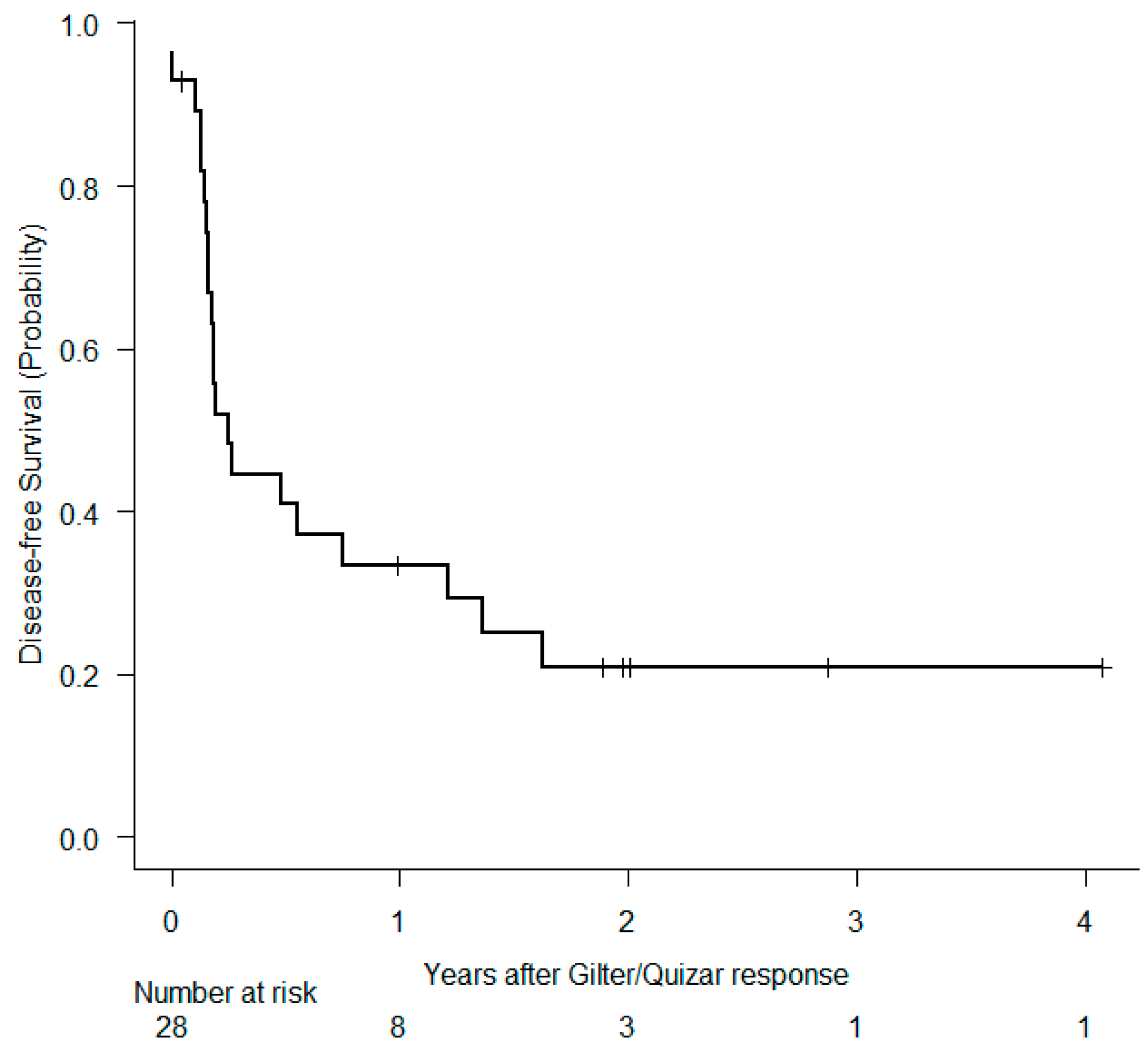
The outcome measures were overall response rate (ORR), median probability of OS and disease-free survival (DFS). The ORR included CR, CRi, and PR rates. Response to FLT3i was assessed at the end of cycle 1 (first day of cycle 2) and then when deemed appropriate by the physician, based on the response achieved. OS was calculated from the date of start gilter/quizar treatment to the date of last follow-up or death. DFS was measured from the date of response achieved after gilter/quizar treatment to the date of relapse/progression, last follow-up or death. The toxicity was graded in accordance with the Common Terminology Criteria for Adverse Events (CTCAE), version 5.0 [26].
The patients’ characteristics at diagnosis and at the start of treatment with gilteritinib or quizartinib were described as median and range (for quantitative variables) and frequency and percentages (for categorical variables). To assess the difference between some paired continuous variables (diagnosis—R/R), the non-parametric Wilcoxon test was used. OS and DFS were plotted by the Kaplan–Meier method and compared by the log-rank test. A binary logistic regression model was used to identify prognostic factors for CR/CRi rate and ORR. Multivariable analysis for OS was performed by Cox proportional hazards regression model (considering response and transplantation after gilter/quizar as a time-dependent covariates). All analyses were performed using SPSS (v.24) and R (4.2.0) software. Two-sided p values of <0.05 were considered statistically significant.

3. Results

3.1. Patients and Treatment

Fifty patients with R/R FLT3mut AML between January 2016 and December 2021 were included. The main characteristics at the front-line are shown in Table 1.
Table 1. Demographic and clinical characteristics of patients at diagnose and relapse/refractory status.
Most patients (40/50) received frontline IC (anthracycline plus cytarabine) and in 20/40 cases, IC was combined with midostaurin. Ten out of fifty patients were treated upfront with HMA (nine patients with azacitidine and one patient decitabine). The CR + CRi rate to the frontline treatment was 56% (negative minimal measurable disease was observed in 15 out of 20 patients in whom data are available, 14 of them treated with IC). Allo-SCT was performed in first remission to 4 out of 28 patients.
At relapse or lack of response to initial treatment, gilter was administered in 44 patients and quizar in 6 patients. Twenty-eight patients (56%) received a salvage therapy prior to gilter or quizar monotherapy initiation. Most of them had been enrolled in clinical trials with or without FLT3i combinations (n = 5 midostaurin, n = 3 crenolanib vs. placebo, n = 3 quizartinib and n = 1 sorafenib). The CR + CRi rate for first salvage therapy was 48% (12/25 patients, three not evaluable). Allo-SCT was performed in second remission in 8 out of 12 patients.
The median time from initial AML diagnosis to FLT3i initiation as single agents was 11 months [range, 1.43–44.7]. At the time of gilter/quizar salvage, 23 patients (46%) were refractory to previous AML line (5 to first line treatment, 11 to second line, and 7 to more than 2 lines) and 27 patients (54%) were relapsed AML (17 after first line treatment, 7 after 2 lines, and 3 after more than 2 lines). Overall, 50% of patients had received at least one FLT3i (n = 14 midostaurin, n = 2 crenolanib or placebo, n = 2 sorafenib, n = 1 quizartinib), and 6 patients received 2 or more prior FLT3i (n = 3 midostaurin and quizartinib, n = 2 midostaurin and sorafenib, n = 1 midostaurin and crenolanib or placebo).
The main characteristics at the time of starting gilter/quizar are shown in Table 1. Comparing to newly diagnosed AML, patients in R/R had lower WBC and LDH (21.7 × 10⁹/L vs. 5.1 × 10⁹/L and 528 U/L vs. 285 U/L, p < 0.001, respectively). In addition, cytogenetic clonal evolution was demonstrated in R/R status in 8 out of 37 patients studied.

3.2. Outcomes

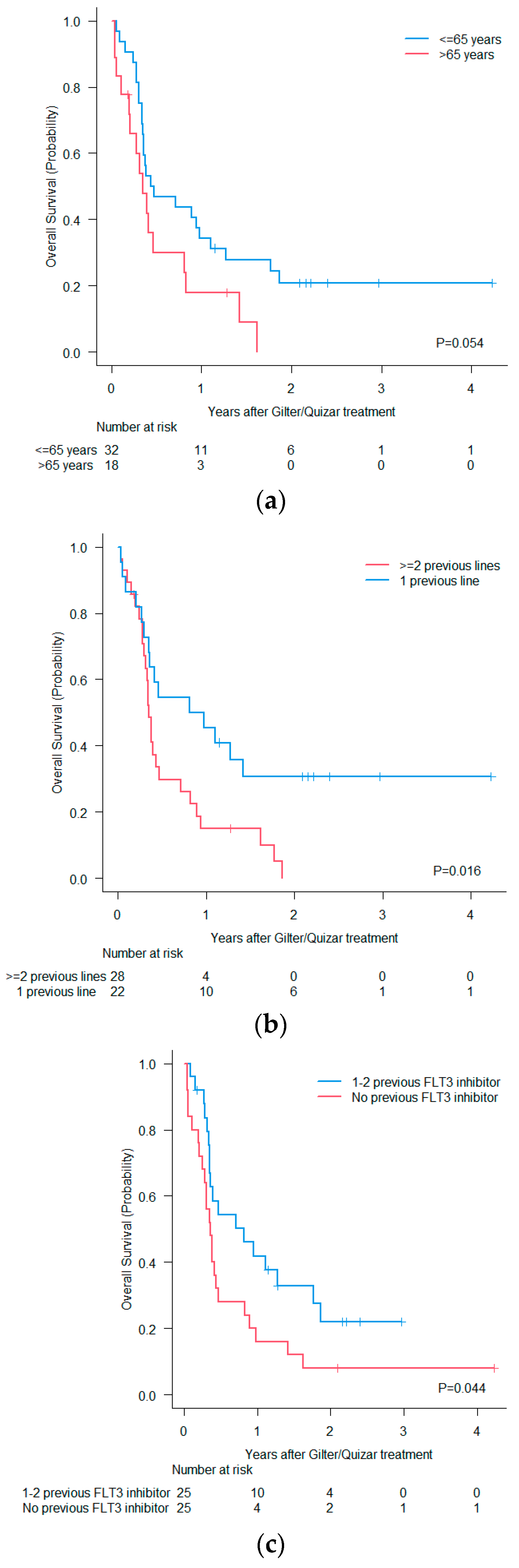
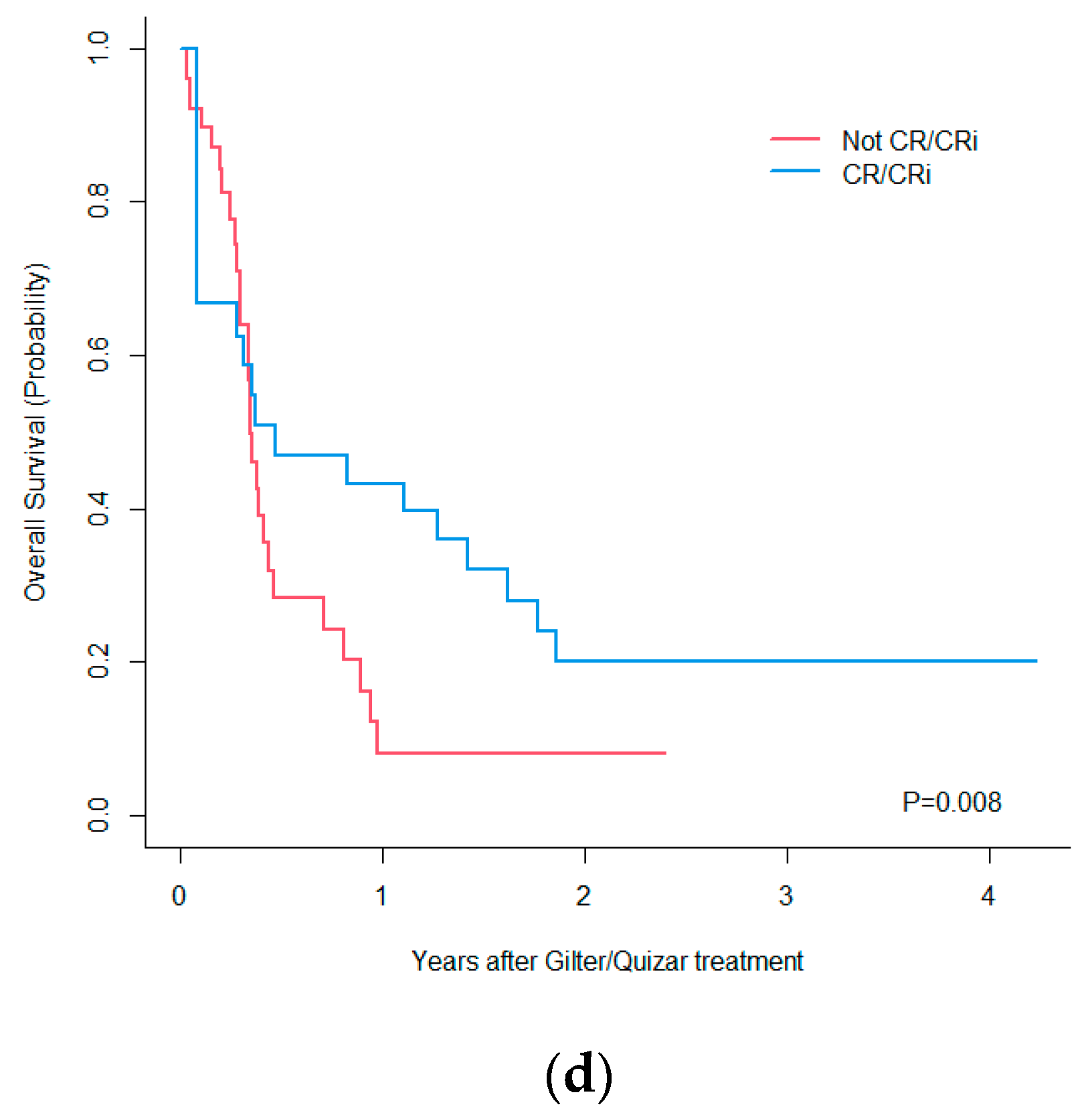
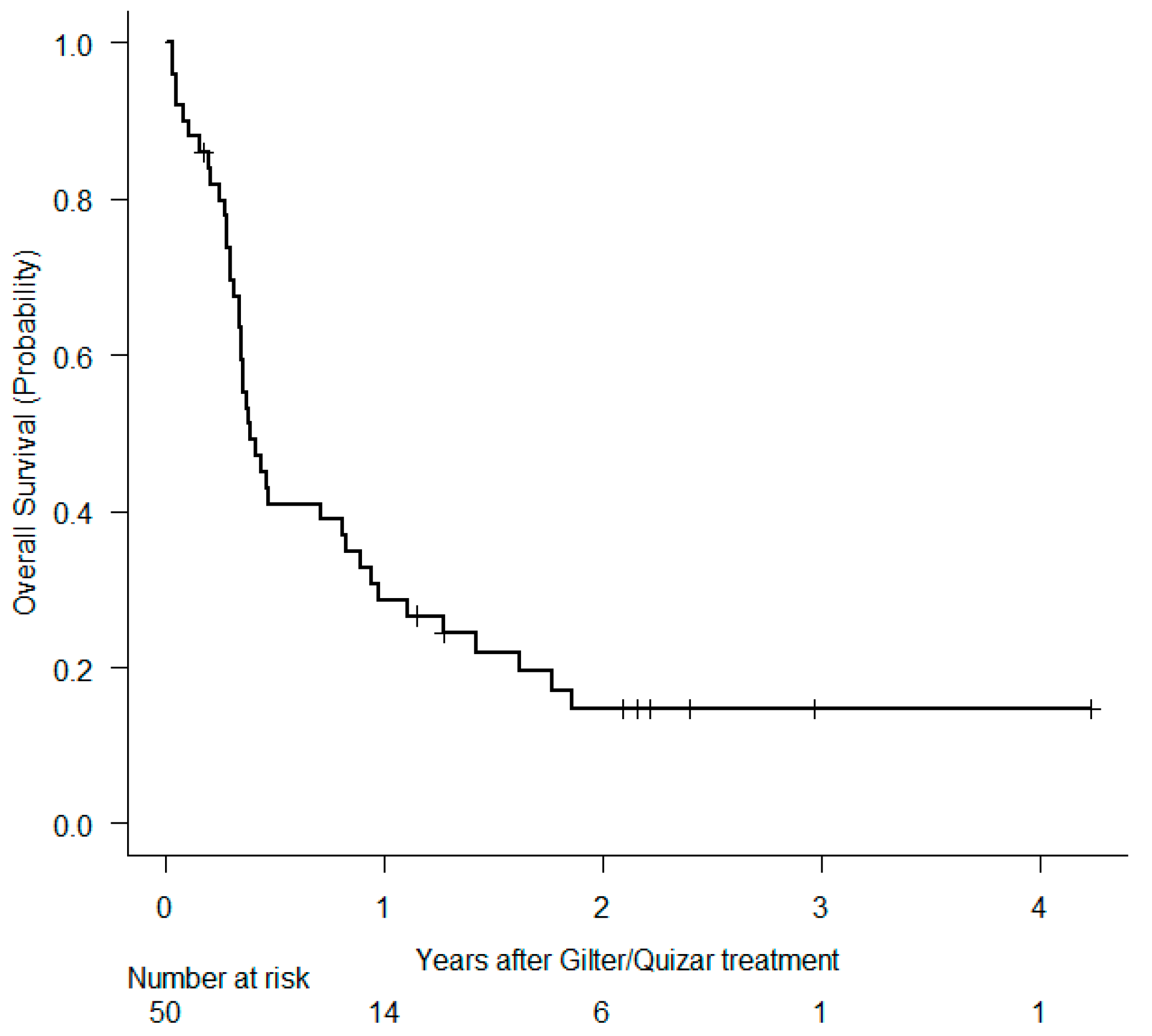
Forty-three patients started with gilter 120 mg (standard dose) and one patient 80 mg due to baseline toxicity. Two patients received quizar 30 mg (recommended initial dose), and four patients 20 mg (concomitant treatment with posaconazole or voriconazole). The median number of administered cycles with gilter and quizar was 3 cycles [range, 1–38] and 4.5 cycles [range, 3–55], respectively. After a median of follow up time of 2.16 years [range, 0.18–4.23] there are nine patients alive and under treatment. Out of 41 death events, 24 (58%) were attributable to leukemia, 13 (32%) were caused by infection (3 patients in CR), 2 hemorrhages (5%) and 2 (5%) acute graft-versus host disease. The percentage of patients who reached CR, CRi and PR was 22%, 18%, and 16%, respectively (CR/CRi 40%, ORR 56%). Two patients died before treatment evaluation due to infections. Ten patients (20%) underwent an allo-SCT, 7 of them in CR/CRi, 1 in PR, and 2 with progressive disease. Median OS and DFS in the whole cohort were 4.74 months [95% CI 4.10–9.92] and 2.99 months [95% CI 1.94–14.53], respectively (Figure 1 and Figure 2). Median OS in patients ≤65 years of age trended higher vs. >65 years (median OS 5.46 months vs. 4.21 months, p = 0.054) (Figure 3a). We also compared OS between patients who had received only one previous line vs. two or more prior lines, and we demonstrated significantly better outcomes in patients with less prior treatment (10.77 months vs. 4.24 months, p = 0.016) (Figure 3b). Comparing OS by number of prior FLT3i, we did not find differences. It should be noted that patients who had not received a prior inhibitor (n = 25) had a significantly worse OS than patients who did receive (4.31 months vs. 9.76 months, p = 0.044) (Figure 3c). Patients who achieved CR/CRi (n = 20) had a 6-month OS of 47% (95% CI, 10–78%) vs. 28% (range, 14–45%) in those not achieving CR/CRi (Figure 3d).
Figure 1. Overall survival for the whole series.
Figure 2. Disease free survival.
Figure 3. Overall survival by subgroups (a): age, (b): pre-treatment lines, (c): previous exposure to FLT3i, (d): response rate as a time-dependent covariate.
In a univariate analysis for response, relapsed AML was associated with higher probability to achieve CR/CRi and ORR compared to refractory AML (OR 3.051, 95% CI 0.921–10.114, p = 0.068 and 3.694, 95% CI 1.139–11.978, p = 0.029). A higher allelic ratio (FLT3-ITD ≥ 0.5) was a favorable factor for CR/CRi (OR 6.0, 95% CI 1.059–34.003, p = 0.043). Age, ECOG PS, WBC count, ELN prognostic risk category, previous treatment with FLT3i, number of previous treatment lines (1 vs. 2 or more), time from diagnosis to gilter/quizar treatment, and previous allo-SCT did not significantly impact the probability of CR/CRi.
In the univariate analysis for survival, age > 65 years old at the time of R/R, higher WBC count, no prior FLT3i exposure, >1 previous therapies, and not achieving CR/CRi with gilter/quizar were associated with worse OS (Table 2). In a multivariable model, not achieving CR/CRi with gilter/quizar, >1 prior therapies, age and WBC count (as continuous variables, increased risk per unit) were independent prognostic factors for OS (Table 2).
Table 2. COX regression analysis for overall survival in patients treated with Gilter/Quizar.

3.3. Toxicity

Thirty-five patients (70%) experienced drug-related toxicity during the treatment (4/6 with quizar and 31/44 with gilter). The most frequent were febrile neutropenia (n = 21), liver impairment (n = 10), and QT interval prolongation (n = 7, 5 gilter and 2 quizar). No clinically significant events of torsade de pointes or arrhythmia were reported. All related toxicities are shown in Table 3. There were two deaths attributed to FLT3i toxicity (both infections). Due to the different toxicities, mainly QT interval prolongation and febrile neutropenia, some patients had dose reduction. However, no patient required treatment discontinuation due to drug-related serious adverse events.
Table 3. Gilter/Quizar related adverse events during treatment.

4. Discussion

In this study, we report a real-world experience including the main characteristics and outcomes of patients with R/R FLT3mut AML treated with second generation FLT3i agents (gilter or quizar) as monotherapy. Access to these drugs was available due to early access programs in Spain. Our results are consistent with those observed in two phase 3 clinical trials with oral inhibitors of FLT3 as a single agent, gilteritinib and quizartinib [13,14].
Compared to the phase 3 trials (ADMIRAL and QuANTUM-R), our study population includes patients with relapsed or refractory AML after a second or subsequent lines of treatment (28 out of 50 patients received ≥2 prior therapies). We also included 25 patients (50%) with a history of prior FLT3i exposure, and 6 patients had received two prior FLT3 inhibitors; in the ADMIRAL trial only 5.7% of patients had received midostaurin in combination with IC in the frontline setting, while in the QuANTUM-R those patients were excluded. The QuANTUM-R cohort was the youngest (median age 55 years vs. 62 years in ADMIRAL and 62.5 years in our study) and they only included FLT3-ITDmut. The proportion of adverse risk cytogenetics was higher in our cohort compared to the QuANTUM-R and ADMIRAL studies (43% vs. 9% and 10.5%, respectively). It should be noted that the Spanish Ministry of Health has excluded the high cytogenetic risk patients form reimbursement of gilter (presumably based of sensitivity analyses of the ADMIRAL trial). When we compare our study population with the real-world data published with Gilteritinib from USA [20], France [21], Israel [22], and Turkey [23]: the median age was 58.3, 65.2, 61, and 55 years old (USA, France, Israel, and Turkey, respectively) and 62.5 years old in our study; the percentage of patients receiving prior FLT3i was 100, 50, 40, and 40.1% (USA, France, Israel, and Turkey, respectively) and 50% in our study; and patients who had received more than one previous line of treatment were included in all the studies. Despite the differences in the reported real-world cohorts, the observed outcomes have been comparable to those published by the phase 3 clinical trials. Rates of overall response (CR, CRi and PR), subsequent allo-SCT and median OS in the current study vs. QuANTUM-R and ADMIRAL were 56% vs. 69% and 67.6%; 20% vs. 32% and 25.5%, and, 4.74 months vs. 6.2 months and 9.3 months, respectively. In real life we observed a worse median OS, but when we analyzed the results excluding patients who received more than one line of treatment (n = 28), the median OS was 10.77 months (range, 3.62–NA). If we compare our results with real-world data from larger US and French studies (n = 113 and n = 140) the CR rate and median OS were more similar (22% vs. 22.1% and 16.9%, and 4.74 months vs. 7 and 6.4 months, respectively) (Table 4).
Table 4. Comparative real-world data studies with gilteritinib.
The prognostic factors that may affect the achievement of CR/CRi or OS are controversial. Achieving a CR and undergoing an Allo-SCT were independent favorable prognostic factors to improve OS in two [21,22] real-world series. We confirm that achieving a CR/CRi is a favorable prognostic factor for OS, but also lower age, WBC count and number previous treatment lines were independent factors. When we focus on the analysis of FLT3 mutations, we observe, as in the ADMIRAL trial, that allelic ratio ITD FLT3mut ≥ 0.5 was a favorable factor for CR/CRi, TKD mutation was associated with worse outcomes in our series, but this was not an independent prognostic factor. There are controversial data about gender impact survival in this population. In the ADMIRAL trial, female gender was associated with a significant HR for death of 0.57 (0.40–0.82), contrary to what they found in the French study where the HR was 1.61 (1.07–2.42, p = 0.02); and in our study, gender did not affect in CR/CRi rate or OS.
The first-line use of FLT3i may contribute to cross-resistance to single agents [27]. Perl et al. [28], retrospectively, compared clinical outcomes in patients with R/R FLT3mut AML in the CHRYSALIS [29] (multicenter, first-in-human, open label, phase 1/2 trial which assessed the safety, tolerability, and pharmacokinetic effects of gilteritinib in R/R FLT3mut AML) and ADMIRAL trials who received prior midostaurin or sorafenib against those without prior FLT3i exposure. Similarly high rates of composite complete remission (CRc) were observed in patients who received FLT3i before gilteritinib (CHRYSALIS, 42%; ADMIRAL, 52%) and those without (CHRYSALIS, 43%; ADMIRAL, 55%). Regarding OS, no significant differences were observed regardless of whether or not they had previously received a FLT3i (CHRYSALIS, OS 7.2 months vs. 7.5 months; ADMIRAL, OS 8.7 months vs. 9.5 months). In the current study, there were 25 patients previously treated with FLT3i, 19 patients received one inhibitor, and 6 patients received two inhibitors. It should be noted that prior exposure to one or more FLT3i did not affect OS in our study; although this variable was significant on univariate analyses, it was not on multivariate analysis. To interpret these results, we have analyzed the clinical and demographic characteristics of these patients and the only difference between the groups (previously treated with FLT3i vs. not treated) was age. The mean age at R/R episode was significantly higher among unexposed patients (62.9 vs. 53.2 years; p = 0.02). In multivariate analyses from the French real world-data [30] prior treatment with midostaurin and prior treatment with other FLT3i were not prognostic factors associated with response. Contrarily, Yilmaz et al. [31] published the MD Anderson Cancer Center retrospective experience of the response rates to sequential FLT3i exposure, and they observed that the response rate dropped progressively with sequential exposure to FLT3i. Additionally, in their experience, in all settings, CRc rates were higher with FLT3i based combinations compared with a single agent.
Our study affirms the efficacy and safety of second generation FLT3i in R/R FLT3mut AML. The most frequent side effects were hematological. Non-hematological side effects were sporadic and controlled with temporary suspension and dose adjustment. There were few cases of QTc interval prolongation in all real-world studies (no torsade de pointes) and differentiation syndrome was only described in the French study [21].
This study has few limitations, which include a retrospective design and the relatively small number of patients. Bone marrow sample evaluation and diagnosis was performed by different pathologist from all participant centers, and mutational data demonstrating mechanisms of resistance to FLT3i were missing. However, although our study population includes heavily pretreated patients (in comparison to the ADMIRAL and QuANTUM-R), we reproduced similar data from these phase 3 clinical trials.

5. Conclusions

In conclusion, in this multicenter real-world study, second generation FLT3i (gilter/quizar) are effective and well-tolerated. Our analysis shows that patients previously treated with FTL3i also respond to treatment. Nevertheless, outcomes with single agents are suboptimal and further improvement is needed, especially in patients treated in second salvage or beyond. Clinical trials with new strategies are urgently needed for patient’s R/R FLT3 mutated AML.

Author Contributions

S.V. and P.M. contributed to study design. S.V., D.Q., I.C.-F., A.S., E.A.-C., M.C. (Marta Cervera), M.D.-B., B.V., J.Á.R.-P., M.A., A.G., A.B., A.I.C., P.H.-P., J.S., R.C., M.T. (Mar Tormo), J.L.-M., S.G.-Á., M.S.C., I.P., G.R.-M., M.C. (María Calbacho), A.P., A.H., M.T. (Melissa Torres), L.C., M.M.C., D.M.-C., J.E. and P.M. enrolled and managed study patients, provided collection and assembly of data. S.V. and D.Q. analyzed the data and M.M. provided statistical support. All authors participated contributed to the writing of the manuscript. All authors have read and agreed to the published version of the manuscript.

Funding

This research received no external funding.

Institutional Review Board Statement

The study was conducted in accordance with the Declaration of Helsinki and approved by the Ethics Committee of Hospital Germans Trias i Pujol (protocol code PI-24-179, 26 June 2024).

Data Availability Statement

Data available upon request due to restrictions (study approved by an ethics committee and subject to the study’s own investigations under informed consent signed by the included patients). The data presented in this study are available upon request from the corresponding author for ethical reasons.

Acknowledgments

The authors thank the patients and their families, nurses and support staff. The authors also thank CETLAM (Grupo Cooperativo de Estudio y Tratamiento de las Leucemias Agudas y Mielodisplásicas) and PETHEMA (Programa Para el Estudio de la Terapéutica en Hemopatías Malignas) Foundation which sponsored this clinical study.

Conflicts of Interest

S.V.: Travel, accommodations, expenses from Astellas Pharma, Pfizer, Servier, AbbVie, and Jazz Pharmaceuticals; consulting or advisory role (without honoraria) for Astellas Pharma, Pfizer, Servier, AbbVie, and Jazz Pharmaceuticals. D.Q.: declares no conflicts of interest. M.M.: declares no conflicts of interest. I.CF.: declares no conflicts of interest. A.S.: declares no conflicts of interest. E.AC.: declares no conflicts of interest. M.C.: declares no conflicts of interest. M.DB.: declares no conflicts of interest. B.V.: declares no conflicts of interest. JA.RP.: Travel, accommodations, expenses from AbbVie, Beigene, Johnson & Johnson, Pfizer and Jazz Pharmaceuticals; consulting or advisory role (with honoraria) for Astellas Pharma. Speakers’ bureaus for AbbVie, Beigene and Astellas Pharma. M.A.: declares no conflicts of interest. A.G.: declares no conflicts of interest. A.B.: Travel, accommodations, expenses from Astellas Pharma, Pfizer, Servier, AbbVie, Gilead, and Jazz Pharmaceuticals; consulting or advisory role for Astellas Pharma, Pfizer, AbbVie, and Jazz Pharmaceuticals. AI.C.: declares no conflicts of interest. P.HP.: declares no conflicts of interest. J.S.: declares no conflicts of interest. R.C.: declares no conflicts of interest. M.T.: declares no conflicts of interest. J.LM.: declares no conflicts of interest. S.GA.: declares no conflicts of interest. MS.C.: declares no conflicts of interest. I.P.: declares no conflicts of interest. G.RM.: declares no conflicts of interest. M.C.: declares no conflicts of interest. A.P.: declares no conflicts of interest. A.H.: declares no conflicts of interest. M.T.: declares no conflicts of interest. L.C.: declares no conflicts of interest. MM.C.: declares no conflicts of interest. D.MC.: declares no conflicts of interest. J.E.: declares no conflicts of interest. P.M.: Consultancy or advisory role with Servier, Bristol Myers Squibb, and Novartis; speakers’ bureaus for Servier, Bristol Myers Squibb, Jazz Pharmaceuticals, Sanofi, AbbVie, and TEVA; research funding from Bristol Myers Squibb, AbbVie, and Daiichi Sankyo; travel, accommodations, or expenses from Pfizer.

References

  1. Ravandi, F.; Kantarjian, H.; Faderl, S.; Garcia-Manero, G.; O’Brien, S.; Koller, C.; Pierce, S.; Brandt, M.; Kennedy, D.; Cortes, J.; et al. Outcome of patients with FLT3-mutated acute myeloid leukemia in first relapse. Leuk. Res. 2010, 34, 752–756. [Google Scholar] [CrossRef]
  2. Cocciardi, S.; Dolnik, A.; Kapp-Schwoerer, S.; Rücker, F.G.; Lux, S.; Blätte, T.J.; Skambraks, S.; Krönke, J.; Heidel, F.H.; Schnöder, T.M.; et al. Clonal evolution patterns in acute myeloid leukemia with NPM1 mutation. Nat. Commun. 2019, 10, 2031. [Google Scholar] [CrossRef] [PubMed]
  3. Arber, D.A.; Orazi, A.; Hasserjian, R.P.; Borowitz, M.J.; Calvo, K.R.; Kvasnicka, H.M.; Wang, S.A.; Bagg, A.; Barbui, T.; Branford, S.; et al. International consensus classifications of myeloid neoplasms and acute leukemias: Integrating morphologic, clinical, and genomic data. Blood 2022, 140, 1200–1228. [Google Scholar] [CrossRef]
  4. Khoury, J.D.; Solary, E.; Abla, O.; Akkari, Y.; Alaggio, R.; Apperley, J.F.; Bejar, R.; Berti, E.; Busque, L.; Chan, J.K.C.; et al. The 5th edition of the World Health Organization Classification of Haematolymphoid Tumours: Myeloid and Histiocytic/Dendritic Neoplasms. Leukemia 2022, 36, 1703–1719. [Google Scholar] [CrossRef] [PubMed]
  5. Döhner, H.; Wei, A.H.; Appelbaum, F.R.; Craddock, C.; DiNardo, C.D.; Dombret, H.; Ebert, B.L.; Fenaux, P.; Godley, L.A.; Hasserjian, R.P.; et al. Diagnosis and management of AML in adults: 2022 recommendations from an international expert panel on behalf of the ELN. Blood 2022, 140, 1345–1377. [Google Scholar] [CrossRef] [PubMed]
  6. Stone, R.M.; Mandrekar, S.J.; Sanford, B.L.; Laumann, K.; Geyer, S.; Bloomfield, C.D.; Thiede, C.; Prior, T.W.; Döhner, K.; Marcucci, G.; et al. Midostaurin plus Chemotherapy for Acute Myeloid Leukemia with a FLT3 Mutation. N. Engl. J. Med. 2017, 377, 454–464. [Google Scholar] [CrossRef]
  7. Larson, R.A.; Mandrekar, S.J.; Huebner, L.J.; Sanford, B.L.; Laumann, K.; Geyer, S.; Bloomfield, C.D.; Thiede, C.; Prior, T.W.; Döhner, K.; et al. Midostaurine reduces relapse in FLT3-mutant acute myeloid leukemia: The Alliance CALGB 10603/RATIFY trial. Leukemia 2021, 35, 2539–2551. [Google Scholar] [CrossRef]
  8. Erba, H.P.; Montesinos, P.; Kim, H.J.; Patkowska, E.; Vrhovac, R.; Žák, P.; Wang, P.N.; Mitov, T.; Hanyok, J.; Kamel, Y.M.; et al. Quizartinib plus chemotherapy in newly diagnosed patients with FLT3-internal-tandem-duplication-positive acute myeloid leukaemia (QuANTUM-First): A randomised, double-blind, placebo-controlled, phase 3 trial. Lancet 2023, 401, 1571–1583. [Google Scholar] [CrossRef]
  9. Wang, E.S.; Montesinos, P.; Minden, M.D.; Lee, J.H.; Heuser, M.; Naoe, T.; Chou, W.C.; Laribi, K.; Esteve, J.; Altman, J.K.; et al. Phase 3 trial of gilteritinib plus azacitidine vs azacitidine for newly diagnosed FLT3mut+ AML ineligible for intensive chemotherapy. Blood 2022, 140, 1845–1857. [Google Scholar] [CrossRef]
  10. Daver, N.; Perl, A.E.; Maly, J.; Levis, M.; Ritchie, E.; Litzow, M.; McCloskey, J.; Smith, C.C.; Schiller, G.; Bradley, T.; et al. Venetoclax Plus Gilteritinib for FLT3-Mutated Relapsed/Refractory Acute Myeloid Leukemia. J. Clin. Oncol. 2022, 40, 4048–4059. [Google Scholar] [CrossRef]
  11. Ma, J.; Zhao, S.; Qiao, X.; Knight, T.; Edwards, H.; Polin, L.; Kushner, J.; Dzinic, S.H.; White, K.; Wang, G.; et al. Inhibition of Bcl-2 Synergistically Enhances the Antileukemic Activity of Midostaurin and Gilteritinib in Preclinical Models of FLT3-Mutated Acute Myeloid Leukemia. Clin. Cancer Res. 2019, 25, 6815–6826. [Google Scholar] [CrossRef] [PubMed]
  12. Short, N.J.; Daver, N.; Dinardo, C.D.; Kadia, T.; Nasr, L.F.; Macaron, W.; Yilmaz, M.; Borthakur, G.; Montalban-Bravo, G.; Garcia-Manero, G.; et al. Azacitidine, Venetoclax, and Gilteritinib in Newly Diagnosed and Relapsed or Refractory FLT3-Mutated AML. J. Clin. Oncol. 2024, 42, 1499–1508. [Google Scholar] [CrossRef]
  13. Perl, A.E.; Larson, R.A.; Podoltsev, N.A.; Strickland, S.; Wang, E.S.; Atallah, E.; Schiller, G.J.; Martinelli, G.; Neubauer, A.; Sierra, J.; et al. Follow-up of patients with R/R FLT3-mutation-positive AML treated with gilteritinib in the phase 3 ADMIRAL trial. Blood 2022, 139, 3366–3375. [Google Scholar] [CrossRef] [PubMed]
  14. Cortes, J.E.; Khaled, S.; Martinelli, G.; Perl, A.E.; Ganguly, S.; Russell, N.; Krämer, A.; Dombret, H.; Hogge, D.; Jonas, B.A.; et al. Quizartinib versus salvage chemotherapy in relapsed or refractory FLT3-ITD acute myeloid leukaemia (QuANTUM-R): A multicentre, randomised, controlled, open-label, phase 3 trial. Lancet Oncol. 2019, 20, 984–997. [Google Scholar] [CrossRef] [PubMed]
  15. Mohebbi, A.; Shahriyary, F.; Farrokhi, V.; Bandar, B.; Saki, N. A systematic review of second-generation FLT3 inhibitors for treatment of patients with relapsed/refractory acute myeloid leukemia. Leuk. Res. 2024, 141, 107505. [Google Scholar] [CrossRef]
  16. Travaglini, S.; Gurnari, C.; Ottone, T.; Voso, M.T. Advances in the pathogenesis of FLT3 -mutated acute myeloid leukemia and targeted treatments. Curr. Opin. Oncol. 2024, 36, 569–576. [Google Scholar] [CrossRef]
  17. Daver, N.; Schlenk, R.F.; Russell, N.H.; Levis, M.J. Targeting FLT3 mutations in AML: Review of current knowledge and evidence. Leukemia 2019, 33, 299–312. [Google Scholar] [CrossRef]
  18. Larrosa-García, M.; Baer, M.R. FLT3 Inhibitors in Acute Myeloid Leukemia: Current Status and Future Directions. Mol. Cancer Ther. 2017, 16, 991–1001. [Google Scholar] [CrossRef]
  19. Loschi, M.; Sammut, R.; Chiche, E.; Cluzeau, T. FLT3 Tyrosine Kinase Inhibitors for the Treatment of Fit and Unfit Patients with FLT3-Mutated AML: A Systematic Review. Int. J. Mol. Sci. 2021, 22, 5873. [Google Scholar] [CrossRef]
  20. Numan, Y.; Abdel Rahman, Z.; Grenet, J.; Boisclair, S.; Bewersdorf, J.P.; Collins, C.; Barth, D.; Fraga, M.; Bixby, D.L.; Zeidan, A.M.; et al. Gilteritinib clinical activity in relapsed/refractory FLT3 mutated acute myeloid leukemia previously treated with FLT3 inhibitors. Am. J. Hematol. 2022, 97, 322–328. [Google Scholar] [CrossRef]
  21. Dumas, P.Y.; Bertoli, S.; Bérard, E.; Largeaud, L.; Bidet, A.; Delabesse, E.; Leguay, T.; Leroy, H.; Gadaud, N.; Rieu, J.B.; et al. Real-World Outcomes of Patients with Refractory or Relapsed FLT3-ITD Acute Myeloid Leukemia: A Toulouse-Bordeaux DATAML Registry Study. Cancers 2020, 12, 2044. [Google Scholar] [CrossRef] [PubMed]
  22. Shimony, S.; Canaani, J.; Kugler, E.; Nachmias, B.; Ram, R.; Henig, I.; Frisch, A.; Ganzel, C.; Vainstein, V.; Moshe, Y.; et al. Gilteritinib monotherapy for relapsed/refractory FLT3 mutated acute myeloid leukemia: A real-world, multi-center, matched analysis. Ann. Hematol. 2022, 101, 2001–2010. [Google Scholar] [CrossRef] [PubMed]
  23. Dogu, M.H.; Tekgunduz, A.I.E.; Deveci, B.; Korkmaz, G.; Comert, M.; Sevindik, O.G.; Yokus, O.; Serin, I. Gilteritinib (XOSPATA®) in Turkey: Early Access Program Results. Mediterr. J. Hematol. Infect. Dis. 2023, 15, e2023031. [Google Scholar] [CrossRef]
  24. Arber, D.A.; Orazi, A.; Hasserjian, R.; Thiele, J.; Borowitz, M.J.; Le Beau, M.M.; Bloomfield, C.D.; Cazzola, M.; Vardiman, J.W. The 2016 revision to the World Health Organization classification of myeloid neoplasms and acute leukemia. Blood 2016, 127, 2391–2405. [Google Scholar] [CrossRef] [PubMed]
  25. Döhner, H.; Estey, E.; Grimwade, D.; Amadori, S.; Appelbaum, F.R.; Büchner, T.; Dombret, H.; Ebert, B.L.; Fenaux, P.; Larson, R.A.; et al. Diagnosis and management of AML in adults: 2017 ELN recommendations from an international expert panel. Blood 2017, 129, 424–447. [Google Scholar] [CrossRef]
  26. Common Terminology Criteria for Advers Events (CTACAE). Available online: https://ctep.cancer.gov/protocoldevelopment/electronic_applications/docs/ctcae_v5_quick_reference_5x7.pdf (accessed on 1 January 2021).
  27. Perrone, S.; Ottone, T.; Zhdanovskaya, N.; Molica, M. How acute myeloid leukemia (AML) escapes from FMS-related tyrosine kinase 3 (FLT3) inhibitors? Still an overrated complication? Cancer Drug Resist. 2023, 6, 223–238. [Google Scholar] [CrossRef]
  28. Perl, A.E.; Hosono, N.; Montesinos, P.; Podoltsev, N.; Martinelli, G.; Panoskaltsis, N.; Recher, C.; Smith, C.C.; Levis, M.J.; Strickland, S.; et al. Clinical outcomes in patients with relapsed/refractory FLT3-mutated acute myeloid leukemia treated with gilteritinib who received prior midostaurin or sorafenib. Blood Cancer J. 2022, 12, 84. [Google Scholar] [CrossRef]
  29. Perl, A.E.; Altman, J.K.; Cortes, J.; Smith, C.; Litzow, M.; Baer, M.R.; Claxton, D.; Erba, H.P.; Gill, S.; Goldberg, S.; et al. Selective inhibition of FLT3 by gilteritinib in relapsed or refractory acute myeloid leukaemia: A multicentre, first-in-human, open-label, phase 1–2 study. Lancet Oncol. 2017, 18, 1061–1075. [Google Scholar] [CrossRef]
  30. Dumas, P.Y.; Raffoux, E.; Bérard, E.; Bertoli, S.; Hospital, M.A.; Heiblig, M.; Desbrosses, Y.; Bonmati, C.; Pautas, C.; Lambert, J.; et al. Gilteritinib activity in refractory or relapsed FLT3-mutated acute myeloid leukemia patients previously treated by intensive chemotherapy and midostaurin: A study from the French AML Intergroup ALFA/FILO. Leukemia 2023, 37, 91–101. [Google Scholar] [CrossRef]
  31. Yilmaz, M.; Alfayez, M.; DiNardo, C.D.; Borthakur, G.; Kadia, T.M.; Konopleva, M.Y.; Loghavi, S.; Kanagal-Shamanna, R.; Patel, K.P.; Jabbour, E.J.; et al. Outcomes with sequential FLT3-inhibitor-based therapies in patients with AML. J. Hematol. Oncol. 2020, 13, 132. [Google Scholar] [CrossRef]
Disclaimer/Publisher’s Note: The statements, opinions and data contained in all publications are solely those of the individual author(s) and contributor(s) and not of MDPI and/or the editor(s). MDPI and/or the editor(s) disclaim responsibility for any injury to people or property resulting from any ideas, methods, instructions or products referred to in the content.

Article Metrics

Citations

Article Access Statistics

Multiple requests from the same IP address are counted as one view.