Effects of Bipolar Disorder on the Verbal Fluency Skills of Native Speakers

 , , , and
Abstract
1. Introduction
2. Methodology
2.1. Study Design
2.2. Participants
2.3. Data Collection Instruments
2.4. Verbal Fluency Task
2.5. Procedure
2.6. Blinding and Inter-Rater Reliability
2.7. Data Analysis
3. Results
4. Discussion
Limitations and Future Research Directions
5. Conclusions
Author Contributions
Funding
Institutional Review Board Statement
Informed Consent Statement
Data Availability Statement
Conflicts of Interest
References
- Belmaker, R.H. Medical progress: Bipolar disorder. N. Engl. J. Med. 2004, 351, 476–486. [Google Scholar] [CrossRef] [PubMed]
- Merikangas, K.R.; Akiskal, H.S.; Angst, J.; Greenberg, P.E.; Hirschfeld, R.M.; Petukhova, M.; Kessler, R.C. Lifetime and 12-month prevalence of bipolar spectrum disorder in the National Comorbidity Survey replication. Arch. Gen. Psychiatry 2007, 64, 543–552. [Google Scholar] [CrossRef]
- American Psychiatric Association. Diagnostic and Statistical Manual of Mental Disorders, 5th ed.; American Psychiatric Publishing: Washington, DC, USA, 2013. [Google Scholar] [CrossRef]
- Oral, T.E. Treatment of acute mania. Neuro Endocrinol. Lett. 2005, 26, 9–25. [Google Scholar] [PubMed]
- Erten, E. Acute and maintenance treatment of bipolar depression. Arch. Neuropsychiatry 2021, 58, 31–40. [Google Scholar] [CrossRef] [PubMed]
- Sadock, B.J.; Sadock, V.A. Sadock & Sadock’s Comprehensive Textbook of Psychiatry, 8th ed.; Güneş Kitabevi: Ankara, Turkey, 2007. [Google Scholar]
- Currier, D.; Mann, M.J.; Oquendo, M.A.; Galfalvy, H.; Mann, J.J. Sex differences in the familial transmission of mood disorders. J. Affect. Disord. 2006, 95, 51–60. [Google Scholar] [CrossRef]
- Stringaris, A.; Youngstrom, E. Unpacking the differences in US/UK rates of clinical diagnoses of early-onset bipolar disorder. J. Am. Acad. Child Adolesc. Psychiatry 2014, 53, 609–611. [Google Scholar] [CrossRef]
- Sobczak, S.; Honig, A.; Riedel, W.J. Acute tryptophan depletion in bipolar disorders. Acta Neuropsychiatr. 2000, 12, 69–72. [Google Scholar] [CrossRef]
- Shen, J.; Tomar, J.S. Elevated brain glutamate levels in bipolar disorder and pyruvate carboxylase-mediated anaplerosis. Front. Psychiatry 2021, 12, 640977. [Google Scholar] [CrossRef]
- Aita, S.L.; Beach, J.D.; Taylor, S.E.; Borgogna, N.C.; Harrell, M.N.; Hill, B.D. Executive, language, or both? An examination of the construct validity of verbal fluency measures. Appl. Neuropsychol. Adult 2018, 25, 417–426. [Google Scholar] [CrossRef]
- Docherty, N.M.; Hawkins, K.A.; Hoffman, R.E.; Quinlan, D.M.; Rakfeldt, J.; Sledge, W.H. Working memory, attention, and communication disturbances in schizophrenia. J. Abnorm. Psychol. 1996, 105, 212–219. [Google Scholar] [CrossRef]
- Ferrier, I.N.; Stanton, B.R.; Kelly, T.P.; Scott, J. Neuropsychological function in euthymic patients with bipolar disorder. Br. J. Psychiatry 1999, 175, 246–251. [Google Scholar] [CrossRef] [PubMed]
- Frankenberg, C.; Weiner, J.; Knebel, M.; Abulimiti, A.; Toro, P.; Herold, C.J.; Schultz, T.; Schröder, J. Verbal fluency in normal aging and cognitive decline: Results of a longitudinal study. Comput. Speech Lang. 2021, 68, 101195. [Google Scholar] [CrossRef]
- Lott, P.R.; Guggenbühl, S.; Schneeberger, A.; Pulver, A.E.; Stassen, H.H. Linguistic analysis of the speech output of schizophrenic, bipolar, and depressive patients. Psychopathology 2002, 35, 220–227. [Google Scholar] [CrossRef]
- Rossell, S.L.; David, A.S. Are semantic deficits in schizophrenia due to problems with access or storage? Schizophr. Res. 2006, 82, 121–134. [Google Scholar] [CrossRef]
- Sung, K.; Gordon, B.; Vannorsdall, T.D.; Ledoux, K.; Schretlen, D.J. Impaired retrieval of semantic information in bipolar disorder: A clustering analysis of category-fluency productions. J. Abnorm. Psychol. 2013, 122, 624–634. [Google Scholar] [CrossRef]
- Nwulia, E.A.; Miao, K.; Zandi, P.P.; MacKinnon, D.F.; DePaulo, R., Jr.; McInnis, M.G. Genome-wide scan of bipolar II disorder. Bipolar Disord. 2007, 9, 580–588. [Google Scholar] [CrossRef]
- Tunçer, A.M. Türkçe Konuşan Yetişkin Popülasyonun Sözel Akıcılık Becerilerinin Yaş, Eğitim ve Cinsiyete Göre Incelenmesi ve Sözcük Normlarının Oluşturulması. Ph.D. Thesis, Anadolu Üniversitesi Sağlık Bilimleri Enstitüsü, Eskişehir, Turkey, 2011. [Google Scholar]
- Maviş, İ.; Toğram, B. Action Verbal Fluency Normative Data for the Turkish Population. In Proceedings of the International Science Conference, Potsdam, Germany, 27 August–1 September 2010. [Google Scholar]
- Tombaugh, T.N.; Kozak, J.; Rees, L. Normative data stratified by age and education for two measures of verbal fluency: FAS and animal naming. Arch. Clin. Neuropsychol. 1999, 14, 167–177. [Google Scholar] [CrossRef] [PubMed]
- Güven, A.G.; Cangökçe, Ö. Sağlıklı yetişkinlerde okuma ve fonemik-harf akıcılığı üzerinde eğitim düzeyi ve cinsiyetin rolü. Türk Psikol. Derg. 2006, 21, 109–120. [Google Scholar]
- Steiner, V.A.G.; Mansur, L.L.; Brucki, S.M.D.; Nitrini, R. Phonemic verbal fluency and age: A preliminary study. Dement. Neuropsychol. 2008, 2, 328–332. [Google Scholar] [CrossRef]
- Tumaç, A. Normal Deneklerde, Frontal Hasarlara Duyarlı Bazı Testlerde Performansa yaş ve Eğitimin Etkisi. Master’s Thesis, İstanbul Üniversitesi Sosyal Bilimler Enstitüsü, İstanbul, Turkey, 1997. [Google Scholar]
- Karakaş, S.; Eski, R.; Başar, E. Türk Kültürü için Standardizasyonu Yapılmış Nöropsikolojik Testler Topluluğu: BİLNOT Bataryası; Nobel Tıp Kitapevi: İstanbul, Turkey, 1996. [Google Scholar]
- De Almeida Rocca, C.C.; de Macedo-Soares, M.B.; Gorenstein, C.; Tamada, R.S.; Isller, C.K.; Dias, R.S.; de Almeida, K.M.; Schwartzmann, A.M.; Amaral, J.A.; Lafer, B. Verbal fluency dysfunction in euthymic bipolar patients: A controlled study. J. Affect. Disord. 2008, 107, 187–192. [Google Scholar] [CrossRef]
- Clark, L.; Iversen, S.D.; Goodwin, G.M. Sustained attention deficit in bipolar disorder. Br. J. Psychiatry 2002, 180, 313–319. [Google Scholar] [CrossRef]
- Cavanagh, J.T.O.; Van Beck, M.; Muir, W.; Blackwood, D.H.R. Case–control study of neurocognitive function in euthymic patients with bipolar disorder: An association with mania. Br. J. Psychiatry 2002, 180, 320–326. [Google Scholar] [CrossRef]
- Chang, K.M.K.; Mitchell, T.; Just, M.A. Quantitative modeling of the neural representation of objects: How semantic feature norms can account for fMRI activation. NeuroImage 2011, 56, 716–727. [Google Scholar] [CrossRef]
- Rossell, S.L.; Batty, R.A. Elucidating semantic disorganisation from a word comprehension task: Do patients with schizophrenia and bipolar disorder show differential processing of nouns, verbs and adjectives? Schizophr. Res. 2008, 102, 63–68. [Google Scholar] [CrossRef]
- Johnston, A.E.; Rossell, S.L.; Gleeson, J.F. Evidence of semantic processing abnormalities in schizotypy using an indirect semantic priming task. J. Nerv. Ment. Dis. 2008, 196, 694–701. [Google Scholar] [CrossRef][Green Version]
- Sumiyoshi, C.; Matsui, M.; Sumiyoshi, T.; Yamashita, I.; Sumiyoshi, S.; Kurachi, M. Semantic structure in schizophrenia as assessed by the category fluency test: Effect of verbal intelligence and age of onset. Psychiatry Res. 2001, 105, 187–199. [Google Scholar] [CrossRef] [PubMed]
- Cotrena, C.; Damiani Branco, L.; Ponsoni, A.; Samamé, C.; Milman Shansis, F.; Paz Fonseca, R. Executive functions and memory in bipolar disorders I and II: New insights from meta-analytic results. Acta Psychiatr. Scand. 2020, 141, 110–130. [Google Scholar] [CrossRef] [PubMed]
- Tsitsipa, E.; Fountoulakis, K.N. The neurocognitive functioning in bipolar disorder: A systematic review of data. Ann. Gen. Psychiatry 2015, 14, 42. [Google Scholar] [CrossRef] [PubMed]
- Orhan, M.; Korten, N.; Stek, M.; Comijs, H.; Schouws, S.; Dols, A. The relationship between cognitive and social functioning in older patients with bipolar disorder. J. Affect. Disord. 2018, 240, 177–182. [Google Scholar] [CrossRef] [PubMed]
- Arts, B.; Jabben, N.; Krabbendam, L.; van Os, J. Meta-analyses of cognitive functioning in euthymic bipolar patients and their first-degree relatives. Psychol. Med. 2008, 38, 771–785. [Google Scholar] [CrossRef]
- Bourne, C.; Aydemir, Ö.; Balanzá-Martínez, V.; Bora, E.; Brissos, S.; Cavanagh, J.T.O.; Clark, L.; Cubukcuoglu, Z.; Dias, V.V.; Dittmann, S.; et al. Neuropsychological testing of cognitive impairment in euthymic bipolar disorder: An individual patient data meta-analysis. Acta Psychiatr. Scand. 2013, 128, 149–162. [Google Scholar] [CrossRef]
- Krabbendam, L.; Arts, B.; van Os, J.; Aleman, A. Cognitive functioning in patients with schizophrenia and bipolar disorder: A quantitative review. Schizophr. Res. 2005, 80, 137–149. [Google Scholar] [CrossRef] [PubMed]
- Porter, R.J.; Robinson, L.J.; Malhi, G.S.; Gallagher, P. The neurocognitive profile of mood disorders: A review of the evidence and methodological issues. Bipolar Disord. 2015, 17, 21–40. [Google Scholar] [CrossRef] [PubMed]
- Burgess, P.W. Strategy application disorder: The role of the frontal lobes in human multitasking. Psychol. Res. 2000, 63, 279–288. [Google Scholar] [CrossRef] [PubMed]
- Chan, A.H.; Liu, H.L.; Yip, V.; Fox, P.T.; Gao, J.H.; Tan, L.H. Neural systems for word meaning modulated by semantic ambiguity. NeuroImage 2004, 22, 1128–1133. [Google Scholar] [CrossRef]
- Frangou, S.; Dakhil, N.; Landau, S.; Kumari, V. Frontotemporal function may distinguish bipolar disorder from schizophrenia. Bipolar Disord. 2006, 8, 47–55. [Google Scholar] [CrossRef]
- Sung, K.; Gordon, B.; Vannorsdall, T.D.; Ledoux, K.; Pickett, E.J.; Pearlson, G.D.; Schretlen, D.J. Semantic clustering of category fluency in schizophrenia examined with singular value decomposition. J. Int. Neuropsychol. Soc. 2012, 18, 565–575. [Google Scholar] [CrossRef]
- Van Lancker Sidtis, D.; Sidtis, J.J. Cortical-subcortical production of formulaic language: A review of linguistic, brain disorder, and functional imaging studies leading to a production model. Brain Cogn. 2018, 126, 53–64. [Google Scholar] [CrossRef]
- Marko, M.; Michalko, D.; Dragašek, J.; Vančová, Z.; Jarčušková, D.; Riečanský, I. Assessment of automatic and controlled retrieval using verbal fluency tasks. Assessment 2023, 30, 2198–2211. [Google Scholar] [CrossRef]
- Birn, R.M.; Kenworthy, L.; Case, L.; Caravella, R.; Jones, T.B.; Bandettini, P.A.; Martin, A. Neural systems supporting lexical search guided by letter and semantic category cues: A self-paced overt response fMRI study of verbal fluency. NeuroImage 2010, 49, 1099–1107. [Google Scholar] [CrossRef]
- Costafreda, S.G.; Fu, C.H.; Lee, L.; Everitt, B.; Brammer, M.J.; David, A.S. A systematic review and quantitative appraisal of fMRI studies of verbal fluency: Role of the left inferior frontal gyrus. Hum. Brain Mapp. 2006, 27, 799–810. [Google Scholar] [CrossRef] [PubMed]


| ICC (Single Measures) | 95% CI (Lower) | 95% CI (Upper) | |
|---|---|---|---|
| Household items | 0.913 | 0.909 | 0.915 |
| Beverages | 0.914 | 0.911 | 0.916 |
| Action words | 0.915 | 0.913 | 0.917 |
| Emotion words | 0.91 | 0.905 | 0.913 |
| Animals and fruits | 0.915 | 0.913 | 0.916 |
| /k/ sound | 0.914 | 0.911 | 0.916 |
| /s/ sound | 0.913 | 0.909 | 0.915 |
| /a/ sound | 0.914 | 0.911 | 0.916 |
| Months | 0.854 | 0.820 | 0.877 |
| Days | 0.897 | 0.800 | 0.965 |
| Effect | df | F | p | η2p | |
|---|---|---|---|---|---|
| Household items | Bipolar Type | 2, 74 | 20.362 | <0.001 | 0.355 |
| Age | 1, 74 | 0.012 | 0.915 | <0.001 | |
| Beverages | Bipolar Type | 2, 74 | 35.264 | <0.001 | 0.488 |
| Age | 1, 74 | 0.003 | 0.958 | <0.001 | |
| Action words | Bipolar Type | 2, 74 | 40.555 | <0.001 | 0.523 |
| Age | 1, 74 | 0.072 | 0.789 | <0.001 | |
| Emotion words | Bipolar Type | 2, 74 | 23.473 | <0.001 | 0.388 |
| Age | 1, 74 | 0.008 | 0.928 | <0.001 | |
| Animals and fruits | Bipolar Type | 2, 74 | 213.141 | <0.001 | 0.852 |
| Age | 1, 74 | 0.030 | 0.862 | <0.001 | |
| /k/ sound | Bipolar Type | 2, 74 | 35.922 | <0.001 | 0.493 |
| Age | 1, 74 | 1.137 | 0.290 | 0.015 | |
| /s/ sound | Bipolar Type | 2, 74 | 27.180 | <0.001 | 0.424 |
| Age | 1, 74 | 0.058 | 0.811 | <0.001 | |
| /a/ sound | Bipolar Type | 2, 74 | 51.741 | <0.001 | 0.583 |
| Age | 1, 74 | 0.961 | 0.330 | 0.013 | |
| Months | Bipolar Type | 2, 74 | 1.607 | 0.207 | 0.042 |
| Age | 1, 74 | 1.277 | 0.262 | 0.017 | |
| Days | Bipolar Type | 2, 74 | 1.440 | 0.243 | 0.037 |
| Age | 1, 74 | 1.455 | 0.232 | 0.019 |
| Variable | BD-I | BD-II | Control | χ2 | df | p | ε2 |
|---|---|---|---|---|---|---|---|
| Household items | 17.5 (7–29) | 20 (16–25) | 25 (17–45) | 22.62 | 2 | <0.001 | 0.424 |
| Beverages | 12 (5–24) | 10 (8–15) | 23.5 (12–30) | 28.62 | 2 | <0.001 | 0.541 |
| Action verbs | 11.5 (0–21) | 13 (7–23) | 26.5 (17–39) | 32.98 | 2 | <0.001 | 0.627 |
| Emotion words | 7 (0–26) | 7 (3–13) | 15.5 (8–25) | 25.56 | 2 | <0.001 | 0.482 |
| Animals and fruits | 0.5 (0–9) | 6 (1–8) | 20 (12–27) | 40.47 | 2 | <0.001 | 0.774 |
| /k/ sound | 10.5 (1–25) | 16 (4–23) | 24.5 (14–35) | 27.66 | 2 | <0.001 | 0.523 |
| /s/ sound | 10 (0–27) | 13 (2–20) | 22 (13–38) | 26.39 | 2 | <0.001 | 0.498 |
| /a/ sound | 9.5 (0–19) | 13 (3–23) | 23.5 (14–35) | 33.62 | 2 | <0.001 | 0.64 |
| Months | 12 (0–12) | 12 (12–12) | 12 (12–12) | 4.39 | 2 | 0.111 | 0.067 |
| Days | 7 (0–7) | 7 (7–7) | 7 (7–7) | 2.87 | 2 | 0.237 | 0.037 |
| BD I (n = 27) | BD II (n = 12) | Control (n = 39) | p | Effect Size | ||
|---|---|---|---|---|---|---|
| Age, Md (Min–Max) ‡ | 43 (23–66) | 25 (19–58) | 41 (20–63) | 0.081 | 0.04 ε2 | |
| Illness Duration (Months), M (SD) | 88.81 (55.9) | 76.75 (20.9) | - | |||
| Gender, n (%) § | ||||||
| Female | 17 (63) | 8 (66.7) | 25 (64.1) | 0.976 | 0.02 V | |
| Male | 10 (37) | 4 (33.3) | 14 (35.9) | |||
| Education, n (%) § | ||||||
| Primary School | 4 (14.8) | 3 (25) | 6 (15.4) | 0.871 | 0.14 V | |
| Middle School | 3 (11.1) | 0 (0) | 5 (12.8) | |||
| High School | 8 (29.6) | 5 (41.7) | 14 (35.9) | |||
| University | 12 (44.4) | 4 (33.3) | 14 (35.9) | |||
| Socioeconomic Status, n (%) § | ||||||
| Low | 10 (37) | 6 (50) | 12 (30.8) | |||
| Middle | 12 (44.4) | 4 (33.3) | 17 (43.6) | 0.805 | 0.11 V | |
| High | 5 (18.5) | 2 (16.7) | 10 (25.6) | |||
| Mania, n (%) | ||||||
| 1 | 15 (56) | |||||
| 2 | 5 (18.5) | - | - | |||
| 3 | 5 (18.5) | - | - | |||
| 4 | 2 (7.4) | - | - | |||
| Episodes | Depression, n (%) | - | - | |||
| 0 | 10 (37) | 0 (0) | ||||
| 1 | 12 (44.4) | 10 (83.3) | - | |||
| 2 | 3 (11.1) | 2 (16.7) | - | |||
| 3 | 2 (7.5) | 0 (0) | - | |||
| Hypomania, n (%) | ||||||
| 1 | - | 8 (67) | - | |||
| 2 | - | 3 (25) | - | |||
| 3 | - | 18 (12) | - | |||
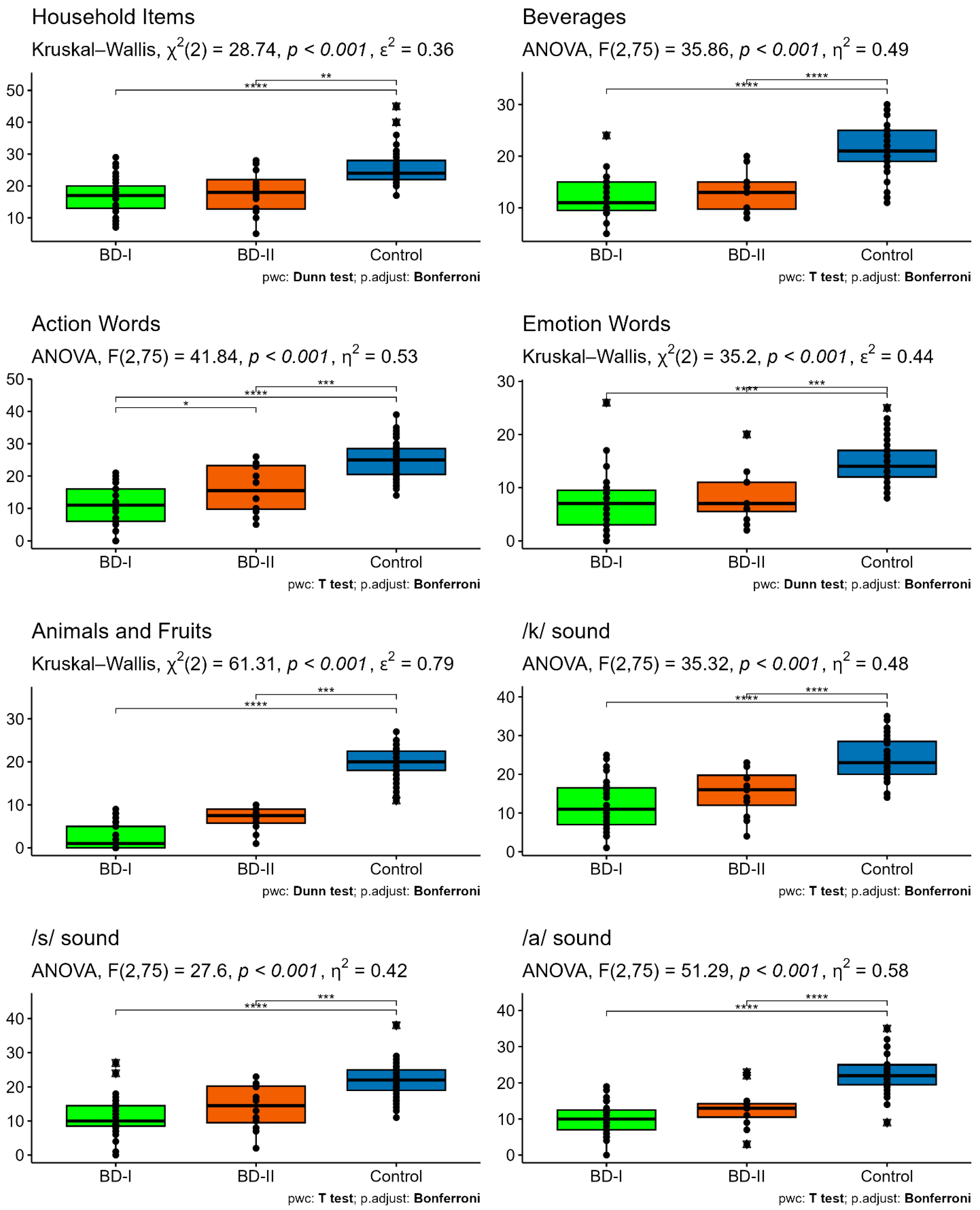
| Household Items, Md (Min–Max) ‡ | 17 (7–29) | 18 (5–28) | 24 (17–45) | <0.001 * | 0.36 ε2 | |
| Beverages, M (SD) † | 12.19 (4.2) | 12.92 (3.91) | 21.49 (5.27) | <0.001 * | 0.49 η2 | |
| Action Words, M (SD) † | 10.52 (6.56) | 16 (7.39) | 24.97 (5.96) | <0.001 * | 0.53 η2 | |
| Emotion Words, Md (Min–Max) ‡ | 7 (0–26) | 7 (2–20) | 14 (8–25) | <0.001 * | 0.44 ε2 | |
| Animals and Fruits, Md (Min–Max) ‡ | 1 (0–9) | 7.5 (1–10) | 20 (11–27) | <0.001 * | 0.79 ε2 | |
| /k/ sound, M (SD) † | 11.89 (6.47) | 15.33 (6.09) | 23.92 (5.38) | <0.001 * | 0.48 η2 | |
| /s/ sound, M (SD) † | 11.19 (6.03) | 14.08 (6.62) | 21.38 (5.02) | <0.001 * | 0.42 η2 | |
| /a/ sound, M (SD) † | 10.15 (4.54) | 13.08 (5.58) | 22.56 (5.28) | <0.001 * | 0.58 η2 | |
| Months, M (SD) † | 11.07 (3.19) | 12 (0) | 12 (0) | 0.125 | 0.05 η2 | |
| Days, M (SD) † | 6.48 (1.86) | 7 (0) | 7 (0) | 0.148 | 0.05 η2 | |
| BD I vs. BD II | BD I vs. Control | BD II vs. Control | |
|---|---|---|---|
| Household Items ‡ | 1.000 | <0.001 * | 0.003 * |
| Beverages † | 1.000 | <0.001 * | <0.001 * |
| Action Words † | 0.048 * | <0.001 * | <0.001 * |
| Emotion Words ‡ | 1.000 | <0.001 * | 0.001 * |
| Animals and Fruits ‡ | 0.232 | <0.001 * | <0.001 * |
| /k/ sound † | 0.287 | <0.001 * | <0.001 * |
| /s/ sound † | 0.429 | <0.001 * | 0.001 * |
| /a/ sound † | 0.302 | <0.001 * | <0.001 * |
| Months † | 0.481 | 0.160 | 1.000 |
| Days † | 0.535 | 0.191 | 1.000 |
Disclaimer/Publisher’s Note: The statements, opinions and data contained in all publications are solely those of the individual author(s) and contributor(s) and not of MDPI and/or the editor(s). MDPI and/or the editor(s) disclaim responsibility for any injury to people or property resulting from any ideas, methods, instructions or products referred to in the content. |
© 2026 by the authors. Licensee MDPI, Basel, Switzerland. This article is an open access article distributed under the terms and conditions of the Creative Commons Attribution (CC BY) license.
Share and Cite
Sakın, B.; Eroğlu Uzun, D.; Cangi, M.E.; Gençer, A.G.; Arslan, M.; Aktaş, S. Effects of Bipolar Disorder on the Verbal Fluency Skills of Native Speakers. Brain Sci. 2026, 16, 228. https://doi.org/10.3390/brainsci16020228
Sakın B, Eroğlu Uzun D, Cangi ME, Gençer AG, Arslan M, Aktaş S. Effects of Bipolar Disorder on the Verbal Fluency Skills of Native Speakers. Brain Sciences. 2026; 16(2):228. https://doi.org/10.3390/brainsci16020228
Chicago/Turabian StyleSakın, Bertuğ, Dilek Eroğlu Uzun, Mehmet Emrah Cangi, Ali Görkem Gençer, Mehtap Arslan, and Selman Aktaş. 2026. "Effects of Bipolar Disorder on the Verbal Fluency Skills of Native Speakers" Brain Sciences 16, no. 2: 228. https://doi.org/10.3390/brainsci16020228
APA StyleSakın, B., Eroğlu Uzun, D., Cangi, M. E., Gençer, A. G., Arslan, M., & Aktaş, S. (2026). Effects of Bipolar Disorder on the Verbal Fluency Skills of Native Speakers. Brain Sciences, 16(2), 228. https://doi.org/10.3390/brainsci16020228