
Article

Understanding the Impacts of Climate Change and Landcover/Land Use Transformations on Highlands Hydrological Ecosystem Services in the Piuray–Ccorimarca Watershed (Andean Cordillera of Peru)


1
National Service of Meteorology and Hydrology of Peru (SENAMHI), Lima 15072, Peru
2
UMR 5563 Géosciences Environnement Toulouse (GET), Université de Toulouse, CNRS, IRD, UPS, CNES, OMP, 14 Avenue Edouard Belin, 31400 Toulouse, France
3
Water Research and Technology Center (CITA), Universidad de Ingeniería y Tecnología (UTEC), Lima 15063, Peru
4
National Institute for Research on Glaciers and Mountain Ecosystems (INAIGEM), Huaraz 02001, Peru
*
Author to whom correspondence should be addressed.
Climate 2026, 14(2), 49; https://doi.org/10.3390/cli14020049
Submission received: 9 November 2025 / Revised: 28 January 2026 / Accepted: 30 January 2026 / Published: 6 February 2026

Abstract

Watersheds provide fundamental hydrological ecosystem services for human well-being and the environment, such as water provisioning, hydrological cycle regulation, and erosion control; however, these services face increasing anthropogenic and climatic pressures. This study assessed individual and combined impacts on the hydrological functionality of the Piuray–Ccorimarca watershed (Cusco, Peru) using a calibrated Soil and Water Assessment Tool (SWAT) model, analyzing water yield, soil water storage, and sediment transport across 20 scenarios. An ensemble of 10 Coupled Model Intercomparison Project Phase 6 (CMIP6) models with bias correction was implemented, integrated with land transformation projections contemplating urban expansion associated with airport development and forest recovery through Payment for Ecosystem Services mechanisms. The results reveal climate change as the dominant driver, generating water yield increases and soil water content improvements primarily due to evapotranspiration decoupling that increases the runoff coefficient. In contrast, land use change produces substantially smaller hydrological effects but critically intensifies sediment yield. Spatial vulnerability analysis identified eight persistently critical sub-basins (20.5% of area) where soil water content emerged as the dominant limiting factor. These findings establish a clear management hierarchy prioritizing climate adaptation over land use interventions, with differentiated strategies required for critical zones demanding structural interventions versus non-critical areas amenable to flexible conservation approaches.

1. Introduction

Hydrological ecosystem services (HES) constitute fundamental elements for human well-being and ecosystem functioning, encompassing water capture, storage, purification, and regulation [1]. These services play a crucial role in the provision of drinking water, agricultural irrigation, sustenance of terrestrial and aquatic ecosystems, and mitigation of extreme climatic events. However, despite the growing importance of HES, research on their alteration under the combined influence of climate change and land use and land cover (LULC) dynamics remains limited, with significant knowledge gaps persisting regarding how these factors interact and affect key aspects such as water availability, quality, and regulation.
High Andean ecosystems represent regions of particular vulnerability to climatic and anthropogenic pressures [2]. High Andean watersheds provide essential water resources for millions of inhabitants in South America, being especially sensitive to climatic variations due to their dependence on seasonal precipitation and snowmelt processes [3,4]. Climate change has the potential to alter hydrological regimes, while LULC changes can increase surface runoff, erosion, and sedimentation, compromising hydrological regulation [5,6]. The integrated assessment of HES is crucial for anticipating synergistic impacts and developing resilient management strategies [7]. Hydrological models have become established as effective tools for quantifying HES, with multi-model approaches that reduce uncertainties [8]. Among these, the SWAT (Soil and Water Assessment Tool) model has proven to be a robust tool for evaluating water resources and ecosystem services at the watershed scale [9,10,11,12,13]. Its capacity to integrate multiple hydrological components makes it an ideal tool for comprehensive HES assessments [13,14,15].
Applications of SWAT for evaluating HES under climate change and LULC scenarios have experienced significant advances in the last decade. Recent studies have demonstrated the model’s capacity to quantify spatial and temporal trade-offs between water regulation and erosion control services, evidencing that high water yield areas frequently coincide with zones of low sedimentary erosion [16]. Comparative research has established that high forest cover scenarios maximize erosion control services but reduce water regulation services, while scenarios with lower vegetation cover show the inverse pattern [17]. These applications have incorporated spatial mapping techniques that facilitate the identification of critical service provision zones and support the optimization of future land use decisions [16].
Despite growing interest in hydrological modeling in Peru, applications of the SWAT model have predominantly concentrated on simulating historical conditions, without considering the effects of climate change and LULC [18,19,20,21,22]. Studies that have integrated climate projections show a methodological evolution, establishing foundations for monthly modeling in Andean–Amazonian watersheds with differentiated hydrological responses according to geographic location [23]; consolidating downscaling techniques with 31 climate models projecting increases in precipitation and runoff during the wet season in the Chancay–Huaral watershed [24]; and incorporating socioeconomic variables in the Vilcanota–Urubamba watershed, where higher streamflows are projected during the wet season but lower water retention capacity will reduce water availability during the dry season [25].
On the other hand, studies in Peruvian territory have evidenced differentiated LULC patterns according to geographic region. In Amazonian watersheds such as Madre de Dios, deforestation significantly increases surface runoff while reducing evapotranspiration [26]. In the central Andes, high Andean grasslands and shrublands have decreased due to agricultural expansion associated with population return, while degraded soils and exotic forest plantations have increased, evidencing that natural ecosystems have a slow recovery [27]. On the northern coast, analysis of the Piura River watershed using satellite products revealed a decrease in agricultural areas and an increase in bare soil, suggesting agricultural degradation and potential desertification, with significant relationships between vegetation dynamics and extreme climatic events such as the El Niño-Southern Oscillation (ENSO) [28].
Research in various regions of the world on combined HES-based modeling demonstrates that climate change constitutes the predominant factor in water yield variability, while LULC changes exert greater influence on spatial distribution patterns and water quality services [29,30]. This trend has been corroborated in Peruvian watersheds using the SWAT hydrological model. The evaluation of the transboundary Puyango–Tumbes watershed projects substantial increases in streamflow and sediment production, intensifying flood risk [31], while in the Utcubamba River watershed, reductions in minimum flows and increases in peak flows are anticipated [32]. Likewise, research in Andean watersheds concludes that climate change will exert greater impact than LULC modifications and that conservation of existing ecosystems is more effective than planned afforestation [33]. Among anthropogenic factors, urbanization constitutes the main driver of hydrological alteration in watersheds, surpassing agricultural expansion and forest conversion [34]. Its impacts affect water regulation and erosion control [35], while in Andean watersheds, urban growth in floodplains intensifies sedimentation and increases water yield [36].
The Piuray–Ccorimarca watershed represents a relevant case study due to its strategic position in the Andean mountain range and the development pressures associated with the projected airport expansion. Therefore, the present research evaluates and quantifies the individual and combined effects of climate change and LULC on HES through integrated hydrological modeling. This approach seeks to generate robust information on complex interactions between climate, land use, and water provision, providing scientific evidence to strengthen sustainable watershed management and support the formulation of regional water policies.

2. Materials and Methods

2.1. Study Area Description

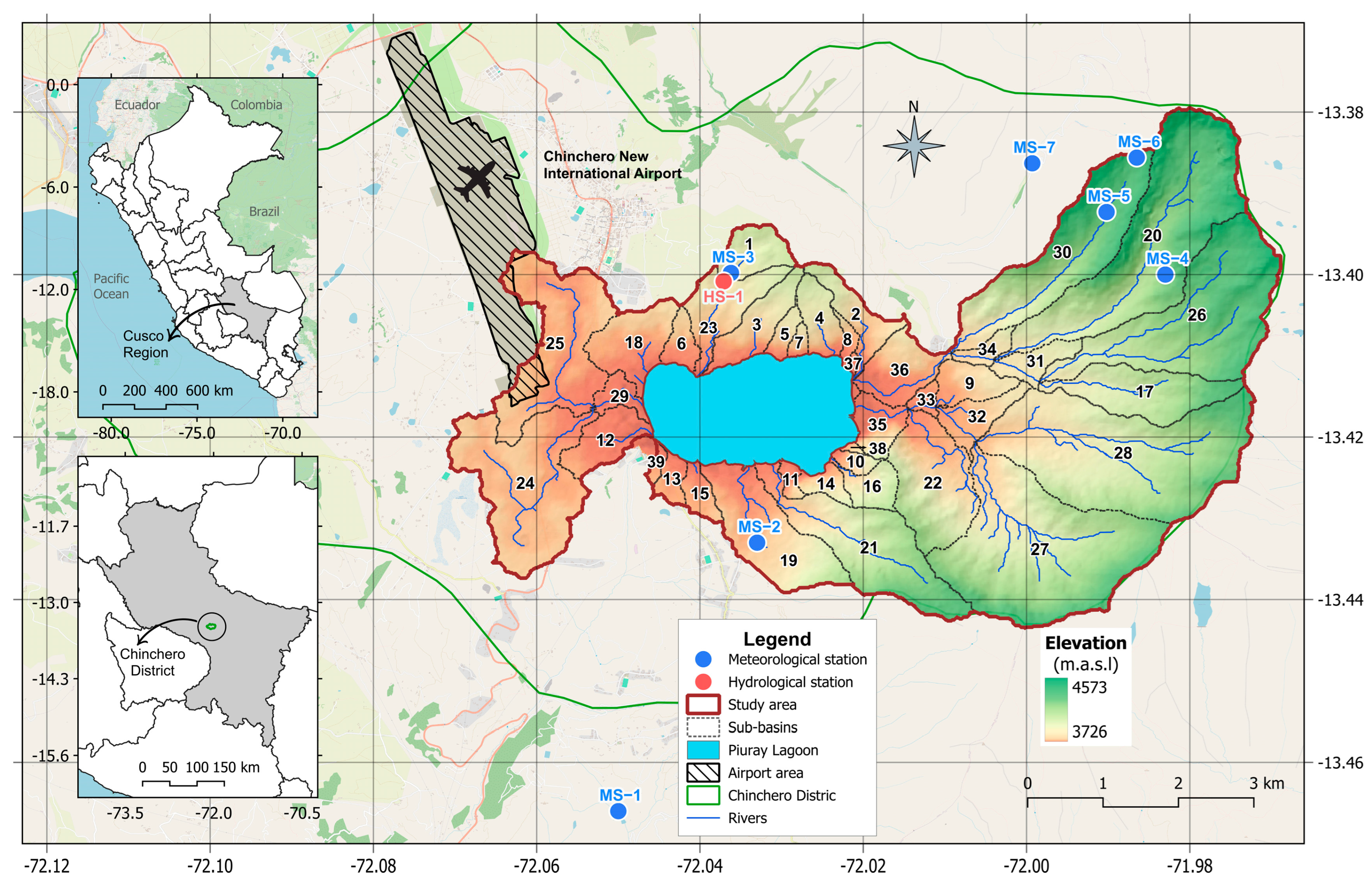
The Piuray–Ccorimarca watershed (PCW) is located in the district of Chinchero, Urubamba Province, Cusco Region, southeastern Peru (Figure 1). Covering an area of approximately 42.82 km2, it is part of the Vilcanota River basin and is characterized by the presence of small natural lakes. Among them, Lake Piuray is the main water body, with a surface area of 3.6 km2, fed by streams and springs, and constitutes the primary source of water supply for approximately 170,083 inhabitants of the city of Cusco (about 42% of its population) [37]. This lacustrine system plays a key regulatory role in the hydrological regime of the basin, functioning as a natural reservoir that stores water during the rainy season and gradually releases it during the dry period. The PCW represents a flagship case in the implementation of Payment for Ecosystem Services mechanisms (MERESE) in Peru [38], which have been in operation since 2013 through a tripartite agreement involving the Municipality of Chinchero, the Cusco Water and Sanitation Utility (SEDACUSCO), and local residents of the watershed. Implemented interventions include infiltration trenches, reforestation with native species, and the construction of earthen check dams.
From a physiographic perspective, the PCW was discretized into 39 sub-basins based on topographic analysis. Elevation ranges from 3733 to 4559 m a.s.l., with slopes below 10% in areas adjacent to the lake and exceeding 50% in headwater zones. Three main spatial units were identified: (i) the northern and eastern headwater areas (sub-basins 1, 2, 17, 20, 23, 26, 27, 28, and 30), located above 4100 m a.s.l. and characterized by steep slopes, dominated by grasslands and forest cover; (ii) the area surrounding Lake Piuray (sub-basins 3–9 and 31–37), characterized by grasslands, agricultural land, and moderate slopes; and (iii) the southern and southwestern slopes (sub-basins 10–16, 18, 19, 21–25, 29, 38, and 39), where agricultural land use predominates, with the presence of wetlands and urban areas, and gentle to moderate slopes. The climate exhibits pronounced seasonality, with a mean annual precipitation of approximately 927 mm concentrated between October and April, and temperatures ranging from minimum values near −4 °C during June–August to maximum values exceeding 13 °C between September and March. In recent years, the watershed has experienced severe water scarcity episodes, reflected in a critical reduction in water levels [39], a situation of increasing concern given the forthcoming operation of the Chinchero International Airport.

2.2. Data Preparation

Topographic data were obtained from the ALOS PALSAR product with a native resolution of 12.5 m https://search.asf.alaska.edu/#/ (accessed on 15 January 2025), derived from Synthetic Aperture Radar (SAR) information, selected for its superior accuracy in mountainous terrain and broader application in hydrological research [40].
For LULC analysis, reference maps from the 1992, 2008, and 2024 periods were utilized from the MapBiomas Peru project https://peru.mapbiomas.org/ (accessed on 12 January 2025), generated through automated classification techniques applied to Landsat imagery with a spatial resolution of 30 m and Random Forest machine learning algorithms [41].
Soil characterization was performed using the Digital Soil Open Land Map (DSOLMap) model with a resolution of 250 m https://www.wateritech.com/data (accessed on 10 February 2025), which provides a detailed representation of the soil profile through six distinct horizons, significantly enhancing SWAT model performance in Andean regions [42]. The DSOLMap product does not include an explicit versioning system; therefore, the version published in the referenced study was used.
Seven meteorological stations (MS) with observed daily precipitation (P) and temperature (T) data were employed. The stations are operated by the National Meteorology and Hydrology Service of Peru (SENAMHI) and by The Nature Conservancy (TNC). The observational records were extended and their temporal representativeness improved using the PISCO SENAMHI gridded dataset (Peruvian Interpolated data of SENAMHI’s Climatological and Hydrological Observations) https://iridl.ldeo.columbia.edu/SOURCES/.SENAMHI/.HSR/.PISCO/ (accessed on 18 November 2024) [43,44]. To achieve this temporal extension and enhance the spatial representativeness of the data, the nonparametric quantile mapping method was applied using the Qmap (version 1.0-6) package in R (version 4.4.2) [45,46].
To assess climate change and its impacts on hydrology, data from the BASD-CMIP6-PE dataset [47] https://doi.org/10.5880/pik.2023.001 (accessed on 15 July 2025) were utilized, which includes projections from 10 CMIP6 models with bias correction using the BASD method [48]. This method employs trend-preserving quantile mapping to correct the entire statistical distribution of climate variables, including extreme values, and applies statistical downscaling to increase spatial resolution from approximately 100 km to 10 km. The correction was implemented using 31-day moving windows with high-quality observational data: RAIN4PE [49] for precipitation and PISCO [44] for temperatures, with a training period spanning 1981–2014. The dataset provides daily climate information (precipitation, minimum, mean, and maximum temperature), comprising historical simulations (1850–2014) and future projections (2015–2100) under three Shared Socioeconomic Pathways (SSP1–2.6, SSP3–7.0, and SSP5–8.5), representing different climate sensitivities.
Baseline daily streamflow data are managed by TNC (The Nature Conservancy) through a weir-type gauging station (HS–1) coupled with a HOBO U20L water level sensor (Onset Computer Corporation, Bourne, MA, USA) located in the middle reach of the Pucamarca stream.

2.3. Research Methodology

2.3.1. Implementation and Evaluation of the SWAT Hydrological Model

The implementation of the SWAT model (version 2012) requires input data, including a Digital Elevation Model (DEM), land use and land cover maps, soil properties, and climatic records. SWAT operates as a continuous simulator based on daily meteorological data. The Hargreaves methodology [50] was employed to calculate potential evapotranspiration (PET) using observed daily precipitation and temperature time series, extended through the PISCO product with bias correction via Quantile Mapping [51,52,53]. The “SWAT2Lake” tool (version 1.0), available at https://projects.au.dk/wet/ (accessed on 22 March 2024), was integrated to adequately represent lentic water bodies [54], automating the determination of morphometric parameters. Sub-basins were disaggregated into Hydrological Response Units (HRUs) without applying filtering thresholds, thereby fully preserving spatial variability. Hydrological processes were simulated using the Soil Conservation Service (SCS) curve number method, complemented with the variable storage coefficient for flow routing. Table 1 presents the evaluated parameters and their main characteristics.
A global sensitivity analysis was implemented using the Fourier Amplitude Sensitivity Test (FAST) to identify the most influential parameters in streamflow simulation [55,56]. Ten parameters related to runoff, groundwater, and evaporation were evaluated, previously identified in nearby watersheds [21,26,33].
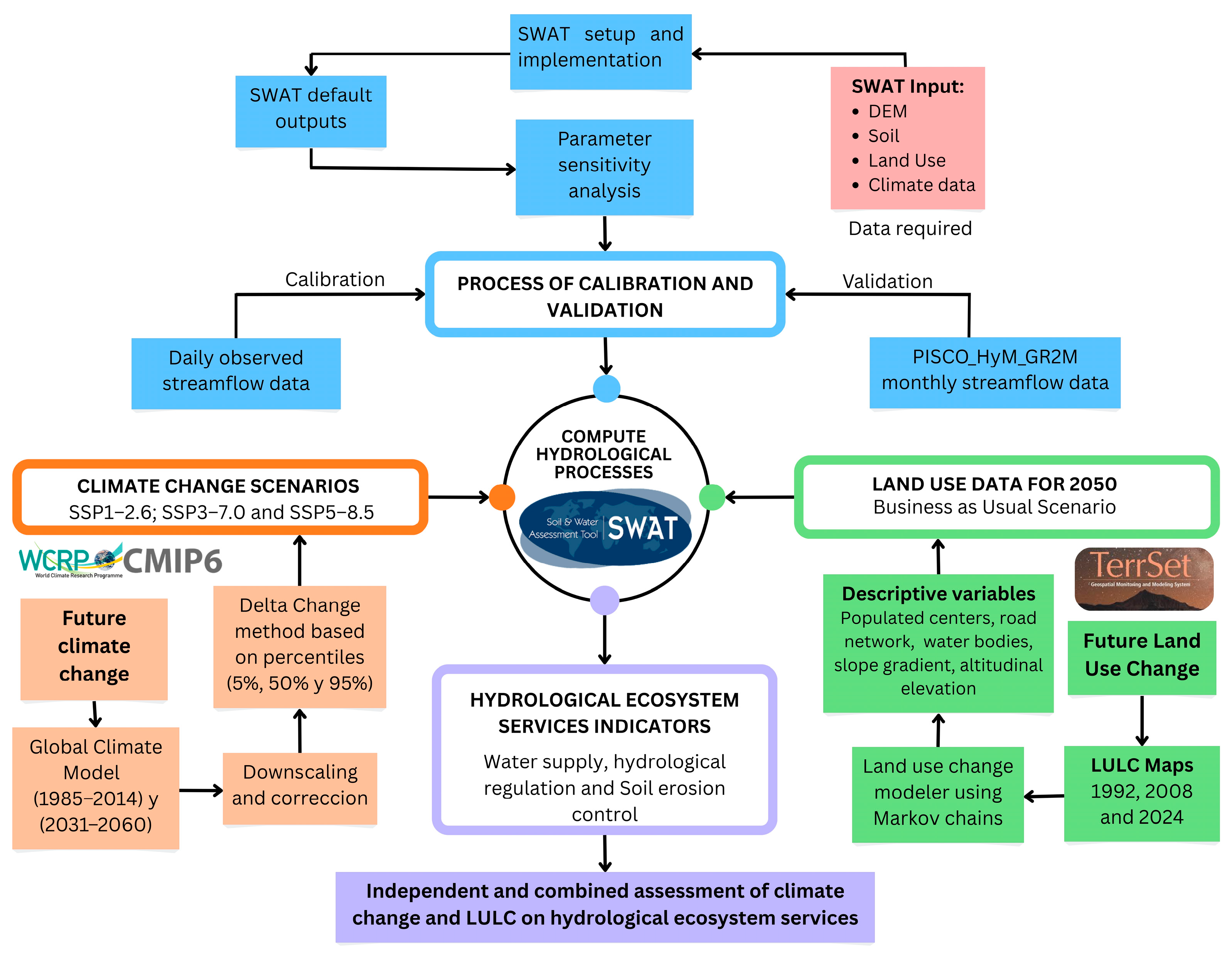
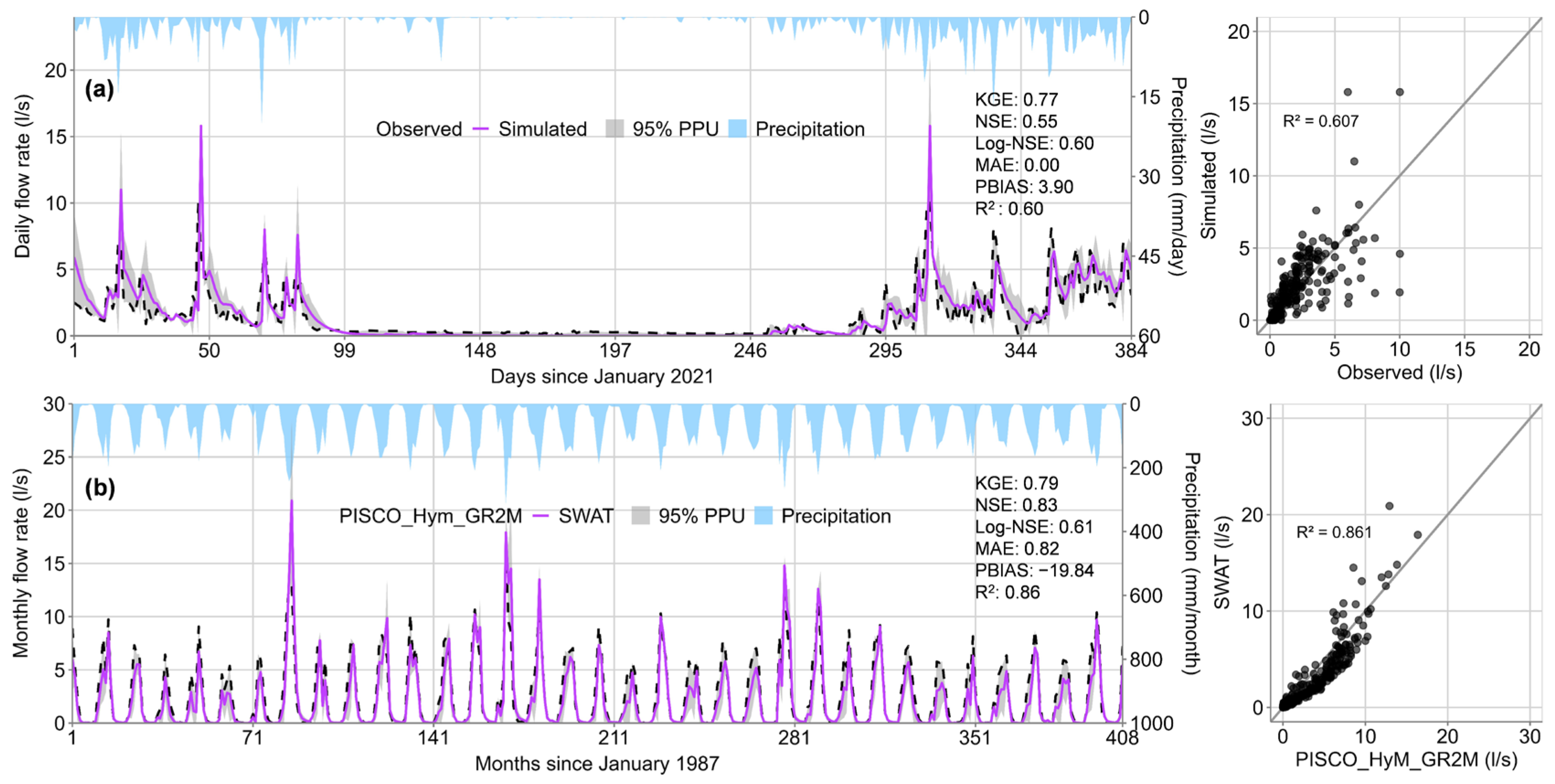
Calibration employed daily streamflow records (January 2021–February 2022) from the hydrological station (HS–1) on Pucamarca stream, preceded by a three-year warm-up period to stabilize the system’s state variables. The NSGA-II multi-objective evolutionary algorithm was utilized [57], simultaneously optimizing three efficiency indicators, Nash–Sutcliffe (NSE), logarithmic Nash–Sutcliffe (log-NSE), and Kling–Gupta (KGE), ensuring adequate representation of both high flows and baseflow. The optimization was executed over 500 iterations, focusing on the most sensitive parameters previously identified. Figure 2 presents the general methodological framework of this study.
Due to the limited availability of hydrological stations and record length, validation was performed through comparison with the monthly PISCO_HyM_GR2M product [58], specifically developed for the Peruvian context through hydrological regionalization. The GR2M model was adapted to the PCW area using calibrated parameters from the corresponding hydrological region, with locally corrected PISCO precipitation and potential evapotranspiration derived from the calibrated SWAT model. Model performance was evaluated using multiple statistical metrics: Nash–Sutcliffe efficiency (NSE), logarithmic Nash–Sutcliffe efficiency (log-NSE), Kling–Gupta efficiency (KGE), Mean Absolute Error (MAE), Percent Bias (PBIAS), and coefficient of determination (R2). Optimal performance is indicated when NSE, log-NSE, KGE, and R2 approach 1 while MAE and PBIAS optimally approach 0. Graphical representations were also used to demonstrate the goodness of fit. Additionally, diagnostics based on hydrological signatures were incorporated to assess the physical consistency of the simulated flow regime [59,60].
On the other hand, due to the absence of observed sediment data on the watershed, calibration and validation of sediment yield (SYLD) were not performed; consequently, no quantitative performance metrics are presented for this variable. This limitation is explicitly acknowledged, and SYLD results should be interpreted for exploratory and comparative purposes rather than as absolute sediment load estimates, with the analysis focusing on relative spatial patterns and directional changes in sediment dynamics under different climate change and land use/land cover (LULC) scenarios.

2.3.2. Climate Change Scenario

Climate projections were analyzed for the 2031–2060 period using the 1985–2014 interval as the historical baseline, following WMO climatological standards that establish 30 years as the minimum period [61]. This time horizon was selected both for its greater scientific robustness compared to more distant projections that accumulate uncertainties exponentially [62] and for its practical utility for EPS SEDACUSCO, which currently implements sustainable development plans in the PCW under a medium-term approach. Thus, the defined evaluation period constitutes a fundamental strategic tool for formulating long-term projections and interventions that ensure the sustainability of water sources and ecosystems linked to the PCW.
The percentile method was applied to characterize climate variability, considering the 5th percentile (optimistic scenario), 50th percentile (median scenario), and 95th percentile (pessimistic scenario) [63,64]. Change deltas were calculated as relative changes (%) for precipitation [65] and absolute changes (°C) for temperature [66], considering the statistical characteristics of each variable. These deltas were applied to observed historical data using the delta change method, preserving local temporal and spatial variability while incorporating climate change signals from global models [67,68].

2.3.3. Land Use and Land Cover Dynamics Scenarios

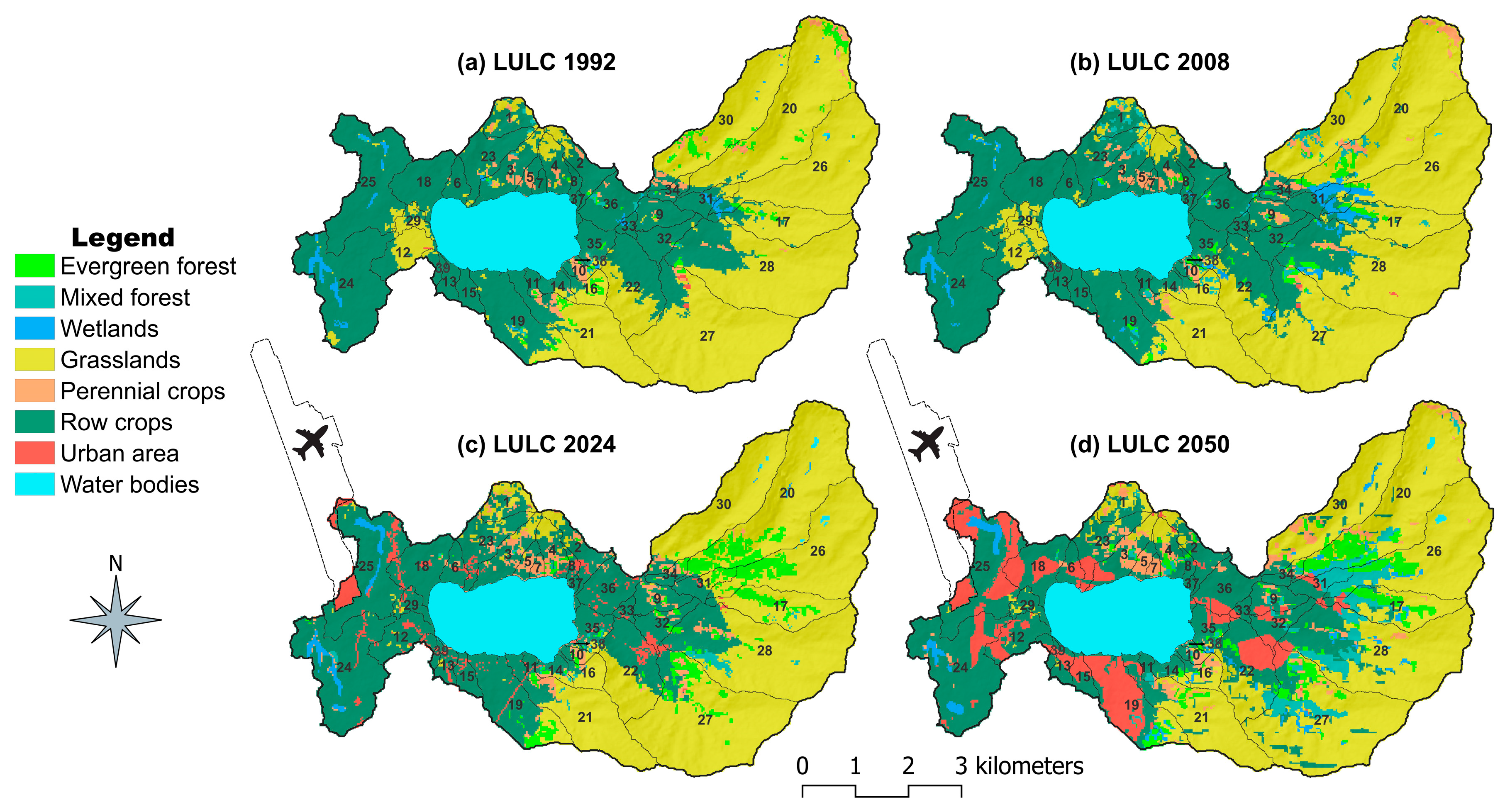
Spatiotemporal modeling was implemented based on LULC maps from 1992, 2008, and 2024 (MapBiomas Peru) to project towards 2050 (Figure 3). The CA–Markov method was utilized in TerrSet (version 20.0.2) [69,70], integrating five spatially explicit explanatory variables, including distance to populated centers, proximity to roads, distance to water bodies, slope, and elevation [71]. The model was calibrated with the 1992–2008 period and validated by projecting 2008–2024, evaluating agreement through the Kappa coefficient [72,73]. The 2050 projection represents a BAU (Business as Usual) scenario derived from trend-based behavior of anthropogenic changes in LULC and natural degradation mechanisms, allowing determination of the impact of the current development pattern [74]. The selection of this single scenario responds to a methodological decision oriented toward the practical utility of the study, in coordination with the EPS, which requires projections based on verifiable trends to support its water security planning and operational management.

2.3.4. Combined Climate Change and Land Use/Land Cover Scenario

An experimental matrix was designed systematically by integrating ten climate scenarios (Historical, plus three SSPs [1–2.6, 3–7.0, and 5–8.5] with three percentiles each [5%, 50%, and 95%]) with two LULC conditions (2024 and 2050), resulting in 20 experimental combinations (Table 2). This structure enables the evaluation of synergistic effects of climate change and landscape transformations. The adopted nomenclature is SSP[X]-([percentile])-[LULC year] for future scenarios (e.g., SSP126-(P50)-2024) and Historical-[LULC year] for the historical scenario.

2.3.5. Evaluation of Hydrological Ecosystem Services

Three hydrological ecosystem services relevant to the quantity and quality of water resources in the PCW were evaluated using SWAT model output parameters (Table 3). Water supply was quantified through water yield (WYLD), which represents the net amount of surface runoff and groundwater that contributes to the main channel flow, constituting an integral measure of the ecosystem’s water production capacity [10,75]. Hydrological regulation was assessed through soil water content (SW), which reflects the watershed’s capacity to moderate hydrological fluctuations, attenuating peak flows during floods and maintaining minimum flows during droughts [1,76,77].
SW represents the temporary storage that controls the partitioning between runoff and infiltration, functioning as a natural buffer that stabilizes water flows [78]. Soil erosion control was measured through sediment yield (SYLD) transported to the main channel [t/ha], where low values indicate high sediment retention capacity of the ecosystem [75]. The selection of these indicators is based on the fact that they can be derived directly from SWAT outputs, allowing a spatially explicit assessment at the sub-basin level, an approach successfully applied in previous studies to quantify hydrological ecosystem services under climate change scenarios [79,80].

2.3.6. Hydrological Ecosystem Services Vulnerability Assessment

To assess integrated hydrological vulnerability, a Hydrological Vulnerability Index (HVI) was developed by normalizing SWAT model output indicators for each sub-basin using the following equation [81,82]:
N o r m a l i z e d   i n d i c a t o r = X i X m i n X m a x X m i n
where Xi is the annual average value of the indicator for the i-th sub-basin during the period, Xmax is the maximum value of the indicator, and Xmin is the minimum value of the indicator. Considering that sub-basins with higher WYLD and SW values represent better hydrological conditions, while higher SYLD indicates erosion vulnerability, inverse values (1 − x) were applied to WYLD and SW [83]. The HVI was calculated as follows:
H V I = 0.25 1 W Y L D n o r m + 0.50 1 S W n o r m + 0.25   ×   S Y L D n o r m
The weights reflect the importance of SW as the primary control of hydrological stress in Andean watersheds [84,85]. Classification was performed employing percentile thresholds, low (≤0.40), moderate (0.40–0.60), and high (>0.60), designating critical sub-basins with HVI > 0.60 in >75% of scenarios [82].

3. Results

3.1. Sensitivity Analysis, Calibration, and Validation

The FAST sensitivity analysis identified three critical parameters from the ten evaluated: CN2, SOL_K, and ESCO. CN2 governs the distribution between precipitation and runoff through the SCS method, determining the volumes reaching the drainage network. SOL_K regulates water movement in the soil matrix, controlling aquifer recharge and subsurface flows that maintain base flow during dry periods. ESCO modulates evaporative demand from different soil horizons, influencing the vertical water balance. Together, this parameterization maintains the model’s predictive capacity by capturing the dominant processes controlling the hydrological response of surface runoff, subsurface flow, and evapotranspiration.
Once the dominant parameters were identified, the hydrological model showed satisfactory performance in both evaluation stages (Figure 4). In the daily calibration (January 2021–February 2022), the model achieved KGE of 0.77 and R2 of 0.60, adequately reproducing the main flood events with slight general overestimation (PBIAS = +3.90%). The monthly validation (1987–2022) exhibited superior performance (KGE = 0.79, NSE = 0.83, R2 = 0.86), exceeding even the daily calibration metrics, demonstrating that the model captures essential hydrological processes beyond a statistical fit to the short period. This result supports the findings of [33,86,87], who demonstrated that calibration effectiveness depends on data representativeness regarding the watershed’s hydrological behavior, rather than the temporal extent of the period. In our case, the calibration period captures both wet and dry season dynamics, providing representative information of dominant processes.
Additionally, the hydrological signatures analysis, following the methodology proposed by [59,60], applied to the calibration period confirmed that the model adequately represents the watershed’s hydrological functioning. The model accurately reproduced the water balance (Runoff Coefficient: obs = 0.885, sim = 0.929, bias +4.9%) and seasonal synchronization (Temporal Centroid: obs = day 152, sim = day 148, bias −2.9%), capturing the high precipitation–runoff conversion ratio (88.5%). Mean discharge magnitudes (biases of +4.9% and +18.5%) and interannual variability (bias of +7.9%) showed satisfactory agreement, with all signatures exhibiting biases below 20% [88].

3.2. Individual Effects of Climate Change

3.2.1. Climate Model Projections

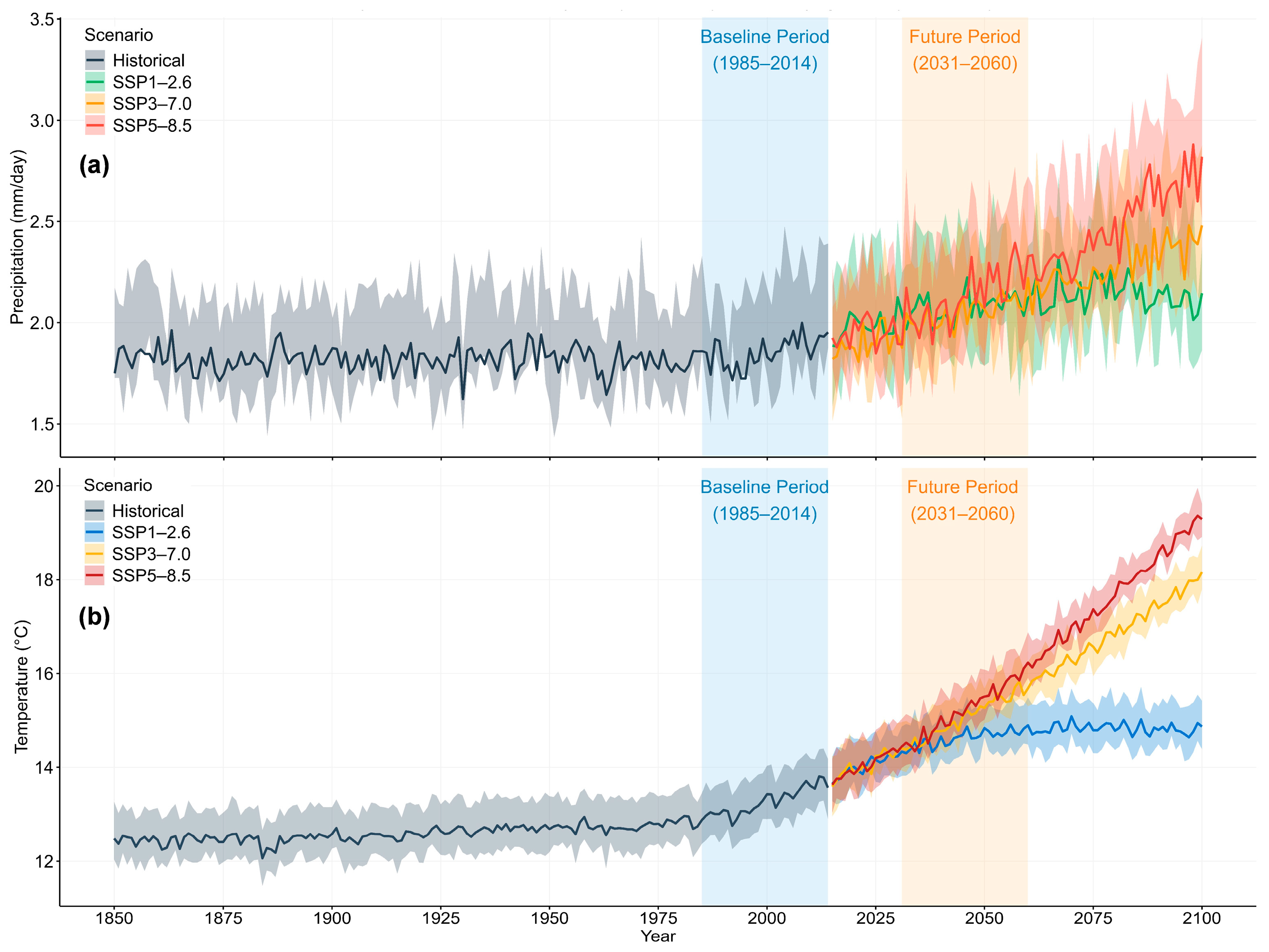
Climate projections reveal clear differentiation between historical (1985–2014) and future (2031–2060) patterns under SSP1–2.6, SSP3–7.0, and SSP5–8.5 scenarios (Figure 5). During the historical period, precipitation fluctuated around 1.8 mm/day, and temperature remained close to 13 °C. However, future projections reveal significant divergence among scenarios, with moderate precipitation increases and substantial temperature rises, particularly under high emission scenarios.
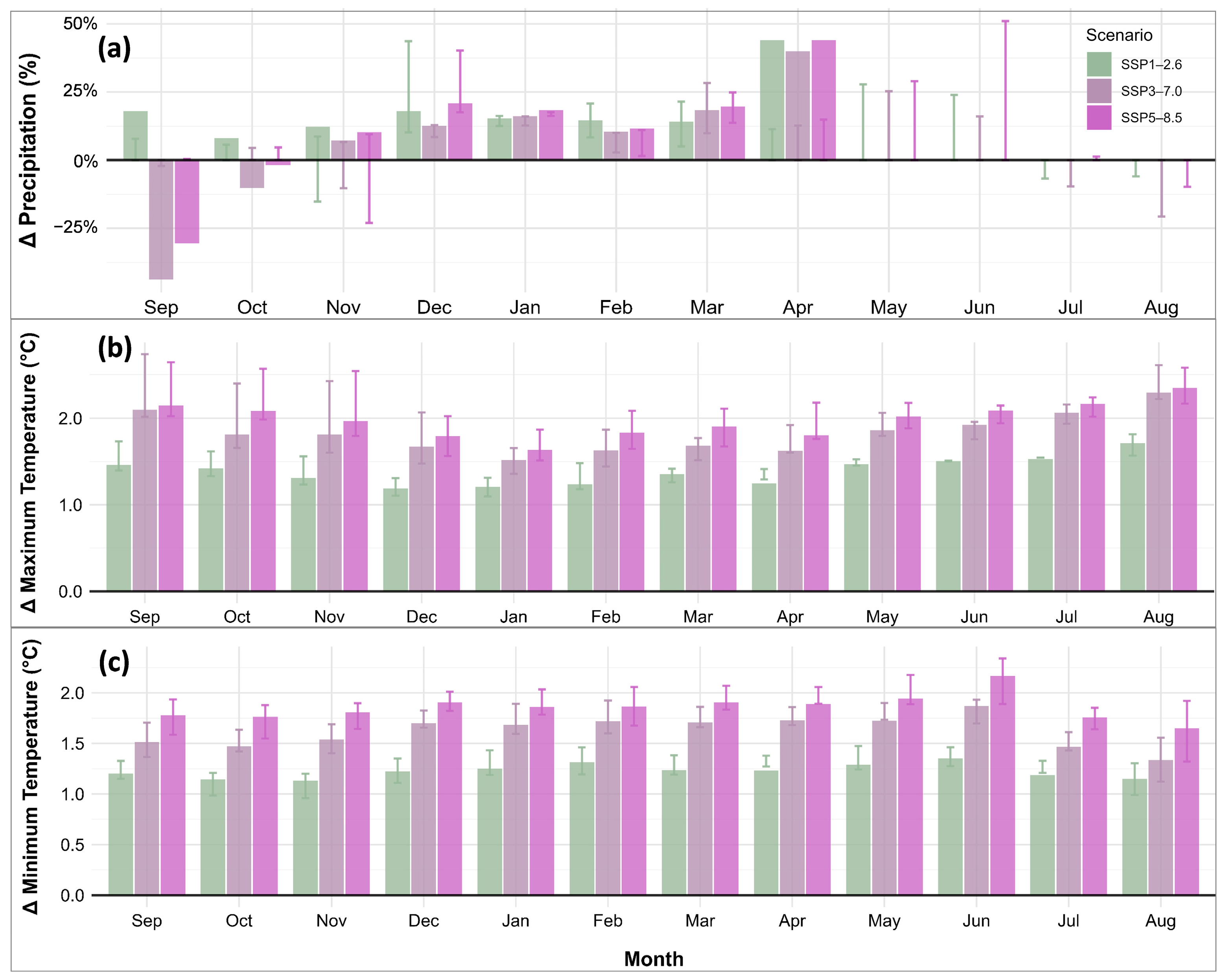
The percentile analysis (Figure 6) demonstrates that during the wet season (October–April), P50 projects precipitation increases up to 45% in April under SSP5–8.5, whereas during the dry season (May–September), medians remain close to zero or slightly negative, evidencing accentuation of Andean seasonality. The uncertainty range (P5–P95) is considerably broad during the wet season and markedly reduced during the dry season. Maximum temperature exhibits an increase between +1.2 °C and +2.2 °C, with comparable increases in minimum temperature. SSP1–2.6 projects moderate increases (+1.5–1.8 °C), while SSP5–8.5 presents the most pronounced warming (+2.0–2.5 °C). Thermal projections display high consensus among models (uncertainty < ±0.3 °C), conferring greater statistical confidence compared to precipitation projections.

3.2.2. Impact of Climate Change on Water Ecosystem Services

Water yield (WYLD) experiences an average increase of +47%, where SSP1–2.6 reaches 192 mm/year (+54%), SSP3–7.0 records 181 mm/year (+45%), and SSP5–8.5 presents 197 mm/year (+57%). Soil water content (SW) increases by +8% on average, with SSP1–2.6 showing +12%, SSP3–7.0 recording +3%, and SSP5–8.5 reaching +8%, suggesting improvement in hydrological regulation capacity.
Sediment yield (SYLD) presents a heterogeneous response with +10% average. SSP1–2.6 exhibits high variability ranging from −18% to +83%, SSP3–7.0 shows consistent reductions from −22% to −2%, and SSP5–8.5 presents moderate increases from +1% to +18%. Central projections reach 0.79 t/ha/year for SSP1–2.6 (+22%), 0.63 t/ha/year for SSP3–7.0 (−3%), and 0.76 t/ha/year for SSP5–8.5 (+18%). Given that SYLD was neither calibrated nor validated due to the absence of observed data, the presented results should be interpreted with an exploratory and comparative scope.
The analysis reveals favorable synergy between water provision and regulation, given that the +47% increase in WYLD occurs simultaneously with the +8% increase in SW, indicating greater system resilience. SSP3–7.0 represents particularly favorable conditions by combining a +45% increase in water availability with −3% sediment reduction, while SSP1–2.6 and SSP5–8.5 imply greater water benefits of +53% to +57% but with erosive increases of +18% to +22% that require adaptive strategies.

3.3. Individual Effects of Land Use Change

3.3.1. Change Detection and Transition Analysis in Land Use and Land Cover

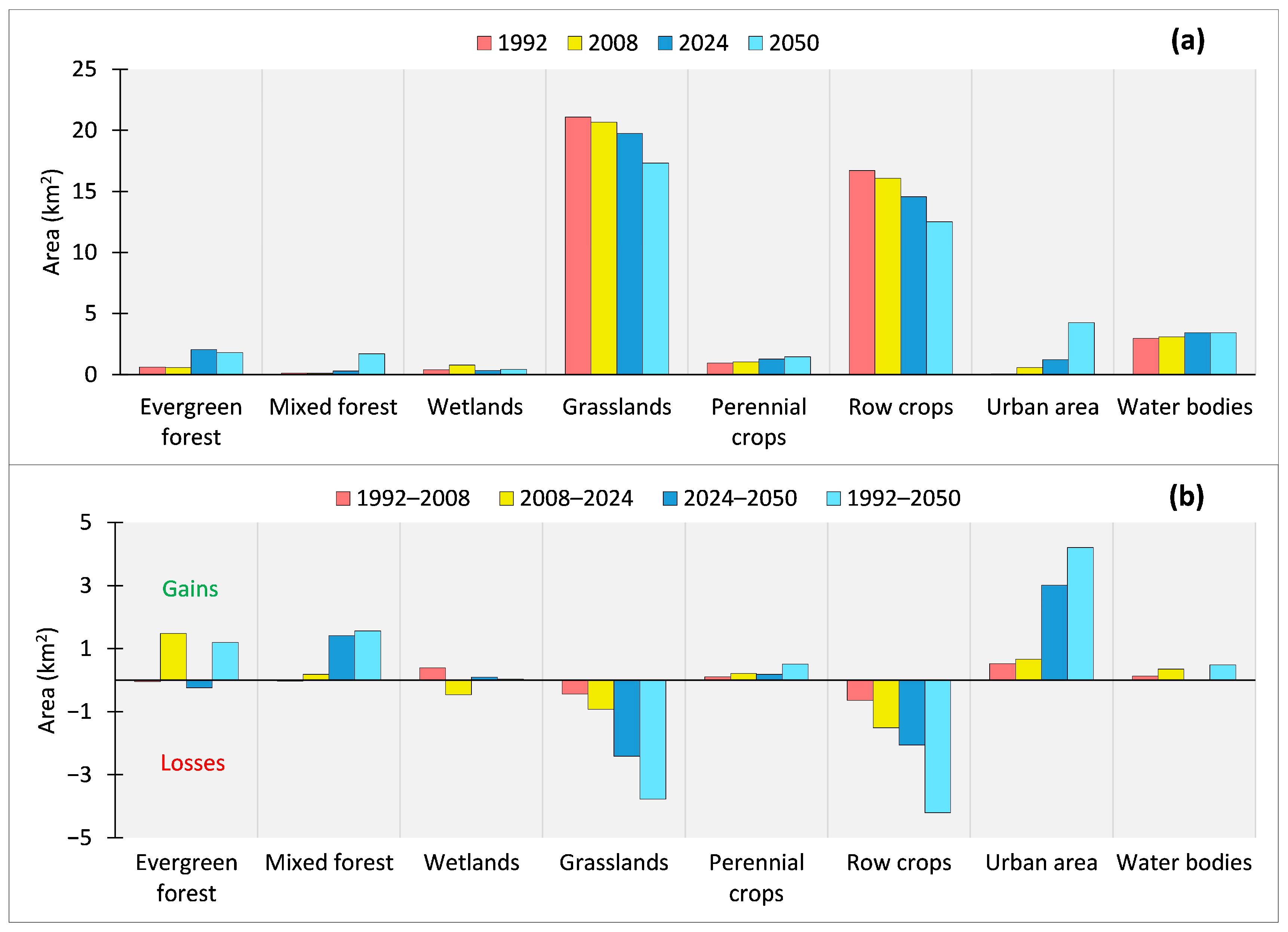
The retrospective validation of the LULC model evidenced good predictive capacity when comparing projected and observed maps for 2024, reaching a Kappa index of 0.81 and an overall accuracy of 86%, exceeding the minimum recommended threshold of 70% [89]. These results validate the model’s reliability for projecting future scenarios toward 2050. The LULC change analysis during 1992–2050 reveals differentiated territorial transformations (Figure 7a). Grasslands declined from 21 km2 to 17.3 km2, and agricultural areas from 16.7 km2 to 12.5 km2. In contrast, forest covers experienced notable increases, with evergreen forest expanding from 0.6 km2 to 2.1 km2 and mixed forest projecting growth up to 1.7 km2 by 2050. Urban area showed the most significant transformation, growing from 0.05 km2 in 1992 to 4.3 km2 projected for 2050.
Net changes between periods (Figure 7b) reveal distinct temporal dynamics. During 1992–2008, transformations remained moderate, characterized by wetland expansion (+0.4 km2) and incipient urban growth (+0.5 km2). The 2008–2024 period represents a critical inflection point, exhibiting extraordinary forest gains in evergreen forest (+1.5 km2) attributable to MERESE implementation, whereas wetlands experienced their most pronounced reduction (−0.5 km2).
Projections for 2024–2050 indicate an intensification of territorial transformations, with urban expansion reaching +3.0 km2 driven primarily by the development of the Chinchero International Airport, situated in proximity to the PCW, with a portion extending within its boundaries. This infrastructure project functions as a developmental catalyst through multiple mechanisms: (i) enhanced regional connectivity, (ii) appreciation of land economic value, and (iii) induced demand for ancillary infrastructure encompassing commercial, hospitality, logistics, and residential sectors. Concurrently, mixed forest expansion (+1.4 km2) demonstrates the sustained effectiveness of forest restoration policies.

3.3.2. Impact of Land Use and Land Cover Change on Water Ecosystem Services

WYLD exhibits a moderate increase of 2%, rising from 125 to 128 mm/year, predominantly concentrated during seasonal transition months. SW demonstrates the most substantial change at +4%, increasing from 2780 to 2900 mm/month. For this index, urban expansion of +244% diminishes infiltration capacity; however, increases in mixed forest of +481% and wetlands of +30% offset this detrimental effect. SYLD constitutes the most compromised index at +83%, escalating from 0.7 to 1.2 t/ha/year, and exhibits marked seasonal intensification during summer, reaching 72% in January, 63% in February, and 62% in March.

3.4. Combined Effects of Climate Change and Land Use and Land Cover

3.4.1. Combined Impacts on Hydrological Ecosystem Service Indices

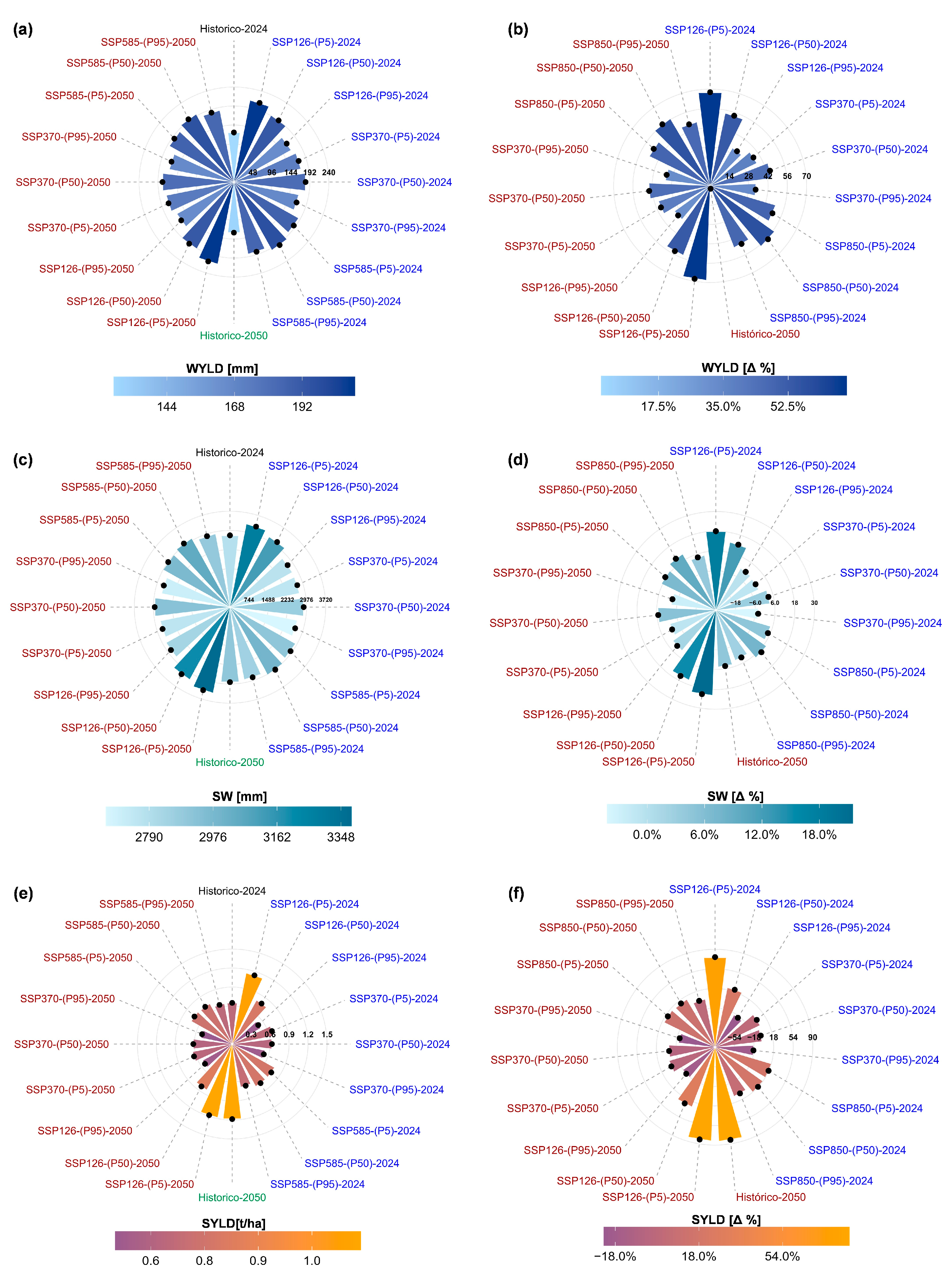
Combined scenarios demonstrate a predominantly positive trend (Figure 8). WYLD experiences increase ranging from 32% to 68%, where SSP1–2.6 exhibits the greatest heterogeneity with 51% variability and a P5-P95 range of 37%, SSP5–8.5 displays enhanced stability with a 2% range, and SSP3–7.0 registers moderate increases of 39% with a 6% range. SW demonstrates increases in seven of nine scenarios. SSP1–2.6 generates pronounced increases from 2% to 22% with a mean of 13%, SSP3–7.0 presents minimal variations from −3% to 5% with a mean of 1%, and SSP5–8.5 exhibits moderate increases from 4% to 10% with a mean of 7%. The SSP1–2.6-P5 scenario represents the greatest ecosystem benefit, whereas SSP3–7.0-P95 constitutes the most limiting conditions.

3.4.2. Identification of Zones Vulnerable to Future Scenarios

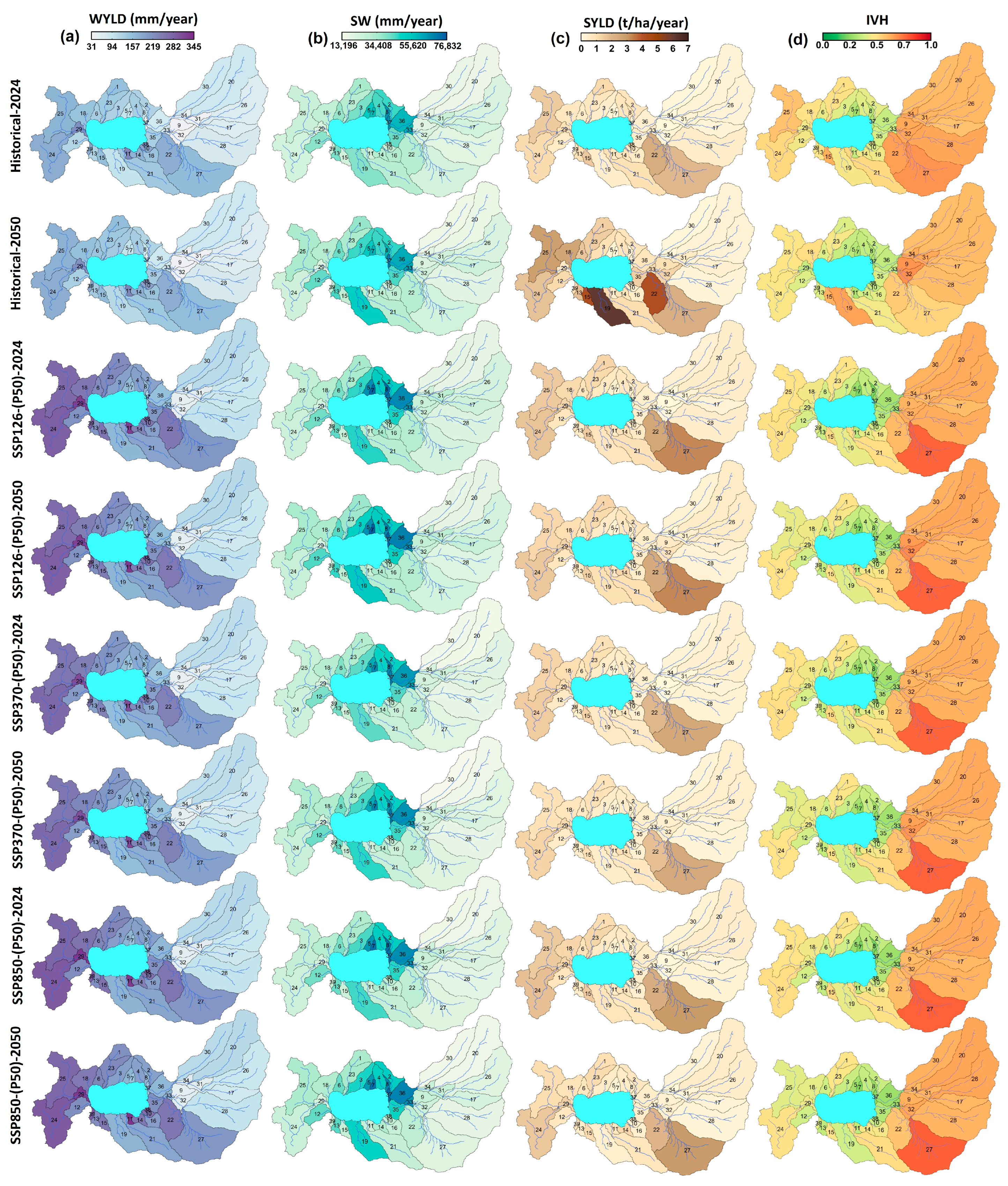
The analysis of the Hydrological Vulnerability Index (HVI) identified eight persistently critical sub-basins (9, 20, 26, 27, 28, 30, 31, and 32) that exhibited high vulnerability levels (HVI > 0.60) in at least 75% of the evaluated scenarios, accounting for approximately 21% of the total watershed area. Figure 9 shows the spatial distribution of WYLD, SW, SYLD, and HVI across the watershed under different scenarios, including land use conditions (2024 and 2050) and median climate projections (P50) for three Shared Socioeconomic Pathways (SSP1–2.6, SSP3–7.0, and SSP5–8.5).
These sub-basins cluster into two distinct spatial groups: (i) high-elevation headwater sub-basins (20, 26, and 30), located above 4100 m a.s.l., characterized by very steep slopes (>60%) and extensive grassland cover with limited soil water retention capacity; and (ii) mid-elevation sub-basins (9, 27, 28, 31, and 32), situated between 3800 and 4000 m a.s.l., with moderate to steep slopes (20–60%) and a mixed land cover of grasslands and agricultural areas.
Among the critical units, sub-basin 32 showed the highest persistence of vulnerability, remaining in the high-vulnerability class in 100% of the scenarios (mean HVI = 0.65), followed by sub-basins 20, 26, 27, and 28, each with a 95% occurrence frequency. Sub-basin 27 exhibited the highest mean HVI value (0.76) and the largest sediment yield (2.82 t ha−1 yr−1), primarily driven by its steep slopes. In contrast, sub-basins 9, 31, and 32 recorded the lowest water yields (<52 mm yr−1), which are associated with their lake-adjacent location and limited contributing area. Overall, the critical sub-basins exhibited a 53% lower mean water yield (91 vs. 196 mm yr−1) and a 49% reduction in soil water content (20,420 vs. 39,632 mm) compared to non-critical areas. Soil water content (SW) emerged as the dominant limiting factor, contributing 40–50% to the vulnerability index, thereby confirming that restricted soil water storage capacity constitutes the primary hydrological constraint in these zones.

4. Discussion

The SWAT model demonstrated robust performance (calibration: KGE = 0.77, R2 = 0.60; validation: KGE = 0.79, R2 = 0.86, NSE = 0.83) with CN2, SOL_K, and ESCO as dominant parameters, consistent with previous studies on Andean watersheds [21,33]. KGE values exceeding 0.75 at both temporal scales, along with hydrological signatures confirming adequate water balance representation (runoff coefficient: obs = 0.885, sim = 0.929, bias +4.9%), provide confidence in future projections, corroborating that data representativeness matters more than temporal extent of the period [33,86,87].
Climate projections for 2031–2060 show precipitation increases (+11.9% to +15.5%) concentrated in the wet season, with peaks of 45% in April under SSP5–8.5, consistent with regional projections for the central Andes [25,90]. The water balance increase (+44% to +64%) substantially exceeds precipitation gains due to decoupling between potential (+2.4% to +6.5%) and actual evapotranspiration (+1.5% to +5.0%), evidencing a transition toward a more reactive hydrological regime. The runoff coefficient increases from 19% in the historical period to a range of 22% to 31% under future scenarios, indicating that future evapotranspiration will be limited by soil water availability rather than atmospheric demand, a pattern consistent with humid tropical Andean ecosystems [84,85]. Temperature projections (+1.2 °C to +2.5 °C) exhibit lower uncertainty (±0.3 °C) than precipitation, reflecting different sensitivity to atmospheric processes [91,92].
Climate scenarios generate consistent increases in WYLD (+47% average) and SW (+8% average), revealing favorable synergy between water provision and regulation that contrasts with other Andean watersheds [25]. However, SYLD exhibits high variability (−22% to +83%), reflecting non-linear thresholds in sediment transport [93]. In contrast, LULC change produces smaller effects on WYLD (+2%) and SW (+4%), though SYLD increases critically (+83%). Urban expansion (+8078% cumulative 1992–2050), driven by the Chinchero International Airport development, represents the main anthropogenic pressure [94], consistent with evidence identifying urbanization as the primary driver of hydrological alteration [34]. MERESE effectiveness is evidenced by mixed forest increase (+480.5%) and wetland recovery (+30.3%). The SW increase (+4%) results from compensation between forest–wetland expansion and urbanization, aligning with evidence on hydrological ecosystem services improvement through afforestation [95] and wetlands functioning as natural sponges [96,97].
The integrated evaluation confirms climate dominance over hydrological response. Combined scenario WYLD (+32% to +68%) primarily reflects the climate signal (+47%) with minor LULC adjustments (+2%), establishing that territorial management can modulate but not fully compensate for climate-induced alterations [29,30]. The heterogeneous SW response across SSPs (SSP1–2.6: +13%, SSP3–7.0: +1%, SSP5–8.5: +7%) reveals non-linear interactions between climate forcing and land use configuration.
Vulnerability analysis identified eight persistently critical sub-basins (9, 20, 26, 27, 28, 30, 31, and 32), representing 20.5% of the total watershed area, with HVI > 0.60 in ≥75% of scenarios. The spatial structure shows remarkable stability (62% of sub-basins maintain constant classification), indicating that vulnerability depends more on intrinsic territorial characteristics than on climate trajectories. SW emerged as the dominant factor (r = 0.80), followed by WYLD (r = 0.40) and SYLD (r = 0.35), prioritizing soil conservation and infiltration enhancement [98]. Sub-basin 32 (HVI = 0.72 in 100% of scenarios) and sub-basins 20, 26, 27, and 28 (95% frequency) require priority structural interventions.
These findings have direct implications for territorial planning and adaptive water resource management. Critical sub-basins require priority structural interventions, including native vegetation restoration [98], green infrastructure [96,99,100], strict regulation of urban expansion [100], and continuous monitoring. For non-critical areas, flexible strategies combining forest conservation through MERESE, sustainable urban management [101], and conservation agricultural practices can maintain hydrological ecosystem services. SSP3–7.0 presents relatively favorable conditions (+45% water availability, +3% regulation, and −3% sediments), although local benefits do not compensate for global adverse climate impacts.
Limitations include short climate time series that require correction with grid data, single-station calibration restricting spatial validation, and the absence of sedimentological observations that precluded SYLD calibration. Consequently, SYLD results are interpreted comparatively for relative spatial patterns rather than absolute loads, where high percentage changes should be interpreted as directional trends [96,99,100,102]. The assessment focused exclusively on hydrological services, without incorporating social, economic, or biodiversity dimensions, reinforcing the need for future studies with transdisciplinary approaches and more extensive observational series.

5. Conclusions

This study assessed the individual and combined impacts of climate change and land use/land cover transformations on hydrological ecosystem services in a high Andean watershed using an integrated SWAT-based framework. The results indicate that future climate conditions will primarily control changes in water availability and hydrological regulation, while land use dynamics, particularly urban expansion, will play a decisive role in sediment production.
Climate projections for the 2031–2060 period consistently show increased precipitation and temperature, leading to higher water yield and improved soil water storage across most scenarios. This reflects a transition toward a more reactive hydrological regime, where runoff increases faster than evapotranspiration, enhancing water availability but also increasing sensitivity to extreme events.
In contrast, land use changes exert a comparatively smaller influence on water yield and regulation but substantially intensify sediment export. Urban growth linked to the Chinchero International Airport emerges as the main anthropogenic pressure, outweighing the hydrological benefits derived from forest recovery and ecosystem-based restoration measures implemented through MERESE.
The Hydrological Vulnerability Index highlights a remarkably stable spatial pattern, with vulnerability primarily determined by intrinsic geomorphological and soil characteristics rather than by the specific climate scenario. A limited number of sub-basins remain persistently critical under most future conditions, where low soil water storage capacity constitutes the dominant constraint.
These findings underscore the importance of prioritizing spatially targeted management actions focused on soil conservation, infiltration enhancement, and strict regulation of urban expansion in highly vulnerable areas. While climate change sets the overall direction of hydrological response, local land management decisions will determine the magnitude of degradation or resilience of hydrological ecosystem services in Andean watersheds.

Author Contributions

Methodology, W.L.-C. and C.M.; writing—original draft, C.M.; formal analysis, D.S.; writing—review and editing, L.B. and W.L.-C.; validation, P.R.; investigation, R.D.D. All authors have read and agreed to the published version of the manuscript.

Funding

This research was partially funded by the Newton-Paulet Fund through the RAHU project (Contract No. 005-2019-PROCIENCIA, Peru).

Data Availability Statement

The data presented in this study are available on request from the corresponding author.

Acknowledgments

C. Montesinos and W. Lavado express their gratitude to The Nature Conservancy (TNC) and the public water utility SEDACUSCO S.A. for their valuable support in providing the essential climate and hydrological data for this research. Additionally, P. Rau acknowledges the support provided by the Newton-Paulet Fund through the RAHU project throughout the development of this study.

Conflicts of Interest

The authors declare no conflicts of interest.

References

  1. Brauman, K.A.; Daily, G.C.; Duarte, T.K.; Mooney, H.A. The Nature and Value of Ecosystem Services: An Overview Highlighting Hydrologic Services. Annu. Rev. Environ. Resour. 2007, 32, 67–98. [Google Scholar] [CrossRef]
  2. Young, K.R.; Ulloa, C.U.; Luteyn, J.L.; Knapp, S. Erratum to Plant Evolution and Endemism in Andean South America. Bot. Rev. 2002, 68, 424. [Google Scholar] [CrossRef]
  3. Rabatel, A.; Francou, B.; Soruco, A.; Gomez, J.; Cáceres, B.; Ceballos, J.L.; Basantes, R.; Vuille, M.; Sicart, J.-E.; Huggel, C.; et al. Current State of Glaciers in the Tropical Andes: A Multi-Century Perspective on Glacier Evolution and Climate Change. Cryosphere 2013, 7, 81–102. [Google Scholar] [CrossRef]
  4. Vuille, M.; Franquist, E.; Garreaud, R.; Lavado Casimiro, W.S.; Cáceres, B. Impact of the Global Warming Hiatus on Andean Temperature. J. Geophys. Res. Atmos. 2015, 120, 3745–3757. [Google Scholar] [CrossRef]
  5. Guzman, C.D.; Tilahun, S.A.; Zegeye, A.D.; Steenhuis, T.S. Suspended Sediment Concentration–Discharge Relationships in the (Sub-) Humid Ethiopian Highlands. Hydrol. Earth Syst. Sci. 2013, 17, 1067–1077. [Google Scholar] [CrossRef]
  6. Li, Y.; Piao, S.; Li, L.Z.X.; Chen, A.; Wang, X.; Ciais, P.; Huang, L.; Lian, X.; Peng, S.; Zeng, Z.; et al. Divergent Hydrological Response to Large-Scale Afforestation and Vegetation Greening in China. Sci. Adv. 2018, 4, eaar4182. [Google Scholar] [CrossRef]
  7. Carpenter, S.R.; Mooney, H.A.; Agard, J.; Capistrano, D.; DeFries, R.S.; Díaz, S.; Dietz, T.; Duraiappah, A.K.; Oteng-Yeboah, A.; Pereira, H.M.; et al. Science for Managing Ecosystem Services: Beyond the Millennium Ecosystem Assessment. Proc. Natl. Acad. Sci. USA 2009, 106, 1305–1312. [Google Scholar] [CrossRef]
  8. Togbévi, Q.F.; Bossa, A.Y.; Yira, Y.; Preko, K.; Sintondji, L.O.; van der Ploeg, M. A Multi-Model Approach for Analysing Water Balance and Water-Related Ecosystem Services in the Ouriyori Catchment (Benin). Hydrol. Sci. J. 2020, 65, 2453–2465. [Google Scholar] [CrossRef]
  9. Arnold, J.G.; Srinivasan, R.; Muttiah, R.S.; Williams, J.R. Large Area Hydrologic Modeling and Assessment Part I: Model Development. JAWRA J. Am. Water Resour. Assoc. 1998, 34, 73–89. [Google Scholar] [CrossRef]
  10. Aznarez, C.; Jimeno-Sáez, P.; López-Ballesteros, A.; Pacheco, J.P.; Senent-Aparicio, J.; Aznarez, C.; Jimeno-Sáez, P.; López-Ballesteros, A.; Pacheco, J.P.; Senent-Aparicio, J. Analysing the Impact of Climate Change on Hydrological Ecosystem Services in Laguna Del Sauce (Uruguay) Using the SWAT Model and Remote Sensing Data. Remote Sens. 2021, 13, 2014. [Google Scholar] [CrossRef]
  11. Gassman, P.; Reyes, M.; Green, C.; Arnold, J. Soil and Water Assessment Tool: Historical Development, Applications, and Future Research Directions. Trans. ASABE 2007, 50, 1211–1250. [Google Scholar] [CrossRef]
  12. Krysanova, V.; White, M. Advances in Water Resources Assessment with SWAT—An Overview. Hydrol. Sci. J. 2015, 60, 771–783. [Google Scholar] [CrossRef]
  13. Villamizar, S.R.; Pineda, S.M.; Carrillo, G.A.; Villamizar, S.R.; Pineda, S.M.; Carrillo, G.A. The Effects of Land Use and Climate Change on the Water Yield of a Watershed in Colombia. Water 2019, 11, 285. [Google Scholar] [CrossRef]
  14. Bieger, K.; Arnold, J.G.; Rathjens, H.; White, M.J.; Bosch, D.D.; Allen, P.M.; Volk, M.; Srinivasan, R. Introduction to SWAT+, A Completely Restructured Version of the Soil and Water Assessment Tool. JAWRA J. Am. Water Resour. Assoc. 2017, 53, 115–130. [Google Scholar] [CrossRef]
  15. Zhang, X.; Srinivasan, R.; Bosch, D. Calibration and Uncertainty Analysis of the SWAT Model Using Genetic Algorithms and Bayesian Model Averaging. J. Hydrol. 2009, 374, 307–317. [Google Scholar] [CrossRef]
  16. Chen, D.; Li, J.; Zhou, Z.; Liu, Y.; Li, T.; Liu, J. Simulating and Mapping the Spatial and Seasonal Effects of Future Climate and Land-Use Changes on Ecosystem Services in the Yanhe Watershed, China. Environ. Sci. Pollut. Res. 2018, 25, 1115–1131. [Google Scholar] [CrossRef]
  17. Ware, H.H.; Chang, S.W.; Lee, J.E.; Chung, I.-M. Assessment of Hydrological Responses to Land Use and Land Cover Changes in Forest-Dominated Watershed Using SWAT Model. Water 2024, 16, 528. [Google Scholar] [CrossRef]
  18. Asurza-Véliz, F.A.; Lavado-Casimiro, W.S.; Asurza-Véliz, F.A.; Lavado-Casimiro, W.S. Regional Parameter Estimation of the SWAT Model: Methodology and Application to River Basins in the Peruvian Pacific Drainage. Water 2020, 12, 3198. [Google Scholar] [CrossRef]
  19. Baltazar, L.A.; Viola, M.R.; Rogério de Mello, C.; Junqueira, R.; da Silva Amorim, J. Hydrological Modeling in a Region with Sparsely Observed Data in the Eastern Central Andes of Peru, Amazon. J. South Am. Earth Sci. 2023, 121, 104151. [Google Scholar] [CrossRef]
  20. Daneshvar, F.; Frankenberger, J.; Bowling, L.; Cherkauer, K.; Moraes, A. Development of Strategy for SWAT Hydrologic Modeling in Data-Scarce Regions of Peru. J. Hydrol. Eng. 2021, 26, 05021016. [Google Scholar] [CrossRef]
  21. Fernandez-Palomino, C.A.; Hattermann, F.F.; Krysanova, V.; Vega-Jácome, F.; Bronstert, A. Towards a More Consistent Eco-Hydrological Modelling through Multi-Objective Calibration: A Case Study in the Andean Vilcanota River Basin, Peru. Hydrol. Sci. J. 2021, 66, 59–74. [Google Scholar] [CrossRef]
  22. Pachac-Huerta, Y.; Lavado-Casimiro, W.; Zapana, M.; Peña, R.; Pachac-Huerta, Y.; Lavado-Casimiro, W.; Zapana, M.; Peña, R. Understanding Spatio-Temporal Hydrological Dynamics Using SWAT: A Case Study in the Pativilca Basin. Hydrology 2024, 11, 165. [Google Scholar] [CrossRef]
  23. Lavado Casimiro, W.S.; Labat, D.; Guyot, J.L.; Ardoin-Bardin, S. Assessment of Climate Change Impacts on the Hydrology of the Peruvian Amazon–Andes Basin. Hydrol. Process. 2011, 25, 3721–3734. [Google Scholar] [CrossRef]
  24. Olsson, T.; Kämäräinen, M.; Santos, D.; Seitola, T.; Tuomenvirta, H.; Haavisto, R.; Lavado-Casimiro, W. Downscaling Climate Projections for the Peruvian Coastal Chancay-Huaral Basin to Support River Discharge Modeling with WEAP. J. Hydrol. Reg. Stud. 2017, 13, 26–42. [Google Scholar] [CrossRef]
  25. Goyburo, A.; Rau, P.; Lavado-Casimiro, W.; Buytaert, W.; Cuadros-Adriazola, J.; Horna, D. Assessment of Present and Future Water Security under Anthropogenic and Climate Changes Using WEAP Model in the Vilcanota-Urubamba Catchment, Cusco, Perú. Water 2023, 15, 1439. [Google Scholar] [CrossRef]
  26. Paiva, K.; Rau, P.; Montesinos, C.; Lavado-Casimiro, W.; Bourrel, L.; Frappart, F. Hydrological Response Assessment of Land Cover Change in a Peruvian Amazonian Basin Impacted by Deforestation Using the SWAT Model. Remote Sens. 2023, 15, 5774. [Google Scholar] [CrossRef]
  27. Arizapana-Almonacid, M.A.; Pariona-Antonio, V.H.; Castañeda-Tinco, I.; Ascención Mendoza, J.C.; Gutiérrez Gómez, E.; Ramoni-Perazzi, P. Land Cover Changes and Comparison of Current Landscape Metrics in a Region of the Central Andes Affected by Population Migration. Ann. GIS 2024, 30, 105–120. [Google Scholar] [CrossRef]
  28. Castillón, F.; Rau, P.; Bourrel, L.; Frappart, F. Dynamics and Patterns of Land Cover Change in the Piura River Basin (Peruvian Pacific Slope and Coast) in the Last Two Decades. Front. Remote Sens. 2025, 6, 1529044. [Google Scholar] [CrossRef]
  29. Mo, W.; Zhao, Y.; Yang, N.; Xu, Z.; Zhao, W.; Li, F.; Mo, W.; Zhao, Y.; Yang, N.; Xu, Z.; et al. Effects of Climate and Land Use/Land Cover Changes on Water Yield Services in the Dongjiang Lake Basin. ISPRS Int. J. Geo-Inf. 2021, 10, 466. [Google Scholar] [CrossRef]
  30. Wu, Y.; Zhang, X.; Li, C.; Xu, Y.; Hao, F.; Yin, G. Ecosystem Service Trade-Offs and Synergies under Influence of Climate and Land Cover Change in an Afforested Semiarid Basin, China. Ecol. Eng. 2021, 159, 106083. [Google Scholar] [CrossRef]
  31. Peña-Murillo, R.; Lavado-Casimiro, W.; Bourrel, L. Impacts of LULC and Climate Change on Runoff and Sediment Production for the Puyango-Tumbes Basin (Ecuador-Peru). Front. Remote Sens. 2024, 5, 1471144. [Google Scholar] [CrossRef]
  32. Rivera-Fernandez, A.S.; Cotrina-Sanchez, A.; Salas López, R.; Zabaleta-Santisteban, J.A.; Rios, N.; Medina-Medina, A.J.; Tuesta-Trauco, K.M.; Sánchez-Vega, J.A.; Silva-Melendez, T.B.; Oliva-Cruz, M.; et al. Spatiotemporal Land Cover Change and Future Hydrological Impacts Under Climate Scenarios in the Amazonian Andes: A Case Study of the Utcubamba River Basin. Land 2025, 14, 1234. [Google Scholar] [CrossRef]
  33. Saavedra, D.; Montesinos, C.A.; Lavado-Casimiro, W.S. Impacts of Land Use and Climate Changes on Hydrological Responses in a Peruvian Andean Watershed. J. Water Clim. Change 2025, 16, 2111–2133. [Google Scholar] [CrossRef]
  34. Rodriguez, B.C.; Palma-Torres, V.M.; Castañeda, T.J.E.; Codtiyeng, S.K.; Castillo, J.F.; Sasi, A.P.V.; Tercero, M.U.; Andrada, R.T. Drivers and Impacts of Land Use and Land Cover Changes on Ecosystem Services Provided by the Watersheds in the Philippines: A Systematic Literature Review. Int. For. Rev. 2023, 25, 473–490. [Google Scholar] [CrossRef]
  35. Arango-Carvajal, L.I.; Villegas, J.C.; León-Peláez, J.D.; Sánchez-Londoño, J. Not All Trade-Offs and Synergies between Ecosystem Services Are Created Equal: Assessing Their Spatio-Temporal Variation in Response to Land Cover Change in the Colombian Andes. Reg. Environ. Change 2025, 25, 46. [Google Scholar] [CrossRef]
  36. Aneseyee, A.B.; Soromessa, T.; Elias, E.; Noszczyk, T.; Feyisa, G.L. Evaluation of Water Provision Ecosystem Services Associated with Land Use/Cover and Climate Variability in the Winike Watershed, Omo Gibe Basin of Ethiopia. Environ. Manag. 2022, 69, 367–383. [Google Scholar] [CrossRef]
  37. Costa Aponte, F.; Sánchez Aguilar, A.; Morán Flores, G.; Arias Chumpitaz, A. Resultados Definitivos de los Censos Nacionales 2017—Departamento de Cusco; Instituto Nacional de Estadística e Informática: Lima, Peru, 2018. [Google Scholar]
  38. Dextre, R.M.; Eschenhagen, M.L.; Camacho Hernández, M.; Rangecroft, S.; Clason, C.; Couldrick, L.; Morera, S. Payment for Ecosystem Services in Peru: Assessing the Socio-Ecological Dimension of Water Services in the Upper Santa River Basin. Ecosyst. Serv. 2022, 56, 101454. [Google Scholar] [CrossRef]
  39. Montesinos, C.; Lavado-Casimiro, W. Caracterización Espacio-Temporal de las Sequías Hidrológicas en la Cuenca del Río Vilcanota; Servicio Nacional de Meteorología e Hidrología del Perú (SENAMHI): Lima, Peru, 2025; Available online: https://repositorio.senamhi.gob.pe/handle/20.500.12542/3832 (accessed on 4 January 2026).
  40. Ngula Niipele, J.; Chen, J. The Usefulness of Alos-Palsar Dem Data for Drainage Extraction in Semi-Arid Environments in The Iishana Sub-Basin. J. Hydrol. Reg. Stud. 2019, 21, 57–67. [Google Scholar] [CrossRef]
  41. MapBiomas Perú. Algoritmo de Procesamiento de Datos y Metodología de la Colección 3 de MapBiomas Perú: Documento de Base Teórica del Algoritmo (ATBD); MapBiomas Perú: Lima, Peru, 2025; Available online: https://peru.mapbiomas.org/wp-content/uploads/sites/14/2025/06/1_ATBD-General-MapBiomas-Peru-Coleccion-3.pdf (accessed on 4 January 2026).
  42. López-Ballesteros, A.; Nielsen, A.; Castellanos-Osorio, G.; Trolle, D.; Senent-Aparicio, J. DSOLMap, a Novel High-Resolution Global Digital Soil Property Map for the SWAT + Model: Development and Hydrological Evaluation. CATENA 2023, 231, 107339. [Google Scholar] [CrossRef]
  43. Aybar, C.; Fernández, C.; Huerta, A.; Lavado, W.; Vega, F.; Felipe-Obando, O. Construction of a High-Resolution Gridded Rainfall Dataset for Peru from 1981 to the Present Day. Hydrol. Sci. J. 2020, 65, 770–785. [Google Scholar] [CrossRef]
  44. Huerta, A.; Aybar, C.; Imfeld, N.; Correa, K.; Felipe-Obando, O.; Rau, P.; Drenkhan, F.; Lavado-Casimiro, W. High-Resolution Grids of Daily Air Temperature for Peru—The New PISCOt v1.2 Dataset. Sci. Data 2023, 10, 847. [Google Scholar] [CrossRef]
  45. Gudmundsson, L. Qmap: Statistical Transformations for Post-Processing Climate Model Output 2012, Version 1.0-6; R Foundation: Vienna, Austria, 2025.
  46. Gudmundsson, L.; Bremnes, J.B.; Haugen, J.E.; Engen-Skaugen, T. Technical Note: Downscaling RCM Precipitation to the Station Scale Using Statistical Transformations—A Comparison of Methods. Hydrol. Earth Syst. Sci. 2012, 16, 3383–3390. [Google Scholar] [CrossRef]
  47. Fernandez-Palomino, C.A.; Hattermann, F.F.; Krysanova, V.; Vega-Jácome, F.; Menz, C.; Gleixner, S.; Bronstert, A. High-Resolution Climate Projection Dataset Based on CMIP6 for Peru and Ecuador: BASD-CMIP6-PE. Sci. Data 2024, 11, 34. [Google Scholar] [CrossRef]
  48. Lange, S. Trend-Preserving Bias Adjustment and Statistical Downscaling with ISIMIP3BASD (v1.0). Geosci. Model Dev. 2019, 12, 3055–3070. [Google Scholar] [CrossRef]
  49. Fernandez-Palomino, C.A.; Hattermann, F.F.; Krysanova, V.; Lobanova, A.; Vega-Jácome, F.; Lavado, W.; Santini, W.; Aybar, C.; Bronstert, A. A Novel High-Resolution Gridded Precipitation Dataset for Peruvian and Ecuadorian Watersheds: Development and Hydrological Evaluation. J. Hydrometeorol. 2022, 23, 309–336. [Google Scholar] [CrossRef]
  50. Hargreaves, G.H.; Samani, Z.A. Estimating Potential Evapotranspiration. J. Irrig. Drain. Div. 1982, 108, 225–230. [Google Scholar] [CrossRef]
  51. Cannon, A.J.; Sobie, S.R.; Murdock, T.Q. Bias Correction of GCM Precipitation by Quantile Mapping: How Well Do Methods Preserve Changes in Quantiles and Extremes? J. Clim. 2015, 28, 6938–6959. [Google Scholar] [CrossRef]
  52. Heo, J.-H.; Ahn, H.; Shin, J.-Y.; Kjeldsen, T.R.; Jeong, C. Probability Distributions for a Quantile Mapping Technique for a Bias Correction of Precipitation Data: A Case Study to Precipitation Data Under Climate Change. Water 2019, 11, 1475. [Google Scholar] [CrossRef]
  53. Qian, W.; Chang, H.H. Projecting Health Impacts of Future Temperature: A Comparison of Quantile-Mapping Bias-Correction Methods. Int. J. Environ. Res. Public Health 2021, 18, 1992. [Google Scholar] [CrossRef]
  54. Molina-Navarro, E.; Nielsen, A.; Trolle, D. A QGIS Plugin to Tailor SWAT Watershed Delineations to Lake and Reservoir Waterbodies. Environ. Model. Softw. 2018, 108, 67–71. [Google Scholar] [CrossRef]
  55. Reusser, D.E.; Zehe, E. Inferring Model Structural Deficits by Analyzing Temporal Dynamics of Model Performance and Parameter Sensitivity. Water Resour. Res. 2011, 47, W07550. [Google Scholar] [CrossRef]
  56. Saltelli, A.; Bolado, R. An Alternative Way to Compute Fourier Amplitude Sensitivity Test (FAST). Comput. Stat. Data Anal. 1998, 26, 445–460. [Google Scholar] [CrossRef]
  57. Ercan, M.B.; Goodall, J.L. Design and Implementation of a General Software Library for Using NSGA-II with SWAT for Multi-Objective Model Calibration. Environ. Model. Softw. 2016, 84, 112–120. [Google Scholar] [CrossRef]
  58. Llauca, H.; Lavado-Casimiro, W.; Montesinos, C.; Santini, W.; Rau, P. PISCO_HyM_GR2M: A Model of Monthly Water Balance in Peru (1981–2020). Water 2021, 13, 1048. [Google Scholar] [CrossRef]
  59. Saavedra, D.; Mendoza, P.A.; Addor, N.; Llauca, H.; Vargas, X. A Multi-Objective Approach to Select Hydrological Models and Constrain Structural Uncertainties for Climate Impact Assessments. Hydrol. Process. 2022, 36, e14446. [Google Scholar] [CrossRef]
  60. Shafii, M.; Tolson, B.A. Optimizing Hydrological Consistency by Incorporating Hydrological Signatures into Model Calibration Objectives. Water Resour. Res. 2015, 51, 3796–3814. [Google Scholar] [CrossRef]
  61. World Meteorological Organization. WMO Guidelines on the Calculation of Climate Normals; World Meteorological Organization: Geneva, Switzerland, 2017; p. 29. [Google Scholar]
  62. Hawkins, E.; Sutton, R. The Potential to Narrow Uncertainty in Regional Climate Predictions. Bull. Am. Meteorol. Soc. 2009, 90, 1095–1108. [Google Scholar] [CrossRef]
  63. Hawkins, E.; Sutton, R. The Potential to Narrow Uncertainty in Projections of Regional Precipitation Change. Clim. Dyn. 2011, 37, 407–418. [Google Scholar] [CrossRef]
  64. Tebaldi, C.; Knutti, R. The Use of the Multi-Model Ensemble in Probabilistic Climate Projections. Philos. Trans. R. Soc. Math. Phys. Eng. Sci. 2007, 365, 2053–2075. [Google Scholar] [CrossRef]
  65. Hay, L.E.; Wilby, R.L.; Leavesley, G.H. A Comparison of Delta Change and Downscaled Gcm Scenarios for Three Mountainous Basins in the United States. JAWRA J. Am. Water Resour. Assoc. 2000, 36, 387–397. [Google Scholar] [CrossRef]
  66. Anandhi, A.; Frei, A.; Pierson, D.C.; Schneiderman, E.M.; Zion, M.S.; Lounsbury, D.; Matonse, A.H. Examination of Change Factor Methodologies for Climate Change Impact Assessment. Water Resour. Res. 2011, 47, 2010WR009104. [Google Scholar] [CrossRef]
  67. Maraun, D.; Wetterhall, F.; Ireson, A.M.; Chandler, R.E.; Kendon, E.J.; Widmann, M.; Brienen, S.; Rust, H.W.; Sauter, T.; Themeßl, M.; et al. Precipitation Downscaling under Climate Change: Recent Developments to Bridge the Gap between Dynamical Models and the End User. Rev. Geophys. 2010, 48, RG3003. [Google Scholar] [CrossRef]
  68. Wilby, R.; Charles, S.; Zorita, E.; Timbal, B.; Whetton, P.; Mearns, L. Guidelines for Use of Climate Scenarios Developed from Statistical Downscaling Methods; IPCC: Geneva, Switzerland, 2004. [Google Scholar]
  69. Gharaibeh, A.; Shaamala, A.; Obeidat, R.; Al-Kofahi, S. Improving Land-Use Change Modeling by Integrating ANN with Cellular Automata-Markov Chain Model. Heliyon 2020, 6, e05092. [Google Scholar] [CrossRef]
  70. Hamad, R.; Balzter, H.; Kolo, K. Predicting Land Use/Land Cover Changes Using a CA-Markov Model under Two Different Scenarios. Sustainability 2018, 10, 3421. [Google Scholar] [CrossRef]
  71. Aburas, M.M.; Ho, Y.M.; Ramli, M.F.; Ash’aari, Z.H. Improving the Capability of an Integrated CA-Markov Model to Simulate Spatio-Temporal Urban Growth Trends Using an Analytical Hierarchy Process and Frequency Ratio. Int. J. Appl. Earth Obs. Geoinf. 2017, 59, 65–78. [Google Scholar] [CrossRef]
  72. Mas, J.-F.; Kolb, M.; Paegelow, M.; Camacho Olmedo, M.T.; Houet, T. Inductive Pattern-Based Land Use/Cover Change Models: A Comparison of Four Software Packages. Environ. Model. Softw. 2014, 51, 94–111. [Google Scholar] [CrossRef]
  73. Foody, G.M. Explaining the Unsuitability of the Kappa Coefficient in the Assessment and Comparison of the Accuracy of Thematic Maps Obtained by Image Classification. Remote Sens. Environ. 2020, 239, 111630. [Google Scholar] [CrossRef]
  74. Mejean, R.; Paegelow, M.; Saqalli, M.; Kaced, D. Improving Business-as-Usual Scenarios in Land Change Modelling by Extending the Calibration Period and Integrating Demographic Data. In Geospatial Technologies for Local and Regional Development; Kyriakidis, P., Hadjimitsis, D., Skarlatos, D., Mansourian, A., Eds.; Springer International Publishing: Cham, Switzerland, 2020; pp. 243–260. [Google Scholar]
  75. Gaglio, M.; Aschonitis, V.; Pieretti, L.; Santos, L.; Gissi, E.; Castaldelli, G.; Fano, E.A. Modelling Past, Present and Future Ecosystem Services Supply in a Protected Floodplain under Land Use and Climate Changes. Ecol. Model. 2019, 403, 23–34. [Google Scholar] [CrossRef]
  76. Kandziora, M.; Burkhard, B.; Müller, F. Interactions of Ecosystem Properties, Ecosystem Integrity and Ecosystem Service Indicators—A Theoretical Matrix Exercise. Ecol. Indic. 2013, 28, 54–78. [Google Scholar] [CrossRef]
  77. Kauffman, S.; Droogers, P.; Hunink, J.; Mwaniki, B.; Muchena, F.; Gicheru, P.; Bindraban, P.; Onduru, D.; Cleveringa, R.; Bouma, J. Green Water Credits—Exploring Its Potential to Enhance Ecosystem Services by Reducing Soil Erosion in the Upper Tana Basin, Kenya. Int. J. Biodivers. Sci. Ecosyst. Serv. Manag. 2014, 10, 133–143. [Google Scholar] [CrossRef]
  78. Zhang, W.; Zha, X.; Li, J.; Liang, W.; Ma, Y.; Fan, D.; Li, S. Spatiotemporal Change of Blue Water and Green Water Resources in the Headwater of Yellow River Basin, China. Water Resour. Manag. 2014, 28, 4715–4732. [Google Scholar] [CrossRef]
  79. Schmalz, B.; Kruse, M.; Kiesel, J.; Müller, F.; Fohrer, N. Water-Related Ecosystem Services in Western Siberian Lowland Basins—Analysing and Mapping Spatial and Seasonal Effects on Regulating Services Based on Ecohydrological Modelling Results. Ecol. Indic. 2016, 71, 55–65. [Google Scholar] [CrossRef]
  80. Zarrineh, N.; Abbaspour, K.C.; Holzkämper, A. Integrated Assessment of Climate Change Impacts on Multiple Ecosystem Services in Western Switzerland. Sci. Total Environ. 2020, 708, 135212. [Google Scholar] [CrossRef] [PubMed]
  81. Blasiak, R.; Spijkers, J.; Tokunaga, K.; Pittman, J.; Yagi, N.; Österblom, H. Climate Change and Marine Fisheries: Least Developed Countries Top Global Index of Vulnerability. PLoS ONE 2017, 12, e0179632. [Google Scholar] [CrossRef]
  82. Moghadam, N.T.; Malekmohammadi, B.; Schirmer, M. Vulnerability Assessment of Hydrological Ecosystem Services under Future Climate and Land Use Change Dynamics. Ecol. Indic. 2024, 160, 111905. [Google Scholar] [CrossRef]
  83. Ahn, S.-R.; Kim, S.-J. Assessment of Watershed Health, Vulnerability and Resilience for Determining Protection and Restoration Priorities. Environ. Model. Softw. 2019, 122, 103926. [Google Scholar] [CrossRef]
  84. Buytaert, W.; Cuesta-Camacho, F.; Tobón, C. Potential Impacts of Climate Change on the Environmental Services of Humid Tropical Alpine Regions. Glob. Ecol. Biogeogr. 2011, 20, 19–33. [Google Scholar] [CrossRef]
  85. Ochoa-Tocachi, B.F.; Buytaert, W.; De Bièvre, B.; Célleri, R.; Crespo, P.; Villacís, M.; Llerena, C.A.; Acosta, L.; Villazón, M.; Guallpa, M.; et al. Impacts of Land Use on the Hydrological Response of Tropical Andean Catchments. Hydrol. Process. 2016, 30, 4074–4089. [Google Scholar] [CrossRef]
  86. Bai, P.; Liu, X.; Xie, J. Simulating Runoff under Changing Climatic Conditions: A Comparison of the Long Short-Term Memory Network with Two Conceptual Hydrologic Models. J. Hydrol. 2021, 592, 125779. [Google Scholar] [CrossRef]
  87. Li, C.; Wang, H.; Liu, J.; Yan, D.; Yu, F.; Zhang, L. Effect of Calibration Data Series Length on Performance and Optimal Parameters of Hydrological Model. Water Sci. Eng. 2010, 3, 378–393. [Google Scholar] [CrossRef]
  88. Moriasi, D.N.; Arnold, J.G.; Liew, M.W.V.; Bingner, R.L.; Harmel, R.D.; Veith, T.L. Model Evaluation Guidelines for Systematic Quantification of Accuracy in Watershed Simulations. Trans. ASABE 2007, 50, 885–900. [Google Scholar] [CrossRef]
  89. Congalton, R.G. A Review of Assessing the Accuracy of Classifications of Remotely Sensed Data. Remote Sens. Environ. 1991, 37, 35–46. [Google Scholar] [CrossRef]
  90. Junquas, C.; Martinez, J.A.; Bozkurt, D.; Viale, M.; Fita, L.; Trachte, K.; Campozano, L.; Arias, P.A.; Boisier, J.P.; Condom, T.; et al. Recent Progress in Atmospheric Modeling over the Andes—Part II: Projected Changes and Modeling Challenges. Front. Earth Sci. 2024, 12, 1427837. [Google Scholar] [CrossRef]
  91. Tebaldi, C.; Debeire, K.; Eyring, V.; Fischer, E.; Fyfe, J.; Friedlingstein, P.; Knutti, R.; Lowe, J.; O’Neill, B.; Sanderson, B.; et al. Climate Model Projections from the Scenario Model Intercomparison Project (ScenarioMIP) of CMIP6. Earth Syst. Dyn. 2021, 12, 253–293. [Google Scholar] [CrossRef]
  92. Wu, Y.; Miao, C.; Fan, X.; Gou, J.; Zhang, Q.; Zheng, H. Quantifying the Uncertainty Sources of Future Climate Projections and Narrowing Uncertainties With Bias Correction Techniques. Earths Future 2022, 10, e2022EF002963. [Google Scholar] [CrossRef]
  93. Banjara, M.; Bhusal, A.; Ghimire, A.B.; Kalra, A. Impact of Land Use and Land Cover Change on Hydrological Processes in Urban Watersheds: Analysis and Forecasting for Flood Risk Management. Geosciences 2024, 14, 40. [Google Scholar] [CrossRef]
  94. Shiferaw, N.; Habte, L.; Waleed, M. Land Use Dynamics and Their Impact on Hydrology and Water Quality of a River Catchment: A Comprehensive Analysis and Future Scenario. Environ. Sci. Pollut. Res. 2025, 32, 4124–4136. [Google Scholar] [CrossRef]
  95. Galli, A.; Peruzzi, C.; Beltrame, L.; Cislaghi, A.; Masseroni, D. Evaluating the Infiltration Capacity of Degraded vs. Rehabilitated Urban Greenspaces: Lessons Learnt from a Real-World Italian Case Study. Sci. Total Environ. 2021, 787, 147612. [Google Scholar] [CrossRef]
  96. Abbaspour, K.C.; Rouholahnejad, E.; Vaghefi, S.; Srinivasan, R.; Yang, H.; Kløve, B. A Continental-Scale Hydrology and Water Quality Model for Europe: Calibration and Uncertainty of a High-Resolution Large-Scale SWAT Model. J. Hydrol. 2015, 524, 733–752. [Google Scholar] [CrossRef]
  97. Li, J.; Wang, Z.; Wu, X.; Guo, S.; Chen, X. Flash Droughts in the Pearl River Basin, China: Observed Characteristics and Future Changes. Sci. Total Environ. 2020, 707, 136074. [Google Scholar] [CrossRef]
  98. Armenteras, D.; Espelta, J.M.; Rodríguez, N.; Retana, J. Deforestation Dynamics and Drivers in Different Forest Types in Latin America: Three Decades of Studies (1980–2010). Glob. Environ. Change 2017, 46, 139–147. [Google Scholar] [CrossRef]
  99. Abdelwahab, O.M.M.; Ricci, G.F.; De Girolamo, A.M.; Gentile, F. Modelling Soil Erosion in a Mediterranean Watershed: Comparison between SWAT and AnnAGNPS Models. Environ. Res. 2018, 166, 363–376. [Google Scholar] [CrossRef] [PubMed]
  100. Betrie, G.D.; Mohamed, Y.A.; van Griensven, A.; Srinivasan, R. Sediment Management Modelling in the Blue Nile Basin Using SWAT Model. Hydrol. Earth Syst. Sci. 2011, 15, 807–818. [Google Scholar] [CrossRef]
  101. Walsh, C.J.; Booth, D.B.; Burns, M.J.; Fletcher, T.D.; Hale, R.L.; Hoang, L.N.; Livingston, G.; Rippy, M.A.; Roy, A.H.; Scoggins, M.; et al. Principles for Urban Stormwater Management to Protect Stream Ecosystems. Freshw. Sci. 2016, 35, 398–411. [Google Scholar] [CrossRef]
  102. Dutta, S.; Sen, D. Application of SWAT Model for Predicting Soil Erosion and Sediment Yield. Sustain. Water Resour. Manag. 2018, 4, 447–468. [Google Scholar] [CrossRef]
Figure 1. Location of the Piuray Lagoon watershed. Blue (MS–1 to MS–7) and red (HS–1) circles indicate meteorological and hydrological stations, respectively. Numbers within the study area correspond to sub-basins. Arrows in the location maps indicate the position of the watershed within the Cusco region and the Chinchero district.
Climate 14 00049 g001
Figure 2. Methodological framework for assessing the impacts of climate change and land cover/land use (LULC) transformations on hydrological ecosystem services (HES).
Climate 14 00049 g002
Figure 3. Land Use and Land Cover (LULC) maps of the Piuray–Ccorimarca watershed corresponding to the years (a) 1992, (b) 2008, and (c) 2024 (historical period) and projection for (d) 2050 (future scenario). Numbers indicate sub-basin identifiers.
Climate 14 00049 g003
Figure 4. Performance evaluation of the hydrological model in the (a) calibration and (b) validation phases.
Climate 14 00049 g004
Figure 5. Historical trends and future projections of precipitation (a) and temperature (b) for the Piuray–Ccorimarca watershed. Three Shared Socioeconomic Pathways (SSPs) are displayed for the baseline period (1985–2014, blue) and future period (2031–2060, orange). Shaded areas represent the multi-model ensemble uncertainty range.
Climate 14 00049 g005
Figure 6. Projected monthly mean changes in (a) precipitation, (b) maximum temperature, and (c) minimum temperature under three Shared Socioeconomic Pathways. Bars indicate the ensemble median of monthly averages, and vertical lines show the 5th to 95th percentile uncertainty range across the multi-model projections.
Climate 14 00049 g006
Figure 7. Area occupied by each Land Use and Land Cover (LULC) category across the four analyzed periods (a) and net area changes between consecutive time periods (b) in the Piuray–Ccorimarca watershed.
Climate 14 00049 g007
Figure 8. Evaluation of annual average hydrological indicators under combined climate change and land use/land cover scenarios: (a,b) water yield (WYLD) in mm and percentage change; (c,d) soil water (SW) in mm and percentage change; and (e,f) sediment yield (SYLD) in t/ha and percentage change. Black circles at the end of each bar represent the values for each scenario; color intensity is synchronized with the legend gradients to reflect the magnitude of the results. Dashed lines serve as radial guides pointing toward each evaluated scenario, and internal axis numbers provide the scale reference.
Climate 14 00049 g008
Figure 9. Spatial distribution of hydrological indicators across subbasins under different climate change and land use/land cover scenarios: (a) water yield (WYLD) in mm/year; (b) soil water (SW) in mm/year; (c) sediment yield (SYLD) in t/ha/year; and (d) Index of Hydrologic Vulnerability (IVH). The numbers within the basin correspond to the identification (ID) of each subbasin, provided for spatial reference.
Climate 14 00049 g009
Table 1. Parameters selected for sensitivity analysis.
ParametersDescriptionProcess
1CN2.mgtCurve number for humidity condition IIRunoff
2SURLAG.bsnSurface runoff delay coefficient (days)Runoff
3SOL_BD.solSoil bulk density (g/cm3)Runoff
4SOL_K.solSaturated hydraulic conductivity (mm/h)Runoff
5SOL_AWC.solSoil available water capacity (%)Runoff
6GW_DELAY.gwGroundwater delay time (days)Groundwater
7RCHRG_DP.gwDeep aquifer percolation fractionGroundwater
8ALPHA_BF.gwBase flow alpha factor (1/day)Groundwater
9GWQMN.gwThreshold depth of water in the shallow
aquifer for return flow to occur (mm H2O)
Groundwater
10ESCO.hruSoil evaporation compensation factorEvaporation
Table 2. Experimental matrix for impact analysis under combined scenarios.
Climate
Scenarios
LUCL Scenarios
20242050
HistoricalHistorical-2024Historical-2050
SSP1–2.6SSP126-(P5/P50/P95)-2024SSP126-(P5/P50/P95)-2050
SSP3–7.0SSP370-(P5/P50/P95)-2024SSP370-(P5/P50/P95)-2050
SSP5–8.5SSP850-(P5/P50/P95)-2024SSP850-(P5/P50/P95)-2050
Table 3. Indicators based on the Soil and Water Assessment Tool (SWAT) output parameters.
Modeled Hydrological
Ecosystem Services
SWAT IndicatorName of the Variable
Water supplyWater yield (mm) at sub-basin levelWYLD
Water regulationSoil water content (mm H2O)SW
Soil erosion controlSediment yield transported to the main
channel during the time step [t/ha]
SYLD
Disclaimer/Publisher’s Note: The statements, opinions and data contained in all publications are solely those of the individual author(s) and contributor(s) and not of MDPI and/or the editor(s). MDPI and/or the editor(s) disclaim responsibility for any injury to people or property resulting from any ideas, methods, instructions or products referred to in the content.