

Conferences
Upcoming MDPI Conferences (1)
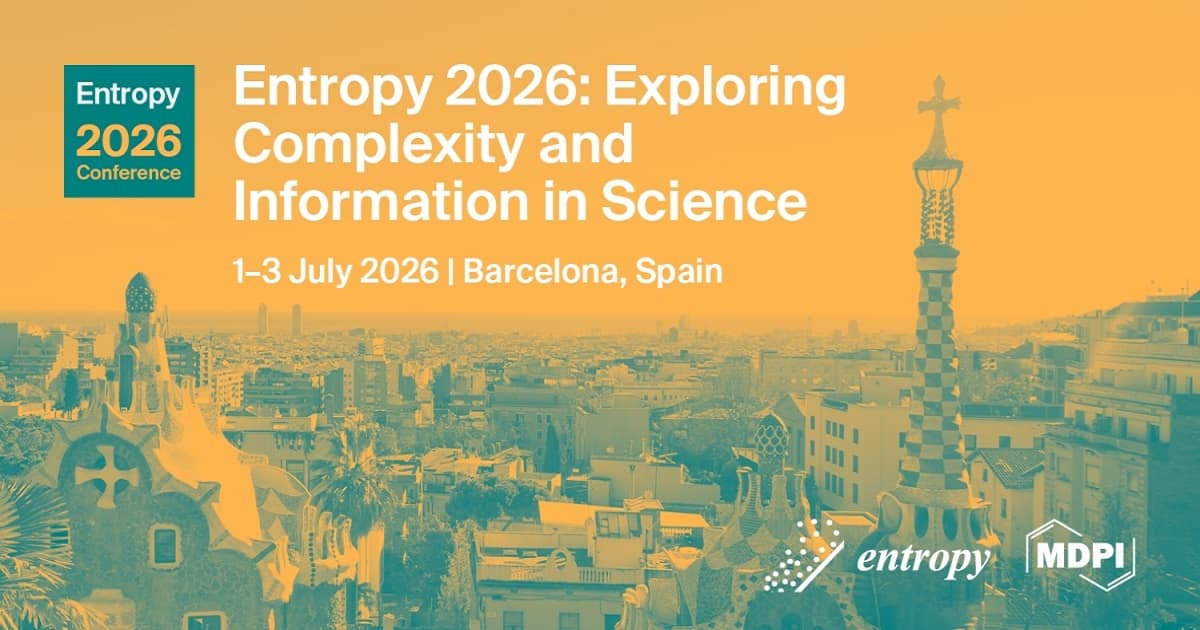
Barcelona, Spain
We are pleased to announce that Entropy 2026: Exploring Complexity and Information in Science will be held in Barcelona, Spain, from 1 to 3 July 2026.
This conference, organized by MDPI's open-access journal Entropy (ISSN 1099-4300; IF: 2.0), offers an exciting opportunity to explore cutting-edge advances and foster collaboration in the rapidly evolving fields of fundamental and applied physics, information theory, mathematics, and complex systems. We anticipate that Entropy 2026 will bring together more than 200 participants from around the world.
Topics of Interest
S1. Complex Systems and Network Science;
S2. Information Theory, Data Science, and Artificial Intelligence;
S3. Quantum Information and Quantum Computing;
S4. Thermodynamics and Energy Systems;
S5. Non-Equilibrium Systems and Entropy Production;
S6. Statistical Physics and Stochastic Processes;
S7. Soft and Living Matter;
S8. Applications of Entropy in Science and Engineering.
Conference Chairs
Prof. Dr. Miguel Rubi, University of Barcelona, Spain.
Prof. Dr. Kevin H. Knuth, University at Albany, USA.
Important Dates
Abstract submission deadline: 1 March 2026
Acceptance notification deadline: 30 March 2026
Early Bird Registration Deadline: 31 March 2026
Registration: 15 June 2026
For any enquiries regarding the event, please contact entropy2026@mdpi.com.
We look forward to seeing you at Entropy 2026.


Upcoming Partner Conferences (2)

Boston, MA, USA
NetSci is the flagship conference of the Network Science Society, and it remains an unparalleled venue for sharing and discussing discoveries, ideas, and emerging challenges in network science. The program explores how networks shape our world, including social and information networks, epidemics and public health, ecological and environmental systems, and neural and AI-driven systems.
Marking the 20th anniversary of the conference series, NetSci 2026 will be hosted by Northeastern University’s Network Science Institute. The conference will take place at the Hyatt Regency from June 1–5, 2026. With its long history of community activism and thriving academic and technological hubs, Boston embodies the spirit of progress and innovation. We look forward to gathering our community in a city known for its contributions to network science, as well as its rich diversity, collaborative spirit, and legacy of tackling global challenges.
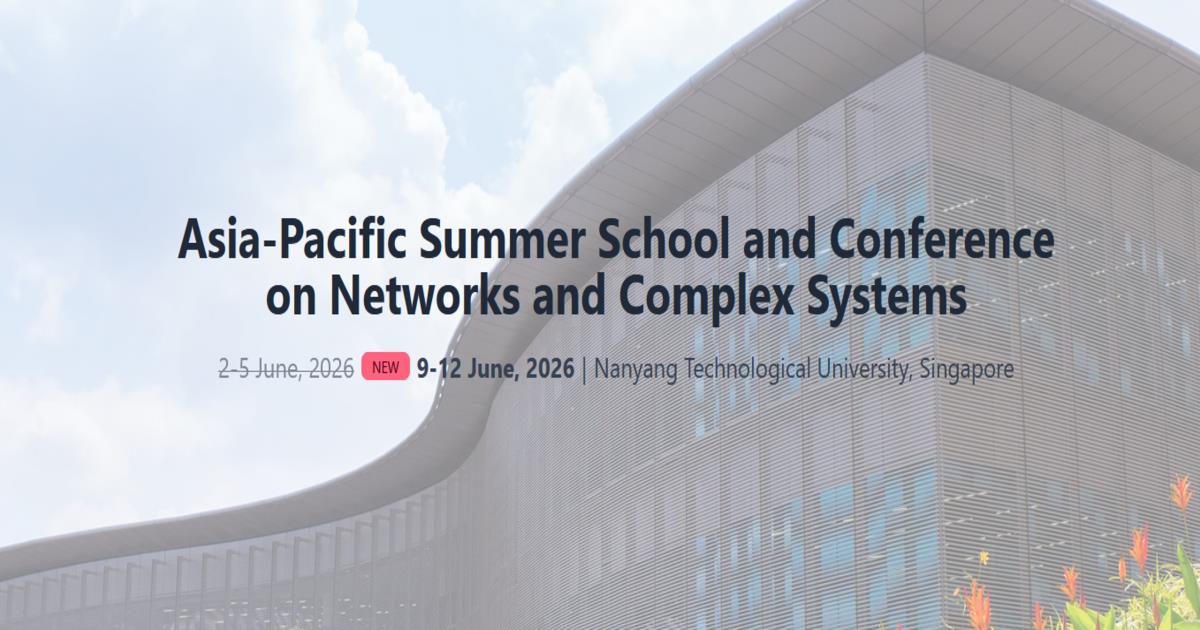
Singapore, Singapore
The number of scientists working on networks and complex systems in the Asia-Pacific region is increasing, but high-level conferences in these areas remain limited to NetSci, NetSciX, the International Conference on Computational Science (ICCS), and Conference on Complex Systems (CCS). Asia-Pacific scientists, especially postdocs and PhD students in these areas, therefore have limited opportunities to attend these conferences. This leads to a lack of exposure of Asia-Pacific scientists to good work carried out elsewhere in the world, and of scientists from other parts of the world to good work performed in Asia-Pacific, and seriously hampers the academic growth of Asia-Pacific scientists. Recently, we have been encouraged by the strong turnout of Indian scientists at all levels at the NetSciX 2025 conference in Indore, India. We can sense that the younger scientists treasured this opportunity to share their work. Unfortunately, it is impossible to bring these flagship conferences to Asia-Pacific every year. At best, we can host one such conference in Asia once every three to four years.
This prompted us to start an Asia-Pacific Conference on Networks and Complex Systems beginning next year (9–12 June 2026 in Singapore) to cater to these unmet demands. With this conference, we would always have a platform to present our recent work and meet up with colleagues. While we will always invite the most exciting speakers from all around the world, our goal is to include more invited speakers from Asia-Pacific. We also aim to give as many participants as possible (including PhD students) a chance to give oral presentations. We will rotate this conference series around Asia-Pacific, where most venues are more affordable compared to Europe or North America. Hopefully, more Asian scientists would be able to attend, even if they have limited funding. This is especially true of PhD students and postdoctoral researchers, many of whom can only attend the local editions of the conference.
Finally, to ensure that the conference is relevant and high-level, we will be advised by an International Advisory Committee of eminent scientists in the fields of networks and complex systems. Additionally, to ensure that good organizational practices are shared after they are developed, besides local organizers the organizing team for a given year will also comprise core members from the organizing team for the next year.
