



TypA Interacts with ExsA to Suppress Type III Secretion System in Pseudomonas aeruginosa
 , , and
Abstract
1. Introduction
2. Materials and Methods
2.1. Microbial Strains, Plasmids and Antibiotics
2.2. Genetic Techniques
2.3. Co-Immunoprecipitation Assay
2.4. Western Blot Assay
2.5. Cytotoxicity Assay
2.6. Quantitative Real-Time PCR Assay
2.7. Bacterial Two-Hybrid Assay
2.8. Protein Purification
2.9. Electrophoretic Mobility Shift Assay (EMSA)
2.10. Glutathione-S-Transferase Pull-Down (GST Pull-Down) Assay
2.11. Mouse Acute Pneumonia Model
3. Results
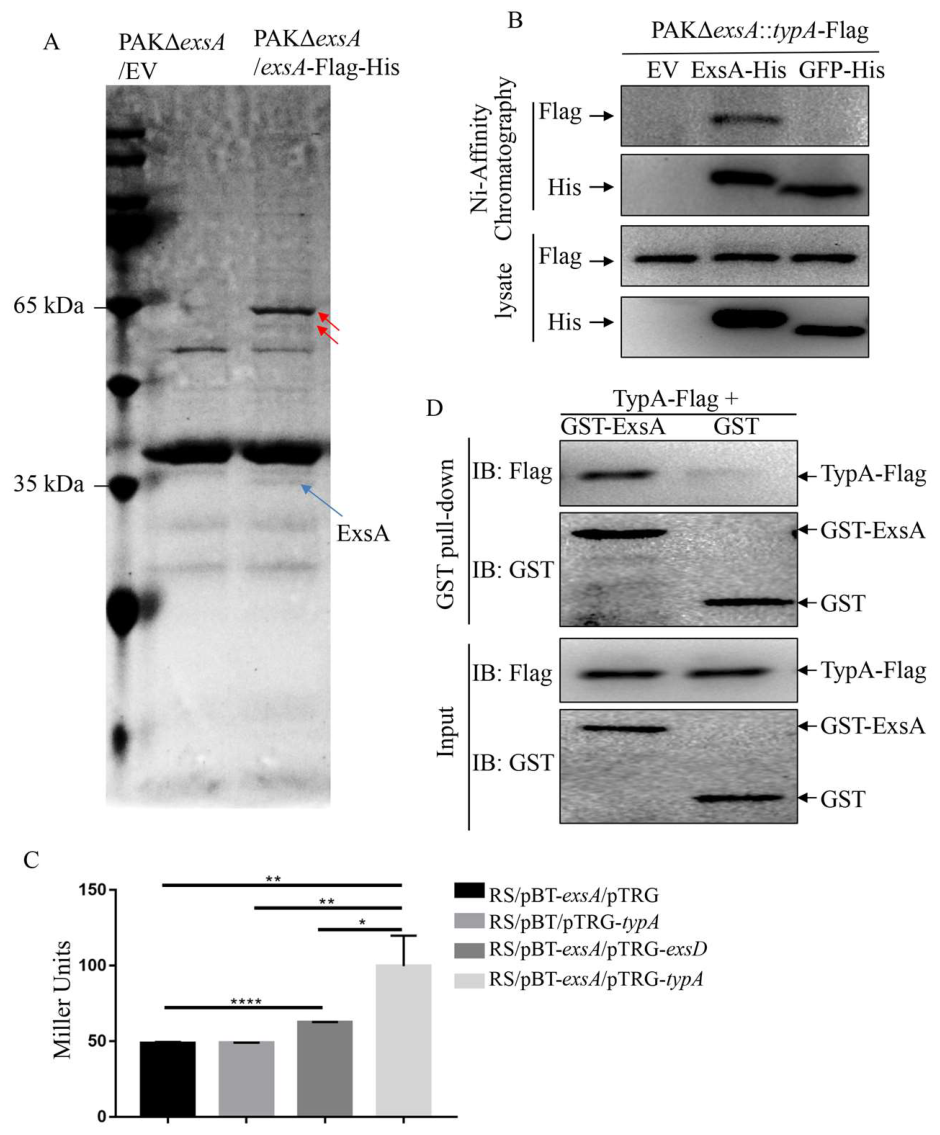
3.1. Identification of Candidate Proteins Interacting with the Master Activator ExsA
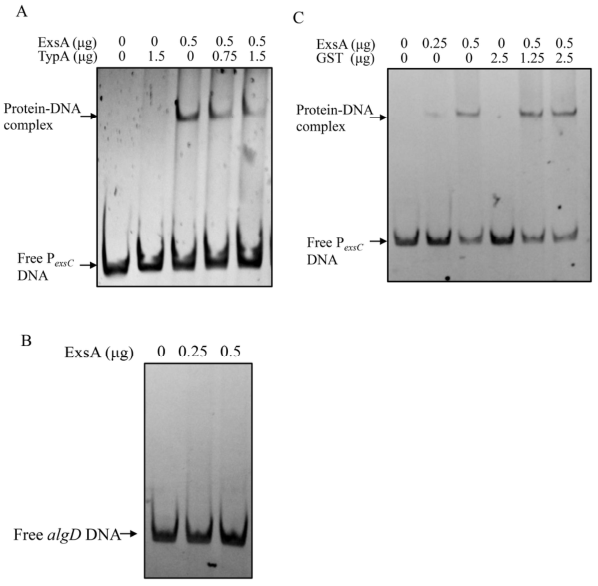
3.2. TypA Prevents ExsA Binding to the Promoter of PexsC
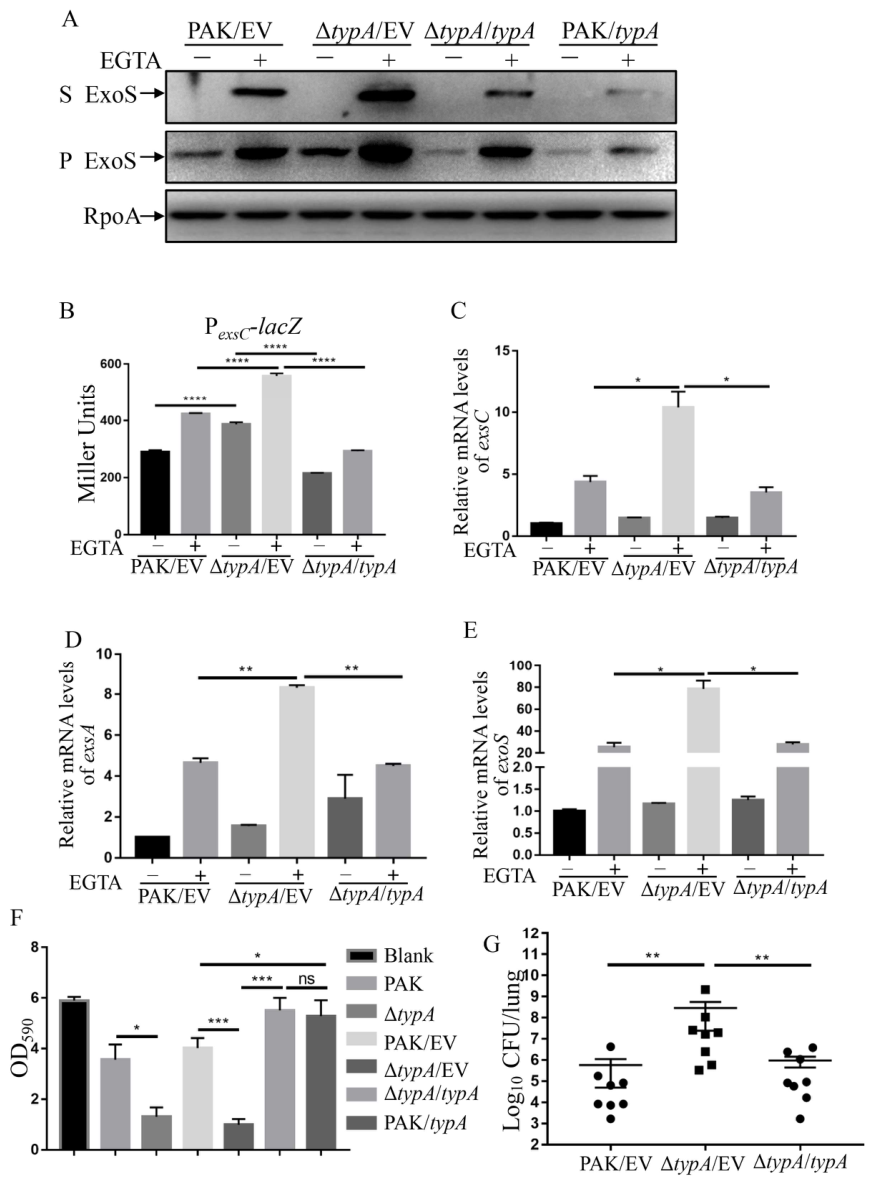
3.3. Deficiency of typA Increases the T3SS Expression in P. aeruginosa
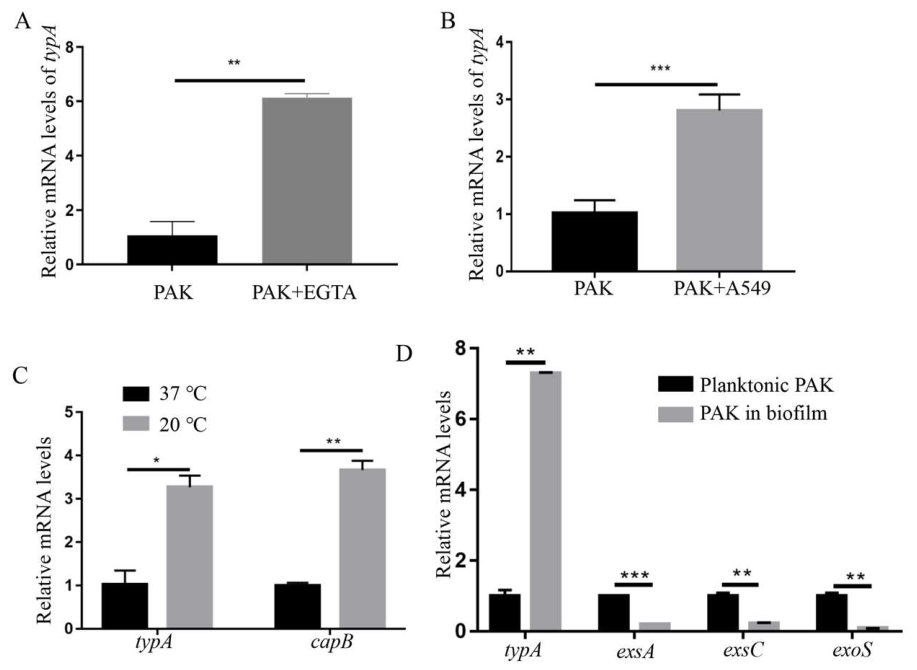
3.4. Expression Patterns of typA in P. aeruginosa
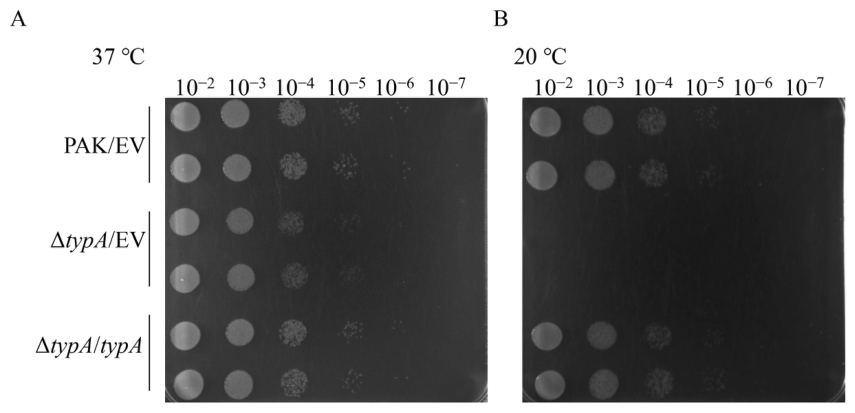
3.5. Mutation of typA Impairs the Growth at Low Temperature in P. aeruginosa
4. Discussion
5. Conclusions
Supplementary Materials
Author Contributions
Funding
Institutional Review Board Statement
Informed Consent Statement
Data Availability Statement
Conflicts of Interest
References
- Reynolds, D.; Kollef, M. The Epidemiology and Pathogenesis and Treatment of Pseudomonas aeruginosa Infections: An Update. Drugs 2021, 81, 2117–2131. [Google Scholar] [CrossRef] [Scilit] [PubMed]
- Driscoll, J.A.; Brody, S.L.; Kollef, M.H. The epidemiology, pathogenesis and treatment of Pseudomonas aeruginosa infections. Drugs 2007, 67, 351–368. [Google Scholar] [CrossRef] [Scilit] [PubMed]
- Hauser, A.R. The type III secretion system of Pseudomonas aeruginosa: Infection by injection. Nat. Rev. Microbiol. 2009, 7, 654–665. [Google Scholar] [CrossRef] [Scilit] [PubMed]
- Vallis, A.J.; Yahr, T.L.; Barbieri, J.T.; Frank, D.W. Regulation of ExoS production and secretion by Pseudomonas aeruginosa in response to tissue culture conditions. Infect. Immun. 1999, 67, 914–920. [Google Scholar] [CrossRef] [Scilit] [PubMed]
- Kim, J.; Ahn, K.; Min, S.; Jia, J.; Ha, U.; Wu, D.; Jin, S. Factors triggering type III secretion in Pseudomonas aeruginosa. Microbiology 2005, 151, 3575–3587. [Google Scholar] [CrossRef] [Scilit] [PubMed]
- Williams McMackin, E.A.; Djapgne, L.; Corley, J.M.; Yahr, T.L. Fitting Pieces into the Puzzle of Pseudomonas aeruginosa Type III Secretion System Gene Expression. J. Bacteriol. 2019, 201, e00209-19. [Google Scholar] [CrossRef] [Scilit] [PubMed]
- Vakulskas, C.A.; Brady, K.M.; Yahr, T.L. Mechanism of transcriptional activation by Pseudomonas aeruginosa ExsA. J. Bacteriol. 2009, 191, 6654–6664. [Google Scholar] [CrossRef] [Scilit] [PubMed]
- Urbanowski, M.L.; Lykken, G.L.; Yahr, T.L. A secreted regulatory protein couples transcription to the secretory activity of the Pseudomonas aeruginosa type III secretion system. Proc. Natl. Acad. Sci. USA 2005, 102, 9930–9935. [Google Scholar] [CrossRef] [Scilit] [PubMed]
- Thibault, J.; Faudry, E.; Ebel, C.; Attree, I.; Elsen, S. Anti-activator ExsD forms a 1:1 complex with ExsA to inhibit transcription of type III secretion operons. J. Biol. Chem. 2009, 284, 15762–15770. [Google Scholar] [CrossRef] [Scilit] [PubMed]
- Brutinel, E.D.; Vakulskas, C.A.; Yahr, T.L. Functional domains of ExsA, the transcriptional activator of the Pseudomonas aeruginosa type III secretion system. J. Bacteriol. 2009, 191, 3811–3821. [Google Scholar] [CrossRef] [Scilit] [PubMed]
- Brutinel, E.D.; Vakulskas, C.A.; Yahr, T.L. ExsD inhibits expression of the Pseudomonas aeruginosa type III secretion system by disrupting ExsA self-association and DNA binding activity. J. Bacteriol. 2010, 192, 1479–1486. [Google Scholar] [CrossRef] [Scilit] [PubMed]
- Ha, U.H.; Kim, J.; Badrane, H.; Jia, J.; Baker, H.V.; Wu, D.; Jin, S. An in vivo inducible gene of Pseudomonas aeruginosa encodes an anti-ExsA to suppress the type III secretion system. Mol. Microbiol. 2004, 54, 307–320. [Google Scholar] [CrossRef] [Scilit] [PubMed]
- Qi, S.Y.; Li, Y.; Szyroki, A.; Giles, I.G.; Moir, A.; O’Connor, C.D. Salmonella typhimurium responses to a bactericidal protein from human neutrophils. Mol. Microbiol. 1995, 17, 523–531. [Google Scholar] [CrossRef] [Scilit] [PubMed]
- Farris, M.; Grant, A.; Richardson, T.B.; O’Connor, C.D. BipA: A tyrosine-phosphorylated GTPase that mediates interactions between enteropathogenic Escherichia coli (EPEC) and epithelial cells. Mol. Microbiol. 1998, 28, 265–279. [Google Scholar] [CrossRef] [Scilit] [PubMed]
- Crane, S.D.; Banerjee, S.K.; Eichelberger, K.R.; Kurten, R.C.; Goldman, W.E.; Pechous, R.D. The Yersinia pestis GTPase BipA Promotes Pathogenesis of Primary Pneumonic Plague. Infect. Immun. 2021, 89, e00673-20. [Google Scholar] [CrossRef] [Scilit] [PubMed]
- Sabbagh, S.C.; Lepage, C.; McClelland, M.; Daigle, F. Selection of Salmonella enterica serovar Typhi genes involved during interaction with human macrophages by screening of a transposon mutant library. PLoS ONE 2012, 7, e36643. [Google Scholar] [CrossRef] [Scilit] [PubMed]
- Rowe, S.; Hodson, N.; Griffiths, G.; Roberts, I.S. Regulation of the Escherichia coli K5 capsule gene cluster: Evidence for the roles of H-NS, BipA, and integration host factor in regulation of group 2 capsule gene clusters in pathogenic E. coli. J. Bacteriol. 2000, 182, 2741–2745. [Google Scholar] [CrossRef] [Scilit] [PubMed]
- Grant, A.J.; Farris, M.; Alefounder, P.; Williams, P.H.; Woodward, M.J.; O’Connor, C.D. Co-ordination of pathogenicity island expression by the BipA GTPase in enteropathogenic Escherichia coli (EPEC). Mol. Microbiol. 2003, 48, 507–521. [Google Scholar] [CrossRef] [Scilit] [PubMed]
- Schweizer, H.P. Allelic exchange in Pseudomonas aeruginosa using novel ColE1-type vectors and a family of cassettes containing a portable oriT and the counter-selectable Bacillus subtilis sacB marker. Mol. Microbiol. 1992, 6, 1195–1204. [Google Scholar] [CrossRef] [Scilit] [PubMed]
- Li, S.; Weng, Y.; Li, X.; Yue, Z.; Chai, Z.; Zhang, X.; Gong, X.; Pan, X.; Jin, Y.; Bai, F.; et al. Acetylation of the CspA family protein CspC controls the type III secretion system through translational regulation of exsA in Pseudomonas aeruginosa. Nucleic Acids Res. 2021, 49, 6756–6770. [Google Scholar] [CrossRef] [Scilit] [PubMed]
- Howard, S.A.; Furniss, R.C.D.; Bonini, D.; Amin, H.; Paracuellos, P.; Zlotkin, D.; Costa, T.R.D.; Levy, A.; Mavridou, D.A.I.; Filloux, A. The Breadth and Molecular Basis of Hcp-Driven Type VI Secretion System Effector Delivery. mBio 2021, 12, e0026221. [Google Scholar] [CrossRef] [Scilit] [PubMed]
- Shi, J.; Jin, Y.; Bian, T.; Li, K.; Sun, Z.; Cheng, Z.; Jin, S.; Wu, W. SuhB is a novel ribosome associated protein that regulates expression of MexXY by modulating ribosome stalling in Pseudomonas aeruginosa. Mol. Microbiol. 2015, 98, 370–383. [Google Scholar] [CrossRef] [Scilit] [PubMed]
- Jin, Y.; Zhang, M.; Zhu, F.; Peng, Q.; Weng, Y.; Zhao, Q.; Liu, C.; Bai, F.; Cheng, Z.; Jin, S.; et al. NrtR Regulates the Type III Secretion System Through cAMP/Vfr Pathway in Pseudomonas aeruginosa. Front. Microbiol. 2019, 10, 85. [Google Scholar] [CrossRef] [Scilit] [PubMed]
- Tian, Z.; Cheng, S.; Xia, B.; Jin, Y.; Bai, F.; Cheng, Z.; Jin, S.; Liu, X.; Wu, W. Pseudomonas aeruginosa ExsA Regulates a Metalloprotease, ImpA, That Inhibits Phagocytosis of Macrophages. Infect. Immun. 2019, 87, e00695-19. [Google Scholar] [CrossRef] [Scilit] [PubMed]
- McCaw, M.L.; Lykken, G.L.; Singh, P.K.; Yahr, T.L. ExsD is a negative regulator of the Pseudomonas aeruginosa type III secretion regulon. Mol. Microbiol. 2002, 46, 1123–1133. [Google Scholar] [CrossRef] [Scilit] [PubMed]
- Neidig, A.; Yeung, A.T.; Rosay, T.; Tettmann, B.; Strempel, N.; Rueger, M.; Lesouhaitier, O.; Overhage, J. TypA is involved in virulence, antimicrobial resistance and biofilm formation in Pseudomonas aeruginosa. BMC Microbiol. 2013, 13, 77. [Google Scholar] [CrossRef] [Scilit] [PubMed]
- Hovey, A.K.; Frank, D.W. Analyses of the DNA-binding and transcriptional activation properties of ExsA, the transcriptional activator of the Pseudomonas aeruginosa exoenzyme S regulon. J. Bacteriol. 1995, 177, 4427–4436. [Google Scholar] [CrossRef] [Scilit] [PubMed]
- Hauser, A.R.; Kang, P.J.; Engel, J.N. PepA, a secreted protein of Pseudomonas aeruginosa, is necessary for cytotoxicity and virulence. Mol. Microbiol. 1998, 27, 807–818. [Google Scholar] [CrossRef] [Scilit] [PubMed]
- Pan, X.; Dong, Y.; Fan, Z.; Liu, C.; Xia, B.; Shi, J.; Bai, F.; Jin, Y.; Cheng, Z.; Jin, S.; et al. In vivo Host Environment Alters Pseudomonas aeruginosa Susceptibility to Aminoglycoside Antibiotics. Front. Cell. Infect. Microbiol. 2017, 7, 83. [Google Scholar] [CrossRef] [Scilit] [PubMed]
- Wurtzel, O.; Yoder-Himes, D.R.; Han, K.; Dandekar, A.A.; Edelheit, S.; Greenberg, E.P.; Sorek, R.; Lory, S. The single-nucleotide resolution transcriptome of Pseudomonas aeruginosa grown in body temperature. PLoS Pathog. 2012, 8, e1002945. [Google Scholar] [CrossRef] [Scilit] [PubMed]
- Choi, E.; Hwang, J. The GTPase BipA expressed at low temperature in Escherichia coli assists ribosome assembly and has chaperone-like activity. J. Biol. Chem. 2018, 293, 18404–18419. [Google Scholar] [CrossRef] [Scilit] [PubMed]
- Ventre, I.; Goodman, A.L.; Vallet-Gely, I.; Vasseur, P.; Soscia, C.; Molin, S.; Bleves, S.; Lazdunski, A.; Lory, S.; Filloux, A. Multiple sensors control reciprocal expression of Pseudomonas aeruginosa regulatory RNA and virulence genes. Proc. Natl. Acad. Sci. USA 2006, 103, 171–176. [Google Scholar] [CrossRef] [Scilit] [PubMed]
- Goodman, A.L.; Kulasekara, B.; Rietsch, A.; Boyd, D.; Smith, R.S.; Lory, S. A signaling network reciprocally regulates genes associated with acute infection and chronic persistence in Pseudomonas aeruginosa. Dev. Cell 2004, 7, 745–754. [Google Scholar] [CrossRef] [Scilit] [PubMed]
- Pfennig, P.L.; Flower, A.M. BipA is required for growth of Escherichia coli K12 at low temperature. Mol. Genet. Genom. 2001, 266, 313–317. [Google Scholar] [CrossRef] [Scilit] [PubMed]
- Bernhards, R.C.; Marsden, A.E.; Esher, S.K.; Yahr, T.L.; Schubot, F.D. Self-trimerization of ExsD limits inhibition of the Pseudomonas aeruginosa transcriptional activator ExsA in vitro. FEBS J. 2013, 280, 1084–1094. [Google Scholar] [CrossRef] [Scilit] [PubMed]
- Choudhury, P.; Flower, A.M. Efficient assembly of ribosomes is inhibited by deletion of bipA in Escherichia coli. J. Bacteriol. 2015, 197, 1819–1827. [Google Scholar] [CrossRef] [Scilit] [PubMed]
- Anderson, G.G.; Yahr, T.L.; Lovewell, R.R.; O’Toole, G.A. The Pseudomonas aeruginosa magnesium transporter MgtE inhibits transcription of the type III secretion system. Infect. Immun. 2010, 78, 1239–1249. [Google Scholar] [CrossRef] [Scilit] [PubMed]
- Chakravarty, S.; Melton, C.N.; Bailin, A.; Yahr, T.L.; Anderson, G.G. Pseudomonas aeruginosa Magnesium Transporter MgtE Inhibits Type III Secretion System Gene Expression by Stimulating rsmYZ Transcription. J. Bacteriol. 2017, 199, e00268-17. [Google Scholar] [CrossRef] [Scilit] [PubMed]
- Brencic, A.; Lory, S. Determination of the regulon and identification of novel mRNA targets of Pseudomonas aeruginosa RsmA. Mol. Microbiol. 2009, 72, 612–632. [Google Scholar] [CrossRef] [Scilit] [PubMed]
- Bichsel, C.; Neeld, D.; Hamazaki, T.; Chang, L.J.; Yang, L.J.; Terada, N.; Jin, S. Direct reprogramming of fibroblasts to myocytes via bacterial injection of MyoD protein. Cell. Reprogram. 2013, 15, 117–125. [Google Scholar] [CrossRef] [Scilit] [PubMed]
- Wang, D.; Zhang, X.; Yin, L.; Liu, Q.; Yu, Z.; Xu, C.; Ma, Z.; Xia, Y.; Shi, J.; Gong, Y.; et al. RplI interacts with 5′ UTR of exsA to repress its translation and type III secretion system in Pseudomonas aeruginosa. PLoS Pathog. 2022, 18, e1010170. [Google Scholar] [CrossRef] [Scilit] [PubMed]
- West, S.E.; Schweizer, H.P.; Dall, C.; Sample, A.K.; Runyen-Janecky, L.J. Construction of improved Escherichia-Pseudomonas shuttle vectors derived from pUC18/19 and sequence of the region required for their replication in Pseudomonas aeruginosa. Gene 1994, 148, 81–86. [Google Scholar] [CrossRef] [Scilit] [PubMed]
- Fürste, J.P.; Pansegrau, W.; Frank, R.; Blöcker, H.; Scholz, P.; Bagdasarian, M.; Lanka, E. Molecular cloning of the plasmid RP4 primase region in a multi-host-range tacP expression vector. Gene 1986, 48, 119–131. [Google Scholar] [CrossRef] [Scilit] [PubMed]
- Deng, X.; Li, M.; Pan, X.; Zheng, R.; Liu, C.; Chen, F.; Liu, X.; Cheng, Z.; Jin, S.; Wu, W. Fis Regulates Type III Secretion System by Influencing the Transcription of exsA in Pseudomonas aeruginosa Strain PA14. Front. Microbiol. 2017, 8, 669. [Google Scholar] [CrossRef] [Scilit] [PubMed]
Disclaimer/Publisher’s Note: The statements, opinions and data contained in all publications are solely those of the individual author(s) and contributor(s) and not of MDPI and/or the editor(s). MDPI and/or the editor(s) disclaim responsibility for any injury to people or property resulting from any ideas, methods, instructions or products referred to in the content. |
© 2026 by the authors. Licensee MDPI, Basel, Switzerland. This article is an open access article distributed under the terms and conditions of the Creative Commons Attribution (CC BY) license.
Share and Cite
Yin, L.; Li, Y.; Gong, X.; Chen, P.; Wu, W.; Ha, U.-H.; Jin, S.; Jin, Y. TypA Interacts with ExsA to Suppress Type III Secretion System in Pseudomonas aeruginosa. Microorganisms 2026, 14, 1942. https://doi.org/10.3390/microorganisms14091942
Yin L, Li Y, Gong X, Chen P, Wu W, Ha U-H, Jin S, Jin Y. TypA Interacts with ExsA to Suppress Type III Secretion System in Pseudomonas aeruginosa. Microorganisms. 2026; 14(9):1942. https://doi.org/10.3390/microorganisms14091942
Chicago/Turabian StyleYin, Liwen, Yiming Li, Xuetao Gong, Peishan Chen, Weihui Wu, Un-Hwan Ha, Shouguang Jin, and Yongxin Jin. 2026. "TypA Interacts with ExsA to Suppress Type III Secretion System in Pseudomonas aeruginosa" Microorganisms 14, no. 9: 1942. https://doi.org/10.3390/microorganisms14091942
APA StyleYin, L., Li, Y., Gong, X., Chen, P., Wu, W., Ha, U.-H., Jin, S., & Jin, Y. (2026). TypA Interacts with ExsA to Suppress Type III Secretion System in Pseudomonas aeruginosa. Microorganisms, 14(9), 1942. https://doi.org/10.3390/microorganisms14091942

