1. Introduction
Q fever is a zoonotic disease caused by the Gram-negative bacterium
Coxiella burnetii, with a distribution spanning nearly all regions of the world [
1]. The animal host range of
Coxiella burnetii is wide, including multiple wild and domestic mammal species, avian species, and arthropods, particularly ticks, some of which are even considered reservoirs of the disease [
2,
3,
4,
5]. Within this broad host range, domestic ruminants, especially cattle, sheep, and goats, are considered the main reservoirs for zoonotic transmission [
6,
7,
8,
9]. However, other domestic animals and wildlife have also been implicated in human outbreaks [
2,
10]. Infected animals excrete
Coxiella burnetii in urine, feces, milk, and birthing materials such as the placenta and amniotic fluid. The primary route of human infection is via inhalation of contaminated aerosols from these sources, which may also contaminate neonates, placental tissues, or wool [
11]. Less commonly, transmission occurs through ingestion of unpasteurized milk or fresh cheese and, more rarely, via blood transfusion [
11], vertical or sexual transmission [
12].
In the European Union (EU), 719 confirmed human cases of Q fever were reported in 2022 (0.17 cases per 100,000 population), representing a 56.5% increase over 2021. Most of these cases (83.0%;
n = 597) were reported to have been acquired in the EU, which is an increase over 2021 (78%), 2020 (66.3%), and 2018 (79.6%) [
13].
Portugal has followed the increasing trend observed across Europe, reporting more cases in 2023 (33 confirmed cases, corresponding to a notification rate of 0.32 per 100,000 population) than in 2022 (25 confirmed cases, with a notification rate of 0.24 per 100,000 population) (EFSA/ECDC, 2024) [
13]. According to Lencastre Monteiro et al. (2021), Q fever is considered underdiagnosed and underreported in Portugal [
14]. However, it has been a notifiable disease since 1998 [
15], and mandatory reporting to the National Information System for Epidemiological Surveillance (SINAVE) has been required since 2021 [
16].
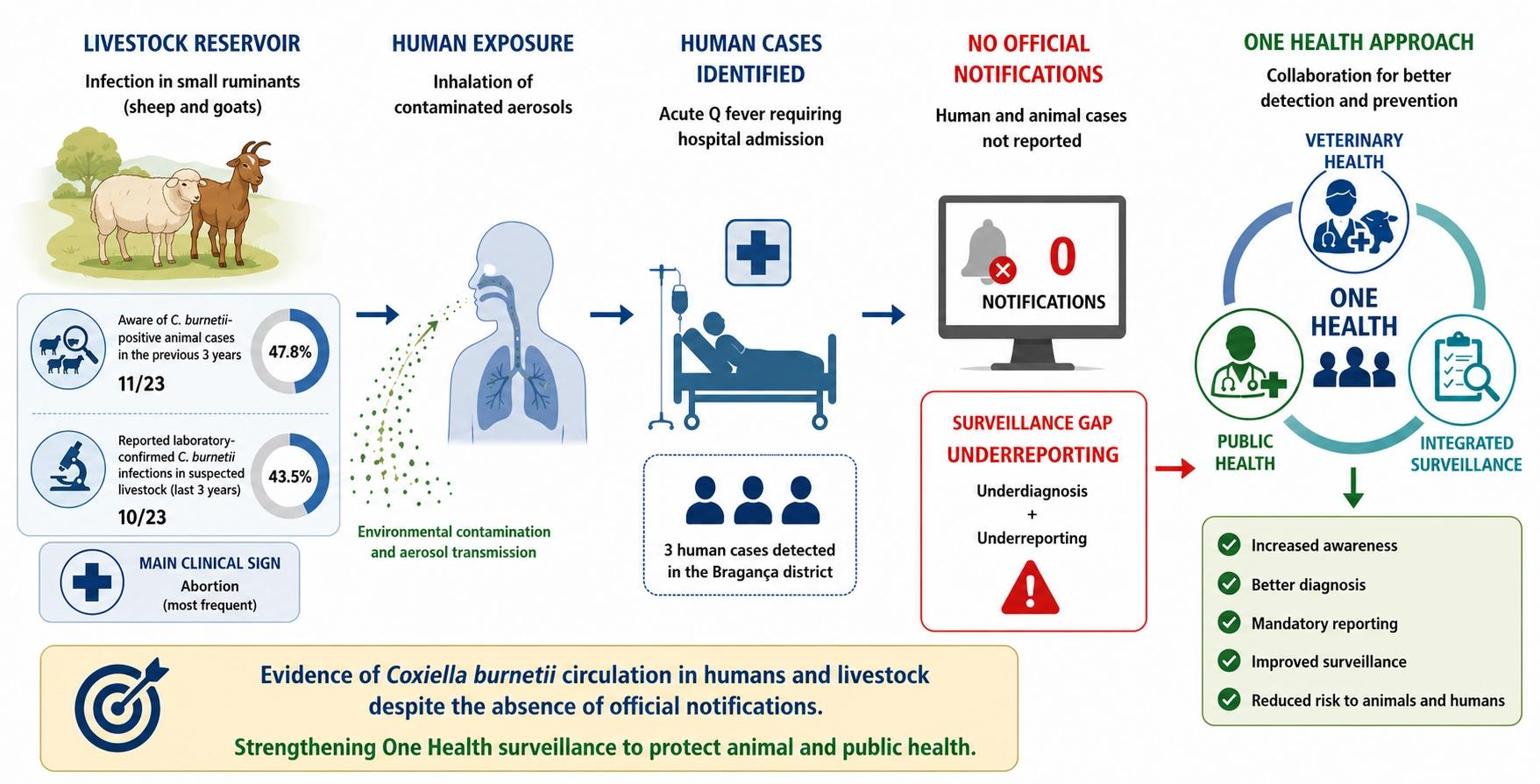
Within the scope of medical activities conducted by a Public Health Unit in the Trás-os-Montes region, three human cases of Q fever were identified in the Bragança district, at the hospital level, between 2021 and 2024, while no corresponding notifications were identified in routine surveillance data for the same period on the National Information System for Epidemiological Surveillance (SINAVE).
In animals, based on Commission Implementing Regulation (EU) 2018/1882, Q fever is a notifiable disease, classified as Category E’ disease, for which there is a need for surveillance and annual reporting of confirmed cases by Member States (MSs) in
Bison spp.,
Bos spp.,
Bubalus spp.,
Ovis spp. and
Capra spp. and notification of suspected notifiable animal diseases, through submission of the applicable information at a national, community (EU) and/or international (WOAH) level [
17]. According to the Commission Implementing Decision (EU) 2018/945 of 22 June 2018 on the communicable diseases and related special health issues to be covered by epidemiological surveillance as well as relevant case definitions, cases are classified as ‘possible’, ‘probable’ and ‘confirmed’, being a possible case one that meets the clinical criteria (which includes common and relevant signs and symptoms of the disease) without epidemiological or laboratory evidence (high sensitivity and low specificity), a probable case one with clinical criteria and epidemiological evidence but without laboratory evidence, and a confirmed case one with laboratory confirmation (highly specific and less sensitive) with clinical criteria, with unknown clinical criteria or without clinical criteria [
18].
In Portugal, despite the circulation of
Coxiella burnetii in ruminants having been identified in several seroprevalence studies [
7,
19,
20,
21], no clinical cases have been reported in recent years [
13]. This responsibility for notification to Competent Authorities lies with the veterinary advisors of the farms that diagnose the occurrences.
According to the European Union One Health 2022 Zoonoses Report, there is a lack of harmonized reporting data for animal Q fever; consequently, the data reported to EFSA cannot be used to analyze spatial representativeness or temporal trends of Q fever, nor to compare differences among reporting countries within the EU [
22].
Given the central role of livestock—particularly ruminants—as reservoirs of Q fever, and the recent identification of human cases at the hospital level in the Bragança district (Portugal northeast) and despite the absence of reported cases in both humans and animals, the main objective of this veterinarians’ questionnaire was to generate awareness and evidence of the presence of this zoonosis in both livestock and humans, and to analyse the possibility of disease underreporting, which may compromise effective decision making regarding surveillance and control measures within a One Health framework.
From this perspective, this work describes an assessment of veterinarians practicing in the outbreak area, producing data about their knowledge and previous diagnosis of Q fever in livestock.
2. Materials and Methods
Within the activities of the Zoonoses Working Group of the Trás-os-Montes and Alto Douro Academic Clinical Center (CAC TMAD), which brings together animal and human health professionals from the Trás-os-Montes region (Portugal), it was noted that, although no regional human Q fever cases were reported between 2021 and 2024 on the National Information System for Epidemiological Surveillance (SINAVE), three human cases—all male patients aged 64–88 years, all hospitalised for 8–10 days—were identified under public health practice in the Bragança district. These cases were identified through a search of the principal diagnosis code (Q fever, ICD-9) in the administrative hospital database, rather than through individual epidemiological case investigation; consequently, detailed information on diagnostic criteria, laboratory confirmation method, clinical presentation, exposure history, occupational risk, and potential contact with livestock could not be obtained for these cases, limiting the extent to which their epidemiological significance can be evaluated.
Furthermore, for the same period, Portugal has not reported animal data, as aforementioned.
Aware of these data, the Zoonoses Working Group of CAC TMAD conducted a joint investigation in the Bragança district to assess livestock veterinarians’ awareness of Q fever in animals.
A questionnaire was conducted between 27 January 2025 and 14 February 2025 to question all livestock veterinarians working in the Bragança district. Each of these veterinarians questioned is responsible for specific farms, with no data overlapping in this questionnaire. Veterinarians were identified by the Zoonoses Working Group of CAC TMAD from those known to be practicing within the district and responsible for livestock farms in the area; all identified veterinarians were invited to take part. The questionnaire was self-administered and could be completed anonymously, with no requirement to provide personal identifying data beyond the geographical area of practice.
Initially, the simple questionnaire consisted of 3 questions:
- (1)
Are you aware of positive cases of Coxiella burnetii in livestock animals in the last 3 years?
- (2)
Have you diagnosed Q fever disease in livestock animals with laboratory-confirmed positive results for Coxiella burnetii infection in the last 3 years?
- (3)
What are the clinical signs that led to the suspicion of Coxiella burnetii in animals, to send samples to the laboratory?
Subsequently, respondents who answered positively to the second question were asked to specify the animal species from which Coxiella burnetii was detected in laboratory samples, the type of laboratory test used, and the type of sample in which the positive diagnosis was obtained.
Informed consent was obtained from all enrolled participants before each questionnaire, using an online form (Google Forms), the blank informed consent form and the blank questionnaire can be found in the
Supplementary Materials. Participation was voluntary.
The data was entered into an Excel spreadsheet and analyzed using descriptive statistical methods.
3. Results
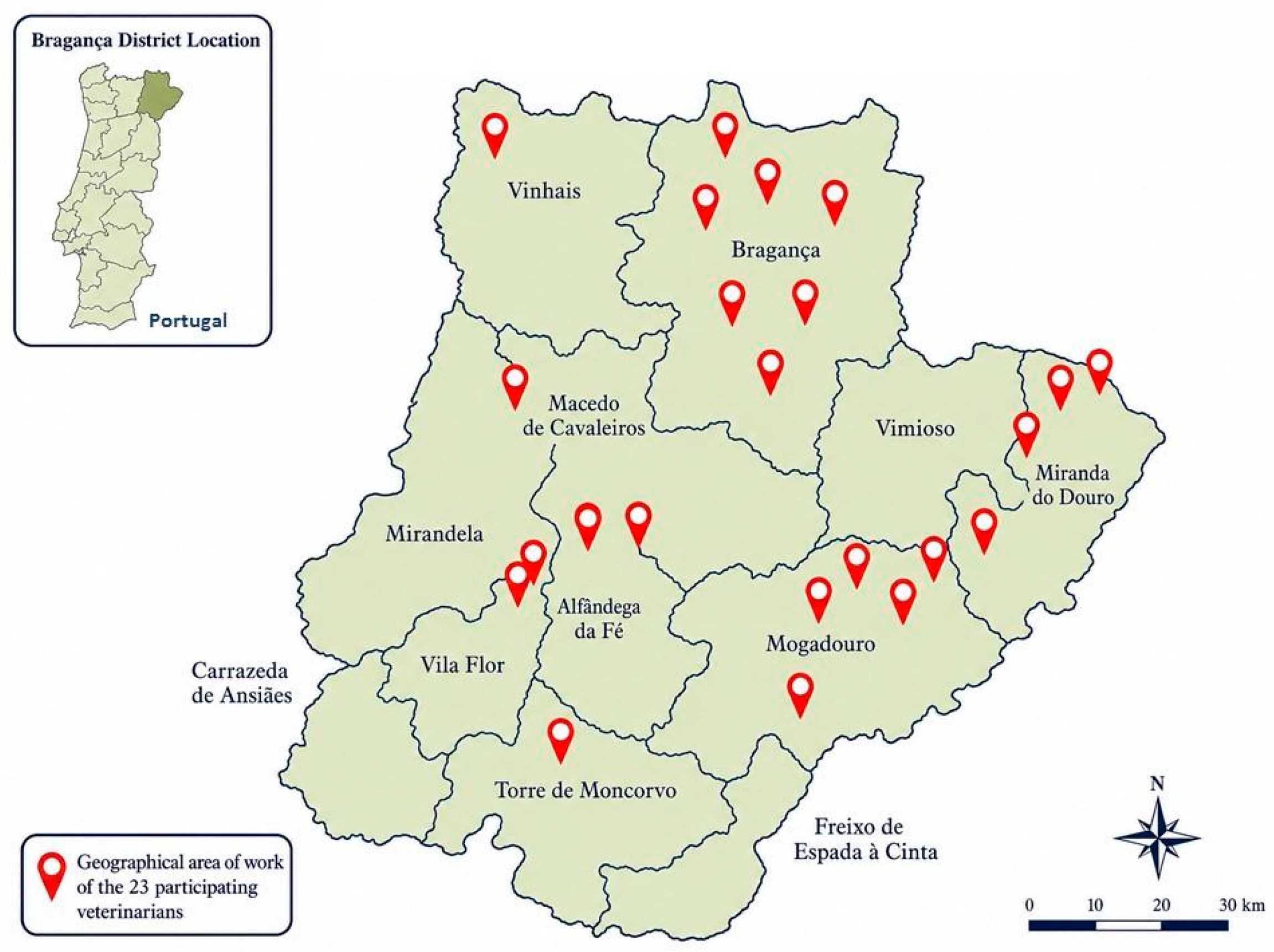
Of the 26 livestock veterinarians who had been practicing in the Bragança district over the past three years, a total of 23 (88.5%) were successfully questioned. The questionnaire achieved a high response rate among identified eligible livestock veterinarians in the district (
Figure 1).
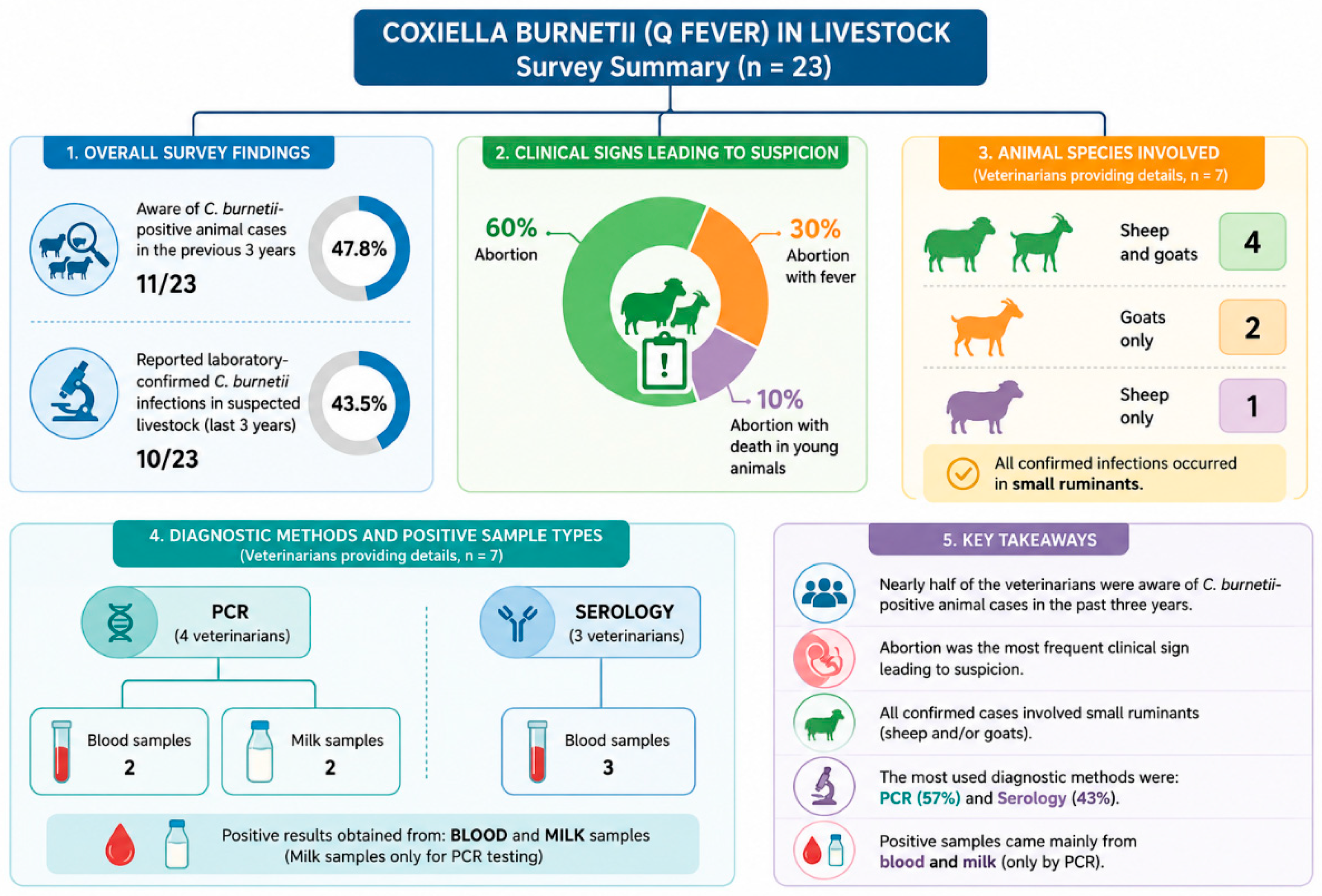
Among respondents, 11 out of 23 (47.8%|CI 95%, 28.5–67.6) reported awareness of C. burnetii-positive animal cases within the previous three years, and 10 out of 23 (43.5%|CI 95%, 24.1–62.1) reported having obtained laboratory-confirmed Coxiella burnetii-positive results in clinically suspected livestock during the same period. Abortion was the most frequent clinical sign leading to suspicion of Coxiella burnetii infection (6/10; 60%|CI 95%, 31.2–83.7), followed by abortion with fever (3/10; 30%|CI 95%, 11.1–56.0) and abortion with death in young animals (1/10; 10%|CI 95%, 1.8–44.5%).
Of the ten veterinarians who reported having diagnosed laboratory-confirmed Q fever in livestock during the past three years, seven provided additional details regarding the animal species involved, the diagnostic methods used, and the types of samples that yielded positive results. All respondents indicated that the positive results occurred in small ruminants: four detected
Coxiella burnetii in both sheep and goats, two exclusively in goats, and one exclusively in sheep. Seven veterinarians provided detailed information on the diagnostic procedures. Of these, four used PCR to detect
Coxiella burnetii in goats and sheep—two based on blood samples and two on milk samples—while the remaining three relied on serological testing, all performed on blood samples from small ruminants (
Figure 2).
Each of these veterinarians reported that the samples were sent to accredited laboratories in Portugal for the diagnosis of biological samples from livestock, strictly following the collection and shipping protocol for the samples to be tested. Since the specifications of the tests conducted in the laboratories are unknown, there is only knowledge of the type of test and the resulting outcome.
4. Discussion
These results provide the first local field-based evidence of
Coxiella burnetii infection in livestock in the Bragança district (Northeast Portugal), an area where unreported human cases had also been identified. Several studies conducted in Portugal have already demonstrated the circulation of this agent in production ruminants, most of which rely on serological evidence [
7,
20,
21]. In contrast, our study documents the clinical presence of the disease, which should be subject to mandatory reporting [
17]. Although Q fever has been a notifiable animal disease in Portugal, no official cases have been reported in available surveillance data for this district, mirroring the broader gaps and inconsistencies in surveillance previously highlighted at the EU level. The findings underscore the need to strengthen research efforts and enhance surveillance frameworks for
C. burnetii, ensuring earlier detection and reducing the likelihood of exposure to both animals and humans [
13]. The three non-reported human cases—all elderly male patients requiring prolonged hospital admission—detected during this joint investigation reinforce the concerns raised by Lencastre Monteiro and collaborators (2021) [
14], who highlighted that Q fever in Portugal is frequently overlooked and remains substantially underdiagnosed. Fever is commonly reported as a clinical manifestation of acute Q fever in humans [
23], alongside flu-like symptoms, pneumonia, and hepatitis. At the same time, chronic cases may present with endocarditis, chronic vascular infections, and, more rarely, osteoarticular involvement [
24,
25]. According to Lencastre Monteiro and collaborators (2021), clinical diagnosis may be missed due to the nonspecific presentation, which can range from mild or subclinical infection to disease severe enough to require hospitalisation, and many infections are only recognized during the chronic phase, when complications may already be established [
14]. In the present study, all three human cases required hospital admission lasting 8 to 10 days, indicating that underdiagnosis in this region is not restricted to mild or subclinical presentations.
Together, these non-reported human and animal cases observed in this study suggest a gap in surveillance and reporting, emphasizing the need for heightened clinical suspicion and improved diagnostic awareness among both medical and veterinary professionals.
These findings also illustrate that underdiagnosis, underreporting and the lack of integration between human and animal health surveillance systems, although related, are distinct problems. Underdiagnosis reflects a failure of clinical suspicion, which may occur when non-specific symptoms are not linked to Q fever or when reproductive disorders in livestock are not investigated further. Underreporting can occur even after a case has been correctly diagnosed, if notification to the competent veterinary or public health authorities does not take place. Finally, the lack of integration between sectors means that, even when cases are identified and reported separately in human and animal health systems, this information is not routinely shared or cross-checked, preventing recognition of the broader epidemiological picture. In the present study, the reporting chain may have failed at several of these points: at the level of clinical suspicion in humans and animals, at sample submission and laboratory confirmation, at notification to veterinary or public health authorities, or in the feedback of information between sectors.
Based on this questionnaire, abortion was the most frequent clinical sign leading to suspicion of
Coxiella burnetii infection (60%), and these findings are in line with previous reports, which identify abortion as the main clinical manifestation of
Coxiella burnetii infection in ruminants. Van den Brom et al. and Trachsel et al. [
26,
27] reported abortion during late pregnancy as the predominant symptom in sheep and goats, while Anastácio et al. (2016) found that antibody positivity (ELISA and PCR in bulk tank milk) was significantly associated with abortion, and bacterial shedding with infertility [
19]. Although many animals remain chronically infected without symptoms, chronic infection has been linked to abortions in sheep and goats, reduced birth weight, and infertility in cattle [
11]. In addition, infection can trigger epizootic abortion events, marked by massive bacterial shedding in parturient fluids and placental tissues, thereby increasing environmental contamination and transmission risk [
28,
29]. The presence of these non-specific symptoms may contribute to misdiagnosis, reinforcing the need for careful differential diagnosis in veterinary practice.
These findings on the diagnosis of positive Q fever cases by 10 responding veterinarians clearly demonstrate the presence of Q fever in local small-ruminant populations and reinforce the need for targeted surveillance in these species. This pattern aligns with EU-level data from 2023, in which small ruminants also exhibited higher prevalence rates compared with cattle (Authority (EFSA) and European Centre for Disease Prevention and Control (ECDC)) [
13]. Our study was conducted in the Bragança district, a rural region of Trás-os-Montes characterized by traditional medium-scale livestock farming [
30]. Sheep and goat farming in Trás-os-Montes is predominantly extensive, with daytime grazing; however, it is common practice to bring animals into pens or barns overnight and, in particular, during the lambing/kidding period, which constitutes a plausible route of human exposure to aerosolised birth fluids even in the absence of direct occupational contact with animals. In this setting, small-ruminant husbandry is widespread. It frequently occurs near human communities, potentially creating favorable conditions for the zoonotic transmission of
Coxiella burnetii, as Cruz et al. (2018) previously reported detection of anti-
Coxiella burnetii IgG in shepherds and sheep milk cheesemakers in Portugal [
20].
The differences in diagnostic methods reported by the responding veterinarians illustrate the diversity of diagnostic approaches currently employed in the region. The wide variety of sample types tested was also highlighted in the European Zoonoses report [
13]. According to van den Brom and collaborators (2025), persistent heterogeneity in Q fever surveillance across Europe, particularly in diagnostic approaches, continues to hinder effective risk assessment and coordinated control strategies across Member States [
26].
5. Conclusions
Despite the study’s limitations—including reliance on self-reported data; the absence of independent laboratory confirmation; absence of herd-level and animal-level denominators; heterogeneity of diagnostic methods and samples; possible failure of veterinarians to recognize Q fever infection clinical signs; potential recall bias, as veterinarians reported cases from memory over a three-year period; and absence of a formal epidemiological link between human cases and animal cases—its findings provide, for the first time, local evidence of Coxiella burnetii presence in both livestock and humans in the Bragança district. Moreover, the study highlights the possible underreporting of this disease, underscoring the potential public health relevance of Q fever in the region, if epidemiological evidence of cases of zoonotic transmission between humans and animals can be found.
This joint effort between animal and human health professionals underscores the need for mandatory reporting of animal cases to both veterinary and public health authorities to strengthen awareness, surveillance, and implementation of control measures within a One Health framework, reinforcing the need for integrated surveillance between human and animal health sectors. Veterinarians should systematically consider Q fever as a differential diagnosis in abortion events and adopt appropriate protective and biosecurity measures. To make this One Health message more operational, practical measures could include the systematic inclusion of Q fever in the differential diagnosis of abortion storms in sheep and goats, the adoption of standardised laboratory confirmation criteria, periodic reporting reminders for veterinarians, structured data sharing between animal and human health authorities, and targeted risk communication for farmers, veterinarians and others exposed to lambing or kidding environments. Financial and logistical support from competent authorities for sampling, laboratory testing and field investigation may further help to overcome practical barriers to diagnosis and reporting, particularly where Q fever surveillance still relies largely on voluntary, practitioner-initiated submissions.
At a time when the number of human cases reported to the ECDC continues to rise across Europe, these findings support the presence of Q fever in both human and animal populations in the region and reinforce the importance of notification, continuous surveillance, and strategic control and mitigation measures aimed at reducing exposure through a preventive One Health approach.
Author Contributions
Conceptualization, T.S., S.S. and M.V.-P.; Methodology, T.S., S.S. and M.V.-P.; Formal analysis, T.S., S.S. and M.V.-P.; Investigation T.S., S.S. and M.V.-P.; Data curation, T.S.; Writing—original draft preparation, T.S., S.S. and M.V.-P.; Writing—review and editing, T.S., S.S., A.C.A. and M.V.-P.; Visualization, A.C.A.; Supervision, M.V.-P. All authors have read and agreed to the published version of the manuscript.
Funding
This work was supported by the Animal and Veterinary Research Center (CECAV) UID/00772/2025.
Institutional Review Board Statement
Not applicable. As described in the informed consent, the questions were asked anonymously and without the inclusion of any personal or opinion-based data, with only professional technical data being collected. Therefore, this data collection followed the general guidelines of the Declaration of Helsinki, without any involvement of personal data, all of which were professional in nature and public for the veterinary epidemiological surveillance systems of Portugal.
Informed Consent Statement
Informed consent was obtained from all enrolled all individual participants included in the study. Participation was voluntary, and informed consent was obtained from all enrolled participants before each questionnaire.
Data Availability Statement
The original contributions presented in this study are included in the article/
Supplementary Materials. Further inquiries can be directed to the corresponding author.
Conflicts of Interest
The authors declare no conflicts of interest.
References
- Hamad, G.; Ranmuthugala, G. Q Fever Awareness in Australia: A Scoping Review. Aust. N. Z. J. Public Health 2023, 47, 100099. [Google Scholar] [CrossRef] [PubMed]
- Tozer, S.J.; Lambert, S.B.; Strong, C.L.; Field, H.E.; Sloots, T.P.; Nissen, M.D. Potential Animal and Environmental Sources of Q Fever Infection for Humans in Queensland. Zoonoses Public Health 2014, 61, 105–112. [Google Scholar] [CrossRef] [PubMed]
- Komiya, T.; Sadamasu, K.; Tsuboshima, S.; Fukushi, H.; Hirai, K. Seroprevalence of Coxiella Burnetii Infections among Cats in Different Living Environments. J. Vet. Med. Sci. 2003, 65, 1047–1048. [Google Scholar] [CrossRef] [PubMed]
- Van den Brom, R.; van Engelen, E.; Roest, H.I.J.; Van der Hoek, W.; Vellema, P. Coxiella burnetii infections in sheep or goats: An opinionated review. Vet. Microbiol. Microb. Dis. Sheep Goats 2015, 181, 119–129. [Google Scholar] [CrossRef] [PubMed]
- Pires, H.; Cardoso, L.; Lopes, A.P.; Fontes, M.d.C.; Matos, M.; Pintado, C.; Figueira, L.; Mesquita, J.R.; Matos, A.C.; Coelho, A.C. Seropositivity for Coxiella Burnetii in Wild Boar (Sus Scrofa) and Red Deer (Cervus Elaphus) in Portugal. Pathogens 2023, 12, 421. [Google Scholar] [CrossRef] [PubMed]
- Cruz, R.; Santos, C.; Esteves, F.; Ferreira, A.S.; Vasconcelos-Nóbrega, C.; Mega, C.; Albuquerque, C.; Teixeira-de-Lemos, E.; Coelho, A.C.; Vala, H.; et al. Occupationally Acquired Q Fever in Shepherds and Sheep Milk Cheesemakers. EcoHealth 2020, 17, 255–257. [Google Scholar] [CrossRef] [PubMed]
- Anastácio, S.; Tavares, N.; Carolino, N.; Sidi-Boumedine, K.; Da Silva, G.J. Serological Evidence of Exposure to Coxiella Burnetii in Sheep and Goats in Central Portugal. Vet. Microbiol. 2013, 167, 500–505. [Google Scholar] [CrossRef] [PubMed]
- Cumbassá, A.; Barahona, M.J.; Cunha, M.V.; Azórin, B.; Fonseca, C.; Rosalino, L.M.; Tilman, M.; Afonso, S.; Amaro, A.; Botelho, A. Coxiella Burnetii DNA Detected in Domestic Ruminants and Wildlife from Portugal. Vet. Microbiol. 2015, 180, 136–141. [Google Scholar] [CrossRef] [PubMed]
- Toledo-Perona, R.; Contreras, A.; Gomis, J.; Quereda, J.J.; García-Galán, A.; Sánchez, A.; Gómez-Martín, Á. Controlling Coxiella burnetii in Naturally Infected Sheep, Goats and Cows, and Public Health Implications: A Scoping Review. Front. Vet. Sci. 2024, 11, 1321553. [Google Scholar] [CrossRef] [PubMed]
- Tan, T.; Fox, J.; Hayes, L.; Hernandez-Jover, M.; Heller, J. Characterising the Knowledge, Attitudes and Practices of Australian Veterinarians Regarding Q Fever and the Diagnosis and Reporting of Coxiellosis. Prev. Vet. Med. 2025, 236, 106421. [Google Scholar] [CrossRef] [PubMed]
- Maurin, M.; Raoult, D.F. Q Fever. Clin. Microbiol. Rev. 1999, 12, 518–553. [Google Scholar] [CrossRef] [PubMed]
- Milazzo, A.; Hall, R.; Storm, P.A.; Harris, R.J.; Winslow, W.; Marmion, B.P. Sexually transmitted Q fever. Clin. Infect. Dis. 2001, 33, 399–402. [Google Scholar] [CrossRef] [PubMed]
- European Food Safety and European Centre for Disease Prevention and Control (ECDC). The European Union One Health 2023 Zoonoses Report. EFSA J. 2024, 22, e9106. [Google Scholar] [CrossRef] [PubMed]
- Lencastre Monteiro, R.; Nascimento, R.; Diogo, J.; Bernardino, R.; Leão, R.N. Q Fever: An Emerging Reality in Portugal. Cureus 2021. advance online publication. [Google Scholar] [CrossRef] [PubMed]
- Ministério da Saúde. Portaria n.º 1071/98 de 31 de Dezembro. In Diário da República—I Série-B, N.o 301—31-12-1998; Ministério da Saúde: Lisboa, Portugal, 1998; pp. 7381–7382. [Google Scholar]
- Ministério da Saúde. Despacho n.º 1150/2021 de 28 de janeiro de 2021. In Diário da República, 2.ª Série, PARTE C, Nº 19; Ministério da Saúde: Lisboa, Portugal, 2021; pp. 137–190. [Google Scholar]
- Juncker, J.C. Commission Implementing Regulation (EU) 2018/1882 of 3 December 2018 on the application of certain disease prevention and control rules to categories of listed diseases and establishing a list of species and groups of species posing a considerable risk for the spread of those listed diseases. Off. J. Eur. Union 2018, 308, 21–29. [Google Scholar]
- European Commission. Commission Implementing Decision (EU) 2018/945 of 22 June 2018 on the communicable diseases and related special health issues to be covered by epidemiological surveillance as well as relevant case definitions. Off. J. Eur. Union 2018, 170, 1–74. [Google Scholar]
- Anastácio, S.; Carolino, N.; Sidi-Boumedine, K.; Da Silva, G.J. Q Fever Dairy Herd Status Determination Based on Serological and Molecular Analysis of Bulk Tank Milk. Transbound. Emerg. Dis. 2016, 63, e293–e300. [Google Scholar] [CrossRef] [PubMed]
- Cruz, R.; Esteves, F.; Vasconcelos-Nóbrega, C.; Santos, C.; Ferreira, A.S.; Mega, C.; Coelho, A.C.; Vala, H.; Mesquita, J.R. A Nationwide Seroepidemiologic Study on Q Fever Antibodies in Sheep of Portugal. Vector-Borne Zoonotic Dis. 2018, 18, 601–604. [Google Scholar] [CrossRef] [PubMed]
- Pimenta, L.; Alegria, N.; Anastácio, S.; Sidi-Boumedine, K.; Da Silva, G.; Rabiço, Â.; Simões, J. Prevalence of Coxiella Burnetii Antibodies in Portuguese Dairy Cattle Herds. Trop. Anim. Health Prod. 2015, 47, 227–230. [Google Scholar] [CrossRef] [PubMed]
- European Food Safety Authority and European Centre for Disease Prevention and Control. The European Union One Health 2022 Zoonoses Report. EFSA J. 2023, 21, e8442. [Google Scholar] [CrossRef] [PubMed]
- Carvalho, J.A.; Pereira, S.; Boavida, L.; Gião, N.; Furtado, A.B.; Pereira, S.G. Bone Marrow Granulomatosis in Acute Q Fever. Cureus 2021. advance online publication. [Google Scholar] [CrossRef] [PubMed]
- Costa, B.; Morais, A.; Santos, A.S.; Tavares, D.; Seves, G.; Gouveia, C. Q Fever Chronic Osteomyelitis in Two Children. Pediatr. Infect. Dis. J. 2015, 34, 1269–1271. [Google Scholar] [CrossRef] [PubMed]
- Navaei, H. Q Fever: Etiology Diagnosis and Treatment. J. Zoonotic Dis. 2023, 7, 260–274. [Google Scholar] [CrossRef]
- van den Brom, R.; Neale, S.; Jourdain, E.; Matthijs, A.; Mori, M.; Rousset, E.; Mertens-Scholz, K.; McNeilly, T.N.; Hurtado, A. Detection of abortifacient agents in domestic ruminants, with a specific focus on Coxiella burnetii [version 2; peer review: 2 approved]. Open Res. Eur. 2025, 5, 5. [Google Scholar] [CrossRef] [PubMed]
- Trachsel, C.; Hirsbrunner, G.; Herms, T.L.; Runge, M.; Kiene, F.; Ganter, M.; Zanolari, P.; Bauer, B.U. Two Years after Coxiella burnetii Detection: Pathogen Shedding and Phase-Specific Antibody Response in Three Dairy Goat Herds. Animals 2023, 13, 3048. [Google Scholar] [CrossRef] [PubMed]
- Filioussis, G.; Theodoridis, A.; Papadopoulos, D.; Gelasakis, A.I.; Vourak, S.; Bramis, G.; Arsenos, G. Serological Prevalence of Coxiella Burnetii in Dairy Goats and Ewes Diagnosed with Adverse Pregnancy Outcomes in Greece. Ann. Agric. Environ. Med. 2017, 24, 702–705. [Google Scholar] [CrossRef] [PubMed]
- O’Neill, T.J.; Sargeant, J.M.; Poljak, Z. A Systematic Review and Meta-Analysis of Phase I Inactivated Vaccines to Reduce Shedding of Coxiella Burnetii from Sheep and Goats from Routes of Public Health Importance. Zoonoses Public Health 2014, 61, 519–533. [Google Scholar] [CrossRef] [PubMed]
- Tibério, M.L.; Diniz, F. Sheep and Goat Production in Portugal: A Dynamic View. Mod. Econ. 2014, 5, 703–722. [Google Scholar] [CrossRef]
| Disclaimer/Publisher’s Note: The statements, opinions and data contained in all publications are solely those of the individual author(s) and contributor(s) and not of MDPI and/or the editor(s). MDPI and/or the editor(s) disclaim responsibility for any injury to people or property resulting from any ideas, methods, instructions or products referred to in the content. |





 ,
,