1. Introduction
Rising geopolitical tensions, supply disruptions, and accelerating decarbonization commitments have intensified concerns over energy security and affordability [
1,
2]. Sustainable development imperatives, particularly SDG 7 on affordable and clean energy and SDG 11 on sustainable cities and communities, have further elevated the policy salience of building-integrated clean energy solutions and stressed the need for subsidy frameworks aligned with long-term decarbonization and resilience objectives. Within this evolving landscape, the built environment has emerged as a critical arena for policy intervention, accounting for a substantial share of global energy consumption and greenhouse gas emissions [
3]. Increasingly, buildings are understood both as energy consumers and as active components of integrated urban energy systems capable of hosting distributed generation, storage, electrification technologies, and digital energy management platforms [
4,
5].
Over the past two decades, renewable energy subsidy frameworks have played a decisive role in promoting building-integrated solar photovoltaic (PV) systems, particularly in overcoming capital cost barriers and investment risk. Instruments such as feed-in tariffs (FiTs), tradable renewable energy certificates (RECs), tax incentives, and capital grants were designed to overcome early-stage technological immaturity, high upfront investment costs, and investor uncertainty. These solar-focused mechanisms proved highly effective in stimulating rapid deployment, driving down costs through technological learning, and catalyzing private sector participation [
5,
6].
However, the technological and institutional conditions that justified these early-generation subsidy models have changed substantially. Solar PV has reached cost competitiveness in many markets, and its rapid expansion has exposed new system-level challenges, including grid integration constraints, intermittency management, and diminishing marginal returns from uniform tariff-based incentives. Simultaneously, the clean energy landscape has broadened to include battery storage, hydrogen production and utilization technologies, hybrid renewable systems, and digitally optimized demand-side management [
5,
7]. These developments require subsidy frameworks that are technologically inclusive, system-oriented, and adaptable rather than narrowly solar-centric.
Recent research reinforces the importance of integrated governance approaches in energy transitions. Studies on sustainable transport and development partnerships demonstrate that effective decarbonization requires coordinated policy instruments spanning land use, infrastructure finance, and green building strategies [
8]. Comparative analyses of urban energy transition policies show that long-term success depends on regulatory coherence, institutional stability, and transparent market design rather than solely on financial incentives [
4,
9]. Digital transformation research further highlights how data integration and AI-enabled optimization can enhance lifecycle efficiency and infrastructure governance [
10,
11]. Recent scholarship emphasizes the importance of regulatory frameworks that promote value creation, accountability, consumer protection, and system-wide coordination, while also providing clear policy direction and institutional leadership [
12]. At the same time, technological innovation continues to reshape the renewable energy landscape. Advances in turbine engineering and related system optimization technologies demonstrate how modern wind energy systems can contribute to rising global clean energy demand and broader sustainable development objectives [
13,
14]. These insights highlight the need for continued innovation and closer alignment between technological progress and policy design to ensure that renewable energy deployment evolves in step with long-term sustainability and integration goals. Together, these studies suggest that subsidy effectiveness cannot be evaluated in isolation from broader governance and technological contexts.
Despite the extensive literature on renewable energy incentives, several important analytical gaps remain. First, much of the empirical research evaluates subsidy effectiveness through a single-technology lens, predominantly solar PV, with limited attention to how subsidy design influences technological diversity within building-integrated clean energy systems [
4,
6]. This narrow focus constrains understanding of how policy architecture affects broader clean energy portfolios, particularly as buildings increasingly integrate storage, hybrid systems, and sector-coupled technologies. Second, while cross-national comparisons of renewable energy policies are common, they often assess aggregate outcomes at the macro level and do not systematically examine how institutional arrangements, such as regulatory stability, electricity market structure, and administrative coordination, shape subsidy performance within the built environment. The building scale presents distinct investment characteristics, ownership structures, and regulatory interfaces that may significantly alter policy effectiveness. Moreover, limited attention has been given to whether solar-centric frameworks bias investment decisions. As energy transitions increasingly emphasize system integration, flexibility, and technological neutrality, such structural biases may reduce long-term policy efficiency and slow innovation diffusion. These gaps motivate a more comprehensive evaluation of subsidy design, which is developed in
Section 2 through a comparative and multi-technology analytical framework. In particular, subsidy design influences technology adoption through eligibility rules, remuneration metrics, and the degree of revenue certainty provided to investors.
Addressing these gaps requires moving beyond a narrow assessment of subsidy generosity toward a structural evaluation of subsidy design and institutional context. The primary objective of this study is therefore to assess how subsidy design structures influence technological adoption, inclusiveness, and long-term institutional adaptability in building-integrated clean energy systems, and to identify principles for next-generation subsidy frameworks capable of supporting multi-technology energy transitions toward sustainable built environments.
To achieve this objective, the study addresses three research questions:
How have existing solar-focused subsidy instruments shaped the deployment trajectory and technological composition of building-integrated clean energy systems?
To what extent do institutional variables, such as regulatory stability, electricity market structure, administrative transparency, and inter-agency coordination, influence the long-term effectiveness and allocative efficiency of these subsidy frameworks?
How can future subsidy models transition from solar-centric support mechanisms toward flexible, technologically neutral architectures that accommodate emerging clean energy technologies, particularly storage and hydrogen, while preserving fiscal sustainability and investor confidence?
The analysis focuses on Hong Kong, Chinese Mainland and Australia because they provide a strategically informative comparative setting. These jurisdictions differ markedly in governance structure (a Special Administrative Region operating under a common law system, a centralized civil-law framework, and a federal market-based system), electricity market organization (regulated monopoly, state-dominant hybrid model, and liberalized national electricity market), and stages of renewable energy maturity (early-stage distributed deployment, large-scale centralized expansion, and advanced market-driven penetration). At the same time, all three have implemented building-level renewable support schemes, enabling meaningful cross-regional comparison under varying institutional, economic, and regulatory conditions [
4].
Methodologically, the research integrates techno-economic assessment with a structured qualitative comparative analysis of policy instruments and deployment data. By situating subsidy design within broader debates on urban energy governance, institutional regulation and digital transformation [
8,
9], the study contributes to the literature on clean energy policy instruments and comparative governance. It advances understanding of how subsidy frameworks can evolve from first-generation solar deployment mechanisms toward adaptive, system-oriented models that enhance technological diversity, strengthen energy resilience, and support integrated clean energy transitions within the built environment. These findings also speak to a broader policy challenge in the clean energy transition: the shift from subsidy-led deployment to system integration increasingly depends on market designs that reward flexibility, balancing, and coordination across the electricity system. They are likewise relevant to scholarship on multi-level governance, as the effectiveness of renewable support frameworks depends on policy design itself, and how national objectives are aligned with institutional arrangements across different levels of governance.
2. Materials and Methods
2.1. Research Design
This study conducts a structured comparative policy analysis. Hong Kong, Chinese Mainland, and Australia were selected under a most-different systems design because they differ substantially in governance structure, electricity market organization, and renewable energy maturity, while sharing the presence of building-level renewable support mechanisms. Policy documents were identified through targeted searches of official government sources using keywords related to renewable energy, feed-in tariffs, certificates, and distributed generation. Only instruments with direct or material implications for building-integrated renewable deployment between 2005 and 2025 were included, ensuring analytical focus on the institutional architecture of subsidy regimes.
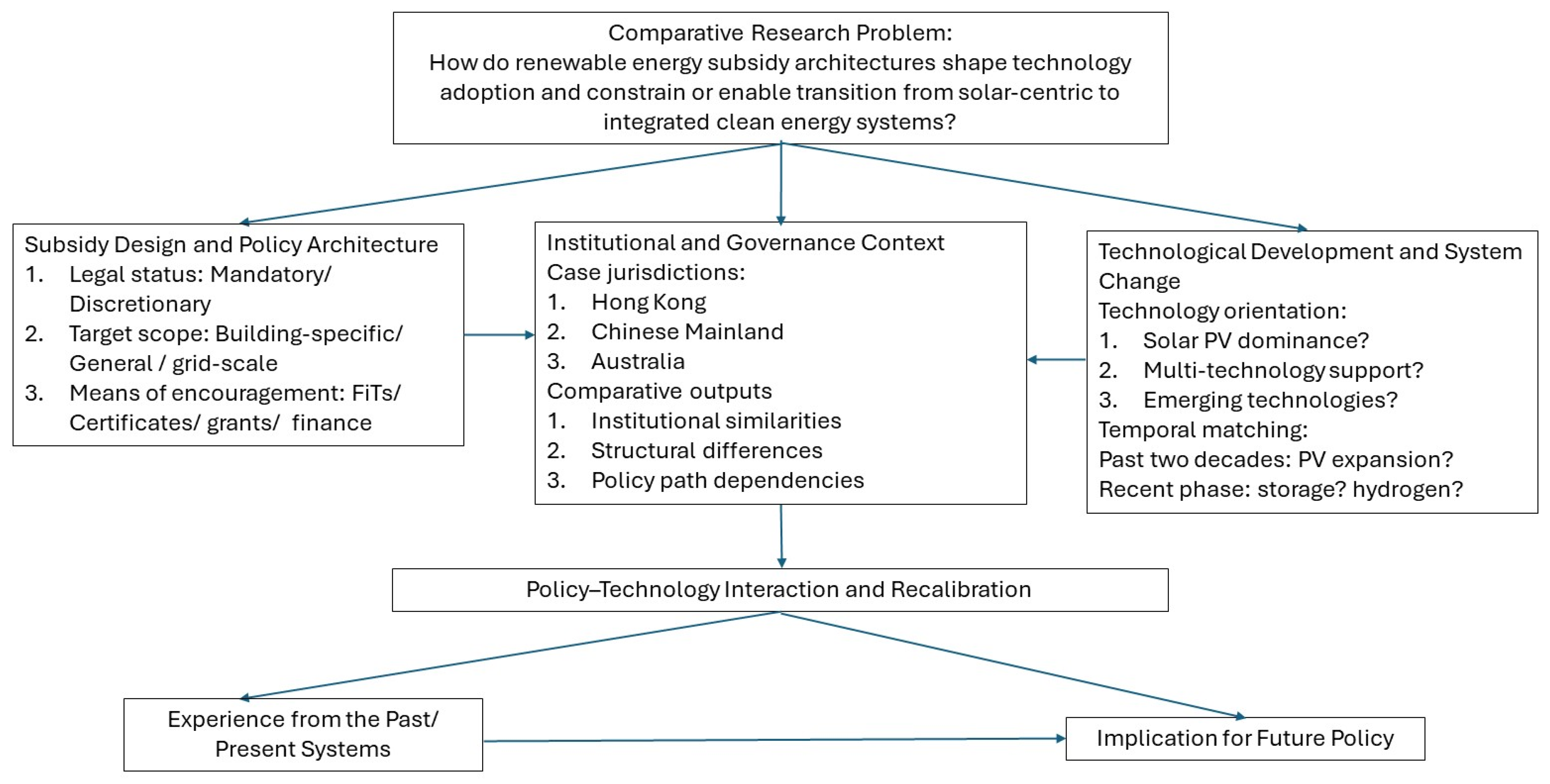
A structured qualitative and comparative research design was adopted to examine how renewable and clean energy subsidy architectures shape technology adoption trajectories within the built environment across three jurisdictions. This approach was selected in preference to econometric or single-case methods because the study focuses on institutional architecture, legal foundations, and incentive logic—features that are not readily reducible to standardized quantitative variables and that require systematic cross-jurisdictional comparison to identify structural patterns. The research design is grounded in the conceptual model presented in
Figure 1, covering policy architecture, institutional context, and technological development. The study does not estimate causal effects econometrically but analyses institutional architecture and incentive logic through structured comparative coding and synthesis.
2.1.1. Conceptual Orientation and Analytical Logic
Figure 1 presents a policy–technology interaction framework in which subsidy design is conceptualized both as a financial instrument and as an institutional mechanism shaping technological diffusion within specific governance contexts. Renewable energy deployment is modeled as the outcome of interactions among three domains: policy instrument architecture (legal basis, instrument type, and target scope), the institutional environment (market structure, regulatory stability, and administrative coordination), and the evolving technological landscape. The framework highlights their reciprocal relationships across expansion and integration phases. Subsidy design influences technology adoption through eligibility rules, performance metrics, and incentive structures, while technological evolution generates recalibration pressures on institutional arrangements. The model serves as an organizing framework for comparative assessment.
Rather than evaluating subsidies solely based on generosity or fiscal magnitude, the model emphasizes structural design characteristics and their alignment with different phases of technological development [
15]. Policy instruments shape adoption through eligibility rules, performance metrics, revenue stabilization mechanisms, compliance obligations, and administrative implementation pathways. Simultaneously, evolving technological conditions feed back into institutional structures, generating policy recalibration pressures over time.
The research proceeds from policy mapping and structural coding through temporal positioning across expansion (2005–2020) and integration (2015–2025) phases, toward comparative synthesis and, ultimately, normative recalibration analysis in
Section 4 and
Section 5. Policy documents were coded using predefined criteria derived from public policy instrument analysis. This stepwise sequencing ensures methodological coherence between the conceptual model, empirical coding, and forward-looking analysis. Similar methods have been applied in business and engineering research [
16,
17].
2.1.2. Comparative Case Selection and Unit of Analysis
Comparative design follows a most-different systems logic, whereby cases are selected to maximize variation in core structural characteristics while holding the policy domain constant [
18]. Hong Kong, Chinese Mainland, and Australia differ systematically in governance structure (contractual–regulatory, centralized statutory–administrative, and federal market-based systems), electricity market organization (vertically integrated duopoly, state-coordinated hybrid model, and liberalized national electricity market), and stage of renewable transition. At the same time, all three jurisdictions operate building-level renewable support mechanisms. This combination of maximum institutional variation and shared policy focus enables structured comparison of subsidy architecture to identify whether observed generation-centric patterns are context-specific or represent broader structural tendencies across heterogeneous governance systems.
As illustrated in
Table 1, the three jurisdictions provide a structured spectrum of institutional, market, and transition-stage variation while sharing the presence of building-level renewable support mechanisms:
The three jurisdictions represent distinct governance models: Hong Kong operates through a contractual–regulatory framework embedded within a common-law system; Chinese Mainland relies on a centralized statutory administrative structure with strong executive recalibration capacity; and Australia adopts a federal, multi-statute regime integrated with market-based compliance mechanisms.
They differ in electricity market organization, ranging from Hong Kong’s vertically integrated duopoly market, to Chinese Mainland’s state-coordinated hybrid model, to Australia’s liberalized National Electricity Market.
They reflect different stages and scales of renewable energy transition, including dense urban distributed deployment (Hong Kong), large-scale national expansion (Chinese Mainland), and advanced rooftop penetration with diversified support institutions (Australia).
This combination of institutional diversity and shared policy domain enables structured comparison of subsidy architecture, allowing assessment of whether output-based design features represent jurisdiction-specific characteristics or broader structural tendencies across renewable transition regimes [
4,
6].
The primary unit of analysis is the renewable energy subsidy architecture as an institutional system. Each jurisdiction is treated as a policy system comprising core legislative instruments, regulatory enforcement mechanisms, market-based compliance structures, and complementary innovation funding mechanisms. This institutional-system approach directs attention toward structural incentive logic and technology eligibility rules rather than quantitative deployment indicators alone.
The inclusion of system-level and utility-scale-oriented instruments within the comparison requires specific justification, particularly in the case of Chinese Mainland. Unlike Hong Kong and Australia, where dedicated building-level subsidy instruments (the FiT Scheme and the SRES respectively) can be isolated and examined independently, Chinese Mainland does not maintain a single freestanding subsidy mechanism targeted exclusively at building-integrated renewable energy. Instead, building-level distributed deployment is governed through a layered regulatory structure in which system-wide statutes, pricing notices, and strategic plans collectively constitute the incentive environment for distributed installations. Excluding these instruments on the grounds that they also address utility-scale deployment would obscure the institutional architecture that actually shapes building-level investment decisions in the Chinese Mainland context. The comparison therefore includes system-level Chinese Mainland instruments where they demonstrably condition building-level deployment outcomes, while the tiered classification introduced below ensures that the governance scope of each instrument remains analytically transparent.
2.1.3. Scope, Temporal Boundaries, and Methodological Positioning
The study covers the period from 2005 to 2025, capturing the rapid expansion of solar PV under early-generation subsidy models, major recalibration episodes such as subsidy reductions and certificate reforms, the emergence of storage and hydrogen technologies, and initial policy experimentation in system integration [
19,
20]. The dual-phase temporal framing embedded in
Figure 1 allows examination of the alignment or misalignment between subsidy architecture and technological evolution across these distinct periods. Institutional configuration, incentive logic, technology inclusiveness, and structural adaptability are discussed and compared.
2.2. Materials: Policy and Legal Documents
This study draws primarily on official legislative instruments, regulatory agreements, and government policy documents that directly shape renewable and clean energy deployment within the built environment. Only instruments with explicit or material implications for renewable electricity generation, distributed systems, storage integration, hydrogen development, or related clean energy infrastructure during the 2005–2025 period were included. All documents were cross-checked against official government sources to ensure accuracy and currency within the study timeframe.
Renewable energy governance in Hong Kong is embedded within a contractual–regulatory framework rather than standalone renewable energy legislation. The key documents reviewed include:
Scheme of Control Agreements (SCAs) (2018–2033) between the Government of the Hong Kong SAR and the two vertically integrated utilities (CLP Power and HK Electric) [
21].
Feed-in Tariff (FiT) Scheme documentation (introduced in May 2018), including tariff schedules, technical guidelines, metering requirements, and grid-connection procedures [
22].
Building Energy Efficiency Ordinance (Cap. 610), which provides the broader regulatory backdrop for building-level energy performance [
23].
Hong Kong Climate Action Plan 2050 (2021), which establishes long-term decarbonization commitments and frames renewable deployment within the net-zero pathway [
24].
Renewable energy policy in Chinese Mainland is anchored in a statutory framework with centralized administrative calibration. The principal documents examined include:
Renewable Energy Law (2005, amended 2009), establishing mandatory grid purchase obligations and authorizing national pricing and subsidy mechanisms [
25].
National Development and Reform Commission (NDRC) and National Energy Administration (NEA) policy notices relating to FiTs and distributed PV development [
26,
27].
The 2018 PV policy adjustment notice, which initiated subsidy reductions and competitive allocation reforms [
28].
Renewable Energy Green Electricity Certificate (GEC) regulations, including recent reforms expanding certificate coverage and strengthening market-based mechanisms [
29].
National strategic plans concerning renewable energy transition and hydrogen development, where relevant to distributed or building-level systems [
30].
These instruments collectively reflect the transition from fiscal subsidy-driven expansion toward increasing reliance on market-oriented and parity-based mechanisms.
Australia’s renewable support regime is founded on statutory legislation combined with innovation funding institutions. The core materials reviewed include:
The SRES is particularly significant for building-level installations, while ARENA and CEFC play important roles in supporting storage, hydrogen, and hybrid system innovation.
2.3. Analytical Framework
To enable systematic comparison of subsidy design, a four-dimensional analytical framework is applied. It is designed focusing on structural characteristics that directly shape building-integrated clean energy adoption.
2.3.1. Legal Foundation
The first dimension examines the legal and regulatory basis of renewable support mechanisms. This includes:
Statutory legislation with enforceable obligations (e.g., mandatory grid purchase, retailer compliance);
Contractual-regulatory arrangements embedded within utility regulation;
Administrative or discretionary programs without binding statutory force.
This dimension determines the stability and enforceability of subsidy commitments and shapes how easily regimes can adapt to technological change [
37].
2.3.2. Target Scope
The second dimension identifies whether subsidy instruments are designed specifically for building-level deployment or operate at the grid or economy-wide scale:
Building-specific mechanisms directly target rooftop, on-site, or distributed installations;
General grid-scale mechanisms apply broadly across utility-scale and distributed systems without explicit building orientation.
This distinction reveals whether building-integrated clean energy is treated as a central policy objective or absorbed within broader renewable deployment strategies [
38].
2.3.3. Incentive Structure
The third dimension categorizes how subsidies deliver financial support:
Price-based mechanisms (e.g., FiTs providing revenue certainty per kWh);
Quantity-based mechanisms (e.g., tradable certificates creating compliance-driven market demand);
Fiscal transfers and grants (direct capital subsidies, rebates, tax incentives);
Concessional finance (low-interest loans, credit support).
This dimension also examines what performance metrics are rewarded—whether incentives are tied exclusively to electricity generation or recognize system flexibility, storage integration, and hybrid configurations [
39].
2.3.4. Technology Orientation
The fourth dimension assesses technology inclusiveness:
Solar-dominant in practice: Subsidies formally neutral but operationally centered on PV;
Technology-neutral design: Open eligibility but without explicit integration support;
Integration-oriented: Explicit recognition of storage, hydrogen, hybrid systems, or multi-technology configurations.
This dimension identifies whether subsidy frameworks facilitate diversified clean energy portfolios or reinforce solar-centric deployment patterns.
These four dimensions were selected because they capture the principal design features through which subsidy regimes shape building-integrated clean energy adoption: legal enforceability, policy targeting, incentive logic, and technological inclusiveness. Building on existing policy instrument analysis, this framework is adapted for the present comparative purpose by focusing not only on instrument type, but also on how subsidy architecture conditions the transition from generation expansion to system integration across different governance contexts. Taken together, the four dimensions identify both institutional differences and a common structural feature: subsidy regimes may vary in legal form and implementation method, but they have largely been designed around generation expansion rather than integrated multi-technology performance. This framework therefore supports the comparative analysis in
Section 3 and helps explain why existing subsidy models may be less effective in the current phase of clean energy transition.
2.4. Temporal Segmentation
To capture structural evolution in subsidy design, the analysis adopts a two-phase temporal segmentation commonly used in energy transition research.
The Expansion Phase (2005–2020) corresponds to the period in which renewable policy objectives were primarily centered on accelerating installed capacity and reducing technology costs. During this phase, subsidy effectiveness was largely assessed through deployment growth and electricity generation metrics [
40].
The Integration Phase (2015–2025) reflects the increasing prominence of system-level challenges associated with high renewable penetration, including flexibility requirements, storage integration, hybrid system development, and sector coupling. This overlapping temporal framing allows assessment of whether existing subsidy architectures have adapted to changing technological and systemic conditions [
41]. The overlap between the two phases is intentional, reflecting the empirical coexistence of legacy expansion-oriented subsidy structures and emerging integration-oriented policy concerns during the transition period.
This phase-based approach facilitates comparison of institutional alignment between policy design and evolving energy system needs.
2.5. Coding and Comparative Procedure
All identified policy instruments were systematically classified according to the four analytical dimensions defined in
Section 2.3: legal foundation, target scope, incentive structure, and technology orientation.
For each jurisdiction, a structured comparative matrix was developed to record:
legal basis (statutory, contractual, or administrative);
operational level (building-specific or general);
instrument type (price-based, quantity-based, fiscal transfer, or concessional finance);
technology orientation (solar-focused, technology-neutral, or integration-oriented); and
period of implementation (expansion or integration phase).
Classification was conducted using predefined criteria derived from comparative public policy methodology to ensure consistency and reduce interpretative bias. The coding process was undertaken by the authors and cross-checked against official source documents, with iterative review across jurisdictions to ensure that similar instruments were classified according to the same analytical criteria. The objective was to identify structural design patterns and institutional similarities or divergences across the three jurisdictions [
18].
3. Comparative Analysis: Application of the Analytical Framework
The analytical framework developed in
Section 2 is applied to compare the subsidy design of Hong Kong, Chinese Mainland, and Australia. The comparison is structured around five common criteria: legal basis, operational level, instrument type, technology eligibility, and period of implementation, as summarized in
Table 2. The table classifies both core and supplementary instruments across the four analytical dimensions.
3.1. Legal Basis
The three jurisdictions exhibit markedly different legal foundations for their renewable energy subsidy architectures, with consequential implications for institutional stability, enforceability, and adaptive capacity.
Hong Kong’s subsidy framework operates primarily through a contractual-regulatory model. The FiTs is not established under standalone renewable energy legislation but is instead embedded within the SCAs negotiated between the Government and the two power utilities [
21,
22]. This arrangement ensures binding force during the contract period but confines the legal authority for renewable support within utility regulation rather than within a broader legislative mandate. Consequently, the scope for market-based participation, third-party entry, and independent regulatory oversight remains structurally limited compared to jurisdictions with dedicated statutory frameworks [
42].
Chinese Mainland anchors its renewable subsidy regime in a statutory foundation through the Renewable Energy Law (2005, amended 2009), which establishes mandatory grid purchase obligations and authorizes centralized pricing mechanisms [
25]. However, the operational detail of subsidy calibration (including tariff levels, degression schedules, competitive allocation rules, and certificate trading parameters) is carried out through administrative notices issued by the NDRC and NEA [
26,
27]. This dual-layered architecture provides both legislative permanence and administrative flexibility, enabling large-scale policy recalibration (such as the 2018 subsidy reduction) without requiring formal legislative amendment. The statutory backbone thus functions as an enabling framework within which considerable executive discretion operates [
43].
Australia exhibits the most diversified statutory architecture among the three jurisdictions. The Renewable Energy (Electricity) Act 2000 establishes legally binding retailer obligations to surrender RECs, creating a compliance-driven demand structure that is structurally independent of annual fiscal appropriations [
31]. This statutory architecture is reinforced by dedicated institutional legislation: the ARENA Act 2011 [
34] and the CEFC Act 2012 [
35] provide separate statutory mandates for grant-based and concessional finance support. The multiplicity of statutory instruments creates a layered but legislatively grounded system in which different mechanisms serve complementary functions within a coherent legal hierarchy [
44].
Hong Kong’s contractual model offers certainty within defined periods but constrains structural evolution. Chinese Mainland’s statutory-administrative hybrid provides both continuity and recalibration capacity. Australia’s multi-statute approach embeds renewable support across several legislative instruments, enhancing institutional resilience but potentially increasing coordination complexity [
37].
A structural difference is that Chinese Mainland’s support for building-integrated renewable energy is embedded in a layered regulatory framework rather than a single dedicated programme. The analysis therefore focuses on those provisions that operate at the building or distributed level, while recognizing that they form part of a broader system-wide policy architecture.
3.2. Operational Level
The operational level at which subsidy instruments are targeted, whether building-specific or general, reveals the extent to which each jurisdiction treats building-integrated clean energy as a distinct policy objective rather than a subsidiary component of broader renewable deployment strategies.
Hong Kong exhibits the most explicit building-level orientation among the three cases. The Feed-in Tariff Scheme is designed specifically for distributed installations connected to the distribution grid, with tiered tariff rates that incentivize small and medium-scale rooftop systems [
22]. In practice, this creates a narrow focus on building-integrated solar deployment, with eligibility tied to exported electricity rather than broader system contributions such as storage or demand-side flexibility [
38].
Chinese Mainland’s framework is predominantly system-wide in scope. The Renewable Energy Law and associated planning instruments were designed to support national-scale capacity expansion, with policy logic oriented toward aggregate renewable penetration targets rather than building-level integration objectives [
25]. Distributed PV has received dedicated administrative attention through NEA measures [
27], but these operate within broader national energy planning rather than as an independent building-integrated policy regime. The operational logic therefore remains predominantly system-wide, even though the Renewable Energy Law also applies to distributed installations.
Australia adopts a structurally bifurcated model that explicitly addresses both levels. The LRET supports large-scale renewable generation through certificate compliance [
32], while the SRES directly targets small-scale systems including residential and commercial rooftop installations [
33]. This dual architecture gives building-level deployment dedicated institutional support. However, like Hong Kong’s FiT, the SRES rewards deemed electricity generation rather than flexibility or integration performance, while battery support remains supplementary rather than embedded in the core federal framework.
Across all three jurisdictions, distributed solar is incentivized at the building level, but none has systematically reoriented building-specific subsidies toward integrated multi-technology system performance. This structural limitation persists regardless of whether operational targeting is narrow (Hong Kong), layered (Australia), or absorbed within national planning (Chinese Mainland).
3.3. Instrument Type
The instrument typology reveals both structural variation across jurisdictions and a shared underlying design logic oriented toward generation output.
Hong Kong relies predominantly on price-based support through its FiTs framework [
22]. The scheme provides revenue certainty per kilowatt-hour of exported electricity, but the absence of complementary quantity-based, grant-based, or concessional-finance instruments limits support for technologies whose value extends beyond electricity generation [
14,
45].
Chinese Mainland historically relied on price-based support mechanisms, primarily through nationally administered benchmark FiTs [
25,
26]. The 2018 policy reform marked a significant transition from fixed tariff guarantees toward competitive allocation processes and increasingly market-based pricing structures [
28]. Concurrently, the introduction and expansion of green electricity certificate trading signaled a gradual shift toward quantity-based instruments [
29]. This evolution reflects a deliberate recalibration of policy design, moving from fiscally driven subsidy dependence toward more market-oriented mechanisms. Nevertheless, administrative planning documents continue to perform an important coordinative function, combining fiscal guidance with regulatory direction in ways that do not fit neatly within conventional instrument classifications. Similar hybrid governance characteristics have been observed in research on building governance, particularly in the context of retro-commissioning [
43].
Australia demonstrates the most diversified instrument portfolio. The core mechanism is quantity-based, with certificate trading under the RET creating market-driven price signals through retailer compliance obligations [
32,
33]. This is complemented by fiscal transfers through ARENA’s competitive grant programs [
34] and concessional finance through the CEFC [
35]. The coexistence of compliance-based, grant-based, and finance-based instruments creates multiple entry points for different technology types and investment scales. This diversification positions Australia’s framework as structurally more accommodating of non-generation technologies, although the primary certificate mechanism itself remains generation-output-based.
Across all three jurisdictions, core subsidy instruments remain structured around renewable electricity generation measured in kilowatt-hours [
39]. Although the specific mechanisms differ, this output-based logic is less suited to storage, hydrogen, and hybrid systems whose value lies in flexibility, balancing, and cross-sectoral integration.
3.4. Technology Eligibility
Technology eligibility analysis reveals a systematic divergence between formal neutrality and operational concentration across the three jurisdictions.
In Hong Kong, the FiTs Scheme does not formally exclude non-solar renewable technologies. However, the tariff structure, grid-connection procedures, and administrative guidelines are operationally calibrated for rooftop solar PV systems [
22]. The practical effect is strong solar dominance within the incentive framework. Support for battery storage, hydrogen applications, or hybrid configurations is not structurally embedded within the FiT mechanism. The Climate Action Plan 2050 signals broader integration ambitions [
24], but these remain at the strategic planning level rather than being translated into subsidy eligibility criteria.
Chinese Mainland’s Renewable Energy Law and green certificate framework are formally technology-neutral, encompassing wind, solar, biomass, and other eligible renewable sources [
25,
29]. In practice, however, distributed-level policy support has been heavily concentrated on PV systems, reflecting both cost competitiveness and administrative path dependency [
27,
28]. The 14th Five-Year Plan for Renewable Energy Development introduces integration-focused language concerning storage and hydrogen [
30], but these emerging priorities have not yet been fully operationalized within the core subsidy instruments governing building-level deployment. The Plan sets aggregate capacity targets that encompass utility-scale renewable energy bases, but it also establishes specific distributed PV deployment objectives, including rooftop PV targets for industrial and commercial buildings, that directly shape the subsidy environment for building-level systems.
Australia’s formal statutory framework is technology-neutral: the RET and associated certificate mechanisms do not restrict eligibility to solar [
31]. Nevertheless, the SRES has in practice overwhelmingly supported rooftop solar installations due to cost structures, installer infrastructure, and consumer familiarity [
33]. The critical distinction in Australia’s case is that integration-oriented support exists through dedicated statutory institutions. ARENA explicitly funds storage, hybrid systems, and hydrogen projects [
34], while the CEFC provides concessional finance for clean energy investments beyond solar generation [
35]. The National Hydrogen Strategy further extends policy attention to cross-sectoral clean energy diversification [
7,
36].
This dimension reveals that integration-oriented technology support exists in all three jurisdictions but typically operates through supplementary or parallel instruments rather than through the principal building-level subsidy mechanism. The core incentive architecture in each case remains structurally aligned with solar generation, whether by explicit design or through operational concentration. This pattern creates a structural asymmetry in which established technologies receive embedded institutional support while emerging integration technologies depend on discretionary or project-based funding streams.
3.5. Temporal Pattern
Temporal classification of the identified instruments illuminates the evolving relationship between subsidy design and the broader technological landscape of energy transitions. Expansion-phase instruments, concentrated in the 2005–2020 period, were designed to overcome early-stage barriers to renewable deployment and therefore rewarded capacity growth and generation volume [
40]. This logic is evident in the main statutory and subsidy frameworks across all three jurisdictions.
Integration-phase instruments, emerging from approximately 2015 onward, reflect growing recognition that high renewable penetration introduces system-level challenges requiring flexibility, storage, demand-side management, and cross-sectoral coordination [
41]. Hong Kong’s Climate Action Plan 2050 [
24], Chinese Mainland’s green certificate rules [
29] and distributed PV administrative measures [
27], and Australia’s ARENA [
34], CEFC [
35], and National Hydrogen Strategy [
36] each represent responses to this evolving technological and systemic context. These instruments demonstrate broadened policy ambition encompassing storage integration, hydrogen development, and multi-technology system design.
However, a critical temporal misalignment persists between evolving system requirements and the performance logic embedded in legally dominant instruments. Although the policy context has shifted decisively toward integration-phase priorities, many of the core subsidy instruments, those with the strongest legal authority, largest fiscal scale, and most direct influence on investment decisions, remain rooted in expansion-phase design logic. The Feed-in Tariff in Hong Kong, the certificate allocation methodology in Australia’s SRES, and the residual tariff structures in Chinese Mainland’s distributed PV framework continue to reward generation output as the primary performance metric. Integration-phase instruments, while growing in scope, tend to operate as supplementary layers rather than as replacements for the output-based core. This temporal lag between system needs and institutional architecture constitutes a structural constraint on technology diversification at the building level [
46].
3.6. Comparative Observations
Synthesizing the five analytical dimensions across the three jurisdictions yields several cross-cutting observations that inform the discussion in
Section 4.
Hong Kong presents a relatively narrow but clearly building-oriented subsidy architecture. Its contractual-regulatory legal basis, price-based instrument logic, and explicit distributed-system targeting create a coherent framework for rooftop solar deployment. However, the absence of statutory legislative authority, quantity-based market instruments, or dedicated integration-technology funding constrains both adaptive capacity and technological diversification. The framework is institutionally stable within its defined scope but structurally limited in accommodating the broader requirements of integrated building-level energy systems.
Chinese Mainland possesses the broadest and most administratively layered framework among the three cases. Its statutory foundation provides institutional durability, while extensive administrative recalibration capacity enables rapid policy adjustment. The framework has demonstrated significant adaptability in transitioning from fiscal subsidies to market-based instruments. However, its operational orientation remains predominantly system-wide rather than building-specific, and its technology eligibility—while formally broad—has been operationally concentrated on PV generation at the distributed level.
Australia demonstrates the most diversified instrument portfolio and the strongest institutional infrastructure for supporting integration-oriented technologies. The combination of statutory compliance mechanisms, dedicated innovation funding agencies, and concessional finance institutions creates multiple pathways through which emerging technologies can receive support. However, the primary certificate-based mechanism that most directly affects building-level installations continues to operate through generation-based allocation logic, limiting the extent to which system-value considerations are embedded within the core subsidy architecture.
Across all three jurisdictions, a shared structural characteristic is evident: support for building-integrated clean energy has been shaped primarily by instruments originally designed to expand renewable generation capacity. By structuring eligibility, remuneration, and investment certainty around electricity output, these instruments tend to privilege solar PV over storage, hydrogen, and hybrid systems, whose value lies less in additional generation than in flexibility, coordination, and reliability. Although newer policies increasingly acknowledge storage, hydrogen, hybrid systems, and flexibility requirements, these integration-oriented objectives are typically addressed through supplementary or parallel mechanisms rather than through fundamental reconfiguration of the principal subsidy architecture. This pattern reflects not only policy choice, but also each jurisdiction’s governance structure, electricity market organization, and administrative pathways for implementation and recalibration.
A further cross-cutting issue is the policy overlap between core subsidy mechanisms and supplementary integration-oriented programs. Although layering may improve policy responsiveness, it can also produce negative effects where instruments operate according to different performance logics. Generation-based subsidies may encourage maximum electricity output, while separate storage or hydrogen programs reward flexibility, innovation, or infrastructure readiness. Where these objectives are not well coordinated, investors may face conflicting signals regarding project design, revenue expectations, and technology choice. Overlap may also increase transaction costs by requiring applicants to navigate multiple agencies, eligibility criteria, and verification procedures. In institutional terms, the result is not simply policy diversification but possible fragmentation of authority and weakened coherence in the subsidy regime.
4. Structural Misalignment and Institutional Recalibration of Renewable Subsidy Regimes
Section 3 showed that the core subsidy instruments in all three jurisdictions were designed primarily to accelerate renewable electricity generation. This section argues that these architectures are increasingly misaligned with the requirements of integration-phase power systems, particularly as storage, hydrogen, and hybrid technologies become more important.
4.1. The Phase Shift from Capacity Expansion to System Integration
Between 2005 and approximately 2020, renewable policies focused on rapid capacity expansion and cost reduction. During this expansion phase, subsidy effectiveness was logically assessed through indicators such as installed capacity growth and electricity generation volume. FiTs, mandatory purchase obligations, and certificate-based compliance schemes were well suited to this objective [
47]. By stabilizing revenue expectations and reducing investment risk, they successfully accelerated technology diffusion and supply-chain maturation.
As renewable penetration increases, however, system priorities shift. Electricity systems with high shares of variable generation face challenges that extend beyond deployment scale. These include temporal imbalance, curtailment risk, grid congestion, peak-load volatility, and the need for fast-response flexibility [
48]. The integration phase, emerging from approximately 2015 onward, redefines policy objectives from maximizing generation output to optimizing system performance under variability constraints.
Table 2 shows that the instruments with the greatest legal and financial significance remain concentrated on PV generation, while hydrogen and other integration-oriented technologies are addressed mainly through strategic or supplementary instruments. Across all three jurisdictions, these technologies therefore remain peripheral to the core incentive regime.
Despite this systemic transition, the principal subsidy mechanisms in the three jurisdictions remain predominantly tied to electricity output measured in kilowatt-hours. This creates a phase-shift mismatch: institutional designs optimized for expansion continue to operate in systems that increasingly require flexibility, coordination, and reliability services. This persistence reflects technological path dependency and institutional structure, as subsidy form is shaped by governance arrangements, market design, and administrative capacity rather than by technology preference alone.
4.2. Generation-Centric Incentive Logic and Its Structural Limits
The comparative analysis reveals that the dominant performance metric embedded within core subsidy instruments is generation output. Whether implemented through price-based tariffs, certificate trading obligations, or mandated purchase rules, the underlying incentive logic of the principal instruments examined here may be simplified conceptually as follows:
where
G represents electricity generation. This formulation is illustrative and intended to capture the dominant reward logic of generation-based subsidy design.
This simplified representation captures the dominant reward structure embedded in output-based subsidy regimes. Because eligibility and remuneration are tied primarily to metered generation, technologies capable of producing certifiable electricity output receive clearer and more durable investment signals than storage, hydrogen, and hybrid systems. This logic was effective in overcoming early-stage investment barriers. However, integration technologies, such as battery storage, hybrid PV–storage systems, and hydrogen production and utilization, do not primarily increase generation. Instead, they shift, stabilize, or optimize existing output, or operate partly or entirely outside the electricity-generation paradigm.
The structural incompatibility is particularly acute for hydrogen. Unlike solar PV, which produces electricity measurable in kilowatt-hours, hydrogen involves a complex, multi-stage supply chain that cannot be accommodated within a generation-output formula. Drawing on the hydrogen logistics framework described by Wong et al. [
7], the hydrogen supply chain spans six functionally distinct stages: the input of resources from fossil fuels, biomass, or renewable electricity; processing and conversion through electrolysis or steam methane reforming; long-distance transport via pipelines, cryogenic tankers, or ammonia shipping; storage and reprocessing in underground caverns or pressurized tanks; short-distance distribution through tube trailers and local pipeline networks; and end-use integration into power generation, fuel cell vehicles, and industrial applications. Each stage involves distinct safety requirements, capital structures, and regulatory interfaces that extend well beyond the building-level metering and grid-connection logic on which current subsidy frameworks are built [
49].
Under a generation-based formula, hydrogen’s system value in sector coupling, long-duration storage, and cross-sector integration remains largely unrecognized [
7,
36]. The point is not that hydrogen is always the preferred option, but that it exposes the limits of generation-only subsidy metrics. The result is a structural bias in favour of established solar generation, while hydrogen depends mainly on supplementary and discretionary support.
4.3. Quantitative Indicators of Structural Misalignment
The structural misalignment identified in the preceding institutional analysis is further supported by selected secondary quantitative indicators drawn from publicly available energy statistics. Although this study does not undertake econometric modelling, the data presented below are intended as illustrative and context-supporting evidence for the generation-centric thesis and indicate the relative scale of the integration gap across the three jurisdictions.
In Australia, according to Clean Energy Regulator (CER), cumulative small-scale solar PV installations exceeded 4 million systems, representing over 28 GW of rooftop capacity in early 2025 [
33,
50]. The ESS (Energy Storage System)-to-PV attachment rate increased markedly relative to previous historical levels, reaching 15% of new rooftop solar installations by late 2024 [
33,
50,
51]. Certificates under the SRES are issued solely on deemed electricity generation, and battery systems receive no direct recognition within the core compliance framework. Financially, the SRES operates at a billion-dollar scale, while ARENA allocations to storage projects remained comparatively modest during the same period [
52], indicating a substantial funding imbalance between generation and integration technologies. This suggests that system-integration-focused support remains supplementary relative to mainstream generation-linked support.
In Chinese Mainland, although total installed solar PV capacity surpassed 1.1–1.2 TW (1100–1200 GW) by the end of 2025 [
53,
54],
Table 3 reports the distributed PV segment for comparability with Hong Kong’s FiT-supported distributed systems and Australia’s small-scale rooftop installations. However, solar curtailment remains a recurring integration issue in certain provinces, reflecting surplus generation during peak production periods. Green hydrogen plays a limited role in the mainstream PV support architecture, and battery storage deployment remains substantially lower than total PV capacity. Although historical generation-linked subsidy flows were exceptionally large, no equivalent mainstream funding mechanism exists for building-level storage or hydrogen integration.
In Hong Kong, the FiTs scheme had supported over 450 MW of distributed renewable capacity in the CLP service area alone by 2025, almost entirely comprising rooftop PV [
55]. Battery storage and hydrogen facilities are not independently eligible for tariff payments. Under the scheme’s rules, the FiTs rate is linked to metered eligible renewable electricity generation; however, because the framework does not provide a standalone incentive for storage, it fails to actively encourage self-consumption paired with load-shifting technologies. As a result, integration technologies remain structurally excluded from the principal remuneration mechanism.
Table 3 therefore illustrates a common pattern: PV expansion has been strongly supported under generation-oriented metrics, whereas storage and hydrogen remain less embedded within core subsidy frameworks.
4.4. Policy Layering and Fragmented Institutional Adaptation
All three jurisdictions have introduced supplementary measures for storage, hydrogen, hybrid systems, and digital optimization. However, these generally operate alongside, rather than within, the principal renewable subsidy framework.
This pattern is evident across the three cases. In Hong Kong, the Climate Action Plan 2050 signals hydrogen ambitions, but these are not reflected in the eligibility rules of the FiT Scheme. In Chinese Mainland, the 14th Five-Year Plan adopts integration-oriented objectives, yet the core distributed PV framework remains operationally solar-focused. In Australia, ARENA and the CEFC support storage and hydrogen, but the SRES—the principal building-level instrument—continues to reward deemed solar generation. Thus, support for integration technologies exists, but it remains supplementary rather than embedded in the core subsidy design.
Such layering has important consequences. Hydrogen and other emerging clean energy systems require regulatory certainty across multi-stage supply chains, but supplementary support does not provide the same institutional stability as established generation-based mechanisms. This increases investor uncertainty, raises transaction costs, and constrains scale-up. More broadly, policy overlap may generate three governance problems: conflicting incentive signals between generation and flexibility objectives, investor confusion arising from multiple schemes and criteria, and regulatory fragmentation across agencies and instruments. These risks are especially acute for hybrid systems that do not fit neatly within traditional generation categories.
Although the institutional form differs across jurisdictions, the common issue is that layering alone does not resolve the disconnect between legacy subsidy design and integration-phase system needs. Unless supplementary measures are incorporated into the core architecture, overlap may reinforce rather than reduce that disconnect.
4.5. A System-Value-Oriented Subsidy Model
Addressing any policy–system disconnect or misalignment requires reconceptualizing subsidy design around system value rather than generation volume alone. A more integration-consistent formulation may be expressed as:
where
G = generation output (kWh),
F = flexibility contribution
(e.g., load shifting, peak reduction, curtailment avoidance),
C = capacity reliability value
(e.g., dispatchable availability, resilience support).
Under this structure, storage, hybrid systems, and hydrogen can be recognized for flexibility and reliability contributions rather than electricity generation alone. In practice, these components may be represented by indicators such as peak reduction, avoided curtailment, and certified dispatchable capacity.
For analytical and policy design purposes, flexibility and capacity should be operationalized through observable proxies rather than abstract categories. These may include peak shifting, avoided curtailment, available capacity during reliability windows, dispatch duration, and resilience contributions during system stress events. Their weighting would depend on regulatory objectives, metering capability, and market conditions.
The precise choice of metric depends on market structure, metering capability, and regulatory design. Equation (2) is therefore not intended as a single universal formula, but as a general performance logic through which generation, flexibility, and reliability can be jointly recognized within subsidy frameworks. This logic may be implemented through practical mechanisms such as time-differentiated FiTs, flexibility certificates embedded in compliance schemes, hybrid credit multipliers for PV–storage systems, and capacity add-ons for distributed resources, including those with hydrogen storage capability. The key shift is conceptual: subsidies move from rewarding output alone to recognizing broader system value, while eligibility expands from grid-connected generation to integrated and multi-stage clean energy services.
F and C components are operationalized under different market structures. The examples are given below:
In Hong Kong, where the FiT already provides a per-kWh tariff administered through utility contracts, F could be proxied by metered peak-hour export reductions attributable to behind-the-meter battery dispatch, compensated through a time-differentiated tariff premium (e.g., an additional rate for electricity exported or load reduced during system peak windows defined by the utility). C could be measured as certified dispatchable capacity (kW) available during designated reliability periods, verified through smart-meter interval data and rewarded via a capacity add-on within the SCA framework.
In Chinese Mainland, where administrative recalibration capacity is well established, F could be operationalized through avoided curtailment credits within the green electricity certificate system: distributed PV-storage systems that demonstrably absorb output during surplus periods would earn additional certificates proportional to curtailment avoided in the local grid area. C could be linked to storage discharge availability during provincial peak-demand intervals, verified through grid-operator dispatch records and incentivized through differentiated grid-service payments administered by the NEA.
In Australia, where market-based mechanisms and institutional diversity are strongest, F could be integrated into the SRES by introducing a hybrid multiplier that awards additional small-scale technology certificates (STCs) to PV-battery systems based on deemed load-shifting capacity (kWh shifted from midday surplus to evening peak, calculated using standardized profiles). C could be operationalized through ARENA- or CEFC-supported contracts that remunerate distributed resources for verified availability during Reliability and Emergency Reserve Trader (RERT) events, drawing on the existing AEMO reliability framework. In each case, the measurement infrastructure required, interval metering, dispatch verification, or deemed performance profiles, already exists or is under active deployment, suggesting that operationalization is institutionally feasible without fundamental regulatory redesign.
4.6. Institutional Recalibration Pathways
While the three jurisdictions differ in legal structure and market organization, each can pursue recalibration within its existing institutional framework.
Hong Kong could incorporate storage and hydrogen-ready system eligibility directly into the FiTs mechanism, introduce time-sensitive tariff differentiation, and apply hybrid-system support based on combined performance rather than export-only measurement. Aligning the contractual-regulatory structure with the integration ambitions of the Climate Action Plan 2050 would require translating strategic hydrogen commitments into instrument-specific criteria rather than leaving them as non-binding planning declarations.
Chinese Mainland could expand green certificate frameworks to recognize flexibility attributes, link distributed PV approvals with storage integration incentives, and gradually differentiate remuneration according to system contribution rather than pure parity pricing. The administrative recalibration capacity demonstrated in the 2018 subsidy adjustment provides a precedent for embedding integration metrics within existing regulatory pathways. Operationalizing the integration-oriented language of the 14th Five-Year Plan within core subsidy instruments, rather than leaving it confined to strategic guidance, would represent a meaningful institutional step.
Australia could modify certificate allocation methodologies to reflect hybrid weighting factors, harmonize federal and state storage schemes, and incorporate flexibility recognition into retailer compliance obligations. More fundamentally, the institutional infrastructure already provided by ARENA and the CEFC could be more formally integrated with the SRES framework, reducing the policy layering that currently separates solar-generation incentives from hydrogen and storage support. Ensuring that the National Hydrogen Strategy is backed by dedicated instrument-level pathways, instead of remaining a coordination document, would strengthen its capacity to support supply chain investment across production, transport, storage, and end-use stages.
Across the three cases, recalibration does not necessitate abandoning established mechanisms. It requires redefining their performance logic and expanding their eligibility scope to accommodate the multi-stage, cross-sectoral nature of emerging clean energy technologies. It involves rearticulating the purpose of renewable subsidies from output maximization to system-value enhancement, and ensuring that hydrogen and other next-generation technologies are embedded within the core incentive architecture rather than relegated to its periphery.
4.7. Theoretical Contribution and Research Agenda
This study contributes to renewable energy policy scholarships in three ways:
It identifies structural phase-shift misalignment as a defining institutional challenge: subsidy regimes effective during capacity expansion become misaligned when systems enter integration-constrained environments, and this pattern persists across all three jurisdictions regardless of governance type.
It demonstrates that institutional path dependency is embedded not in political preferences alone but in the foundational performance logic of early-generation subsidy models, transcending differences in legal tradition and market structure.
It advances a system-value-oriented conceptual framework, extending generation-based incentive logic toward multi-dimensional performance recognition, that offers an analytically transferable and instrument-neutral template for subsidy redesign.
While these contributions are grounded in three specific jurisdictions, the recurrence of generation-centric design patterns across markedly different governance systems, market structures, and legal traditions suggests that the analytical framework has broader applicability beyond the cases examined. The study does not claim universal generalizability; rather, the observed structural convergence across institutionally diverse settings supports the use of the comparative framework as a transferable heuristic for subsidy analysis in other renewable energy contexts.
These contributions open several avenues for future research. First, future work could undertake empirical quantification of flexibility, reliability, and system-value contributions under alternative subsidy formulations, moving beyond output-based metrics toward performance-based designs. Second, the comparative typology developed here could be extended to additional jurisdictions to test its analytical generalizability across differing regulatory, market, and grid contexts. Third, scholars may examine the interaction between distributed subsidy reform and wholesale electricity market restructuring, particularly where price formation, ancillary service markets, and capacity mechanisms are evolving in parallel. Fourth, longitudinal research is needed to trace institutional transition pathways from generation-expansion regimes to system-value-oriented frameworks, identifying sequencing patterns, political constraints, and policy feedback effects. Finally, further investigation should address the governance, measurement, and data architecture requirements necessary for integration-phase incentive calibration, including metering standards, digital infrastructure, and regulatory oversight mechanisms.
5. Improving Subsidy Design for Integration-Phase Energy Systems
The comparative analysis demonstrates that renewable subsidy regimes were highly effective during the capacity-expansion phase, yet their core incentive logic remains predominantly generation-centric. As renewable penetration deepens, policy objectives shift from maximizing output to enhancing system performance. Integration-phase systems require flexibility, reliability, and coordination across distributed assets. Subsidy frameworks that continue to reward electricity volume alone risk design mismatch with these evolving system conditions [
41].
Reform should therefore reorient incentive design toward system value. Eligibility criteria ought to recognize measurable contributions such as peak reduction, load shifting, avoided curtailment, and dispatchable availability, rather than export-only generation metrics. Embedding storage and hybrid configurations within primary instruments, rather than confining them to supplementary or innovation-based programs, would reduce institutional asymmetry and align investment signals with high-renewable grid realities [
39].
Credible implementation depends on transparent and verifiable performance measurement. Digital monitoring and AI-assisted analytics can support the quantification of flexibility and reliability attributes, provided they operate within clear regulatory parameters and audit safeguards. Such tools enhance precision and scalability but do not substitute for institutional accountability [
10].
Finally, subsidy recalibration may generate indirect investment effects through property markets. Evidence from high-rise housing demonstrates that measurable building attributes are capitalized into asset values [
45]. By strengthening transparency and performance verification, system-value-oriented subsidies may reinforce private investment not only through direct remuneration but also through enhanced asset valuation.
The reform proposed here is consistent with emerging empirical research emphasizing the need to move beyond generation-only incentives toward flexibility- and integration-oriented market designs. Recent studies highlight how high-renewable systems require coordinated policy instruments that explicitly value storage, demand response, and hybrid configurations to maintain reliability and economic efficiency [
56,
57]. By situating subsidy recalibration within this broader evidence base, the present analysis reinforces the view that integration-phase reform must align financial incentives with measurable system contributions rather than electricity output alone.
In sum, the transition from expansion to integration is fundamentally institutional. Durable reform requires embedding multi-dimensional performance logic within core legal frameworks while ensuring transparent measurement infrastructure to sustain investor confidence, system resilience, and long-term sustainability outcomes [
41]. More broadly, the findings suggest that the effectiveness of renewable subsidy frameworks should be understood in connection with evolving market arrangements for system flexibility and with multi-level governance structures that shape implementation and coordination.
6. Conclusions
This study has argued that the central challenge facing contemporary renewable subsidy regimes is not simply insufficient financial support, but a deeper institutional misalignment between legacy incentive design and the operational needs of integration-phase energy systems. Across Hong Kong, Chinese Mainland, and Australia, the comparison shows that markedly different legal traditions, market structures, and governance arrangements nonetheless produce a convergent outcome: the principal subsidy instruments affecting building-integrated clean energy remain anchored in generation-based performance logic. This convergence suggests that the persistence of solar-dominant support is not reducible to a single national policy choice but reflects a broader path dependency embedded in the architecture of first-generation renewable incentives. Although the findings are not presented as universally generalizable, their recurrence across three jurisdictions that differ substantially in legal tradition, market organization, and governance arrangement indicates that the identified structural tendency may have analytical relevance beyond the specific cases examined here.
The paper’s main theoretical contribution is therefore to identify phase-shift misalignment as a comparative institutional phenomenon. Subsidy frameworks that were effective during the expansion phase become increasingly constrained when system priorities move toward flexibility, reliability, and cross-sectoral coordination. The study also extends the literature by showing that policy layering is not necessarily a sufficient response to this shift. When storage, hydrogen, and hybrid technologies are supported mainly through supplementary instruments rather than embedded in core subsidy mechanisms, layering may reproduce fragmentation, conflicting incentives, and uneven investment signals.
On this basis, the article proposes a system-value-oriented subsidy framework as a transferable analytical model for reform. Its significance lies less in any single instrument than in a change in evaluative logic: subsidies should reward not only electricity generation, but also measurable contributions to flexibility and capacity reliability. This offers a basis for redesigning building-level support mechanisms in ways that are technologically inclusive while remaining institutionally adaptable across different governance contexts.
The policy implication is that next-generation subsidy reform should focus on integration within the core architecture rather than continuous accumulation of peripheral schemes. For Hong Kong, this means moving beyond export-only FiT logic; for Chinese Mainland, embedding integration metrics more directly within administratively calibrated instruments; and for Australia, linking its relatively advanced innovation institutions more closely to mainstream small-scale subsidy design. More broadly, jurisdictions seeking net-zero transitions in the built environment should treat subsidy reform as an issue of institutional redesign, measurement governance, and technology inclusion rather than as a question of financial scale alone.
Several limitations remain. The study does not quantify causal effects econometrically, and cross-jurisdictional indicators are constrained by differing reporting standards. Even so, the comparative framework developed here offers a foundation for future work on performance-based subsidy calibration, measurement systems for flexibility and reliability, and broader cross-country testing of integration-oriented policy design. In that sense, the paper’s broader contribution is to reframe renewable subsidy analysis from the politics of deployment expansion toward the governance of system integration.