Teachable Moments: Development of an Environmental Health Behavior Change Tool for Pregnant Women and Parents

Highlights
- The perinatal period represents a critical window of susceptibility where environmental exposures, such as endocrine-disrupting chemicals and air pollution, can significantly impact long-term maternal and child health outcomes.
- While pregnant individuals are highly motivated to reduce risks, they often face a “knowledge–action gap” due to the complexity and overwhelming nature of environmental health data.
- This study introduces a novel digital health tool that translates high-level federal datasets and evidence-based screening into a simplified health index to improve environmental health literacy.
- By utilizing Motivational Interviewing principles, the tool shifts away from traditional fear-based risk communication toward an empowerment-based model that fosters self-efficacy.
- Digital screening tools that provide personalized, low-cost behavioral recommendations can effectively scale environmental health interventions beyond clinical settings.
- Leveraging objective, localized data can help address environmental justice concerns by identifying risks in historically underserved or red-lined communities.
Abstract
1. Introduction
2. Materials and Methods
2.1. Assessment Development and Theoretical Framework
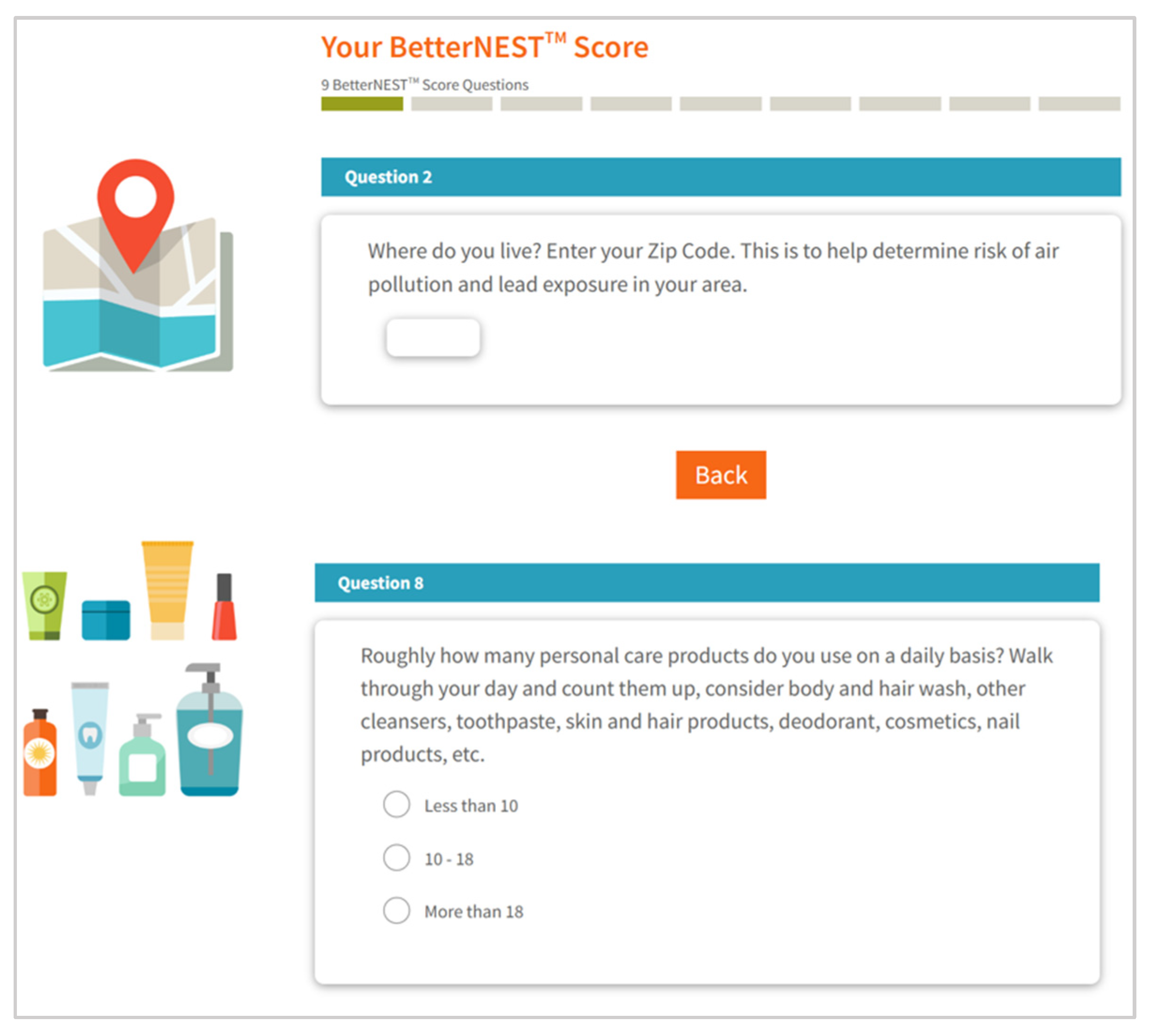
2.2. Survey Design and User Experience
2.3. Scoring Algorithm and Data Integration
- “There might be a risk of lead exposure in your home. Consider testing your tap water, and look into ways to reduce lead in the home. Get recommendations here (link to factsheets).”
- “Try to reduce ingestion of plastics. Avoid heating food or drinks in plastic, and switch to metal, glass or other materials for products where possible. Get more recommendations here (link to factsheets).”
- “Keep trying to reduce the number of personal care products you use daily, or check their ingredients and swap out for safer products based on your priorities. Get more recommendations here (link to factsheets).”
3. Results
4. Discussion
Strengths, Limitations and Future Directions
5. Conclusions
Author Contributions
Funding
Institutional Review Board Statement
Informed Consent Statement
Data Availability Statement
Conflicts of Interest
Abbreviations
| CDC | U.S. Centers for Disease Control and Prevention |
| EPA | U.S. Environmental Protection Agency |
| PM2.5 | Particulate Matter, 2.5 microns |
| SDT | Self Determination Theory |
| MI | Motivational Interviewing |
| NAAQS | National Ambient Air Quality Standards |
Appendix A. Usability Testing Focus Group Discussion Prompts
- To start, could you introduce yourselves? We have a mix of doulas and parents, so please share your first name, whether you’re a doula and/or parent, and why you’re interested in this topic.
- Please take a few minutes to explore the Safetynest website on your own, and take the BetterNest quiz. Feel free to click around, explore different sections, and take the quiz either as yourself, or if you’ve already taken it, try entering different answers this time.
- As you explore, please try to think about: What stands out? What’s easy to use? What’s confusing? What questions come to mind?
- When you first landed on the website, what were your immediate thoughts or feelings? What was the first thing that caught your eye?
- On a scale of 1 to 10 (1 being very easy, 10 being very difficult), how easy or difficult was it to navigate and find the information that was helpful?
- What did you find most challenging or frustrating?
- What words come to mind about your interaction with the BetterNest quiz?
- Were the questions clear and straightforward?
- Did the quiz’s results or recommendations make sense to you? Was the output easy to understand?
- What, if anything, would make the quiz more effective or user-friendly?
- What next steps or additional information would you want after taking the quiz, or what kind of follow-up?
References
- Gómez-Roig, M.D.; Pascal, R.; Cahuana, M.J.; García-Algar, O.; Sebastiani, G.; Andreu-Fernández, V.; Martínez, L.; Rodríguez, G.; Iglesia, I.; Ortiz-Arrabal, O.; et al. Environmental Exposure during Pregnancy: Influence on Prenatal Development and Early Life: A Comprehensive Review. Fetal Diagn. Ther. 2021, 48, 245–257. [Google Scholar] [CrossRef] [PubMed]
- Crighton, E.J.; Phipps, E.; Smith, G.N.; Ahmed, R.; Cook, J.L.; Masuda, J.R.; Osornio-Vargas, A.R.; Sanborn, M.; Brennan, L.J.; Phillips, K.P.; et al. Environmental Health Attitudes, Practices, and Educational Preferences: A National Survey of Reproductive-Aged Women in Canada. Int. J. Environ. Res. Public Health 2024, 21, 1397. [Google Scholar] [CrossRef] [PubMed]
- Piazza, M.J.; Urbanetz, A.A. Environmental toxins and the impact of other endocrine disrupting chemicals in women’s reproductive health. JBRA Assist. Reprod. 2019, 23, 154–164. [Google Scholar] [CrossRef] [PubMed]
- Rouillon, S.; El Ouazzani, H.; Hardouin, J.-B.; Enjalbert, L.; Rabouan, S.; Migeot, V.; Albouy-Llaty, M. How to Educate Pregnant Women about Endocrine Disruptors? Int. J. Environ. Res. Public Health 2020, 17, 2156. [Google Scholar] [CrossRef] [PubMed]
- Kim, H.K.; Jeong, G.H. Effect of Pro-Environmental Prenatal Education Program on Pregnant Women’s Environmental Health Awareness and Behaviors based on the Protection Motivation Theory. INQUIRY J. Health Care Organ. Provis. Financ. 2022, 59, 00469580211047045. [Google Scholar] [CrossRef] [PubMed]
- Kim, H.K. The protocol of DECO-MOM: A clinical trial testing the effectiveness of a mobile application for an environmental health intervention among pregnant women. BMC Med. Inform. Decis. Mak. 2023, 23, 154. [Google Scholar] [CrossRef] [PubMed]
- El Ouazzani, H.; Fortin, S.; Venisse, N.; Dupuis, A.; Rouillon, S.; Cambien, G.; Gourgues, A.-S.; Pierre-Eugène, P.; Rabouan, S.; Migeot, V.; et al. Perinatal Environmental Health Education Intervention to Reduce Exposure to Endocrine Disruptors: The PREVED Project. Int. J. Environ. Res. Public Health 2022, 19, 70. [Google Scholar] [CrossRef] [PubMed]
- Hendrie, G.A.; Baird, D.; Golley, R.K.; Noakes, M. The CSIRO Healthy Diet Score: An Online Survey to Estimate Compliance with the Australian Dietary Guidelines. Nutrients 2017, 9, 47. [Google Scholar] [CrossRef] [PubMed]
- Sinaci, A.A.; Gencturk, M.; Teoman, H.A.; Laleci Erturkmen, G.B.; Alvarez-Romero, C.; Martinez-Garcia, A.; Poblador-Plou, B.; Carmona-Pírez, J.; Löbe, M.; Parra-Calderon, C.L. A Data Transformation Methodology to Create Findable, Accessible, Interoperable, and Reusable Health Data: Software Design, Development, and Evaluation Study. J. Med. Internet Res. 2023, 25, e42822. [Google Scholar] [CrossRef] [PubMed]
- Patrick, H.; Williams, G.C. Self-determination theory: Its application to health behavior and complementarity with motivational interviewing. Int. J. Behav. Nutr. Phys. Act. 2012, 9, 18. [Google Scholar] [CrossRef] [PubMed]
- Miller, W.R.; Rollnick, S. Motivational Interviewing: Helping People Change, 3rd ed.; Guilford Press: New York, NY, USA, 2012. [Google Scholar]
- Miller, W.R.; Rose, G.S. Toward a theory of motivational interviewing. Am. Psychol. 2009, 64, 527. [Google Scholar] [CrossRef] [PubMed]
- Balla, J.; Hagger, M.S. Protection motivation theory and health behaviour: Conceptual review, discussion of limitations, and recommendations for best practice and future research. Health Psychol. Rev. 2024, 19, 145–171. [Google Scholar] [CrossRef] [PubMed]
- MySafetyNEST, LLC. BetterNest Score. Available online: https://www.mysafetynest.com/betternest-score/ (accessed on 26 March 2026).
- CDC National Environmental Public Health Tracking Tool. Available online: https://ephtracking.cdc.gov/indicatorPages?selectedContentAreaAbbreviation=22&selectedIndicatorId=34 (accessed on 9 March 2026).
- Review of the National Ambient Air Quality Standards for Particulate Matter, 85 Fed. Reg. 82684 (18 December 2020) (40 C.F.R. pt. 50). Available online: https://www.govinfo.gov/content/pkg/FR-2020-12-18/pdf/2020-27125.pdf (accessed on 9 March 2026).
- LeBrón, A.M.W.; Torres, I.R.; Valencia, E.; Dominguez, M.L.; Garcia-Sanchez, D.G.; Logue, M.D.; Wu, J. The State of Public Health Lead Policies: Implications for Urban Health Inequities and Recommendations for Health Equity. Int. J. Environ. Res. Public Health 2019, 16, 1064. [Google Scholar] [CrossRef] [PubMed]
- Chambliss, S.; La Frinere-Sandoval, N.Q.N.B.; Zigler, C.; Mueller, E.J.; Peng, R.D.; Hall, E.M.; Matsui, E.C.; Cubbin, C. Alignment of Air Pollution Exposure Inequality Metrics with Environmental Justice and Equity Goals in the United States. Int. J. Environ. Res. Public Health 2024, 21, 1706. [Google Scholar] [CrossRef] [PubMed]
- Barrett, E.S.; Wadie, K.; Getz, K.; Greenberg, P.; Moore, T.; Llanos, A.A.M. Evaluating personal care product use by Environmental Working Group hazard scores in relation to consumers’ sociodemographic characteristics, purchasing behaviors, and product safety perceptions. J. Expo. Sci. Environ. Epidemiol. 2025, 35, 921–932. [Google Scholar] [CrossRef] [PubMed]


| Question | Responses | Associated Scores |
|---|---|---|
| Q1. Are you considering pregnancy, currently pregnant, or have a baby or young children at home? | I’m considering pregnancy | N/A |
| I’m currently pregnant | ||
| I have a baby or young children at home | ||
| Q2. Where do you live? Enter your zipcode. This is to help determine risk of air pollution and lead exposure in your area. | No response. Estimates lead risk, or percentage of housing built before 1980, by county | <41.05 = 9 |
| 41.05–<50.3 = 7 | ||
| 50.3–<58.8 = 5 | ||
| 58.8–<69.3 = 3 | ||
| >69.3 = 1 | ||
| No response. Estimates air quality, historical PM2.5 monitored and modeled, by county | <12 = 9 | |
| 12–15 = 5 | ||
| >15 = 1 | ||
| Q3. How often are you exposed to tobacco or other smoke? | Never, or only by passing smokers outdoors in public places | 10 |
| Sometimes, I’m around smokers a few times a week, mostly outdoors | 6 | |
| Frequently, someone in my home smokes | 3 | |
| Daily, I smoke | 1 | |
| Q4. How often are you exposed to conventional cleaning products (consider home and at work)? [For those considering or currently pregnant]. How often are conventional cleaning products used in your home? [For those who have a baby/child at home]. | Almost never, I only use “green” products with minimal chemical ingredients | 9 |
| Weekly, or a few times a month | 6 | |
| Daily, or a few times a week | 2 | |
| Q5. How often are pesticides sprayed in or around your home or building? | Never or rarely | 9 |
| Sometimes, or I’m not sure | 5 | |
| Regularly, monthly or more frequently | 1 | |
| Q6. How often do you drink from, eat from, or heat food or drink in plastic containers? [For those considering or currently pregnant]. How often does your child drink or eat from plastic containers, drink or eat items heated in plastic, or chew on plastic toys? [For those who have a baby/child at home]. | Almost never | 10 |
| A few times a month | 7 | |
| A few times a week | 3 | |
| Daily | 1 | |
| Q7. How often do you buy organic produce for you or your family, or check the pesticide level on the DirtyDozen list? | Always, or at least the ones recommended by DirtyDozen | 9 |
| Sometimes | 5 | |
| Never, I buy what’s available or cheapest | 2 | |
| Q8. Roughly how many personal care products do you use on a daily basis? Walk through your day and count them up, consider body and hair wash, other cleansers, toothpaste, skin and hair products, deodorant, cosmetics, nail products, etc. | Less than 10 | 9 |
| 10–18 | 5 | |
| >18 | 1 | |
| Q9. How often do you check the ingredients of your or your child’s personal care products on a tool like SkinDeep, Think Dirty, or Clearya? | All the time, for all the products I can | If Q8 = 9, then 10; If 5, then 7; If 1, then 5 |
| Sometimes | If Q8 = 9, then 8; If 5, then 6; If 1, then 3 | |
| Never | If Q8 = 9, then 7, if 5, then 3, if 1, then 1 |
Disclaimer/Publisher’s Note: The statements, opinions and data contained in all publications are solely those of the individual author(s) and contributor(s) and not of MDPI and/or the editor(s). MDPI and/or the editor(s) disclaim responsibility for any injury to people or property resulting from any ideas, methods, instructions or products referred to in the content. |
© 2026 by the authors. Licensee MDPI, Basel, Switzerland. This article is an open access article distributed under the terms and conditions of the Creative Commons Attribution (CC BY) license.
Share and Cite
Ofrane, R.H.; Agolli, S. Teachable Moments: Development of an Environmental Health Behavior Change Tool for Pregnant Women and Parents. Int. J. Environ. Res. Public Health 2026, 23, 674. https://doi.org/10.3390/ijerph23050674
Ofrane RH, Agolli S. Teachable Moments: Development of an Environmental Health Behavior Change Tool for Pregnant Women and Parents. International Journal of Environmental Research and Public Health. 2026; 23(5):674. https://doi.org/10.3390/ijerph23050674
Chicago/Turabian StyleOfrane, Rebecca H., and Stella Agolli. 2026. "Teachable Moments: Development of an Environmental Health Behavior Change Tool for Pregnant Women and Parents" International Journal of Environmental Research and Public Health 23, no. 5: 674. https://doi.org/10.3390/ijerph23050674
APA StyleOfrane, R. H., & Agolli, S. (2026). Teachable Moments: Development of an Environmental Health Behavior Change Tool for Pregnant Women and Parents. International Journal of Environmental Research and Public Health, 23(5), 674. https://doi.org/10.3390/ijerph23050674