


Protein and Micronutrient Intake After Two Years of Sapropterin Treatment in PKU
 , , , and
Abstract
1. Introduction
2. Materials and Methods
2.1. Study Design and Participants
2.2. Data Collection
2.3. Statistical Analysis
2.4. Ethics
3. Results
3.1. Participants
3.2. Protein and Micronutrient Intake
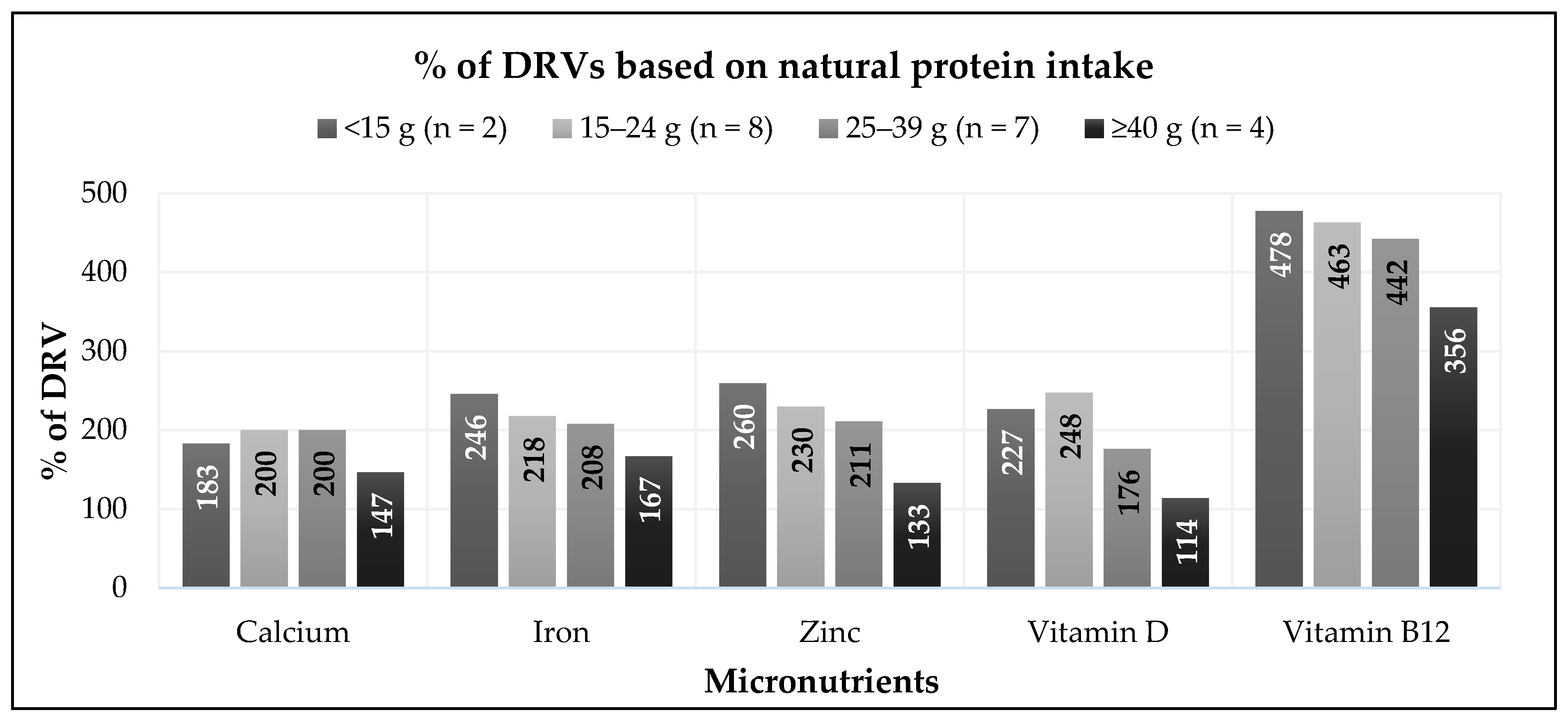
- Subject 5, who consumed ≥40 g/day of natural protein and had no protein equivalent intake from protein substitutes, had iron intake at 51% DRV, zinc at 90% DRV, and vitamin D at 4% DRV.
- Subject 10 (15–24 g/day natural protein group), with protein equivalent intake from protein substitutes of 60 g/day, had vitamin D intake at 85% DRV.
- Subject 14 (25–39 g/day natural protein group), with protein equivalent intake from protein substitutes of 6 g/day, had intakes below 75% DRV for iron (73%), zinc (68%), and vitamin D (51%).
- Subject 20 (≥40 g/day natural protein group), who was non-adherent with dietary management and had no protein equivalent intake from protein substitutes, had intakes below the reference values for calcium (46% DRV), iron (64% DRV), zinc (41% DRV), and vitamin D (60% DRV).
3.3. Micronutrient Intakes from Food Sources and Protein Substitutes
4. Discussion
5. Conclusions
Author Contributions
Funding
Institutional Review Board Statement
Informed Consent Statement
Data Availability Statement
Acknowledgments
Conflicts of Interest
Abbreviations
| BH4 | Tetrahydrobiopterin |
| BIMDG | The British Inherited Metabolic Disease Group |
| COMA | The Committee on Medical Aspects of Food and Nutrition Policy |
| DHPR | Dihydropteridine Reductase |
| DRV | Dietary Reference Value |
| NHS | National Health Service |
| PAH | Phenylalanine Hydroxylase |
| Phe | Phenylalanine |
| PKU | Phenylketonuria |
| SACN | The Scientific Advisory Committee on Nutrition |
| UK | United Kingdom |
References
- van Wegberg, A.; MacDonald, A.; Ahring, K.; Bélanger-Quintana, A.; Beblo, S.; Blau, N.; Bosch, A.; Burlina, A.; Campistol, J.; Coşkun, T. European guidelines on diagnosis and treatment of phenylketonuria: First revision. Mol. Genet. Metab. 2025, 145, 109125. [Google Scholar] [CrossRef]
- Brown, C.S.; Lichter-Konecki, U. Phenylketonuria (PKU): A problem solved? Mol. Genet. Metab. Rep. 2016, 6, 8–12. [Google Scholar] [CrossRef]
- Cazzorla, C.; Bensi, G.; Biasucci, G.; Leuzzi, V.; Manti, F.; Musumeci, A.; Papadia, F.; Stoppioni, V.; Tummolo, A.; Vendemiale, M. Living with phenylketonuria in adulthood: The PKU ATTITUDE study. Mol. Genet. Metab. Rep. 2018, 16, 39–45. [Google Scholar] [CrossRef]
- Burlina, A.; Leuzzi, V.; Spada, M.; Carbone, M.T.; Paci, S.; Tummolo, A. The management of phenylketonuria in adult patients in Italy: A survey of six specialist metabolic centers. Curr. Med. Res. Opin. 2021, 37, 411–421. [Google Scholar] [CrossRef] [PubMed]
- Walter, J.H.; White, F.J. Blood phenylalanine control in adolescents with phenylketonuria. Int. J. Adolesc. Med. Health 2004, 16, 41–46. [Google Scholar] [CrossRef] [PubMed]
- Yagudina, R.; Kulikov, A.; Serpik, V.; Protsenko, M.; Kopeyka, K. Factors affecting adherence to a low phenylalanine diet in patients with phenylketonuria: A systematic review. Nutrients 2024, 16, 3119. [Google Scholar] [CrossRef] [PubMed]
- De Giorgi, A.; Nardecchia, F.; Romani, C.; Leuzzi, V. Metabolic control and clinical outcome in adolescents with phenylketonuria. Mol. Genet. Metab. 2023, 140, 107684. [Google Scholar] [CrossRef]
- Jurecki, E.; Cederbaum, S.; Kopesky, J.; Perry, K.; Rohr, F.; Sanchez-Valle, A.; Viau, K.; Sheinin, M.; Cohen-Pfeffer, J. Adherence to clinic recommendations among patients with phenylketonuria in the United States. Mol. Genet. Metab. 2017, 120, 190–197. [Google Scholar] [CrossRef]
- Berry, S.A.; Brown, C.; Grant, M.; Greene, C.L.; Jurecki, E.; Koch, J.; Moseley, K.; Suter, R.; Van Calcar, S.C.; Wiles, J. Newborn screening 50 years later: Access issues faced by adults with PKU. Genet. Med. 2013, 15, 591–599. [Google Scholar] [CrossRef]
- Nardecchia, F.; Manti, F.; Chiarotti, F.; Carducci, C.; Carducci, C.; Leuzzi, V. Neurocognitive and neuroimaging outcome of early treated young adult PKU patients: A longitudinal study. Mol. Genet. Metab. 2015, 115, 84–90. [Google Scholar] [CrossRef]
- Aitkenhead, L.; Krishna, G.; Ellerton, C.; Moinuddin, M.; Matcham, J.; Shiel, L.; Hossain, S.; Kiffin, M.; Foley, J.; Skeath, R. Long-term cognitive and psychosocial outcomes in adults with phenylketonuria. J. Inherit. Metab. Dis. 2021, 44, 1353–1368. [Google Scholar] [CrossRef]
- Cardona, F.; Leuzzi, V.; Antonozzi, I.; Benedetti, P.; Loizzo, A. The development of auditory and visual evoked potentials in early treated phenylketonuric children. Electroencephalogr. Clin. Neurophysiol./Evoked Potentials Sect. 1991, 80, 8–15. [Google Scholar] [CrossRef] [PubMed]
- Antenor-Dorsey, J.A.V.; Hershey, T.; Rutlin, J.; Shimony, J.S.; McKinstry, R.C.; Grange, D.K.; Christ, S.E.; White, D.A. White matter integrity and executive abilities in individuals with phenylketonuria. Mol. Genet. Metab. 2013, 109, 125–131. [Google Scholar] [CrossRef] [PubMed]
- Hood, A.; Grange, D.K.; Christ, S.E.; Steiner, R.; White, D.A. Variability in phenylalanine control predicts IQ and executive abilities in children with phenylketonuria. Mol. Genet. Metab. 2014, 111, 445–451. [Google Scholar] [CrossRef]
- Hegge, K.A.; Horning, K.K.; Peitz, G.J.; Hegge, K. Sapropterin: A new therapeutic agent for phenylketonuria. Ann. Pharmacother. 2009, 43, 1466–1473. [Google Scholar] [CrossRef]
- Trefz, F.K.; Burton, B.K.; Longo, N.; Casanova, M.M.-P.; Gruskin, D.J.; Dorenbaum, A.; Kakkis, E.D.; Crombez, E.A.; Grange, D.K.; Harmatz, P. Efficacy of sapropterin dihydrochloride in increasing phenylalanine tolerance in children with phenylketonuria: A phase III, randomized, double-blind, placebo-controlled study. J. Pediatr. 2009, 154, 700–707.e701. [Google Scholar] [CrossRef]
- Rohde, C.; Hofman, D.L.; Klawon, I.; Rutsch, F.; Rodenburg, I.; van Spronsen, F.; Thiele, A.G.; Woestenenk, W.; Beblo, S. Risk of inadequate protein and micronutrient intakes in patients with PKU with an increased phe-tolerance: Impact of a micronutrient-dense protein substitute. Mol. Genet. Metab. Rep. 2025, 45, 101264. [Google Scholar] [CrossRef]
- van Spronsen, F.; Peters, H.; Margvelashvili, L.; Agladze, D.; Schwartz, I.V.D.; Giżewska, M.; Hamazaki, T.; Guilder, L.; MacDonald, A.; Vijay, S. Effect of long-term sepiapterin treatment on dietary phenylalanine tolerance in patients with phenylketonuria: Interim results from the Phase 3 APHENITY Extension Study. Genet. Med. 2026, 28, 101683. [Google Scholar] [CrossRef]
- Williams, R.A.; Bell, D.A.; Hooper, A.J.; Burnett, J.R. Sepiapterin for the treatment of phenylketonuria. Expert Opin. Pharmacother. 2025, 26, 933–938. [Google Scholar] [CrossRef] [PubMed]
- Yilmaz Nas, O.; Ashmore, C.; Gama, M.I.; Daly, A.; Evans, S.; Pinto, A.; Ozdogan, Y.; MacDonald, A. Two-Year Outcomes of Sapropterin Treatment in Children with Phenylketonuria: A Longitudinal Observational Study of Metabolic, Dietary, and Psychosocial Effects. Nutrients 2026, 18, 446. [Google Scholar] [CrossRef]
- Brantley, K.D.; Douglas, T.D.; Singh, R.H. One-year follow-up of B vitamin and Iron status in patients with phenylketonuria provided tetrahydrobiopterin (BH4). Orphanet J. Rare Dis. 2018, 13, 192. [Google Scholar] [CrossRef] [PubMed]
- Viau, K.; Wessel, A.; Martell, L.; Sacharow, S.; Rohr, F. Nutrition status of adults with phenylketonuria treated with pegvaliase. Mol. Genet. Metab. 2021, 133, 345–351. [Google Scholar] [CrossRef]
- MacDonald, A.; Ahring, K.; Bledsoe, A.; Fujimoto, H.; Giorda, S.; Kogelmann, C.; Kopesky, J.; Nagy, L.; O’Neill, S.; Pinto, A. Dietetic guidance for nutritional management of people with phenylketonuria receiving sepiapterin. Mol. Genet. Metab. 2025, 147, 109705. [Google Scholar] [CrossRef] [PubMed]
- Rohde, C.; von Teeffelen-Heithoff, A.; Thiele, A.; Arelin, M.; Mütze, U.; Kiener, C.; Gerloff, J.; Baerwald, C.; Schultz, S.; Heller, C. PKU patients on a relaxed diet may be at risk for micronutrient deficiencies. Eur. J. Clin. Nutr. 2014, 68, 119–124. [Google Scholar] [CrossRef] [PubMed]
- Das, A.; Goedecke, K.; Meyer, U.; Kanzelmeyer, N.; Koch, S.; Illsinger, S.; Lücke, T.; Hartmann, H.; Lange, K.; Lanfermann, H. Dietary habits and metabolic control in adolescents and young adults with phenylketonuria: Self-imposed protein restriction may be harmful. In JIMD Reports-Case and Research Reports; Springer: Berlin/Heidelberg, Germany, 2013; Volume 13, pp. 149–158. [Google Scholar]
- Ilgaz, F.; Marsaux, C.; Pinto, A.; Singh, R.; Rohde, C.; Karabulut, E.; Gökmen-Özel, H.; Kuhn, M.; MacDonald, A. Protein substitute requirements of patients with phenylketonuria on BH4 treatment: A systematic review and meta-analysis. Nutrients 2021, 13, 1040. [Google Scholar] [CrossRef]
- Thiele, A.G.; Rohde, C.; Mütze, U.; Arelin, M.; Ceglarek, U.; Thiery, J.; Baerwald, C.; Kiess, W.; Beblo, S. The challenge of long-term tetrahydrobiopterin (BH4) therapy in phenylketonuria: Effects on metabolic control, nutritional habits and nutrient supply. Mol. Genet. Metab. Rep. 2015, 4, 62–67. [Google Scholar] [CrossRef]
- Hennermann, J.B.; Roloff, S.; Gebauer, C.; Vetter, B.; von Arnim-Baas, A.; Mönch, E. Long-term treatment with tetrahydrobiopterin in phenylketonuria: Treatment strategies and prediction of long-term responders. Mol. Genet. Metab. 2012, 107, 294–301. [Google Scholar] [CrossRef]
- Hochuli, M.; Bollhalder, S.; Thierer, C.; Refardt, J.; Gerber, P.; Baumgartner, M.R. Effects of inadequate amino acid mixture intake on nutrient supply of adult patients with phenylketonuria. Ann. Nutr. Metab. 2017, 71, 129–135. [Google Scholar] [CrossRef]
- van den Broek, T.J.; Kremer, B.H.; Marcondes Rezende, M.; Hoevenaars, F.P.; Weber, P.; Hoeller, U.; van Ommen, B.; Wopereis, S. The impact of micronutrient status on health: Correlation network analysis to understand the role of micronutrients in metabolic-inflammatory processes regulating homeostasis and phenotypic flexibility. Genes Nutr. 2017, 12, 5. [Google Scholar] [CrossRef]
- Van Wegberg, A.; MacDonald, A.; Ahring, K.; Bélanger-Quintana, A.; Blau, N.; Bosch, A.; Burlina, A.; Campistol, J.; Feillet, F.; Giżewska, M. The complete European guidelines on phenylketonuria: Diagnosis and treatment. Orphanet J. Rare Dis. 2017, 12, 162. [Google Scholar] [CrossRef]
- Nutritics. Nutritics, version 6.22. Research Edition. Computer Software. Nutritics: Dublin, Ireland, 2026.
- Scientific Advisory Committee on Nutrition (SACN). Vitamin D and Health; SACN: London, UK, 2016. Available online: https://assets.publishing.service.gov.uk/government/uploads/system/uploads/attachment_data/file/537616/SACN_Vitamin_D_and_Health_report.pdf (accessed on 21 April 2026).
- Committee on Medical Aspects of Food and Nutrition Policy (COMA). Dietary Reference Values for Food Energy and Nutrients for the United Kingdom: Report of the Panel on Dietary Reference Values of the Committee on Medical Aspects of Food Policy; HM Stationery Office: Richmond, UK, 1991. [Google Scholar]
- Tummolo, A.; Carella, R.; De Giovanni, D.; Di Tullio, V.; Lorusso, L.; Bartolomeo, N. A cross-sectional study on protein substitutes for paediatric phenylketonuria diet: Time to pay attention. Nutrients 2025, 17, 1767. [Google Scholar] [CrossRef] [PubMed]
- Tummolo, A.; Carella, R.; De Giovanni, D.; Paterno, G.; Simonetti, S.; Tolomeo, M.; Leone, P.; Barile, M. Micronutrient deficiency in inherited metabolic disorders requiring diet regimen: A brief critical review. Int. J. Mol. Sci. 2023, 24, 17024. [Google Scholar] [CrossRef]
- Bélanger-Quintana, A.; García, M.J.; Castro, M.; Desviat, L.R.; Pérez, B.; Mejía, B.; Ugarte, M.; Martínez-Pardo, M. Spanish BH4-responsive phenylalanine hydroxylase-deficient patients: Evolution of seven patients on long-term treatment with tetrahydrobiopterin. Mol. Genet. Metab. 2005, 86, 61–66. [Google Scholar] [CrossRef] [PubMed]
- MacDonald, A.; Ahring, K.; Dokoupil, K.; Gokmen-Ozel, H.; Lammardo, A.M.; Motzfeldt, K.; Robert, M.; Rocha, J.C.; van Rijn, M.; Bélanger-Quintana, A. Adjusting diet with sapropterin in phenylketonuria: What factors should be considered? Br. J. Nutr. 2011, 106, 175–182. [Google Scholar] [CrossRef] [PubMed][Green Version]
- Evans, S.; Daly, A.; Chahal, S.; MacDonald, J.; MacDonald, A. Food acceptance and neophobia in children with phenylketonuria: A prospective controlled study. J. Hum. Nutr. Diet. 2016, 29, 427–433. [Google Scholar] [CrossRef]
- Bugi, M.-A.; Jugănaru, I.; Isac, R.; Simina, I.-E.; Munteanu, A.-I.; Mang, N.; Brad, G.-F.; Nicoară, D.-M.; Cîrnatu, D.; Mărginean, O. Factors impacting the reduction in neophobia prevalence in phenylketonuria patients. Nutrients 2024, 16, 768. [Google Scholar] [CrossRef]
- Rohde, C.; Mütze, U.; Weigel, J.; Ceglarek, U.; Thiery, J.; Kiess, W.; Beblo, S. Unrestricted consumption of fruits and vegetables in phenylketonuria: No major impact on metabolic control. Eur. J. Clin. Nutr. 2012, 66, 633–638. [Google Scholar] [CrossRef]
- Slavin, J.L.; Lloyd, B. Health benefits of fruits and vegetables. Adv. Nutr. 2012, 3, 506–516. [Google Scholar] [CrossRef]
- Mahadzir, M.D.A.; Tan, S.; Elena, S.; Chin, E.M.; Garg, V.; Mantantzis, K.; Péter, S.; Maier, A.B. Towards defining optimal concentrations of micronutrients in adults to optimize health. Mech. Ageing Dev. 2025, 225, 112062. [Google Scholar] [CrossRef]

| Protein Intake | Micronutrient Intake | ||||||||
|---|---|---|---|---|---|---|---|---|---|
| Subject | Age at 24 Months (Year) | Total Protein (g/day, g/kg/day) | Natural Protein (g/day, g/kg/day) | PE from PS (g/day, g/kg/day) | Calcium (mg/day, DRV%) | Iron (mg/day, DRV%) | Zinc (mg/day, DRV%) | Vitamin D (µg/day, DRV%) | Vitamin B12 (µg/day, DRV%) |
| 1 | 19 | 104 (1.4) | 59 (0.8) | 45 (0.6) | 1605, 229% | 28.0, 321% | 18.6, 196% | 25.2, 252% | 6.9, 459% |
| 2 | 9 | 72 (3.2) | 32 (1.4) | 40 (1.8) | 1663, 302% | 28.0, 322% | 20.4, 291% | 26.2, 261% | 5.2, 515% |
| 3 | 9 | 83 (3.2) | 23 (0.9) | 60 (2.3) | 1508, 274% | 26.9, 309% | 19.2, 274% | 33, 330% | 6, 603% |
| 4 | 13 | 69 (1.4) | 9 (0.2) | 60 (1.3) | 1250, 125% | 23.7, 209% | 17.4, 193% | 30.2, 302% | 4.9, 405% |
| 5 | 9 | 66 (1.7) | 66 (1.7) | 0 (0) | 855, 155% | 4.5, 51% | 6.3, 90% | 0.49, 4% | 4.2, 420% |
| 6 | 9 | 68 (1.7) | 8 (0.2) | 60 (1.5) | 1326, 241% | 24.7, 283% | 22.9, 326% | 15.2, 151% | 5.5, 550% |
| 7 | 8 | 76 (2.8) | 31 (1.1) | 45 (1.7) | 1159, 210% | 20.1, 231% | 19.1, 273% | 11.6, 115% | 4, 396% |
| 8 | 8 | 78 (2.1) | 38 (1.0) | 40 (1.1) | 1108, 201% | 17.0, 195% | 13.1, 187% | 20.9, 208% | 5, 496% |
| 9 | 9 | 70 (2.3) | 32 (1.1) | 38 (1.3) | 1418, 257% | 22.2, 255% | 16, 229% | 21.4, 214% | 6.3, 625% |
| 10 | 12 | 79 (1.6) | 19 (0.4) | 60 (1.2) | 1509, 150% | 20.0, 176% | 12.3, 136% | 8.6, 85% | 5.6, 463% |
| 11 | 6 | 60 (3.2) | 20 (1.1) | 40 (2.1) | 1332, 295% | 18.3, 300% | 11.7, 180% | 27.2, 272% | 3.9, 486% |
| 12 | 12 | 86 (1.3) | 16 (0.2) | 70 (1.1) | 1614, 201% | 29.0, 196% | 21.2, 235% | 36.8, 368% | 6.5, 543% |
| 13 | 16 | 61 (1.0) | 21 (0.3) | 40 (0.6) | 1069, 133% | 16.5, 111% | 11.5, 163% | 9.9, 98% | 4.7, 310% |
| 14 | 7 | 42 (1.0) | 36 (0.9) | 6 (0.1) | 661, 120% | 6.4, 73% | 4.8, 68% | 5.2, 51% | 2.8, 284% |
| 15 | 14 | 80 (2.5) | 20 (0.6) | 60 (1.9) | 1430, 143% | 27.9, 247% | 20.5, 227% | 27.7, 276% | 5.6, 468% |
| 16 | 19 | 85 (1.1) | 40 (0.5) | 45 (0.6) | 1103, 157% | 20.1, 231% | 19.6, 205% | 13.9, 139% | 5.8, 385% |
| 17 | 11 | 73 (2.1) | 37 (1.1) | 36 (1.0) | 1425, 178% | 26.6, 179% | 19.5, 216% | 23.9, 238% | 4.6, 379% |
| 18 | 14 | 81 (1.3) | 21 (0.3) | 60 (1.0) | 1477, 184% | 26.7, 180% | 24.7, 275% | 14.8, 147% | 5, 412% |
| 19 | 17 | 102 (1.5) | 22 (0.3) | 80 (1.2) | 1763, 220% | 32.9, 222% | 24.4, 348% | 40, 404% | 6.3, 418% |
| 20 | 17 | 55 (0.7) | 55 (0.7) | 0 (0) | 323, 46% | 9.5, 64% | 2.9, 41% | 6.1, 60% | 2.4, 158% |
| 21 | 18 | 81 (1.3) | 31 (0.5) | 50 (0.8) | 1301, 130% | 23.1, 204% | 20.1, 211% | 14.8, 147% | 6, 397% |
| Mean ± SD | 12 ± 4 | 75 ± 14 (1. 8 ± 0.8) | 30 ± 16 (0.7 ± 0.4) | 45 ± 21 (1.1 ± 0.6) | 1281 ± 347 188 ± 65% | 21.5 ± 7.5 208 ± 81% | 16.5 ± 6.2 208 ± 79% | 19.7 ± 10.9 196 ± 109% | 5.1 ± 1.2 437 ± 107% |
| Micronutrient | Total Intake | From PS | From Food | % from PS | % from Food |
|---|---|---|---|---|---|
| Calcium (mg/day) | 1332 (1108, 1508) | 1100 (848, 1199) | 280 (186, 323) | 80 (72, 84) | 20 (16, 28) |
| Iron (mg/day) | 23.1 (18.3, 26.9) | 18.7 (15.9, 22) | 4.2 (2.7, 4.9) | 84 (72, 88) | 16 (12, 28) |
| Zinc (mg/day) | 19.1 (12.3, 20.4) | 16.7 (11.1, 17.3) | 2.5 (2.0, 3.1) | 87 (82, 92) | 13 (8, 18) |
| Vitamin D (µg/day) | 20.9 (11.6, 27.2) | 20 (11.3, 26) | 0.5 (0.2, 2.5) | 96 (90, 99) | 4 (1, 10) |
| Vitamin B12 (µg/day) | 5.2 (4.6, 6.0) | 3.7 (3.3, 4.8) | 1.3 (0.3, 2.1) | 78 (63, 93) | 22 (7, 37) |
Disclaimer/Publisher’s Note: The statements, opinions and data contained in all publications are solely those of the individual author(s) and contributor(s) and not of MDPI and/or the editor(s). MDPI and/or the editor(s) disclaim responsibility for any injury to people or property resulting from any ideas, methods, instructions or products referred to in the content. |
© 2026 by the authors. Licensee MDPI, Basel, Switzerland. This article is an open access article distributed under the terms and conditions of the Creative Commons Attribution (CC BY) license.
Share and Cite
Yilmaz Nas, O.; Ashmore, C.; Gama, M.I.; Daly, A.; Evans, S.; Pinto, A.; Ozdogan, Y.; MacDonald, A. Protein and Micronutrient Intake After Two Years of Sapropterin Treatment in PKU. Nutrients 2026, 18, 1549. https://doi.org/10.3390/nu18101549
Yilmaz Nas O, Ashmore C, Gama MI, Daly A, Evans S, Pinto A, Ozdogan Y, MacDonald A. Protein and Micronutrient Intake After Two Years of Sapropterin Treatment in PKU. Nutrients. 2026; 18(10):1549. https://doi.org/10.3390/nu18101549
Chicago/Turabian StyleYilmaz Nas, Ozlem, Catherine Ashmore, Maria Ines Gama, Anne Daly, Sharon Evans, Alex Pinto, Yahya Ozdogan, and Anita MacDonald. 2026. "Protein and Micronutrient Intake After Two Years of Sapropterin Treatment in PKU" Nutrients 18, no. 10: 1549. https://doi.org/10.3390/nu18101549
APA StyleYilmaz Nas, O., Ashmore, C., Gama, M. I., Daly, A., Evans, S., Pinto, A., Ozdogan, Y., & MacDonald, A. (2026). Protein and Micronutrient Intake After Two Years of Sapropterin Treatment in PKU. Nutrients, 18(10), 1549. https://doi.org/10.3390/nu18101549

