


Abstract
Aphanomyces root rot is a major threat to legume production worldwide, mainly in pea and lentil, crops on which extensive research programs are targeting the management of the disease. However, other legumes such as common vetch, although known to be severely affected by the disease, remain largely unexplored. This study aimed to identify sources of resistance within V. sativa subsp. sativa accessions. A total of 211 genetically diverse accessions were screened under controlled conditions following inoculation with isolate RB84. Disease progression was monitored through periodic foliar assessments and final root symptom evaluation. To assess resistance stability, a subset of 13 accessions representing contrasting response levels was further inoculated with three additional isolates (Aph-1, AE11, and AE12). In this multi-isolate assay, disease severity was quantified, shoot biomass was recorded, and root system architecture traits were determined using WinRHIZO image analysis. A high correlation between foliar and root symptoms at 20 days indicated that foliar symptom assessment provides a reliable, non-destructive indicator of root health. Considerable variation in disease response was detected, with several genotypes maintaining consistently low symptom levels and three exhibiting near-complete resistance across all isolates. Root architectural traits further corroborated visual disease assessments, showing patterns consistent with resistance and susceptibility responses. Overall, this study demonstrates the presence of genetic variability in the response of V. sativa to A. euteiches, with a subset of accessions showing resistance to the four isolates tested. This resistance potential can be directly used in breeding programs focused on improving tolerance to root rot.
1. Introduction
Common vetch (Vicia sativa subsp. sativa L.) is globally recognized as one of the most economically significant annual legumes [1], contributing to reduced fertilizer inputs due to its capacity to fix atmospheric nitrogen via symbiosis with soil rhizobia [2]. It is primarily cultivated as forage for animal feed due to its high leaf crude protein and high digestibility or as green manure in sustainable agricultural systems [3,4]. Although its origin is traced to the arid regions of the Middle East, common vetch has been extensively adopted and cultivated in diverse agroecological areas, with major production zones currently located in Ethiopia, Mexico, Turkey, Russia, and Spain [5]. According to the Food and Agriculture Organization [6], global vetch production declined from 1,277,642 tons harvested from 888,125 hectares in 2004 to 654,724 tons from 339,462 hectares in 2024, reflecting a marked decrease in production over recent years.
Despite its agronomic advantages, common vetch, like other legume crops, is affected by a range of biotic stresses, including fungal pathogens, insect pests, and parasitic weeds, that can severely reduce yield and quality [1,7]. Among these, foliar diseases such as anthracnose [8], powdery mildew [9], downy mildew [10], and rust [11] are widespread, while soil-borne pathogens, including fungi such as Fusarium spp. [12], the parasitic weed Orobanche crenata [13], and the oomycete Aphanomyces euteiches [14], pose significant challenges due to their persistence in the soil and difficulty of control.
Aphanomyces root rot caused by A. euteiches is a major constraint to legume production, being widespread across many agricultural regions and responsible for substantial yield losses, particularly in North America, Europe, Oceania, and Asia [15]. This oomycete is recognized for its persistence in soil, facilitated by the production of long-lived oospores that can survive for years in the absence of a host [16,17]. Aphanomyces euteiches infects a broad range of legume hosts, including Pisum sativum (pea), Lens culinaris (lentil), Medicago sativa (alfalfa), Phaseolus vulgaris (common bean), and Vicia sativa (common vetch), among others [18,19]. The disease is characterized by root discoloration, cortical decay, and a marked reduction in root biomass, resulting in reduced plant growth, poor nodulation, and significant yield losses [17,20]. In peas and lentils, yield reductions of up to 100% have been reported under optimal conditions [19,21]. Recent studies have also highlighted the increasing prevalence of A. euteiches in Mediterranean and continental climates, raising concerns about its potential impact on emerging legume crops such as common vetch [22]. The wide host range and adaptability of this oomycete, together with the lack of effective chemical control options and the limited availability of resistant cultivars, make it a major challenge for sustainable legume production [15,16]. In this context, controlled-condition resistance screening remains a critical step to identify stable sources of resistance that can be integrated into breeding programs [23].
Common vetch germplasm has been extensively characterized for agro-morphological traits, forage yield components, and seed morphology [24]. However, while the incidence of A. euteiches on pea and lentil has been widely studied, with numerous reports documenting its biology, distribution, and host–pathogen interactions [16,25], research on its occurrence and impact on vetch remains limited, and only a few studies have evaluated the susceptibility of vetch genotypes under controlled conditions [17,21]. Given the growing interest in V. sativa as a sustainable forage and cover crop, particularly in temperate climates, there is an increasing need to address the impact of A. euteiches, which can severely compromise root development, biomass accumulation, and nitrogen fixation capacity. Due to the need for environmentally sustainable disease management strategies that reduce reliance on chemical inputs and contribute to lowering greenhouse gas emissions, identifying resistant or tolerant genotypes becomes a key component of integrated disease control. Furthermore, considering the high level of genetic diversity previously reported in vetch germplasm collections, especially for traits related to adaptation and agronomic performance [26], it is reasonable to assume that some genotypes may also exhibit differential responses to root rot. However, to date, no systematic screening under controlled conditions has been conducted to evaluate the extent of variation in susceptibility to A. euteiches within a genetically diverse panel of V. sativa accessions.
Based on previous studies in other legume species and the reported genetic diversity in common vetch germplasm, we hypothesized that V. sativa subsp. sativa may harbor exploitable variation in response to A. euteiches, which could be reliably assessed under controlled conditions. Therefore, the objectives of this study were to evaluate the responses of a genetically diverse panel of V. sativa accessions to A. euteiches under controlled conditions, in order to identify sources of resistance that could be exploited in breeding programs aimed at improving vetch resilience to root rot and to study the stability of identified resistances against a set of contrasting isolates.
2. Materials and Methods
2.1. Plant Material and Experiment Conditions
A total of 211 accessions of V. sativa subsp. sativa L., with a wide geographical origin (Albania, Algeria, Cyprus, Egypt, France, Greece, Italy, Jordan, Lebanon, Malta, Morocco, Palestine, Portugal, Spain, Syria, Tunisia, Turkey and former Yugoslavia), were used in the study. Seeds were surface-sterilized with 0.1% (v/v) sodium hypochlorite for 1 min, scarified and pre-germinated for 4 days. Germinated seeds were placed individually in plastic pots (6 × 6 × 8 cm) containing 250 mL of perlite, with each plant considered an independent experimental unit.
Two independent experiments were conducted under controlled conditions. In experiment 1, the full collection of 211 accessions was evaluated using a single isolate. Within each experimental run, pots were arranged in a randomized complete block design comprising four blocks, each block including one plant per accession. The experiment was repeated three times over time, resulting in a total of 12 independent biological replicates per accession. In experiment 2, a subset of selected genotypes was evaluated independently under the same controlled conditions. In this case, each genotype × treatment combination was represented by eight biological replicates per experimental run, and the experiment was repeated twice over time, resulting in a total of 16 independent biological replicates per genotype and treatment.
Plants were maintained under controlled conditions (25 ± 2 °C, 50% relative humidity, and a 16/8 h day/night photoperiod) and watered as needed.
2.2. Oomycete Material and Inoculation
The Aphanomyces euteiches isolate RB84 (pathotype I, France), previously reported as virulent on vetch [27], was used for the initial screening of the 211 V. sativa subsp. sativa accessions (experiment 1). For experiment 2, a subset of 13 genotypes showing contrasting levels of susceptibility in experiment 1 (six resistant, four intermediate, and three highly susceptible) were selected and inoculated with four A. euteiches isolates: (1) the above described RB84; (2) Aph-1 (from pea, UK) [28]; and the Canadian isolates (3) AE11, a field isolate routinely used for pea phenotyping at the Crop Development Centre (CDC), University of Saskatchewan, Canada; and (4) AE12 [29]. RB84, AE11 and AE12 have been classified as pathotype I according to the French differential system, whereas no formal pathotype designation has been reported for Aph-1. These isolates were selected because, although classified within the same pathotype, previous studies have shown differences in disease severity across pea differential genotypes, indicating variability in aggressiveness within pathotype I [29].
All isolates were maintained and multiplied under the same conditions. The cultures were grown on corn meal agar (CMA) medium for 7 days at 24 °C in the dark. Zoospores were produced using a modified version of the method described by [30]. Plugs (5 × 5 mm) taken from the advancing edge of cultures were transferred to flasks containing 50 mL of peptone-glucose broth (20 g/L Oxoid bacteriological peptone, 5 g/L glucose). Cultures were incubated at 24 °C in darkness for 4 days, after which the broth was removed under sterile conditions, and mycelial mats were rinsed twice with sterile water for 2 h. Subsequently, 50 mL of mineral salt solution (0.26 g CaCl2·2H2O, 0.07 g KCl, 0.49 g MgSO4·7H2O dissolved in 1 L of sterile distilled water) was added to each flask and incubated at 24 °C in the dark for 20 h, allowing zoospore release. The inoculum was then filtered, zoospore density was determined using a Fuchs-Rosenthal haemocytometer and the concentration was adjusted to 103 zoospores/mL, and the plants were inoculated with 5 mL of zoospore suspension [31]. Control plants were treated with 5 mL of sterile distilled water following the same protocol, without the presence of the pathogen.
2.3. Disease Assessment
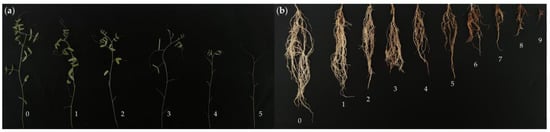
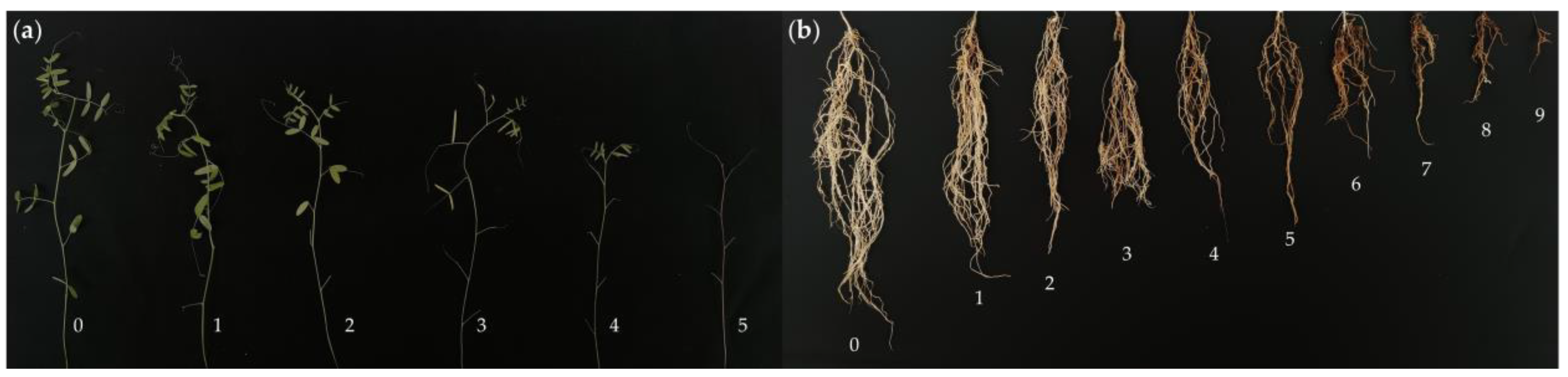
In both experiments, foliar symptoms were assessed at 0, 6, 11, 14, 17, and 20 days after inoculation (DAI) using a 0–5 visual scale adapted from [32] and originally developed for pea (Pisum sativum). This scale integrates progressive levels of yellowing, wilting, and basal stem necrosis (Figure 1a). In addition, foliar symptom values were used to calculate the relative area under the disease progress curve (rAUDPC) for each plant. At 20 DAI, roots were carefully removed from the substrate, washed, and visually scored for necrosis and rot severity (Figure 1b) using a 0–9 scale [19,33]. In experiment 2, at the end of the experiment, shoot fresh biomass was recorded, and root architecture (root length, surface area, volume, mean diameter, tips and crossings) was analysed using WinRHIZO software (v3.10b, Regent Instruments Inc., Québec, QC, Canada). For WinRHIZO analysis, roots were cut, placed on filter paper, and stored at −20 °C. Prior to analysis, samples were thawed at room temperature for 1 h.
Figure 1.
Scale of foliar (a) and root (b) symptoms of Aphanomyces euteiches in Vicia sativa subsp. sativa.
2.4. Statistical Analysis
All statistical analyses were performed in R version 4.4.2 [34], and graphical representations were generated using the ggplot2 package (v3.5.1) [35]. For both experiments, mean values were calculated for foliar symptoms at 11, 14, 17, and 20 DAI, root symptoms, and relative AUDPC (rAUDPC). The AUDPC was calculated using the trapezoidal method based on foliar symptom scores across assessment dates and expressed relative to the maximum theoretical AUDPC value. In experiment 2, additional root architecture traits obtained with WinRHIZO (total root length, surface area, mean diameter, and number of tips) were also summarized as means and standard errors.
For experiment 1, the distribution of accession means was explored using histograms. For the variables, a linear mixed model (lmer function from the lme4 package (v2.0.1)) was used including genotype, repetition and replicate as random factors. Broad-sense heritability (H2) was calculated using the formula H2 = σ2G/(σ2G + σ2E/r), where σ2G is the genetic variance, σ2E is the residual variance and r is the number of rounds [25,36]. For experiment 2, treatment effects were evaluated for each genotype using one-way analysis of variance (ANOVA), followed by Tukey’s test when significant (p < 0.05).
3. Results
3.1. Experiment 1
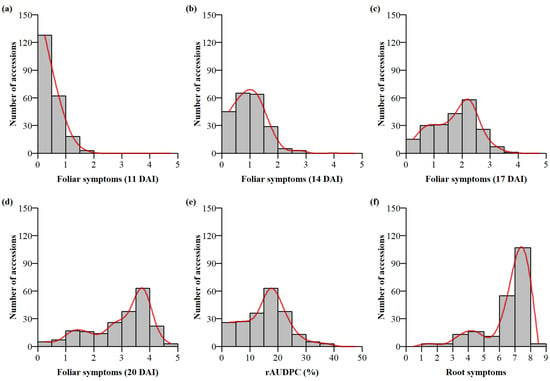
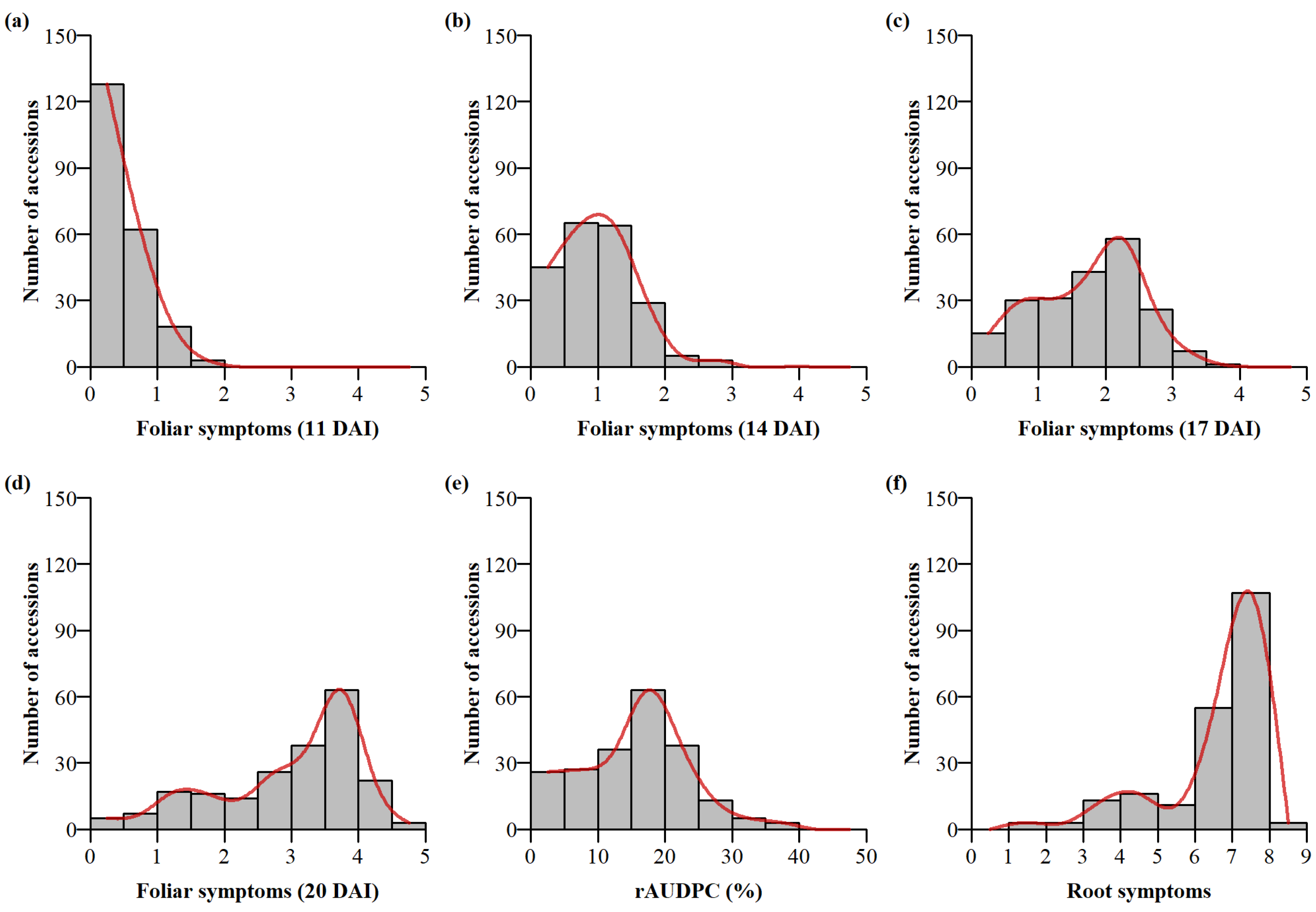
The 211 evaluated V. sativa accessions exhibited a wide range of foliar and root symptoms after A. euteiches inoculation (Figure 2). No foliar symptoms were observed before 6 DAI. At 11 DAI, 90% of the accessions remained asymptomatic (mean foliar symptoms < 1), while 10% exhibited slight yellowing or wilting (1–2) (Figure 2a). By 14 DAI, 52% of accessions were still not symptomatic, with 44% showing low symptoms, and only 4% reaching foliar symptoms ≥ 2 (Figure 2b). By 17 DAI, symptom distribution broadened, with accessions more evenly spread across categories from 0 to 3 (Figure 2c). By 20 DAI, most of the accessions (60%) exhibited medium to severe foliar symptoms (≥3), while ~6% remained asymptomatic (Figure 2d). In line with these patterns, rAUDPC was dominated by intermediate severities: 71% of accessions were distributed between 10 and 30%, 12% were in the 0–5% class, and 10% exceeded 30% (Figure 2e). Root symptoms were also high for most genotypes: 51% scored 7–8, whereas only 3% were <3 (Figure 2f).
Figure 2.
Frequency distribution of disease metrics for 211 Vicia sativa subsp. sativa accessions inoculated with Aphanomyces euteiches. (a–d) Foliar symptoms at 11, 14, 17 and 20 days after inoculation (DAI), scored on a 0–5 scale. (e) Relative area under the disease progress curve (rAUDPC, %). (f) Root symptoms scored on a 0–9 scale. Bars represent the number of accessions within each class of mean disease score (means calculated from 12 biological replicates per accession); red lines indicate smoothed frequency curves.
The genetic component did not exert a significant influence on foliar symptoms until 17 DAI, after which its effect progressively increased over time. By the end of the experiment (20 DAI), foliar symptoms exhibited moderately high heritability (H2 = 0.71), with lower but still significant values also observed at 17 DAI (H2 = 0.60). On the other hand, rAUDPC displayed moderate heritability (H2 = 0.64), although it was notably influenced by environmental factors. With respect to root symptoms, they were predominantly determined by genetic factors, displaying the highest heritability (H2 = 0.85) (Table 1).
Table 1.
Variance components and broad-sense heritability (H2) estimates for foliar symptoms (11, 14, 17, and 20 days after inoculation, DAI), the relative area under the disease progress curve (rAUDPC) and root symptoms at 20 DAI.
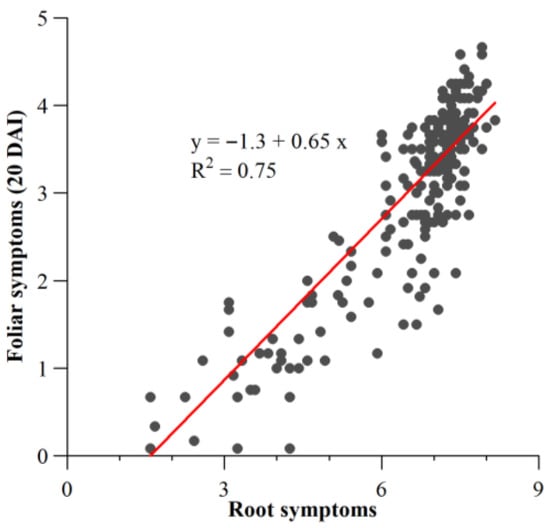
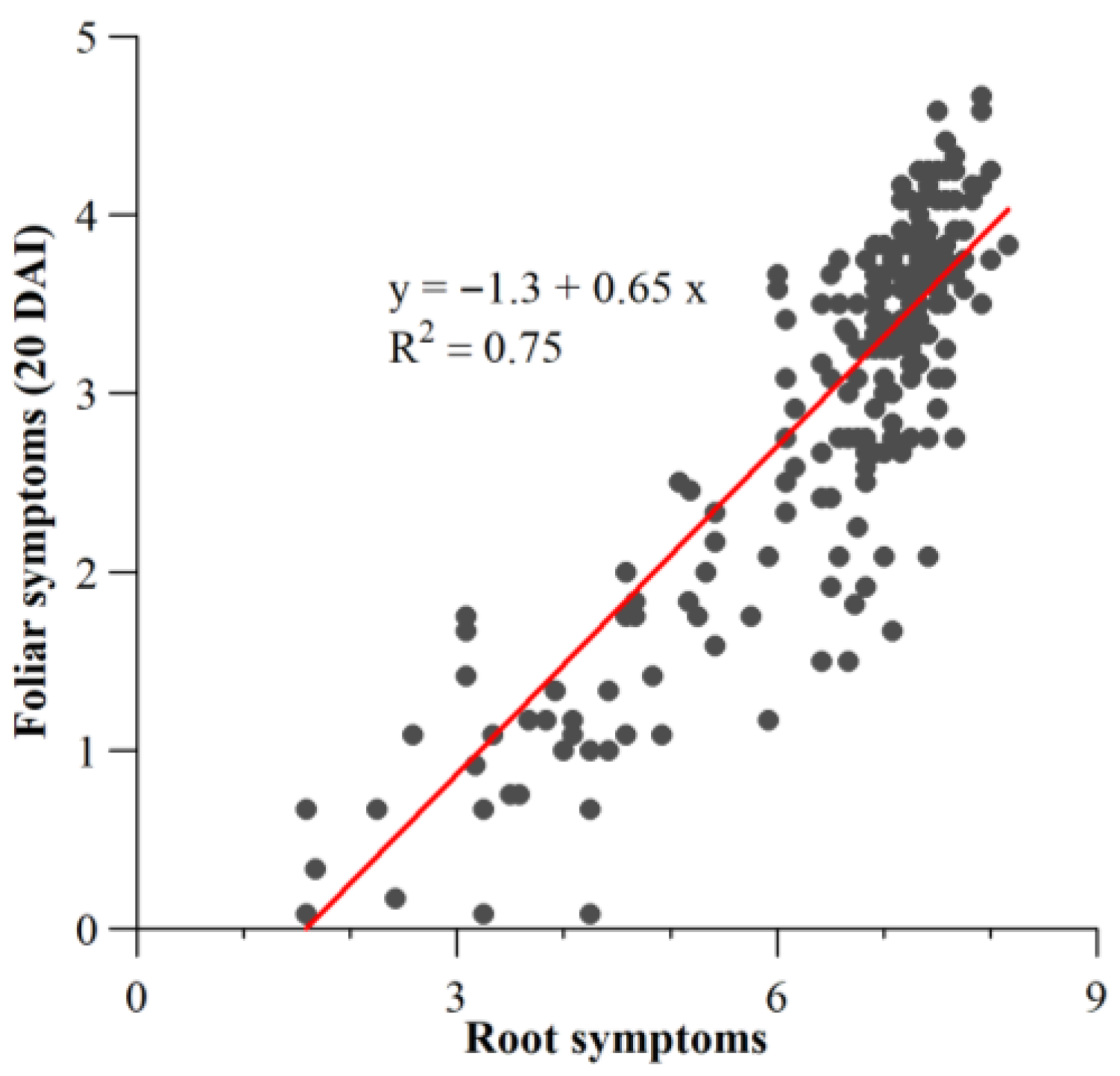
Regression analysis at 20 DAI revealed a moderately strong association between foliar and root symptoms (Figure 3). At this stage, foliar values spanned the full 0–5 scale, and their correlation with root symptoms was high (R2 = 0.75), indicating that plants with more severe foliar symptoms also exhibited more advanced root rot. In contrast, at earlier time points (11, 14, and 17 DAI), the correlation between foliar and root symptoms was low (R2 = 0.32, 0.47, and 0.6, respectively). Most of the evaluated accessions were classified as susceptible (root symptoms ≥ 5) or highly susceptible (root symptoms ≥ 7), but a subset of accessions was resistant, displaying low foliar (<0.5) and root symptoms (<3).
Figure 3.
Correlation between foliar (scale: 0–5) and root (scale: 0–9) symptoms 20 days after Aphanomyces euteiches inoculation under controlled conditions. Dots represent the mean values for each genotype. Red line indicates the linear regression fit (p < 0.0001), with the coefficient of determination (R2).
Among the most resistant accessions (root symptoms < 3), several genotypes exhibited almost complete absence of foliar symptoms throughout the evaluation period (Table S1). Accessions 124, 75 and 113 consistently maintained foliar symptoms values of 0 or close to 0 across all time points, with final scores at 20 DAI below 0.8. Notably, accession 124 showed minimal symptom expression (foliar symptoms ≤ 0.1), suggesting a particularly high level of resistance. Other resistant accessions, such as 75 and 172, displayed slightly higher foliar symptom values over time but remained well below thresholds typically associated with susceptibility (foliar symptoms < 1). The group of resistant genotypes showed rAUDPC values ranging from 0.1 to 6.5, indicating slow disease progression and limited symptom development. The resulting plots reveal the variability in disease response among accessions, highlighting both the progression of severity over time and the presence of accessions with consistently low mean foliar values, which may indicate higher levels of resistance. In contrast, the three most susceptible genotypes (58, 201 and 272) exhibited rapid disease onset, with foliar symptom values exceeding 3.8 at 20 DAI and rAUDPC values between 17.5 and 27.7. Their corresponding root symptoms scores (≥8.0) confirmed extensive root damage, in agreement with the severity of the foliar symptoms.
3.2. Experiment 2
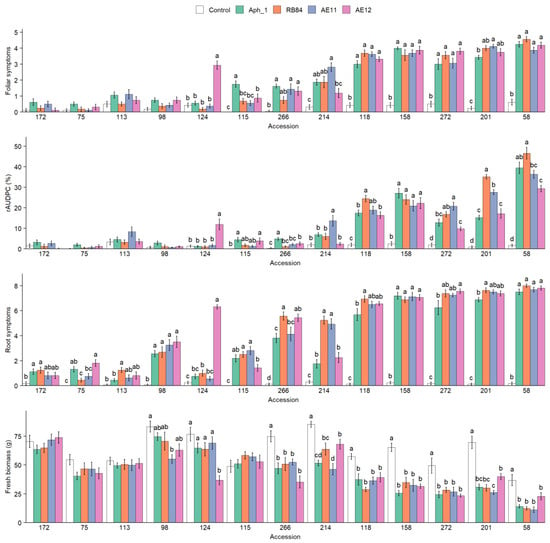
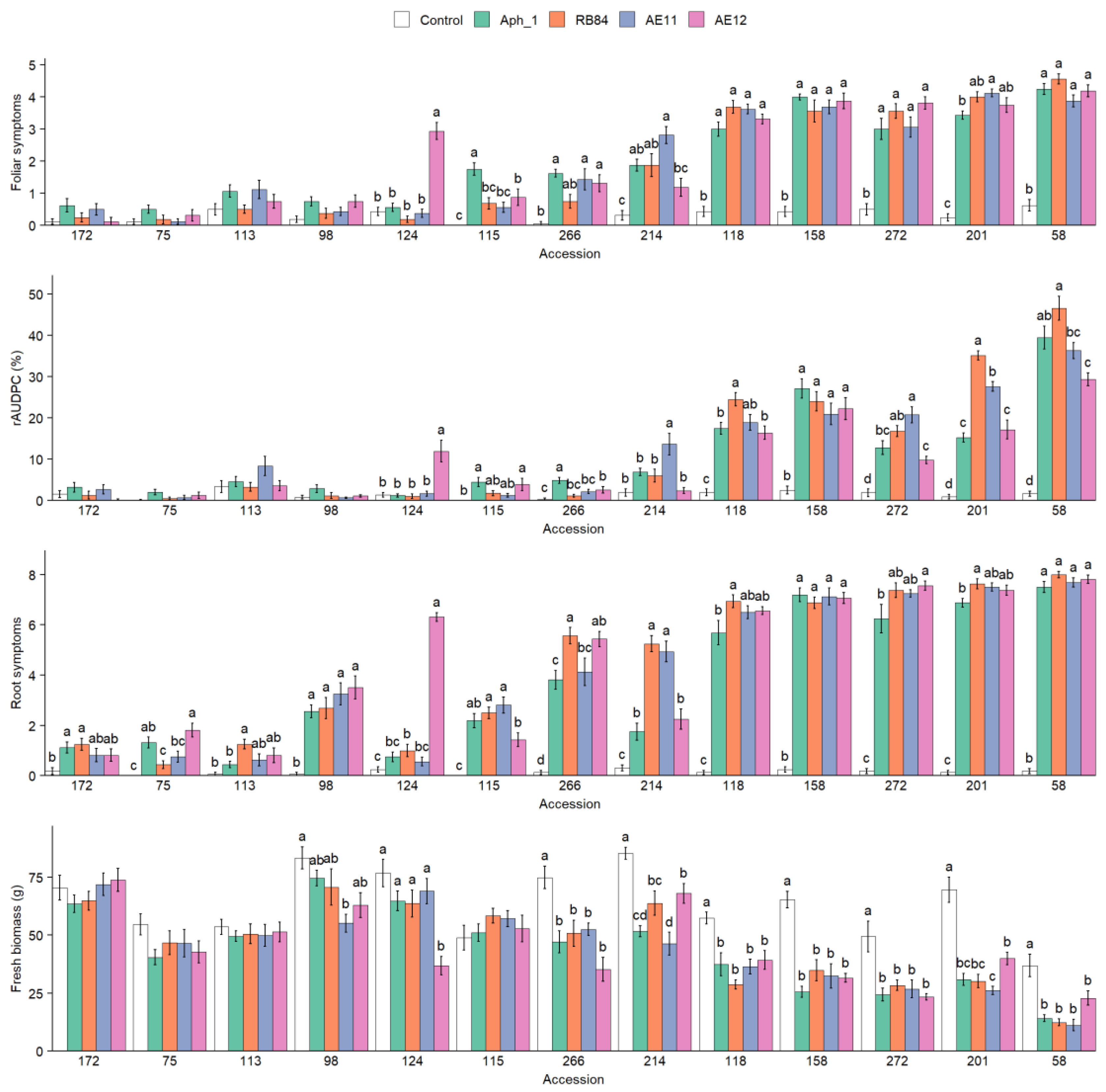
The multi-isolate experiment showed that foliar symptoms, rAUDPC and plant biomass responses after 20 DAI were consistent across vetch accessions (Figure 4, Table S2). In contrast, root symptoms showed significant differences between non-inoculated controls and at least one inoculated treatment in all accessions, indicating that root infection occurred even in resistant genotypes. Accessions 172, 75, and 113 showed no significant differences between inoculated and control plants for foliar symptoms, rAUDPC, or fresh biomass, and only exhibited very low root symptoms (<2) across all isolates, with significant differences detected only in some isolates and always associated with minimal symptom severity. A comparable response was observed in genotype 98, which did not differ from the control in foliar symptoms and rAUDPC and showed only moderate root symptoms for all the isolates and limited biomass reduction to isolate Aph-1. In contrast, genotypes 118, 158, 272, 201 and 58 exhibited significantly higher foliar symptoms, rAUDPC and root rot severity, together with marked biomass reductions, in all inoculated treatments compared with the control, indicating high susceptibility regardless of the isolate. Genotype 124 remained resistant to most isolates across all parameters but showed a clear susceptible response to isolate AE12, reflected by increased foliar and root symptoms and a significant reduction in biomass. Genotype 115 showed low root symptom levels and no biomass reduction despite intermediate foliar symptom responses, indicating resistance at the root and plant performance levels. Genotypes 266 and 214 showed intermediate, isolate-dependent responses, with moderate to high root symptoms and consistent biomass reductions.
Figure 4.
Foliar and root disease parameters and plant biomass of vetch genotypes inoculated with four Aphanomyces euteiches isolates or non-inoculated controls. Values represent mean ± SE (n = 16 plants per treatment). For each genotype and parameter, different letters indicate significant differences among treatments according to Tukey’s HSD test (p < 0.05).
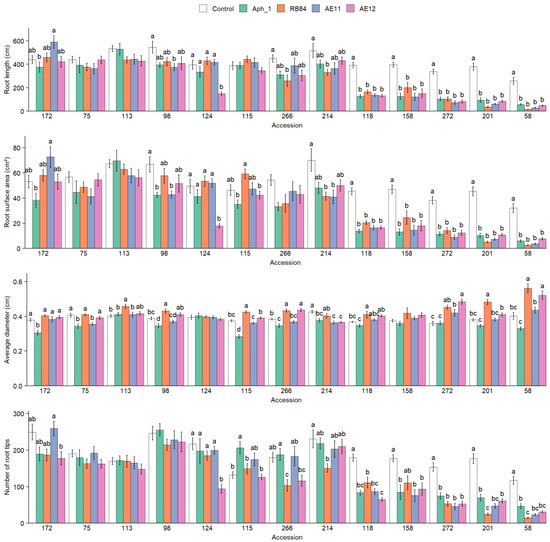
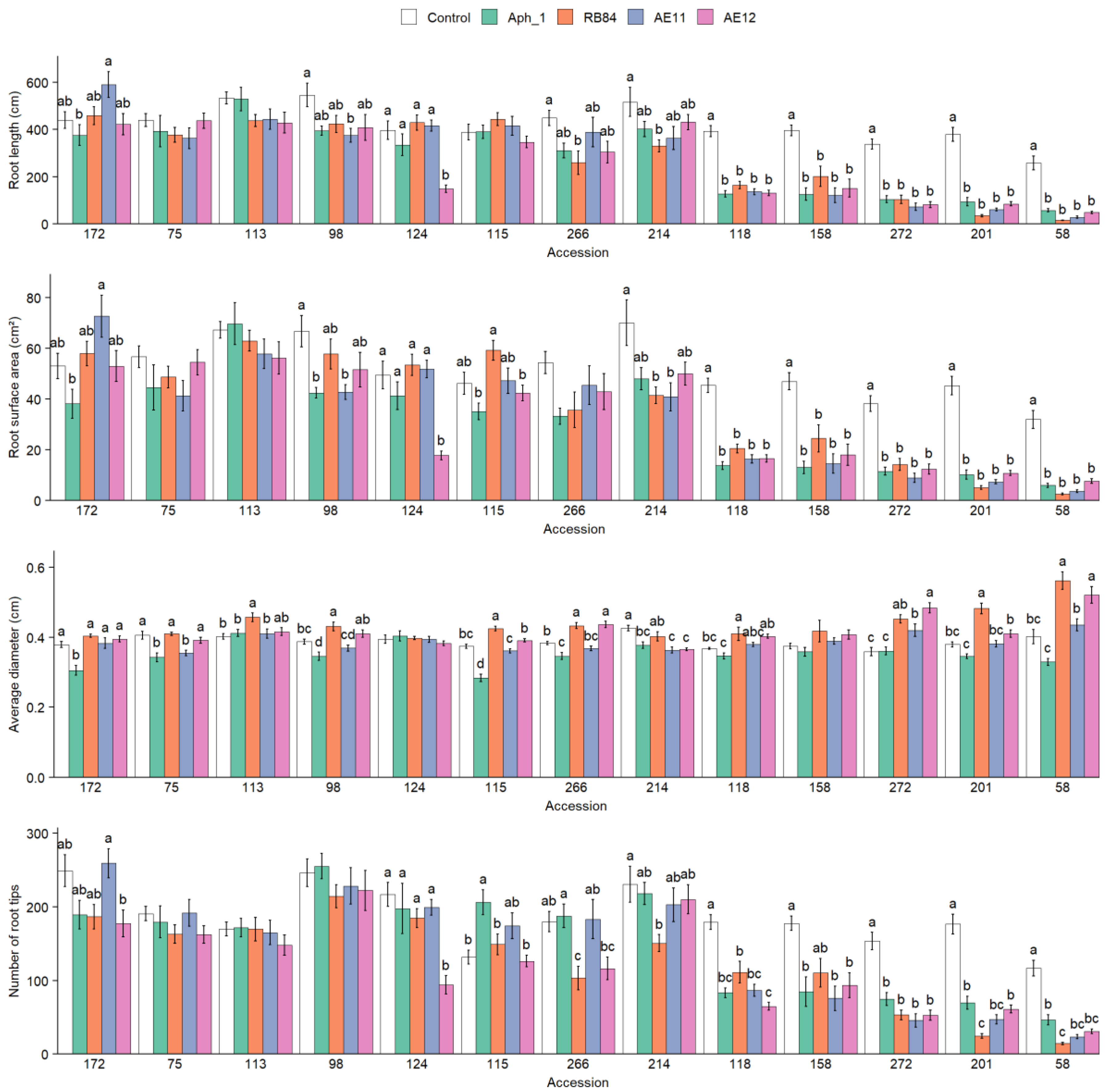
Regarding root system architecture, the parameters measured with WinRHIZO showed the resistance patterns observed for disease and biomass parameters (Figure 5). The most resistant accessions (172, 75 and 113) showed no significant differences between inoculated plants and the non-inoculated control for total root length, root surface area or number of root tips, indicating that root development was not affected by any A. euteiches isolate. A similar response was observed in accession 98, with significant reductions detected only for isolate AE11, while reductions in root length and surface area were limited to isolates Aph-1 and AE11 and no differences were observed in the number of root tips.
Figure 5.
Root system architecture traits of vetch genotypes inoculated with four Aphanomyces euteiches isolates or non-inoculated controls, using WinRHIZO software. Parameters include total root length, root surface area, average root diameter and number of root tips. Values represent mean ± SE (n = 16 plants per treatment). For each genotype and parameter, different letters indicate significant differences among treatments according to Tukey’s HSD test (p < 0.05).
In contrast, accessions 58, 118, 201 and 272 showed consistent reductions in all root traits across all isolates, and accession 158 also showed reduced root length and surface area for all isolates, with a less pronounced effect on root tips for isolate RB84. Several accessions showed isolate-dependent responses: accession 124 was affected only by isolate AE12, accession 115 showed an increased number of root tips only for isolate Aph-1, and accessions 214 and 266 showed significant reductions in root traits only when inoculated with isolate RB84. Regarding average root diameter, control plants generally showed intermediate values relative to inoculated treatments, indicating that this parameter did not provide a clear or consistent discrimination between resistant and susceptible responses and should therefore not be considered a key indicator of disease incidence under the conditions of this experiment.
4. Discussion
Resistance to A. euteiches has been extensively characterized in several grain legumes [19], whereas comparable information for common vetch is based on limited material [17]. Interest in this disease has increased markedly in recent years due to its expanding geographical distribution, its impact on an increasing number of legume crops, and the limited effectiveness of current control strategies, which has in turn highlighted the need for efficient resistance screening approaches that can be applied to large germplasm collections [37]. The results obtained here provide broad-scale evidence that V. sativa harbors substantial genetic variation for resistance to this pathogen, allowing both methodological and biological aspects of resistance to be addressed.
The main methodological limitation in A. euteiches resistance screening is the dependence on destructive root evaluations, which restricts throughput and increases experimental costs [38]. Recent studies in pea have shown that foliar symptom assessment at late stages of infection can provide a reliable estimation of root disease severity, enabling non-destructive and more efficient resistance screening [32]. The results obtained in the present study confirm the applicability of this approach in common vetch. Foliar symptoms increased markedly only after 14 days post-inoculation, which is consistent with the early infection by A. euteiches and the delayed observation of foliar symptoms described in other legumes [16]. At 20 days after inoculation, the strong correlation observed between foliar and root symptoms (R2 = 0.75) indicates that foliar symptom severity at this stage reflects root health status. In addition, the increase in heritability estimates at later stages supports the relevance of this timing for resistance evaluation, as genetic effects become more clearly expressed once disease progression is sufficiently advanced. From a practical point of view, the use of a single foliar assessment at 20 DAI simplifies large-scale phenotyping in vetch, reducing the need for destructive root sampling while still capturing relevant genetic variation for resistance. Importantly, this methodology allows resistance screening to be conducted under controlled conditions while preserving selected plants, facilitating their direct use in subsequent breeding and improvement programs.
The response validation against a series of isolates of different origins provided a useful approximation of the stability of the resistance across pathogen diversity. This is particularly relevant given the well-documented genetic and pathogenic variability of A. euteiches populations, including differences in aggressiveness and host interaction among isolates from different geographic origins [15,19,39]. For example, the detection of A. euteiches across different legume hosts and regions in northern Europe highlights its adaptability and persistence in agricultural systems [40]. In some legume species, isolate-specific resistance has been reported, with pathotypes described reinforcing the need to validate resistance using multiple isolates rather than relying on single-isolate assays [21,27]. In this context, the multi-isolate experiment conducted in our work provides relevant information on resistance stability in common vetch. Accessions 75, 113 and 172, which showed low disease expression for all tested isolates, are particularly valuable for breeding because their resistance is stable across different pathogen populations. In contrast, the response of accession 124 clearly illustrates the influence of isolate-specific pathogenicity, as this genotype remained highly resistant to three isolates but showed pronounced susceptibility to isolate AE12. The occurrence of intermediate responses is consistent with the quantitative nature of aphanomyces root rot resistance described in other legumes [25,41]. These results highlight the potential impact of pathogen population diversity on the durability of resistance, as genotype performance may vary depending on the isolate, emphasizing the need to consider pathogen variability in resistance breeding.
Comparative studies across legumes have revealed marked differences in susceptibility to A. euteiches, both between and within species. In pea and lentil, most genotypes evaluated under controlled conditions typically show high disease severity, with root rot scores commonly ranging from 6 to 9 on a 0–9 scale and only limited levels of partial resistance reported [17,19]. In contrast, common vetch has been identified as one of the legume species exhibiting a wide intraspecific variation in response to A. euteiches. In a broad screening of grain and forage legumes, Ref. [17] reported that V. sativa included genotypes ranging from highly susceptible to highly resistant, with several cultivars displaying strong partial resistance or even qualitative resistance to a pea-infecting isolate. The results of our work were obtained using isolates originally collected from pea, which remain the most widespread and studied due to the global predominance of pea cultivation. However, as observed in other legumes such as faba bean, host-driven adaptation may occur over time [17], and the expansion of vetch cultivation could favor the emergence and spread of isolates better adapted to this host. In that study, common vetch clustered with species such as faba bean and clover, where resistant and susceptible genotypes coexisted, in clear contrast to lentil and alfalfa, which were uniformly susceptible. The results obtained in the present work support and extend these observations. Although most vetch accessions showed moderate to high disease severity, a small but distinct subset showed low foliar and root symptom levels, confirming the existence of exploitable resistance within V. sativa germplasm. The continuous distribution of susceptibility observed here further supports the quantitative nature of resistance in this species, while the identification of accessions with stable low disease expression highlights their potential value for breeding. Although the genetic basis of resistance to A. euteiches in common vetch has not yet been characterized, studies in other legumes, particularly pea and lentil, have shown that resistance is controlled by multiple QTLs distributed across the genome [25]. This quantitative resistance may involve a combination of structural and biochemical defenses, including reinforcement of cell walls and the production of antimicrobial compounds such as phytoalexins where differences in the timing and intensity of these responses can determine the outcome of infection [23], which may also be modulated by redox and hormonal signaling pathways [42].
On the other hand, root system architecture has become an important component of resistance phenotyping to root rot in legumes, as it captures the functional impact of root infection beyond visual disease scoring. In pea, total root length and projected root area were shown to be negatively correlated with susceptibility, and genetic loci associated with both root architecture and resistance have been identified, supporting a close link between preservation of root development and quantitative resistance [43]. In common vetch, root system architecture traits measured with WinRHIZO closely matched the resistance patterns defined by disease severity and plant biomass, with resistant accessions maintaining root length, surface area and tip number at levels comparable to non-inoculated controls, while susceptible accessions showed strong and consistent reductions in these traits across isolates. However, at least in the set of genotypes analyzed here, no clear relationship was observed between root surface area in non-inoculated plants and their level of susceptibility, indicating that resistance is not determined by constitutive root traits per se but may instead rely on the ability to maintain root integrity under pathogen pressure, in contrast to what has been reported in pea [43]. Isolate-dependent responses observed for several accessions further support the quantitative nature of resistance and highlight the value of root system architecture traits for detecting subtle differences in host–pathogen interactions. However, the stability of these resistance responses under field conditions remains to be validated, as environmental factors may influence their expression.
5. Conclusions
In conclusion, the resistance sources identified in this study provide a foundation for breeding strategies aimed at improving tolerance to root rot in common vetch. The use of foliar symptoms at 20 DAI as a rapid screening trait, combined with confirmatory root and biomass evaluations, offers a scalable phenotyping framework for breeding programs. Future work should focus on validating these resistance responses under field conditions, assessing their stability across environments, and determining the genetic basis of resistance through mapping or genomic approaches.
Supplementary Materials
The following supporting information can be downloaded at: https://www.mdpi.com/article/10.3390/agronomy16080823/s1, Table S1: Mean values (±SE), median, and interquartile range (Q1–Q3) of the foliar symptoms at 11, 14, 17 and 20 days after inoculation (DAI), the relative area under disease progress curve (rAUDPC) and the root symptoms for the 211 accessions of V. sativa subsp. sativa inoculated with Aphanomyces euteiches; Table S2: Analysis of variance (ANOVA) results for each genotype and trait evaluated in experiment 2. The effect of treatment (isolate) was tested separately for each genotype. The table includes degrees of freedom (Df), F-values and corresponding p-values for the treatment effect and residuals.
Author Contributions
Conceptualization, D.R. and M.G.; methodology, M.G.; software, S.R.-M.; validation, M.G. and Á.M.; formal analysis, M.G. and S.R.-M.; investigation, M.G. and Á.M.; resources, D.R.; data curation, M.G. and S.R.-M.; writing—original draft preparation, M.G.; writing—review and editing, D.R., Á.M., M.G. and S.R.-M.; visualization, M.G.; supervision, D.R. and M.G.; project administration, D.R.; funding acquisition, D.R. All authors have read and agreed to the published version of the manuscript.
Funding
This research was supported by the Horizon Europe project BELIS (Grant Agreement No. 101081878) and the Spanish AEI project CPP2022-009742 (funded by MICIU/AEI/10.13039/501100011033 and NextGenerationEU/PRTR).
Data Availability Statement
The datasets generated during and/or analyzed during the current study are available from the corresponding author on reasonable request.
Acknowledgments
The authors acknowledge Marie-Laure Pilet-Nayel (INRAE, French National Institute for Agriculture, Food and Environment), Léa Harold (Processors and Growers Research Organisation), and Sabine Banniza (Crop Development Centre, University of Saskatchewan), for kindly providing the isolates.
Conflicts of Interest
The authors declare no conflicts of interest.
References
- Ramírez-Parra, E.; De la Rosa, L. Designing novel strategies for improving old legumes: An overview from common vetch. Plants 2023, 12, 1275. [Google Scholar] [CrossRef] [Scilit]
- Dalias, P.; Neocleous, D. Comparative analysis of the nitrogen effect of common agricultural practices and rotation systems in a rainfed Mediterranean environment. Plants 2017, 6, 61. [Google Scholar] [CrossRef] [Scilit]
- Huang, Y.F.; Gao, X.L.; Nan, Z.B.; Zhang, Z.X. Potential value of the common vetch (Vicia sativa L.) as an animal feedstuff: A review. J. Anim. Physiol. Anim. Nutr. 2017, 101, 807–823. [Google Scholar] [CrossRef] [Scilit] [PubMed]
- Nguyen, V.; Riley, S.; Nagel, S.; Fisk, I.; Searle, I.R. Common vetch: A drought tolerant, high protein neglected leguminous crop with potential as a sustainable food source. Front. Plant Sci. 2020, 11, 818. [Google Scholar] [CrossRef] [Scilit]
- Ford, R.; Maddeppungeng, A.M.; Taylor, P.W.J. Vetch. In Compendium of Transgenic Crop Plants: Transgenic Legume Seeds and Forages; Kole, C., Hall, T.C., Eds.; Blackwell Publishing: Oxford, UK, 2008; pp. 163–170. [Google Scholar]
- FAOSTAT. Food and Agriculture Organization of the United Nations (FAO). Available online: http://www.fao.org/faostat/en/#data/QA (accessed on 10 March 2026).
- Rubiales, D.; Fondevilla, S.; Chen, W.; Gentzbittel, L.; Higgins, T.J.V.; Castillejo, M.A.; Singh, K.B.; Rispail, N. Achievements and challenges in legume breeding for pest and disease resistance. Crit. Rev. Plant Sci. 2015, 34, 195–236. [Google Scholar] [CrossRef] [Scilit]
- Ding, T.; Zhang, W.; Li, Y.; Duan, T. Effect of the AM fungus Sieverdingia tortuosa on common vetch responses to an anthracnose pathogen. Front. Microbiol. 2020, 11, 542623. [Google Scholar] [CrossRef] [Scilit]
- Li, F.; Zhu, R.; Gao, F.; Duan, T. Prior Infection by Colletotrichum spinaciae Lowers the Susceptibility to Infection by Powdery Mildew in Common Vetch. Plants 2024, 13, 52. [Google Scholar] [CrossRef] [Scilit]
- Ahmed, S.; Akem, C.; Abd El Moneim, A.M. Sources of resistance to downy mildew in narbon (Vicia narbonensis) and common (Vicia sativa) vetches. Genet. Resour. Crop Evol. 2000, 47, 153–156. [Google Scholar] [CrossRef] [Scilit]
- Rubiales, D.; Sillero, J.C.; Emeran, A.A. Response of vetches (Vicia spp.) to specialized forms of Uromyces vicia-fabae and to Uromyces pisi. Crop Prot. 2013, 46, 38–43. [Google Scholar] [CrossRef] [Scilit]
- Labed, I.; Bani, M.; Barboucha, G.; Belkouicem, D.; Boushaba, K.; Boumegoura, A.; Zarouri, B. First report of Fusarium redolens causing fusarium wilt on vetch (Vicia sativa). J. Gen. Plant Pathol. 2025, 91, 186–190. [Google Scholar] [CrossRef] [Scilit]
- Fernández-Aparicio, M.; Sillero, J.C.; Rubiales, D. Resistance to broomrape species (Orobanche spp.) in common vetch (Vicia sativa L.). Crop Prot. 2008, 28, 7–12. [Google Scholar] [CrossRef] [Scilit]
- Levenfors, J.P.; Wikström, M.; Persson, L.; Gerhardson, B. Pathogenicity of Aphanomyces spp. from different leguminous crops in Sweden. Eur. J. Plant Pathol. 2003, 109, 535–543. [Google Scholar] [CrossRef] [Scilit]
- Becking, T.; Kiselev, A.; Rossi, V.; Street-Jones, D.; Grandjean, F.; Gaulin, E. Pathogenicity of animal and plant parasitic Aphanomyces spp. and their economic impact on aquaculture and agriculture. Fungal Biol. Rev. 2022, 40, 1–18. [Google Scholar] [CrossRef] [Scilit]
- Gaulin, E.; Jacquet, C.; Bottin, A.; Dumas, B. Root rot disease of legumes caused by Aphanomyces euteiches. Mol. Plant Pathol. 2007, 8, 539–548. [Google Scholar] [CrossRef] [Scilit] [PubMed]
- Moussart, A.; Even, M.N.; Tivoli, B. Reaction of genotypes from several species of grain and forage legumes to infection with a French pea isolate of the oomycete Aphanomyces euteiches. Eur. J. Plant Pathol. 2008, 122, 321–333. [Google Scholar] [CrossRef] [Scilit]
- Ditzler, L.; van Apeldoorn, D.F.; Pellegrini, F.; Antichi, D.; Bàrberi, P.; Rossing, W.A.H. Current research on the ecosystem service potential of legume inclusive cropping systems in Europe. A review. Agron. Sustain. Dev. 2021, 41, 26. [Google Scholar] [CrossRef] [Scilit]
- Wu, L.; Chang, K.-F.; Conner, R.L.; Strelkov, S.; Fredua-Agyeman, R.; Hwang, S.-F.; Feindel, D. Aphanomyces euteiches: A threat to Canadian field pea production. Engineering 2018, 4, 542–551. [Google Scholar] [CrossRef] [Scilit]
- Giles, J.M.; Tordsen, C.L.; Rebstock, T.R.; Bucciarelli, B.; Samac, D.A.; Sathoff, A.E. Management strategies and distribution of Aphanomyces root rot of alfalfa (Medicago sativa), a continuing threat to forage production in the United States. Plant Pathol. 2022, 71, 1231–1240. [Google Scholar] [CrossRef] [Scilit]
- Wicker, E.; Hullé, M.; Rouxel, F. Pathogenic characteristics of isolates of Aphanomyces euteiches recovered from pea in France. Plant Pathol. 2001, 50, 433–442. [Google Scholar] [CrossRef] [Scilit]
- Kälin, C.; Berlin, A.; Kolodinska Brantestam, A.; Dubey, M.; Arvidsson, A.K.; Riesinger, P.; Elfstrand, M.; Karlsson, M. Genetic diversity of the pea root pathogen Aphanomyces euteiches in Europe. Plant Pathol. 2022, 71, 1570–1578. [Google Scholar] [CrossRef] [Scilit]
- Trenk, N.K.; Pacheco-Moreno, A.; Arora, S. Understanding the root of the problem for tackling pea root rot disease. Front. Microbiol. 2024, 15, 1441814. [Google Scholar] [CrossRef] [Scilit]
- van de Wouw, M.; Maxted, N.; Ford-Lloyd, B.V. Agro-morphological characterisation of common vetch and its close relatives. Euphytica 2003, 130, 281–292. [Google Scholar] [CrossRef] [Scilit]
- Leprévost, T.; Imbert, B.; Lavaud, C.; Boutet, G.; Miteul, H.; Leduc, A.; Kreplak, J.; Phung, H.-T.; Aubert, G.; Carrillo-Perdomo, E.; et al. Comparative genomic analysis of QTL for resistance to Aphanomyces euteiches between pea, lentil, faba bean, and the model species Medicago truncatula. Theor. Appl. Genet. 2026, 139, 2. [Google Scholar] [CrossRef] [Scilit]
- Jin, H.; Zhang, J.; Dimtrov, Y.; Yang, X.; Du, R.; Wu, Y.E.; Chang, D.; Zhang, R.; Zhao, H. Uncovering the genetic basis of grain yield-related traits in common vetch (Vicia sativa L.) through genome-wide association mapping. Agronomy 2025, 15, 2128. [Google Scholar] [CrossRef] [Scilit]
- Quillévéré-Hamard, A.; Le Roy, G.; Moussart, A.; Baranger, A.; Andrivon, D.; Pilet-Nayel, M.-L.; Le May, C. Genetic and Pathogenicity Diversity of Aphanomyces euteiches Populations from Pea-Growing Regions in France. Front. Plant Sci. 2018, 9, 1673. [Google Scholar] [CrossRef] [Scilit] [PubMed]
- Loinsigh, B. Detection and distribution of Aphanomyces euteiches in the United Kingdom. In Proceedings of the 11th International Congress of Plant Pathology, Boston, MA, USA, 29 July–3 August 2018. [Google Scholar]
- Sivachandra Kumar, N.T.; Caudillo-Ruiz, K.B.; Chatterton, S.; Banniza, S. Characterization of Aphanomyces euteiches pathotypes infecting peas in Western Canada. Plant Dis. 2021, 105, 4025–4030. [Google Scholar] [CrossRef] [Scilit]
- Parke, J.L.; Grau, C.R. Aphanomyces . In Methods for Research on Soilborne Phytopathogenic Fungi; Singleton, L.L., Mihail, J.D., Rush, C.M., Eds.; APS Press: St. Paul, MN, USA, 1992; pp. 27–30. [Google Scholar]
- Sivachandra Kumar, N.T.; Cox, L.; Armstrong-Cho, C.; Banniza, S. Optimization of zoospore production and inoculum concentration of Aphanomyces euteiches for resistance screening of pea and lentil. Can. J. Plant Pathol. 2020, 42, 419–428. [Google Scholar] [CrossRef] [Scilit]
- Rodríguez-Mena, S.; Rubiales, D.; González, M. Identification of Sources of Resistance to Aphanomyces Root Rot in Pisum. Plants 2024, 13, 2454. [Google Scholar] [CrossRef] [Scilit]
- Xue, A.G. Effect of seed-borne Mycosphaerella pinodes and seed treatments on emergence, foot rot severity, and yield of field pea. Can. J. Plant Pathol. 2000, 22, 248–253. [Google Scholar] [CrossRef] [Scilit]
- R Core Team. R: A Language and Environment for Statistical Computing; R Foundation for Statistical Computing: Vienna, Austria, 2024; Available online: https://www.rproject.org/ (accessed on 1 January 2026).
- Wickham, H. ggplot2: Elegant Graphics for Data Analysis; Springer: New York, NY, USA, 2016. [Google Scholar]
- Estaghvirou, S.B.O.; Ogutu, J.O.; Piepho, H.-P. Influence of outliers on accuracy estimation in genomic prediction in plant breeding. G3 Genes Genomes Genet. 2014, 4, 2317–2328. [Google Scholar] [CrossRef] [Scilit]
- Godebo, A.T.; Wee, N.M.J.; Yost, C.K.; Walley, F.L.; Germida, J.J. A meta-analysis to determine the state of biological control of Aphanomyces root rot. Front. Mol. Biosci. 2022, 8, 777042. [Google Scholar] [CrossRef] [Scilit] [PubMed]
- Al Bari, M.A.A.; Fonseka, D.; Stenger, J.; Zitnick-Anderson, K.; Atanda, S.A.; Morales, M.; Worrall, H.; Piché, L.; Kim, J.; Johnson, J.; et al. A greenhouse-based high-throughput phenotyping platform for identification and genetic dissection of resistance to Aphanomyces root rot in field pea. Plant Phenome J. 2023, 6, e20063. [Google Scholar] [CrossRef] [Scilit]
- Moussart, A.; Lavaud, C.; Onfroy, C.; Leprévost, T.; Pilet-Nayel, M.L.; Le May, C. Pathotype characterization of Aphanomyces euteiches isolates collected from pea breeding nurseries. Front. Plant Sci. 2024, 15, 1332976. [Google Scholar] [CrossRef] [Scilit]
- Wikström, J.; Chaudhary, S.; Persson, L.; Wikström, M.; Fatehi, J.; Karlsson, M. Distribution of plant pathogenic Aphanomyces species in Sweden, Denmark and Lithuania and its relationship with soil factors. J. Plant Pathol. 2025, 108, 211–221. [Google Scholar] [CrossRef] [Scilit]
- Gali, K.K.; Sivachandra Kumar, N.T.; Warkentin, T.D.; Banniza, S. Identification of quantitative trait loci contributing partial resistance to Canadian isolates of Aphanomyces euteiches in a pea RIL population derived from a new resistance source. Plant Pathol. 2026, 75, e70091. [Google Scholar] [CrossRef] [Scilit]
- Ali, M.; Kaderbek, T.; Khan, M.A.; Skalicky, M.; Brestic, M.; Elsabagh, M.; El Sabagh, A. Biosynthesis and multifaceted roles of reactive species in plant defense mechanisms during environmental cues. Plant Stress. 2025, 18, 101102. [Google Scholar] [CrossRef] [Scilit]
- Desgroux, A.; Baudais, V.N.; Aubert, V.; Le Roy, G.; de Larambergue, H.; Miteul, H.; Aubert, G.; Boutet, G.; Duc, G.; Baranger, A.; et al. Comparative genome-wide-association mapping identifies common loci controlling root system architecture and resistance to Aphanomyces euteiches in pea. Front. Plant Sci. 2018, 8, 2195. [Google Scholar] [CrossRef] [Scilit]

Disclaimer/Publisher’s Note: The statements, opinions and data contained in all publications are solely those of the individual author(s) and contributor(s) and not of MDPI and/or the editor(s). MDPI and/or the editor(s) disclaim responsibility for any injury to people or property resulting from any ideas, methods, instructions or products referred to in the content. |
© 2026 by the authors. Licensee MDPI, Basel, Switzerland. This article is an open access article distributed under the terms and conditions of the Creative Commons Attribution (CC BY) license.