Review

Bearing Witness to the Anthropocene: A Contemplative Interbeing Framework for Planetary Health and Nursing Ethics


by
Roberta Daiho Rōfū Lavin
* and
Bhawana Kafle
College of Nursing, University of New Mexico, Albuquerque, NM 87106, USA
*
Author to whom correspondence should be addressed.
Challenges 2026, 17(2), 12; https://doi.org/10.3390/challe17020012
Submission received: 27 November 2025 / Revised: 27 March 2026 / Accepted: 30 March 2026 / Published: 7 April 2026

Abstract

While spirituality and contemplative practices are increasingly invoked in response to environmental crisis, the specific mechanisms by which they may mediate professional ethical action remain underdeveloped. This is particularly evident regarding nuclear harm, an existential planetary threat often siloed from health scholarship. This paper investigates the mediating mechanism of contemplative formation as the analytical link between spiritual ethics and planetary health. By centering this link, we demonstrate how professional nursing identity can be restructured to address existential threats like nuclear harm, which are currently under-integrated in health scholarship. We employed a convergent, integrative design combining a scoping review of the literature published in 2015–2025 with a contemplative autoethnography. The scoping review (n = 39) maps the scholarly evidence of spiritual–ecological constructs, while the autoethnography provides a situated, analytical account of the first author’s professional and spiritual formation. Integration was achieved through a four-step thematic synthesis that explicitly identifies where first-person lived experience and third-person scholarly evidence converge to illuminate the process of ethical integration. Four convergent themes describe the pathways linking contemplative practice to planetary health: (1) embodied practice (somatic resilience); (2) narrative meaning-making (transforming grief into purpose); (3) interconnected ethics (reframing remote harms as proximate responsibilities); and (4) reflective integration (the reflexive weaving of clinical and spiritual identities). The findings reveal that while contemplative traditions offer robust resources for systems thinking and equity, nuclear harm and nursing perspectives remain significantly under-integrated in the current planetary health literature. Contemplative formation functions as the mediating mechanism that turns planetary threats into sustained professional advocacy. The Interbeing Planetary Health Framework provides a pragmatic guide for nursing ethics under existential risks.

1. Introduction: Bearing Witness in the Anthropocene

1.1. Bearing Witness in the Anthropocene

The Anthropocene exposes clinicians to harms that are planetary in scale yet felt through individual bodies and communities. Planetary health scholarship has established the interdependence of human well-being and Earth systems [1], but it continues to under-address existential technological hazards, particularly nuclear weapons, testing, and radioactive waste, whose intergenerational consequences mirror and intensify ecological disruption. Despite their relevance to global health, nuclear threats remain largely separated from environmental health, nursing ethics, and spiritual–ecological scholarship.
Three gaps shape this study:
  • Conceptual gap: Little explanation of how spiritual or contemplative practice translates into ethical action relevant to planetary health.
  • Topical gap: minimal integration of nuclear harm (an existential planetary threat) into spiritual, ecological, or nursing scholarship.
  • Professional gap: limited attention to how nursing identity and ethics incorporate planetary responsibility or engage with nuclear and environmental harm.
To address these gaps, this paper investigates contemplative formation as the mediating mechanism linking spiritual ethics to planetary health practice. Through a convergent design, integrating a 2015–2025 scoping review (n = 39) and a contemplative autoethnography of nursing and Soto Zen training, we identify four pathways through which contemplative practice supports ethical engagement with planetary crisis: embodied practice, narrative meaning-making, interconnected ethics, and reflective integration.

1.2. The Nuclear Threat as a Planetary Health Hazard

Despite extensive research on planetary health, the field has given limited attention to existential technological hazards such as nuclear weapons, nuclear testing, and radioactive waste. These hazards pose irreversible harm to human and multi-species systems, with the potential for immediate and catastrophic planetary consequences. The scale and duration of nuclear harm are already well-documented across sites such as the Marshall Islands, Semipalatinsk, Chernobyl, and Fukushima, where ongoing impacts on cancer, reproduction, ecosystems, and community well-being persist [2,3].
Yet nuclear harm is rarely discussed as a primary planetary health hazard. Research on nuclear war and testing has been largely confined to the security, military, and public health literature, remaining poorly integrated with scholarship on environmental crises and health systems [4]. The potential for future harm is escalating; even a small-scale regional nuclear conflict would produce global famine, atmospheric soot injection, climate disruption, and a massive collapse of the agricultural system [5,6]. This threat is exacerbated by recent political shifts, such as declarations regarding the resumption of nuclear testing [7].
Reframing nuclear risk is not merely a policy issue but a proximate moral concern that tests the limits of professional nursing ethics and spiritual responsibility. Understanding this growing harm is essential for the future development of a compassionate world and the well-being of all sentient beings. Despite the planetary-scale consequences of nuclear harm, several critical gaps persist in current scholarship. First, a profound disconnection exists between environmental crisis research and health systems scholarship, leaving nuclear hazards largely peripheral to mainstream discourse [2,4]. This is compounded by a lack of integrated ethical frameworks that link contemplative practice and spirituality with the specific demands of planetary health and nuclear responsibility. Furthermore, nursing perspectives remain conspicuously absent from these high-level crisis discussions, despite the profession’s essential role in public health and community resilience [4]. Ultimately, an integration gap remains: there is a paucity of scholarship centering the mediating link between the lived experience of bearing witness and the structural data required for ethical action under conditions of planetary threat [2,8].
Analytically, nuclear harm serves here as the primary boundary case for testing how contemplative ethics can scale from individual presence to planetary-scale hazards. This study is positioned as an initial integrative contribution to addressing these critical gaps in current nursing and planetary health discourse.

1.3. Spirituality in Healthcare in a Time of Crisis

Across traditions, such as Buddhist, Indigenous, Christian/Catholic, Islamic, and secular contemplative practices, spirituality is increasingly engaged in health education and care as a resource for resilience, meaning-making, ethical clarity, and values-based action [9,10,11]. Blended programs that integrate contemplative practice with sustainability or health training have been associated with improved stress regulation and greater ecological awareness, and they have been proposed as pathways linking inner development with pro-environmental behavior [10,12]. Yet the mechanism by which spiritual practice becomes operational in professional planetary-health engagement—particularly in relation to high-consequence hazards such as nuclear harm—remains poorly specified in the literature [11,13].
In this study, Soto Zen practice and contemplative medicine function as a situated case rather than a universal template. Soto Zen precepts (Table 1) orient practitioners toward non-harming and benefitting all beings, offering a moral vocabulary for recognizing remote consequences and intergenerational duties [14]. Contemplative medicine emphasizes presence, compassion, and reflective integration in the midst of profound suffering, which are competencies directly relevant when caring for communities bearing the visible and invisible burdens of nuclear activities [8,15]. Framed within the Planetary Health Education Framework, contemplative formation can support systems thinking, equity, and intergenerational responsibility as core professional competencies in nursing [16,17].
This study utilizes the first author’s Soto Zen training and contemplative medicine education as a primary case example. Soto Zen ordination, centered on the Three Refuges and the Ten Great Precepts (Supplemental Table S1), is presented here not as a universal doctrine, but as a specific contemplative pathway through which planetary and nuclear harm are reframed as proximate moral concerns rather than distant abstractions. This foundation is furthered by contemplative medicine, which emphasizes human connection and compassion in the presence of profound suffering [15].
This study asks how contemplative/spiritual practice operates as a mediating mechanism linking personal formation to professional action, enabling nurses to respond ethically to environmental and nuclear harm within a planetary health framework. Using a convergent design (autoethnography and a scoping review), we propose the Interbeing Planetary Health Framework to integrate spiritual wisdom with nursing ethics for sustained, compassionate advocacy necessary for planetary health.

2. Methodology: Integrating Lived Experience and Scholarly Inquiry

2.1. Overall Design

This study used a convergent, integrative design combining a contemplative autoethnographic narrative and a scoping review of the peer-reviewed literature on spirituality and contemplative practice in relation to the Anthropocene. Grounded in contemplative inquiry [18], this approach treats first-person situated accounts and third-person scholarly analysis as distinct but complementary modes of knowing. The purpose of this convergence is not to validate the first-person experience against published evidence, but to examine them in relation to one another within a structured analytic framework. In the design, the scoping review provides structural breadth while the autoethnography provides analytical depth; neither strand is primary, as their integration, detailed in Section 2.8, serves as the study’s central analytical engine.

2.2. Scoping Review Framework

The scoping review followed Arksey and O’Malley’s methodological framework and was informed by the Joanna Briggs Institute’s (JBI) guidance [19,20]. The question guiding the search and screening was: What does the recent literature (2015–2025) report related to spirituality and/or contemplative practice in relation to environmental harm, the Anthropocene, and/or nuclear harm, and what implications are described for ethical action, health, and professional practice?

2.3. Search Strategy

The search strategy to identify relevant spiritual paths and their link to either environmental or nuclear awareness included searches conducted in (1) PubMed, (2) CINAHL, (3) PsycINFO, and (4) Google to identify relevant publications. Search terms included combinations of: “nurse,” “environment,” “nuclear,” “Anthropocene,” “spiritual,” and “contemplative medicine.” Elicit was used to expand the search for articles and perform an initial analysis of the articles for relevance. All articles were then uploaded to Covidence for screening and extraction by two reviewers.

2.4. Inclusion and Exclusion Criteria

Inclusion criteria were: (1) articles published between 2015 and 2025, (2) English language; (3) addressed spirituality, religion, contemplative practice, or closely related constructs; and (4) linked these constructs to environmental harm, climate or ecological disruption, the Anthropocene, or nuclear harm in ways that included ethical, psychosocial, health, or professional/practice implications. Exclusion criteria included: (1) articles solely focused on technical nuclear policy, military strategy, or environmental science without ethical or spiritual framing; (2) articles not related to healthcare or spiritual practitioners; and (3) editorials, unless used only for background, but not included in the extraction.

2.5. Screening, Data Extraction, and Quality Approach

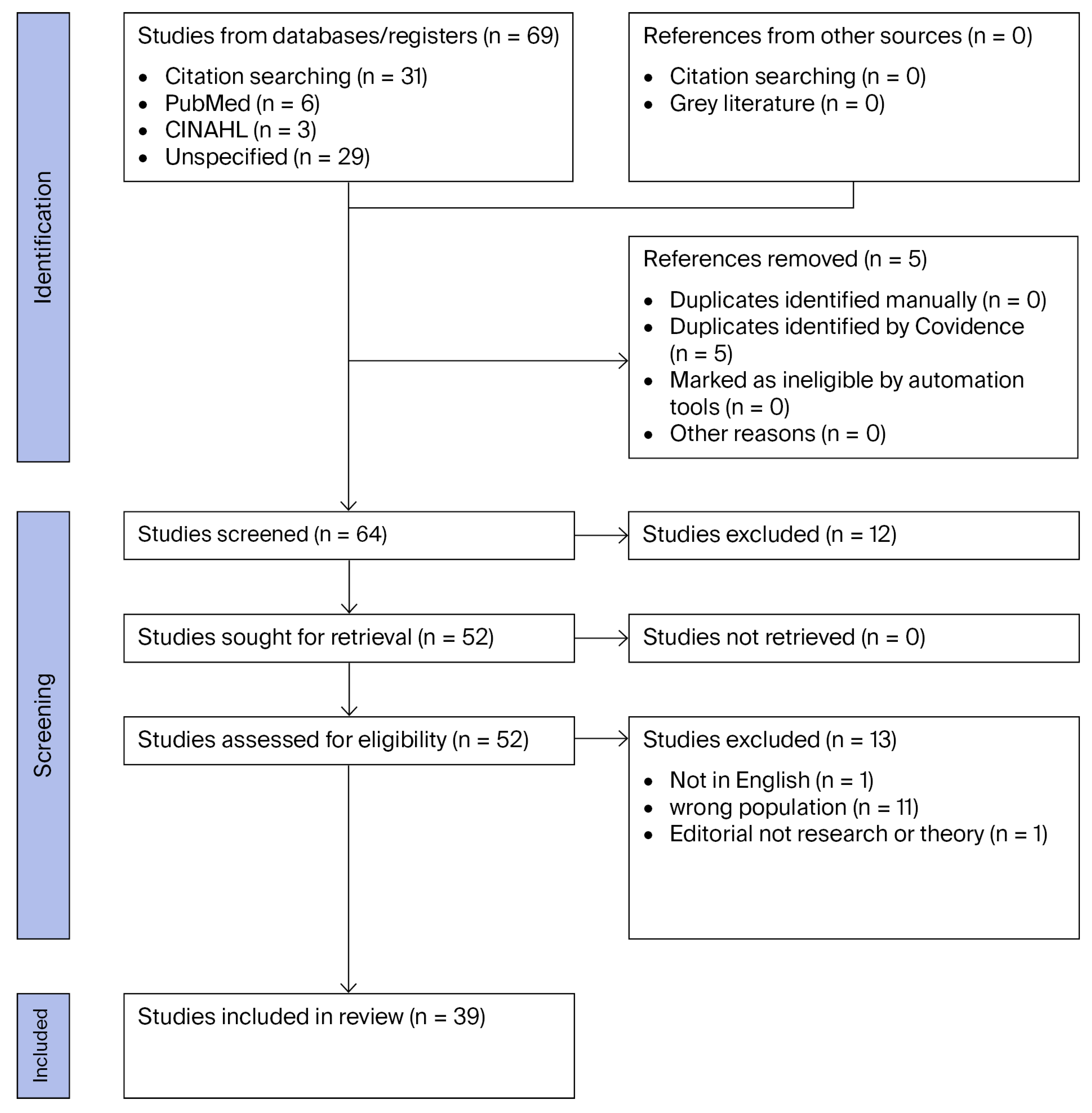
From the five databases, supplemented by Elicit and hand-searching, 69 citations were identified. After removing duplicates (n = 5), titles and abstracts (n = 64) were screened independently by two team members. A total of 64 articles were screened independently by two team members, of which 12 were excluded. A full text review of 52 articles was conducted: Thirteen were excluded (not being in English, n = 1; wrong population, n = 11; and editorial, n = 1. Thirty-nine articles met the established criteria (Figure 1). The research team supplemented the dataset with articles from Elicit and references found through handsearching articles.
Using Covidence, two research team members performed dual extraction, with one doing the primary extraction, and then consensus-based resolution for 39 articles. Elements reflect the methodological framework and include bibliographic data, region, population, spiritual tradition, study type, and planetary health outcomes or ethical implications. Each article was further assessed for relevance using the Planetary Health Education Framework [16] and the Public Health Crisis Conceptual Model [4]. To mitigate bias, the second extractor served as a critical colleague, challenging the thematic integration of the autoethnographic narrative. In line with scoping review convention, the process focused on mapping and synthesis rather than formal risk-of-bias appraisal.

2.6. Contemplative Autoethnography: Narrative Corpus and Analysis

The personal narrative was treated as a contemplative autoethnography [21]: a first-person, situated account analyzed as qualitative data rather than offered as a testimony. It documents the first author’s lived experience in disaster response, nursing/academic work, and Soto Zen training, and is presented as one perspective within a broader spiritual and professional context rather than a definitive Soto Zen position. The narrative was analyzed in Atlas.ti using a reflective thematic approach: (1) multiple close readings with a deeper focus each time to identify salient moments when encounters shifted responsibility, resulted in moral distress, or may have been perceived to have remote consequences on reflection; (2) line-by-line coding of experiential claims and any implied ethical logic; (3) memo writing to document analytic decisions; and (4) consolidation of codes into narrative themes. These themes were generated prior to formal integration with the scoping review findings to enable rigorous comparison. The second author’s role in the autoethnography was editorial rather than experiential, reviewing thematic summaries and serving as a dialogue partner during integration (Section 2.8) to strengthen transparency of interpretation.

2.7. Narrative Corpus Selection and Delimitation

The narrative corpus consisted of 20 documents (2008–2026), purposively sampled from a substantially larger digital archive of several thousand personal and professional records based on their thematic density at the intersection of Zen practice and professional nursing crisis. All documents are securely archived and backed up in a cloud-based repository (Dropbox), enabling systematic retrieval and auditability. To ensure analytical consistency, all blog posts meeting the inclusion criteria were exported and consolidated into a single document, treated as one of the 20 primary units of analysis. Selection followed a structured keyword-based screening process using the same core search terms as the scoping review (“nurse,” “environment,” “nuclear,” “Anthropocene,” “spiritual,” and “contemplative medicine”) to identify documents directly relevant to the study’s conceptual focus. Documents were included if they demonstrated substantive engagement with one or more of the following intersections: nursing and the environment, nuclear harm, the Anthropocene, contemplative medicine, and spiritual care; they were excluded if tangential to these intersections, unrelated to professional nursing identity, or jointly authored. Although the archive is large, most entries were unrelated to planetary health or contemplative nursing and were therefore excluded, and there were fewer formal journal entries because the public blog served as the primary vehicle for reflective writing during this period. The resulting corpus is purposively constructed rather than representative, consistent with qualitative autoethnographic methodology, with the aim of theoretical coherence and relevance to the research question and not statistical generalizability.
The corpus was categorically heterogeneous, including private journals, professional emails, training reflections, and public blog posts that differed in audience, tone, and degree of self-presentation. Rather than collapsing these distinctions, each document type was initially coded with attention to its communicative context and genre markers were retained during first-cycle coding in Atlas.ti. No systematic divergence in core thematic categories was identified; instead, themes such as advocacy and social responsibility, community impact, embodied practice, ethics, holistic understanding, interconnected ethics, narrative meaning-making, and reflective integration appeared across document types, though public blog posts more often emphasized advocacy and social responsibility, while private journals contained more direct expressions of moral distress and uncertainty, consistent with autoethnographic accounts of the writing I that was shaped by audience-shaped self-presentation [21]. To preserve analytic independence, the scoping review was completed and its themes locked before coding of the autoethnographic corpus began. The primary author utilized a raw data approach to the autoethnography, initially coding the journals and vignettes for lived experience and emotional friction rather than pre-existing theoretical categories, and only then compared patterns with the completed review. The second author then served as a methodological auditor, reviewing the autoethnographic codes to confirm that themes emerged from the narrative data rather than being retrofitted to the scoping review. The majority of coded segments clustered within the thematic domains listed above; a second analytic phase used axial coding to refine these domains into higher-order integrative mechanisms linking contemplative formation and professional action. This sequence allowed the scoping review to serve as a rigorous external landscape against which the narrative could be critically mapped, surfacing not only convergence but also practice insights absent from the published literature.

2.8. Integration of Autoethnography and Scoping Review

Integration was undertaken using a structured thematic synthesis and narrative weaving rather than an informal assertion of similarity. Following a preliminary synthesis of the scoping review and the reflexive coding of the autoethnographic narrative, findings were organized around shared thematic domains. To support transparency, the integrative synthesis retained an explicit traceability link between themes and the scoping review dataset; exemplar articles that most clearly operationalized relevant mechanisms (e.g., somatic regulation, ritual-based meaning-making, relational ethics/justice, integrative reflective practice) are categorized in Table 1. Coded narrative excerpts were aligned with extracted scoping-review elements, including the practices described, proposed mechanisms, outcomes, and explicit ethical or practice implications. Alignment was documented with analytic memos specifying whether the two sources showed convergence, complementarity, meaningful tension, or divergence. This mapping was then used to refine the themes so that each final theme was supported (or appropriately qualified) by both strands rather than resting on asserted similarity. Integration followed a four-step process:
  • Step 1: Sequential theme generation. Scoping review themes were finalized and locked first. The autoethnographic corpus was coded independently using a bottom-up, inductive approach to ensure narrative categories emerged from the lived experience rather than being the pre-existing scoping review framework.
  • Step 2: Comparative refinement. Themes were retained only when there was convergent support across strands or a clearly articulated tension in which one strand meaningfully qualified the other. This ensured each theme provided either a concrete narrative case or broader scholarly support.
  • Step 3: Search for disconfirming evidence. Narrative segments and reviewed articles that contradicted emerging themes were sought. The autoethnography functioned as an interpretive dataset to help clarify how and why ethical mechanisms become salient in professional life, while the scoping review situates these mechanisms within the mapped scholarly work. This was important to determine where Soto Zen-specific insights diverged from more general ecospiritual frameworks in an effort not to overemphasize the personal experience.
  • Step 4: Definition of final integrative themes. Final integrative themes, embodied practice, narrative meaning-making, interconnected ethics, and reflective integration, were defined only where the two datasets showed genuine convergence or meaningful tensions.
To ensure integrity within this sequential design, the second author served as a methodological auditor, reviewing raw narrative codes to verify that they originated in the autoethnographic data rather than being retrofitted to the scoping review. Generative artificial intelligence (GenAI) was used to provide basic demographic analysis (number of articles by type, country, etc.) of the articles that were extracted from Covidence. Atlas.ti sentiment analysis was used to supplement initial coding.
By using this approach, the study goes beyond identifying similarities to a systematic integration. This allows the personal narrative to specify how and why certain ethical mechanisms, such as the cultivation of radical compassion or attention to remote consequences, become salient in professional nursing and planetary health practice, while the scoping review provides the necessary epistemological breadth and scholarly context.

3. Autoethnographic Personal Narrative

Reader Note on Voice: This section distinguishes between the ‘Writing I’ (narrative data) and the ‘Analytical I’ (reflexive synthesis). Vignettes are presented as qualitative data excerpts followed by an analysis of the structural friction and non-linearity of professional formation.
The following representative sample of coded vignettes (Table 1) illustrates the four integrative themes: embodied practice, narrative meaning-making, interconnected ethics, and reflective integration. By linking lived experiences to planetary health, this narrative traces the movement from individual contemplative insight to systemic ethical action.

3.1. Embodied Practice: Somatic Resilience in Uncertainty

Embodied practice serves as an anchor when external systems fail or are unstable. In Soto Zen, breath and posture become sites of somatic regulation; in clinical and disaster settings, they steady attention so suffering can be met without being consumed. During one late-night sitting, the breath became the only anchor in a sea of uncertainty, a visceral reminder that the body is the ground for presence under moral stress (Box 1).
Box 1. Embodied Practice—Practicing with Mu: Embodied Attention in Uncertainty.
One night in practice, Mu (Mu is a traditional Zen koan representing nothingness or non-being) was there, and then not there. In its absence, the breath became the only anchor in a sea of shifting uncertainty. What had once been a koan became a somatic truth: stability arises not from grasping but from releasing. The body knew this before the mind did. That moment taught me that when external systems fail, during disasters, in clinical crises, or under planetary strain, the breath remains the most immediate refuge. It is the first site of ethical presence and the ground of all subsequent action.
Reflexive Analysis: This narrative excerpt illustrates the mediating link between contemplative somatic regulation and professional resilience under structural strain. By anchoring attention in the breath, the practitioner creates the internal stability necessary to maintain ethical presence amid the external instability of a planetary or clinical crisis, demonstrating that the link to planetary health is not a theoretical abstraction but a somatic negotiation with existential dread.
Analytical Transition (reflective link to structures and tensions): In coding this journal entry, I initially categorized it as private coping, a personal refuge from clinical stress. However, upon re-reading it against the scoping review’s findings on somatic regulation as in Cayir, 2022, and Somarathne, 2025 [22,23], I recognized that this moment was not merely personal but represented a structural tension between healthcare norms and contemplative practice. Healthcare culture rewards speed, productivity, and cognitive control, conditions that intensify moral distress when ecological and technological harms feel ungraspable. The refuge of breath here is not a private coping strategy; it is a disciplined counter-practice to the institutional demand to keep moving past uncertainty. This tension became a recurring theme across 8 of the 20 documents, particularly in entries written during times of high pressure. Notably, in coding the documents related to embodied practice, explicit references to nuclear harm were rare. This absence is analytically significant and consistent with the broader findings of this study, which show that nuclear harm remains under-articulated in both the narrative corpus and the literature. Unlike the immediate sensory demands of clinical or ecological crises, nuclear harm often operates as a diffuse, temporally extended phenomenon that resists direct narrative capture.
Within the vignettes, experiences of uncertainty, instability, and moral weight are clearly present, yet they are not consistently named in nuclear terms. Rather than indicating irrelevance, this pattern suggests a perceptual gap: contemplative practice appears to cultivate the capacity to remain present with forms of harm that are difficult to apprehend directly, including those that are spatially distant, temporally delayed, or conceptually abstract. In this sense, the relative silence of the corpus on nuclear harm reflects not its absence, but the challenge of rendering such harm experientially visible within everyday professional and contemplative life.

3.2. Narrative Meaning Making: From Observation to Authorship

Narrative transforms witnessing into responsibility, and in so doing, transforms passive observation of a crisis into active telling of a new planetary story. This analysis draws in part on the authors’ experiences in disaster response contexts (see vignette beginning Section 3.3 for a detailed account and further reflection in Section 3.5). The years of nursing practice and disaster response serve as a critical bridge and reveal a pattern: broken bodies in hospitals and clinics reflect broken systems in the environment. Recasting the climate and ecological crisis as a crisis of meaning enabled me to connect clinical particulars to structural causality, using rituals and writing to metabolize ecological grief into durable professional purpose.

3.3. Interconnected Ethics: Radical Relationality and Mutual Aid

Interconnected ethics moves beyond transactional care toward a shared vulnerability, exemplified by the fire brigade model of mutual aid, where the distinction between responder and victims dissolves (Hidayat, 2025) [24].
Vignette: The Sisters of Baton Rouge. This experience occurred during a federal disaster deployment to Louisiana in response to Hurricanes Gustav and Ike in 2008, where I led a human services response team. I encountered radical compassion as I watched local Sisters quietly give away food to those in need, even as they began dipping into their own limited supplies. The belief was simple: “If they cannot eat, why should we?” I experienced this as an embodied lesson; their act required no speech; it was enacted through a clear relational orientation and a willingness to go without. This ethic of being prioritizes the quality of presence over quantitative metrics of service and aligns with the review’s findings that social justice is not an add-on but a formative foundation of ecological well-being. This encounter serves as a lived enactment of interconnected ethics, where the link between spiritual vow and professional disaster response becomes a visible, relational reality. While the immediate crisis was a hurricane and flooding, the ethical logic of shared vulnerability witnessed in that moment is the same logic required to address nuclear harm. Just as the Sisters did not distinguish between their own hunger and that of the community, a planetary nursing ethic must recognize that radioactive waste cannot be placed outside the ecological systems that sustain life; harm occurring in the Marshall Islands or Fukushima remains part of the same planetary processes that affect us all.
Analytical Transition (structural conditions, contradictions): In coding this Baton Rouge vignette, I initially labeled it radical compassion and relational ethics. However, this encounter exposes the contradiction between “countable” service outputs (throughput, compliance) and non-quantifiable commitments to shared vulnerability. While disaster infrastructures require emotional containment and rigid roles (responder vs. victim), contemplative ethics pushes toward a permeability of witness.
This tension between the institutional logic of bounded responsibility and the contemplative ethic of unbounded care became a recurring source of professional dissonance across 6 of the 20 documents. The analytic point is not that faith-based compassion is better than professional disaster response, but that such moments reveal how institutional logics shape what forms of care become thinkable. Interconnected ethics is not a seamless integration but a negotiated stance that must be actively maintained against structural pressures that reward efficiency over presence.

3.4. Reflective Integration: The Radical Act of Pausing

Reflective integration is the process by which internal contemplative insights are translated into outward professional advocacy. Central to this integration is the radical act of pausing, a deliberate resistance against the accelerationist norms of modern healthcare that drive burnout and ecological degradation (Box 2).
Box 2. Reflective Integration—Eyes That See, Ears That Hear: The Ordination Moment.
My ordination as a Soto Zen priest did not arise from personal insight alone, nor solely from my teacher’s guidance. It arose from a moment of seeing, really seeing, the Sisters’ generosity in Baton Rouge. Their wordless compassion gave me “eyes that see and ears that hear,” an old biblical phrase for a shift in ethical perception. What began as government service became spiritual practice: a recognition that self and world, suffering and responsibility, are inseparable. Ordination was simply the formal acknowledgment of that shift. Bringing that realization back into nursing, teaching, and research allowed my professional life and spiritual life to become one continuous vow of care.
Reflexive Analysis: This moment of ordination serves as an analytical marker of reflexive identity integration. It demonstrates how a spiritual vow (the vow of care) functions as the structural bridge that aligns personal contemplative insight with systemic professional advocacy in nursing and planetary health. Crucially, this integration is not a linear arrival but a persistent negotiation with the institutional pressures of a high-output biomedical environment, where the vow acts as a counterweight to professional burnout and ethical erasure.
Analytical Transition (nonlinearity and resistance): Although the narrative arc can appear linear in retrospect from clinical nurse to planetary health advocate, the integration of contemplative practice into nursing contexts was uneven and at times contested. In coding the 20-document corpus, I tracked moments of institutional resistance and professional friction to test whether the transformation was as smooth as the ordination vignette might suggest. It was not.
Institutional norms often treat spirituality as private, optional, or outside the epistemic boundaries of clinical work, while environmental and nuclear harms are frequently framed as politically sensitive, distant, or irrelevant to immediate patient care. In a February 2020 blog post titled “Rending My Nursing Heart,” I described the tension in nursing education culture: “My question to my nursing friends is why does it happen so often? Why do students fear us? We should be the model of kindness and compassion to them, but instead, it sometimes feels more like we are the inquisitors.” The post identifies how institutional patterns, where hierarchy and control are valued over dialogue and vulnerability, directly contradict contemplative values of openness and compassion. This pattern of institutional resistance to contemplative presence appeared repeatedly in the corpus, coded as boundary policing or professional legitimacy challenges.

3.5. Causality, Compassion, and Planetary Responsibility

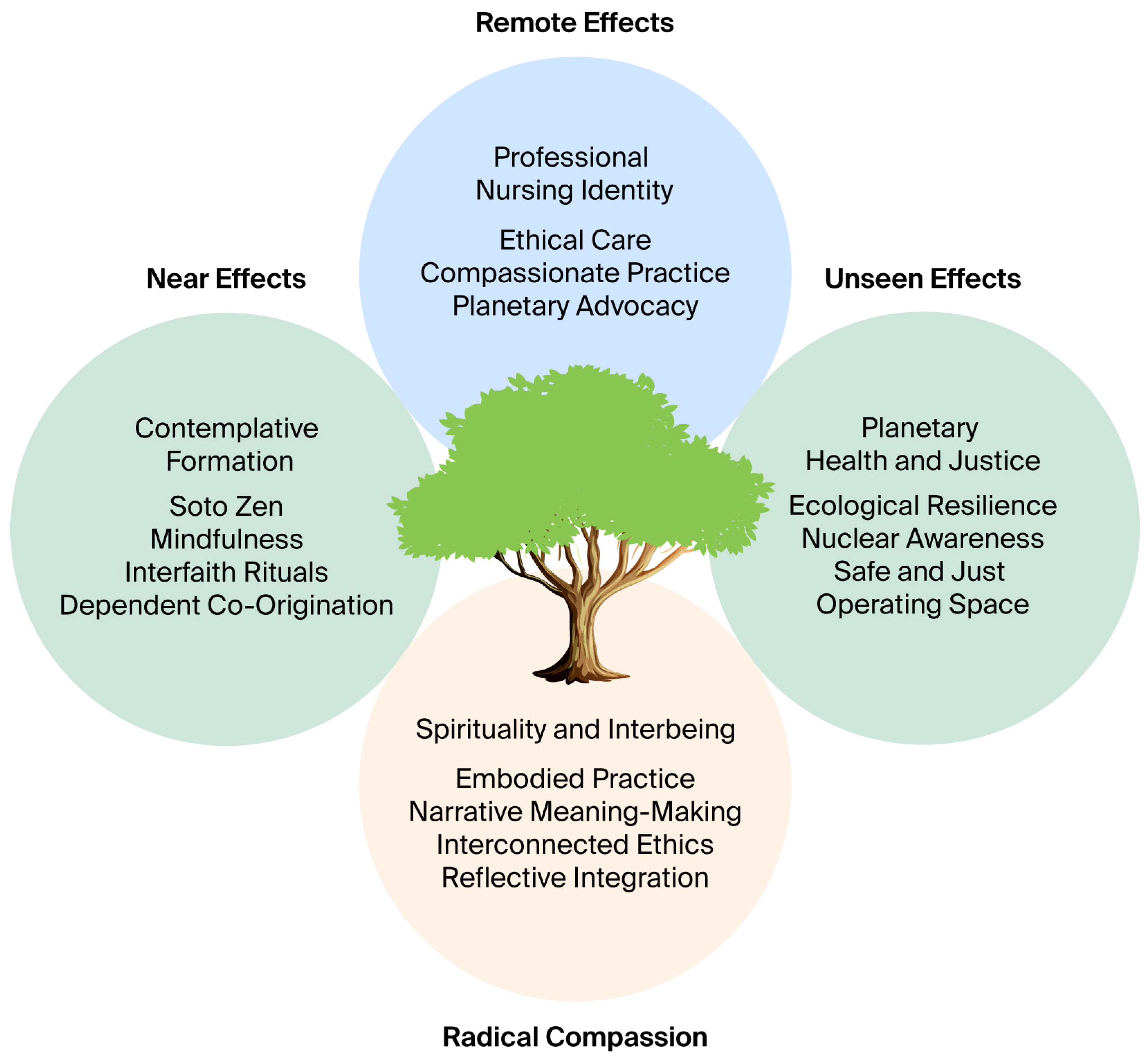
Analytically, the Soto Zen framework of causality proposed by Eihei Dōgen (1200–1253), categorizing effects as near, remote, or imperceptible [14], functions as a heuristic for systems thinking in planetary health. It provides a structured way for practitioners to internalize the long-tail consequences of nuclear waste or carbon emissions, which are often cognitively siloed due to their temporal distance. This framework may offer a way to reflect on how environmental and nuclear harms unfold over time. Dōgen urged practitioners to look for the distant consequences of action and to foster the compassion to act upon them [14]. The Buddha’s image of goodness accumulating drop by drop can likewise suggest that small acts of care may matter even when their effects are not immediately visible. Analytically, Dōgen’s three causal patterns provide a heuristic for thinking about lagged environmental/nuclear effects in planetary health.
Analytically, the silence of the early narrative corpus on nuclear harm reflects a broader professional “expertise gap” (Coded as Embodied Practice: Expertise Gap). In my early disaster work, clinical attention was often directed toward immediate, disaster-caused needs, while pre-existing, long-tail complexities remained invisible until subject matter experts were integrated into the team. This mirrors a persistent state in nursing: nurses are trained for the near clinical crisis but often lack the perceptual capacity to apprehend the remote nuclear legacy. However, as seen in the identification of an entire community’s needs through the care of a single patient, the contemplative act of Bearing Witness functions as the specific mechanism that renders the unidentified visible. It transforms what is initially perceived as a distant technological hazard into a proximate ethical responsibility.
In my own practice, Dōgen’s framework further transformed nuclear harm from a distant abstraction into this kind of proximate concern. By meditating on remote effects, the radioactive isotopes leaching into Pacific waters or the legacy of Downwinders ceased to be technical data points and became part of my interbeing responsibility. This shift in perception, moving from the near clinical task to the remote planetary consequence, is the specific mechanism by which contemplative formation mediates engagement with nuclear harm. By destabilizing the boundary between the immediate and the distant, contemplative practice ensures that ethical visibility is extended to the most dispersed and normalized harms of the Anthropocene.

3.6. Negotiating Legitimacy: Friction, Constraints, and Boundary Conditions

Thematic coding of the narrative corpus revealed recurring segments marked by tension, hesitation, and boundary negotiation, which were consolidated under the category of negotiating legitimacy. Navigating high-pressure clinical environments required managing professional norms that prioritize immediate tasks, measurable outcomes, and rapid productivity over the ethical deliberation. Sustaining this work relied on external scaffolding, including the formal legitimacy of the Contemplative Medicine Fellowship and reflective writing to process the cognitive dissonance between planetary reality and institutional silence. This clarifies that the Interbeing framework is not merely a personal coping strategy, but a professional stance that must be actively maintained against significant structural and emotional pressures.

4. Results: Scoping Review

Table 2 provides an overview of the elements of the 39 articles that are included in this scoping review completed in September 2025, and are consistent with the intent of the paper and identify the relevance of each to planetary health. The articles are international in nature representing Asia (n = 12), Africa (n = 4), North America (n = 10), Europe (n = 8), Oceania: (n = 1), and multi-regional/global (n = 4). Populations included a wide range of participants including religious and spiritual practitioners (Vipassana meditators, Buddhist monastics, interfaith volunteers, clergy, and ecospiritual practitioners), community groups (Indigenous and rural communities of Amah Mutsan, Tarali Magar, and Pokot, environmental activists, and local faith groups), and other studies that were secondary data analyses, literature reviews or theoretical in nature. The studies also represented a broad range of spiritual traditions that accounted for approximately 45% of the articles and included Buddhist (n = 2), Islamic (n = 1), Catholic/Christian (n = 1), Indigenous/traditional spiritualities (n = 3), Ecospiritual/interfaith (n = 6), general religious/spiritual (n = 4), and Confucian or East Asian philosophical (n = 1). There was a strong trend of ecospiritual and interreligious collaboration rather than focus on a single religion or spirituality.
Each of these practice traditions foster environmental and nuclear awareness. Embodied practice is represented by long-term Vipassana meditators who describe direct bodily awareness as a foundation to recognizing through engagement of the senses, which leads to perception of the fragility of the natural systems [23]. Likewise, the interfaith fire brigades in Indonesia demonstrated how mindful action and service to the community can be forms of prayer proclaimed through the body [25]. Narrative meaning-making is reflected in ritual storytelling and personal lived religious experience as a means for transforming ecological grief and ancestral memory into moral purpose [25,26]. The similarity between Indigenous and Buddhist worldviews and the understanding that human suffering and environmental degradation arise from the same relational conflicts clearly illustrates an interconnected ethic, acknowledging that all beings, actions, and conditions are mutually influential and interdependent [26,27]. The potential for a breakthrough through reflective integration was seen in studies where contemplative and faith-based education promoted participants to develop mindful awareness with ecological and social responsibility [28,29]. Taken together, these studies demonstrate a growing body of work at the intersection of spirituality and environment and health concerns, but they rarely address nuclear threats as a planetary health hazard, rarely integrate nursing perspectives, and offer few narrative accounts of bearing witness. This reinforces the need for the present paper, which combines a personal narrative with an interfaith, nursing-informed conceptual framework for interbeing and planetary health.
Table 2. Summary of articles evaluated in Covidence.
Thematic CategoryLead Author/YearApproachPlanetary Health Relevance
Embodied PracticeBarrett, 2016 [12]Mindful Climate Action (MCA) program: 8-week course blending MBSR with climate/energy education, 2.5 h weekly + retreatDirectly contributes to behavior change outcomes within sustainable behaviors, aligning with interconnection and systems-thinking competencies.
Embodied PracticeCayir, 2022 [22]The Pause (brief contemplative practice)Improves responder readiness and well-being via contemplative practices, aligned with PHEF’s mental health and self-care objectives.
Embodied PracticeGoralnik, 2020 [29]5-min pause integrated into sustainability teachingModels the integration of contemplative pedagogy with sustainability goals, enhancing individual and community capacity for climate response.
Embodied PracticeLee, 2015 [30]Recycling practices, Buddhist environmental ethicsDemonstrates community-based religious models that integrate sustainable action, reinforcing health-sustainability-spirituality links.
Embodied PracticeRiordan, 2022 [31]8-week MBSR; structurally matched active control; waitlistSupports empirical study of meditation’s impact on pro-environmental behavior, mapping behavior change pathways.
Embodied PracticeSchmid, 2020 [32]Mind–body practices (meditation, yoga, reflection) within activismLinks contemplative practice with activism, promoting shared purpose, equity, and systems response to ecological injustice.
Embodied PracticeSomarathne, 2025 [23]Vipassana meditation (natural practice, not experimental interventionQuantifies links between long-term meditation, ecological behavior, and well-being, demonstrating intervention impact across scales.
Embodied Practicevan Vugt, 2019 [33]Analytical meditation and monastic debate trainingEnhances cognitive tools for critical thinking and ethical reasoning, essential for informed planetary health leadership.
Embodied PracticeWamsler, 2017 [10]Learning lab on mindfulness integrated into courseworkDemonstrates how contemplative education nurtures sustainability mindsets and emotional intelligence.
Narrative Meaning-MakingBendell, 2021 [34]Deep Relating and facilitation practices (containment, uncertainty, emotions, othering)Addresses emotional and ethical preparedness as a form of anticipatory guidance for societal disruption linked to resilience and systems response.
Narrative Meaning-MakingBryant, 2024 [35]No experimental intervention (study focused on narrative documentation and reflection of real-world coping strategies and caregiving experiencesHighlights ethical and relational leadership in crisis response, modeling interprofessional collaboration and emotional resilience in disaster care.
Narrative Meaning-MakingMaddrell, 2022 [36]Prayer walks, Celtic Christian spiritualityUses embodied spirituality to navigate grief and activate ecological action, connecting inner transformation to collective ethics.
Narrative Meaning-MakingMölkänen, 2025 [26]Not applicableReveals lived religion as a mediator of ecological ethics and conservation, supporting cultural and contextual responsiveness.
Narrative Meaning-MakingPike, 2024 [25]Rituals (funerals for extinct species, ceremonial fire, Red Rebel Brigade)Activates care and identity through ritual-based ecological mourning, reinforcing place-based, relational ethics.
Narrative Meaning-MakingTarusarira, 2022 [27]Not experimental; analysis of religious sensemaking practicesExplores how sacred framing and religious sensemaking mediate climate-induced conflicts, supporting peacebuilding and community resilience under environmental stressors, key to planetary health’s focus on equity and systems response.
Narrative Meaning-MakingYamaguchi, 2024 [37]Kokoro no kea teams; informal social activities; spiritual/
religious support
Highlights culturally grounded spiritual support structures post-disaster in Japan, strengthening psychosocial recovery and community resilience, which are core to planetary health’s emphasis on mental health, equity, and disaster preparedness in the Anthropocene.
Interconnected EthicsBillet, 2025 [38]Narrative reviewBridges spirituality and planetary stewardship, aligning with the values underpinning interconnection, equity, and health for all.
Interconnected EthicsBudha, 2025 [39]Not experimental; ethnographic documentation of rituals, weather forecasting, and farming practicesReflects Indigenous knowledge systems and their application in climate adaptation, contributing to transdisciplinary education and community resilience.
Interconnected EthicsChavan, 2024 [40]To examine the determinants of pro-environmental religious practices in the context of Ganesh idol immersionExplores how religious ritual can intersects with environmental behavior, highlights tensions between spiritual belief and pro-environmental action, informing values-based approaches to ecological stewardship within the planetary health framework.
Interconnected EthicsHidayat, 2025 [24]Faith-based fire prevention practices (wasathiyah and zhong yong principles)Demonstrates faith-based fire mitigation initiatives as examples of community-centered climate action aligned with local values and adaptive capacity.
Interconnected EthicsIves, 2025 [41]Religious–civic partnership model for climate actionEstablishes a civic-religious governance model for climate mitigation that supports policy transformation and systems thinking.
Interconnected EthicsJohnson, 2022 [42]Recognition and healing frameworks in planetary justiceIntroduces Indigenous healing and justice frameworks that advance multispecies justice and collective recovery strategies.
Interconnected EthicsLuetz, 2024 [43]Not experimental; conceptual review of Indigenous ecotheologyAdvocates for spiritual and Indigenous worldviews in biodiversity and sustainability policy.
Interconnected EthicsMarkus, 2018 [44]Discussion of climate engineering proposalsProvides ethical analysis for planetary-scale technological interventions, aligning with environmental justice.
Interconnected EthicsMatthews, 2023 [45]Caring for Country practices, cultural revitalizationCenters Indigenous epistemologies in planetary health.
Interconnected EthicsMohidem, 2023 [46]Islamic principles: unity, balance, responsibilityProposes a religious ethics-based sustainability model consistent with integrated health and environmental justice.
Interconnected EthicsMpofu, 2021 [47]Faith-based mission framing (healing, reconciliation, restoration)Advances spiritual models for healing ecological and social rupture—aligned with care ethics and community resilience.
Interconnected EthicsTaylor, 2016 [48]Literature review of evidence to determine if world religions are becoming more environmentally friendlySurveys world religions’ ecological positioning, illuminating barriers and opportunities for values-based environmental action.
Interconnected EthicsZielke, 2023 [49]Meditation, politics of care, eco-activist practicesTranslates Buddhist contemplative frameworks into collective action, advancing ecospiritual care and civic ecology.
Reflective IntegrationBarbir, 2025 [13]Literature reviewSupports cross-cutting competencies such as systems thinking and values-based leadership through mindfulness-based sustainability education.
Reflective IntegrationBock, 2024 [50]Ecospiritual praxis (conceptual cycle)Operationalizes behavior change models integrating spirituality and environmental action, reinforcing Planetary Health competencies in sustainability science.
Reflective Integrationde Diego-Cordero, 2024 [11]Systematic reviewSynthesizes evidence connecting ecospirituality to health, addressing the biopsychosocial-spiritual model central to planetary health education.
Reflective IntegrationFry, 2021 [51]Develops a new conceptual framework integrating spiritual leadership principles, ethical principles for sustainability and a global mindset for fostering purpose.Develops leadership frameworks aligned with ethics, collective action, and planetary responsibility, per the PHEF leadership competency.
Reflective IntegrationJadgal et al., 2024 [17]Questionnaires: demographic, environmental knowledge/attitude/behavior, environmental ethics, spiritual healthLinks nursing education with ethics, environmental behavior, and spiritual development, reinforcing cross-scale planetary competencies.
Reflective IntegrationMayer, 2019 [52]Interdisciplinary analysis of Catholic environmental teachingBuilds interdisciplinary understanding of ecological crisis across theology, health, and social behavior, core to transformative education.
Reflective IntegrationOughton, 2016 [8]Evacuation/remediation policiesChallenges disaster response ethics post-Fukushima, revealing how evacuation policies prioritized technical over psychosocial health; supports reflective capacity and health equity, aligning with planetary health’s concern for intergenerational and community well-being.
Reflective IntegrationPandya, 2021 [28]Not experimental; catalogues spiritually sensitive
models/techniques
Informs spiritually sensitive, trauma-informed models for displaced populations within environmental migration.
Reflective IntegrationShahida, 2024 [53]Not experimental; documents household-level rituals/valuesDemonstrates the role of spiritual traditions in shaping ethical reasoning for environmental education and values transformation.
Reflective IntegrationStahl, 2024 [54]Eco-ministry certification program with spiritual and
environmental practices
Equips spiritual leaders with eco-ethical competencies, integrating ecological grief, leadership, and planetary health praxis.
Note: Full data extraction tables are available as Supplemental Table S2.

5. Discussion

This manuscript brings two distinct forms of inquiry into a structured dialogue: a contemplative autoethnographic narrative and a scoping review of the literature (2015–2025) on spirituality/contemplative practice in relation to environmental harm, the Anthropocene, and nuclear harm. The goal is not to claim that the narrative proves the literature or that the literature validates the first-person experience. Rather, using an epistemologically plural stance, the narrative is treated as situated interpretive material that can illustrate how ethical mechanisms become visible in professional life, while the scoping review maps how similar mechanisms are described across contexts, traditions, and disciplines. The value of the convergent design is thus analytic: it clarifies where themes align, where they diverge, and where boundary conditions and gaps remain, especially regarding nuclear harm and nursing within planetary health scholarship.
To strengthen traceability and address auditability, the thematic claims in Section 5.1, Section 5.2, Section 5.3 and Section 5.4 are explicitly anchored to exemplar studies from the scoping review (cited by author/year and catalogued in Table 2). Because the included evidence base is heterogeneous, spanning qualitative ethnography, cross-sectional survey work, controlled trials, and conceptual frameworks, these exemplars are provided to show how each integrative theme is supported (or qualified) across contexts and study types rather than implied by the narrative alone.
Across the included literature, spirituality and contemplative practice are most often framed not as private consolation but as a set of practices and moral orientations that can shape resilience, meaning-making, relational ethics, and integrative leadership. The present synthesis suggests that these pathways overlap with recognized planetary health competencies such as systems thinking, equity, resilience, and intergenerational responsibility. It also reveals that nuclear harm remains under-integrated in the planetary health discussion, despite its uniquely catastrophic and long-term consequences.

5.1. Thematic Integration Across Data Sources—Convergence

The thematic analysis [55] (Braun & Clarke, 2019) identified four key themes that bridge the gap between contemplative practice and planetary health nursing. These themes represent a synthesis where the autoethnographic data provides a lived-experience test for the theoretical frameworks found in the scoping review. By referencing the exemplar articles in Table 2 alongside the narrative excerpts, we provide an audit trail that demonstrates how contemplative formation functions as a mediating mechanism for professional ethical integration.
Embodied practice emerged as a recurring pathway through which awareness and ethical responsiveness were understood to develop, not solely from cognitive insight, but through disciplined somatic practices that cultivate attention, presence, and tolerance of distress. The scoping review similarly includes accounts in which contemplative or spiritual practices shape perception and motivate action through somatic, habitual, and relational channels rather than purely informational ones, such as meditation and service as embodied devotion. Convergence here is both methodological and conceptual: both sources describe embodied practice as a mechanism that can reorganize attention and reduce avoidance in the face of ecological and existential threats. As shown in Table 2, the scoping review provides the structural evidence for these mechanisms (e.g., Somarathne, 2025; Cayir, 2022) [22,23], which the autoethnography then populates with lived, professional experience, creating a transparent audit trail between scholarly evidence and clinical practice.
In the scoping review, embodied practice appears in both clinical and community forms, including brief contemplative pause interventions in healthcare that improve physiological stress markers [22], contemplative pedagogy embedded in sustainability education [29,31], and associations between long-term meditation practice and lifestyle/carbon-footprint domains [23]. These exemplars illustrate how somatic attentional training is operationalized across study types as a pathway to steadiness and sustained engagement.
Narrative meaning-making describes how stories and rituals transform diffuse crisis into actionable responsibility. The scoping review substantiates this as a stabilizing mechanism; for example, Pike (2024) [25] describes ritualized responses to ecological loss, while Maddrell (2022) [37] reports on prayer-walk practices that bridge grief and environmental action. These scholarly findings converge with the autoethnographic account of the “Sisters in Baton Rouge” (Section 3.3), where a situated narrative of radical generosity transformed a disaster encounter into a durable professional vow. The scoping review includes parallel accounts in which rituals, storytelling, and lived religious experience transform grief, fear, and uncertainty into durable moral purpose. Convergence is evident in the shared function of narrative processes: they stabilize commitment, translate diffuse crisis into actional responsibility, and support continuity of care and advocacy under chronic stress. Across the reviewed literature, narrative and ritual processes are described as transforming ecological grief and uncertainty into moral purpose, including ritualized responses to ecological loss [26], facilitated collapse-aware dialogue practices that build emotional and ethical preparedness for disruption [34], and pilgrimage/prayer-walk practices reported as bridging enchantment, grief, and environmental action [36]. Together, these studies substantiate narrative meaning-making as a stabilizing mechanism rather than an ancillary add-on.
Interconnected ethics reflects a shared structure where harms appearing “remote” are reframed as ethically proximate. This aligns with the scoping review’s findings on relational responsibility across traditions, such as Matthews (2023) [45] on Indigenous prescriptions for planetary health and Hidayat (2025) [24] on interfaith mutual-aid models. These external studies support the autoethnographic claim that Soto Zen teachings on causality (Section 3.5) can scale from individual presence to planetary-scale hazards like nuclear harm, reframing them as proximate moral concerns. In the narrative, the ethical problem is framed as a relational one: harms that appear distant such as climate disruption, radioactive waste, and nuclear escalation are treated as ethically proximate through teachings on interdependence and remote consequences. Across the literature, analogous relational ethics appear through different metaphysical languages: Indigenous responsibilities to the land and kin, religious environmental stewardship, interfaith mutual aid, and justice-centered ecospiritual frameworks. Importantly, convergence here does not require agreement on doctrine; it appears at the level of ethical structure, harm and responsibility are understood as distributed across relationships, systems, and time. This aligns closely with planetary health’s emphasis on equity and the distribution of vulnerability across populations and geographies. Exemplars in Table 2 include Indigenous prescriptions for planetary health that foreground justice, culture, and relationships [45] and planetary justice/healing frameworks [42], as well as interfaith mutual-aid/fire-mitigation models that operationalize relational responsibility at community scale [24]. These studies support the claim that interconnected ethics can be expressed through multiple metaphysical languages while converging on a shared ethical structure of distributed harm and responsibility.
Reflective integration is the practice of weaving scientific, professional, and spiritual commitments. Within the reviewed literature, this is described through leadership models that connect inner formation to outward civic capacities (Fry, 2021) [51] and conceptual frameworks linking mindfulness to sustainability outcomes (Barbir, 2025) [13]. These exemplars show that the radical act of pausing described in the autoethnography (Section 3.4) is not a private disposition but a teachable professional skill that negotiates plural sources of knowledge to sustain advocacy. In the narrative illustration, reflective integration involves translating contemplative insights into professional advocacy and ethical action while remaining attentive to limits and uncertainties. The scoping review includes parallel approaches in education, leadership development and community-based practices that attempt to integrate contemplative practices with ecological literacy, leadership, and ethical action. Convergence here supports the claim that integration can be treated as an analyzable practice: a reflective skill that negotiates plural sources of knowledge and translates them into sustained professional and civic responsibility. For nursing and allied health professions, reflective integration may offer one pathway for bridging clinical ethics with planetary-scale responsibilities.

5.2. Gaps, Boundaries, and Analytical Contributions

The integration of these two data sources highlights clear boundary conditions and critical gaps in the current evidence base. First, as a single contemplative autoethnography, the narrative is a situated case example rather than a definitive account of Soto Zen or spirituality at large. Second, as shown in Table 2, while the literature robustly addresses climate disruption and ecological grief, explicit framing of nuclear harm as a planetary health hazard remains uncommon, with nursing-specific empirical perspectives (e.g., Jadgal et al., 2024; Oughton, 2016 [8,17]) being particularly sparse. These gaps delimit the existing scholarship and justify this manuscript’s specific emphasis on nuclear harm as a boundary case and nursing identity as a site where bearing witness must become ethically actionable.
Crucially, the autoethnographic strand does not merely illustrate the scoping review themes; it specifies their operational contours. While the reviewed literature describes embodied practice, relational ethics, and reflective integration in general terms, the narrative data reveals how these mechanisms are negotiated under professional constraint, including moments of friction, perceived illegitimacy, and institutional silence. In this way, the narrative functions analytically to refine and sometimes complicate the review-derived categories. The relative absence of explicit nuclear references in the autoethnographic vignettes (Section 3) compared to the Introduction and Discussion highlights a central challenge of the Anthropocene: the difficulty of narrating harms that are temporally and spatially diffuse. However, as the analysis shows, the capacities cultivated in those vignettes (somatic resilience, radical relationality, and the act of pausing) are the very tools required to engage with the nuclear boundary case. The silence of the corpus on nuclear issues is thus not a lack of relevance, but a reflection of the perceptual gap that contemplative formation is uniquely positioned to bridge. By naming these tensions, the analysis demonstrates that the link between contemplative formation and planetary action is not a linear achievement but a non-linear process of negotiation, as further detailed in the Negotiating Legitimacy findings (Section 3.6).

5.3. Contemplative Practices as a Health Relevant Ethical Resource

The included literature suggests that contemplative and spiritual practices are often associated with outcomes and capacities relevant to health professions: stress regulation, fostering resilience, empathy, and ecological consciousness, which can bridge inner transformation with outer responsibility [9,30]. Programs such as Mindful Climate Action [12] describe mindfulness-based behavioral training as a route to health co-benefits and reduced carbon footprints, while brief contemplative pause interventions in healthcare settings have shown improvements in physiological stress markers among providers [22]. Within healthcare contexts, practices such as mindful pausing, reflective inquiry, prayer, ritual, and values-based formation are described as supporting clinicians’ ability to remain present with suffering and to act with ethical clarity under pressure. In the context of planetary harm, this matters because the stressors are chronic, complex, and frequently experienced as overwhelming or beyond individual control.
For nursing, these practices may be particularly relevant because the profession sits at the interface of bodily suffering, moral distress, and systems-level constraints. Nurses and healthcare professionals, guided by these frameworks, can embody a care ethic that extends beyond the individual to the community and ripple out beyond sight, resisting the fragmentation that fuels environmental and nuclear harm. The scoping review and the narrative illustration together suggest that contemplative practice can be understood as more than self-care: it may support ethical steadiness, reduce avoidance, and sustain engagement with environmental injustice and technological hazards. However, the evidence remains heterogeneous, and mechanisms and outcomes vary across traditions, populations, and interventions. This reinforces the need for careful language: contemplative practices are described as supportive resources and may function as enabling conditions for ethical action, rather than as universally effective solutions.

5.4. Implications for Planetary Health Scholarship: Centering Nuclear Harm and Nursing

A central contribution of this paper is to name nuclear weapons, testing, and radioactive contamination as a planetary health concern that is often treated as adjacent to, rather than integrated with, planetary health frameworks. Nuclear harm differs from many environmental hazards in its potential for abrupt, massive mortality and long-term contamination with profound intergenerational and multispecies consequences. Yet the scoping review indicates that explicit nuclear framing is uncommon within spirituality and planetary health scholarship, and where nuclear issues are addressed, they are often siloed within security, public health, or disaster ethics rather than planetary health.
The relative absence of nursing perspectives exacerbates this gap. Nursing brings critical expertise in community resilience, disaster response, public health practice, and relational ethics of care, which are capacities central to planetary health. Future work could strengthen the field by; (a) explicitly integrating nuclear risk into planetary health curricula and ethics frameworks, and (b) examining how spiritual and contemplative practices influence clinicians’ and communities’ engagement with high consequence technological hazards; and (c) developing nursing led, interprofessional models that connect spiritual care, environmental justice, and preparedness.

5.5. Conceptual Synthesis: A Proposed Integrative Framework

Across the four convergent themes, spirituality is positioned as a potential catalyst for planetary health engagement. Specifically, contemplative formation may support the transformation of reactive states, such as denial or ecological grief, into sustained forms of compassionate responsibility. Grounded in dependent origination (Paticca-Samuppada), we propose the Interbeing Planetary Health Framework as a conceptual synthesis derived from the scoping review and tested against the autoethnographic narrative (Figure 2). The principle of dependent origination suggests that “all phenomena are dependently originated, thus, related and relative” [56] (p. iv). The concept of Interbeing was introduced by Thich Nhat Hanh, initially in reference to the Order of Interbeing founded in 1966, to describe the essential interconnectedness of all phenomena [57]. The Interbeing Planetary Health Framework adopts Nhat Hanh’s core insight that no phenomenon exists in isolation and operationalizes it as a professional mandate for nursing. By recognizing that the health of the individual is inseparable from the health of the Earth’s systems, the framework transforms Interbeing from a contemplative realization into a pragmatic substrate for planetary advocacy. Building on this understanding, we propose the Interbeing Planetary Health Framework. The framework suggests that spiritual insights into greed, ignorance, and delusion parallel the structural drivers of planetary health loss identified by the Lancet Commission [1,2]. By naming these poisons as both personal and collective, spiritual traditions illuminate the psychological and moral economies that sustain extractivism and ecological indifference.
The framework organizes these contributions into four functional dimensions:
  • Embodied practice grounds ecological awareness in direct somatic experience, potentially reducing the psychological distress associated with witnessing planetary harm.
  • Narrative meaning-making metabolizes ecological grief through reflection, ritual, and storytelling into durable moral purpose and long-term engagement.
  • Interconnected ethics reframes environmental and nuclear risks as relational, multispecies responsibilities rather than technical externalities.
  • Reflective integration weaves scientific evidence with spiritual wisdom, enabling nurses and faith communities to co-create contextually grounded responses to crisis.
A critical contribution of this framework is the explicit inclusion of nuclear harm as a planetary health priority. While climate change dominates current discourse, the scoping review and narrative data suggest that spiritual frameworks can expose nuclear denial as a form of delusion and cultivate the existential stamina required to face catastrophic risk without paralysis. While the model is articulated through Soto Zen concepts, the scoping review demonstrates that analogous commitments, such as care for our common home in Catholic social teaching, Indigenous responsibilities to kin, and Islamic principles of balance, function similarly as catalysts for planetary health [41,45,46,52]. These traditions can mobilize moral clarity against existential risks [45,50], reframing disarmament and non-proliferation as expressions of “vows to protect life” rather than purely strategic calculations.
This transition from fear to vow necessitates moving beyond ritual into concrete advocacy. This includes: (1) policy engagement where faith-based organizations support treaties that restrict nuclear testing and reduce emissions; (2) amending professional codes of ethics to explicitly name planetary health and nuclear harm as dimensions of beneficence; and (3) building interfaith coalitions that translate contemplative values into local civic action. In this context, responsibility is an expression of interbeing, the realization that the welfare of all beings arises through the health of planetary systems. Spiritual integrity thus serves as a driving force for cultural transformation, encouraging collaboration between healthcare and faith communities to prevent harm and encourage reverence for life [39,44].
Finally, framing spirituality as a stimulus for planetary health has practical implications. For nursing education, it suggests integrating contemplative practices and interfaith literacy as core competencies. For healthcare institutions, it invites collaboration with spiritual care leaders to address environmental and nuclear harms as public health concerns rather than limiting spiritual care to individual consolation. Ultimately, the Interbeing Planetary Health Framework suggests that spirituality operates not as a private consolation, but as a generative force for planetary responsibility, linking personal transformation with ecological resilience and collective well-being.

6. Limitations

This paper has several limitations inherent to its dual method design.
  • The scoping review focuses on the peer-reviewed literature from the last decade rather than an exhaustive systematic search of all theological or philosophical texts.
  • Consistent with the scoping review methodology, no formal quality appraisal of included studies was performed, as the goal was conceptual mapping rather than measuring intervention strength.
  • The autoethnographic contemplative narrative is a situated, first-person account from a specific Soto Zen and nursing perspective and is not intended to be generalizable or represent the vast diversity of spiritual traditions or professional nursing experiences.
  • The thematic synthesis is an interpretive process; while the coding and comparison steps are transparent, the resulting model is a conceptual contribution rather than a definitive or final model of spiritual–planetary interaction.

7. Conclusions: A Path Forward

The findings of this integrative study indicate that contemplative formation, particularly its capacity to reshape practitioners’ ethical perception of remote and temporally diffuse harms, may function as a mediating mechanism linking spiritual practice with professional planetary health engagement. Within nursing, this manifests as a stable ethical orientation that frames the discipline as inherently planetary in scope, bridging contemplative insight with systemic forms of advocacy. This dynamic is especially evident in the boundary case of nuclear harm, where the Soto Zen heuristic of near, remote, and imperceptible causality supports the internalization of long-tail environmental effects as proximate ethical responsibilities.
By foregrounding the Interbeing Planetary Health Framework, the analysis demonstrates that spiritual formation can be understood not as an adjunct to professional practice but as a substrate for ethical integration. The narrative data show that even in institutional contexts where existential threats remain unaddressed, reflective processes within the practitioner enable the alignment of contemplative insights with planetary health commitments.
Taken together, these findings suggest that climate disruption and nuclear risk are not solely technical challenges but pressures that expose and extend the epistemic and ethical boundaries of nursing. Responding to these planetary crises requires a professional identity attuned to interconnected systems of harm and responsibility, an identity supported, in part, by the perceptual and ethical capacities cultivated through contemplative practice.

Supplementary Materials

The following supporting information can be downloaded at: https://www.mdpi.com/article/10.3390/challe17020012/s1, Table S1: Buddhist Precepts Taken in Soto Zen Ordination; Table S2: Articles evaluated in Covidence.

Author Contributions

R.D.R.L. conceptualization, methods, article review, personal narrative, and writing. B.K. data collection, article review. All authors have read and agreed to the published version of the manuscript.

Funding

This research received no external funding.

Institutional Review Board Statement

Not applicable.

Informed Consent Statement

Not applicable.

Data Availability Statement

Acknowledgments

Osama Rosan Yoshida is my Soto Zen teacher and has guided my study and understanding of Soto Zen and is an advocate for a global ethic. The New York Zen Center for Contemplative Care guided my study of Contemplative Medicine. During the preparation of this manuscript, the author used Elicit to search the relevant literature as a support to PubMed, PsycINFO, and CINAHL. Grammarly and ChatGPT 5.4 were used to check grammar and readability, specifically to reduce technical jargon, biased language, identify redundancy, and improve readability. The author has reviewed and edited the output and takes full responsibility for the content of this publication. Atlas.ti was used to code personal narratives, and sentiment analysis was used to classify data as positive, negative, or neutral.

Conflicts of Interest

The authors declare no conflicts of interest.

References

  1. Whitmee, S.; Haines, A.; Beyrer, C.; Boltz, F.; Capon, A.G.; de Souza Dias, B.F.; Ezeh, A.; Frumkin, H.; Gong, P.; Head, P.; et al. Safeguarding Human Health in the Anthropocene Epoch: Report of The Rockefeller Foundation–Lancet Commission on Planetary Health. Lancet 2015, 386, 1973–2028. [Google Scholar] [CrossRef]
  2. Myers, S.S. Planetary Health: Protecting Human Health on a Rapidly Changing Planet. Lancet 2017, 390, 2860–2868. [Google Scholar] [CrossRef]
  3. Møller, A.P.; Mousseau, T.A. Are Organisms Adapting to Ionizing Radiation at Chernobyl? Trends Ecol. Evol. 2016, 31, 281–289. [Google Scholar] [CrossRef] [PubMed]
  4. Couig, M.P.; Lavin, R.; Rogers, H.H.; Nugent, S.B. The Public Health Crisis Conceptual Model: Historical Application to the World’s First Nuclear Bomb Test. Soc. Sci. 2024, 13, 186. [Google Scholar] [CrossRef] [PubMed]
  5. Coupe, J.; Bardeen, C.G.; Robock, A.; Toon, O.B. Nuclear Winter Responses to Nuclear War Between the United States and Russia in the Whole Atmosphere Community Climate Model Version 4 and the Goddard Institute for Space Studies ModelE. J. Geophys. Res. Atmos. 2019, 124, 8522–8543. [Google Scholar] [CrossRef]
  6. Robock, A.; Oman, L.; Stenchikov, G.L. Nuclear Winter Revisited with a Modern Climate Model and Current Nuclear Arsenals: Still Catastrophic Consequences. J. Geophys. Res. Atmos. 2007, 112. [Google Scholar] [CrossRef]
  7. Hunnicutt, T.; Shakil, I.; Singh, K.; Singh, K. Trump Tells Pentagon to Resume Testing US Nuclear Weapons. Reuters 2025. Available online: https://www.reuters.com/world/china/trump-asks-pentagon-immediately-start-testing-us-nuclear-weapons-2025-10-30/ (accessed on 10 November 2025).
  8. Oughton, D. Societal and Ethical Aspects of the Fukushima Accident. Integr. Environ. Assess. Manag. 2016, 12, 651–653. [Google Scholar] [CrossRef]
  9. Moura, A.T.; Coriolano, A.M.; Kobayasi, R.; Pessanha, S.; Cruz, H.L.; Melo, S.M.; Pecly, I.M.; Tempski, P.; Martins, M.A. Is There an Association among Spirituality, Resilience and Empathy in Medical Students? BMC Med. Educ. 2024, 24, 704. [Google Scholar] [CrossRef]
  10. Wamsler, C.; Brossmann, J.; Hendersson, H.; Kristjansdottir, R.; McDonald, C.; Scarampi, P. Mindfulness in Sustainability Science, Practice, and Teaching. Sustain. Sci. 2017, 13, 143–162. [Google Scholar] [CrossRef]
  11. de Diego-Cordero, R.; Martínez-Herrera, A.; Coheña-Jiménez, M.; Lucchetti, G.; Pérez-Jiménez, J.M. Ecospirituality and Health: A Systematic Review. J. Relig. Health 2024, 63, 1285–1306. [Google Scholar] [CrossRef]
  12. Barrett, B.; Grabow, M.; Middlecamp, C.; Mooney, M.; Checovich, M.; Converse, A.; Gillespie, B.; Yates, J. Mindful Climate Action: Health and Environmental Co-Benefits from Mindfulness-Based Behavioral Training. Sustainability 2016, 8, 1040. [Google Scholar] [CrossRef] [PubMed]
  13. Barbir, J.; Baars, C.; Eustachio, J.H.P.P.; Sharifi, A.; Demarzo, M.; Filho, W.L. Observing Sustainability through the Mindfulness Lens: A Conceptual Framework Based on a Bibliometric Review Analysis. Sustain. Sci. 2025, 20, 251–267. [Google Scholar] [CrossRef]
  14. Dōgen; Nearman, H. Shōbōgenzō. Vol. I: The Treasure House of the Eye of the True Teaching: A Trainee’s Translation of Great Master Dōgen’s Spiritual Masterpiece, Reformatted version; Shasta Abbey Press: Mount Shasta, CA, USA, 2007; ISBN 978-0-930066-37-6. [Google Scholar]
  15. Contemplative Medicine Fellowship|New York Zen Center for Contemplative Care. Available online: https://www.zencare.org/contemplative-medicine-fellowship (accessed on 10 November 2025).
  16. Guzmán, C.A.F.; Aguirre, A.A.; Astle, B.; Barros, E.; Bayles, B.; Chimbari, M.; El-Abbadi, N.; Evert, J.; Hackett, F.; Howard, C.; et al. A Framework to Guide Planetary Health Education. Lancet Planet. Health 2021, 5, e253–e255. [Google Scholar] [CrossRef]
  17. Saeed Jadgal, M.; Bamri, A.; Ardakani, M.F.; Jadgal, N.; Zareipour, M. Investigation of Environmental Ethics, Spiritual Health, and Its Relationship with Environmental Protection Behaviors in Nursing Students. Investig. Educ. En. Enferm. 2024, 42, e14. [Google Scholar]
  18. Zajonc, A. Meditation as Contemplative Inquiry: When Knowing Becomes Love; Lindisfarne Books: Great Barrington, MA, USA, 2009; ISBN 978-1-58420-062-8. [Google Scholar]
  19. Arksey, H.; O’Malley, L. Scoping Studies: Towards a Methodological Framework. Int. J. Soc. Res. Methodol. 2005, 8, 19–32. [Google Scholar] [CrossRef]
  20. Joanna Briggs Institute. The Joanna Briggs Institute Critical Appraisal Tools for Use in JBI Systematic Reviews: Checklist for Systematic Reviews and Research Syntheses; Joanna Briggs Institute: Adelaide, Australia, 2017. [Google Scholar]
  21. Ellis, C.; Adams, T.E.; Bochner, A.P. Autoethnography: An Overview. Forum Qual. Sozialforschung/Forum: Qual. Soc. Res. 2011, 12, 10. [Google Scholar] [CrossRef]
  22. Cayir, E.; Cunningham, T.; Ackard, R.; Haizlip, J.; Logan, J.; Yan, G. The Effects of the Medical Pause on Physiological Stress Markers among Health Care Providers: A Pilot Randomized Controlled Trial. West J. Nurs. Res. 2022, 44, 1036–1046. [Google Scholar] [CrossRef]
  23. Somarathne, E.A.S.K.; Gunathunga, M.W.; Lokupitiya, E. How Does Meditation Relate to Quality of Life, Positive Lifestyle Habits and Carbon Footprint? Heliyon 2025, 11, e41144. [Google Scholar] [CrossRef]
  24. Hidayat, S.; Tanggok, M.I.; Ho, E. Interfaith Response to Fire Mitigation: Islamic and Confucian Perspectives in Addressing Climate Change in Indonesia. Rev. Relig. Chin. Soc. 2025, 11, 121–142. [Google Scholar] [CrossRef]
  25. Pike, S.M. Ritual Responses to Environmental Apocalypse in Activist Communities. Arch. Psychol. Relig. 2024, 46, 222–233. [Google Scholar] [CrossRef]
  26. Mölkänen, J. Living with Spirits and Environmental Conservation Efforts in Rural North-Eastern Madagascar. AR 2025, 15, 61–78. [Google Scholar] [CrossRef]
  27. Tarusarira, J. Religious Environmental Sensemaking in Climate-Induced Conflicts. Religions 2022, 13, 204. [Google Scholar] [CrossRef]
  28. Pandya, S. Social Work with Environmental Migrants: Exploring the Scope for Spiritually Sensitive Practice. Soc. Work 2021, 66, 148–156. [Google Scholar] [CrossRef]
  29. Goralnik, L.; Marcus, S. Resilient Learners, Learning Resilience: Contemplative Practice in the Sustainability Classroom. New Dir. Teach. Learn. 2020, 2020, 83–99. [Google Scholar] [CrossRef]
  30. Lee, C.; Han, L. Recycling Bodhisattva: The Tzu-Chi Movement’s Response to Global Climate Change. Soc. Compass 2015, 62, 311–325. [Google Scholar] [CrossRef]
  31. Riordan, K.M.; MacCoon, D.G.; Barrett, B.; Rosenkranz, M.A.; Chungyalpa, D.; Lam, S.U.; Davidson, R.J.; Goldberg, S.B. Does Meditation Training Promote Pro-Environmental Behavior? A Cross-Sectional Comparison and a Randomized Controlled Trial. J. Environ. Psychol. 2022, 84, 101900. [Google Scholar] [CrossRef]
  32. Schmid, B.; Taylor Aiken, G. Transformative Mindfulness: The Role of Mind-Body Practices in Community-Based Activism. Cult. Geogr. 2020, 28, 3–17. [Google Scholar] [CrossRef]
  33. van Vugt, M.K.; Moye, A.; Pollock, J.; Johnson, B.; Bonn-Miller, M.O.; Gyatso, K.; Thakchoe, J.; Phuntsok, L.; Norbu, N.; Tenzin, L.; et al. Tibetan Buddhist Monastic Debate: Psychological and Neuroscientific Analysis of a Reasoning-Based Analytical Meditation Practice. Prog. Brain Res. 2019, 244, 233–253. [Google Scholar] [CrossRef]
  34. Bendell, J.; Carr, K. Group Facilitation on Societal Disruption and Collapse: Insights from Deep Adaptation. Sustainability 2021, 13, 6280. [Google Scholar] [CrossRef]
  35. Bryant, J.; Nyhof, M.; Hassler, M.W.; Abe, J.; Vives De León, A. Spiritual and Emotional Care Among Clergy as First Responder-Victims in Puerto Rico: A Longitudinal Qualitative Study. J. Relig. Health 2024, 63, 4580–4608. [Google Scholar] [CrossRef] [PubMed]
  36. Maddrell, A. ‘It Was Magical’: Intersections of Pilgrimage, Nature, Gender and Enchantment as a Potential Bridge to Environmental Action in the Anthropocene. Religions 2022, 13, 319. [Google Scholar] [CrossRef]
  37. Yamaguchi, S. The Faultline of Kokoro No Kea: Mental Distress and Post-Disaster Psychosocial Care After the Great East Japan Earthquake. Rev. Gen. Psychol. 2025, 29, 199–210. [Google Scholar] [CrossRef]
  38. Billet, M.I.; Baimel, A.; Schaller, M.; Norenzayan, A. Ecospirituality. Curr. Dir. Psychol. Sci. 2025, 34, 97–104. [Google Scholar] [CrossRef]
  39. Budha, J.B.; Daurio, M.; Turin, M. Climing Up, Thinking With, Feeling Through: Ritual, Spirituality and Ecoscience in Northwestern Nepal. Religions 2025, 16, 660. [Google Scholar] [CrossRef]
  40. Chavan, P.; Sharma, A. Religiosity, Spirituality or Environmental Consciousness? Analysing Determinants of Pro-Environmental Religious Practices. J. Hum. Values 2024, 30, 160–187. [Google Scholar] [CrossRef]
  41. Ives, C.D.; Baker, C. Engaging Faith for a Sustainable Urban Future. Glob. Sustain. 2024, 7, e45. [Google Scholar] [CrossRef]
  42. Johnson, A.; Sigona, A. Planetary Justice and ‘Healing’ in the Anthropocene. Earth Syst. Gov. 2022, 11, 100128. [Google Scholar] [CrossRef]
  43. Luetz, J.M. Can Indigenous Ecotheology Save the World? Affinities between Traditional Worldviews and Environmental Sustainability. Clim. Dev. 2024, 16, 730–738. [Google Scholar] [CrossRef]
  44. Markus, T.; Vivekānanda, B.; Lawrence, M. An Assessment of Climate Engineering from a Buddhist Perspective. J. Study Relig. Nat. Cult. 2018, 12, 8–33. [Google Scholar] [CrossRef]
  45. Matthews, V.; Vine, K.; Atkinson, A.-R.; Longman, J.; Lee, G.W.; Vardoulakis, S.; Mohamed, J. Justice, Culture, and Relationships: Australian Indigenous Prescription for Planetary Health. Science 2023, 381, 636–641. [Google Scholar] [CrossRef]
  46. Mohidem, N.A.; Hashim, Z. Integrating Environment with Health: An Islamic Perspective. Soc. Sci. 2023, 12, 321. [Google Scholar] [CrossRef]
  47. Mpofu, B. Pursuing Fullness of Life through Harmony with Nature: Towards an African Response to Environmental Destruction and Climate Change in Southern Africa. HTS Teol. Stud./Theol. Stud. 2021, 77, 8. [Google Scholar]
  48. Taylor, B.; Van Wieren, G.; Zaleha, B. The Greening of Religion Hypothesis (Part Two): Assessing the Data from Lynn White, Jr, to Pope Francis. J. Study Relig. Nat. Cult. 2016, 10, 306–378. [Google Scholar] [CrossRef]
  49. Zielke, Z. Contesting Religious Boundaries with Care: Engaged Buddhism and Eco-Activism in the UK. Religions 2023, 14, 986. [Google Scholar] [CrossRef]
  50. Bock, C. Ecospiritual Praxis: Cultivating Connection to Address the Climate Crisis. Religions 2024, 15, 1405. [Google Scholar] [CrossRef]
  51. Fry, L.W.; Egel, E. Global Leadership for Sustainability. Sustainability 2021, 13, 6360. [Google Scholar] [CrossRef]
  52. Mayer, C.-H.; George, W.M.; Nass, E. “Care for the Common Home”: Responses to Pope Francis’s Encyclical Letter. J. Relig. Health 2020, 59, 416–427. [Google Scholar] [CrossRef] [PubMed]
  53. Shahida From Micro-Rituals to Macro-Impacts: Mapping Eco-Ethics via Religious/Spiritual Teachings into Higher Education. Ethics Educ. 2024, 19, 233–254. [CrossRef]
  54. Stahl, W.J. Meaningful Vocation in a Climate-Changed World: Learnings from Seminary of the Wild. Relig. Educ. 2024, 119, 429–441. [Google Scholar] [CrossRef]
  55. Braun, V.; Clarke, V. Reflecting on Reflexive Thematic Analysis. Qual. Res. Sport Exerc. Health 2019, 11, 589–597. [Google Scholar] [CrossRef]
  56. Yoshida, O. No Self: New Systematic Interpretation of Buddhism; The World Sacred Text Publishing Society: Tokyo, Japan, 1994. [Google Scholar]
  57. Hanh, T.N. Interbeing: The 14 Mindfulness Trainings of Engaged Buddhism, 4th ed.; Parrallax Press: Berkeley, CA, USA, 2020; ISBN 978-1-946764-20-1. [Google Scholar]
Figure 1. Spirituality and the Anthropocene.
Challenges 17 00012 g001
Figure 2. The Interbeing Planetary Health Framework conceptual synthesis derived from the scoping review themes, illustrating how spirituality, sustainability, and nursing can be integrated within a planetary health orientation.
Challenges 17 00012 g002
Table 1. Autoethnographic Personal Narrative.
Thematic CategoryCoded ExcerptAnalytic Memo Planetary Health LinkSource
Embodied PracticeI was sitting one night, and Mu was there and then not there… the breath became the only anchor in a sea of shifting uncertainty.Use of contemplative anchors to sustain steadiness amid uncertainty; relevant to resilience under chronic socio-ecological stress.Journal entry on Mu
Embodied PracticeThe practice is not about escaping the world, but about being fully present to the suffering within it without being consumed by it.Somatic/attentional regulation as a competency for practitioners facing moral distress and burnout in planetary health work.Reflection on Pausing Practices
Narrative Meaning-MakingWe are not just observers of the Anthropocene; we are its authors, and our stories determine whether the next chapter is one of extinction or evolution.Narrative agency frames the climate crisis as a meaning-making challenge; supports interpretive links between story and action.Curse of a Nurse (blog)
Narrative Meaning-MakingIn the hospital, we see the broken bodies; in the environment, we see the broken systems. The story of one is the story of the other.Bridges clinical and planetary health through systems storytelling; links individual morbidity to structural and ecological drivers.Dharma Talk—Public health and the environment
Interconnected EthicsI watched as the Sisters gave out food to those in need even when it was clear that they had started dipping into their own food and that of the responders. Their belief was, “If they cannot eat, why should we?”Illustrates a radical relational ethics of shared vulnerability; converges with scoping review findings on the fire brigade model of mutual aid in disaster response.Personal Reflection/Fieldnotes
Interconnected EthicsPerhaps more important than the number of clients served is the quality of the presence we bring to the encounter… an ethics of being.Relational ethics challenges purely quantitative metrics; emphasizes quality of care and presence within disaster/community response.DCM Pilot-Research
Interconnected EthicsSocial justice is not an ‘add-on’ to planetary health; it is the foundation. There is no healthy planet without a just society.Positions equity as constitutive of planetary health; aligns ethical commitments with socio-ecological determinants and power.Curse of a Nurse (Social Justice category)
Reflective IntegrationThe transition from nurse to planetary health advocate required a fundamental re-integration of my professional identity and spiritual practice.Reflexive identity integration connects inner practice with outward advocacy; documents professional transformation toward planetary health.Contemplative Medicine Capstone
Reflective IntegrationPausing is not a luxury; it is a radical act of resistance against a system that demands constant, unthinking productivity.Frames reflection as ethical/political intervention against accelerationist norms driving burnout and ecological harm.Reflection Paper
Disclaimer/Publisher’s Note: The statements, opinions and data contained in all publications are solely those of the individual author(s) and contributor(s) and not of MDPI and/or the editor(s). MDPI and/or the editor(s) disclaim responsibility for any injury to people or property resulting from any ideas, methods, instructions or products referred to in the content.