
Essay

Our Common Home: Embracing Spiritual Tenets Within a Novel Integrative Environmental Health Promotion Framework to Advance People, Place, and Planetary (3P) Health


Department of Community, Environment, and Policy, Mel and Enid Zuckerman College of Public Health, University of Arizona, Tucson, AZ 85724, USA
Challenges 2026, 17(1), 10; https://doi.org/10.3390/challe17010010
Submission received: 14 November 2025 / Revised: 16 February 2026 / Accepted: 27 February 2026 / Published: 28 February 2026

Abstract

This essay poses a novel integrative environmental health promotion (EHP) framework inclusive of spiritual tenets to increase interdisciplinary science as well as public engagement for improved people, place, and planetary (3P) health outcomes. Environmental public health professionals have typically relied upon quantitative scientific evidence related to negative human health outcomes from toxic exposures. Environmental health lags behind more progressive mixed-methods research frameworks leveraging health promotion and 3P health initiatives. This essay argues for a novel integrative EHP framework to encourage more mixed-methods research based on merging an integrative health (body-mind-spirit) perspective and the public health ecological model. Using a three-dimensional Cartesian Coordinate System, the author developed a visual integrative EHP framework with the future ability to record, interpret, and report data with units of measure in three dimensions rather than the traditional x- and y-axis variable relationships. The long-term goal is to engage researchers, study participants, and the general public in exploring new 3P health research and outcomes inclusive of the spiritual axis to leverage more scientific evidence for the care and nurturing of our common home as a basic tenet of civil society.

1. Introduction

Environmental health (EH), a discipline within the broader field of public health, has historically relied upon scientific evidence using risk assessment to identify hazards and apply controls to reduce risk of human exposure [1,2]. The need for evidence is based upon the fear of developing a disease from an exposure to a chemical, biological, or physical hazard or hazardous conditions primarily for protecting worker health and safety. EH analysis does not commonly emphasize a benefit framework to reflect health promotion opportunities, nor does it typically align with body-mind-spirit (i.e., integrative or holistic) medicine. Instead, EH tends to sidestep opportunities to engage interdisciplinary researchers and the public as environmental advocates to analyze overlapping findings from people, place, and planetary (3P) health [3]. The 3P health construct was coined as a phrase related to identifying interconnected health outcomes and linkages between human health (people), natural and built environmental health (place), and impacts of the Anthropocene (planetary health) [3,4,5,6]. By demonstrating the interconnection of health on multiple levels, it could lead to identifying more solutions for complex challenges facing 3P health in the 21st century. Although these environmental linkages are mentioned in various published articles [3,6,7,8], there does not seem to be a way to easily categorize the research, measure such outcomes, or diagram linkages. One method of advancing 3P health would be to develop novel models or frameworks to collect and analyze data differently.
The core disciplines of medicine, public health, and environmental sciences have routinely relied upon quantitative data and findings to advance health knowledge and develop interventions [9,10,11,12]. Yet in the late 20th century (c.1990s) researchers across health disciplines realized complex health problems were influenced by the socio-economic and environmental status of individuals, groups, or organizations. As a result, qualitative data analysis was introduced into the health disciplines from the social sciences to explore why interventions may succeed or fail in pragmatic real-life settings to enhance quantitative data and findings [13,14]. This led researchers to implement mixed-method data collection approaches (i.e., utilizing both quantitative and qualitative participant data). Mixed methods have been deemed essential to elucidating a holistic 360° perspective on health outcomes [9,10,11,12,13,14,15]. However, even 30 years after its introduction to the health sciences, mixed-method research remains substantially underutilized within journals representing environmental exposure science (<1%) [11] and integrative medicine (<4%) [10]. The lack of mixed-method usage has been attributed to not effectively engaging interdisciplinary research partners [12] and inability to integrate data to report findings [10,14,15].
The purpose of this essay article is to review 3P health in the context of advancing an environmental health promotion (EHP) framework to better integrate empirical evidence for reporting future scientific findings. EHP has been defined as “any planned process employing comprehensive health promotion approaches to assess, correct, control, and prevent those factors in the environment that can potentially harm the health and quality of life of present and future generations” [16] (p. 429). This EHP definition emphasizes prevention from harm without acknowledging the positive influences of our environmental settings. The novelty of the author’s approach is to develop a holistic EHP framework aligning integrative health (i.e., body-mind-spirit) with the public health ecological model. The purpose would be to establish a framework for improving future data collection, analysis, categorization, and diagramming research using three-dimensional (3D) units of measure such as x = body, y = mind, and z = spirit. To the author’s knowledge, using 3D units and inclusion of the z-axis = spirit has not been included in prior EH frameworks. The author will also explore an EHP framework within the context of the public health ecological model to understand EHP impact across various levels of social dynamics and environmental settings.

2. Background

2.1. Environmental Health

EH is a discipline within public health which initially centered on sanitation and safety [17]. Over time, EH established its research and policies around exposure science and the complex study of environmental toxicants impacting human health [1,18]. Exposure science has been associated with United States (US) government agencies focusing on environmental and occupational hazards. Examples of traditional routes of human exposure include breathing in poor- air, drinking contaminated water, ingesting spoiled food, or working at a noisy manufacturing plant. Latent health conditions from toxic exposures are known to manifest as permanent health conditions associated with cancer, heart disease, and other non-communicable diseases primarily associated with working conditions or lifestyle behaviors.
Although EH hazard analysis is an essential public health study area, solely investigating the dangers of chemical, biological, and physical hazards limits EH’s ability to go “beyond toxicity” [2] (p. 234), overlooking the opportunity to engage the public with the benefits of the environment emphasizing “our common home” [19] (p. 6). For example, to change from a society of smokers in the 1950s, it took a broad ecological health model informing the public about the health benefits of working and living in non-smoking environments to advance health policy toward a society of nonsmokers [20]. Yet today, environmental challenges (e.g., climate, extreme weather events, fossil fuels, or forever chemicals in water) have become extremely polarizing topics intertwined with political agendas [21,22].
Advancing 3P health resembles the environmental health challenges commonly defined as wicked problems. Wicked problems [23] are those characterized as difficult and complex to capture within traditional empirical research methods using narrowness (i.e., singular problem identification, data gathering, and two-dimensional variable analysis). A wicked problem tends to expand into various patterns of complex social and political factors which fluctuate while engaging in problem resolution. Wicked problems are tackled over longer periods of time with progress seen as a movement over time with shifts in human behavior and social/cultural norms versus a defined solution developed by subject matter experts or consultant practitioners. Scientists have been warning that we do not have the luxury of time to avoid the already emerging 3P health crisis and that new models are needed to find new solutions [3,4,6].

2.2. Spirituality Connection to Wellness, Health Promotion, and Integrative Health

Parallel to the evolution of EH, physicians, and public health professionals have been advancing health beyond the absence of disease and trying to establish levels of optimal health. In 1936, Hans Selye, an endocrinologist, published theories of stress focused on the body’s response to physical, environmental, or psychological challenges as a cause or mechanism of disease [24]. He further hypothesized linkages between the brain, human emotions, and the body. Selve’s nearly century-old observations remain foundational to present day studies of stress physiology and disease outcomes [25]. His work represents a seminal point within research and empirical evidence for body-mind-spirit medicine and integrative health [24].
Since 1948, the World Health Organization has defined the state of human health as “complete physical, mental and social well-being and not merely the absence of disease or infirmity” [26] (p. 134). Within the US, Halbert Dunn, a public health physician and renowned biostatistician, coined the term ‘wellness’ suggesting linkages between human health and the environment to achieve optimal human health [27]. Dunn published a series of theoretical manuscripts [28,29,30,31,32] in the late 1950’s and these culminated in 1961 with his book entitled High-Level Wellness: a collection of short talks on the theme of high-level wellness (HLW) for man and society [33]. Dunn [31] examined health as fundamental to the attainment of peace and security that was dependent upon citizen cooperation. Also, Dunn noted concepts of body-mind-spirit medicine and its connections to the body’s involuntary stress response as reported by Hans Selye’s research [31].
Dunn [28] described Western culture as isolating the three key areas of human health. First, the body was related to physical and biological hazards, which were assigned to a physician to monitor and prescribe interventions. Second, the mind was defined as a source of knowledge and mental wellbeing. Mental health outcomes were assigned to the disciplines of psychology and psychiatric disorders. Third, the spirit of a person was not considered part of human health. Spiritual discussions were relegated to pastors or ministers as solely a religious matter. In Dunn’s notations about body-mind-spirit medicine [31], he noted that humans’ environmental conditions had been largely dictated by economics and politics, rather than the physical and social determinants of health. He envisioned the intersections of human health and our environment as an opportunity for medicine and public health to advance wellness. Dunn [30] notably mentioned the medical and public health research disciplines could not ignore the spirit of man as an important influence in measuring human health outcomes.
Similar to Dunn’s HLW [28,29,30,31,32,33] concepts, a group of physicians at academic medical institutions in 1999 decided to form a consortium of thought leaders and practitioners to advance body-mind-spirit medicine as a health delivery model of care called integrative medicine [34,35]. These physicians were health researchers, educators, and practitioners witnessing disconnected and uncoordinated care around chronic health conditions (e.g., asthma, depression, diabetes, heart disease, and high blood pressure) driving increased costs of healthcare. Simultaneously, these physicians were conducting research studies and learning patient stories about issues of depression, loneliness, anger, and hostility that were impacting patient compliance with behavior and lifestyle interventions (e.g., diet changes, exercise, work habits) associated with serious disease cycles. Dean Ornish, a leading integrative medicine physician specializing in cardiology and reversing heart disease, researched differences between negative and positive messaging to patients about healthy lifestyles and behavior modifications [35]. Patients reported physicians admonishing them about eating bad food, cheating on diet restrictions, or demeaning them as a bad person for non-compliance. Ornish concluded negative messaging (e.g., lack of willpower) was not a sustainable pathway for healing from serious disease cycles. He countered with a theory that patients were highly motivated by living well versus a fear of dying. Ornish reported patients tended to respond better to joy of living as motivation for better patient compliance.
In 2002, The Bravewell Collaborative was formed involving key philanthropists and integrative medicine physician leaders (including Ornish) to change the trajectory of healthcare delivery and establish a new model of care involving body-mind-spirit and wellness practices [35,36,37]. The Bravewell Collaborative established a definition of integrative medicine as follows: “An approach to care that puts the patient at the center and addresses the full range of physical, emotional, mental, social and spiritual, and environmental influences that affect a person’s health. Employing a personalized strategy that considers the patient’s unique conditions, needs, and circumstance, it uses the most appropriate interventions from an array of scientific disciplines to heal illness and disease and help people regain and maintain optimum health” [37] (p. 18). Over the ensuing decade, approximately US $30 MIL was invested in strengthening an integrative medicine network of programs, as well as developing physician education, championing physician leaders, and distributing public education materials [36]. The overarching goal was systemic change for healthcare delivery to be offered on a human level to complement the modern advances of traditional medical care. After a decade of growth, The Bravewell Collaborative performed a benchmark study collecting data from twenty-nine US integrative medicine centers [37]. The report [35] described practice models, practitioner types, patient characteristics, and patient satisfaction. An important finding was identifying health interventions (e.g., nutrition, supplements, yoga, meditation, and acupuncture) commonly prescribed for each health condition (e.g., chronic pain, gastrointestinal, depression/anxiety, cancer, and stress). Many of these alternative health interventions are widely recognized today as non-pharmacological interventions (NPIs) to be used in complement to allopathic medicine treatments [38]. Although Bravewell sunset its foundation in 2015 [36], some integrative medicine practitioners today have established institutes and peer-reviewed journals to advance the focus and integrative health principles not only for individual health but for 3P health initiatives [39].

2.3. Religious and Spirituality Alignment with Health

Spirituality and health outcomes have been connected throughout human history [40,41,42,43]. Religion encompasses beliefs, practices, and rituals, while spirituality embodies humanism, values, and morals connected to a person’s view of sacredness. Religious and spiritual (R&S) tenets represent qualities of transcendence—seeking information outside of oneself from a higher power. Tenets of transcendence are often expressed in association with God, Allan, Braham, Budda, Christ, Dao, HaShem, Gaia, the Universe or a Higher Power, among others. In many countries, R&S tenets have evolved to become intertwined with national or political systems of government (e.g., Saudi Arabia or India), shifting perspectives on R&S tenets and health outcomes [44,45]. This may create unique findings associated with a country or regional study population and not allow for universal or generalizable outcomes. For example, the US constitution has recognized the separation of church and state, leading to a bias to exclude R&S tenets within academic medicine and public health even though 90% of Americans believe in some form of higher power [41]. As the US approaches its 250th constitutional anniversary, the country has been witnessing extreme R/S viewpoints (i.e., conservative vs. liberal) within US public policy, causing controversy regarding a wide variety of topics (e.g., religious freedom, reproductive rights, immigration, or use of the death penalty) [40].
R&S norms are frequently associated with both positive and negative health influences. From a positive perspective, R&S tenets have been linked to coping with adversity and exhibiting positive emotions, as well as promoting wellbeing, happiness, optimism and self-esteem [40,41]. Additionally, R&S norms are associated with reducing depression, anxiety, substance abuse, marital instability, and crime. Further, R&S practices have been shown to influence better outcomes for persons suffering from cardiovascular disease, hypertension, dementia, and cancer.
From a negative perspective, religious institutions have been associated with gender discrimination and institutional abuse, leading to poor health outcomes. Homan and Berdette [46] stated health benefits were contingent upon equal representation (status and power) within religious institutions. These authors noted most religious traditions framed activities by gender, with females representing sharing, caregiving and comforting, while males are portrayed as in charge of financial resources and positions of power. Institutional sexism is associated with men with conservative religious views contributing to domestic violence issues. For women in religious communities, this can increase vulnerability and, over time, erode a woman’s mental or physical health. Additionally, Lueger-Schuster et al. [47] studied institutional abuse within the Austria Catholic Church. They reported children who were abused (i.e., emotionally, sexually, and physically) in a similar stage of life showed long-term mental health problems. Typical protective factors (e.g., education or social support) were not associated with better health outcomes. They concluded that trusted caregivers who turned into perpetrators and institutions that engaged in a cover-up contributed to adverse health conditions for children, which continued as they matured into adulthood.
Additionally, there have been minimal studies about R&S tenets influencing environmental research and subsequent human health outcomes that are generalizable. Scientific research has tended to focus on downstream specific health outcomes with less emphasis on upstream environmental public health promotion or public policy [48]. The emergence of 3P health research has brought health, R&S tenets, and climate policies into a crossroads, suggesting a moral and ethical response is critical to the survival of humans on the planet [49,50]. Some have wondered if scientists are part of the problem with their allegiance to empirical evidence, since they are believed to lack R&S values [51].
As a counterpoint to these theories, Ecklund and colleagues [44,45,51] have led seminal research about the intersections of scientific inquiry, religion, and spirituality. They reported scientists across nations viewed religion and spirituality as separate aspects of life and not necessarily in conflict with their scientific research agendas. For example, Ecklund and Long [51] conducted a qualitative study of 275 US academic natural and social scientists at 21 different institutions. The authors reported scientists often viewed spirituality as distinct from religion. Spirituality was considered open to personal inquiry as a pursuit of the truth, as well as related to the awe and wonder of discovery about how the universe works. Scientists also expressed choosing their line of work related to societal benefits and that spirituality flows through and acts as an expression of their work. Other participants expressed spirituality connected to nature and the natural environment which was part of their work or outcomes of their research.
Similarly, Khalsa, Kalinowski, and Ecklund [44] studied Indian scientists illustrating views of religion and spirituality are not homogeneous across cultures (e.g., eastern Hinduism vs. western Christianity) based on the predominance of the religion within a country. Study participants rejected a definitive notion of God and described a higher power as more abstract. They viewed religion as a rules-based system of community behaviors versus spirituality as a basis of developing a personal ethics-based treatment of others. To some participants, religion was an overarching theme for developing spirituality. Also, a mixed-method research study by Di, Khalsa, Thomson and Ecklund [45] surveyed scientists across four national/regional countries (n = 6470 from Taiwan, France, United Kingdom, and US) and interviewed study participants (n = 65) who self-identified as spiritual but not religious (SBNR) scientists. Across all four regions, SBNR scientists found the relationship of religion and science as a conflict (8%), as independent (29%), and as a collaboration (62%). These findings demonstrated a majority of these SBNR scientists reported R/S tenets moving along a spectrum rather than a binary religious or non-religious choice, suggesting R&S tenets are more fluid and changing in different geographic contexts.

2.4. Ecological Model and Health

The biological sciences developed the ecological model to study the interrelationships between organisms [52]. Social and behavioral science adapted the model to study the inherent characteristics of human interactions with their physical and sociocultural environments [52,53]. Kurt Lewin, a renowned psychologist in ecology theories, researched the interplay between social psychology, group dynamics, and organization development. In 1936, Lewin [53] published principles of psychology introducing a theoretical formula B = f (P, E) defining human behavior (B) as a function (f) of the person (P) and the environment (E). Later, Bronfenbrenner [52], a childhood development psychologist, stated an ecological perspective was essential to the research of human development and behavior over time and across multiple settings [54,55,56]. Bronfenbrenner’s ecological perspective identified four environmental domains—the microsystem, mesosystem, exosystem, and macrosystem [52]. The microsystem represented a person’s interactions within an immediate time, place, and life role (e.g., perception of self). Mesosystem represented a person within a series of settings related to their age (e.g., children at home or peer-group setting). The exosystem extends the mesosystem concept, yet the person would not be in complete control of the norms or behaviors within the setting (e.g., adults at work). Lastly, the macrosystem represented broad institutional policies (e.g., state, federal, or global) influencing acceptable human behavior patterns within a functioning civil society.
Subsequently, public health research and practice further adapted the ecological model for examining human health for implementing multilevel interventions [57]. McLeroy et al. [54] built on Bronfenbrenner’s ecological perspective to identify five levels of human health (see Figure 1). The public health ecological model has been used for interventions to tackle large, wicked public and environmental health problems such as smoking, removing lead (e.g., paint and gasoline), tackling obesity, and even the more recent opioid addiction epidemic [57,58].
The traditional public health ecological model was expanded in the 7th edition of the work of Pender et al. [59], who reported evidence about the influences of the built environment and health including housing density, land use, street patterns, sidewalks and recreational facilities, as well as access to public parks and green space. Although some scientists do not recognize these built environmental factors as NPIs [38], the area of built environmental research has been growing substantially to produce evidence that the physical environmental setting directly impacts human health outcomes [60,61,62]. Additionally, Pender [59,63] included spiritual growth as a health-promoting behavior and encouraged nurse practitioners to administer a patient spiritual assessment survey as part of an inclusive healthy lifestyle evaluation.

2.5. Ecological Model and Built Environment

2.5.1. Origins Within Urban Sociology and Planning

While the public health ecological model was influenced by ecology and psychology, parallel concepts in sociology, urban planning, and architecture have shaped the idea of ‘place’. In 1925, urban ecologists Park, Burgess, and McKenzie at the University of Chicago published The City, a seminal work on urban growth theory related to human behavior [64]. Their Concentric Zone Theory emerged from rapid population growth, immigration, and industrialization occurring in the early 20th century. They proposed infrastructure and the built environment would create socio-economic cycles of gentrification leading to community diversity [64,65]. After WWII and advances in transportation, the theory extended into urban/suburban sprawl.

2.5.2. Urban Density and Defensible Space Theory

Similarly, in the 1920s, Le Corbusier, a renowned European architect, pioneered design concepts for the modern-international style and the vertical Radiant City [66]. His concepts suggested residential design (1200 residents per acre) in urban settings would consist of skyscrapers within an open space setting. Le Corbusier anticipated the need for radical change related to increased urban density and the proliferation of the motor vehicle. His designs were considered progressive by planners, architects, developers, and city mayors. Yet, as these building concepts were replicated and reinterpreted over many decades, urban residents and activists like Jane Jacobs labeled these residential developments as dreary, clumsy, useless, and even a vulgar failure. The Pruitt-Igoe complex is the best example of a controversial urban housing project that emerged (c.1954) in St. Louis, USA [67,68]. Minoru Yamasaki, an American architect later famed for designing (c.1973) the New York World Trade Center, used the modern-international urban design style as inspiration for Pruitt-Igoe. The Pruitt-Igoe complex transformed 57-acres of a central city slum area into 2870 residential units in 33 eleven-story buildings in an open-space grass and sidewalk setting [67,69]. The project was initially constructed at a cost of US $36 MIL (i.e., equivalent to 2025 US $433 MIL). At the time it was constructed, Pruitt-Igoe was considered a flagship example of city urban renewal.
In 1954, Oscar Newman, an architect and urban planner, developed the Defensible Space Theory from observing crime levels between high- versus low-density housing neighborhoods in St. Louis, USA [67]. His high-density analysis focused on the Pruitt-Igoe complex. After resident occupancy, Pruitt-Igoe was plagued by vandalism and crime within four years of opening. Studies from 1959 to 1967 indicated non-residents (e.g., criminals, gangs, and drug dealers) were responsible for the damage to the complex. In 1972, Pruitt-Igoe was deemed an urban housing failure and demolished [67,68,69]. Its negative impact never recovered, since most of the Pruitt-Igoe site remains underutilized and vacant in 2024.
Newman [67] contrasted this study with similar low-income, older neighborhoods with smaller, row-home units which were fully occupied and reasonably crime-free. He theorized the Pruitt-Ioge modern-international style housing design promoted crime while low-density neighborhood housing did not. From his observations, Newman developed the Defensible Space Theory [67,70,71,72] to introduce a range of social spaces (public, semi-public, semi-private, and private) now referred to as ‘hierarchy-of-space’ to explain the social dynamics of place. Newman hypothesized spatial hierarchy would deter criminals who perceived enclosed neighborhoods as high-risk areas of getting caught. He introduced cul-de-sacs to form mini-neighborhoods, which limited traffic, created safe child play areas, increased neighbor social engagement, and increased neighbor familiarity.
Newman’s theories were later implemented in urban housing revitalization projects in US cities, like Dayton, Ohio [67], and the United Kingdom [70]. In Dayton, after re-constructing streets into mini-neighborhoods with cul-de-sacs, the city noticed substantial reduction in crime (26% lower) and violent crime (50% lower) [67]. Additionally, the city noted reductions in traffic (67%) and related accidents (40% lower). Burglary, assault and automobile theft were the lowest in 5 years. Families investing in residential upgrades increased housing values (15%) which boosted housing sales (55%). Neighborhood surveys reported residents feeling safer (53%) and in a better place to live (61%). Even with the neighborhood turn-over, racial diversity was retained, and more families moved into the neighborhoods.
Since Newman’s theory has been used in the architectural and urban planning disciplines over the past 50+ years, it has been equally praised and disliked [68,70,71]. Newman’s theory focused on physical deterrents to portray space as under watch by its owner to discourage residential crime. This was considered complementary to Jane Jacobs ‘eyes on the street’ concepts to encourage mixed-use neighborhoods to engage in informal surveillance to create vibrant city environments [68,73]. Newman’s work is still used today by the International Crime Prevention Through Environmental Design Association as the basis of its aims to reduce crime in urban environments. Yet, Newman has been highly criticized for assuming the physical environment could directly determine human behavior [73]. The criticism was about displacing criminal acts downstream to other areas. It was also seen as inadequate for complex threats (e.g., urban violence, gun violence, or terrorism) that will occur regardless of physical space issues (e.g., lighting or aesthetics). New theories such as selective permeability [74,75,76,77] have emerged related to social human subjective filters to explain how individuals perceive the same environment very differently. The same environmental space could be perceived as welcoming to some and equally repelling to others based upon different human characteristics (e.g., gender, age, socio-economic status, or life experiences like trauma). Selective permeability is being studied for physical and natural environments, as well as digital environments such as understanding how humans relate to each other within social media, virtual reality, or other artificial intelligence (AI)-type settings.

2.5.3. Later Mid-Century Contributions

In the later mid-20th century, Alexander [78] and Lynch [79] further developed urban ecology theories about human behavior and the built environment. In 1960 Lynch’s urban planning work introduced concepts for city navigation by defining connections through key markers: path, edge, landmark, node, and district [80]. Lynch argued that effective city design would contribute to human wellbeing over time by fostering a sense of self-control over a person’s environment.
In contrast, Alexander’s writings sought to move architecture and city planning from a subjective, creative approach toward a more scientific, evidence-based process [81]. In a trilogy of books stemming from his 1970’s doctoral dissertation, Alexander illustrated human behavior patterns linked to socio-spatial environmental conditions. His book, A Pattern Language [78], annotated 253 design concepts ranging from broad elements (e.g., public transportation and roads) to specific details (e.g., interior vaulted ceilings and wall thicknesses). The book has been praised as the most-read work of architectural theory ever published and yet criticized for Alexander’s faulty reasoning and logic as a European way of defining place that was considered subjective and not scientifically objective [81].
As a summary, Table 1 identifies these cited ecological frameworks from diverse fields. While psychologists, public health experts, urban planners, and architects have all connected environmental settings and social interaction to human health, a comprehensive integrative environmental health framework combining the ecological model and body-mind-spirit model to evaluate health across multiple settings has yet to be established. This essay article addresses this notable gap.

3. Developing an Integrative Visual Model

3.1. Mixed Methods

Health researchers have been migrating from single-method, single-observer, and single-theory studies toward a broader health analysis using a mixed-method research approach [9,10,11,12,13,14,15]. The rationale for implementing mixed-method research is to utilize results for (a) triangulation (mutually corroborated data); (b) expansion (explain unexpected findings); (c) exploration (identify new variables of interest); and (d) comprehensiveness (accounting for study phenomena) [9,14]. However, researchers collect quantitative and qualitative data differently. Quantitative data seeks to measure, count or express data numerically to determine quantities of variance using statistical patterns, trends, or relationships [9,13,15]. Qualitative data uses a more narrative approach from unstructured interviews, focus group discussions, or participant observations to provide critical insights [9,13]. Qualitative research often has fewer study participants and data is collected until saturation of information is achieved [9].
Gonot-Schoupinsky [10] discussed integrative medicine as a health discipline specifically in need of a mixed-method approach that can address mainstream and non-mainstream medicine especially when the collected data is from disparate variables. This has led to analyzing results which are inherently challenging, contentious, and even difficult to define, measure, and agree upon outcomes for both researchers and study participants. For that purpose, Gonot-Schoupinsky introduced the BPSE-B Framework (biological, psychological, social and socio-economic and environmental behavior factors) as a system of analysis. For example, Gonot-Schoupinsky [82] used the BPSE-B model in a systematic scoping review to ascertain the benefits of laughter and humor within integrative medicine. However, the BPSE-B model was simply used to categorize varied study designs, data sampling, and other methods—there was no statistical analysis or visual model numerically integrating multiple variables of health. Other researchers offer versions of health frameworks suggesting integration of the environment and health; however, these are primarily two-dimensional (2D) visual figures [59,83,84,85,86,87]. None of these frameworks deal with translation of disparate variables into an integrated visual model with numeric display or the potential for statistical analysis.

3.2. Visual Models and 3D Plotting

Visual models are used in health sciences for establishing and articulating evidence-based practices, quality improvement projects, and scientific research [88]. Visual models can be as simple as a 2D process diagram using shapes and text, photographs, tables, or figures [89]. More robust visual models can integrate data from multiple sources in a mixed-method approach [89] that may use qualitative information that is coded and categorized [9] as well as quantitative variables. This allows a visual model to bring together disparate variable types. Integration of this data can be used as a visual audit trail [90], for example, to review pre- and post-intervention outcomes [89]. Merging data from several sources allows the researcher to progress beyond raw data analysis and toward identifying more holistic patterns of research phenomena. Visual models are good for mapping data patterns and recording temporal data (past, present, future). Integrated visual displays should have the capacity to incorporate more than two data sources.
Three-dimensional (3D) plotting allows for the integration and analysis of more than two variables using the Cartesian Coordinate System (CCS) [91]. The CCS is an innovation of Rene Descartes, a 17th century French philosopher, scientist, and mathematician [92]. Complex data plotting and analysis is commonly used in the disciplines of architecture, engineering, mathematics, and biological sciences, where spatial relationships are commonly explored [12]. 3D scatter plots, contour plots, and surface plots are used to depict variables across the three axes [93], as well as visual enhancements for color, point size, point transparency, and text overlay [91]. By leveraging robust scientific methodologies such as 3D open-source software [91], IoT (internet of things), and AI, environmental, public health, and medicine should be able to review complex data sets [12] and report more robust findings regarding a core phenomenon [89].

3.3. Elements of the Visual Model

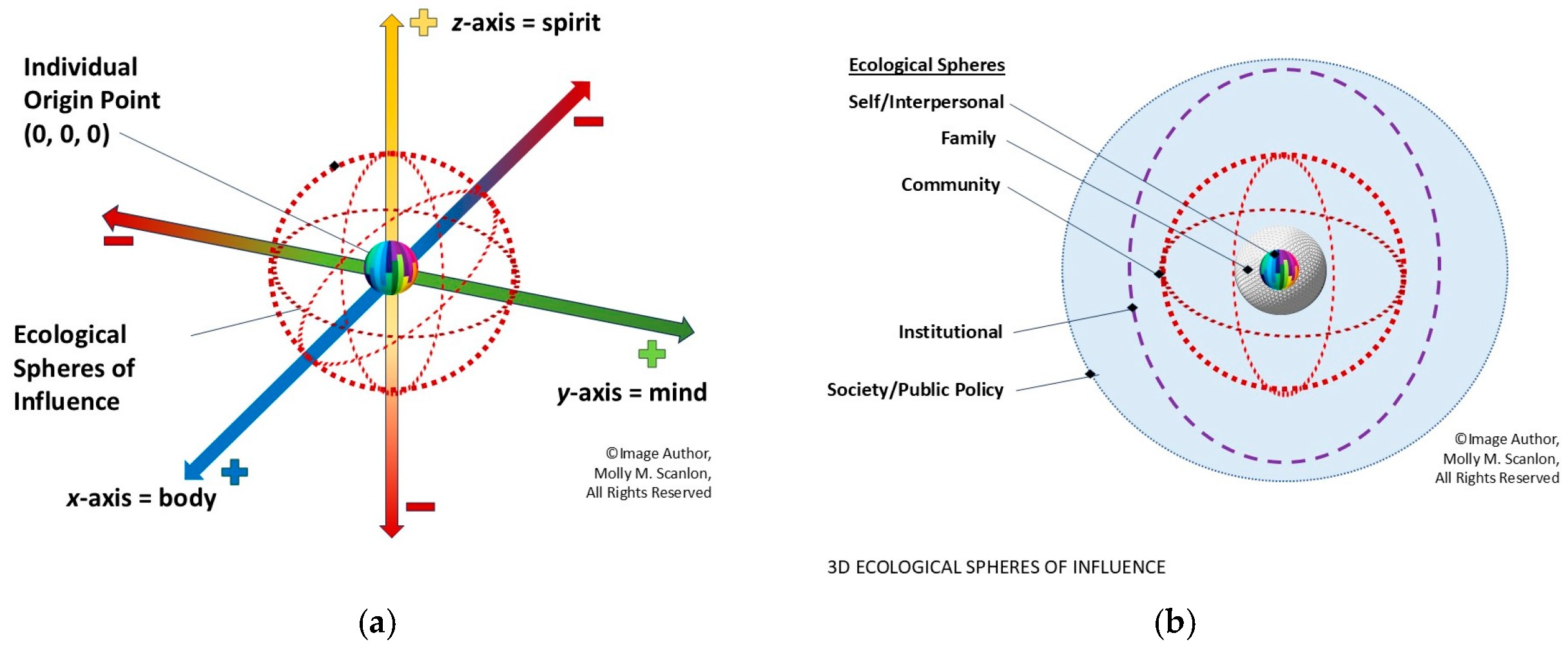
The author proposes a more robust multi-dimensional EHP model incorporating an integrative health framework embracing the body-mind-spirit approach conjoined with the ecological model as previously theorized and reinforced over ensuing decades of research [25,26,28,36,59]. The visual model would be based upon using Descartes’ CCS, which allows for graphic 3D visualization models, as well as utilizing equations for advanced mathematics and geometric forms [94]. The 3D CCS determines a location based upon a unique set of ordered numbers representing three axes (e.g., x-axis = body, y-axis = mind, and z-axis = spirit). The point where all three axes meet is known as the origin point (0,0,0) from which all numbers are measured in a positive or negative direction. For the purposes of this essay, the author depicted a 3D axis framework for health outcomes including spiritual tenets. The z-axis is positioned with the positive direction pointing upward (i.e., known as the right-hand rule for 3D axis orientation in mathematics) [94]. Additionally, the different levels of the ecological model are depicted as spheres of influence (see Figure 2).
Ideally, health researchers would design studies with data collection techniques using a common base-10 standard positional numeric system (e.g., range of integers from −10 to 0 as neutral and +10, similar to a Likert scale) [10]. For qualitative studies, the visual model can be displayed for study participants to locate responses along each axis and subsequently code them into a base-10 system. Study participants could report health variable data for multiple environmental settings along the ecological spheres of influence. The EHP visual model could translate large data sets into a succinct format; promote multidimensional thinking; align data for discovery of new patterns and relationships; expose gaps and limitations; and/or explain group or cohort differences [89]. Visual models like the EHP framework could be used to expand the health literacy of any topic to communicate results with better visual modeling to a wide variety of study participants or researchers.

3.4. X-Axis—The Body

The x-axis represents the anatomy and physiology of the human body. Physical health aspects include proper body functions and its organs (e.g., heart, lungs, brain), systems (e.g., central nervous, circulatory, or digestive), structures (e.g., bone/skeletal), and tissues (e.g., connective or muscle). The objective is to maintain a body free of acute or chronic conditions defined as disease and/or on-going illness. Note some organ physiology (e.g., brain) has complex relationships to other axes (e.g., mind). Examples could be a person with Alzheimer’s or dementia whose brain physiology impacts mental and physical health outcomes.

3.5. Y-Axis—The Mind

The y-axis represents the mental and behavioral aspects of health to balance emotional, psychological, and social well-being. This involves the brain and interconnected systems. Mental health impacts humans’ ability to learn, cope with life stressors, and have work satisfaction to contribute to society. The objective is to maintain a mental health condition to allow for emotional regulation (i.e., managing feelings of happiness, sadness or anger); psychological functions (i.e., processing information, personal thoughts and beliefs); and social engagement (i.e., ability to connect with others, interact in relationships, and function effectively in groups or society at large).

3.6. Z-Axis—The Spirit

The z-axis represents the human spirit and its connection to health for a person to manage coping with positive or negative health outcomes for oneself and others around them. The z-axis represents beliefs, practices, and rituals, and it embodies humanism, values, and morals connected to a person’s view of sacredness. These attributes stem from exposures within family, community, or country of origin. These spiritual tenets maybe classified in the studies of humanities, religion, social or cultural norms, historical perspectives, anthropology, contemplation, or meta-physical activities.

3.7. The Built Environment and 3P Health

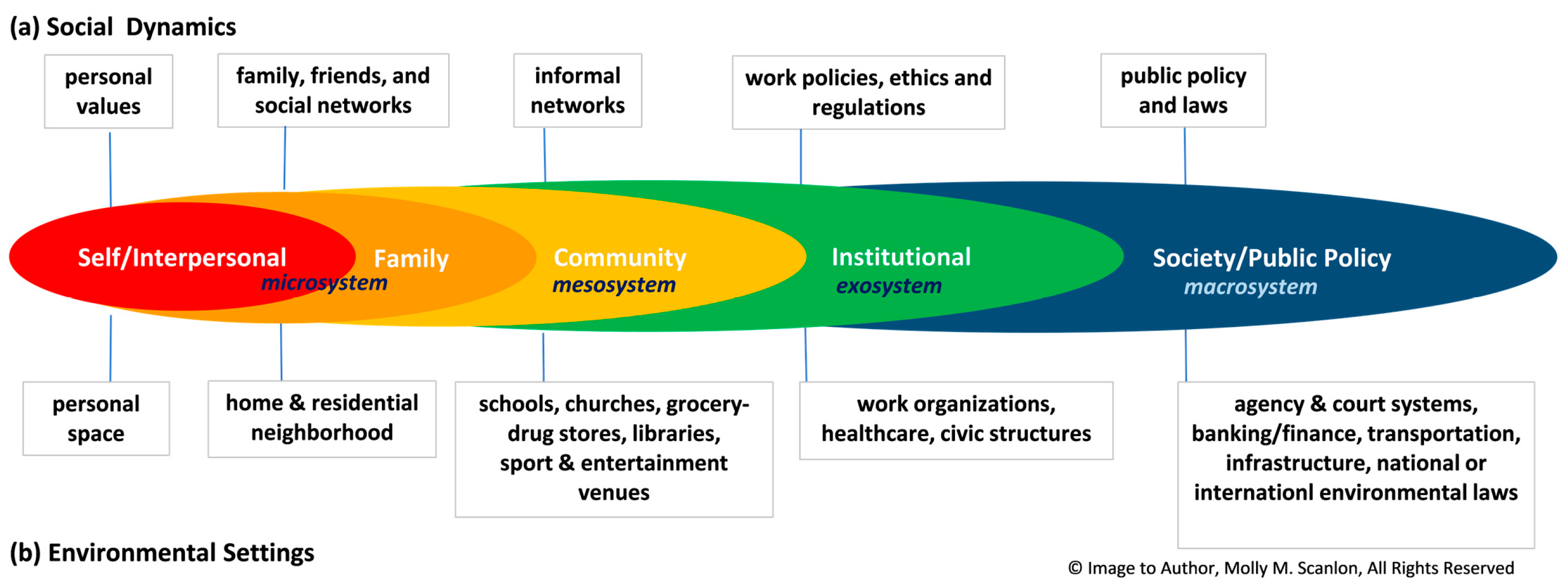
Although the ecological model implies various levels of environmental settings, it has mostly been used to measure impacts or develop interventions involving the social dynamics of humans. Historically, public and environmental health practitioners do not routinely focus on the influence of the built environment (e.g., landscape settings and buildings) and have not routinely interfaced with architects, engineers, or urban planners who create built environments. This has changed over the past 20-year period with an increasing focus on health and the built environment. However, in the evaluation of place, human health is not singularly influenced in terms of person or location. Health is occurring differently in various locations. To get at the root of health, it is not only 3D in terms of body-mind-spirit, it is multi-dimensional in terms of people and place. What is healthy at home might not be the same at school or work. Health dynamics at a residential or community level might be a very different concern at the regional, national, or global level. Figure 3 illustrates both social dynamics and environmental settings as part of influencing human health outcomes.

4. Integrative EHP Visual Framework

Using the visual model elements described above, the author developed a visual integrative EHP framework. A brief explanation of the framework and its components is described for articulating the axes of health and well-being.

Integrative Environmental Health Promotion Framework

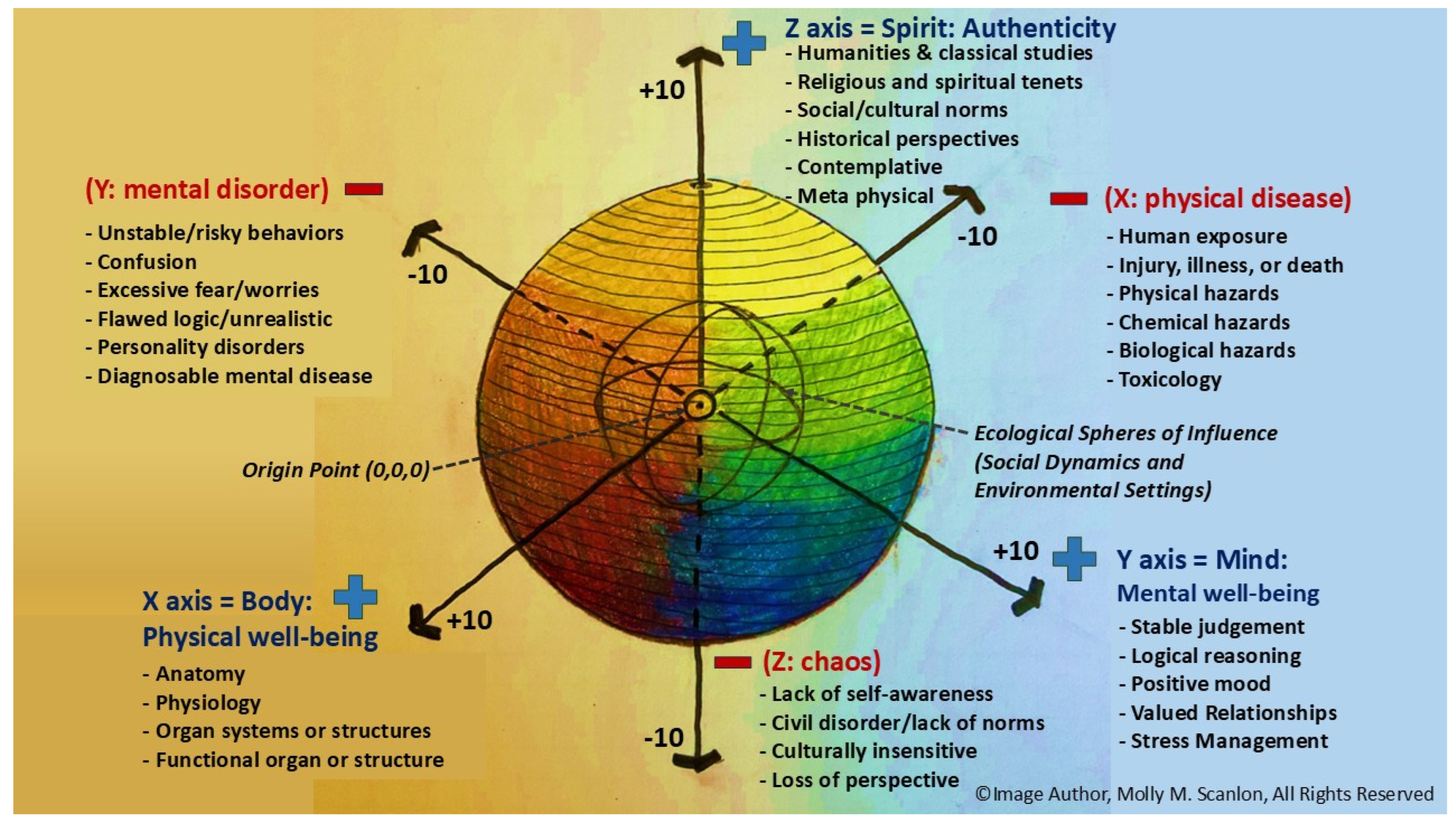
The combination of the ecological model and the body-mind-spirit 3D axes depicts our physical, mental, and spiritual health and well-being as interconnected within our social, cultural, and physical environment (see Figure 4). Multiple factors determine individual health within the broader EHP systems. Integration of the two frameworks (i.e., ecological and body-mind-spirit) to report measurable results would likely reveal new evidence about Dunn’s HLW theories as well as explore more robust cross-disciplinary EHP findings. Specifically, four key aspects of health could be advanced:
(1)
Holistic and balanced: acknowledging health is a dynamic state influenced by the intricate interactions of an individual person’s inner being (body-mind-spirit) with their outer environmental settings (in context with social, cultural, community and national norms).
(2)
Multi-level interventions: supporting research and reporting results to address different levels of the ecological model while acknowledging the interconnectedness of body-mind-spirit health.
(3)
Personal and culturally sensitive approach: ability to tailor interventions to consider the unique needs, circumstances, or cultural backgrounds of research participants.
(4)
Empowerment and resiliency: strengthening individual and community health by studying capabilities and capacity for coping and adapting to different environments.
The EHP framework, shown herein, is yet to be numerically operationalized and is a preliminary representation. The EHP framework is currently illustrative of several possible approaches to data collection and analysis in health science research and is not an exhaustive representation of its capabilities (see Section 5.4 Limitations).

5. Discussion

Although prior researchers have reported on integrative health and the impacts of the environment [6,26,28,95,96], these researchers and their frameworks, models, or methods have not, to the author’s knowledge, incorporated 3D units of measure nor 3D visualization techniques to assess the integration of these topics. The physiological (body) and mental (brain) human health parameters are studied more often but lack integration of a third dimension (i.e., z-axis) to measure the influence of spiritual tenets. As Dean Ornish noted with cardiac patients, people are motivated with positive aspects of wellness to increase positive health behavior engagement [35]. This is likely true for 3P health initiatives versus entrapping people in a constant state of fear about the climate crisis. Yet, can any of these spiritual tenets evolve into credible interventions?
Koenig [40,41] identified spiritual tenets impacting health outcomes when implementing secular interventions for universal health benefits. For example, Jon Kabat-Zinn translated Buddhist tenets and mindfulness practice into a secular intervention now known as mindfulness-based stress reduction (MBSR) [97]. MBSR has been tested in children, adults, and healthcare workers as an evidence-based method of coping with stress. As MBSR research has grown substantially since its inception in 1979, it is now recognized as an NPI [38] and a key aspect of treating trauma [98].
Another example would be interventions associated with human health and time spent in or around natural environments. Kellert and Wilson [99] posed the Biophilia Hypothesis stating humans possess an essential, innate drive to connect with nature and other living organisms. They suggested humans have an affinity for natural processes ingrained in physical genetic makeup (i.e., x-axis) and mental psychology (i.e., y-axis). This theory spawned biophilic design aimed at incorporating natural elements into the built environment (e.g., landscape and buildings) to improve human health and well-being. Publications by seminal researchers Ulrich [100], Kaplan & Kaplan [101], Frumkin [2], and Wolf [102] focused on the impacts of the natural environment on human health in various settings. Other researchers have conducted studies about human behavior and nature connectedness and found significant positive relationships with pro-environmental behaviors [103,104], environmental education [104], socially responsible consumption [105], and mindfulness practice [106]. Scanlon [107] was even able to correlate perceived nature contact with reduced occupational stress in registered nurses. A study of registered nurses (n = 161) reported their health promotion lifestyle scores were significantly higher (p < 0.001) when positively associated with thoughts of perceived nature contact. These nature-related findings have led to more efforts, like those of Robinson et al. [108], to examine options for prescribing nature visits to enhance traditional allopathic medical treatments, predominantly those related to noncommunicable diseases.
Beyond translating mindfulness and access to nature as NPIs within medicine, there lies a series of what are likely considered unorthodox approaches of incorporating spiritual tenets into the lexicon of environmental research. These approaches could reach larger audiences to motivate and pivot our society out of our planetary health crisis. Over 3000 empirical studies and 100 systematic reviews have reported findings on associations between spiritual tenets and health outcomes [43]. Yet, public and environmental health largely remain indifferent to the integration of spirituality into higher-education and research. For example, three categories of spiritual tenets—connections to creation, valuing sacred lands, and green fellowship—are discussed to demonstrate the opportunity of the z-axis representing spirituality to yield broader appeal for 3P health engagement.

5.1. Connections to Creation

Faith-based institutions have emphasized the connections between environmental health and concepts of creation to bridge the divide about impacts of our evolving planetary climate crisis. When Pope Francis published his encyclical “Laudata Si’ on Care of Our Common Home” he called upon all nations and the Catholic community to see our environment as a source of holistic health and part of the greater common cause for humanity [109,110]. The Pope’s message centered upon how the Creator formed the world, our surrounding environment, and the wonder of all creation within it. Humanity is the environmental caretaker to protect, oversee, and preserve the planet to assure its existence beyond oneself for the whole of mankind. Recently, Pope Leo XIV has reinforced the foundational message of environmental stewardship in the need for climate action and the impacts on the poor and disadvantaged [111]. Similarly, Harper and Kennedy [112] advocated for connections to creation through an eco-theological initiative. Eco-theology envisions growing environmental awareness within faith-based institutions, complementing core spiritual beliefs of creation. Eco-theology encourages “greening of our faith” [113] (p. 619) through spiritual worship, religious education, and spiritual practice. Other eco-theological aspects focus on environmental justice accentuating impacts on low-income and marginalized populations. Additionally, Randolph [21] suggested alignment between environmental health and creation to shift Christian bioethics to remove barriers between human and environmental health. Christian medical ethics focus on individual personal health outcomes while ignoring environmental ethics impacting health. Randolph claims this disconnect can be bridged with a “bigger tent” [21] (p. 164) of specialized environmental health topics, as well as collaboration on common areas of interest. The EHP framework could be used in future studies to compare and contrast faith-based study populations to evaluate eco-theological behaviors or program outcomes.

5.2. Valuing Sacred Lands

Indigenous peoples state they are a diverse population with unique languages, customs, ceremonies, and geography that must be respected globally and among local communities [114,115]. The Indigenous population is estimated at 476 million people (i.e., 6.2% of the global population) representing 5000 different cultures, 4000 spoken languages, and residing in 90 countries. Indigenous peoples inhabit 22% of the Earth’s surface, yet they steward and live within approximately 80% of our global biodiversity [114]. In addition to respecting their diverse culture, a valid distrust exists of non-Indigenous populations. Indigenous nations lament the long history of colonization, which destroyed ‘traditional’ knowledge about food, labor, forests, water, and ideology to benefit mankind, while violating sacred lands [22,116]. Indigenous researchers have reported Western medicine and research as negatively impacting indigenous health and well-being [114,115,117,118]. Destroying and separating from sacred land adversely impacts Indigenous peoples’ health by reducing life expectancy [116] by 20 years [119].
Williams [117] described this erosion of Indigenous knowledge and way of life as a legally weaponized form of cultural genocide moving Indigenous populations toward extinction within the 21st century. Indigenous populations have been forced into costly and time-consuming litigation with minimal results in protecting themselves from ecocide (i.e., legalized environmental destruction). Global court systems tend to protect the advancement of commerce and power within industrial, political, and private enterprises. Yet, as a resilient population, Indigenous peoples simultaneously realize an expression of unity is essential to speak for Indigenous rights, health, and traditional medicine systems [114,115,117,118,119].
Indigenous peoples are advocating to restore and maintain sacred land for indigenous health to create valuable partnerships to advance 3P health. Indigenous peoples refer to Mother Earth as sacred [22,116,119] and humans as part of the natural environment and not separate from it [115,120]. Indigenous authors offered a new definition of human health as follows: “health is a state of dynamic balance within and between your physical, mental, social, and spiritual well-being that is completely dependent on planetary health” [119] (p. 726). Indigenous authors described climate change as a long-term destruction of their connection to land or country [115,117,121]. Williams [117] summarized a global humanitarian crisis related to the destruction of Indigenous land due to climate change. He described the following geographic regions and conditions: Africa (water stress and famine); Asia (projected sea-level rise, coastal eco-systems, and flooding); Australia and New Zealand (heatwaves, fires, droughts, storm surges, and flooding); Central and South America (intensive rainfall, hail storms, and hurricanes); Southern Europe (exposure to vector- and food-borne diseases); North America (weather extremes impacting water available for agriculture, municipal, and industrial infrastructure); and the Arctic/Antarctic (warming trends impacting sea-ice, glaciers, freshwater species, and ecosystems). These situations adversely impact Indigenous peoples with relationship to health and wellbeing, traditional medicines, and knowledge transfer [22].
Indigenous authors have expressed pathways toward resolution as residing within restoring self-determination, implementing land-based health programs, establishing determinants of planetary health, and engaging differently with Western science [22,114,115,116,117,118,119,120,122]. Self-determination is an essential and collective right of Indigenous peoples to control their destiny within systems influencing economic, social, cultural, and health policy outcomes [115,117,118,119]. To achieve these goals, Williams [117] recommended establishing two international court systems for (1) human rights and (2) the environment. For health outcomes, Indigenous researchers [119,120] want to continue land-based health programs to encourage intergenerational knowledge transfer, as well as leverage Indigenous application of plant-based medicine.
For engagement within 3P health initiatives, Redvers et al. [114] developed their own definition of determinants of health using Indigenous language describing three levels of interrelated concepts: Mother Earth (respect the feminine and ancestral legal personhood); Interconnecting (humans within nature, self and community relationships, modern science paradigms, governance and law); and Indigenous Peoples (land tenure rights, languages, health, and elders and children). A stated goal within these concepts was to engage with Western science and research differently to respect other knowledge systems and to motivate governments and environmental policy to be Earth-centric [114,115,117]. Indigenous peoples are pro-science yet want scientific endeavors to be holistic, as well as an extension of the heart of Mother Earth. The EHP framework described in this essay maybe a visual model used to bridge discussions between Indigenous and Western researchers to develop more common ground and a better means of expression.

5.3. Green Fellowship

Religious and spiritual leaders are encouraging action at a local level to help people embrace a lifestyle incorporating environmental stewardship. New Jersey Jewish and Christian leaders came together from diverse religious perspectives using their link to a common environment [112,113]. Their efforts spawned GreenFaith, a grassroots fellowship movement, emerging from a void of environmental knowledge for spiritual leaders in seminaries, universities, and other learning institutions. GreenFaith has grown into an international certification program for spiritual environmental engagement for energy conservation, member recruitment, and accomplishing bigger community goals than one congregation might achieve alone. In 2024, GreenFaith trained nearly 3000 leaders of various faith organizations to organize their communities to speak out and work toward implementing strategic environmental initiatives. In 2025, GreenFaith organized rallies in alliance with Sun Day as a national mobilization to support climate justice, a focus on clean energy, and a reduction in fossil fuels. The organization instills a belief that all persons and communities deserve a life of dignity that includes living on a planet where the environment is sacred. Similarly, Bioneers is a non-profit, secular organization focusing on practical visionary environmental solutions mimicking natural science fostering an inclusive environment for all faiths [123]. The Bioneers Indigenous Knowledge Program promotes spiritual connectedness between all creations, their right to exist, and the value of their contributions to the larger whole. The EHP framework could be used during future empirical studies to evaluate study participants’ pro-environmental behaviors or training and education programs regarding green fellowship or other green faith-based population characteristics.

5.4. Limitations

The current essay described a foundational framework and structural baseline rather than an exhaustive simulation of how the integrative EHP framework could be used in mixed-method research. The framework is currently exploratory and needs further visual and numeric testing, as well as 3D test plots to move toward operations for data collection and analysis. This framework can be used as a preliminary tool to acquire study participant data and analyze results demonstrating a baseline proof-of-concept before advancing toward more complex studies. While the integrative EHP framework in this essay is foundational, its scope is subject to two primary limitations regarding study populations and environmental settings.
For study populations, the model is envisioned to generalize a neurotypical human health baseline and does not currently account for unique and complex ‘body-mind’ dynamics. For example, the brain organ can have neurological variances associated with neurodivergent profiles (e.g., Attention Deficit/Hyperactivity Disorder, Autism, Down Syndrome) and/or neurodegenerative conditions (e.g., Alzheimer’s, Parkinson’s, or multiple sclerosis). While these populations offer critical insights into unique human health conditions, as research study cohorts, they will introduce substantial confounding variables that fall beyond the scope of this initial EHP visual model’s structural analysis.
Further, the model’s parameters for environmental settings are currently restricted to known socio-economic conditions and/or physical settings. It does not yet incorporate the unique aspect and cognitive demands of digital, artificial, or simulated spaces—such as virtual reality, social media interfaces, or cinematic/film or fantasy environments—which involve unique physiological stressors that are distinct from natural environments. Maintaining these initial boundaries, the integrative EHP framework can conduct future studies to test for internal validity of its core mechanisms—3D variable analysis. However, over time with subsequent iterations, these more diverse human health complexities and alternative environmental settings could be incorporated.

6. Conclusions

Current EH research primarily focuses on macro-scale risk analysis, overlooking the essential role of a supportive physical and social environment in fostering healthy lifestyles. This focus, combined with the political polarization of environmental challenges, has limited advancements in environmental health promotion and 3P health initiatives. The result is a lack of public engagement, a rise in environmental skepticism, and a failure to effectively promote the positive benefits of environmental stewardship. Fundamentally, the current EH framework is deficient due to its lack of a balanced risk-versus-benefit evaluation, exclusion of a spiritual axis, and neglect in analyzing social and environmental settings within the context of a public health ecological model.
This essay, therefore, advocates for a paradigm shift in EH towards a health promotion model, necessitating dynamic and visual frameworks to advance research and regain public trust. Drawing on lessons from public health’s ecological model and integrative health’s focus on positive motivation, the author proposed an integrative EHP framework that incorporates spiritual tenets. This novel, inclusive approach is posited as a worthwhile avenue for both future research methodology and a strategic tool to foster stronger engagement and trust among researchers, study populations, and the general public in achieving 3P health goals.

Funding

This research received no external funding.

Institutional Review Board Statement

Not applicable.

Informed Consent Statement

Not applicable.

Data Availability Statement

Not applicable.

Acknowledgments

The author gratefully acknowledges the former Spirituality and Public Health Student Essay Contest, which inspired the author’s original 2016 unpublished manuscript from which this essay article was derived. The contest, organized by faculty from five universities, sought to advance awareness of the evidence integrating spirituality and health and its relevance to public health. The student essay contest was sponsored by the founding director of the John Templeton Foundation, an organization supporting research that fosters dialogue and inspires wonder.

Conflicts of Interest

The author declares no conflicts of interest.

Abbreviations

The following abbreviations are used in this manuscript:
3DThree-Dimensional
3PPeople, Place, and Planetary
CCSCartesian Coordinate System
EHEnvironmental Health
EHPEnvironmental Health Promotion
EPAEnvironmental Protection Agency
HLWHigh-Level Wellness
NPINon-Pharmacological Intervention
R&SReligious and Spiritual
USUnited States

References

  1. Frumkin, H. Environmental Health: From Global to Local, 2nd ed.; Jossey-Bass: San Francisco, CA, USA, 2010. [Google Scholar]
  2. Frumkin, H. Beyond Toxicity: Human Health and the Natural Environment. Am. J. Prev. Med. 2001, 20, 234–240. [Google Scholar] [CrossRef] [Scilit]
  3. Benton, L.; Brousselle, A.; McDavid, J.; Whitmee, S.; Haines, A. Need for planetary health perspective in guidance for complex interventions for climate and health. BMJ 2025, 389, e083337. [Google Scholar] [CrossRef] [Scilit]
  4. Logan, A.C.; Berman, S.H.; Berman, B.M.; Prescott, S.L. Healing Anthropocene Syndrome: Planetary Health Requires Remediation of the Toxic Post-Truth Environment. Challenges 2021, 12, 1. [Google Scholar] [CrossRef] [Scilit]
  5. Prescott, S.; Logan, A. Narrative Medicine Meets Planetary Health: Mindsets Matter in the Anthropocene. Challenges 2019, 10, 17. [Google Scholar] [CrossRef] [Scilit]
  6. Prescott, S.L.; Logan, A.C. Planetary Health: From the Wellspring of Holistic Medicine to Personal and Public Health Imperative. Explore 2019, 15, 98–106. [Google Scholar] [CrossRef] [Scilit]
  7. Dixon, J.K.; Dixon, J.P. An Integrative Model for Environmental Health Research. Adv. Nurs. Sci. 2002, 24, 43–57. [Google Scholar] [CrossRef] [Scilit]
  8. Pleyer, J.A.; Pesliak, L.D.; McCall, T. Salutogenic Environmental Health Model—Proposing an integrative and interdisciplinary lens on the genesis of health. Front. Public Health 2024, 12, 1445181. [Google Scholar] [CrossRef] [Scilit] [PubMed]
  9. Kaur, M. Application of mixed method approach in public health research. Indian J. Community Med. 2016, 41, 93–97. [Google Scholar] [CrossRef] [Scilit] [PubMed]
  10. Gonot-Schoupinsky, F. Novel methodological approaches to support four recognized challenges in integrative medicine mixed methods research design. Adv. Integr. Med. 2025, 12, 81–86. [Google Scholar] [CrossRef] [Scilit]
  11. Ramírez, D.M.; Sachs, A.L.; Ekenga, C.C. Qualitative and mixed methods: Informing and enhancing exposure science. J. Expo. Sci. Environ. Epidemiol. 2025, 35, 535–538. [Google Scholar] [CrossRef] [Scilit]
  12. Stanek, L.; Cascio, W.; Barzyk, T.; Breen, M.; DeLuca, N.; Griffin, S.; Melnyk, L.; Minucci, J.; Thomas, K.; Tulve, N.; et al. Environmental public health research at the U.S. Environmental Protection Agency: A blueprint for exposure science in a connected world. J. Expo. Sci. Environ. Epidemiol. 2024, 35, 539–547. [Google Scholar] [CrossRef] [Scilit]
  13. Rana, K.; Chimoriya, R. A Guide to a Mixed-Methods Approach to Healthcare Research. Encyclopedia 2025, 5, 51. [Google Scholar] [CrossRef] [Scilit]
  14. Doyle, L.; Brady, A.-M.; Byrne, G. An overview of mixed methods research—Revisited. J. Res. Nurs. 2016, 21, 623–635. [Google Scholar] [CrossRef] [Scilit]
  15. Zhang, W.; Creswell, J. The Use of “Mixing” Procedure of Mixed Methods in Health Services Research. Med. Care 2013, 51, e51–e57. [Google Scholar] [CrossRef] [Scilit]
  16. Howze, E.H.; Baldwin, G.T.; Kegler, M.C. Environmental Health Promotion: Bridging Traditional Environmental Health and Health Promotion. Health Educ. Behav. 2004, 31, 429–440. [Google Scholar] [CrossRef] [Scilit] [PubMed]
  17. Lang, T.; Rayner, G. Ecological public health: The 21st century’s big idea? BMJ 2012, 345, e5466. [Google Scholar] [CrossRef] [Scilit] [PubMed]
  18. Plog, B.A.; Quinlan, P. Fundamentals of Industrial Hygiene, 6th ed.; National Safety Council: Itasca, IL, USA, 2012. [Google Scholar]
  19. Francis, P. Our Common Home: The Encyclical of Pope Francis on the Environment, Laudato Si’; Libreria Editrice Vaticana: Vatican City, Vatican City State, 2015; pp. 1–82. [Google Scholar]
  20. Gilman, S.L.; Zhou, X. Smoke: A Global History of Smoking; Reaktion Books: London, UK, 2004. [Google Scholar]
  21. Randolph, R.O. Human Health and Environmental Health Are Interdependent: Removing an Unnatural Partition within Christian Bioethics. J. Soc. Christ. Ethics 2009, 29, 153–170. [Google Scholar] [CrossRef] [Scilit]
  22. Goldtooth, T.B.K.; Awanyankapi, M. The State of Indigenous America Series: Earth Mother, Piñons, and Apple Pie. Wicazosa Rev. 2010, 25, 11–28. [Google Scholar] [CrossRef] [Scilit]
  23. Kreuter, M.W.; De Rosa, C.; Howze, E.H.; Baldwin, G.T. Understanding Wicked Problems: A Key to Advancing Environmental Health Promotion. Health Educ. Behav. 2004, 31, 441–454. [Google Scholar] [CrossRef] [Scilit]
  24. Rochette, L.; Dogon, G.; Vergely, C. Stress: Eight Decades after Its Definition by Hans Selye: “Stress Is the Spice of Life”. Brain Sci. 2023, 13, 310. [Google Scholar] [CrossRef] [Scilit]
  25. Selye, H. The Stress Syndrome. Am. J. Nurs. 1965, 65, 97–99. [Google Scholar] [CrossRef] [Scilit]
  26. Witt, C.M.; Chiaramonte, D.; Berman, S.; Chesney, M.A.; Kaplan, G.A.; Stange, K.C.; Woolf, S.H.; Berman, B.M. Defining Health in a Comprehensive Context: A New Definition of Integrative Health. Am. J. Prev. Med. 2017, 53, 134–137. [Google Scholar] [CrossRef] [Scilit]
  27. Prescott, S.L.; Logan, A.C.; Katz, D.L. Preventive medicine for person, place, and planet: Revisiting the concept of high-level wellness in the planetary health paradigm. Int. J. Environ. Res. Public Health 2019, 16, 238. [Google Scholar] [CrossRef] [Scilit]
  28. Dunn, H.L. High-level wellness for man and society. Am. J. Public Health Nation’s Health 1959, 49, 786–792. [Google Scholar] [CrossRef] [Scilit]
  29. Dunn, H.L. Social Change and the Fundamentals of Community Organization. J. Educ. Sociol. 1960, 33, 373–383. [Google Scholar] [CrossRef] [Scilit]
  30. Dunn, H.L. What High-Level Wellness Means. Can. J. Public Health 1959, 50, 447–457. [Google Scholar] [PubMed]
  31. Dunn, H.L. Points of attack for raising the levels of wellness. J. Natl. Med. Assoc. 1957, 49, 225–235. [Google Scholar]
  32. Dunn, H.L. Positive Wellness in the Human and national Posture. In Presentation Given at The Pentagon, Washington, DC, USA. 1958, pp. 1–35. Available online: https://babel.hathitrust.org/cgi/pt?id=uc1.c095455649&seq=9 (accessed on 30 May 2025).
  33. Dunn, H.L. High-Level Wellness: A Collection of Twenty-Nine Short Talks on the Theme “High-Level Wellness for Man and Society”; RW Beatty: Arlington, VA, USA, 1961; p. 254. [Google Scholar]
  34. Academic Consortium for Integrative Medicine & Health. ACIM&H Mission & Vision. Available online: https://imconsortium.org/page/mission-and-vision (accessed on 7 October 2025).
  35. Institute of Medicine. Integrative Medicine and the Health of the Public: A Summary of the February 2009 Summit, 1st ed.; National Academies Press: Washington, DC, USA, 2009; p. 244. [Google Scholar]
  36. George, P. The Legacy of The Bravewell Collaborative: Transforming Health Care through Integrative Medicine; Views from the Field; Grantmakers in Health: Washington, DC, USA, 2014; pp. 1–2. Available online: https://www.gih.org/views-from-the-field/the-legacy-of-the-bravewell-collaborative-transforming-health-care-through-integrative-medicine/ (accessed on 7 October 2025).
  37. Horrigan, B.; Lewis, S.; Abrams, D.I.; Pechura, C. Integrative Medicine in America—How Integrative Medicine is Being Practiced in Clinical Centers across the United States. Glob. Adv. Health Med. 2012, 1, 18–52. [Google Scholar] [CrossRef] [Scilit]
  38. Ninot, G. Non-Pharmacological Interventions: An Essential Answer to Current Demographic, Health, and Environmental Transitions, 1st ed.; Springer: Cham, Switzerland, 2021; p. 283. [Google Scholar]
  39. Logan, A.C.; Berman, B.M.; Prescott, S.L. Earth Dreams: Reimagining ARPA for Health of People, Places and Planet. Int. J. Environ. Res. Public Health 2021, 18, 12788. [Google Scholar] [CrossRef] [Scilit]
  40. Koenig, H.G. Religion, Spirituality, and Health: The Research and Clinical Implications. ISRN Psychiatry 2012, 2012, 1–33. [Google Scholar] [CrossRef] [Scilit] [PubMed]
  41. Koenig, H.G. Religion, Spirituality, and Public Health: Research, Applications, and Recommendations; Duke University Medical Center: Durham, NC, USA, 2008; pp. 1–18. [Google Scholar]
  42. Long, K.N.; Gregg, R.J.; VanderWeele, T.J.; Oman, D.; Laird, L.D. Boundary Crossing: Meaningfully Engaging Religious Traditions and Religious Institutions in Public Health. Religions 2019, 10, 412. [Google Scholar] [CrossRef] [Scilit]
  43. Oman, D. Why Religion and Spirituality Matter for Public Health: Evidence, Implications, and Resources, 1st ed.; Springer International Publishing: Cham, Switzerland, 2018. [Google Scholar]
  44. Khalsa, S.; Kalinowski, B.D.; Howard Ecklund, E. Indian Scientists’ Definitions of Religion and Spirituality. Religions 2020, 11, 355. [Google Scholar] [CrossRef] [Scilit]
  45. Di, D.; Khalsa, S.; Thomson, R.A.; Howard Ecklund, E. Alternative Spirituality among Global Scientists. Sociol. Q. 2021, 62, 187–208. [Google Scholar] [CrossRef] [Scilit]
  46. Homan, P.; Burdette, A. When Religion Hurts: Structural Sexism and Health in Religious Congregations. Am. Sociol. Rev. 2021, 86, 234–255. [Google Scholar] [CrossRef] [Scilit]
  47. Lueger-Schuster, B.; Weindl, D.; Kantor, V.; Knefel, M.; Glück, T.; Moy, Y.; Butollo, A.; Jagsch, R. Resilience and Mental Health in Adult Survivors of Child Abuse Associated with the Institution of the Austrian Catholic Church. J. Trauma. Stress 2014, 27, 568–575. [Google Scholar] [CrossRef] [Scilit]
  48. Egan, R.; Timmins, F. Spirituality as a Public Health Issue: The Potential Role of Spirituality in Promoting Health. In Spirituality in Healthcare: Perspectives for Innovative Practice; Timmins, F., Caldeira, S., Eds.; Springer International Publishing: Cham, Switzerland, 2019; pp. 55–66. [Google Scholar]
  49. Frumkin, H.; Watts, N. Health, Science, Faith, and Stewardship. EcoHealth 2018, 15, 482–484. [Google Scholar] [CrossRef] [Scilit]
  50. Sorondo, M.M.S.; Frumkin, H.; Ramanathan, V. Health, Faith, and Science on a Warming Planet. J. Am. Med. Assoc. 2018, 319, 1651–1652. [Google Scholar] [CrossRef] [Scilit]
  51. Ecklund, E.H.; Long, E. Scientists and Spirituality. Sociol. Relig. 2011, 72, 253–274. [Google Scholar] [CrossRef] [Scilit]
  52. Bronfenbrenner, U. Toward an experimental ecology of human development. Am. Psychol. 1977, 32, 513–531. [Google Scholar] [CrossRef]
  53. Lewin, K. Psychological Ecology: 1943, 1st ed.; Routledge: Abingdon, UK, 2014; pp. 17–21. [Google Scholar]
  54. McLeroy, K.R.; Bibeau, D.; Steckler, A.; Glanz, K. An Ecological Perspective on Health Promotion Programs. Health Educ. Behav. 1988, 15, 351–377. [Google Scholar] [CrossRef] [Scilit]
  55. Tudge, J.R.; Navarro, J.L.; Merçon-Vargas, E.A.; Payir, A. The promise and the practice of early childhood educare in the writings of Urie Bronfenbrenner. Early Child Dev. Care 2021, 191, 1079–1088. [Google Scholar] [CrossRef] [Scilit]
  56. Glanz, K.; Rimer, B.K.; Viswanath, K. Health Behavior: Theory, Research, and Practice, 5th ed.; Jossey-Bass/Wiley: San Francisco, CA, USA, 2015. [Google Scholar]
  57. Glanz, K.; Bishop, D.B. The role of behavioral science theory in development and implementation of public health interventions. Annu. Rev. Public Health 2010, 31, 399–418. [Google Scholar] [CrossRef] [Scilit]
  58. Jalali, M.S.; Botticelli, M.; Hwang, R.C.; Koh, H.K.; McHugh, R.K. The opioid crisis: A contextual, social-ecological framework. Health Res. Policy Syst. 2020, 18, 87. [Google Scholar] [CrossRef] [Scilit]
  59. Pender, N.J. Health Promotion in Nursing Practice, 7th ed.; Pearson: London, UK, 2015. [Google Scholar]
  60. Pleasant, A.; Scanlon, M.M.; Pereira-Leon, M. Literature review: Environmental design and research on the human health effects of open spaces in urban areas. Hum. Ecol. Rev. 2013, 20, 36–49. [Google Scholar]
  61. Miedema, E.; Lindahl, G.; Elf, M. The Swedish Health Promoting Healthcare network and the built environment. Health Promot. Int. 2022, 37, 1. [Google Scholar] [CrossRef] [Scilit] [PubMed]
  62. Ulrich, R.S.; Zimring, C.; Zhu, X.; DuBose, J.; Seo, H.-B.; Choi, Y.-S.; Quan, X.; Joseph, A. A Review of the Research Literature on Evidence-Based Healthcare Design. Health Environ. Res. Des. J. 2008, 1, 61–125. [Google Scholar] [CrossRef] [Scilit] [PubMed]
  63. Walker, S.N.; Sechrist, K.R.; Pender, N.J. The Health-Promoting Lifestyle Profile: Development and Psychometric Characteristics. Nurs. Res. 1987, 36, 76–81. [Google Scholar] [CrossRef] [Scilit]
  64. Banai, R. Concentric Zone Theory. In The Wiley Blackwell Encyclopedia of Urban and Regional Studies; Orum, A., Ed.; John Wiley & Sons: Chichester, UK, 2019; pp. 1–6. [Google Scholar] [CrossRef] [Scilit]
  65. Banai, R.; Rapino, M.A. Urban theory since A Theory of Good City Form (1981)—A progress review. J. Urban. 2009, 2, 259–276. [Google Scholar] [CrossRef] [Scilit]
  66. Jacobs, J. The Death and Life of Great American Cities; Vintage Books: New York, NY, USA, 1993; p. 448. [Google Scholar]
  67. Newman, O. Defensible Space: A New Physical Planning Tool for Urban Revitalization. J. Am. Plan. Assoc. 1995, 61, 149–155. [Google Scholar] [CrossRef] [Scilit]
  68. Knoblauch, J. The Economy of Fear: Oscar Newman Launches Crime Prevention through Urban Design (1969–197x). Archit. Theory Rev. 2014, 19, 336–354. [Google Scholar] [CrossRef] [Scilit]
  69. Condon, P.M. Chapter 3—Rule One: See the City as a System. In Five Rules for Tomorrow’s Cities; Island Press: Washington, DC, USA, 2020; pp. 57–75. [Google Scholar]
  70. Jacobs, J.M.; Lees, L. Defensible Space on the Move: Revisiting the Urban Geography of Alice Coleman. Int. J. Urban Reg. Res. 2013, 37, 1559–1583. [Google Scholar] [CrossRef] [Scilit]
  71. Lees, L. Defensible Space on the Move: Chapter 1 An Introduction. In Defensible Space on the Move: Mobilisation in English Housing Policy and Practice; John Wiley & Sons, Inc.: Hoboken, NJ, USA, 2022; pp. 1–31. [Google Scholar]
  72. Reynald, D.M.; Elffers, H. The Future of Newman’s Defensible Space Theory: Linking Defensible Space and the Routine Activities of Place. Eur. J. Criminol. 2009, 6, 25–46. [Google Scholar] [CrossRef] [Scilit]
  73. Crippen, M. Intuitive cities: Pre-reflective, aesthetic and political aspects of urban design. J. Aesthet. Phenomenol. 2016, 3, 125–145. [Google Scholar] [CrossRef] [Scilit]
  74. Crippen, M. Emotional Environments: Selective Permeability, Political Affordances and Normative Settings. Topoi 2022, 41, 917–929. [Google Scholar] [CrossRef] [Scilit]
  75. Crippen, M. Selective Permeability, Political Affordances and the Gendering of Cities. Societies 2025, 15, 188. [Google Scholar] [CrossRef] [Scilit]
  76. Crippen, M.; Klement, V. Architectural Values, Political Affordances and Selective Permeability. Open Philos. 2020, 3, 462–477. [Google Scholar] [CrossRef] [Scilit]
  77. Crippen, M.; Lindemann, D.M. Selective permeability, multiculturalism and affordances in education. Philos. Psychol. 2024, 37, 1924–1947. [Google Scholar] [CrossRef] [Scilit]
  78. Alexander, C. A Pattern Language: Towns, Buildings, Construction; Oxford University Press: New York, NY, USA, 1977. [Google Scholar]
  79. Lynch, K. The Image of the City; Technology Press: Cambridge, MA, USA, 1960. [Google Scholar]
  80. Mondschein, A.; Moga, S.T. New Directions in Cognitive-Environmental Research: Applications to Urban Planning and Design. J. Am. Plan. Assoc. 2018, 84, 263–275. [Google Scholar] [CrossRef] [Scilit]
  81. Dawes, M.J.; Ostwald, M.J. Christopher Alexander’s A Pattern Language: Analysing, mapping and classifying the critical response. City Territ. Archit. 2017, 4, 17. [Google Scholar] [CrossRef] [Scilit]
  82. Gonot-Schoupinsky, F.N.; Garip, G.; Sheffield, D. Laughter and humour for personal development: A systematic scoping review of the evidence. Eur. J. Integr. Med. 2020, 37, 101144. [Google Scholar] [CrossRef] [Scilit]
  83. Terry, P. The Art of Health Promotion. Am. J. Health Promot. 2015, 29, 1–12. [Google Scholar] [CrossRef] [Scilit]
  84. Guzmán, C.A.; Aguirre, A.A.; Astle, B.; Barros, E.; Bayles, B.; Chimbari, M.; El-Abbadi, N.; Evert, J.; Hackett, F.; Howard, C.; et al. A framework to guide planetary health education. Lancet. Planet. Health 2021, 5, e253–e255. [Google Scholar] [CrossRef] [Scilit] [PubMed]
  85. Golden, S.D.; McLeroy, K.R.; Green, L.W.; Earp, J.A.L.; Lieberman, L.D. Upending the Social Ecological Model to Guide Health Promotion Efforts Toward Policy and Environmental Change. Health Educ. Behav. 2015, 42, 8S–14S. [Google Scholar] [CrossRef] [Scilit]
  86. Sallis, J.F.; Cervero, R.B.; Ascher, W.; Henderson, K.A.; Kraft, M.K.; Kerr, J. An ecological approach to creating active living communities. Annu. Rev. Public Health 2006, 27, 297–322. [Google Scholar] [CrossRef] [Scilit] [PubMed]
  87. Cerin, E. Building the evidence for an ecological model of cognitive health. Health Place 2019, 60, 102206. [Google Scholar] [CrossRef] [Scilit]
  88. Grys, C.A. Evidence-based practice, quality improvement, and research: A visual model. Nursing 2022, 52, 47–49. [Google Scholar] [CrossRef] [Scilit]
  89. Creamer, E.G. Leveraging an Integrated Visual Display for Case-Based Analysis in Mixed Method Research. Int. J. Qual. Methods 2021, 20, 16094069211059000. [Google Scholar] [CrossRef] [Scilit]
  90. Biddix, J.P. Visual models, piloting, and triangulation as core formative research practices. Int. J. Soc. Res. Methodol. 2025, 1–10. [Google Scholar] [CrossRef] [Scilit]
  91. Papaphilippou, P. Juniper: A 3D plotting framework for effective multi-dimensional scatterplots. SoftwareX 2025, 31, 102203. [Google Scholar] [CrossRef] [Scilit]
  92. Otaiku, A.I. Did René Descartes Have Exploding Head Syndrome? J. Clin. Sleep Med. 2018, 14, 675–678. [Google Scholar] [CrossRef] [Scilit]
  93. Cintas, P.G.; Almagro, L.M.; Llabrés, X.T.M. Chapter 5: Three Dimensional Plots. In Industrial Statistics with MiniTab; John Wiley & Sons, Ltd.: Chichester, UK, 2012; pp. 52–61. [Google Scholar]
  94. Jenn. Mastering 3D Coordinate System: Step-by-Step. Available online: https://calcworkshop.com/vectors-and-the-geometry-of-space/3d-coordinate-system/ (accessed on 15 June 2025).
  95. George, M. Integrative medicine is integral to providing patient-centered care. Ann. Allergy Asthma Immunol. 2015, 114, 261–264. [Google Scholar] [CrossRef] [Scilit]
  96. Allen, J.G.; MacNaughton, P.; Laurent, J.G.C.; Flanigan, S.S.; Eitland, E.S.; Spengler, J.D. Green Buildings and Health. Curr. Environ. Health Rep. 2015, 2, 250–258. [Google Scholar] [CrossRef] [Scilit] [PubMed]
  97. Geary, C.; Rosenthal, S.L. Sustained impact of MBSR on stress, well-being, and daily spiritual experiences for 1 Year in academic health care employees. J. Altern. Complement. Med. 2011, 17, 939–944. [Google Scholar] [CrossRef] [Scilit]
  98. Van der Kolk, B.A. The Body Keeps the Score: Brain, Mind, and Body in the Healing of Trauma; Penguin Books: New York, NY, USA, 2015. [Google Scholar]
  99. Kellert, S.R.; Wilson, E.O. The Biophilia Hypothesis; Island Press: Washington, DC, USA, 1993. [Google Scholar]
  100. Ulrich, R.S. View through a window may influence recovery from surgery. Science 1984, 224, 417–419. [Google Scholar] [CrossRef] [Scilit] [PubMed]
  101. Kaplan, S.; Kaplan, R. Health, supportive environments, and the Reasonable Person Model. Am. J. Public Health 2003, 93, 1484–1489. [Google Scholar] [CrossRef] [Scilit] [PubMed]
  102. Wolf, K.L.; Robbins, A.S.T. Metro nature, environmental health, and economic value. Environ. Health Perspect. 2015, 123, 390–398. [Google Scholar] [CrossRef] [Scilit]
  103. Ray, T.N.; Franz, S.A.; Jarrett, N.L.; Pickett, S.M. Nature Enhanced Meditation: Effects on Mindfulness, Connectedness to Nature, and Pro-Environmental Behavior. Environ. Behav. 2021, 53, 864–890. [Google Scholar] [CrossRef] [Scilit]
  104. Begum, A.; Wang, Q.; Qayum, H.; Khan, S.; Zaib, K. Fostering Green Behaviour Through Environmental Education: A Structural Equation Model of Nature Connectedness and Social Dominance Orientation. SAGE Open 2025, 15, 21582440251378188. [Google Scholar] [CrossRef] [Scilit]
  105. Stinus, C.; Shankland, R.; Berjot, S. Connectedness to humanity and connectedness to nature as a leverage point for eco and socio-responsible consumption. Curr. Psychol. 2024, 43, 30429–30445. [Google Scholar] [CrossRef] [Scilit]
  106. Ruckert, J.H.; Granato, H.F.; Barnes, A.; Martin, E.G. Nature Relatedness and Self-Transcendent Emotions: A Mediational Exploration of the Role of Mindfulness. Humanist. Psychol. 2025, 53, 406–424. [Google Scholar] [CrossRef] [Scilit]
  107. Scanlon, M.M. Occupational Stress Risk Assessment: Assessing the Impact of Health Promotion Lifestyle and Perceived Nature Contact on Nursing Health and Wellness. Ph.D. Thesis, University of Arizona, Tucson, AZ, USA, 2016. [Google Scholar]
  108. Robinson, J.M.; Breed, M.F. Green Prescriptions and Their Co-Benefits: Integrative Strategies for Public and Environmental Health. Challenges 2019, 10, 9. [Google Scholar] [CrossRef] [Scilit]
  109. Schneck, S. ‘Laudato Si: On Care of Our Common Home’, by Pope Francis. Energy Law J. 2016, 37, 79–84. [Google Scholar]
  110. Li, N.; Hilgard, J.; Scheufele, D.A.; Winneg, K.M.; Jamieson, K.H. Cross-pressuring conservative Catholics? Effects of Pope Francis’ encyclical on the U.S. public opinion on climate change. Clim. Change 2016, 139, 367–380. [Google Scholar] [CrossRef] [Scilit]
  111. Sanders, M. Ways Pope Leo XIV Will Lead On Climate Justice And Sustainability. Forbes.com. 2025. Available online: https://www.forbes.com/sites/monicasanders/2025/05/20/ways-pope-leo-xiv-will-lead-on-climate-justice-and-sustainability/ (accessed on 8 October 2025).
  112. Harper, F. Greening Faith: Turning Belief into Action for the Earth. Zygon 2011, 46, 957–971. [Google Scholar] [CrossRef] [Scilit]
  113. Harper, F.; Kennealy, S. Greening Our Faith: Putting Belief into Action. Angl. Theol. Rev. 2009, 91, 619. [Google Scholar]
  114. Redvers, N.; Celidwen, Y.; Schultz, C.; Horn, O.; Githaiga, C.; Vera, M.; Perdrisat, M.; Mad Plume, L.; Kobei, D.; Kain, M.C.; et al. The determinants of planetary health: An Indigenous consensus perspective. Lancet. Planet. Health 2022, 6, e156–e163. [Google Scholar] [CrossRef] [Scilit]
  115. Biles, B.J.; Serova, N.; Stanbrook, G.; Brady, B.; Kingsley, J.; Topp, S.M.; Yashadhana, A. What is Indigenous cultural health and wellbeing? A narrative review. Lancet Reg. Health. West. Pac. 2024, 52, 101220. [Google Scholar] [CrossRef] [Scilit]
  116. Johnston, F.H.; Jacups, S.P.; Vickery, A.J.; Bowman, D.M.J.S. Ecohealth and Aboriginal Testimony of the Nexus Between Human Health and Place. EcoHealth 2007, 4, 489–499. [Google Scholar] [CrossRef] [Scilit]
  117. Williams, J. The impact of climate change on indigenous people—The implications for the cultural, spiritual, economic and legal rights of indigenous people. Int. J. Hum. Rights 2012, 16, 648–688. [Google Scholar] [CrossRef] [Scilit]
  118. Whitt, L. Indigenous Knowledge, Power, and Responsibility. In Science, Colonialism, and Indigenous Peoples: The Cultural Politics of Law and Knowledge; Cambridge University Press: Cambridge, UK, 2009; pp. 29–56. [Google Scholar]
  119. Redvers, N.; Menzel, K.; Carroll, D.; Zavaleta, C.; Kokunda, S.; Kobei, D.M.; Rojas, J.N. Indigenous rights, health and traditional medicine systems. Bull. World Health Organ. 2025, 103, 722–729. [Google Scholar] [CrossRef] [Scilit]
  120. Redvers, J. “The land is a healer”: Perspectives on land-based healing from Indigenous practitioners in northern Canada. Int. J. Indig. Health 2020, 15, 90–107. [Google Scholar] [CrossRef] [Scilit]
  121. Jaakkola, J.J.K.; Juntunen, S.; Näkkäläjärvi, K. The Holistic Effects of Climate Change on the Culture, Well-Being, and Health of the Saami, the Only Indigenous People in the European Union. Curr. Environ. Health Rep. 2018, 5, 401–417. [Google Scholar] [CrossRef] [Scilit] [PubMed]
  122. Redvers, N.; Aubrey, P.; Celidwen, Y.; Hill, K. Indigenous Peoples: Traditional knowledges, climate change, and health. PLoS Glob. Public Health 2023, 3, e0002474. [Google Scholar] [CrossRef] [Scilit] [PubMed]
  123. Ausubel, K.; Badashi, T.; Barr, K.; Brown-Almaweri, N.; Bunten, A.; Cartier, G.; Gondolfi, B.; Grossman, T.; Harpignies, J.; Harris, E.; et al. Everything Breathes Together: Bioneers Celebrating 35 Years; Bioneers: Santa Fe, NM, USA, 2024; pp. 1–37. [Google Scholar]
Figure 1. Traditional ecological public health model and overlap with human psychology.
Challenges 17 00010 g001
Figure 2. Establishing the 3D Cartesian Coordinate System with (a) health defined using x-, y-, and z-axes and (b) ecological spheres of influence defining environmental scale.
Challenges 17 00010 g002
Figure 3. Updated ecological public health model (center ovals) with influences of (a) social dynamics (upper text boxes) and (b) environmental settings (lower text boxes).
Challenges 17 00010 g003
Figure 4. Integrative environmental health promotion framework: a visual model with topics and ecological spheres of influence illustrating advanced high-level wellness.
Challenges 17 00010 g004
Table 1. Ecological frameworks from diverse fields from 1925 to 1988.
[Ref] Theorist(s)YearDisciplineFrameworkLevel 1Level 2Level 3Level 4Level 5
[64,65] Park, Burgess,
Mckenzee
1925Urban
Ecology
Concentric Zone
Theory
Loop/Inner CityTransitionWorkingmen’s HomesResidentialCommuters
[53] Lewin1936–43PsychologistPsychological EcologyPersonal ChoiceFamily Culture & NormsGrocery Stores & RestaurantsRegional GrowingNational Agriculture
[28,29,30,31,32,33] Dunn1957–61Public Health & MedicineHuman EcologyIndividualFamilyCommunityOrg./Group DynamicsPublic/Population
[79] Lynch1960Urban
Planning
Physical Elements of PlacePathEdgeLandmarkNodeDistrict
[67] Newman1972Architecture/City PlanningDefensible Space TheoryExclusivePrivateSemi- PrivateSemi- PublicPublic
[52] Bronfenbrenner1977PsychologistEcological PerspectiveMicro SystemMeso SystemExo-
System
Macro System__
[78] Alexander1977ArchitecturePattern
Language
County StreetsAgricultural
Valleys
City-County FingersDistribution of TownsIndependent
Regions
[54] McLeroy et al.1988Public Health & Social PsychologyEcological Model—Health PromotionIntra personal/IndividualInter personal/Primary GroupsInstitutionalCommunityPublic
Policy
Disclaimer/Publisher’s Note: The statements, opinions and data contained in all publications are solely those of the individual author(s) and contributor(s) and not of MDPI and/or the editor(s). MDPI and/or the editor(s) disclaim responsibility for any injury to people or property resulting from any ideas, methods, instructions or products referred to in the content.