1. Introduction
Parrots (Order: Psittaciformes) represent one of the most threatened orders of birds globally, with approximately 25% of over 400 species at risk of extinction [
1,
2,
3,
4]. Illegal wildlife trade is one of the leading threats to parrots, as their vibrant colors, high intelligence, and remarkable vocal mimicry make them among the most frequently trafficked bird groups globally [
3,
5]. In Latin America, nest poaching for the illegal trade (both local and international) significantly endangers many species [
1,
6,
7] and protection of habitat alone is likely insufficient for conserving many species [
8]. The Yellow-naped Amazon (
Amazona auropalliata), native to Costa Rica, El Salvador, Guatemala, Honduras, Mexico, and Nicaragua, is categorized as Critically Endangered and is highly sought after as a pet [
8,
9]. Between 1999 and 2008, poaching accounted for 64% of failed nests [
7], and by 2016, the Yellow-naped Amazon population had declined by 54% [
3].
Costa Rica’s Wildlife Conservation Law N° 7317 [
10] prohibits the possession of wild animals as pets without authorization from the National System of Conservation Areas (SINAC—Spanish acronym, Costa Rica, 2012, Art. 110). Similar laws exist in many Latin American countries including Bolivia, Brazil, Colombia, Mexico and Peru, but despite these laws, parrot ownership is not uncommon in Costa Rica and throughout the Neotropics [
11,
12,
13]. Drews [
14] revealed that over 20% of Costa Rican households owned at least one pet parrot, with high mortality rates prompting individuals to frequently seek replacements from the wild. Recent research from other countries confirms these trends, with Romero-Vidal et al. [
11] estimating up to half a million parrots poached in a single year in Bolivia for the pet trade, and other work showing that poaching is still a major problem in Costa Rica [
8].
Across the region, governments frequently confiscate large numbers of parrots, which are then transferred to government-owned or private rescue centers [
15,
16]. Additional birds may end up in rescue centers when private citizens voluntarily relinquish their illegal pets to government authorities or directly to rescue centers. These centers are often strong allies in the fight against the illegal trade [
17]. Since these centers suffer from a finite capacity and limited budgets, they often work to rehabilitate and release as many individuals as they can. However, releasing confiscated parrots presents significant challenges. Depending on how they were raised, many captive parrots (especially ex-pets) have poor flight, foraging, and navigation skills. Many may not recognize predators or be able to avoid them if attacked [
18,
19].
Parrots raised in captivity and released are known to display additional potentially maladaptive behaviors such as reduced socialization with conspecifics, perching lower in trees, walking on the ground, and approaching humans [
20,
21]. Pre-release training is commonly used to improve foraging on native foods, flight skills, and predator recognition and avoidance [
18,
22,
23,
24,
25,
26,
27,
28,
29]. Attraction to humans is considered problematic in parrot releases as it may lead to increased mortality or recapture by humans [
19,
30]. As a result, there is a growing interest in human aversion training, where rehabilitators use a systematic protocol for repeatedly scaring birds to reduce their propensity to approach humans [
15]. However, studies of different types of pre-release training do not always provide conclusive evidence of their effectiveness [
26,
31]. Given the considerable effort put into some pre-release training protocols, it seems wise to critically evaluate if, when, and why different training protocols have positive impacts in parrot rehabilitation and release.
Our research tests whether aversion training can reduce attraction to humans and increase survival post-release for confiscated Yellow-naped Amazons in Costa Rica. We hypothesize that (1) aversion to humans will increase over time for birds receiving aversion training compared to control birds, (2) recaptures in the local community will be lower for aversion-trained birds than control birds, and (3) overall survival will be higher for aversion-trained birds than control birds.
2. Materials and Methods
2.1. Study Site
The study was conducted in Bosque Escondido Biological Reserve (9.95973, −85.22335), a private reserve owned and operated by Rescate Wildlife Rescue Center (RWRC) in the Province of Puntarenas, Nicoya Peninsula, western Costa Rica. The reserve is 729 ha and is a naturally regenerated secondary forest, classified as Tropical Moist Forest (dry transition) under the Holdridge Life Zone [
32]. Approximately 2.5 km to the east is the village of Pilas de Canjel, with a population of over 400 inhabitants (pers. comm. Gonzales Campos, 4 May 2025). The reserve has been used as a release site by RWRC since 2000, and a broad array of native mammals and birds have been released. Since 2000, RWRC has released over 400
A. auropalliata. However, during this current research, only about 30–40 were regularly sighted around the release area.
2.2. Study Birds and Evaluations
The study group initially included 30 Yellow-naped Amazons (Amazona auropalliata). All birds were either confiscated by the government or voluntarily surrendered by members of the public and transferred to RWRC, and all appeared to be adults. Only one bird had information on its previous life; it had been held as a pet for about 10 years. The birds were held by RWRC in aviaries on site for between 1 and 20 months before the beginning of the study. The average weight of the birds in this study was 512 ± 58 g. Seven of the birds had been released at the site previously and had been recaptured when they approached people post-release. For individual identification, each bird was collared with a uniquely numbered tag (round, anodized aluminum tag, 2.5 cm in diameter, numbered on both sides and green in color with silver text, manufactured by Providence Engraving, Tarpon Springs, FL, USA) using 49-strand 400 lb stainless steel vinyl-coated wire, clamped using a 1.8 mm metal crimp.
For each bird, author RT assessed flight ability and willingness to approach humans. To assess flight ability, RT conducted two trials on each bird. During each trial, the bird was subjected to one forced flight, and the flight was scored on a scale of 1 to 5, where 1 = bird falls from the perch and 5 = elegant with precise flight and controlled landing. To assess their willingness to approach humans, we conducted a Food Offer Test (FOT) following Franzone et al. [
15]. See
Section 2.4 below for further details. For the first test, the observer offered food from the ground, and for the second test, the observer climbed up a 2.44 m step ladder. In both tests, sunflower seeds were offered. Based on the birds’ response, a human aversion (HA) score was given from 1 to 6 (
Table 1).
The scores from each round of flight and food offer tests were averaged. All birds whose flight score averaged below 3.5 were excluded from the study (n = 6 birds excluded). The flight and HA values were used to create approximately matched pairs of birds, and one member of each pair was assigned to the control group and the other to the treatment group to receive aversion training. Three of the previously released and recaptured birds were in the control group and four in the treatment group. If birds were observed to have a pair bond, both were placed in the same group. In this way, the 12 pairs of birds were placed into two matched groups of 12 birds each. During the study, two birds in the control group were predated by a Central American boa (Boa imperator), including one of the previously recaptured birds, leaving the control group with 10 birds and a total of 10 matched pairs for analysis: data for the depredated birds were not included in the manuscript.
2.3. Housing and Husbandry
Two aviaries were used to house the birds. These aviaries were separated by ~600 m, so birds in one aviary could not see or hear activities in the other aviary. Dimensions of Aviary 1 were 21.1 mL × 6.06 mW × 5.2 mH, and Aviary 2, 15 mL × 6 mW × 5.2 mH. Birds were provided with fixed and hanging perches that moved when landed upon, plus hanging feeders. Irregularly throughout the study period, staff and volunteers enriched aviaries with cut branches, branches crafted into toys, and wild foods either attached to their respective branches or incorporated into the toys. Every morning between 06h30 and 07h30, birds were fed a mush of cooked rice and beans, sweet potato, dog food, and fruits. When morning trainings were conducted, the birds were given their food immediately after training, usually by the observers who conducted the training. The food quantity provided was one bowl with approximately 700 g of food per four birds.
The treatment group was housed in Aviary 1 for the first 9 weeks, then captured, placed in carriers, and moved to Aviary 2 for the next 7 weeks. The control group followed the reverse schedule. This switch allowed both groups to experience the same environmental conditions and to reduce the experimental effect of the aviary on changes in bird behavior over time. After 16 weeks, both groups were captured, put in carriers, and placed together in a release cage (18.1 m L × 6 m W × 5.3 m H) and held for 16 weeks, until release. The long delay was mandated by the owner of RWRC to avoid releasing birds near the Christmas holiday, a time of increased capture of parrots. The aviary was divided by an internal wall so birds could be held in a smaller section for release without releasing them all at once. An internal door allowed access to both sections, and prior to release, this door was left open, giving all birds access to both sections. Dimensions of the smaller section were 3 mL × 6 mW × 5.3 mH. A release door was constructed in the top corner with dimensions 3 mW × 1.5 mH.
As part of normal husbandry, all study birds were captured a total of four times each. The first was to move them into their respective study groups in Aviary 1 and Aviary 2 (two weeks before week 0 FOT). The second capture was conducted halfway through the study when the two groups switched aviaries (week 7). The third was to move all the birds into the pre-release aviary (week 15), and the fourth was to move all birds into the release annex of the release aviary (week 30). None of the birds were captured at any other time during the pre-release portion of the study.
2.4. Food Offer Test (FOT)
To determine which food item was the most attractive to the birds for use in subsequent tests, we conducted an informal food choice test. We offered the study birds equal portions of sunflower seeds (Helianthus annuus), papaya (Carica papaya), peanuts (Arachis hypogaea), and soaked black beans (Phaseolus vulgaris). Birds overwhelmingly preferred sunflower seeds, which were used for all subsequent trials.
During the study, FOTs were conducted in weeks 0, 5, 10 (during training period), 14, 18, 21, and 29 (post-training). Week 0 started on 18 June 2024. The objective was to document any change in the parrots’ willingness to approach humans over time. To reduce sources of variation in these tests, all these FOTs were conducted by author RT (except the final one on week 29). For each FOT, about 10–15 sunflower seeds were taken in the hand and extended to approximately 15 cm from the bird. If the bird could not be approached to 15 cm because it was perched higher up, the observer stood directly beneath the target bird and extended the hand as high as possible. The food was offered for 20 s, followed by a retraction of the hand. If a bird approached the observer within 20 s, the hand was retracted as soon as the bird approached to a distance of 10 cm from the hand. Each bird was tested only once. We only initiated tests when birds were at least 30 cm away from other birds. If birds remained too close to another bird throughout the session, the two birds were gently separated by using a stick to entice them to separate. If a bird approached the observer when it was not the target bird and before being tested, it received an automatic score of 1, and the bird was subsequently not tested. All tests were conducted between 05h30 and 07h30 before the daily feeding to ensure the birds were food motivated (
Table S1). Upon completion of the tests, the new food for the day was placed in the aviary.
2.5. Human Aversion Training
Human aversion training (HAT) was conducted for 12 weeks, 3 times per week (36 sessions) over a 14-week period. The protocol was based loosely on the work of Franzone et al. [
15] and modified based on feedback from members of a 1 h workshop hosted by the Parrot Release Network on 15 April 2024. The objective was to train parrots that a negative consequence would follow when offered food if they did not attempt to move away from the observer. Observer 1 would offer seeds to the target bird, either in the hand or from a small plastic container. The food was offered for a variable amount of time (the seed presentation time). The seed presentation time was varied so that the birds would not get accustomed to a single duration and ranged from 5 to 20 s across the study (
Table 2 and
Table S2).
If the bird walked or flew away from the food when offered, no aversive action was taken. If the bird moved toward the observer and approached within 10 cm of the hand, Observer 2 would immediately perform an aversive action. If the bird stayed still or approached but stopped outside of 10 cm from the hand, Observer 2 would perform the aversive action when the seed presentation time ended (
Table 2). Following Franzone et al. [
15], the initial aversive action was shaking a tin can filled with rocks quickly in the direction of the parrot. However, we noticed that unless a parrot was perched close enough to the observer to be reached by hand, the punishment provoked very little reaction from the bird. Therefore, the subsequent tests used a mixture of aversive items, including a cloth or towel, sock, fake net, or glove attached to a ~1 m-long stick or 3 m extendable pole. In each case, the observer feigned capture of the bird using the aversion item. We rotated the aversion style each session and changed the item’s appearance so that the parrots would experience aversion from a wide array of different items.
In weeks 1 to 6, the observer offering the food was standing on the ground. In week 8, the observer placed a ladder under the bird and climbed up to offer the food, and in weeks 9 to 13, we alternated between ground and ladder in each session. During week seven, the birds were switched between aviaries, and no training was conducted. To ensure that the birds did not become accustomed to just a single person doing the training, a total of 29 different individuals from 12 countries participated in the HAT. The participants performed the roles of both Observer 1 and Observer 2. Training sessions were conducted between 05h30–07h30 and 13h00–16h30 (
Table S2). In light rain, training was continued, but in heavy rain, training was delayed or canceled.
2.6. Release and Post-Release Monitoring
All 22 parrots were soft-released in January 2025 (week 30). Parrots were released over five consecutive days in groups of 4 to 5. The day before release, birds were captured, weighed, and scored for body condition, then placed inside the smaller partition of the release aviary. On the release day, the release door was opened at 09h00, and the birds could leave of their own volition. The members of each control–treatment pair were released on the same day, with the most human-averse pairs released first. At the release site, there are two primary feeding stations, one situated outside the release cage with approximately 20 feeding bowls and another, approximately 230 m from the release cage, with 10 feeding bowls. After release, observers conducted observations at these two primary feeding stations and recorded which birds were seen visiting the food station. A total of 33 observations were conducted from release through 15 March 2025 (two months post-release). When released birds were seen near the staff living quarters (~1 km from the release cages) or reported approaching the homes of local people in the town, which is located about 2+ km from the release cages, the staff of RWRC would recapture the birds and return them to captivity. Staff would normally use food to lure the birds down and recapture them with nets or by hand. At times, recapturing was difficult, taking up to 2 or 3 h. RWRC staff recaptured these birds to ensure that the birds could be returned to captivity for additional rehabilitation before they were captured by local people or otherwise harmed in proximity to houses. However, it is uncertain if all recaptured birds would have been recaptured by local people had RWRC staff not performed these recaptures.
2.7. Statistical Analysis
To test for differences in HA scores between the treatment and control groups during both ground and ladder tests, we used the Wilcoxon rank-sum test. This non-parametric test was applied to compare scores at weeks 0 and 14. It was chosen because the Score variable is ordinal and violates the normality assumption required for a t-test (Shapiro–Wilk test: p < 0.001). Effect sizes (r) and their 95% confidence intervals were calculated to assess the magnitude and precision of group differences. To analyze within-group changes over time, we used the Wilcoxon signed-rank test to compare HA scores from week 0 to week 14 (training period) and from week 14 to week 29 (post-training period). The signed-rank test was applied to paired data to assess within-individual changes across time. To compare the scores from each week to week 0, we applied a Cumulative Link Mixed Model (CLMM) to examine the effect of week and where seeds were presented from (ground or ladder) on HA scores over the training period (week 0 to 14) and post-training (week 14 to 29). All analyses were performed in R (R Foundation for Statistical Computing, Vienna, Austria, version 4.4.1) with α = 0.05.
4. Discussion
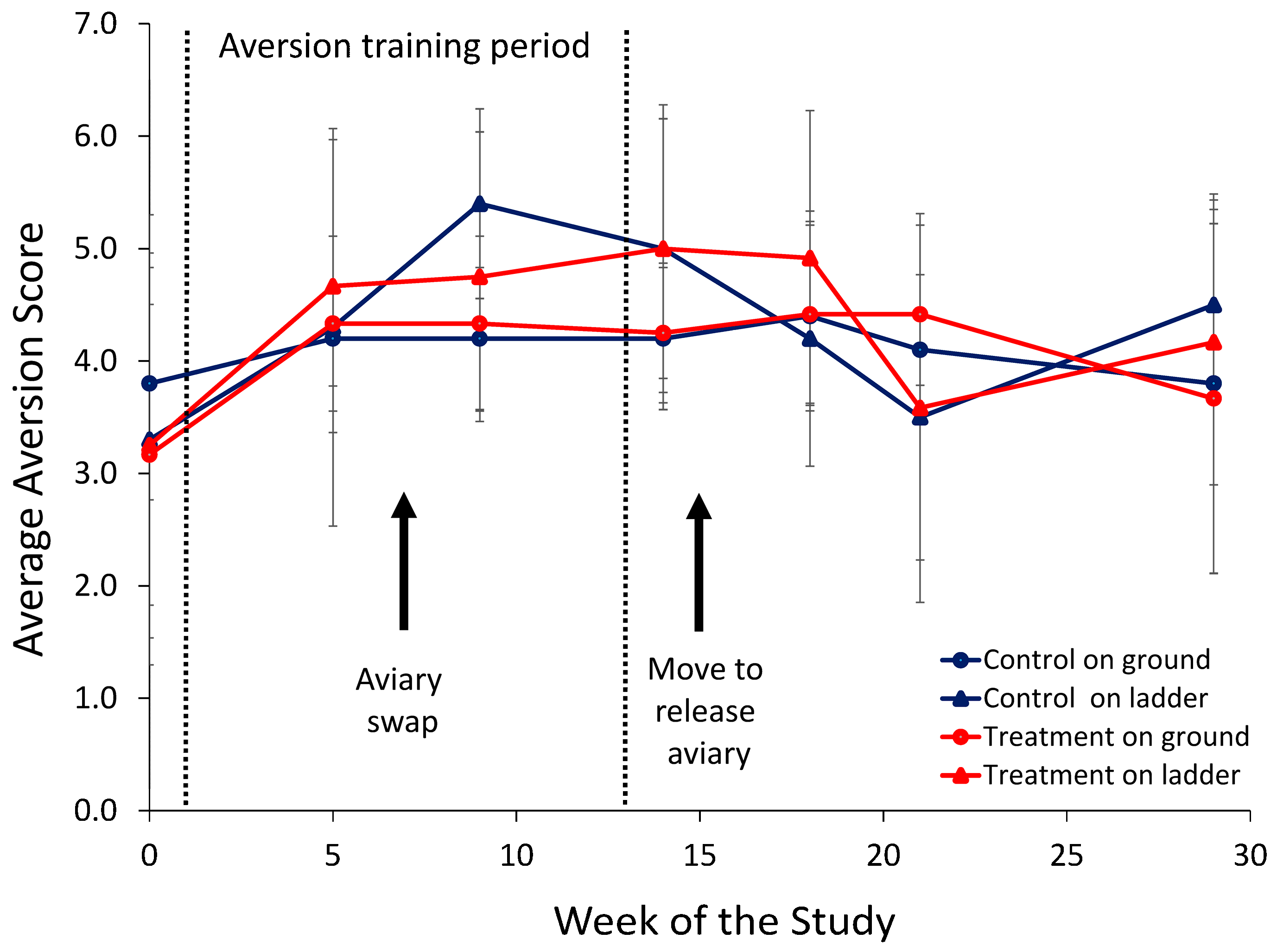
This study investigated whether parrots could be trained to avoid humans using an aversion training protocol, comparing trained birds with a control group that received no training. In general, aversion to humans increased over time for all birds, but this increase was similar between the trained birds and the control group. In addition, recapture rates were broadly similar between the birds that received aversion training and those that did not.
The act of holding the birds in captivity in monospecific groups and the associated captures for movement among cages increased the levels of aversion to humans in the control birds. This increase in aversion over time, while not previously mentioned in the peer-reviewed literature, is commonly discussed by practitioners and has been documented anecdotally by rehabilitators in Belize [
16].
4.1. Impacts of Training
The results of this study suggest possible new interpretations of the findings of Franzone et al. [
15], who also found a significant increase in aversion to humans by
Amazona parrots during a 10-week training regime. However, their work did not use a control group nor track birds post-release. In our work, both the trained birds and the control group showed significant increases in human aversion throughout the study. In Franzone et al.’s study, the trained birds were captured and transported to the training aviary before each training session (multiple times a week for 10 weeks). It is possible that the repeated capture and transport or other aspects of their time in captivity may have had as much impact on the birds in this study as the actual training. This was a trend we noticed in our data as well: the peak in HA scores during training weeks 8 and 9 may have been in response to capturing the birds in week 7. Additionally, environmental factors may influence aversion responses. During week 20 of the FOT, heavy rainfall and local flooding meant it was not logistically feasible to feed the birds the day before the test, and during the test, five treatment birds exhibited increased motivation to approach the observer for food. This suggests that conditions of food scarcity and associated hunger may override learned aversion, highlighting a potential limitation of human aversion training in challenging conditions.
During training, birds were discouraged from approaching humans. However, immediately post-training, they received their usual food from either observers or rescue center staff, who were not disguised. This may have inadvertently weakened the impact of the training by reinforcing a human–food association.
4.2. Post-Release Fate
In total, we confirmed that 40% of the birds released in this study were recaptured by humans in the first two months post-release, and that rate was likely higher, as some of the >35% of birds that disappeared may have also been recaptured by people. Lopes et al. [
19] also found tame birds that were comfortable with approaching humans were recaptured, reporting an incidence of over 30% in
Amazona aestiva released in Brazil. Although work in Brazil documented that rehabilitated
A. aestiva confiscated from the illegal trade had an incidence of just 3% recapture in the first year [
33].
We were most surprised that there was little difference between the rates of recapture between the birds that had received human aversion training and those that had not. There was a trend towards lower capture rates for trained birds, but the sample sizes were small, and the results suggest there was not a large impact of the training on propensity for recapture. Many of the study birds were pets before the study, and the 36 sessions of aversion training may have been insufficient to counteract years of receiving daily food and companionship from humans.
Given that this is the first study to track the post-release fate of birds with aversion training, we have little to which we can compare our findings. However, pre-release training is not universally effective at achieving its stated purpose. In a major review of 47 parrot releases, White et al. [
26] failed to find clear evidence that wild food training and predator aversion training led to higher post-release success. This led the authors to posit that, while likely beneficial, the relationship between pre-release training and post-release success may be variable and complicated. Similar reviews have found that few studies that implement predator aversion training were able to track fates post-release and determine if the training actually increased long-term survival [
31]. While the individual history of the birds in the study is mostly unknown, it is likely that some were pets for many years and would have been completely dependent on humans for their feeding and social interactions. Given the intelligence and memory of large parrots like Amazons, it should not be surprising that a few weeks of training were not enough to break the attraction to humans.
5. Conclusions
Our finding that trained and control birds showed few important differences suggests that this human aversion training protocol had little to no impact on the birds involved, beyond the impacts expected from extended holding periods and the capture, handling, and husbandry associated with normal pre-release procedures. This lack of impact on the birds was observed despite the fact that people of different genders and ethnicities used different types of hazing methods across 14 weeks.
The fact that control birds showed an increase in aversion to humans across the 14-week period confirms the assertions by release practitioners that time with conspecifics and normal capture, handling, and husbandry can increase aversion to humans among
Amazona and other parrots [
16]. It also suggests that over time, even without intensive aversion training, many birds in rehabilitation centers may lose interest in humans and become successful release candidates. However, this process can be extremely long: from 14 months for hand-raised chicks to 9 years for
A. oratrix that had been long-term captives [
16]. For rehabilitation centers and others that do not have the ability to hold release candidates for such long periods and want to minimize post-release recapture rates, using alternative hand-rearing methods [
30] and employing effective aversion training protocol could be very useful.
While the finding that our training protocol was not very effective is unfortunate, it does highlight an important point: release projects should evaluate the financial and time costs of training and their real-world impacts to determine which protocols are worth implementing. We recognize that few release projects may have the ability to run and monitor controlled experiments, like what we did here. However, we suggest that projects should not assume that all training protocols are effective and that projects critically evaluate all evidence (even anecdotal) to better determine what actions actually help their birds transition from captivity to the wild. It is also important to recognize that just because a protocol is effective in one set of circumstances, it may not work for all projects (see White et al. [
26] for comments on predator aversion training).
Large numbers of confiscated parrots are accumulating in rescue centers throughout Latin America and beyond, with many nations logging hundreds to thousands of parrots confiscated per year [
13,
34,
35,
36]. These birds simultaneously represent a potential conservation opportunity and an animal welfare crisis. Unfortunately, birds that approach humans may be classified as unreleasable or have low survival probability post-release. As a result, as long as local communities cannot be convinced not to capture released parrots, creating effective human aversion training may remain important from both a conservation and animal welfare perspective.
For releases where aversion training is deemed necessary, we suggest that future projects use a modified training protocol. Training could start as ours did with relatively benign measures (aversive noises as per Franzone et al. [
15], fake captures as in this paper, etc.) and then move on to harsher (but still ethical) treatments for birds that fail to move away (like capture and brief restraint). For birds that still fail to flee observers, aversion protocols could include holding birds in carriers for longer periods or moving them to new cages, isolated from the social group for up to a few days. Hopefully, these harsher protocols would be more effective than those tried here. In addition, it may help if the birds are not fed by clearly visible people immediately after training, as this could counteract some of the desired aversion. We also suggest that projects release the birds shortly after aversion training ends, to ensure that the effects of training are strongest in the period immediately post-release. Hopefully, such modifications would lead to greater levels of aversion and better post-release success in human-dominated landscapes.
The individual parrots in the study were complex organisms with varied histories, and while we tried to create matched pairs of birds in treatment and control, there was a wide array of factors that we were unable to control for. The behaviors of individual birds before and after release may have been influenced by personality, duration in captivity, time spent at RWRC, relationships with caretakers, post-release foraging ability, etc. As a result, future studies may benefit from measuring additional parameters pre-release to help us better determine how individual characteristics can help predict post-release performance in Amazona and other psittacines.
In summary, our findings do not imply that aversion training cannot work, but that our method, as described here, was not very effective. Effective aversion training may require longer durations or more drastic actions, especially for those birds that have been held as pets for years. Protocols of longer duration that involve actually capturing and holding or otherwise hazing birds may be needed if we are to see meaningful increases in aversion to humans.



 ,
,