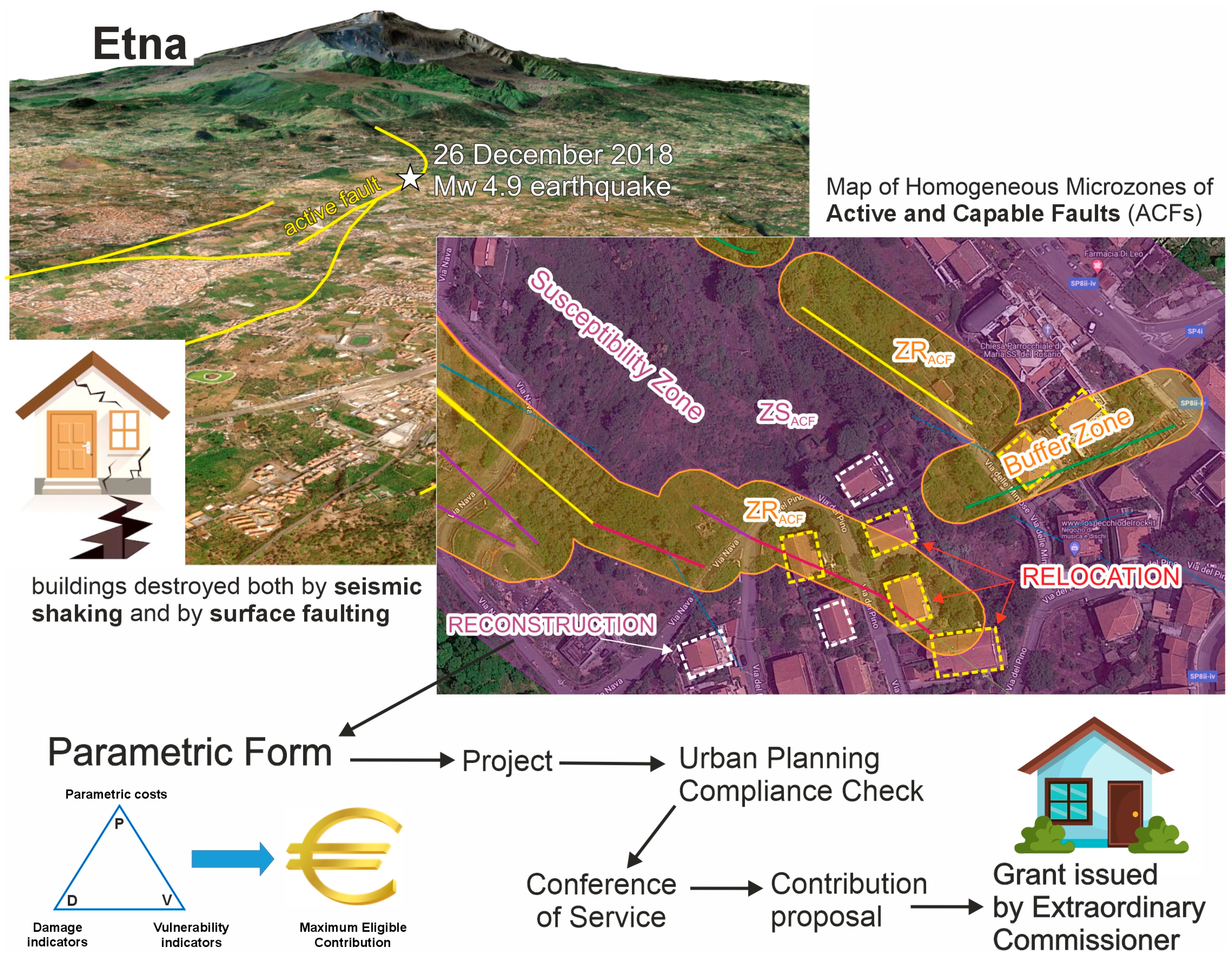
Digital Governance and Geohazard Mitigation in Post-Earthquake Reconstruction: The 2018 Etna Case Study



Abstract
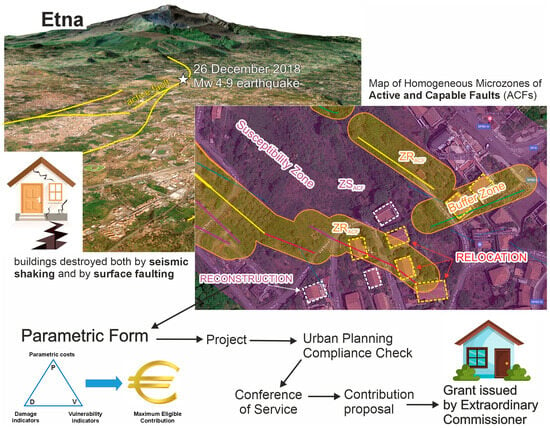
1. Introduction
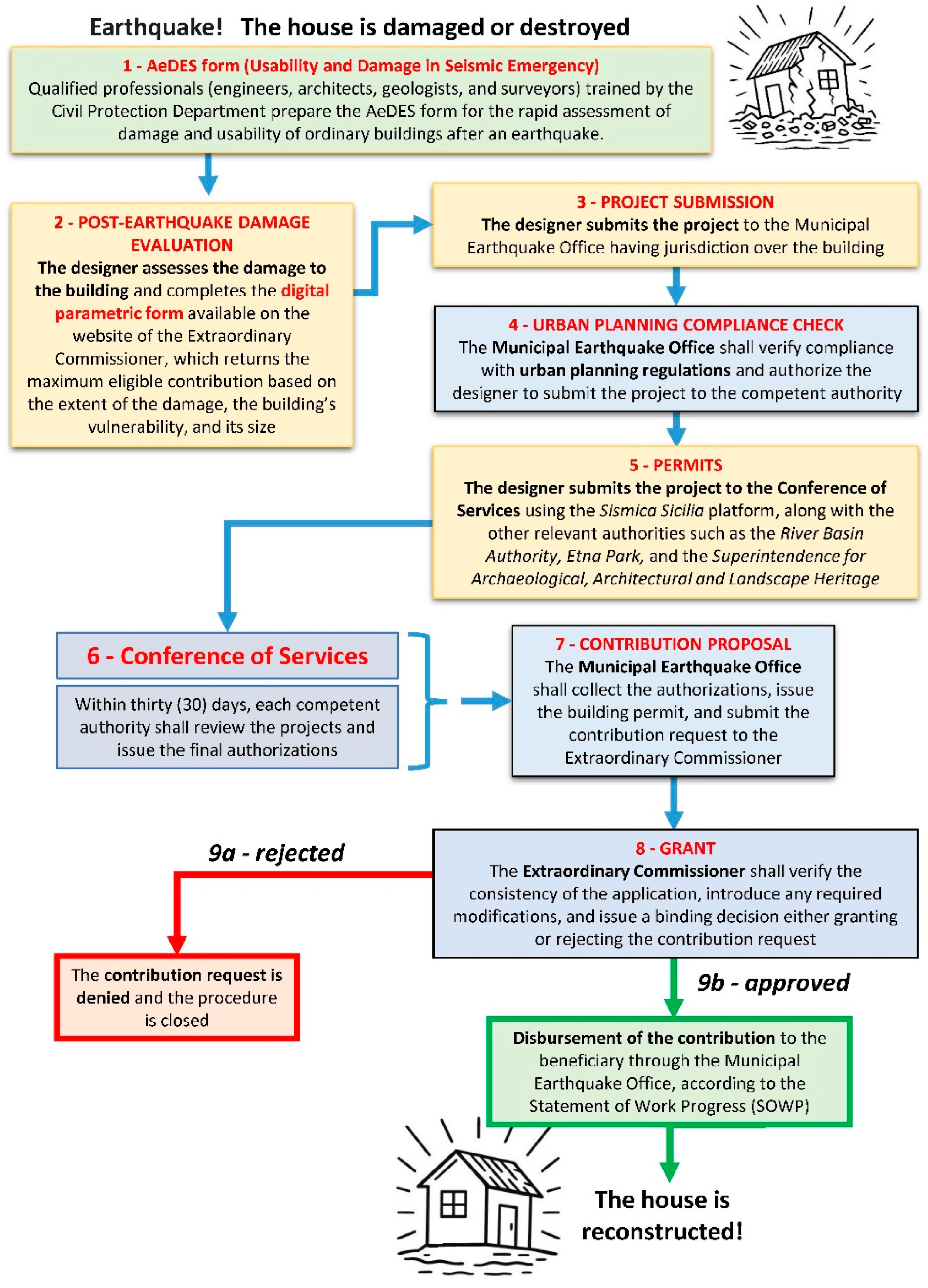
2. Reconstruction Workflow: Methods and Operational Framework
3. Results
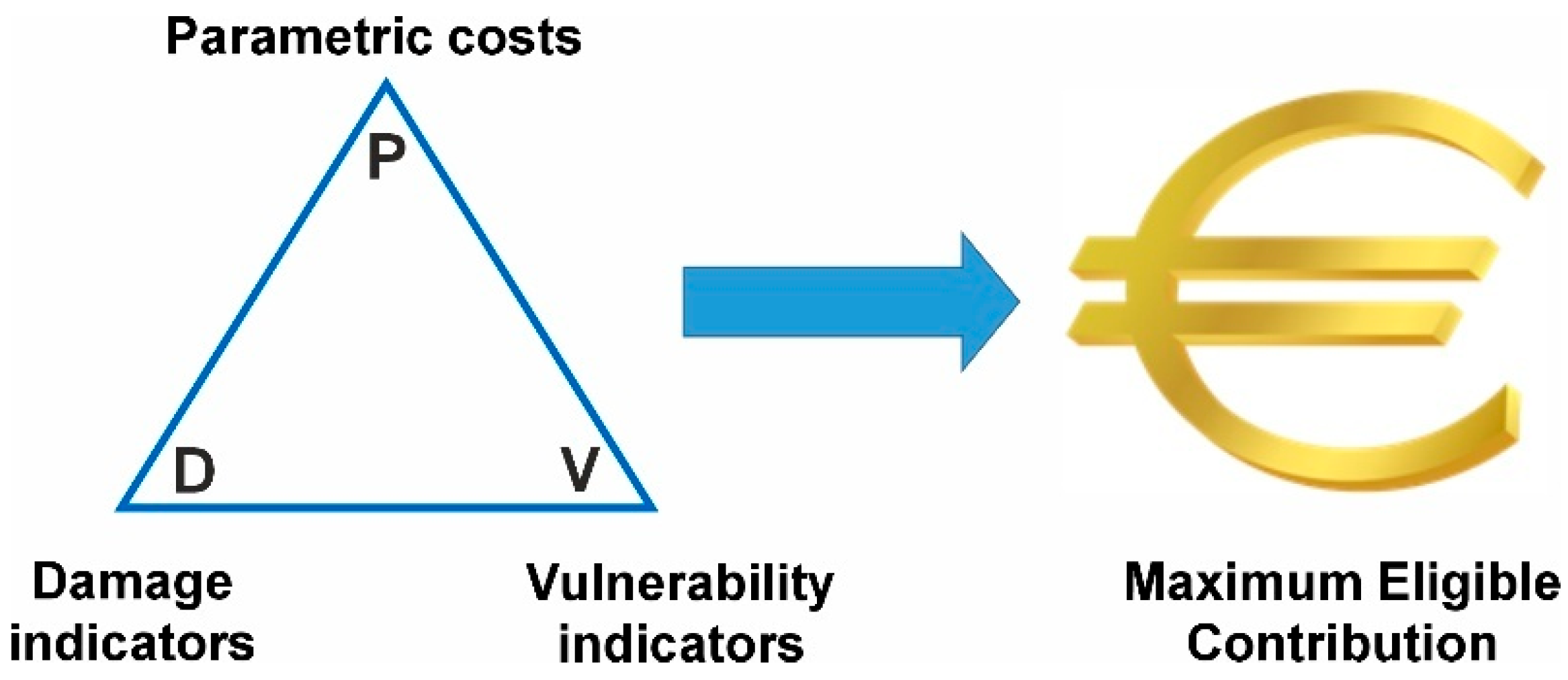
3.1. The Parametric Form

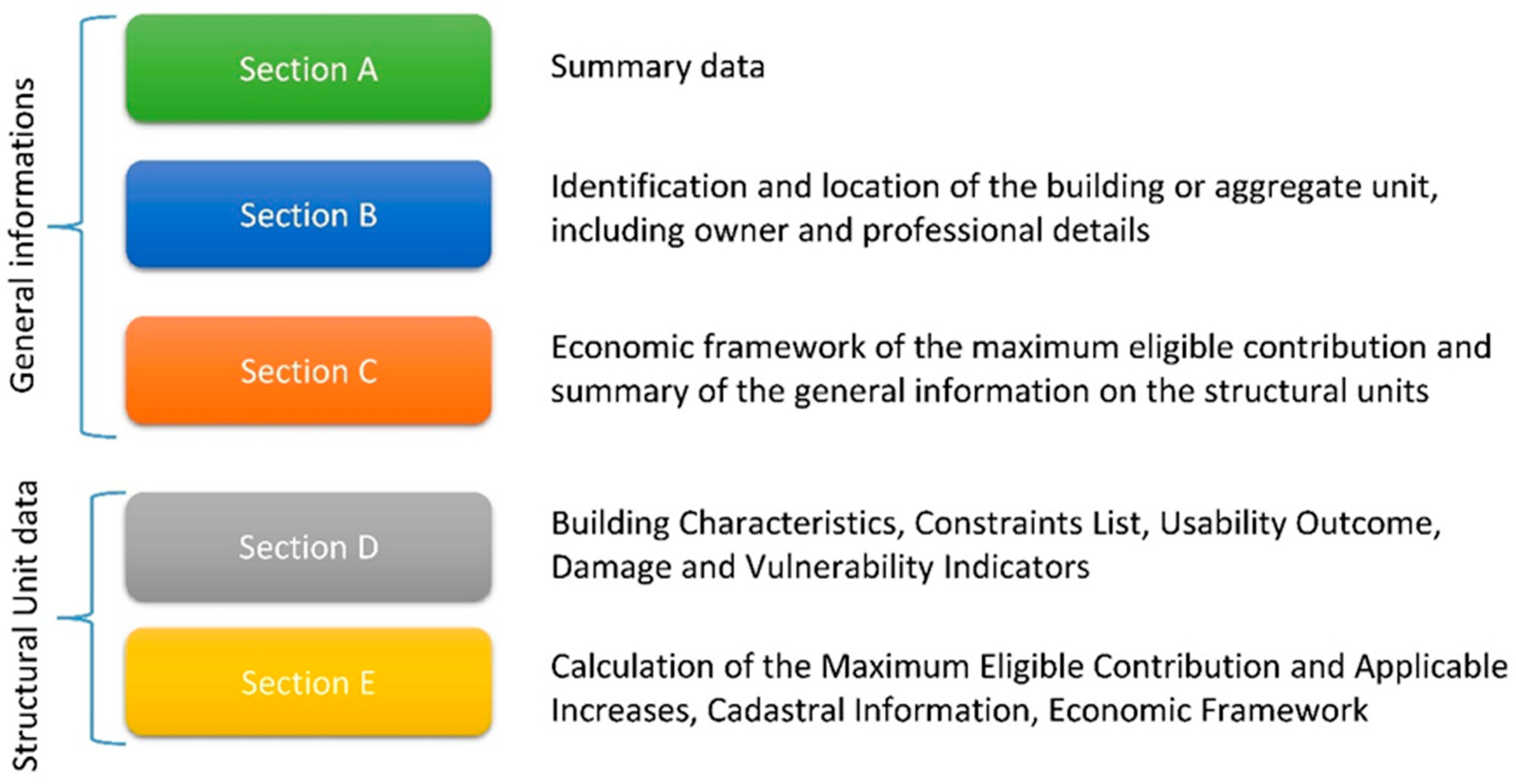
3.2. Structure of the Parametric Form
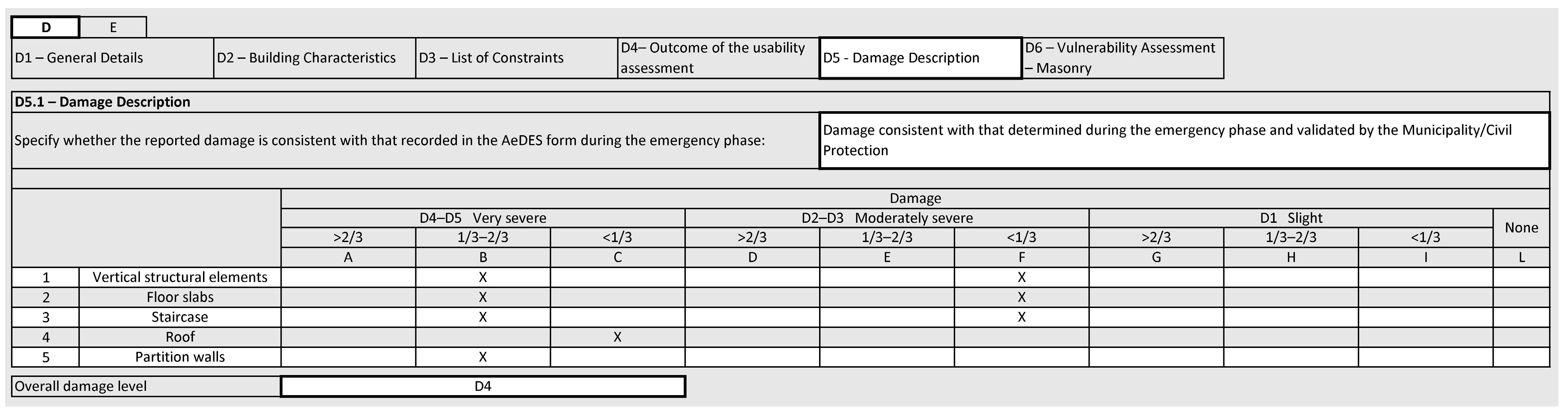
3.3. Assessment of the Damage Sustained by the Building During the Earthquake
- Identify the presence of each of the three damage levels;
- Estimate the extent to be assigned to each level by calculating both the percentage ratio, on each floor, between the damaged portions or surfaces and the total portions or surfaces of that floor, and the percentage ratio between the number of damaged floors and the total number of floors.
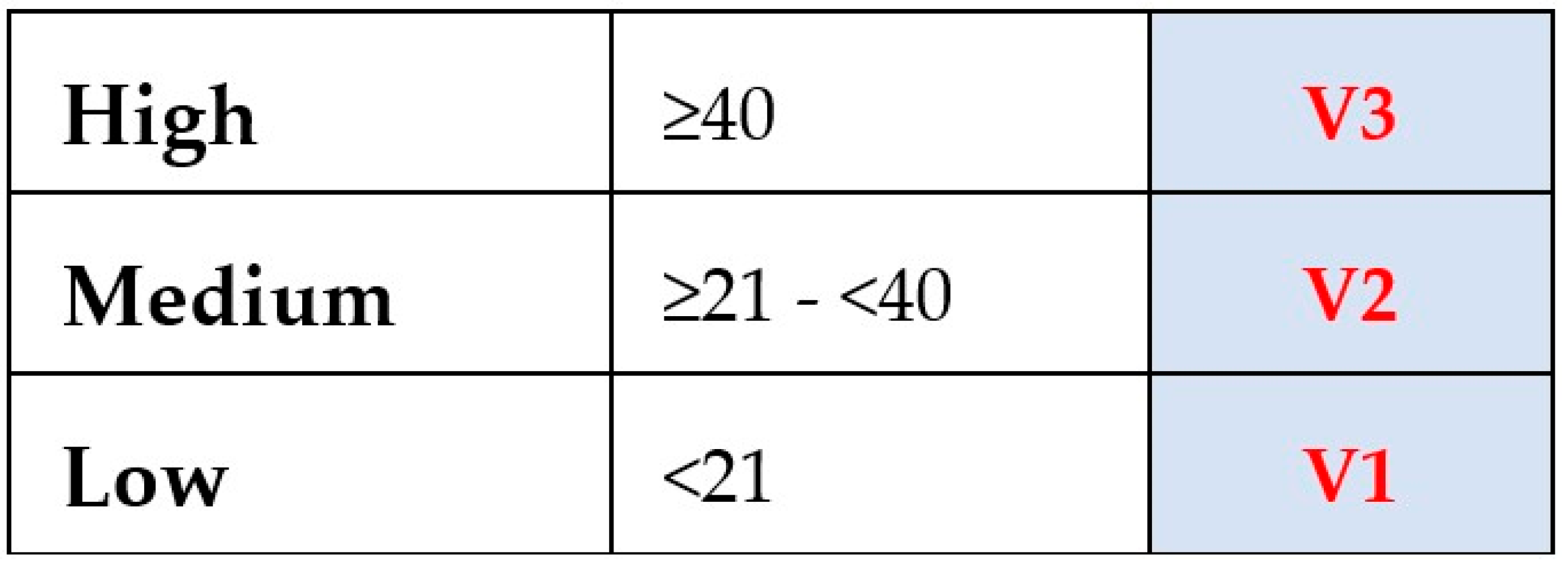
3.4. Vulnerability of Masonry Buildings
3.5. Vulnerability of Reinforced Concrete Buildings
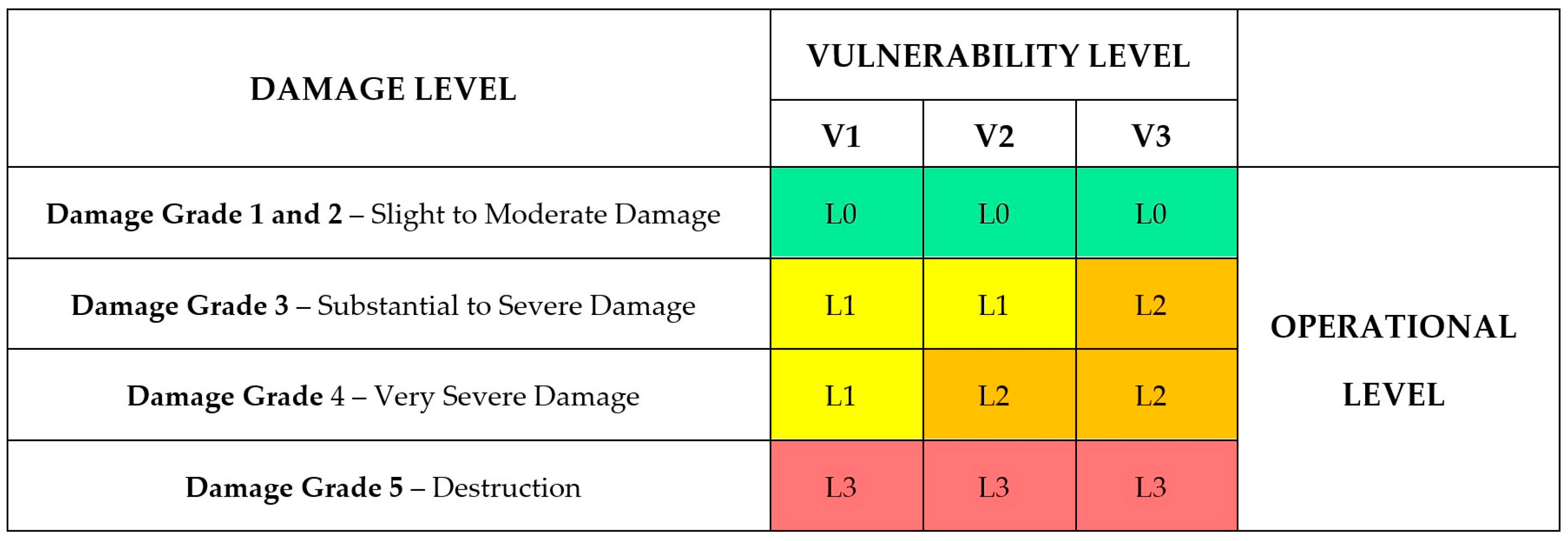
3.6. Quantitative Characterization of Building Damage
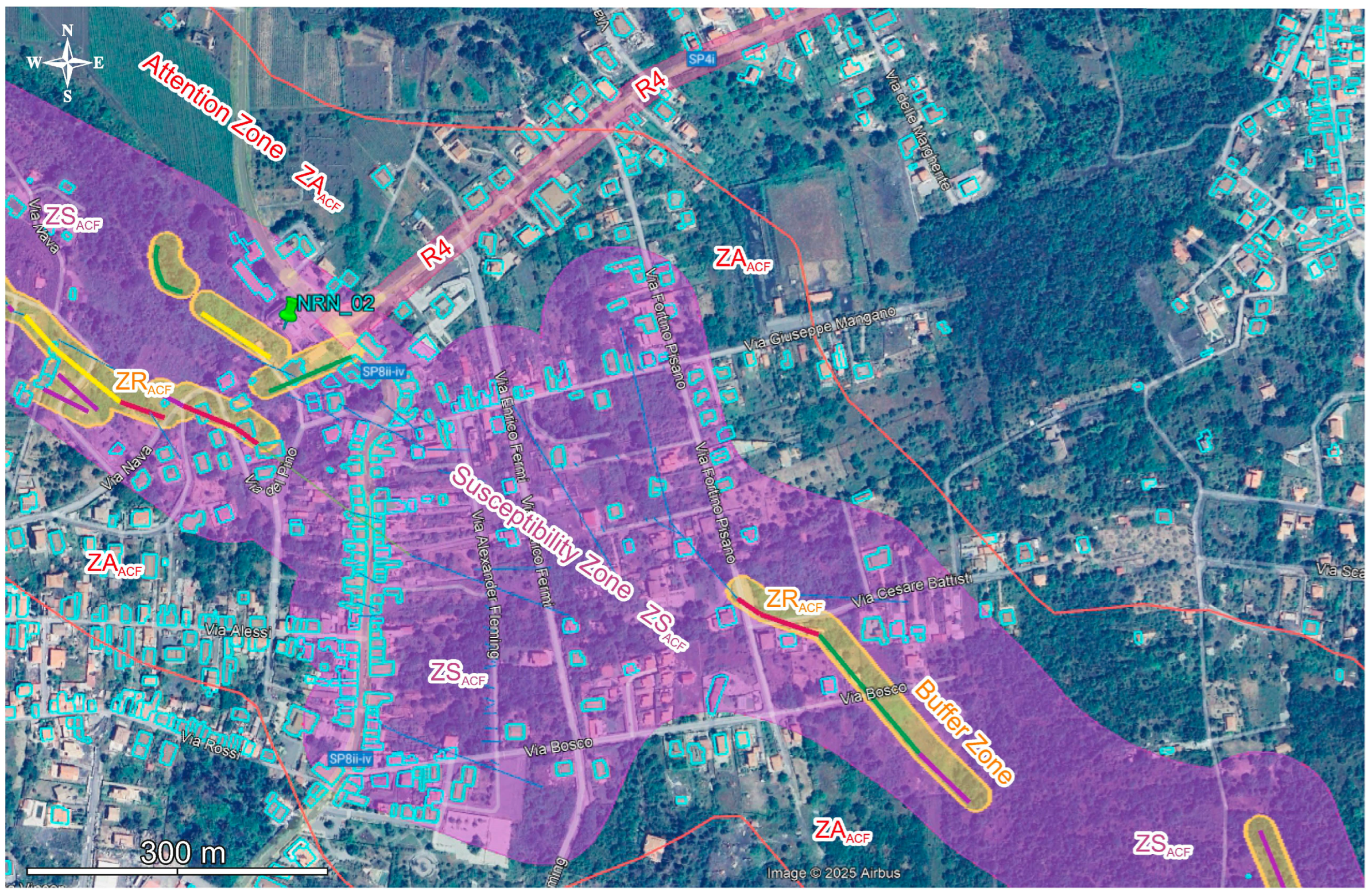
3.7. Vulnerability to Geological Hazards

- Reconstructing the building in another site that is not hazardous and not susceptible to severe dynamic instability;
- Purchasing another equivalent existing building, provided it is habitable and compliant with urban planning, building, and seismic regulations.
- The amplitude of the expected ground motion (peak ground acceleration);
- The time history of the expected seismic accelerations;
- The frequency content of the expected seismic motion, describing how the amplitudes are distributed across different frequencies;
- Stresses and strains (relevant for liquefaction problems and for the stability of slopes and retaining structures).
- A simplified approach, which—while still requiring geotechnical characterization of the soils within the significant volume—is based on classifying the subsoil according to the shear-wave velocity (Vs). For the purpose of identifying the subsoil category, classification is performed using the equivalent shear-wave velocity (VSeq) [24];
- A rigorous approach, which relies on a full local seismic response analysis developed using appropriate software and acceleration time histories, based on site-specific seismic (Vs) and geotechnical (modulus reduction and damping curves) characterization.
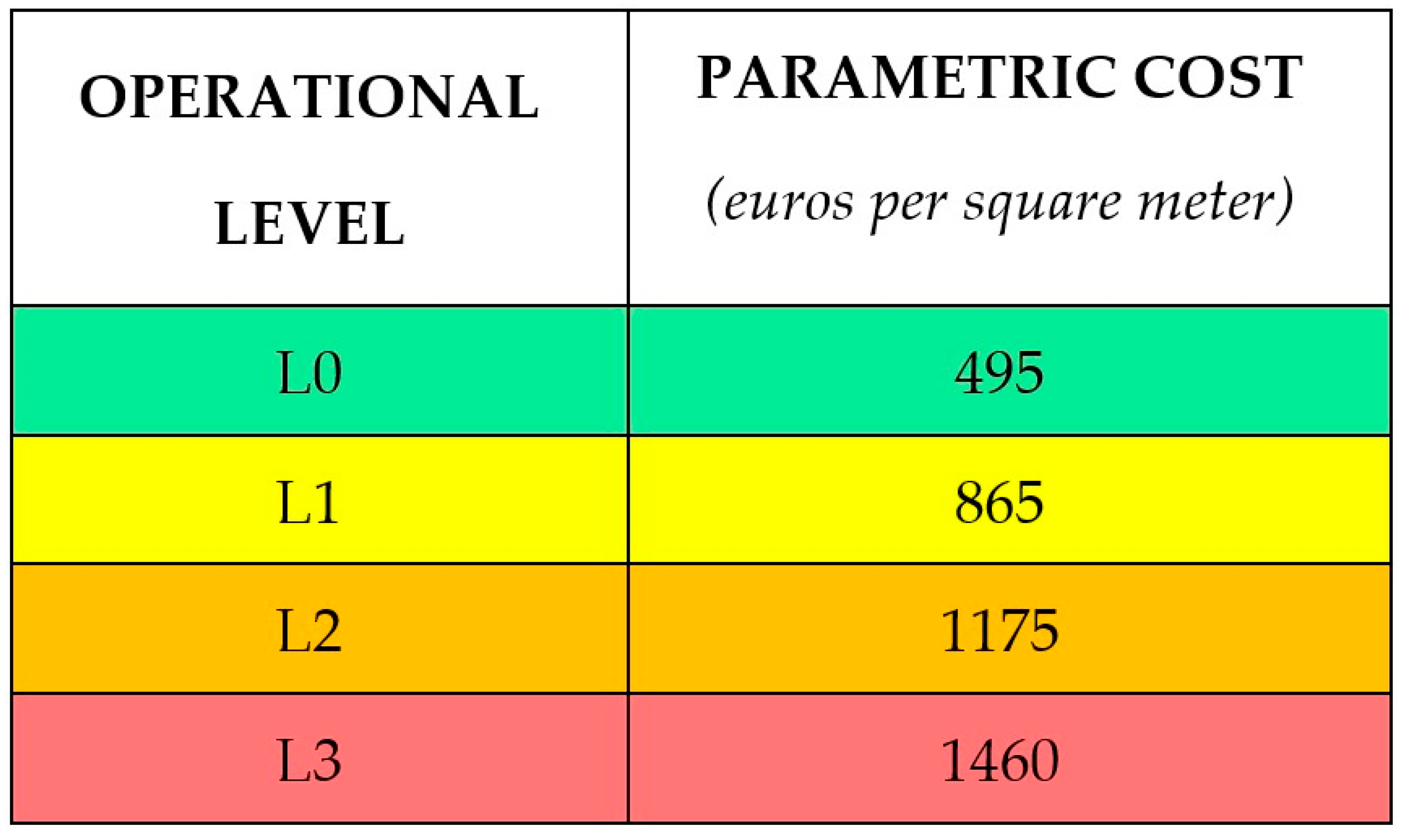
3.8. Illustrative Example of the Calculation Workflow
- Building of cultural interest: +20% (=99 €/m2).
- LSRA-based amplification: +10% (=49.5 €/m2).
- Technical investigations (2%) → 2574 €.
- Specialist studies (LSRA, 0.5%) → 643.5 €.
- Design and professional services (12.5%) → 16,087.5 €.
4. Discussion
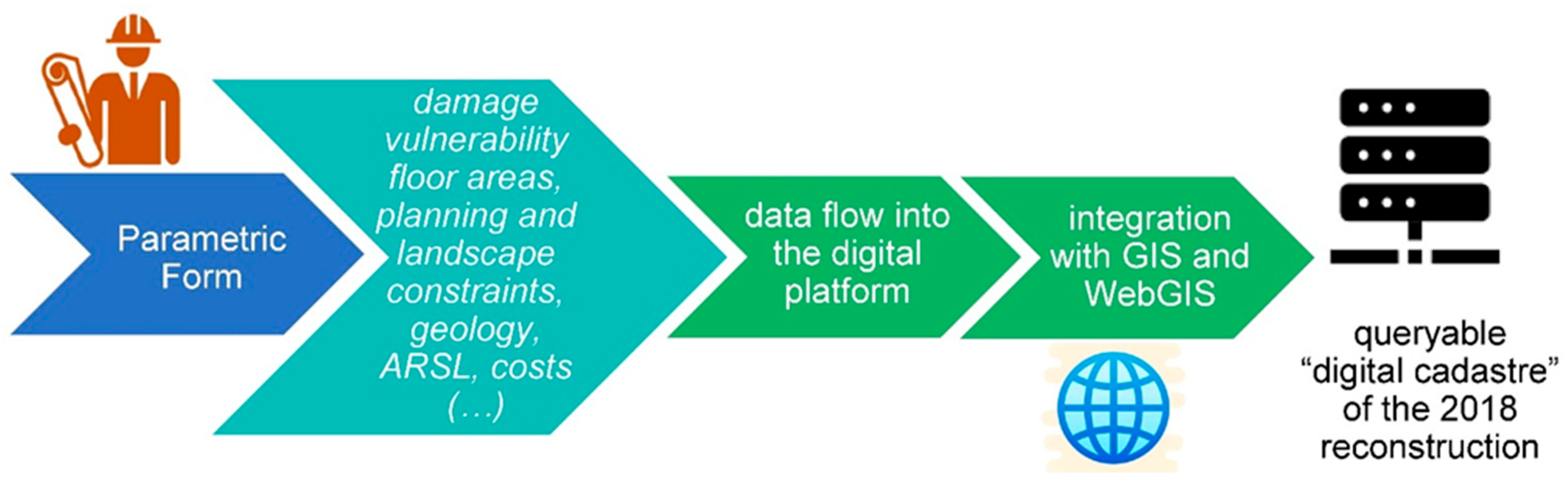
4.1. Usefulness of the Parametric Form as a “Cadaster” of the Reconstruction
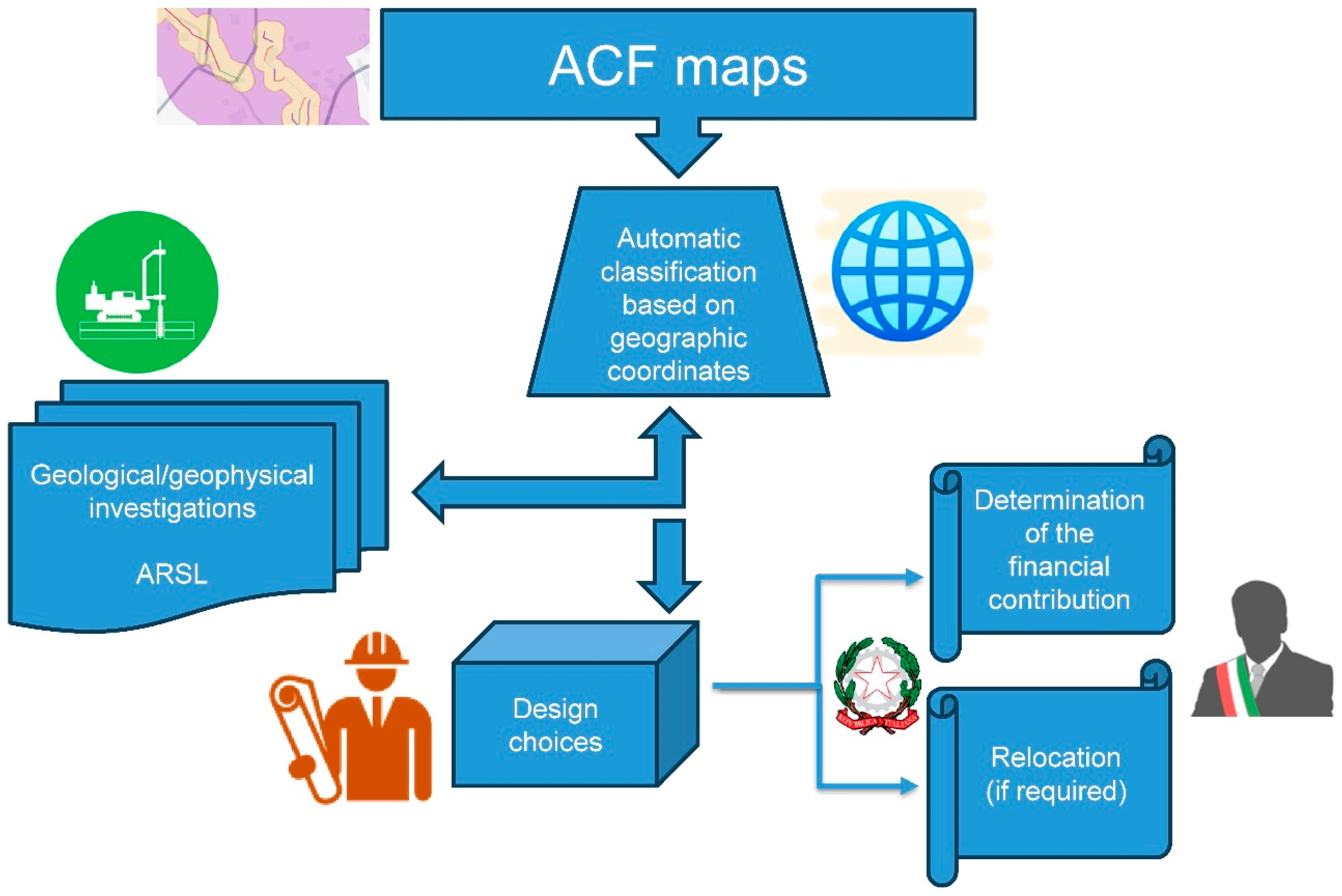
4.2. Geohazard Mitigation
4.2.1. Example of LSRA Application for a Minor Etna Earthquake (M 3.5–4.0)
- Surface PGA: 0.28–0.30 g (≈+25–35% amplification);
- Stratigraphic amplification factor Fa: 1.3–1.4;
- Fundamental site frequency: 1.5–1.8 Hz (HVSR peak), consistent with the estimated thickness of soft deposits.
4.2.2. Comparative Applicability of the Etna Reconstruction Model to Minor Seismic Events
4.3. Usefulness of the Parametric Form for Ensuring Legality
4.4. Comparative Reconstruction Trajectories Across Recent Italian Earthquakes
4.5. Comparison with Other Reconstruction Experiences Worldwide
5. Conclusions
- The digital platform developed under Law 55/2019 [11] standardizes procedures for accessing financial contributions, streamlining communication among citizens, professionals, local administrations, and the Commissioner’s Office. A central component of the system is the Parametric Form, which enables an objective and uniform determination of the eligible contribution based on indicators of damage, vulnerability, and parametric costs.
- The integration between administrative management and geohazard mitigation represents one of the most innovative aspects of the Etna model. Reconstruction is grounded in a preliminary assessment of site-specific hazards, the continuous updating of hazard maps, and procedures that account for local geological, hydrogeological, and geomorphological conditions—transforming reconstruction into an opportunity to reduce the overall vulnerability of the settlement system.
- The platform also ensures high levels of transparency and legality through public-monitoring tools (WebGIS, online dashboards) and the digital traceability of all procedures, contributing to the prevention of illicit interference and strengthening institutional trust.
Author Contributions
Funding
Data Availability Statement
Acknowledgments
Conflicts of Interest
References
- ANAC. Vademecum Ricostruzione Sisma 2016: Indicazioni Operative e Best Practices per Soggetti Attuatori e Stazioni Appaltanti; Autorità Nazionale Anticorruzione: Rome, Italy, 2022; Available online: https://url-shortener.me/5D3H (accessed on 26 December 2025).
- UNDRR. Special Report on the Use of Technology for Disaster Risk Reduction; United Nations Office for Disaster Risk Reduction: Geneva, Switzerland, 2025; Available online: https://www.undrr.org/media/110436/download?startDownload=20251223 (accessed on 22 December 2025).
- Rawat, A.; Witt, E.; Roumyeh, M.; Lill, I. Advanced Digital Technologies in the Post-Disaster Reconstruction Process—A Review Leveraging Small Language Models. Buildings 2024, 14, 3367. [Google Scholar] [CrossRef]
- Aa.Vv. Sisma Abruzzo 2009, Manuale Istruzioni, Scheda P.E.R. L’Aquila; Comune di L’Aquila, Assessorato alla Ricostruzione; Ufficio Speciale per la Ricostruzione del Comune di L’Aquila, Struttura Speciale Alta Consulenza: L’Aquila, Italy, 2013; Available online: https://usra.it/wp-content/uploads/2019/10/QR1-C.pdf (accessed on 22 December 2025).
- USRA. Manuale Istruzioni della Scheda di Accompagnamento ai Progetti di Ricostruzione del Comune dell’Aquila—V02; Ufficio Speciale per la Ricostruzione del Comune dell’Aquila: L’Aquila, Italy, 2014; Available online: https://url-shortener.me/5D36 (accessed on 26 December 2025).
- Commissario Straordinario Ricostruzione. Protocollo d’Intesa tra Commissario Straordinario e Soprintendenze per la Digitalizzazione delle Pratiche Edilizie Post-Sisma 2009 e 2016; Presidenza del Consiglio dei Ministri: Roma, Italy, 2025; Available online: https://url-shortener.me/5D3F (accessed on 26 December 2025).
- Ministero dell’Interno. Protocolli di Legalità e Prevenzione Antimafia nella Ricostruzione Post-Sisma; Ministero dell’Interno: Rome, Italy, 2017. Available online: https://www.interno.gov.it/it/ministero/documenti-linee-guida-e-protocolli (accessed on 22 December 2025).
- Legge 18 Marzo 2025, N. 40—Legge Quadro in Materia di Ricostruzione Post-Calamità; Gazzetta Ufficiale. 1 April 2025. Available online: https://www.gazzettaufficiale.it/eli/id/2025/04/01/25G00047/SG (accessed on 21 December 2025).
- De Novellis, V.; Atzori, S.; De Luca, C.; Manzo, M.; Valerio, E.; Bonano, M.; Cardaci, C.; Castaldo, R.; Di Bucci, D.; Casu, F.; et al. DInSAR analysis and analytical modeling of Mount Etna displacements: The December 2018 volcano-tectonic crisis. Geophys. Res. Lett. 2019, 46, 5817–5827. [Google Scholar] [CrossRef]
- Decreto Legge 32/2019. Disposizioni Urgenti per il Rilancio del Settore dei Contratti Pubblici, per l’Accelerazione Degli Interventi Infrastrutturali, di Rigenerazione Urbana e di Ricostruzione a Seguito di Eventi Sismici. (19G00040) (GU Serie Generale n.92 18-04-2019) (G.U. 17/06/2019, N. 140). Available online: https://bit.ly/4q0QqwE (accessed on 26 December 2025).
- Legge 55/2019. Conversione in Legge, con Modificazioni, del Decreto-Legge 18 Aprile 2019, N. 32, Recante Disposizioni Urgenti per il Rilancio del Settore dei Contratti Pubblici, per l’Accelerazione Degli Interventi Infrastrutturali, di Rigenerazione Urbana e di Ricostruzione a Seguito di Eventi Sismici. (19G00062) (GU Serie Generale n.140 del 17-06-2019). Available online: https://www.gazzettaufficiale.it/eli/id/2019/06/17/19G00062/sg (accessed on 21 December 2025).
- Scapellato, S. Scheda Parametrica—Manuale Istruzioni—Rev. 0; Presidenza del Consiglio dei Ministri Commissario Straordinario Area Etnea Sisma 2018. 2022. Available online: https://bit.ly/3LiaawE (accessed on 26 December 2025).
- Aa.Vv. Manuale per la Compilazione della Scheda di 1° Livello di Rilevamento Danno, Pronto Intervento e Agibilità per Edifici Ordinari nell’Emergenza Post-Sismica (AeDES), 2nd ed.; Presidenza del Consiglio dei Ministri, Dipartimento Della Protezione Civile, Collana Tecnica: Rome, Italy, 2014. [Google Scholar]
- Regione Siciliana. Prezzario Unico Regionale per i Lavori Pubblici; Decreto N. 01/Gab. 14 January 2025. Available online: https://bit.ly/4jcAUv8 (accessed on 23 December 2025).
- Tringali, G.; Bella, D.; Livio, F.A.; Blumetti, A.M.; Groppelli, G.; Guerrieri, L.; Neri, M.; Adorno, V.; Pettinato, R.; Michetti, A.M.; et al. New paleoseismological and morphotectonic investigations along the 2018 surface ruptures of the Fiandaca Fault, eastern flank of Etna volcano (Italy). Solid Earth 2025, 16, 1473–1491. [Google Scholar] [CrossRef]
- Technical Commission on Seismic Microzonation. Seismic Microzonation: Land Use Guidelines for Areas with Active and Capable Faults (ACF), Vers. 1.0; Conference of Regions and Autonomous Provinces of Italy—Presidency of the Council of Ministers of the Italian Republic: Rome, Italy, 2015; Available online: https://h7.cl/1hU1V (accessed on 15 January 2026).
- CMTE Working Group. Catalogo Macrosismico dei Terremoti Etnei, 1832–2008; INGV: Catania, Italy, 2008; Available online: https://www.ct.ingv.it/macro/etna/index.html (accessed on 22 December 2025).
- Siniscalchi, A.; Tripaldi, S.; Neri, M.; Balasco, M.; Romano, G.; Ruch, J.; Schiavone, D. Flank instability structure of Mt. Etna inferred by a magnetotelluric survey. J. Geophys. Res. 2012, 117, B03216. [Google Scholar] [CrossRef]
- D’Amico, S.; Azzaro, R.; Tusa, G.; Tuvè, T.; Varini, E. Volcano-tectonic seismicity and related hazard: A component of the multi-hazard assessment in the highly exposed region of Mt. Etna (Italy). Ann. Geophys. 2025, 68, V101. [Google Scholar] [CrossRef]
- Presidenza del Consiglio dei Ministri. Mappe delle Microzone Omogenee delle Faglie Attive e Capaci (FAC) e Mappe del Dissesto Idrogeologico; Commissario Straordinario Area Etnea: Acireale, Italy, 2020; Available online: https://bit.ly/3YRabKZ (accessed on 26 December 2025).
- Ordinanza n. 18/2020. Delocalizzazione di Edifici Ricadenti Nella Zona di Rispetto (ZRFAC); Presidenza del Consiglio dei Ministri Commissario Straordinario Area Etnea Sisma 2018. 2020. Available online: https://bit.ly/4oY0nLm (accessed on 24 August 2025).
- Neri, M.; Neri, E. Integrating Geoscience, Ethics, and Community Resilience: Lessons from the Etna 2018 Earthquake. Geosciences 2025, 15, 333. [Google Scholar] [CrossRef]
- Neri, M.; Neri, E. Etna 2018 earthquake: Rebuild or relocate? Applying geoethical principles to natural disaster recovery planning. J. Geoethics Soc. Sci. 2024, 2, 1–28. [Google Scholar] [CrossRef]
- NTC. Aggiornamento delle Norme Tecniche per le Costruzioni; Gazzetta Ufficiale, Serie Generale n.42 20-02-2018—Suppl. Ordinario N. 8. Available online: https://www.gazzettaufficiale.it/eli/id/2018/2/20/18A00716/sg (accessed on 21 December 2025).
- Bonforte, A.; Guglielmino, F.; Puglisi, G. Large dyke intrusion and small eruption: The December 24, 2018 Mt. Etna eruption imaged by Sentinel-1 data. Terra Nova 2019, 31, 405–412. [Google Scholar] [CrossRef]
- Aloisi, M.; Bonaccorso, A.; Cannavò, F.; Currenti, G.; Gambino, S. The 24 December 2018 eruptive intrusion at Etna volcano as revealed by multidisciplinary continuous deformation networks (CGPS, borehole strainmeters and tiltmeters). J. Geophys. Res. Solid Earth 2020, 125, e2019JB019117. [Google Scholar] [CrossRef]
- Presidenza del Consiglio dei Ministri. Piano di Delocalizzazione—Primo Stralcio; Commissario Straordinario Area Etnea Sisma 2018. 2020. Available online: https://url-shortener.me/5D3M (accessed on 26 December 2025).
- Consiglio Superiore dei Lavori Pubblici. Circolare N. 7—Istruzioni per l’Applicazione dell’Aggiornamento Delle Norme Tecniche per le Costruzioni di cui al D.M. 17 Gennaio 2018; CSLP: Rome, Italy, 2019. [Google Scholar]
- Agrawal, H.; McCloskey, J. Estimating ground motion intensities using simulation-based estimates of local crustal seismic response. Nat. Hazards Earth Syst. Sci. 2024, 24, 3519–3536. [Google Scholar] [CrossRef]
- UNISDR. Sendai Framework for Disaster Risk Reduction 2015–2030; United Nations Office for Disaster Risk Reduction: Geneva, Switzerland, 2015; Available online: https://www.undrr.org/media/16176/download?startDownload=20251222 (accessed on 24 December 2025).
- Dpr 445/2000. Decreto del Presidente della Repubblica 28 Dicembre 2000, N. 445; Testo Unico Delle Disposizioni Legislative e Regolamentari in Materia di Documentazione Amministrativa. (Testo A). Gazzetta Ufficiale, Serie Generale n.42 20 February 2001—Suppl. Ordinario N. 30. Available online: https://www.gazzettaufficiale.it/eli/id/2001/02/20/001G0049/sg (accessed on 23 December 2025).
- Missione Antimafia Sisma. Protocollo di Legalità. 2021. Available online: https://bit.ly/3YLh4gR (accessed on 22 December 2025).
- Shao, Y.; Sun, Y. Examining governance of post-earthquake reconstruction planning from an evolutionary resilience perspective. J. Disaster Res. Built Envir. 2023, 16, 38–56. [Google Scholar] [CrossRef]
- Otani, J. (Ed.) Reconstructing Resilient Communities after the Wenchuan Earthquake: Disaster Recovery in China; Lexington Books: Lanham, MD, USA, 2023. [Google Scholar]
- Lamond, J.; Proverbs, D.; Booth, C.; Mannakkara, S.; Wilkinson, S. Build Back Better principles for post-disaster structural improvements. Struct. Surv. 2013, 31, 314–327. [Google Scholar] [CrossRef]
- Rodrigo, N.; Wilkinson, S. Impact of post-disaster government policy on reconstruction: A case study of post-earthquake Christchurch, New Zealand. Int. J. Constr. Supply Chain. Manag. 2020, 10, 172–193. [Google Scholar] [CrossRef]
- Nakagawa, Y.; Shaw, R. Social capital: A missing link to disaster recovery. Int. J. Mass Emergencies Disasters 2004, 22, 5–34. [Google Scholar] [CrossRef]
- Lizarralde, G.; Johnson, C.; Davidson, C. (Eds.) Rebuilding After Disasters: From Emergency to Sustainability; Spon Press: London, UK; New York, NY, USA, 2010. [Google Scholar]
- Schuller, M. Humanitarian Aftershocks in Haiti; Rutgers University Press: New Brunswick, NJ, USA, 2016. [Google Scholar]
- Schuller, M. Killing with Kindness: Haiti, International Aid, and NGOs; Rutgers University Press: New Brunswick, NJ, USA, 2012. [Google Scholar]
- Erdik, M. Report on 1999 Kocaeli and Düzce (Turkey) Earthquakes. In Structural Control for Civil and Infrastructure Engineering; World Scientific: Singapore, 2001; pp. 149–186. [Google Scholar] [CrossRef]
- Vuran, E.; Serhatoğlu, C.; Timurağaoğlu, M.; Smyrou, E.; Bal, İ.E.; Livaoğlu, R. Damage observations of RC buildings from 2023 Kahramanmaraş earthquake sequence and discussion on the seismic code regulations. Bull. Earthq. Eng. 2025, 23, 1153–1182. [Google Scholar] [CrossRef]
- Bosher, L.; Chmutina, K. Disaster Risk Reduction for the Built Environment; Wiley Blackwell: Oxford, UK, 2017. [Google Scholar]
- Khosrowshahi, F.; Arayici, Y. Roadmap for Implementation of BIM in the UK Construction Industry. Engineering. Constr. Archit. Manag. 2012, 19, 610–635. [Google Scholar] [CrossRef]



| Simplified Vulnerability Assessment Model | V3 = High | V2 = Medium | V1 = Low | V3 | V2 | V1 |
|---|---|---|---|---|---|---|
| Quality of masonry | Chaotic texture with roughly hewn, irregular stones arranged without any horizontal alignment or regular courses. Through-stones (diatones) are absent or very limited, and joints are uneven, often filled with weak or inconsistent mortar | Roughly hewn or split-face stones, occasional courses that provide some degree of horizontal alignment. Through-stones (diatones) may be present but are not consistently distributed | Squared stones or solid bricks, featuring a regular texture with well-defined courses. Through-stones (diatones) are consistently present. Joints are generally uniform and well executed | 15 | 8 | 4 |
| Quality of the masonry connections at corners and wall junctions | Absent | Irregular | Regular alternation of elements | 6 | 4 | 1 |
| Presence of overhanging masonry, at least on one level, bearing on horizontal structures for at least 10% of the floor plan area | Present | Absent | 3 | 0 | 0 | |
| Large spacing between successive load-bearing walls (maximum span-to-masonry-thickness ratio greater than 14) | >14 | ≥10 and <14 | <10 | 4 | 2 | 0 |
| Floor structures: connection to the vertical load-bearing elements | Absent or poorly connected | Ineffective connections | Well connected | 10 | 5 | 0 |
| Roof structures: connection to the vertical load-bearing elements | Absent, Poorly connected/heavy | Ineffective connections | Well connected | 8 | 5 | 2 |
| Presence of floor systems set on staggered levels with an offset greater than one-third of the story height | YES | NO | NO | 4 | 1 | 1 |
| Lack of connections between non-structural elements and the structural system | Absent | Ineffective | Effective | 4 | 2 | 0 |
| Position within the building aggregate | End unit/corner position | Protruding internal unit | Internal unit | 3 | 0 | 0 |
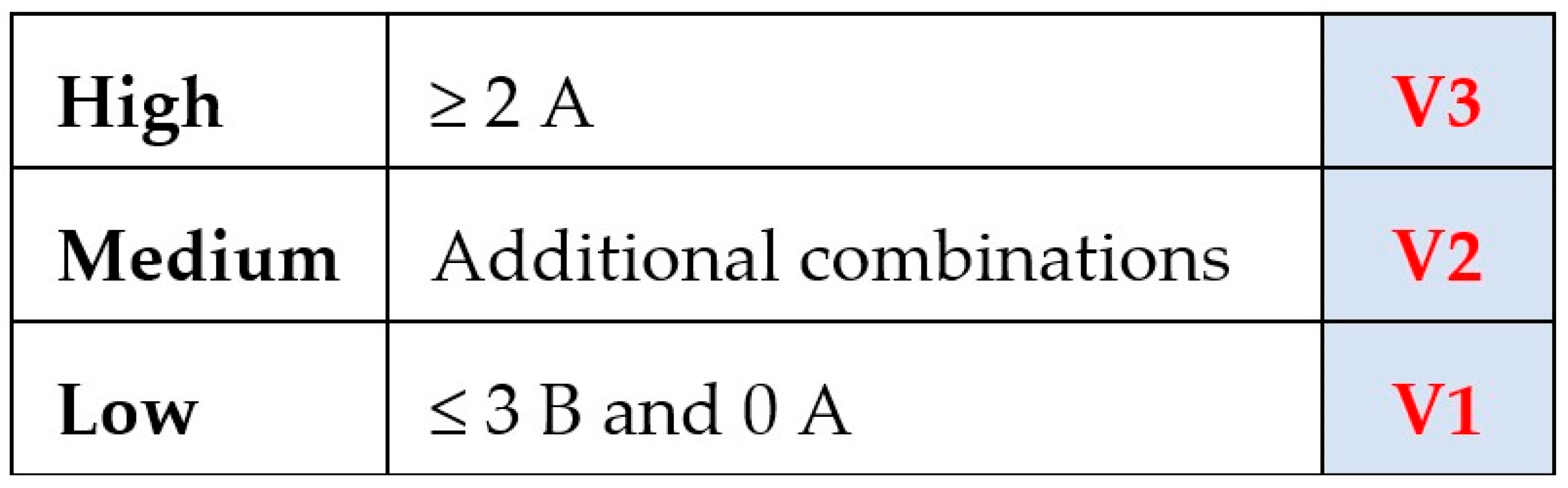
| Total maximum score | 57 | 27 | 8 |
| Summary Table of Major Construction Deficiencies | A | B | YES | Score | NO | Score |
|---|---|---|---|---|---|---|
| Plan regularity | X | absent | 0 | high | 2 | |
| Floor stiffness | X | absent | 0 | low | 1 | |
| In plan distribution of infill walls | X | absent | 0 | low | 1 | |
| Vertical distribution of infill walls | X | absent | 0 | low | 1 | |
| Presence of short columns | X | high | 2 | absent | 0 | |
| Deficiency of the load bearing system | X | high | 2 | absent | 0 | |
| State of conservation | X | low | 1 | absent | 0 | |
| Absence of seismic separation joint | X | absent | 0 | low | 1 | |
| Load on columns | X | high | 2 | absent | 0 | |
| Concrete strength | X | high | 2 | absent | 0 | |
| Construction period | X | low | 1 | absent | 0 |
| Category | Applications Submitted | Applications Processed | Applications Pending | Percentage of Applications Processed |
|---|---|---|---|---|
| Reconstruction | 1364 | 1178 | 186 | 86% |
| Relocation | 65 | 65 | 0 | 100% |
| Retaining walls | 48 | 43 | 5 | 90% |
| Total | 1477 | 1286 | 191 | 87% |
| Category | Projects Submitted | Projects or Works in Progress | Number of Completed Works | Percentage of Completed Works |
|---|---|---|---|---|
| Public works | 30 | 24 | 6 | 20% |
| Places of worship | 28 | 22 | 6 | 21% |
| Total | 58 | 46 | 12 | 21% |
| Issuance and Drafting of Commissioner Ordinances | Design Phase | Urban Compliance Verification and Services Conference | Congruity Analysis and Funding Decree | Building Reconstruction | Total |
|---|---|---|---|---|---|
| 400 | 190–250 | 532 | 52 | 502 | 1736 |
| Case Study | Governance Model | Geohazard Integration | Digital Tools | Legal/Anti-Corruption Safeguards | Reconstruction Approach | Key Strengths | Main Weaknesses/Criticalities |
|---|---|---|---|---|---|---|---|
| China (Sichuan 2008) | Centralized, multi-phase | Strong zoning; relocations; microzonation | GIS; limited digitalization | Low transparency | Transformative | Fast rebuilding; major urban renewal | Low participation; weak traceability |
| Christchurch (2010–11) | Centralized (CERA) | Liquefaction zoning; red zones | GIS; no parametric tools | Strong safeguards | State-led redesign | Clear vision; hazard-based planning | Slow; costly; limited community role |
| Japan (Kobe 1995) | National + local | Codes updated; limited relocation | Early GIS; advanced engineering | Strong compliance | Urban regeneration | High standards; rapid code reform | Limited digital integration; high costs |
| Nepal (2015) | Decentralized; owner-driven | Uneven microzonation | Minimal digitalization | Weak safeguards | Owner-driven | Community empowerment | Slow; inconsistent quality; no traceability |
| Haiti (2010) | Fragmented; weak state | Hazard ignored | No digital systems | Very weak safeguards | Donor-driven | Fast NGO response | Failed governance; unsafe rebuilding |
| Turkey (1999; 2023) | Centralized but uneven | Poor hazard enforcement | GIS for emergencies | Regulatory gaps | State-led | Strong emergency response | Weak code enforcement; governance gaps |
| Etna, Italy (2018) | Commissioner-led; digital platform | Full ACF integration; LSRA; relocation | GIS + WebGIS + platform + Parametric Form | Strong anti-mafia controls | Parametric, hazard-driven | Unique integration of hazards + digitalization + legality | Needs data updates; training; regulatory scaling |
Disclaimer/Publisher’s Note: The statements, opinions and data contained in all publications are solely those of the individual author(s) and contributor(s) and not of MDPI and/or the editor(s). MDPI and/or the editor(s) disclaim responsibility for any injury to people or property resulting from any ideas, methods, instructions or products referred to in the content. |
© 2026 by the authors. Licensee MDPI, Basel, Switzerland. This article is an open access article distributed under the terms and conditions of the Creative Commons Attribution (CC BY) license.
Share and Cite
Scapellato, G.; Licciardello, G.; Blanco, G.L.M.; Campione, F.; Carbone, M.L.; Castorina, S.; Londino, A.M.; Riggio, M.; Sapienza, G.; Scrofana, G.; et al. Digital Governance and Geohazard Mitigation in Post-Earthquake Reconstruction: The 2018 Etna Case Study. GeoHazards 2026, 7, 16. https://doi.org/10.3390/geohazards7010016
Scapellato G, Licciardello G, Blanco GLM, Campione F, Carbone ML, Castorina S, Londino AM, Riggio M, Sapienza G, Scrofana G, et al. Digital Governance and Geohazard Mitigation in Post-Earthquake Reconstruction: The 2018 Etna Case Study. GeoHazards. 2026; 7(1):16. https://doi.org/10.3390/geohazards7010016
Chicago/Turabian StyleScapellato, Giovanni, Giuseppe Licciardello, Giuseppe Lorenzo Maria Blanco, Francesco Campione, Maria Letizia Carbone, Salvatore Castorina, Antonio Mirko Londino, Mariangela Riggio, Giuseppe Sapienza, Giuseppe Scrofana, and et al. 2026. "Digital Governance and Geohazard Mitigation in Post-Earthquake Reconstruction: The 2018 Etna Case Study" GeoHazards 7, no. 1: 16. https://doi.org/10.3390/geohazards7010016
APA StyleScapellato, G., Licciardello, G., Blanco, G. L. M., Campione, F., Carbone, M. L., Castorina, S., Londino, A. M., Riggio, M., Sapienza, G., Scrofana, G., Tomarchio, S., Scalia, S., & Neri, M. (2026). Digital Governance and Geohazard Mitigation in Post-Earthquake Reconstruction: The 2018 Etna Case Study. GeoHazards, 7(1), 16. https://doi.org/10.3390/geohazards7010016