1. Introduction
In the contemporary business environment, the integration of Environmental, Social, and Governance (ESG) factors into corporate strategy has become increasingly imperative. Over the past decade, ESG considerations have transitioned from being niche concerns to central elements of strategic business planning and investment decision-making. This shift is largely driven by a growing recognition that long-term corporate sustainability is inextricably linked to a company’s impact on the environment, its social responsibilities, and the robustness of its governance structures.
Recent estimates indicate that the market capitalization of the ESG-related economy has exceeded 7.9 trillion dollars globally, reflecting the significant role these factors now play in the financial markets [
1]. As investors and stakeholders continue to prioritize responsible and sustainable business practices, the demand for reliable and consistent ESG assessments have surged. However, as ref. [
2] assessed, evaluating the true impact of a company’s ESG initiatives remains a complex challenge, primarily due to the lack of standardization in ESG reporting and the inconsistencies this creates across different industries and regions.
One of the primary obstacles in the evaluation of ESG performance is the absence of a unified standard for ESG disclosures. Companies often report ESG data using diverse metrics and methodologies, leading to substantial difficulties in comparing ESG performance across different entities. Moreover, ESG rating agencies frequently produce divergent assessments of the same company, largely due to differences in the metrics they consider important, the methods they use to measure these metrics, and the weights they assign to each metric. As ref. [
3] discussed, these discrepancies result in fragmented and sometimes misleading evaluations of a company’s ESG performance, complicating the decision-making process for investors and other stakeholders.
This issue is particularly critical within the context of business strategy. Accurate ESG ratings are essential for informed decision-making, influencing a company’s reputation, access to capital, and overall competitiveness. From an investor’s perspective, ESG ratings are increasingly being used to guide portfolio construction, with the objective of mitigating risks and identifying opportunities in a dynamic global economy. Consequently, the need for a more objective, transparent, and standardized approach to ESG rating is not only timely but also vital for the alignment of corporate practices with broader societal and environmental goals.
To address these challenges, this study proposes a standardized approach to constructing ESG ratings. The methodology developed in this research is designed to provide an objective and transparent evaluation of corporate sustainability, drawing on established frameworks such as the Global Reporting Initiative standards [
4] and the Sustainable Development Goals (SDGs) [
5]. By integrating these frameworks, the study identifies key performance indicators (KPIs) for each of the three ESG pillars—environmental, social, and governance—and develops a rating system that is both comprehensive and adaptable to different industry contexts. While studies such as [
6,
7] aim to identify the main drivers of ESG ratings provided by data vendors like LSEG—whose algorithms are proprietary and undisclosed—the goal of this work is to propose a transparent and easily replicable algorithm based on GRI standards.
The GRI standards offer a robust set of guidelines for sustainability reporting, which are widely recognized and adopted by companies around the world. These standards provide the foundation for identifying the most relevant KPIs within each ESG pillar. The SDGs, on the other hand, present a global agenda for sustainable development, with specific targets that align with the broader objectives of corporate sustainability. By combining these two frameworks, the proposed methodology ensures that the ESG ratings are not only aligned with global best practices but also focused on achieving long-term sustainability outcomes.
In addition to addressing the need for standardization, this study also tackles the issue of data gaps, a common problem in ESG reporting. Companies may opt not to disclose certain data, either due to a lack of resources or to avoid revealing potentially unfavourable information. The methodology includes a penalty mechanism for missing data, thereby penalizing the lack of information, in line with the practices adopted by major ESG rating providers. Moreover, the construction of the rating does not rely on any external data provider, but rather on the analysis of publicly available corporate documents, a process that is greatly facilitated by the use of GRI standards.
The proposed model is applied to a representative sample of firms in the financial and manufacturing sectors, based in the United States and Europe. ESG scores are compared against ratings from leading commercial providers such as LSEG and S&P Global. While the comparison helps assess strengths and limitations, the objective of this work is not to replicate proprietary methodologies. Rather, we offer a transparent, performance-based framework that avoids reliance on corporate promises, forward-looking statements, or third-party commercial data. The model penalizes missing disclosures, incentivizes reporting completeness, and remains parsimonious by design, requiring only a limited set of inputs for construction. Finally, the inclusion of sector-specific sensitivity analysis demonstrates how the model can be tailored through ESG pillar weighting to support differentiated strategic goals and regulatory needs.
By addressing the critical need for standardization in ESG ratings, this study aims to contribute to the development of more reliable and transparent tools for assessing corporate sustainability. The proposed model not only provides a clearer picture of a company’s ESG performance but also aligns this assessment with global sustainability goals, thereby enhancing the strategic decision-making process for businesses and investors alike.
Summarizing, this study contributes to the ESG literature along three complementary dimensions. First, we propose a fully transparent and reproducible ESG rating framework grounded exclusively in GRI standards and explicitly aligned with the United Nations SDGs. Unlike existing commercial ESG ratings, which rely on proprietary algorithms and heterogeneous indicator selection, our approach provides a clear mapping between disclosed sustainability information, key performance indicators, and final ESG scores, thereby enhancing comparability and accountability.
Second, the proposed methodology advances current thinking on ESG measurement by adopting a strictly performance-based perspective. The framework deliberately excludes forward-looking commitments, targets, and policy statements, focusing instead on disclosed and realized outcomes. This design choice allows the score to distinguish between sustainability intentions and effective implementation, addressing a central source of divergence and opacity in existing ESG assessments.
Third, by incorporating sector-specific materiality through transparent weighting schemes and sensitivity analysis, the framework reconciles standardization with heterogeneity across industries. This feature enables meaningful cross-firm and cross-sector comparisons while preserving the economic relevance of ESG dimensions. Overall, this work offers a conceptually coherent and empirically tractable alternative to opaque ESG rating methodologies, contributing to the debate on standardization, interpretability, and the role of disclosure in sustainability assessment.
The remainder of this paper is structured as follows.
Section 2 examines the growing significance of ESG factors in shaping business strategies, discussing how firms are integrating ESG considerations into their decision-making processes and the implications of this shift for long-term corporate sustainability.
Section 3 presents the methodology for constructing the ESG rating model, detailing the identification of KPIs for each ESG pillar, their aggregation into key factors, the alignment of indicators with the GRI standards and the SDGs, and the adopted weighting scheme.
Section 4 applies the proposed ESG rating model to a real-world dataset of firms operating in the manufacturing and financial sectors across the U.S. and Europe. This section includes the computation of ESG scores and a benchmarking exercise. The comparison highlights key methodological differences with respect to ESG scores produced by commercial data providers and provides insights into the implications of a fully transparent, performance-based rating framework. The section concludes with a sector-specific sensitivity analysis. The final section summarizes the main findings of the study. Finally, the online
Supplementary Material provides a comprehensive description of the methodology underlying the ESG rating model, including detailed explanations of the selected KPIs.
2. ESG in Business Strategy: Evidence from the Literature
A rapidly growing body of literature has examined ESG issues from multiple perspectives, including sustainability measurement, corporate disclosure practices, governance and accountability, and the economic implications of ESG performance. Recent contributions investigate the construction and refinement of ESG indices and rating methodologies, the informational content and economic relevance of sustainability disclosures, as well as the broader implications of ESG ratings and ESG integration for firm behavior, value creation, and risk exposure (e.g., [
8,
9,
10,
11,
12,
13,
14,
15,
16]). This expanding literature reflects the increasing strategic relevance of ESG considerations for firms, investors, and policymakers.
The widespread adoption of ESG ratings by investors has further amplified their relevance. Survey-based evidence shows that a large majority of institutional investors rely regularly on third-party ESG ratings as a practical tool to incorporate sustainability considerations into portfolio decisions, given the high informational and analytical costs associated with processing raw ESG data [
17,
18]. The growing demand for ESG information gained particular momentum following the global financial crisis, when firms with stronger social capital exhibited greater resilience in stock market performance, triggering a surge of academic interest in the link between ESG-related risks and financial outcomes [
19].
On the theoretical side, several extensions of the traditional capital asset pricing model (CAPM) incorporate ESG preferences into portfolio choice, showing how sustainability considerations may affect expected returns and risk premia [
20,
21]. Empirical evidence, however, remains mixed. While some studies document price reactions and portfolio rebalancing effects following ESG rating changes [
22,
23], others find that the impact of ESG information on real corporate behavior and long-term financial performance is weak or heterogeneous, and in some cases, even consistent with a trade-off between corporate social responsibility and traditional financial performance [
24].
A parallel and increasingly influential stream of research focuses on understanding, replicating, and critically assessing the methodologies employed by major ESG rating agencies. Several studies attempt to unveil the models underlying proprietary ESG ratings, often relying on machine learning techniques to approximate or explain rating outcomes. For example, [
6] shows that ESG ratings provided by LSEG can be replicated with high accuracy using both white-box and black-box models, while also emphasizing the importance of explainability tools to identify the main drivers of ESG scores. At the same time, concerns have been raised about the reliability and stability of ESG data, including unannounced revisions of historical ratings that undermine their suitability for empirical research and investment decision-making [
3].
A key critique emerging from this literature is that ESG ratings often conflate forward-looking commitments with backward-looking realizations of sustainable performance. Using granular ESG data, ref. [
25] documents that ratings may overstate actual sustainability outcomes, exhibit limited correlation with realized performance, and incentivize inefficient capital allocation as investors tilt portfolios toward firms with inflated ESG scores. Related work shows that ESG ratings are highly sensitive to optimistic future performance estimates, often weakly correlated or even negatively correlated with firms’ realized sustainability performance. Complementary studies further highlight the opaque nature of rating construction by showing that ESG scores can be predicted using financial statement variables and risk measures, reinforcing the close—yet non-transparent—link between economic performance and sustainability assessments [
26,
27].
Overall, this body of evidence highlights the central role of ESG ratings in investment and corporate decision-making, while simultaneously exposing their methodological opacity, limited comparability, and over-reliance on promised rather than realized sustainability outcomes. These shortcomings directly motivate the need for transparent, performance-based, and replicable ESG assessment frameworks, providing the conceptual foundation for the methodology proposed in this study.
In recent years, ESG factors have become critical components of corporate strategy. This shift is driven by global crises such as climate change, resource depletion, and social inequalities, which have fundamentally altered societal expectations and business practices. These challenges have prompted companies to reconsider their responsibilities not only to shareholders but also to a broader set of stakeholders, including employees, customers, and the communities in which they operate. For example, ref. [
28] highlights the catastrophic consequences of unethical corporate behavior, such as the 2019 bankruptcy of Purdue Pharma. Purdue Pharma’s aggressive promotion of the opioid painkiller OxyContin led to a public health crisis. This case underscores the importance of integrating ethical considerations into corporate governance.
Similarly, ref. [
29] discusses other significant examples, such as the Deepwater Horizon oil spill in 2010 and the Enron accounting scandal in 2001, both of which demonstrate how failures in environmental and governance practices can severely damage a company’s reputation and financial stability. These incidents illustrate the vulnerability of businesses to ESG-related risks and underscore the need for robust strategies to mitigate these risks. The importance of addressing ESG issues is further highlighted in a study by [
30], which argues that companies failing to incorporate ESG factors into their strategies are more likely to face operational disruptions and legal liabilities. This perspective is further reinforced by the findings of [
31], who examined the interplay between climate change sentiment (CCS), ESG practices, and firm value across a large international sample. Their study reveals that CCS has a significantly negative impact on firm value, which becomes more pronounced during periods of crisis. Crucially, robust ESG practices are found to mitigate this effect, enhancing firms’ resilience to climate-related risks. These results underline the strategic importance of ESG integration, especially for companies operating in institutional environments with high investor scrutiny.
Additionally, investor demand for responsible investment practices has surged in recent years. As noted by [
32] the integration of ESG factors into financial decision-making, known as sustainable finance, has become a critical area of focus. Once considered a peripheral concern managed by corporate social responsibility teams, sustainability has now risen to the level of CEO attention, becoming central to business operations. Similarly, in the investment sector, sustainability was previously the niche interest of socially responsible investors who balanced social and financial goals. Today, however, it has entered the mainstream, attracting investors who prioritize financial returns alongside, or even over, social impact.
Despite this growth, the evaluation of corporate ESG performance remains challenging due to a lack of standardization in ESG disclosures. As ref. [
3] highlights, inconsistent and unreliable data collection makes it difficult for investors to obtain a comprehensive assessment of a company’s sustainability practices. The lack of standardization continues to pose significant challenges for both investors and companies, as noted by [
33], who argue that the divergence in ESG ratings between agencies complicates investment decisions and undermines the credibility of ESG assessments. This challenge directly motivates the normalization and scoring strategy introduced in
Section 3, where firm performance is evaluated relative to peer distributions using empirical cumulative distribution functions. Moreover, to mitigate the inconsistent data collection issue, the methodology incorporates an explicit treatment of missing disclosures, described in
Section 3.2, where non-reporting is penalized in order to discourage selective disclosure.
A study by [
34] further emphasizes the importance of materiality in ESG assessments, with their study demonstrating that companies operating in industries with a high concentration of ESG materiality are often rewarded by the market. This insight aligns with the growing consensus that sustainable practices are not merely ethical choices but strategic imperatives that can enhance a firm’s financial performance. This consideration is explicitly addressed in the proposed framework through sector-specific weighting schemes, discussed in
Section 4, which allows the relative importance of ESG dimensions to vary across industries.
The integration of ESG factors into business strategy is crucial for effective risk management. ESG risks–ranging from environmental disasters to social upheavals and governance failures–can have severe financial and reputational consequences. For example, companies in industries like energy, agriculture, and manufacturing are particularly exposed to environmental risks, which can result in operational disruptions, increased costs, and loss of market share. Social risks, such as labor practices and community relations, also pose significant challenges. Companies that neglect these aspects risk facing boycotts, legal actions, and damage to their brand reputation. Governance risks, related to internal policies and practices, can lead to mismanagement, fraud, and corruption, as seen in the Enron scandal. According to a study by [
35], companies with weak governance structures are more likely to experience financial distress and market underperformance, further underscoring the importance of robust ESG practices.
Another key consideration is the role of ESG in enhancing corporate resilience. A study by [
36] found that companies with strong ESG performance are better able to weather economic downturns and recover more quickly from crises, due in part to their stronger relationships with stakeholders and more sustainable business practices.
There is growing evidence that companies with strong ESG performance tend to outperform their peers over the long term. This outperformance is attributed to enhanced risk management, improved operational efficiency, and stronger stakeholder relationships. For instance, a study by [
37] underscores the significant impact that digital ESG (DESG) initiatives can have on customer attitudes and brand equity. Their findings suggest that firms should prioritize DESG strategies to cultivate positive customer perceptions and strengthen brand equity. Moreover, as ref. [
38] discusses, companies with strong ESG performance often attract and retain top talent, as employees increasingly seek to work for organizations that align with their values. This leads to higher levels of employee engagement, productivity, and innovation, contributing to better financial performance. A study by [
39] supports this view, showing a positive correlation between ESG factors and financial performance in the long term.
In conclusion, the integration of ESG factors into business strategy is not merely a trend but a fundamental shift in how companies operate and create value. Companies that excel in ESG are likely to enjoy significant competitive advantages, including better risk management, stronger financial performance, and enhanced market valuation. Conversely, companies that fail to integrate ESG into their strategies risk falling behind in an increasingly competitive and environmentally conscious global market.
Given the growing importance of ESG considerations in shaping corporate strategies and investment decisions, it is no longer reasonable to delegate their evaluation entirely to private data providers whose methodologies are proprietary and undisclosed, and whose assessments may also rely on forward-looking commitments whose implementation is not systematically monitored, see [
7]. Such opacity not only prevents independent verification and academic scrutiny, but also raises concerns about potential biases and conflicts of interest, as these providers are often compensated for the ratings they assign. Therefore, developing transparent, reproducible, and publicly accessible methodologies for ESG assessment is essential to ensure accountability, comparability, and trust in sustainability evaluations. This concern informs the decision to adopt a strictly performance-based approach, detailed in
Section 3, which excludes forward-looking commitments and focuses exclusively on disclosed and realized outcomes.
While the exclusion of forward-looking statements enhances the objectivity and verifiability of the proposed framework, it also entails a potential trade-off. Companies that are at an early stage of their sustainability transition but have set credible and ambitious commitments may be temporarily penalized until measurable outcomes are achieved. Forward-looking approaches, such as the one proposed by [
40], integrate expected improvements in ecological performance through green technology innovation, offering valuable insights into prospective sustainability dynamics. However, as highlighted by [
41,
42], most current ESG rating systems and sustainable finance instruments lack mechanisms to verify or penalize unfulfilled commitments, which creates a risk of inflated or misleading scores based on intentions rather than realized performance. In this context, our backward-looking approach avoids this source of bias by relying exclusively on verifiable outcomes. Nonetheless, a potential evolution of the framework could adopt a two-step design: first, rewarding credible sustainability commitments, and subsequently applying a strong penalization if those commitments are not met. Such an approach would preserve the model’s transparency and accountability while better capturing the dynamic nature of sustainability transitions.
The following sections will delve into the methodology developed in this study for constructing a standardized ESG rating model, aiming to provide an objective and transparent assessment of corporate sustainability performance.
3. Methodology for Constructing the ESG Rating Model
The development of a robust and standardized ESG rating model is crucial for providing objective and transparent assessments of corporate sustainability. The methodology outlined in this section is designed to address the challenges of inconsistent ESG data, the varying importance of different ESG factors across industries, and the need for a comprehensive approach that integrates environmental, social, and governance considerations into a single, coherent framework.
The ESG rating model is built upon the widely recognized GRI standards [
4] and the United Nations SDGs [
5]. These frameworks provide a comprehensive set of guidelines for assessing corporate sustainability across environmental, social, and governance dimensions. By aligning the ESG rating model with these global standards, the methodology ensures that the ratings are relevant and applicable across different industries and regions.
The integration of GRI standards and SDGs in the proposed framework follows a clear conceptual distinction between measurement and strategic alignment. The GRI standards provide a structured and standardized set of quantitative indicators that can be directly observed, verified, and compared across firms. In contrast, the SDGs define a high-level policy and sustainability agenda, articulating long-term societal and environmental objectives rather than firm-level performance metrics.
In this framework, SDGs are not scored directly. Instead, they are used as a guiding reference to inform the selection and grouping of GRI indicators, ensuring that the ESG dimensions captured by the model are aligned with internationally recognized sustainability priorities. Each selected GRI indicator can therefore be interpreted as a measurable proxy for a specific sustainability objective embedded in the SDG framework.
This mapping serves two purposes. First, it provides a transparent rationale for KPI selection, reducing arbitrariness in the construction of the ESG score. Second, it enhances the interpretability and replicability of the methodology, allowing other researchers to extend or adapt the framework while preserving conceptual consistency with global sustainability goals.
Table 1 illustrates this alignment through selected examples.
3.1. Identification of KPIs and Key Factors
The first step in constructing the ESG rating model is the identification of key performance indicators (KPIs) for each ESG pillar. The selection of KPIs is based on a thorough review of the GRI standards and the SDGs, as well as an analysis of industry-specific ESG risks and opportunities. The KPIs are chosen to reflect the most material ESG issues that are likely to impact a company’s financial performance and long-term sustainability.
For the environmental pillar, KPIs include metrics such as greenhouse gas emissions, energy efficiency, water usage, and waste management. These indicators are aligned with SDGs related to climate action, clean water and sanitation, and responsible consumption and production.
The social pillar encompasses KPIs that measure a company’s impact on its employees, customers, suppliers, and the broader community. These indicators include labor practices, human rights, diversity and inclusion, product safety, and community engagement. The selected KPIs are aligned with SDGs that focus on decent work and economic growth, reduced inequalities, and good health and well-being.
The governance pillar evaluates the effectiveness of a company’s leadership, oversight, and ethical standards. KPIs in this category include board diversity, executive compensation, anti-corruption policies, and shareholder rights. These governance indicators are aligned with SDGs related to peace, justice, and strong institutions.
Once identified, these KPIs are then grouped into broader elements that represent the major dimensions of each ESG pillar; we will refer to these elements as key factors. This grouping allows for a more structured approach to evaluating and scoring each company’s performance, enabling a comprehensive and nuanced analysis of how well a company is managing its ESG responsibilities. By organizing KPIs into key factors, the model ensures that the assessment is both detailed and manageable, facilitating more accurate and actionable ESG ratings.
While a comprehensive list of all the KPIs utilized in constructing the ESG rating is provided in the Online
Supplementary Materials, this section focuses on presenting the key factors associated with each ESG pillar. These key factors represent the critical dimensions that encompass the broader set of KPIs, offering a condensed yet insightful overview of the core areas evaluated within the environmental, social, and governance frameworks.
By summarizing the key factors in
Table 2, we aim to provide a clearer understanding of the essential elements that drive the overall ESG rating. Each pillar—environmental, social, and governance—comprises specific key factors that are integral to assessing a company’s performance and impact in these domains. These key factors serve as the foundational components that guide the evaluation process, ensuring that the rating model captures a comprehensive picture of a company’s sustainability practices.
3.2. From KPIs Performance Scores to ESG Rating
Once the KPIs have been identified, the next step is to construct a performance score that quantifies each company’s standing with respect to every KPI. We develop an objective rating methodology which takes shape and significance from businesses’ sustainability disclosures, aiming to provide a transparent benchmark of corporate ESG performance. This approach considers only quantitative data, deliberately excluding unmeasurable qualitative descriptions of impressions or subjective viewpoints, in order to generate a judgment that is as tangible as possible.
To construct this measurement tool, the algorithm first “learns” the prevailing environmental, social, and governance policies by analyzing a training dataset of historical KPI values. For each KPI, it estimates the underlying distribution by computing the empirical cumulative distribution function (eCDF), which then serves to measure a company’s relative performance.
More precisely, let
K be a generic KPI taking values in a domain
with sample size
m, and denote its ordered realizations by
The empirical cumulative distribution function (eCDF) of
K is defined as
We define the score associated with a given KPI by evaluating the eCDF
at the observed value
for the firm under consideration. Specifically, for each key factor
j, when higher values of the KPI correspond to better performance, the score is computed as
which yields a value in the interval
and represents the firm’s percentile rank relative to its peers. Conversely, when higher values of the KPI indicate poorer performance (e.g., CO
2 emissions or workplace injury rates), the score is adjusted as
Accordingly, the factor score
constitutes a normalized measure of performance, capturing the firm’s relative position within the empirical distribution of the corresponding KPI over the reference sample.
This transformation ensures that in all cases, higher values correspond to better sustainability performance, thereby maintaining interpretability and consistency across heterogeneous indicators. Notice that the use of an empirical CDF is also the core of LSEG ESG score (LSEG ESG denotes the ESG data and scoring methodology developed by the London Stock Exchange Group), which is based on category scores constructed accordingly.
Once the factor scores are obtained, each pillar score is itself a convex combination of its key-factor scores:
with
the number of key factors in pillar
i,
the associated weights, and
the individual factor scores. Further details are provided in
Section 4, which illustrates how the scores are constructed and applied in a real-world setting. In the same section, the specific values of the weights
used in Equation (
1) for European and U.S. firms operating in the manufacturing and financial sectors are also reported.
Finally, the overall ESG rating
is then obtained as an equally weighted sum of the three pillar scores:
where
denote the environmental, social, and governance pillar scores, respectively. While the current implementation adopts equal weights across the three ESG pillars, this choice reflects a neutral stance aimed at ensuring interpretability and comparability in the initial validation phase. However, the methodology is inherently flexible, and the weighting scheme can be adapted to reflect sector-specific materiality, aligning with the principle that the relative importance of environmental, social, and governance factors varies across industries. Future extensions of this work could incorporate industry-adjusted weights to enhance the model’s sensitivity to sectoral ESG risk profiles.
Data Imputation and Normalization
Accurate ESG assessment requires consistent and comparable data across firms. However, corporate sustainability disclosures are often incomplete or heterogeneous, with missing values and scale differences that can distort the resulting scores. To address these issues, this section describes the data imputation and normalization procedures implemented prior to computing the pillar scores and the overall ESG rating. These steps are essential to ensure that the model treats companies fairly, regardless of their reporting practices or size, and that the resulting ratings accurately reflect relative performance rather than data availability or firm magnitude.
If the value for a given KPI is missing for a company, the corresponding score is marked as 0. This imputation strategy is in line with the LSEG ESG approach, in order to penalize absence of data reporting. The computation of pillar scores and the final ESG rating is performed only after handling missing values appropriately.
To ensure meaningful comparisons between firms of different sizes, certain indicators are normalized relative to company scale. A key example is GRI 201-1, which reports the economic value generated and distributed (EVG&D). Since this absolute figure reflects company magnitude rather than performance per se, it is rescaled using appropriate size metrics. Therefore, let
K be any such raw KPI and let
E denote the direct economic value generated and distributed. Then the transformed indicator is
Transformed variables are consistently denoted with a tilde throughout the subsequent pillar-specific scoring procedures, see
Section 4.
The next section will apply this model to a sample of companies, demonstrating its practical application and effectiveness in evaluating sustainability across different sectors.
4. GRI-Based ESG Score: A Real Application
This section illustrates the practical implementation of the proposed ESG rating methodology, applying it to a representative sample of firms from the financial and manufacturing sectors in Europe and the United States. The objective is to demonstrate how the GRI-based framework operates in a real-world context—from data collection and indicator processing to the computation of pillar-specific and aggregate ESG scores.
We begin by describing the data sources, structure, and completeness of the collected GRI indicators, highlighting differences in disclosure practices across sectors and regions. Then we detail the construction of each ESG pillar (environmental, social, and governance), specifying the underlying KPIs, the scoring algorithms, and the sector- or region-specific weighting schemes. Finally, we compute our GRI-based ESG score.
4.1. Data Collection Structure
Our study targets firms in the financial and manufacturing sectors across the United States and Europe. We selected a total of 344 companies, stratified by LSEG ESG rating category (A–D), sector, and region. Primary data sources included the following:
Sustainability Reports, from which GRI disclosures were extracted.
Annual Reports, providing complementary narrative and contextual information.
Proxy Statements, detailing governance practices and board composition.
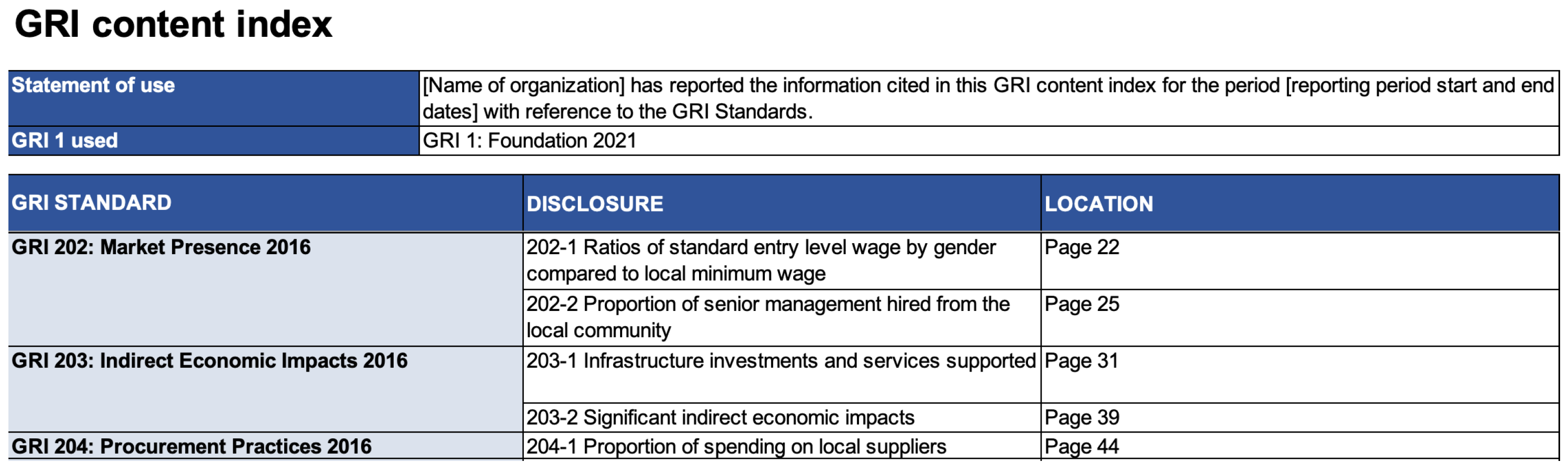
To streamline extraction, we first filtered for companies flagged by LSEG as publishing a GRI Content Index. We then performed a random audit of those with a “TRUE” flag, confirming the presence of a structured index listing each GRI code, its disclosure location, and page reference (see
Figure 1). This standardized mapping of indicators and corresponding report pages greatly facilitates and accelerates the retrieval of information required for database construction. In several cases, page references pointed to narrative descriptions without numerical data; these entries were recorded as missing values.
Table 3 summarizes the final sample composition. The reliance on the GRI Content Index accelerated code identification but introduced occasional gaps where narrative disclosures replaced numeric tables.
As detailed below, we consider 75 KPIs, each corresponding to a specific GRI indicator. We computed the percentage of reported GRI indicators per company, stratifying results by region and sector. European firms exhibited a slightly higher mean completeness (51.7%) compared to U.S. firms (48.8%), reflecting more stringent EU disclosure mandates (e.g., the corporate sustainability reporting directive—CSRD) versus predominantly voluntary U.S. reporting. Manufacturing companies reported on average 50.3% of indicators, marginally above the financial sector’s 50.2%, likely due to the greater number of environment-related metrics (e.g., resource use, emissions) required in manufacturing. In
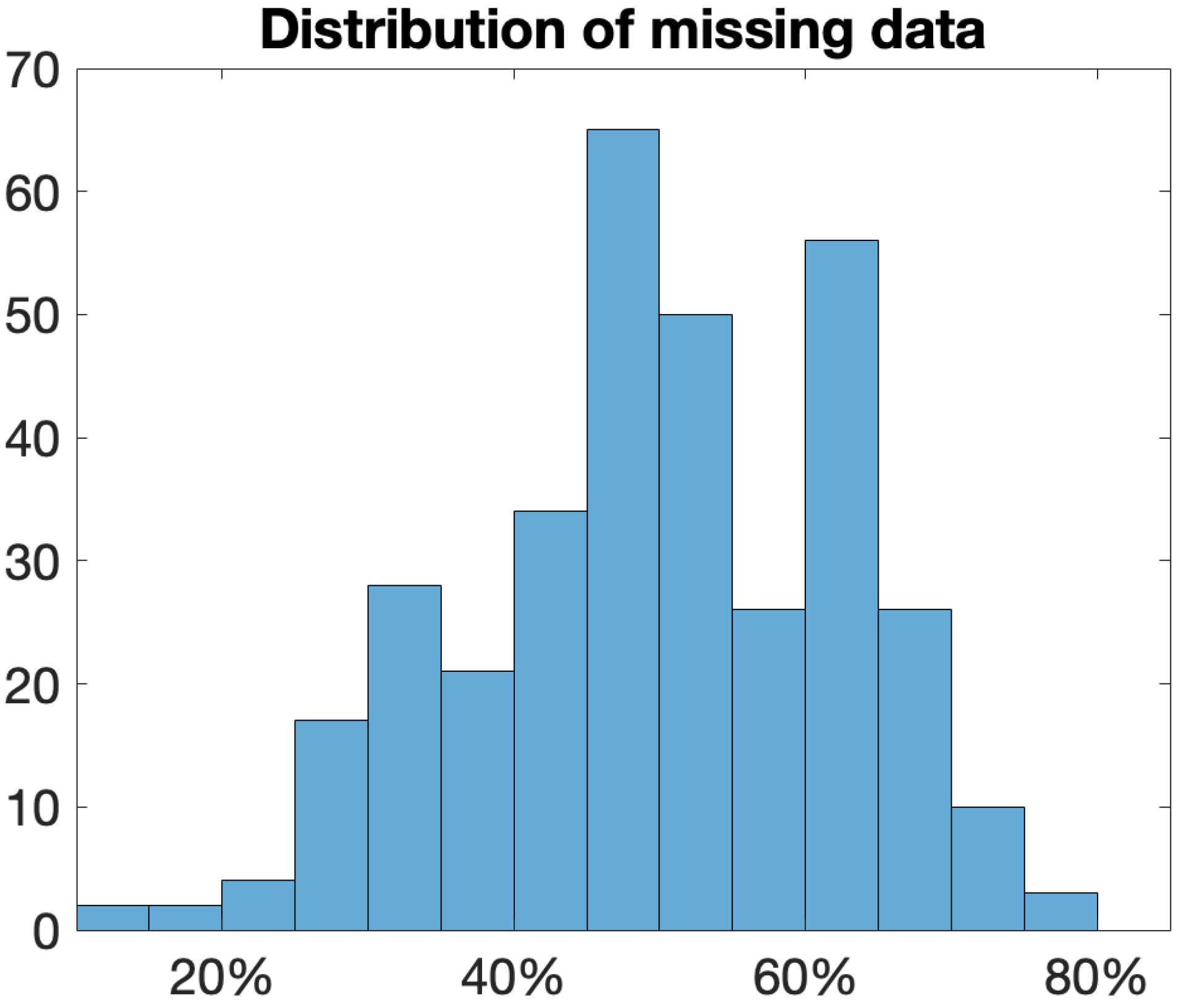
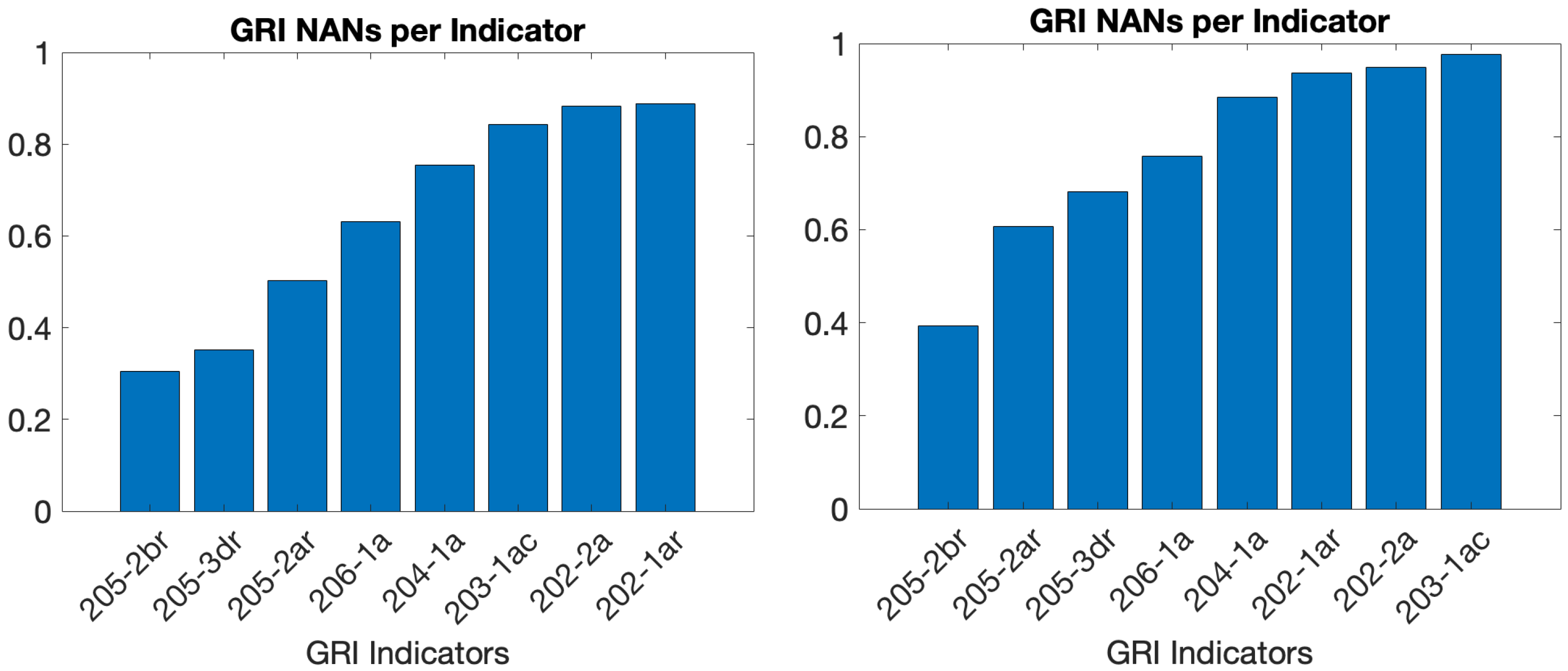
Figure 2 we show the overall distribution of missing data among all the 344 firms considered in this analysis.
4.2. Environmental Pillar
We now discuss the specific rating methodology adopted for each key factor, reviewing and reasoning, one at a time, its key performance indicators. At the end of each section, the final list of all the indicators used in the key factor analysis is presented, to be reported in the company’s sustainability disclosure. Exploiting the GRI documentation, we mark with an “r” the indicators that have been somehow revised, i.e., “revised KPIs”. Finally, the algorithm that computes the specific key factor’s score is provided.
Throughout the discussion we have the following:
is the i-th indicator;
is the training dataset for ;
is the number of ’s observations in the training dataset;
is the highest number of recurrent elements in ;
is the value of recorded by the company to be evaluated.
In this framework, the E pillar consists of six key factors, see
Table 2.
4.2.1. Greenhouse Gas (GHG), Ozone-Depleting Substances (ODSs), and Other Significant Emissions
This key factor measures the gaseous by-products of industrial processes released into the atmosphere. Greenhouse gases trap solar radiation, driving the greenhouse effect, while ozone-depleting substances degrade the stratospheric ozone layer, increasing harmful ultraviolet exposure.
We focus on the GRI KPIs reported in
Table 4, all of which are measured in tonnes of CO
2 equivalent (tCO
2eq), with the exception of KPI 305-6a, which is expressed in tonnes of CFC-11 equivalent (tCFC-11eq). The latter metric represents the impact of various substances in terms of the equivalent mass of CFC-11, a reference chlorofluorocarbon. Recall that the mass of a gas
x, expressed in tonnes of CO
2 equivalent, is given by
so that one unit of each gas yields the same radiative forcing as the corresponding mass of CO
2. The global warming potential (GWP) quantifies the amount of energy absorbed by one tonne of gas
x over a time horizon
t, relative to the energy absorbed by one tonne of CO
2:
After applying the training-dataset transformation to each KPI, we define the following:
The first stage corresponds to constructing a score considering the four above KPIs and their eCDF, and then recognizing the same materiality, that is, assigning equal weights
,
, to all four KPI scores. The second stage focuses on GHG emissions reduction, valuing
After computing the transformation of the training dataset, we classify the magnitude of GHG emission reductions by means of the empirical quantile function
, defined as
That is, for a given probability level
p, the function returns the largest value
x such that at most a fraction
p of the observations lies to its left and at least
lies to its right. We compute the quantiles
and
to partition emission reductions into three awarding categories, as reported in
Table 5.
Taking the value
registered by the company in the reporting period, it falls into one of these three ranges. Thus, we apply a continuous and increasing reward function
to the computed rating, of the following form:
Finally, we get the adjusted score function
of the form
which takes the value of the score calculated in the first phase and returns the final one, stopping
’s growth at 1. Algorithm 1 below summarizes the score construction.
| Algorithm 1 Algorithm for computing the GHG emissions and emissions reduction score. |
- 1.
Emissions generated Fix Scope 1, Scope 2, Scope 3, and ODS emissions: , Compute the eCDF associated with , denoted for all . Take the corresponding values registered by the company, denoted , and compute Compute the weighted average score
- 2.
Emissions reduction
A step-by-step worked example of the score construction for a representative U.S. manufacturing firm is provided in Section SB of the Supplementary Materials.
|
4.2.2. Water
We focus on KPIs in
Table 6. The GRI documentation measures all of them in megaliter (Ml). We conduct a two-layer analysis: one on the size of the water supply, and one on water management procedures. Notice that GRI 303 defines
y being the water discharge. After applying the training dataset transformation, we compute the total water withdrawn:
Higher values of
are penalized to mitigate the risks of water shortages.
To evaluate water handling, we analyze consumption relative to the total withdrawn amount:
Lower values of
are penalized, as they reflect water-intensive processes characterized by high withdrawal volumes relative to effective consumption.
Therefore Algorithm 2 is as follows.
| Algorithm 2 Algorithm for computing the water key factor score. |
- 1.
Water scores - a.
Water withdrawal Compute and the corresponding eCDF . Take company value , and compute .
- b.
Water consumption and discharge Compute and the corresponding eCDF . Take company value , and compute .
- 2.
Aggregate water score:
|
4.2.3. Land Use and Biodiversity
GRI indicator 304-4, see
Table 7, considers animals, plants, and fungi species included in the IUCN Red List and national conservation lists that inhabit areas affected by industrial operations. The Red List status reflects the likelihood that a given species may go extinct in the near future, based on available data on population trends and threats (Algorithm 3).
| Algorithm 3 Algorithm for computing the land use and biodiversity score. |
Set and compute the eCDF . Take the company value , and compute the final score
|
4.2.4. Raw Materials Sourcing
The GRI factors are summarized in
Table 8. All indicators are reported in tonnes, with the exception of GRI 301-2, which expresses the share of recycled input materials as a percentage.
We first assess the total materials used, after the training dataset transformation:
Due to the global impact of resource extraction, higher
values are penalized. Given that
we compute the shares of renewable and non-renewable materials used over the total:
Renewable materials are naturally replenished over a human time scale, thus positively rated. To evaluate materials stewardship, we use:
Since
, and because
(for a continuous distribution, the result holds with an equal), we simplify the following:
This allows us to focus on the renewable material proportion regardless of non-renewables.
Next, similarly, we assess the share of recycled materials:
For GRI 301-3, we express reclaimed material use relative to total material input, computing
where
p is the reclaimed material mass in tonnes.
Recycled and recovered materials reduce reliance on virgin resources, and are rewarded accordingly. Since these categories may overlap and none is universally preferable, we adopt equal weighting:
for
. The combined score is then averaged with the penalty score on
(Algorithm 4).
| Algorithm 4 Algorithm for the construction of the raw materials sourcing score. |
- 1.
Raw Material Evaluation - a.
Total materials used ().
- •
Compute eCDF , take company value , and compute .
- b.
Renewable, recycled, and recovered materials ().
- •
Compute eCDFs , take company values , and compute for . - •
Compute
- 2.
Final score:
|
4.2.5. Waste and Pollution
Waste management (
Table 9, all indicators are reported in tonnes) is central to sustainability due to its impact on ecosystems, air, soil, and water. We first evaluate total waste generated after the training dataset transformation:
Higher values of
indicate negative performance.
Following the GRI 306 guidelines, the total amount of waste generated by an organization is categorized into two distinct flows: waste diverted from disposal and waste directed to disposal. This classification reflects both the environmental impact and the management practices associated with industrial waste handling.
Waste directed to disposal typically refers to conventional methods such as landfilling and incineration. While straightforward, these methods are associated with significant environmental harm, including methane emissions, toxic leachates, and loss of material value. In particular, incineration and landfill disposal contribute directly to air, soil, and water pollution, and they interrupt the materials’ life cycle, preventing future recovery or reuse. Conversely, waste diverted from disposal refers to waste that is handled through more sustainable practices such as reuse, recycling, composting, or energy recovery in closed-loop systems. These strategies are consistent with circular economy principles, where the outputs of one process can become the inputs of another, reducing the need for virgin resources and minimizing ecological damage.
Mathematically, the total waste is composed of diverted and directed waste, that is,
We define the following:
According to the European Union Waste Framework Directive, a waste management hierarchy is recommended, ranking prevention as the most preferred option, followed by reuse and recycling (diversion), and only as a last resort, disposal. In this framework, only the waste diverted from disposal is considered positively in the sustainability rating, coherently with
Section 4.2.4. Therefore, we define
This is then averaged with the score from
(Algorithm 5).
| Algorithm 5 Algorithm for the construction of the waste generation and treatment score. |
- 1.
Waste generation and treatment - a.
Total waste ().
- •
Compute eCDF , take company value , and compute .
- b.
Diversion from disposal ().
- •
Compute eCDF , take company value , and compute .
- 2.
Final score:
|
4.2.6. Clean-Tech and Renewables
The analysis is structured in two independent parts, focusing respectively on the company’s energy consumption and its clean-tech efforts. Each component is assessed separately to evaluate its individual contribution. The final clean-tech and renewables score is then computed as the weighted average of these two components, ensuring a balanced and fair representation of both aspects. The relevant GRI indicators are listed in
Table 10. All GRI 302 indicators (related to energy) are typically measured in GJ, as this unit allows for consistent reporting across renewable, non-renewable, and total energy consumption.
We begin by evaluating the total energy consumption:
which is penalized due to its direct environmental impact. To assess the company’s sustainable energy management, we distinguish between energy consumption and energy reduction, in line with the treatment of emissions and waste.
More precisely, we require the quantification of energy consumed internally to the organization, disaggregated by source type as in GRI 302-1a and 302-1b (i.e., renewable vs. non-renewable). That is,
. From a sustainability standpoint, as done for materials and waste key factors, we focus only on the “positive” share of consumption—that is, renewable energy—while omitting the complementary non-renewable component. We thus compute the following ratios:
This is positively scored using its eCDF; therefore, we compute the total energy component score by
Next, we evaluate efforts related to energy reduction by introducing the following:
This is assessed using quantile-based adjusted reward functions, as described in
Table 11. The final energy score is obtained by sequentially applying the reward adjustments:
where
is the adjusted reward function corresponding to
.
The second part of the analysis assesses the company’s efforts to adopt solutions that reduce or eliminate the environmental impacts of its production processes. These efforts may include improvements in energy efficiency, more rational use of natural resources, and reductions in both waste generation and polluting emissions. To capture the breadth of these initiatives, we resume several KPIs already evaluated in other sections, treating them collectively as indicators of clean-tech engagement.
More precisely, we aggregate six key indicators reflecting diverse aspects of environmental performance:
Notice that
is not normalized since it relies on a percentage.
Each indicator
, for
, is positively scored using its empirical cumulative distribution function and contributes equally to the clean-tech score. Accordingly, we compute:
Finally, the overall clean-tech and renewables score is obtained by averaging the energy component and the clean-tech component:
The score
provides a comprehensive assessment of the company’s commitment to energy sustainability and technological innovation. A high value of
indicates both a responsible approach to energy sourcing and consumption, and proactive efforts to adopt clean technologies that minimize environmental impacts. As such, it reflects the firm’s overall transition toward a more sustainable and circular production model (Algorithm 6).
| Algorithm 6 Algorithm for the construction of the clean-tech score. |
- 1.
Energy consumption and sourcing Compute , and their eCDFs. Compute
- 2.
Energy reduction rewards - 3.
Clean-tech efforts Compute , for , and their eCDFs. Compute
- 4.
Final score:
|
4.2.7. E Score
To compute the environmental score for a given firm in the manufacturing sector, we need to aggregate the above-described six specific scores, that is,
defining a vector of non-negative weights
,
which sum to one, see Equation (
1).
The sector-specific weighting schemes were determined through a reasoned assessment of the relative materiality of each ESG dimension (the E dimension, in this case) within the sector, as discussed below. The specific percentage allocations reflect the authors’ informed judgment rather than empirical derivation. Employing an expert survey represents an effective way to validate and refine these weights in a real-world application of the model.
Manufacturing Sector
The weighting structure is designed to reflect the relative environmental materiality of each dimension within the manufacturing industry. Manufacturing activities are energy- and resource-intensive, yet highly heterogeneous across sub-sectors. Hence, the proposed ranking of weights prioritizes those environmental aspects that most directly determine the sector’s ecological footprint, regulatory exposure, and transition potential.
(1) Greenhouse Gas (30%)—GHG emissions receive the highest weight since they represent the most significant and measurable externality in manufacturing. Energy consumption from fossil fuels, process emissions (e.g., in metal, cement, or chemical production), and supply-chain carbon intensity directly contribute to climate impact. Moreover, carbon pricing mechanisms and emission regulations create immediate financial exposure. A high weight on GHG thus captures both the operational relevance and the transition risk faced by the sector.
(2) Raw Materials (20%)—The manufacturing sector depends on large volumes of raw inputs such as metals, minerals, and chemicals. These inputs often have high embodied energy and environmental costs upstream, including mining, refining, and logistics. Efficient use of materials, recycling, and circular economy practices can substantially reduce both costs and environmental pressure. This dimension ranks second, as material efficiency is a key lever of sustainability beyond emissions control.
(3) Water (20%)—Water usage is central in many manufacturing processes (e.g., cooling, cleaning, dyeing, and chemical reactions). Excessive water consumption not only affects local ecosystems but also exposes firms to operational and reputational risks, especially in water-scarce regions. Water therefore receives a weight comparable to raw materials, reflecting its dual role as a critical input and a source of regional environmental sensitivity.
(4) Waste (15%)—Waste generation reflects production inefficiency and inadequate resource recovery. Although waste management is a tangible environmental issue, its financial and systemic relevance is typically lower than that of energy or raw materials, given the higher degree of regulatory control and available mitigation technologies (e.g., recycling, industrial symbiosis). Therefore, waste retains a moderate but not dominant weight.
(5) Clean Technology and Renewable Energy (10%)—This indicator captures the firm’s proactive efforts in decarbonization, energy efficiency, and renewable adoption. While it represents a crucial forward-looking signal of transition readiness, it is less directly linked to current environmental impact. Hence, it is weighted moderately: rewarding innovation without allowing firms to compensate for poor operational performance merely through future-oriented investments.
(6) Land Use (5%)—Land occupation and ecosystem alteration are comparatively less relevant for manufacturing. The physical footprint of industrial sites is limited relative to the upstream land use embedded in raw materials or energy production. Therefore, land use receives the lowest weight, as it has minimal direct influence on the environmental intensity of core manufacturing activities.
The final environmental score for the manufacturing sector is thus expressed as a weighted average:
Financial Sector
For the financial sector, environmental impacts are primarily operational rather than production-based. Financial institutions do not engage in resource extraction or manufacturing, and therefore, their direct environmental footprint is comparatively small. Key drivers of environmental performance include energy consumption, building efficiency, business travel, and office resource management. The weighting scheme below reflects the relative materiality of these factors:
(1) Greenhouse Gas (35%)—GHG emissions receive the highest weight because energy use (heating, cooling, data centers, business travel) represents the most significant and quantifiable source of environmental impact for financial institutions. Reducing operational emissions through efficiency measures and renewable sourcing is a core component of sustainability management.
(2) Clean Technology and Renewable Energy (25%)—This component measures the adoption of clean energy sources, building efficiency systems, and low-carbon technologies within operations.
(3) Water (15%) and (4) Waste (15%)—Both indicators capture operational resource efficiency. Although their absolute magnitudes are lower than in industrial sectors, responsible water use and waste reduction are relevant for environmental compliance, green building certifications, and corporate image. They also reflect an organization’s internal culture of sustainability.
(5) Raw Materials (10%)—This score reflects paper consumption, IT hardware renewal, and office materials. The digitalization of financial services reduces material intensity, but responsible procurement and recycling policies remain pertinent.
(6) Land Use (0%)—Land-related impacts stem primarily from real estate management (offices, branches, data centers), which is peripheral to the core business activities of the financial sector. As such, land use is assigned a null weight, reflecting its negligible materiality in the sector’s direct environmental footprint.
The final environmental score for the financial sector is thus expressed as a weighted average:
4.2.8. Data and Preliminary Results
Manufacturing Sector
As shown in
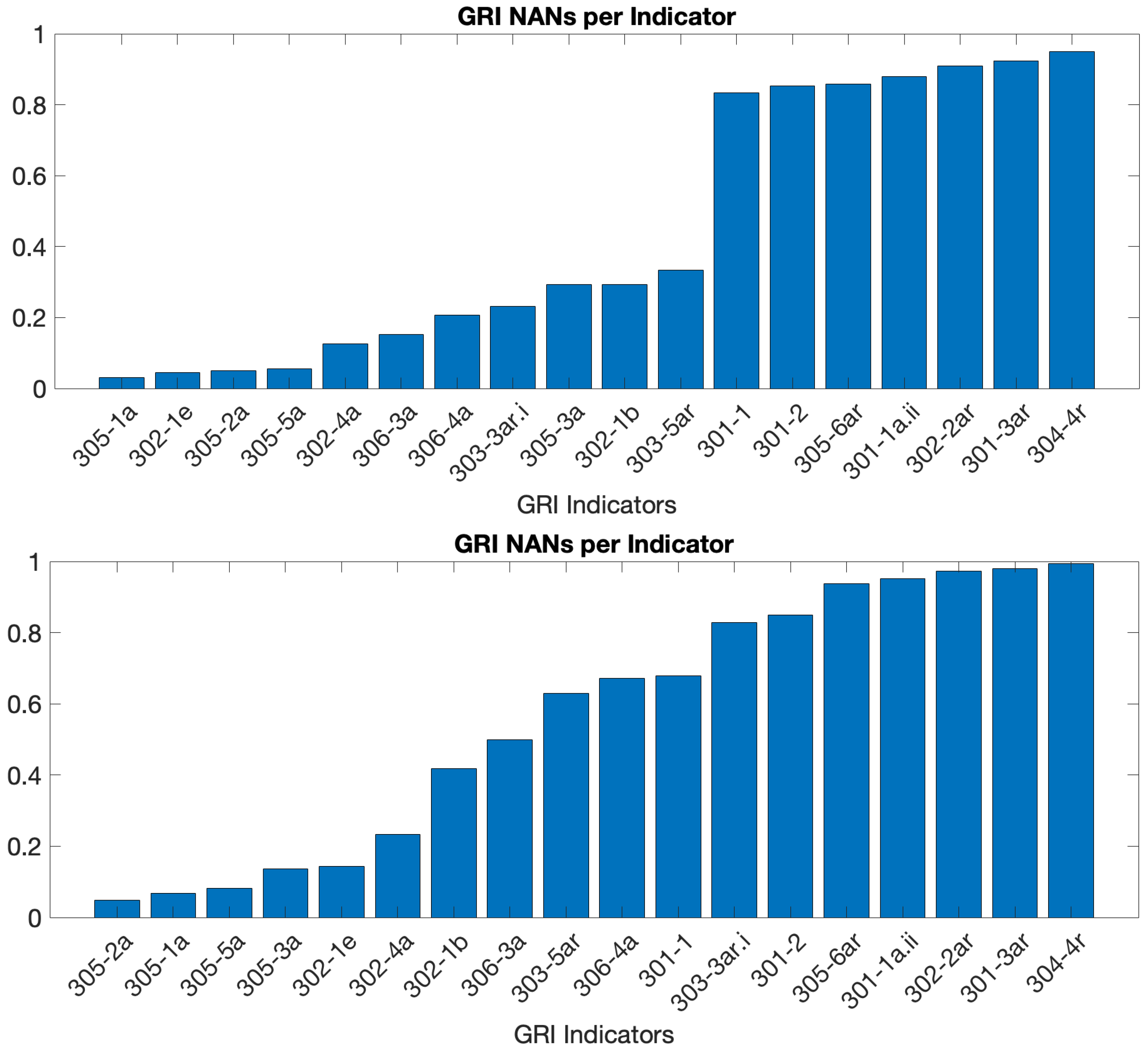
Table 3, we are dealing with 198 firms. In
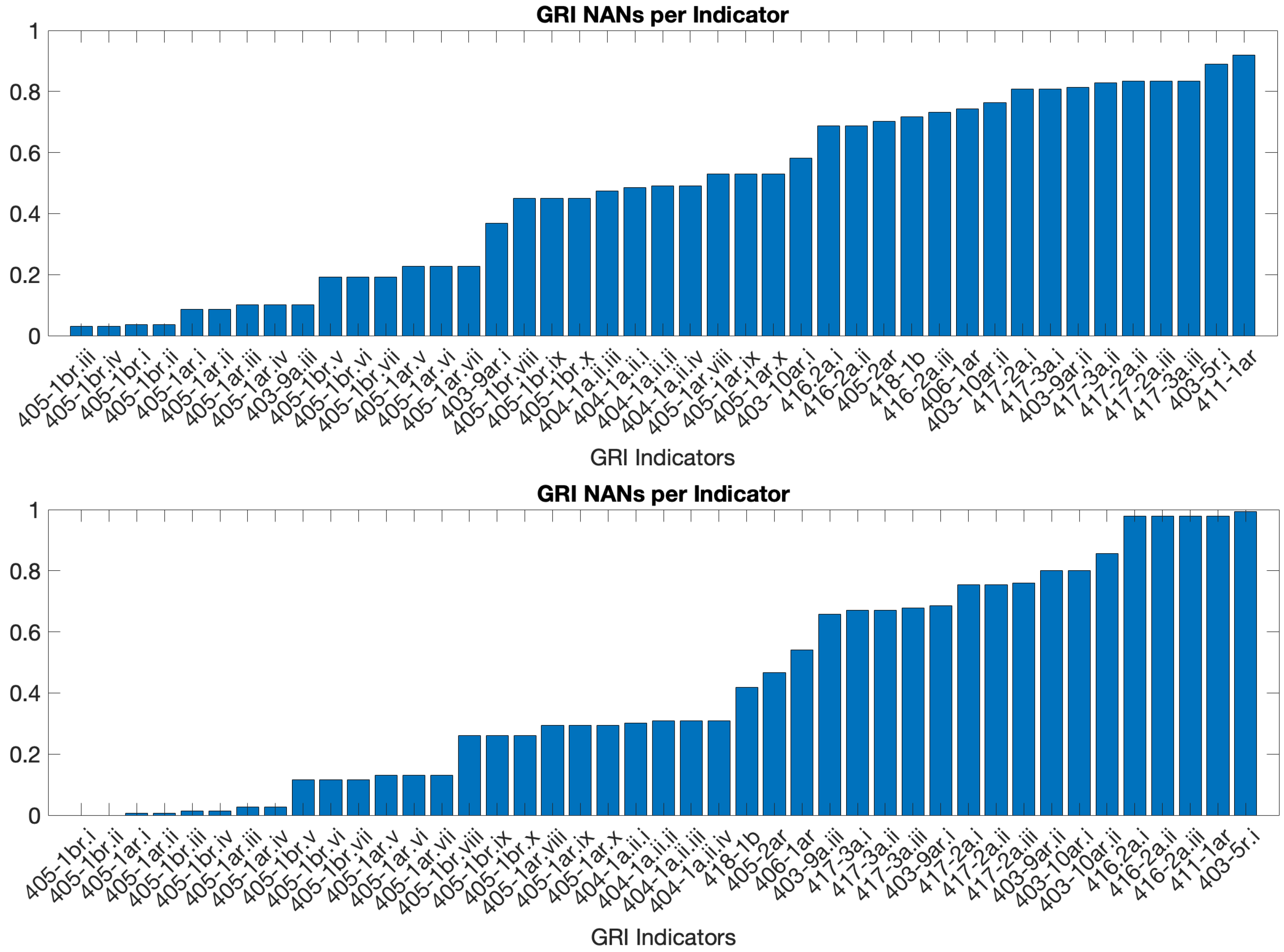
Figure 3 (top) we report the missing values distribution (NaNs). GRI 304-4r (number of IUCN Red List and national conservation list species with habitats in areas affected by operations, by extinction risk,
) shows 94.9% of missing values, followed by 301-3ar (reclaimed products and packaging,
) with 92.4%, and 302-2ar (energy consumption (external),
) with 90.9% missing values. It is worth noting that the highest share of missing observations occurs for indicator
, which also carries the lowest weight within the sector. This confirms the relatively low materiality of this dimension, both in terms of its environmental relevance and firms’ reporting priorities. Despite the presence of missing values, data availability remains acceptable: for 11 out of 18 GRI codes, the share of missing data is below one third, allowing the construction of a reliable composite score. Finally, it is important to recall that missing information is explicitly penalized in our framework through the data imputation procedure, which ensures that incomplete disclosures reduce the final score proportionally to the uncertainty introduced.
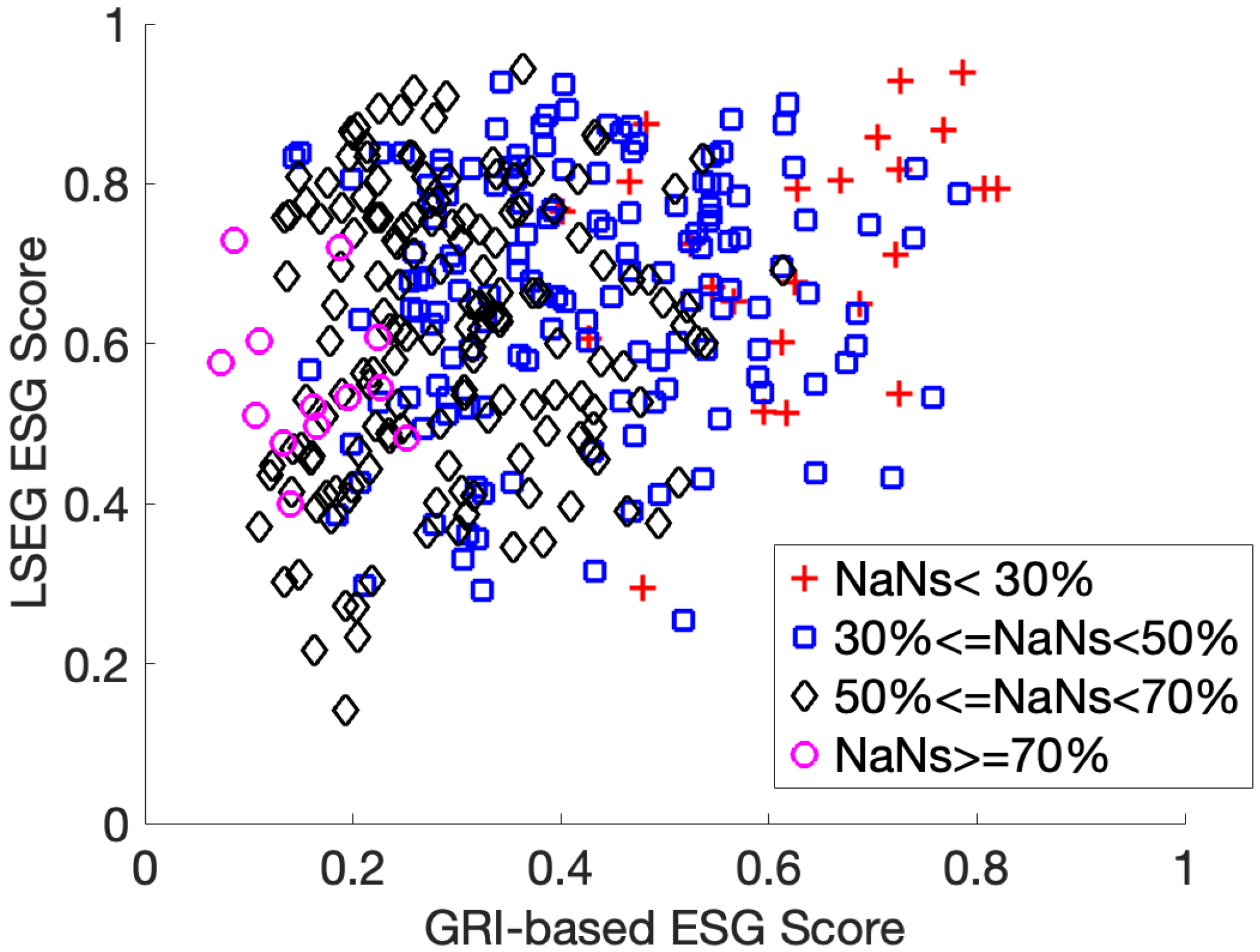
As a preliminary validation step, we compute the correlation coefficient between our E score and the LSEG environmental score across the 198 firms in the sample. The correlation equals , indicating a positive relationship. This suggests that our metric captures an environmental signal that is broadly consistent with the LSEG benchmark, while still reflecting methodological differences and potentially providing complementary information.
It is important to note, however, that score–score correlation should not be interpreted as a measure of accuracy. The two metrics are constructed under different methodological assumptions and incorporate distinct sets of criteria, as discussed in
Section 4.5. Correlation analysis therefore serves only as an exploratory comparison rather than a formal validation of performance.
Financial Sector
As shown in
Table 3, the sample includes 146 firms.
Figure 3 (bottom) reports the distribution of missing values (NaNs) across all GRI indicators. Indicator GRI 304-4r (biodiversity,
) contains only a single reported value, provided by one financial firm. Given its null weight in the financials sector, this lack of data is consistent with its low materiality for this sector. Moreover, GRI 301-3ar (reclaimed products and their packaging materials,
) displays 97.94% missing values.
In general, missing data are relatively widespread across the indicators: six out of eighteen GRI codes exhibit more than two-thirds of available data, while eleven codes display at least one-third of non-missing observations. This level of data coverage is sufficient to construct the environmental score, particularly since missing information is explicitly penalized through our data imputation procedure. The correlation with the LSEG ESG score is 0.26.
Treatment of Missing Data and Potential Reporting Bias
The decision to assign a score of zero to missing KPIs represents a deliberately strong penalization strategy. While this choice enhances transparency and discourages selective disclosure, it may also raise concerns about potential bias against firms operating in jurisdictions with less stringent or differently structured reporting requirements. Firms may comply with alternative, yet equally legitimate, disclosure frameworks, e.g., Sustainability Accounting Standards Board (SASB) or Task Force on Climate-related Financial Disclosures (TCFD), without fully aligning with GRI standards, leading to mechanically lower scores despite comparable sustainability practices.
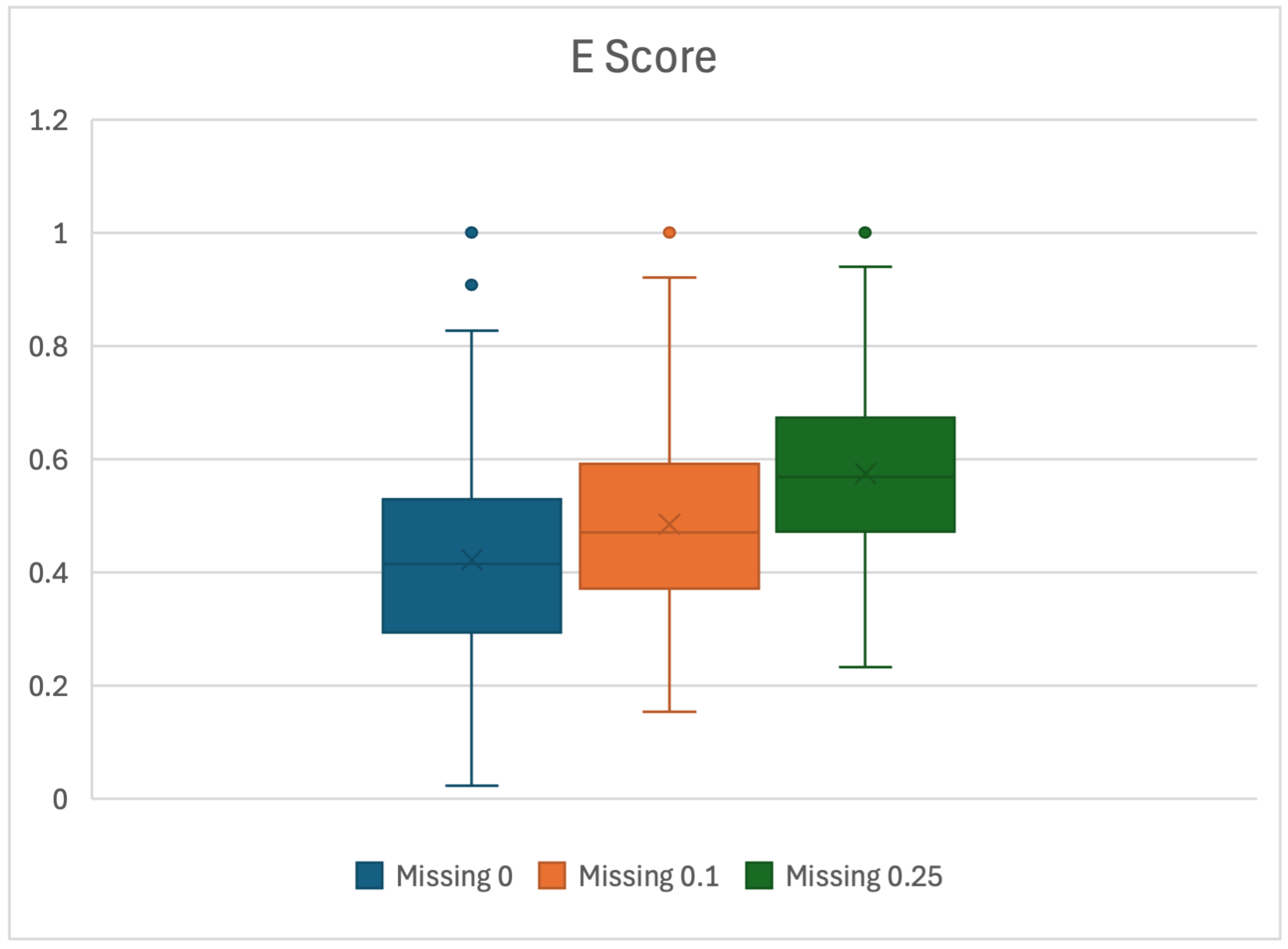
To assess the robustness of our results to the severity of the missing-data penalty, we conduct a sensitivity analysis by modifying the scoring algorithm. Instead of assigning a score of zero to missing KPIs (corresponding to the worst possible performance), we alternatively assign values of 0.10 and 0.25. These thresholds can be interpreted as assuming that a firm with missing disclosure performs better than respectively 10% or 25% of the peer distribution, rather than being placed at the absolute bottom.
Focusing on the environmental pillar for manufacturing firms,
Figure 4 reports the distribution of the E scores obtained under the three alternative treatments of missing data. As expected, a less stringent penalization of missing disclosures systematically results in higher scores across firms. Moreover, the correlation between our GRI-based environmental score and the LSEG environmental score decreases from 0.30 under the baseline specification (missing = 0), to 0.25 when missing values are set to 0.10, and further to 0.15 when they are set to 0.25. This monotonic decline is intuitive: LSEG explicitly assigns the lowest possible score to non-disclosed indicators, and relaxing the penalty in our framework mechanically reduces alignment with a methodology that treats non-reporting as the worst possible outcome.
These results also indicate that the choice of missing-data penalization does not overturn the qualitative properties of the model. Rather, it highlights an inherent trade-off between fairness across heterogeneous reporting regimes and the provision of strong incentives for disclosure completeness. We therefore retain the missing = 0 specification as our baseline, both for comparability with established ESG providers and to preserve the normative principle that transparency is an integral component of sustainability performance. Importantly, assigning a strong penalty to non-disclosure creates an explicit incentive for firms to report ESG information even when performance is weak or unfavorable. In this sense, the framework discourages strategic opacity and selective reporting, promoting more comprehensive and credible sustainability disclosures.
We also recall that this analysis is conducted on firms that have voluntarily adopted the GRI standards for sustainability reporting. In this context, the use of a transparent ESG scoring framework grounded in GRI disclosures can be viewed not only as an evaluation tool, but also as a potential incentive toward convergence on a common, performance-based reporting standard.
4.3. Social Pillar
We now move to the social pillar, which consists of seven key factors, see
Table 2.
4.3.1. Employment
As a first step, we consider the employment indicators reported in
Table 12. In line with GRI standards, we assess workforce composition in terms of gender and age, both at the beginning and at the end of the reporting period. Indicators are grouped by governance body and employees, to evaluate diversity and inclusion practices.
Let g and x denote the number of individuals in the governance body and among employees, respectively. Subscripts m and w refer to male and female categories, while b and e mark the beginning and the end of the reporting period. Age groups are labeled as for under 30, – for middle age, and for over 50.
To measure gender imbalance, we define the asymmetry ratios:
at time
. The final gender gap in the governance body is
while the change over time is normalized as follows:
where
is penalized and
is rewarded to promote gender balance and corrective actions. Then, the composite gender score for the governance body is then defined as
where the weights assigned to
and
are determined by a continuous weighting function:
with the following definitions:
x denotes the value of the static metric (e.g., );
y denotes the absolute change between the baseline and end-of-period values (e.g., );
is a tuning parameter that controls the speed at which the weight shifts between static and dynamic components.
This function satisfies the following properties:
when : the static score dominates when the company is already well-balanced and stable.
for large x or y: both static and dynamic components are weighted equally when imbalance or change is high.
w is smooth and symmetric in x and y.
The parameter determines the steepness of the transition from static-dominated to equal weighting. We set to satisfy two threshold conditions based on normative evaluation:
when both : i.e., companies that are balanced and stable should be rewarded mostly for maintaining their level.
when : i.e., when the imbalance is substantial, improvement efforts should be weighted more.
These conditions reflect policy considerations: companies in equilibrium are incentivized to maintain their position, while those with a deficit are expected to show progress. Moreover, this threshold behaviour is designed to the following:
Emphasize the importance of maintaining low imbalance and variance (high w).
Avoid rewarding improvements when the starting point is already optimal.
Encourage progress when initial conditions are poor (low w, more weight on the dynamic score).
This adaptive approach ensures that companies with low initial imbalance are rewarded for stability, while those with higher imbalance are encouraged to improve over time.
To assess age diversity, we define with
N the total population, e.g.,
and a pseudo-variance:
since the perfect age diversification would be
. Therefore,
denotes the age dispersion. We thus define
where
is the theoretical maximum variance. In fact it is easy to prove that plausible values of
Again, we use
with
, to compute
Similarly, composite gender (
)/age diversity (
) scores for employees are defined. Lastly, equal pay is assessed using the ratio between women’s and men’s remuneration:
The final employment score is defined as
The lower weight assigned to the governance age diversity component (
) reflects the fact that governance positions generally demand extensive experience and accumulated expertise, attributes that tend to increase with age. As a result, age diversity within governance bodies, while potentially beneficial, is considered comparatively less material than other diversity dimensions when assessing governance quality (Algorithm 7).
| Algorithm 7 Algorithm for the construction of the employment score. |
- 1.
Training dataset For and , compute
- 2.
Governance body-gender composition Scores: Weights: . Compute score
- 3.
Governance body-age composition Scores: Weights: . Compute score
- 4.
Employees-gender composition Scores: Weights: . Compute score
- 5.
Employees-age composition Scores: Weights: . Compute score
- 6.
Equal pay - 7.
Aggregate employment score
|
4.3.2. Occupational and Customer Health and Safety
We consider the indicators listed in
Table 13. This section addresses both occupational and customer health and safety. The former is evaluated in terms of training and incident rates, while the latter considers compliance with safety standards in products and services.
We first assess the company’s investment in worker protection through health and safety training. Following GRI 403-5, we introduce
where
denotes the average number of health and safety training hours per employee. Since training is not gender-specific, no gender distinction is applied. Higher values of
are positively rated.
Second, we measure harm to employees. GRI 403-9 and 403-10 split occupational health damages into injuries and ill health, respectively, each with a severity scale. We compute two composite indicators:
where
,
,
refer to injury-related rates, and
,
to ill-health rates. Both
and
are negatively scored, as they represent undesired outcomes.
To synthesize the occupational safety score, we aggregate the positively-rated training () with the negatively-rated incident metrics (, ), giving equal weight to each contribution.
Turning to customer health and safety, GRI 416-2 details three levels of non-compliance regarding product safety. We assign severity-based weights to build a synthetic indicator:
where
refers to fines or penalties,
to warnings, and
to breaches of voluntary codes. This indicator is also negatively evaluated.
The final score combines the occupational and customer safety scores with equal weights (Algorithm 8).
| Algorithm 8 Algorithm for the construction of the occupational and customer health and safety score. |
- 1.
Occupational health and safety - a.
Employee training Compute and its eCDF . Take company value , and compute score .
- b.
Damages to employees Compute and their eCDFs. Take company values , and compute Compute
- c.
Aggregate occupational score:
- 2.
Customer health and safety - 3.
Final score:
|
4.3.3. Training and Education
The evolving dynamics of the business environment compel organizations to continually invest in their human capital. Employee training programs play a central role in updating skills and promoting professional development. We consider the indicators listed in
Table 14.
According to GRI 404-1, companies should report the average number of training hours per employee, segmented by professional category. We exclude health and safety training (analyzed above) and anti-corruption training (addressed in the government pillar), focusing here on functional or role-specific training.
We consider four categories:
Senior leadership: ;
Management: ;
Professional staff: ;
Operational and technical staff: .
All categories are treated equally in the final score, acknowledging the importance of training regardless of hierarchical level or role. Hence, all indicators are positively rated, with equal weights
for
(Algorithm 9).
| Algorithm 9 Algorithm for the construction of the training and education score. |
Compute and their eCDFs. Take company values and compute scores Compute final score
|
4.3.4. Modern Slavery
A foundational element of social responsibility is the prevention of discriminatory practices in the workplace. In this section, we assess company’s exposure to episodes of discrimination, in line with GRI 406-1, see
Table 15.
We focus exclusively on formal incidents—those reported through legal channels or filed as official complaints to the organization or authorities. Internal cases emerging from company-specific monitoring are not considered.
We compute the number of incidents normalized by the direct economic value generated and distributed
x denotes the total number of discrimination incidents in the reporting period. As these events violate individual dignity and well-being, they are negatively rated. Lower values of
indicate a better company performance (Algorithm 10).
| Algorithm 10 Algorithm for the construction of the modern slavery score. |
|
4.3.5. Communities
Company operations may conflict with the rights and interests of indigenous populations residing in nearby areas. Building positive relations requires a partnership where local communities provide resources and growth potential, while the company ensures respect for indigenous rights.
To evaluate company conduct in this domain, we follow GRI 411-1 (see
Table 16) and focus on formal incidents of indigenous rights violations. As in the case of modern slavery, only legally recognized or formally submitted complaints are considered valid.
Let
x denote the number of such violations in the reporting period. We define
This indicator is negatively rated: fewer or zero violations reflect stronger community respect and social responsibility (Algorithm 11).
| Algorithm 11 Algorithm for the construction of the communities score. |
|
4.3.6. Product Responsibility
Product and service information—such as labeling and marketing communications—serves as a fundamental channel through which companies engage with consumers, conveying transparency and ethical responsibility. Misleading or incomplete information may compromise informed choices and reduce trust. We consider the indicators listed in
Table 17.
According to GRI 417-2 and 417-3, we evaluate the number of incidents of non-compliance across two domains: product/service labeling and marketing communications. These are categorized by severity: fines/penalties, warnings, and breaches of voluntary codes.
We define
Higher values of
and
indicate increased non-compliance and are therefore penalized. Both are assigned equal importance in the final product responsibility score (Algorithm 12).
| Algorithm 12 Algorithm for the construction of the product responsibility score. |
Compute and their eCDFs. From company values , get and Compute final score
|
4.3.7. Data Privacy
As digitalization advances, companies increasingly collect and store sensitive personal data. To protect consumers’ privacy, organizations must clearly disclose how data is gathered, processed, and used, while preventing unauthorized access or misuse.
We evaluate corporate behavior in this area by counting the number of confirmed data breaches involving customer information. Following GRI 418-1 (see
Table 18), we define
where
x represents the number of substantiated cases of customer data loss reported during the period. These incidents are negatively evaluated, as they reflect failures in data governance and protection systems (Algorithm 13).
| Algorithm 13 Algorithm for the construction of the data privacy score. |
|
4.3.8. S Score
Manufacturing Sector
The social profile of the manufacturing sector is characterized by significant exposure to workforce, health and safety, and community-related issues. Social performance is therefore driven primarily by human capital management, working conditions, and product responsibility. The proposed weighting scheme is as follows:
(1) Occupational and Customer Health and Safety (25%)—This dimension receives the highest weight, as manufacturing operations involve physical risks for employees and product users. Accidents, unsafe working conditions, or product defects can result in legal liabilities, operational disruptions, and reputational damage.
(2) Employment (20%)—Employment practices—such as fair wages, diversity, and non-discriminatory hiring—are essential to labor stability and corporate reputation. The manufacturing sector typically employs large workforces, often in diverse geographical areas, amplifying the importance of employment management.
(3) Training and Education (15%)—Continuous workforce training supports both employee well-being and process efficiency. It also contributes to long-term social sustainability through skill development and retention.
(4) Modern Slavery and Discrimination (15%)—Given the global nature of manufacturing supply chains, exposure to forced labor and human rights violations remains a major risk, particularly in low-cost regions. Adequate monitoring and due diligence systems are thus essential.
(5) Communities (10%)—Manufacturing facilities often operate near local communities, where issues such as noise, pollution, and land use can create social tensions. Engagement with and respect for local and indigenous populations are therefore included with moderate weight.
(6) Product Responsibility (10%)—Ensuring accurate labeling, safe product design, and ethical marketing helps protect consumers and maintains trust in industrial products.
(7) Data Privacy (5%)—While relevant in the context of digital manufacturing and IoT, data privacy risks remain secondary compared to physical safety and labor-related issues.
Financial Sector
In the financial industry, social impacts stem mainly from workforce management, client trust, and data protection rather than physical safety or community conflict. Social performance is therefore assessed based on human capital development, diversity, ethical conduct, and responsible information management. The proposed weighting scheme is as follows:
(1) Employment (20%)—Employee well-being, equal opportunity, and inclusion are crucial in attracting and retaining skilled professionals. Employment conditions directly affect productivity, turnover, and corporate culture in a knowledge-based industry.
(2) Training and Education (20%)—Given the rapid evolution of financial technologies, regulation, and compliance requirements, continuous training ensures employee competence and ethical behavior. It also supports adaptability and innovation capacity.
(3) Data Privacy (20%)—As financial institutions manage large volumes of sensitive personal and corporate data, data protection is a material social issue. Failure to safeguard client information can result in regulatory sanctions and severe reputational losses. Thus, Data Privacy receives a weight equal to the most important human capital dimensions.
(4) Occupational and Customer Health and Safety (10%)—Physical safety risks are limited to office environments, but occupational well-being and ergonomic conditions remain relevant. Customer safety relates to the integrity and transparency of financial products.
(5) Modern Slavery and Discrimination (10%)—Although less exposed to supply-chain risks than industrial sectors, the financial industry must maintain strict policies against discrimination, harassment, and unethical employment practices.
(6) Communities (10%)—Financial institutions influence local communities through employment, taxation, and inclusion initiatives. Community investment and responsible lending practices contribute to broader social value creation.
(7) Product Responsibility (10%)—Transparent communication about financial products—fees, risks, and conditions—helps prevent consumer harm and aligns with ethical marketing standards.
Data and Preliminary Results
Figure 5 illustrates the distribution of missing values for the social pillar. The issue is more pronounced in the financials sector, where the four GRI codes with the highest number of missing observations are those related to the “Occupational and Customer Health and Safety” key factor. This dimension also carries the lowest weights within the sectoral scoring scheme. This alignment suggests internal consistency: firms tend to underreport indicators that are less material to their core business model, confirming that the weighting structure appropriately reflects the perceived relevance of each social dimension.
The correlation with the LSEG S score is 0.18 for the manufacturing sector and 0.08 for the financial sector, remaining positive but lower than in the environmental case. However, it is important to emphasize that the objective of this study is not to replicate the LSEG rating, but rather to develop a transparent and reproducible ESG index. The lower correlation may therefore arise from several factors: (i) the limited availability of data reported in a GRI-standardized format; (ii) methodological differences in how the social dimension is captured—differences that are difficult to assess, given the proprietary and undisclosed nature of the LSEG scoring process; and (iii) the parsimonious structure of our framework, which relies on only 75 KPIs in total.
A more detailed discussion of these methodological differences and their implications will be provided in
Section 4.5.
4.4. Governance Pillar
The government pillar consists of 3 factors, as shown in
Table 2.
4.4.1. Economic Performance and Its Impacts
To assess the sustainable economic contribution of a company, we consider two dimensions: infrastructure development and local procurement. These aspects measure how a company supports the surrounding territory through investments and integration into the local supply chain.
Following GRI 203-1, we assess infrastructure development via the transformed indicator (see
Table 19):
where
is the value of infrastructure investments and services supported, after applying the dataset transformation. Higher values are positively rated.
GRI 204-1 captures local procurement behavior. Since limited local spending may stem from structural supply gaps rather than strategic decisions, we introduce a binary indicator:
where
y is the percentage of procurement spent on local suppliers. The indicator
takes value 1 if local suppliers are used, and 0 otherwise. Being categorical,
is assessed absolutely, without applying empirical distribution functions.
Both
and
are equally weighted in the final score (Algorithm 14).
| Algorithm 14 Algorithm for the construction of the economic performance and its impacts score. |
Compute (and its eCDF) and Take company values and compute Compute the final score
|
4.4.2. Market Presence
To evaluate how companies contribute to local economic development and inclusion, we consider two aspects: fair wage policies and the integration of local personnel into senior management.
Following GRI 202-1, we assess the ratio of the standard entry-level wage to the legal minimum wage:
where
x denotes the ratio (see
Table 20). Higher values of
reflect stronger support for employee welfare and are positively evaluated.
GRI 202-2 focuses on whether companies hire senior managers from the local community. Recognizing the organizational and geographical limitations in accessing qualified local candidates, we assess the presence of local hires via a binary indicator:
where
y is the percentage of senior management hired locally. The indicator
is positively rated as-is, without applying a CDF.
Both dimensions are equally weighted in the final score (Algorithm 15).
| Algorithm 15 Algorithm for the construction of the market presence score. |
Compute (and its eCDF) and Take company values and compute Compute the final score
|
4.4.3. Business Ethics
Sound business ethics are foundational for sustainable governance. They encompass transparency, fairness, integrity, and the implementation of anti-corruption practices.
We begin by assessing the level of anti-corruption training across the organization, distinguishing between employees and members of the governance body. Following GRI 205-2, we define the following:
see
Table 21. Both are positively rated. As the governance body bears higher responsibility, we assign more weight to
:
,
.
Next, we evaluate legal risks associated with unethical behavior. We use GRI 205-3 and 206-1 to assess the following:
These indicators are negatively evaluated and equally weighted.
The final score combines training and litigation-based assessments with equal weights (Algorithm 16).
| Algorithm 16 Algorithm for the construction of the business ethics score. |
- 1.
Anti-corruption training Compute and their eCDFs. Take values and compute Compute
- 2.
Legal actions Compute and their eCDFs. Take values and compute Compute
- 3.
Aggregate business ethics score: .
|
4.4.4. G Score
For the governance pillar firms are grouped by macro-region (Europe and the USA). We define the same weights for both macro-regions. The governance pillar captures the institutional quality and ethical integrity of firms, which directly influence long-term resilience and stakeholder trust. Among the three governance sub-dimensions—Economic Performance and Its Impacts, Market Presence, and Business Ethics—the relative importance varies according to the extent to which each reflects managerial accountability and risk control. The proposed weighting structure is:
(1) Business Ethics (45%)—This dimension receives the highest weight as it encompasses transparency, anti-corruption measures, compliance culture, and board independence—all central to good governance. Ethical conduct not only mitigates reputational and legal risks but also supports the credibility of environmental and social commitments, acting as a governance backbone across all ESG dimensions.
(2) Economic Performance and Its Impacts (30%)—While financial outcomes and economic value creation are essential for firm sustainability, they primarily represent outputs rather than governance mechanisms. The assigned weight acknowledges their relevance for long-term stability without overshadowing ethical oversight.
(3) Market Presence (25%)—Market presence reflects fairness and inclusivity in employment practices, such as equal pay and representation. Although socially valuable, it exerts a more indirect influence on governance quality, justifying a moderate weight.
4.4.5. Data and Preliminary Results
Figure 6 shows the missing value problem for the governance case. We observe an asymmetry between European and American firms in the availability and completeness of GRI-based sustainability data. Notice that, on average, European firms report 51.70% of the 75 GRI indicators considered, compared to 48.76% for U.S. firms. This difference reflects well-known regulatory and reporting divergences, such as the stronger institutional alignment with GRI standards promoted in the European Union through the Non-Financial Reporting Directive (NFRD) and the CSRD.
Importantly, our empirical analysis is restricted to firms that explicitly declare adherence to the GRI standards. As a result, the comparison does not contrast fundamentally different reporting frameworks (e.g., GRI versus SASB), but rather captures differences in disclosure intensity within a common methodological reference.
This interpretation is further supported by the sectoral analysis. When firms are grouped by sector rather than by geographical area, reporting completeness appears remarkably stable: manufacturing firms report on average 50.26% of the indicators, while financial firms report 50.17%. Taken together, these results suggest that although a reporting-culture-related effect cannot be ruled out in principle, its magnitude appears limited within the selected sample and is unlikely to drive the main empirical patterns observed in the governance pillar.
Finally, the correlation with the LSEG G score is low (−0.03 for Europe and 0.06 for the United States). As previously discussed, this result should not be interpreted negatively, since the objective of our framework is not to replicate LSEG scores but to construct an independent and transparent benchmark. The low correlation may similarly reflect data availability, methodological differences, and the parsimonious structure of our model, as detailed below.
A closer inspection of this divergence suggests that the GRI-based governance score captures a distinct and more structural dimension of governance compared to commercial ratings. In our framework, the G pillar reflects verifiable disclosures about the company’s formal architecture of control and accountability—for example, anti-corruption training, board composition, and local procurement practices—all of which are measurable and replicable through GRI indicators. By contrast, proprietary providers integrate non-public qualitative judgments, controversy adjustments, and forward-looking evaluations, which are not disclosed and thus cannot be independently reproduced or verified.
Therefore, the low or even negative correlation observed for the governance pillar does not indicate a methodological weakness of our model, but rather evidences that it measures a different construct: documented governance structures and practices, as opposed to perceived governance quality derived from subjective assessments. This distinction mirrors the broader divergence observed across ESG data providers in the literature [
2,
3], and reinforces the value of transparent, disclosure-based scoring systems.
4.5. GRI-Based ESG Score
As a final step, we compute our GRI-based ESG score as follows. Given the previously obtained
E,
S, and
G scores, each component is rescaled to the
interval by dividing it by its maximum value. The overall ESG score is then obtained as the simple average of the three normalized components.
Figure 7 compares our GRI-based ESG score with the corresponding LSEG ESG score. A strong accordance emerges when the number of missing disclosures is low (see
Figure 2 for the distribution of missing information across firms), suggesting that differences between the two measures are largely driven by data completeness rather than by methodological discrepancies. The overall correlation between the two scores is 0.21. When restricting the sample to firms with less than 25% of missing disclosures, the correlation increases to 0.33, indicating a stronger alignment once data availability improves. Conversely, in the worst-case scenario—considering only firms reporting less than 30% of the required information—the correlation drops sharply to
, highlighting how incomplete reporting can severely distort ESG assessments.
This relationship is further confirmed by the absence of firms displaying a high GRI-based ESG score alongside a low LSEG score, whereas the opposite pattern does occur. Companies in this latter group typically exhibit substantial data gaps, reinforcing the view that incomplete reporting drives much of the observed divergence between the two measures.
As an additional robustness check, we extend our comparison beyond LSEG and incorporate the ESG score provided by S&P Global (
Figure 8). Out of the 344 firms in our sample, S&P Global reports an ESG score for 244 companies. This overlap allows us to assess how the proposed GRI-based score aligns with two external ratings that differ not only in indicator coverage and data sources, but also in their approach to disclosure, evaluation, and aggregation.
S&P Global’s ESG score is derived from the Corporate Sustainability Assessment (CSA), a structured evaluation process combining firm-level disclosures, standardized questionnaires, and supporting documentation. Compared to LSEG, which collects a very large number of ESG datapoints from public sources and corporate disclosures, the CSA relies more heavily on a targeted set of indicators that are explicitly linked to firm-specific practices, processes, and risk management systems.
In terms of transparency, the two providers also differ. LSEG publicly discloses the list of indicators used in its ESG assessment but relies on a proprietary aggregation algorithm whose detailed structure and weighting scheme are not fully disclosed. S&P Global similarly retains a proprietary scoring methodology; however, the CSA framework provides clearer guidance on the thematic structure of the assessment and the types of evidence required from firms, thereby establishing a tighter link between disclosed inputs and evaluated outcomes.
The three scores differ substantially in terms of data requirements. LSEG relies on more than 500 datapoints and includes a broad range of indicators, while S&P Global follows its CSA, which combines an extensive set of environmental, social, and governance metrics with firm-level self-reported information. In contrast, our GRI-based score is intentionally parsimonious, drawing on only 75 disclosure codes. Parsimony reduces the mechanical influence of missing data and limits the extent to which the score depends on unverified or modelled inputs.
A second and more substantive distinction concerns the treatment of forward-looking statements and corporate commitments. LSEG places considerable weight on the presence of policies, targets, and stated commitments, often granting credit independently of their effective implementation. Recent evidence shows that approximately 60% of the LSEG ESG score reflects aspirational commitments, while only about 40% is grounded in observed performance [
7]. S&P Global also incorporates forward-looking elements within its CSA. However, its framework places greater emphasis on demonstrated practices, documented processes, and verifiable outcomes, combining qualitative assessments with quantitative evidence collected through structured questionnaires and supporting documentation. As a result, commitments are more tightly linked to implementation and monitoring mechanisms than in purely disclosure-based scoring approaches. By construction, our GRI-based ESG score excludes forward-looking statements altogether and relies exclusively on disclosed and realized performance indicators. This difference helps explain why the correlation between our score and the S&P Global ESG score is higher (0.37) than the corresponding correlation with LSEG (0.21, decreasing to 0.14 when restricting the comparison to the 244 firms for which an S&P Global ESG score is available), a pattern that is also visually apparent when comparing
Figure 7 and
Figure 8. Overall, the results support the view that systematic differences in how ESG providers balance commitments and realized practices are a key driver of rating divergence.
Low correlation across ESG scores is a well-documented phenomenon in the literature, and our results reinforce this insight. In this sense, the observed divergences with commercial ESG ratings should not be interpreted as inconsistencies, but as the natural outcome of distinct informational domains. Our GRI-based framework is disclosure-driven and backward-looking, focusing exclusively on verifiable evidence of sustainability practices, whereas proprietary ratings integrate qualitative judgments, controversy adjustments, and forward-looking statements. This conceptual divergence is particularly evident for the governance pillar, where commercial ratings often emphasize incident-driven or reputational assessments, while our score captures the formal structures of control, ethics, and compliance disclosed by firms. Accordingly, the low correlations do not indicate a measurement weakness but demonstrate that the two approaches measure complementary aspects of ESG performance: transparency versus perception, and realized outcomes versus expectations.
Even between S&P Global and LSEG, the correlation in our sample is 0.49, in line with previous evidence that provider-specific methodologies, disclosure requirements, and interpretive judgments produce heterogeneous outcomes. This underscores the importance of constructing a transparent, fully disclosed, and methodologically explicit GRI-based score. Such a measure allows researchers and practitioners to understand precisely how the score is formed, to identify the role of reporting completeness, and to avoid conflating methodological noise with substantive differences in corporate sustainability performance.
Finally, the analysis highlights the potential of GRI-based disclosures as a reliable and transparent source for constructing ESG scores without relying on commercial data providers. Building indicators directly from standardized sustainability reports ensures full methodological transparency and replicability, avoiding the opacity and proprietary biases often associated with external rating agencies. However, the main limitation remains the presence of missing or incomplete data, which can significantly affect cross-firm comparability and the stability of aggregate indicators. Encouraging firms to adopt and systematically report under the GRI framework would therefore represent an important step toward greater transparency and accountability in ESG measurement, reducing dependence on private data vendors and promoting a more open and verifiable information ecosystem.
4.5.1. Sensitivity Analysis of GRI Codes
Having constructed a parsimonious, performance-based ESG score grounded on GRI codes—using only 75 indicators in total—it is natural to investigate which of these codes play the most influential role in driving the final score. Understanding the relative importance of the underlying GRI indicators allows us to identify the key disclosure dimensions that most strongly affect the model output, thereby providing transparency and interpretability to the scoring methodology.
To this end, we consider a representative firm. For this hypothetical company, we assign to each GRI code the average value observed among firms in the same sector (for the environmental and social dimensions) and in the same geographical area (for governance). Starting from this benchmark firm, we conduct a sensitivity analysis by perturbing the value of each GRI code individually. In particular, for each of the 75 indicators, we consider a increase and a decrease relative to the benchmark value.
For each perturbation, we compute the resulting change in the ESG score. Let
denote the score of the benchmark firm, and let
denote the score obtained after perturbing a specific GRI code. We measure the impact of each perturbation through the percentage variation
which can be equivalently written as
This sensitivity metric captures the marginal influence of each GRI indicator on the overall ESG score, thereby identifying the disclosure items that most strongly drive the model’s output. A detailed analysis enables companies themselves to identify which specific disclosure metrics most influence their ESG rating and where targeted improvements would be most effective. This type of analysis can serve as a practical diagnostic tool to enhance sustainability reporting and performance. In the following, we illustrate this approach while limiting commentary to selected aspects in order to maintain conciseness.
Manufacturing Sector, Located in Europe
In
Table 22 and
Table 23 we report the ten GRI indicators that most affect the GRI-based ESG score (both in negative and positive sense) of a representative firm of the manufacturing sector, located in Europe, when each metric is perturbed individually by
around the benchmark firm’s value. For percentage-based indicators and ratio-type KPIs, perturbations are constrained to the feasible interval of the variable. In particular, values are capped at 100% (or 1 when expressed in unit-normalized form) and bounded below by zero, so as to preserve the natural domain of the underlying metric. The results highlight several important features of the model’s structure and provide useful insights into the relative influence of the underlying disclosure items.
The first notable insight from this analysis is that a decrease in the entry-level wage/minimum wage ratio or in the percentage of anti-corruption training provided to governance bodies would significantly reduce the ESG rating of the benchmark firm. This reflects the model’s sensitivity to indicators associated with fair compensation practices and ethical leadership, which are critical components of both social equity and governance accountability. Conversely, the indicators that most positively affect the ESG score include an increase in anti-corruption training for employees, which reinforces the importance of a broad-based ethical culture, and a reduction in the proportion of male employees at the end of the period, which may be interpreted as an improvement in gender balance and inclusivity.
Financial Sector, Located in the U.S.
In
Table 24 and
Table 25 we deal with a representative firm of the financial sector, located in the U.S. The results show that the most significant reductions in the ESG score are driven by an increase in violations of indigenous peoples’ rights and, to a lesser extent, by a decrease in waste diverted from disposal or by changes in gender balance indicators—given the representative firm has perfect gender balance, movements of male and female employees have identical effects. The largest increases are instead associated with improvements in waste management and renewable energy use, as well as a reduction in total energy consumption. These findings reflect the model’s sensitivity to compliance-related risks and diversity measures, while also highlighting the statistical relevance of environmental metrics even in sectors where they are not highly material.
Key Insights
Overall, the sensitivity analysis highlights important structural features of the ESG scoring model. One of the most notable observations is that environmental indicators, despite their conceptual relevance, tend to exert relatively limited influence on the final score when perturbed individually. This result is not due to a lack of importance, but rather to the fact that the environmental pillar includes a large number of GRI indicators. As a consequence, the effect of changing any single metric is diluted in the overall computation. In contrast, pillars such as governance, which rely on a smaller set of disclosure items, display much stronger responses to individual perturbations. This pattern also reflects intrinsic differences in measurability across ESG dimensions. Environmental impact is inherently multi-dimensional and context-dependent, requiring the consideration of numerous heterogeneous factors. As a result, environmental performance is necessarily captured through a broader set of indicators, each representing only a partial aspect of overall impact. Governance, by contrast, is more directly observable through a smaller number of well-defined institutional and procedural variables, which naturally leads to higher sensitivity to individual perturbations.
This asymmetry suggests that the contribution of each indicator to the final score is not only a function of its empirical value or variability, but also of its relative weight within the structure of its pillar. Modifying a single variable in a dense group has marginal effects, while doing so in a sparse group can lead to sizable score changes.
Understanding this mechanism provides a pathway for refining the rating framework. As discussed earlier, one possible adjustment would be to revisit the aggregation scheme by reweighting the pillars globally. Such a change could help better align the score with sectoral priorities or stakeholder expectations.
The sensitivity analysis also highlights an interesting pattern in the financial sector: some environmental GRI indicators, although characterized by low sectoral materiality and relatively small weights in the model, show statistically significant associations with the overall ESG score. From a technical standpoint, this result can be explained by two features of the model’s structure. First, since missing data are penalized (i.e., non-disclosed GRI indicators are assigned a score of zero), the mere presence or absence of an environmental disclosure becomes a differentiating factor. Financial institutions that voluntarily report quantitative environmental information—although such aspects are marginal to their operational footprint—achieve higher normalized scores and tend to rank higher in the overall ESG distribution. Second, these environmental KPIs display a highly asymmetric distribution, with a large share of zero values (non-disclosure) and a limited number of high values (full disclosure). This imbalance amplifies relative variance and increases the likelihood of statistical significance in the sensitivity analysis, even when the assigned sectoral weight is low. Therefore, the observed statistical relevance of low-materiality environmental indicators does not indicate a flaw in the weighting scheme, but rather reflects differences in disclosure behavior and the discriminating effect of the model’s normalization and penalization mechanisms.
Taken together, the case studies confirm the diagnostic value of sensitivity analysis: it reveals which disclosure items most affect the ESG score, clarifies the role of proportional and bounded metrics, and exposes how the model’s structure interacts with the empirical data to shape outcomes across sectors.
5. Discussion
This section discusses the main findings of the paper, situating the proposed GRI-based ESG rating framework within the existing literature and critically interpreting the empirical results. While the preceding sections primarily focus on the algorithmic construction of the ESG scores, this discussion emphasizes the economic interpretation, methodological implications, and policy relevance of the findings.
5.1. Transparency, Standardization, and ESG Rating Divergence
A central contribution of this study is the construction of an ESG rating based exclusively on publicly disclosed performance indicators derived from the GRI standards. The empirical results confirm well-established evidence in the ESG literature regarding the low correlation across ESG ratings produced by different providers [
3]. In our sample, correlations between the proposed GRI-based ESG score and commercial ratings remain modest, particularly when benchmarked against LSEG.
Rather than interpreting this divergence as a limitation of the proposed framework, the results support the growing consensus that ESG rating disagreement is largely driven by methodological opacity, heterogeneous indicator selection, and the inclusion of forward-looking or aspirational elements in proprietary scores.
5.2. Disclosure, Missing Data, and Incentives for Transparency
A key methodological feature of the proposed framework concerns the treatment of missing disclosures. By assigning the lowest possible score to non-reported KPIs, the model explicitly embeds transparency as an integral component of sustainability performance. The sensitivity analysis presented in
Section 4.2.8 shows that relaxing the missing-data penalty mechanically increases firms’ scores and reduces alignment with commercial ESG ratings, particularly LSEG, which adopts a similar penalization strategy.
These results highlight an inherent trade-off between fairness across heterogeneous reporting regimes and the provision of strong incentives for disclosure completeness. Importantly, the empirical evidence indicates that differences in disclosure completeness across regions and sectors are relatively limited within the selected sample. As a consequence, missing data are unlikely to be the dominant driver of the observed score differentials. More broadly, the results reinforce the idea that ESG scores should be interpreted as conditional on disclosure choices: low scores may in some cases reflect incomplete reporting rather than weak underlying sustainability performance, especially in jurisdictions where GRI adoption remains voluntary.
5.3. Sectoral Materiality and Pillar-Specific Insights
The sector-specific construction of the environmental and social pillars, implemented in a fully transparent manner, provides additional insights into ESG materiality. Consistent with the materiality-based perspective advocated in the literature [
34], the framework explicitly allows the relevance of ESG dimensions to vary across industries through the use of sector-specific weighting schemes. The subsequent sensitivity analysis further confirms that the main drivers of the ESG scores differ across sectors, reflecting structural differences between manufacturing and financial firms in terms of business models, risk exposure, and sustainability impacts.
The sensitivity analysis further shows that individual environmental indicators tend to have a limited marginal impact on the overall ESG score, reflecting the multidimensional and diffuse nature of environmental performance. By contrast, governance indicators—constructed from a smaller and more concentrated set of variables—exhibit higher sensitivity to individual disclosures. This asymmetry underscores structural differences across ESG pillars and cautions against overinterpreting changes in single indicators without considering the aggregation structure of the rating.
5.4. Governance, Reporting Culture, and Cross-Country Comparisons
The analysis of the governance pillar reveals systematic differences in disclosure practices between European and U.S. firms, consistent with divergent regulatory environments. European companies operate under increasingly stringent non-financial reporting requirements, while U.S. firms rely more heavily on voluntary disclosure frameworks. However, once the analysis is restricted to firms that explicitly declare adherence to the GRI standards, these differences remain quantitatively limited.
More generally, the results highlight the importance of disentangling performance effects from disclosure effects in cross-country ESG analyses, particularly when reporting cultures differ. The proposed framework makes this distinction explicit and transparent, thereby facilitating more informed interpretation of governance scores.
5.5. Implications for Investors, Firms, and Policymakers
From an applied perspective, the proposed GRI-based ESG score offers a transparent benchmark that complements existing commercial ratings. For investors, the framework provides a performance-based alternative that reduces reliance on proprietary methodologies and allows full traceability from raw data to final scores. For firms, the strong penalization of non-disclosure creates incentives to improve reporting completeness, including the disclosure of unfavorable outcomes, thereby discouraging selective reporting and greenwashing.
From a policy standpoint, the results support ongoing regulatory efforts, such as the CSRD, to promote standardized sustainability reporting. By demonstrating that a parsimonious set of GRI indicators can generate informative and reproducible ESG scores, the study highlights the potential of GRI-based frameworks as a foundation for more harmonized, credible, and transparent ESG assessment practices.
5.6. Performance-Based Measurement Versus Aspirational Commitments
An additional implication of the proposed framework concerns the distinction between measured sustainability performance and aspirational ESG commitments. A growing share of commercial ESG ratings incorporates forward-looking elements such as stated targets, policies, and corporate pledges, often granting credit independently of their effective implementation. While such information may capture firms’ strategic intentions, it also introduces a risk of overestimating sustainability performance in the presence of weak execution or limited accountability.
By construction, the GRI-based ESG score developed in this study relies exclusively on disclosed and realized performance indicators. Forward-looking statements, policy declarations, and unverified commitments are deliberately excluded. This design choice reflects the view that sustainability assessments should prioritize observable outcomes over intentions, thereby reducing the scope for strategic signaling and greenwashing.
From the perspective of investors and policymakers, this distinction is crucial. A performance-based metric enhances comparability and verifiability, allowing stakeholders to distinguish between firms that have already integrated ESG considerations into their operations and those that primarily communicate future ambitions. In this sense, the proposed framework should be interpreted as complementary to existing ESG ratings: while commitment-based indicators may inform expectations about future trajectories, performance-based scores provide a clearer benchmark of current sustainability outcomes and accountability.
6. Conclusions
This paper presents a transparent and parsimonious approach to constructing ESG ratings based on publicly available sustainability reports and grounded in GRI indicators and SDG alignment. In contrast to methodologies used by major rating providers such as LSEG or S&P Global, our framework does not rely on proprietary data sources, commercial ESG vendors, or forward-looking statements and corporate commitments. Instead, it evaluates firms based on disclosed performance indicators, thus offering a reproducible and objective benchmark for corporate sustainability.
The model penalizes firms that fail to disclose relevant information, incentivizing transparency and completeness in reporting. Its simplicity makes it accessible and scalable, avoiding the excessive complexity that often characterizes commercial ESG ratings.
The sector-level sensitivity analysis further confirms the model’s diagnostic capabilities. By identifying the most influential disclosure metrics, it enables firm-specific and sector-specific insights. Moreover, it reveals how modifying the relative weight of each ESG pillar in our rating system can guide firms toward targeted improvements. Such flexibility makes the framework adaptable to different stakeholder priorities and evolving regulatory standards.
Ultimately, this work contributes to the ongoing debate on ESG rating standardization by offering a replicable and evidence-based alternative to opaque, data-provider-dependent methodologies. The proposed ESG rating framework is designed to be applicable to firms that disclose sustainability information in accordance with the GRI standards. This requirement represents both a strength and a limitation of the approach. On the one hand, reliance on a standardized reporting framework ensures consistency, transparency, and replicability in the construction of the ESG score. On the other hand, the framework is less readily applicable to firms that rely exclusively on alternative disclosure standards or provide predominantly qualitative ESG information.
Within this reporting setting, the methodology is inherently flexible and can be applied across sectors, provided that appropriate sector-specific weighting schemes are defined. In the present study, such weights are determined through a reasoned assessment of ESG materiality; however, future applications could refine this step by incorporating expert surveys, stakeholder input, or regulatory guidance, particularly when extending the framework to additional industries.
The framework can also be adapted to different geographical and institutional contexts, including emerging markets, as long as a minimum level of standardized quantitative disclosure is available. In contexts where GRI reporting is not yet widespread, the methodology highlights a broader implication: the adoption of transparent, performance-based ESG scoring systems may themselves act as an incentive for firms to converge toward internationally recognized reporting standards such as GRI, thereby improving the overall quality and comparability of sustainability information. More broadly, the framework provides a transparent reference point that regulators, standard-setters, and researchers can build upon to assess existing ESG ratings and to support the development of sector-specific sustainability standards.