


Validation of the Polish Version of the Perceived Future Employability Scale (PFES)

Abstract
1. Introduction
2. Materials and Methods
2.1. Concept of Perceived Future Employability
2.1.1. Theoretical Foundations
2.1.2. Research Gap and Theoretical Expectations
2.2. The Polish Context: Labour Market, Higher Education, and Career Development
2.2.1. Polish Labour Market Characteristics
2.2.2. Higher-Education–Employment Linkages
2.2.3. Career Expectations and Student Employment Patterns
2.3. Determinants of Perceived Employability (PFE)
2.4. Employability and Sustainable Career Development
2.5. Research Design and Participants
2.6. Scale Translation, Adaptation and Procedure
2.7. Measures
2.8. Ethics
2.9. Data Analysis Strategy
3. Results
3.1. Preliminary Analyses
3.2. Factor Structure: Exploratory Factor Analysis (EFA)
Item Reduction: Rationale and Implications
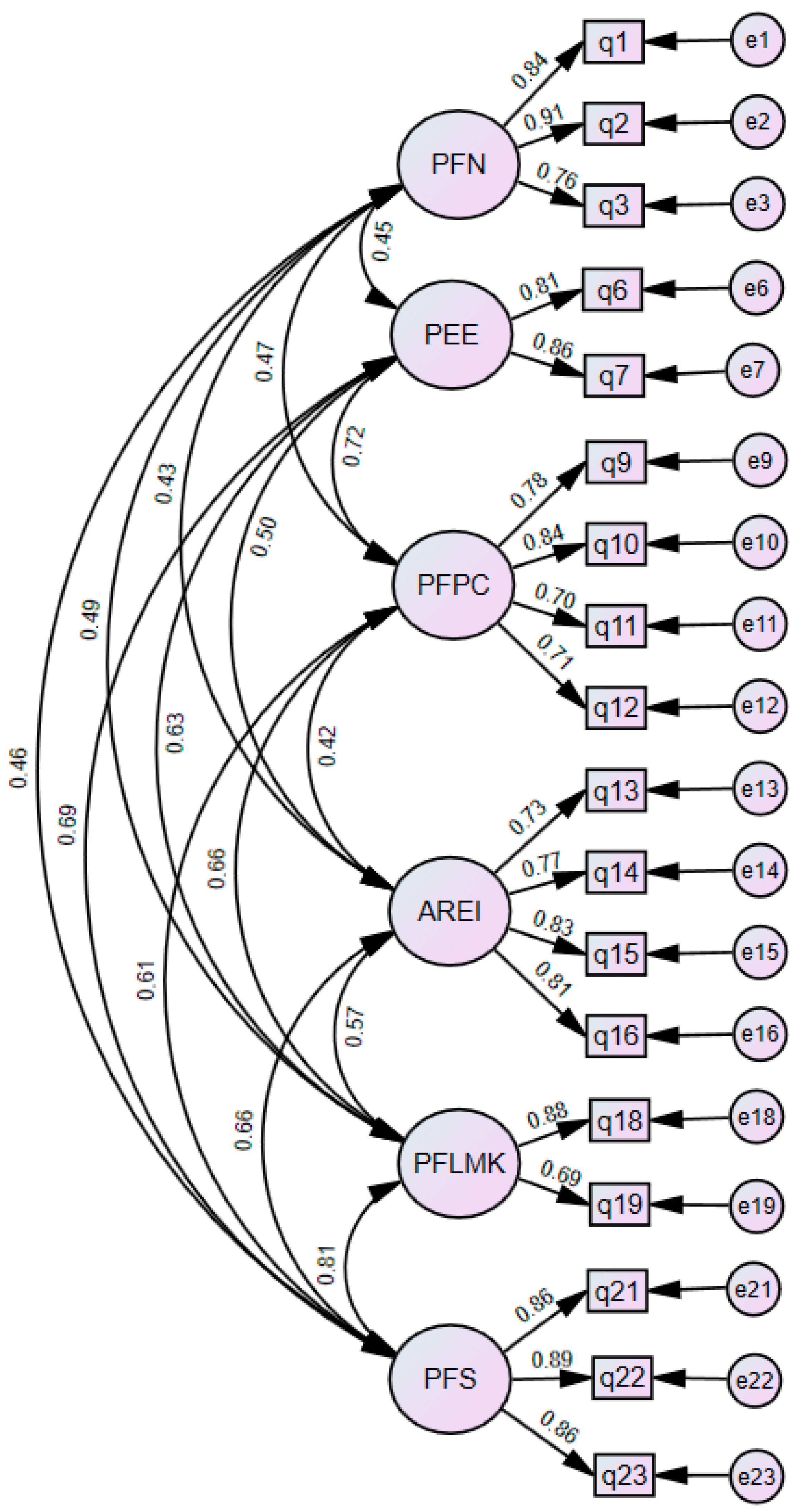
3.3. Factor Structure: Confirmatory Factor Analysis (CFA)
3.4. Reliability and Validity
3.5. Measurement Invariance Across Gender
4. Discussion
4.1. Psychometric Properties and Practical Implications
- High PFLMK, low PFS → competency-building workshops, self-efficacy interventions;
- High PFS, low PFLMK → labour market orientation, job search strategies;
- Low on both → comprehensive work-integrated learning programs;
- High on both → advanced career planning and negotiation skills.
4.2. Theoretical Contributions and the Polish Context
5. Conclusions
6. Limitations and Future Research
6.1. Limitations
6.2. Future Research
Author Contributions
Funding
Institutional Review Board Statement
Informed Consent Statement
Data Availability Statement
Acknowledgments
Conflicts of Interest
Abbreviations
| AREI | Anticipated Reputation of Educational Institution |
| AVE | Average Variance Extracted |
| CDL | Career Development Learning |
| HEI | Higher-Education Institution |
| HTMT | Heterotrait–Monotrait Ratio |
| PFE | Perceived Future Employability |
| PFES | Perceived Future Employability Scale |
| PFLMK | Perceived Future Labour Market Knowledge |
| PFN | Perceived Future Network |
| PFPC | Perceived Future Personal Characteristics |
| PFS | Perceived Future Skills |
| PLS-SEM | Partial Least Squares Structural Equation Modelling |
| SCCT | Social Cognitive Career Theory |
| SD | Standard Deviation |
| VIF | Variance Inflation Factor |
Appendix A. Perceived Future Employability Scale
- Original: Gunawan, Creed & Glendon (2018) [6]
- Instructions: Please indicate to what extent you agree with the following statements. 1—strongly disagree, 7—strongly agree

| Item | Statment | Scale | |
|---|---|---|---|
| Perceived Future Network/Postrzegana przyszła sieć kontaktów | |||
| 1 | I will be able to draw on the network I have developed to succeed at my work. | Będę w stanie wykorzystać sieć kontaktów społecznych, którą rozwinąłem/am, aby odnieść sukces w pracy. | 1–2–3–4–5–6–7 |
| 2 | I will have built up a social network that will help me do well in my job. | Będę posiadać sieć kontaktów społecznych, która pomoże mi dobrze radzić sobie w pracy. | 1–2–3–4–5–6–7 |
| 3 | I will have developed a network of contacts who can help identify potential work opportunities. | Będę mieć sieć kontaktów, która pomoże mi zidentyfikować potencjalne możliwości zatrudnienia. | 1–2–3–4–5–6–7 |
| 4 | I will know how to network with people who can help me find work in my chosen career. | Będę umiał/a nawiązywać kontakty z osobami, którzy mogą pomóc mi znaleźć pracę w wybranej przeze mnie ścieżce kariery. | 1–2–3–4–5–6–7 |
| Perceived Expected Experiences/Postrzegane oczekiwane doświadczenia | |||
| 5 | I will have had relevant work experience applying the knowledge acquired in my studies. | Zdobędę odpowiednie doświadczenie zawodowe, wykorzystując wiedzę nabytą podczas studiów. | 1–2–3–4–5–6–7 |
| 6 | Future employers will be impressed with the relevant work experience I have accumulated. | Moje doświadczenie zawodowe związane ze stanowiskiem zrobi wrażenie na przyszłych pracodawcach. | 1–2–3–4–5–6–7 |
| 7 | Future employers will be satisfied with the work experiences I have gained. | Przyszli pracodawcy będą zadowoleni z doświadczenia zawodowego, które zdobędę. | 1–2–3–4–5–6–7 |
| 8 | I will be able to show future employers that I have the required practical skills and academic experience they require. | Będę w stanie pokazać przyszłym pracodawcom, że posiadam wymagane przez nich umiejętności praktyczne i wiedzę akademicką. | 1–2–3–4–5–6–7 |
| Perceived Future Personal Characteristics/Postrzegane przyszłe cechy osobiste | |||
| 9 | My experiences will show that I have developed resilience and do not give up easily. | Moje doświadczenia pokażą, że rozwinąłem/am odporność psychiczną i nie poddaję się łatwo. | 1–2–3–4–5–6–7 |
| 10 | Prospective employers will be able to see from what I have achieved that I am well motivated. | Moje osiągnięcia pokażą potencjalnym pracodawcom, że jestem dobrze zmotywowany/a | 1–2–3–4–5–6–7 |
| 11 | Prospective employers will be able to see that I have clear goals for myself. | Potencjalni pracodawcy zobaczą, że mam jasno określone cele. | 1–2–3–4–5–6–7 |
| 12 | My record will show that I have a strong work ethic. | Moje osiągnięcia i historia zawodowa pokażą, że mam silną etykę pracy. | 1–2–3–4–5–6–7 |
| Anticipated Reputation of Educational Institution/Przewidywana renoma instytucji edukacyjnej | |||
| 13 | I will have an advantage as future employers will be more likely to recruit graduates from my institution than from other institutions. | Będę mieć przewagę, ponieważ przyszli pracodawcy chętniej rekrutują absolwentów mojej uczelni niż absolwentów z innych uczelni. | 1–2–3–4–5–6–7 |
| 14 | The reputation of my educational institution will be a significant asset to me in job seeking. | Renoma mojej uczelni będzie znaczącym atutem w poszukiwaniu pracy. | 1–2–3–4–5–6–7 |
| 15 | I will have a lot of work opportunities open to me because my teaching institution has strong partnerships with many potential employers. | Będę mieć wiele możliwości pracy, ponieważ moja uczelnia ma silne partnerstwa i współpracuje z wieloma potencjalnymi pracodawcami. | 1–2–3–4–5–6–7 |
| 16 | I will be in demand because graduates from my institution are well prepared for work roles that are in high demand. | Będę poszukiwanym/ną kandydatem/tką do pracy, ponieważ absolwenci mojej uczelni są dobrze przygotowani do pełnienia poszukiwanych ról zawodowych. | 1–2–3–4–5–6–7 |
| Perceived Future Labour Market Knowledge/Postrzegana przyszła wiedza na temat rynku pracy | |||
| 17 | I will have developed a good understanding of the variety of work opportunities available to me. | Będę dobrze orientować się w różnorodnych możliwościach pracy dostępnych dla mnie. | 1–2–3–4–5–6–7 |
| 18 | I will know the steps I need to take to do well in my chosen career. | Będę znać kroki, które muszę podjąć, aby odnieść sukces w wybranej ścieżce kariery. | 1–2–3–4–5–6–7 |
| 19 | I will have developed the ability to find out about job opportunities in my chosen field. | Rozwinę umiejętność wyszukiwania ofert pracy w wybranej przeze mnie dziedzinie. | 1–2–3–4–5–6–7 |
| 20 | I will be up-to-date with occupational trends in my chosen field. | Będę posiadać aktualną wiedzę o trendach zawodowych w mojej branży. | 1–2–3–4–5–6–7 |
| Perceived Future Skills/Postrzegane przyszłe umiejętności | |||
| 21 | I will have gained the knowledge required to get the job I want. | Zdobędę wiedzę niezbędną do uzyskania pożądanej przeze mnie pracy | 1–2–3–4–5–6–7 |
| 22 | I will have the relevant skills for the occupation I choose. | Będę mieć odpowiednie umiejętności do wykonywania wybranego przeze mnie zawodu. | 1–2–3–4–5–6–7 |
| 23 | Future employers will see that I will have learned the right discipline-specific/technical skills and knowledge that they want. | Przyszli pracodawcy zobaczą, że opanowałem/am właściwe umiejętności techniczne i wiedzę specjalistyczną, których potrzebują. | 1–2–3–4–5–6–7 |
| 24 | I will have developed the reasoning and problem-solving skills that future employers often require. | Rozwinę umiejętności analitycznego myślenia i rozwiązywania problemów których często wymagają pracodawcy. | 1–2–3–4–5–6–7 |
References
- Rothwell, A.; Jewell, S.; Hardie, M. Self-perceived employability: Investigating the responses of post-graduate students. J. Vocat. Behav. 2009, 75, 152–161. [Google Scholar] [CrossRef]
- Vanhercke, D.; De Cuyper, N.; Peeters, E.; De Witte, H. Defining perceived employability: A psychological approach. Pers. Rev. 2014, 43, 592–605. [Google Scholar] [CrossRef]
- De Vos, A.; Van der Heijden, B.; Akkermans, J. Sustainable careers: Toward a conceptual model. J. Vocat. Behav. 2020, 117, 103196. [Google Scholar] [CrossRef]
- Fugate, M.; Kinicki, A.J.; Ashforth, B.E. Employability: A psycho-social construct, its dimensions, and applications. J. Vocat. Behav. 2004, 65, 14–38. [Google Scholar] [CrossRef]
- Clarke, M. Rethinking graduate employability: The role of capital, individual attributes and context. Stud. High. Educ. 2018, 43, 1923–1937. [Google Scholar] [CrossRef]
- Gunawan, W.; Creed, P.A.; Glendon, A.I. Development and initial validation of a perceived future employability scale for young adults. J. Career Assess. 2018, 27, 610–627. [Google Scholar] [CrossRef]
- Gunawan, W.; Glendon, A.I.; Creed, P.A. Young adults’ perceived future employability: Testing a social cognitive career model. Int. J. Educ. Vocat. Guid. 2024, 24, 1287–1304. [Google Scholar] [CrossRef]
- Yepes Zuluaga, S.M. External aspects that stand out in the self-perceived employability of engineering students and recent graduates. J. Teach. Learn. Grad. Employab. 2024, 15, 108–125. [Google Scholar] [CrossRef]
- Atitsogbe, K.A.; Mama, N.P.; Sovet, L.; Pari, P.; Rossier, J. Perceived employability and entrepreneurial intentions across university students and job seekers in Togo: The effect of career adaptability and self-efficacy. Front. Psychol. 2019, 10, 180. [Google Scholar] [CrossRef] [PubMed]
- Niu, Y. Exploring self-perceived employability and its determinants among international students in the United States. J. Comp. Int. High. Educ. 2022, 14, 6–22. [Google Scholar] [CrossRef]
- Domagała-Zyśk, E.; Mamcarz, P.; Martynowska, K.; Fudali-Czyż, A.; Rothwell, A. Self-perceived employability scale—Polish adaptation. New Educ. Rev. 2022, 70, 9–22. [Google Scholar] [CrossRef]
- Strauss, K.; Griffin, M.A.; Parker, S.K. Future work selves: How salient hoped-for identities motivate proactive career behaviors. J. Appl. Psychol. 2012, 97, 580–598. [Google Scholar] [CrossRef] [PubMed]
- Wiernik, B.M.; Kostal, J.W. Protean and boundaryless career orientations: A critical review and meta-analysis. J. Couns. Psychol. 2019, 66, 280–307. [Google Scholar] [CrossRef] [PubMed]
- Kwiek, M. Changing European Academics: A Comparative Study of Social Stratification, Work Patterns and Research Productivity; Routledge: New York, NY, USA, 2019. [Google Scholar]
- Sarnowska, J. Double transition: University-to-work abroad and adulthood. Rocznik Lubuski 2016, 42, 216–228. [Google Scholar]
- Watts, A.G.; Sultana, R.G. Career guidance policies in 37 countries: Contrasts and common themes. Int. J. Educ. Vocat. Guid. 2004, 4, 105–122. [Google Scholar] [CrossRef]
- Rothwell, A.; Arnold, J. Self-perceived employability: Development and validation of a scale. Pers. Rev. 2007, 36, 23–41. [Google Scholar] [CrossRef]
- Savickas, M.L. The theory and practice of career construction. In Career Development and Counseling: Putting Theory and Research to Work; Brown, S.D., Lent, R.W., Eds.; John Wiley & Sons: Hoboken, NJ, USA, 2005; pp. 42–70. [Google Scholar]
- Savickas, M.L. Career construction theory and practice. In Career Development and Counselling, 2nd ed.; Lent, R.W., Brown, S.D., Eds.; John Wiley & Sons: Hoboken, NJ, USA, 2013; pp. 147–183. [Google Scholar]
- Kwiek, M.; Antonowicz, D. The changing paths in academic careers in European universities: Minor steps and major milestones. In Academic Work and Careers in EUROPE: Trends, Challenges, Perspectives; Fumasoli, T., Goastellec, G., Kehm, B.M., Eds.; Springer: Berlin/Heidelberg, Germany, 2015; pp. 41–68. [Google Scholar] [CrossRef]
- Becker, G.S. Human Capital: A Theoretical and Empirical Analysis; University of Chicago Press: Chicago, IL, USA, 1964. [Google Scholar]
- Tomlinson, M. Forms of graduate capital and their relationship to graduate employability. Educ. Train. 2017, 59, 338–352. [Google Scholar] [CrossRef]
- Jackson, D.; Wilton, N. Perceived employability among undergraduates and the importance of career self-management, work experience and individual characteristics. High. Educ. Res. Dev. 2017, 36, 747–762. [Google Scholar] [CrossRef]
- Suleman, F. The employability skills of higher education graduates: Insights into conceptual frameworks and methodological options. High. Educ. 2018, 76, 263–278. [Google Scholar] [CrossRef]
- Forrier, A.; Verbruggen, M.; De Cuyper, N. Integrating different notions of employability in a dynamic chain: The relationship between job transitions, movement capital and perceived employability. J. Vocat. Behav. 2015, 89, 56–64. [Google Scholar] [CrossRef]
- Teichler, U. Does higher education matter? Lessons from a comparative graduate survey. Eur. J. Educ. 2007, 42, 11–34. [Google Scholar] [CrossRef]
- Tomlinson, M.; Holmes, L. (Eds.) Graduate Employability in Context: Theory, Research and Debate; Palgrave Macmillan: London, UK, 2017. [Google Scholar] [CrossRef]
- Antonowicz, D.; Kwiek, M.; Westerheijden, D.F. The government response to the private sector expansion in Polish higher education. In Policy Analysis of Structural Reforms in Higher Education; de Boer, H., File, J., Huisman, J., Seeber, M., Vukasovic, M., Westerheijden, D.F., Eds.; Palgrave Macmillan: London, UK, 2017; pp. 119–138. [Google Scholar] [CrossRef]
- Kwiek, M. Changing higher education policies: From the deinstitutionalization to the reinstitutionalization of the research mission in Polish universities. Sci. Public Policy 2012, 39, 641–654. [Google Scholar] [CrossRef]
- Holmes, L. Competing perspectives on graduate employability: Possession, position or process? Stud. High. Educ. 2013, 38, 538–554. [Google Scholar] [CrossRef]
- Rakowska, A.; de Juana-Espinosa, S. Public sector motivational practices and their effect on job satisfaction: Country differences. Eur. J. Manag. Bus. Econ. 2018, 27, 141–154. [Google Scholar] [CrossRef]
- Cieciora, M.; Pietrzak, P.; Gago, P. University graduates’ skills-and-employability evaluation in Poland—A case study of a faculty of management in Warsaw. Int. J. Innov. Learn. 2021, 30, 1–18. [Google Scholar] [CrossRef]
- Brennan, J.; Teichler, U. The future of higher education and of higher education research. High. Educ. 2008, 56, 259–264. [Google Scholar] [CrossRef]
- Kwiek, M. The prestige economy of higher education journals: A quantitative approach. High. Educ. 2021, 81, 493–519. [Google Scholar] [CrossRef]
- Myant, M.; Drahokoupil, J. Transition Economies: Political Economy in Russia, Eastern Europe, and Central Asia; John Wiley & Sons: Hoboken, NJ, USA, 2011. [Google Scholar]
- Rapacki, R.; Próchniak, M. EU membership and economic growth: Empirical evidence for the CEE countries. Eur. J. Comp. Econ. 2019, 16, 3–40. [Google Scholar] [CrossRef]
- Magda, I.; Gromadzki, J.; Moriconi, S. Firms and wage inequality in Central and Eastern Europe. J. Comp. Econ. 2021, 49, 499–552. [Google Scholar] [CrossRef]
- Wójcik, P.; Krzesiński, P. Human capital of tertiary graduates in the context of their employability in the labour market of Lubelskie Province. Sci. Q. Organ. Manag. 2019, 4, 121–135. [Google Scholar]
- Lewandowski, P.; Magda, I. The labour market in Poland, 2000–2016. IZA World Labor 2018, 2018, 426. [Google Scholar] [CrossRef]
- Dakowska, D. Between competition imperative and Europeanisation: The case of higher education in Poland. High. Educ. 2015, 69, 129–141. [Google Scholar] [CrossRef]
- Piróg, D. Job search strategies of recent university graduates in Poland: Plans and effectiveness. High. Educ. 2016, 71, 557–573. [Google Scholar] [CrossRef]
- Tyrańska, M.; Łapczyński, M.; Walczak, M.; Ziębicki, B. The gap between higher business education and business expectations: The case of Poland. Sustainability 2021, 13, 13809. [Google Scholar] [CrossRef]
- Zając, T.; Jasiński, M.; Bożykowski, M. Early careers of tertiary graduates in Poland: Employability, earnings, and differences between public and private higher education. Pol. Sociol. Rev. 2018, 2, 179–198. [Google Scholar]
- Blokker, R.; Akkermans, J.; Tims, M.; Jansen, P.; Khapova, S. Building a sustainable start: The role of career competencies, career success, and career shocks in young professionals’ employability. J. Vocat. Behav. 2019, 112, 172–187. [Google Scholar] [CrossRef]
- Berntson, E.; Näswall, K.; Sverke, M. Investigating employability: Psychometric properties, validity, and associations with well-being. Eur. J. Work Organ. Psychol. 2008, 17, 413–425. [Google Scholar] [CrossRef]
- Van der Heijden, B.I.J.M.; De Vos, A.; Akkermans, J.; Nauta, A. Sustainable careers across the lifespan: Moving the field forward. J. Vocat. Behav. 2020, 117, 103344. [Google Scholar] [CrossRef]
- Donald, W.E.; van der Heijden, B.I.J.M.; Manville, G. (Re)framing sustainable careers: Towards a conceptual model and future research agenda. Career Dev. Int. 2024, 29, 513–526. [Google Scholar] [CrossRef]
- Beaton, D.E.; Bombardier, C.; Guillemin, F.; Ferraz, M.B. Guidelines for the process of cross-cultural adaptation of self-report measures. Spine 2000, 25, 3186–3191. [Google Scholar] [CrossRef] [PubMed]
- Tarka, P. Własności 5- i 7-stopniowej skali Likerta w kontekście normalizacji zmiennych metodą Kaufmana i Rousseeuwa. Pr. Nauk. Uniw. Ekon. We Wrocławiu 2015, 385, 286–295. [Google Scholar] [CrossRef]
- Weijters, B.; Cabooter, E.; Schillewaert, N. The effect of rating scale format on response styles: The number of response categories and response category labels. Int. J. Res. Mark. 2010, 27, 236–247. [Google Scholar] [CrossRef]
- Finstad, K. Response interpolation and scale sensitivity: Evidence against 5-point scales. J. Usability Stud. 2010, 5, 104–110. [Google Scholar]
- Kolen, M.J.; Brennan, R.L. Test Equating, Scaling, and Linking: Methods and Practices, 3rd ed.; Springer Science: Berlin/Heidelberg, Germany, 2014. [Google Scholar] [CrossRef]
- Regulation (EU) 2016/679 of the European Parliament and of the Council of 27 April 2016 on the Protection of Natural Persons with Regard to the Processing of Personal Data and on the Free Movement of Such Data, and Repealing Directive 95/46/EC (General Data Protection Regulation). 2016. Available online: https://eur-lex.europa.eu/eli/reg/2016/679/oj (accessed on 15 November 2025).
- George, D.; Mallery, M. IBM SPSS Statistics 26 Step by Step: A Simple Guide and Reference, 16th ed.; Routledge: New York, NY, USA, 2020. [Google Scholar] [CrossRef]
- Kaiser, H.F. An index of factorial simplicity. Psychometrika 1974, 39, 31–36. [Google Scholar] [CrossRef]
- Field, A. Discovering Statistics Using IBM SPSS Statistics: And Sex and Drugs and Rock “n” Roll, 4th ed.; Sage: Hong Kong, China, 2013. [Google Scholar]
- Marsh, H.W.; Yeung, A.S. Longitudinal structural equation models of academic self-concept and achievement: Gender differences in the development of math and English constructs. Am. Educ. Res. J. 1998, 35, 705–738. [Google Scholar] [CrossRef]
- Bandura, A. Self-Efficacy: The Exercise of Control; W H Freeman/Times Books/Henry Holt & Co.: New York, NY, USA, 1997. [Google Scholar]
- Curran, P.J.; West, S.G.; Finch, J.F. The robustness of test statistics to nonnormality and specification error in confirmatory factor analysis. Psychol. Methods 1996, 1, 16–29. [Google Scholar] [CrossRef]
- Li, C.-H. Confirmatory factor analysis with ordinal data: Comparing robust maximum likelihood and diagonally weighted least squares. Behav. Res. Methods 2016, 48, 936–949. [Google Scholar] [CrossRef] [PubMed]
- Rhemtulla, M.; Brosseau-Liard, P.É.; Savalei, V. When can categorical variables be treated as continuous? A comparison of robust continuous and categorical SEM estimation methods under suboptimal conditions. Psychol. Methods 2012, 17, 354–373. [Google Scholar] [CrossRef]
- Hu, L.T.; Bentler, P.M. Cutoff criteria for fit indexes in covariance structure analysis: Conventional criteria versus new alternatives. Struct. Equ. Model. 1999, 6, 1–55. [Google Scholar] [CrossRef]
- Kline, R.B. Principles and Practice of Structural Equation Modeling, 4th ed.; Guilford Publications: New York, NY, USA, 2016. [Google Scholar]
- Chen, F.F. Sensitivity of Goodness of Fit Indexes to Lack of Measurement Invariance. Struct. Equ. Model. A Multidiscip. J. 2007, 14, 464–504. [Google Scholar] [CrossRef]
- Lent, R.W.; Brown, S.D.; Hackett, G. Toward a unifying social cognitive theory of career and academic interest, choice, and performance. J. Vocat. Behav. 1994, 45, 79–122. [Google Scholar] [CrossRef]
- Fornell, C.; Larcker, D.F. Evaluating structural equation models with unobservable variables and measurement error. J. Mark. Res. 1981, 18, 39–50. [Google Scholar] [CrossRef]
- Nunnally, J.C.; Bernstein, I.H. Psychometric Theory, 3rd ed.; McGraw-Hill: New York, NY, USA, 1994. [Google Scholar]
- Svetina, D.; Rutkowski, L.; Rutkowski, D. Multiple-group invariance with categorical outcomes using updated guidelines: An illustration using Mplus and the lavaan/semTools packages. Struct. Equ. Model. 2020, 27, 111–130. [Google Scholar] [CrossRef]
- Akkermans, J.; Tims, M. Crafting your career: How career competencies relate to career success via job crafting. Appl. Psychol. Int. Rev. 2017, 66, 168–195. [Google Scholar] [CrossRef]
- UNESCO. Education for Sustainable Development Goals: Learning Objectives; UNESCO: Paris, France, 2017. [Google Scholar] [CrossRef]
- International Labour Organization. Global Employment Trends for Youth 2020: Technology and the Future of Jobs; International Labour Organization: Genève, Switzerland, 2020; Available online: https://www.ilo.org/wcmsp5/groups/public/---dgreports/---dcomm/---publ/documents/publication/wcms_737648.pdf (accessed on 15 November 2025).
- Frey, C.B.; Osborne, M.A. The future of employment: How susceptible are jobs to computerisation? Technol. Forecast. Soc. Change 2017, 114, 254–280. [Google Scholar] [CrossRef]
- Markus, H.; Nurius, P. Possible selves. Am. Psychol. 1986, 41, 954–969. [Google Scholar] [CrossRef]
- De Vos, A.; De Hauw, S.; Van der Heijden, B.I. Competency development and career success: The mediating role of employability. J. Vocat. Behav. 2011, 79, 438–447. [Google Scholar] [CrossRef]
- Brown, P.; Hesketh, A.; Williams, S. Employability in a knowledge-driven economy. J. Educ. Work. 2003, 16, 107–126. [Google Scholar] [CrossRef]
- Brown, P.; Souto-Otero, M. The end of the credential society? An analysis of the relationship between education and the labour market using big data. J. Educ. Policy 2020, 35, 95–118. [Google Scholar] [CrossRef]
- Jackson, D. Re-conceptualising graduate employability: The importance of pre-professional identity. High. Educ. Res. Dev. 2016, 35, 925–939. [Google Scholar] [CrossRef]
- Marsh, H.W.; Guo, J.; Parker, P.D.; Nagengast, B.; Asparouhov, T.; Muthén, B.; Dicke, T. What to do when scalar invariance fails: The extended alignment method for multi-group factor analysis comparison of latent means across many groups. Psychol. Methods 2018, 23, 524–545. [Google Scholar] [CrossRef]
- Vandenberg, R.J.; Lance, C.E. A review and synthesis of the measurement invariance literature. Organ. Res. Methods 2000, 3, 4–70. [Google Scholar] [CrossRef]
- Henseler, J.; Ringle, C.M.; Sarstedt, M. A new criterion for assessing discriminant validity in variance-based structural equation modeling. J. Acad. Mark. Sci. 2015, 43, 115–135. [Google Scholar] [CrossRef]
- Podsakoff, P.M.; MacKenzie, S.B.; Lee, J.Y.; Podsakoff, N.P. Common method biases in behavioral research: A critical review of the literature and recommended remedies. J. Appl. Psychol. 2003, 88, 879–903. [Google Scholar] [CrossRef] [PubMed]
- Podsakoff, P.M.; Organ, D.W. Self-reports in organizational research: Problems and prospects. J. Manag. 1986, 12, 531–544. [Google Scholar] [CrossRef]
- Litwinek, J. Exploring the role of Green HR and sustainable practices in initial career choices from an international student’s perspective. Eduk. Ekon. I Menedżerów 2024, 71, 17–30. [Google Scholar] [CrossRef]
| Characteristic | Gunawan et al. [6]—Australia | Current Study—Poland |
|---|---|---|
| Sample size | N = 383 | N = 408 |
| Gender (% female) | 61.4% | 61.0% |
| Mean age (SD) | 20.39 (3.13) | 20.97 (2.68) |
| Response scale | 6-point Likert | 7-point Likert |
| Final item count | 24 | 18 (refined) |
| Number of Statement | Dimension | M | SD | 95% CI LL | 95% CI UL | Skewness | Kurtosis |
|---|---|---|---|---|---|---|---|
| 1 | PFN | 4.45 | 1.52 | 4.30 | 4.60 | −0.25 | −0.29 |
| 2 | 4.35 | 1.46 | 4.20 | 4.49 | −0.26 | −0.17 | |
| 3 | 4.39 | 1.44 | 4.25 | 4.53 | −0.25 | −0.48 | |
| 4 | 4.81 | 1.36 | 4.68 | 4.94 | −0.55 | 0.21 | |
| 5 | PEE | 4.56 | 1.52 | 4.41 | 4.71 | −0.60 | −0.28 |
| 6 | 3.95 | 1.45 | 3.81 | 4.09 | −0.07 | −0.35 | |
| 7 | 4.35 | 1.43 | 4.21 | 4.49 | −0.31 | −0.27 | |
| 8 | 4.80 | 1.32 | 4.67 | 4.93 | −0.70 | 0.84 | |
| 9 | PFPC | 5.33 | 1.34 | 5.20 | 5.46 | −1.15 | 1.74 |
| 10 | 5.14 | 1.30 | 5.02 | 5.27 | −0.91 | 1.16 | |
| 11 | 5.04 | 1.31 | 4.91 | 5.17 | −0.72 | 0.64 | |
| 12 | 4.99 | 1.33 | 4.86 | 5.12 | −0.71 | 0.32 | |
| 13 | AREI | 3.88 | 1.49 | 3.74 | 4.03 | 0.05 | −0.25 |
| 14 | 4.07 | 1.52 | 3.93 | 4.22 | −0.23 | −0.39 | |
| 15 | 4.16 | 1.36 | 4.03 | 4.30 | −0.27 | 0.02 | |
| 16 | 4.05 | 1.31 | 3.92 | 4.18 | −0.30 | 0.27 | |
| 17 | PFLMK | 4.86 | 1.22 | 4.75 | 4.98 | −0.87 | 1.34 |
| 18 | 4.75 | 1.31 | 4.62 | 4.88 | −0.67 | 0.56 | |
| 19 | 5.29 | 1.26 | 5.16 | 5.41 | −1.02 | 1.32 | |
| 20 | 4.97 | 1.32 | 4.84 | 5.09 | −0.76 | 0.81 | |
| 21 | PFS | 4.91 | 1.31 | 4.78 | 5.04 | −0.84 | 0.85 |
| 22 | 4.97 | 1.34 | 4.84 | 5.10 | −0.80 | 0.84 | |
| 23 | 4.73 | 1.31 | 4.60 | 4.86 | −0.55 | 0.35 | |
| 24 | 5.02 | 1.27 | 4.90 | 5.14 | −0.83 | 1.19 |
| Dimension | Number of Items | M | SD | Skewness | Kurtosis |
|---|---|---|---|---|---|
| PFN | 4 | 4.50 | 1.22 | −0.39 | 0.31 |
| PEE | 4 | 4.42 | 1.18 | −0.39 | 0.27 |
| PFPC | 4 | 5.12 | 1.08 | −0.86 | 1.52 |
| AREI | 4 | 4.04 | 1.20 | −0.19 | 0.34 |
| PFLMK | 4 | 4.97 | 1.05 | −0.91 | 1.94 |
| PFS | 4 | 4.91 | 1.14 | −0.92 | 1.77 |
| Number of Statement | Dimension | Factor 1 | Factor 2 | Factor 3 | Factor 4 | Factor 5 | Factor 6 |
|---|---|---|---|---|---|---|---|
| 1 | PFN | 0.050 | −0.002 | 0.841 | 0.023 | −0.093 | 0.045 |
| 2 | −0.014 | −0.007 | 0.909 | −0.036 | −0.045 | 0.045 | |
| 3 | −0.066 | 0.023 | 0.789 | −0.034 | 0.074 | −0.031 | |
| 4 | 0.040 | 0.017 | 0.469 | 0.235 | 0.165 | −0.074 | |
| 5 | PEE | 0.306 | 0.226 | 0.012 | 0.060 | −0.074 | 0.314 |
| 6 | −0.001 | 0.009 | 0.080 | 0.034 | 0.056 | 0.721 | |
| 7 | 0.062 | −0.006 | 0.013 | 0.100 | 0.046 | 0.721 | |
| 8 | 0.396 | 0.130 | 0.077 | 0.126 | −0.011 | 0.317 | |
| 9 | PFPC | −0.135 | −0.017 | 0.010 | 0.623 | 0.118 | 0.220 |
| 10 | 0.024 | 0.016 | 0.025 | 0.891 | −0.068 | −0.009 | |
| 11 | 0.143 | 0.053 | 0.047 | 0.606 | 0.060 | −0.076 | |
| 12 | −0.013 | 0.048 | 0.015 | 0.521 | 0.058 | 0.175 | |
| 13 | AREI | −0.019 | 0.826 | −0.023 | 0.051 | −0.065 | −0.043 |
| 14 | −0.107 | 0.888 | −0.022 | 0.026 | 0.051 | −0.028 | |
| 15 | 0.110 | 0.679 | 0.107 | −0.076 | 0.041 | 0.035 | |
| 16 | 0.153 | 0.596 | 0.041 | −0.036 | 0.083 | 0.125 | |
| 17 | PFLMK | 0.240 | 0.052 | 0.051 | 0.077 | 0.462 | 0.001 |
| 18 | 0.272 | 0.070 | 0.037 | 0.031 | 0.510 | 0.074 | |
| 19 | −0.059 | 0.022 | 0.008 | −0.003 | 0.828 | 0.037 | |
| 20 | 0.091 | 0.069 | 0.074 | 0.117 | 0.483 | 0.052 | |
| 21 | PFS | 0.604 | 0.092 | 0.095 | −0.028 | 0.206 | 0.065 |
| 22 | 0.793 | 0.051 | 0.020 | 0.069 | 0.037 | 0.048 | |
| 23 | 0.594 | 0.074 | 0.018 | 0.052 | 0.130 | 0.159 | |
| 24 | 0.387 | −0.064 | 0.071 | 0.265 | 0.245 | 0.009 |
| Item No. | Original Dimension | Item Content (Abbreviated) | Primary Factor Loading | Secondary/Cross-Loading | Rationale for Exclusion |
|---|---|---|---|---|---|
| 4 | PFN | I will know how to network with people… | 0.469 | — | Loading below the 0.50 threshold; conceptual redundancy with item 3 |
| 5 | PEE | I will have had relevant work experience… | 0.306 (F1) | 0.314 (F6) | Substantial cross-loadings on two factors; ambiguous construct representation |
| 8 | PEE | I will be able to show future employers… | 0.396 (F1) | 0.317 (F6) | Insufficient primary loading combined with notable secondary loading |
| 17 | PFLMK | I will have developed a good understanding… | 0.462 | — | Marginal loading below threshold; conceptual overlap with item 19 |
| 20 | PFLMK | I will be up-to-date with occupational trends… | 0.483 | — | Marginal loading below threshold; redundancy with item 19 |
| 24 | PFS | I will have developed reasoning and problem-solving skills… | 0.387 | — | Weakest loading within the dimension; item reflects generic rather than domain-specific skills |
| Model | χ2 | df | p | CFI | TLI | RMSEA | RMSEA 90% CI | SRMR | χ2/df |
|---|---|---|---|---|---|---|---|---|---|
| Model 1: Six-factor (24 items, original) | 735.76 | 237 | <0.001 | 0.992 | 0.990 | 0.072 | [0.066, 0.078] | 0.051 | 3.10 |
| Model 2: Six-factor (18 items, reduced) | 256.73 | 120 | <0.001 | 0.996 | 0.995 | 0.053 | [0.044, 0.062] | 0.040 | 2.14 |
| Model 3: Second-order hierarchical | 887.40 | 246 | <0.001 | 0.989 | 0.988 | 0.080 | [0.074, 0.086] | 0.058 | 3.61 |
| Model 4: Bifactor | 524.27 | 228 | <0.001 | 0.995 | 0.994 | 0.057 | [0.050, 0.063] | 0.048 | 2.30 |
| Estimation Method | χ2 (df) | p | χ2/df | CFI | TLI | RMSEA | RMSEA 90% CI | SRMR | GFI |
|---|---|---|---|---|---|---|---|---|---|
| DWLS/WLSMV (lavaan) | 256.73 (120) | <0.001 | 2.14 | 0.996 | 0.995 | 0.053 | [0.044, 0.062] | 0.040 | — |
| ML (AMOS) | 307.17 (120) | <0.001 | 2.56 | 0.958 | 0.946 | 0.062 | [0.053, 0.071] | 0.042 | 0.922 |
| Model | χ2 (df) | p | χ2/df | CFI | TLI | RMSEA | RMSEA 90% CI | SRMR |
|---|---|---|---|---|---|---|---|---|
| Model 2: Six-factor (18 items) | 256.73 (120) | <0.001 | 2.14 | 0.996 | 0.995 | 0.053 | [0.044, 0.062] | 0.040 |
| Model 2c: Five-factor (PFLMK + PFS combined) | 342.20 (125) | <0.001 | 2.74 | 0.994 | 0.993 | 0.065 | [0.057, 0.074] | 0.046 |
| Factor | Cronbach’s α | McDonald’s ω | AVE | PFN | PEE | PFPC | AREI | PFLMK | PFS |
|---|---|---|---|---|---|---|---|---|---|
| PFN | 0.872 | 0.875 | 0.733 | (0.856) | |||||
| PEE | 0.818 | 0.819 | 0.730 | 0.463 | (0.854) | ||||
| PFPC | 0.839 | 0.838 | 0.612 | 0.486 | 0.743 | (0.782) | |||
| AREI | 0.866 | 0.873 | 0.679 | 0.425 | 0.482 | 0.402 | (0.824) | ||
| PFLMK | 0.756 | 0.754 | 0.653 | 0.508 | 0.626 | 0.691 | 0.536 | (0.808) | |
| PFS | 0.903 | 0.893 | 0.785 | 0.477 | 0.709 | 0.633 | 0.636 | 0.797 | (0.886) |
| Model | χ2 Scaled | df | p | RMSEA | CFI | TLI | SRMR | Δχ2 | Δdf | p | ΔCFI | ΔRMSEA | ΔSRMR |
|---|---|---|---|---|---|---|---|---|---|---|---|---|---|
| Configural | 611.78 | 240 | <0.001 | 0.087 | 0.963 | 0.952 | 0.047 | — | — | — | — | — | — |
| Metric | 593.93 | 252 | <0.001 | 0.082 | 0.966 | 0.958 | 0.051 | 27.38 | 12 | 0.007 | +0.003 | –0.006 | +0.004 |
| Scalar | 650.30 | 336 | <0.001 | 0.068 | 0.968 | 0.971 | 0.048 | 45.59 | 84 | 1.000 | +0.003 | –0.014 | –0.003 |
| Strict | 650.30 | 336 | <0.001 | 0.068 | 0.968 | 0.971 | 0.048 | 0.00 | 0 | — | 0.000 | 0.000 | 0.000 |
Disclaimer/Publisher’s Note: The statements, opinions and data contained in all publications are solely those of the individual author(s) and contributor(s) and not of MDPI and/or the editor(s). MDPI and/or the editor(s) disclaim responsibility for any injury to people or property resulting from any ideas, methods, instructions or products referred to in the content. |
© 2026 by the authors. Licensee MDPI, Basel, Switzerland. This article is an open access article distributed under the terms and conditions of the Creative Commons Attribution (CC BY) license.
Share and Cite
Wójcik, P.; Litwinek, J. Validation of the Polish Version of the Perceived Future Employability Scale (PFES). Sustainability 2026, 18, 1049. https://doi.org/10.3390/su18021049
Wójcik P, Litwinek J. Validation of the Polish Version of the Perceived Future Employability Scale (PFES). Sustainability. 2026; 18(2):1049. https://doi.org/10.3390/su18021049
Chicago/Turabian StyleWójcik, Paweł, and Justyna Litwinek. 2026. "Validation of the Polish Version of the Perceived Future Employability Scale (PFES)" Sustainability 18, no. 2: 1049. https://doi.org/10.3390/su18021049
APA StyleWójcik, P., & Litwinek, J. (2026). Validation of the Polish Version of the Perceived Future Employability Scale (PFES). Sustainability, 18(2), 1049. https://doi.org/10.3390/su18021049

