You are currently viewing a new version of our website. To view the old version click .
Energies
  • Review
  • Open Access

23 December 2025

Grey-Box RC Building Models for Intelligent Management of Large-Scale Energy Flexibility: From Mass Modeling to Decentralized Digital Twins

,
,
,
and
1
Department of Energy, Systems, Territory and Constructions Engineering (DESTEC), University of Pisa, 56122 Pisa, Italy
2
Idiap Research Institute, Rue Marconi 19, 1920 Martigny, Switzerland
*
Authors to whom correspondence should be addressed.
This article belongs to the Special Issue Decarbonizing Smart Buildings and Energy Systems: Digital Twins, Advanced Models and Optimization Algorithms

Abstract

Managing complex and large-scale building facilities requires reliable, easily interpretable, and computationally efficient models. Considering the electrical-circuit analogy, lumped-parameter resistance–capacitance (RC) thermal models have emerged as both simulation surrogates and advanced tools for energy management. This review synthesizes recent uses of RC models for building energy management in large facilities and aggregates. A systematic review of the most recent international literature, based on the analysis of 70 peer-reviewed articles, led to the classification of three main areas: (i) the physics and modeling potential of RC models; (ii) the methods for automation, calibration, and scalability; and (iii) applications in model predictive control (MPC), energy flexibility, and digital twins (DTs). The results show that these models achieve an efficient balance between accuracy and simplicity, allowing for real-time deployment in embedded control systems and building-automation platforms. In complex and large-scale situations, a growing integration with machine learning (ML) techniques, semantic frameworks, and stochastic methods within virtual environments is evident. Nonetheless, challenges persist regarding the standardization of performance metrics, input data quality, and real-scale validation. This review provides essential and up-to-date guidance for developing interoperable solutions for complex building energy systems, supporting integrated management across district, urban, and community levels for the future.

1. Introduction

Large facilities, such as offices, schools, hospitals, and university campuses, serve as critical testbeds for the deployment of digitized, flexible, and low-carbon energy systems. These environments are characterized by complex system configurations, intricate spatial layouts, and nonlinear thermo-energy dynamics. Moreover, they exhibit diverse operational patterns and stochastic interactions between occupants and building systems.
The paradigm shift toward intelligent interconnected management reveals the inadequacy of conventional methods, highlighting the urgent need for predictive tools that are scalable to district and urban operations [1,2]. At such scales, ensuring data quality through the coordinated management of heterogeneous sources is paramount. The recent literature [3,4] addresses these challenges via automated methodologies leveraging building archetypes, temporal clustering, and physics-guided structures with data-driven parameter estimation (grey-box modeling). These approaches effectively abstract building heterogeneity into highly representative synthetic models. The integration of such models with urban DT platforms facilitates neighborhood- and urban-level simulation and dynamic management through continuous training, validation, and real-time data assimilation. This evolution marks a departure from building-centric modeling toward a systemic approach capable of supporting complex control and optimization strategies at scale.
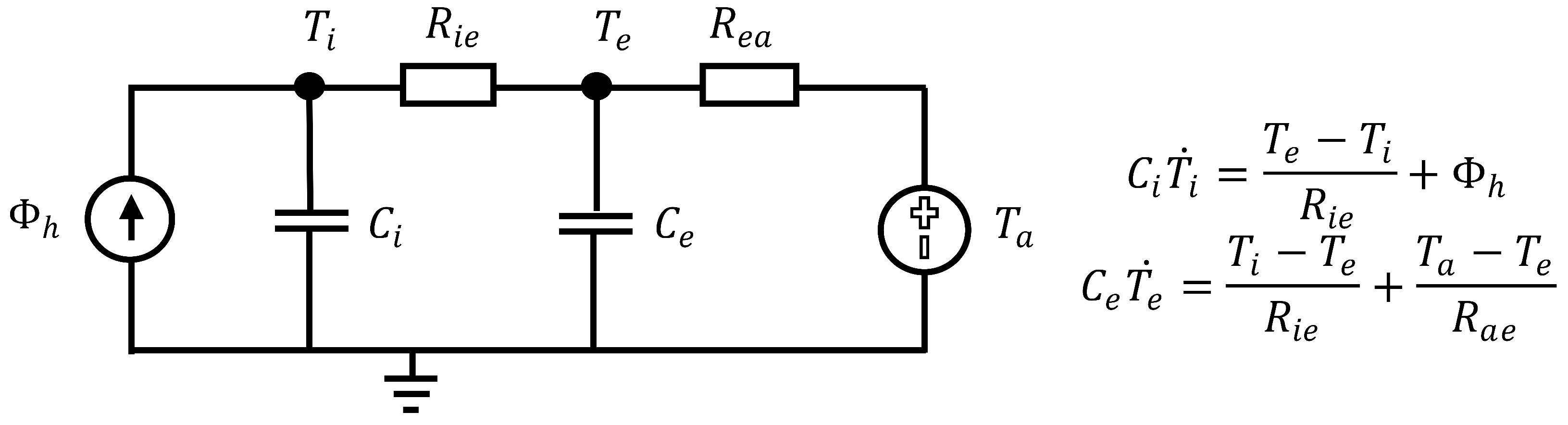
The methodological soundness of the RC approach is evidenced by its incorporation into pivotal reference standards, most notably ISO 13790 [5] and ISO 52016-1 [6]. Both standards explicitly employ RC-based frameworks for the assessment of energy needs and thermal loads. Furthermore, the ASHRAE guidelines [7] acknowledge the efficacy of RC models for dynamic building performance analysis. Interest in this modeling class has been revitalized by its synergy with automated identification methods, advanced predictive control strategies, and artificial intelligence (AI) algorithms [8,9]. Figure 1 illustrates a classical 2R2C schema, detailing both the continuous formulation and the discrete form employed for identification and predictive control. This compact interpretable formalism serves as the foundation for the multi-zone extensions and DT integrations addressed later.
Figure 1. Two-resistance and two-capacitance RC model (classic Bacher and Madsen scheme [10]): indoor node T i and envelope node T e connected by R ie and R ea , with capacitances C i and C e ; heat input Φ h and outdoor disturbance T a . On the right: the energy-balance equations.
Despite their consolidation in ISO/ASHRAE workflows, open research questions remain: (i) The accuracy–interpretability trade-off: While RC models offer transparency and computational efficiency, deep data-driven models may yield superior accuracy when high-quality data is abundant. (ii) Scalability and generalizability: The validity of archetype- and clustering-based RC models across heterogeneous climates, typologies, and operational profiles is not yet fully proven. (iii) Technology readiness: The operational maturity of DT and edge implementations varies significantly, with the majority of studies limited to the prototyping stage. (iv) Comparative analysis: Benchmarking against data-driven baselines is frequently hindered by disparate data requirements and heterogeneous KPIs, preventing like-for-like comparisons.
Large-scale analysis of building facilities often faces a lack of high-quality data, which traditionally must be collected through on-site surveys, an operation that is not always feasible and often insufficient for the required analysis. In recent years, the use of datasets from Internet of Things (IoT) technologies and digital infrastructures has overcome some of the historical barriers related to data collection, enabling large-scale identification and calibration procedures for RC models [8]. While the literature has extensively demonstrated the strengths of RC models for large-scale energy simulation [3,11], a new research frontier is rapidly emerging. This involves applying these models to advanced control scenarios, energy flexibility, demand response (DR) automation, and DT integration, often using real-world datasets from facilities and districts characterized by high heterogeneity in properties and operating conditions [12,13,14].
High-fidelity physical models, known as ’white-box’ (e.g., BEM), represent the state of the art in simulation reliability. However, especially for large and complex buildings, the difficulty of acquiring detailed data and the presence of unpredictable variables severely limit their large-scale applicability [1,11]. On the opposite side of the spectrum, “black-box” or purely data-driven models often lack interpretability and transparency, creating a barrier for administrators or policymakers who require clear insights into the drivers of energy consumption [5,12]. Therefore, recent applications underscore the main challenge of combining the computational efficiency of lumped parameter models with the accuracy required for predictive management and control, particularly in real-world contexts where data quality and availability are inconsistent [15].
Previous reviews, such as the study by Serasinghe et al. [16], provide a critical assessment of parameter-identification methodologies for low-order models like RC models. Their research offers an in-depth evaluation of the current methods, explaining both the advantages and limitations of parameter estimation and serving as a fundamental reference in the field. Yang et al. [3] currently represent the main reference for grey-box RC modeling at the urban and district scales, examining different model structures, identification techniques, and urban applications. While this review provides useful information on the pros, cons, and scalability of grey-box RC models, it does not explicitly address how the proposed framework can be integrated into current DT platforms or how IoT data and smart thermostats can support it. Finally, the valuable work by Ma et al. [14] provides an updated overview of the integration between physical models (such as RC) and new ML techniques. Although the paper thoroughly analyzes hybrid approach opportunities, including physics-informed neural networks (PINNs), it focuses more on algorithmic potential than on operational and automated large-scale implementations.
Overall, these valuable works tend to leave crucial aspects partially uncovered, such as standardization, real interoperability between DT ecosystems, large-scale automation in urban districts, and the standardization of KPIs based on real operational data. The integration of urban DT platforms with real-time feedback for continuous parameter updates represents a primary research and innovation direction for energy management in large facilities and districts. Combining grey-box modeling with ML techniques enables advanced adaptive control and anomaly detection systems capable of operating across extensive infrastructures with reduced human intervention, improved resilience, and decentralized management. Furthermore, the application of grey-box models at the intersection of building physics and digital markets for energy flexibility warrants further research as it holds great promise for energy communities, aggregators, and smart districts. These models enable active participation in DR, collective optimization, and energy flexibility services at an urban scale owing to their interpretability and computational compactness.
To clearly distinguish the novel contribution of this work, Table 1 provides a detailed comparison with existing reviews, highlighting the specific gaps addressed regarding interoperability and operational deployment.
Table 1. Comparison of this review with previous related works.
This review therefore provides a critical and operational synthesis of recent RC model applications for energy management approaches in large buildings and districts and urban clusters. The originality of this review lies in four main points:
  • Comparative analysis and operational benchmarking;
  • Open-source automation and workflow focus;
  • Real integration with DT and smart city platforms;
  • Critical summary and actionable recommendations.
Ultimately, this study offers a clear and practical framework for developers, operators, and users managing building energy infrastructure, providing them with actionable insights for potential implementations and system optimization.

2. Methodology-Selection Criteria and Research Structure

The following section describes the research methodology adopted to select and classify the literature about RC “grey-/gray-box” model development and application for energy analysis and forecasting in large building facilities and clusters and districts. The methodology consists of four primary steps:
  • Definition of the conceptual framework and presentation of objectives;
  • Literature search and selection criteria;
  • Classification of articles and identification of research fields;
  • Synthesis and analysis methods.

2.1. Conceptual Framework and Research Questions

RC models are emerging as key tools for the energy management of complex large-scale building facilities. To provide a structured framework, the analysis is guided by the following three main research questions:
  • Which RC modeling approaches are used to represent energy dynamics in large buildings and aggregate systems, and what data collection and qualification strategies are applied?
  • How are RC models integrated into automated workflows for parameter identification, large-scale calibration, and model generation at the city level?
  • How are RC models employed as predictive control tools, and what are their benefits and drawbacks for energy flexibility management and the development of dynamic DTs?
The research and classification phases of the selected articles were structured around these guiding questions.

2.2. Literature Search and Selection

The research focuses on buildings or building clusters with an internal floor area exceeding 500 m2, without geographical restrictions, in articles published from 1 January 2019 to 31 March 2025. This choice is driven by the prevalence of centralized systems (HVAC, TABS, and AHU), complex spatial zonation, and the availability of building management systems (BMSs) and IoT infrastructure in such facilities. Larger volumes result in longer average time constants and more pronounced coupling between zones; consequently, RC-type models are more identifiable and suitable for predictive control, unlike smaller units where data noise may be more significant. Furthermore, buildings with a floor area larger than 500 m2 are more likely to possess stable sensors, historical data logging, and metadata, which are prerequisites for automatic calibration. Higher thermal loads and mass also make energy flexibility measurable and economically valuable. Additionally, the imposed threshold reduces the variability of the surface-to-volume ratio, enhancing the comparability of the analyzed KPIs. In district-scale studies, buildings with smaller surface areas are included as the analysis focuses on the collective response. The primary databases consulted were Scopus, Google Scholar, and ScienceDirect. For each keyword combination, the top 50 results were screened based on relevance to the predefined inclusion criteria. Table 2 summarizes the inclusion and exclusion criteria that guided the screening process.
Table 2. Summary table of inclusion and exclusion criteria for the search.

2.3. Article Classification and Research Fields

The analysis process followed the method presented in the initial part of the study by Naumann et al. [17], with the aim to create a thematic organization structure for selected articles with systematic and reproducible results. The research questions were established before the exploratory literature review, which identified three research fields (RFs) that represent the logical sequence of RC models:
RF1: Potential and versatility of RC models, which includes contributions related to physical representation, spatial flexibility, and available data quality. It comprises three subfields:
  • a.1 Representative capacity and physical flexibility (e.g., multi-zone modeling, thermal networks, HVAC, ventilation, and dynamic loads).
  • a.2 Modeling approaches and spatial granularity (lumped vs. distributed models and hybrid RC).
  • a.3 Data collection and quality for modeling (datasets from BMS/IoT, granularity, duration, data alignment, and uncertainty quantification).
RF2: Development, automation, and calibration methods for RC models, focusing on parametric identification, robustness, and scalability. It includes
  • b.1 Automatic identification and calibration (parametric optimization, ML, and subspace identification).
  • b.2 Model robustness and data quality (pre-processing, objective metrics, and resilience to incomplete data).
  • b.3 Scalability and large-scale generation (building archetypes, clustering, automated scripting, and bottom-up modeling).
RF3: Advanced applications and energy management, which groups together articles oriented towards the operational use of RC models in real or complex contexts. The subfields considered are
  • c.1 Energy forecasting and retrofitting (load forecasting, hybrid models, benchmarking, and efficiency scenarios).
  • c.2 Advanced predictive control and demand response (centralized/decentralized MPC, AI, edge control, and virtual sensors).
  • c.3 DT and aggregated flexibility (semantic modeling, BMS environments, district clusters, and flexibility aggregation).
The nine subfields enabled researchers to identify the main trends, methodological approaches, and emerging critical issues while ensuring the traceability and replicability of the selection processes. Table 3 summarizes the three research fields (RFs) and subfields adopted for the quest; Table 4 reports the complete Boolean search strings (including synonyms such as “grey-/gray-box” and “resistance–capacitance/RC” that for brevity are not written).
Table 3. Summary of the main phases and research fields (RFs) of the framework adopted for the evaluation, development, and application of RC models in the building energy sector.
Table 4. Boolean search strings used for the systematic literature review. For each research field (RF), keywords were grouped and combined using Boolean operators to ensure a comprehensive and reproducible selection of relevant articles.
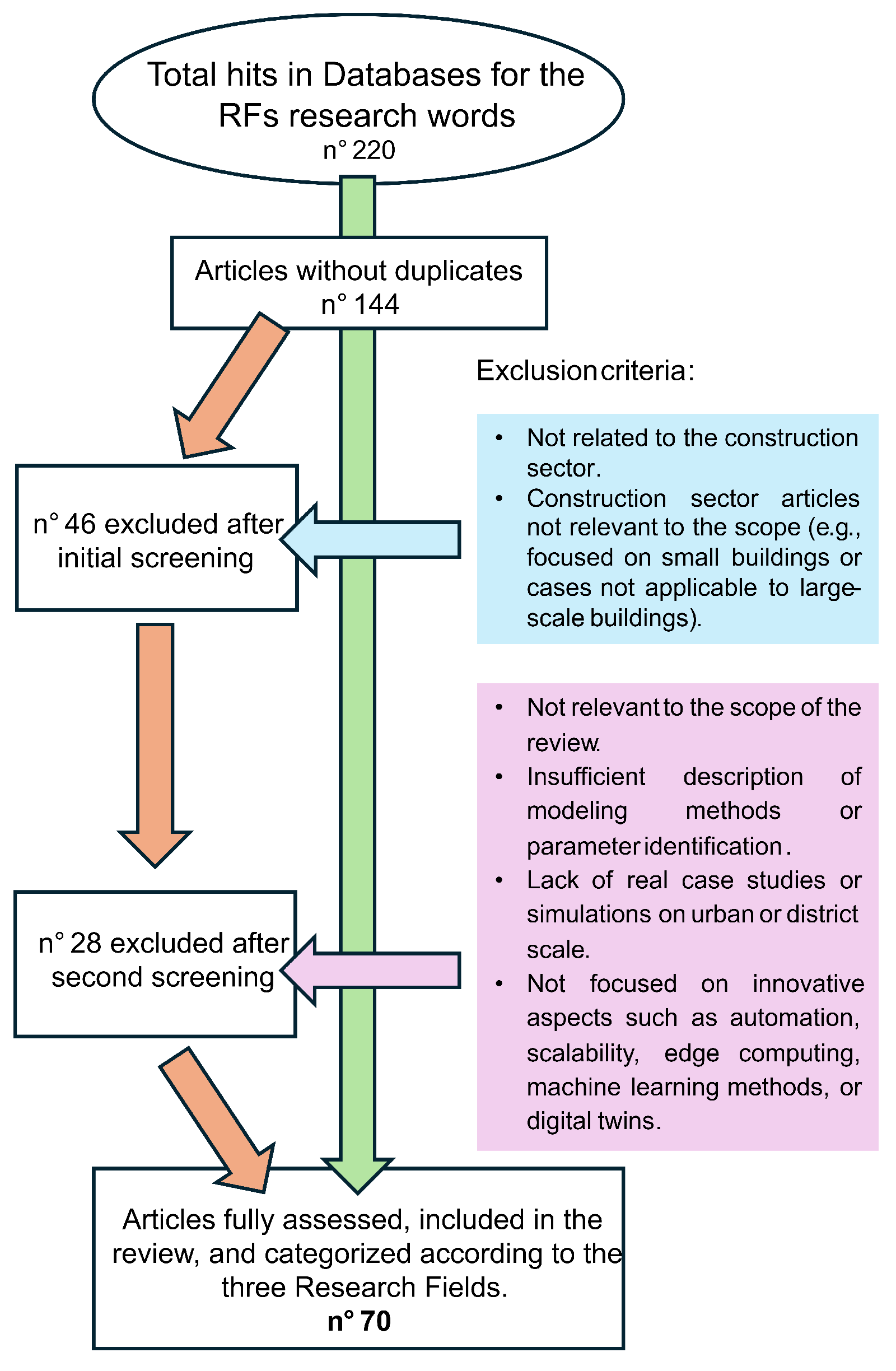
As illustrated in Figure 2, from an initial total of 220 identified contributions, 144 articles were considered after removing duplicates. At the end of the selection process, 70 articles were included in the final analysis, which is the subject of the following chapters. This approach ensured comprehensive coverage that could be replicated over time.
Figure 2. Flowchart of the literature selection process. Out of 220 articles initially identified, 144 were screened after duplicate removal. Following a two-stage screening process based on predefined inclusion and exclusion criteria, 70 articles were fully assessed and included in the review.

3. Results of the Literature Review

The search process yielded a final corpus of 70 articles that satisfied the eligibility criteria and aligned with the research objectives. The following analysis is structured around the three primary research domains and their associated subfields defined earlier. Given the cross-cutting nature of the subject matter, certain studies addressing intersecting topics may be referenced across multiple thematic subsections.

3.1. Potential and Versatility of RC Models (Research Field 1)

3.1.1. a.1-Representative Capacity and Physical Flexibility

The first area of research investigates the potential of RC models, specifically the characteristics that make these lumped-parameter models, constructed from networks of thermal resistances and capacitances, particularly suitable for representing complex buildings with large spatial dimensions, intricate geometries, and diverse construction components.
The literature demonstrates that RC models effectively integrate fundamental thermal phenomena, including natural or mechanical ventilation, solar radiation, internal heat gains, and HVAC system responses, into a compact physically meaningful framework. Their modular design allows for the addition of nodes, sources, and connections to create complex dynamic systems.
A key strength of multi-zone modeling lies in its ability to represent buildings as composite systems formed by interconnected subnetworks. This capability captures interactions between zones with different usage characteristics, occupancy profiles, and system configurations. This approach has proven particularly effective in large facilities exhibiting non-uniform thermal distributions.
In this context, Shamsi et al. [18] propose an advanced framework for uncertainty assessment in grey-box RC models, distinguishing between aleatory (e.g., weather data) and epistemic (e.g., unknown model parameters and envelope infiltration) sources. Their approach, based on Nested Fuzzy Monte Carlo analysis (2D-FMCA) and copula distributions, enables the quantification of joint uncertainty propagation in energy models. A case study of a 3390 m2 building in Dublin demonstrated that this method produced daily heat demand estimates with a deviation of less than 50 kWh/day, significantly outperforming the 10–15% overestimation observed with classical Monte Carlo simulations.
Zarrella et al. [19] propose a MATLAB-based framework supporting thermal modeling in compliance with the ISO 13790 standard [5]. The system aggregates climatic data from heterogeneous sources, including urban sensors, weather stations, and local datasets, and processes them via a modular workflow, facilitating the deployment of RC models even when detailed geometric data is unavailable. Furthermore, the literature documents applications that extend RC modeling to address specific architectural characteristics and, notably, advanced envelope features [20].

3.1.2. a.2-Modeling Approaches and Spatial Granularity

RC models constitute a dominant methodology in the literature for analyzing the thermo-energy performance of building facilities, favored for their balance of computational efficiency and physical interpretability. Within this domain, two primary modeling paradigms are distinguished:
  • Lumped models: These approximate a building zone as a compact network of thermal nodes, assuming uniform temperature distribution within each node. This abstraction enables rapid, scalable modeling suitable for extensive simulations.
  • Distributed models: These employ detailed spatial discretization to simulate heat propagation through complex elements, such as multilayer walls and high-thermal-mass structures. While enhancing accuracy in scenarios with non-uniform thermal gradients, this approach significantly increases computational overhead.
Lumped parameter simplification facilitates rapid analysis while maintaining acceptable error margins, even when benchmarked against high-fidelity Finite Difference Method (FDM) solutions, thus validating its applicability for large-scale climatic and comparative studies. In this context, Hagentoft and Pallin (2021) [21] introduce a conceptual lumped model for energy demand forecasting in commercial buildings, governed by representative parameters such as Driving Temperature Difference (DTD), External Load Temperature (ELT), and Building Envelope Performance (BEP). While significantly reducing complexity relative to distributed numerical models, the approach yielded an average annual energy deviation of only 3% for cooling demand and between 3% and 22% for heating demand across reference test cases.
Kong et al. [22], by combining RC models and ML algorithms (Genetic Algorithms and XGBoost), report a 34.5% improvement in energy consumption prediction accuracy compared to the physical model and 38.8% compared to purely data-driven models. This hybrid approach is further advanced by Deng et al. [23], who propose an RC model identified via the Self-Adaptive State Transition Algorithm (SASTA) coupled with the wavelet threshold denoising method, convolutional neural network, and long short-term memory network (WTD–CNN–LSTM) integrated with information-entropy weights. The RC component captures physical processes but lacks spatial–temporal variability and local microclimate representation; the LSTM (data-driven) component addresses these limitations by capturing heterogeneity and temporal dependencies. For a real high-rise building (49 floors, located in Shenzhen, China), the model achieves R 2 = 95.34 % and yields predictions within the error threshold for 94.07% of the samples, outperforming the RC model alone ( R 2 = 92 % ). Shamsi et al. [18] demonstrate that aggregating multiple zones into a single RC structure results in low scalability error (3.42–4.35%) and reduces flexibility error, striking a better trade-off between model detail and computational complexity. Similarly, Joe et al. (2023) [24] compare a detailed multi-zone grey-box model with a centralized lumped model, both identified using experimental data from a commercial building. The lumped model, which utilizes a weighted average temperature of the various zones, achieves robust predictive performance (validation RMSE 0.60 °C vs. 0.59 °C for the detailed model). When employed in an MPC framework, it enables cooling-cost savings of up to 7.7% compared to traditional feedback control, approaching the 8.9% achieved by the detailed model. This lumped-parameter simplification thus reduces modeling complexity and implementation costs for multi-zone facilities while maintaining high accuracy, even under significant thermal load variations.
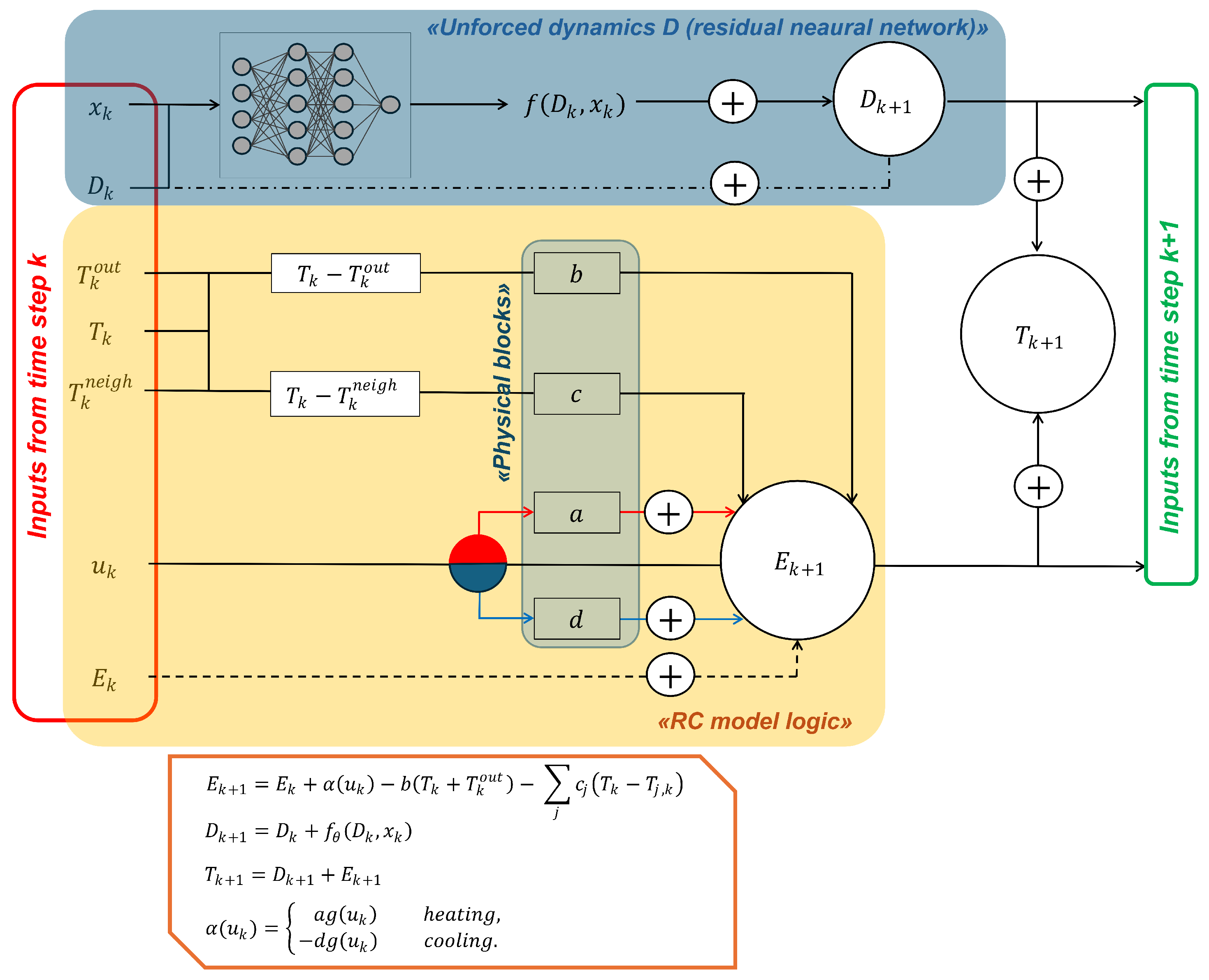
Conversely, Di Natale et al. [25,26] benchmark a lumped RC model against advanced data-driven approaches for predicting the thermal dynamics of an occupied apartment unit. The findings indicate that, while the RC model offers superior interpretability and physical consistency, it exhibits lower predictive accuracy compared to physically consistent neural networks (PCNNs). As illustrated in Figure 3, these hybrid architectures integrate a physics-inspired module with a neural network component designed to capture nonlinearities that remain unmodeled by the physical structure.
Figure 3. Conceptual representation of the hybrid framework proposed by Di Natale et al. [26]: the RC module provides the physics-based backbone, while the neural network layer models nonlinear dynamics not captured by the simplified lumped structure.
In a comparative analysis of RC topologies (e.g., 4R1C vs. 3R2C), Wang et al. [27] demonstrate that a novel boundary condition lumping strategy, categorizing nodes by boundary type (external, internal, ground contact, thermal mass, and fenestration), significantly enhances physical granularity relative to standard lumped approaches.
To ensure robustness in large-scale implementations, RC models must comprehensively account for complex physical phenomena, including natural and mechanical ventilation dynamics, time-varying solar gain, active and passive thermal storage mechanisms, and stochastic internal loads.

3.1.3. a.3-Data Collection and Quality for Modeling

The reliability of RC models, especially in their grey-box configuration, depends heavily on the availability of accurate and consistent real-world data. In recent years, the scientific literature has emphasized the importance of accurate and systematic data collection for the development, calibration, and validation of RC models applied to complex building facilities. One of the most common sources of operational data is provided by smart thermostats and BMS, which allow for the automatic acquisition of internal temperatures, outdoor climate conditions, HVAC operating parameters, and, in some cases, occupancy information.
Vallianos et al. [8] analyze data from 7800 houses equipped with smart thermostats to show how the length of time series and data resolution affect predictive accuracy. In subsequent studies [19], the same authors extend the analysis to 60,000 residential buildings, demonstrating the scalability of the calibration procedure using data collected automatically via IoT.
Oh et al. [28] demonstrate that grey-box RC models can be effectively calibrated using only operational AHU data collected via BMS without the need for additional measurement campaigns. This method reduces costs while making the models easier to deploy at scale.
Tugores et al. [29] conducted an in situ monitoring campaign across 32 school classrooms in four different climatic regions of Catalonia, collecting hourly data on CO2 concentration with high-precision sensors, dynamic occupancy, window and door operation, and physical and geometrical classroom characteristics. These data enabled the development of a stochastic grey-box model that combines real-world natural ventilation conditions with occupant behavior to generate reliable and robust estimates of CO2 generation rates, achieving estimation variability below 12% in validated cases.
Shamsi et al. [18] propose a framework to identify and classify the main sources of uncertainty in input data, distinguishing between random uncertainties (such as climate variability) and epistemic uncertainties related to model parameters. The quality and reliability of these datasets directly influence simulation robustness, necessitating advanced pre-processing, filtering, and imputation techniques.
Alfouly et al. [30] implement an RC modeling framework that exploits a wide variety of input data, including open CityJSON/CityGML LoD2 3D models, standardized thermophysical parameters (transmittances and resistances from TABULA/IEE EU), hourly outdoor temperature over a dense climate grid (~81 stations per km2), and realistic occupancy profiles. The collection and temporal alignment of these datasets, together with the automatic assignment of windows and active surfaces, ensure faithful and scalable modeling of the energy performance of entire urban districts.
Klanatsky et al. [31] present a methodology replicable in buildings equipped with standard sensors, adopting Measurement and Verification (M&V) protocols to identify significant periods for calibration. Kumar Yadav et al. [32] emphasize the importance of temporal alignment of datasets when combining different sources (occupancy registers, climate data, and BMS) to predict thermal dynamics in occupied environments like university classrooms.
Overall, the research shows that RC model accuracy and transferability depend on the quality and coherence of input data, establishing data qualification as a critical requirement for grey-box modeling in practical applications.

3.2. Development, Automation, and Calibration Methods for RC Models (Research Field 2)

In recent years, the increasing diffusion of IoT devices, smart thermostats, and BMS sensors has revolutionized data collection, especially in large-scale building facilities, revealing new opportunities for the automation of energy modeling and RC model calibration. Automating modeling processes, combined with access to large datasets with high temporal and spatial resolution, makes the calibration of RC models more efficient, scalable, and reproducible, even at a large scale [8,30].
According to the recent literature, the quality of input data remains a fundamental requirement for developing energy models that produce reliable and generalizable results. Other studies demonstrate how it is possible to exploit operational data already available in BMS systems to automate calibration, reducing the need for dedicated measurement campaigns and making the approach more economically sustainable [28,31].
In this scenario, the automation and standardization of modeling procedures, along with advanced data qualification and pre-processing techniques, form the basis for the robust and widespread use of RC models in building energy analysis and management [15,30].

3.2.1. b.1-Automatic Identification and Calibration

The automatic identification of RC model parameters is now enabled by workflows that leverage large-scale data sources (IoT devices, BMS, smart thermostats, etc.) alongside optimization and data-driven algorithms. Two major studies illustrate the robustness and quality of large-scale automatic calibration: the first applies an automated workflow to 247 residential buildings, utilizing objective quantitative indicators such as nCPBES, which remain effective with partial or noisy data [13]; the second, based on data from over 1000 houses with smart thermostats, confirms the feasibility of automatic calibration using ARX methods and least-squares optimizations, maintaining high forecast accuracy owing to the granularity and duration of the time series [33].
Liu et al. (2023) [34] implement an automated parameter identification workflow for third-order lumped RC models by applying a Genetic Algorithm (GA) to minimize the deviation between measured and simulated data from a residential building with radiator heating. The procedure precisely calibrates five resistances and three thermal capacitances within minutes on a standard PC, enabling accurate prediction of internal thermal dynamics and facilitating the implementation of advanced control strategies in existing buildings. To represent unmeasured internal thermal gains, a two-stage procedure is employed: first, estimating time-invariant RC parameters by minimizing time-of-day grouped errors; second, dynamically identifying unmeasured internal load profiles. This method achieves an RMSE of 0.31 °C in 24 h simulation tests for office facilities, representing a 54% error reduction compared to conventional methods lacking internal-load modeling [4].
Subspace identification methods further reduce the dimensionality of RC models without significantly compromising accuracy. The combination of subspace identification with stochastic models yields high predictive accuracy in extreme climatic scenarios, even when dealing with noisy or incomplete data [35].
Overall, the identification and calibration process of RC models has evolved through automated workflows, data-driven techniques, and objective quality assessments. This evolution has enabled the creation of robust and transferable models at scale, suitable for practical urban and district-level energy management applications.

3.2.2. b.2-Model Robustness and Data Quality

The use of RC models in energy management and control depends strongly on the robustness, quality, and completeness of input data. Numerous studies have shown that pre-processing techniques, such as low-pass filtering, normalization, outlier removal, and automatic data cleaning, ensure numerical consistency during simulation and parameter calibration [13].
Data temporal resolution and the duration of collected series have been systematically analyzed in building facilities: datasets shorter than one week, or signals affected by sensor instability, lead to a deterioration of up to 20% in RC parameter estimation. Consequently, robustness and reliability in real-world applications are enhanced by structured pre-processing systems that incorporate sensor stabilization and temporal granularity control [33]. The calibration time window is also critical: operational data spanning 7–14 days is typically required to produce accurate temperature and consumption forecasts, whereas shorter datasets generate unstable and non-transferable estimates [8].
Sun et al. [36] propose a multi-zone grey-box RC model validated on real data collected from an office building equipped with 5 min smart sensors. The model accurately captures thermal dynamics and energy flows in environments featuring Variable Air Volume (VAV) and Photovoltaic (PV) systems. Identification and calibration were performed across three distinct zones, achieving an RMSE of less than 0.6°C for internal temperature and an MAPE of 2.18% for flow rates and component power consumption. In parallel, Reference [37] introduces a rapid estimation procedure that exploits nighttime thermal gradients to reduce parameter collinearity, enabling robust estimation with only a few days of data.
The predictive feedback model developed by Liu et al. [34] demonstrates high robustness and accuracy even in the presence of behavioral variability and data noise, maintaining the RMSE of the internal temperature within 0.38% and a variance at 0.539 °C2 compared to 0.91 °C2 for conventional control. Consequently, the model proves reliable and stable in thermal regulation, capable of adapting to real operating conditions. While the use of RC models in energy management depends on the robustness and quality of input data, Reference [38] further confirms the reliability of reduced RC models ( 3 R 2 C 2 α ) applied to clusters of real buildings. This was achieved through automatic parameter calibration on multi-year datasets collected via smart thermostats and sub-metering. Validation results demonstrate that the models maintain predictive accuracy with RMSE values between 0.28 °C and 0.77 °C and goodness-of-fit values between 72.1% and 82.9%, even when dealing with strong data heterogeneity and real operating conditions. Sun et al. [39] also validate RC models combined with data-driven techniques on a multi-zone dataset from a real building (126 spaces). Their approach predicts thermal loads and indoor temperatures with an R 2 up to 0.95 and an RMSE of only 0.25 °C. Compared with reference models (XGBoost and LSTM), the methodology reduces mean errors (MAE and RMSE) by 52% and 28%, respectively, and maintains high performance even with incomplete data by dynamically selecting the most appropriate predictive model. Overall, the objective validation of RC models relies on quantitative metrics such as nCPBES or predictive performance indicators (e.g., RMSE of internal temperature), which enable the scalable assessment of model stability and flexibility, particularly in multi-zone or aggregated environments [4,13].

3.2.3. b.3-Scalability and Large-Scale Generation

The modular and compact nature of RC models enables their successful application to aggregated building systems and complex urban contexts. The recent literature highlights an increasing interest in automatic RC model generation and large-scale management through clustering methodologies, building archetypes, and open-source tools.
Wang et al. [27] demonstrate that their new approach leads to faster computations and is capable of handling large urban problems (e.g., multi-zone scenarios on the UECC platform), running 78% faster than EnergyPlus. The building-archetype method allows for the representation of uniform building classes through pre-calibrated RC models, which can be assigned to specific real-world units based on their morphological, climatic, or usage characteristics. This methodology achieves more than 90% accuracy in energy consumption simulation and reduces computational time significantly compared to case-by-case analysis. It proves effective for building stock analysis through thermal clustering and automatic matching algorithms [1]. Using building thermal-mass clustering, the authors also predict aggregate flexibility in DR scenarios, achieving robust performance with errors below 2–3% compared to complete reference models [40].
Open-source platforms enable the automatic generation of RC models for hundreds or thousands of buildings, creating multi-zone structures without complete geometric data. This makes it possible to model entire neighborhoods or districts [2]. The “model–cluster–reduce” pipeline combines thermally similar zones in large complexes, reducing simulation times by 95% while keeping annual consumption errors below 5% [41]. The residential application of smart thermostat data collection further supports RC model scalability. One study shows that one week of data with 15 min resolution is sufficient to build accurate RC models for cluster-level predictive control applications, optimizing both accuracy and computational efficiency [8].
Su et al. [42] show that the RC methodology allows for the fast and scalable simulation of geothermal systems integrated into large infrastructures, such as metro stations. The study modeled over 13,000 m2 of active surfaces with computation times of less than 10 min for multi-year scenarios. This approach allows the model to be applied extensively to different climatic and structural contexts by varying only the physical parameters, making it ideal for district-level studies and the comparative analysis of large-scale solutions.
RC models achieve operational scalability through the combination of modular architectures, clustering techniques, and automatic model generation tools. These advances enable the deployment of models at urban or district scales, supporting simulation and planning, as well as advanced control and energy flexibility strategies in complex building ecosystems.

3.3. Advanced Applications and Energy Management (Research Field 3)

3.3.1. c.1-Energy Forecasting and Retrofit

RC models demonstrate their most proven efficacy when applied to energy demand prediction and HVAC system optimization. The current literature highlights an increased interest in combining physical RC structures with ML methods to create grey-box and hybrid forecasting models that deliver enhanced accuracy.
The application of RC models remains widespread for short-term and medium-term heating load prediction due to their interpretable nature and computational efficiency [11,12,43]. Deng et al. [23] develop an ISO 13790-compliant RC structure integrated with SASTA calibration and a WTD–CNN–LSTM network. This approach reduces residual errors, achieving an R2 of 91.3% and an RMSE of 20.23 kW.
Numerous studies employ basic RC models (1R1C and 2R2C) as fundamental elements for sophisticated control systems. Guo et al. [44] establish a Deep Reinforcement Learning (DRL)-based HVAC controller to achieve simultaneous optimization of energy consumption while maintaining comfort and air quality. The DRL system, deployed in an office building, achieves a 21.4% reduction in energy consumption compared to traditional rule-based controllers.
The framework developed by Guo et al. [45] merges optimized building envelope design through GA with MPC utilizing automatically generated grey-box RC models. This combined MPC and GA approach for office building management resulted in a 23.7% annual energy reduction, along with 29.4% lower HVAC expenses and 27.8% lower CO2 emissions compared to baseline conditions. In contrast, the optimization strategy relying solely on GA produced minimal annual energy savings of 0.4%. The MPC + GA strategy delivers net savings over a twenty-year period reaching EUR 17.9/m2, which exceeds GA-based savings by approximately 60 times, demonstrating the advantage of integrated approaches for retrofitting and energy forecasting. Furthermore, the implementation of tube-based MPC in [46] utilized a 2R2C model calibrated from BOPTEST data to reduce operating expenses by 24% compared to standard MPC.
Kim et al. [47] extend RC models by incorporating setpoint values as inputs in multi-zone applications, such as schools or office clusters. The forecasting method developed in [35,48] uses multistep architectures relying on neural networks for aggregated hourly forecasting.
Liu et al. [49] develop an advanced framework that merges MPC with RC model management for PV systems, heat pumps, and thermal reservoirs in office buildings. The MPC strategy produces a 26.95% reduction in daily summer energy expenses together with a 25.69% increase in winter economic benefits, driven by improved indoor temperature predictive accuracy (RMSE 0.32–0.59 °C). Benchmarking processes and retrofit analyses utilize grey-box RC models to generate baseline models for building comparisons. Studies [13,32] apply real consumption and occupancy data to determine post-retrofit savings. Furthermore, research analyzing more than 7800 houses shows that 7 days of 15 min resolution data provides acceptable model accuracy [8].

3.3.2. c.2-Advanced Predictive Control and DR

RC models are widely applied in MPC strategies for real buildings, playing a key role in DR contexts. They provide an effective compromise between modeling accuracy and computational speed.
In the MPC domain, Shan et al. [50] demonstrate the use of periodically updated RC models to exploit building thermal mass while limiting control requirements. Work by [51] proposes an extension called “RC-Mapping” that integrates HVAC inertia, thereby enhancing passive cooling. Klanatsky et al. [31] show that Distributed MPC (DMPC) can reduce thermal consumption by 41% and allows for the elimination of the existing heating system. Stochastic approaches (SMPC), such as that of [52], enable the management of meteorological uncertainty while decreasing consumption by 39%.
Other promising solutions are based on edge computing: Morovat et al. and Kim et al. [53,54] integrate IoT sensors and local actuators to implement MPC in multi-zone environments, improving adaptability and reducing costs in energy districts. Guo et al. [44] further demonstrate the effectiveness of AI-based controllers, such as DRL, while Gao et al. [46] integrate a hybrid MPC approach.
The integration of MPC with Demand-Side Management (DSM) and distributed resources is explored in several works.
In the work by Liu et al. [49] (2025), an MPC strategy is applied to an office building equipped with a PV system, five air-to-water heat pumps, a thermal storage tank (TT, 1000 kWh), and five electric buses (EB, 180.86 kWh each), operating under a time-of-use tariff with an evening peak band. The control logic is implemented via a TRNSYS–MATLAB co-simulation environment and solved as a Mixed-Integer Linear Programming (MILP) problem with CPLEX. The study utilizes a 1 h control step and a 24 h horizon, simulated over 20 days per season. For the Rule-Based Control (RBC) benchmark, temperature setpoints are aligned (26.5 °C in summer; 19.5 °C in winter) to ensure a fair comparison.
A low-dimensional grey-box RC model serves as the forecasting core of the loop, describing the thermal dynamics of the building (internal air and wall surfaces). Identified and validated on simulation data, the model demonstrates limited errors (identification MAE/RMSE: 0.30/0.45 °C in summer and 0.26/0.32 °C in winter; validation: 0.40/0.53 °C in summer and 0.54/0.59 °C in winter). This confirms its reliability within the MPC strategy, delivering superior peak load demand reduction (PLRR) compared to conventional control methods while maximizing PV self-consumption and minimizing grid usage during high-tariff periods.
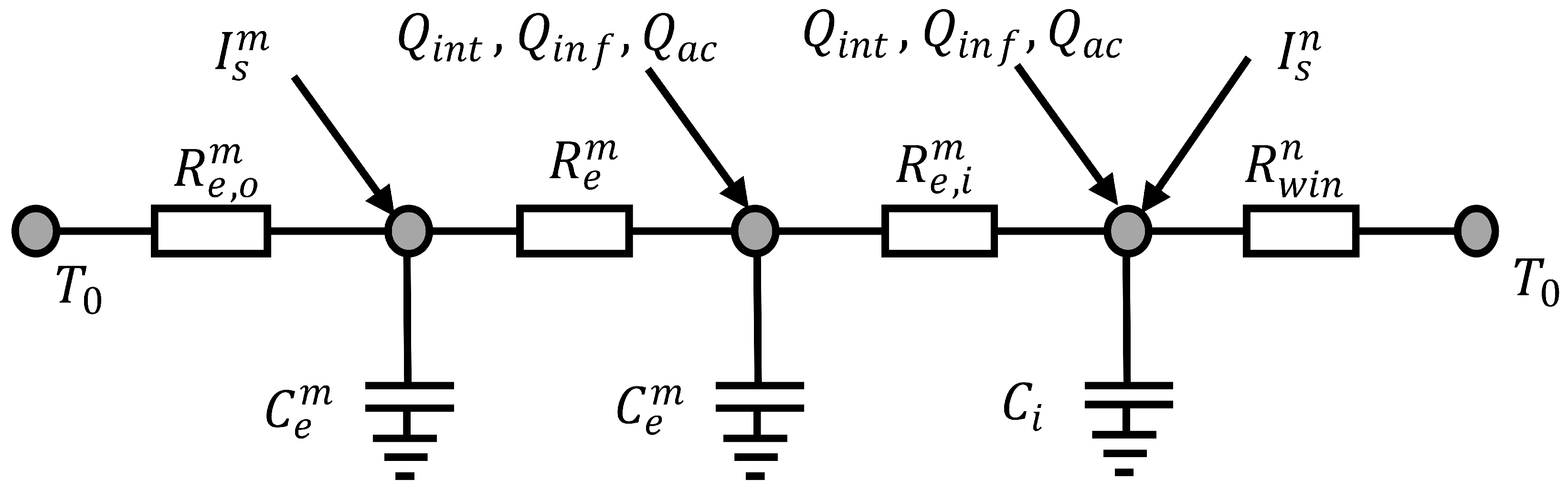
C e m d T e , o m d t = T o T e , o m R e , o m + T e , i m T e , o m R e m + f s , e m I s m ,
C e m d T e , i m d t = T e , o m T e , i m R e m + T i T e , i m R e , i m + f int , e m Q int + f inf , e m Q inf + f ac , e m Q ac ,
C i d T i d t = m T e , i m T i R e , i m + n T o T i R win n + f s , i n I s n + f int , i Q int + f inf , i Q inf + f ac , i Q ac .
The first-order differential equations reported [49] represent the thermal equilibrium of the scheme in Figure 4. They are based on the following elements: capacitance (C), resistance (R), and temperature (T). The superscripts m and n represent the m-th envelope and the n-th window of the building, while the subscripts e, o, and i stand for envelope, outdoor, and indoor, respectively. The solar radiation absorption coefficient of the envelope is f s , e m , and I s m represents the solar radiation on the surface of the m-th building envelope, which includes the east, south, west, and north vertical facades and the horizontal roof surface. The calculation of I s m depends on meteorological data and geographic location and current time. The absorption coefficients f int , e and f int , i represent the building envelope and indoor air for internal heat gains Q int , which stem from occupants and lighting and equipment. The absorption coefficients for infiltration heat gains Q inf are represented by f ac , e and f ac , i for the building envelope and indoor air. The absorption coefficients for thermal energy supplied by the AC system Q ac are represented by f ac , e and f ac , i .
Figure 4. The 4R3C lumped-parameter model at the basis of the method proposed by Liu et al. [49].
Sun et al. [36] show that simultaneously optimizing indoor air and evaporator setpoints with Particle Swarm Optimization (PSO) reduces peak electricity demand by up to 94% and chiller plant on/off cycles by 98.7% in standard buildings. Similarly, the DSM framework enables intelligent DR by exploiting the thermal capacity of the building envelope and multi-objective mechanical-comfort optimization. Reference [2] proposes DR automation strategies based on multi-zone RC models with aggregate predictive control, enabling the collective participation of multiple buildings in flexibility programs.
Sun et al. [39] introduce a dynamic hierarchical predictive control framework that optimizes temperature setpoints, pre-cooling scheduling, and load shifting strategies in response to price and carbon factor signals. This approach achieves a comfort satisfaction level higher than 95%, even under conditions of high demand variability, and reduces CO2 emissions by up to 8.7% on an annual basis. This demonstrates the effectiveness of the multi-objective strategy for flexible participation in DR programs.
Beyond control and DSM, RC models also act as “virtual sensors” for continuous commissioning and Fault Detection and Diagnosis (FDD), as shown in [4]. Finally, robust optimization approaches and stochastic techniques [52,55,56] are adopted to increase operational resilience.

3.3.3. c.3-Digital Twin and Aggregated Flexibility

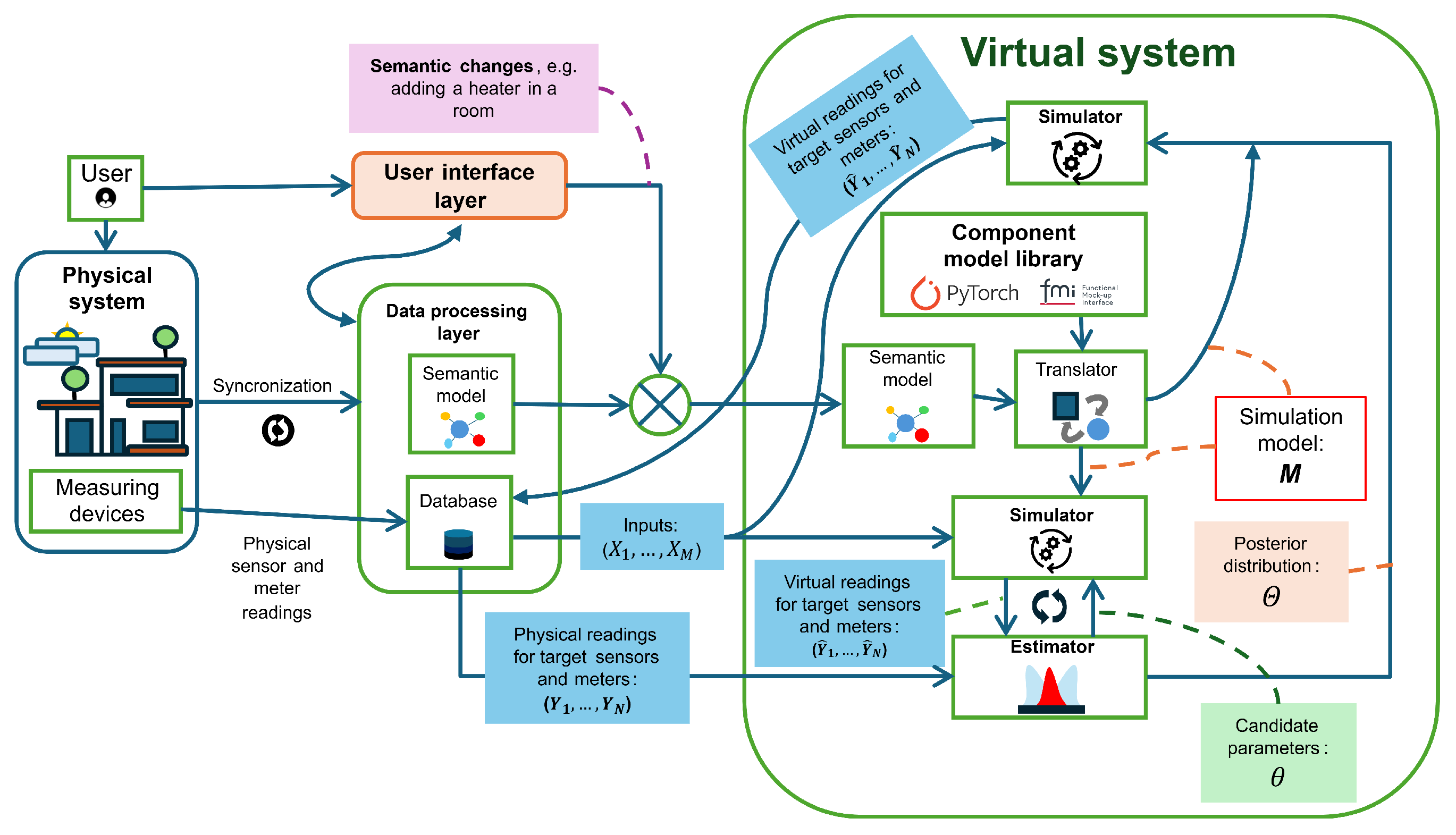
The integration of RC models into DT environments marks a strategic convergence of physical modeling and real-time data streams. Nevertheless, the current literature underscores that operational deployment is frequently impeded by significant barriers in semantic interoperability and data architecture scalability. Bjørnskov et al. [57] address the semantic gap separating static Building Information Models (BIMs) from dynamic energy simulations. They propose a novel framework (Figure 5) leveraging a “Semantic Data Lake” to automate the instantiation of lumped RC models for complex facilities, such as hospitals. A pivotal innovation in this work is the deployment of ontology-based standards to bridge the divide between raw BMS data and physical models, effectively resolving three distinct integration challenges:
Figure 5. Ontology-driven interoperable energy-modelling framework, adapted from Bjørnskov et al. [57] for generating building digital twins.
  • Brick Schema (Data Classification and Disambiguation): Raw BMS data is often plagued by unstructured vendor-specific naming conventions. The framework employs the “Brick” schema to enforce a standardized taxonomy for physical assets. This resolves the challenge of automated point mapping, enabling the algorithm to programmatically distinguish input types (e.g., differentiating a “Supply Air Temperature Sensor” from a “Zone Air Temperature Setpoint”) without manual intervention.
  • BOT (Topological Inference): While Brick defines the semantic identity of entities, generating a multi-zone RC network necessitates understanding their spatial relationships. The Building Topology Ontology (BOT) is utilized to model graph-based relationships between thermal zones (e.g., adjacency and shared boundaries). This enables the automated instantiation of thermal resistances ( R i n t ) between nodes exclusively where physical adjacency exists, effectively transforming a static 3D model into a dynamic thermal network graph via SPARQL queries.
  • SAREF (Actuation Abstraction): To facilitate the write-back capabilities essential for control loops, the “SAREF” (Smart Appliances REFerence) ontology abstracts the functionalities of IoT devices (e.g., actuators and smart meters). By defining device capabilities semantically (e.g., abstracting functions like SetTemperature), the DT can execute control actions agnostically across heterogeneous hardware ecosystems.
Furthermore, the framework incorporates an automated translation layer that converts semantic graph queries into the structured input vectors required by the RC solver. Model parameters are subsequently estimated via probabilistic calibration, utilizing Bayesian inference with Markov Chain Monte Carlo (MCMC) sampling on real-time sensor data. This pipeline demonstrated high predictive fidelity, achieving Mean Absolute Errors (MAEs) of 0.4 °C for indoor temperature and 32 ppm for CO2 concentration [57]. At the district and urban scales, the locus of data architectural challenges shifts from sensor mapping to geometric alignment and data sparsity mitigation. Alfouly et al. [30] introduced a framework natively integrated with Geographic Information System (GIS) workflows that leverages CityJSON 3D models for high-resolution solar analysis. In contrast to the verbose CityGML standard, CityJSON provides a lightweight developer-centric architecture that significantly reduces the computational overhead associated with aligning static 3D city models and time-series weather data. This approach facilitates “solar-smart” urban planning by tightly coupling geometric data with RC thermal networks. To circumvent the scarcity of thermophysical metadata in massive urban datasets, Giuzio et al. [1] developed a data augmentation pipeline utilizing pre-calibrated TABULA archetypes. This methodology enables the imputation of missing properties (e.g., U-values and thermal mass) derived solely from building age and geometry, effectively permitting the automated generation of reduced-order models for thousands of buildings starting from sparse GIS shapefiles [58].
Once established, these DT frameworks enable the comprehensive assessment of aggregated energy flexibility. RC models are particularly advantageous in this domain due to their computational efficiency in quantifying the thermal inertia of building envelopes. Sun et al. [36] and Chen et al. [59] demonstrate that these models facilitate the active participation of buildings in DR programs by dynamically optimizing setpoints in response to real-time price signals.
Addressing the integration of electric mobility, Petrucci et al. [38] introduce the Combined Building Energy Flexibility Index (CBEFI) within a coordinated MPC framework. Validated on residential clusters in Quebec, the platform achieved a peak load reduction of up to 140% during DR events. Nevertheless, the authors identify a critical architectural bottleneck: while data acquisition (reading) for DTs is well-established, closing the control loop (writing/actuation) necessitates robust middleware capable of managing the asynchronous nature of IoT devices and adhering to the strict safety constraints of grid-interactive operations [38,49].
Finally, specialized applications underscore the versatility of this modeling paradigm. The grey-box model developed by Tugores et al. [29] is integrated into DT platforms for the real-time optimization of Indoor Air Quality (IAQ) in schools, dynamically modulating ventilation rates based on stochastic occupancy to outperform standard control baselines. In a similar vein, Li et al. [60] and Jiang et al. [35] leverage probabilistic RC approaches to estimate real-time flexibility across building clusters, reinforcing the conclusion that semantic and data-driven integration is a prerequisite for the transition from isolated building management to connected energy communities [55,61].

3.4. Quantitative Synthesis and Emerging Trends

Complementing the qualitative methodological analysis, it is imperative to synthesize the quantitative reliability reported across these domains. Empirical evidence suggests that the accuracy of RC models is highly context-dependent. To provide a systematic assessment, Table 5 presents a benchmarking of error metrics derived from the reviewed case studies. The data reveals a distinct performance divergence: while RC models demonstrate high fidelity in DT applications (MAE 0.4 °C [57]), they may exhibit higher RMSE relative to deep learning baselines in “data-rich” load forecasting scenarios (e.g., 7.44 °C vs. 5.59 °C [62]). Nevertheless, in industrial settings, hybrid architectures effectively bridge this performance gap, yielding significant error reductions compared to purely data-driven baselines [22].
Table 5. Systematic assessment of RC model accuracy across different application scenarios (DT, MPC, and forecasting).
The observed variance in error metrics can be attributed to three primary technical determinants:
  • The Interpretability vs. Accuracy Trade-Off: The intrinsic transparency of RC models allows operators to intuitively grasp underlying thermal dynamics. Although black-box architectures may yield superior RMSE performance in specific forecasting tasks (Table 5), the physical explicability of RC models remains indispensable for ensuring control loop stability and facilitating stakeholder acceptance [3,9].
  • Data Quality Dependency: Model reliability is contingent upon data integrity. Factors such as temporal resolution, sensor topology, and data sparsity exert a profound influence on parameter identification accuracy [13,33]. Accordingly, the recent literature has pivoted toward automated pre-processing pipelines and noise-robust identification algorithms [64].
  • Edge Computing and Latency Minimization: The deployment of computationally efficient RC models directly on local control hardware (PLCs and edge nodes) facilitates real-time operation by minimizing the latency between state estimation and control actuation [46,65]. Empirical evidence suggests that such edge-native architectures significantly enhance the responsiveness of DR strategies in large-scale facilities [65,66].

4. Discussion and Future Research Perspectives

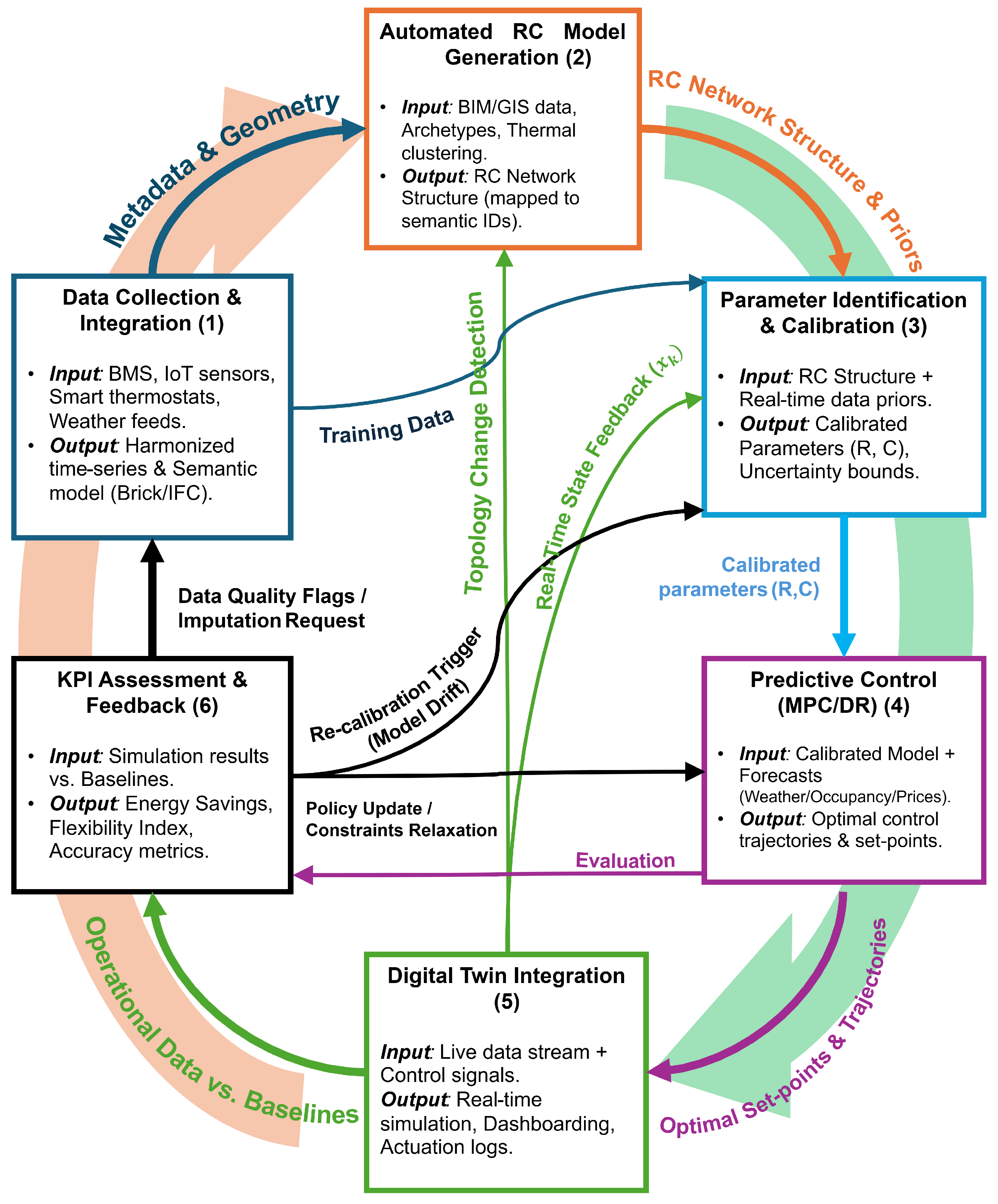
This review extends beyond traditional methodological identification to examine the end-to-end operation of RC grey-box models in real-world applications, ranging from data processing to decision-making. The operational pathway depicted in Figure 6 illustrates this entire process, tracing the flow from heterogeneous data streams to KPI feedback that closes the loop for continuous improvement. Specifically, the pipeline consists of six key stages: (1) data collection and integration (BMS/IoT, weather/occupancy, and BIM/IFC/CityGML/ Brick); (2) automatic/semi-automatic RC model generation (lumped, distributed, multi-zone, and archetypes) mapped to semantic IDs; (3) automatic calibration and parameter optimization, providing accuracy and uncertainty estimates; (4) predictive control (MPC/DR/AI) deployed on edge or cloud infrastructure; (5) DT integration for real-time simulation and supervision; and (6) aggregated KPIs (energy savings, RMSE/MAE, flexibility, peak shaving, and CO2), which close the loop by triggering data-quality flags, re-calibration, and control retuning.
Figure 6. Workflow of closed-loop RC to DT. The diagram represents the complete operational pipeline from data collection to continuous KPI-driven feedback.
This visual anchor serves as a reference point to connect surveyed contributions with specific pipeline stages, effectively demonstrating both mature practices (such as MPC/DR based on RC models) and remaining gaps (such as DT feedback updates, standardized KPI sets, and building-to-district interoperability).
The discussion follows a structured approach to examine three main themes: (i) scalable automated model generation and calibration via archetypes, clustering, and batch/online identification; (ii) predictive control operational robustness under uncertainty, addressing data quality, forecasting, and constraint handling; and (iii) DT-based KPI-driven governance to enable model-data-control co-evolution. This structure aims to clarify which solutions are ready for widespread adoption and which require standardized protocols, tools, and validation across multiple building types and climate zones.

4.1. Critical Analysis: Failure Modes and the Accuracy–Interpretability Trade-Off

While RC models represent a robust compromise between computational efficiency and physical consistency, the literature delineates specific operational boundaries where their efficacy is surpassed by purely data-driven (black-box) or high-fidelity (white-box) paradigms. This performance trade-off is fundamentally dictated by the interplay between data availability and system complexity. The primary limitation of RC models stems from their structural constraints; in data-rich environments, the lumped-parameter simplification may lack the expressiveness required to capture complex nonlinear dynamics, such as anisotropic solar gains or stochastic zonal interactions. For instance, Cui et al. [62] demonstrate that, while RC models offer stability, they produce a generalized response with a total RMSE of 7.44 °C. In contrast, recurrent neural networks (RNNs) capitalize on the extensive dataset to achieve a significantly superior RMSE of 5.59 °C. Similarly, Di Natale et al. [25] quantify this gap, revealing that PCNNs reduced MAE by approximately 35% compared to linear grey-box models (1.17 °C vs. 1.79 °C), thereby exposing the inherent inability of standard RC structures to resolve high-order nonlinearities. Conversely, the advantage of black-box models collapses in data-sparse scenarios or when extrapolation beyond the training domain is necessary. Kong et al. [22] identify a critical empirical threshold: with limited training samples (e.g., 7 days), physics-based RC models significantly outperformed data-driven algorithms (e.g., XGBoost), which suffered from poor generalization. The asymptotic superiority of the data-driven approach only emerged once the dataset exceeded 35 days. Furthermore, Ma et al. [14] emphasize that pure black-box models are susceptible to violating physical laws, such as predicting temperature drops during active heating, errors that are precluded by the thermodynamic constraints embedded within RC networks.
However, RC models are not immune to failure, even when the structure is sound. A critical vulnerability is the “data-rich but information-poor” paradox described by Serasinghe et al. [16], where operational data lacks the necessary thermal excitation to uniquely identify resistance (R) and capacitance (C) parameters. To mitigate ill-posed identification, Vallianos et al. [8] establish that a training period of 7 to 14 days is optimal for residential buildings, noting that shorter datasets lead to overfitting while longer ones offer diminishing returns. Additionally, neglecting sensor dynamics can compromise physical plausibility; Yu et al. [33] show that ignoring the thermal inertia of wall-mounted sensors in stochastic models leads to erroneous estimations of heat transfer coefficients.
Ultimately, the choice of modeling strategy depends on specific operational constraints. While hybrid approaches combining RC structures with ML show promise in reducing prediction errors by up to 34.5% (Kong et al. [22]), the traditional RC model remains the superior choice when training data is scarce (<2 weeks) or for strict physical consistency and interpretability. Interpretability is required for control stability (Di Natale et al. [25]).
To corroborate these findings and quantify the trade-off between predictive fidelity and computational overhead, Table 6 presents a comparative benchmarking of RC models against white-box and black-box paradigms. Empirical evidence underscores a distinct divergence: while RC models offer a dramatic reduction in computational runtime relative to white-box simulations (e.g., ∼80% reduction [1]), they may succumb to higher prediction errors compared to advanced black-box architectures in data-rich environments (e.g., RMSE 7.44 °C vs. 5.59 °C [62]).
Table 6. Quantitative performance comparison between RC/grey-box models and alternative approaches (white-box and black-box) based on recent literature benchmarks.

4.2. Synthesis of Current Research Limitations

Transcending individual performance metrics, a holistic synthesis of the literature exposes three systemic impediments currently constraining the ubiquitous deployment of RC models.

4.2.1. The “Data-Rich, Information-Poor” Paradox

A pervasive challenge in data-driven modeling is that dataset volume does not equate to parameter identifiability. Serasinghe et al. [16] emphasize that operational data from modern BMS often lacks sufficient spectral excitation as feedback controllers actively suppress the temperature fluctuations required for identification. In such closed-loop scenarios, RC parameters frequently converge to physically implausible values. To mitigate this ill-posedness, Vallianos et al. [8] empirically establish a narrow optimal calibration window: datasets shorter than 7 days result in significant overfitting, while extending beyond 14 days yields diminishing returns in accuracy. Moreover, Yu et al. [33] demonstrate that overlooking sensor dynamics, specifically the thermal inertia of sensor encapsulation, introduces a systematic bias in stochastic parameter estimation.

4.2.2. Structural and Stochastic Inflexibility

Standard RC models exhibit limited generalization capabilities in environments dominated by nonlinear dynamics or stochastic behavior. Di Natale et al. [25] and Cui et al. [62] demonstrate that grey-box structures fail to capture complex solar gain interactions without significant manual engineering. Moreover, Tugores et al. [29] emphasize that deterministic RC baselines cannot adequately model stochastic variables, such as occupant-driven natural ventilation and metabolic rates, leading to significant prediction errors in real-world educational buildings. While hybrid solutions like PINNs aim to bridge this gap, Chen et al. [59] note that they introduce new challenges regarding the complex balancing of physical loss terms against data-driven loss terms during training.

4.2.3. Fragmentation of Validation Frameworks

Finally, the lack of standardized validation protocols hinders cross-study comparisons. As noted by Shamsi et al. [15], most studies rely on deterministic error metrics (RMSE and MAPE) which fail to capture the probabilistic nature of thermal flexibility. Furthermore, the semantic disconnect between physical models and digital platforms remains a significant barrier; Bjørnskov et al. [57] emphasize that, without unified ontologies (such as Brick or SAREF), mapping model variables to sensors remains a manual bottleneck. At the urban scale, this issue is compounded by the geometric misalignment between static GIS data and dynamic thermal requirements, often necessitating computationally expensive ray-tracing workarounds [30].

4.3. Deep Analysis of ML Integration Paths and Core Challenges

To move beyond a generic overview of ML adoption, it is necessary to dissect the specific technical architectures that currently define the state of the art in hybrid RC modeling. The literature review identifies three distinct integration paths, each with unique advantages and trade-offs.

4.3.1. Technical Integration Paths

  • Series Integration (Residual Modeling): This approach utilizes the RC model as a physical baseline and employs ML algorithms to predict the error term (residuals). Kong et al. [22] successfully apply this method by using an XGBoost model to compensate for the RC model’s inability to capture unmeasured internal heat gains. The primary advantage is that the ML module only needs to learn the nonlinear deviation, reducing the data requirement compared to pure black-box approaches.
  • Soft-Constrained Integration (Standard PINNs): In this architecture, physical laws are embedded directly into the loss function of a neural network as penalty terms (soft constraints). As reviewed by Ma et al. [14], this involves minimizing a composite loss function: L t o t a l = L d a t a + λ L p h y s i c s . Chen et al. [59] demonstrate this path for DR control, where RC equations constrain the search space of the neural network, promoting physical consistency without altering the network structure.
  • Hard-Constrained Integration (Architectural Embedding): A more robust path involves embedding physical laws into the neural network topology itself (hard constraints). Di Natale et al. [25] propose PCNNs, where a parallel physics-inspired module enforces thermodynamic laws (e.g., positive heat transfer) by design. Unlike soft-constrained PINNs, this architecture guarantees physical consistency even if training converges to a sub-optimal local minimum.

4.3.2. Critical Implementation Barriers

Notwithstanding these methodological strides, two fundamental challenges persist, creating barriers to robust deployment:
  • The Weighting Factor Dilemma (Loss Balancing): In Physics-Regularized PINNs, the calibration of the weighting factor ( λ ) governing the trade-off between empirical error ( L d a t a ) and physical consistency ( L p h y s i c s ) presents a non-trivial multi-objective optimization problem. Chen et al. [59] caution that an ill-conditioned λ leads to gradient pathologies: a low λ results in the violation of physical laws, while an excessively high λ causes the physics term to dominate the gradient, preventing convergence on the measurement data. This dependency induces a computationally expensive hyperparameter tuning bottleneck.
  • The Expressiveness–Robustness Trade-Off: While augmenting RC models with neural components enhances expressiveness, it concomitantly reintroduces the risk of overfitting. Ma et al. [14] observe that, while hybrid architectures excel at “interpolation” (within the training distribution), their capacity for “extrapolation” to unseen climatic conditions (distributional shift) degrades significantly if the ML component is over-parameterized. In such cases, the hybrid model loses its physical grounding and inherits the robustness limitations typical of pure black-box approaches.

4.4. Predictive Control and Flexibility: A Concrete but Fragmented Innovation

RC models are now well established for the implementation of MPC strategies and for the management of energy flexibility in buildings [31,52,67]. Real-world deployments report tangible benefits: tube-based MPC reduced HVAC costs by up to 24% [46], while DMPC achieved thermal energy savings of 41% [31]. Han et al. [68] propose probabilistic KPIs to measure operational flexibility, allowing for the real-time estimation of a building’s capacity to modulate its load. Meanwhile, Morovat et al. [53] show that thermal inertia enables shifts of ∼ 30 % in daily usage patterns. From an economic valuation perspective, Sun et al. [36] propose adaptive models capable of responding to external price signals, thereby increasing the potential for participation in DR programs. Despite this promising progress, the simultaneous adoption of the three fundamental dimensions of advanced control, namely robust optimization, real-time implementation, and distributed architectures, remains limited. Evolutionary optimization techniques (e.g., PSO) can further enhance MPC performance [39]. However, as summarized in Table 7, while strategies such as MPC and DR are widely present (over 80% of cases), truly distributed solutions (e.g., edge computing and peer-to-peer coordination) are largely absent from the examined case studies, mentioned at most as future perspectives. Similarly, most DT applications remain hybrid or conceptual, while fully operational implementations are rare and still in the experimental phase, as exemplified by the study in [57]. This analysis reveals a major discrepancy: RC solutions have reached theoretical maturity, yet many implementation systems remain underdeveloped. Building scalable distributed energy control systems will require lightweight RC models that (i) interoperate through semantic workflows (e.g., Brick and IFC), (ii) support online parameter identification techniques [69], and (iii) operate under intelligent supervisory control.
Table 7. Operational benchmarking of advanced control features in RC models. Analysis of key implementation dimensions: MPC, DR, DT, RT, and SUP.
The subsequent operational benchmark in Table 7 analyzes the presence of key features in recent advanced control research. The codes are defined by level of implementation (e.g., direct use, simulation, and potential) and specific feature. The core codes are standardized across all columns: Y (yes) signifies direct implementation or fulfillment of the column’s core requirement; S (simulation) indicates that the feature was validated only in a simulation environment (applicable for MPC and RT); and N (no) means that the topic or feature is entirely absent. A specific feature code captures variants and nuances within each dimension: MPC variants include ‘PA’ (potential application), ‘E’ (enablement/citation but no implementation), and ‘P’ (predictive but not traditional MPC logic). DR (demand response) variants include ‘LS’ (load shifting), ‘A’ (adaptability/suitability), ‘F’ (future application), and ‘NP’ (non-pure demand response). DT uses ‘H’ (hybrid simulator) for non-actual DT models. RT (real-time control) variants include ‘QA’ (quasi-real-time updates), ‘RP’ (real-time prediction without closed-loop control), and ‘PU’ (potential real-time use without demonstration). Finally, SUP (smart/intelligent supervision) variants include ‘SA’ (scenario analysis), ‘AA’ (automatic adaptation), ‘MR’ (monitoring with recommendations), and ‘AP’ (advanced disturbance prediction).

4.5. Operational Implications for Planners and Managers

Evaluated RC models produce specific operational outcomes that affect various stakeholders involved in building energy digitalization, including retrofit contractors, DT system developers, and smart city solution providers. BMS designers benefit from RC models that adopt semantic standards, such as SAREF or Brick, enabling the creation of automated interpretable energy models based on architectural and plant descriptions [77]. The Modelica environment supports large-scale DTs through interoperable systems. The literature [57] demonstrates temperature prediction errors below 0.4 °C and full compatibility with BMS infrastructures. Combining pre-calibrated RC archetypes with thermal clustering techniques allows for quick and dependable simulations for large retrofit projects, even when detailed geometric data is unavailable [51,78]. The works of Mugnini et al. [40] and Giuzio et al. [1] show that thousands of buildings can be represented with > 90 % accuracy and computational time reductions of up to 80%, thus offering effective tools for aggregate assessments of urban energy flexibility and massive-scale energy audits. The deployment of simplified RC models (e.g., 2R2C) on Raspberry Pi or comparable industrial controllers within smart decentralized environments enables local MPC strategies. Reported implementations ([46,50]) show the potential to enhance passive cooling by 25% and reduce HVAC energy costs by 24% while requiring minimal field intervention and enabling quick adaptation to environmental variations. The upcoming generation of DT systems will provide new capabilities through the combination of RC models and AI techniques, including PINNs. The recent literature [23] demonstrates a hybrid RC + CNN–LSTM framework capable of dynamically correcting residual errors. Similarly, Odendaal et al. [79] present a hybrid approach combining RC models with a CNN–LSTM architecture for real-time error correction, while Cui et al. [62] prove that RC models can function as virtual sensors for FDD, thereby eliminating the need for physical sensors. The operational implications summarized in Table 8 provide designers, energy managers, and developers with practical hints for selecting and implementing RC models in real-world contexts.
Table 8. Operational recommendations for the practical adoption of RC models in different application areas.

4.6. Operational Recommendations and Future Perspectives

This study set out to provide operational recommendations for the adoption of RC models as energy management tools in large-scale building facilities. The review led to the following aspects:
  • Automatic generation and interoperability:
    The integration of RC-based grey-box models into component/model libraries through semantic ontologies and schemas (e.g., SAREF, IFC, and Brick) enables faster development of dependable models that can directly extract data from DT [80]. The implementation of semantics reduces modeling effort and improves interoperability with existing BMS [57].
  • Urban scalability:
    The use of pre-calibrated archetypes and thermal-clustering techniques for large-scale building clusters enables the evaluation of entire building stocks with higher accuracy [81] and drastic reduction in computational time.
  • Decentralized predictive control:
    The implementation of simplified RC models as an internal computational core on edge devices (e.g., Raspberry Pi) enables local execution of predictive control strategies, with measurable reductions in HVAC energy consumption and rapid response to environmental changes.
  • Robustness, adaptability, and intelligent diagnostics:
    RC models hybridized with AI techniques, such as DRL, PINNs, and CNN–LSTM architectures, show strong potential to improve robustness, automate parameter updates, and enable fault detection without additional sensors [82,83].
  • Energy coordination at district level:
    At the microgrid or urban district level, RC models enable the integrated management of HVAC, PV, and batteries, improving self-consumption and energy flexibility [84,85].
Challenges and Future Perspectives: Despite the progress detailed in this review, several key challenges remain:
  • Standardizing evaluation metrics (especially probabilistic KPIs) to ensure true comparability across studies;
  • Validating virtual sensors in buildings characterized by limited data infrastructure;
  • Developing adaptive multi-zone RC models that are tested and validated at scale;
  • Strengthening interoperability between diverse software environments and ensuring native integration with edge architectures and distributed AI.
Recent experiences confirm that RC models currently represent a strategic bridge between physics and data. Their continued evolution will be crucial for enabling resilient and digitized energy management in future urban districts.

5. Conclusions

This review analyzed the state of the art and the current and future perspectives of RC models applied to modeling and energy control in complex large-scale building facilities. The reviewed studies demonstrate that these models offer a practical way to combine predictive accuracy, physical interpretability, and ease of implementation in energy management tools. Their compact structure is well-suited for real-time control, thermal flexibility estimation, and the automatic generation of energy DTs for districts and building clusters.
However, the review also underlines critical issues: data quality and granularity remain fundamental constraints. RC models built on noisy datasets tend to perform worse than black-box models, especially in highly variable contexts. Moreover, their interpretability-oriented structure can limit their ability to capture complex nonlinear dynamics unless they are augmented by hybrid data-driven methods.
The emerging trends include the following:
  • The adoption of hybrid RC+AI approaches, such as PINNs, which combine generalization with robustness.
  • The use of RC models as “virtual sensors” to detect faults or perform continuous commissioning.
  • Integration with DTs via semantic ontologies and edge deployments for distributed control.
RC models enable practical applications that facilitate participation in DR programs and the coordination of energy flexibility across energy communities and urban districts. Research demonstrates that RC modeling can be scaled to thousands of buildings through clustering and model-order reduction, maintaining acceptable error margins with low computational costs.
Future research and development should converge on three strategic pillars:
  • Automation and Scalability: The advancement of fully automated data-driven modeling workflows leveraged by archetype-based clustering to ensure replicability at scale.
  • Robustness and Adaptability: The hybridization of physical models with interpretable AI architectures, supported by rigorous uncertainty quantification frameworks.
  • Interoperability and Integration: The deep embedding of RC models within digital ecosystems and holistic distributed energy management architectures.
In conclusion, RC models stand as pivotal enablers for the transition toward resilient smart built environments. By unlocking predictive control and quantifying energy flexibility, they effectively bridge the gap between physical infrastructure and digital intelligence. Strategic investments in building digitalization, coupled with the inherent computational efficiency of grey-box RC models, are poised to accelerate the decarbonization of large-scale building portfolios.


Author Contributions

Conceptualization, L.A.B.B., J.H.K., U.D., F.L. and G.S.; methodology, L.A.B.B.; software, L.A.B.B.; validation, L.A.B.B.; formal analysis, L.A.B.B.; investigation, L.A.B.B.; resources, L.A.B.B.; data curation, L.A.B.B.; writing—original draft preparation, L.A.B.B.; writing—review and editing, J.H.K., U.D., F.L. and G.S.; visualization, L.A.B.B.; supervision, J.H.K., U.D., F.L. and G.S. All authors have read and agreed to the published version of the manuscript.

Funding

This research was funded by the Piano Nazionale di Ripresa e Resilienza (PNRR)—Missione 4, Componente 2, Investimento 3.3, funded by the European Union—NextGenerationEU, and jointly co-financed by the industrial partner Tecno Service S.r.l., aiming to foster the transfer of scientific results into industrial application.

Data Availability Statement

All data generated or analyzed during this study are included in this published article.

Conflicts of Interest

The authors declare that this study received funding from Tecno Service S.r.l. The funder was not involved in the study design, collection, analysis, interpretation of data, the writing of this article or the decision to submit it for publication. The authors declare that the research was conducted in the absence of any commercial or financial relationships that could be construed as a potential conflict of interest.

Abbreviations

The following abbreviations are used in this manuscript:
RCResistance–Capacitance
MPCModel Predictive Control
IoTInternet of Things
BMSBuilding Management System
DRDemand Response
DRLDeep Reinforcement Learning
PINNPhysics-Informed Neural Network
PIMLPhysics-Informed Machine Learning
HVAC   Heating, Ventilation, and Air Conditioning
BEMBuilding Energy Model(ing)
FDDFault Detection and Diagnosis
KPIKey Performance Indicator
MAEMean Absolute Error
RMSERoot Mean Square Error
MAPEMean Absolute Percentage Error
nCPBESNormalized Cumulative Prediction Error of Building Energy Simulation
DMPCDistributed Model Predictive Control
SMPCStochastic Model Predictive Control
GAGenetic Algorithm
PSOParticle Swarm Optimization
TTThermal Storage Tank
PVPhotovoltaic (system)
LCRLoad Cover Ratio
PLRRPeak Load Reduction Ratio
CBEFICombined Building Energy Flexibility Index
IAQIndoor Air Quality
RBCRule-Based Controller
LSTMLong Short-Term Memory
BIMBuilding Information Modeling
IFCIndustry Foundation Class
GISGeographic Information System
AHUAir Handling Unit
VAVVariable Air Volume
PCMPhase Change Material
DTDigital Twin
SASTASelf-Adaptive State Transition Algorithm
WTDWavelet Threshold Denoising (method)
CNNConvolutional Neural Network

References

  1. Giuzio, G.F.; Russo, G.; Cipolla, G.; Pompei, L.; Stasi, R.; Buonomano, A. User-Centric Urban Energy Modelling: A Reduced Order Model Approach Based on Pre-Calibrated Archetypes Dataset. Energy Build. 2025, 339, 115768. [Google Scholar] [CrossRef]
  2. Prataviera, E.; Romano, P.; Carnieletto, L.; Pirotti, F.; Vivian, J.; Zarrella, A. EUReCA: An Open-Source Urban Building Energy Modelling Tool for the Efficient Evaluation of Cities Energy Demand. Renew. Energy 2021, 173, 544–560. [Google Scholar] [CrossRef]
  3. Yang, J.; Wang, H.; Cheng, L.; Gao, Z.; Xu, F. A Review of Resistance–Capacitance Thermal Network Model in Urban Building Energy Simulations. Energy Build. 2024, 323, 114765. [Google Scholar] [CrossRef]
  4. Lin, X.; Dai, Q.; Zhang, H.; Ma, S.; Liu, J.; Fu, T.; Li, Z. Grey-Box Modeling for Thermal Dynamics of Buildings under the Presence of Unmeasured Internal Heat Gains. Energy Build. 2024, 314, 114229. [Google Scholar] [CrossRef]
  5. ISO 13790:2008; Energy Performance of Buildings—Calculation of Energy Use for Space Heating and Cooling. International Organization for Standardization: Geneva, Switzerland, 2008; pp. 1–162.
  6. ISO 52016-1:2017; Energy Performance of Buildings—Energy Needs for Heating and Cooling, Internal Temperatures and Sensible and Latent Heat Loads—Part 1: Calculation Procedures. International Organization for Standardization: Geneva, Switzerland, 2017; pp. 1–218.
  7. ASHRAE. ASHRAE Handbook—Fundamentals; ASHRAE: Atlanta, GA, USA, 2021; pp. 1–1024. [Google Scholar]
  8. Vallianos, C.; Candanedo, J.; Athienitis, A. Application of a Large Smart Thermostat Dataset for Model Calibration and Model Predictive Control Implementation in the Residential Sector. Energy 2023, 278, 127839. [Google Scholar] [CrossRef]
  9. Chen, Y.; Guo, M.; Chen, Z.; Chen, Z.; Ji, Y. Physical Energy and Data-Driven Models in Building Energy Prediction: A Review. Energy Rep. 2022, 8, 2656–2671. [Google Scholar] [CrossRef]
  10. Bacher, P.; Madsen, H. Procedure for Identifying Models for the Heat Dynamics of Buildings; Technical University of Denmark: Kongens Lyngby, Denmark, 2010; p. 14. [Google Scholar]
  11. Schito, E.; Barbieri, M.; Conti, P.; Testi, D. A Simplified Dynamic Tool for Building Heating and Cooling Energy Requirements Estimation on a Daily Time Scale. J. Build. Eng. 2024, 91, 109237. [Google Scholar] [CrossRef]
  12. Mugnini, A.; Evens, M.; Arteconi, A. Model Predictive Controls for Residential Buildings with Heat Pumps: Experimentally Validated Archetypes to Simplify the Large-Scale Application. Energy Build. 2024, 320, 114632. [Google Scholar] [CrossRef]
  13. Leprince, J.; Aste, N.; Candanedo, J.M.; Sun, Z.; Athienitis, A.K. Fifty Shades of Grey: Automated Stochastic Model Identification of Building Heat Dynamics. Energy Build. 2022, 266, 112095. [Google Scholar] [CrossRef]
  14. Ma, Z.; Jiang, G.; Hu, Y.; Chen, J. A Review of Physics-Informed Machine Learning for Building Energy Modeling. Appl. Energy 2025, 381, 125169. [Google Scholar] [CrossRef]
  15. Shamsi, M.H.; Ali, U.; Mangina, E.; O’Donnell, J. Feature Assessment Frameworks to Evaluate Reduced-Order Grey-Box Building Energy Models. Appl. Energy 2021, 298, 117174. [Google Scholar] [CrossRef]
  16. Serasinghe, R.; Long, N.; Clark, J.D. Parameter Identification Methods for Low-Order Gray Box Building Energy Models: A Critical Review. Energy Build. 2024, 311, 114123. [Google Scholar] [CrossRef]
  17. Naumann, M.; Mùller, H.; Rohlfs, W.; Lickert, A.; Büss, F. Energy Efficiency Improvement for Decarbonization in Manufacturing Industry: A Review. Energy Convers. Manag. 2025, 338, 119763. [Google Scholar] [CrossRef]
  18. Shamsi, M.H.; Ali, U.; Mangina, E.; O’Donnell, J. A Framework for Uncertainty Quantification in Building Heat Demand Simulations Using Reduced-Order Grey-Box Energy Models. Appl. Energy 2020, 275, 115141. [Google Scholar] [CrossRef]
  19. Zarrella, A.; Prataviera, E.; Romano, P.; Carnieletto, L.; Vivian, J. Analysis and Application of a Lumped-Capacitance Model for Urban Building Energy Modelling. Sustain. Cities Soc. 2020, 63, 102450. [Google Scholar] [CrossRef]
  20. Yu, J.; Zhou, X.; Zhang, H.; Li, Q.; Sun, Z.; Guo, Y.; Song, Y. Study on Thermal Performance of Dynamic Insulation Roof Integrated with Phase Change Material. Energy Build. 2024, 303, 113832. [Google Scholar] [CrossRef]
  21. Hagentoft, C.-E.; Pallin, S. A Conceptual Model for How to Design for Building Envelope Characteristics. Impact of Thermal Comfort Intervals and Thermal Mass on Commercial Buildings in U.S. Climates. J. Build. Eng. 2021, 35, 101994. [Google Scholar] [CrossRef]
  22. Kong, D.; Xu, S.; Yang, Y.; Chen, Y.; Zhang, C. A Parametric, Control-Integrated and Machine Learning-Enhanced Modeling Method of Demand-Side HVAC Systems in Industrial Buildings: A Practical Validation Study. Appl. Energy 2025, 379, 124971. [Google Scholar] [CrossRef]
  23. Deng, S.; Cen, J.; Song, H.; Xiong, J.; Chen, Z. A Hybrid Predictive Model with an Error-Trigger Adjusting Method of Thermal Load in Super-High Buildings. Energy Build. 2025, 328, 115081. [Google Scholar] [CrossRef]
  24. Joe, J.; Im, P.; Cui, B.; Dong, J. Model-Based Predictive Control of Multi-Zone Commercial Building with a Lumped Building Modelling Approach. Energy 2023, 263, 125494. [Google Scholar] [CrossRef]
  25. Di Natale, L.; Svetozarevic, B.; Heer, P.; Jones, C.N. Towards Scalable Physically Consistent Neural Networks: An Application to Data-Driven Multi-Zone Thermal Building Models. Appl. Energy 2023, 340, 121071. [Google Scholar] [CrossRef]
  26. Di Natale, L.; Svetozarevic, B.; Heer, P.; Jones, C.N. Physically Consistent Neural Networks for Building Thermal Modeling: Theory and Analysis. Appl. Energy 2022, 325, 119806. [Google Scholar] [CrossRef]
  27. Wang, X.; Tian, S.; Ren, J.; Jin, X.; Zhou, X.; Shi, X. A Novel Resistance–Capacitance Model for Evaluating Urban Building Energy Loads Considering Construction Boundary Heterogeneity. Appl. Energy 2024, 361, 122896. [Google Scholar] [CrossRef]
  28. Oh, J.-H.; Park, S.-H.; Kim, E.-J. Component Model Calibration Using Typical AHU Data for Improved Prediction of Daily Heat Source Energy Consumption. J. Build. Eng. 2023, 76, 107376. [Google Scholar] [CrossRef]
  29. Tugores, J.; Macarulla, M.; Gangolells, M. Estimation of Children’s CO2 Generation Rates in Naturally Ventilated Educational Buildings. Build. Environ. 2024, 257, 111550. [Google Scholar] [CrossRef]
  30. Alfouly, M.; Halilovic, S.; Hamacher, T. Evaluating Urban Form Influence on Solar Exposure and Corresponding Building Energy Demands. Energy Build. 2025, 338, 115708. [Google Scholar] [CrossRef]
  31. Klanatsky, P.; Hruška, O.; Kořan, M.; Tesař, R. Real Long-Term Performance Evaluation of an Improved Office Building Operation Involving a Data-Driven Model Predictive Control. Energy Build. 2025, 338, 115590. [Google Scholar] [CrossRef]
  32. Kumar Yadav, M.; Verma, A.; Ketan Panigrahi, B.; Mishra, S. User Comfort Driven Time-Table Linked AHU Scheduling for Ancillary Service Maximization of an Educational Building. Energy Build. 2020, 225, 110317. [Google Scholar] [CrossRef]
  33. Yu, X.; Skeie, K.S.; Knudsen, M.D.; Ren, Z.; Imsland, L.; Georges, L. Influence of Data Pre-Processing and Sensor Dynamics on Grey-Box Models for Space-Heating: Analysis Using Field Measurements. Build. Environ. 2022, 212, 108832. [Google Scholar] [CrossRef]
  34. Liu, Z.; Zhang, H.; Wang, Y.; Fan, X.; You, S.; Li, A. Data-Driven Predictive Model for Feedback Control of Supply Temperature in Buildings with Radiator Heating System. Energy 2023, 280, 128248. [Google Scholar] [CrossRef]
  35. Jiang, Z.; Peng, J.; Yin, R.; Hu, M.; Cao, J.; Zou, B. Stochastic Modelling of Flexible Load Characteristics of Split-Type Air Conditioners Using Grey-Box Modelling and Random Forest Method. Energy Build. 2022, 273, 112370. [Google Scholar] [CrossRef]
  36. Sun, Y.; Luo, Z.; Li, Y.; Zhao, T. Grey-Box Model-Based Demand Side Management for Rooftop PV and Air Conditioning Systems in Public Buildings Using PSO Algorithm. Energy 2024, 296, 131052. [Google Scholar] [CrossRef]
  37. Takahashi, A.; Hokari, H.; Doi, M.; Yoshikawa, N.; Mariyama, T.; Ueda, N. Concise Parameter Identification Method for 1C1R Gray-Box Model Using Thermal Balance Points Associated with Active Cooling/Heating. IFAC-PapersOnLine 2022, 55, 463–468. [Google Scholar] [CrossRef]
  38. Petrucci, A.; Vallianos, C.; Buonomano, A.; Delcroix, B.; Athienitis, A. Coordinated Load Management of Building Clusters and Electric Vehicles Charging: An Economic Model Predictive Control Investigation in Demand Response. Energy Convers. Manag. 2025, 339, 119965. [Google Scholar] [CrossRef]
  39. Sun, Y.; Zhao, T.; Li, Y.; Luo, Z.; Liu, R.; Cui, H. Optimal Control Strategy for Building HVAC Systems: Satisfying Flexible Demand Response with Different Value-Based Selection. Energy Build. 2024, 323, 114823. [Google Scholar] [CrossRef]
  40. Mugnini, A.; Ramallo-González, A.P.; Parreño, A.; Molina-Garcia, A.; Skarmeta, A.F.; Arteconi, A. Dynamic Building Thermal Mass Clustering for Energy Flexibility Assessment: An Application to Demand Response Events. Energy Build. 2024, 308, 114011. [Google Scholar] [CrossRef]
  41. Piccinini, A.; Hajdukiewicz, M.; Keane, M.M. A Novel Reduced Order Model Technology Framework to Support the Estimation of the Energy Savings in Building Retrofits. Energy Build. 2021, 244, 110896. [Google Scholar] [CrossRef]
  42. Su, X.; Chen, Y.; Zhang, C.; Wei, H.; Ma, Y.; He, Y. System Reliability Study of Geothermal Energy Walls in Subway Stations Based on Rapid Thermal Performance Prediction Model. Energy 2024, 304, 132242. [Google Scholar] [CrossRef]
  43. Wang, X.; Wang, P.; Huang, R.; Zhu, X.; Arroyo, J.; Li, N. Safe Deep Reinforcement Learning for Building Energy Management. Appl. Energy 2025, 377, 124328. [Google Scholar] [CrossRef]
  44. Guo, F.; Ham, S.W.; Kim, D.; Moon, H.J. Deep Reinforcement Learning Control for Co-Optimizing Energy Consumption, Thermal Comfort, and Indoor Air Quality in an Office Building. Appl. Energy 2025, 377, 124467. [Google Scholar] [CrossRef]
  45. Guo, R.; Shi, D.; Liu, Y.; Min, Y.; Shi, C. A Modeling Framework for Integrating Model Predictive Control into Building Design Optimization. Appl. Energy 2025, 388, 125686. [Google Scholar] [CrossRef]
  46. Gao, Y.; Miyata, S.; Akashi, Y. Energy Saving and Indoor Temperature Control for an Office Building Using Tube-Based Robust Model Predictive Control. Appl. Energy 2023, 341, 121106. [Google Scholar] [CrossRef]
  47. Kim, S.-I.; Oh, J.-H.; Kim, E.-J. Set-Point Temperature Representation in a Resistance–Capacitance Network Model to Predict Both Heating Rates and Room Temperatures. Appl. Therm. Eng. 2025, 278, 127228. [Google Scholar] [CrossRef]
  48. Talib, A.; Park, S.; Im, P.; Joe, J. Grey-Box and ANN-Based Building Models for Multistep-Ahead Prediction of Indoor Temperature to Implement Model Predictive Control. Eng. Appl. Artif. Intell. 2023, 126, 107115. [Google Scholar] [CrossRef]
  49. Liu, R.; Liu, Z.; Leng, Y.; Li, B.; Wu, Y. Economic Model Predictive Control for an Office Building with Photovoltaic, Heat Pump, Thermal Storage and Electric Vehicle under Time-of-Use Tariff. Build. Environ. 2025, 282, 113312. [Google Scholar] [CrossRef]
  50. Shan, K.; Wang, J.; Hu, M.; Gao, D. A Model-Based Control Strategy to Recover Cooling Energy from Thermal Mass in Commercial Buildings. Energy 2019, 172, 958–967. [Google Scholar] [CrossRef]
  51. Wang, H.; Weng, X.; Ji, Y.; Mai, D.; Cui, H.; Niu, J. A Novel RC-Mapping Model of Building Air Conditioning Systems Dedicated to Demand Response and Training Condition Analysis. J. Build. Eng. 2025, 108, 112774. [Google Scholar] [CrossRef]
  52. He, N.; Guo, J.; Li, Y.; Quan, Y.; Li, R.; Yang, L. Stochastic Model Predictive Control for the Optimal Operation of Office Buildings. Build. Environ. 2025, 267, 112248. [Google Scholar] [CrossRef]
  53. Morovat, N.; Athienitis, A.K.; Candanedo, J.A.; Nouanegue, H.F. Field Implementation of Model-Based Predictive Control in an All-Electric School Building: Impact of Occupancy on Energy Flexibility. Energy 2025, 329, 136852. [Google Scholar] [CrossRef]
  54. Kim, D.; Braun, J.E. Model Predictive Control for Supervising Multiple Rooftop Unit Economizers to Fully Leverage Free Cooling Energy Resource. Appl. Energy 2020, 275, 115324. [Google Scholar] [CrossRef]
  55. Morovat, N.; Athienitis, A.K.; Candanedo, J.A.; Nouanegue, H.F. Heuristic Model Predictive Control Implementation to Activate Energy Flexibility in a Fully Electric School Building. Energy 2024, 296, 131126. [Google Scholar] [CrossRef]
  56. Yu, X.; Georges, L.; Imsland, L. Data Pre-Processing and Optimization Techniques for Stochastic and Deterministic Low-Order Grey-Box Models of Residential Buildings. Energy Build. 2021, 236, 110775. [Google Scholar] [CrossRef]
  57. Bjørnskov, J.; Thomsen, A.; Jradi, M. Large-Scale Field Demonstration of an Interoperable and Ontology-Based Energy Modeling Framework for Building Digital Twins. Appl. Energy 2025, 387, 125597. [Google Scholar] [CrossRef]
  58. He, N.; Chen, S.; Yang, L.; Luo, C. An Event-Triggered Stochastic Model Predictive Control of Indoor Thermal Environment for Building Energy Management. J. Build. Eng. 2025, 109, 113026. [Google Scholar] [CrossRef]
  59. Chen, Y.; Yang, Q.; Chen, Z.; Yan, C.; Zeng, S.; Dai, M. Physics-Informed Neural Networks for Building Thermal Modeling and Demand Response Control. Build. Environ. 2023, 234, 110149. [Google Scholar] [CrossRef]
  60. Li, Y.; He, N.; He, L.; Li, R.; Gao, F.; Cheng, F. Self-Triggered Model Predictive Control for the Thermal Comfort and Energy Saving of Office Buildings. Energy 2025, 326, 135822. [Google Scholar] [CrossRef]
  61. Hu, Z.; Gao, Y.; Sun, L.; Mae, M.; Imaizumi, T. Improved Robust Model Predictive Control for Residential Building Air Conditioning and Photovoltaic Power Generation with Battery Energy Storage System under Weather Forecast Uncertainty. Appl. Energy 2024, 371, 123652. [Google Scholar] [CrossRef]
  62. Cui, B.; Im, P.; Bhandari, M.; Lee, S. Performance Analysis and Comparison of Data-Driven Models for Predicting Indoor Temperature in Multi-Zone Commercial Buildings. Energy Build. 2023, 298, 113499. [Google Scholar] [CrossRef]
  63. Putz, D.; Gumhalter, M.; Auer, H. The True Value of a Forecast: Assessing the Impact of Accuracy on Local Energy Communities. Sustain. Energy Grids Netw. 2023, 33, 100983. [Google Scholar] [CrossRef]
  64. Liguori, A.; Quintana, M.; Fu, C.; Miller, C.; Frisch, J.; Van Treeck, C. Opening the Black Box: Towards Inherently Interpretable Energy Data Imputation Models Using Building Physics Insight. Energy Build. 2024, 310, 114071. [Google Scholar] [CrossRef]
  65. Silvestri, A.; Melgar, E.; Fahed, E.; Fabbri, P.; Athienitis, A. Real Building Implementation of a Deep Reinforcement Learning Controller to Enhance Energy Efficiency and Indoor Temperature Control. Appl. Energy 2024, 368, 123447. [Google Scholar] [CrossRef]
  66. Huang, T.; Bacher, P.; Møller, J.K.; D’Ettorre, F.; Markussen, W.B. A Step Towards Digital Operations—A Novel Grey-Box Approach for Modelling the Heat Dynamics of Ultra-Low Temperature Freezing Chambers. Appl. Energy 2023, 349, 121630. [Google Scholar] [CrossRef]
  67. Macià Cid, J.; Mylonas, A.; Péan, T.Q.; Pascual, J.; Salom, J. Energy Optimization Algorithms for Multi-Residential Buildings: A Model Predictive Control Application. Energy Build. 2024, 319, 114562. [Google Scholar] [CrossRef]
  68. Han, B.; Li, H.; Wang, S. A Probabilistic Model for Real-Time Quantification of Building Energy Flexibility. Adv. Appl. Energy 2024, 15, 100186. [Google Scholar] [CrossRef]
  69. Winz, J.; Fromme, F.; Engell, S. Overcoming the Modeling Bottleneck: A Methodology for Dynamic Gray-Box Modeling with Optimized Training Data. J. Process Control 2023, 130, 103089. [Google Scholar] [CrossRef]
  70. Yang, S.; Li, Y.; Du, Z.; Zheng, S. Experimental Study of Model Predictive Control for an Air-Conditioning System with Dedicated Outdoor Air System. Appl. Energy 2020, 257, 113920. [Google Scholar] [CrossRef]
  71. Kumar, P.; Rawlings, J.B.; Wenzel, M.J.; Risbeck, M.J. Grey-Box Model and Neural Network Disturbance Predictor Identification for Economic MPC in Building Energy Systems. Energy Build. 2023, 286, 112936. [Google Scholar] [CrossRef]
  72. Choi, K.; Lee, D.; Park, S.; Joe, J. Infrared Signal-Based Implementation of Model-Based Predictive Control (MPC) for Cost Saving in a Campus Building. Energy 2024, 306, 132578. [Google Scholar] [CrossRef]
  73. Joe, J. Investigation on Pre-Cooling Potential of UFAD via Model-Based Predictive Control. Energy Build. 2022, 259, 111898. [Google Scholar] [CrossRef]
  74. Sperber, E.; Frey, U.; Bertsch, V. Reduced-Order Models for Assessing Demand Response with Heat Pumps—Insights from the German Energy System. Energy Build. 2020, 223, 110144. [Google Scholar] [CrossRef]
  75. Sampaio, P.R.; Salvazet, R.; Mandel, P.; Becker, G.; Chenu, D. Simulation and Optimal Control of Heating and Cooling Systems: A Case Study of a Commercial Building. Energy Build. 2021, 246, 111102. [Google Scholar] [CrossRef]
  76. Vallianos, C.; Candanedo, J.; Athienitis, A. Thermal Modeling for Control Applications of 60,000 Homes in North America Using Smart Thermostat Data. Energy Build. 2024, 303, 113811. [Google Scholar] [CrossRef]
  77. Maturo, A.; Vallianos, C.; Delcroix, B.; Buonomano, A.; Athienitis, A. Automated Model Order Reduction for Building Thermal Load Prediction Using Smart Thermostats Data. J. Build. Eng. 2024, 96, 110492. [Google Scholar] [CrossRef]
  78. Hou, D.; Allan, L.; Awad, H.; Bahiraei, F.; Evins, R. Estimating the Time Constant Using Smart Thermostat Data Acquisition and Manipulation: A Whole Building Experimental Study. J. Build. Eng. 2025, 105, 112485. [Google Scholar] [CrossRef]
  79. Odendaal, K.; Alkemade, A.; Kana, A.A. Enhancing Early-Stage Energy Consumption Predictions Using Dynamic Operational Voyage Data: A Grey-Box Modelling Investigation. Int. J. Nav. Archit. Ocean Eng. 2023, 15, 100484. [Google Scholar] [CrossRef]
  80. Vallianos, C.; Athienitis, A.; Delcroix, B. Automatic Generation of Multi-Zone RC Models Using Smart Thermostat Data from Homes. Energy Build. 2022, 277, 112571. [Google Scholar] [CrossRef]
  81. Patin, M.; Bégot, S.; Gustin, F.; Lepiller, V. Comprehensive Bottom-Up Methodology for Generating High-Resolution Yearly Building Load Profiles: A Case Study in Temperate Oceanic Climate. Energy Build. 2024, 320, 114584. [Google Scholar] [CrossRef]
  82. Guo, F.; Wu, X.; Liu, L.; Ye, J.; Wang, T.; Fu, L.; Wu, Y. Prediction of Remaining Useful Life and State of Health of Lithium Batteries Based on Time Series Feature and Savitzky-Golay Filter Combined with Gated Recurrent Unit Neural Network. Energy 2023, 270, 126880. [Google Scholar] [CrossRef]
  83. Saeed, M.H.; Kazmi, H.; Deconinck, G. Dyna-PINN: Physics-Informed Deep Dyna-Q Reinforcement Learning for Intelligent Control of Building Heating System in Low-Diversity Training Data Regimes. Energy Build. 2024, 324, 114879. [Google Scholar] [CrossRef]
  84. Hinkelman, K.; Anbarasu, S.; Zuo, W. Exergy-Based Ecological Network Analysis for Building and Community Energy Systems. Energy Build. 2024, 303, 113807. [Google Scholar] [CrossRef]
  85. Ercoli, P.; Mugnini, A.; Arteconi, A. Demand Response for Renewable Energy Communities: Exploring Coordination of Prosumer-Generated PV and Flexible Aggregated Demand in the Italian Framework. Energy Build. 2025, 340, 115814. [Google Scholar] [CrossRef]
Disclaimer/Publisher’s Note: The statements, opinions and data contained in all publications are solely those of the individual author(s) and contributor(s) and not of MDPI and/or the editor(s). MDPI and/or the editor(s) disclaim responsibility for any injury to people or property resulting from any ideas, methods, instructions or products referred to in the content.

Article Metrics

Citations

Article Access Statistics

Multiple requests from the same IP address are counted as one view.