Communication

Fusarium awaxy Associated with Maize from Paraguay: A First Report

by
Guillermo Andrés Enciso-Maldonado
1,2,
Fernando Jesús Lugo-Pedrozo
1,
Gabriela Micaela Romero
1,
Rosana Vázquez
3,
Lorena Liebl-Meza
3,
Silverio Andrés Quintana-Arrúa
4,
María Laura Ramírez
5,
Eugenia Cendoya
5,
Danilo Fernández Ríos
4,
Marco Maidana-Ojeda
3 and
Andrea Alejandra Arrua Alvarenga
1,4,*
1
Centro Multidisciplinario de Investigaciones Tecnológicas, Universidad Nacional de Asunción, Campus de la UNA, San Lorenzo 111421, Paraguay
2
Facultad de Ciencias Agropecuarias, Unidad Pedagógica Hohenau, Universidad Católica Nuestra Señora de la Asunción, Hohenau 6290, Paraguay
3
Facultad de Ciencias Agropecuarias y Forestales, Universidad Nacional de Itapúa, Encarnación 070102, Paraguay
4
Facultad de Ciencias Exactas y Naturales, Universidad Nacional de Asunción, Campus de la UNA, San Lorenzo 111421, Paraguay
5
Instituto de Investigaciones en Micología y Micotoxicología (IMICO), Consejo Nacional de Investigaciones Científicas y Técnicas-Universidad Nacional de Río Cuarto (CONICET-UNRC), Rio Cuarto 5800, Argentina
*
Author to whom correspondence should be addressed.
J. Fungi 2025, 11(11), 794; https://doi.org/10.3390/jof11110794
Submission received: 29 September 2025 / Revised: 24 October 2025 / Accepted: 31 October 2025 / Published: 7 November 2025
(This article belongs to the Section Fungi in Agriculture and Biotechnology)

Abstract

Maize (Zea mays L.) is a cornerstone of food security and livestock production in Paraguay. However, its productivity and grain safety are increasingly threatened by Fusarium species because of their pathogenic capacity and ability to produce mycotoxins. In this study, symptomatic maize leaves collected from commercial fields in Pirapó, Itapúa, during the 2022 growing season were processed to isolate and characterize fungal pathogens. Three isolates displaying typical Fusarium morphology were obtained and examined through macroscopic and microscopic traits. Molecular identification was conducted using translation elongation factor 1-α 1-α (TEF) sequences, followed by phylogenetic inference using maximum likelihood and Bayesian methods. The Paraguayan isolates (PYF-MZE22-01, -02, -03) clustered with the ex-type strain Fusarium awaxy CBS139380 in a strongly supported clade, confirming species identity. This finding constitutes the first record of F. awaxy associated with maize in Paraguay, thereby expanding its known geographical distribution. Considering that members of the Fusarium fujikuroi species complex are recognized producers of regulated mycotoxins, the detection of F. awaxy raises concerns regarding its pathogenic potential and possible implications for food safety. These results underscore the importance of integrating molecular diagnostics, toxigenic profiling, and surveillance programs to monitor emerging Fusarium taxa in South American agroecosystems.

1. Introduction

Zea mays L., commonly known as maize, plays a key role in global agriculture due to its adaptability, high yield, and economic importance [1]. In 2023, worldwide maize production reached approximately 1.24 billion tons from over 200 million hectares [2]. In Paraguay, maize covers more than 750,000 hectares and produces around 3.7 million tons annually, making it a strategic crop not only for human consumption but also as a primary resource for livestock production [3]. Within Paraguayan livestock systems, maize (Zea mays L.) serves as a strategic resource for livestock production, particularly during the dry season, when the growth and nutritional quality of natural pastures decline sharply. Beyond its role as grain for concentrating feed, maize is widely used as silage, and by incorporating leaves and stalks, it provides an essential source of energy and fiber for both beef and dairy cattle [4]. This relevance underscores the need to better understand the threats posed by fungal pathogens that compromise yield, grain quality, and food safety. Among these pathogens, species of the genus Fusarium stand out for their ubiquity, high diversity, and significant economic impact [5]. They can persist as both epiphytic and endophytic, invade the root system, and colonize xylem vessels, where the proliferation of hyphae causes vascular obstruction and interferes with the ascent of xylem sap to aerial tissues [5,6,7]. With over 400 genetically distinct species, many forming morphologically similar complexes, the genus Fusarium presents considerable identification challenges [8,9,10,11,12]. It belongs to the phylum Ascomycota (class Sordariomycetes, order Hypocreales, family Nectriaceae), is widely distributed worldwide, and is distinguished by its remarkable species diversity and economic relevance in agricultural systems [9,11,13,14]. Fusarium species exhibit high morphological variability, including distinct conidial forms, pigmentation types, septation characteristics, variations in reproductive structures, and substantial phylogenetic diversity, as revealed by multilocus sequence analyses [9,12,15]. The high variability within the genus has driven repeated taxonomic revisions and revealed previously overlooked hidden species [11,14]. Species complexes often share similar ecological traits and disease-causing abilities, affecting a broad range of hosts and environments, making it difficult to reliably distinguish species and to design effective, species-specific control approaches [9,14,16,17]. Mycotoxins are chemically diverse, low-molecular-weight secondary metabolites (generally 200–500 Da) synthesized by filamentous fungi that exert a wide range of toxicological effects on animals and humans [18,19,20,21]. Within the broad spectrum of Fusarium secondary metabolites, only three groups are consistently detected at levels relevant to food safety and animal health, which has led to the establishment of international regulatory limits for fumonisins (FUMs), trichothecenes (TRIs), and zearalenone (ZEA) [22]. Among them, the trichothecene analog deoxynivalenol (DON) and its derivatives are considered the most economically significant owing to their high prevalence and frequent association with yield and quality losses [23,24]. Several other metabolites, including beauvericin (BEA), enniatins (ENNs), fusaproliferin (FUP), fusaric acid (FA), fusarins (FUSs), and moniliformin (MON), have demonstrated toxicological effects under laboratory conditions, but lack confirmed links to natural outbreaks of mycotoxicoses [16,22,25]. Recent phylogenetic studies have revealed an increasing number of new and cryptic Fusarium species, many of which pose emerging threats to global agriculture [9,16]. The introduction of such species into new agroecological zones, facilitated by global trade, seed movement, and shifting climatic conditions, has the potential to modify local disease dynamics, expand the diversity of mycotoxins in staple grains, and undermine current management strategies [16,26,27]. The emergence of F. awaxy in maize is a novel and significant finding with both phytopathological and food safety implications. Unlike the more extensively studied members of the F. fujikuroi Species Complex, F. awaxy has only recently been reported in association with cereal crops, reflecting the expanding diversity of cryptic taxa within this group [28,29]. Its detection in Paraguayan maize fields is particularly relevant given the crop’s central role in national food security and agro-export markets. Considering that species within this complex are well-known producers of regulated mycotoxins and are adapted to diverse agroecological conditions [17,30], the occurrence of F. awaxy raises critical questions regarding its pathogenicity, toxigenic potential, and epidemiological dynamics in subtropical production systems. This highlights the urgent need for integrated surveillance and molecular characterization to predict its impact on maize health and food safety [31]. In Paraguay, research on Fusarium diversity in maize has not yet been conducted, and no studies have addressed the occurrence, taxonomy, or pathogenic potential of these species in local production systems. Therefore, the diversity of Fusarium species affecting maize in the country remains underexplored, and no records of Fusarium awaxy are available to date. Given the strategic importance of maize for both human consumption and livestock feeding systems in Paraguay, the emergence of new Fusarium species represents a significant concern because of their capability to produce toxic secondary metabolites. This study provides the first evidence of F. awaxy in maize from Paraguay based on phylogenetic analyses of EF-1α sequences, contributing to the understanding of local fungal diversity and highlighting the need for strengthened diagnostic, monitoring, and management strategies to safeguard agricultural productivity and food security.

2. Materials and Methods

2.1. Sample Collection

Between October and December 2022, during a field evaluation of fungicide performance, we opportunistically collected leaf samples from commercial maize (Zea mays L.) hybrids grown in production fields in Pirapó, Itapúa, Paraguay (−26.955742, −55.391232). Sampling targeted plants with necrotic foliar lesions. Across the surveyed plots, disease incidence was 100%, and lesion severity ranged from 30% to 60%, estimated using the 0–6 scale of Hernández-Ramos and Sandoval-Islas [32]. The etiology of the lesion was not determined in situ and may involve multiple agents. Five plants were sampled from each hybrid, and three symptomatic leaves per plant were collected. Samples were placed in sterile paper bags, transported on ice, and stored at −20 °C until processing immediately.

2.2. Surface Disinfection and Isolation

Five leaf fragments (~5 × 5 mm) were excised from the margins of necrotic lesions, surface-disinfected by immersion in 3% sodium hypochlorite (1 min), followed by 70% ethanol (1 min), and rinsed three times in sterile distilled water under agitation. Disinfected asymptomatic leaves from the same plants were processed under the same conditions as symptomatic samples, and plates containing only sterile PDA medium were used as environmental controls, which showed no fungal growth. These results indicate that cross-contamination did not occur during isolation, and contamination is considered unlikely since F. awaxy has never been handled in our laboratory and this study represents its first confirmed record in Paraguay. The fragments were blotted dry on sterile filter paper and plated on Potato Dextrose Agar. Plates were incubated at 25 ± 2 °C in the dark for 7 days, and fungal colonies emerging from the tissues were subcultured on fresh potato-dextrose-agar (PDA) medium to obtain pure cultures. Subsequently, monosporic cultures were established from the previously purified isolates [14].

2.3. Morphological Identification

Monosporic isolates were examined macroscopically for colony morphology (growth rate, pigmentation, and aerial mycelium) and microscopically for conidial characteristics. Observations of macroconidia, microconidia, and conidiogenous cells. Morphological identification at the genus level was conducted following the taxonomic keys of Leslie and Summerell [11] and Crous et al. [14]. For macromorphological characterization, colonies were grown on Potato Dextrose Agar (PDA) and incubated in darkness at 25 °C for 14 days. For micromorphological observations, cultures on Carnation Leaf Agar (CLA) were incubated under continuous near-UV light (24 h photoperiod) at 25 °C for 14 days [11,14].
Representative isolates were preserved on PDA slants at 4 °C for short-term storage and as glycerol stocks (20%) at −80 °C for long-term maintenance.

2.4. DNA Isolation, Amplification and Sequencing

Each strain was grown on PDA for one week at 22 ± 1 °C. The resulting mycelia were harvested by plate surface scraping, stored frozen at −20 °C until ground, and extracted using the CTAB method [11,33,34] to obtain fungal DNA. Its quality was analyzed by electrophoresis, quantified using a spectrophotometer (DS-11-DeNovix, Wilmington, DE, USA) [35], and stored at −25 °C in a freezer. Amplification of the translation elongation factor 1-α (TEF1) gene was carried out with PCR primers EF1 and EF2 using the amplification conditions described by O’Donnell et al. (1998) [36]. PCR reactions were carried out on a thermal cycler MJ Research PTC-200 (MJ Research Inc., Watertown, MA, USA) and the reaction conditions were: denaturation at 94 °C for 1 min; 34 cycles of the denaturation at 94 °C for 30 s, annealing at 56 °C for 45 s, extension at 72 °C for 1 min; final extension at 72 °C for 5 min, followed by cooling at 4 °C to develop the next step. Agarose gels of 0.8% concentration were prepared in 0.5× TBE (Tris borate EDTA) buffer and run at 90 V and 100 mA for 60 min. Amplification products were compared to a 100 bp molecular weight marker, EZ Load™ 100 bp Molecular Ruler (#170- 8352), BioRad, Hercules, CA, USA [37]. For gel staining, 1× Diamond red intercalator Diamond™ Nucleic Acid Dye (Promega), Madison (WI), USA was used [38]. The gels were visualized using a Gel Documentation System with UV light in Gel Doc EZ–BioRad, BioRad, Hercules, CA, USA [39]. PCR products were purified and sequenced by Macrogen, Inc. (Seoul, South Korea) using the same primers used for PCR amplification. Sequences were edited with BioEdit Sequence Alignment Editor 7.1.3.0 (North Carolina State University, Raleigh, (NC), USA) [40] and compared with FUSARIUM-ID [41] and GenBank databases for the identification of the isolates.

2.5. Phylogenetic Analyses

According to BLAST v2.16.0., Bethesda, Maryland (MD), USA. searches, the three analyzed sequences were aligned with F. awaxy reference sequences downloaded from the National Center for Biotechnology Information (NCBI). The three strains and the other 26 species within the American clade of the Fusarium fujikuroi species complex (FFSC) were used in the phylogenetic analysis, with F. oxysporum NRRL 22902 (GenBank TEF1 accession number: AF160312) as the outgroup (Table 1). The nucleotide sequences of the TEF1 amplicons were aligned using MAFFT online version 7 [42]. Aligned sequences were subjected to Bayesian phylogenetic inference (BI) using MrBayes 3.2.6 [43] and Maximum likelihood (ML) analysis using PhyML 3.1 [44]. For both BI and ML analyses, the best substitution model was determined using jModelTest [45] and scored following the Akaike information criterion (AIC). The General Time-Reversible (GTR) substitution model + gamma-distributed rate variation across sites (G) was used. Two runs with four chains each were run for ten million generations, with a sampling frequency of every 100 generations. Trees after the initial 25% trees of each run were discarded as burn-in. Tree topologies were adjusted using FigTree v1.4.3. The DNA sequences generated in this study were deposited in GenBank under accession numbers (Table 1).

3. Results

3.1. Culture Characteristics

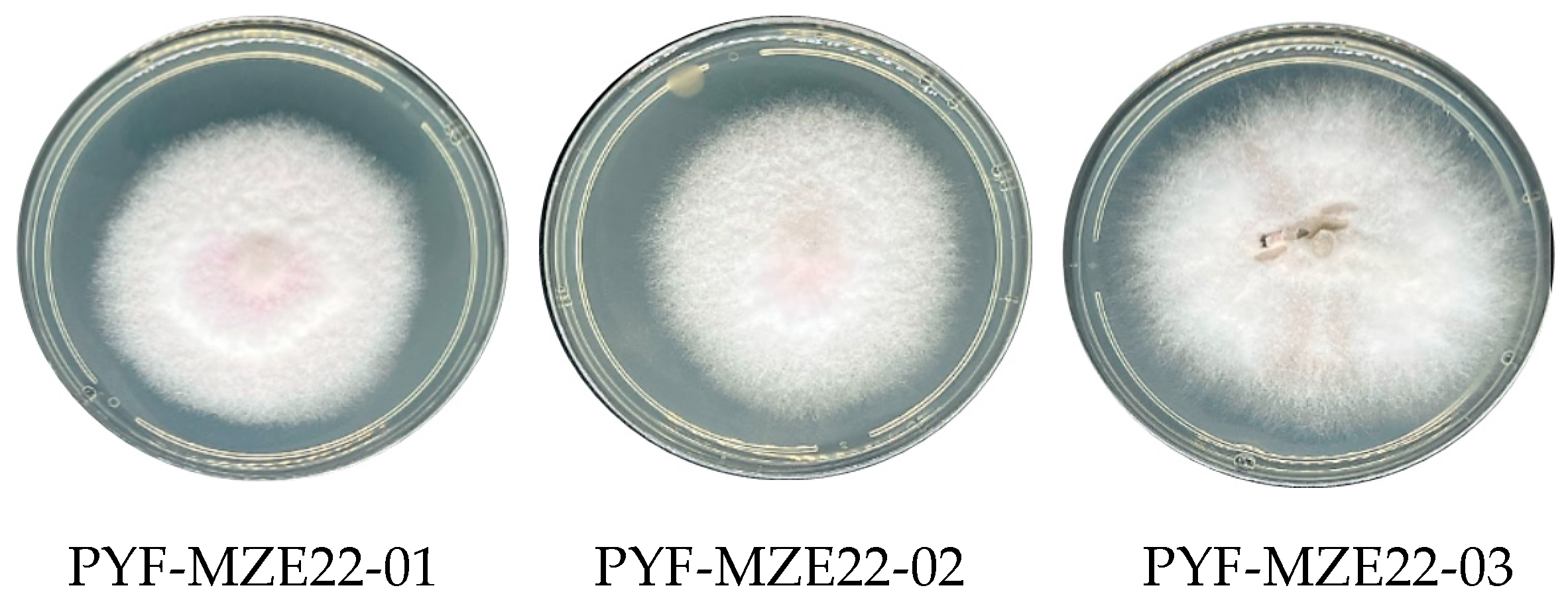
Three isolates that exhibited morphological characteristics consistent with those of Fusarium were obtained from the processed samples. Pure cultures were evaluated based on macroscopic traits, including growth rate, pigmentation, and aerial mycelium development, as well as microscopic features, focusing on conidial morphology [14]. Culture characteristics: Colonies on PDA incubated in the dark displayed an average radial growth rate of 5.6 mm/day at 24 ± 2 °C, reaching 75–85 mm in diameter within 15 days (Figure 1). Colonies produced abundant aerial mycelium and were initially white, pale pink, and pale violet in older cultures [46]. On CLA microconidia forming in false heads in aerial mycelium, arising in monophialides and polyphialides, macroconidias 3-septate, 29.8–56.6 μm large ( x ¯ = 38.2 μm) and 4.0–6.6 μm wide ( x ¯ = 4.1 μm wide). Microconidias 10.3–19.7 μm large ( x ¯ = 13.8 μm) and 3.0–5.7 μm wide ( x ¯ = 3.9 μm wide). Chlamydospores absent. No odor was detected.

3.2. Phylogenetic Analysis

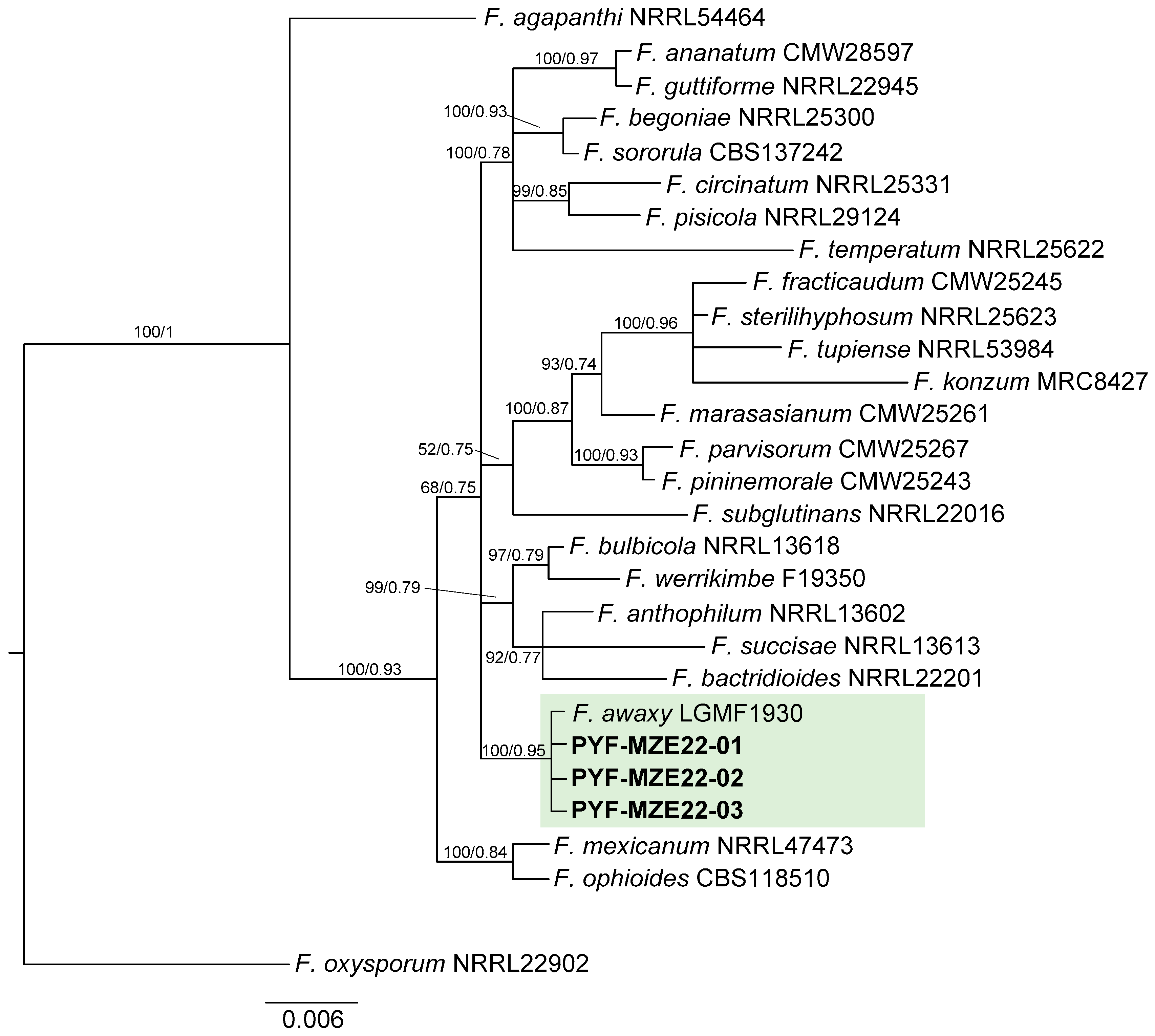
The TEF1 sequence data set consisted of 30 sequences of a 600-base alignment. In the BI and ML analysis of TEF1 sequences, the three Paraguayan isolates from this study formed a well-supported monophyletic clade that included F. awaxy LGMF 1930 reference strain (Figure 2). Both BI as well as ML trees exhibited the same topology. The robustness of ML and BI analyses allowed the identification of the strains isolated from the present study as F. awaxy (Figure 2).

4. Discussion

This study is the first to report the presence of F. awaxy isolated from maize in Paraguay, thus expanding the known geographical distribution of this recently described species. However, recent studies have shown that cryptic species and overlapping morphological traits often complicate field-level identification, emphasizing the importance of multilocus phylogenetics and genome-scale approaches for accurate species delimitation [9]. The detection of F. awaxy aligns with recent findings in Brazil from rotten stalks [46], South Africa from white and yellow maize kernels collected post-harvest but pre-storage [28], and the United States from ears, stalks, and roots [31]. In China, F. awaxy was detected as a pathogen causing maize stalk rot [17,29], where the species was also reported for the first time in maize, revealing highly diverse Fusarium communities associated with cereals, and where the species has been detected in maize, highlighting its emerging role in diverse agroecosystems.
The emergence of F. awaxy in South America has phytopathological and food safety implications because maize is highly susceptible to Fusarium infections and the associated risks [5]. Although the toxigenic profile of F. awaxy remains poorly characterized [17,28,29,30,46], fumonisin production in grains and plant tissues has been documented [28,30]. These observations warrant further targeted fumonisin production characterization of the species. The occurrence of fumonisins in agricultural products depends on environmental and post-harvest factors, including region, season, and storage conditions [19].
Fumonisin exposure is recognized as a major health concern for humans and animals because these mycotoxins interfere with key cellular mechanisms and contribute to diverse toxic and pathological outcomes [47]. Human exposure to fumonisins has been associated with an elevated risk of esophageal and hepatic cancers, as well as developmental abnormalities such as neural tube defects, highlighting their relevance as public health hazards [48,49]. In animals, fumonisin exposure induces a variety of species-specific toxicoses. In equids, it causes leukoencephalomalacia [50] due to disruption of sphingolipid metabolism, while in swine, it leads to pulmonary edema and cardiopulmonary failure [19,51]. In cattle and other ruminants, the ingestion of contaminated feed has been associated with feed refusal, hepatocellular degeneration, and severe renal tubular necrosis [19,52]. In poultry, fumonisins have been implicated in acute broiler mortality syndrome, which is characterized by increased embryonic mortality and high death rates in young broilers [19,53,54]. Members of the F. fujikuroi and F. sambucinum complexes are well-known producers of fumonisins, trichothecenes, and zearalenone [22]. The emergence of F. awaxy in Paraguay parallels the trends observed in Africa and Asia, suggesting that environmental changes may facilitate the spread of cryptic or newly described taxa across continents [17,55,56]. However, mycotoxin occurrence does not always correlate with the presence of specific Fusarium species [10,28], reflecting the need for further chemical and genomic characterization of Paraguayan isolates. The detection of multiple strains in a limited area suggests that F. awaxy may be more widespread than previously recognized [9,28].
Our findings highlight the emergence of novel Fusarium taxa in South American agroecosystems. The detection of F. awaxy in Paraguayan maize raises concerns regarding plant health, food safety, and trade. This study was based on a limited number of samples, from which only three F. awaxy isolates were obtained. Consequently, statistical analyses, such as replication-based inference or estimation of variability, were not applicable. Therefore, the findings should be interpreted within the scope of an initial exploratory assessment that confirms the occurrence of F. awaxy in maize in Paraguay. Future studies should include broader sampling and quantitative analyses to deepen our understanding of the species’ biology, distribution, and toxigenic potential.

5. Conclusions

This is the first study to report the presence of F. awaxy associated with maize in Paraguay. Phylogenetic analyses based on TEF1 sequences confirmed the identity of three isolates obtained from symptomatic plants. The detection of this species expands its known geographical distribution and highlights the need to strengthen monitoring and diagnostic efforts to anticipate its potential impact on maize production and food safety in Paraguay.

Author Contributions

Conceptualization, A.A.A.A. and M.L.R.; methodology, A.A.A.A., M.L.R.; E.C. and G.A.E.-M. software, M.L.R., E.C. and S.A.Q.-A. validation, A.A.A.A., M.L.R. and G.A.E.-M.; formal analysis, M.L.R.; investigation, F.J.L.-P., G.M.R., R.V., L.L.-M. and M.M.-O.; resources, A.A.A.A.; data curation, M.L.R., E.C. and G.A.E.-M.; writing—original draft preparation, A.A.A.A. and G.A.E.-M.; writing—review and editing, M.L.R., E.C., A.A.A.A. and D.F.R.; visualization, G.A.E.-M.; supervision, A.A.A.A. and M.L.R.; project administration, A.A.A.A.; funding acquisition, A.A.A.A. All authors have read and agreed to the published version of the manuscript.

Funding

This research was funded by CONSEJO NACIONAL DE CIENCIAS Y TECNOLOGIA DEL PARAGUAY CONACYT, grant number PINV01-37 and The APC was funded by PINV01-37.

Institutional Review Board Statement

Not applicable.

Informed Consent Statement

Not applicable.

Data Availability Statement

The original data presented in the study are openly available in NCBI; accession numbers are PX214124, PX214125, and PX214126.

Acknowledgments

The authors used an AI-based academic writing assistance platform for language editing under their direction. The authors revised the manuscript for English clarity and take full responsibility for the final content.

Conflicts of Interest

The funders had no role in the study design; collection, analyses, or interpretation of data; writing of the manuscript; or decision to publish the results.

Abbreviations

The following abbreviations are used in this manuscript:
PDAPotato Dextrose Agar
CLACarnation Leaf Agar

References

  1. Erenstein, O.; Jaleta, M.; Sonder, K.; Mottaleb, K.; Prasanna, B.M. Global Maize Production, Consumption and Trade: Trends and R&D Implications. Food Secur. 2022, 14, 1295–1319. [Google Scholar] [CrossRef]
  2. Food and Agriculture Organization FAOSTAT. Available online: https://www.fao.org/faostat/en/#data/QCL (accessed on 25 September 2025).
  3. CAPECO (Cámara Paraguaya de Exportadores y Comercializadores de Cereales y Oleaginosas) Área de Siembra, Producción y Rendimiento de Maíz en Paraguay. Available online: https://capeco.org.py/area-de-siembra-produccion-y-rendimiento/ (accessed on 25 September 2025).
  4. Portillo, G.A.; Sosa, R.D.R.; González, A.F.; Griffith, L.A.A.; Mascheroni, J.D.C. Influencia del estadio de madurez en la calidad nutricional y el costo de producción del silaje de maíz en San Pedro de Ycuamandyyú, Paraguay. Investig. Agrar. 2025, 27, e2701838. [Google Scholar] [CrossRef]
  5. Bryła, M.; Pierzgalski, A.; Zapaśnik, A.; Uwineza, P.A.; Ksieniewicz-Woźniak, E.; Modrzewska, M.; Waśkiewicz, A. Recent research on Fusarium mycotoxins in maize—A review. Foods 2022, 11, 3465. [Google Scholar] [CrossRef] [PubMed]
  6. Ņečajeva, J.; Borodušķe, A.; Nikolajeva, V.; Seņkovs, M.; Kalniņa, I.; Roga, A.; Skinderskis, E.; Fridmanis, D. Epiphytic and endophytic fungi colonizing seeds of two Poaceae weed species and Fusarium spp. seed degradation potential in vitro. Microorganisms 2023, 11, 184. [Google Scholar] [CrossRef] [PubMed]
  7. Solórzano-Solórzano, J.A.; Zambrano, S.M.V.; Olmedo, J.B.V. Fusarium spp. en el cultivo de maíz: Identificación, distribución geográfica, sintomatología, micotoxinas, ciclo de la enfermedad, control, y desafíos actuales y futuros. Sci. Agropecu. 2024, 15, 537–556. [Google Scholar] [CrossRef]
  8. O’Donnell, K.; Whitaker, B.K.; Laraba, I.; Proctor, R.H.; Brown, D.W.; Broders, K.; Kim, H.-S.; McCormick, S.P.; Busman, M.; Aoki, T.; et al. DNA Sequence-Based identification of Fusarium: A work in progress. Plant Dis. 2022, 106, 1597–1609. [Google Scholar] [CrossRef]
  9. Bugingo, C.; Infantino, A.; Okello, P.; Perez-Hernandez, O.; Petrović, K.; Turatsinze, A.N.; Moparthi, S. From morphology to multi-omics: A new age of Fusarium research. Pathogens 2025, 14, 762. [Google Scholar] [CrossRef]
  10. Gomez-Chavarria, D.A.; Rua-Giraldo, A.L.; Alzate, J.F. An evolutionary view of the Fusarium core genome. BMC Genom. 2024, 25, 304. [Google Scholar] [CrossRef]
  11. Leslie, J.F.; Summerell, B.A. The Fusarium Laboratory Manual; John Wiley & Sons: Hoboken, NJ, USA, 2008; ISBN 978-0-470-27646-4. [Google Scholar]
  12. Kamil, D.; Mishra, A.K.; Das, A.; Nishmitha, K. Genus Fusarium and Fusarium Species Complexes. In Biodiversity, Bioengineering, and Biotechnology of Fungi; Manoharachary, C., Singh, H.B., Singh, S.K., Sharma, Y.P., Eds.; Developments in Applied Microbiology and Biotechnology; Academic Press: Cambridge, MA, USA, 2025; pp. 209–225. ISBN 978-0-443-13856-0. [Google Scholar]
  13. Nikitin, D.A.; Ivanova, E.A.; Semenov, M.V.; Zhelezova, A.D.; Ksenofontova, N.A.; Tkhakakhova, A.K.; Kholodov, V.A. Diversity, Ecological Characteristics and Identification of Some Problematic Phytopathogenic Fusarium in Soil: A Review. Diversity 2023, 15, 49. [Google Scholar] [CrossRef]
  14. Crous, P.W.; Lombard, L.; Sandoval-Denis, M.; Seifert, K.A.; Schroers, H.-J.; Chaverri, P.; Gené, J.; Guarro, J.; Hirooka, Y.; Bensch, K.; et al. Fusarium: More than a Node or a Foot-Shaped Basal Cell. Stud. Mycol. 2021, 98, 100116. [Google Scholar] [CrossRef]
  15. Samiksha; Kumar, S. Molecular Taxonomy, Diversity, and Potential Applications of Genus Fusarium. In Industrially Important Fungi for Sustainable Development: Volume 1: Biodiversity and Ecological Perspectives; Abdel-Azeem, A.M., Yadav, A.N., Yadav, N., Usmani, Z., Eds.; Springer International Publishing: Cham, Switzerland, 2021; pp. 277–293. ISBN 978-3-030-67561-5. [Google Scholar]
  16. Ekwomadu, T.I.; Mwanza, M. Fusarium Fungi Pathogens, Identification, Adverse Effects, Disease Management, and Global Food Security: A Review of the Latest Research. Agriculture 2023, 13, 1810. [Google Scholar] [CrossRef]
  17. Han, S.L.; Wang, M.M.; Ma, Z.Y.; Raza, M.; Zhao, P.; Liang, J.M.; Gao, M.; Li, Y.J.; Wang, J.W.; Hu, D.M.; et al. Fusarium diversity associated with diseased cereals in China, with an updated phylogenomic assessment of the genus. Stud. Mycol. 2023, 104, 87–148. [Google Scholar] [CrossRef]
  18. Awuchi, C.G.; Ondari, E.N.; Ogbonna, C.U.; Upadhyay, A.K.; Baran, K.; Okpala, C.O.R.; Korzeniowska, M.; Guiné, R.P.F. Mycotoxins affecting animals, foods, humans, and plants: Types, occurrence, toxicities, action mechanisms, prevention, and detoxification strategies—A revisit. Foods 2021, 10, 1279. [Google Scholar] [CrossRef]
  19. Anumudu, C.K.; Ekwueme, C.T.; Uhegwu, C.C.; Ejileugha, C.; Augustine, J.; Okolo, C.A.; Onyeaka, H. A Review of the mycotoxin family of fumonisins, their biosynthesis, metabolism, methods of detection and effects on humans and animals. Int. J. Mol. Sci. 2025, 26, 184. [Google Scholar] [CrossRef] [PubMed]
  20. Yazar, S.; Omurtag, G.Z. Fumonisins, trichothecenes and zearalenone in cereals. Int. J. Mol. Sci. 2008, 9, 2062–2090. [Google Scholar] [CrossRef] [PubMed]
  21. Qu, Z.; Ren, X.; Du, Z.; Hou, J.; Li, Y.; Yao, Y.; An, Y. Fusarium Mycotoxins: The major food contaminants. mLife 2024, 3, 176–206. [Google Scholar] [CrossRef]
  22. Munkvold, G.P.; Proctor, R.H.; Moretti, A. Mycotoxin production in Fusarium according to contemporary species concepts. Annu. Rev. Phytopathol. 2021, 59, 373–402. [Google Scholar] [CrossRef]
  23. Foroud, N.A.; Baines, D.; Gagkaeva, T.Y.; Thakor, N.; Badea, A.; Steiner, B.; Bürstmayr, M.; Bürstmayr, H. Trichothecenes in cereal grains—An update. Toxins 2019, 11, 634. [Google Scholar] [CrossRef]
  24. Wegulo, S.N. Factors influencing deoxynivalenol accumulation in small grain cereals. Toxins 2012, 4, 1157–1180. [Google Scholar] [CrossRef] [PubMed]
  25. Jajić, I.; Dudaš, T.; Krstović, S.; Krska, R.; Sulyok, M.; Bagi, F.; Savić, Z.; Guljaš, D.; Stankov, A. Emerging Fusarium mycotoxins fusaproliferin, beauvericin, enniatins, and moniliformin in Serbian maize. Toxins 2019, 11, 357. [Google Scholar] [CrossRef]
  26. McDonald, B.A.; Stukenbrock, E.H. Rapid Emergence of Pathogens in Agro-Ecosystems: Global Threats to Agricultural Sustainability and Food Security. Philos. Trans. R. Soc. B Biol. Sci. 2016, 371, 20160026. [Google Scholar] [CrossRef] [PubMed]
  27. Rossman, A.Y. The Impact of Invasive Fungi on Agricultural Ecosystems in the United States. In Ecological Impacts of Non-Native Invertebrates and Fungi on Terrestrial Ecosystems; Langor, D.W., Sweeney, J., Eds.; Springer: Dordrecht, The Netherlands, 2009; pp. 97–107. ISBN 978-1-4020-9680-8. [Google Scholar]
  28. Visagie, C.M.; Meyer, H.; Yilmaz, N. Maize Fusarium Associations and Their Mycotoxins: Insights from South Africa. Fungal Biol. 2024, 128, 2408–2421. [Google Scholar] [CrossRef] [PubMed]
  29. Zhang, M.; Peng, C.; Li, S.; Tian, C. Morphological and Phylogenetic Analyses Reveal Two New Species of the Fusarium Fujikuroi (Hypocreales, Nectriaceae) Species Complex in China. MycoKeys 2025, 112, 127–163. [Google Scholar] [CrossRef] [PubMed]
  30. Ma, Y. Fusarium Species Structure in Nebraska Corn. Master’s Thesis, University of Nebraska-Lincoln, Lincoln, NE, USA, 2023. [Google Scholar]
  31. Nigam, D.R. Plant Diseases and Food Security in the 21st Century; Academic Guru Publishing House: Bhopal, India, 2024; ISBN 978-81-974433-3-6. [Google Scholar]
  32. Hernández-Ramos, L.; Sandoval-Islas, J.S. Escala diagramática de severidad para el complejo mancha de asfalto del maíz. Rev. Mex. Fitopatol. 2015, 33, 95–103. [Google Scholar]
  33. Doyle, J.J.; Doyle, J.L. A Rapid DNA Isolation Procedure for Small Quantities of Fresh Leaf Tissue. Phytochem. Bull. 1987, 19, 11–15. [Google Scholar]
  34. Reynoso, M.M.; Ramirez, M.L.; Torres, A.M.; Chulze, S.N. Trichothecene Genotypes and Chemotypes in Fusarium graminearum Strains Isolated from Wheat in Argentina. Int. J. Food Microbiol. 2011, 145, 444–448. [Google Scholar] [CrossRef]
  35. Arrua Alvarenga, A.A.; Iehisa Ouchi, J.C.M.; Cazal Martínez, C.C.; Moura Mendes, J.; Colmán, A.A.; Fernández Ríos, D.; Arrua, P.D.; Barboza Guerreño, C.A.; Kohli, M.M.; Ramírez, M.L.; et al. Trichothecene Genotype Profiling of Wheat Fusarium Graminearum Species Complex in Paraguay. Toxins 2022, 14, 257. [Google Scholar] [CrossRef]
  36. O’Donnell, K.; Kistler, H.C.; Cigelnik, E.; Ploetz, R.C. Multiple Evolutionary Origins of the Fungus Causing Panama Disease of Banana: Concordant Evidence from Nuclear and Mitochondrial Gene Genealogies. Proc. Natl. Acad. Sci. USA 1998, 95, 2044–2049. [Google Scholar] [CrossRef]
  37. BioRad EZ Load 100 bp Molecular Ruler #1708352|Bio-Rad. Available online: https://www.bio-rad.com/es-py/sku/1708352-ez-load-100-bp-molecular-ruler?ID=1708352 (accessed on 25 September 2025).
  38. Promega DiamondTM Nucleic Acid Dye. Available online: https://worldwide.promega.com/products/biochemicals-and-labware/biochemical-buffers-and-reagents/diamond-nucleic-acid-dye/ (accessed on 25 September 2025).
  39. BioRad Gel Doc EZ Gel Documentation System|Bio-Rad. Available online: https://www.bio-rad.com/es-py/product/gel-doc-ez-gel-documentation-system?ID=O4950KKG4 (accessed on 25 September 2025).
  40. Hall, T.A. BioEdit A User-Friendly Biological Sequence Alignment Editor and Analysis Program for Windows 95/98/NT. Nucleic Acids Symp. Ser. 1999, 41, 95–98. Available online: https://www.scirp.org/reference/ReferencesPapers?ReferenceID=1383440 (accessed on 25 September 2025).
  41. Geiser, D.M.; Del Mar Jiménez-Gasco, M.; Kang, S.; Makalowska, I.; Veeraraghavan, N.; Ward, T.J.; Zhang, N.; Kuldau, G.A.; O’Donnell, K. FUSARIUM-ID v. 1.0: A DNA Sequence Database for Identifying Fusarium. In Molecular Diversity and PCR-Detection of Toxigenic Fusarium Species and Ochratoxigenic Fungi; Mulè, G., Bailey, J.A., Cooke, B.M., Logrieco, A., Eds.; Springer: Dordrecht, The Netherlands, 2004; pp. 473–479. ISBN 978-90-481-6631-2. [Google Scholar]
  42. Katoh, K.; Rozewicki, J.; Yamada, K.D. MAFFT Online Service: Multiple Sequence Alignment, Interactive Sequence Choice and Visualization. Brief. Bioinform. 2019, 20, 1160–1166. [Google Scholar] [CrossRef]
  43. Ronquist, F.; Teslenko, M.; van der Mark, P.; Ayres, D.L.; Darling, A.; Höhna, S.; Larget, B.; Liu, L.; Suchard, M.A.; Huelsenbeck, J.P. MrBayes 3.2: Efficient Bayesian Phylogenetic Inference and Model Choice Across a Large Model Space. Syst. Biol. 2012, 61, 539–542. [Google Scholar] [CrossRef]
  44. Guindon, S.; Dufayard, J.-F.; Lefort, V.; Anisimova, M.; Hordijk, W.; Gascuel, O. New Algorithms and Methods to Estimate Maximum-Likelihood Phylogenies: Assessing the Performance of PhyML 3.0. Syst. Biol. 2010, 59, 307–321. [Google Scholar] [CrossRef]
  45. Posada, D. jModelTest: Phylogenetic Model Averaging. Mol. Biol. Evol. 2008, 25, 1253–1256. [Google Scholar] [CrossRef]
  46. Crous, P.W.; Wingfield, M.J.; Lombard, L.; Roets, F.; Swart, W.J.; Alvarado, P.; Carnegie, A.J.; Moreno, G.; Luangsaard, J.; Thangavel, R.; et al. Fungal Planet Description Sheets: 951-1041. Persoonia 2019, 43, 223–425. [Google Scholar] [CrossRef]
  47. EFSA Panel on Contaminants in the Food Chain (CONTAM); Knutsen, H.; Alexander, J.; Barregård, L.; Bignami, M.; Brüschweiler, B.; Ceccatelli, S.; Cottrill, B.; Dinovi, M.; Edler, L.; et al. Risks for Animal Health Related to the Presence of Fumonisins, Their Modified Forms and Hidden Forms in Feed. EFSA J. 2018, 16, e05242. [Google Scholar] [CrossRef]
  48. Nair, M.G. Fumonisins and Human Health. Ann. Trop. Paediatr. 1998, 18, S47–S52. [Google Scholar] [CrossRef] [PubMed]
  49. Marasas, W.F.O.; Riley, R.T.; Hendricks, K.A.; Stevens, V.L.; Sadler, T.W.; Gelineau-van Waes, J.; Missmer, S.A.; Cabrera, J.; Torres, O.; Gelderblom, W.C.A.; et al. Fumonisins Disrupt Sphingolipid Metabolism, Folate Transport, and Neural Tube Development in Embryo Culture and In Vivo: A Potential Risk Factor for Human Neural Tube Defects among Populations Consuming Fumonisin-Contaminated Maize. J. Nutr. 2004, 134, 711–716. [Google Scholar] [CrossRef] [PubMed]
  50. Smith, G.W.; Gupta, R.C. Chapter 70—Fumonisins. In Veterinary Toxicology, 4th ed.; Gupta, R.C., Ed.; Academic Press: Cambridge, MA, USA, 2025; pp. 1039–1056. ISBN 978-0-443-29007-7. [Google Scholar]
  51. EFSA Panel on Contaminants in the Food Chain (CONTAM); Schrenk, D.; Bignami, M.; Bodin, L.; Chipman, J.K.; del Mazo, J.; Grasl-Kraupp, B.; Hogstrand, C.; Leblanc, J.; Nielsen, E.; et al. Assessment of Information as Regards the Toxicity of Fumonisins for Pigs, Poultry and Horses. EFSA J. 2022, 20, e07534. [Google Scholar] [CrossRef] [PubMed]
  52. Mathur, S. Fumonisin B1 Increases Serum Sphinganine Concentration but Does Not Alter Serum Sphingosine Concentration or Induce Cardiovascular Changes in Milk-Fed Calves. Toxicol. Sci. 2001, 60, 379–384. [Google Scholar] [CrossRef]
  53. Rauber, R.H.; Oliveira, M.S.; Mallmann, A.O.; Dilkin, P.; Mallmann, C.A.; Giacomini, L.Z.; Nascimento, V.P. Effects of Fumonisin B1 on Selected Biological Responses and Performance of Broiler Chickens. Pesq. Vet. Bras. 2013, 33, 1081–1086. [Google Scholar] [CrossRef]
  54. Javed, T.; Richard, J.L.; Bennett, G.A.; Dombrink-Kurtzman, M.A.; Bunte, R.M.; Koelkebeck, K.W.; Côté, L.M.; Leeper, R.W.; Buck, W.B. Embryopathic and Embryocidal Effects of Purified Fumonisin B1 or Fusarium Proliferatum Culture Material Extract on Chicken Embryos. Mycopathologia 1993, 123, 185–193. [Google Scholar] [CrossRef] [PubMed]
  55. Singh, B.K.; Delgado-Baquerizo, M.; Egidi, E.; Guirado, E.; Leach, J.E.; Liu, H.; Trivedi, P. Climate Change Impacts on Plant Pathogens, Food Security and Paths Forward. Nat. Rev. Microbiol. 2023, 21, 640–656. [Google Scholar] [CrossRef] [PubMed]
  56. Hovmøller, M.S.; Thach, T.; Justesen, A.F. Global Dispersal and Diversity of Rust Fungi in the Context of Plant Health. Curr. Opin. Microbiol. 2023, 71, 102243. [Google Scholar] [CrossRef] [PubMed]
Figure 1. Colonies of Fusarium awaxy grown on Potato Dextrose Agar (PDA) and incubated in the dark for 15 days at 24 ± 2 °C.
Jof 11 00794 g001
Figure 2. Bayesian inferred tree based on partial sequences of the TEF1 gene. Values at branch nodes indicate branch support with posterior probabilities (PP × 100); values ≥ 50 are shown. Both Bayesian Inference (BI) and Maximum likelihood (ML) analysis yielded a tree with the same topology. The tree was rooted with a sequence from F. oxysporum NRRL 22902.
Jof 11 00794 g002
Table 1. Fusarium species included in this study.
Fusarium SpeciesStrain NumberHostOriginTEF1 GenBank Accession Number
F. agapanthiNRRL 54463Agapanthus praecoxAustraliaKU900630
F. ananatumCMW 28597Ananas comosusSouth AfricaEU668312
F. anthophilumNRRL13602Hippeastrum sp.GermanyAF160292
F. awaxyLGMF 1930Rotten stalk of Zea maysBrazilMG839004
F. awaxyPYF-MZE22-01Zea maysParaguayPX214124
F. awaxyPYF-MZE22-02Zea maysParaguayPX214125
F. awaxyPYF-MZE22-03Zea maysParaguayPX214126
F. bactridioidesNRRL 22201Cronartium conigenumUSAKC514053
F. begoniaeNRRL 25300Begonia elatiorGermanyAF160293
F. bulbicolaNRRL 13618Nerine bowdeniiGermany AF160294
F. circinatumNRRL 25331Pinus radiataUSAAF160295
F. fracticaudumCMW 25245Pinus maximinoiiColombiaKJ541059
F. guttiformeNRRL 22945Ananas comosusEnglandAF160297
F. konzumMRC 8427Sorghastrum nuttansUSA LT996098
F. marasasianumCMW 25261Pinus patulaColombiaKJ541063
F. mexicanumNRRL 47473Mangiferia indicaMexicoGU737416
F. ophioidesCBS 118510Panicum maximumSouth AfricaMN534020
F. oxysporumNRRL22902Pseudotsuga menziesiiUSAAF160312
F. parvisorumCMW 25267Pinus patulaColombiaKJ541060
F. pininemoraleCMW 25243Pinus tecunumaniiColombiaKJ541064
F. pilosicolaNRRL 29124Bidens pilosaUSAMN534055
F. sororulaCBS 137242Pinus patulaColombiaKJ541067
F. sterilihyphosumNRRL 25623MangoSouth AfricaAF160300
F. subglutinansNRRL 22016Zea maysUSAAF160289
F. succisaeNRRL 13613Succisa pratensisGermanyAF160291
F. temperatumNRRL25622Zea maysSouth AfricaAF160301.1
F. tupienseNRRL 53984Magnifera indicaBrazilGU737404
F. werrikimbeF19350Sorghum leiocladumAustraliaEF107131
Disclaimer/Publisher’s Note: The statements, opinions and data contained in all publications are solely those of the individual author(s) and contributor(s) and not of MDPI and/or the editor(s). MDPI and/or the editor(s) disclaim responsibility for any injury to people or property resulting from any ideas, methods, instructions or products referred to in the content.