1. Introduction
Autistic individuals continue to face significant challenges in accessing and maintaining stable employment [
1,
2]. Despite evidence of diverse skills and competencies, they experience disproportionately high rates of unemployment and underemployment across many countries, with an unemployment rate of over 90% in Italy [
3]. If employment is found, it is often unskilled, unstable and poorly paid [
4]. This not only restricts the personal and financial autonomy of autistic individuals, but also represents a loss of potential for the labor market and society as a whole. Unemployment also has a serious impact on the lives of autistic individuals, since having a job would allow them to explore opportunities to socialize, gain financial independence, discover new identity aspects, and contribute to a general sense of well-being and improved quality of life [
5,
6,
7].
Previous research has identified several practices that may facilitate the inclusion of autistic individuals in employment settings. These include workplace accommodations tailored to sensory and communication needs, adjustments to recruitment and selection procedures, flexible work arrangements, job coaching, mentorship programs, and autism-specific training for managers and colleagues [
8,
9,
10]. However, evidence also suggests that the availability, implementation, and perceived usefulness of such measures vary considerably across organizational contexts, and that many autistic adults continue to encounter barriers during recruitment, onboarding, and career development [
10,
11]. While these issues have received increasing attention in private sector and supported-employment contexts, less is known about how different stakeholders perceive existing inclusion measures and potential support tools within public administration settings. In fact, public administration may be a potentially promising environment to support the employment of autistic individuals. In this paper, we refer to “public administration” as a broad category comprising employment within government-funded sectors, including social care, education, healthcare and local government services, which together form the core of public service infrastructure. In many global contexts, this definition extends to any state-led or subsidized organization dedicated to meeting the basic needs of the citizenry through direct service delivery. Public administrations are directly shaped by public policy, legal frameworks on inclusion and occupational well-being accountability [
12,
13]. Moreover, compared to private employment settings, job positions in the public sector are generally more stable, less subject to market fluctuations, and governed by standardized procedures and protections; they often provide structured routines and greater legal protections against dismissal, granting greater job stability and retention over time, as well as clear criteria for evaluation and hiring [
14]. Furthermore, public administrations are bound by legal obligations to promote inclusion and guarantee equal access, creating a more positive setting for long-term employment retention [
12]. Research also demonstrates that inequalities regarding pay gaps are less pronounced in public administration jobs than those in the private sector, pointing to more equitable employment conditions [
15]. These considerations should be interpreted as theoretical premises and exploratory assumptions rather than evidence of inherently superior inclusiveness within public administration contexts, given that the current empirical evidence base remains limited and does not allow definitive conclusions regarding whether public administration contexts are more inclusive than private sector workplaces. However, some available findings suggest that characteristics such as standardized procedures, stronger legal protections, and greater job stability may represent potentially favorable conditions for employment inclusion. These considerations should therefore be interpreted as theoretical premises and promising areas for further investigation. In Italy, the inclusion of disabled people, including autistic individuals, in public employment, is supported by a legal framework based on Law 68/1999, which guarantees the so-called “reserved quotas”. These quotas require both public and private employers to reserve a fixed percentage of positions for individuals with disabilities, including autism. Moreover, candidates who wish to participate in public competitions to access employment in public administration can request reasonable accommodations such as extra time, accessible formats, or assistive tools during the exam and selection process, in line with Law 104/1992 and Law 67/2006, and refer to the UN Convention on the Rights of Persons with Disabilities, ratified by Italy in 2009.
While the legislative framework offers tools for inclusion, empirical evidence suggests that autistic individuals remain underrepresented in public administration roles, and often face barriers even when formal protections are in place [
3]. We believe that this issue needs to be addressed with a deeper discussion about what is “disability”, drawing from the neurodiversity paradigm and the theoretical framework of social models of disability. Recent research positions autism as a form of neurodivergence, meaning that autistic individuals simply process inputs and information in a non-typical way, a perspective that allows them to actively contribute to research, policy design, and organizational practices [
16,
17]. Combining these perspectives with the social model of disability [
18] allows us to frame “disability” as an experience, more than a condition. Read through these lenses, difficulties in employment inclusion may emerge from work environments that fail to adequately address accessibility, communication, and sensory needs for autistic individuals. Thus, disabling experiences may arise through the interaction between individuals and social or organizational barriers.
When interpreted through these theoretical perspectives, the employment issue appears to be not centered around a specific impairment or disability, but about typically structured environments which are not able to respond to diverse needs; work environments that impose structural barriers, operate with limited understanding of neurodiversity, and perpetuate stigma or rigid expectations, can negatively impact on the possibility of finding and retaining employment. At the same time, it is important to acknowledge the substantial heterogeneity of autism and the plurality of perspectives within both autism and disability. While neurodiversity-oriented and social model approaches emphasize the role of environmental and relational barriers, these frameworks should not be interpreted as denying the existence of significant support needs or disabling impairments experienced by some autistic individuals, especially those with higher support needs [
19,
20]. Rather, they are used as interpretive lenses to explore how organizational and environmental factors may interact with individual characteristics in shaping employment experiences.
Current inclusion policies and laws are necessary and appreciated; however, we believe that more could be done by adapting inclusion procedures to the specific characteristics of autism and by shifting responsibility back to the workplace, creating inclusive work environments. A growing body of work has focused on neurodiversity in organizational and employment settings, suggesting that inclusion should be understood as a structural and organizational responsibility that involves redesigning workplace practices, environments, and policies [
21,
22]. Scoping reviews in this area have also highlighted the importance of employer practices, environmental accommodations, and tailored supports in promoting labor market participation for autistic individuals [
22].
As critically highlighted by Oliver [
23], who proposed the social model of disability, “
the talking has to stop” (page 4) and we need to move from theoretical acknowledgment to actual concrete changes. To inform the future development of practical tools and strategies, our study aims to explore the opinions, perspectives and perceived needs of adult autistic individuals and other stakeholders with direct experience of autism in adulthood, including family members and professionals working with autistic adults in educational, vocational, and employment-related contexts.
An exploratory survey was developed to investigate three core areas: (1) perceptions of current inclusion measures, (2) perceived importance of different inclusion domains, and (3) perceived usefulness of potential support tools. An optional open-ended question was added. The ultimate aim is not to evaluate the effectiveness of existing inclusion measures, but to explore how autistic adults, family members, and professionals perceive current tools, which areas they consider most relevant, and which supports they judge most useful, as an initial needs-assessment to identify stakeholder priorities that may inform future research.
3. Results
The quantitative component is descriptive and exploratory, while the qualitative component provides initial indications and practical suggestions.
The aim of the analysis was to examine potential differences among the three groups involved in the study, educators (teachers, educators, and psychologists), family members, and autistic individuals, in relation to perceptions of the effectiveness of current employment inclusion tools for autistic people within the public administration, as well as the perceived need for additional measures to support employment inclusion.
Because the dependent variables were measured on Likert scales and did not meet assumptions of normality, non-parametric analyses were conducted.
3.1. Descriptive Statistics
3.1.1. Preliminary Analyses
All questionnaire items were initially screened using Kruskal–Wallis tests to assess potential between-group differences across the three participant groups. Only two items yielded statistically significant results and were therefore examined further through post hoc pairwise comparisons. This approach was adopted to reduce Type I error inflation and to focus interpretation on the items that most clearly differentiated the groups. The significant items were:
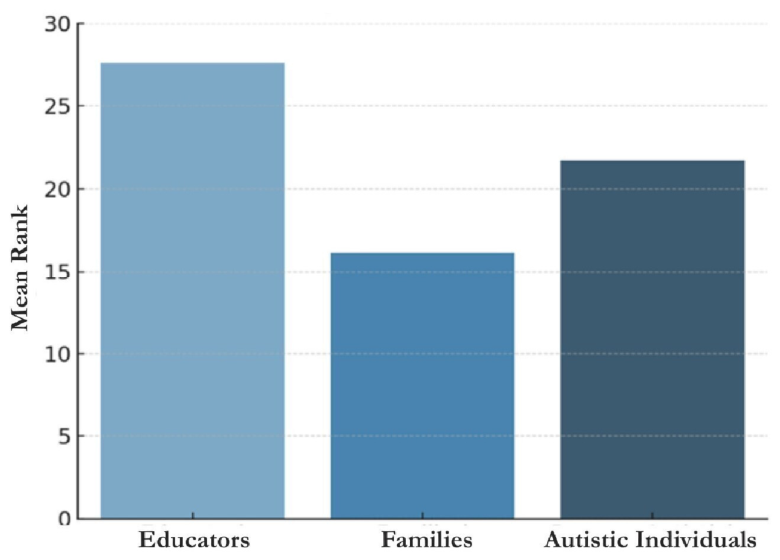
Item 1: “The current pathways and tools for the employment of autistic individuals in public administration (e.g., reserve quotas, housing requests, etc.) are very effective” → H(2) = 8.17, p = 0.017.
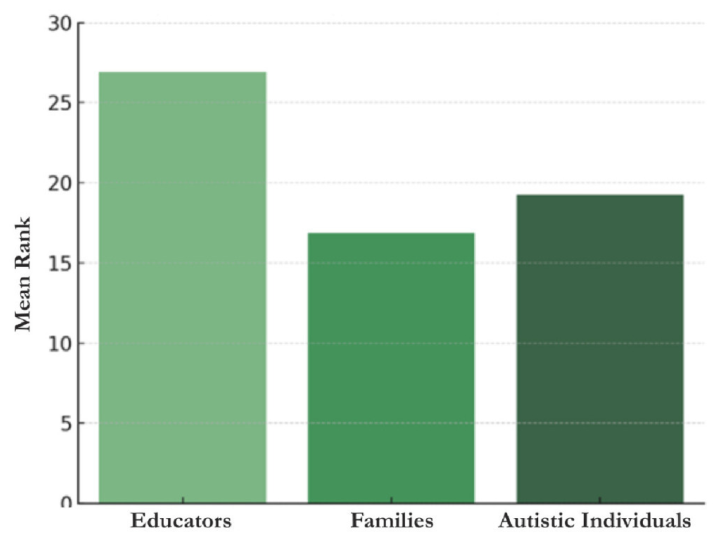
Item 2: “It is necessary to intervene with new measures to improve the employment of autistic individuals in public administration” → H(2) = 9.90, p = 0.007.
The remaining items did not show statistically significant between-group differences (p > 0.05) and were not included in further analyses.
For the two significant items, pairwise comparisons were conducted using Mann–Whitney U tests. Bonferroni correction was applied to control for multiple comparisons, resulting in an adjusted significance threshold of α = 0.017. Effect sizes were calculated using the formula r = Z/√N and interpreted according to Cohen’s (1988) guidelines.
3.1.2. Post Hoc Analyses
Item 1: Perceived Effectiveness of Current Employment Inclusion Tools
A statistically significant difference emerged between educators and family members, with educators reporting higher evaluations of the effectiveness of current employment inclusion tools within the public administration, U = 108.00, Z = −3.14, p = 0.002, r = 0.48, indicating a medium-to-large effect. No statistically significant differences emerged between educators and autistic individuals, U = 140.00, Z = −0.49, p = 0.624, r = 0.08, or between family members and autistic individuals, U = 95.00, Z = −1.84, p = 0.065, r = 0.31. Although the latter comparison yielded a medium effect size, the result did not remain statistically significant after Bonferroni correction.
Autistic participants generally showed intermediate scores between educators and family members (see
Figure 1).
Item 2: Perceived Need for Additional Measures
A similar pattern emerged for the perceived need for additional measures. Educators reported significantly higher agreement than family members regarding the need for further regulatory and practical interventions aimed at improving employment inclusion within the public administration, U = 123.00, Z = −3.18, p = 0.001, r = 0.49, indicating a medium-to-large effect.
The comparison between educators and autistic individuals showed a similar directional pattern, U = 97.00, Z = −2.11, p = 0.035, r = 0.35; however, the result did not remain statistically significant after Bonferroni correction. The effect size was nevertheless moderate, suggesting a potentially meaningful group difference that may warrant further investigation in larger samples.
No statistically significant differences emerged between family members and autistic individuals, U = 129.50, Z = −0.97,
p = 0.331, r = 0.16. Overall, autistic participants again showed intermediate scores relative to the other two groups (see
Figure 2).
The analyses suggest that educators tend to express stronger agreement both regarding the effectiveness of current employment inclusion tools and the need for additional measures compared to family members. Autistic individuals generally reported intermediate evaluations, although pairwise differences involving this group did not remain statistically significant after correction for multiple comparisons. These findings should be interpreted cautiously given the exploratory nature of the questionnaire and the relatively small sample size, particularly for the autistic participant group.
3.2. Qualitative Analysis
The responses to the open-ended question were analyzed using reflexive thematic analysis [
23], following an inductive and data-driven approach. The analysis aimed to identify recurrent patterns and meaningful thematic structures without applying a pre-existing coding frame.
The six phases of thematic analysis were systematically followed: (1) familiarization with the data, through repeated reading of all responses; (2) generation of initial codes, which were assigned in MAXQDA24 by the second author (M.B.); (3) search for themes, by grouping codes into potential thematic clusters; (4) review of themes, through iterative refinement and comparison across cases; (5) definition and naming of themes, to ensure conceptual clarity and internal coherence; and (6) writing up, with data extracts used to support analytic claims.
Although initial coding was carried out by M.B., the process was iterative and collaborative: theme development and refinement involved the full research team (E.D.A., V.G.) under the supervision of the senior academic advisor A.L.A. This collaborative approach ensured analytical triangulation and enhanced the credibility of the findings.
3.2.1. Reflexivity and Positionality
Reflexivity and positionality were continuously considered throughout the analytic process, in line with the reflexive thematic analysis approach adopted in this study [
24]. Consistent with reflexive thematic analysis, coding frequencies were treated as descriptive rather than inferential or validity-based indicators. None of the researchers identify as autistic or neurodivergent; however, all authors have longstanding professional experience working closely with autistic adults in clinical, academical, and inclusion-oriented contexts. These experiences likely influenced both the interpretation of participants’ accounts and the researchers’ sensitivity toward themes related to stigma, accessibility, and self-determination. The research team approaches autism from a neurodiversity-affirming and social model perspective, with a theoretical commitment toward participatory inclusion principles and the recognition of autistic individuals as active agents in decisions affecting their lives. These epistemological assumptions informed the interpretive lens through which data were analyzed, particularly regarding the emphasis placed on organizational responsibility, environmental barriers, and co-designed inclusion practices. At the same time, the collaborative and iterative nature of coding discussions was used to critically reflect on potential interpretive biases and to maintain analytical openness toward divergent or nuanced perspectives emerging from the data. In line with reflexive thematic analysis, the study did not aim to achieve “data saturation” in a positivist sense; instead, the analysis focused on developing sufficiently coherent thematic patterns capable of meaningfully capturing recurrent perspectives across participants. In line with reflexive thematic analysis, the relevance and analytical significance of themes were not determined solely by their frequency within the dataset. Some themes or experiences, although less frequently articulated by participants, were considered conceptually important due to their interpretive richness and their relevance to the broader research questions. Consequently, any descriptive indication of thematic prevalence should not be interpreted as a measure of objective importance, validity, or representativeness.
During the later stages of coding and theme refinement, no substantially new thematic dimensions emerged, and the research team considered the thematic structure adequately developed in relation to the exploratory aims of the study.
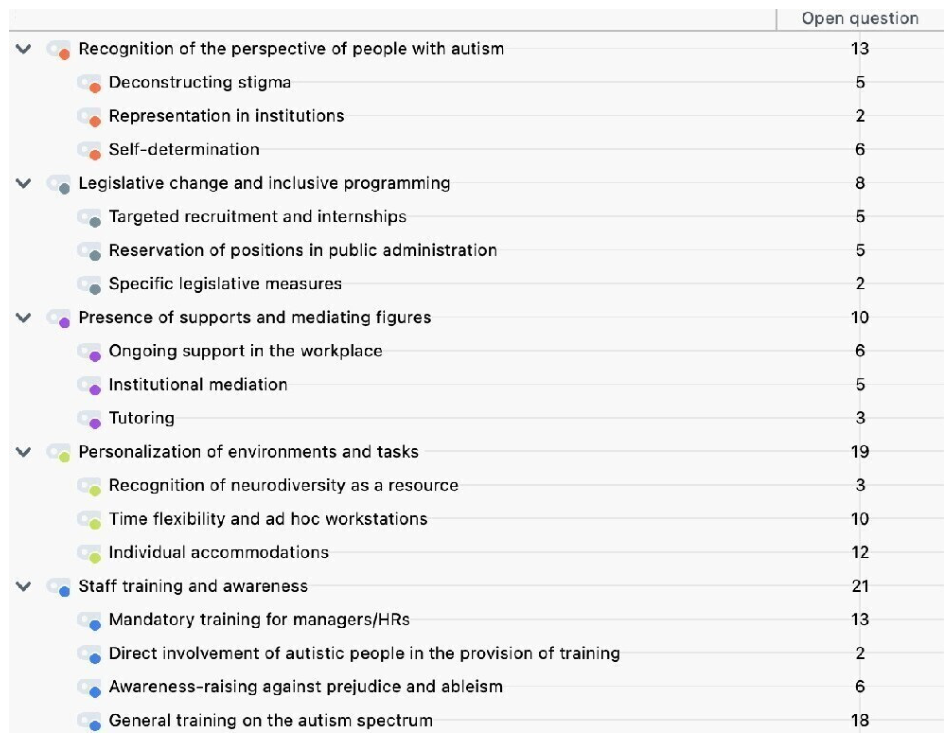
The final thematic structure includes five main themes and sixteen sub-themes which reflect a wide range of concrete suggestions and critical reflections shared by the 62 respondents. These themes are presented in
Figure 3 and discussed in the following section.
3.2.2. Theme 1. Recognition of the Perspective of Autistic Individuals
This theme captures a central concern shared by many respondents: the urgent need to shift the narrative around autism in the workplace. Rather than viewing autism through a deficit-based lens, participants emphasized the value of acknowledging autistic perspectives, dismantling stereotypes, and promoting authentic representation within public institutions. Three sub-themes emerged: (1) deconstructing stigma; (2) representation in institutions; (3) self-determination.
Sub-Theme 1: Deconstructing Stigma
Several respondents stressed that a key barrier to inclusion is the persistence of stigma and misconceptions surrounding autism. To foster more inclusive workplaces, they called for cultural and educational efforts aimed at redefining autism not as a pathology, but as a form of cognitive diversity. One participant advocated for greater visibility and appreciation of autistic viewpoints, underlining their potential to contribute unique and valuable solutions: “Give more voice and importance to autistic employees. Often, a different viewpoint provides the right solution to many problems, just listen to it” (Female, 25–35, autistic person).
Another respondent emphasized the importance of training and public messaging to challenge medicalized narratives and normalize neurodivergent expression: “Make it clear that autism is not an illness. Our minds simply process information differently, and as a result, we express information differently too.” (Male, 25–35, autistic person).
These statements reflect a shared aspiration for recognition without condescension, and for a cultural shift that validates autistic ways of being as fully legitimate within professional environments.
Sub-Theme 2: Representation in Institutions
Beyond dismantling stigma, respondents highlighted the importance of tangible representation of autistic individuals within the structures of public administration not only as employees, but also in positions of visibility and leadership. The presence of autistic professionals in institutional roles was seen as both a symbolic and practical step toward inclusion, capable of challenging stereotypes and fostering more informed organizational cultures.
One respondent pointedly suggested reversing traditional power dynamics by placing autistic individuals in decision-making roles: “Hire an autistic person as the boss” (Female, >45, parent/guardian of an autistic person).
Another emphasized the need for proactive policies to support recruitment and presence in public employment: “Facilitate hiring of autistic individuals” (Female, >45, parent/guardian of an autistic person).
These perspectives underscore the belief that inclusion cannot be fully realized without representation: not only as beneficiaries of policy, but as active participants and leaders in shaping inclusive institutions.
Sub-Theme 3: Self-Determination
A recurring concern among respondents was the importance of respecting autistic individuals’ agency and autonomy in the workplace. Rather than applying one-size-fits-all solutions, participants advocated for personalized approaches that take into account each person’s strengths, preferences, and self-knowledge. This emphasis on self-determination points to the need for participatory practices in role assignment and career development.
One autistic respondent stressed the value of jointly assessing abilities and limitations to ensure appropriate task placement, explicitly underlining the importance of consent: “Assess characteristics, strengths, and weaknesses to find a suitable role/task for each autistic person (in agreement with them, of course)” (Female, 18–24, autistic person).
Others emphasized the centrality of individual interests and aptitudes in job matching processes:
“Assign roles based on areas of interest” (Male, >45, autistic person).
“Evaluate each individual’s specific aptitudes case by case” (Female, >45, parent/guardian of an autistic person).
Together, these contributions articulate a vision of inclusion grounded not in standardized accommodations, but in relational and negotiated recognition of individual identity and potential.
3.2.3. Theme 2. Legislative Change and Inclusive Programming
This theme reflects a strong call for systemic interventions to structurally enable the inclusion of autistic individuals in public employment. Participants emphasized that cultural change alone is insufficient without formal, institutional commitments. Responses point to the need for targeted programs, legal recognition of specific vulnerabilities, and clear legislative provisions aimed at securing access to work opportunities in public administration. Three interrelated sub-themes emerged: (1) targeted recruitment and internships; (2) reservation of positions in public administration; (3) specific legislative measures.
Sub-Theme 1: Targeted Recruitment and Internships
Respondents proposed concrete mechanisms to improve access pathways, including the creation of dedicated job competitions and internship programs for neurodivergent individuals. These suggestions were grounded in the recognition of systemic barriers to entry and the need to reduce bureaucratic and meritocratic filters that may disadvantage autistic applicants.
One young autistic respondent advocated explicitly for exclusive access routes: “Create specific job competitions exclusively for neurodivergent people” (Female, 18–24, autistic person).
Others called for a simplification of hiring processes and the expansion of inclusive opportunities:
“Direct and frequent hirings” (Male, 18–24, parent/guardian of an autistic person).
“Open more inclusive positions in terms of opportunities” (Female, 25–35, psychologist with autistic users).
These inputs suggest that targeted recruitment is seen as not only an affirmative action tool, but as a structural corrective to persistent exclusion.
Sub-Theme 2: Reservation of Positions in Public Administration
A second cluster of responses focused on the institutional recognition of autism as a condition warranting reserved access to public sector jobs. Participants argued for the formal categorization of autistic individuals as a vulnerable group, to enable the allocation of reserved quotas in public hiring.
As one teacher proposed: “Modify current employment regulations so autistic individuals are specifically considered a highly vulnerable group” (Male, >45, teacher).
This suggestion was echoed by others calling for explicit job reservation schemes: “Reserve a portion of positions for them” (Female, >45, teacher).
These proposals reflect a demand for affirmative policy tools that concretely guarantee representation and access in the public workforce.
Sub-Theme 3: Specific Legislative Measures
Beyond hiring mechanisms, some respondents expressed a broader frustration with the lack of binding, coherent legal frameworks to support inclusion. Their comments called for both new laws and the revision of existing ones that are perceived as misaligned with autistic needs.
One participant put it simply: “We need more concrete actions and laws” (Female, >45, parent/guardian of an autistic person).
Another respondent directly challenged the use of Applied Behavior Analysis (ABA), advocating for its legislative elimination as an elective tool: “Elimination of the ABA system” (gender not specified, 36–45, autistic person).
This sub-theme points to the demand for rights-based legal reforms, capable of moving beyond tokenistic measures toward deeper trauma-informed and structural justice.
3.2.4. Theme 3. Presence of Supports and Mediating Figures
Many respondents emphasized that achieving effective inclusion requires ongoing, structured, and specialized support within the workplace. The mere act of hiring an autistic person is not enough if the work environment remains inaccessible or unresponsive to their needs. This theme brings together proposals centered on continuous support, institutional mediation, and individualized tutoring, all aimed at promoting not only access, but long-term sustainability of inclusion. Three key sub-themes emerged: (1) ongoing support in the workplace; (2) institutional mediation; (3) tutoring.
Sub-Theme 1: Ongoing Support in the Workplace
Respondents stressed the need for workplaces to be proactively designed and maintained as inclusive environments, both physically and relationally. This includes not only accessible infrastructure, but also colleagues and collaborators trained to understand and respect autistic processing and communication styles.
One participant suggested a holistic design approach: “Create spaces designed with and for them, choose collaborators/colleagues trained in autism spectrum” (Female, 36–45, teacher).
Another highlighted the importance of systematic therapeutic support as part of a coordinated inclusion strategy: “Have trained therapists systematically supporting existing PA staff to accelerate the inclusion process” (Female, >45, parent/guardian of an autistic person).
Additionally, flexibility in terms of leave and workload was cited as essential to support autistic employees’ well-being and retention: “Allow extra leave when needed” (Female, 36–45, psychologist with autistic users).
Sub-Theme 3: Tutoring
A final cluster of responses focused on the need for training and tutoring models tailored to the person, allowing autistic individuals to gradually enter and stabilize within the workplace.
One participant stressed the importance of matching training to personal interests and capacities: “Create tailored training courses for autistic individuals related to a specific job role based on personal inclinations” (Female, 25–35, sister of an autistic person).
Others advocated for dual-track training models, which combine technical education with real work experience under supported conditions: “Promote dedicated support programs and dual training models that provide technical qualifications and skills through internships in real work settings” (Male, >45, teacher).
These suggestions highlight the need for structured yet flexible pathways, where autistic individuals are not simply placed into jobs, but guided and prepared with meaningful, context-specific support.
3.2.5. Theme 4. Personalization of Environments and Tasks
A prominent theme across responses was the necessity to move beyond standardized inclusion practices and instead adopt flexible, individualized approaches that respond to the diverse profiles and needs of autistic individuals. Participants emphasized that inclusion should not mean assimilation into rigid structures, but rather the adaptation of environments, schedules, and practices to the individual. This theme articulates a model of inclusion grounded in neurodiversity as a resource, and sustained by concrete adjustments in the workplace. Three sub-themes were identified: (1) recognition of neurodiversity as a resource; (2) time flexibility and ad hoc workstations; (3) individual accommodations.
Sub-Theme 1: Recognition of Neurodiversity as a Resource
Several respondents argued that inclusion must begin with a conceptual shift: autism should be recognized not as a limitation, but as a source of potential, characterized by unique cognitive styles and abilities. An inclusive work culture, they suggested, must celebrate this diversity and avoid imposing uniform expectations.
As one teacher eloquently summarized, “Autism can manifest in many forms and with a range of characteristics, which makes it clear that not all solutions suit every autistic individual; therefore, it is crucial to foster an inclusive environment that recognizes and values each person’s uniqueness, supported by targeted staff training to promote effective, personalized approaches” (Female, 36–45, teacher).
These reflections highlight a strength-based vision of autism, in which workplace inclusion is framed as mutual transformation, not mere accommodation.
Sub-Theme 2: Time Flexibility and Ad Hoc Workstations
A second sub-theme focused on concrete modifications to the structure and organization of work. Participants recommended offering flexible schedules, remote work options, and customized tasks that align with individual preferences and sensory profiles.
One autistic participant emphasized avoiding overstimulating contexts: “Increase remote work or improve the working environment. Avoid public-facing jobs” (Male, 36–45, autistic person).
Another respondent detailed multiple elements that contribute to a more accessible environment: “Ensure a suitable workstation and task aligned with the person’s functioning; promote part-time access; ensure clear and precise rules and communication” (Female, >45, parent/guardian of an autistic person).
Similarly, a professional working with autistic individuals noted the importance of environmental structure: “Better structured work environments” (Male, 36–45, psychology intern and worker in contact with autistic adults).
These inputs suggest that adjusting spatial, relational, and temporal dynamics is key to facilitating sustainable inclusion.
Sub-Theme 3: Individual Accommodations
The final sub-theme underscores the right to individual accommodations, both as a legal obligation and as a necessary condition for effective participation. Respondents called for the implementation and monitoring of agreed-upon measures to ensure the well-being of autistic employees.
One respondent made this demand explicit: “Ensure compliance with accommodations” (Female, >45, parent/guardian of an autistic person).
Others offered detailed suggestions, including sensory and communication adjustments: “Allow smart working, prefer written communication, when possible, address sensory needs” (Female, 36–45, psychologist with autistic users).
“Establish all accommodations and necessary measures for the well-being of the autistic person” (Female, >45, parent/guardian of an autistic person).
These comments reinforce the need for institutional responsibility in tailoring work conditions not as optional favors, but as non-negotiable rights tied to equity and accessibility.
3.2.6. Theme 5. Staff Training and Awareness
Across the dataset, one of the most frequently cited priorities for promoting effective work inclusion was the need to educate and train non-autistic staff, particularly those in decision-making or relationally central roles. Respondents emphasized that without a shared understanding of autism and neurodiversity, well-intentioned inclusion efforts may fail or even backfire. Training was viewed not only as a technical necessity, but as a cultural transformation tool to combat stigma, enable empathy, and foster relational safety in the workplace. Four main sub-themes emerged: (1) mandatory training for managers and HR personnel; (2) direct involvement of autistic individuals in the provision of training; (3) awareness-raising against prejudice and ableism; (4) general training on the autism spectrum.
Sub-Theme 1. Mandatory Training for Managers/HR
A large number of participants explicitly called for structured and compulsory training for those in leadership, human resources, and occupational health roles. This training was seen as essential for establishing inclusive policies, but also for creating everyday working conditions in which autistic individuals can thrive.
As several respondents noted, “Specific training for all public administration staff would be important” (Female, >45, parent/guardian of an autistic person).
“Raise awareness within the organization where that specific person works, as well as among their colleagues” (Male, 25–35, autistic person).
“Train managers, colleagues, and occupational physicians” (Female, >45, parent/guardian of an autistic person).
The responsibility for inclusion, according to many, must begin from the top: “Provide mandatory training on autism and neurodiversity for managers, HR, and colleagues” (Female, >45, parent/guardian of an autistic person).
“Training for managers” (Male, >45, autistic person with a public sector diagnosis).
“Train non-autistic staff” (Female, 25–45, autistic person with a private sector diagnosis).
These calls reflect the recognition that institutional ignorance can become a structural barrier, and that inclusion must be strategically embedded in organizational competence.
Sub-Theme 2: Direct Involvement of Autistic Individuals in the Provision of Training
Several responses went further, emphasizing that effective training cannot rely solely on third-person descriptions of autism. Instead, they advocated for the active participation of autistic individuals as co-trainers or speakers, in order to humanize the experience and promote relational understanding.
For instance, “Organize meetings between neurotypicals and autistic individuals; autism, especially level 1, is little known in public contexts” (Female, 36–45, parent/guardian of an autistic person).
“Include direct testimonies and involvement of autistic individuals in training activities to boost empathy and understanding” (Female, >45, parent/guardian of an autistic person).
These contributions point to a model of training as relational co-construction, where mutual understanding replaces abstract diagnosis.
Sub-Theme 3: Awareness-Raising Against Prejudice and Ableism
Another recurring theme was the need for training programs to explicitly address societal and institutional forms of ableism: including unconscious bias and internalized stigma. The focus here is not on technical knowledge, but on transforming attitudes and relational behaviors.
As one respondent stated, “Training for able-bodied people on societal ableism, internalized ableism” (gender not specified, 36–45, autistic person).
Others emphasized the need for emotional intelligence and cultural shift: “Respond with understanding, patience, resilience, and without judgment” (Male, 36–45, psychology intern and worker in contact with autistic adults).
“Educate workplaces where an autistic person is to be integrated” (Male, >45, parent/guardian of an autistic person).
These reflections highlight the ethical and emotional dimensions of inclusion, grounded in respect rather than mere compliance.
Sub-Theme 4: General Training on the Autism Spectrum
Finally, many participants emphasized the value of basic, widespread training on autism and neurodivergence, especially given the persistence of stereotypes and misinformation. These training sessions were imagined as informative, regular, and tailored to different workplace contexts.
Suggestions included “Training on the autism spectrum and support for it” (gender not specified, 36–45, autistic person).
“Train staff on neurodivergence” (Female, 25–35, sister of an autistic person).
“Implement intensive training and information sessions for neurotypical people” (Female, >45, parent/guardian of an autistic person).
This sub-theme reflects a shared perception that ignorance remains a core barrier to inclusion, and that lasting change requires institutional commitment to continuous learning.
4. Discussion
This study explored perceptions of the effectiveness of current inclusion tools and the need for additional measures to promote the employment of autistic individuals in public administration, integrating both quantitative comparisons across stakeholder groups and qualitative insights based on thematic analysis.
Read through the lenses of the neurodiversity paradigm, and the social model of disability [
18], these results may be interpreted as supporting the importance of reframing autism. While autism is a broad spectrum encompassing different kinds of experiences, functioning, and needs, these findings suggest the importance of considering how environmental, organizational, and relational dimensions can contribute to disabling experiences for some autistic individuals, offering an interesting perspective in examining employment inclusion processes.
The quantitative findings provided preliminary exploratory indications of potential differences in perceptions across stakeholder groups regarding the effectiveness of current inclusion tools and the perceived need for additional measures. Given the exploratory nature of the questionnaire and the limited sample size, these patterns should be interpreted cautiously and not as robust evidence of stable group-level differences.
Some preliminary differences in perceptions appeared to emerge between educators, family members, and autistic individuals, particularly regarding views on the effectiveness of existing tools and the perceived usefulness of potential supportive measures. Autistic participants showed more moderate or ambivalent positions. It is possible that these discrepancies are due to proximity to institutional systems which, as in the case of educators, may foster greater confidence in the tools available; conversely, families often carry first-hand or mediated experience of systemic barriers, from hiring difficulties to risks associated with disclosure, leading to more critical evaluations. Autistic participants’ more ambivalent positions resonate with the heterogeneity of lived experiences, where inclusion can be genuine in some contexts and yet exclusionary in others.
The qualitative data further enhanced this picture, allowing us to have a deeper insight into participants’ opinions, proposals and experiences of the complex issue of inclusion, seen from a thematic perspective. Across the five themes identified, participants articulated a multidimensional vision of inclusion, grounded in values of involvement, personalization, and awareness-spreading, with a general consensus on the need for new measures.
Both autistic respondents and other stakeholders emphasized agency and self-determination, underscoring the importance of negotiating and co-designing tools and solutions directly involving autistic individuals; this may be useful in considering how to articulate future practices, but it can also be interpreted as a shift away from viewing autistic individuals as passive recipients of help toward recognizing them as active agents in organizational transformation. Moreover, these findings, although preliminary, may suggest that policies, quotas, and accommodations should be accompanied by a corresponding cultural shift, or they risk producing empty forms of compliance, with no real impact on autistic individuals’ lives and employment conditions. At the same time, such practical measures and tools are needed to create concrete changes. In this perspective, inclusive employment requires multi-level interventions that directly impact both autistic individuals and working contexts, in line with our theoretical framework, which emphasizes the important role that organizations and work environments may play, alongside individual and contextual factors, in shaping inclusive employment experiences.
Our results, highlighting the need for both the implementation of newly created practical tools and a broader cultural shift, resonate with recent work examining the experiences of autistic and neurodivergent individuals. Recruitment methods are specifically designed around neurotypical functioning, while other paths could allow autistic individuals to best express their potential [
25]. On the other hand, tools and paths need to be implemented into an inclusive work environment, moving towards systemic changes that embed autism and neurodivergent inclusive practices across the entire process of access to job opportunities, recruitment, and job design, in line with the recommendations coming from the most recent works on the topic [
26]. Nurturing long-term employment and building community employment support that does not revolve exclusively around families are recognized crucial points to achieve inclusiveness in employment and support autistic individuals’ autonomy [
27]. These findings, although exploratory, support the idea that public employment may represent a potentially promising context in which to further investigate inclusive employment practices for autistic individuals. However, there remains relatively little empirical work that focuses specifically on inclusion within public administration as an institutional context. This gap reinforces the contribution of the present study: by addressing perceptions of inclusion tools within public work, we add an early, context-specific empirical perspective to the literature that is still emerging and unevenly distributed across sectors. Since this study is specifically directed at public work, the implementation of such measures, tools and paths to guarantee a realistically inclusive and actively involved role to autistic employees would also have a significant cultural meaning, signaling a sincere interest in autistic experiences in public discourse and politics.
4.1. Practical Implications
This study offers several insights and practical implications to improve employment inclusion initiatives. The differences in views among stakeholders, especially between educators and family members, may suggest the use of inclusive planning processes that actively involve all relevant parties, especially autistic individuals, in which participation should not just involve consultation but includes them in co-designing policies and procedures. Since emphasis on training and raising awareness has been highlighted by participants, structured education programs for public sector employees may represent a useful direction for future inclusion initiatives, especially for those in decision-making roles; such programs may have the aim to go beyond technical training and aim for the bigger objective of building empathy, challenging biased attitudes, and promoting a safe work environment. The presence of trained mediators, the adaptation of roles and environments, and the institutional monitoring of accommodations also emerged as appreciated suggestions for future practice. However, every potential new practice should always be discussed and co-designed with autistic populations and aim to create solutions that actively involve the single individual and their specific needs, whenever possible.
4.2. Limitations and Future Research
This study has several limitations. The use of convenience sampling and the online dissemination of the questionnaire through autism-related Facebook groups may limit the representativeness of the findings; participants were also self-selected and participation was voluntary, therefore contributing to the risk that the collected responses may reflect the views of those with stronger opinions or a special interest in the topic, which constitutes a potential bias.
A further limitation concerns the instrument itself: the questionnaire was intentionally pragmatic and exploratory, but it was not formally piloted, validated, or systematically checked for leading wording or response biases; moreover, the use of self-report creates a potential chance for biases, such as personal interpretation of the questions and social desirability. This limits the robustness of the findings and warrants caution in interpretation. The modest sample size (n = 62) also limits generalization, as it cannot support strong statistical conclusions about the wider autism community in Italy. The cross-sectional design is also limiting, since it does not allow us to capture potential shifts in public discussions or policy developments, which could affect stakeholders’ attitudes in ways that this study could not account for. Additionally, the study did not include direct comparisons between public and private employment contexts; therefore, no conclusions can be drawn regarding whether public administration environments are more inclusive than other occupational settings. The relatively small subgroup sizes also increase the risk of Type II error, meaning that potentially meaningful differences between stakeholder groups may not have reached statistical significance. This concern is particularly relevant given that some comparisons approached, but did not exceed, the corrected significance threshold.
Furthermore, the exploratory and stakeholder-based nature of the study means that the findings should not be interpreted as evidence regarding the actual effectiveness of specific employment inclusion measures. Rather, they reflect perceptions, priorities, and experiences reported by participants. Consequently, recommendations emerging from the present study should be considered as preliminary indications useful for informing future research and participatory intervention design, rather than empirically validated best practices. In addition, the study focused on a heterogeneous group of stakeholders with different roles, experiences, and relationships to autism. While this diversity represents a strength in terms of perspective gathering, it may also have contributed to variability in responses that could not be fully explored given the sample size. Future studies involving larger samples may benefit from examining more specific stakeholder categories separately. Finally, because participants were recruited within autism-related communities and networks, the findings may primarily reflect the perspectives of individuals already engaged with autism advocacy, support services, or disability-related issues. Perspectives of autistic individuals and employers who are less connected to these networks may therefore be underrepresented.
Despite these limitations, this study offers a valuable starting point to investigate autistic voices and experiences directly. Future research might focus on expanding the sample, diversifying recruitment strategies, and introducing mixed or longitudinal methods.