Perspective

Theoretical Perspectives on Teaching with Robots: From Interdisciplinary Prerequisites and Necessities in Today’s Classrooms to Five Different Types of Robots


1
Institute Humans in Complex Systems, School of Applied Psychology, University of Applied Sciences and Arts, Northwestern Switzerland, 4600 Olten, Switzerland
2
Institute for Digital Technology Management, Business School, Bern University of Applied Sciences, 3005 Bern, Switzerland
3
Institute of Design Research, Bern Academy of the Arts, Bern University of Applied Sciences, 3027 Bern, Switzerland
4
Applied Research & Development in Nursing, School of Health Professions, Bern University of Applied Sciences, 3012 Bern, Switzerland
*
Author to whom correspondence should be addressed.
AI Educ. 2026, 2(3), 28; https://doi.org/10.3390/aieduc2030028
Submission received: 31 July 2025 / Revised: 15 June 2026 / Accepted: 25 June 2026 / Published: 3 August 2026

Abstract

Since the onset of the COVID-19 pandemic, children and adolescents across Europe have experienced a significant rise in mental health challenges, including anxiety, depression, and behavioural disorders. Schools have observed a marked shift in social behaviour, with increased emotional instability, social withdrawal, and attention-related issues. Simultaneously, educational systems face a growing shortage of skilled professionals, particularly in psychological support roles. While digital technologies offer partial relief, their effectiveness is limited by concerns such as screen fatigue and a lack of embodied interaction. This paper conceptualises the use of social robots as a novel intervention tool in education, grounded in the 4E cognition framework—embodied, embedded, enacted, and extended—and informed by interdisciplinary research. Using design thinking and insights from empirical and practical work, we developed five use cases for integrating robots into the Swiss MindMatters mental health promotion programme. These five use cases demonstrate how robots can facilitate emotional learning, simulate social interactions, support conflict mediation, and reduce teacher workload. By combining physical presence with adaptive behaviour, social robots, which will serve as digital twins of pedagogical partners, offer a promising, ethically sensitive extension of classroom environments, fostering deeper engagement, social competence, and cognitive development in ways traditional technologies cannot fully replicate.

1. Introduction

1.1. Psychological Well-Being in Children and Young Adults Since 2020

Before the pandemic, European studies had already indicated rising concerns regarding youth mental health, with increasing diagnoses of anxiety, depression, and behavioural disorders (Polanczyk et al., 2015; Silva et al., 2020). However, the COVID-19 crisis has exacerbated these trends significantly (Jones et al., 2021; Silva et al., 2020). A combination of lockdowns, school closures, and social distancing measures, as well as pandemic-related anxiety, has intensified psychological distress among children and adolescents (Hossain et al., 2020; Larsen et al., 2022; Rajmil et al., 2021). The pandemic’s long-term impacts on child development and mental health necessitate focused academic inquiry and robust public policy responses. Data from multiple studies have indicated substantial increases in mental health disorders among children and adolescents across Europe. The German COVID-19 and Psychological Health (COPSY) study (Ravens-Sieberer et al., 2022) has revealed that the prevalence of psychological problems in children rose from 17.6% before the pandemic to over 30% during subsequent lockdown phases. Similar patterns have been documented in France, Italy, Spain, and the United Kingdom, where national studies and meta-analyses report heightened incidences of anxiety, depressive symptoms, and eating disorders (Loades et al., 2020; Viner et al., 2020).
One notable development is the surge in hospitalisations for eating disorders, particularly among children aged zero to 14 (Herpertz-Dahlmann et al., 2022). Furthermore, data from the World Health Organization Regional Office for Europe (2023) underscores a rise in self-reported unhappiness, stress, and sleep disturbances among adolescents. Several interrelated factors contribute to these trends:
  • Educational disruption: Extended periods of remote learning have undermined routines, reduced social contact, and challenged students’ self-regulation abilities (Garbe et al., 2020).
  • Increased screen time: Higher digital media consumption correlates with reduced physical activity, disrupted sleep patterns, and heightened risk of anxiety and depressive symptoms (Twenge & Campbell, 2019).
  • Family stress: Economic hardships and familial conflicts exacerbated by the pandemic have negatively impacted children’s emotional security (Patrick et al., 2020).
  • Reduced access to mental health services: The limited availability of in-person therapy and school-based interventions during lockdowns has delayed the identification and treatment of emerging psychological disorders (S. Singh et al., 2020).
The effects of all factors could be observed in school settings.

1.2. Changes Observed in European Schools

Research has shown that teachers and school staff across Europe have reported widespread changes in student behaviour following the onset of the pandemic. These changes include increased inattention, hyperactivity, and emotional instability (European Parliament, 2022). Schools have seen a rise in disciplinary incidents, heightened instances of absenteeism, and school refusal behaviours (Madigan et al., 2023; Ravens-Sieberer et al., 2022). Notably, educators report significant increases in social withdrawal and a decline in classroom participation. Children often exhibit difficulties with peer relationships and collaborative learning, frequently displaying heightened irritability and frustration, as well as issues with depression (Senft et al., 2022). School counsellors in countries such as Germany have indicated an increase in demand for psychosocial support services, with many students experiencing persistent anxiety related to academic performance and future uncertainty (Deutsche Gesellschaft für Psychologie & Berufsverband Deutscher Psychologinnen und Psychologen, 2023). Additionally, studies from Norway and Finland report a marked rise in anxiety and depression (Hafstad et al., 2021), attention-deficit symptoms with behavioural disruptions (Auro et al., 2024). Evidence from the UK also shows that teachers observed higher rates of aggression, oppositional behaviour, and disengagement, particularly among boys in primary and early secondary education (Waite et al., 2021).
These findings indicate a profound behavioural shift in European school environments, underscoring the need for targeted interventions and educator support. Further analysis highlights country-specific and age-specific trends. In Germany, younger children (ages 6–10) have exhibited higher levels of separation anxiety and regressive behaviours, while adolescents (ages 13–18) showed more signs of depressive symptoms and substance use (Ravens-Sieberer et al., 2022). In Scandinavian countries, such as Sweden and Denmark, educators have observed that immigrant and refugee children were disproportionately affected, struggling with language barriers and isolation during remote schooling periods (Nøkleby et al., 2024). The UK also has reported an increase in mental health-related school absences (Shafan-Azhar & Bottomley, 2024) with a notable rise in demand for special educational needs and disability (SEND) support services, especially among neurodivergent students (Fielding et al., 2025). Besides the behavioural effect on students, a skilled labour shortage in schools is also observable.

1.3. Skilled Labour Shortage in European Schools

European education systems are experiencing a widespread and growing shortage of skilled professionals, particularly in teaching, school psychology, and special education services. The European Commission’s Education and Training Monitor (European Commission, Directorate General for Education, Youth, Sport and Culture, 2023) notes that many countries struggle to recruit and retain qualified teachers, especially in STEM subjects and in rural or disadvantaged areas (European Commission, Directorate General for Education, Youth, Sport and Culture, 2024). UNESCO projects that Europe and North America will face a shortfall of over 4.8 million teachers by 2030, with secondary education requiring 3.1 million additional staff (UNESCO, 2025).
Country-specific analyses reinforce this trend. For example, in Germany, teacher shortages are projected to persist into the 2030s, particularly in primary education and special needs support (Lindqvist & Gidlund, 2024). In Poland and Sweden, similar pressures have led to initiatives such as financial incentives and teacher training reforms (European Commission, Directorate General for Education, Youth, Sport and Culture, 2024). A significant shortage of school psychologists has also been documented across Europe. Recommended ratios (e.g., one psychologist per 500–1000 students) are rarely met. In Germany, estimates suggest a ratio as high as 1:9482 students, indicating a serious undersupply (Jimerson et al., 2009). Finland fares better, with ratios between 1:800 and 1:1200, but still above ideal thresholds (OECD, 2025). These gaps hinder timely psychological assessments and interventions, especially for students with emotional or behavioural needs. The shortage of special education professionals is particularly acute in countries like the UK and Ireland. In England, the lack of educational psychologists has delayed support for over 20,000 students with special educational needs (Dickens, 2024). Ireland reports over 2700 teacher vacancies, including in special education roles, which have significantly disrupted service delivery for vulnerable students (Masterson, 2025).
Overall, the shortage of skilled personnel in European schools undermines efforts to provide inclusive, equitable, and quality education, especially in the context of post-pandemic recovery and rising student mental health needs. If the skilled labour shortage persists mid-term, what technical support may be available in school settings?

1.4. Technical Support in the Classroom

The integration of technological tools in educational settings has seen a significant rise in recent years (Del Campo et al., 2012). Studies have explored various aspects, including interaction quality (Mumtaz et al., 2024), effectiveness in STEM education (Sungur Gül & Ateş, 2023), linguistic development (Alakrash & Abdul Razak, 2021) and pedagogical strategies (Alam & Mohanty, 2023). These studies have consistently found that certain technologies can alleviate the burden on teachers in managing complex social problems within classrooms.
One of the most effective technologies highlighted is Learning Management Systems (LMSs), such as Google Classroom and Moodle. These platforms streamline communication between teachers, students and parents. They also help manage assignments and allow for automated feedback, which reduces classroom conflicts arising from misunderstandings or missed communications (Al-Fraihat et al., 2020). However, LMS platforms can lead to screen fatigue, overwhelming students and teachers with notifications and digital clutter. This also conflicts with a possible reason for the disrupted health trend: more screen time. Higher digital media consumption correlates with reduced physical activity, disrupted sleep patterns, and heightened risk of anxiety and depressive symptoms (Twenge & Campbell, 2019).
Behaviour management applications, such as ClassDojo, also play a significant role. Research reveals that ClassDojo helps teachers track student behaviour, reward positive conduct, and engage parents, thus creating a transparent and supportive classroom environment. However, behaviour management applications may also raise concerns about data privacy and the potential for student over-surveillance (Manolev et al., 2019). For example, depending upon the country, monitoring, through tests or mobile tracking (Vinceti et al., 2020), has been part of the coronavirus measures. Due to these massive interventions, which resulted in limited mobility and the unavailability of school and face-to-face-based interventions during lockdowns (S. Singh et al., 2020), excessive surveillance could lead to low acceptance in classrooms.
Other impactful tools are digital mental health platforms, such as Headspace for Educators and Calm Schools. These platforms provide guided meditation and mindfulness exercises that help students regulate their emotions, reduce conflicts, and support teachers in maintaining classroom harmony. Conversely, digital mental health platforms might not be equally effective for all students, and there is a risk of superficial engagement without proper follow-up (Zenner et al., 2014). Additionally, the effectiveness of such systems in effectively countering the rise in attention-deficit symptoms and behavioural disruptions should be questioned (Figueiredo et al., 2024; Hertenstein & Campos, 2001).
Interactive whiteboards and collaborative software such as Padlet and Jamboard foster inclusive participation. These tools enable quieter students to contribute without the pressure of speaking up in front of the class, thereby mitigating social anxiety and reducing classroom disruptions (Türel, 2012). The disadvantages of interactive whiteboards and collaborative tools are that they can be costly and require substantial teacher training to be used effectively.
Peer tutoring platforms and collaborative learning tools such as Piazza and Peergrade encourage peer support and self-regulated learning. These platforms help address social issues by fostering collaborative problem-solving and reducing the need for teacher intervention. However, such systems can lead to uneven participation and over-reliance on high-performing students, thus creating imbalances and unintended social tensions (Topping, 2005).
In conclusion, these technologies aim to help manage communication, promote positive behaviour, and foster emotional well-being, making teaching more sustainable and allowing educators to focus on instruction. However, upon examining data based on actual epidemiological developments, it can be questioned whether these technologies are compelling enough to effectively support existing and future challenges. Therefore, we propose an embodied intelligence that mimics human interaction, leveraging the internet and artificial intelligence capabilities.
This paper should be viewed as offering a theoretical perspective rather than an empirical investigation. Its goal is to synthesise current interdisciplinary findings from psychology, pedagogy, social robotics and health into a heuristic framework for understanding how embodied, socially interactive robots can enhance students’ well-being and social development in post-pandemic classrooms. Theoretical contributions of this kind play a crucial role in AI in the education field, through identifying theoretical gaps, proposing integrative models, and informing subsequent empirical research (Zawacki-Richter et al., 2019). Rather than presenting new data, the present work develops a structured argument that connects educational psychology and embodied cognition with the emerging capabilities of artificial intelligence in robotics. Also, due to the interdisciplinary nature of the field, this paper employs a narrative, concept-driven literature review rather than a systematic search procedure. Selection was guided by relevance to post-pandemic schooling, embodied cognition, and empirical work on child–robot interaction. This approach aligns with recommendations for theory-building contributions in technology-enhanced learning, where conceptual synthesis precedes systematic evidence aggregation. Importantly, the proposed typology is not intended as an empirically validated classification, but instead as a heuristic design framework that structures the emerging design space of social robots in education. Its purpose is to guide future empirical research, design processes, and interdisciplinary dialogue by identifying functionally distinct pedagogical roles that can be systematically explored and evaluated.

2. Children–Robot Interaction

The integration of robots in educational settings has seen a significant rise in recent years, with research focusing on their impact on children’s learning experiences. Various studies have explored aspects such as interaction quality, effectiveness in STEM education (Sungur Gül & Ateş, 2023), linguistic development (Alakrash & Abdul Razak, 2021), and pedagogical strategies (Alam & Mohanty, 2023). These studies have consistently shown that robots enhance engagement, improve motivation, and promote better learning outcomes through interactive and adaptive techniques. Rudenko et al. (2024) explored how children’s characteristics influence robot interactions. Researchers analysed engagement levels, cognitive development, and the novelty effect of robots in classrooms. They concluded that robots enhance learning by adapting to children’s learning pace and providing personalised interactions. The findings also emphasise that long-term studies are needed to assess retention and sustained impact. Inan and Güldenoğlu (2024) investigated the role of humanoid robots in education. While it primarily focuses on special education, the insights gained highlight the broader applications of robotic-assisted learning. The study shows that robots foster increased social interaction, offer customizable behaviours to cater to diverse learning needs, and hold promise for broader implementation in general classrooms or STEM applications. Ouyang and Xu (2024) demonstrated a significant contribution to STEM education. They presented a multilevel meta-analysis, examining how robotics enhances problem-solving abilities and motivation. Findings indicate that students engaging with educational robots demonstrate higher conceptual understanding and stronger problem-solving skills. However, the study highlights the need for proper teacher training to effectively integrate robotics into curricula, thereby ensuring maximum learning benefits.

2.1. Empirical Perspectives on Social Robots in Education

The role of physical robots in education was systematically reviewed by Wang et al. (2024). The authors employed the Technological Pedagogical Content Knowledge (TPACK) framework to analyse the impact of robotics in multiple learning domains. The study found that robots are most effective when teachers mediate learning activities, and that structured curricula should be designed to integrate robots seamlessly. The study highlights that robots are facilitators, rather than replacements, for traditional teaching methods. Building on classroom applications, Huang (2024) analysed multiple studies on classroom robot use, emphasising participant demographics, study duration, and teaching methodologies. This review finds that robot-assisted learning is most effective in small-group settings and calls for longitudinal studies to better assess its long-term learning benefits. The review raises ethical concerns regarding children’s privacy and data protection, recommending a robust ethical framework for integrating robots into educational environments. Additionally, the study by Beelen et al. (2021) highlighted ethical concerns related to misinformation and the reliance on AI-driven responses.
The authors explored the potential of conversational robots in assisting children with information retrieval. They found that conversational robots help refine search queries and enhance digital literacy skills. Children trust robots more when they provide responsible, contextual responses, highlighting the potential role of AI-driven conversational agents in education (Beelen et al., 2021). Schulz et al. (2020) addressed the role of social robots in language education, finding that robots improve vocabulary acquisition and pronunciation, making language learning less stressful for children, compared to traditional methods. The ability of robots to provide immediate feedback and encouragement further enhances the learning process, demonstrating their value in language education, particularly for children facing linguistic barriers. Additionally, a multimodal approach may foster learning success. Efthymiou et al. (2022) presented an integrated robotic system that enhances education and entertainment. The system incorporates multimodal interactions, including speech, gestures, and facial expressions, to improve engagement and maintain children’s attention. The findings suggest that robots with multimodal capabilities offer a more immersive learning experience, although further technological refinements are necessary.

2.2. Social and Digital Skills in the 21st-Century Classroom

Beyond technological feasibility, the pedagogical relevance of social robots depends on their ability to foster specific competence domains that are essential in contemporary education. These include:
  • Socio-emotional competence, such as empathy, emotional regulation, and perspective-taking;
  • Digital and media competence, encompassing algorithmic literacy, responsible AI use, and understanding of human–machine interaction;
  • Metacognitive and reflective competence, referring to students’ awareness of their own learning processes and ethical reasoning about technology (Belpaeme et al., 2018; Cukurova, 2024).
Social robots can act as mediators that help learners practice these skills in embodied, interactive settings. For instance, role-playing activities with affective feedback support emotional awareness, while conversational robots can model critical questioning and self-reflection about digital systems. Integrating these competencies explicitly into the design of robot-supported interventions strengthens both theoretical consistency and classroom applicability (Lampropoulos, 2025). To further strengthen the conceptual contribution, these competence domains can be systematically linked to different forms of human–robot interaction. Rather than viewing social robots as general engagement tools, their pedagogical relevance lies in their capacity to build specific competence domains through distinct interactional configurations, such as reflective observation, embodied interaction, one-on-one dialogue, or mediated social participation. This is further discussed in Section 6, where different robot types are mapped into these competence domains.
The above research demonstrates that educational robotics is increasingly crucial in enhancing children’s learning experiences. These studies highlight positive outcomes in engagement, motivation, and skill acquisition. However, they also raise concerns about ethics, curriculum integration, and long-term impact assessment. Also, interdisciplinary and social skill development, which is crucial in child development, has not been focused upon in the above discussed studies. Therefore, in the next chapter, the impact of touch and physical play will be summarised. Following this, a brief introduction to the 4E Cognition approach will be provided to discuss the heuristic dimension of social learning concerning the abilities of robots.

3. Touch and Physical Play in Children

3.1. Impact of Touch

Touch is one of the first senses to develop in humans, and research indicates that tactile interactions have a significant influence on brain maturation, particularly during infancy. Sensory experiences, including physical touch, heavily shape the early stages of brain development. Tactile experiences are pivotal in forming neural circuits that underpin cognitive, emotional and social abilities. A seminal study by Field (2010) highlights the importance of touch in infants’ early development, particularly in terms of emotional regulation, cognitive development, and the formation of secure attachment relationships. Field’s research emphasised the role of tactile experiences in the growth of the somatosensory cortex, which is responsible for processing touch. Infants who received consistent physical affection, such as holding and stroking, showed enhanced brain development and more positive emotional responses. In addition, touch-based activities in infancy and early childhood are critical for promoting neuroplasticity, which is the brain’s ability to reorganise itself by forming new neural connections. A study by Carozza and Leong (2021) demonstrated that early physical touch experiences promote synaptogenesis, or the creation of new synapses in the brain. These synapses are crucial for learning and memory, underscoring the connection between touch and cognitive development. Additionally, touch is a primary way in which infants communicate and connect with caregivers. The quality and quantity of tactile interactions children experience in early life can have long-term effects on their emotional and social development. Positive touch promotes the release of oxytocin, a hormone associated with bonding, trust, and emotional regulation. This bonding process is essential for developing secure attachments with caregivers and lays the foundation for emotional well-being, as well as for later social relationships. Bowlby (1991) and Cassidy and Shaver (2016) in their attachment theory argued that early physical contact between children and caregivers forms the basis for secure attachment. A child who receives a consistent and nurturing touch is more likely to develop a sense of trust in others, which is critical for successful social interactions throughout life. Research (Figueiredo et al., 2024; Hertenstein & Campos, 2001) further supports this idea, showing that infants who are touched in specific ways by caregivers display better emotional regulation and higher levels of social competence. Moreover, touch serves as a fundamental mode of non-verbal communication. Studies by Hertenstein and colleagues (2001) revealed that touch can convey a wide range of emotions, including affection, empathy, and comfort, and it plays a significant role in facilitating social learning. Children learn to interpret and respond to these non-verbal cues, which are crucial for understanding social dynamics and forming positive peer relationships.

3.2. Social Development and Regulation

A study by Pellegrini and Smith (1998) demonstrated that rough-and-tumble play, which involves playful physical interactions such as wrestling, chasing, and play fighting, is crucial for children’s social development. This type of play allows children to practice social behaviours such as negotiation, conflict resolution and empathy. It also helps children learn about social hierarchies and boundaries, which are essential for forming healthy peer relationships. Moreover, physical play supports the development of executive functions, which are cognitive processes that enable individuals to plan, make decisions, solve problems, and control their impulses. Research by Diamond (2013) suggests that physical activities involving coordination, balance, and movement help develop neural connections in the prefrontal cortex, the region of the brain responsible for executive functions. These cognitive skills are essential for school readiness and social competence.
The calming effects of touch are significant in high-stress environments, such as those involving trauma or neglect. An article by Schore (2021) demonstrated that physical contact with a caregiver helps to regulate the autonomic nervous system, promoting a sense of calm and safety. This physiological response is crucial for promoting optimal brain development and fostering social engagement. Research by Tanaka et al. (2021) emphasised the role of positive physical touch in facilitating the development of early exploration and interaction skills. Physical touch also plays a role in regulating the physiological processes involved in speech production (Cieśla et al., 2022). Research demonstrates (Berent & Platt, 2022; Cieśla et al., 2025; Franken et al., 2022) that tactile experiences influence the development of the motor areas of the brain responsible for speech production and articulation. Consequently, physical interactions may help children develop the neural networks necessary for effective verbal communication, thus further enhancing their social learning capabilities (Wasilewski, 2018).
In conclusion, physical touch and body-based interactions are integral to children’s brain development, social learning, and emotional regulation. Early tactile experiences shape neural circuits that support cognitive, emotional, and social development, promoting secure attachment, enhancing brain plasticity, and fostering social skills. In the next section, the heuristic dimension of social learning and the physical necessity of generating knowledge with the presentation of the 4E Cognition approach to education will be discussed.

4. 4E Cognition as a Heuristic Learning Approach

The 4E Cognition approach emphasises that cognition is not solely a brain-based process, but is also influenced by the body, the environment, and interactions (Alexander, 2025). The four E’s of cognition are: embodied, embedded, enacted, and extended. Each aspect offers a unique perspective of how human cognitive processes function in real-world contexts, and how external factors support or influence these processes (Newen et al., 2018b).

4.1. The Four Dimensions of 4E Cognition

Embodied cognition posits that cognitive processes are deeply rooted in the body’s interactions with the world. According to this view, the body’s shape, movement, and capabilities are crucial in shaping the mind (Gallagher, 2005; Wilson, 2002). This means that thought processes are not detached mental activities but are instead influenced by bodily states and motor activities (Alexander, 2025).
Embedded cognition emphasises the influence of the environment on cognitive processes. Cognitive functions are supported by environmental structures, along with tools that reduce cognitive load and enhance problem-solving abilities (Clark, 1996; Hutchins, 1995; Newen et al., 2018a). For example, external memory aids or spatial arrangements can support memory and reasoning. Embedded cognition finds empirical support in research on distributed cognition, where cognition is spread across individuals, artefacts, and environmental features (Hutchins, 1995). Classroom studies illustrate how tools such as whiteboards, visual aids, and robot collaborative arrangements (Hennessy, 2011; Mitnik et al., 2009; Rosenberg-Kima et al., 2020) function as cognitive extensions.
Enacted cognition views cognition as emerging through dynamic interactions between the organism and its environment. It suggests that cognition arises from patterns of sensorimotor activities rather than static mental representations (Noë, 2006; Varela et al., 1991). Research on sensorimotor contingencies has validated enacted cognition, demonstrating that perception and cognition emerge from active exploration and environmental interaction (Gallagher, 2020; O’Regan & Noë, 2001).
Extended cognition argues that cognitive processes can extend beyond the individual to include external devices and tools. Tools such as notebooks, computers, and calculators are not just aids; they become part of the cognitive system (Clark & Chalmers, 1998). For example, digital devices and software are used as means to store memory and as problem-solving tools (Kirsh, 2010).
These four perspectives converge to offer a more holistic understanding of cognition. Studies showing that physical movement can improve learning and memory retention (Barsalou, 2008; Glenberg, 2010), supporting the concept of embodied cognition. For instance, gestures during learning have been shown to enhance understanding and recall (Goldin-Meadow et al., 2001). The 4E Cognition approach has significant implications for educational settings. It suggests that learning is not confined to mental activities, but is additionally distributed across bodies, tools, and social environments (Pouw et al., 2014). In technology-enhanced learning, the 4E Cognition approach encourages the design of learning environments that incorporate interactive elements and real-world engagement (Lindgren & Johnson-Glenberg, 2013). Virtual and augmented reality are particularly relevant, providing immersive environments that align with embodied and enacted cognition (Christ et al., 2022). Moreover, the 4E Cognition approach challenges the traditional focus on individual cognition, emphasising collective and distributed learning processes (Hutchins, 1995). Peer learning platforms and collaborative technologies resonate with this view. To ensure theoretical consistency, the four dimensions of 4E cognition can be explicitly mapped onto general design features of social robots in educational contexts. Embodied cognition is reflected in robots that enable physical interaction and sensorimotor engagement. Embedded cognition is realised through the integration of robots into classroom environments and social learning contexts. Enacted cognition emerges in dynamic interaction processes, where meaning is co-constructed through real-time engagement. Finally, extended cognition is represented by the role of robots as external cognitive and social partners that augment human capabilities.
This mapping provides a theoretical foundation for understanding how different forms of human–robot interaction can support learning processes in embodied and socially situated ways.

4.2. Limitations and Criticisms

Critics of the 4E Cognition approach argue that it sometimes blurs the boundaries of cognition, making it difficult to delineate what constitutes cognitive processes (Adams & Aizawa, 2010). Nonetheless, the approach has gained widespread acceptance for its comprehensive perspective. In conclusion, the 4E perspective—embodied, embedded, enactive, and extended cognition—positions cognition as situated, interactive, and context-dependent, moving beyond a purely computational model of the mind (Clark & Chalmers, 1998; Varela et al., 1991, 2017). This shift from individual, brain-bound processing to relational, embodied engagement with the environment offers a conceptual bridge to school-based mental health promotion. In this light, the MindMatters (see below) program can be viewed as an applied instantiation of 4E principles. It operationalises embodiment through mindfulness and emotion-regulation practices; embeddedness through a focus on whole-school climate and systemic structures; enaction through participatory, action-oriented learning processes; and extension through collective reflection and resource-sharing across professional and digital networks. Thus, MindMatters translates the theoretical commitments of 4E cognition into practical, school-level strategies for wellbeing and resilience.

5. MindMatters Framework and AI Foundations

The MindMatters program is a school-based, comprehensive framework for promoting mental health and resilience that was originally developed in Australia (ACER, 2010; Wyn et al., 2000). It follows a holistic, ecological approach that addresses the entire school as a system. The aim is to strengthen the well-being of both students and teachers, promote social competencies, and reduce psychological stress in the long term (Rowling & Mason, 2005). The academic literature from Rowling and Mason (2005) highlights the complexity of evaluating whole-school interventions and the value of integrating educational and health perspectives.

5.1. Evaluation of Effectiveness

The MindMatters evaluation assessed effects on students, teachers, and schools. In the National Implementation Study, a four-year time-series cohort design with in-school controls demonstrated that students exposed to the program showed improved resilience and help-seeking behaviour compared to baseline and non-participants. At the teacher level, the Understanding Mental Illness study found increased teacher confidence and competence in addressing mental health topics, alongside improvements in students’ understanding and openness. At the school level, MindMatters fostered whole-school change through enhanced staff collaboration, stronger links with parents and health professionals, and the integration of mental health promotion into policies and practices. In Germany, the Australian MindMatters program has been adapted and empirically evaluated. Franze and Paulus (2009) assessed the secondary school version in a large-scale study involving 633 teachers and 4019 students. Using a questionnaire-based pre–post design, they found that teachers reported more positive perceptions of their schools and experienced reduced pressure following the intervention. Students reported improvements in the promotion of social competence. However, overall effects were modest, and there were indications of negative impacts on learning motivation and academic engagement. These findings underscore that even programmes with broad acceptance and partial positive effects require a nuanced assessment of their implementation and impact. A current German study (Fischer et al., 2024; Kuyken et al., 2013) is evaluating the primary school module Learning Together with Emotions using a cluster-randomised controlled trial. Preliminary findings indicate reductions in behavioural and emotional problems, improvements in classroom climate, and strengthened health-promoting school culture. Recent results from Fischer et al. (2024) suggest that MindMatters may foster positive developments in primary school contexts, including decreased behavioural and emotional difficulties, reduced bullying, fewer classroom disruptions, and enhanced shared pedagogical values. Teachers also reported a stronger focus on health-promoting school culture and leadership. These findings are promising, highlighting the potential of MindMatters to enhance both student mental health and overall school quality when implemented comprehensively and in a context-sensitive manner. In an international comparison—for instance, with other school-based interventions such as the Mindfulness in Schools Programme (Kuyken et al., 2013)—it is evident that holistic approaches incorporating teacher participation and systemic perspectives tend to yield more sustainable effects, but only when implemented with high quality and adapted to cultural contexts. Overall, existing evidence portrays MindMatters as a promising but complex program, whose effectiveness is strongly influenced by contextual factors such as implementation quality, school climate, and teacher engagement.

5.2. Artificial Intelligence Foundations of Social Robots

The pedagogical functions proposed in this paper rely on several core AI technologies that enable adaptive and socially responsive behaviour. These include natural-language processing (NLP) for dialogic interaction, affective computing for emotion recognition and expression, reinforcement learning for adaptive behaviour modulation, and behaviour-prediction models that support personalised engagement (Tozadore & Romero, 2024). When integrated into multimodal sensor architectures, these components enable robots to interpret speech, gestures, facial expressions, and proxemics in real time, thereby aligning with the principles of embodied and enacted cognition. Conceptually, such systems exemplify hybrid intelligence, in which human and machine capabilities co-evolve through shared attention and mutual adaptation (Cukurova, 2024). In educational contexts, this view reframes AI not as a substitute for the teacher, but as a cognitive extension that amplifies human judgement and empathy. Detailing these AI underpinnings clarifies the technological realism of the proposed robot types and strengthens the paper’s link to current AI in Education discourse. While these AI components enable adaptive and embodied interaction, their deployment in child-centred educational contexts necessitates strict ethical governance, particularly regarding data protection, transparency, and human oversight.

6. Five Types of Robots for Classroom Support

The following typology should be understood as a heuristic framework rather than a fixed taxonomy. It delineates a structured design space that can inform future empirical validation, iterative prototyping, and context-sensitive adaptation in real-world educational settings. The typology comprises five robot types, as they represent the minimal set of functionally distinct pedagogical roles, emerging from the design-thinking workshops. Earlier iterations generated seven categories, but overlapping pedagogical roles were merged during a consensus process. The five retained types of robots capture non-interactive demonstration, haptic interaction, one-on-one empathic dialogue, externally guided performative agents, and situated behavioural reflection—roles which were consistently identified in prior robotics research as being pedagogically meaningful. They are not exhaustive, but instead constitute a heuristic design space for educational robotics, comparable to existing taxonomies of instructional support agents.
As evident in this paper, robots appear to have considerable potential in pedagogical classroom activities. They represent embodiment, embedding, and enacting, as outlined in the 4E Cognition concept. Additionally, they represent extension when they are perceived as part of the pedagogical setting, both by teachers and students. However, an impactful use of robots in classrooms requires both a concrete pedagogical setting and a situated design of the robots. In this section, we present the development of different role types of robots that could support classroom activities. There are many optional pedagogical settings in which this could occur, and each setting requires precise capabilities from the robots. It is currently not possible to derive generic results regarding functional designs for robots with a defined purpose. Even if the purpose is fixed and defined (which is the goal of the interventions), different settings may enable either more or less productive integrations of robots. Therefore, we have limited ourselves to a concrete, specific programme, for which a lot of practical experience is already available. We selected the MindMatters programme from Radix, a Swiss health promotion foundation (Gesundheitsförderung Schweiz, n.d.; RADIX Schweizerische Gesundheitsstiftung, n.d.). Since 2003, it has been widely implemented in Swiss primary and secondary schools. It consists of several modules, for example, ‘How are you?’ (RADIX Schweizerische Gesundheitsstiftung, 2021c), ‘Dealing with stress—staying balanced’ (RADIX Schweizerische Gesundheitsstiftung, 2021a), and ‘Bullying? Not in our school!’ (RADIX Schweizerische Gesundheitsstiftung, 2021b). The programme’s characteristics and scientific basis are presented previously in this paper.
Based on Brown’s (2008) design thinking principles, a team of seven experts iteratively developed five robot types (no real robots were used in the workshops) for the scientifically developed MindMatters health promotion programme. The team of experts comprised six researchers specialising in health sciences, robotics, computer science, mathematics and design, as well as one expert in evidence-based modules for promoting mental health in Swiss schools. This article addresses the two phases of inspiration and ideation based upon Brown’s model (Brown, 2008). A total of five, two-hour workshops were undertaken. Each workshop was documented visually and descriptively.

6.1. Inspiration

  • First, the literature on the latest findings regarding the use, opportunities and risks of social robots in school settings was reviewed. Each research team member then analysed the MindMatters modules regarding the potential use of social robots, providing the team with a summary.
  • During the initial workshop, the interdisciplinary team of experts established a shared understanding of the MindMatters modules and social robots, forming the foundation for subsequent research. The “think–pair–share” method (Think-pair-share|the derek bok center for teaching and learning, n.d.) was utilised to develop positions and priorities regarding the content of these modules, and to establish how they could add value through the use of social robots in the classroom.
  • During the second workshop, the team of experts applied the ‘think–pair–share’ technique to determine how social robots could be effectively employed in teaching the MindMatters modules. This collaborative approach facilitated the identification of key problems and opportunities encountered by both teachers and pupils, along with their respective pedagogical needs and contextual challenges. Based on these discussions, the research team delineated a set of core outcomes that social robots should aim to achieve within the framework of the MindMatters program: enhanced efficiency in the use of instructional time, effective transfer of knowledge and skills, targeted skills development, and overall improvement in learning outcomes.

6.2. Ideation

  • The third workshop was dedicated to the descriptive development and conceptualization of potential robot prototypes intended for use in educational environments with pupils between the ages of eight and fifteen. This age group was chosen because of their cognitive maturity, which enables them to express themselves adequately verbally. They are also affected by issues such as bullying and stress (The HBSC Violence & Injuries Prevention Focus Group et al., 2009). Drawing on the findings of the preceding workshops, the research team employed the Metaplan method (Schnelle, 1982) to develop situation-oriented tasks designed to guide the potential functions of social robots in supporting content delivery and skills acquisition. For example, the child could assess an emotional situation simulated by the robot; the robots could act out a scene for the child to practise or critically reflect on; or the robots could interact with the child to simulate a situation. Specific application situations were compiled and described, e.g., exam preparation, conflict resolution practice and job interview practice. Characteristics were developed that a particular type of robot must fulfil. For example, a robot could have pre-programmed emotions, be controlled by touch, or be controlled from a different room by the user. The result of this workshop was the description of the seven types of robots.
  • During the fourth workshop, the research team conducted a moderated discursive consensus process, to refine distinctions among the seven robot types, enacted through different forms of social theatre. This enabled the team to prioritise five theoretically distinguishable robot types. Two of these types comprise two subtypes, which differ in terms of data storage duration, and the extent in which the child actively or passively controls the robot. While not absolute, this typology is theoretically robust for a prototype context, in which a robot responds either in a pre-programmed way or through situationally adaptive behaviour during interaction.
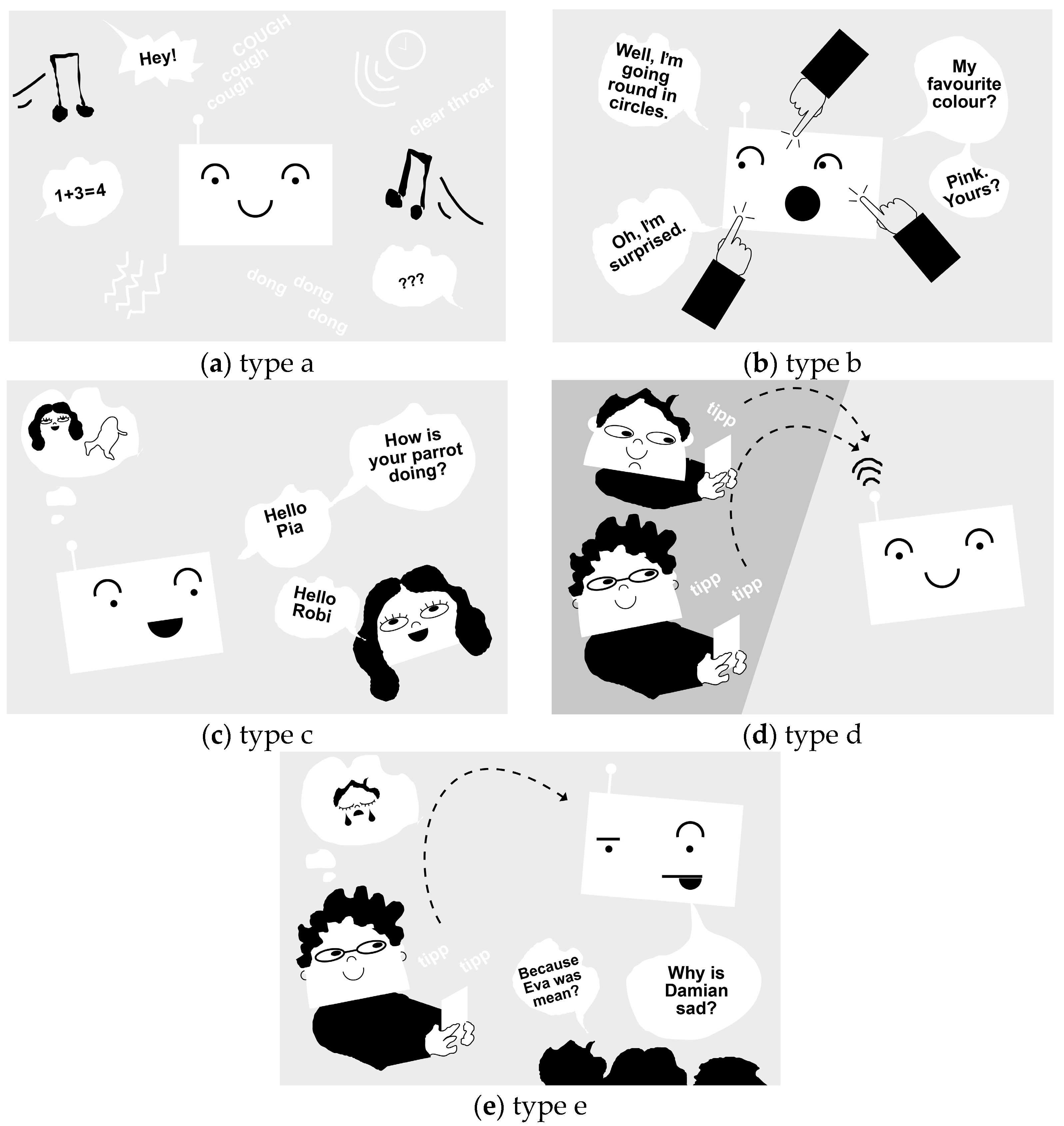
  • In the fifth workshop, the research team applied the Metaplan method (Schnelle, 1982) to identify the added value and weaknesses of the five robot types. For instance, an added value might be the robot’s ability to simulate sensitive topics, whereas a weakness could be that children quickly lose interest in less complex interactions. The five robot types were then categorised according to four criteria: key characteristics, relevant situations, added value, and weaknesses. Short descriptions of the five robot types are provided below, and their corresponding illustrations can be found in Figure 1a–e.
Robot Type a: Demonstration of Generic Social Patterns: Non-interactive robots are pre-programmed to perform a limited set of social interactions, creating an automated theatre of emotions. They are used with a group of students to illustrate patterns of behaviour, which are then discussed with the pupils. This type of robot most closely resembles the studies by Cameron et al. (2018), Beck et al. (2013), and Cohen et al. (2011).
Robot Type b: Experiments with Physical Interaction: Interactive robots reacting to touching, in which they are programmed to perform human reactions to touching, which enables a participative physical theatre. They are used individually and enable role-play among peers, without pupils having to play unpleasant roles (as robots often do). Studies describing this type of robot were conducted, among other things, in work with autistic children or children with visual impairment (Neto et al., 2024; Robins et al., 2010; Robins & Dautenhahn, 2014).
Robot Type c: Safe Partners One-on-one Interactions: interactive robots reacting to spoken language in which they are programmed to perform empathic behaviour (Kory-Westlund & Breazeal, 2019; Ligthart et al., 2019). They memorise interactions with single students and mimic human-to-human interaction (Leite et al., 2017). A one-to-one theatre is set up, and it is used for one-on-one communication, thereby reducing the fear in students to share secrets with real people (Ramnauth et al., 2025).
Robot Type d: Abstraction from Social Hierarchy: Interactive robots that are guided by an invisible pedagogical intervention specialist, functioning like puppets but with greater degrees of freedom (Bettencourt et al., 2025). Some are inspired by Georg Büchner’s play, “Leonce und Lena”, acting in effigy of absent humans. These robots can be used individually or in groups to interact with crowds of pupils, helping to minimise social hierarchies and gain interest in the learning content (Shiomi et al., 2015).
Robot Type e: Demonstration of Concretely Observed Social Patterns: Non-interactive robots that are programmed in a situated manner to mimic actions (Bravo et al., 2021) which have recently occurred in the school setting, creating a stage for reflection. They are used in groups and, in the future, may be guided by AI that extracts behavioural patterns from videos. Through their embodiment of observed actions, robots support the reflection process. To clarify the distinction between robot types a and e, consider the following example: In type a, a robot might enact a generic conflict scenario (e.g., a disagreement between two peers) to illustrate common social patterns such as escalation or misunderstanding. The focus lies on recognising generalisable dynamics. In contrast, type e involves the re-enactment of a specific, previously observed situation within the classroom context. Here, the robot reproduces concrete behavioural patterns that are familiar to the students, enabling situated reflection and discussion of real interactions.
While both types rely on non-interactive demonstration, they differ fundamentally in their level of abstraction—type a operates at a generalised level, whereas type e is context-specific and reflective.
The proposed robot types can also be interpreted through the lens of 4E cognition, linking their design features to established theories of embodied and situated learning. Embodied cognition is most strongly reflected in robot type b, which enables physical interaction and sensorimotor engagement. Embedded cognition is realised through the integration of robots into classroom environments, particularly in group-based scenarios such as types a, d, and e. Enacted cognition emerges in dynamic interaction processes, most prominently in types b, c, and d, where meaning is co-constructed through real-time engagement. Finally, extended cognition is represented by robot types that act as external cognitive and social partners, particularly in types c and e. This mapping illustrates how the typology operationalises 4E cognition not only at a conceptual level, but also in terms of concrete interaction patterns and pedagogical functions. Building on this theoretical foundation, the pedagogical relevance of the robot types can be further specified in terms of competence development.
The three competence domains outlined earlier—socio-emotional, digital/media, and metacognitive competence—are differentially supported by the distinct interactional configurations of each robot type. More specifically, robot types a and e primarily foster reflective and perspective-taking skills by externalising social situations and enabling structured discussion. Robot type b emphasises embodied learning processes and supports the development of boundary awareness and emotion regulation through physical interaction. Robot type c enables the development of socio-emotional competence in a protected one-on-one setting, particularly regarding self-disclosure and trust. Finally, robot type d supports critical engagement with social hierarchies and agency by introducing mediated or externally guided interaction. This mapping illustrates how the typology not only differentiates technological functions, but also structures pedagogical affordances in terms of competence development.

6.3. Implementation

Each robot type, also referred to as a use case, offers a range of opportunities, exercises, and application scenarios for classroom teaching.
The first use case provides the opportunity to utilise the robot to explore social issues. Children’s perception is trained through situations enacted by the robot, while empathy is conveyed through its responses. Pupils can assess emotional situations using scenarios, for example by considering questions such as, “What would you do?” In particular, conflict mediation can be discussed based on multiple proposals presented by the robot.
The second use case facilitates exercises focused on emotion regulation and physical proximity. During haptic interactions, the robot can indicate when it feels hurt. Cultural differences can be illustrated through various programming parameters, such as personal space, norms and rules of touch, greeting rituals, or farewell practices. In particular, boundary violations can be explored through interactions with the robot, in both passive and active roles.
The third use case can be applied in a variety of one-on-one settings, ranging from job interview training to sharing emotions with a trustworthy partner. Whereas in the first use case the robot functions primarily as a coach, here it supports students in sharing personal thoughts or secrets, despite being a machine. Interactions can be further enriched through non-verbal communication, including gestures and body movements.
The fourth use case can be applied in teaching scenarios that encourage pupils to be more active, and even to push the boundaries of classroom rules, while also supporting mediation and conflict resolution. Ethical guardrails and clear guidelines are particularly important in this context. We recommend informing pupils about the experimental setting and having external coaches, rather than classroom teachers, to control the robot.
The fifth use case resembles the first, but with a key distinction: robot interactions are customised so that pupils can recognise the original scene being mimicked. The enactment by robots remains pedagogically and ethically different from showing a video, as robots introduce a level of abstraction. Unlike multimedia deepfakes, robots operate in physical space, which may be crucial in some educational contexts, though not necessarily in all cases.
The key advantage across all five use cases is twofold. First, robots possess a physical presence that surpasses multimedia animations and enables real interaction. Second, they introduce an element of abstraction, as they are machines rather than humans. Additionally, they offer unique pedagogical possibilities. For instance, robots can help overstep the natural boundaries of play, such as enacting peer-to-peer scenarios that would be impossible with real pupils. They also provide a “natural form of extension,” in which cognition emerges not from external tools but from human-like machines themselves. This is particularly evident in the fifth use case, in which pupils can infer concepts from observations in a concrete pedagogical setting.
The five types of social robots need to be understood from the perspective of MindMatters schools. Building on the results of the inspiration and ideation steps, the next phase of the project aims to assess their feasibility and impact from the teachers’ perspective. Teachers will participate in focus groups to examine the developed robot types, critically discuss them, and evaluate their potential to support MindMatters modules. This evaluation will address the practicality of using the robots in classrooms and across the school, their potential to promote social–emotional learning, and the limitations, risks, and ethical considerations involved in shaping relationships with children and the broader learning environment.

6.4. Ethical Risks and Safeguards in Robot-Supported Mental Health Education

The integration of socially interactive robots into school-based mental health promotion raises ethical considerations that must be addressed alongside pedagogical and technological potential. This is particularly important when interventions involve children, emotionally sensitive content, and adaptive AI systems operating in everyday classroom environments. Work in educational robotics and child–robot interaction has repeatedly noted that ethical acceptability depends not only on “what works,” but on how systems are designed, governed, and explained to stakeholders in context (e.g., teachers, parents, students) (Serholt et al., 2017; D. K. Singh et al., 2023; Song et al., 2024).

6.4.1. Data Privacy, Minimisation, and Secondary Use

A central ethical challenge concerns data privacy and data minimisation. Many of the proposed robot types rely on processing speech, affective cues, bodily interaction, or behavioural patterns to enable adaptive and context-sensitive responses—capabilities that are frequently enabled by continuous sensing and/or cloud-connected services. Privacy research in HRI argues that such systems expand the surface for “human data” collection, introduce ambiguities about what is captured and retained, and can make it difficult for users to understand how their data move through socio-technical pipelines (Chatzimichali et al., 2021). In child-facing settings, these issues are heightened because interaction data may contain sensitive emotional disclosures, mental-health-related signals, or peer-conflict details. Reviews focused on child–robot interaction ethics stress that personalisation and memory—often framed as interaction advantages—can also create risks of profiling, unintended inference, and function creep if retention and access boundaries are not strictly defined (Langer et al., 2023; D. K. Singh et al., 2023). Empirical work on robot disclosure strategies further indicates that privacy expectations are context-dependent and that users’ comfort can be shaped by what the robot reveals, when it reveals it, and how intelligible its data practices are—highlighting the need for transparent, age-appropriate disclosure and governance in schools (Dietrich et al., 2023). Safeguards implied by this literature include strict data minimisation, preference for on-device/local processing where feasible, explicit retention limits, privacy-by-design defaults, and institutional policies that prevent secondary use for disciplinary monitoring, performance ranking, or other non-wellbeing purposes (Chatzimichali et al., 2021; Serholt et al., 2017). Relational risks: attachment, anthropomorphism, and emotional dependency.

6.4.2. Psychological and Relational Risks

Social robots may evoke anthropomorphic responses and emotional attachment, which can support engagement and emotional expression but also raise concerns about over-reliance, manipulation, or distress when systems are withdrawn or fail. The broader HRI literature documents both potential benefits and challenges of human–robot attachment, emphasising the importance of anticipating dependency dynamics and designing for appropriate relational boundaries (Law et al., 2022). Ethical analyses focused on children specifically caution against designs that encourage the illusion of reciprocal care or “meaningful relationship” where the system cannot genuinely reciprocate, framing this as a potential form of deception or moral hazard in child–robot contexts (Sharkey, 2011; Sharkey & Sharkey, 2021). Recent syntheses in child–robot interaction similarly argue that socio-emotional deployments require special scrutiny because children may attribute understanding and trust beyond the robot’s capabilities, particularly in one-on-one settings (Langer et al., 2023; Song et al., 2024). Safeguards recommended across this scholarship include: framing robots explicitly as tools rather than confidants; avoiding design choices that imply mind, empathy, or confidentiality beyond reality; ensuring teachers and caregivers remain the primary relational anchors; and planning “end-of-intervention” transitions to prevent abrupt relational rupture (Law et al., 2022; Sharkey & Sharkey, 2021).

6.4.3. Power, Surveillance, and Behavioural Normalisation in Schools

A further ethical dimension concerns power and surveillance dynamics within the classroom. Even when introduced for supportive aims, robots can be perceived as behavioural monitoring devices—especially if they include cameras, microphones, or analytics. Teacher deliberations about classroom robots highlight privacy concerns, role ambiguity, and responsibility questions, as central tensions that shape acceptance and legitimacy in practice (Serholt et al., 2017). Moreover, children may alter behaviour when they feel “watched,” and research indicates that even young children can be sensitive to reputation and observation effects in robot interaction contexts (Okumura et al., 2023). This is particularly salient for your Robot Type e (reflection of observed social patterns) and any future AI-supported behavioural extraction: without strict governance, wellbeing-oriented reflection could drift toward normalising monitoring. Safeguards to avoid this include: clear prohibitions on using robot data for discipline or high-stakes evaluation; minimising always-on sensing; explicit signage and consent procedures; and designing reflective activities so that pedagogical dialogue—not automated judgement—remains the core mechanism (Okumura et al., 2023; Serholt et al., 2017).

6.4.4. Transparency, Responsibility, and Accountability in Hybrid Human–AI Systems

Finally, responsibility and accountability must be clarified. In hybrid systems, agency is distributed across teachers, designers, institutions, and technological artefacts. This becomes especially important for scenarios resembling the Robot Type d (externally guided performative agents) and any adaptive behaviour based on reinforcement or predictive models. HRI ethics research and teacher-focused studies underline that role clarity—who controls the robot, who is accountable for its actions, and how errors are handled—is essential to maintaining trust and preventing harm (Serholt et al., 2017; D. K. Singh et al., 2023). Work on transparency in autonomous systems further supports the explainability and audibility of system behaviour, enabling stakeholders to understand why a robot acted in a certain way and how to contest or correct it (Winfield et al., 2021). Safeguards, therefore, include explicit disclosure of control modes (teleoperated vs. autonomous), teacher override mechanisms, incident logging and review, and age-appropriate explanation of capabilities and limitations—positioning transparency as a measurable design requirement rather than a vague aspiration (Winfield et al., 2021). These considerations underscore that ethical design is not an external constraint on innovation, but instead a constitutive element of responsible educational robotics. A credible pathway for robot-supported mental health promotion must, therefore, integrate privacy-by-design, relational boundary setting, anti-surveillance governance, and transparency/accountability mechanisms from the beginning (Belpaeme et al., 2018; Langer et al., 2023; Serholt et al., 2017; Song et al., 2024).
Building on these considerations, the ethical principles outlined above can be translated into concrete operational guidelines for implementation in educational settings. For example, interaction data involving children should be subject to strict retention limits (e.g., immediate deletion after session completion or storage for a clearly defined short-term period such as 24–72 h, depending on pedagogical purpose). Personalised interaction histories should be minimised or anonymised wherever possible, and systems should prioritise on-device processing to avoid unnecessary data transfer.
In addition, schools should implement clear governance protocols, including informed consent procedures, transparent communication about data use, and explicit restrictions on secondary uses such as behavioural monitoring or performance evaluation. These measures operationalise the principle of privacy-by-design and facilitate the responsible integration of social robots into educational practice.

7. Conclusions

The current educational landscape in Europe is characterised by a convergence of challenges, including rising psychological distress among children and adolescents, persistent shortages of skilled educational and mental health professionals, and the limited capacity of conventional digital tools to address embodied and social dimensions of learning. In this context, this paper has developed a theoretical and design-oriented perspective on the potential role of social robots in school-based mental health promotion. Grounded in the 4E Cognition framework and embedded within the Swiss implementation of the MindMatters programme, the paper conceptualises social robots as embodied, embedded, enacted, and extended pedagogical partners that can complement existing educational practices. The five proposed robot types illustrate how different forms of embodiment, interaction, and abstraction can be aligned with specific pedagogical goals, such as emotional learning, conflict mediation, reflection on social behaviour, and teacher support. Rather than presenting robots as replacements for human educators or therapeutic professionals, the framework positions them as supportive extensions that may help scaffold social–emotional learning and reduce pressure on overburdened school systems—provided that ethical safeguards, transparent design principles, and pedagogical oversight are maintained. At the same time, the conclusions of this work must be interpreted within clear contextual boundaries.
The framework and use cases are explicitly anchored in the Swiss educational context and in the structure, values, and implementation logic of MindMatters. While the underlying principles of embodied cognition and socially interactive learning are theoretically transferable, their practical realisation through social robots is highly sensitive to regional, cultural, and institutional factors. Educational systems beyond Switzerland may differ substantially regarding curricular priorities, norms of physical interaction and emotional disclosure, data protection regulations, and available support infrastructures. Consequently, the proposed robot typology should be understood as a context-sensitive design space rather than a universally applicable model. Moreover, this contribution does not claim to establish long-term effectiveness or sustained impact. Important questions remain unresolved, including the durability of learning and wellbeing effects beyond initial novelty phases, the evolution of children’s emotional relationships with robotic agents over extended periods, and the institutional sustainability of robot-supported interventions in everyday school practice.
Addressing these gaps will require longitudinal, mixed-methods research designs, as well as comparative studies across different national and cultural contexts. In this sense, the primary contribution of the present paper is heuristic and generative. By integrating insights from embodied cognition, educational psychology, social robotics, and school-based mental health promotion, it offers a structured conceptual framework that can guide future empirical research, participatory design processes, and ethical deliberation. Rather than delivering ready-to-scale solutions, the paper aims to clarify design possibilities, theoretical assumptions, and boundary conditions for the responsible exploration of social robots in post-pandemic education.

Author Contributions

Conceptualization, O.C. and F.T.; methodology, O.C.; validation, P.Z., J.S. and R.R.; formal analysis, R.R. and F.T.; investigation, F.T.; data curation, P.Z.; writing—original draft preparation, O.C., R.R. and F.T.; writing—review and editing, P.Z. and J.S.; visualization, J.S.; supervision, F.T. and O.C. All authors have read and agreed to the published version of the manuscript.

Funding

This research received no external funding.

Data Availability Statement

No new data were created or analysed in this study. Data sharing is not applicable to this article.

Conflicts of Interest

The authors declare no conflicts of interest.

References

  1. ACER. (2010). MindMatters evaluation report. Australian Council for Educational Research (ACER). Available online: https://research.acer.edu.au/policy_analysis_misc/19 (accessed on 27 October 2025).
  2. Adams, F., & Aizawa, K. (2010). The bounds of cognition (1st ed.). Wiley. [Google Scholar] [CrossRef] [Scilit]
  3. Alakrash, H. M., & Abdul Razak, N. (2021). Technology-based language learning: Investigation of digital technology and digital literacy. Sustainability, 13(21), 12304. [Google Scholar] [CrossRef] [Scilit]
  4. Alam, A., & Mohanty, A. (2023). Educational technology: Exploring the convergence of technology and pedagogy through mobility, interactivity, AI, and learning tools. Cogent Engineering, 10(2), 2283282. [Google Scholar] [CrossRef] [Scilit]
  5. Alexander, C. (2025). What is 4E cognitive science? Phenomenology and the Cognitive Sciences. [Google Scholar] [CrossRef] [Scilit]
  6. Al-Fraihat, D., Joy, M., Masa’deh, R., & Sinclair, J. (2020). Evaluating E-learning systems success: An empirical study. Computers in Human Behavior, 102, 67–86. [Google Scholar] [CrossRef] [Scilit]
  7. Auro, K., Holopainen, I., Perola, M., Havulinna, A. S., & Raevuori, A. (2024). Attention-deficit/hyperactivity disorder diagnoses in Finland during the COVID-19 pandemic. JAMA Network Open, 7(6), e2418204. [Google Scholar] [CrossRef] [Scilit] [PubMed]
  8. Barsalou, L. W. (2008). Grounded cognition. Annual Review of Psychology, 59(1), 617–645. [Google Scholar] [CrossRef] [Scilit] [PubMed]
  9. Beck, A., Cañamero, L., Hiolle, A., Damiano, L., Cosi, P., Tesser, F., & Sommavilla, G. (2013). Interpretation of emotional body language displayed by a humanoid robot: A case study with children. International Journal of Social Robotics, 5(3), 325–334. [Google Scholar] [CrossRef] [Scilit]
  10. Beelen, T., Velner, E., Ordelman, R., Truong, K. P., Evers, V., & Huibers, T. (2021). Does your robot know? Enhancing children’s information retrieval through spoken conversation with responsible robots (version 1). arXiv, arXiv:2106.07931. [Google Scholar] [CrossRef] [Scilit]
  11. Belpaeme, T., Kennedy, J., Ramachandran, A., Scassellati, B., & Tanaka, F. (2018). Social robots for education: A review. Science Robotics, 3(21), eaat5954. [Google Scholar] [CrossRef] [Scilit] [PubMed]
  12. Berent, I., & Platt, M. (2022). Is phonology embodied? Evidence from mechanical stimulation. Journal of Psycholinguistic Research, 51(3), 597–626. [Google Scholar] [CrossRef] [Scilit] [PubMed]
  13. Bettencourt, C., Grossard, C., Zou, J., Segretain, M., Bree, M., Pellerin, H., Anzalone, S. M., Chetouani, M., & Cohen, D. (2025). Investigating the feasibility of a wizard-of-oz robotic interface (R2C3) in a social skills group for children with autism spectrum disorder. International Journal of Social Robotics, 17(7), 1395–1411. [Google Scholar] [CrossRef] [Scilit]
  14. Bowlby, J. (1991). Attachment and loss. Penguin Books. [Google Scholar]
  15. Bravo, F. A., Hurtado, J. A., & González, E. (2021). Using robots with storytelling and drama activities in science education. Education Sciences, 11(7), 329. [Google Scholar] [CrossRef] [Scilit]
  16. Brown, T. (2008). Design thinking. Harvard Business Review, 86, 84–92, 141. [Google Scholar] [PubMed]
  17. Cameron, D., Millings, A., Fernando, S., Collins, E. C., Moore, R., Sharkey, A., Evers, V., & Prescott, T. (2018). The effects of robot facial emotional expressions and gender on child–robot interaction in a field study. Connection Science, 30(4), 343–361. [Google Scholar] [CrossRef] [Scilit]
  18. Carozza, S., & Leong, V. (2021). The role of affectionate caregiver touch in early neurodevelopment and parent–infant interactional synchrony. Frontiers in Neuroscience, 14, 613378. [Google Scholar] [CrossRef] [Scilit] [PubMed]
  19. Cassidy, J., & Shaver, P. R. (2016). Handbook of attachment, third edition: Theory, research, and clinical applications. Guilford Publications. [Google Scholar]
  20. Chatzimichali, A., Harrison, R., & Chrysostomou, D. (2021). Toward privacy-sensitive human–robot interaction: Privacy terms and human–data interaction in the personal robot era. Paladyn, Journal of Behavioral Robotics, 12(1), 160–174. [Google Scholar] [CrossRef] [Scilit]
  21. Christ, O., Sambasivam, M., Roos, A., & Zahn, C. (2022). Learning in immersive virtual reality: How does the 4E cognition approach fit in virtual didactic settings? In T. Ahram, & R. Taiar (Eds.), Human interaction, emerging technologies and future systems V (Vol. 319, pp. 790–796). Springer International Publishing. [Google Scholar] [CrossRef] [Scilit]
  22. Cieśla, K., Wolak, T., & Amedi, A. (2025). Resting-state functional connectivity changes following audio-tactile speech training. Frontiers in Neuroscience, 19, 1482828. [Google Scholar] [CrossRef] [Scilit] [PubMed]
  23. Cieśla, K., Wolak, T., Lorens, A., Mentzel, M., Skarżyński, H., & Amedi, A. (2022). Effects of training and using an audio-tactile sensory substitution device on speech-in-noise understanding. Scientific Reports, 12(1), 3206. [Google Scholar] [CrossRef] [Scilit] [PubMed]
  24. Clark, A. (1996). Being there: Putting brain, body, and world together again. The MIT Press. [Google Scholar] [CrossRef] [Scilit]
  25. Clark, A., & Chalmers, D. (1998). The extended mind. Analysis, 58(1), 7–19. [Google Scholar] [CrossRef]
  26. Cohen, I., Looije, R., & Neerincx, M. A. (2011, March 6–9). Child’s recognition of emotions in robot’s face and body. 6th International Conference on Human-Robot Interaction, HRI ’11 (pp. 123–124), Lausanne, Switzerland. [Google Scholar] [CrossRef] [Scilit]
  27. Cukurova, M. (2024). The interplay of learning, analytics, and artificial intelligence in education: A vision for hybrid intelligence. arXiv, arXiv:2403.16081. [Google Scholar] [CrossRef] [Scilit]
  28. Del Campo, J. M., Negro, V., & Núñez, M. (2012). The history of technology in education. A comparative study and forecast. Procedia—Social and Behavioral Sciences, 69, 1086–1092. [Google Scholar] [CrossRef] [Scilit]
  29. Deutsche Gesellschaft für Psychologie & Berufsverband Deutscher Psychologinnen und Psychologen. (2023). Förderliche psychosoziale Bedingungen in der Schule: Empfehlungen für eine schulpsychologische und psychologische Perspektive (Föderative Stellungnahme). Available online: https://www.dgps.de/fileadmin/user_upload/PDF/Stellungnahmen/DGPs_BDP_Foederative_Stellungnahme_20231909_01.pdf (accessed on 27 October 2025).
  30. Diamond, A. (2013). Executive functions. Annual Review of Psychology, 64(1), 135–168. [Google Scholar] [CrossRef] [Scilit] [PubMed]
  31. Dickens, L. (2024, October 10). Psychologist shortage is hampering special needs support and intervention. The Guardian. Available online: https://www.theguardian.com/education/2024/oct/10/psychologist-shortage-is-hampering-special-needs-support-and-intervention (accessed on 27 October 2025).
  32. Dietrich, M., Krüger, M., & Weisswange, T. H. (2023). What should a robot disclose about me? A study about privacy-appropriate behaviors for social robots. Frontiers in Robotics and AI, 10, 1236733. [Google Scholar] [CrossRef] [Scilit] [PubMed]
  33. Efthymiou, N., Filntisis, P. P., Koutras, P., Tsiami, A., Hadfield, J., Potamianos, G., & Maragos, P. (2022). ChildBot: Multi-robot perception and interaction with children. Robotics and Autonomous Systems, 150, 103975. [Google Scholar] [CrossRef] [Scilit]
  34. European Commission, Directorate General for Education, Youth, Sport and Culture. (2023). Education and training monitor 2023: Luxembourg. Publications Office. Available online: https://data.europa.eu/doi/10.2766/999951 (accessed on 27 October 2025).
  35. European Commission, Directorate General for Education, Youth, Sport and Culture. (2024). Education and training monitor 2024: Comparative report. Publications Office. Available online: https://data.europa.eu/doi/10.2766/815875 (accessed on 27 October 2025).
  36. European Parliament. (2022). European parliament resolution of 13 September 2022 on the impact of COVID-19 closures of educational, cultural, youth and sports activities on children and young people in the EU. Available online: https://www.europarl.europa.eu/doceo/document/TA-9-2022-0314_EN.html (accessed on 27 October 2025).
  37. Field, T. (2010). Touch for socioemotional and physical well-being: A review. Developmental Review, 30(4), 367–383. [Google Scholar] [CrossRef] [Scilit]
  38. Fielding, C., Streeter, A., Riby, D. M., & Hanley, M. (2025). Neurodivergent pupils’ experiences of school distress and attendance difficulties. Neurodiversity, 3, 27546330251327056. [Google Scholar] [CrossRef] [Scilit]
  39. Figueiredo, A. R., Moniz, P., & Laureano, M. (2024). Touch: A review of the infant-caregiver relationship in the neonatal field. International Journal of Psychiatric Trainees, 3(1), 124910. [Google Scholar] [CrossRef] [Scilit]
  40. Fischer, L., Liegmann, K., Morgenstern, M., & Dadaczynski, K. (2024, September 8–13). Evaluation von “MindMatters” zur förderung der psychischen gesundheit in der grundschule. Ergebnisse der evaluation einer komplexen intervention. In Gesundheit—gemeinsam. Kooperationstagung der deutschen gesellschaft für medizinische informatik, biometrie und epidemiologie (GMDS), deutschen gesellschaft für sozialmedizin und prävention (DGSMP), deutschen gesellschaft für epidemiologie (DGEpi), deutschen gesellschaft für medizinische soziologie (DGMS) und der deutschen gesellschaft für public health (DGPH), Dresden, Germany. German Medical Science GMS Publishing House. [Google Scholar] [CrossRef]
  41. Franken, M. K., Liu, B. C., & Ostry, D. J. (2022). Towards a somatosensory theory of speech perception. Journal of Neurophysiology, 128(6), 1683–1695. [Google Scholar] [CrossRef] [Scilit] [PubMed]
  42. Franze, M., & Paulus, P. (2009). MindMatters—A programme for the promotion of mental health in primary and secondary schools: Results of an evaluation of the German language adaptation. Health Education, 109(4), 369–379. [Google Scholar] [CrossRef] [Scilit]
  43. Gallagher, S. (2005). How the body shapes the mind (1st ed.). Oxford University Press. [Google Scholar] [CrossRef] [Scilit]
  44. Gallagher, S. (2020). Action and interaction. Oxford University Press. Available online: https://www.academia.edu/93199579/Gallagher_S_2020_Action_and_Interaction_Oxford_Oxford_University_Press (accessed on 9 June 2026).
  45. Garbe, A., Ogurlu, U., Logan, N., & Cook, P. (2020). Parents’ experiences with remote education during COVID-19 school closures. American Journal of Qualitative Research, 4(3), 45–65. [Google Scholar] [CrossRef] [Scilit]
  46. Gesundheitsförderung Schweiz. (n.d.). Projekt «MindMatters—Mit psychischer gesundheit schule entwickeln». Projektförderung Kantonale Aktionsprogramme. [Google Scholar]
  47. Glenberg, A. M. (2010). Embodiment as a unifying perspective for psychology. WIREs Cognitive Science, 1(4), 586–596. [Google Scholar] [CrossRef] [Scilit] [PubMed]
  48. Goldin-Meadow, S., Nusbaum, H., Kelly, S. D., & Wagner, S. (2001). Explaining math: Gesturing lightens the load. Psychological Science, 12(6), 516–522. [Google Scholar] [CrossRef] [Scilit] [PubMed]
  49. Hafstad, G. S., Sætren, S. S., Wentzel-Larsen, T., & Augusti, E.-M. (2021). Adolescents’ symptoms of anxiety and depression before and during the COVID-19 outbreak—A prospective population-based study of teenagers in Norway. The Lancet Regional Health—Europe, 5, 100093. [Google Scholar] [CrossRef] [Scilit] [PubMed]
  50. Hennessy, S. (2011). The role of digital artefacts on the interactive whiteboard in supporting classroom dialogue: Dialogue and IWB artefacts. Journal of Computer Assisted Learning, 27(6), 463–489. [Google Scholar] [CrossRef] [Scilit]
  51. Herpertz-Dahlmann, B., Dempfle, A., & Eckardt, S. (2022). The youngest are hit hardest: The influence of the COVID-19 pandemic on the hospitalization rate for children, adolescents, and young adults with anorexia nervosa in a large German representative sample. European Psychiatry, 65(1), e84. [Google Scholar] [CrossRef] [Scilit] [PubMed]
  52. Hertenstein, M. J., & Campos, J. J. (2001). Emotion regulation via maternal touch. Infancy, 2(4), 549–566. [Google Scholar] [CrossRef] [Scilit] [PubMed]
  53. Hossain, M. M., Tasnim, S., Sultana, A., Faizah, F., Mazumder, H., Zou, L., McKyer, E. L. J., Ahmed, H. U., & Ma, P. (2020). Epidemiology of mental health problems in COVID-19: A review. F1000Research, 9, 636. [Google Scholar] [CrossRef] [Scilit] [PubMed]
  54. Huang, X. (2024). The rise of educational robots: A review of classroom applications. Applied and Computational Engineering, 38(1), 57–65. [Google Scholar] [CrossRef] [Scilit]
  55. Hutchins, E. (1995). Cognition in the wild. The MIT Press. [Google Scholar] [CrossRef] [Scilit]
  56. Inan, B., & Güldenoğlu, B. (2024). The use and future of social humanoid robots in special education: A systematic review. International Journal of Sciences: Basic and Applied Research (IJSBAR), 75(1), 45–67. [Google Scholar]
  57. Jimerson, S. R., Stewart, K., Skokut, M., Cardenas, S., & Malone, H. (2009). How many school psychologists are there in each country of the world?: International estimates of school psychologists and school psychologist-to-student ratios. School Psychology International, 30(6), 555–567. [Google Scholar] [CrossRef] [Scilit]
  58. Jones, E. A. K., Mitra, A. K., & Bhuiyan, A. R. (2021). Impact of COVID-19 on mental health in adolescents: A systematic review. International Journal of Environmental Research and Public Health, 18(5), 2470. [Google Scholar] [CrossRef] [Scilit] [PubMed]
  59. Kirsh, D. (2010). Thinking with external representations. AI & Society, 25(4), 441–454. [Google Scholar] [CrossRef] [Scilit]
  60. Kory-Westlund, J. M., & Breazeal, C. (2019). Exploring the effects of a social robot’s speech entrainment and backstory on young children’s emotion, rapport, relationship, and learning. Frontiers in Robotics and AI, 6, 54. [Google Scholar] [CrossRef] [Scilit] [PubMed]
  61. Kuyken, W., Weare, K., Ukoumunne, O. C., Vicary, R., Motton, N., Burnett, R., Cullen, C., Hennelly, S., & Huppert, F. (2013). Effectiveness of the mindfulness in schools programme: Non-randomised controlled feasibility study. British Journal of Psychiatry, 203(2), 126–131. [Google Scholar] [CrossRef] [Scilit] [PubMed]
  62. Lampropoulos, G. (2025). Social robots in education: Current trends and future perspectives. Information, 16(1), 29. [Google Scholar] [CrossRef] [Scilit]
  63. Langer, A., Marshall, P. J., & Levy-Tzedek, S. (2023). Ethical considerations in child-robot interactions. Neuroscience & Biobehavioral Reviews, 151, 105230. [Google Scholar] [CrossRef] [Scilit] [PubMed]
  64. Larsen, L., Helland, M. S., & Holt, T. (2022). The impact of school closure and social isolation on children in vulnerable families during COVID-19: A focus on children’s reactions. European Child & Adolescent Psychiatry, 31(8), 1–11. [Google Scholar] [CrossRef] [Scilit] [PubMed]
  65. Law, T., Chita-Tegmark, M., Rabb, N., & Scheutz, M. (2022). Examining attachment to robots: Benefits, challenges, and alternatives. ACM Transactions on Human-Robot Interaction (THRI), 11(4), 36:1–36:18. [Google Scholar] [CrossRef] [Scilit]
  66. Leite, I., Pereira, A., & Lehman, J. F. (2017). Persistent memory in repeated child-robot conversations. In Proceedings of the 2017 conference on interaction design and children (pp. 238–247). Association for Computing Machinery. [Google Scholar] [CrossRef] [Scilit]
  67. Ligthart, M., Fernhout, T., & Neerincx, M. A. (2019). A child and a robot getting acquainted—Interaction design for eliciting self-disclosure. In Proceedings of the 18th international conference on autonomous agents and multiagent systems (AAMAS ’19), Richland, SC, USA, May 13–19 (pp. 61–70). International Foundation for Autonomous Agents and Multiagent Systems. [Google Scholar] [CrossRef]
  68. Lindgren, R., & Johnson-Glenberg, M. (2013). Emboldened by embodiment: Six precepts for research on embodied learning and mixed reality. Educational Researcher, 42(8), 445–452. [Google Scholar] [CrossRef] [Scilit]
  69. Lindqvist, M. H., & Gidlund, U. (2024). Important aspects of teacher shortage in schools. A literature review. Athens Journal of Education, 12(3), 383–400. [Google Scholar] [CrossRef] [Scilit]
  70. Loades, M. E., Chatburn, E., Higson-Sweeney, N., Reynolds, S., Shafran, R., Brigden, A., Linney, C., McManus, M. N., Borwick, C., & Crawley, E. (2020). Rapid systematic review: The impact of social isolation and loneliness on the mental health of children and adolescents in the context of COVID-19. Journal of the American Academy of Child & Adolescent Psychiatry, 59(11), 1218–1239.e3. [Google Scholar] [CrossRef] [Scilit] [PubMed]
  71. Madigan, S., Racine, N., Vaillancourt, T., Korczak, D. J., Hewitt, J. M. A., Pador, P., Park, J. L., McArthur, B. A., Holy, C., & Neville, R. D. (2023). Changes in depression and anxiety among children and adolescents from before to during the COVID-19 pandemic: A systematic review and meta-analysis. JAMA Pediatrics, 177(6), 567–581. [Google Scholar] [CrossRef] [Scilit] [PubMed]
  72. Manolev, J., Sullivan, A., & Slee, R. (2019). The datafication of discipline: ClassDojo, surveillance and a performative classroom culture. Learning, Media and Technology, 44(1), 36–51. [Google Scholar] [CrossRef] [Scilit]
  73. Masterson, D. R. (2025, April 21). ‘Irish kids deserve better’ say teachers over primary school funding. The Irish Sun. Available online: https://www.thesun.ie/news/15085401/teachers-primary-school-crisis-special-education-children/ (accessed on 27 October 2025).
  74. Mitnik, R., Nussbaum, M., & Recabarren, M. (2009). Developing cognition with collaborative robotic activities. Educational Technology & Society, 12, 317–330. [Google Scholar]
  75. Mumtaz, F., Jehangiri, A. I., Ishaq, W., Ahmad, Z., Alramli, O. I., Ala’anzy, M. A., & Ghoniem, R. M. (2024). Quality of interaction-based predictive model for support of online learning in pandemic situations. Knowledge and Information Systems, 66(3), 1777–1805. [Google Scholar] [CrossRef] [Scilit]
  76. Neto, I., Hu, Y., Correia, F., Rocha, F., Nogueira, J., Buckmayer, K., Hoffman, G., Nicolau, H., & Paiva, A. (2024, March 11–15). ‘I’m not touching you. It’s the robot!’: Inclusion through a touch-based robot among mixed-visual ability children. The 2024 ACM/IEEE International Conference on Human-Robot Interaction (pp. 511–521), Boulder, CO, USA. [Google Scholar] [CrossRef] [Scilit]
  77. Newen, A., De Bruin, L., & Gallagher, S. (Eds.). (2018a). The Oxford handbook of 4E cognition. Oxford University Press. [Google Scholar] [CrossRef] [Scilit]
  78. Newen, A., Gallagher, S., & De Bruin, L. (2018b). E Cognition: Historical roots, key concepts, and central issues. In A. Newen, L. De Bruin, & S. Gallagher (Eds.), The Oxford handbook of 4E Cognition (1st ed., pp. 3–16). Oxford University Press. [Google Scholar] [CrossRef] [Scilit]
  79. Noë, A. (2006). Action in perception (1. MIT Press paperback ed.). MIT Press. [Google Scholar]
  80. Nøkleby, H., Langøien, L. J., Borge, T. C., & Johansen, T. B. (2024). Experiences and consequences of remote schooling during the COVID-19 pandemic for children and youth in the Nordic countries: A scoping review. London Review of Education, 22(1), 39. [Google Scholar] [CrossRef] [Scilit]
  81. OECD. (2025). Bridging gaps in social and emotional skills: The essential contribution of school psychologists (19th ed.). OECD Education Spotlights. OECD Publishing. [Google Scholar] [CrossRef] [Scilit]
  82. Okumura, Y., Hattori, T., Fujita, S., & Kobayashi, T. (2023). A robot is watching me!: Five-year-old children care about their reputation after interaction with a social robot. Child Development, 94(4), 865–873. [Google Scholar] [CrossRef] [Scilit] [PubMed]
  83. O’Regan, J. K., & Noë, A. (2001). A sensorimotor account of vision and visual consciousness. Behavioral and Brain Sciences, 24(5), 939–973. [Google Scholar] [CrossRef] [Scilit] [PubMed]
  84. Ouyang, F., & Xu, W. (2024). The effects of educational robotics in STEM education: A multilevel meta-analysis. International Journal of STEM Education, 11(1), 7. [Google Scholar] [CrossRef] [Scilit]
  85. Patrick, S. W., Henkhaus, L. E., Zickafoose, J. S., Lovell, K., Halvorson, A., Loch, S., Letterie, M., & Davis, M. M. (2020). Well-being of parents and children during the COVID-19 pandemic: A national survey. Pediatrics, 146(4), e2020016824. [Google Scholar] [CrossRef] [Scilit] [PubMed]
  86. Pellegrini, A. D., & Smith, P. K. (1998). Physical activity play: The nature and function of a neglected aspect of playing. Child Development, 69(3), 577–598. [Google Scholar] [CrossRef]
  87. Polanczyk, G. V., Salum, G. A., Sugaya, L. S., Caye, A., & Rohde, L. A. (2015). Annual research review: A meta-analysis of the worldwide prevalence of mental disorders in children and adolescents. Journal of Child Psychology and Psychiatry, 56(3), 345–365. [Google Scholar] [CrossRef] [Scilit] [PubMed]
  88. Pouw, W. T. J. L., Van Gog, T., & Paas, F. (2014). An embedded and embodied cognition review of instructional manipulatives. Educational Psychology Review, 26(1), 51–72. [Google Scholar] [CrossRef] [Scilit]
  89. RADIX Schweizerische Gesundheitsstiftung. (n.d.). Psychische gesundheit: MindMatters. Available online: https://www.radix.ch/de/gesunde-gemeinden/angebote/radix-jubilaeum/buch/1972-2022/die-2000er-jahre/psychische-gesundheit-mindmatters/ (accessed on 16 October 2025).
  90. RADIX Schweizerische Gesundheitsstiftung. (2021a). Mit Stress umgehen—Im Gleichgewicht bleiben—Förderung der Resilienz in der Schule [unveröffentlichtes internes Schulungsdokument]. RADIX Schweizerische Gesundheitsstiftung. [Google Scholar]
  91. RADIX Schweizerische Gesundheitsstiftung. (2021b). Mobbing? Nicht in unserer Schule! Prävention und Handlungsstrategien [unveröffentlichtes internes Schulungsdokument]. RADIX Schweizerische Gesundheitsstiftung. [Google Scholar]
  92. RADIX Schweizerische Gesundheitsstiftung. (2021c). Wie geht’s? Psychische Störungen in der Schule verstehen lernen [unveröffentlichtes internes Schulungsdokument]. RADIX Schweizerische Gesundheitsstiftung. [Google Scholar]
  93. Rajmil, L., Hjern, A., Boran, P., Gunnlaugsson, G., Kraus De Camargo, O., & Raman, S. (2021). Impact of lockdown and school closure on children’s health and well-being during the first wave of COVID-19: A narrative review. BMJ Paediatrics Open, 5(1), e001043. [Google Scholar] [CrossRef] [Scilit] [PubMed]
  94. Ramnauth, R., Brščić, D., & Scassellati, B. (2025, August 25–29). From fidgeting to focused: Developing robot-enhanced social-emotional therapy (reset) for school de-escalation rooms. 2025 34th IEEE International Conference on Robot and Human Interactive Communication (RO-MAN) (pp. 966–973), Eindhoven, The Netherlands. [Google Scholar] [CrossRef] [Scilit]
  95. Ravens-Sieberer, U., Kaman, A., Erhart, M., Devine, J., Schlack, R., & Otto, C. (2022). Impact of the COVID-19 pandemic on quality of life and mental health in children and adolescents in Germany. European Child & Adolescent Psychiatry, 31(6), 879–889. [Google Scholar] [CrossRef] [Scilit] [PubMed]
  96. Robins, B., Amirabdollahian, F., Ji, Z., & Dautenhahn, K. (2010, September 12–15). Tactile interaction with a humanoid robot for children with autism: A case study analysis involving user requirements and results of an initial implementation. 19th International Symposium in Robot and Human Interactive Communication (pp. 704–711), Viareggio, Italy. [Google Scholar] [CrossRef] [Scilit]
  97. Robins, B., & Dautenhahn, K. (2014). Tactile interactions with a humanoid robot: Novel play scenario implementations with children with Autism. International Journal of Social Robotics, 6(3), 397–415. [Google Scholar] [CrossRef] [Scilit]
  98. Rosenberg-Kima, R. B., Koren, Y., & Gordon, G. (2020). Robot-supported collaborative learning (RSCL): Social robots as teaching assistants for higher education small group facilitation. Frontiers in Robotics and AI, 6, 148. [Google Scholar] [CrossRef] [Scilit] [PubMed]
  99. Rowling, L., & Mason, J. (2005). A case study of multimethod evaluation of complex school mental health promotion and prevention: The MindMatters evaluation suite. Australian Journal of Guidance and Counselling, 15(2), 125–136. [Google Scholar] [CrossRef] [Scilit]
  100. Rudenko, I., Rudenko, A., Lilienthal, A. J., Arras, K. O., & Bruno, B. (2024). The child factor in child–robot interaction: Discovering the impact of developmental stage and individual characteristics. International Journal of Social Robotics, 16(8), 1879–1900. [Google Scholar] [CrossRef] [Scilit]
  101. Schnelle, E. (Ed.). (1982). Metaplan gesprächstechnik. Kommunikationswerkzeug für die Gruppenarbeit. Metaplan. [Google Scholar]
  102. Schore, A. N. (2021). The interpersonal neurobiology of intersubjectivity. Frontiers in Psychology, 12, 648616. [Google Scholar] [CrossRef] [Scilit] [PubMed]
  103. Schulz, T., Halbach, T., & Solheim, I. (2020, March 23–26). Using social robots to teach language skills to immigrant children in an oslo city district. The 2020 ACM/IEEE International Conference on Human-Robot Interaction (pp. 442–444), Cambridge, UK. [Google Scholar] [CrossRef] [Scilit]
  104. Senft, B., Liebhauser, A., Tremschnig, I., Ferijanz, E., & Wladika, W. (2022). Effects of the COVID-19 pandemic on children and adolescents from the perspective of teachers. Frontiers in Education, 7, 808015. [Google Scholar] [CrossRef] [Scilit]
  105. Serholt, S., Barendregt, W., Vasalou, A., Alves-Oliveira, P., Jones, A., Petisca, S., & Paiva, A. (2017). The case of classroom robots: Teachers’ deliberations on the ethical tensions. AI & Society, 32(4), 613–631. [Google Scholar] [CrossRef] [Scilit]
  106. Shafan-Azhar, A., & Bottomley, A. (2024). Not in school. Centre for Mental Health. Available online: https://www.centreformentalhealth.org.uk/wp-content/uploads/2024/04/CentreforMH_NotInSchool.pdf (accessed on 27 October 2025).
  107. Sharkey, A. (2011). Children, the elderly, and interactive robots. IEEE Robotics and Automation Magazine, 18(1), 32–38. [Google Scholar] [CrossRef] [Scilit]
  108. Sharkey, A., & Sharkey, N. (2021). We need to talk about deception in social robotics! Ethics and Information Technology, 23(3), 309–316. [Google Scholar] [CrossRef] [Scilit]
  109. Shiomi, M., Kanda, T., Howley, I., Hayashi, K., & Hagita, N. (2015). Can a social robot stimulate science curiosity in classrooms? International Journal of Social Robotics, 7(5), 641–652. [Google Scholar] [CrossRef] [Scilit]
  110. Silva, S. A., Silva, S. U., Ronca, D. B., Gonçalves, V. S. S., Dutra, E. S., & Carvalho, K. M. B. (2020). Common mental disorders prevalence in adolescents: A systematic review and meta-analyses. PLoS ONE, 15(4), e0232007. [Google Scholar] [CrossRef] [Scilit] [PubMed]
  111. Singh, D. K., Kumar, M., Fosch-Villaronga, E., Singh, D., & Shukla, J. (2023). Ethical considerations from child-robot interactions in under-resourced communities. International Journal of Social Robotics, 15(12), 2055–2071. [Google Scholar] [CrossRef] [Scilit] [PubMed]
  112. Singh, S., Roy, D., Sinha, K., Parveen, S., Sharma, G., & Joshi, G. (2020). Impact of COVID-19 and lockdown on mental health of children and adolescents: A narrative review with recommendations. Psychiatry Research, 293, 113429. [Google Scholar] [CrossRef] [Scilit] [PubMed]
  113. Song, H., Barakova, E. I., Ham, J., & Markopoulos, P. (2024). The impact of social robots’ presence and roles on children’s performance in musical instrument practice. British Journal of Educational Technology, 55(3), 1041–1059. [Google Scholar] [CrossRef] [Scilit]
  114. Sungur Gül, K., & Ateş, H. (2023). An examination of the effect of technology-based STEM education training in the framework of technology acceptance model. Education and Information Technologies, 28(7), 8761–8787. [Google Scholar] [CrossRef] [Scilit]
  115. Tanaka, Y., Kanakogi, Y., & Myowa, M. (2021). Social touch in mother–infant interaction affects infants’ subsequent social engagement and object exploration. Humanities and Social Sciences Communications, 8(1), 32. [Google Scholar] [CrossRef] [Scilit]
  116. The HBSC Violence & Injuries Prevention Focus Group, the HBSC Bullying Writing Group, Craig, W., Harel-Fisch, Y., Fogel-Grinvald, H., Dostaler, S., Hetland, J., Simons-Morton, B., Molcho, M., De Mato, M. G., Overpeck, M., Due, P., & Pickett, W. (2009). A cross-national profile of bullying and victimization among adolescents in 40 countries. International Journal of Public Health, 54(S2), 216–224. [Google Scholar] [CrossRef] [Scilit] [PubMed]
  117. Think-pair-share|the derek bok center for teaching and learning. (n.d.). Available online: https://bokcenter.harvard.edu/think-pair-share (accessed on 17 October 2025).
  118. Topping, K. J. (2005). Trends in peer learning. Educational Psychology, 25(6), 631–645. [Google Scholar] [CrossRef] [Scilit]
  119. Tozadore, D. C., & Romero, R. A. F. (2024). Multiuser design of an architecture for social robots in education: Teachers, students, and researchers perspectives. Frontiers in Robotics and AI, 11, 1409671. [Google Scholar] [CrossRef] [Scilit] [PubMed]
  120. Türel, Y. K. (2012). Teachers’ belief and use of interactive whiteboards for teaching and learning. Journal of Educational Technology & Society, 15(1), 381–394. Available online: https://www.academia.edu/67614796/Teachers_Belief_and_Use_of_Interactive_Whiteboards_for_Teaching_and_Learning (accessed on 24 July 2025).
  121. Twenge, J. M., & Campbell, W. K. (2019). Media use is linked to lower psychological well-being: Evidence from three datasets. Psychiatric Quarterly, 90(2), 311–331. [Google Scholar] [CrossRef] [Scilit] [PubMed]
  122. UNESCO. (2025). UNESCO global report on teachers: Spanish edition. UNESCO Publishing. Available online: https://www.unesco.org/en/articles/teacher-shortage-europe-unesco-and-fundacion-sm-launch-spanish-edition-unescos-global-report (accessed on 27 October 2025).
  123. Varela, F. J., Rosch, E., & Thompson, E. (1991). The embodied mind: Cognitive science and human experience. The MIT Press. [Google Scholar] [CrossRef] [Scilit]
  124. Varela, F. J., Thompson, E., & Rosch, E. (2017). The embodied mind: Cognitive science and human experience (2nd ed.). The MIT Press. [Google Scholar] [CrossRef] [Scilit]
  125. Vinceti, M., Filippini, T., Rothman, K. J., Ferrari, F., Goffi, A., Maffeis, G., & Orsini, N. (2020). Lockdown timing and efficacy in controlling COVID-19 using mobile phone tracking. eClinicalMedicine, 25, 100457. [Google Scholar] [CrossRef] [Scilit] [PubMed]
  126. Viner, R. M., Russell, S. J., Croker, H., Packer, J., Ward, J., Stansfield, C., Mytton, O., Bonell, C., & Booy, R. (2020). School closure and management practices during coronavirus outbreaks including COVID-19: A rapid systematic review. The Lancet Child & Adolescent Health, 4(5), 397–404. [Google Scholar] [CrossRef] [Scilit] [PubMed]
  127. Waite, P., Pearcey, S., Shum, A., Raw, J. A. L., Patalay, P., & Creswell, C. (2021). How did the mental health symptoms of children and adolescents change over early lockdown during the COVID-19 pandemic in the UK? JCPP Advances, 1(1), e12009. [Google Scholar] [CrossRef] [Scilit] [PubMed]
  128. Wang, H., Luo, N., Zhou, T., & Yang, S. (2024). Physical robots in education: A systematic review based on the technological pedagogical content knowledge framework. Sustainability, 16(12), 4987. [Google Scholar] [CrossRef] [Scilit]
  129. Wasilewski, T. P. (2018). Sensory integration and its significance for functioning and developing children speech. Pediatria i Medycyna Rodzinna, 14(1), 20–32. [Google Scholar] [CrossRef] [Scilit]
  130. Wilson, M. (2002). Six views of embodied cognition. Psychonomic Bulletin & Review, 9(4), 625–636. [Google Scholar] [CrossRef] [Scilit] [PubMed]
  131. Winfield, A. F. T., Booth, S., Dennis, L. A., Egawa, T., Hastie, H., Jacobs, N., Muttram, R. I., Olszewska, J. I., Rajabiyazdi, F., Theodorou, A., Underwood, M. A., Wortham, R. H., & Watson, E. (2021). IEEE P7001: A proposed standard on transparency. Frontiers in Robotics and AI, 8, 665729. [Google Scholar] [CrossRef] [Scilit] [PubMed]
  132. World Health Organization Regional Office for Europe. (2023). A focus on adolescent mental health and well-being in Europe, central Asia and Canada: Findings from the 2021/2022 Health Behaviour in School-aged Children (HBSC) survey (No. 1). WHO Regional Office for Europe. Available online: https://www.who.int/europe/publications/i/item/9789289060356 (accessed on 27 October 2025).
  133. Wyn, J., Cahill, H., Holdsworth, R., Rowling, L., & Carson, S. (2000). MindMatters, a whole-school approach promoting mental health and wellbeing. Australian & New Zealand Journal of Psychiatry, 34(4), 594–601. [Google Scholar] [CrossRef] [PubMed]
  134. Zawacki-Richter, O., Marín, V. I., Bond, M., & Gouverneur, F. (2019). Systematic review of research on artificial intelligence applications in higher education—Where are the educators? International Journal of Educational Technology in Higher Education, 16(1), 39. [Google Scholar] [CrossRef] [Scilit]
  135. Zenner, C., Herrnleben-Kurz, S., & Walach, H. (2014). Mindfulness-based interventions in schools: A systematic review and meta-analysis. Frontiers in Psychology, 5, 603. [Google Scholar] [CrossRef] [Scilit] [PubMed]
Figure 1. Graphical representation of the five types of digital pedagogical partners (type a to type e, see text) in the form of social robots in the classroom.
Aieduc 02 00028 g001
Disclaimer/Publisher’s Note: The statements, opinions and data contained in all publications are solely those of the individual author(s) and contributor(s) and not of MDPI and/or the editor(s). MDPI and/or the editor(s) disclaim responsibility for any injury to people or property resulting from any ideas, methods, instructions or products referred to in the content.