
Navigating AI in Higher Education: Balancing Efficiency, Equity, and Autonomy in South Africa and Kenya


Abstract
1. Introduction
- How does AI integration in higher education in South Africa and Kenya negotiate the tensions between efficiency, equity, and autonomy?
- In what ways do contextual factors shape the opportunities and risks of AI adoption in these countries?
- How do algorithmic bias, the digital divide, and resource inequities intersect to influence student agency, institutional practices, and policy outcomes?
- What lessons from South Africa and Kenya can inform broader debates on AI in education across the Global South?
2. Theoretical Framework
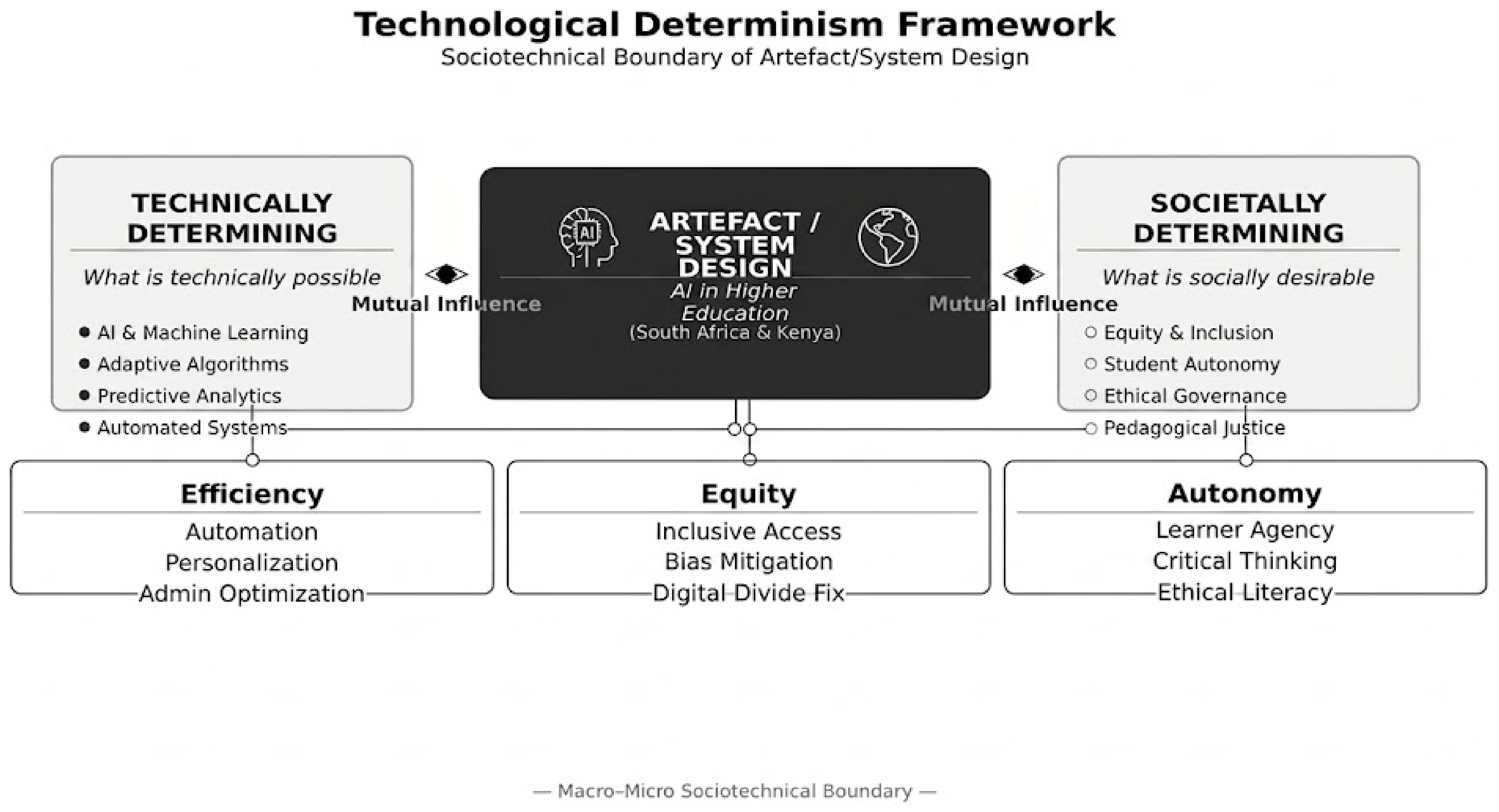
2.1. Technological Determinism and Critical Pedagogy
2.2. Technological Determinism
2.3. Critical Pedagogy
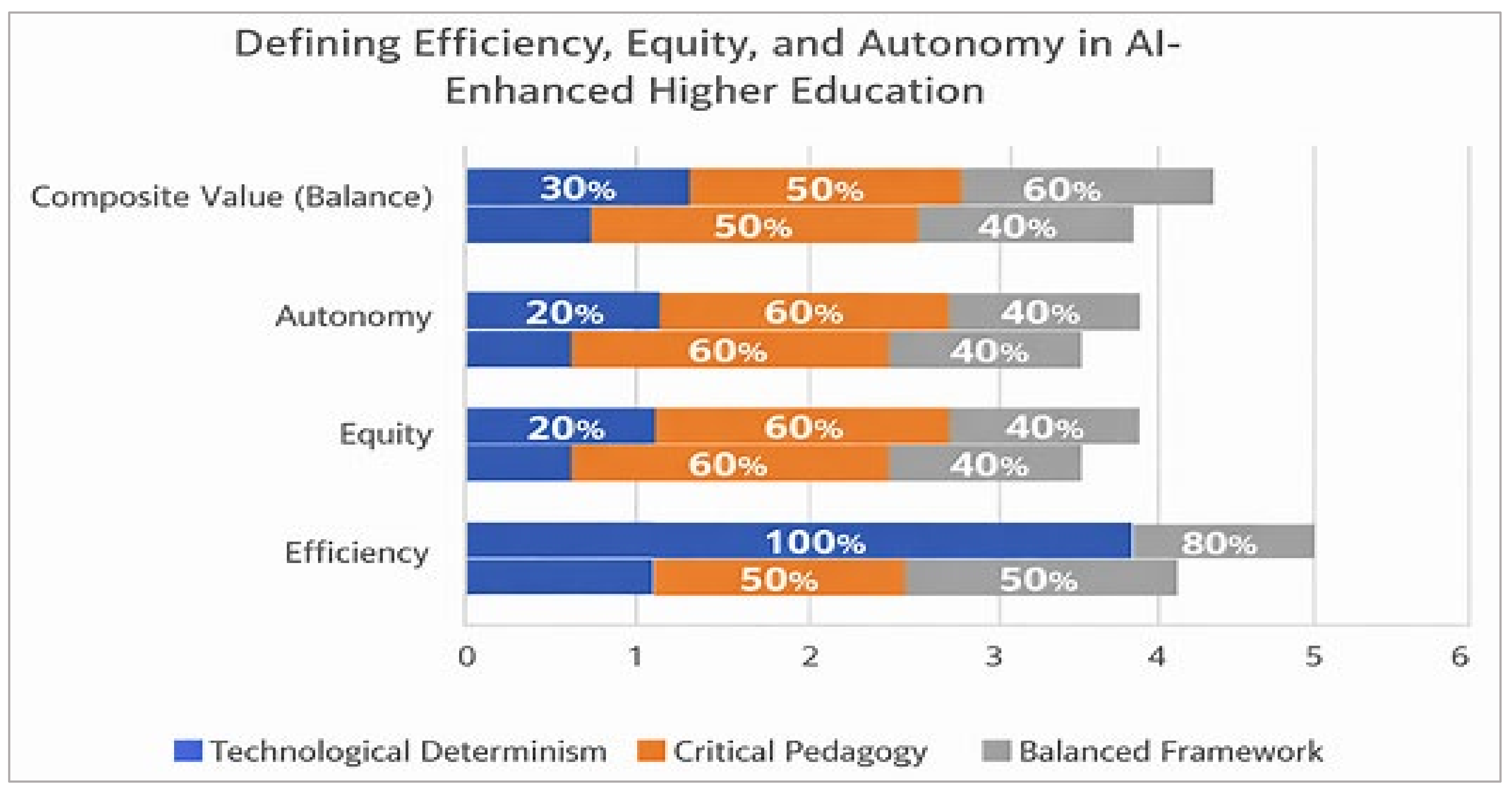
2.4. Defining Efficiency, Equity, and Autonomy in AI-Enhanced Higher Education
3. Literature Review
3.1. Foundations and Evolution of AI in Education
3.2. Regulatory Frameworks for Ethical AI Application in Education
3.3. Efficiency and Optimization in AI-Driven Learning
3.4. Equity, Bias, and Inclusion in Algorithmic Systems
3.5. Student Autonomy in an AI-Augmented Educational Landscape
4. Methodology
5. Findings and Discussion
5.1. Coding Process and Category Development
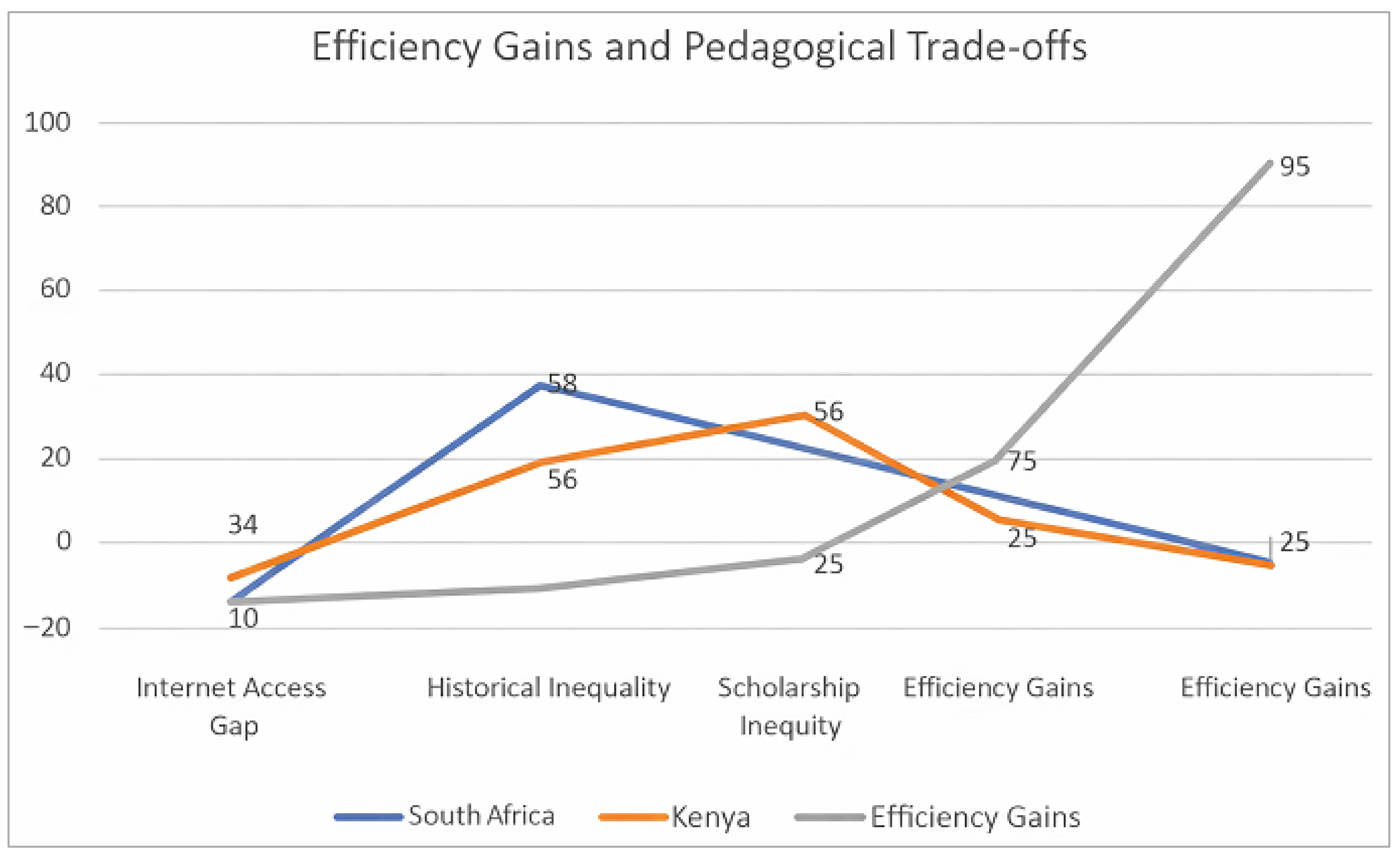
5.2. Efficiency Gains and Pedagogical Trade-Offs
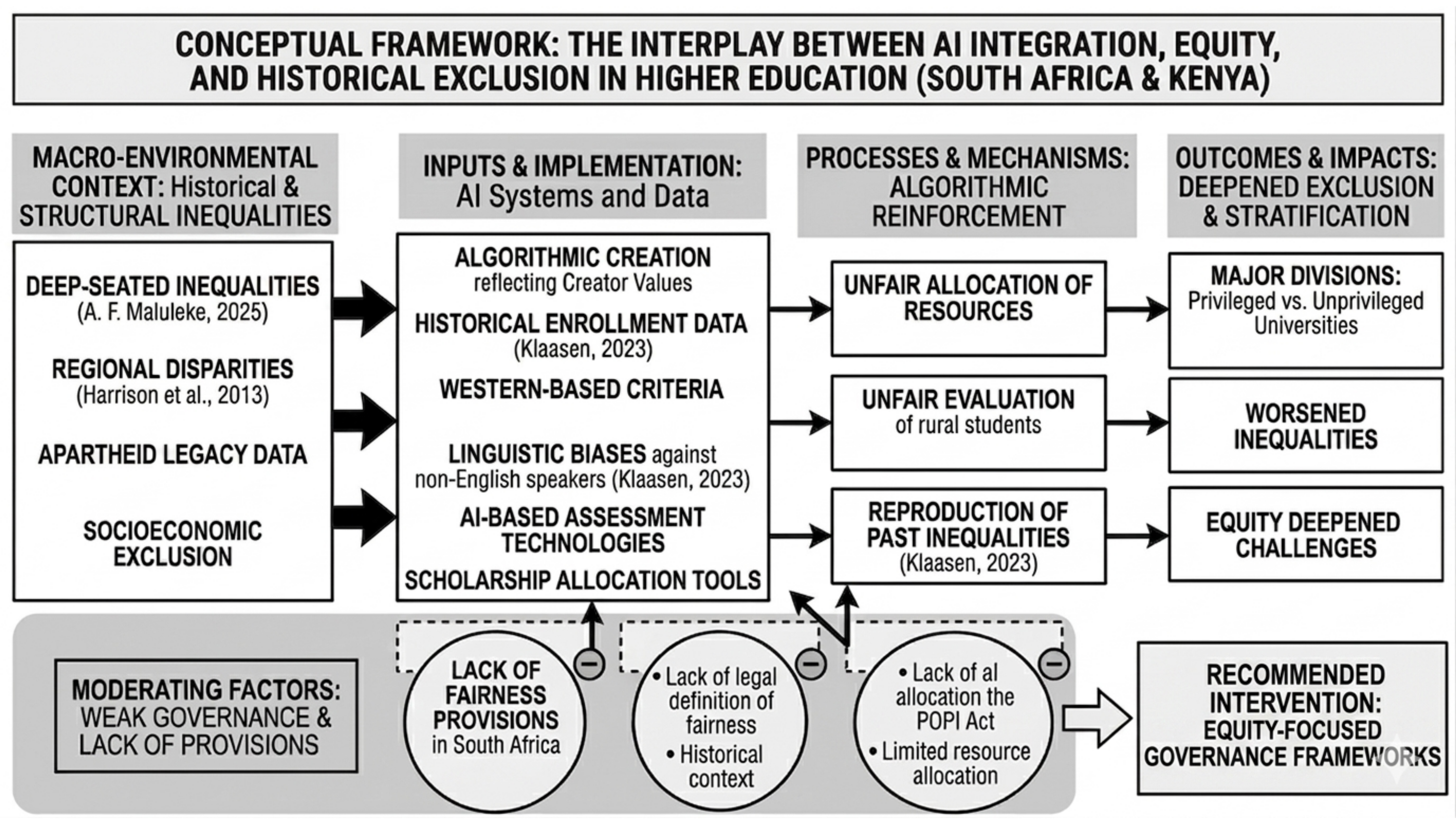
5.3. Algorithmic Bias and Equity Challenges
5.4. Student Autonomy and Human–AI Collaboration
5.5. Case Study Evidence: South Africa and Kenya
5.6. Synthesis of Results, Efficiency, Equity and Autonomy
6. Global Perspectives: AI in Education Across Distinct Contexts
7. Advancing Debates on Efficiency, Equity, and Autonomy
8. Conclusions
Author Contributions
Funding
Data Availability Statement
Conflicts of Interest
References
- Adamakis, M., & Rachiotis, T. (2025). Artificial intelligence in higher education: A state-of-the-art overview of pedagogical integrity, artificial intelligence literacy, and policy integration. Encyclopedia, 5(4), 180. [Google Scholar]
- Adiguzel, T., Kaya, M. H., & Cansu, F. K. (2023). Revolutionizing education with AI: Exploring the transformative potential of ChatGPT. Contemporary Educational Technology, 15(3), ep429. [Google Scholar] [CrossRef] [PubMed]
- Alamri, H., Alshammari, S., & Alzahrani, A. (2020). Using personalized learning as an instructional approach to motivate learners in online higher education: Learner self-determination and intrinsic motivation. Journal of Research on Technology in Education, 52(3), 322–352. [Google Scholar] [CrossRef]
- Alm, A. (2024). Exploring autonomy in the AI wilderness: Learner challenges and choices. Education Sciences, 14(12), 1369. [Google Scholar] [CrossRef]
- Angwaomaodoko, E. A. (2025). The role of artificial intelligence in addressing g lobal education inequality. Traektoriâ Nauki, 11(4), 1001–1006. [Google Scholar] [CrossRef]
- Baker, R. S., & Hawn, A. (2022). Algorithmic bias in education. International Journal of Artificial Intelligence in Education, 32(4), 1052–1092. [Google Scholar] [CrossRef]
- Baker, T., Smith, L., & Anissa, N. (2019). Exploring the future of artificial intelligence in schools and colleges. Available online: https://media.nesta.org.uk/documents/Future_of_AI_and_education_v5_WEB.pdf (accessed on 15 October 2025).
- Bao, L., Huang, D., & Lin, C. (2026). Can artificial intelligence improve gender equality? Evidence from a natural experiment. Management Science, 72(1), 474–494. [Google Scholar] [CrossRef]
- Baraza, W., Mwakijele, J. P., Gitau, G., Kamau, A. Y., Dinga, L., Mpapalika, J., & Gachogu, S. (2022). Resilience in emerging digital economies: Case study of Kenya during COVID-19 pandemic. AFRALTI, Kobe Institute of Computing. [Google Scholar]
- Barnes, E., & Hutson, J. (2024). Navigating the complexities of AI: The critical role of interpretability and explain ability in ensuring transparency and trust. International Journal of Multidisciplinary and Current Educational Research, 6(3), 248–256. [Google Scholar]
- Benjamin, R. (2019). Race after technology: Abolitionist tools for the new Jim code. Polity Press. [Google Scholar]
- Binns, R. (2018). Fairness in machine learning: Lessons from political philosophy. In Conference on fairness, accountability and transparency. PMLR. [Google Scholar]
- Binns, R. (2022). Human judgment in algorithmic loops: Individual justice and automated decision-making. Regulation & Governance, 16(1), 197–211. [Google Scholar]
- Binns, R. (2024). If the difference principle won’t make a real difference in algorithmic fairness, what will? Philosophy & Technology, 37(4), 119. [Google Scholar] [CrossRef]
- Bird, K. A., Castleman, B. L., & Song, Y. (2025). Are algorithms biased in education? Exploring racial bias in predicting community college student success. Journal of Policy Analysis and Management, 44(2), 379–402. [Google Scholar]
- Blake, J., Smeyers, P., Smith, R., & Standish, P. (Eds.). (2003). The Blackwell guide to the philosophy of education. Blackwell. [Google Scholar]
- Boateng, O., & Boateng, B. (2025). Algorithmic bias in educational systems: Examining the impact of AI-driven decision making in modern education. World Journal of Advanced Research and Reviews, 25(1), 2012–2017. [Google Scholar] [CrossRef]
- Boden, M. A. (2018). Artificial intelligence: A very short introduction. Oxford University Press. [Google Scholar]
- Bowen, G. A. (2009). Document analysis as a qualitative research method. Qualitative Research Journal, 9(2), 27–40. [Google Scholar] [CrossRef]
- Bozkurt, A., & Xiao, J. (2023). Speculative futures on ChatGPT and generative artificial intelligence (AI): A collective reflection from the educational landscape. Asian Journal of Distance Education, 18(1), 53–130. [Google Scholar]
- Carvalho, A. E., Cosme, A., & Veiga, A. (2023). Inclusive education systems: The struggle for equity and the promotion of autonomy in Portugal. Education Sciences, 13(9), 875. [Google Scholar] [CrossRef]
- Cavanagh, R. F., Reynolds, P. S., & Roman, T. (2020). Artificial intelligence in education: Implications for multilingual and heterogeneous societies. Journal of Educational Technology, 19(3), 173–179. [Google Scholar]
- Celik, I., Dindar, M., Muukkonen, H., & Järvelä, S. (2022). The promises and challenges of artificial intelligence for teachers: A systematic review of research. TechTrends, 66, 616–630. [Google Scholar] [CrossRef]
- Chai, F., Ma, J., Wang, Y., Zhu, J., & Han, T. (2024). Grading by AI makes me feel fairer? How different evaluators affect college students’ perception of fairness. Frontiers in Psychology, 15, 1221177. [Google Scholar] [CrossRef] [PubMed]
- Chan, C. K. Y. (2023). A comprehensive AI policy education framework for university teaching and learning. International Journal of Educational Technology in Higher Education, 20(1), 38. [Google Scholar] [CrossRef]
- Chan, C. K. Y., & Hu, W. (2023). Students’ voices on generative AI: Perceptions, benefits, and challenges in higher education. International Journal of Educational Technology in Higher Education, 20(1), 43. [Google Scholar] [CrossRef]
- Chang, Q., Pan, X., Manikandan, N., & Ramesh, S. (2022). Artificial intelligence technologies for teaching and learning in higher education. International Journal of Reliability, Quality and Safety Engineering, 29(5), 2240006. [Google Scholar] [CrossRef]
- Chen, H. L., Widarso, G. V., & Sutrisno, H. (2020). A ChatBot for learning Chinese: Learning achievement and technology acceptance. Journal of Educational Computing Research, 58(6), 1161–1189. [Google Scholar] [CrossRef]
- Chen, X., Liu, C., & Li, S. (2018). Machine learning and deep learning methods for cybersecurity. IEEE Access, 6, 35365–35381. [Google Scholar] [CrossRef]
- Chick, J. C. (2025). AI-enhanced computational thinking: A comprehensive review of ethical frameworks and pedagogical integration for equitable higher education. Education Sciences, 15(11), 1515. [Google Scholar] [CrossRef]
- Chilunjika, A., Uwizeyimana, D. E., & Nyathi, W. G. (2025). Statutory, regulatory and policy frameworks governing the use of artificial intelligence (AI) in public policy making in the South African context. International Journal of Business Ecosystem & Strategy, 7(5), 553–563. [Google Scholar] [CrossRef]
- Chinta, S. V., Wang, Z., Yin, Z., Hoang, N., Gonzalez, M., Le Quy, T., & Zhang, W. (2024). FairAIED: Navigating fairness, bias, and ethics in educational AI applications. arXiv, arXiv:2407.18745. [Google Scholar] [CrossRef]
- Chiu, T. K. F., Xia, Q., Zhou, X., Chai, C. S., & Cheng, M. (2023). Systematic literature review on opportunities, challenges, and future research recommendations of artificial intelligence in education. Computers and Education: Artificial Intelligence, 4, 100118. [Google Scholar] [CrossRef]
- Conati, C., Heffernan, N., Mitrovic, A., & Verdejo, M. F. (Eds.). (2015). Artificial intelligence in education: 17th international conference, AIED 2015, Madrid, Spain, June 22–26, 2015. Proceedings. Springer. [Google Scholar]
- Cotilla Conceição, J. M., & van der Stappen, E. (2025). The impact of AI on inclusivity in higher education: A rapid review. Education Sciences, 15, 1255. [Google Scholar] [CrossRef]
- Creswell, J. W. (2014). Research design: Qualitative, quantitative and mixed methods approaches (4th ed.). Sage. [Google Scholar]
- Cullen, S., & Oppenheimer, D. (2024). Choosing to learn: The importance of student autonomy in higher education. Science Advances, 10(29), eado6759. [Google Scholar] [CrossRef] [PubMed]
- Czerniewicz, L., Agherdien, N., Badenhorst, J., Belluigi, D., Chambers, T., Chili, M., de Villiers, M., Felix, A., Gachago, D., Gokhale, C., Ivala, E., Kramm, N., Madiba, M., Mistri, G., Mgqwashu, E., Mnguni, L., Ndebele, C., Ng’ambi, D., Oliphant, T., … Wissing, G. (2020). A wake-up call: Equity, inequality and COVID-19 emergency remote teaching and learning. Postdigital Science and Education, 2(3), 946–967. [Google Scholar] [CrossRef] [PubMed]
- Darvishi, A., Khosravi, H., Sadiq, S., Gašević, D., & Siemens, G. (2024). Impact of AI assistance on student agency. Computers & Education, 210, 104967. [Google Scholar] [CrossRef]
- DataReportal. (2024). Number of people using the internet in Kenya: Access to the internet by county. Available online: https://statskenya.co.ke/public/at-stats-kenya/about/number-of-people-using-the-internet-in-kenya-access-to-the-internet-by-county/84/?utm_source=copilot.com (accessed on 10 November 2025).
- Dlamini, R., Simuja, C., Feldman, J., & van Wyk, M. (2025). AI in education: Challenges, opportunities, and possibilities. Journal of Education (University of KwaZulu-Natal), (98), 1–4. [Google Scholar]
- Duong, C. D., Vu, T. N., & Ngo, T. V. N. (2023). Applying a modified technology acceptance model to explain higher education students’ usage of ChatGPT. International Journal of Management in Education, 21, 100883. [Google Scholar] [CrossRef]
- Dwivedi, Y. K., Hughes, D. L., Coombs, C., Constantiou, I., Duan, Y., Edwards, J. S., Gupta, B., Lal, B., Misra, S., Prashant, P., & Raman, R. (2020). Impact of COVID-19 pandemic on information management research and practice: Transforming education, work and life. International Journal of Information Management, 55, 102211. [Google Scholar] [CrossRef]
- EIT Digital. (2024, February 18). EMAI4EU: A new frontier in Emotion AI education across Europe. EIT Digital. Available online: https://28digital.eu/newsroom/news/2024/emai4eu-a-new-frontier-in-emotion-ai-education-across-europe/ (accessed on 18 March 2026).
- Ertmer, P. A. (1999). Addressing first- and second-order barriers to change: Strategies for technology integration. Educational Technology Research and Development, 47(4), 47–61. [Google Scholar] [CrossRef]
- European Commission. (2021). AI4T—Artificial intelligence for and by teachers. Available online: https://www.france-education-international.fr/en/expertises/cooperation-education/projets/ai4t-artificial-intelligence-and-teachers?langue=en (accessed on 4 September 2025).
- European Commission. (2023). Artificial intelligence policy and strategy. European Commission. [Google Scholar]
- Eynon, R. (2015). The quantified self for learning: Critical questions for education. Learning, Media and Technology, 40(4), 407–411. [Google Scholar] [CrossRef][Green Version]
- Fazelpour, S., & Danks, D. (2021). Algorithmic bias: Senses, sources, solutions. Philosophy Compass, 16(8), e12760. [Google Scholar] [CrossRef]
- Ferrero, F., & Barujel, A. G. (2019). Algorithmic driven decision-making systems in education: Analyzing bias from the sociocultural perspective. In 2019 XIV Latin American conference on learning technologies (LACLO) (pp. 166–173). IEEE. [Google Scholar] [CrossRef]
- Finley, T. (2023, March 13). 6 ways to use ChatGPT to save time. Edutopia. Available online: https://www.edutopia.org/article/6-ways-chatgpt-save-teachers-time?utm_content=linkposarchive&utm_source=edu-newsletter&utm_medium=email&utm_campaign=weekly-2023-09-27 (accessed on 13 November 2025).
- Freire, P. (1970). Pedagogy of the oppressed. Herder and Herder. [Google Scholar]
- Gardner, J., Brooks, C., & Baker, R. (2019). Evaluating the fairness of predictive student models through slicing analysis. In Proceedings of the 9th international conference on learning analytics & knowledge (pp. 225–234). Association for Computing Machinery. [Google Scholar]
- Garzón, J., Patiño, E., & Marulanda, C. (2025). Systematic review of artificial intelligence in education: Trends, benefits, and challenges. Multimodal Technologies and Interaction, 9(8), 84. [Google Scholar] [CrossRef]
- Gaskins, N. (2022). Interrogating algorithmic bias: From speculative fiction to liberatory design. TechTrends, 67, 417–425. [Google Scholar] [CrossRef] [PubMed]
- Georgieva, M., Webb, J., Stuart, J., Bell, J., Crawford, S., & Ritter-Guth, B. (2025, June 24). AI ethical guidelines. EDUCAUSE Library. Available online: https://library.educause.edu/resources/2025/6/ai-ethical-guidelines (accessed on 4 September 2025).
- Han, Y., Qiu, Z., Cheng, J., & LC, R. (2024). When teams embrace AI: Human collaboration strategies in generative prompting in a creative design task. In Proceedings of the CHI conference on human factors in computing systems (pp. 1–14). ACM. [Google Scholar]
- Harrison, M., Uusipaikka, M., Karinen, A., Räsänen, T., Raitala, D., Ellonen, R., Huumonen, H., & Tuomela, O. (2013). Bridging passion and profession: Supporting agency and investment in multilingual university writers. Language Learning in Higher Education, 3(1), 1–25. [Google Scholar] [CrossRef]
- Hauer, T. (2017). Education, technological determinism and new media. In INTED2017 proceedings (pp. 10026–10030). IATED. [Google Scholar] [CrossRef]
- Hinojo-Lucena, F. J., Aznar-Díaz, I., Cáceres-Reche, M. P., & Romero-Rodríguez, J. M. (2019). Artificial intelligence in higher education: A bibliometric study on its impact in the scientific literature. Education Sciences, 9(1), 51. [Google Scholar] [CrossRef]
- Holmes, W., Porayska-Pomsta, K., Holstein, K., Sutherland, E., Baker, T., Shum, S. B., Santos, O. C., Rodrigo, M. T., Cukurova, M., Bittencourt, I. I., & Koedinger, K. R. (2022). Ethics of AI in education: Towards a community-wide framework. International Journal of Artificial Intelligence in Education, 32(3), 504–526. [Google Scholar] [CrossRef]
- Holstein, K., & Doroudi, S. (2021). Equity and artificial intelligence in education: Will “AIEd” amplify or alleviate inequities in education? arXiv, arXiv:2104.12920. [Google Scholar] [CrossRef]
- Holstein, K., & Doroudi, S. (2022). Equity and artificial intelligence in education. In The ethics of artificial intelligence in education (pp. 151–173). Routledge. [Google Scholar]
- Idowu, J. A. (2024). Debiasing education algorithms. International Journal of Artificial Intelligence in Education, 34(4), 1510–1540. [Google Scholar] [CrossRef]
- Ifenthaler, D. (2017). Are higher education institutions prepared for learning analytics? TechTrends, 61(4), 366–371. [Google Scholar]
- Imran, M., & Almusharraf, N. (2023). Analyzing the role of ChatGPT as a writing assistant at higher education level: A systematic review of the literature. Contemporary Educational Technology, 15, ep464. [Google Scholar] [CrossRef]
- Jeong, H. Y., Choi, C. R., & Song, Y. J. (2012). Personalized learning course planner with e-learning DSS using user profile. Expert Systems with Applications, 39(3), 2567–2577. [Google Scholar] [CrossRef]
- Kaas, M. H. (2024). The perfect technological storm: Artificial intelligence and moral complacency. Ethics and Information Technology, 26(3), 49. [Google Scholar] [CrossRef]
- Kajiwara, Y., Matsuoka, A., & Shinbo, F. (2023). Machine learning role playing game: Instructional design of AI education for age-appropriate in K-12 and beyond. Computers and Education: Artificial Intelligence, 5, 100162. [Google Scholar] [CrossRef]
- Kamalov, F., Santandreu Calonge, D., & Gurrib, I. (2023). New era of artificial intelligence in education: Towards a sustainable multifaceted revolution. Sustainability, 15(16), 12451. [Google Scholar] [CrossRef]
- Karumbaiah, S., & Brooks, J. (2021). How colonial continuities underlie algorithmic injustices in education. In Conference on research in equitable and sustained participation in engineering, computing, and technology (RESPECT) (pp. 1–6). IEEE. [Google Scholar]
- Kenya National Bureau of Statistics. (2024). Economic survey 2024. KNBS.
- Khosravi, H., Shum, S. B., Chen, G., Conati, C., Tsai, Y. S., Kay, J., Knight, S., Martinez-Maldonado, R., Sadiq, S., & Gašević, D. (2022). Explainable artificial intelligence in education. Computers and Education: Artificial Intelligence, 3, 100074. [Google Scholar] [CrossRef]
- Kincheloe, J. L., McLaren, P., & Steinberg, S. R. (2011). Critical pedagogy and qualitative research. In N. K. Denzin, & Y. S. Lincoln (Eds.), The SAGE handbook of qualitative research (4th ed., pp. 163–177). SAGE. [Google Scholar]
- Kizilcec, R. F., & Lee, H. (2022). Algorithmic fairness in education. In The ethics of artificial intelligence in education (pp. 174–202). Routledge. [Google Scholar]
- Klaasen, S. (2023). Algorithmic bias and language exclusion in South African higher education: A critical review. South African Journal of Higher Education, 37(6), 112–130. [Google Scholar]
- Knox, J. (2020). Artificial intelligence and education in China. Learning, Media and Technology, 45(3), 298–311. [Google Scholar] [CrossRef]
- Kohnke, S., & Zaugg, T. (2025). Artificial intelligence: An untapped opportunity for equity and access in STEM education. Education Sciences, 15(1), 68. [Google Scholar] [CrossRef]
- Kucirkova, N., & Leaton Gray, S. (2023). Beyond personalization: Embracing democratic learning within AI systems. Educational Theory, 73(4), 469–489. [Google Scholar] [CrossRef]
- Kulik, J. A., & Fletcher, J. D. (2016). Effectiveness of intelligent tutoring systems: A meta-analysis. Journal of Educational Psychology, 108(6), 798–812. [Google Scholar]
- Kunschak, C. (2021). Translingual transcultural competence: Student agency, teacher guidance, and program support. Language Learning in Higher Education, 11(2), 343–358. [Google Scholar] [CrossRef]
- Kurilovas, E. (2019). Advanced machine learning approaches to personalise learning: Learning analytics and decision making. Behaviour & Information Technology, 38(4), 410–421. [Google Scholar]
- Lin, Y., Luo, Q., & Qian, Y. (2023). Investigation of artificial intelligence algorithms in education. Applied and Computational Engineering, 16(1), 180–184. [Google Scholar] [CrossRef]
- Luckin, R. (2018). Machine learning and human intelligence: The future of education for the 21st century. UCL IOE Press. [Google Scholar]
- Luckin, R., & Holmes, W. (2016). Intelligence unleashed: An argument for AI in education. UCL Knowledge Lab. [Google Scholar]
- Maluleke, A. F. (2025). AI adoption in African higher education: A systematic review of benefits and ethical implications. Interdisciplinary Journal of Education Research, 7(2), a05. [Google Scholar] [CrossRef]
- Marín, Y. R., Caro, O. C., Rubio, Y. M., Tuesta, J. N. A., Bardales, E. S., Rituay, A. M. C., & Santos, R. C. (2025). Artificial intelligence as a teaching tool in university education. Frontiers in Education, 10, 1578451. [Google Scholar] [CrossRef]
- Mateko, F. M., Dowelani, M., & Sinamano, R. (2025). Digital inequality and transformation in South African higher education during COVID-19: A comparative analysis of historically disadvantaged and historically advantaged universities. Higher Education Policy. Advance online publication. [Google Scholar] [CrossRef]
- Mayfield, E., Madaio, M., Prabhumoye, S., Gerritsen, D., McLaughlin, B., Dixon-Román, E., & Black, A. W. (2019). Equity beyond bias in language technologies for education. In Proceedings of the fourteenth workshop on innovative use of NLP for building educational applications (pp. 444–460). Association for Computational Linguistics. [Google Scholar] [CrossRef]
- McLaren, B. M., Richey, J. E., Nguyen, H. A., & Mogessie, M. (2022). Focused self-explanations lead to the best learning outcomes in a digital learning game. In Proceedings of the 16th International conference on learning science (ICLS 2022). NSF Public Access Repository(PAR). [Google Scholar]
- McLuhan, M. (1964). Understanding media: The extensions of man. McGraw Hill. [Google Scholar]
- Mehrabi, N., Morstatter, F., Saxena, N., Lerman, K., & Galstyan, A. (2019). A survey on bias and fairness in machine learning. arXiv, arXiv:1908.09635. [Google Scholar] [CrossRef]
- Mhlanga, D., Denhere, V., & Moloi, T. (2022). COVID-19 and the key digital transformation lessons for higher education institutions in South Africa. Education Sciences, 12(7), 464. [Google Scholar] [CrossRef]
- Mhlanga, D., & Moloi, T. (2020). COVID-19 and the digital transformation of education: What are we learning on 4IR in South Africa? Education Sciences, 10(7), 180. [Google Scholar] [CrossRef]
- Mirjalili, S., & Lewis, A. (2016). The whale optimization algorithm. Advances in Engineering Software, 95, 51–67. [Google Scholar] [CrossRef]
- Mirjalili, S., Mirjalili, S. M., & Lewis, A. (2014). Binary bat algorithm. Neural Computing and Applications, 25, 663–681. [Google Scholar]
- Mitchell, S., Potash, E., Barocas, S., D’Amour, A., & Lum, K. (2021). Algorithmic fairness: Choices, assumptions, and definitions. Annual Review of Statistics and Its Application, 8, 141–163. [Google Scholar] [CrossRef]
- Mogoale, P. D., Pretorius, A., Mogase, R. C., & Segooa, M. A. (2025). Integrating artificial intelligence within South African higher learning institutions. South African Journal of Information Management, 27(1), a1939. [Google Scholar]
- Mousavinasab, E., Zarifsanaiey, N., R. Niakan Kalhori, S., Rakhshan, M., Keikha, L., & Ghazi Saeedi, M. (2021). Intelligent tutoring systems: A systematic review of characteristics, applications, and evaluation methods. Interactive Learning Environments, 29, 142–163. [Google Scholar]
- Murtaza, M., Ahmed, Y., Shamsi, J. A., Sherwani, F., & Usman, M. (2022). AI-based personalized e-learning systems: Issues, challenges, and solutions. IEEE Access, 10, 81323–81342. [Google Scholar] [CrossRef]
- Ng, D. T. K., Leung, J. K. L., Su, J., Ng, R. C. W., & Chu, S. K. W. (2023). Teachers’ AI digital competencies and twenty-first century skills in the post-pandemic world. Educational Technology Research and Development, 71(1), 137–161. [Google Scholar] [PubMed]
- Niu, W., Zhang, W., Zhang, C., & Chen, X. (2024). The role of artificial intelligence autonomy in higher education: A uses and gratification perspective. Sustainability, 16(3), 1276. [Google Scholar] [CrossRef]
- Noble, S. U. (2018). Algorithms of oppression: How search engines reinforce racism. New York University Press. [Google Scholar]
- Ntoutsi, E., Fafalios, P., Gadiraju, U., Iosifidis, V., Nejdl, W., Vidal, M. E., Ruggieri, S., Turini, F., Papadopoulos, S., Krasanakis, E., & Kompatsiaris, I. (2020). Bias in data-driven artificial intelligence systems—An introductory survey. Wiley Interdisciplinary Reviews: Data Mining and Knowledge Discovery, 10(3), e1356. [Google Scholar] [CrossRef]
- Ntsobi, M., Mwale, B. J., Ntsobi, K., Ntsobi, M., Mwale, B. J., & Ntsobi, K. (2025). Ethical artificial intelligence in education: A Southern African framework decoding algorithmic through governance lens. American Journal of Science Education Research, 4, 100252. [Google Scholar]
- Nwana, H. S. (1990). Intelligent tutoring systems: An overview. Artificial Intelligence Review, 4(4), 251–277. [Google Scholar] [CrossRef]
- Ocumpaugh, J., Baker, R. S., Gowda, S., Heffernan, N., & Heffernan, C. (2014). Population validity for educational data mining models: A case study in affect detection. British Journal of Educational Technology, 45(3), 487–501. [Google Scholar] [CrossRef]
- OECD. (2021). OECD digital education outlook 2021: Pushing the frontiers with artificial intelligence, blockchain and robots. OECD Publishing. [Google Scholar] [CrossRef]
- OECD. (2024). Trustworthy artificial intelligence in education. OECD Publishing. Available online: https://www.oecd.org/en/publications/trustworthy-artificial-intelligence-ai-in-education_a6c90fa9-en.html (accessed on 4 September 2025).
- Okur, E., Aslan, S., Alyuz, N., Arslan Esme, A., & Baker, R. S. (2018). Role of socio-cultural differences in labeling students’ affective states. In C. Penstein Rosé, R. Martínez-Maldonado, H. Ulrich Hoppe, R. Luckin, M. Mavrikis, K. Porayska-Pomsta, B. McLaren, & B. du Boulay (Eds.), Proceedings of the 19th international conference on artificial intelligence in education (AIED 2018) (pp. 367–380). Springer. [Google Scholar] [CrossRef]
- Oliveira, W., Hamari, J., Shi, L., Toda, A. M., Rodrigues, L., Palomino, P. T., & Isotani, S. (2023). Tailored gamification in education: A literature review and future agenda. Education and Information Technologies, 28(1), 373–406. [Google Scholar]
- Olteanu, A., Castillo, C., Diaz, F., & Kıcıman, E. (2019). Social data: Biases, methodological pitfalls, and ethical boundaries. Frontiers in Big Data, 2, 13. [Google Scholar] [CrossRef] [PubMed]
- Onyango, G. (2025). Artificial intelligence (AI) for public policy and governance in Africa. In Designing artificial intelligence for public policy and governance in Africa (pp. 1–17). Springer Nature Switzerland. [Google Scholar]
- O’Sullivan, S., Nevejans, N., Allen, C., Blyth, A., Leonard, S., Pagallo, U., Holzinger, K., Holzinger, A., Sajid, M. I., & Ashrafian, H. (2019). Legal, regulatory, and ethical frameworks for development of standards in artificial intelligence (AI) and autonomous robotic surgery. The International Journal of Medical Robotics and Computer Assisted Surgery, 15(1), e1968. [Google Scholar] [CrossRef] [PubMed]
- Oyetade, K., & Zuva, T. (2025). Advancing equitable education with inclusive AI to mitigate bias and enhance teacher literacy. Educational Process: International Journal, 14, e2025087. [Google Scholar]
- Paquette, L., Ocumpaugh, J., Li, Z., Andres, A., & Baker, R. S. (2020). Who’s learning? Using demographics in EDM research. Journal of Educational Data Mining, 12(3), 1–30. [Google Scholar] [CrossRef]
- Patel, S., & Ragolane, M. (2024). The implementation of artificial intelligence in South African higher education institutions: Opportunities and challenges. Technium Education and Humanities, 9, 51–65. [Google Scholar] [CrossRef]
- Paullada, A., Raji, I. D., Bender, E. M., Denton, E., & Hanna, A. (2020). Data and its (dis)contents: A survey of dataset development and use in machine learning research. arXiv, arXiv:2012.05345. [Google Scholar] [CrossRef]
- Pedro, F., Subosa, M., Rivas, A., & Valverde, P. (2019). Artificial intelligence in education: Challenges and opportunities for sustainable development. UNESCO. Available online: https://unesdoc.unesco.org/ark:/48223/pf0000366994 (accessed on 16 August 2025).
- Peña-García, P., Jaime-de-Aza, M., & Feltrero, R. (2026). Dialogic reflection and algorithmic bias: Pathways toward inclusive AI in education. Trends in Higher Education, 5(1), 9. [Google Scholar] [CrossRef]
- Pleasants, J., Krutka, D. G., & Nichols, T. P. (2023). What relationships do we want with technology? Toward technoskepticism in schools. Harvard Educational Review, 93(4), 486–515. [Google Scholar] [CrossRef]
- Popenici, S. A. D., & Kerr, S. (2017). Exploring the impact of artificial intelligence on teaching and learning in higher education. Research and Practice in Technology Enhanced Learning, 12(1), 22. [Google Scholar] [CrossRef] [PubMed]
- Prem, E. (2023). From ethical AI frameworks to tools: A review of approaches. AI and Ethics, 3(3), 699–716. [Google Scholar] [CrossRef]
- Prinsloo, P., & Slade, S. (2016). Student vulnerability, agency and learning analytics: An exploration. Journal of Learning Analytics, 3(1), 159–182. [Google Scholar] [CrossRef]
- Ramineni, C., & Williamson, D. M. (2013). Automated essay scoring: Psychometric guidelines and practices. Assessing Writing, 18(1), 25–39. [Google Scholar] [CrossRef]
- Renz, A., & Vladova, G. (2021). Reinvigorating the discourse on human-centered artificial intelligence in educational technologies. Technology Innovation Management Review, 11(5), 5–16. [Google Scholar] [CrossRef]
- Research ICT Africa. (2021). AI, data protection & privacy in Africa. Research ICT Africa. Available online: https://researchictafrica.net/wp-content/uploads/2021/03/AI-Data-Protection-and-Privacy-in-Africa.pdf (accessed on 16 August 2025).
- Riedl, M. O. (2019). Human-centered artificial intelligence and machine learning. arXiv, arXiv:1901.11184. [Google Scholar] [CrossRef]
- Ritter, S., Yudelson, M., Fancsali, S. E., & Berman, S. R. (2016). How mastery learning works at scale. In Proceedings of the third ACM conference on learning @ scale (pp. 71–79). ACM. [Google Scholar] [CrossRef]
- Saldaña, J. (2016). The coding manual for qualitative researchers (3rd ed.). SAGE Publications. [Google Scholar]
- Salikutluk, V., Schöpper, J., Herbert, F., Scheuermann, K., Frodl, E., Balfanz, D., Jäkel, F., & Koert, D. (2024). An evaluation of situational autonomy for human-AI collaboration in a shared workspace setting. In Proceedings of the CHI conference on human factors in computing systems (pp. 1–17). ACM. [Google Scholar]
- Schiff, D. (2022). Education for AI, not AI for education: The role of education and ethics in national AI policy strategies. International Journal of Artificial Intelligence in Education, 32(2), 527–563. [Google Scholar] [CrossRef]
- Selwyn, N. (2022). The future of AI and education: Some cautionary notes. European Journal of Education, 57(4), 620–631. [Google Scholar] [CrossRef]
- Sevhake, M. G., & Hofisi, C. (2026). Institutional agenda development framework diagram. North-West University. [Google Scholar]
- Shen, H., Deng, W. H., Chattopadhyay, A., Wu, Z. S., Wang, X., & Zhu, H. (2021). Value cards: An educational toolkit for teaching social impacts of machine learning through deliberation. In Proceedings of the 2021 ACM conference on fairness, accountability, and transparency. ACM. [Google Scholar]
- Shneiderman, B. (2022). Human-centered AI. Oxford University Press. [Google Scholar]
- Singh, N. T., Yadav, K., Kumar, R., Yadav, V., Bhardwaj, P., & Chaurasia, A. (2025). AI-powered learning management system for enhanced education. In 2025 6th international conference on intelligent communication technologies and virtual mobile networks (ICICV) (pp. 460–464). IEEE. [Google Scholar]
- Slimi, Z., & Carballido, B. V. (2023). Navigating the ethical challenges of artificial intelligence in higher education: An analysis of seven global AI ethics policies. TEM Journal, 12(2), 590–602. [Google Scholar]
- Smith, H. (2020). Algorithmic bias: Should students pay the price? AI & Society, 35(4), 1077–1078. [Google Scholar] [CrossRef] [PubMed]
- Soundarajan, S., & Clausen, D. L. (2018, July 10–18). Equal protection under the algorithm: A legal-inspired framework for identifying discrimination in machine learning [Conference session]. 35th International Conference on Machine Learning, Stockholm, Sweden. Available online: https://www.fatml.org/media/documents/equal_protection_under_the_algorithm.pdf (accessed on 20 October 2025).
- South Africa. (2013). Protection of personal information act, Act No. 4 of 2013. Government Printing Works. Available online: https://www.justice.gov.za/legislation/acts/2013-004.pdf (accessed on 14 May 2025).
- Strauss, A., & Corbin, J. (1998). Basics of qualitative research: Techniques and procedures for developing grounded theory (2nd ed.). SAGE. [Google Scholar]
- Taddeo, M., McNeish, D., Blanchard, A., & Edgar, E. (2022). Ethical principles for artificial intelligence in national defence. In The 2021 yearbook of the digital ethics lab (pp. 261–283). Springer International Publishing. [Google Scholar]
- Takyi, S. A., Amponsah, O., Asibey, M. O., & Ayambire, R. A. (2021). An overview of Ghana’s educational system and its implication for educational equity. International Journal of Leadership in Education, 24, 157–182. [Google Scholar]
- Taub, M., Sawyer, R., Smith, A., Rowe, J., Azevedo, R., & Lester, J. (2020). The agency effect: The impact of student agency on learning, emotions, and problem-solving behaviors in a game-based learning environment. Computers & Education, 147, 103781. [Google Scholar] [CrossRef]
- Tsai, Y. S., Poquet, O., Gašević, D., Dawson, S., & Pardo, A. (2019). Complexity leadership in learning analytics: Drivers, challenges and opportunities. British Journal of Educational Technology, 50(6), 2839–2854. [Google Scholar] [CrossRef]
- Veblen, T. (1921). The engineers and the price system. B. W. Huebsch, Inc. Available online: https://archive.org/details/engineersandpri01veblgoog (accessed on 14 March 2026).
- Vieriu, A. M., & Petrea, G. (2025). The impact of artificial intelligence (AI) on students’ academic development. Education Sciences, 15(3), 343. [Google Scholar] [CrossRef]
- Wang, G., Deb, S., & Cui, Z. (2019). Monarch butterfly optimization. Neural Computing and Applications, 31(7), 1995–2014. [Google Scholar] [CrossRef]
- Wang, N., Wang, X., & Su, Y.-S. (2024). Critical analysis of the technological affordances, challenges and future directions of generative AI in education: A systematic review. Asia Pacific Journal of Education, 44(2), 139–155. [Google Scholar] [CrossRef]
- Wargo, K., & Anderson, B. (2024, December 5). Striking a balance: Navigating the ethical dilemmas of AI in higher education. EDUCAUSE Review (Online). Available online: https://www.proquest.com/openview/13cf050bc0f8ee1c3071296a1a3cd6bb/1?pq-origsite=gscholar&cbl=7213897 (accessed on 10 November 2025).
- Williamson, B., Bayne, S., & Shay, S. (2020). The datafication of teaching in Higher Education: Critical issues and perspectives. Teaching in Higher Education, 25(4), 351–365. [Google Scholar] [CrossRef]
- Williamson, B., & Eynon, R. (2020). Historical threads, missing links, and future directions in AI in education. Learning, Media and Technology, 45(3), 223–235. [Google Scholar] [CrossRef]
- Wyatt, S. (2008). Technological determinism is dead; long live technological determinism. In The handbook of science and technology studies (Vol. 3, pp. 165–180). MIT Press. [Google Scholar]
- Xiao, M., & Yi, H. (2021). Building an efficient artificial intelligence model for personalized training in colleges and universities. Computer Applications in Engineering Education, 29(2), 350–358. [Google Scholar] [CrossRef]
- Xing, W., & Du, D. (2019). Dropout prediction in MOOCs: Using deep learning for personalized intervention. Journal of Educational Computing Research, 57(3), 547–570. [Google Scholar] [CrossRef]
- Yin, X., Ye, J., Yu, S., Li, H., Liu, Q., & Zhao, G. (2025). The association between groups’ interactions with the Visual-GenAI learning analytics feedback and student engagement in CSCL. Computers & Education, 239, 105434. [Google Scholar] [CrossRef]
- Zawacki-Richter, O., Marín, V. I., Bond, M., & Gouverneur, F. (2019). Systematic review of research on artificial intelligence applications in higher education—Where are the educators? International Journal of Educational Technology in Higher Education, 16(1), 39. [Google Scholar] [CrossRef]
- Zeide, E. (2017). The structural consequences of big data-driven education. Big Data, 5(2), 164–171. [Google Scholar] [CrossRef] [PubMed]
- Zviel-Girshin, R. (2024). The good and bad of AI tools in novice programming education. Education Sciences, 14(10), 1089. [Google Scholar] [CrossRef]




| Coding Stage | Emergent Concepts | Supporting Sources |
|---|---|---|
| Open coding | Automation, algorithmic bias, learner agency | Duong et al. (2023); Ng et al. (2023); Noble (2018) |
| Axial coding | Efficiency, equity, autonomy | Luckin and Holmes (2016); Freire (1970); Kaas (2024) |
| Thematic synthesis | Institutional optimization, fairness challenges, student agency | Mhlanga and Moloi (2020); Fazelpour and Danks (2021); Renz and Vladova (2021) |
| Dimension | South Africa | Kenya |
|---|---|---|
| AI Adoption Context | Momentum in higher education, but inequities rooted in language and historical apartheid divides | Momentum in higher education, but inequities rooted in infrastructure and socioeconomic divides |
| Admissions and Placement | AI disadvantages students from poorer and English-speaking schools; multilingual bias noted (Patel & Ragolane, 2024) | Scholarship allocation algorithms favor urban learners with high access to resources (Angwaomaodoko, 2025; Fazelpour & Danks, 2021) |
| Digital Divide (Internet Access) | 92% of students in historically advantaged universities have stable internet vs. 58% in disadvantaged universities | 95%+ of population has mobile network access, but only 35% overall has internet access; 56.6% urban vs. 25% rural (Kenya National Bureau of Statistics, 2024; DataReportal, 2024) |
| Structural Inequality | Historical enrollment data recreates apartheid inequalities; lack of algorithmic fairness in law (Protection of Personal Information Act (South Africa, 2013) | Infrastructure gaps exacerbate rural exclusion; lack of governance mechanisms for algorithmic fairness despite Digital Economy Blueprint (2019) |
| Scholarly Insights | AI design must be multilingual and fair to drive reform (Patel & Ragolane, 2024); digital inequality is structural (Mateko et al., 2025) | Algorithmic fairness requires statistical, individual, and causal fairness (Kizilcec & Lee, 2022; Cullen & Oppenheimer, 2024); governance frameworks needed for fairness and transparency (Onyango, 2025) |
| Root Cause of Inequality | Linguistic prejudice and historical divides | Infrastructure and socioeconomic inequality |
Disclaimer/Publisher’s Note: The statements, opinions and data contained in all publications are solely those of the individual author(s) and contributor(s) and not of MDPI and/or the editor(s). MDPI and/or the editor(s) disclaim responsibility for any injury to people or property resulting from any ideas, methods, instructions or products referred to in the content. |
© 2026 by the authors. Licensee MDPI, Basel, Switzerland. This article is an open access article distributed under the terms and conditions of the Creative Commons Attribution (CC BY) license.
Share and Cite
Sevhake, M.G.; Hofisi, C. Navigating AI in Higher Education: Balancing Efficiency, Equity, and Autonomy in South Africa and Kenya. AI Educ. 2026, 2, 24. https://doi.org/10.3390/aieduc2030024
Sevhake MG, Hofisi C. Navigating AI in Higher Education: Balancing Efficiency, Equity, and Autonomy in South Africa and Kenya. AI in Education. 2026; 2(3):24. https://doi.org/10.3390/aieduc2030024
Chicago/Turabian StyleSevhake, Mahlatse Given, and Costa Hofisi. 2026. "Navigating AI in Higher Education: Balancing Efficiency, Equity, and Autonomy in South Africa and Kenya" AI in Education 2, no. 3: 24. https://doi.org/10.3390/aieduc2030024
APA StyleSevhake, M. G., & Hofisi, C. (2026). Navigating AI in Higher Education: Balancing Efficiency, Equity, and Autonomy in South Africa and Kenya. AI in Education, 2(3), 24. https://doi.org/10.3390/aieduc2030024