Article

Navigating AI in Higher Education: Balancing Efficiency, Equity, and Autonomy in South Africa and Kenya


by
Mahlatse Given Sevhake
1,2,* and
Costa Hofisi
1,2,*
1
Department of Public Administration and Governance, North-West University, Vaal Triangle Campus, Vanderbijlpark 1900, South Africa
2
Afrocentric Governance of Public Affairs (AGOPA), North-West University, Vaal Triangle Campus, P.O. Box 1174, Vanderbijlpark 1900, South Africa
*
Authors to whom correspondence should be addressed.
AI Educ. 2026, 2(3), 24; https://doi.org/10.3390/aieduc2030024
Submission received: 13 November 2025 / Revised: 19 March 2026 / Accepted: 22 April 2026 / Published: 8 July 2026

Abstract

Artificial intelligence (AI) is reshaping higher education worldwide, raising tensions between efficiency, equity, and autonomy. This paper examines these dynamics in South Africa and Kenya, two countries that illustrate distinct governance frameworks and infrastructural challenges within African higher education. Using qualitative document analysis of policy frameworks, scholarly literature, and institutional reports, the study investigates how AI integration offers opportunities for personalized learning, streamlined administration, and enhanced educational quality, while simultaneously exposing risks related to algorithmic bias, digital divides, and the erosion of student agency. The findings show that AI can improve efficiency and enrich student experiences, but without ethical safeguards it may reinforce existing inequalities and diminish learner autonomy. Through situating the analysis in South Africa and Kenya, the paper contributes to debates on AI in education by demonstrating that efficiency gains must be balanced with equity and autonomy considerations. The study concludes with recommendations for educators and policymakers on responsible AI adoption, emphasizing ethical literacy, inclusive infrastructure, and participatory approaches to ensure that technological innovation enhances rather than undermines social justice in higher education.

1. Introduction

Artificial intelligence (AI) has profoundly revolutionized the institutions of higher learning globally, reshaping education, administration and organizational governance in ways that seemed inconceivable years ago. During this epoch, AI systems have advanced from simple rule-based applications to mature machine learning platforms that allows revolutionary education, predictive analytics as well as automated feedback (Zawacki-Richter et al., 2019; Ritter et al., 2016). The attraction of AI is not only based on its technical aspects but also on the capabilities to modernize education, the optimal use of resources as well as the extension of access to high-quality educational opportunities (Pedro et al., 2019; McLaren et al., 2022). In the same breath, the internationalization of pedagogical data mining, intelligent tutoring systems and educational analytics platforms has been intensified globally, with all of them being focused on attaining instructional efficiency, individualization of education processes and the advancement of shared decision-making processes in universities (Ocumpaugh et al., 2014; Paquette et al., 2020). As Garzón et al. (2025) emphasize, “AI in education is increasingly conceptualized as a strategic tool for personalization and efficiency, but its ethical and equity implications remain underexplored”. This dual nature of the issue, therefore, calls for a critical inquiry into the adoption of AI in different settings, especially in countries such as South Africa and Kenya, which have different infrastructural and governance challenges. Through situating the analysis in these countries, this article clarifies both the promise and the risks of AI integration, ensuring that efficiency gains are examined alongside equity and autonomy concerns.
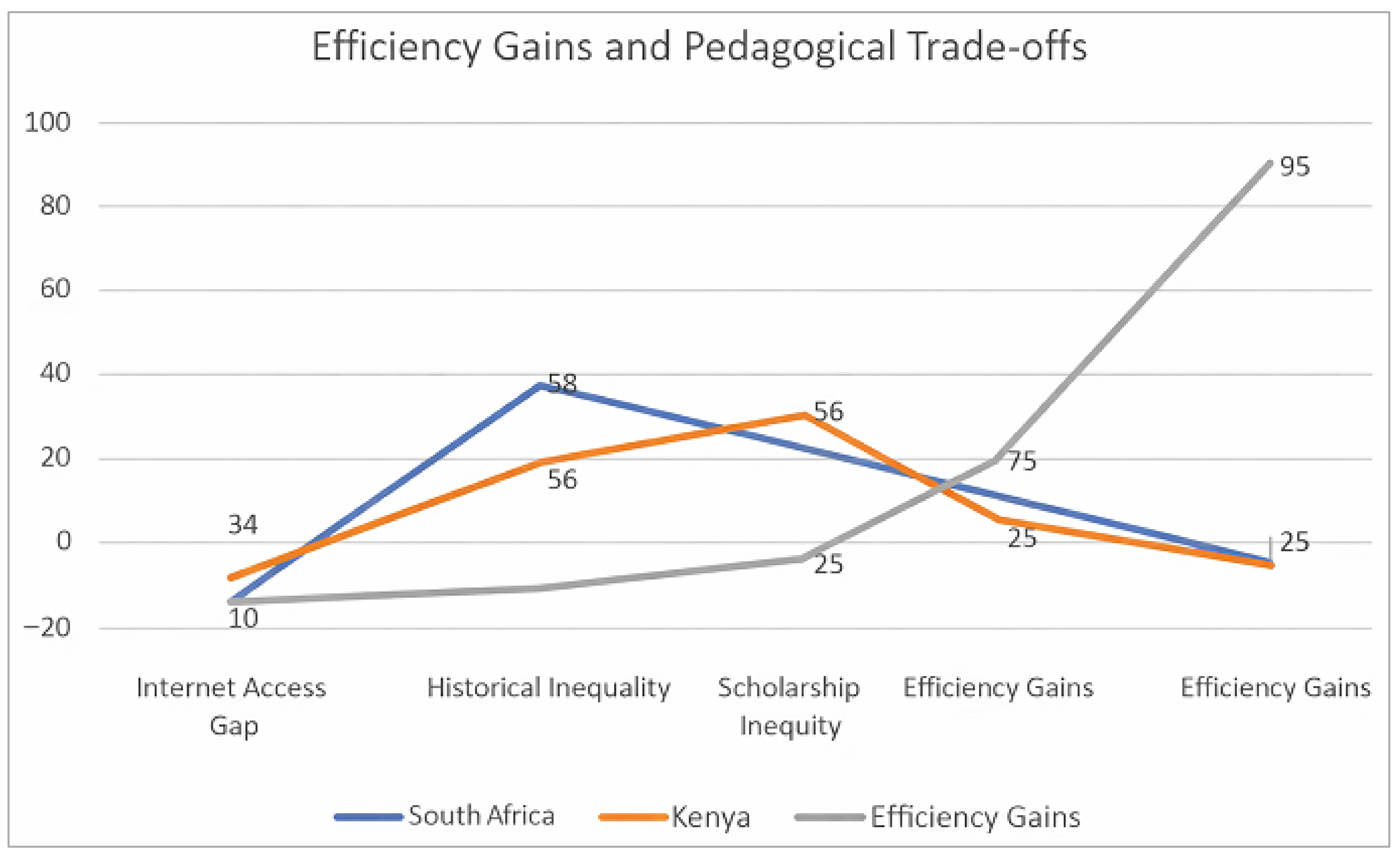
In the academic and policy debates, enthusiasm about the capacity of AI has been balanced by concerns about its sociotechnical impacts. For instance, Mehrabi et al. (2019) and Mitchell et al. (2021) have pointed to the potential bias and lack of transparency in AI, as well as the issue of equity of access. Ramineni and Williamson (2013) have demonstrated how the use of automated scoring in AI can reinforce existing inequalities, while Paullada et al. (2020) have emphasized the importance of transparency in the design of algorithms. In addition to the issue of bias, there are also the more traditional issues of equity of access, such as the digital divide. Czerniewicz et al. (2020) found that, in South Africa, only 60% of students in historically disadvantaged universities reported access to the internet, in contrast to over 90% in historically advantaged universities. In Kenya, while the penetration rate of mobile phones is high, only 35% of the population reported access to the internet in 2024. There are also large differences in access between urban and rural areas, with 56.6% of households in urban areas reporting access, compared to 25% in rural areas (Kenya National Bureau of Statistics, 2024; DataReportal, 2024). These are examples of how the use of AI cannot be disassociated from the issue of equity in infrastructure and governance. In the literature, Peña-García et al. (2026) have emphasized the importance of dialogic reflection in order to “mitigate algorithmic bias and ensure inclusive AI in education”.
The aforementioned risks of bias and inequality in AI-mediated education are further complicated by the issue of student autonomy and pedagogical agency. As Smith (2020) and Mayfield et al. (2019) warn, algorithmically mediated learning environments threaten to diminish human agency and transform power dynamics in a way that undermines democratic engagement. Experimental studies confirm that AI-based decision making can unintentionally replicate social disparities, particularly when conditioned on unbalanced datasets or deployed without contextual safeguards (R. S. Baker & Hawn, 2022; Bird et al., 2025; Idowu, 2024), while predictive models used to assess student success and allocate resources have revealed racial, gender, and socioeconomic differences (Boateng & Boateng, 2025; Ferrero & Barujel, 2019). Noble (2018) and Benjamin (2019) further show that algorithmic systems reproduce historical biases embedded in data infrastructures, perpetuating exclusion rather than inclusion, and Adamakis and Rachiotis (2025) warn that “AI literacy must extend beyond technical skills to include ethical literacy and metacognitive engagement”. Evidence from South Africa reinforces this point, as Mhlanga et al. (2022) demonstrate that universities’ rapid digital transformation during COVID-19 revealed “deep systemic inequalities in access and participation”, while Patel and Ragolane (2024) and Mogoale et al. (2025) show that adoption remains unequal, with well-resourced universities leading the way. In Kenya, lecturers highlight both opportunities for personalized learning and concerns about ethical use and infrastructural readiness (Maluleke, 2025; Olteanu et al., 2019; Soundarajan & Clausen, 2018). Taken together, these insights showcase that efficiency, equity, and autonomy must be understood as interconnected dimensions of AI adoption, requiring deliberate policy safeguards and pedagogical strategies to ensure that technological innovation enhances, rather than erodes, human agency and social justice in higher education.
Despite growing scholarship, much of the research on AI in education remains concentrated in high-income contexts, overlooking the unique challenges faced in regions where infrastructural barriers and socioeconomic inequalities shape adoption trajectories (Conati et al., 2015; Okur et al., 2018). South Africa and Kenya provide critical case studies to address this gap, as their distinct governance frameworks and resource constraints illustrate how AI integration unfolds differently across African higher education systems. South Africa’s centralized higher education system, with its entrenched structural disparities, illustrates how AI can both streamline administration and exacerbate divides. Kenya’s decentralized ecosystem, characterized by community-led edtech initiatives and mobile learning platforms, demonstrates both innovation and infrastructural constraints (Patel & Ragolane, 2024; Mogoale et al., 2025; Maluleke, 2025). Maluleke (2025) observes that “AI adoption in African higher education presents both opportunities for accessibility and risks of deepening inequities if ethical safeguards are not prioritized”. These cases were selected to foreground the interplay between global technological imaginaries and local educational realities, while highlighting the distinct governance frameworks and infrastructural conditions of South Africa and Kenya and avoiding the homogenization of African contexts.
Drawing from these contextual differences, this article critically examines how AI-driven educational reforms in South Africa and Kenya negotiate the tensions between efficiency, equity, and autonomy. Efficiency reflects institutional and instructional gains facilitated by AI systems; equity concerns access and inclusion, particularly for marginalized groups; and autonomy relates to learner agency and pedagogical freedom (Kohnke & Zaugg, 2025; Cullen & Oppenheimer, 2024). Rather than treating these dimensions as discrete, the paper conceptualizes them as co-constitutive values that must be balanced to foster democratic, inclusive, and effective learning environments. By situating the analysis in South Africa and Kenya, the study contributes to broader debates on AI in education across the Global South while offering policy, pedagogical, and institutional recommendations for equitable adoption. In doing so, it extends existing theories of technological determinism and critical pedagogy by applying them to African higher education contexts, thereby clarifying both the opportunities and risks of AI integration in diverse institutional settings.
The present study extends prior reviews by situating the tensions between efficiency, equity, and autonomy within a multilevel framework that integrates technological, pedagogical, and ethical dimensions. It seeks to answer four guiding questions:
  • How does AI integration in higher education in South Africa and Kenya negotiate the tensions between efficiency, equity, and autonomy?
  • In what ways do contextual factors shape the opportunities and risks of AI adoption in these countries?
  • How do algorithmic bias, the digital divide, and resource inequities intersect to influence student agency, institutional practices, and policy outcomes?
  • What lessons from South Africa and Kenya can inform broader debates on AI in education across the Global South?
Through addressing these questions, the study contributes to the global conversation on equitable and responsible AI adoption in education, while offering contextual insights for South Africa and Kenya as they navigate the intersection of innovation, governance, and social justice.

2. Theoretical Framework

2.1. Technological Determinism and Critical Pedagogy

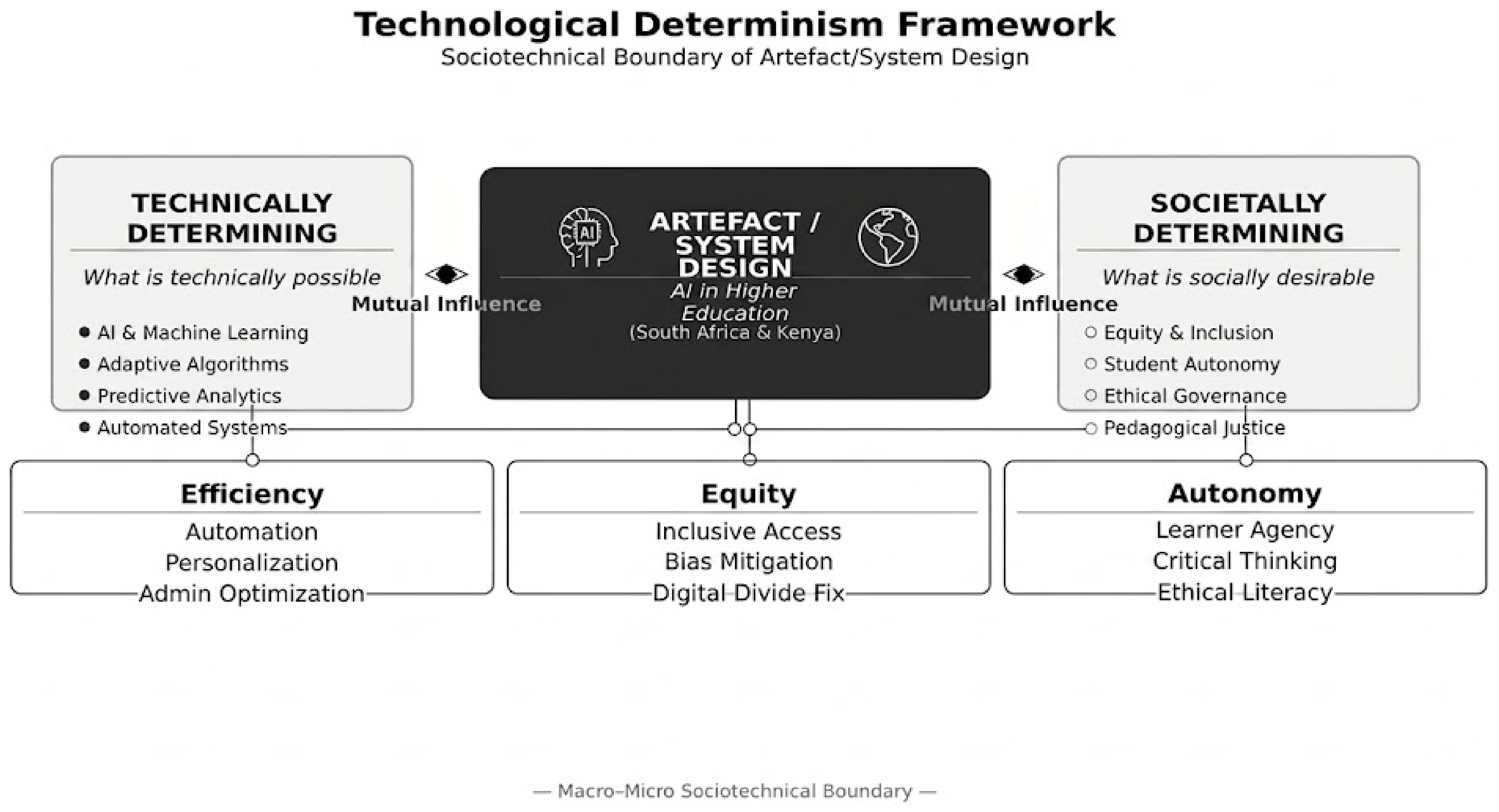
In the AI-oriented environment of higher education, conflicts between autonomy, efficiency, and equity persist, which is a complicated field of interference. A thorough analysis would thus demand theoretical prisms, which explain how these dimensions influence institutional practice. This article is based on two interrelated theories of technological determinism and critical pedagogy (Hauer, 2017; Finley, 2023; Blake et al., 2003, p. 38; Kincheloe et al., 2011; Shneiderman, 2022; Riedl, 2019, p. 33).

2.2. Technological Determinism

Technological determinism is a theoretical model first developed by Veblen (1921) before being later elaborated by McLuhan (1964) who hypothesized that technology innovations have a hegemonic impact on the social order and drive social change, often increasing the efficiency beyond anything previously seen. This theoretical framework anticipates the use of artificial intelligence in the restructuring of higher education ecosystems in the context of AI-driven education, by automated routine processes, simplifying administrative procedures, improving pedagogical performance, and maximizing resource distribution (Luckin & Holmes, 2016). Recent empirical studies conducted by Kamalov et al. (2023) and Vieriu and Petrea (2025) support this thesis by showing that AI can save money, expand the opportunity to access high-quality educational materials, and introduce flexibility in the work of the administration. Through the utilization of machine learning algorithms, AI-powered applications can alter the learning content to meet the personal requirements of students to enhance academic outcomes and enhance the engagement of learners (Luckin & Holmes, 2016). However, the literature warns against changing into an over-dependence on AI tools that may focus more on algorithmic products and less on critical thinking, creativity and autonomy of learners. Data-privacy-based ethical issues and algorithmic transparency are provided as key challenges associated with the use of AI. In turn, the successful adoption of AI pedagogical solutions should be marked by the desire to create holistic and equitable educational results so that technological progress can become the source of an inclusive change but not a divisive one (See Figure 1 below).

2.3. Critical Pedagogy

Critical pedagogy, as founded by Freire (1970), states that education was never neutral but incorporated with power relations that impact access to opportunities and foster exclusion. In connection with AI in higher education, this framework explains how algorithmic systems risk establishing structural differences or gaps rather than eradicating them completely. Noble (2018) and Benjamin (2019) demonstrate that AI systems often reproduce biases that are inherent in educational datasets, thus perpetuating inequalities that disadvantaged groups have traditionally experienced. However, R. S. Baker and Hawn (2022) highlight that such issues can be addressed if there is clear monitoring of algorithmic decision making. Such concerns are supported by Garzón et al. (2025) in their systematic review of AI in education settings that highlights that ethical issues, infrastructure inequalities, and resistance to AI by teachers are already impacting inequalities in AI adoption. Similarly, Adamakis and Rachiotis (2025) highlight that AI literacy needs to move beyond technological literacy to include ethical literacy and metacognitive engagement with AI systems, arguing that over-reliance on AI generation tools has the capacity to create “cognitive debt” that impacts creativity and autonomy. Overall, such research reaffirms the premise of critical pedagogy that power relations need to be interrogated in terms of technology use and that justice-based innovation is required to ensure that AI is aligned with inclusive educational goals.
The trade-offs between the demands of efficiency, equity, and autonomy in the use of AI in education can be seen in the African higher education systems, where structural and attitude-related barriers play a role in the integration of technology in these systems. Ertmer (1999) identified first-order and second-order barriers in the integration of technology in education, where the former refers to the more structural issues and the latter refers to the beliefs of the teachers, where “confronting second-order barriers requires challenging one’s belief systems and the institutionalized routines of one’s practice” (p. 48). This is also in line with the arguments of Pleasants et al. (2023) that teachers need “technoskepticism” in the critical evaluation of the use of technology in the classroom. In South Africa, the persistent inequalities in internet access between historically advantaged and disadvantaged universities (Czerniewicz et al., 2020) illustrate the ways in which AI can further entrench the digital divide, while in Kenya, educators demonstrate both optimism and worry in relation to the use of generative AI, highlighting the potential for personalized learning as well as ethical and infrastructural concerns (Garzón et al., 2025). From the perspective of critical pedagogy, these processes require the development of participatory approaches in which AI is co-designed with students, educators, and the broader community to prioritize transparency, accountability, and equity. As Adamakis and Rachiotis (2025) argue, “AI is neither emancipatory nor oppressive in and of itself, but rather a ‘technology of selection whose impact depends on the deliberate choices of educators, institutions, and learners’” (p. 2). The integration of AI literacy programs that emphasize the development of critical thinking, ethics, and self-regulated learning is thus imperative to ensure that learners do not become passive recipients of AI outputs but rather become active agents of their own learning trajectories.

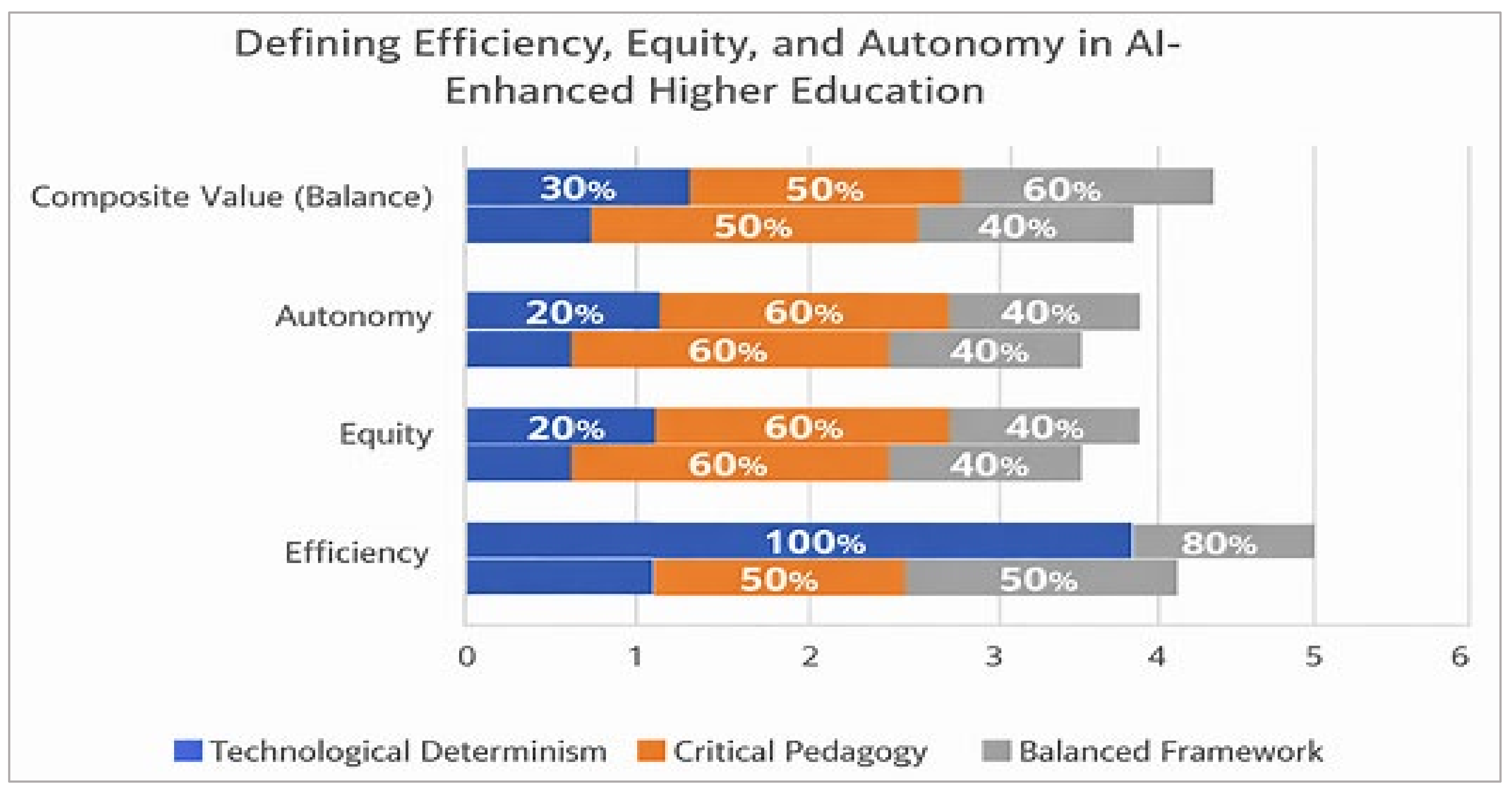
2.4. Defining Efficiency, Equity, and Autonomy in AI-Enhanced Higher Education

Efficiency within AI-driven education is defined as the optimization of organizational and instructional processes through automation, personalization and predictive analytics. Adamakis and Rachiotis (2025) state that AI systems have the potential to automate the grading process, simplify the administrative functions, and customize the learning pathways, thus decreasing the workload of instructors and redistributing the resources to pedagogy and academic research.
These insights echo the principles of technological determinism, which believes that technology is a leading agent of systemic change by increasing its productivity and restructuring of the way education is conducted. However, it is also possible that, by going after efficiency without expressly focusing on equity or autonomy, one creates a tendency towards standardization and stifles creativity. Therefore, the concept of efficiency would be placed within the framework as the so-called promise of AI, but it will require some moral protection to avoid divisive consequences of it (See Figure 2 below).
Equity refers to equitable accessibility, inclusion and justice in AI-based learning spaces. As Cotilla Conceição and van der Stappen (2025) describe, AI has the potential to be inclusive, however, in the absence of culturally responsive safety nets constructed, AI can be propagating the same injustices as current systems do. This is also supported by Chick (2025), who claims that fair AI should be designed as participatory and have ethical frameworks to minimize biases embedded in the algorithms. According to the critical pedagogy perspective AI plays a central role in education. As Freire contends, education is not (and can never be) neutral and this argument has a direct connection to AI; algorithms have the potential to reproduce historical biases embedded in data archives. In South Africa and Kenya, loopholes in the coverage and the availability of internet and infrastructure demonstrate that AI is likely to create a larger divide unless equality is made a priority. Therefore, equity is a justice-based opposition against technological determinism. It makes sure that efficiency gains are not subjected at the expense of marginalizations.
Autonomy refers to the preservation of learner agency, critical thinking, and pedagogical freedom in AI-mediated environments. Niu et al. (2024) explained that the concept of AI-based education in embracing the role of autonomy is the ratio of the learners to personalization, while predictive analytics poses a threat of the learners becoming passive receivers of information. Adamakis and Rachiotis (2025) explained that the concept of AI literacy is to be tackled as not only technical but also ethical in nature because it is essential to ensure that the learners are active participants in the learning process but not products of the algorithms of the AI systems themselves. Autonomy, in turn, is connected to the framework because it is the relationship between technological determinism, which is based on the efficiency strengths of the technology, and critical pedagogy, which is based on the empowerment of the learners and the presence of democracy in the learning process itself. The absence of autonomy would result in the use of AI reducing education to a mere mechanism that would not only comprise the ideas of creativity but would also not be a threat to the innovation that is focused on humanity itself.
Collectively, the three variables of efficiency, equity, and autonomy constitute the co-constitutive value of AI adoption in higher education. Technological determinism justifies the need to ensure efficiency, while critical pedagogy analyzes the concept of equity and autonomy to ensure justice. In the case of South Africa and Kenya, where the two variables of infrastructure and governance determine the AI adoption process, the need to balance the variables arises. Thus, the framework indicates that AI adoption neither has emancipatory nor oppressive potential but is instead a “technology of selection whose impact depends on deliberate choices” (Adamakis & Rachiotis, 2025).

3. Literature Review

3.1. Foundations and Evolution of AI in Education

Artificial intelligence in education (AIED) is based on the intersection of cognitive science, computer science, and educational theory. Since the beginning of the mid-twentieth century, AI aimed to rationalize the thinking of humans by artificial systems that could think, learn, and solve (Boden, 2018). These capabilities were first utilized in education through expert systems and intelligent tutoring services that automated the interaction of an educator in structured environments to support learners (Nwana, 1990; Kulik & Fletcher, 2016). With the development of AI, adaptive algorithms, natural-language processing, and predictive analytics have become a broad spectrum of its usage in the education sphere and not just rule-based systems. Pedagogical practice was transformed by such technologies through such means as individualized learning pathways, automated assessment, and instant feedback (Murtaza et al., 2022; Lin et al., 2023). The concept of strong versus weak AI has remained central to this trend, where present-day artefacts of education seem to demand an embodiment of the latter, namely purpose-specific systems being designed to optimize discrete educational processes (Kajiwara et al., 2023; Taddeo et al., 2022). This paradigm shift has triggered subsequent increasingly complex AI-based educational systems, which not only hold greater instructional effectiveness but also anticipate important concerns on the issue of autonomy and equity in the learning curriculum design.
In the past decade, lock-page transformations in artificial intelligence in education (AIED) have become particularly high due to the dramatic technological capabilities, global crisis, and changing educational concepts. Bibliometrical studies show that there has been a dramatic increase in academic production after 2017 that accompanies the development of generative AI and the digital changes brought about by the COVID-19 pandemic (Hinojo-Lucena et al., 2019; Dwivedi et al., 2020; N. Wang et al., 2024). Some of the existing uses include intelligent tutoring systems, game-based learning environments, socially interactive robots, as well as AI-based learning management systems (Singh et al., 2025; Oliveira et al., 2023; H. L. Chen et al., 2020). This diversification shows a more epistemic change, since now AI is not only used as a necessary instrumental instrument, but it is also a co-author of the learning experience. However, the fast rise of AIED has also revealed significant theoretical and ethical deficiencies simultaneously. Critics note an absence of coherence in the directive structures, inadequate implementation of the critical pedagogical theory, and a disproportional distribution of attention to such problems as bias and inclusion and learner autonomy (Selwyn, 2022; Kucirkova & Leaton Gray, 2023; Slimi & Carballido, 2023). In the context of increasingly mediated pedagogical decision making by AI systems, the need to increase efficiency through equity and autonomy grows. This torsion underscores the need to have policy and institutional designs that prospectively anticipate ethical stewardship, the principle of democratic learning and pedagogical innovation, which are issues that this article attempts to explore.

3.2. Regulatory Frameworks for Ethical AI Application in Education

In South Africa, the Presidential Commission on the Fourth Industrial Revolution Notice 591 of 2020 (PC4IR) outlined various regulatory frameworks that guide the use of AI in higher learning institutions (O’Sullivan et al., 2019, p. 1968; Prem, 2023). The policy frameworks that are being debated are designed in such a way that they promote inclusivity and at the same time enhance operational effectiveness. The establishment of the Artificial Intelligence Institute of South Africa (AIISA) in 2021 was a strategic intervention in the country of South Africa aimed at shaping AI governance in the education sector (Chilunjika et al., 2025). The mandate of the Institute includes the alignment that the new AI frameworks have with the national education goals and that they proactively curb the inequalities in higher education (O’Sullivan et al., 2019, p. 1968; Prem, 2023). Along with these efforts, the introduction of the Protection of Personal Information Act (POPIA) in 2013 provides a legal framework to support data protection and establish the regulatory framework of AI implementation in the educational setting. Kenyan officials have also implemented a rigorous set of regulatory tools that can be used to control the use of AI in the education field (Baraza et al., 2022). The Digital Economy Blueprint of 2019 clarifies the future of the integration of AI in institutions of higher learning, which anticipates the eradication of the digital divide and promotion of collective, participatory decision-making processes as the key strategic priorities (Baraza et al., 2022; Research ICT Africa, 2021). The Kenya Data Protection Act implemented in 2019 outlines frameworks that guide the use of AI in education and how institutions must protect data and enact rigorous measures to combat issues of ethicality (Research ICT Africa, 2021). Unlike South Africa, Kenya commissioned a huge task force on blockchain and AI use to develop policies that promote the use of AI in education in a lawful way and tackle issues of bias.

3.3. Efficiency and Optimization in AI-Driven Learning

The integration of the artificial intelligence system into learning systems has been widely promoted as one of the methods to increase efficiency, simplify educational processes, and reduce the workload. Intelligent tutoring systems (ITSs) such as those reviewed by Mousavinasab et al. (2021) have been central to this change, providing automated feedback, dynamic learning pathways, and monitoring of learner performance, reducing the workloads of educators and improving the performance of learners. Machine learning models are becoming more robust to support these systems by adjusting the content delivery and maximizing real-time decision making (Kurilovas, 2019). In the academic sector, AI devices have been used to automate grading, monitoring student performance, and operations of the administration, which have consequently redirected institutional resources toward teaching and learning (Alamri et al., 2020; Jeong et al., 2012). The Binary Bat algorithm (Mirjalili et al., 2014), Monarch Butterfly Optimization (G. Wang et al., 2019), and Whale Optimization Algorithm (Mirjalili & Lewis, 2016) are also optimization methods that are used to optimize the instructional parameters and make the systems more receptive. These changes are examples of greater dependence on the computational efficiency ability to solve a variety of problems with scalability, cost mitigation, and even flow of instruction throughout a variety of learning settings. The latest AI-based tools have enhanced regular programming processes, including debugging and code annotation, thus enabling students to concentrate more on advanced problem-solving analytical skills (Zviel-Girshin, 2024).
However, the idealistic quest for higher efficiency by means of artificial intelligence generates intricate implications of equity and autonomy in the educational domain. Scholars like X. Chen et al. (2018) and Xing and Du (2019) point out that, although predictive analytics and precision-learning paradigms are effective in identifying at-risk students, there is a danger that they will create artificially high benchmarks of standardization at the cost of creative and analytical abilities. In novel multilingual, socioeconomically heterogeneous settings that typify the South and Nigeria, AI-generated teaching resources and entirely automated, never-heuristic assessment systems threaten to marginalize cultural plurality and limit the role of teachers in supporting inclusive pedagogy (Cavanagh et al., 2020; Celik et al., 2022). The scarcity of strict regulatory systems within many states in Africa only increases the alarming aspects of algorithmic bias, data privacy, and ethical application of algorithms, which are more strictly regulated in regions like the European Union (T. Baker et al., 2019). Since AI is increasingly integrated into academic institutions to streamline pedagogical delivery and administration, there is a need to ensure that such technologies are implemented with safeguards to maintain the integrity of pedagogy and social justice. This cannot be done with long-term technological improvement but also the creation of policy tools that support ethical stewardship, explicability, and responsible use of AI as a supplement to human-centered teaching (Ntsobi et al., 2025).

3.4. Equity, Bias, and Inclusion in Algorithmic Systems

The growth of algorithmic processes in education has fostered more criticism on how the processes are perceived to impact equity, fairness, and inclusion. Researchers have raised concerns that data-driven decision making, even at its most efficient level, is often replicative of old social issues in its opaque biases and exclusionary mechanisms (Zeide, 2017; Ntoutsi et al., 2020). Student performance models that predict performance or automated assessment systems, as discussed by Bird et al. (2025) and Chai et al. (2024), have the integrity to predict performance and are usually based on historical datasets, which encode racial, socioeconomic, and linguistic differences to promote structural disadvantage. According to R. S. Baker and Hawn (2022), the notion that algorithmic bias in education is a technical flaw is flawed since it is a more fundamental problem to institutional practices and data infrastructures, which disregard the heterogeneity of contexts. Binns (2018, 2022, 2024) relies on political philosophy to argue that algorithmic fairness should be based on normative concepts of justice, such as the difference principle and the need to have individual judgment within the automated loops. Holstein and Doroudi (2021, 2022) also caution that AI in education can only increase inequities unless it is specifically designed to decrease them, specifically in the context of learning institutions where students face the effects of systemic barriers. It is more complicated in multilingual and heterogeneous societies like South Africa and Ghana because the risk of demonstrating cultural diversity soon and losing an inclusive pedagogical practice is increased by algorithmic systems (Takyi et al., 2021; Cavanagh et al., 2020).
Sociotechnical aspects and governance solutions to prejudice in the algorithm have begun to lead to the effort to build more accessible, understandable, and participatory designs of an algorithmic research domain. As Barnes and Hutson (2024) point out, explainability is extremely instrumental in building trust and accountability, particularly in the high-stakes education learning setting. Khosravi et al. (2022) support explainable AI (XAI) as a tool to empower educators and learners with practicable information, but the researchers also present deliberative tools, including value cards, to support positive ethical thinking about the effects of machine learning (Shen et al., 2021). Inclusive AI, such as that of Oyetade and Zuva (2025), is meant to bring teachers to higher literacy rates and alleviate bias based on cultures through culturally responsive design. Bao et al. (2026) present empirical data that AI has the potential to promote gender equality in the learning process in certain circumstances, but they advise that any benefits of AI are determined by cautious system design and sensitivity to context. According to scholars like Karumbaiah and Brooks (2021) and Gaskins (2022), algorithmic injustices often recount colonial legacies and speculative fantasies that should be subjected to skepticism. The OECD (2021) and UNESCO frameworks are aimed at the establishment of strong policy interventions to make the deployment of AI in education appropriate to the postulates of equity and democratic involvement. With the rise of the algorithmic system as part of the institutional decision-making process, the need to balance technological innovation with ethical governance and inclusive pedagogy continues to be the focus of the future of educational change. Within educational environments, algorithms often support the existing social inequalities. Due to inappropriate consideration of local contexts, the use of standardized monitoring and evaluation usually aggravates disparities instead of reducing them (Carvalho et al., 2023).

3.5. Student Autonomy in an AI-Augmented Educational Landscape

The adoption of artificial intelligence in higher education institutions has led to a re-evaluation of learner autonomy, especially as AI technology is playing an increasingly relevant role in mediating the instruction process, assessment, and interaction. Even though AI-powered platforms like ChatGPT and intelligent tutoring systems provide personalized learning paths and real-time feedback (Duong et al., 2023; H. L. Chen et al., 2020), researchers have serious concerns that the systems reduce agency among learners by introducing algorithmic decision making into the pedagogical procedures (Kaas, 2024; Popenici & Kerr, 2017). Self-regulated learning and critical participation were historically associated with the notion of autonomy, which is threatened by data-based optimization in which learners are guided to preforeseen results through predictive analytics (Prinsloo & Slade, 2016; Darvishi et al., 2024). As Taub et al. (2020) demonstrate, the realm of learner agency affects affective engagement and problem-solving behavior in a significant way, while AI systems tend to focus on efficiency at the cost of exploratory learning. Furthermore, composition and design tasks executed using generative AI tools, even though offering benefits in terms of creativity, can also be associated with relocating control to the system, casting the issue of authorship, ownership, and epistemic autonomy in challenged terms (Han et al., 2024; Imran & Almusharraf, 2023). The ability of learners to achieve substantive control within the environment enhanced with artificial intelligence can be based on the capacity to critically interrogate the results of AI to retain their personal agency and autonomy (Alm, 2024).
The urgency to protect and support the autonomy of students in AI-enhanced classroom settings has precipitated the creation of the human-centered model of AI augmentation with the central principle of effective transparency, co-agency, and ethical design assumptions. Researchers such as Renz and Vladova (2021) and Holmes et al. (2022) promote participatory modalities by making students active creators in the process of building their learning pathways, rather than inactive receivers of algorithmic output. The issue of situational autonomy, discussed by Salikutluk et al. (2024), highlights the need for situational flexibility in human–AI interaction, whereby learners can maintain their decision-making autonomy even when acting in organized environments. The support of multilingual learners and culturally heterogeneous classes should also be focused on translingual and transcultural skills (AI tools should deal with both translingual and transcultural competencies), otherwise autonomy between the learners is confined by linguistic or algorithmic prejudice (Kunschak, 2021; Harrison et al., 2013). Williamson et al. (2020) posit that making education more datafied can lead to the loss of autonomy because it presents students not as holistic learners but rather as data subjects; a view that is similarly expressed concerning surveillance-based learning analytics. To balance technological advancement with pedagogical integrity, higher education institutions will have to implement governance structures that enhance the rights of the students, securing informed consent and with substantive choice, which are crucial in maintaining autonomy in the changing world of AI-driven education.

4. Methodology

This study employed a qualitative research design based on document analysis, which suits the investigation of policy frameworks, academic discussions, and institutional reports on AI in higher education. Document analysis allows systematizing the comprehension of the text to detect discursive configurations, the organized forms in which AI adoption is articulated, and the contradictions that emerge between efficiency and equity and autonomy (Bowen, 2009). The studies that were included in the literature reviewed encompass national policy documents (e.g., Presidential Commission on the Fourth Industrial Revolution by South Africa, Digital Economy Blueprint in Kenya), peer-reviewed articles and systematic reviews (Zawacki-Richter et al., 2019; Garzón et al., 2025), and empirical investigations of infrastructural inequality (e.g., Czerniewicz et al., 2020; Mhlanga et al., 2022). These sources were chosen on the grounds of being directly involved in the crossover of efficiency, equity, and autonomy in African higher education. Inclusion criteria included publications between 2013 and 2025 that directly touched on AI in education or on governance in South Africa and Kenya but exclusion criteria removed those which were restricted to high-income settings as well as the ones that only involved technical AI development without application to education.
A thematic coding strategy was employed to analyze the data based on the known qualitative approaches. Thematic coding was facilitated using NVivo (version 14, QSR internationally Pty Ltd., Burlington, MA, USA). No physical equipment or instruments were deployed because the research followed a qualitative document analysis using secondary data. Moreover, the data was inductively coded using open coding (Strauss & Corbin, 1998) with recurring concepts such as: digital divide, algorithmic bias, and student agency identified in the data and deductive coding applied to align the findings to the theoretical perspectives of determinism and critical pedagogy. The categories were mapped to the bigger themes of efficiency, equity, and autonomy through axis coding (Saldaña, 2016), and these were incorporated into a more coherent framework by using selective coding (Creswell, 2014); this placed AI acceptance in the context of justice-oriented pedagogical discussions. The study also integrated the triangulation technique to improve the rigor, which compared the information on policy texts, academic literature, and empirical research to make sure that there were validity, transparency and uniformity in decoding. The iterative nature of this process provided the descriptive and interpretive character of the findings concerning how the contextual factors in South Africa and Kenya determine the opportunities and threats of AI introduction into higher education.

5. Findings and Discussion

5.1. Coding Process and Category Development

The findings were derived through a systematic coding process applied to policy documents, institutional reports, and scholarly literature from South Africa and Kenya. Using thematic analysis, the data were coded into three overarching categories: efficiency, equity, and autonomy. Each category was further broken down into sub-themes that reflected recurring patterns in the evidence. For example, references to automated grading and predictive analytics were coded under efficiency gains, while discussions of internet access disparities were coded under equity risks. Similarly, concerns about reduced student agency in algorithmically mediated learning environments were coded under autonomy constraints. This coding process ensured transparency in how raw data were transformed into analytical insights.
Table 1 illustrates the coding stages, emergent concepts and supporting used in the qualitative analysis.

5.2. Efficiency Gains and Pedagogical Trade-Offs

The results showcase that efficiency is one of the most prevalent or visible byproducts of AI adoption within universities. For instance, intelligent tutoring systems, digital tools (ChatGPT-4o mini, Germini 2.0 Flash AI, Open Scale AI) and AI-based grading system all have enhanced the efficiency of pedagogical delivery, feedback generation and administrative processes (Duong et al., 2023; Ng et al., 2023). Luckin and Holmes (2016) reveal how AI can tailor learning content to suit individual students’ needs, which can improve engagement and learning outcomes. This shows the transformative power of AI adoption in higher education, especially considering that there are large student populations to cater to. These changes can be seen as part of technological determinism, which argues that technology is inevitable and must be used to transform institutions. However, it has also been shown that these processes come with various trade-offs. Taub et al. (2020) uncovered that the adoption of AI, especially feedback generation, can reduce metacognitive reflection and critical engagement, which can result in shallow engagement. Freire (1970) argues that “education is never neutral but embedded within power relations”, relating to how AI adoption can reduce dialogic learning and student engagement to favor efficiency. The evidence suggests that AI adoption has improved efficiency, but it can reduce the emancipatory potential of higher education, especially considering that these institutions are already constrained (See Figure 3 below).

5.3. Algorithmic Bias and Equity Challenges

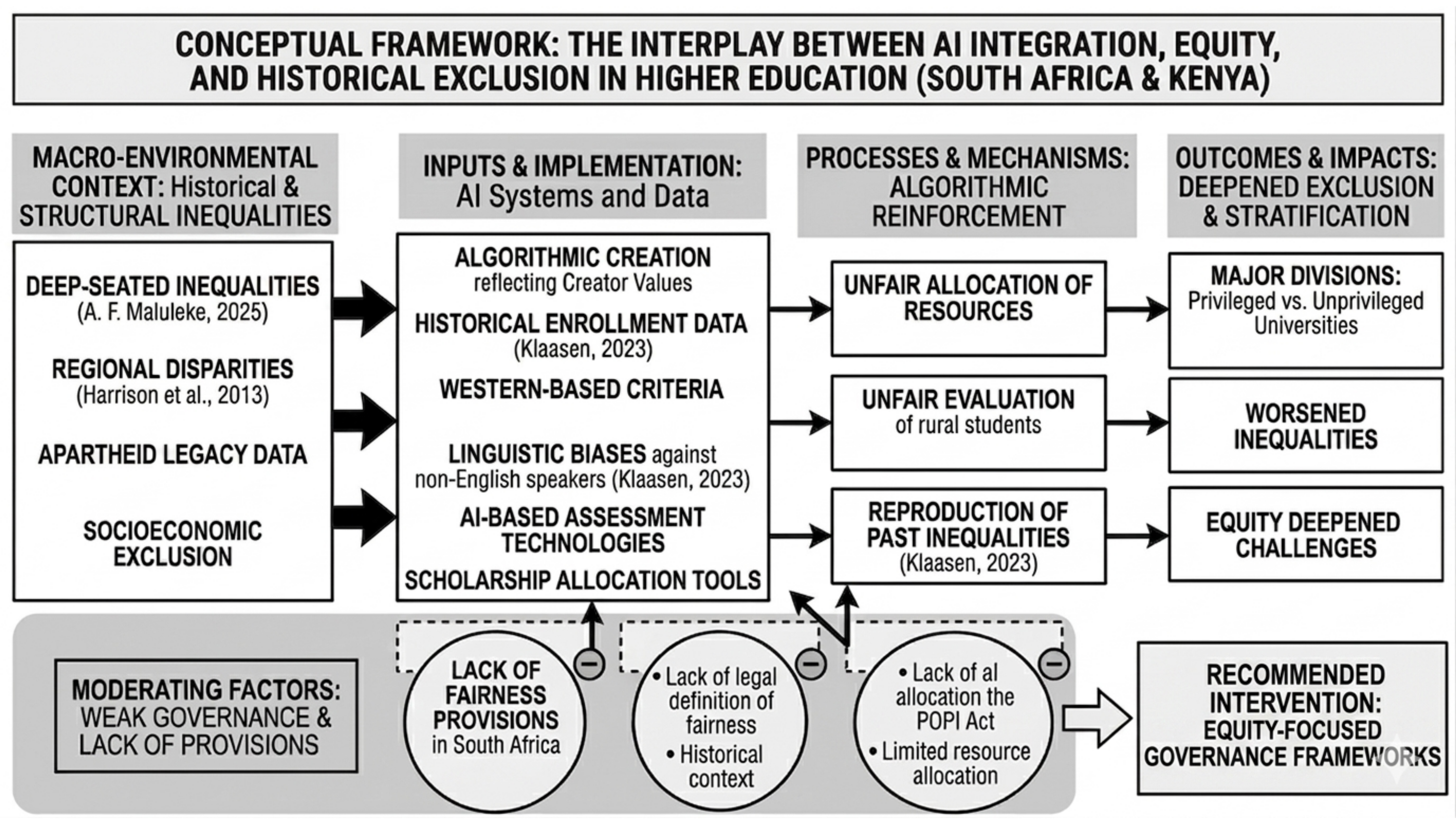
Equity emerged as the most debated area in scholarship regarding AI adoption in higher learning institutions globally. The findings revealed that AI has the immense potential to establish or deepen already existing inequalities. Within South Africa Mhlanga and Moloi (2020) reports that the technological revolution during the COVID-19 pandemic has uncovered deep-seated inequalities within the system. Klaasen (2023) also indicates that the use of AI-based assessment technologies has linguistic biases that function against those who do not utilize English as their first language. Furthermore, the research showcases that the application of historical enrollment data by AI-based tools has the potential to worsen inequalities that were established during the epoch of the apartheid regime. This has caused major divisions among the privileged and unprivileged universities. Despite the Protection of Personal Information Act (South Africa, 2013) outlining the provisions for protection of information in South Africa, there is no provision to tackle the issue of fairness. In Kenya, the use of AI-based tools to allocate scholarships has resulted in the unfair allocation of resources to urban and economically advantaged students (Fazelpour & Danks, 2021). In addition, the use of Western-based criteria has resulted in the unfair evaluation of rural students (Angwaomaodoko, 2025). This has been made worse by the lack of adequate infrastructure and AI regulation. Noble (2018) indicates that “algorithms are not neutral; they reflect the values and assumptions of their creators”, which indicates the need for equity-focused governance frameworks to prevent the reproduction of historical socioeconomic exclusion.
The conceptual framework illustrating the interplay between AI integration, equity, and historical exclusion in higher education is presented in Figure 4. It draws on the perspectives of Maluleke (2025), Harrison et al. (2013), and Klaasen (2023).

5.4. Student Autonomy and Human–AI Collaboration

One of the most important findings in this article pertains to the rise of student autonomy in AI-mediated learning environments. Such learning environments have a significant impact on the behavior of learners, as AI systems increasingly use predictive analytics to “nudge” learners in specific ways, thus influencing their actions (Darvishi et al., 2024; Yin et al., 2025). Although such learning environments can be beneficial for learners in terms of enhanced performance and task optimization, they can have a detrimental impact on student autonomy and independent learning. Kaas (2024) reveals that “algorithmic logic is gradually becoming the basis for decisions, gradually replacing the judgment of the human brain, thus limiting the space for independent thinking and creativity”. From a pedagogical perspective, the findings of this article point to a paradigm shift in the learning landscape, as the locus of control in learning environments has moved away from both the learner and the educator to the algorithm. The findings of the article, thus, point to the need for a human-centered approach to AI, in which learners have the autonomy to doubt, question, and even disregard the recommendations of the AI system. As Renz and Vladova (2021) assert, “agency in educational technology needs to be transmitted through human-centered AI, addressing contestability and learner autonomy”.

5.5. Case Study Evidence: South Africa and Kenya

The comparative results indicate that the process of AI adoption in higher education is currently gaining momentum both in South Africa and Kenya, yet the factors influencing non-adoption vary in magnitude and effect. For instance, in South Africa, the use of AI in admissions and placement in higher education disadvantages students from poorer and English-speaking schools. The marginalized students, particularly those whose first language is not English, are at a greater disadvantage. This is supported by empirical evidence that shows that 92 percent of students in historically advantaged universities experience stable internet access compared to only 58 percent in disadvantaged universities, which shows the deep-seated digital divide that impacts the use and adaptation of AI in the country. This is further compounded by the use of historical enrollment data that recreates historical apartheid inequalities and the absence of effective mechanisms for algorithmic fairness in the law, as evidenced in the Protection of Personal Information Act (South Africa, 2013). Patel and Ragolane (2024) assert that the design of AI must be multilingual and fair to drive education reform in post-apartheid South Africa. Mateko et al. (2025) further argue that digital inequality is not only about access but rather a structural issue that mirrors historical divides and must be considered in the design of AI for the future of higher education in South Africa.
In Kenya, exclusion mechanisms can be seen in the pattern followed in the allocation of scholarships since algorithms are more exclusionary of the urban learner with high access to academic and extracurricular resources (Angwaomaodoko, 2025; Fazelpour & Danks, 2021). Statistics also show that there is an infrastructure gap in terms of internet usage in Kenya, given that, in 2024, while 95+ percent of Kenyans had access to mobile networks, only 35 percent of the population had access to the internet, with 56.6 percent of urban populations compared to 25 percent in rural areas (Kenya National Bureau of Statistics, 2024; DataReportal, 2024). These infrastructure gaps will affect the adoption of AI in education, thus exacerbating the digital divide in online learning adoption in the country. Kizilcec and Lee (2022) and Cullen and Oppenheimer (2024) argue that ensuring algorithmic fairness in education requires the effective application of concepts of statistical, individual (similar), and causal fairness because, in most cases, these algorithms exacerbate inequality in society. In the Kenyan context, while there is a commitment to adopting AI in an inclusive manner through the Digital Economy Blueprint (2019), there is no mechanism to address issues of bias in the adoption of AI, thus leading to issues of governance, as Onyango (2025) argues that there is a need to develop context-specific governance frameworks to ensure that there is enforcement of fairness and transparency in the adoption of AI, thus the need to address issues of regional responsiveness in such adoption processes. Thus, while there is a manifestation of inequality in South Africa, which is rooted in linguistic prejudices, in Kenya, the inequality is rooted in infrastructure and socioeconomic inequality, thus showing that there is a need to ensure that there is a renewed commitment to a just, contextualized, and sensitive approach to architecture in line with issues of justice in the adoption of AI in these nations (See Table 2 below).

5.6. Synthesis of Results, Efficiency, Equity and Autonomy

The results indicate that efficiency, equity, and autonomy are not mutually exclusive variables in the deployment of AI but rather interconnected variables. While efficiency in the deployment of AI can be expected to occur first, equity and autonomy are variables that must be carefully managed. The deployment of AI in South Africa and Kenya indicates a more profound issue of inequality. According to Benjamin (2019), race and technology are mutually constitutive, meaning that, unless proper care is taken, innovation can be a source of continued marginalization. Therefore, justice-oriented approaches are necessary in the deployment of AI. Thus, the thesis of the paper can be advanced that the deployment of AI in higher learning institutions must not be judged on its performance but on its impact on society. Through the results of the deployment of AI in South Africa and Kenya, a crucial discussion on how AI can be a source of empowerment or marginalization in college learning can be sparked.

6. Global Perspectives: AI in Education Across Distinct Contexts

Scientific literature and empirical evidence demonstrate that the application of AI in education across various states in the Global North and South has revolutionized the landscape of education regardless of countries’ socioeconomic levels (Chan, 2023; Chan & Hu, 2023; Luckin, 2018). Adiguzel et al. (2023) argue that the education systems of Europe and North America have used artificial intelligence as a way of improving the quality of instruction as well as the efficiency of administration. As an example, Finland and Estonia have utilized AI to develop learning systems with a heavier emphasis on effectiveness in their operations and strong overall ethical management (Pedro et al., 2019; Luckin, 2018). Conversely, a substantial number of sub-Saharan African countries view AI as the means to solve ingrained inequality, with the consideration that the idea of adopting Western-centered datasets can keep perpetuating the same biases (Pedro et al., 2019). South Africa and Kenya are two of the few African countries that have issued AI policies specifically aimed at reducing the digital divide and strengthening the role of education control and delivery (Dlamini et al., 2025). China and Singapore have led the world in using AI in the education sector by introducing state-based programs aimed at enhancing monitory control, student autonomy, and personal data privacy (Dlamini et al., 2025).
A range of pan-European initiatives represent the rapid adoption of artificial intelligence to the educational setting of higher education. For instance, in France, the AI4T project launched by the EU in 2021 is focused on both the creation of AI tools that benefit lecturers and the protection of student autonomy at the same time (European Commission, 2021). In this regard, the EMAI4EU initiative was launched in 2024 and is focused on implementing affective AI in education, thus becoming one of the organizations to further develop research and apply emotion-based AI systems (EIT Digital, 2024). Moreover, the European AI Alliance, which was founded in 2018, is a platform that is open-ended and supports open dialogues on policies concerning ethical uses of AI in the fields of education and other organizations (European Commission, 2023). Overall, the programs show the willingness of Europe to develop and control AI technologies, boosting the outcomes of the educational process and maintaining moral principles, transparency, and inclusivity. Moreover, the introduction of artificial intelligence in educational systems has been successfully implemented in other countries like the United Kingdom and the People’s Republic of China. An illustration of this is China, which has deployed AI-assisted instructional modalities improving the level of pedagogy, and the United Kingdom, which has implemented AI-adaptive learning platforms to enrich the student experience (Knox, 2020, pp. 298–311). The scientific literature on adopting AI in the educational field highlights the need to focus on human-centered policy design to reconcile these efficiency, equity, and autonomy tensions and, in such a way, recalibrate pedagogies based on AI in educating equal individuals and challenging existing inequalities (Chang et al., 2022; Knox, 2020, pp. 298–311).

7. Advancing Debates on Efficiency, Equity, and Autonomy

A unique contribution of this article lies in viewing AI implementation in higher education as the interplay between efficiency, equity, and autonomy and not only in isolation or with attention paid exclusively to technological performance (Bozkurt & Xiao, 2023; Zawacki-Richter et al., 2019). In contrast to most previous studies, which address AI in terms of its ability to individualize (Chiu et al., 2023) or employ predictive analytics (Gardner et al., 2019), the given work brings to the fore the pressing sociopolitical and ethical surroundings of AI implementation in the educational domain (Selwyn, 2022; Holmes et al., 2022). To its credit, it shows that institutional goals, governance, and learner agency can interact to induce inelegant results that are both problematic and therefore useful: as automated grading and adaptive feedback are sources of efficiency, they can also reinforce inequities (R. S. Baker & Hawn, 2022) or limit student agency (Tsai et al., 2019). Placing autonomy on par with efficiency and equity both highlights the philosophy–ethics gap between techno-solutionist tropes and locates the study within current debates, such as those argued in the study by Marín et al. (2025), a recent report by Wargo and Anderson (2024) and the policy statement by the United Nations Educational, Scientific and Cultural Organization (2021), that the applicability of autonomy as an effective governance method remains elusive without due diligence to policy considerations and ethical stewardship, particularly in situations where structural inequalities exist, and that student autonomy will be at risk due to the reliance on AI.
This study contributes to contemporary debates on AI-driven education by investigating how institutional practices, policy orientations, and AI system designs interact to shape the experiences of students and educators. By focusing on higher education settings in the Global South, it addresses a significant gap in the literature, challenging the predominance of Global North perspectives in this field (Ifenthaler, 2017). The study points out the long-term and short-term effects (intended and unintended) of adopting AI, which indicate how the strategy of increasing efficiency through more efficient administrative procedures and automatic feedback may unintentionally expand disparities and undermine student agency (Eynon, 2015; Schiff, 2022). The originality of the given work consists in the fact that it provides an evidence-based analysis of how socioethical and policy considerations are linked with the technical functionalities of AI and presents actionable insights to institutional decisionmakers (Williamson & Eynon, 2020). Through suggesting key trade-offs, mediating mechanisms, and governance strategies, the research can provide a globally applicable lens on AI implementation in higher education that would be characterized by attention to the tripartite rule of efficiency, equity, and autonomy. The unique contribution of focus on the interaction between operational efficiency, learner-centered concerns, and ethical supervision to the findings proves that it can inform the research, policy, and practices in various settings where structural disadvantages and resource limitations are pertinent (Chinta et al., 2024; OECD, 2024; Xiao & Yi, 2021).

8. Conclusions

The prospect of applying artificial intelligence (AI) to the field of higher education has deep transformational possibilities and at the same time raises a set of complicated issues regarding efficiency, equity, and student agency. Artificial intelligence is transforming governance systems, education methods, and educational flows, hence igniting an active academic debate on a global scale. Although AI can represent an opportunity to automate administrative duties and personalize learning processes, introducing it should be based on purposeful control. Without this kind of stewardship, AI threatens to exacerbate education inequity via algorithmic bias and exacerbate the digital divide and this is so especially in the under-resourced context. To make sure that artificial intelligence operates as an enabling power instead of a manipulative control apparatus, it is important that educational establishments promote a humanist paradigm where students have agency and are learning in inclusive environments. To realize this goal, a multistakeholder model that involves educators, scholars and policymakers as well as technologists in designing frameworks based on transparency, fairness and student-centric values must be used. Technical efficacy must in no way override the factors of justice or personal autonomy; on the contrary, artificial intelligence must be used to develop pedagogical experiences and trigger creativity and meet the needs of different learners with their various learning requirements.
In the next phase, colleges and universities must introduce AI literacy courses in their set of studies to prepare learners with the imagined knowledge and moral sensitivity needed to operate in AI-enhanced learning platforms. To protect privacy, provide accountability and enhance equitable access the introduction of strong data governance procedures is indispensable. Moreover, the contemporary resilient ICT infrastructure is central to the modernization of the educational system and lessening the digital disparity; the areas where strategic investment should be made should be the creation of national research and education networks (NRENs) as well as the development of relationships with telecommunication providers, which will ensure the further expansion of the connection and better access to digital resources. Finally, ethical stewardship, advocacy of inclusive design, and student empowerment represent the key to how the purposeful implementation of artificial intelligence in higher education can be achieved, and it should not only rely on further technological progress but also on a shared desire to make it a priority. It can be argued that, by addressing AI development in ways that support the core educational values of institutions and more social responsibility, it is possible to create a future where AI enhances rather than determines the learning process. Future studies should examine how AI integration interacts with local socioeconomic realities, including digital divides, infrastructure limitations, and cultural variations in teaching and learning.

Author Contributions

M.G.S. led the writing and drafting of the manuscript. C.H. contributed to writing also and provided substantial input through reviewing and editing. All authors have read and agreed to the published version of the manuscript.

Funding

This research received no external funding.

Data Availability Statement

Data supporting this manuscript is available within the citied peer reviewed articles, policies, and institutional reports. No new data was generated.

Conflicts of Interest

The authors declare no conflict of interest.

References

  1. Adamakis, M., & Rachiotis, T. (2025). Artificial intelligence in higher education: A state-of-the-art overview of pedagogical integrity, artificial intelligence literacy, and policy integration. Encyclopedia, 5(4), 180. [Google Scholar]
  2. Adiguzel, T., Kaya, M. H., & Cansu, F. K. (2023). Revolutionizing education with AI: Exploring the transformative potential of ChatGPT. Contemporary Educational Technology, 15(3), ep429. [Google Scholar] [CrossRef] [PubMed]
  3. Alamri, H., Alshammari, S., & Alzahrani, A. (2020). Using personalized learning as an instructional approach to motivate learners in online higher education: Learner self-determination and intrinsic motivation. Journal of Research on Technology in Education, 52(3), 322–352. [Google Scholar] [CrossRef]
  4. Alm, A. (2024). Exploring autonomy in the AI wilderness: Learner challenges and choices. Education Sciences, 14(12), 1369. [Google Scholar] [CrossRef]
  5. Angwaomaodoko, E. A. (2025). The role of artificial intelligence in addressing g lobal education inequality. Traektoriâ Nauki, 11(4), 1001–1006. [Google Scholar] [CrossRef]
  6. Baker, R. S., & Hawn, A. (2022). Algorithmic bias in education. International Journal of Artificial Intelligence in Education, 32(4), 1052–1092. [Google Scholar] [CrossRef]
  7. Baker, T., Smith, L., & Anissa, N. (2019). Exploring the future of artificial intelligence in schools and colleges. Available online: https://media.nesta.org.uk/documents/Future_of_AI_and_education_v5_WEB.pdf (accessed on 15 October 2025).
  8. Bao, L., Huang, D., & Lin, C. (2026). Can artificial intelligence improve gender equality? Evidence from a natural experiment. Management Science, 72(1), 474–494. [Google Scholar] [CrossRef]
  9. Baraza, W., Mwakijele, J. P., Gitau, G., Kamau, A. Y., Dinga, L., Mpapalika, J., & Gachogu, S. (2022). Resilience in emerging digital economies: Case study of Kenya during COVID-19 pandemic. AFRALTI, Kobe Institute of Computing. [Google Scholar]
  10. Barnes, E., & Hutson, J. (2024). Navigating the complexities of AI: The critical role of interpretability and explain ability in ensuring transparency and trust. International Journal of Multidisciplinary and Current Educational Research, 6(3), 248–256. [Google Scholar]
  11. Benjamin, R. (2019). Race after technology: Abolitionist tools for the new Jim code. Polity Press. [Google Scholar]
  12. Binns, R. (2018). Fairness in machine learning: Lessons from political philosophy. In Conference on fairness, accountability and transparency. PMLR. [Google Scholar]
  13. Binns, R. (2022). Human judgment in algorithmic loops: Individual justice and automated decision-making. Regulation & Governance, 16(1), 197–211. [Google Scholar]
  14. Binns, R. (2024). If the difference principle won’t make a real difference in algorithmic fairness, what will? Philosophy & Technology, 37(4), 119. [Google Scholar] [CrossRef]
  15. Bird, K. A., Castleman, B. L., & Song, Y. (2025). Are algorithms biased in education? Exploring racial bias in predicting community college student success. Journal of Policy Analysis and Management, 44(2), 379–402. [Google Scholar]
  16. Blake, J., Smeyers, P., Smith, R., & Standish, P. (Eds.). (2003). The Blackwell guide to the philosophy of education. Blackwell. [Google Scholar]
  17. Boateng, O., & Boateng, B. (2025). Algorithmic bias in educational systems: Examining the impact of AI-driven decision making in modern education. World Journal of Advanced Research and Reviews, 25(1), 2012–2017. [Google Scholar] [CrossRef]
  18. Boden, M. A. (2018). Artificial intelligence: A very short introduction. Oxford University Press. [Google Scholar]
  19. Bowen, G. A. (2009). Document analysis as a qualitative research method. Qualitative Research Journal, 9(2), 27–40. [Google Scholar] [CrossRef]
  20. Bozkurt, A., & Xiao, J. (2023). Speculative futures on ChatGPT and generative artificial intelligence (AI): A collective reflection from the educational landscape. Asian Journal of Distance Education, 18(1), 53–130. [Google Scholar]
  21. Carvalho, A. E., Cosme, A., & Veiga, A. (2023). Inclusive education systems: The struggle for equity and the promotion of autonomy in Portugal. Education Sciences, 13(9), 875. [Google Scholar] [CrossRef]
  22. Cavanagh, R. F., Reynolds, P. S., & Roman, T. (2020). Artificial intelligence in education: Implications for multilingual and heterogeneous societies. Journal of Educational Technology, 19(3), 173–179. [Google Scholar]
  23. Celik, I., Dindar, M., Muukkonen, H., & Järvelä, S. (2022). The promises and challenges of artificial intelligence for teachers: A systematic review of research. TechTrends, 66, 616–630. [Google Scholar] [CrossRef]
  24. Chai, F., Ma, J., Wang, Y., Zhu, J., & Han, T. (2024). Grading by AI makes me feel fairer? How different evaluators affect college students’ perception of fairness. Frontiers in Psychology, 15, 1221177. [Google Scholar] [CrossRef] [PubMed]
  25. Chan, C. K. Y. (2023). A comprehensive AI policy education framework for university teaching and learning. International Journal of Educational Technology in Higher Education, 20(1), 38. [Google Scholar] [CrossRef]
  26. Chan, C. K. Y., & Hu, W. (2023). Students’ voices on generative AI: Perceptions, benefits, and challenges in higher education. International Journal of Educational Technology in Higher Education, 20(1), 43. [Google Scholar] [CrossRef]
  27. Chang, Q., Pan, X., Manikandan, N., & Ramesh, S. (2022). Artificial intelligence technologies for teaching and learning in higher education. International Journal of Reliability, Quality and Safety Engineering, 29(5), 2240006. [Google Scholar] [CrossRef]
  28. Chen, H. L., Widarso, G. V., & Sutrisno, H. (2020). A ChatBot for learning Chinese: Learning achievement and technology acceptance. Journal of Educational Computing Research, 58(6), 1161–1189. [Google Scholar] [CrossRef]
  29. Chen, X., Liu, C., & Li, S. (2018). Machine learning and deep learning methods for cybersecurity. IEEE Access, 6, 35365–35381. [Google Scholar] [CrossRef]
  30. Chick, J. C. (2025). AI-enhanced computational thinking: A comprehensive review of ethical frameworks and pedagogical integration for equitable higher education. Education Sciences, 15(11), 1515. [Google Scholar] [CrossRef]
  31. Chilunjika, A., Uwizeyimana, D. E., & Nyathi, W. G. (2025). Statutory, regulatory and policy frameworks governing the use of artificial intelligence (AI) in public policy making in the South African context. International Journal of Business Ecosystem & Strategy, 7(5), 553–563. [Google Scholar] [CrossRef]
  32. Chinta, S. V., Wang, Z., Yin, Z., Hoang, N., Gonzalez, M., Le Quy, T., & Zhang, W. (2024). FairAIED: Navigating fairness, bias, and ethics in educational AI applications. arXiv, arXiv:2407.18745. [Google Scholar] [CrossRef]
  33. Chiu, T. K. F., Xia, Q., Zhou, X., Chai, C. S., & Cheng, M. (2023). Systematic literature review on opportunities, challenges, and future research recommendations of artificial intelligence in education. Computers and Education: Artificial Intelligence, 4, 100118. [Google Scholar] [CrossRef]
  34. Conati, C., Heffernan, N., Mitrovic, A., & Verdejo, M. F. (Eds.). (2015). Artificial intelligence in education: 17th international conference, AIED 2015, Madrid, Spain, June 22–26, 2015. Proceedings. Springer. [Google Scholar]
  35. Cotilla Conceição, J. M., & van der Stappen, E. (2025). The impact of AI on inclusivity in higher education: A rapid review. Education Sciences, 15, 1255. [Google Scholar] [CrossRef]
  36. Creswell, J. W. (2014). Research design: Qualitative, quantitative and mixed methods approaches (4th ed.). Sage. [Google Scholar]
  37. Cullen, S., & Oppenheimer, D. (2024). Choosing to learn: The importance of student autonomy in higher education. Science Advances, 10(29), eado6759. [Google Scholar] [CrossRef] [PubMed]
  38. Czerniewicz, L., Agherdien, N., Badenhorst, J., Belluigi, D., Chambers, T., Chili, M., de Villiers, M., Felix, A., Gachago, D., Gokhale, C., Ivala, E., Kramm, N., Madiba, M., Mistri, G., Mgqwashu, E., Mnguni, L., Ndebele, C., Ng’ambi, D., Oliphant, T., … Wissing, G. (2020). A wake-up call: Equity, inequality and COVID-19 emergency remote teaching and learning. Postdigital Science and Education, 2(3), 946–967. [Google Scholar] [CrossRef] [PubMed]
  39. Darvishi, A., Khosravi, H., Sadiq, S., Gašević, D., & Siemens, G. (2024). Impact of AI assistance on student agency. Computers & Education, 210, 104967. [Google Scholar] [CrossRef]
  40. DataReportal. (2024). Number of people using the internet in Kenya: Access to the internet by county. Available online: https://statskenya.co.ke/public/at-stats-kenya/about/number-of-people-using-the-internet-in-kenya-access-to-the-internet-by-county/84/?utm_source=copilot.com (accessed on 10 November 2025).
  41. Dlamini, R., Simuja, C., Feldman, J., & van Wyk, M. (2025). AI in education: Challenges, opportunities, and possibilities. Journal of Education (University of KwaZulu-Natal), (98), 1–4. [Google Scholar]
  42. Duong, C. D., Vu, T. N., & Ngo, T. V. N. (2023). Applying a modified technology acceptance model to explain higher education students’ usage of ChatGPT. International Journal of Management in Education, 21, 100883. [Google Scholar] [CrossRef]
  43. Dwivedi, Y. K., Hughes, D. L., Coombs, C., Constantiou, I., Duan, Y., Edwards, J. S., Gupta, B., Lal, B., Misra, S., Prashant, P., & Raman, R. (2020). Impact of COVID-19 pandemic on information management research and practice: Transforming education, work and life. International Journal of Information Management, 55, 102211. [Google Scholar] [CrossRef]
  44. EIT Digital. (2024, February 18). EMAI4EU: A new frontier in Emotion AI education across Europe. EIT Digital. Available online: https://28digital.eu/newsroom/news/2024/emai4eu-a-new-frontier-in-emotion-ai-education-across-europe/ (accessed on 18 March 2026).
  45. Ertmer, P. A. (1999). Addressing first- and second-order barriers to change: Strategies for technology integration. Educational Technology Research and Development, 47(4), 47–61. [Google Scholar] [CrossRef]
  46. European Commission. (2021). AI4T—Artificial intelligence for and by teachers. Available online: https://www.france-education-international.fr/en/expertises/cooperation-education/projets/ai4t-artificial-intelligence-and-teachers?langue=en (accessed on 4 September 2025).
  47. European Commission. (2023). Artificial intelligence policy and strategy. European Commission. [Google Scholar]
  48. Eynon, R. (2015). The quantified self for learning: Critical questions for education. Learning, Media and Technology, 40(4), 407–411. [Google Scholar] [CrossRef]
  49. Fazelpour, S., & Danks, D. (2021). Algorithmic bias: Senses, sources, solutions. Philosophy Compass, 16(8), e12760. [Google Scholar] [CrossRef]
  50. Ferrero, F., & Barujel, A. G. (2019). Algorithmic driven decision-making systems in education: Analyzing bias from the sociocultural perspective. In 2019 XIV Latin American conference on learning technologies (LACLO) (pp. 166–173). IEEE. [Google Scholar] [CrossRef]
  51. Finley, T. (2023, March 13). 6 ways to use ChatGPT to save time. Edutopia. Available online: https://www.edutopia.org/article/6-ways-chatgpt-save-teachers-time?utm_content=linkposarchive&utm_source=edu-newsletter&utm_medium=email&utm_campaign=weekly-2023-09-27 (accessed on 13 November 2025).
  52. Freire, P. (1970). Pedagogy of the oppressed. Herder and Herder. [Google Scholar]
  53. Gardner, J., Brooks, C., & Baker, R. (2019). Evaluating the fairness of predictive student models through slicing analysis. In Proceedings of the 9th international conference on learning analytics & knowledge (pp. 225–234). Association for Computing Machinery. [Google Scholar]
  54. Garzón, J., Patiño, E., & Marulanda, C. (2025). Systematic review of artificial intelligence in education: Trends, benefits, and challenges. Multimodal Technologies and Interaction, 9(8), 84. [Google Scholar] [CrossRef]
  55. Gaskins, N. (2022). Interrogating algorithmic bias: From speculative fiction to liberatory design. TechTrends, 67, 417–425. [Google Scholar] [CrossRef] [PubMed]
  56. Georgieva, M., Webb, J., Stuart, J., Bell, J., Crawford, S., & Ritter-Guth, B. (2025, June 24). AI ethical guidelines. EDUCAUSE Library. Available online: https://library.educause.edu/resources/2025/6/ai-ethical-guidelines (accessed on 4 September 2025).
  57. Han, Y., Qiu, Z., Cheng, J., & LC, R. (2024). When teams embrace AI: Human collaboration strategies in generative prompting in a creative design task. In Proceedings of the CHI conference on human factors in computing systems (pp. 1–14). ACM. [Google Scholar]
  58. Harrison, M., Uusipaikka, M., Karinen, A., Räsänen, T., Raitala, D., Ellonen, R., Huumonen, H., & Tuomela, O. (2013). Bridging passion and profession: Supporting agency and investment in multilingual university writers. Language Learning in Higher Education, 3(1), 1–25. [Google Scholar] [CrossRef]
  59. Hauer, T. (2017). Education, technological determinism and new media. In INTED2017 proceedings (pp. 10026–10030). IATED. [Google Scholar] [CrossRef]
  60. Hinojo-Lucena, F. J., Aznar-Díaz, I., Cáceres-Reche, M. P., & Romero-Rodríguez, J. M. (2019). Artificial intelligence in higher education: A bibliometric study on its impact in the scientific literature. Education Sciences, 9(1), 51. [Google Scholar] [CrossRef]
  61. Holmes, W., Porayska-Pomsta, K., Holstein, K., Sutherland, E., Baker, T., Shum, S. B., Santos, O. C., Rodrigo, M. T., Cukurova, M., Bittencourt, I. I., & Koedinger, K. R. (2022). Ethics of AI in education: Towards a community-wide framework. International Journal of Artificial Intelligence in Education, 32(3), 504–526. [Google Scholar] [CrossRef]
  62. Holstein, K., & Doroudi, S. (2021). Equity and artificial intelligence in education: Will “AIEd” amplify or alleviate inequities in education? arXiv, arXiv:2104.12920. [Google Scholar] [CrossRef]
  63. Holstein, K., & Doroudi, S. (2022). Equity and artificial intelligence in education. In The ethics of artificial intelligence in education (pp. 151–173). Routledge. [Google Scholar]
  64. Idowu, J. A. (2024). Debiasing education algorithms. International Journal of Artificial Intelligence in Education, 34(4), 1510–1540. [Google Scholar] [CrossRef]
  65. Ifenthaler, D. (2017). Are higher education institutions prepared for learning analytics? TechTrends, 61(4), 366–371. [Google Scholar]
  66. Imran, M., & Almusharraf, N. (2023). Analyzing the role of ChatGPT as a writing assistant at higher education level: A systematic review of the literature. Contemporary Educational Technology, 15, ep464. [Google Scholar] [CrossRef]
  67. Jeong, H. Y., Choi, C. R., & Song, Y. J. (2012). Personalized learning course planner with e-learning DSS using user profile. Expert Systems with Applications, 39(3), 2567–2577. [Google Scholar] [CrossRef]
  68. Kaas, M. H. (2024). The perfect technological storm: Artificial intelligence and moral complacency. Ethics and Information Technology, 26(3), 49. [Google Scholar] [CrossRef]
  69. Kajiwara, Y., Matsuoka, A., & Shinbo, F. (2023). Machine learning role playing game: Instructional design of AI education for age-appropriate in K-12 and beyond. Computers and Education: Artificial Intelligence, 5, 100162. [Google Scholar] [CrossRef]
  70. Kamalov, F., Santandreu Calonge, D., & Gurrib, I. (2023). New era of artificial intelligence in education: Towards a sustainable multifaceted revolution. Sustainability, 15(16), 12451. [Google Scholar] [CrossRef]
  71. Karumbaiah, S., & Brooks, J. (2021). How colonial continuities underlie algorithmic injustices in education. In Conference on research in equitable and sustained participation in engineering, computing, and technology (RESPECT) (pp. 1–6). IEEE. [Google Scholar]
  72. Kenya National Bureau of Statistics. (2024). Economic survey 2024. KNBS.
  73. Khosravi, H., Shum, S. B., Chen, G., Conati, C., Tsai, Y. S., Kay, J., Knight, S., Martinez-Maldonado, R., Sadiq, S., & Gašević, D. (2022). Explainable artificial intelligence in education. Computers and Education: Artificial Intelligence, 3, 100074. [Google Scholar] [CrossRef]
  74. Kincheloe, J. L., McLaren, P., & Steinberg, S. R. (2011). Critical pedagogy and qualitative research. In N. K. Denzin, & Y. S. Lincoln (Eds.), The SAGE handbook of qualitative research (4th ed., pp. 163–177). SAGE. [Google Scholar]
  75. Kizilcec, R. F., & Lee, H. (2022). Algorithmic fairness in education. In The ethics of artificial intelligence in education (pp. 174–202). Routledge. [Google Scholar]
  76. Klaasen, S. (2023). Algorithmic bias and language exclusion in South African higher education: A critical review. South African Journal of Higher Education, 37(6), 112–130. [Google Scholar]
  77. Knox, J. (2020). Artificial intelligence and education in China. Learning, Media and Technology, 45(3), 298–311. [Google Scholar] [CrossRef]
  78. Kohnke, S., & Zaugg, T. (2025). Artificial intelligence: An untapped opportunity for equity and access in STEM education. Education Sciences, 15(1), 68. [Google Scholar] [CrossRef]
  79. Kucirkova, N., & Leaton Gray, S. (2023). Beyond personalization: Embracing democratic learning within AI systems. Educational Theory, 73(4), 469–489. [Google Scholar] [CrossRef]
  80. Kulik, J. A., & Fletcher, J. D. (2016). Effectiveness of intelligent tutoring systems: A meta-analysis. Journal of Educational Psychology, 108(6), 798–812. [Google Scholar]
  81. Kunschak, C. (2021). Translingual transcultural competence: Student agency, teacher guidance, and program support. Language Learning in Higher Education, 11(2), 343–358. [Google Scholar] [CrossRef]
  82. Kurilovas, E. (2019). Advanced machine learning approaches to personalise learning: Learning analytics and decision making. Behaviour & Information Technology, 38(4), 410–421. [Google Scholar]
  83. Lin, Y., Luo, Q., & Qian, Y. (2023). Investigation of artificial intelligence algorithms in education. Applied and Computational Engineering, 16(1), 180–184. [Google Scholar] [CrossRef]
  84. Luckin, R. (2018). Machine learning and human intelligence: The future of education for the 21st century. UCL IOE Press. [Google Scholar]
  85. Luckin, R., & Holmes, W. (2016). Intelligence unleashed: An argument for AI in education. UCL Knowledge Lab. [Google Scholar]
  86. Maluleke, A. F. (2025). AI adoption in African higher education: A systematic review of benefits and ethical implications. Interdisciplinary Journal of Education Research, 7(2), a05. [Google Scholar] [CrossRef]
  87. Marín, Y. R., Caro, O. C., Rubio, Y. M., Tuesta, J. N. A., Bardales, E. S., Rituay, A. M. C., & Santos, R. C. (2025). Artificial intelligence as a teaching tool in university education. Frontiers in Education, 10, 1578451. [Google Scholar] [CrossRef]
  88. Mateko, F. M., Dowelani, M., & Sinamano, R. (2025). Digital inequality and transformation in South African higher education during COVID-19: A comparative analysis of historically disadvantaged and historically advantaged universities. Higher Education Policy. Advance online publication. [Google Scholar] [CrossRef]
  89. Mayfield, E., Madaio, M., Prabhumoye, S., Gerritsen, D., McLaughlin, B., Dixon-Román, E., & Black, A. W. (2019). Equity beyond bias in language technologies for education. In Proceedings of the fourteenth workshop on innovative use of NLP for building educational applications (pp. 444–460). Association for Computational Linguistics. [Google Scholar] [CrossRef]
  90. McLaren, B. M., Richey, J. E., Nguyen, H. A., & Mogessie, M. (2022). Focused self-explanations lead to the best learning outcomes in a digital learning game. In Proceedings of the 16th International conference on learning science (ICLS 2022). NSF Public Access Repository(PAR). [Google Scholar]
  91. McLuhan, M. (1964). Understanding media: The extensions of man. McGraw Hill. [Google Scholar]
  92. Mehrabi, N., Morstatter, F., Saxena, N., Lerman, K., & Galstyan, A. (2019). A survey on bias and fairness in machine learning. arXiv, arXiv:1908.09635. [Google Scholar] [CrossRef]
  93. Mhlanga, D., Denhere, V., & Moloi, T. (2022). COVID-19 and the key digital transformation lessons for higher education institutions in South Africa. Education Sciences, 12(7), 464. [Google Scholar] [CrossRef]
  94. Mhlanga, D., & Moloi, T. (2020). COVID-19 and the digital transformation of education: What are we learning on 4IR in South Africa? Education Sciences, 10(7), 180. [Google Scholar] [CrossRef]
  95. Mirjalili, S., & Lewis, A. (2016). The whale optimization algorithm. Advances in Engineering Software, 95, 51–67. [Google Scholar] [CrossRef]
  96. Mirjalili, S., Mirjalili, S. M., & Lewis, A. (2014). Binary bat algorithm. Neural Computing and Applications, 25, 663–681. [Google Scholar]
  97. Mitchell, S., Potash, E., Barocas, S., D’Amour, A., & Lum, K. (2021). Algorithmic fairness: Choices, assumptions, and definitions. Annual Review of Statistics and Its Application, 8, 141–163. [Google Scholar] [CrossRef]
  98. Mogoale, P. D., Pretorius, A., Mogase, R. C., & Segooa, M. A. (2025). Integrating artificial intelligence within South African higher learning institutions. South African Journal of Information Management, 27(1), a1939. [Google Scholar]
  99. Mousavinasab, E., Zarifsanaiey, N., R. Niakan Kalhori, S., Rakhshan, M., Keikha, L., & Ghazi Saeedi, M. (2021). Intelligent tutoring systems: A systematic review of characteristics, applications, and evaluation methods. Interactive Learning Environments, 29, 142–163. [Google Scholar]
  100. Murtaza, M., Ahmed, Y., Shamsi, J. A., Sherwani, F., & Usman, M. (2022). AI-based personalized e-learning systems: Issues, challenges, and solutions. IEEE Access, 10, 81323–81342. [Google Scholar] [CrossRef]
  101. Ng, D. T. K., Leung, J. K. L., Su, J., Ng, R. C. W., & Chu, S. K. W. (2023). Teachers’ AI digital competencies and twenty-first century skills in the post-pandemic world. Educational Technology Research and Development, 71(1), 137–161. [Google Scholar] [PubMed]
  102. Niu, W., Zhang, W., Zhang, C., & Chen, X. (2024). The role of artificial intelligence autonomy in higher education: A uses and gratification perspective. Sustainability, 16(3), 1276. [Google Scholar] [CrossRef]
  103. Noble, S. U. (2018). Algorithms of oppression: How search engines reinforce racism. New York University Press. [Google Scholar]
  104. Ntoutsi, E., Fafalios, P., Gadiraju, U., Iosifidis, V., Nejdl, W., Vidal, M. E., Ruggieri, S., Turini, F., Papadopoulos, S., Krasanakis, E., & Kompatsiaris, I. (2020). Bias in data-driven artificial intelligence systems—An introductory survey. Wiley Interdisciplinary Reviews: Data Mining and Knowledge Discovery, 10(3), e1356. [Google Scholar] [CrossRef]
  105. Ntsobi, M., Mwale, B. J., Ntsobi, K., Ntsobi, M., Mwale, B. J., & Ntsobi, K. (2025). Ethical artificial intelligence in education: A Southern African framework decoding algorithmic through governance lens. American Journal of Science Education Research, 4, 100252. [Google Scholar]
  106. Nwana, H. S. (1990). Intelligent tutoring systems: An overview. Artificial Intelligence Review, 4(4), 251–277. [Google Scholar] [CrossRef]
  107. Ocumpaugh, J., Baker, R. S., Gowda, S., Heffernan, N., & Heffernan, C. (2014). Population validity for educational data mining models: A case study in affect detection. British Journal of Educational Technology, 45(3), 487–501. [Google Scholar] [CrossRef]
  108. OECD. (2021). OECD digital education outlook 2021: Pushing the frontiers with artificial intelligence, blockchain and robots. OECD Publishing. [Google Scholar] [CrossRef]
  109. OECD. (2024). Trustworthy artificial intelligence in education. OECD Publishing. Available online: https://www.oecd.org/en/publications/trustworthy-artificial-intelligence-ai-in-education_a6c90fa9-en.html (accessed on 4 September 2025).
  110. Okur, E., Aslan, S., Alyuz, N., Arslan Esme, A., & Baker, R. S. (2018). Role of socio-cultural differences in labeling students’ affective states. In C. Penstein Rosé, R. Martínez-Maldonado, H. Ulrich Hoppe, R. Luckin, M. Mavrikis, K. Porayska-Pomsta, B. McLaren, & B. du Boulay (Eds.), Proceedings of the 19th international conference on artificial intelligence in education (AIED 2018) (pp. 367–380). Springer. [Google Scholar] [CrossRef]
  111. Oliveira, W., Hamari, J., Shi, L., Toda, A. M., Rodrigues, L., Palomino, P. T., & Isotani, S. (2023). Tailored gamification in education: A literature review and future agenda. Education and Information Technologies, 28(1), 373–406. [Google Scholar]
  112. Olteanu, A., Castillo, C., Diaz, F., & Kıcıman, E. (2019). Social data: Biases, methodological pitfalls, and ethical boundaries. Frontiers in Big Data, 2, 13. [Google Scholar] [CrossRef] [PubMed]
  113. Onyango, G. (2025). Artificial intelligence (AI) for public policy and governance in Africa. In Designing artificial intelligence for public policy and governance in Africa (pp. 1–17). Springer Nature Switzerland. [Google Scholar]
  114. O’Sullivan, S., Nevejans, N., Allen, C., Blyth, A., Leonard, S., Pagallo, U., Holzinger, K., Holzinger, A., Sajid, M. I., & Ashrafian, H. (2019). Legal, regulatory, and ethical frameworks for development of standards in artificial intelligence (AI) and autonomous robotic surgery. The International Journal of Medical Robotics and Computer Assisted Surgery, 15(1), e1968. [Google Scholar] [CrossRef] [PubMed]
  115. Oyetade, K., & Zuva, T. (2025). Advancing equitable education with inclusive AI to mitigate bias and enhance teacher literacy. Educational Process: International Journal, 14, e2025087. [Google Scholar]
  116. Paquette, L., Ocumpaugh, J., Li, Z., Andres, A., & Baker, R. S. (2020). Who’s learning? Using demographics in EDM research. Journal of Educational Data Mining, 12(3), 1–30. [Google Scholar] [CrossRef]
  117. Patel, S., & Ragolane, M. (2024). The implementation of artificial intelligence in South African higher education institutions: Opportunities and challenges. Technium Education and Humanities, 9, 51–65. [Google Scholar] [CrossRef]
  118. Paullada, A., Raji, I. D., Bender, E. M., Denton, E., & Hanna, A. (2020). Data and its (dis)contents: A survey of dataset development and use in machine learning research. arXiv, arXiv:2012.05345. [Google Scholar] [CrossRef]
  119. Pedro, F., Subosa, M., Rivas, A., & Valverde, P. (2019). Artificial intelligence in education: Challenges and opportunities for sustainable development. UNESCO. Available online: https://unesdoc.unesco.org/ark:/48223/pf0000366994 (accessed on 16 August 2025).
  120. Peña-García, P., Jaime-de-Aza, M., & Feltrero, R. (2026). Dialogic reflection and algorithmic bias: Pathways toward inclusive AI in education. Trends in Higher Education, 5(1), 9. [Google Scholar] [CrossRef]
  121. Pleasants, J., Krutka, D. G., & Nichols, T. P. (2023). What relationships do we want with technology? Toward technoskepticism in schools. Harvard Educational Review, 93(4), 486–515. [Google Scholar] [CrossRef]
  122. Popenici, S. A. D., & Kerr, S. (2017). Exploring the impact of artificial intelligence on teaching and learning in higher education. Research and Practice in Technology Enhanced Learning, 12(1), 22. [Google Scholar] [CrossRef] [PubMed]
  123. Prem, E. (2023). From ethical AI frameworks to tools: A review of approaches. AI and Ethics, 3(3), 699–716. [Google Scholar] [CrossRef]
  124. Prinsloo, P., & Slade, S. (2016). Student vulnerability, agency and learning analytics: An exploration. Journal of Learning Analytics, 3(1), 159–182. [Google Scholar] [CrossRef]
  125. Ramineni, C., & Williamson, D. M. (2013). Automated essay scoring: Psychometric guidelines and practices. Assessing Writing, 18(1), 25–39. [Google Scholar] [CrossRef]
  126. Renz, A., & Vladova, G. (2021). Reinvigorating the discourse on human-centered artificial intelligence in educational technologies. Technology Innovation Management Review, 11(5), 5–16. [Google Scholar] [CrossRef]
  127. Research ICT Africa. (2021). AI, data protection & privacy in Africa. Research ICT Africa. Available online: https://researchictafrica.net/wp-content/uploads/2021/03/AI-Data-Protection-and-Privacy-in-Africa.pdf (accessed on 16 August 2025).
  128. Riedl, M. O. (2019). Human-centered artificial intelligence and machine learning. arXiv, arXiv:1901.11184. [Google Scholar] [CrossRef]
  129. Ritter, S., Yudelson, M., Fancsali, S. E., & Berman, S. R. (2016). How mastery learning works at scale. In Proceedings of the third ACM conference on learning @ scale (pp. 71–79). ACM. [Google Scholar] [CrossRef]
  130. Saldaña, J. (2016). The coding manual for qualitative researchers (3rd ed.). SAGE Publications. [Google Scholar]
  131. Salikutluk, V., Schöpper, J., Herbert, F., Scheuermann, K., Frodl, E., Balfanz, D., Jäkel, F., & Koert, D. (2024). An evaluation of situational autonomy for human-AI collaboration in a shared workspace setting. In Proceedings of the CHI conference on human factors in computing systems (pp. 1–17). ACM. [Google Scholar]
  132. Schiff, D. (2022). Education for AI, not AI for education: The role of education and ethics in national AI policy strategies. International Journal of Artificial Intelligence in Education, 32(2), 527–563. [Google Scholar] [CrossRef]
  133. Selwyn, N. (2022). The future of AI and education: Some cautionary notes. European Journal of Education, 57(4), 620–631. [Google Scholar] [CrossRef]
  134. Sevhake, M. G., & Hofisi, C. (2026). Institutional agenda development framework diagram. North-West University. [Google Scholar]
  135. Shen, H., Deng, W. H., Chattopadhyay, A., Wu, Z. S., Wang, X., & Zhu, H. (2021). Value cards: An educational toolkit for teaching social impacts of machine learning through deliberation. In Proceedings of the 2021 ACM conference on fairness, accountability, and transparency. ACM. [Google Scholar]
  136. Shneiderman, B. (2022). Human-centered AI. Oxford University Press. [Google Scholar]
  137. Singh, N. T., Yadav, K., Kumar, R., Yadav, V., Bhardwaj, P., & Chaurasia, A. (2025). AI-powered learning management system for enhanced education. In 2025 6th international conference on intelligent communication technologies and virtual mobile networks (ICICV) (pp. 460–464). IEEE. [Google Scholar]
  138. Slimi, Z., & Carballido, B. V. (2023). Navigating the ethical challenges of artificial intelligence in higher education: An analysis of seven global AI ethics policies. TEM Journal, 12(2), 590–602. [Google Scholar]
  139. Smith, H. (2020). Algorithmic bias: Should students pay the price? AI & Society, 35(4), 1077–1078. [Google Scholar] [CrossRef] [PubMed]
  140. Soundarajan, S., & Clausen, D. L. (2018, July 10–18). Equal protection under the algorithm: A legal-inspired framework for identifying discrimination in machine learning [Conference session]. 35th International Conference on Machine Learning, Stockholm, Sweden. Available online: https://www.fatml.org/media/documents/equal_protection_under_the_algorithm.pdf (accessed on 20 October 2025).
  141. South Africa. (2013). Protection of personal information act, Act No. 4 of 2013. Government Printing Works. Available online: https://www.justice.gov.za/legislation/acts/2013-004.pdf (accessed on 14 May 2025).
  142. Strauss, A., & Corbin, J. (1998). Basics of qualitative research: Techniques and procedures for developing grounded theory (2nd ed.). SAGE. [Google Scholar]
  143. Taddeo, M., McNeish, D., Blanchard, A., & Edgar, E. (2022). Ethical principles for artificial intelligence in national defence. In The 2021 yearbook of the digital ethics lab (pp. 261–283). Springer International Publishing. [Google Scholar]
  144. Takyi, S. A., Amponsah, O., Asibey, M. O., & Ayambire, R. A. (2021). An overview of Ghana’s educational system and its implication for educational equity. International Journal of Leadership in Education, 24, 157–182. [Google Scholar]
  145. Taub, M., Sawyer, R., Smith, A., Rowe, J., Azevedo, R., & Lester, J. (2020). The agency effect: The impact of student agency on learning, emotions, and problem-solving behaviors in a game-based learning environment. Computers & Education, 147, 103781. [Google Scholar] [CrossRef]
  146. Tsai, Y. S., Poquet, O., Gašević, D., Dawson, S., & Pardo, A. (2019). Complexity leadership in learning analytics: Drivers, challenges and opportunities. British Journal of Educational Technology, 50(6), 2839–2854. [Google Scholar] [CrossRef]
  147. Veblen, T. (1921). The engineers and the price system. B. W. Huebsch, Inc. Available online: https://archive.org/details/engineersandpri01veblgoog (accessed on 14 March 2026).
  148. Vieriu, A. M., & Petrea, G. (2025). The impact of artificial intelligence (AI) on students’ academic development. Education Sciences, 15(3), 343. [Google Scholar] [CrossRef]
  149. Wang, G., Deb, S., & Cui, Z. (2019). Monarch butterfly optimization. Neural Computing and Applications, 31(7), 1995–2014. [Google Scholar] [CrossRef]
  150. Wang, N., Wang, X., & Su, Y.-S. (2024). Critical analysis of the technological affordances, challenges and future directions of generative AI in education: A systematic review. Asia Pacific Journal of Education, 44(2), 139–155. [Google Scholar] [CrossRef]
  151. Wargo, K., & Anderson, B. (2024, December 5). Striking a balance: Navigating the ethical dilemmas of AI in higher education. EDUCAUSE Review (Online). Available online: https://www.proquest.com/openview/13cf050bc0f8ee1c3071296a1a3cd6bb/1?pq-origsite=gscholar&cbl=7213897 (accessed on 10 November 2025).
  152. Williamson, B., Bayne, S., & Shay, S. (2020). The datafication of teaching in Higher Education: Critical issues and perspectives. Teaching in Higher Education, 25(4), 351–365. [Google Scholar] [CrossRef]
  153. Williamson, B., & Eynon, R. (2020). Historical threads, missing links, and future directions in AI in education. Learning, Media and Technology, 45(3), 223–235. [Google Scholar] [CrossRef]
  154. Wyatt, S. (2008). Technological determinism is dead; long live technological determinism. In The handbook of science and technology studies (Vol. 3, pp. 165–180). MIT Press. [Google Scholar]
  155. Xiao, M., & Yi, H. (2021). Building an efficient artificial intelligence model for personalized training in colleges and universities. Computer Applications in Engineering Education, 29(2), 350–358. [Google Scholar] [CrossRef]
  156. Xing, W., & Du, D. (2019). Dropout prediction in MOOCs: Using deep learning for personalized intervention. Journal of Educational Computing Research, 57(3), 547–570. [Google Scholar] [CrossRef]
  157. Yin, X., Ye, J., Yu, S., Li, H., Liu, Q., & Zhao, G. (2025). The association between groups’ interactions with the Visual-GenAI learning analytics feedback and student engagement in CSCL. Computers & Education, 239, 105434. [Google Scholar] [CrossRef]
  158. Zawacki-Richter, O., Marín, V. I., Bond, M., & Gouverneur, F. (2019). Systematic review of research on artificial intelligence applications in higher education—Where are the educators? International Journal of Educational Technology in Higher Education, 16(1), 39. [Google Scholar] [CrossRef]
  159. Zeide, E. (2017). The structural consequences of big data-driven education. Big Data, 5(2), 164–171. [Google Scholar] [CrossRef] [PubMed]
  160. Zviel-Girshin, R. (2024). The good and bad of AI tools in novice programming education. Education Sciences, 14(10), 1089. [Google Scholar] [CrossRef]
Figure 1. Technological determinism (Diagram created by Sevhake & Hofisi, 2026; adopted from Wyatt, 2008). The dashed oval delineates the micro-micro sociotechnical boundary within which artefact or system design occurs. The horizontal bidirectional arrows illustrate the mutual influence between what is technically possible (technically determining) and what is socially desirable (societally determining) deterministic potentiality. (Adapted from Wyatt, 2008).
Aieduc 02 00024 g001
Figure 2. Percentage Distribution of Efficiency, Equity, and Autonomy in AI-Enhanced Higher Education (Georgieva et al., 2025).
Aieduc 02 00024 g002
Figure 3. Comparative gains (Czerniewicz et al., 2020).
Aieduc 02 00024 g003
Figure 4. Conceptual framework (Maluleke, 2025; Harrison et al., 2013; Klaasen, 2023).
Aieduc 02 00024 g004
Table 1. Coding and theme development process.
Coding StageEmergent ConceptsSupporting Sources
Open codingAutomation, algorithmic bias, learner agencyDuong et al. (2023); Ng et al. (2023); Noble (2018)
Axial codingEfficiency, equity, autonomyLuckin and Holmes (2016); Freire (1970); Kaas (2024)
Thematic synthesisInstitutional optimization, fairness challenges, student agencyMhlanga and Moloi (2020); Fazelpour and Danks (2021); Renz and Vladova (2021)
Table 2. Comparative Equity Challenges in South Africa and Kenya.
DimensionSouth AfricaKenya
AI Adoption ContextMomentum in higher education, but inequities rooted in language and historical apartheid dividesMomentum in higher education, but inequities rooted in infrastructure and socioeconomic divides
Admissions and PlacementAI disadvantages students from poorer and English-speaking schools; multilingual bias noted (Patel & Ragolane, 2024)Scholarship allocation algorithms favor urban learners with high access to resources (Angwaomaodoko, 2025; Fazelpour & Danks, 2021)
Digital Divide (Internet Access)92% of students in historically advantaged universities have stable internet vs. 58% in disadvantaged universities95%+ of population has mobile network access, but only 35% overall has internet access; 56.6% urban vs. 25% rural (Kenya National Bureau of Statistics, 2024; DataReportal, 2024)
Structural InequalityHistorical enrollment data recreates apartheid inequalities; lack of algorithmic fairness in law (Protection of Personal Information Act (South Africa, 2013)Infrastructure gaps exacerbate rural exclusion; lack of governance mechanisms for algorithmic fairness despite Digital Economy Blueprint (2019)
Scholarly InsightsAI design must be multilingual and fair to drive reform (Patel & Ragolane, 2024); digital inequality is structural (Mateko et al., 2025)Algorithmic fairness requires statistical, individual, and causal fairness (Kizilcec & Lee, 2022; Cullen & Oppenheimer, 2024); governance frameworks needed for fairness and transparency (Onyango, 2025)
Root Cause of InequalityLinguistic prejudice and historical dividesInfrastructure and socioeconomic inequality
Disclaimer/Publisher’s Note: The statements, opinions and data contained in all publications are solely those of the individual author(s) and contributor(s) and not of MDPI and/or the editor(s). MDPI and/or the editor(s) disclaim responsibility for any injury to people or property resulting from any ideas, methods, instructions or products referred to in the content.