1. Attention Control and Working Memory, Varying Definitions and Measurements
Imagine receiving a phone call from a courier during which you are told the tracking number for a package you ordered and you need to wait until you are back at your computer to enter the number. Not only do you need to keep the number, which may be quite long, active in memory, but you must also keep other information such as room numbers, how hungry you are, or other personal concerns from causing you to forget the tracking number or lose track of your goal. This is an example that cognitive psychologists would describe as requiring the use of your working memory and attention control. But what are attention control and working memory? When one examines the research regarding these constructs, it can be difficult to parse the differing and overlapping definitions and representative models of attention control and working memory. We intend to explore these constructs as they exist in the cognitive literature today and compare definitions and measurements of each. Towards this end, we will be using the following definitions of these constructs. Attention control will be defined as the ability to maintain and manipulate task-relevant information in an active state, while simultaneously filtering and suppressing task-irrelevant information and behaviors. Working memory capacity (WMC) will be defined as the short-term limited capacity for storing, processing, and manipulating elements and information from both internal and external sources. We propose that working memory, as a broader construct, should be defined as a hierarchical structure made up of working memory capacity and attentional control of the elements stored in WMC necessary to complete tasks. We will first discuss attention control, then working memory, and working memory capacity individually, before elaborating on the distinction between these highly interrelated constructs, and finally discuss some neuroscience and computational modeling research describing the relationship between these constructs.
2. What Is Attention Control?
Discussions of attention can be difficult to navigate given the sheer bevy of terms and unclear language used to define the construct. To illustrate, the American Psychological Association’s definition of attention is 160+ words with links to 10 different related terms, which do not even include cognitive control (
APA Dictionary of Psychology, 2024), and yet a simple search of Google Scholar using the terms
cognitive control and
attention returns more than 5,400,000 returns. This is illustrative of the difficulties found in researching or understanding this topic. While this is in part due to a difference between the cognitive and clinical definitions of these constructs, it does present an issue when attempting to achieve a full understanding of the topic. For the sake of relevance, in this paper, we will be focused on the cognitive definitions over the clinical. This still leaves significant complexity, however. Firstly, we should understand if we are discussing attention or
attention control, sometimes referred to as cognitive control.
Oberauer (
2019) stated that there is a division between the concept of attention as a limited resource and the concept of attention as selective information processing or control. Others have used factor analytic measures to examine the distinction between attention control and selective attention (e.g.,
Kotyusov et al., 2023). Many authors refer to attention as having both a storage component and a control of what is stored in that storage component (
Cowan, 2006). Attention control or cognitive control refers to the ability to control one’s attention, particularly in the face of task-irrelevant but distracting stimuli (
Hasher et al., 2007). For example, in an anti-saccade task, a distracting asterisk is flashed on the opposite side of the screen from the stimulus that the participant must see in order to complete the task. If the participant allows their attention to be automatically directed to the flashing stimuli, they will miss the task-relevant stimuli unless they deliberately control their attention to keep it from wandering.
To address the complexity surrounding this construct, we will discuss two types of models of attention control as exemplars of how work in the field of cognitive psychology addresses this construct. First, we will present models described as selection theories; then, we present more recent dual-component models. Once we have established the theory and definitions of attention control, we will discuss the measurement of this complex construct.
2.1. Selection Theories
Selection theories, sometimes called
bottleneck theories, came in two distinct categories as they attempted to explain the limited nature of attention. These categories were early and late selection theories. Principally, all these theories described how external stimuli flowed from the outside world and the senses through different levels of processing to eventually lead to a response (
Driver, 2001). The primary difference between the two theory types is where the “bottleneck” or filter is present within this process. The first early selection theories, such as the models proposed by Brodabent, proposed an early “perceptual filter” which determines what stimuli is attended to before almost any processing of that stimuli occurs (
Broadbent, 1958;
Lachter et al., 2004). According to this model, sensory information enters a short-term store or “perceptual buffer” and is then filtered, and only the stimuli that is attended to is retained, processed, and stored in short-term memory, where it can be used to generate a response (
Broadbent, 1958). These early selection theories failed to fully explain the experimental evidence from phenomena like the cocktail party effect or priming, in which unattended stimuli affect responses or behavior (
Yantis & Johnston, 1990). These theories were opposed by “late selection” theories. Late selection theories include the Deutsch & Deutsch model, which claimed that all stimuli are processed, and the actual bottleneck is that individuals can only respond to a limited subset of stimuli (
Deutsch & Deutsch, 1963). While these late selection theories allow for unattended information to impact behavior, thus allowing for the cocktail party and priming effects, they fail to accurately model inattentional blindness and change blindness phenomena. This leaves both late and early selection theories unable to explain all the experimental phenomena, and thus other theories are needed.
2.2. The Dual-Component Model
While early and late selection theories had flaws, the focus of these theories was solely attention control. The same cannot be said of more modern dual-component models. These models have largely attempted to integrate attention control research with research findings from the working memory, inhibition, and other executive function studies. One of the prominent theories in this space is
Kane and Engle’s (
2002) executive attention theory, also known as the dual-component model. In this theory, Kane and Engle describe what they refer to as both executive attention and attention control interchangeably, as “... a capability whereby memory representations are maintained in a highly active state in the presence of interference, and these representations may reflect action plans, goal states, or task relevant stimuli in the environment.” (
Kane & Engle, 2002, p. 638). Comparing this definition to the definition we provided earlier, we can see that they have many elements in common, particularly the focus on retaining items relevant to the task at hand in an active state and the presence of interference. However, while these definitions are very similar, Kane and Engle tie their definition to working memory. The model they proposed in their 2002 paper is a hierarchical system in which working memory comprises short-term memory, representational components, and executive attention (
Kane & Engle, 2002). This definition has been further elaborated upon and discussed throughout the literature. Notably,
Shipstead et al. (
2016) proposed that attention control comprises the distinct processes of maintenance and disengagement, which can be measured via different types of tasks. Similarly,
Unsworth et al. (
2014) proposed that secondary memory retrieval also plays an important role, particularly when using the dual-component model to predict measures of general cognition such as general measures of intelligence. Notably, unlike the previous late and early selection theories, these models are focused more on using individual differences in these constructs to predict other higher order cognitive processes such as reading or listening comprehension (
Was & Woltz, 2007) or general fluid intelligence (
Engle, 2002). Thus, a much larger focus has been placed on the method of measurement used to assess these models and the construct of attention control overall.
2.3. Measures of Attention Control
With the various and continually changing definitions of attention control and its proximity to working memory and WMC, it can be illustrative to examine how it is measured and how those measurements contrast with WMC and working memory measurements. Several tasks have emerged that look to measure attention control as a separable construct. Some of these include the anti-saccade, visual array, Stroop, and flanker tasks. Given his prominence in this area, Engle’s contribution of several tasks has dominated the measurement of attention control in the extant literature. One example of these tasks is the prominent use of the sustained attention-to-cue task (SACT). However, there have been calls to drop some tasks from this list, as there have been questions about the reliability of tasks which rely on response time difference scores such as the Stroop, Simons, and flanker tasks (
Burgoyne et al., 2023;
Draheim et al., 2021). Given their place in the literature and the fact that multiple variations in these tasks have been developed to attempt to assuage these issues, we will still include them here.
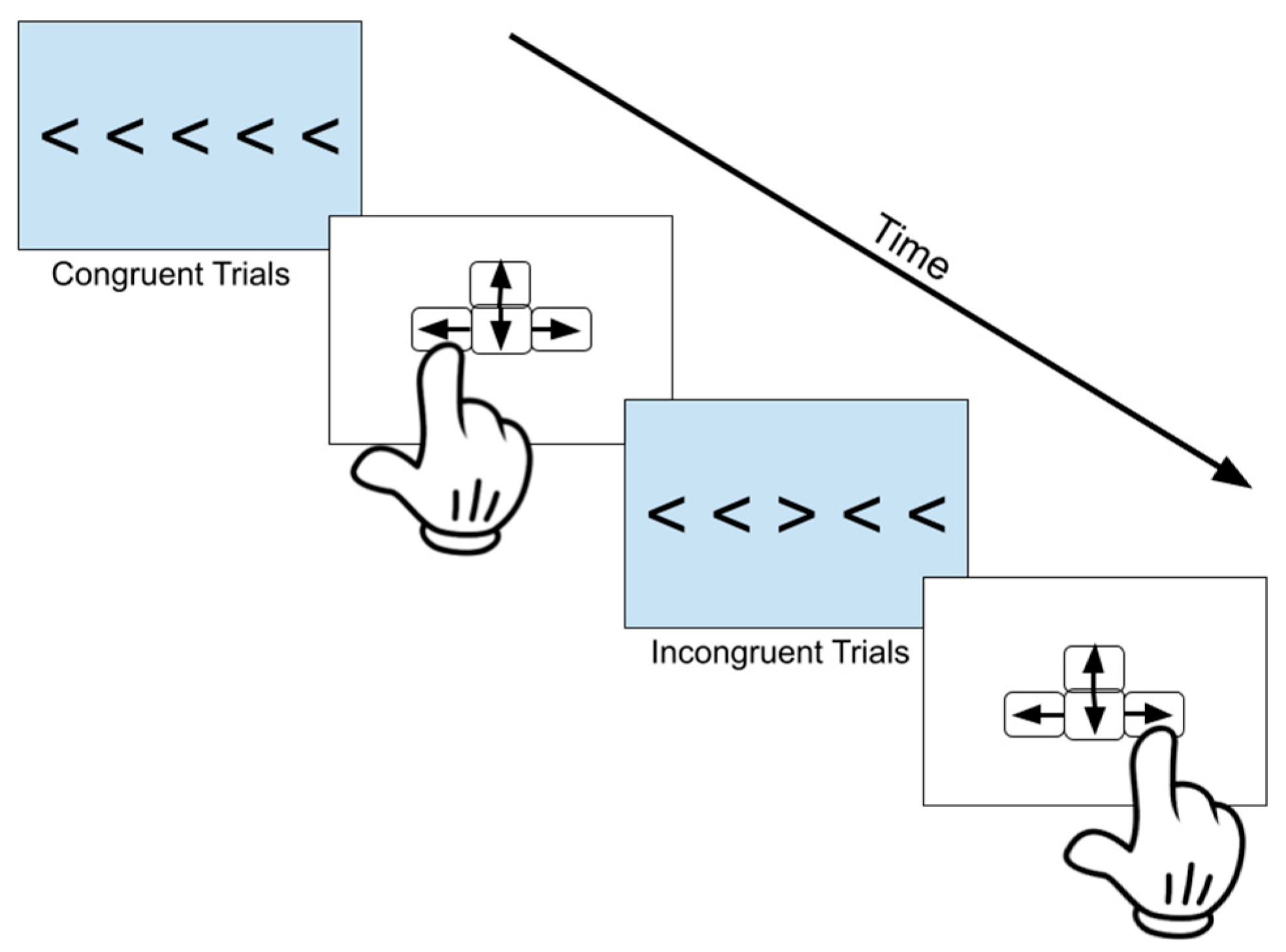
Beginning with these response time tasks, the flanker task requires participants to focus on a fixation point before the presentation of a series of arrows, with the participant being tasked with pressing the arrow corresponding to the arrow directly above their fixation point, as depicted in
Figure 1.
The attention control dimension of the task arises when some trials are “congruent”, where all the presented arrows are pointing in the same direction, or “incongruent”, where arrows flanking the target are pointing in the opposite direction of the target arrow. Classically, these congruent and incongruent trials are compared to each other to produce a difference score (
Eriksen & Eriksen, 1974), but other methods have been proposed, such as using the residuals from regressing the incongruent trial response time onto the congruent trial response time (e.g.,
Byrnes & Was, 2024). The Stroop task uses similar logic, where participants are shown a series of words for colors such as “blue” or “green” that are either printed in the same color as their namesake (congruent) or as a different color (incongruent); the participant is tasked with indicating what color the word was printed in (
Stroop, 1935). The difference in response time between the congruent and incongruent trials is calculated in the same manner as the flanker task.
The non-response time-based tasks avoid the use of differences in response time and instead use accuracy measures. For example, the anti-saccade task requires participants to focus on a fixation point before a distractor stimuli is displayed on one side of the fixation point, followed by the “target” stimuli on the opposite side of the fixation point. If the participant allows their attention to be pulled to the distractor stimuli, the timing is short enough (~100 ms) that they will not have time to reorient to the target stimuli before it is gone (
Hallett, 1978;
Hutchison, 2007;
Kane et al., 2001). Scores for this task are based on the accuracy of the participant’s identification of the target stimulus, which is usually one of a set of letters. Another example is the visual array tasks. The visual array tasks require participants to view a series of colored shapes, specifically telling them to only attend to one color or shape before presenting the stimuli. They are then presented with an array of stimuli, before it is replaced with an array containing only the target stimuli. The participants are tasked with determining if one of the target stimuli had changed between the first and second array (
Draheim et al., 2021). Scores for this task could be based on accuracy, but many use a capacity score calculated as the size of the array times the number of hits and correct rejections minus one (
Cowan et al., 2006;
Shipstead et al., 2014;
Draheim et al., 2021).
Finally, in Engle’s SACT (e.g.,
Draheim et al., 2021), participants are required to inhibit a flashing stimuli and surrounding letters and attend to a central letter at specific cued locations. Each trial starts with a central fixation point. After the fixation, a large white circle cue is presented in a randomly determined location on the screen to orient the participant. The circle begins to shrink in size until it reaches a fixed size and pauses for a variable wait time (equally distributed among 2 s, 4 s, 8 s, and 12 s) before a white distracting asterisk appears at the center of the screen. This distracts the participant from a 3 × 3 array of letters displayed at the center of the cue location, consisting of letters with the central letter as the target letter. After 125 ms, the central letter is obscured and participants are asked to respond what the target letter was (
Draheim et al., 2021). The goal of the task is to control attention such that the distractors (the flash and surrounding letters) do not detract from the goal of central letter identification.
The definition and conceptualization of attention control has changed throughout its development in the literature. The early selection theories, in a somewhat behaviorist way, described attention as the “bottleneck” which determined what external stimuli would be processed and thus responded to. These selection theories waned, as they failed to account for all the phenomena observed, such as Brodabent’s early selection theory being unable to explain the cocktail party effect. These theories gave way to the more modern theories, which deal with attention control as something like an executive function and attempt to integrate work from working memory, inhibition, and other work on executive functions. The dual-component model sees attention control as the ability to maintain and manipulate memory representations of stimuli both internal and external regardless of the presence of interference both internal and external. This definition can be seen to inform the tasks used to measure working memory in the modern literature, as many require the participant to retain focus on a limited portion of stimuli to know how to respond while inhibiting others. However, this integrated definition has been the source of debate over how attention control relates to other executive functions which have overlapping definitions, in particular working memory.
3. What Is Working Memory
Just as with attention control, working memory is an important, but divisive, construct in cognitive psychology. Several definitions of working memory have been applied to it across its history in the field, and even today researchers do not often agree on the particulars. In fact,
Logie et al. (
2021) discuss in depth nine separate definitions of working memory throughout the field,
Miyake and Shah (
1999) discuss ten definitions, and
Cowan (
2016) outlines several approaches, including those from the developmental literature. While several of these lists overlap, it is particularly surprising just how many definitions, or “flavors” as
Cowan (
2016) calls them, are in use, especially when we consider that two of these lists of definitions do not include definitions used outside of the cognitive field, such as in animal cognition research (
Givens & Olton, 1995) or diagnostic criteria (
Daneman & Carpenter, 1980), let alone common parlance. Complicating matters further, these definitions often overlap with one another, which can make it difficult to distinguish between them and what evidence supports what theories or models. Additionally, confusion can arise from the distinction between working memory capacity (WMC) and working memory more generally. To explore this construct, we will start with this distinction between WMC and working memory more generally before exploring several of the more prominent models of working memory and finally the tasks used in the literature to measure it.
3.1. WMC vs. Working Memory
In the extant literature, the terms working memory capacity (WMC) and working memory (more broadly) are often used interchangeably (e.g.,
A. Baddeley, 2010;
Kotyusov et al., 2023). However, some definitions of working memory make this distinction an important one to draw.
Engle (
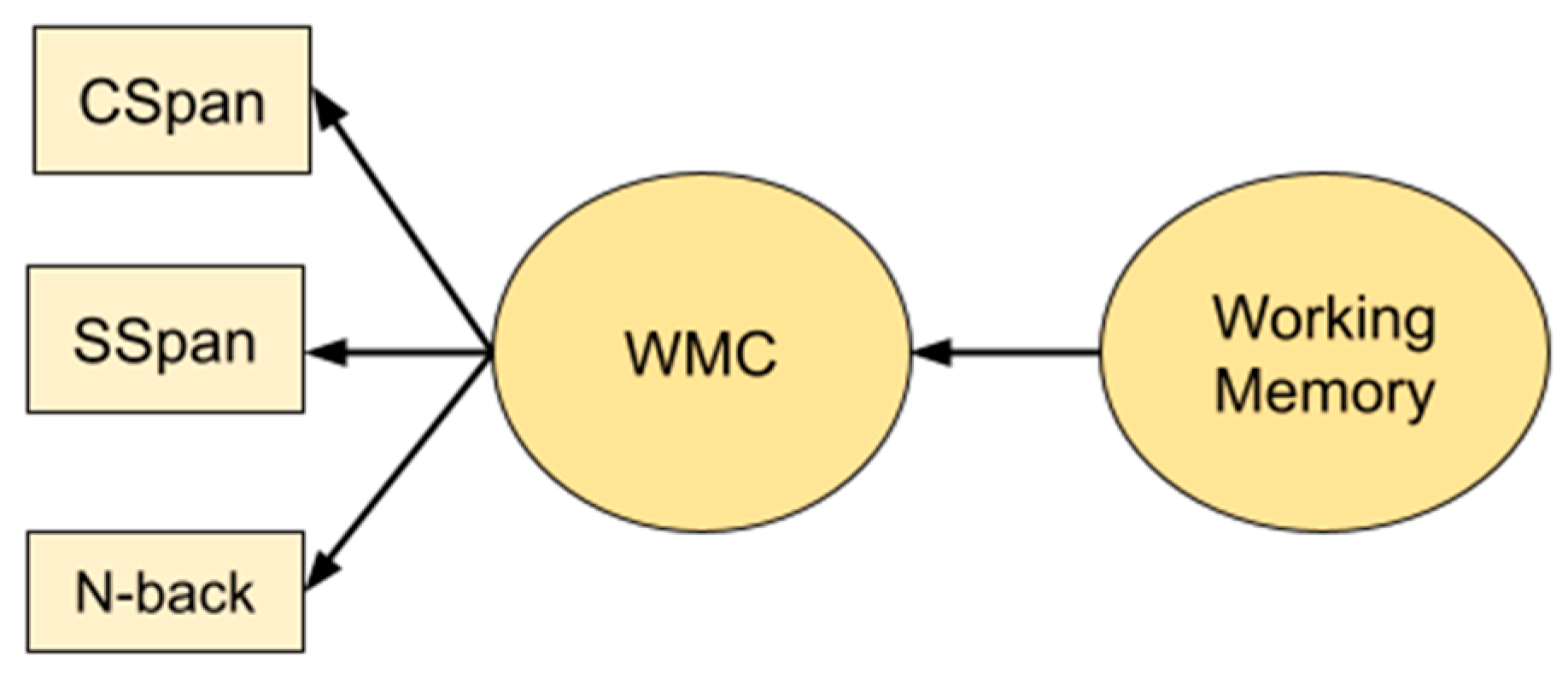
2001) described WMC as being related to attention and representing both the number of items that can be maintained in the focus of attention and the ability to effectively block irrelevant information from the focus of attention. This definition by Engle is expansive and has evolved over time to become the dual-component theory, which is concerned with attention’s role in working memory. For this discussion, we will use Shipstead’s definition; WMC is “a measure of individual differences in the efficacy with which this system (working memory) functions” (
Shipstead et al., 2015, p. 1863). According to Shipstead et al., WMC can be thought of as a measurable way to assess the differences between individuals in working memory but WMC itself is not the construct. From a factor analytic perspective, Shipstead’s view proposes that WMC is a latent variable we can measure with tasks that are associated with a second-order construct of working memory, as depicted in
Figure 2.
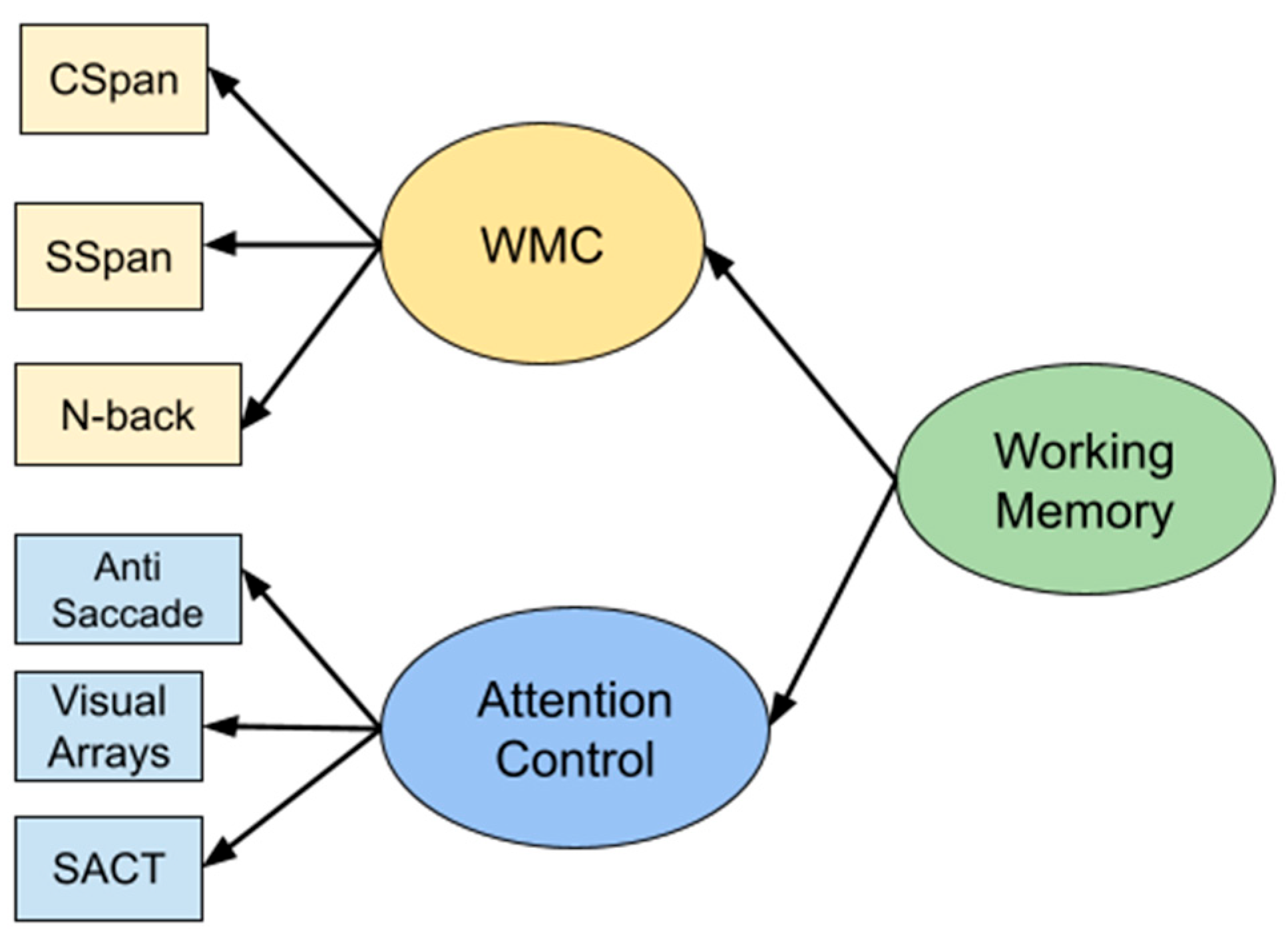
This distinction may seem minor, but it is important to understand when discussing the construct of working memory overall and the efficacy of some measures over others. Reviewing the definition of WMC we started with, the short-term limited capacity for storing, processing, and manipulating elements and information from both internal and external sources, we can use this framework to give a definition of working memory as a whole. We propose that working memory be defined more broadly as a second-order construct comprising WMC and attentional control of the elements stored in WMC necessary to complete tasks, as illustrated in
Figure 3.
3.2. Models and Definitions
Following the review of WMC and working memory and the proposed second-order definition of working memory, we can explore models of working memory that have been previously proposed.
We will begin, in chronological order, with
A. D. Baddeley and Hitch’s (
1994) multiple component model, which is still often taught in undergraduate classrooms today. In this model, Baddeley and Hitch propose that working memory is made up of components separated by modality and controlled by a central executive. The components other than the central executive include the phonological loop, which acts as a short-term store of auditory information, and the visual spatial sketchpad, which acts as a short-term store of visual and spatial information. Both store information from the external world and long-term memory. These two stores were joined in later revisions by the episodic buffer, which acts as a temporary store of information from the other two stores and long-term memory and integrates across modalities. These stores are all directed by a central executive. The central executive is described as a way to incorporate executive processes into the model and builds off of
Norman and Shallice’s (
1986) supervisory attentional system (SAS). The central executive is primarily defined by three primary functions: focusing attention, dividing attention, and switching attention. However, unlike the other components in this model, the central executive does not possess any storage of its own and is only capable of directing the other systems (
A. Baddeley, 2000;
A. D. Baddeley & Hitch, 1994;
Logie et al., 2021). From this definition, the construct of attention control is seemingly baked into the central executive in this model. Baddeley even describes it as an “attentional controller” (
A. Baddeley, 2000, p. 418). This fits with our definition of working memory as a construct composed of attentional control and WMC. WMC in this model can be understood as the individual differences in the amount of information one can store in the phonological loop and visuospatial sketchpad, and attentional control is captured in the executive functions of the central executive. Thus, in the previous example of trying to remember a package’s tracking number, this model would say that you store the number in the phonological loop, and the central executive must attend to the stored information and keep other information from overwriting the number in that store. However, this model does not make clear what mechanisms actually drive these executive functions contained in the central executive. Baddeley and Hitch admit that the central executive is “the most complex and least well understood component of working memory” (
A. D. Baddeley & Hitch, 1994, p. 490). The vagueness of its description and lack of a mechanism for its functions has led to it being criticized as a “homunculus” by detractors. While still prevalent, there are many models which have since built on or refuted it.
One model that built upon Baddeley’s unitary central executive and attempted to elaborate on its executive functions was the model proposed by
Miyake et al. (
2000), who proposed that there were three separable executive functions. This model proposed that shifting between mental sets or tasks (Shifting), information updating and monitoring (Updating), and the inhibition of prepotent responses (Inhibition) were all distinct and accounted for unique variances in performance for working memory measures (
Miyake et al., 2000). Thus, in the previous tracking number example, your inhibition would be responsible for keeping irrelevant stimuli from overwriting the tracking number, and your updating system would be responsible for monitoring the number in your memory and making sure that you had not forgotten it. Looking to our definition of attention control, as with Baddeley’s model, we can see that these executive processes are representative of attention control. In order to filter and suppress irrelevant information, behavior inhibition is necessary. Similarly, updating and monitoring are required to ensure that attention has not slipped and items are still being maintained in an active state, while manipulating those items. Miyake’s model does not directly deal with the storage of working memory, instead focusing on the executive processes that Baddeley’s model did not elaborate on, but not all models take this approach. Some models instead challenged Baddeley’s idea of separable stores of information in working memory directly.
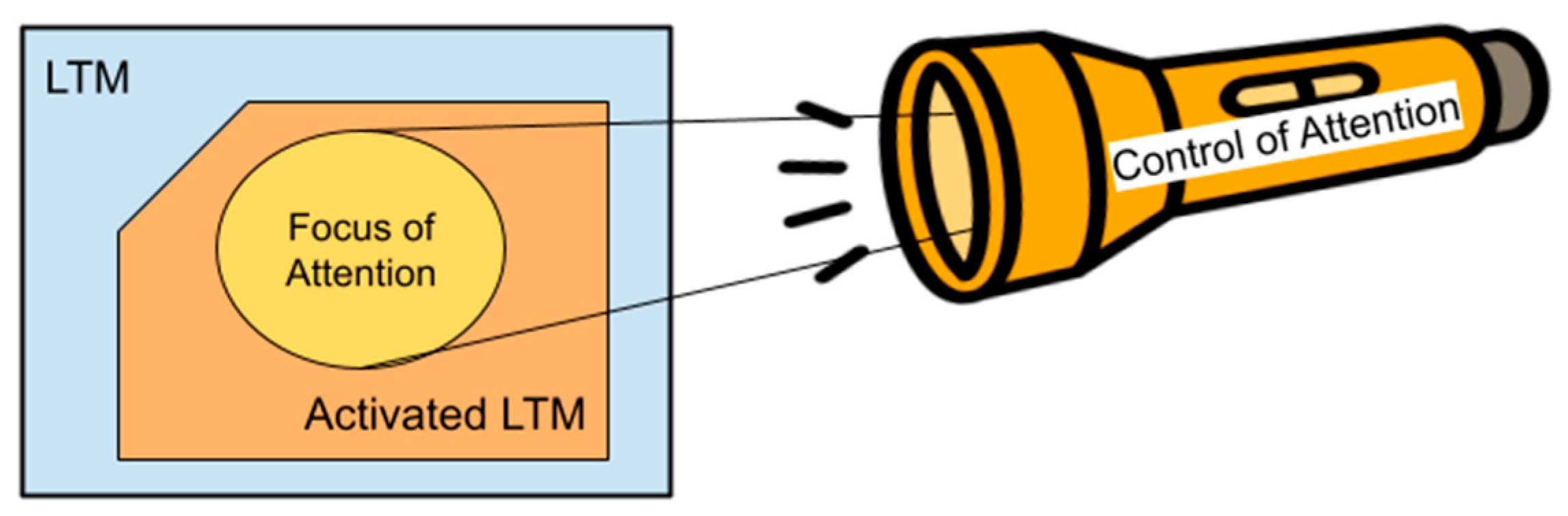
One such model is Cowan’s embedded processes framework. According to this model, working memory is a series of hierarchically arranged faculties comprising long-term memory (LTM), currently activated LTM, and the subset that is currently in the focus of attention (
Cowan, 2010). Items in long-term memory include both physical and semantic features that are activated by external stimuli. These features decay or become less active over time. Activated features enter the focus of attention either automatically or deliberately. The automatic route can pull the focus of attention to previously unattended items if the stimulus is particularly novel or highly activated. Meanwhile, the deliberate route involves executive processes and is based on task demands and can potentially override the automatic route (
Cowan, 2016). This model has been described using a spotlight metaphor (
Cowan et al., 2014). Attention can be thought of as a spotlight shining onto a stage, and the elements of LTM are like actors on the stage. The spotlight can be broad, encompassing many actors at once, or more focused if the audience needs to pay attention to only a few actors in an intense scene, and the center of the spotlight is the focus of attention, as depicted in
Figure 4.
In this model we could think of WMC as the maximum number of actors one could maintain in the spotlight at one time. This is how
Cowan (
2016, p. 247) describes WMC, as “how many items can occupy the focus of attention.” In our previous example of remembering a tracking number, we could describe the number as an activated element in LTM, and we need to keep it within the focus of our attention and not let other “nearby” elements of LTM, such as the contents of the package or the conversation we are having with someone, cause us to shift the “spotlight” elsewhere, losing the number. While this framework does away with Baddeley’s individual stores, it is still broadly compatible with Miyake’s executive processes. We can describe inhibition as the process of keeping “nearby” elements of LTM from entering the focus of attention and shifting as moving the “spotlight” deliberately to another part of the stage. Cowan’s framework is not the only such model to discard the modality-specific stores of Baddeley to instead focus on activated elements of long-term memory.
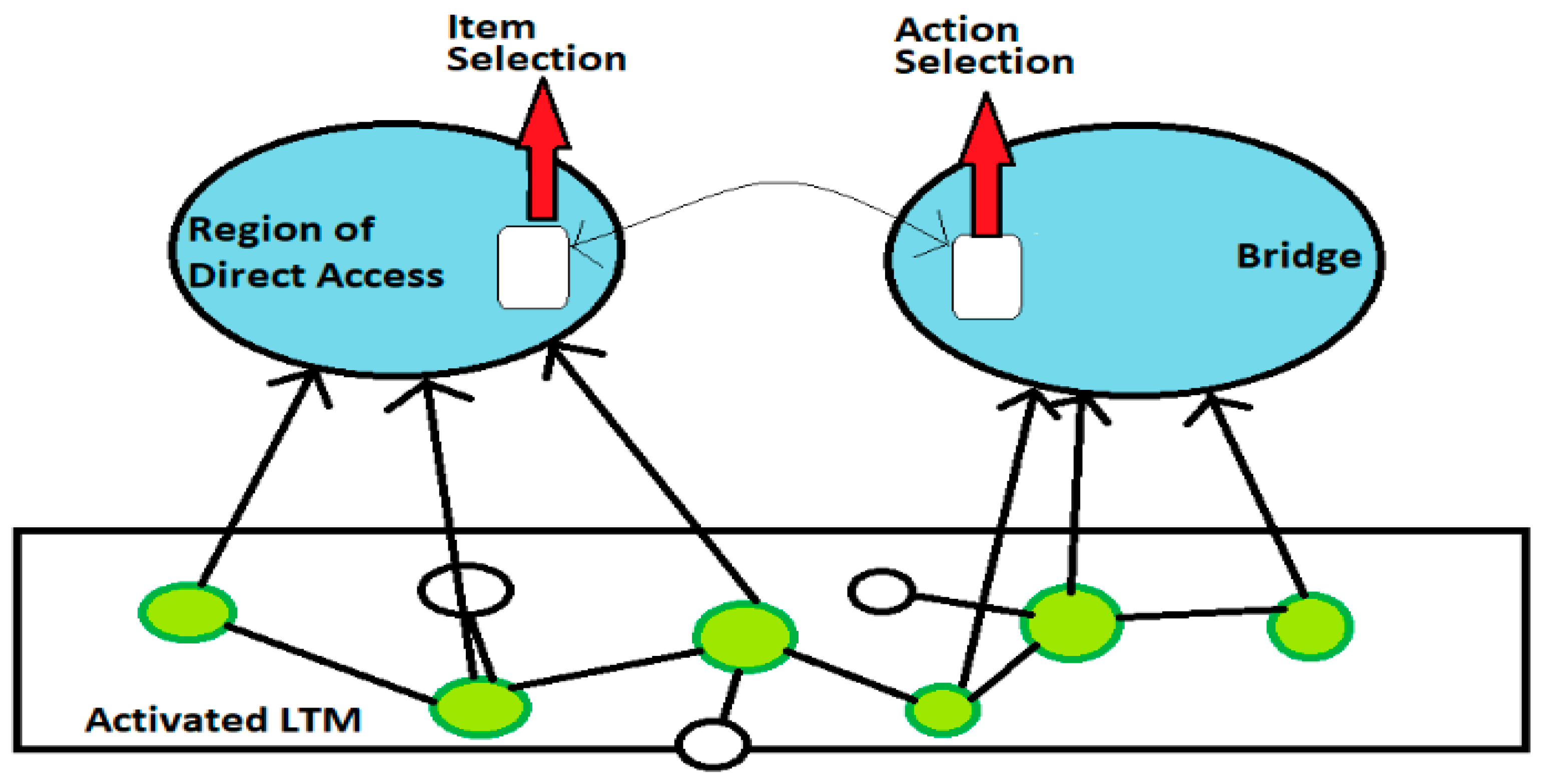
Another model which uses activated long-term memory elements was proposed by Oberauer. In this model, Oberauer describes working memory as being made up of three central parts: activated long-term memory (LTM) elements, a region of direct access, and the bridge (
Oberauer, 2009). The elements of LTM are “activated” or brought into a heightened state by stimuli both external and internal. Oberauer deviates from Cowan’s model by distinguishing between declarative and procedural elements in LTM. A selection of activated declarative elements is brought into the region of direct access, while procedures are brought into the bridge, both of which are limited in capacity. Individual items in the region of direct access can be easily accessed and “loaded” into what Oberauer calls the focus of attention. Similarly, procedural items in the bridge can be easily accessed and “loaded” into the response focus. Once both a procedure and an element from the region of direct access are selected, the procedure can be carried out on the declarative item (
Oberauer et al., 2013). This model is depicted in
Figure 5, which is adapted from
Oberauer et al. (
2013, p. 159).
So, returning again to our tracking number example, the tracking number would be a declarative item activated in LTM and brought into the focus of attention, where we would need to maintain its activation until we reached our computer. Once we reached the computer, we would then need to activate the appropriate procedures necessary to allow us to act on the tracking number and go through the process of actually typing the number into our computer from our LTM into the bridge. From there, we would take each procedure and load it into the response focus, while the number was put into the focus of attention, so that we could use them together. Like Cowan’s model, this model uses activated LTM and a limited capacity “storage” for task-relevant items. While Oberauer’s model differentiates between procedural and declarative elements, we can still think of WMC in this model as the limited size of the region of direct access and the bridge. Oberauer’s model implies that these would be separately taxable by different tasks, with the direct access region able to be shown through memory-set switch costs and task-set switch costs for the bridge (
Oberauer et al., 2013). This is reminiscent of Baddeley’s phonological loop and visuospatial sketchpad being separately taxable stores. We can see our definition of attention control reflected similarly as in Cowan’s model. Attention control involves maintaining items in the region of direct access and the bridge, while simultaneously filtering and suppressing task-irrelevant information and procedures from entering them. Here, we also can see the manipulation component of our definition in the mechanism for using procedures on the items maintained in the focus of attention, as described by Oberauer.
3.3. Measures of Working Memory
With the bevy of definitions and models, it is no wonder that there are many different measures used to examine the construct of working memory. One large distinction is between span and non-span tasks. The primary distinction is that span tasks (STs), both complex and basic, require participants to retain a list of items to be recalled at the end of each block of trials, whereas the non-span tasks do not.
Beginning with simple STs, sometimes called short-term memory (STM) tasks (
Colom et al., 2006), such tasks are designed to tax the participants’ ability to remember an increasingly large series of items to subsequently repeat back in order. These items can be numbers, as in the digit ST, words, as in the forward ST, or the position of shapes, as in the Corsi or dot memory tasks. There are many variants of these tasks, including those that reverse the order or change the specific stimuli. The benefit of these simple STs is that they are relatively simple to administer and often easy for participants to understand. Additionally, these simple STs map onto our understanding of WMC, as they should require participants to hold as many items as they can in their limited capacity at one time. Unfortunately, there have been questions about their validity, particularly as the construct of working memory has grown and evolved. Namely, studies such as
Colom et al. (
2006) have found that STM tasks and complex STs often load onto separate factors, which they label as STM and WM, respectively.
Colom et al. (
2006) recommend using them in a hierarchical fashion, which is similar to the definition of working memory we adopted at the beginning of this review.
Complex STs are, as their name implies, more complex versions of simple STs. These tasks require participants to solve some sort of problem before they are given each word, number, or symbol to remember. This can be a simple math problem, as in the operation ST (O-span), determining if a sentence makes logical sense, as in the reading ST (R-span), indicating if a series of items is symmetrical, as in the symmetry ST, or counting the number of shapes, as in the counting ST (C-span). In all of these tasks, at the end of each series, the participant is asked to repeat the letters, numbers, or symbols they were asked to remember in order (
Was et al., 2011). Just like with simple STs, there are multitudes of variants of these tasks created by researchers for different research questions, including those which require participants to recall the list backwards, often called reversed tasks. Complex STs have been found to have greater correlations with other executive functions and higher order cognitive processes than simple STs. In fact, according to McCabe et al., “The finding that WMC as measured by complex span tasks were so strongly correlated with EF tasks lends support to the idea that the functioning of the central executive component of the multiple component model (
A. D. Baddeley & Hitch, 1994) is captured by complex span tasks” (
McCabe et al., 2010, p. 235). However, here we run into the muddy use of the term working memory. As McCabe goes on to say, “The data from the current study are also consistent with other approaches suggesting that individual differences in complex span tasks primarily measure attentional abilities, such as inhibitory control, goal maintenance, or the focus of attention” (
McCabe et al., 2010, p. 235). This means that, depending on our definition of working memory, complex STs may be measuring more than just one’s ability to hold information in a limited store, but also attentional abilities as well. This is where our hierarchical model of working memory can be useful. We can say that complex STs are tapping both attention control, though the manipulation and updating needed to solve the problems presented, and WMC, in storing the list of items and their order. We can then say that tapping both of these constructs leads to the strong association between these complex STs and working memory overall, as well as other executive functioning tasks.
There are also many non-span tasks that attempt to measure working memory. One of the more common is the so called N-back task, in which a participant is presented with a series of stimuli, often letters, and is then asked to respond when the current stimuli matches the stimuli that appeared N stimuli before the current stimuli. This flexible task can be increased in difficulty by increasing the number (N), as well as by adding lures which match the stimuli one or two off of the correct N (
Kane et al., 2007). This task is similar to an ST, but there has been some research showing that they may not correlate well with complex STs, perhaps because they do not necessarily invoke the same attentional components as those tasks (
Kane et al., 2007). Looking back to our hierarchical definition, this discrepancy could be that the N-back task is more reliant on the attention control component of working memory, perhaps because the task requires a more frequent updating of the list of stimuli and inhibition of now irrelevant stimuli, whereas the simple STs are more closely tapping the WMC component by not requiring as much attention control, as there is less need to inhibit previous stimuli, which leads to their correlations not being as high as expected.
Content-embedded tasks also appear in working memory research as an alternative to complex STs. These tasks all require participants to do some sort of calculation or problem solving in order to know how to adjust some initial stimulus. This can be shifting up or down the alphabet, as in the Alphabet WM task, the order of four letters, as in the ABCD task, or the relative position of a number in a string of numbers, as in the digit-recoding task (
Was et al., 2011). These tasks are much more complex than the ST they originate from and require participants to both hold and manipulate stored information. They have also been shown to account for unique variance in higher order processing, such as reading comprehension, compared to complex STs (
Was et al., 2011). This may set them apart from complex STs, which also require participants to hold and manipulate stored information. However, they also may have the same caveat that complex STs do, that being the fact that, if you define working memory more rigidly or are looking at WMC, then these tasks may be drawing upon other processes. Specifically, the problem solving required by these tasks requires a good deal of manipulation and updating and WMC in storing the list of items and their order, though the hierarchical view of working memory accounts for this in the same way. Namely, the problem solving and updating of the initial stimulus is tapping the attention control component of working memory, while the actual holding of items is more dependent on WMC. As such, clear language is necessary to convey and compare results using all of these methods, particularly when the construct of attention control is also discussed.
Working memory is a construct with many differing models. While some models use working memory capacity (WMC) and working memory interchangeably, some models have found it necessary to distinguish between them. We argue that we can define working memory more broadly as a second-order construct made up of WMC and attentional control of the elements stored in WMC necessary to complete tasks, as illustrated in
Figure 2. This view of WMC and working memory is compatible with several models of working memory that exist within the literature, including those of Oberauer and Cowan. This view of WMC and working memory is also compatible with many of the already existing tasks in the literature. Simple STs measure WMC, while more complex span tasks and content-embedded measures may map onto both WMC and attention control, and as such are viable for questions that wish to examine working memory as a singular construct above the level of WMC and attention control.
4. What Is the Distinction Between These Two Constructs?
These two constructs are clearly highly intertwined, particularly in the dual-component model, which most closely resembles our definitions of attention control. While it may be tempting to merge these two constructs given how similar their definitions are, there is evidence that these are not just a single construct. Factor modeling studies (such as
Draheim et al., 2021,
2022,
2023) have shown that both attention control and working memory can account for unique variance in more general intelligence measures, but the significance of WMC is debated. Some have suggested that this may be due to reliability issues, particularly from response time-based tasks (
Burgoyne et al., 2023;
Draheim et al., 2021). There is also the possibility that other factors may play a role, such as processing speed (
Burgoyne et al., 2023;
Draheim et al., 2019;
Mashburn et al., 2024). We propose that working memory should be considered as a hierarchical construct, with WMC and attention control as nested constructs that load onto it, as depicted in
Figure 5.
This approach fits all of the models presented in this review and allows us to account for unique variance without losing the predictive power of these constructs on higher-order cognitive processes such as reading comprehension. For work which seeks to address research questions which are above the level of WMC and attention control, such as those that have previously tied working memory to other higher-level constructs, this change does not alter previous conclusions. However, for work which examines the contributions of multiple executive functions, this framework will need to be considered. For instance,
Was et al. (
2011) indicate that content-embedded tasks accounted for unique variances in reading comprehension when modeled with more traditional complex STs (O-span, C-span, and R-span). They indicate that “the key difference between content-embedded and complex span tasks is that, for content-embedded tasks, one must continually update processing-relevant information that is being maintained in WM, whereas for complex ST, one must simply keep information active in WM while completing the processing required for an unrelated task” (p. 914). Considering these results with the hierarchical definition of working memory, it is possible that these content-embedded tasks are tapping the attentional control component more directly, while the STs are better able to tap the WMC component. At first glance, the fact that previous works such as (
McCabe et al., 2010) have indicated that there is an attentional component of complex STs seems to contradict this interpretation. However, if we consider the high degree of correlation between content-embedded and complex span tasks shown by
Was et al. (
2011), it is possible that this correlation is partially due to the overlap of tapped constructs. This framework would predict a more significant split between content-embedded tasks and simple STs compared to complex STs, as the simple STs more cleanly tap WMC, whereas complex STs likely tap both WMC and attention control. Interpretations of existing work in the literature like this are worth exploring in further replications and extensions to test this definitional framework.
5. Neuropsychological Mechanisms Linking Attention Control and Working Memory
The persistent conceptual overlap between attention control and working memory has motivated a shift away from purely psychometric descriptions toward neuropsychological accounts that specify the neural systems responsible for cognitive stability, flexibility, and goal maintenance. While early latent-variable models demonstrated robust correlations between attention control and WMC, they offered limited insight into how these constructs are implemented in the brain. Contemporary neuroscience has begun to fill this gap by identifying shared large-scale control networks and neuromodulatory mechanisms that jointly support the maintenance, updating, and suppression of information in the service of goal-directed behavior. These findings provide a mechanistic foundation for dual-component models in which attention control regulates the use of limited working memory resources.
At the systems level, converging evidence implicates the frontoparietal control network (FPCN) as a central substrate for both attention control and working memory. Core regions of this network—including the dorsolateral prefrontal cortex (DLPFC), inferior frontal junction (IFJ), anterior cingulate cortex (ACC), and intraparietal sulcus (IPS)—exhibit sustained activation during tasks requiring the maintenance of task goals, resistance to distraction, and flexible updating of information (
D’Esposito & Postle, 2015). Functional connectivity analyses indicate that the FPCN dynamically couples with sensory cortices during attentional selection and with medial temporal and posterior cortical regions during mnemonic maintenance. This flexible coupling allows the same control architecture to support both perceptual prioritization and internal representational stability.
Neurophysiological studies further suggest that attention control and working memory rely on distinct yet interacting temporal dynamics within these networks. Sustained low-frequency oscillations, particularly in the theta and alpha bands, have been associated with the maintenance of task-relevant representations, whereas higher-frequency gamma activity appears to support the transient reactivation and updating of stored information. These oscillatory regimes provide a physiological instantiation of the dual-component distinction between maintenance and disengagement, indicating that control is not a unitary process but a coordination of multiple rhythmic processes operating across timescales.
Individual differences in attention control and WMC also appear to arise from variability in the neuromodulatory systems that regulate prefrontal function. Dopamine plays a particularly prominent role in shaping the stability–flexibility trade-off inherent in working memory. Tonic dopaminergic activity enhances the robustness of maintained representations by increasing the neural gain and signal-to-noise ratios, whereas phasic dopamine release facilitates updating by transiently destabilizing existing representations (
Cools & D’Esposito, 2011). This balance is critical for adaptive control: excessive stability leads to perseveration, whereas excessive flexibility results in distractibility. Noradrenergic modulation, originating in the locus coeruleus, exerts complementary effects by regulating attentional breadth, task engagement, and responsiveness to salient events (
Aston-Jones & Cohen, 2005). Together, these systems suggest that individual differences in WMC and attention control reflect differences in the dynamic regulation of control parameters rather than fixed structural limits.
Importantly, neuropsychological evidence challenges strictly hierarchical accounts in which attention control unidirectionally governs working memory. Representations actively maintained in the working memory have been shown to bias perceptual selection automatically, producing working memory-driven attentional capture (
Carlisle et al., 2011;
Soto et al., 2008). This phenomenon demonstrates that mnemonic contents can shape future attentional allocation even in the absence of explicit goals, indicating a recurrent loop between control and representation. Such reciprocity supports models in which attention and working memory are dynamically coupled processes embedded within the same control architecture.
Temporal dynamics further complicate this relationship. Contemporary control theories distinguish between proactive control—characterized by sustained goal maintenance—and reactive control, which is transiently recruited in response to conflict or interference (
Braver, 2012). These modes map closely onto individual differences in WMC, with higher-capacity individuals more likely to engage in proactive control strategies that maintain task goals over extended intervals. This evidence suggests that WMC reflects not only the number or precision of maintained representations but also the endurance and consistency of attentional control across time. Neuropsychologically, these distinctions reinforce the view that working memory capacity is inseparable from the temporal dynamics of control engagement.
6. Computational Models of Attention Control and Working Memory Integration
In parallel with neuropsychological advances, computational modeling has provided formal tools for understanding how attention control and working memory emerge from shared representational and regulatory mechanisms. Rather than treating working memory as a static buffer, contemporary models increasingly conceptualize it as the dynamic stabilization of prioritized representations within a competitive neural workspace (
Wang, 2022;
Constantinidis et al., 2022). Within this framework, attention corresponds to the selective allocation of representational resources, while working memory reflects the sustained protection of those representations against noise and interference.
Neural resource models based on population coding offer a particularly influential account of this integration. These models posit that working memory consists of a finite pool of representational precision distributed across concurrently maintained items (
Bays, 2015). Attention control operates by dynamically reallocating this precision, enhancing the fidelity of task-relevant items at the expense of less relevant information. From this perspective, capacity limitations emerge naturally from trade-offs in precision, and individual differences in WMC reflect differences in the efficiency with which attention control manages these trade-offs. This account provides a direct computational realization of hierarchical models in which attention control governs the effective use of mnemonic resources.
Predictive coding and Bayesian inference models extend this logic by embedding attention and working memory within a unified inferential framework. In these models, cortical processing is organized around the minimization of prediction error across hierarchical levels (
Friston et al., 2017). Attention corresponds to the precision weighting of sensory and internal signals, determining which sources of information exert the greatest influence on belief updating. Working memory, in turn, reflects the maintenance of high-level generative models that predict task-relevant input over time. This approach re-frames working memory as an active inference process, emphasizing its role in guiding perception and action rather than merely storing information. Attention control thus becomes the mechanism by which the system regulates uncertainty and allocates inferential resources.
Recent computational developments have also begun to address individual differences through learning-based architectures. Recurrent neural networks incorporating biologically inspired gating mechanisms simulate how selective updating and inhibition can be acquired through reinforcement learning (
O’Reilly & Frank, 2006). These models reproduce hallmark behavioral phenomena observed in attention control tasks, such as selective failures in the anti-saccade task or interference effects in the N-back, and suggest that variability in performance may arise from differences in learned control policies rather than immutable capacity constraints. Similarly, models incorporating spike-timing-dependent plasticity demonstrate how stable working memory representations can emerge from recurrent reactivation patterns shaped by experience (
Barbosa et al., 2020).
Crucially, computational models also capture the bidirectional interaction between attention and working memory observed in neural data. Maintained representations bias future attentional selection by altering competitive dynamics within the workspace, while attentional signals modulate which representations are stabilized or updated. This reciprocal influence challenges modular views of cognition and supports architectures characterized by recurrent loops and distributed control. From this perspective, attention control and working memory are best understood as complementary functions of the same adaptive system rather than separable cognitive faculties.
Collectively, these computational approaches help reconcile historically competing theories of capacity and control. Structural constraints arise from limits on representational precision, neural synchrony, and learning dynamics, while control processes determine how these constraints are navigated in real time. Working memory capacity thus reflects the quantitative limits of active representations, whereas attention control reflects the qualitative regulation of those representations across contexts and timescales. This synthesis aligns with the hierarchical framework advanced in this manuscript, while emphasizing that hierarchy does not imply strict top-down supervision but rather dynamic coordination within a unified control architecture.
7. Conclusions and Future Directions
The review presented here emphasizes that the constructs of attention control, WMC, and working memory more broadly are deeply intertwined, both conceptually and mechanistically. Building upon the behavioral and psychometric foundations of previous research, contemporary neuroscientific and computational findings converge on a shared principle: cognitive control arises from the dynamic regulation of limited representational resources within a distributed neural network. In this light, attention control can be viewed as the mechanism by which the brain flexibly allocates and protects these resources, while working memory reflects the temporary representational state that results from such regulation.
This integrated view has several important implications. First, it supports the hierarchical model advanced in the current manuscript while recognizing that the hierarchy is functionally reciprocal. Attention control directs how memory resources are allocated, while the information held in working memory, in turn, influences control settings and guides what is perceived. This interplay aligns with findings from neuroimaging and electrophysiology that demonstrate a bidirectional communication between prefrontal and posterior cortical areas. Second, it encourages a rethinking of measurement practices. Many classic behavioral tasks conflate control and capacity demands; for example, complex span tasks involve storage, processing, and inhibition. Combining these behavioral paradigms with neurophysiological measures—such as oscillatory coherence, event-related potentials, or neuromodulatory signatures—could help disentangle the relative contributions of each component to performance.
Future research should also focus on multilevel modeling approaches that can capture how individual differences in attention control and working memory emerge from common neural substrates. Latent variable techniques can be combined with connectome-based predictive modeling to examine how structural and functional connectivity constrain cognitive capacity. Similarly, computational models that integrate reinforcement learning and neural network dynamics can be used to simulate how control policies evolve with experience, providing a bridge between cognitive theory and neurobiology.
Applied domains stand to benefit from this integrative framework as well. In educational and occupational settings, interventions designed to improve working memory often yield inconsistent results. A more mechanistic understanding of attention control’s role in regulating working memory resources could inform more targeted approaches—for instance, training programs that focus on enhancing proactive control or reducing susceptibility to interference. Moreover, understanding how neuromodulatory states (e.g., arousal, fatigue, stress) alter control dynamics offers a pathway to contextualize variability in performance across individuals and tasks.
As the field advances, progress will depend on integrative methodologies that move beyond descriptive correlations to causal and mechanistic explanations. Testing the hierarchical model at behavioral, neural, and computational levels will not only clarify the architecture of cognitive control but also strengthen our understanding of how human cognition achieves its remarkable flexibility and focus in a world of competing demands.