Article

A Low-Cost Static and Wearable Passive Sampler for Chemical Fingerprinting of Indoor and Outdoor Airborne Semi-Volatile Organic Compounds


1
Environmental Research Group, MRC Centre for Environment and Health, Imperial College London, 86 Wood Lane, London W12 0BZ, UK
2
NIHR Health Protection Research Unit in Chemical and Radiation Threats and Hazards, Imperial College London, 86 Wood Lane, London W12 0BZ, UK
3
NIHR Health Protection Research Unit in Environmental Exposures and Health, Imperial College London, 86 Wood Lane, London W12 0BZ, UK
*
Author to whom correspondence should be addressed.
Int. J. Environ. Med. 2026, 1(3), 11; https://doi.org/10.3390/ijem1030011
Submission received: 24 April 2026 / Revised: 15 June 2026 / Accepted: 22 June 2026 / Published: 2 July 2026

Abstract

Understanding indoor and outdoor airborne organic mixtures, including semi-volatile organic compounds (sVOCs), remains challenging as quantitative monitoring is often costly and difficult to scale across buildings and individuals. Here we present a low-cost, miniaturised passive sampler-based methodology for static and wearable deployment to generate time-integrated chemical fingerprints and source prioritisation. New sampler devices containing replicate 9 mm sorbent discs (Tenax® TA and/or polydimethylsiloxane) were deployed for 28 days in indoor (kitchen, bedroom) and outdoor (roadside) environments and worn by five participants; extracts were analysed by liquid extraction and gas chromatography–mass spectrometry (GC-MS) using conservative, transparent criteria for tentative compound identification. Across the household deployments, 52 compounds met inclusion criteria and distinct room-specific and outdoor chemical signatures were observed. Wearable deployments also produced differentiable chemical profiles, with greater similarity among co-inhabitants, but still could differentiate co-habitant activities based on exposure. These results demonstrate the feasibility of using miniature passive samplers to obtain reproducible, information-rich profiles that can help discriminate environments and exposure scenarios.

1. Introduction

Air pollution is a pressing global concern with far-reaching implications for human health and well-being. Among pollutants of growing concern, semi-volatile organic compounds (sVOCs) are significant contributors to indoor and outdoor air quality [1]. These compounds, characterised by intermediate volatility between volatile organic compounds (VOCs) and particulate matter (PM), are emitted from a wide range of sources, including industrial processes, vehicle exhaust, consumer products, and household chemicals. Exposure to VOCs and sVOCs has been linked to adverse health effects such as respiratory irritation, headaches, and chronic disease [1,2,3,4]. To better understand the range of sVOC exposures, this study evaluates the utility of novel passive samplers in indoor and outdoor environments, both at fixed locations and as wearable devices.
In this context, it is helpful to distinguish between what a monitoring technology attempts to do and the evidential level it is designed to deliver. Here, we position our miniature passive sampler as a complementary pre-screening tool: its primary objective was rapid and efficient collection of chemically rich profiles (“fingerprints”) that enable robust discrimination of chemical profiles in and between environments, households, and individuals. Accordingly, this study does not aim to infer health risk, regulatory exceedance, or compliance from detection alone (but is potentially applicable to early detection of highly toxic sVOCs or chemical markers of pathogens).
Assessing the risk posed by airborne chemicals at individual and population levels requires detailed characterisation of complex mixtures, including how they vary across time, space, and human behaviour. As people spend over 80% of their time indoors [1,2,3,4], they are exposed to many chemicals from diverse sources. Comprehensive chemical profiles are therefore needed to understand the spectrum of potential indoor exposures. This, in turn, requires scalable analytical approaches for sampling and/or measurement that can be integrated conveniently and cost-effectively into indoor settings, ideally with minimal user input and a low risk of failure. High-precision approaches (e.g., calibrated active sampling and targeted analysis) are then ultimately used for accurate quantification of specified compounds to determine risk factors [5].
Indoor air contains a complex, dynamic mixture of chemicals derived from cleaning agents, combustion appliances, electronic equipment, paint, building materials, furnishings, biocides, and human and animal emissions [6]. Compounds emitted from these sources can co-react and undergo oxidation or photochemical reactions, generating secondary aerosols and potentially thousands of additional molecules [7,8]. sVOCs dynamically partition between the gas phase and condensed phases, including airborne particles, surface films, settled dust, and building materials [9]. This partitioning depends strongly on temperature, humidity, ventilation, airborne particle density, and compound volatility and thermal stability [9]. The World Health Organisation classifies VOCs and very volatile organic compounds (vVOCs) as having boiling points below 240 °C, and sVOCs as ranging from 240 to 400 °C [4]. Accordingly, chemical screening of indoor and outdoor air requires sampling devices capable of capturing compounds across a wide range of boiling points.
Passive air sampling captures time-integrated chemical exposures through diffusion and sorption in or onto a sorbent over a defined sampling period [10,11]. Compared with active air-monitoring approaches, passive samplers are attractive due to their affordability, simple design and installation, and user-friendliness [12]. The passive sampler device (PSD) housing and sorbent largely determine the sampling rate and the range of chemicals taken up. PSDs commonly use particle-based sorbent beds [13] (e.g., packed phenylene oxide derivatives, activated carbon, etc.) or surface coatings (e.g., polydimethylsiloxane, waxes, etc.) to capture diverse compounds. We previously developed a novel passive air sampler for security-related investigations of volatile explosive vapours based on a liquid-film sorbent coating [14]. Rather than using particle-packed beds, sorbents could be solubilised and coated onto a meta-aramid-based substrate, which made it suitable for direct thermal desorption mass spectrometric analysis. This approach provided flexibility for continuous, discrete, and autonomous passive monitoring of explosives and marking agents in indoor and outdoor environments as an early-warning system [14,15]. This same method is adapted in the present study as 2,6-diphenylphenylene oxide (Tenax® TA) coated-Emfab filters and polydimethylsiloxane (PDMS) discs are enclosed in our Teflon-based sampler housing [16] to be used for passive sampling of indoor air and exposure profiles.
Wearable silicone-type sorbents have also emerged over the past decade [17] to evaluate occupational [18,19] and environmental exposures [20], including in homes [21]. They provide a low-cost, convenient, and effective approach for studying vapour-mixture exposures in large-scale monitoring programmes [22]. However, they have rarely been integrated with replicate and/or alternative sorbent chemistries within the same PSD, which could expand the chemical space captured while maintaining a compact format. A multi-modal approach may therefore extend capability and confidence by combining multiple molecular interaction modes. The techniques used for measuring and profiling indoor VOCs and sVOCs depend on the objectives of the research and therefore vary across studies. In America, the recent HOMEChem study [23] employed direct measurement via proton-transfer reaction mass spectrometry to assess VOC emissions in response to specific activity events such as cooking and cleaning over a 24-h period. In the UK and EU, the WellHome [24], INGENIOUS [25] and INQUIRE [26] projects aim to use a variety of sampling methods followed by GC-MS analyses to profile VOCs and sVOCs across many homes to better understand geographical, environmental and behavioural drivers of indoor chemical profiles.
In this proof-of-concept study, we describe the development and application of a miniaturised, multi-modal PSD-based methodology for broad, non-targeted characterisation of indoor and outdoor air environments. The objectives were: (a) to assess the PSD’s practical capacity to house multiple sampling sorbents (2,6-diphenylphenylene oxide (Tenax® TA) and/or polydimethylsiloxane (PDMS)) and generate consistent chemical profiles; (b) to deploy PSDs to screen for and compare location-specific chemical fingerprints across indoor and outdoor settings; and (c) to explore whether wearable PSDs yield differentiable personal chemical fingerprints over a 28-day period.

2. Materials and Methods

Analytical and experimental materials: The following standards were employed for quality controls: C7 to C40 Linear Alkane mix at 1000 µg/mL in hexane (Merck Chemicals Ltd., Gillingham, UK) and EPA PAH Mix Standard A at 500 µg/mL in dichloromethane (DCM) (Sigma-Aldrich, Gillingham, UK). Solvents used included ethyl acetate 99.8% (VWR International Ltd., Lutterworth, UK), dichloromethane (Fisher Scientific, Loughborough, UK) and methanol (Merck Chemicals Ltd., Darmstadt, Germany). Materials used include the sorbent Tenax® TA (60–80 mesh) poly(2,6-diphenyl-p-phenylene) oxide (Sigma-Aldrich, Gillingham, UK), white silicone wristbands (polydimethylsiloxane (PDMS)) purchased from Amazon UK (London, UK), Emfab membranes (PALLFLEX®, PALL Life Sciences, Portsmouth, UK) and a PTFE sheet (8 mm × 600 mm × 300 mm) (Direct Plastics Ltd., Leicester, UK).
Design and fabrication of the passive sampling device: The passive sampler housing was based on a 3D-printed prototype where up to five separate sorbent discs were sandwiched together in a rounded housing of 32 mm × 9 mm. The schematic and computer-aided design (CAD) files can be found in Richardson et al. [16]. In these trials, the sampler was milled on a computer numerical control (CNC) router in polytetraflouroethylene (PTFE, or Teflon). This enabled a faster manufacturing process than a previously developed stereolithography-based approach, of up to 12 devices an hour, while reducing fabrication costs [16].
Passive air sampling sorbents, set-up and liquid extraction: Passive samplers housed five disc-shaped sorbents of 9 mm diameter. In this trial, a handheld 9 mm steel punch was used on Emfab (PALLFLEX®) membranes, bought as 47 mm diameter discs (PALL Life Sciences, Portsmouth, UK). These were coated in a liquid sorbent, Tenax® TA granules dissolved in dichloromethane, following the method protocol in McEneff et al. [14,15]. The Tenax® TA-coated sorbents were then rinsed in three successive methanol washes. PDMS wristbands were also steel-punched to 9 mm discs, rinsed in ultrapure water, and then pretreated by baking at 300 °C for 130 min to minimise contamination. After baking, the discs were soaked in DCM using clean, sealed Duran glass jars. The discs underwent successive 24 h soaks, with the DCM replaced for each soak in triplicate, and were then air dried between two sheets of foil [27,28,29,30]. All cleaned sorbents were wrapped in foil, placed in a sealed tin and stored at −20 °C. After deployment, the sorbents were extracted in 300 µL of ethyl acetate added to amber glass vials, followed by agitation for 5 min on a shaker, 20 min in an ultrasonicator bath and a final 1 min vortex mix before transferring to GC-MS vials for analysis. No derivatisation was performed in this study.
Experimental study design: First, passive samplers were assessed to determine an optimal sampling period. In this field trial, samplers containing triplicate Tenax® TA-coated Emfab discs were deployed in a kitchen in a home in Greater London (Four PSDs, each containing five replicate Tenax-coated discs). Sorbents were prepared in the laboratory as described above, wrapped in two layers of foil, and transported in a sealed container. PSDs were deployed for successive seven-day periods over one month; all devices were then retrieved, returned to the laboratory, and stored at −20 °C. The schematic diagram outlined in Figure S1 illustrates the steps in this preparation. Next, PSDs were simultaneously deployed for one month in the kitchen, bedroom, and outdoors at an urban home (one PSD per location, each containing five replicate sorbent discs). Doors were largely left open throughout the study to increase air exchange. Windows were opened intermittently and for short periods (typically less than one hour). In the kitchen, ventilation was additionally influenced by a single active extractor vent above a gas cooker used approximately once to twice daily during food preparation.
Finally, in a separate experiment, five participants were recruited to wear a PSD on a lanyard (each fitted with five TENAX-coated filters). Participants lived in three households, two of which had two co-inhabiting participants, and each household also had static samplers deployed in the living room and at a roadside outdoor location. Participants were encouraged to wear the PSD throughout the day, place it adjacent to them at night and to avoid getting it wet during bathing or washing.
Instrumental analysis: Samples were randomised and analysed using gas chromatography-mass spectrometry (GC-MS) on a Shimadzu QP2020-NX (Shimadzu Corporation, Kyoto, Japan). Separations were performed using the Rtx-5MS capillary column 30 m × 0.25 mm, 0.25 µm film thickness (Restek UK Ltd., Ripley, UK), held for 1.5 min at 67 °C, a gradient to 330 °C for 16 min, and held for 3 min at 330 °C. The flow rate of the Helium carrier gas is 1.5 mL/min. Splitless injection was used to maximise sensitivity. The MS was operated at a scan range of 35–600 m/z, a scan rate of 4.0 s−1, an ion source temperature of 230 °C and an ionising energy of 70 eV.
Peak identification criteria: The following criteria were adopted for peak identification, and only compounds that satisfied all points were shortlisted. Peaks that were detected in all three sample replicates were considered further for identification. All peaks with a signal-to-noise (S/N) ratio less than 3:1 were removed from the dataset. Manual mass spectral interpretation of the NIST library (version: NIST17) matches for each peak was conducted—a minimum match score of 70% was set for consideration, and any compounds below were removed. Retention index (RI) matching of candidate peak IDs was conducted by analysing a series of alkanes (C7–C40) alongside the samples and calculating the RI values relative to the retention times of the alkanes. Peak IDs that were found to have an RI value within 15 points of the reference data available on the NIST Chemistry WebBook database were included in this study. Three field blanks were included; these were fully prepared PSDs wrapped in two layers of tinfoil and transported sealed during deployments and collection. Blank filters were prepared and treated the same as samples, but wrapped in tinfoil and immediately stored in ultra-low (−70 °C) freezers (n = 3). Blank solvent samples were prepared and analysed using the same workflow. For compounds detected in both samples and blanks to be included in the final dataset, the abundance must have been a minimum of five-fold higher in samples. Compounds detected in blanks are reported in Supplementary Information, Table S1.
Statistics and data analysis: All data were processed using GCMS Postrun Analysis in the NIST17 libraries (GCMS Solution Version 4.50). Statistical methods were applied to peak areas, peak heights, and retention times to create contaminant profiles. Hierarchical clustering (HCA) and principal component analysis (PCA) were carried out on the data sets using the following R packages: ‘pheatmap’ (version: 1.0.12), which uses a complete linkage method and Euclidean distance metric. Other R packages used for the graphics in this study were the following: ‘tidyverse’ (version: 1.3.1), ‘ggplot2’ (version: 3.3.5), and ‘ggfortify’ (version: 0.4.12). Statistical analyses were facilitated by the R package ‘ggpubr’ (version: 0.4.0). Mean comparison p-values were calculated using the Wilcoxon test to test significant differences in chemical abundance uptake between PDMS and Tenax® TA.

3. Results

In the present study, we tested whether a miniature passive sampler device (PSD) prototype, originally developed for monitoring contaminants in aquatic environments [16], could be adapted for qualitative, chemical profiling of airborne organic compounds, with emphasis on sVOCs using a liquid-extraction GC-MS workflow. The motivation was to explore whether self-manufactured, customisable, and reusable devices could support scalable chemical fingerprinting across ambient air environments, including wearable deployments for personal monitoring in cohort-style studies.

Chemical Exchange, Desorption Characteristics, and Storage Stability

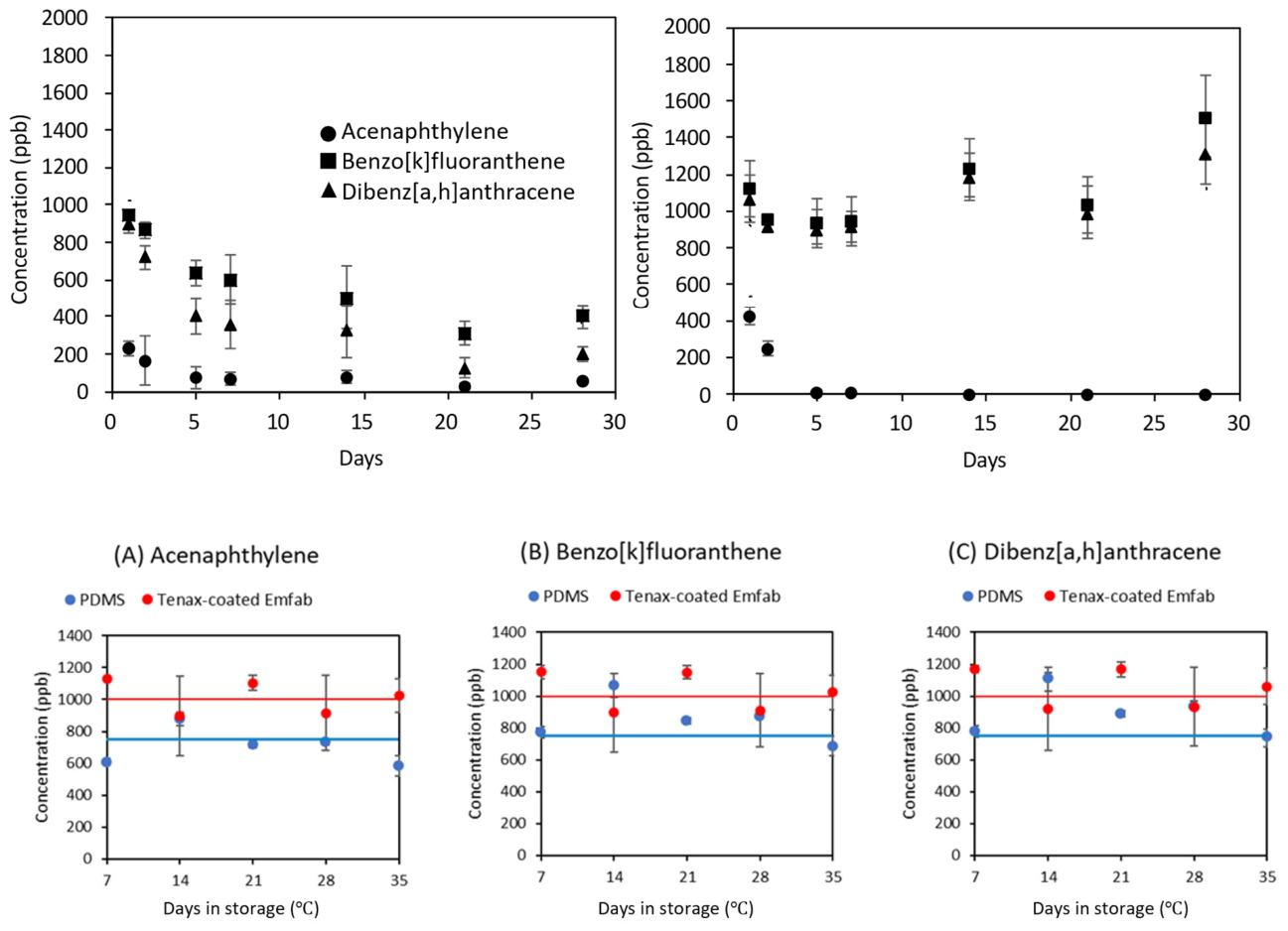
Figure 1 plots three of the sVOCs for Tenax-coated Emfab and PDMS sorbents, chosen for their range in boiling point and molecular weight. PDMS had a stronger sorption capacity than Tenax, which was a limitation during extraction and could explain the method protocol for PDMS requiring longer agitation and sonication. These complex desorption characteristics make passive sampling challenging for quantitative analysis, as there is no simplistic linear accumulation due to the variations in adsorption and desorption for each chemical. However, after seven days, measured concentrations plateaued to steady-state for all compounds. Additionally, it was important to ensure that following 28 days, significant sample loss did not occur. Figure 1 shows concentrations of acenaphthylene, benzo[k]fluoranthene and dibenz[a,h]anthracene extracted from samplers at different storage time periods at −70 °C. All compounds showed good stability after 35 days, with between 2% and 10% loss. Therefore, samplers can be stored for at least 35 days with minimal losses at −70 °C.
Temporal deployment trial: To inform selection of a practical deployment duration for subsequent experiments, PSDs were deployed for 7, 14, 21, and 28 days. Figure S1 shows peak areas (base-peak ion abundance from extracted ion chromatograms) for 11 representative compounds detected at all time points in all replicates. Peak abundances were lowest after seven days and increased with deployment duration; the highest abundances were observed at 28 days. Based on these observations, a 28-day deployment period was used for subsequent deployments in this study.
Multi-functional sorbent capability: The capability for housing multiple sorbent types was investigated by incorporating PDMS discs into samplers for sVOCs during a 28-day wearable deployment with two participants. Corresponding Tenax® TA sorbent samplers were simultaneously worn with the PDMS by two participants and an additional three participants (without PDMS). PDMS is a strongly hydrophobic polymer that has a high affinity for non-polar molecules [31,32]. Tenax® TA (2,6-diphenylphenylene oxide) is widely used for air sampling and can capture a wide variety of chemicals across a range of polarities. Following the 28-period, 43 compounds passed all inclusion criteria. Significantly higher abundances of alcohols, esters and aromatic hydrocarbons were recovered from the PDMS discs (Figure S3). Similar abundances of ketones, aldehydes, acids, and aliphatic hydrocarbons were collected from both sorbents. Although Tenax® TA has capabilities of capturing compounds with boiling points ranging between 60 and 350 °C [33,34], the identified compounds across the Tenax® TA sorbents were semi-volatile with boiling points higher than 210 °C. This was likely due to evaporation of lower-boiling-point compounds during the solvent extraction step [35]. The 2 mm thickness of the PDMS discs potentially facilitated analyte retention due to the permeable properties of PDMS [36] as opposed to the thin coating of Tenax® TA sorbent. Exploring the use of Carboxen-coated sorbents in the future may also be a viable approach to increasing the chemical range in the lower boiling point range. The data collected demonstrate the capability of the sampler to employ multiple sorbent types for air sampling and highlight its applicability for untargeted chemical screening in the future.
Classification of indoor and outdoor exposures: In this experiment, passive samplers were deployed in a kitchen, bedroom, and outdoors (one PSD per location, containing five replicate sorbent discs) at a single household for 28 days to assess whether location-specific chemical fingerprints could be recovered. After deployment, 127 unique peaks were detected across all samples. Field blank analyses (three sorbents in one PSD) were used to remove compounds plausibly originating from the sampler itself or transport/handling (43 compounds, Supplementary Information, Table S1). Of the remaining peaks, 52 compounds passed all inclusion criteria for tentative identification based on library matches. Electron impact (EI) ionisation at 70 eV yields reproducible mass spectra that are well suited to library matching. However, isomeric compounds (e.g., linear and branched alkanes) can remain difficult to distinguish using one-dimensional GC-EI-MS alone. This proof-of-concept study deliberately used standard GC-MS instrumentation and conservative identification criteria to enable accessibility and more transparent interpretation. High-resolution MS databases do not yet contain significant numbers of chemical spectra to be useful for broad-scope chemical profiling of thousands of compounds, but could be used in the future as they grow and mature.
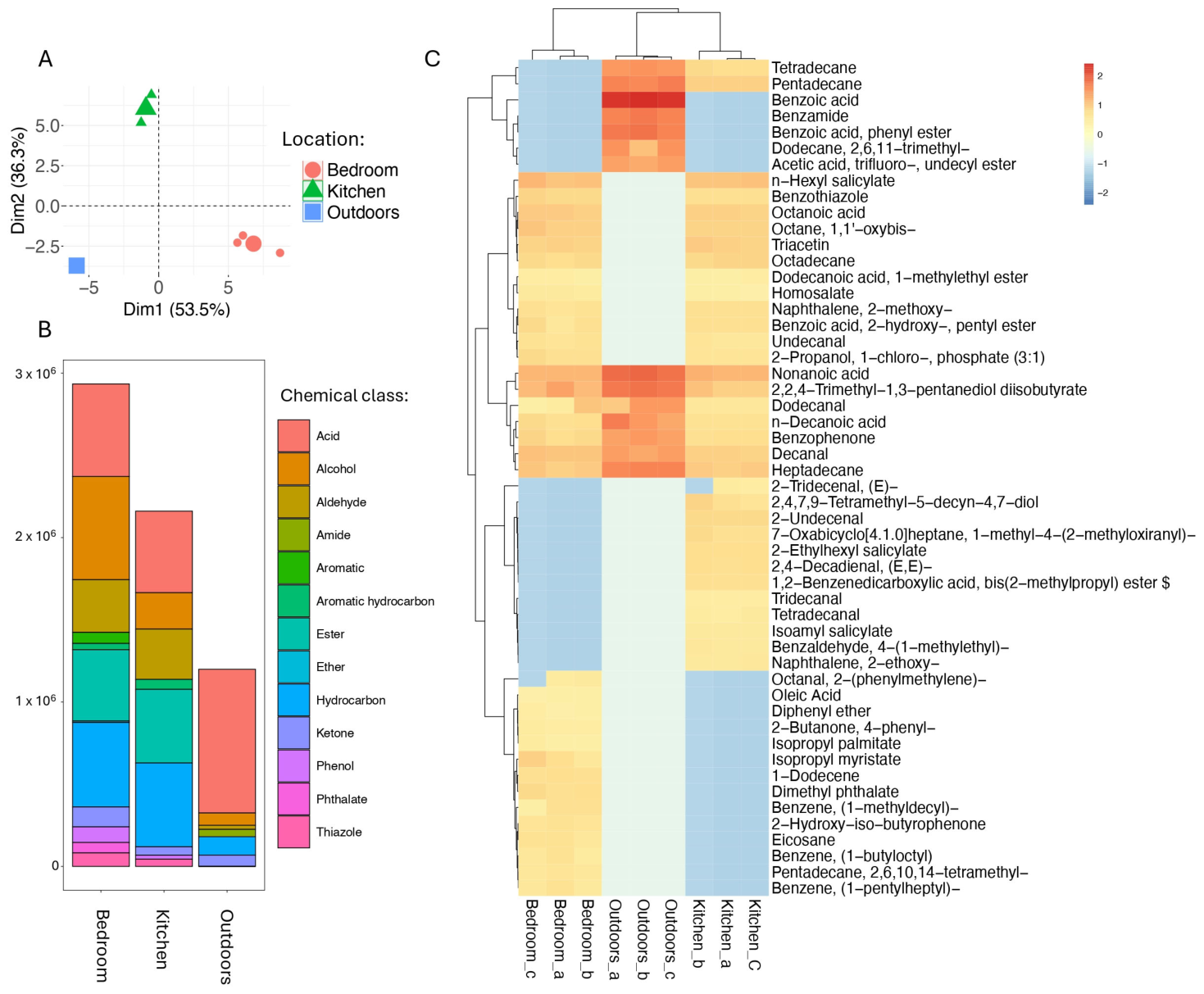
Principal component analysis (PCA) was used to investigate whole sVOC signature differences across the bedroom, kitchen, and outdoor air environments (Figure 2A). The PCs are variables consisting of linear combinations of the original variables, which can then be visualised using scores plots. Scores plots visualise Euclidean distances between sample groups [37]. Figure 2A illustrates that significant differences in chemical profiles existed across the bedroom and kitchen, with almost 90% of the variance described by PC1 and PC2. Low variability between the replicate samples (different sorbent discs within the one sampler) was also observed, highlighting the reproducibility of sampler performance (Figure 2A). Although the PCA clearly enabled differences to be elucidated across the locations within the same household, it is not expected that such marked discrimination of these air environments would exist across similar rooms in larger numbers of households. It is important to note that the examined kitchen was located at the back extension of the house, and the bedroom was located upstairs at the front of the house. The spatial differences in these rooms may be less pronounced for flats and apartments where proximity between rooms is less, and it would therefore be expected that the chemical profiles across these spaces may exhibit greater homogeneity. Stacked bar charts shown in Figure 2B summarise the chemical class composition and relative abundances captured from each environment. Hierarchical clustering was performed to group samples based on the molecular signatures and ion abundances present; compounds were also clustered to visualise which features contributed most to between-environment differences. The results are presented as a dendrogram (Figure 2C). Outdoor PSD extracts formed the most distinct cluster relative to indoor samples. Bedroom and kitchen profiles were also separated, and replicate discs within each device clustered closely.
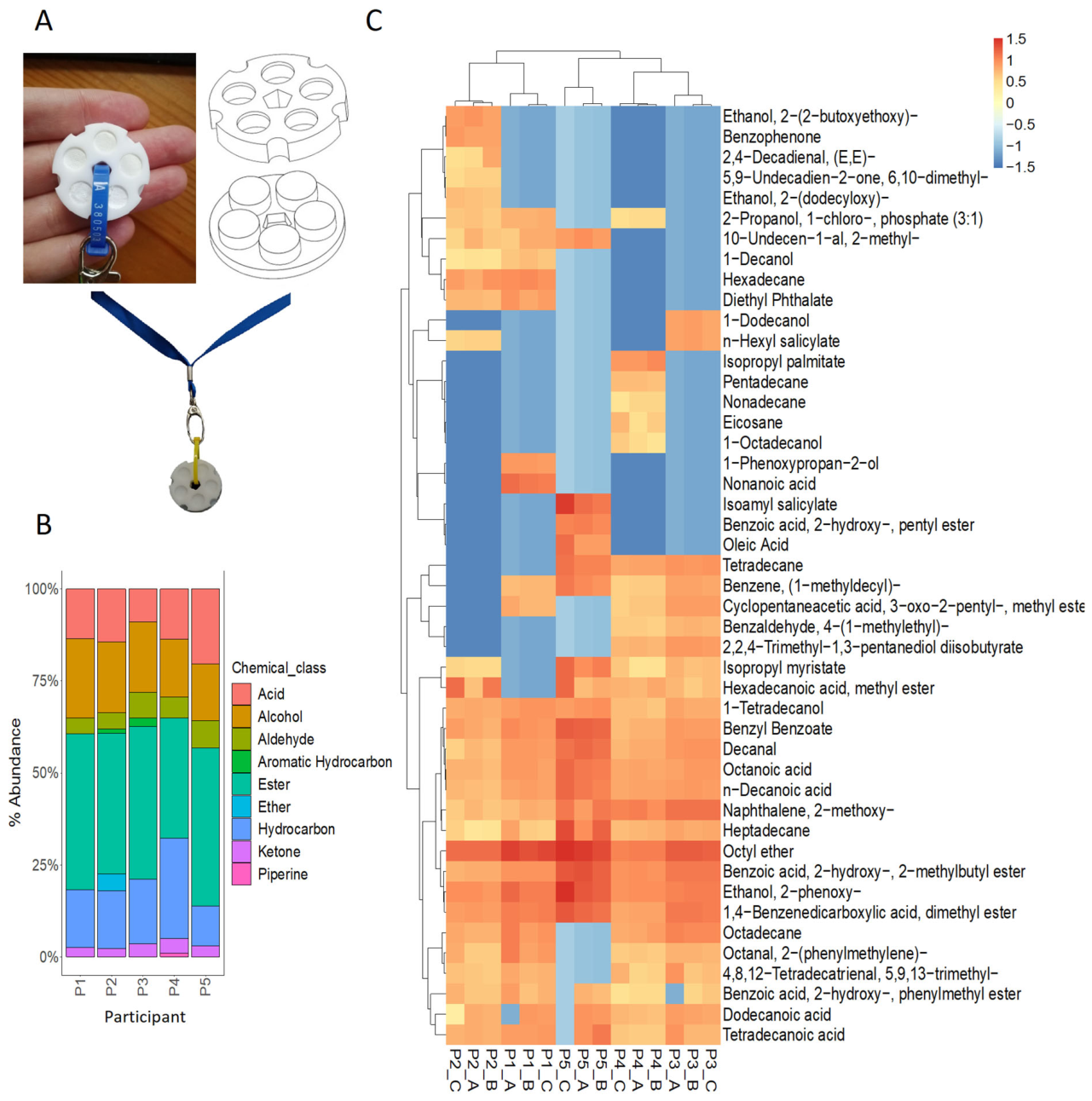
Wearable passive samplers for personal airborne chemical exposures: In this investigation, the PSDs were worn around the neck of five participants (P1 to P5) for a 28-day period (Figure 3A) using lanyards. The characterisation of the chemical composition of each participant’s personal exposure near the point of entry to their airways was thus possible. This enabled the comparison of chemical exposures between participants and co-inhabiting participants, thus enabling comparisons between homes. Following liquid extraction and GC-MS analysis, a total of 198 unique peaks were detected, and 53 compounds were identified and passed the inclusion criteria. The passive samplers worn by each participant had similar relative proportions of chemical classes. Acids, alcohols, esters and hydrocarbons made up approximately 90% of the chemical classes recovered from these samples (Figure 3B). The molecular breakdown of the chemical classes recovered from each participant can be seen in the heatmap (Figure 3C). As with the spatial chemical data shown in Figure 2, hierarchical clustering was employed in this experiment to assess the similarities and dissimilarities between the profiles obtained from the PSD worn by each participant (Figure 3C). Clear discrimination of the wearable replicate samples was achieved.

4. Discussion

The indoor chemical profile is influenced by many factors such as ventilation, human activities and skin emissions, building characteristics, furniture, paints and varnishes—all of which vary depending on seasonality. The effects of prolonged duration indoors could potentially lead to higher risks of exposure to poor air quality [38,39]. Communities in lower socioeconomic brackets are generally exposed to higher concentrations of air pollutants than those with higher incomes due to housing location in proximity to air pollution sources, poorer building design and a higher health burden [40,41]. In this study, we piloted the use of a previously designed [16] miniature, low-cost, multi-functional sampler device for the sorbent-based capture of sVOCs in air. The aims of this study were to (1) develop a method for sampling and analysis of sVOCs using this device; (2) deploy the devices across a single home and apply this method to discriminate indoor sVOC profiles; and (3) deploy the devices as wearables and apply the method to discriminate individual exposure profiles.
The development of the method consisted of testing the storage stability, comparison of sorbents, varying deployment times, characterisation and subtraction of blank filters (Table S1), chemical desorption kinetics (Figure 1), extraction recovery, and analytical precision (Table S2). Samples collected using Tenax-coated and PDMS sorbents were stable for 35 days post-collection when stored at −20 °C (Figure 1). Tenax-coated sorbents were preferred for the field study over PDMS due to the ease of preparation; these differences are illustrated in the comparative workflow schematic in Figure S1. The deployment time for the field study was determined to be 28 days, as the highest chemical abundances were captured after this period compared to 7-, 14-, and 21-day deployments (Figure S2). Additionally, as these sampling devices have been designed for application in large-scale public health projects (WellHome project [24]), the 28-day sampling deployment is logistically better suited for indoor air profiling of larger sample numbers. Chemical extraction recoveries (Table S2) varied significantly, as chemicals with higher vapour pressures had poorer recoveries compared to less-volatile chemicals, most likely due to evaporation during the liquid extraction process. Therefore, the application of this sampling device was optimised for sVOCs rather than VOCs. From here, we proceeded with this method for qualitative discriminatory profiling of chemicals across different environments.
In this single-home study, after 28-day deployments, the most abundant chemical groups recovered across the kitchen, bedroom and outdoor environments were hydrocarbons, acids, alcohols and esters. Although hydrocarbons have been previously reported to dominate the volatile chemistry of kitchen spaces [42], these results show that the acid, alcohol and ester profiles also strongly contribute to the overall sVOC make-up of this space. Many of these compounds are likely formed through successive oxidation of oils [42]. Compounds derived from cleaning products and laundry washing are also strong contributors to the kitchen chemical profile, such as naphthalene, 2-methoxy- or isoamyl salicylate. In a recent study, oven-cooking was shown to contribute less to indoor particle concentrations (across a variety of sizes) than stove-cooking, which clearly highlights how different cooking practices generate different indoor air pollution profiles [43]. The resulting molecular composition of the dual profile of the bedroom with an ensuite was mainly composed of hydrocarbons, fatty acids, fatty esters, and fatty aldehydes. Sources of these emissions include personal care products such as shampoos, cosmetics and indoor furnishings, as well as the impact of humidity and dynamics of room ventilation, such as hydrocarbons elevated with relative humidity [44,45]. The outdoor PSDs had the lowest diversity and abundance in chemical classes and detected compounds. High abundances of acids were detected in the outdoor samples. Carboxylic acids found in the atmosphere can occur in particulate and gaseous form; however, acidic sVOCs are the end-products of photochemical oxidation of other organic compounds through gas-phase reactions or by reactions of other organic compounds dissolved in aqueous aerosols [46]. The indoor environment has more confined sources with surfaces that trap and reemit compounds under generally reduced air flows, allowing for a greater number of compounds to accumulate and be detected indoors than outdoors. In addition, outside temperatures, wind speed and direction, rainfall and humidity play a role in compound PSD uptake and release.
In the wearable PSD investigation, clear discrimination of each participant was achieved based on the chemical profiles recovered from triplicate samples. Importantly, P1 and P2, and P3 and P4 were co-inhabitants. As a result, it was hypothesised and observed that they had relatively similar chemical profiles, which closely cluster together. With no association to any other participant in this study, the P5 samples were individually clustered but had some similarities to P3 and P4 (Figure 3C). Other studies also found that room-specific factors and interior finishes of buildings are reflected by unique chemical profiles [47]. Chemical similarities across the participants included decanal, oleic acid, 1-dodecanol and octanoic acid. Decanal and octanoic acid are common components of the human skin volatilome [48,49], while 1-dodecanol is a common constituent of fragrance-free soaps [50]. Differences in the chemical signatures between participants therefore likely reflected behavioural differences. For example, isoamyl salicylate or benzoic acid, 2-hydroxy-pentyl ester are common components of fragrances used in personal care products and cosmetics and were only present on one wearable [45,51].
As expected, most compounds detected following liquid-extraction GC-MS analysis were sVOCs. Alternative techniques such as purge-and-trap can provide the necessary sensitivity for analysing more volatile compounds in liquid samples. Likewise, direct thermal desorption of the Tenax® TA Emfab discs could be used to analyse compounds with widely varying boiling points. Due to the unavailability of this instrumentation, but also their current incompatibility with the new smaller sorbent sizes, frequently detected indoor air contaminants such as toluene, styrene, limonene, and ethylbenzene [23,52,53,54] that may have been present in trace concentrations were not detected in this study. Despite this, the sorbent discs in the PSD itself can potentially be adapted further for the recovery of VOCs and vVOCs by functionalising Emfab discs with microporous carbon adsorbents such as carboxens or carbotraps, followed by thermal desorption GC-MS analysis [32]. For example, direct mass spectrometry detection (PTR-MS) was applied as part of the HOMEChem study to quantify highly volatile compounds (acetic acid, methanol, formic acid, and acetaldehyde) in indoor environments. The application of PTR-MS for direct quantification of target VOCs highlights the complementary relationship between these two workflows, as GC-MS can be used for untargeted screening of sVOCs and VOCs, and other techniques such as PTR-MS can be used for real-time quantification of targets [55].
Effective communication of chemical analysis findings: Chemical analysis workflows can generate data-rich profiles that are useful for discrimination and hypothesis generation; however, they also create specific communication challenges. First, due to the cost associated with confirmatory detection of so many compounds and the availability of reference materials, many reported compounds are tentatively identified (i.e., putative assignments based on mass spectral matching and retention behaviour). Second, results are typically not concentration-calibrated, meaning they should not be interpreted as quantitative measures of exposure or risk. Without careful framing, these limitations can lead to overinterpretation by non-specialist audiences, particularly if detected chemicals are discussed in the context of toxicity without corresponding dose information.
We therefore recommend a transparent, proportionate reporting approach for passive sampling and non-targeted analysis studies: (1) clearly state the intended use (screening/fingerprinting versus quantitative monitoring); (2) describe the identification workflow and confidence criteria, including retention-index checks and blank handling; (3) report relevant blanks and sources of uncertainty; and (4) avoid translating detection into health-risk statements without sufficiently robust quantitation and context. Used in this way, chemically rich fingerprints can support rapid prioritisation and targeted follow-up, while helping prevent misinterpretation of exploratory findings.

5. Conclusions

Humans are increasingly spending more time indoors. The effects of prolonged duration indoors could potentially lead to higher risks of exposure to poor air quality, especially in high-population-density, lower-socioeconomic areas with smaller living spaces. High numbers of low-cost, non-invasive and reliable sampling devices are required to effectively characterise indoor chemical profiles of homes on the population level. This proof-of-concept study demonstrates that low-cost, miniature passive sampler devices (PSDs) can be used as scalable tools for generating reproducible, non-targeted chemical fingerprints of indoor, outdoor, and personal air environments. Rather than aiming to provide concentration-calibrated measurements of individual compounds, the PSD is designed to deliver chemically rich, time-integrated profiles that support discrimination between locations and exposure scenarios and help prioritise likely sources for follow-up investigation. In a single-home deployment, the PSDs recovered distinct fingerprints from the bedroom, kitchen, and outdoors, and the replicate discs within devices showed low variability. In a 28-day wearable deployment, PSDs produced differentiable personal fingerprints, with greater similarity observed among co-inhabitants, consistent with shared microenvironments and behaviours.
As implemented here (liquid extraction followed by GC-MS), the approach primarily reflects sVOCs, and more volatile compounds are likely to be underrepresented due to analyte loss during extraction and handling. Nevertheless, the central utility of the PSD concept is its ability to support high-coverage mapping of source-relevant fingerprints (e.g., cooking-related emissions, cleaning products, personal care products, building materials) across many rooms, buildings, and individuals at low cost. This enables a practical monitoring pipeline in which (i) PSD fingerprinting is used to identify distinct environments, potential contributors, and high-priority settings; and (ii) targeted, quantitatively calibrated methods (e.g., active sampling, thermal desorption GC-MS, purge-and-trap, or real-time VOC instrumentation) are then deployed strategically to confirm identities, quantify key compounds, and evaluate interventions. Future work should therefore focus on controlled validation and calibration (including recovery studies and performance reference compounds/internal standards), expanding sorbent chemistries and analytical workflows to better capture VOCs and vVOCs, and larger deployments to build libraries of interpretable indoor/outdoor source fingerprints that can inform exposure science and mitigation strategies.

Supplementary Materials

The following supporting information can be downloaded at: https://www.mdpi.com/article/10.3390/ijem1030011/s1, Figure S1. Method schematic for the preparation of sorbents, extraction procedure and analysis of samples; Figure S2. Compound-specific kinetics plots. Passive samplers were deployed for 7, 14, 21 and 28 days to assess the temporal influence on compound recovery. A total of 12 compounds detected in the kitchen sampler in triplicate are plotted; Figure S3. Comparative boxplot representation illustrating the differences in abundance of different chemical classes recovered from the PDMS (n = 3) and Tenax® TA (n = 3) sorbents following a 28-day simultaneous sampling deployment on wearable samplers with two participants. Each participant carried PDMS and Tenax® TA samplers. The following symbols were used to indicate statistical significance (**: p ≤ 0.05; ***: p ≤ 0.01); Table S1. Compounds detected in blank samples; Table S2. Recovery and precision measurements from spiked TENAX filter quality control samples (n = 3).

Author Contributions

Conceptualisation: L.P.B., I.S.M. and H.M.W. Data curation: H.M.W. and S.F. Funding acquisition: L.P.B. and I.S.M. Methodology: H.M.W. and S.F. Supervision: L.P.B. and I.S.M. Writing—original draft: H.M.W. and S.F. Review and editing: L.P.B., I.S.M., S.F. and H.M.W. All authors have read and agreed to the published version of the manuscript.

Funding

NIHR Health Protection Research Unit Chemical Radiation Threats and Hazards, a partnership between the UK Health Security Agency and Imperial College London, is funding this study (NIHR 200922). The views expressed are those of the authors and not necessarily those of the NIHR, UKHSA or the Department of Health and Social Care.

Institutional Review Board Statement

Ethical approval was granted by the ICREC committee at Imperial College London on 28 February 2023: Reference number: 6418693.

Informed Consent Statement

Informed consent was obtained from all subjects involved in the study.

Data Availability Statement

Anonymised data from these pilot studies will be shared on request.

Conflicts of Interest

The authors declare no conflicts of interest. The funders had no role in the design of the study; in the collection, analyses, or interpretation of data; in the writing of the manuscript; or in the decision to publish the results.

Abbreviations

The following abbreviations are used in this manuscript:
SVOCSemi-volatile organic compounds
VOCVolatile organic compounds
vVOCsVey volatile organic compounds
GC-MSGas chromatography—mass spectrometry
EIElectron ionisation
RIRetention index
PMParticulate matter
PSDPassive sampler device
TENAX TA2,6-diphenylphenylene oxide
DCMDichloromethane
PDMSPolydimethylsiloxane
CECsContaminants of emerging concern
PTFEPolytetraflouroethylene
PAHPolyaromatic hydrocarbons
CNCcomputer numerical control
PCAPrincipal component analysis
HCHierarchical clustering

References

  1. Sonne, C.; Xia, C.; Dadvand, P.; Targino, A.C.; Lam, S.S. Indoor volatile and semi-volatile organic toxic compounds: Need for global action. J. Build. Eng. 2022, 62, 105344. [Google Scholar] [CrossRef]
  2. Tsai, W.T. An overview of health hazards of volatile organic compounds regulated as indoor air pollutants. Rev. Environ. Health 2019, 34, 81–89. [Google Scholar] [PubMed]
  3. Zhou, X.; Zhou, X.; Wang, C.; Zhou, H. Environmental and human health impacts of volatile organic compounds: A perspective review. Chemosphere 2023, 313, 137489. [Google Scholar] [PubMed]
  4. WHO. Indoor Air Quality: Organic Pollutants Report on a WHO Meeting, Berlin, 23–27 August 1987; E.R. a. S. 111; World Health Organization Regional Office for Europe, World Health Organization: Copenhagen, Denmark, 1989. [Google Scholar]
  5. Klepeis, N.E.; Nelson, W.C.; Ott, W.R.; Robinson, J.P.; Tsang, A.M.; Switzer, P.; Behar, J.V.; Hern, S.C.; Engelmann, W.H. The National Human Activity Pattern Survey (NHAPS): A resource for assessing exposure to environmental pollutants. J. Expo. Anal. Environ. Epidemiol. 2001, 11, 231–252. [Google Scholar] [CrossRef] [PubMed]
  6. Weschler, C.J.; Carslaw, N. Indoor Chemistry. Environ. Sci. Technol. 2018, 52, 2419–2428. [Google Scholar] [CrossRef] [PubMed]
  7. Mellouki, A.; Wallington, T.J.; Chen, J. Atmospheric chemistry of oxygenated volatile organic compounds: Impacts on air quality and climate. Chem. Rev. 2015, 115, 3984–4014. [Google Scholar] [CrossRef] [PubMed]
  8. Oke, T.R.; Mills, G.; Christen, A.; Voogt, J.A. Urban Climates; Cambridge University Press: Cambridge, UK, 2017. [Google Scholar]
  9. Lunderberg, D.M.; Kristensen, K.; Tian, Y.; Arata, C.; Misztal, P.K.; Liu, Y.; Kreisberg, N.; Katz, E.F.; DeCarlo, P.F.; Patel, S.; et al. Surface Emissions Modulate Indoor SVOC Concentrations through Volatility-Dependent Partitioning. Environ. Sci. Technol. 2020, 54, 6751–6760. [Google Scholar] [CrossRef] [PubMed]
  10. Wania, F.; Shunthirasingham, C. Passive air sampling for semi-volatile organic chemicals. Environ. Sci. Process. Impacts 2020, 22, 1925–2002. [Google Scholar] [CrossRef] [PubMed]
  11. Sedláčková, L.; Melymuk, L.; Vrana, B. Calibration of silicone for passive sampling of semivolatile organic contaminants in indoor air. Chemosphere 2021, 279, 130536. [Google Scholar] [CrossRef] [PubMed]
  12. Fan, Z.T. Passive Air Sampling: Advantages, Limitations, and Challenges. Assessment methodology for newly emerging exposures in environmentally epidemiology. Seoul. South Korea. Epidemiology 2011, 22, S132. [Google Scholar]
  13. McAlary, T.; Groenevelt, H.; Disher, S.; Arnold, J.; Seethapathy, S.; Sacco, P.; Crump, D.; Schumacher, B.; Hayes, H.; Johnson, P.; et al. Passive sampling for volatile organic compounds in indoor air-controlled laboratory comparison of four sampler types. Environ. Sci. Process. Impacts 2015, 17, 896–905. [Google Scholar] [CrossRef] [PubMed]
  14. McEneff, G.L.; Richardson, A.; Webb, T.; Wood, D.; Murphy, B.; Irlam, R.; Mills, J.; Green, D.; Barron, L.P. Sorbent Film-Coated Passive Samplers for Explosives Vapour Detection Part B: Deployment in Semi-Operational Environments and Alter-native Applications. Sci. Rep. 2018, 8, 5816. [Google Scholar] [PubMed]
  15. McEneff, G.L.; Murphy, B.; Webb, T.; Wood, D.; Irlam, R.; Mills, J.; Green, D.; Barron, L.P. Sorbent Film-Coated Passive Samplers for Explosives Vapour Detection Part A: Materials Optimisation and Integration with Analytical Technologies. Sci. Rep. 2018, 8, 5815. [Google Scholar] [CrossRef] [PubMed]
  16. Richardson, A.K.; Irlam, R.C.; Wright, H.R.; Mills, G.A.; Fones, G.R.; Sturzenbaum, S.R.; Cowan, D.A.; Neep, D.J.; Barron, L.P. A miniaturized passive sampling-based workflow for monitoring chemicals of emerging concern in water. Sci. Total Environ. 2022, 839, 156260. [Google Scholar] [CrossRef] [PubMed]
  17. O’Connell, S.G.; Kincl, L.D.; Anderson, K.A. Silicone wristbands as personal passive samplers. Environ. Sci. Technol. 2014, 48, 3327–3335. [Google Scholar] [CrossRef] [PubMed]
  18. Craig, J.A.; Ceballos, D.M.; Fruh, V.; Petropoulos, Z.E.; Allen, J.G.; Calafat, A.M.; Ospina, M.; Stapleton, H.M.; Hammel, S.; Gray, R.; et al. Exposure of Nail Salon Workers to Phthalates, Di(2-ethylhexyl) Terephthalate, and Organophosphate Esters: A Pilot Study. Environ. Sci. Technol. 2019, 53, 14630–14637. [Google Scholar] [CrossRef] [PubMed]
  19. Bakali, U.; Baum, J.L.R.; Louzado-Feliciano, P.; Killawala, C.; Santiago, K.M.; Pauley, J.L.; Dikici, E.; Schaefer Solle, N.; Kobetz, E.N.; Bachas, L.G.; et al. ‘Characterization of fire investigators’ polyaromatic hydrocarbon exposures using silicone wristbands. Ecotoxicol. Environ. Saf. 2024, 278, 116349. [Google Scholar] [CrossRef] [PubMed]
  20. Hammel, S.C.; Hoffman, K.; Webster, T.F.; Anderson, K.A.; Stapleton, H.M. Measuring Personal Exposure to Organo-phosphate Flame Retardants Using Silicone Wristbands and Hand Wipes. Environ. Sci. Technol. 2016, 50, 4483–4491. [Google Scholar] [PubMed]
  21. Hoffman, K.; Tang, X.; Cooper, E.M.; Hammel, S.C.; Sjodin, A.; Phillips, A.L.; Webster, T.F.; Stapleton, H.M. Children’s exposure to brominated flame retardants in the home: The TESIE study. Environ. Pollut. 2024, 352, 124110. [Google Scholar] [PubMed]
  22. Samon, S.M.; Hammel, S.C.; Stapleton, H.M.; Anderson, K.A. Silicone wristbands as personal passive sampling devices: Current knowledge, recommendations for use, and future directions. Environ. Int. 2022, 169, 107339. [Google Scholar] [CrossRef] [PubMed]
  23. Arata, C.; Misztal, P.K.; Tian, Y.; Lunderberg, D.M.; Kristensen, K.; Novoselac, A.; Vance, M.E.; Farmer, D.K.; Nazaroff, W.W.; Goldstein, A.H. Volatile organic compound emissions during HOMEChem. Indoor Air 2021, 31, 2099–2117. [Google Scholar] [CrossRef] [PubMed]
  24. Varaden, D.; Barratt, B.; Dallman, M.J.; Skillern, A.; Elmi, M.S.; Green, D.C.; Tremper, A.H.; Hedges, M.; Hicks, W.; Priestman, M.; et al. West London Healthy Home and Environment (WellHome) Study: Protocol for a Community-Based Study Investigating Exposures Across the Indoor-Outdoor Air Pollution Continuum in Urban Communities. Int. J. Environ. Res. Public Health 2025, 22, 249. [Google Scholar] [PubMed]
  25. Carslaw, N.; Aghaji, J.; Budisulistiorini, S.H.; Carslaw, D.C.; Chatzidiakou, L.; Cheung, R.W.; Dillon, T.J.; Edwards, P.M.; Genes, D.; Giorio, C.; et al. The INGENIOUS project: Towards understanding air pollution in homes. Environ. Sci. Process. Impacts 2025, 27, 355–372. [Google Scholar] [CrossRef] [PubMed]
  26. Vojta, Š.; Melymuk, L.; Prokeš, R.; Klánová, J. Assessment of the impact of sampler housing on indoor passive air sampler measurements of SVOCs. J. Environ. Expo. Assess. 2024, 3, 6. [Google Scholar] [CrossRef]
  27. Romanak, K.A.; Wang, S.; Stubbings, W.A.; Hendryx, M.; Venier, M.; Salamova, A. Analysis of brominated and chlorinated flame retardants, organophosphate esters, and polycyclic aromatic hydrocarbons in silicone wristbands used as personal passive samplers. J. Chromatogr. A 2019, 1588, 41–47. [Google Scholar] [CrossRef] [PubMed]
  28. Wang, S.; Romanak, K.A.; Stubbings, W.A.; Arrandale, V.H.; Hendryx, M.; Diamond, M.L.; Salamova, A.; Venier, M. Silicone wristbands integrate dermal and inhalation exposures to semi-volatile organic compounds (SVOCs). Environ. Int. 2019, 132, 105104. [Google Scholar] [CrossRef] [PubMed]
  29. Lin, E.Z.; Esenther, S.; Mascelloni, M.; Irfan, F.; Godri Pollitt, K.J. The Fresh Air Wristband: A Wearable Air Pollutant Sampler. Environ. Sci. Technol. Lett. 2020, 7, 308–314. [Google Scholar] [CrossRef]
  30. Wacławik, M.; Rodzaj, W.; Wielgomas, B. Silicone Wristbands in Exposure Assessment: Analytical Considerations and Comparison with Other Approaches. Int. J. Environ. Res. Public Health 2022, 19, 1935. [Google Scholar] [CrossRef] [PubMed]
  31. Desmet, K.; Schelfaut, M.; Gorecki, T.; Sandra, P. Evaluation of the suitability of sampling on Tenax TA and polydimethylsiloxane for the analysis of combustion gases. Talanta 2009, 79, 967–970. [Google Scholar] [CrossRef] [PubMed]
  32. Shirey, R.E. 4—SPME Commercial Devices and Fibre Coatings. In Handbook of Solid Phase Microextraction; Elsevier: Bellefonte, PA, USA, 2012; pp. 99–133. [Google Scholar]
  33. Salthammer, T.; Zhang, Y.; Mo, J.; Koch, H.M.; Weschler, C.J. Assessing Human Exposure to Organic Pollutants in the Indoor Environment. Angew. Chem. Int. Ed. Engl. 2018, 57, 12228–12263. [Google Scholar] [CrossRef] [PubMed]
  34. Van Noorden, N. Tenax, Carboxen and Other Sorbents Used for Thermal Desorption Sampling. 2024. Available online: https://markes.com/content-hub/blog/tenax-carboxen-and-other-sorbents-used-for-thermal-desorption-sampling (accessed on 9 May 2024).
  35. Osik, N.A.; Lukzen, N.N.; Yanshole, V.V.; Tsentalovich, Y.P. Loss of Volatile Metabolites during Concentration of Metabolomic Extracts. ACS Omega 2024, 9, 24015–24024. [Google Scholar] [CrossRef] [PubMed]
  36. Seethapathy, S.; Gorecki, T. Applications of polydimethylsiloxane in analytical chemistry: A review. Anal. Chim. Acta 2012, 750, 48–62. [Google Scholar] [CrossRef] [PubMed]
  37. Ringnér, M. What is principal component analysis? Nat. Biotechnol. 2008, 26, 303–304. [Google Scholar] [CrossRef] [PubMed]
  38. Metcalfe, R.; Roth, S. Making the Invisible Visible: The Impact of Revealing Indoor Air Pollution on Behavior and Welfare; National Bureau of Economic Research: Cambridge, MA, USA, 2025. [Google Scholar] [CrossRef]
  39. Fecht, D.; Fischer, P.; Fortunato, L.; Hoek, G.; de Hoogh, K.; Marra, M.; Kruize, H.; Vienneau, D.; Beelen, R.; Hansell, A. Associations between air pollution and socioeconomic characteristics, ethnicity and age profile of neighbourhoods in England and the Netherlands. Environ. Pollut. 2015, 198, 201–210. [Google Scholar] [CrossRef] [PubMed]
  40. Ferguson, L.; Taylor, J.; Zhou, K.; Shrubsole, C.; Symonds, P.; Davies, M.; Dimitroulopoulou, S. Systemic inequalities in indoor air pollution exposure in London, UK. Build. Cities 2021, 2, 425. [Google Scholar] [CrossRef] [PubMed]
  41. Bennett, J.E.; Pearson-Stuttard, J.; Kontis, V.; Capewell, S.; Wolfe, I.; Ezzati, M. Contributions of diseases and injuries to widening life expectancy inequalities in England from 2001 to 2016: A population-based analysis of vital registration data. Lancet Public Health 2018, 3, e586–e597. [Google Scholar] [CrossRef] [PubMed]
  42. Choe, E.; Min, D.B. Mechanisms and Factors for Edible Oil Oxidation. Compr. Rev. Food Sci. Food Saf. 2006, 5, 169–186. [Google Scholar] [CrossRef]
  43. Farmer, D.K.; Vance, M.E.; Abbatt, J.P.D.; Abeleira, A.; Alves, M.R.; Arata, C.; Boedicker, E.; Bourne, S.; Cardoso-Saldana, F.; Corsi, R.; et al. Overview of HOMEChem: House Observations of Microbial and Environmental Chemistry. Environ. Sci. Process. Impacts 2019, 21, 1280–1300. [Google Scholar] [CrossRef] [PubMed]
  44. Huang, L.; Wei, Y.; Zhang, L.; Ma, Z.; Zhao, W. Estimates of emission strengths of 43 VOCs in wintertime residential indoor environments, Beijing. Sci. Total Environ. 2021, 793, 148623. [Google Scholar] [CrossRef] [PubMed]
  45. Yeoman, A.M.; Shaw, M.; Lewis, A.C. Estimating person-to-person variability in VOC emissions from personal care products used during showering. Indoor Air 2021, 31, 1281–1291. [Google Scholar] [PubMed]
  46. Manahan, S. Environmental Chemistry, 11th ed.; CRC Press: Boca Raton, FL, USA, 2022. [Google Scholar]
  47. Mai, J.-L.; Yang, W.-W.; Zeng, Y.; Guan, Y.-F.; Chen, S.-J. Volatile organic compounds (VOCs) in residential indoor air during interior finish period: Sources, variations, and health risks. Hyg. Environ. Health Adv. 2024, 9, 100087. [Google Scholar]
  48. Shetewi, T.; Finnegan, M.; Fitzgerald, S.; Xu, S.; Duffy, E.; Morrin, A. Investigation of the relationship between skin-emitted volatile fatty acids and skin surface acidity in healthy participants-a pilot study. J. Breath Res. 2021, 15, 037101. [Google Scholar]
  49. Finnegan, M.; Fitzgerald, S.; Duroux, R.; Attia, J.; Markey, E.; O’Connor, D.; Morrin, A. Predicting Chronological Age via the Skin Volatile Profile. J. Am. Soc. Mass Spectrom. 2024, 35, 421–432. [Google Scholar] [CrossRef] [PubMed]
  50. Gallagher, M.; Wysocki, C.J.; Leyden, J.J.; Spielman, A.I.; Sun, X.; Preti, G. Analyses of volatile organic compounds from human skin. Br. J. Dermatol. 2008, 159, 780–791. [Google Scholar] [CrossRef] [PubMed]
  51. Zhang, Y.; Hopke, P.K.; Mandin, C. Handbook of Indoor Air Quality; Springer Nature Singapore Pte Ltd.: Singapore, 2022. [Google Scholar]
  52. Król, S.; Namiesnik, J.; Zabiegala, B. alpha-Pinene, 3-carene and d-limonene in indoor air of Polish apartments: The im-pact on air quality and human exposure. Sci. Total Environ. 2014, 468–469, 985–995. [Google Scholar] [PubMed]
  53. Klein, F.; Farren, N.J.; Bozzetti, C.; Daellenbach, K.R.; Kilic, D.; Kumar, N.K.; Pieber, S.M.; Slowik, J.G.; Tuthill, R.N.; Hamilton, J.F.; et al. Indoor terpene emissions from cooking with herbs and pepper and their secondary organic aerosol production potential. Sci. Rep. 2016, 6, 36623. [Google Scholar] [CrossRef] [PubMed]
  54. Zhang, Z.F.; Zhang, X.; Zhang, X.M.; Liu, L.Y.; Li, Y.F.; Sun, W. Indoor occurrence and health risk of formaldehyde, toluene, xylene and total volatile organic compounds derived from an extensive monitoring campaign in Harbin, a megacity of China. Chemosphere 2020, 250, 126324. [Google Scholar] [CrossRef] [PubMed]
  55. Majchrzak, T.; Wojnowski, W.; Lubinska-Szczygel, M.; Rozanska, A.; Namiesnik, J.; Dymerski, T. PTR-MS and GC-MS as complementary techniques for analysis of volatiles: A tutorial review. Anal. Chim. Acta 2018, 1035, 1–13. [Google Scholar] [PubMed]
Figure 1. (Top): Desorption experiment at room temperature (~22 °C), in triplicate. A sampler was spiked and removed at time intervals at 1000 ppb (1 µg/mL). Both plots show three representative compounds out of thirteen, due to their ranges in molecular weight and boiling point, acenaphthylene (152.1 g/mol, 298.9 °C), benzo[k]fluoranthene (252.3 g/mol and 480 °C) and dibenz[a,h]anthracene (278 g/mol and 524.7 °C), showing tenax-coated Emfab and PDMS. Data are illustrated as means (standard deviation) based on triplicate measurements and are plotted using a power trendline. (Below): Stability of analyte experiment in storage at −70 °C in triplicate. A sampler was spiked at each time point with 1000 ppb (1 µg/mL) and 750 ppb (0.75 µg/mL) and frozen immediately. Red represents the sorbent tenax-coated Emfab and blue represents the PDMS sorbents, with the lines at the concentration level made from standard at time of spiking (A) acenaphthylene (152.1 g/mol, 298.9 °C); (B) benzo[k]fluoranthene (252.3 g/mol and 480 °C); and (C) shows dibenz[a,h]anthracene (278 g/mol and 524.7 °C).
Ijem 01 00011 g001
Figure 2. Chemical occurrence and statistical analysis of 28 days of PSD deployment in three homes. (A) Principal component analysis (PCA) scores plot of indoor and outdoor air samples. PC1 and PC2 summarised 88.7% of the variance of the overall dataset, with 53.5% being summarised by PC1 and 36.3% being summarised by PC2; (B) Stacked bar plots of the summed chemical abundances according to chemical class recovered from each examined environment; (C) Hierarchical clustering analysis of indoor and outdoor air samples.
Ijem 01 00011 g002
Figure 3. Chemical profiling results from wearable PSDs. (A) Teflon-based sampler containing Tenax® TA-functionalised discs; (B) Chemical composition of profiles recovered from samplers worn by each participant (n = 5); (C) Hierarchical clustering analysis of triplicate samples taken from passive samplers worn by participants over a 28-day period. Each row represents a compound, and each column represents an individual replicate sample. Values were scaled relative to each sample (column).
Ijem 01 00011 g003
Disclaimer/Publisher’s Note: The statements, opinions and data contained in all publications are solely those of the individual author(s) and contributor(s) and not of MDPI and/or the editor(s). MDPI and/or the editor(s) disclaim responsibility for any injury to people or property resulting from any ideas, methods, instructions or products referred to in the content.