Article

Leveraging Bag Dissimilarity Regularized Multi-Instance Learning for Analyzing Infrared Spectra of Heterogeneous Objects


1
Artificial Intelligence and Digital Finance Key Laboratory of Sichuan Province, School of Computing and Artificial Intelligence, Southwestern University of Finance and Economics, Chengdu 611130, China
2
Key Laboratory of Artificial Organs and Computational Medicine of Zhejiang Province, Institute of Translational Medicine, Shulan International Medical College, Zhejiang Shuren University, Hangzhou 310015, China
*
Author to whom correspondence should be addressed.
AI Chem. 2026, 1(2), 6; https://doi.org/10.3390/aichem1020006
Submission received: 30 December 2025 / Revised: 19 February 2026 / Accepted: 13 March 2026 / Published: 27 March 2026

Abstract

Infrared (IR) spectroscopy is a powerful tool for characterizing molecular structures and chemical groups, offering advantages such as low cost, rapid analysis, and non-destructive testing. When analyzing heterogeneous objects, spectra are typically measured from different regions to capture the local variations, presenting a multi-instance learning (MIL) problem. However, existing methods primarily rely on multi-instance assumptions or explicit bag representations, often failing to fully capture the intrinsic information from implicit representations. We introduce a bag dissimilarity regularized MIL framework for analyzing IR spectra of heterogeneous objects, which integrates both explicit and implicit representations to effectively learn the MIL bags. Specifically, a bag dissimilarity regularization term is utilized to extract implicit representations, which subsequently guide the classifier based on explicit representations to enhance generalization performance. The proposed method was validated on two heterogeneous detection tasks: polydimethylsiloxane (PDMS) block assessment and polyethylene terephthalate (PET) fiber inspection. Experimental results demonstrate that our approach significantly outperforms existing methods on both datasets with a considerable margin.

1. Introduction

Owing to the ability to characterize chemical structures and functional groups, infrared (IR) spectroscopy has offered rapid, low-cost, and non-destructive analysis. Its integration with machine learning has significantly advanced detection capabilities in fields such as tobacco [1], textiles [2], pharmaceuticals [3], and food quality control [4]. However, complex samples often exhibit spatial heterogeneity, where composition and properties vary across different regions. Consequently, multi-point spectral acquisition is essential to fully capture sample characteristics. In such scenarios, acquiring detailed local labels is often costly and impractical. Traditional supervised learning methods, which typically treat spectra as independent instances, are ill-suited for this context, often resulting in limited applicability or suboptimal performance when dealing with heterogeneous samples represented by sets of spectra.
Multi-instance learning (MIL) [5,6] is an effective tool for weakly supervised problems. In this framework, the fundamental data unit is termed an “instance”, while a collection of related instances forms a “bag.” The primary objective of MIL is to learn from data with bag-level labels exclusively, addressing the absence of instance-level annotations. By conceptualizing a single spectrum as an instance and the spectra corresponding to a sample as a bag, MIL aligns naturally with the IR-based analysis of heterogeneous samples. Beyond chemical analysis, MIL is extensively utilized in fields such as biochemistry [7,8], computer vision [9,10], and natural language processing [11,12].
In general, MIL approaches are categorized into instance-space (IS), bag-space (BS), and embedded-space (ES) methods [13]. Assuming that bag labels are inferred from local instances, IS methods first predict the instance scores based on the instance-level classifier, and then aggregate the scores to predict bag labels. Multi-instance support vector machines (mi-SVM, MI-SVM) [14], single instance learning methods (SIL) [15], and multi-instance network (mi-Net) [16] can be categorized as the IS method. BS methods are based on distance functions or kernel functions which can be incorporated into distance-based or kernel-based classifiers. MIGraph and miGraph [17] define graph kernels for distinguishing the MIL bags. In [18], the bags are regarded as point sets or distributions, and several bag dissimilarity functions are proposed. ES methods explicitly map the bags into representation vectors that retain the essential information, which forms a feature space where the classifiers are trained. Chen et al. [19] project the bags into an embedded space defined by the training instances using a similarity measure. Wei et al. [20] introduce the vector of locally aggregated descriptors (VLAD) and Fisher vector (FV) for bag representation. The explicit representations can also be learned via deep neural networks [21].
Conventional IR spectral modeling approaches [22,23] can be viewed as supervised learning methods, requiring detailed spectrum-level labels. However, acquiring such fine-grained local properties is often impractical when analyzing heterogeneous samples [24,25]. As a result, multiple spectra obtained from a single sample share a coarse-grained bag label, which hinders standard supervised methods from fully exploiting the multi-spectral representations. Early studies typically employed average spectra as the representative spectrum [26] or propagated the bag label to every individual spectrum, thereby enabling the direct application of supervised algorithms. Crucially, such strategies overlook inter-spectral correlations and fail to capture the varying contributions of local regions to the sample’s overall properties. Alternative approaches leverage computer vision algorithms to extract spatial features [27,28]. However, these require spatial coordinates, limiting their applicability to imaging spectral data [29]. Furthermore, visual methods may neglect long-range dependencies. A limited number of studies for analyzing heterogeneous samples [25] have incorporated MIL, which is naturally fit for such weakly supervised spectra from both standard and imaging spectrometers. However, existing applications have primarily relied on IS methods. As a result, they fall short of fully capturing the intrinsic information within the infrared spectra.
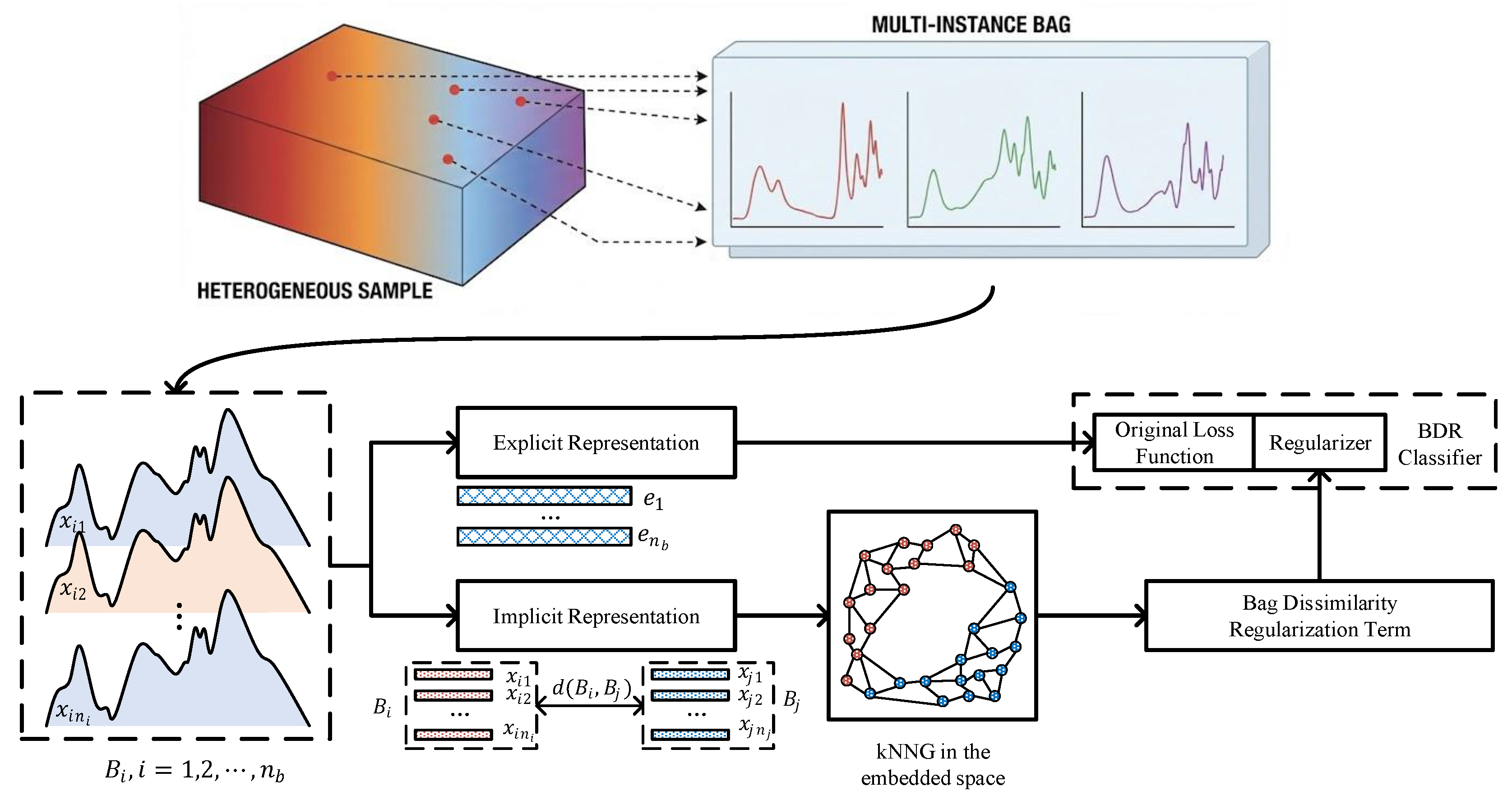
Therefore, we introduce a Bag Dissimilarity Regularization (BDR) [30] MIL method for the IR spectral analysis of heterogeneous samples. As illustrated in Figure 1, IR spectra of heterogeneous objects are modeled as multi-instance bags and analyzed via the BDR framework. The proposed approach refines the performance by enhancing the diversity of representations, which enables the simultaneous utilization of implicit and explicit representations. Specifically, explicit features extracted via ES methods are directly fed into the classifier for learning, while implicit features derived from BS methods are incorporated within a BDR regularization term. This regularization term is subsequently incorporated into the classifier’s objective function. Thus, the classifier is guided by the BDR term while learning from the explicit representations, enabling the utilization of both representation types. We implemented the BDR method based on the Support Vector Machine (SVM) [31], denoted as BDR-SVM. The proposed method demonstrated competitive results in two real-world IR spectroscopy-based analytical tasks for heterogeneous samples.

2. Results

2.1. Implementation Details

Traditional research on single-point infrared spectroscopy predominantly relies on the average spectrum to represent sample features [26]. This approach is functionally equivalent to the SimpleMI framework [32]. Consequently, SimpleMI is adopted in this study as a baseline to approximate the traditional characterization method.
To provide a comprehensive evaluation, we compare our approach against several feature-based MIL algorithms, specifically: miVLAD, miFV [20], mi-Net [16], MI-Net [21], and Att. Net [33]. Additionally, maxc-LS-SVM [25], a method previously utilized in infrared spectral analysis, is incorporated to benchmark the performance differences between feature-based and instance-based MIL paradigms. Hyperparameters were configured as follows. BDR-SVM retains the same settings as described previously, using MIFA features as explicit features and average bag dissimilarity as implicit features; BLS-MS utilizes miVLAD features with the number of cluster centers set to 1; for miMFA, the number of local models is set to 6, the dimension of latent factors is set to 4, and no auxiliary features are used. The remaining methods utilize parameters recommended in their original publications or determined via cross-validation.
All algorithms were implemented in Python 3.7. The experiments were executed on a laptop workstation equipped with 32 GB of RAM. To comprehensively evaluate the performance of the various algorithms, we employed four standard metrics: Accuracy, Precision, Recall, and F1-score. These metrics are defined as follows:
Accuracy = T P + T N T P + T N + F P + F N Precision = T P T P + F P Recall = T P T P + F N F1-score = 2 × Precision × Recall Precision + Recall
where T P , F P , T N , and F N denote the number of true positives, false positives, true negatives, and false negatives, respectively.
In this paper, we use a joint bag representation based on MIFA [30] and miVLAD [20] as the explicit representation, while the multiple dissimilarities proposed in [18] are used as the implicit representation. Specifically, the dissimilarity between two bags is defined as the average of meanmean, meanmin, maxmin, and minmin dissimilarities. The number of clustering centers is fixed at 1 during the extraction of explicit representations. Furthermore, a directed kNN graph is constructed with the nearest neighbor parameter k set to 10 for the textile dataset and 3 for the PDMS dataset.

2.2. Performance on PDMS Block Assessment

2.2.1. Overall Comparison

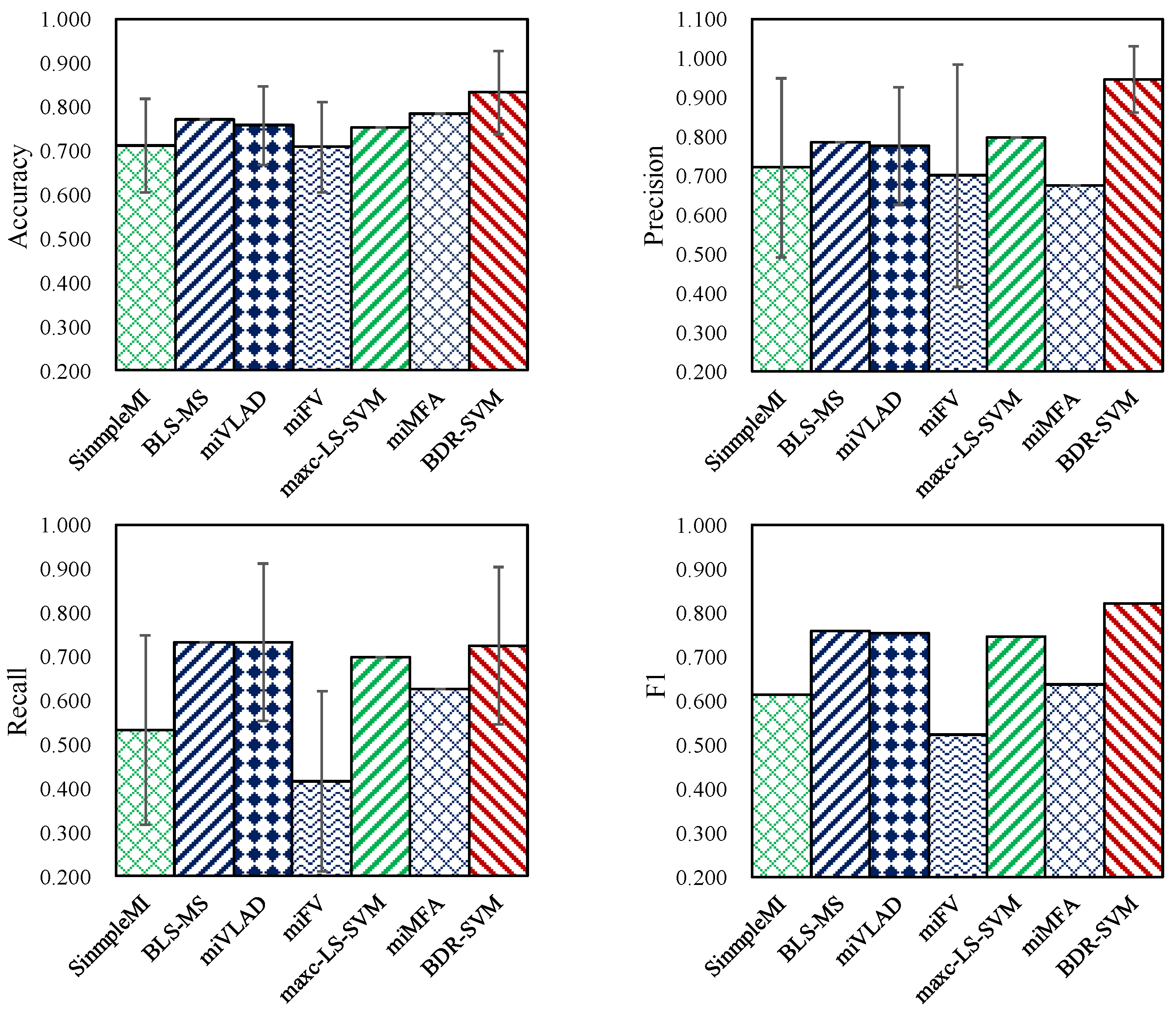
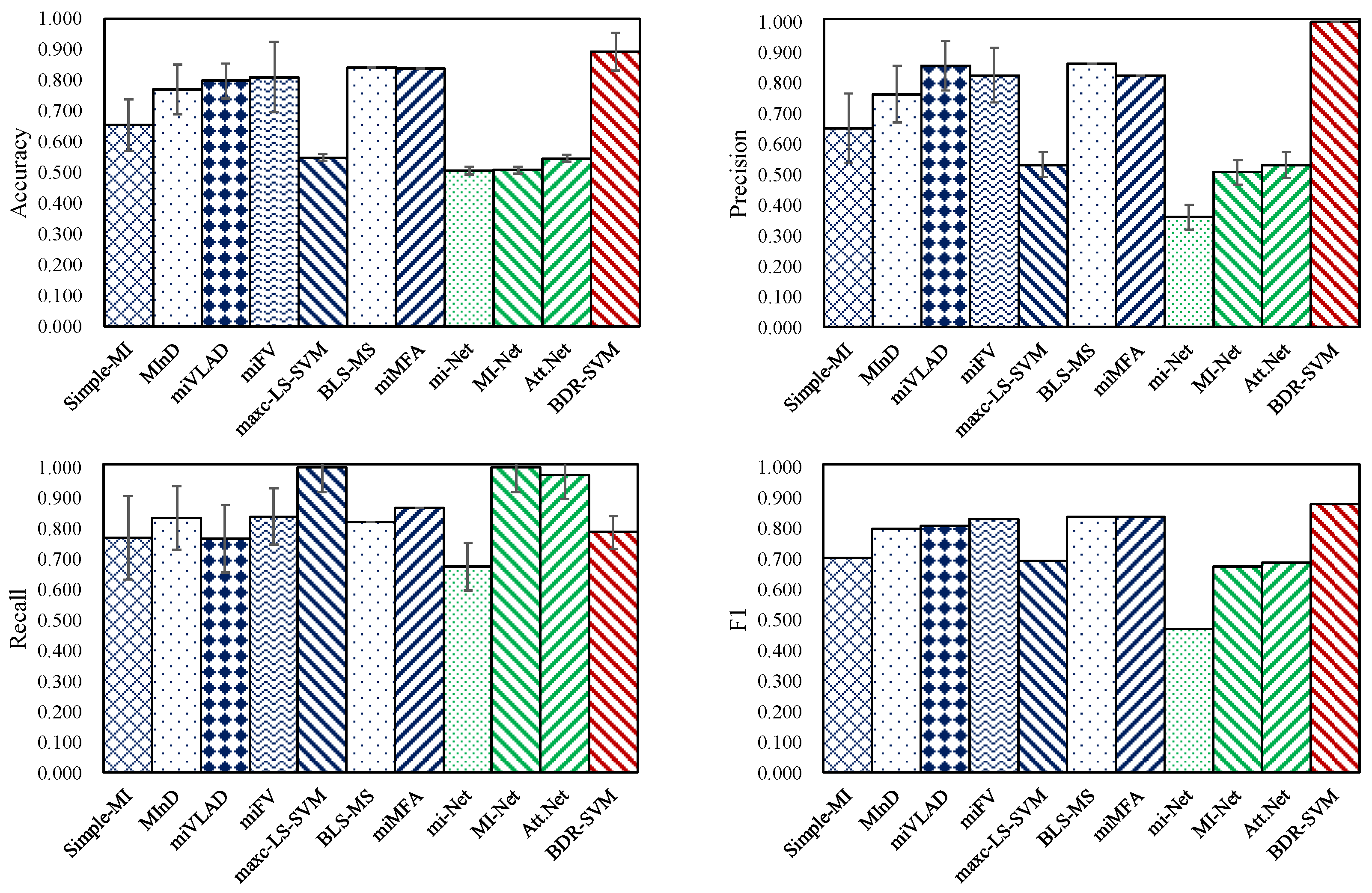
The experimental results for this subsection are presented in Figure 2. As illustrated, feature-based MIL methods significantly outperformed the single-spectrum characterization approach (SimpleMI). Specifically, feature-based MIL achieved a maximum improvement of over 10% in accuracy and 20% in F1-score. This substantial gain suggests that the spatial correlations among spectra collected from different locations on the same chip contribute critically to the classification performance.
Among the evaluated MIL frameworks, BDR-SVM exhibited the most competitive comprehensive performance, yielding an accuracy of 0.83 and an F1-score of 0.82. Notably, compared to the existing instance-based method (maxc-LS-SVM), the proposed BDR-SVM improved both accuracy and F1-score by 8%. This underscores the efficacy of the BDR framework, which leverages a combination of multiple MIL features to enhance performance in practical tasks. It is worth noting that miFV, which performed well in previous studies on open-source datasets and polyester fiber classification, showed relatively poor performance on the PDMS dataset. This degradation is likely attributable to the Gaussian Mixture Model (GMM) inherent to miFV, which tends to struggle with the high-dimensional, small-sample nature of this dataset, leading to compromised feature extraction. In contrast, BDR-SVM and miMFA, which utilize MIFA features, maintained robust performance under these challenging conditions.
Collectively, these results demonstrate the capability of bag dissimilarity regularized MIL to distinguish between PDMS elastomers with varying curing states. Furthermore, the experiments validate the practical utility of BDR-SVM in real-world infrared spectral analysis tasks.

2.2.2. Hyper Parameter Analysis

BDR-SVM continues to demonstrate superior performance in the task of PDMS homogeneity detection. This subsection begins by investigating the specific influence of the BDR regularization term on this task.
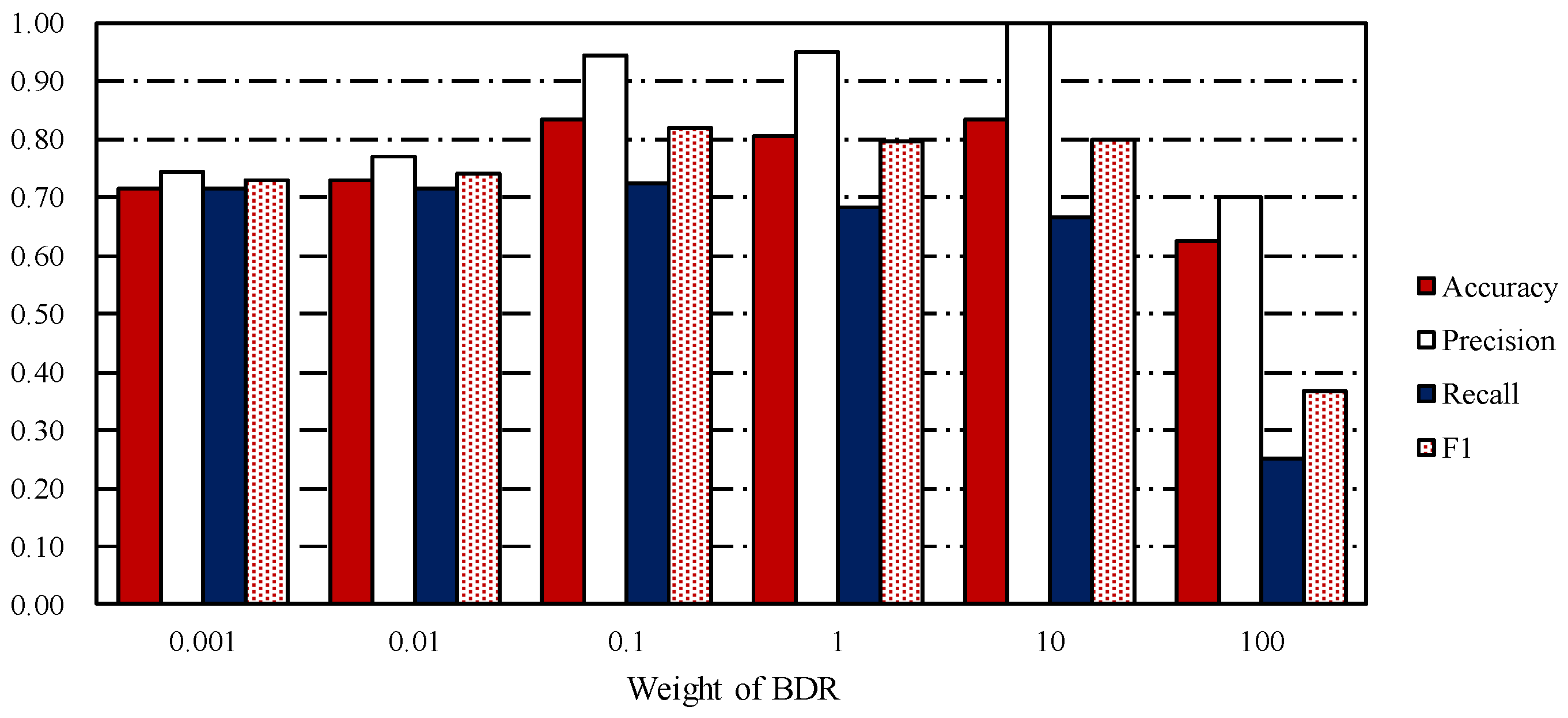
Experimental protocols were set as follows: all other hyperparameters of BDR-SVM were held constant while the regularization weight was varied. We recorded the average results of 10 runs of 4-fold cross-validation for each weight configuration. The results are illustrated in Figure 3. As the weight increases, the performance of BDR-SVM follows a trend of initial improvement followed by a decline, achieving optimal performance around a value of 0.1. Notably, the BDR regularization term yields a more pronounced performance enhancement in PDMS detection compared to previous tasks. Specifically, with a minimal weight of 0.001, the accuracy was only 0.716; however, increasing the weight to 0.1 boosted the accuracy to 0.833.
When the weight is increased beyond this optimal point, accuracy remains relatively stable, while precision increases and recall decreases. A significant performance degradation is observed when the weight reaches 100. Similar to the polyester dyeing classification task, an excessively large regularization weight may hinder the classifier’s ability to fit empirical information (underfitting), resulting in performance deterioration. These results confirm that the incorporation of additional implicit feature information effectively enhances the performance of BDR-SVM in PDMS detection.

2.2.3. Analysis of Spectral Regions

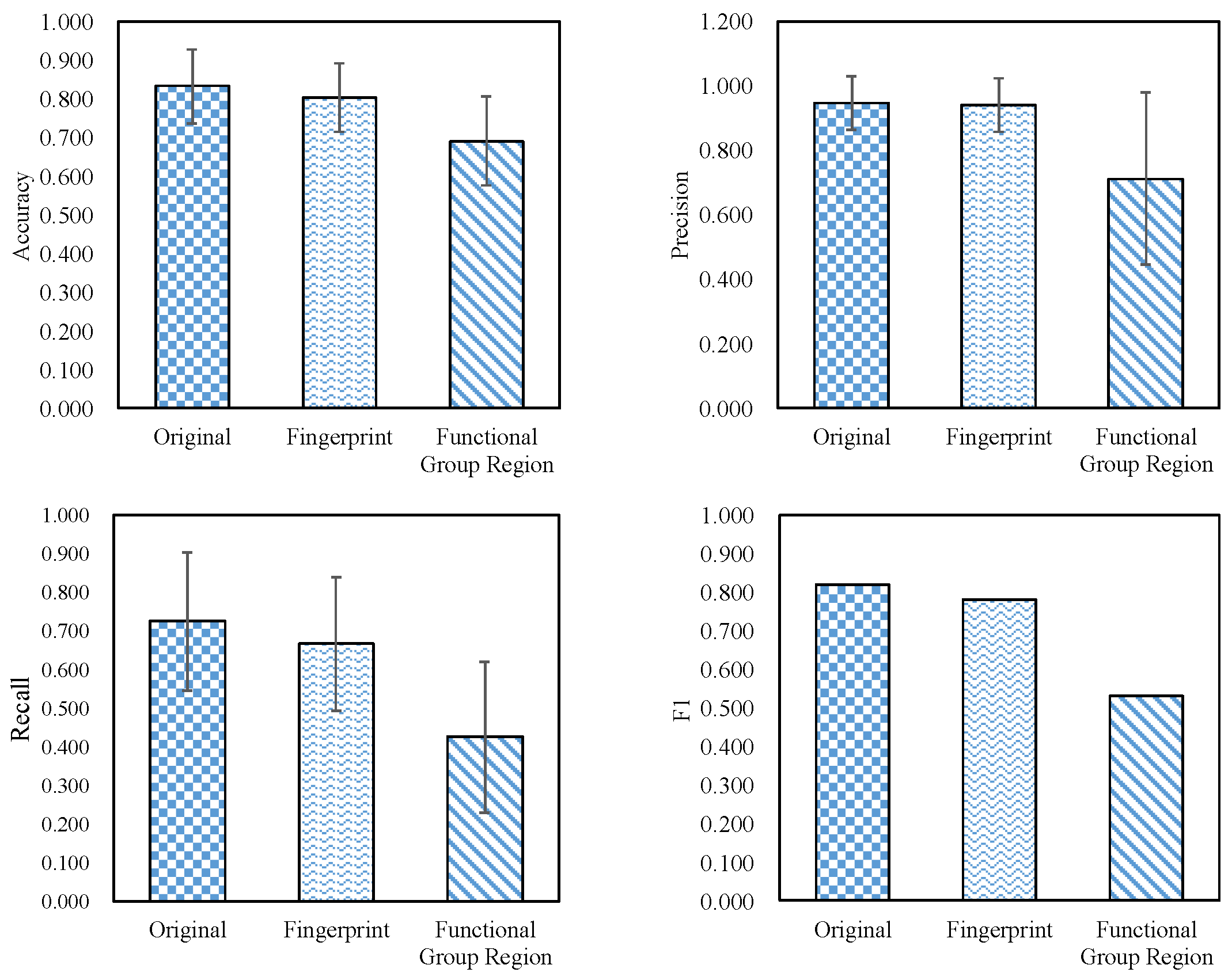
Conventionally, the mid-infrared (MIR) spectrum is partitioned into two distinct zones: the functional group region and the fingerprint region [34]. The range of 4000–1350 cm 1 constitutes the functional group region, where spectral peaks correspond strongly to specific molecular functional groups. Conversely, the 1350–400 cm 1 range is designated as the fingerprint region, which primarily characterizes the holistic molecular structure. To investigate the contribution of these specific spectral bands to the classification task, we evaluated the performance of BDR-SVM trained on three different inputs: the full spectrum, the fingerprint region alone, and the functional group region alone. The comparative results are depicted in Figure 4. Observations indicate that BDR-SVM achieves optimal performance in both accuracy and F1-score when utilizing the full spectrum. When trained exclusively on the fingerprint region, a minor performance degradation was observed, with accuracy and F1-score decreasing by approximately 3% and 4%, respectively. In contrast, training solely on the functional group region resulted in a significant decline, with both metrics dropping by over 10%. This finding suggests that the proposed MIL-based infrared analysis primarily relies on information from the fingerprint region to discriminate between PDMS elastomers with varying curing states.

2.3. PET Fiber Inspection

2.3.1. Overall Comparison

Following the protocol established in the PDMS experiments, we evaluated the impact of the BDR regularization weight on Textile A. The average results derived from 10 runs of 4-fold cross-validation are depicted in Figure 5. As the regularization weight increases, the performance of BDR-SVM exhibits a trajectory of initial improvement followed by a decline. Optimal performance was achieved at a weight of 0.01, yielding an accuracy of 0.89 ± 0.06 (95% confidence interval) and an F1-score of 0.88. In comparison, the absence of regularization (a weight of 0) resulted in a lower accuracy of 0.85. A slight performance degradation was observed when the weight was increased to 0.1, whereas a substantial decline occurred at a weight of 100, with accuracy and F1-score falling to 0.65 and 0.73, respectively, indicating that excessive regularization leads to underfitting. It is noteworthy that the optimal weight for this task (0.01) is smaller than that observed in the PDMS detection task (0.1). This discrepancy is likely attributable to the smaller sample size of Textile A, which constrains the accuracy of bag distribution estimation; consequently, the model is more sensitive to performance degradation from heavy regularization. Collectively, these results demonstrate that the appropriate incorporation of implicit feature information effectively enhances the performance of BDR-SVM on Dataset A.
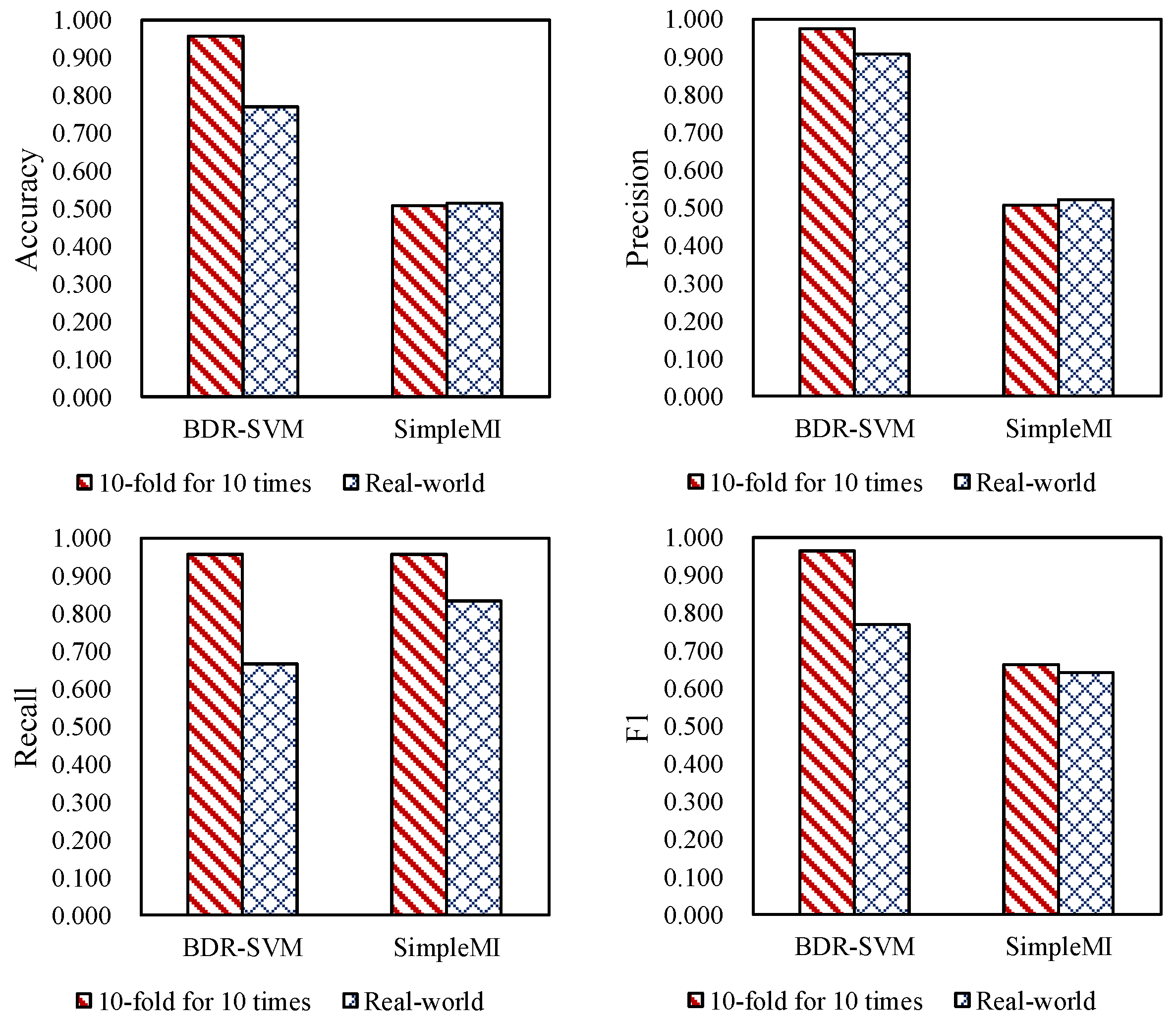
Based on its superior performance on Textile A, which validates the hypothesis that enhancing feature diversity effectively improves MIL performance, BDR-SVM was selected as the primary analytical method for Textile B. The SimpleMI method, representing traditional single-spectrum characterization, was employed as a comparative baseline. We adopted two distinct evaluation protocols for Textile B. The first protocol utilized 10 runs of 10-fold cross-validation, consistent with previous experimental settings. The second protocol, termed the “real-world split”, was designed to be more rigorous; it involved manually partitioning the dataset to ensure that hyperspectral images from the same sample group did not appear simultaneously in both the training and testing sets, thereby evaluating the algorithm’s generalization capability on unseen sample groups. Under this real-world split protocol, two separate partitions were conducted, with 18 and 17 hyperspectral images designated as test sets, respectively, while the remainder served as training data.
The comparative performance of BDR-SVM and SimpleMI on Textile B is illustrated in Figure 6. BDR-SVM consistently outperformed SimpleMI under both testing protocols, underscoring the significant advantage of feature-based MIL over conventional infrared analysis for detecting fiber dyeing homogeneity. Specifically, in the standard 10-fold cross-validation experiments, BDR-SVM achieved both accuracy and F1-scores exceeding 0.9, whereas SimpleMI exhibited negligible discriminative capability. In the more stringent real-world split experiments, although the performance of BDR-SVM declined, it maintained a substantial performance margin over SimpleMI. Specifically, BDR-SVM achieves the accuracy and F1-scores of approximately 0.75.

2.3.2. Hyper Parameter Analysis

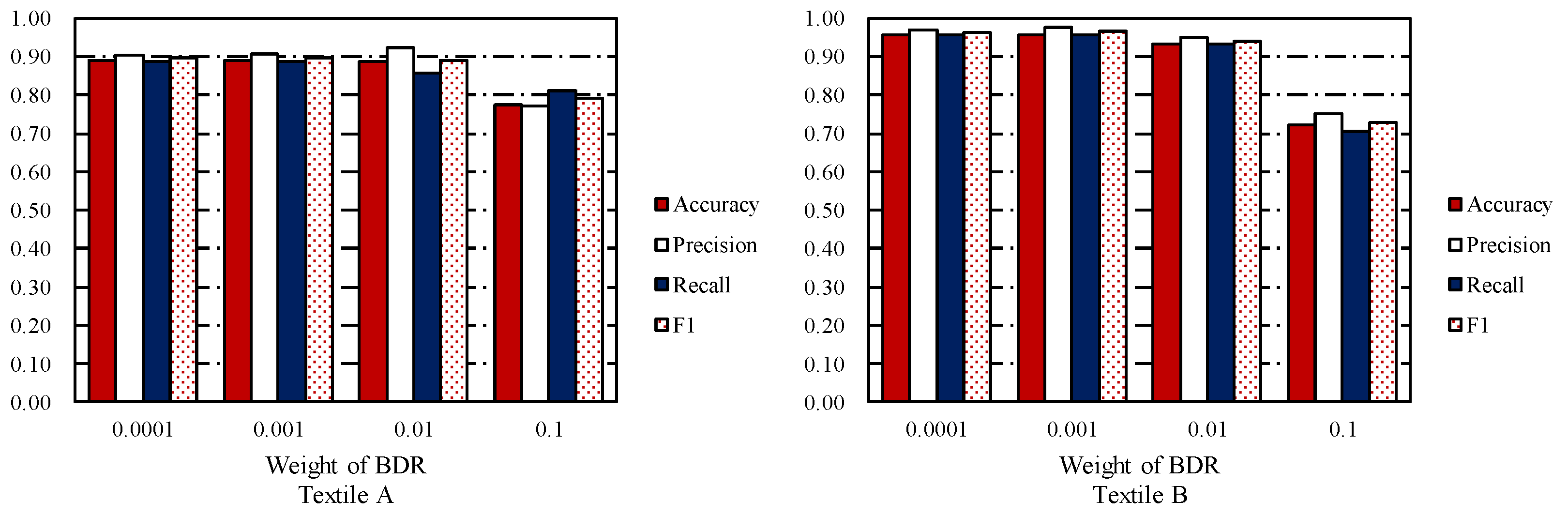
As previously demonstrated, BDR-SVM exhibits superior performance in the polyester dyeing classification task. To rigorously examine the influence of the BDR regularization term on classification outcomes, we conducted a sensitivity analysis on both Textile A and Textile B. In this experiment, all other hyperparameters were held constant while the regularization weight was systematically varied, with performance evaluated using 10 runs of 10-fold cross-validation. The results are presented in Figure 7. A consistent trend was observed across both datasets: as the regularization weight increases, the performance of BDR-SVM initially shows a slight improvement, followed by a substantial decline once the weight surpasses a specific threshold. This deterioration at high weights is likely due to the regularization term overshadowing the empirical loss term in the objective function, thereby compromising the model’s overall ability to fit the data. These results indicate that under the standard cross-validation protocol, the BDR regularization term provides a marginal but positive enhancement to BDR-SVM performance.
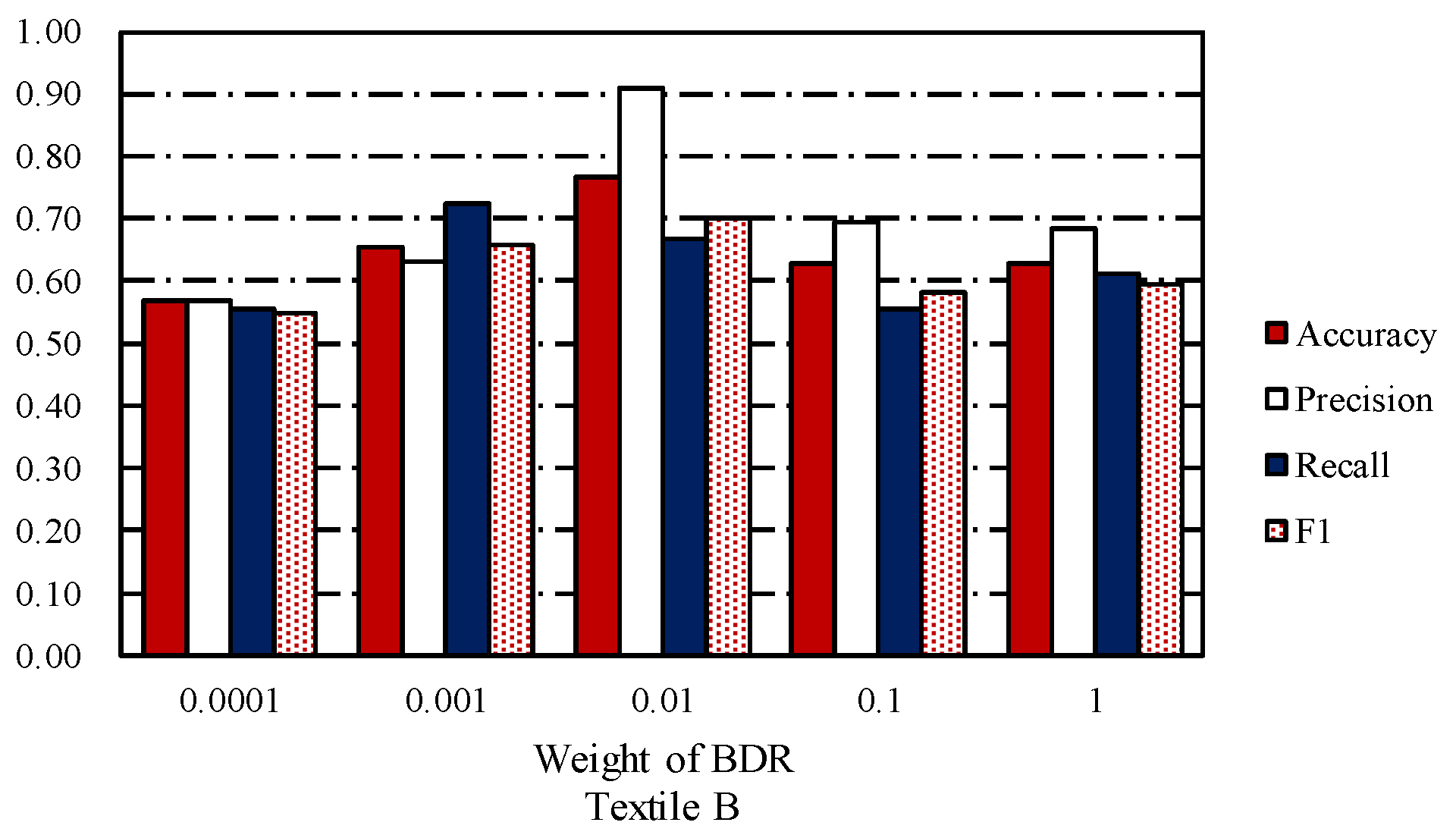
Under the more rigorous real-world split protocol, the classification accuracy of BDR-SVM is inevitably impacted by the challenge of generalizing to unseen groups. Consequently, we further investigated the impact of the BDR regularization term specifically on Textile B using this protocol. Similar to the previous setup, all parameters except the regularization weight were fixed. The corresponding results are depicted in Figure 8. The performance trajectory of BDR-SVM under the real-world split mirrors that observed in the cross-validation experiments, characterized by an initial ascent followed by a decline as the weight increases. However, a critical distinction lies in the magnitude of the improvement; the performance gain attributed to the BDR regularization term is significantly more pronounced in the real-world split scenario, with accuracy increasing by over 10%. These findings suggest that the incorporation of additional implicit features plays a vital role in improving Multiple Instance Learning performance, in the challenging task of polyester dyeing classification.

2.3.3. Analysis of Spectral Regions

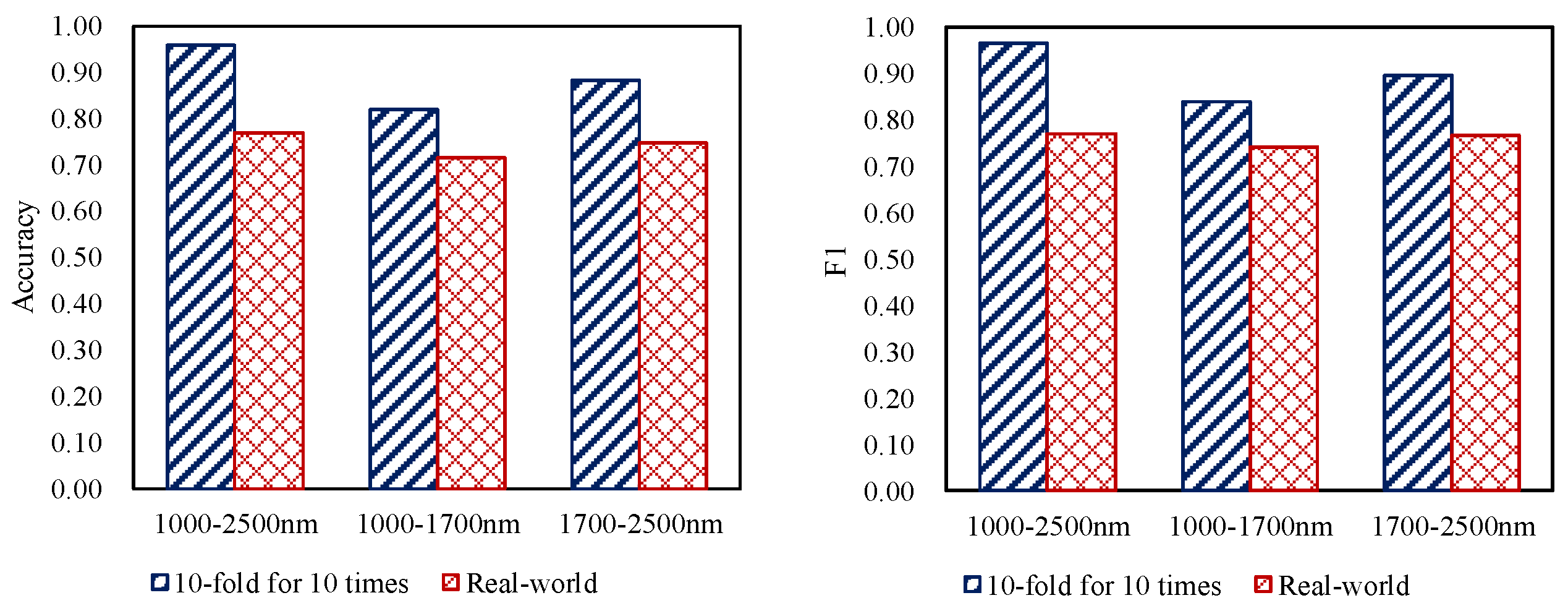
Commercially available near-infrared (NIR) imaging spectrometers typically operate within two distinct spectral ranges (Dualix Spectral Imaging, http://www.i-spectral.com/ (accessed on 1 February 2026); Specim, https://www.specim.com/(accessed on 1 February 2026)): 900–1700 nm and 1000–2500 nm. To investigate the specific contribution of spectral information beyond 1700 nm to the classification of polyester dyeing quality, we partitioned the spectrum of Textile B at the 1700 nm cutoff. Experiments were conducted using both the standard 10 runs of 10-fold cross-validation and the more rigorous real-world split protocol. BDR-SVM was employed as the primary analytical method with its hyperparameters held constant throughout the experiments. The comparative results are presented in Figure 9. Data analysis reveals that truncating the spectrum to exclude wavelengths beyond 1700 nm results in a consistent performance degradation for BDR-SVM across both validation protocols. Specifically, in the 10-fold cross-validation scenario, restricting the input to the 1000–1700 nm range caused a 13% decrease in both accuracy and F1-score. Similarly, under the real-world split protocol, the same spectral restriction led to declines of 5% in accuracy and 2% in F1-score. These findings indicate that for the detection methodology proposed in this study, the spectral information contained in the long-wave NIR region (>1700 nm) is critical for achieving optimal classification performance.

3. Discussion

The core challenge addressed in this study is the effective IR spectroscopic characterization of heterogeneous objects. The intrinsic complexity of such samples often challenges the fundamental assumption of homogeneity relied upon by conventional chemometric strategies. By framing the analysis of IR spectra from heterogeneous objects as a MIL problem, we leverage bag dissimilarity regularized MIL, which incorporates both explicit and implicit representations for performance improvement. The experimental results across diverse tasks, including PDMS block assessment and PET fiber inspection, strongly corroborate this hypothesis, validating the proposed BDR-MIL framework.
A recurring theme throughout our experiments was the substantial performance margin between MIL-based approaches and traditional single-spectrum characterization (SimpleMI). In tasks characterized by high sample heterogeneity, such as the PET fiber inspection, averaging spectra effectively dilutes critical local information, leading to negligible discriminative capability. In contrast, feature-based MIL methods consistently achieved high accuracy. This indicates that the spatial correlations and local spectral variations among different regions of the same object are not merely noise but contain pivotal information regarding the macroscopic properties of the sample.
However, the existing MIL methods for IR analysis overlook the underlying manifold structure of the data. While explicit representations (like MIFA or miVLAD features) capture statistical descriptors of bags, they may not fully encode the complex topological relationships between bags. To this end, we introduce BDR-SVM to the IR analysis of heterogeneous objects. Our parameter sensitivity analysis revealed that incorporating the bag dissimilarity regularization term yields a distinct performance improvement, particularly in challenging scenarios such as the real-world split generalization test. This suggests that the implicit representation acts as a crucial regularizer. By constraining the classifier to respect the pairwise dissimilarities in the embedded space, the BDR term effectively guides the learning process, preventing overfitting to noisy empirical information and enhancing generalization to unseen sample groups. The observation that excessive regularization leads to underfitting further confirms the need for a balanced synergy between fitting explicit features and respecting implicit representations.

4. Materials and Methods

4.1. Bag Dissimilarity Regularized MIL

The process of extracting implicit features using the BS method can be viewed as projecting multi-instance bags into a specific embedding space. In this space, the distance between bags satisfies the bag distance or dissimilarity d ( B i , B j ) defined by the BS method. Within the BDR framework, the information provided by implicit representations is incorporated into a regularization term. Here, an assumption is introduced: multi-instance bags in this implicit embedding space lie on a low-dimensional manifold, and bags that are closer on this manifold are more likely to share the same label. This assumption aligns with the manifold assumption, which is widely applied in fields such as semi-supervised learning [35] and dimensionality reduction [36]. As illustrated in Figure 1, explicit and implicit features are integrated into the BDR framework via distinct mechanisms. The fixed-length explicit features extracted by the ES method serve directly as the input to the classifier. Meanwhile, the implicit features provided by the BS method are utilized to construct a k-nearest neighbor graph (kNNG), which is subsequently integrated into the regularization term.
As previously discussed, existing studies [36,37,38] indicate that the kNNG effectively captures the local geometric structure of data. For a specific multi-instance bag and its given implicit features, the kNNG identifies the k nearest neighbors based on the defined bag dissimilarity metric. In this context, each node in the graph represents a bag, while the edges encode the pairwise relationships between these bags. In this work, a 0–1 weighted kNNG, denoted as S, is employed to leverage this implicit feature information and is defined as follows.
S i , j = 1 , if B j is the k-nearest neighbor of B i 0 , otherwise
where S i , j indicates whether bag B i and bag B j are close under the metric d ( · ) .
Since bags that are close on the manifold are likely to share similar labels, their output vectors should also be proximate. Let the set of output vectors be denoted as Y ^ = { y ^ 1 , y ^ 2 , , y ^ n b } , where y ^ i represents the output vector for bag B i , and n b is the total number of bags. Let e i be the explicit feature vector corresponding to bag B i . For a classifier f ( · ) , the output y ^ i is generated from the explicit feature e i , denoted as y ^ i = f ( e i ) . Based on the adjacency matrix S derived from d B i , B j , the following regularization term is employed to constrain the output vectors according to the local manifold structure:
R B D = 1 2 i j S i , j y ^ i y ^ j 2
Minimizing R B D encourages bags that are close on the manifold to remain close in the output space. In this manner, the output vectors derived from the explicit features e i are guided by the implicit feature information. This regularization term can be rewritten in matrix form as:
R B D = Tr ( Y ^ T L Y ^ ) ,
where Tr ( · ) denotes the trace of a matrix, and L represents the graph Laplacian of S, defined as L = D S . Here, D is a diagonal matrix where D i , i = j S i , j .

4.2. BDR-SVM

As a classical classifier, the Support Vector Machine (SVM) has been widely applied to various practical problems, particularly in the field of MIL [14,18,39]. In MIL research, SVMs are frequently employed as backend classifiers to process extracted multi-instance features, as seen in methods such as MInD [18] and miFV [20]. In this section, we integrate bag dissimilarity regularization with the SVM framework to propose the Bag Dissimilarity Regularized Support Vector Machine (BDR-SVM). Constrained by supervisory information and structural risk terms, the standard SVM seeks to identify an optimal classification hyperplane. The objective function of the standard SVM is formulated as follows:
O S V M = 1 2 α T K α + C i n b l ξ i s . t .     y i ( j n b l α i K i , j + b ) 1 ξ i , i = 1 , 2 , , n b l ξ i 0 , i = 1 , 2 , , n b l
where K is the kernel matrix defined as K i , j = ϕ ( e i ) , ϕ ( e j ) , with ϕ representing a linear or nonlinear transformation. n b l is the number of labeled samples. The vector α = { α 1 ; ; α n b l } denotes the contribution (or weight) of each bag to the final prediction, and b is the bias term. Given the explicit feature e i of a bag B i , the corresponding predicted label Y ^ e i can be obtained via the following formula:
Y ^ e i = α T k e i + b ,
where k e i denotes the kernel vector corresponding to e i . Only training samples with α i > 0 (i.e., support vectors) influence the final classification result.
Upon incorporating the regularization term, the loss function of the Bag Dissimilarity Regularized Support Vector Machine (BDR-SVM) can be formulated as
O B D R S V M = 1 2 α T K α + C i n b l ξ i + λ 2 2 α T L α s . t .     y i ( j n b α i K i , j + b ) 1 ξ i , i = 1 , 2 , , n b l       ξ i 0 , i = 1 , 2 , , n b l
As previously discussed, R B D may introduce feature information from unlabeled data; consequently, α R n b × 1 . The prediction for a given explicit feature e i can be formulated as follows:
Y ^ e i = α T k e i + b ,
where k e i R n b × 1 denotes the kernel vector corresponding to e i .

4.3. PDMS Block Assessment

PDMS elastomers are extensively employed in soft lithography for fabricating microstructures in microfluidic and microengineering applications [40]. As the primary material for polymer-based microfluidic chips, PDMS is also a standard elastomeric material utilized in soft lithography technology [41,42]. Compared to traditional materials such as silicon and glass, PDMS offers distinct advantages, including low cost, ease of fabrication, and excellent biocompatibility. To date, PDMS has established itself as a foundational material in the field of microfluidics, finding applications in digital PCR, gene sequencing, and wearable sensors [41].
The fabrication of PDMS elastomers involves multiple operations, among which cross-linking curing is a critical step. Dow Corning’s Sylgard 184 consists of a base and a curing agent. These two components are typically mixed at a ratio of approximately 10:1 and subsequently cured to form the PDMS elastomer. During the process, the base and curing agent are mixed at a specific ratio, degassed, and then cast onto a mold to form a liquid layer. Subsequently, the mixture undergoes thermal curing at 85 °C. After a curing period of 30 min, the solidified PDMS can be demolded. Following specific processing steps, the cured PDMS elastomer can be fabricated into devices such as polymer chips and sensors for various applications. During the curing reaction, the ratio of the curing agent significantly influences the physical and mechanical properties of PDMS (e.g., Young’s modulus [40]), along with the uniformity of mixture. Non-uniform curing of the PDMS elastomer (caused by inconsistent curing conditions) results in spatial variations in physical and mechanical properties, which may adversely affect subsequent experiments and applications. Therefore, developing a method to detect the curing uniformity of PDMS is of great significance.
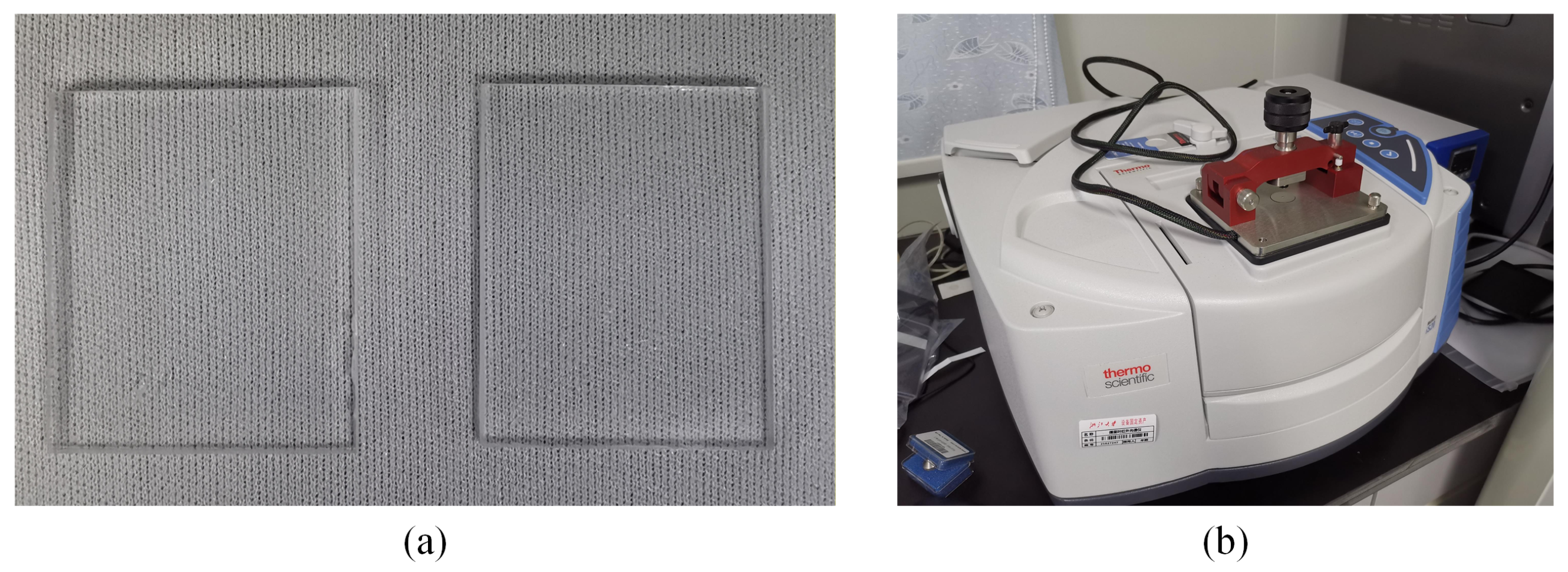
In this study, two sets of PDMS elastomers were fabricated for experimentation using Sylgard 184. The fabrication process primarily involved the following steps: mixing the PDMS base (Part A) and curing agent (Part B) at a 10:1 ratio; placing the mixture into a mixer for homogenization and vacuum degassing; casting the homogenized mixture onto a mold wrapped in aluminum foil to form a liquid layer approximately 5 mm thick; and placing the mold in an oven for thermal curing, followed by demolding. To obtain PDMS elastomers with different curing states, varying mixing times were employed. The mixing time was set to 1 min for normal samples and 10 seconds for abnormal samples, while all other procedures remained consistent. Figure 10a shows a normal sample and an abnormal sample. Due to the shorter mixing time, the distribution of the curing agent in the abnormal sample was non-uniform, leading to local variations in the final elastomer. Notably, the aforementioned fabrication process aligns with that of common PDMS microfluidic chips, effectively simulating conditions encountered in practical applications.
A Thermo Fisher IS-20 Fourier Transform Infrared (FTIR) spectrometer (Thermo Fisher Scientific Inc., Waltham, MA, USA) was employed to acquire the infrared spectra of the PDMS chips. The spectrometer used in this study is illustrated in Figure 10b. The instrument was equipped with a Smart Golden Gate ATR accessory. Using this accessory, the acquisition time for a spectrum at a single point on the PDMS surface was approximately 1 to 2 min. The number of scans was set to 16, with a spectral resolution of 8 cm 1 . The background spectrum was re-acquired after completing data collection for each PDMS chip. The IS-20 spectrometer automatically converts the interferogram into a single-beam spectrum and subsequently derives the reflectance of the sample based on the background spectrum. Prior to subsequent analysis, the spectra were normalized to mitigate interference from irrelevant background information.
A total of 24 PDMS elastomers were fabricated, consisting of 12 normal and 12 abnormal samples. Depending on the surface area of each elastomer, 4 to 12 infrared spectra were collected per sample, resulting in a total of 195 spectra across the 24 chips. Each infrared spectrum was recorded in the range of 4000 cm 1 to 650 cm 1 , corresponding to 6950 spectral sampling points. Due to the difficulty in determining the specific ratio of the curing agent at different locations within the PDMS during fabrication, precise labels for individual spectra were unavailable; only the global uniformity status of the PDMS elastomer could be ascertained. Consequently, in the data analysis, each infrared spectrum was treated as an instance, while the collection of all spectra corresponding to a single chip was treated as a bag. Specifically, spectra from abnormal samples (10 s mixing time) were defined as positive bags, whereas spectra from uniform chips (1 min mixing time) were defined as negative bags. Constrained by the number of PDMS elastomers, the collected infrared spectral data exhibited characteristics of high dimensionality and small sample size. The high resolution of the Fourier transform spectrometer resulted in a feature dimensionality of 6950, while the total number of spectra was only 195.

4.4. PET Fiber Data Acquisition

In the textile industry, ensuring the dyeing consistency of fabrics is of great importance [43]. To guarantee the dyeing consistency of fabrics, the dyeing uniformity of the constituent fibers must first be ensured. As the most widely utilized synthetic fiber, polyester requires strict maintenance of fiber dyeing uniformity during its production, necessitating the assessment of its dyeing uniformity. To effectively characterize the various regions of the fibers, an imaging spectrometer was employed to acquire spectral data of the polyester fibers. The imaging spectrometer used in this section is the GaiaSorter, manufactured by Dualix Spectral Imaging. This instrument is capable of acquiring near infrared (NIR) spectra within the range of 1000–2500 nm, with a spectral resolution of approximately 10 nm. The resultant imaging spectral data output by the spectrometer consists of 288 bands in the spectral dimension.
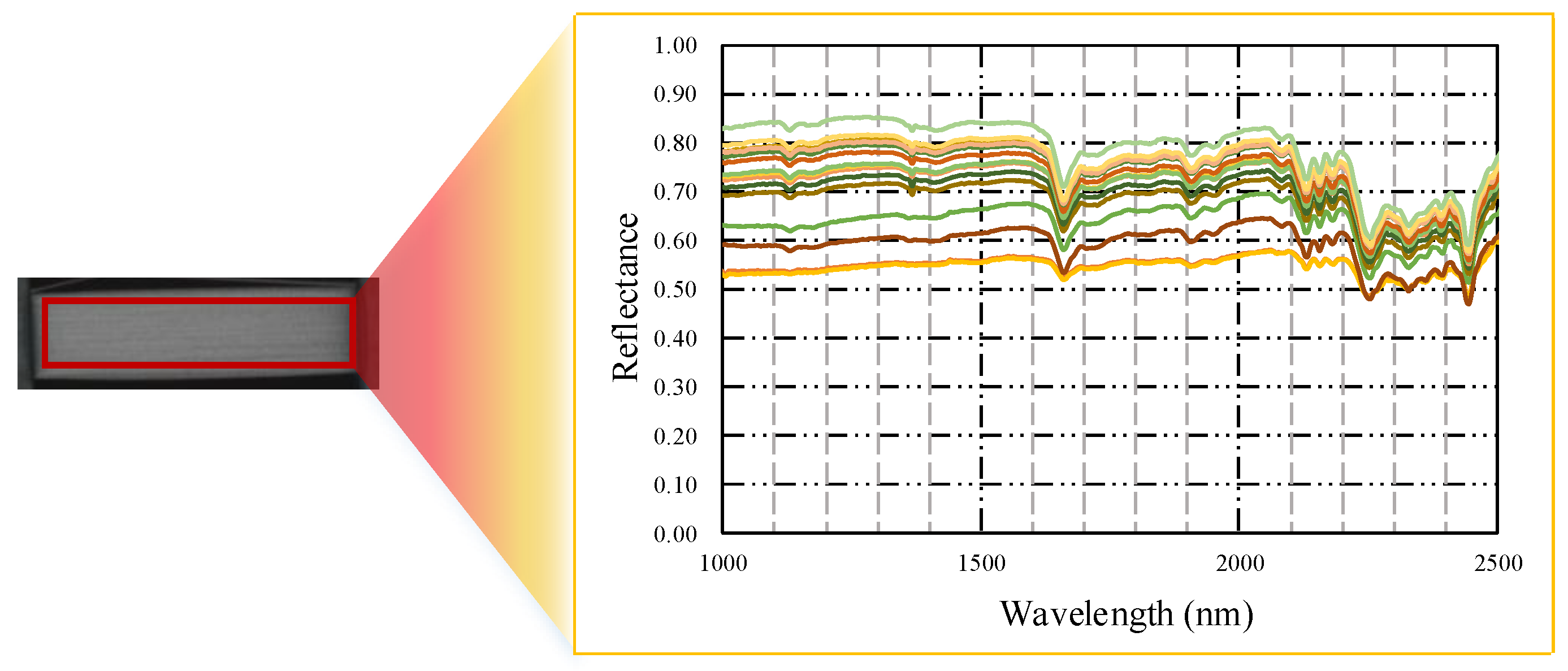
Following the acquisition of imaging spectral data, black-and-white calibration was performed on the hyperspectral images of the fibers using a standard white reference board and background noise data to obtain the relative reflectance of the fibers. The calibrated hyperspectral data is presented in Figure 11. Due to the inherent characteristics of the instrument, noise interference became significant in bands beyond 2500 nm. Consequently, the last 10 bands were excluded, and the first 278 bands were utilized for subsequent analysis. The hyperspectral images acquired inevitably contain spectra from background objects. To extract the regions corresponding to the fiber samples, we compared the data in the spectral dimension and extracted pixels matching the sample spectrum. In this section, the Spectral Angle Mapper (SAM) algorithm was employed strictly for background segmentation (i.e., isolating effective fiber regions from the background). The spectral angle is defined as α = cos 1 { s 1 · s 2 / ( s 1 s 2 ) } , where s 1 and s 2 represent two spectra with the same number of bands. First, a spectrum belonging to the sample region was manually selected as the reference spectrum; subsequently, the sample regions were screened based on the similarity between each pixel and the reference spectrum, calculated using the spectral angle formula. Due to the limited number of samples, the fiber data was further cropped into multiple smaller hyperspectral patches, ensuring a certain interval between each patch.
Since the infrared spectra were collected directly from the fibers, whereas the actual dyeing quality of the polyester fibers can only be determined through knitting and dyeing, precise labels for each individual infrared spectrum could not be obtained; only coarse, sample-level labels were available. Therefore, it is essential to employ MIL algorithms for subsequent processing. In this study, each spectrum of a sample is treated as an instance, while the imaging spectral data corresponding to a single sample is treated as a bag. The collected fiber hyperspectral data were utilized to construct two datasets, denoted as Textile A and Textile B. Textile A dataset comprises 79 collected hyperspectral images, consisting of 39 abnormal sample images (treated as positive bags) and 40 normal sample images (treated as negative bags). These 79 hyperspectral images contain a total of 6876 near infrared (NIR) spectra. Textile B comprises 101 hyperspectral images and 146,390 infrared spectra, including 50 abnormal samples and 51 normal samples. The samples in Textile B originated from different batches, and a single sample may correspond to multiple hyperspectral images acquired at different positions. Similar to many publicly available MIL datasets [5,17], the number of bags in these two fiber datasets is relatively limited due to the difficulty of sample collection. However, these datasets simultaneously possess a relatively large number of instances, posing a challenge for subsequent infrared spectral analysis algorithms.

4.5. Generative AI Disclosure

Generative artificial intelligence tools (Gemini 3 by Google) were used to assist with wording refinement and structural editing. No AI tools were used for data collection, analysis, or interpretation. All statistical analyses were performed by the authors.

5. Conclusions

This paper introduces a novel Bag Dissimilarity Regularized Multiple Instance Learning (BDR-MIL) framework to address the challenge of analyzing heterogeneous objects using infrared spectroscopy, where traditional methods fail to capture local variations. By integrating explicit spectral features with an implicit regularization term, BDR-MIL effectively captures the intrinsic information of IR spectra. Extensive validation on real-world PDMS and PET fiber tasks demonstrated that BDR-MIL significantly outperforms existing MIL and conventional single-spectrum methods, with regularization substantially improving generalization to testing samples. The above results have established BDR-MIL as a powerful tool for advancing automated, non-destructive testing of complex materials.

Supplementary Materials

The following supporting information can be downloaded at: https://www.mdpi.com/article/10.3390/aichem1020006/s1, File S1: code.zip.

Author Contributions

Conceptualization, S.H. and Z.Z.; methodology, software, validation, formal analysis, S.H.; writing—original draft preparation, S.H.; writing—review and editing, Z.Z. All authors have read and agreed to the published version of the manuscript.

Funding

This research received no external funding.

Institutional Review Board Statement

Not applicable.

Informed Consent Statement

Not applicable.

Data Availability Statement

The original data presented in the study are provided in Supplementary Materials.

Acknowledgments

The authors would like to thank the Research Centre for Analytical Instrumentation, Zhejiang University for providing the experimental facilities and equipment. During the preparation of this study, the authors used Gemini 3 for the purposes of language editing. The authors have reviewed and edited the output and take full responsibility for the content of this publication.

Conflicts of Interest

The authors declare no conflicts of interest.

Abbreviations

The following abbreviations are used in this manuscript:
MILMultiple instance learning
IRInfrared
ISInstance space
BSBag space
ESEmbedded space
BDRBag dissimilarity regularization/regularized

References

  1. Liu, H.; Tian, L.; Wang, L.; Zhang, Z.; Li, J.; Liu, X.; Zheng, B.; Ma, H.; Wang, Y.; Li, J. Real-time grading of roasted tobacco using near infrared spectroscopy technology. Microchem. J. 2024, 204, 110963. [Google Scholar] [CrossRef]
  2. Chrimatopoulos, C.; Tummino, M.L.; Iliadis, E.; Sakkas, C.T. Attenuated Total Reflection Fourier Transform Infrared Spectroscopy and Chemometrics for the Discrimination of Animal Hair Fibers for the Textile Sector. Appl. Spectrosc. 2025, 79, 1173–1184. [Google Scholar] [CrossRef]
  3. Rish, A.J.; Kurt, C.; Assis, J.M.; Rehrauer, O.; Rangel-Gil, R.S.; Taylor, E. Evaluation of Calibration Burden for Monitoring of a Pharmaceutical Continuous Manufacturing Line using Near-Infrared Spectroscopy. Int. J. Pharm. 2025, 673, 125419. [Google Scholar] [CrossRef] [PubMed]
  4. Tarapoulouzi, M.; Theocharis, C.R. Discrimination of Anari cheese samples in comparison with Halloumi cheese samples regarding the origin of the species by FTIR measurements and chemometrics. Analytica 2023, 4, 374–384. [Google Scholar] [CrossRef]
  5. Dietterich, T.G.; Lathrop, R.H.; Lozano-Pérez, T. Solving the multiple instance problem with axis-parallel rectangles. Artif. Intell. 1997, 89, 31–71. [Google Scholar] [CrossRef]
  6. Jang, J.; Kwon, H.Y. Are multiple instance learning algorithms learnable for instances? In Proceedings of the NIPS ’24: 38th International Conference on Neural Information Processing Systems, Vancouver, BC, Canada, 10–15 December 2024; Curran Associates Inc.: Red Hook, NY, USA, 2024. [Google Scholar]
  7. Eksi, R.; Li, H.D.; Menon, R.; Wen, Y.; Omenn, G.S.; Kretzler, M.; Guan, Y. Systematically differentiating functions for alternatively spliced isoforms through integrating RNA-seq data. PLoS Comput. Biol. 2013, 9, e1003314. [Google Scholar] [CrossRef]
  8. Shen, L.C.; Zhang, Y.; Wang, Z.; Littler, D.R.; Liu, Y.; Tang, J.; Rossjohn, J.; Yu, D.J.; Song, J. Self-iterative multiple-instance learning enables the prediction of CD4+ T cell immunogenic epitopes. Nat. Mach. Intell. 2025, 7, 1250–1265. [Google Scholar] [CrossRef]
  9. Shi, J.; Li, C.; Gong, T.; Zheng, Y.; Fu, H. ViLa-MIL: Dual-scale Vision-Language Multiple Instance Learning for Whole Slide Image Classification. In Proceedings of the 2024 IEEE/CVF Conference on Computer Vision and Pattern Recognition (CVPR), Seattle, WA, USA, 16–22 June 2024; pp. 11248–11258. [Google Scholar]
  10. Makadiya, S.; Pavan Kumar Reddy, K.; Gubbi, J. SS-MIL: Attention-Based Selective Correlated Multiple Instance Learning for Whole Slide Image Classification. In Proceedings of the ECCV 2024 Workshops, Milan, Italy, 29 September–4 October 2024; Springer: Cham, Switzerland, 2025; pp. 239–251. [Google Scholar] [CrossRef]
  11. Liu, J.; Kong, D.; Huang, L.; Mao, D.; Xue, H. Multiple Instance Learning for Offensive Language Detection. In Proceedings of the Findings of the Association for Computational Linguistics: EMNLP 2022, Abu Dhabi, United Arab Emirates, 7–11 December 2022; Association for Computational Linguistics: Abu Dhabi, United Arab Emirates, 2022; pp. 7387–7396. [Google Scholar]
  12. Yang, R.; Ma, J.; Lin, H.; Gao, W. A weakly supervised propagation model for rumor verification and stance detection with multiple instance learning. In Proceedings of the 45th International ACM SIGIR Conference on Research and Development in Information Retrieval, Madrid, Spain, 11–15 July 2022; Association for Computing Machinery: New York, NY, USA, 2022; pp. 1761–1772. [Google Scholar]
  13. Amores, J. Multiple instance classification: Review, taxonomy and comparative study. Artif. Intell. 2013, 201, 81–105. [Google Scholar] [CrossRef]
  14. Andrews, S.; Tsochantaridis, I.; Hofmann, T. Support vector machines for multiple-instance learning. Adv. Neural Inf. Process. Syst. 2002, 15, 577–584. [Google Scholar]
  15. Bunescu, R.C.; Mooney, R.J. Multiple Instance Learning for Sparse Positive Bags. In Proceedings of the 24th International Conference on Machine Learning (ICML), Corvalis, OR, USA, 20–24 June 2007; Association for Computing Machinery: New York, NY, USA, 2007; pp. 105–112. [Google Scholar] [CrossRef]
  16. Wu, J.; Yu, Y.; Huang, C.; Yu, K. Deep multiple instance learning for image classification and auto-annotation. In Proceedings of the 2015 IEEE Conference on Computer Vision and Pattern Recognition (CVPR), Boston, MA, USA, 7–12 June 2015; IEEE: New York, NY, USA, 2015; pp. 3460–3469. [Google Scholar] [CrossRef]
  17. Zhou, Z.H.; Sun, Y.Y.; Li, Y.F. Multi-Instance Learning by Treating Instances as Non-I.I.D. Samples. In Proceedings of the 26th Annual International Conference on Machine Learning (ICML), Montréal, QC, Canada, 14–18 June 2009; Association for Computing Machinery: New York, NY, USA, 2009; pp. 1249–1256. [Google Scholar] [CrossRef]
  18. Cheplygina, V.; Tax, D.M.; Loog, M. Multiple instance learning with bag dissimilarities. Pattern Recognit. 2015, 48, 264–275. [Google Scholar] [CrossRef]
  19. Chen, Y.; Bi, J.; Wang, J.Z. MILES: Multiple-instance learning via embedded instance selection. IEEE Trans. Pattern Anal. Mach. Intell. 2006, 28, 1931–1947. [Google Scholar] [CrossRef] [PubMed]
  20. Wei, X.S.; Wu, J.; Zhou, Z.H. Scalable algorithms for multi-instance learning. IEEE Trans. Neural Netw. Learn. Syst. 2016, 28, 975–987. [Google Scholar] [CrossRef] [PubMed]
  21. Wang, X.; Yan, Y.; Tang, P.; Bai, X.; Liu, W. Revisiting multiple instance neural networks. Pattern Recognit. 2018, 74, 15–24. [Google Scholar] [CrossRef]
  22. Wang, H.; Han, L.; Cai, W.; Shao, X. Chemometrics: A Vital Implement for Understanding the Water Structures by Near-Infrared Spectroscopy. J. Chemom. 2024, 38, e3631. [Google Scholar] [CrossRef]
  23. Song, W.; Wang, H.; Power, U.F.; Rahman, E.; Barabas, J.; Huang, J.; McLaughlin, J.; Nugent, C.; Maguire, P. Classification of Respiratory Syncytial Virus and Sendai Virus Using Portable Near-Infrared Spectroscopy and Chemometrics. IEEE Sens. J. 2023, 23, 9981–9989. [Google Scholar] [CrossRef]
  24. Wang, Y.; Ou, X.; He, H.J.; Kamruzzaman, M. Advancements, limitations and challenges in hyperspectral imaging for comprehensive assessment of wheat quality: An up-to-date review. Food Chem. X 2024, 21, 101235. [Google Scholar] [CrossRef]
  25. Lin, Z.; Jia, S.; Luo, G.; Dai, X.; Xu, B.; Wu, Z.; Shi, X.; Qiao, Y. Dealing with heterogeneous classification problem in the framework of multi-instance learning. Talanta 2015, 132, 175–181. [Google Scholar] [CrossRef]
  26. Caetano, V.F.; e Brito, L.R.; Rohwedder, J.J.R.; Pasquini, C.; Pimentel, M.F.; Vinhas, G.M. Determination of diethyleneglycol content and number of carboxylic end groups in poly (ethylene terephthalate) fibers using imaging and conventional near infrared spectroscopy. Polym. Test. 2016, 49, 15–21. [Google Scholar] [CrossRef]
  27. Liu, Y.; Zhou, S.; Han, W.; Liu, W.; Qiu, Z.; Li, C. Convolutional neural network for hyperspectral data analysis and effective wavelengths selection. Anal. Chim. Acta 2019, 1086, 46–54. [Google Scholar] [CrossRef]
  28. Qi, Y.; Zhang, Y.; Tang, S.; Zeng, Z. Synergizing Wood Science and Interpretable Artificial Intelligence: Detection and Classification of Wood Species Through Hyperspectral Imaging. Forests 2025, 16, 186. [Google Scholar] [CrossRef]
  29. Bhargava, A.; Sachdeva, A.; Sharma, K.; Alsharif, M.H.; Uthansakul, P.; Uthansakul, M. Hyperspectral imaging and its applications: A review. Heliyon 2024, 10, e33208. [Google Scholar] [CrossRef]
  30. Huang, S.; Liu, Z.; Jin, W.; Mu, Y. Bag dissimilarity regularized multi-instance learning. Pattern Recognit. 2022, 126, 108583. [Google Scholar] [CrossRef]
  31. Chapelle, O.; Haffner, P.; Vapnik, V.N. Support vector machines for histogram-based image classification. IEEE Trans. Neural Netw. 1999, 10, 1055–1064. [Google Scholar] [CrossRef] [PubMed]
  32. Foulds, J.R. Learning Instance Weights in Multi-Instance Learning. Ph.D. Thesis, The University of Waikato, Hamilton, New Zealand, 2008. [Google Scholar]
  33. Ilse, M.; Tomczak, J.; Welling, M. Attention-based deep multiple instance learning. In Proceedings of the International Conference on Machine Learning (ICML), Stockholm, Sweden, 10–15 July 2018; Proceedings of Machine Learning Research (PMLR): Cambridge, MA, USA, 2018; pp. 2127–2136. [Google Scholar]
  34. Traoré, M.; Kaal, J.; Martínez Cortizas, A. Application of FTIR spectroscopy to the characterization of archeological wood. Spectrochim. Acta Part A Mol. Biomol. Spectrosc. 2016, 153, 63–70. [Google Scholar] [CrossRef]
  35. Belkin, M.; Niyogi, P.; Sindhwani, V. Manifold regularization: A geometric framework for learning from labeled and unlabeled examples. J. Mach. Learn. Res. 2006, 7, 2399–2434. [Google Scholar]
  36. Belkin, M.; Niyogi, P. Laplacian Eigenmaps and Spectral Techniques for Embedding and Clustering. In Proceedings of the NIPS’01: 15th International Conference on Neural Information Processing Systems (NIPS), Vancouver, BC, Canada, 3–8 December 2001; MIT Press: Cambridge, MA, USA, 2001; pp. 585–591. [Google Scholar]
  37. Chung, F.R. Spectral Graph Theory; American Mathematical Soc.: Providence, RI, USA, 1997; Volume 92. [Google Scholar]
  38. Cai, D.; He, X.; Han, J.; Huang, T.S. Graph regularized nonnegative matrix factorization for data representation. IEEE Trans. Pattern Anal. Mach. Intell. 2010, 33, 1548–1560. [Google Scholar] [CrossRef]
  39. Melki, G.; Cano, A.; Ventura, S. MIRSVM: Multi-instance support vector machine with bag representatives. Pattern Recognit. 2018, 79, 228–241. [Google Scholar] [CrossRef]
  40. Johnston, I.; McCluskey, D.; Tan, C.; Tracey, M. Mechanical characterization of bulk Sylgard 184 for microfluidics and microengineering. J. Micromech. Microeng. 2014, 24, 035017. [Google Scholar]
  41. Raj M, K.; Chakraborty, S. PDMS microfluidics: A mini review. J. Appl. Polym. Sci. 2020, 137, 48958. [Google Scholar] [CrossRef]
  42. Borók, A.; Laboda, K.; Bonyár, A. PDMS bonding technologies for microfluidic applications: A review. Biosensors 2021, 11, 292. [Google Scholar] [CrossRef]
  43. Günay, M. Determination of dyeing levelness using surface irregularity function. Color Res. Appl. 2009, 34, 285–290. [Google Scholar] [CrossRef]
Figure 1. Workflow of the IR spectra analysis utilizing Bag Dissimilarity Regularization (BDR). Input spectral bags are processed through dual pathways to extract explicit features and implicit topological constraints, where the latter regularizes the original loss function to improve the generalization of the BDR classifier.
Aichem 01 00006 g001
Figure 2. Performance metrics (Accuracy, Precision, Recall, and F1-score) of the evaluated methods on the PDMS infrared spectral dataset. Error bars represent the 95% confidence intervals derived from the cross-validation.
Aichem 01 00006 g002
Figure 3. Performance of BDR-SVM with varying regularization weights in the detection of PDMS curing homogeneity.
Aichem 01 00006 g003
Figure 4. Performance metrics (Accuracy, Precision, Recall, and F1-score) of BDR-SVM trained on different spectral regions. Error bars represent the 95% confidence intervals derived from the cross-validation.
Aichem 01 00006 g004
Figure 5. Performance metrics (Accuracy, Precision, Recall, and F1-score) of the evaluated methods on Textile A. Error bars represent the 95% confidence intervals derived from the cross-validation.
Aichem 01 00006 g005
Figure 6. Comparison of performance metrics (Accuracy, Precision, Recall, and F1-score) between BDR-SVM and SimpleMI on Textile B.
Aichem 01 00006 g006
Figure 7. Performance of BDR-SVM under varying regularization weights using 10 runs of 10-fold cross-validation.
Aichem 01 00006 g007
Figure 8. Performance of BDR-SVM under varying regularization weights using the real-world split protocol.
Aichem 01 00006 g008
Figure 9. Comparison of Accuracy and F1-score for BDR-SVM and SimpleMI on Textile B using different spectral ranges.
Aichem 01 00006 g009
Figure 10. (a) Comparison between a normal elastomer (left) and an abnormal elastomer (right); (b) The FTIR spectrometer setup equipped with an ATR accessory for measuring PDMS samples.
Aichem 01 00006 g010
Figure 11. Pseudo-color images of fiber hyperspectral data and the corresponding spectral curves, with the corresponding IR spectra displayed on the right.
Aichem 01 00006 g011
Disclaimer/Publisher’s Note: The statements, opinions and data contained in all publications are solely those of the individual author(s) and contributor(s) and not of MDPI and/or the editor(s). MDPI and/or the editor(s) disclaim responsibility for any injury to people or property resulting from any ideas, methods, instructions or products referred to in the content.