
Integrating Artificial Intelligence in Audit Workflow: Opportunities, Architecture, and Challenges: A Systematic Review



Abstract
1. Introduction
1.1. Research Gaps and Contributions
1.2. Research Questions
2. Materials and Methods
2.1. Search Strategy and Information Sources
- Search String 1: (“machine learning” OR “deep learning” OR “neural network” OR “artificial intelligence”), AND (“auditing” OR “auditor” OR “audit” OR “internal audit”).
- Search String 2: (“NLP” OR “text mining” OR “natural language processing”) AND (“auditing” OR “audit” OR “audit workflow”).
- Search String 3: “RPA” OR “process automation” OR “robotic process automation”), AND (“audit” OR “internal audit”).
- Search String 4: (“continuous monitoring” OR “real-time audit*”, “continuous audit*”) AND (“artificial intelligence” OR “machine learning”).
- Search String 5: “audit effectiveness”, “audit quality”, AND “automation”, “data analytics”, “artificial intelligence”).
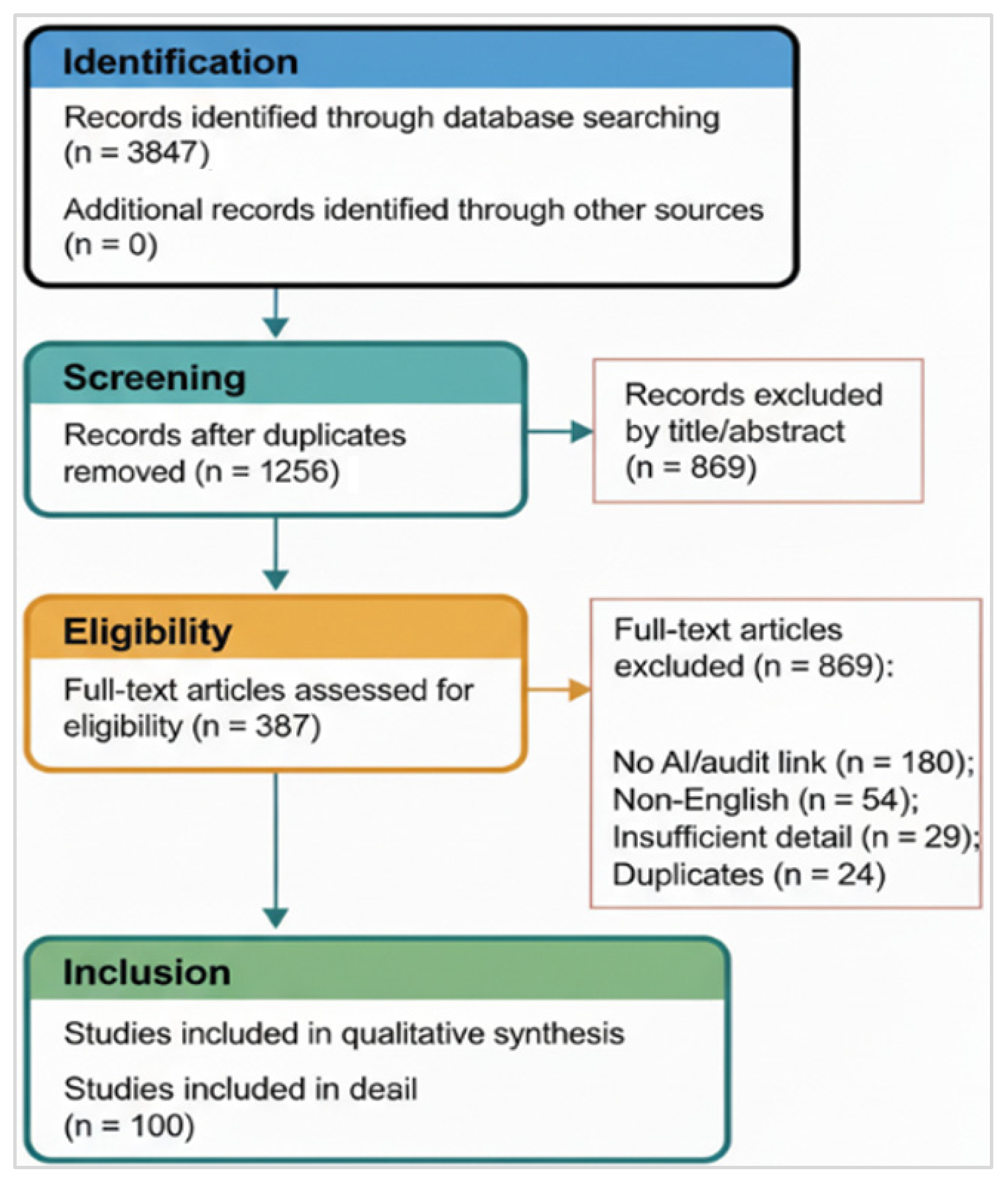
- Change from 2015 to 2025: This review covers the following timeframe: 1 January 2015–31 December 2025 (a period of 10 years). This period was selected because it spans the most recent peak in AI-enabled audit innovation while also capturing contemporary trends in machine learning and AI techniques.
- Language: English-language articles only.
2.2. Inclusion and Exclusion Criteria
- Inclusion Criteria
- Studies focused on the application of artificial intelligence, machine learning, deep learning, natural language processing, robotic process automation, or similar techniques in audit or assurance.
- Studies outlining artificial intelligence applications, architectures, frameworks, and tools/human assessments or empirical evaluations that relate to at least one of the identifiable stages of the audit workflow (planning, risk assessment, controls testing, substantive procedures, reporting, or continuous monitoring).
- Peer-reviewed journal articles, peer-reviewed conference proceedings, or high-quality institutional/professional reports from recognized audit firms, standard-setting bodies, or research organizations.
- For empirical studies, adequate methodological information is given to allow a judgment on study design, sample characteristics, and criteria for evaluation.
- ○
- To illustrate, Rahman and Ziru [31] examined the role of digitalizing clients and audits in the context of the Chinese audit market, offering empirical panel data on client digitalization and audit quality based on a digital expertise analytics approach, and demonstrating that digital clients mediate the interaction between client digitalization and audit quality.
- ○
- A case-based empirical investigation of the global fintech lending environment, conducted by Sachan et al. [32], showed that human–AI collaboration in the context of decision support systems can reduce noise in the decision-making process, giving grounds to this phenomenon and the use of AI.
- ○
- The study by Sun and Vasarhelyi [33], a technical empirical structure of textual data analytics in auditing, demonstrated the performance of deep learning NLP models in improving the efficiency and effectiveness of textual data audits within the global audit analytics environment.
- Exclusion Criteria
- Studies on generic data analytics, business intelligence, or business process management without explicitly mentioning AI/machine learning approaches.
- Articles with a focus on applications of AI or machine learning in accounting, finance, and other areas of business, other than audit or assurance,
- Pure opinion pieces, editorial commentaries or speculative pieces without substantive technical, methodical, or empirical content.
- Research conducted in non-English languages or studies that lacked sufficient detail to extract relevant data.
- Duplicate of article or multiple publications of the same work.
2.3. Study Selection Process
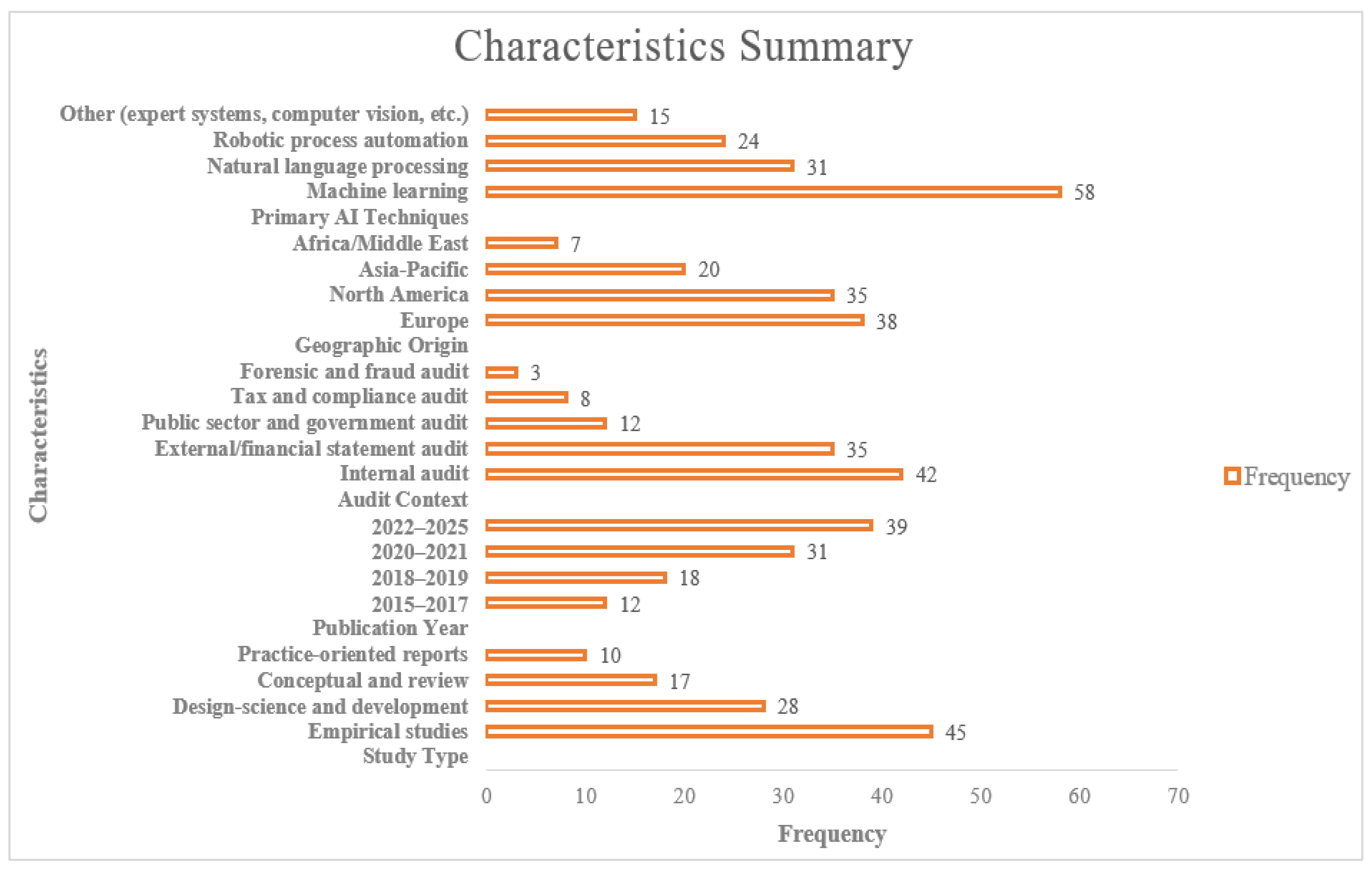
- Empirical studies (45%): Case studies, controlled experiments, field evaluation, surveys, mixed-method studies.
- Design science and development studies (28%): Prototype development, system design descriptions, technical architecture papers.
- Frameworks, position papers, story syntheses (17%): Conceptual studies and literature reviews.
- Practice-oriented reports (10%): White papers/technical guidance from major audit firms and professional organizations.
- Publication timeline: Our earliest matching publication dates to 2015. Publications began to accelerate around 2018, with notable growth in number from 2020 to 2025, driven by increasing attention to AI in auditing as technological advances emerged and competitors adopted these tools.
- Geographic distribution: Authors and studies originated mainly from Europe (38%), North America (35%), Asia-Pacific (20%), and Africa/Middle-East (7%), with significant contributions coming from jurisdictions with strong responses from audit firms and advanced financial markets.
- Contexts of audit addressed: Research on auditing has extensively covered a variety of contexts. Forty-two studies focused on internal auditing, which gives importance to monitoring and evaluating the internal processes of an organization. External financial statement auditing has been covered in 35 works, with a focus on the transparency and accuracy of financial reporting. Public sector and government audits have been the topic of 12 such studies, in which an audit essentially judges the efficiency and accountability of government expenditure and spending in specific sectors. Tax and compliance audits are covered in eight studies, demonstrating the importance of complying with financial and tax laws and regulatory standards. Lastly, forensic and fraud audits have been examined in three studies, which focus on the detection and prevention of fraudulent activities in organizations.
2.4. Quality Assessment
- Clarity/specificity of research objectives and scope;
- Transparency of methodologies, including description of data source and selection of sample;
- Adequacy of data description and auditable quality checks;
- Specification of AI techniques, models, and parameters;
- Appropriateness of evaluation design (e.g., empirical methods, metrics, comparators);
- Completeness of reporting of results;
- Reasons for limitations and possible bias, and acknowledgement and discussion;
- Clarity in terms of generalizability and applicability to context X.
2.5. Data Extraction
- Bibliographic information: Author(s), year of publication, type of study (empirical, design science, conceptual or review), source (journal name, conference, report).
- Audit context: Type of audit (internal audit, external audit/financial statement audit, public sector audit, tax audit/compliance audit, forensic/fraud audit, others).
- Participants/setting: Organization type: multinational firm, big four, small and medium-sized entities (SMEs), public/government, non-profit, audit domains.
- AI techniques and tools: Specific AI techniques that were used (machine learning algorithms and approaches for NLP, RPA platforms, knowledge-based systems, and hybrids) and software/platforms that were mentioned.
- Areas of audit documentation covered how AI supported tasks in the following audit workflow stages: planning, risk assessment, controls testing, substantive procedures, reporting, and continuous monitoring.
- Key findings and outcomes: Reported benefits, efficiency measures, detection rates, accuracy measures, user satisfaction, lessons learnt.
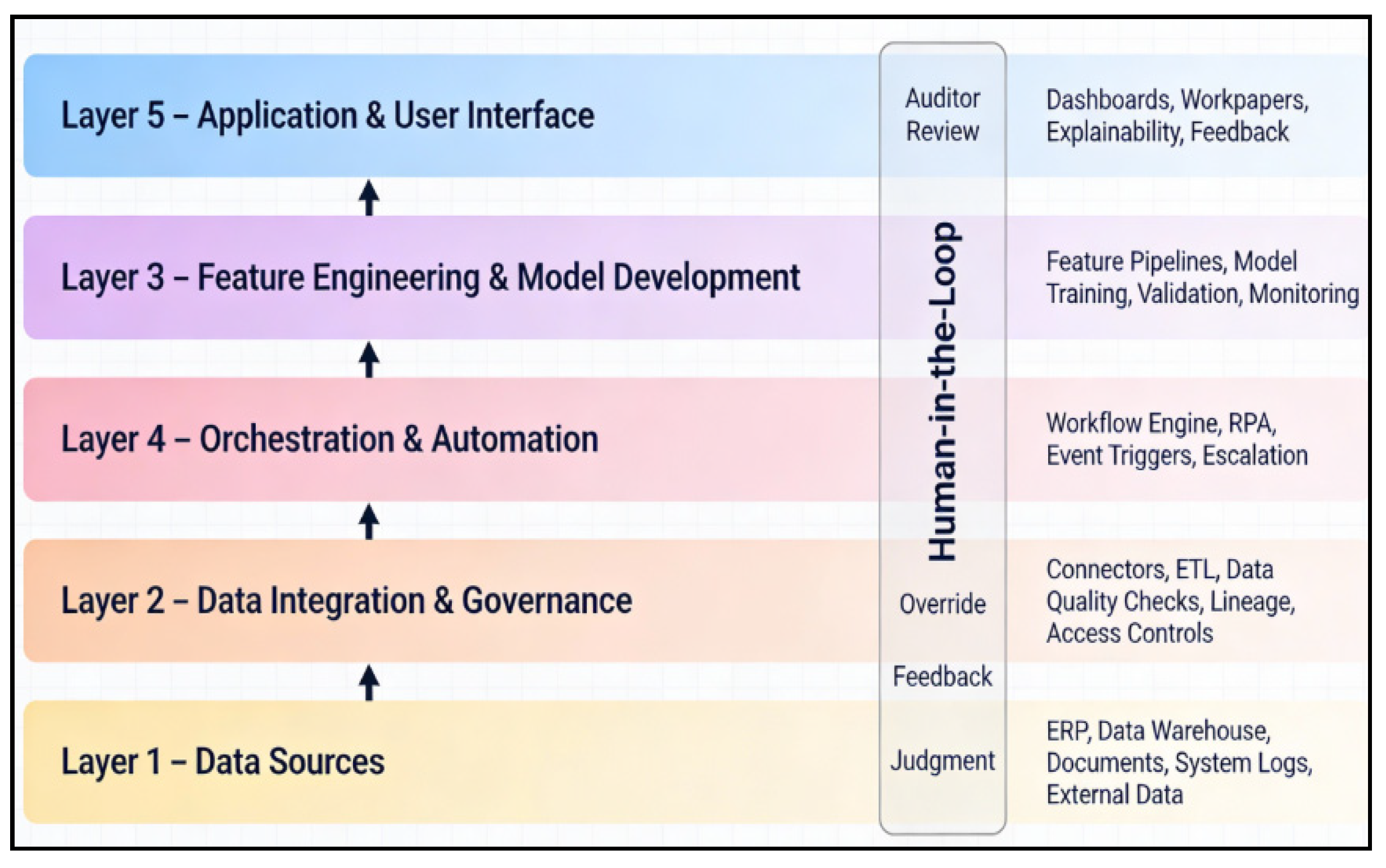
- Architectural/design features: system architecture, data sources, model governance, explainability mechanisms, human–AI interaction design, integration points.
- Challenges and barriers: Technical: data quality, model performance; Organizational: adoption, skills, change management; Regulatory/ethical: compliance, bias, transparency; Governance.
- Research gaps and future directions: The open questions and recommendations that emerged from the research.
2.6. Synthesis Approach
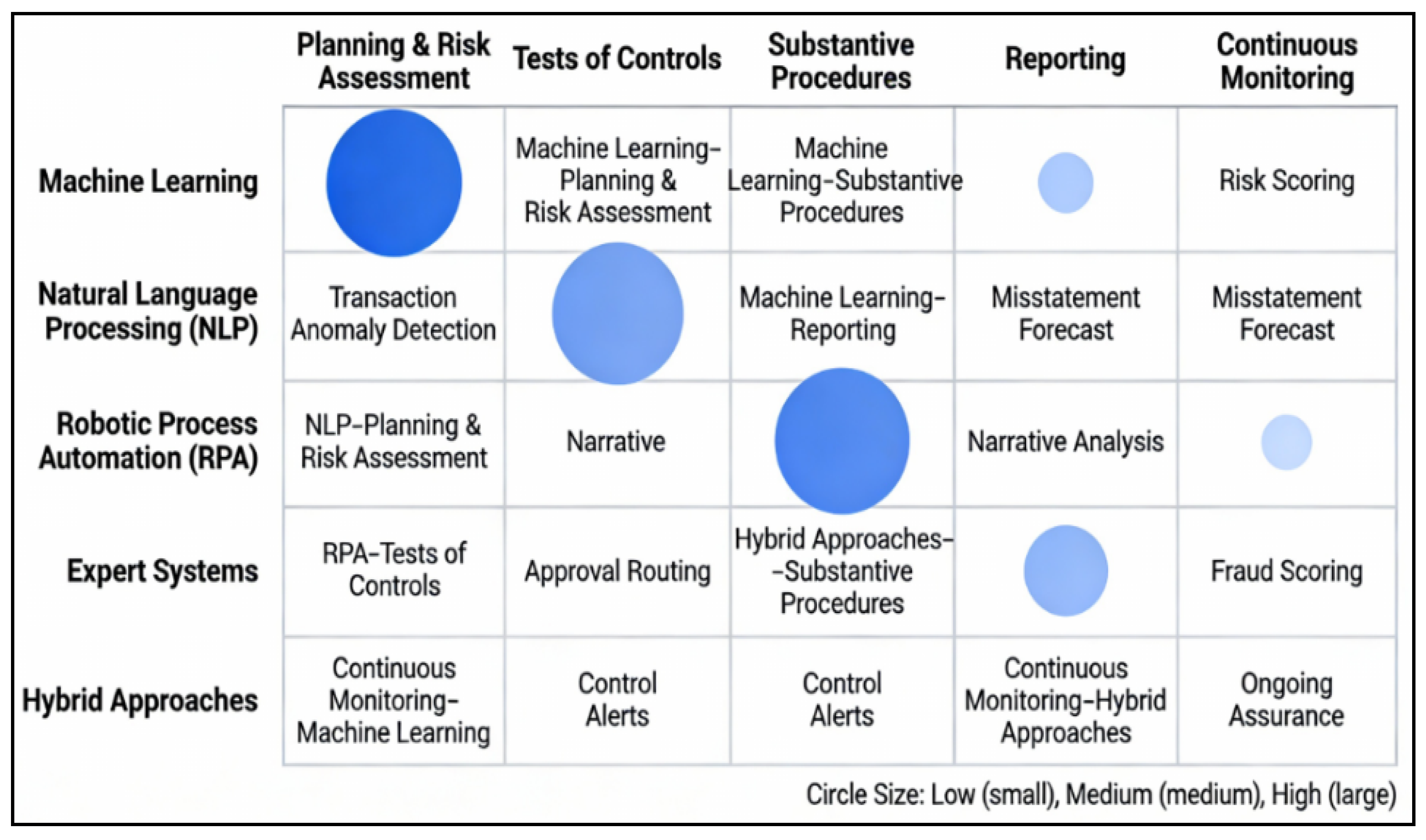
- Mapping: Refers to structural tables and visual diagrams, which were created to correlate AI techniques with the audit workflow stages, architecture elements, opportunities, and challenges to facilitate pattern recognition and gap identification.
3. Results
3.1. AI Techniques and Tools Identified
- Classification algorithms (random forests, gradient boosting, support vector machines, logistic regression) for anomaly detection and classification (fraud and spam) and risk scoring.
- Clustering concepts (k-means, hierarchical clustering, DBSCAN) for the segmentation of transactions and finding patterns.
- Deep learning neural network (multilayer perceptron, convolutional neural networks, recurrent neural networks, and LSTMs) for sequential pattern recognition and time-series forecasting.
- Ensemble methods, which combine multiple models (to achieve better robustness).
- Named entity recognition (NER) and information extraction for contract analysis and regulatory compliance document review.
- Sentiment and tone analysis for management commentary, earnings calls, and internal communications.
- Topic modeling (Latent Dirichlet Allocation, Non-negative Matrix Factorization) based on categorization and summarization of the audit documentation.
- Document matching and validation of standard classification and semantic similarity for text.
- Large language models (GPT variants, BERT, transformer architectures) for document summarization and question answering.
- RPA for the development of bots that can extract data, navigate systems easily, and produce reports upon request.
- Integration of RPA with machine learning for “intelligent automation” enables context-aware decision-making.
- Workflow orchestration engines coordinate multiple bots and AI services.
- Exception handling and escalation mechanisms are also important.
3.2. Audit Workflow Stages and AI Application Patterns
- Integrated risk scoring models use combinations of financial metrics, control scoring, process indicators, and management narrative analysis to prioritize accounts, entities, or processes to focus audits.
- Time-series forecasting and anomaly detection on past financial data to detect out-of-the-ordinary trends in potential risk areas.
- Sentiment and tone analysis of management commentary and regulatory filings to determine tone at the top and quality of the disclosure.
- Entity linking and network analysis to identify the related parties and complex structure requiring increased attention during the audit.
- Machine learning-based inherent risk models based on client industry, regulatory context, and organization factors.
- Real-time analysis of system logs and user access patterns to identify segregation of duty violations and unauthorized system transactions.
- Process mining algorithms to reconstruct real flows in processes based on transaction logs and compare them to the designed controls, flagging deviations.
- Rule-based and machine learning models to monitor transaction approvals, authorization limits, and patterns.
- Continuous monitoring dashboards that raise alarms for auditors concerning breaches of controls, anomalies, or exceptions in near real-time.
- Unsupervised and supervised anomaly detection used for journal entries, accounts receivable, inventory, and other transaction populations to find unusual transactions for focused audit investigation.
- Automated verification and validation of supporting documents (invoices, purchase orders, receipts, contracts) with the help of NLP and computer vision.
- The project aims to combine journal entry testing based on a mix of rule-based (unusual timing, round amounts, top accounts) and machine learning-based anomaly detection.
- Predictive models for the prediction of the likelihood of misstatement or estimates of the account balances for providing the basis of audit judgment and identifying unexpected variances.
- Fraud risk scoring, which is based on characteristics of the transaction, user behavior, and historical patterns, to prioritize items for substantive review.
- Supporting or external reporting, communication, and ongoing assurance (31 studies): post-fieldwork and continuous activities by following AI.
- Automated generation of audit documentation, workpaper summaries, and management letters with the findings and recommendations.
- Interactive dashboards and visualization tools for communicating with the audit committee and how to manage risk heat maps, anomaly profiles, control status, and findings.
- Continuous auditing and monitoring systems to allow the ongoing assessment of control effectiveness and emerging risks instead of point-in-time audit opinions.
- Predictive models for forecasting future control performance/misstatement likelihood to inform audit strategies and allocate resources.
3.3. Study Characteristics
4. Findings: AI Technologies in Audit
4.1. Machine Learning and Anomaly Detection
- Transaction-level anomaly detection: Random forests, gradient boosting machine (XGBoost 3.0.0, LightGBM 4.6.0), and logistic regression are widely employed for the detection of outlier transactions in journal entries, receivables, payables, and inventory [16,33,35,46]. These models learn patterns in millions of routine transactions and identify transactions with unusual characteristics (amount, timing, counterparty, approval chain, and account combination) [25,33,35]. Studies have reported that such models, when properly trained and validated, can detect fraud and errors more than those achievable through manual sampling [25,35].
- Unsupervised anomaly detection (clustering, isolation forests, and autoencoders) is useful if labeled fraud data are limited, as they are often in audit environments [35]. These methods are used to identify a transaction that presents a significant deviation from the learned standard behavior pattern without the need for explicit fraud labels [33,38].
- Key findings: Based on empirical investigations, we find an improvement in detection rates of 20–70% compared with manual sampling methods, but the absolute detection rate varies greatly depending on the data quality, feature engineering, and actual probability of anomalies in the dataset [25,35]. However, several studies have also reported high false-positive rates, which require the auditor to review and triage the alerts, and discuss the importance of investing in data quality, feature engineering, and model validation [39,41].
4.2. Natural Language Processing and Document Analysis
- Contract and regulatory document analysis: NLP models are used to identify important clauses (covenants, termination conditions, related party terms and contingencies) from contracts and deviations from templates or standard language [51,52,54]. Named entity recognition tools are employed to find out named entities like persons, dates, money amount, etc. [55,56]. Such capabilities aid audit procedures in verifying contract completeness, determining the terms of odd contracts, and verifying the adequacy of disclosure [57,58,59].
- Sentiment and tone analysis: Tools are used to measure the tone, the complexity, and the linguistic indicator for possible bias or management overrides in earnings call transcripts, management commentary, and internal communications [59,60,61]. Studies suggest that combining quantitative sentiment measures with human reviews will improve auditors’ ability to evaluate management’s attitude toward controls and the tone at the top [62,63,64].
- Document classification and clustering: Topic modeling and text classification fall into the category of labeling (assigning audit documents into categories, such as controlling narratives, risk assessment, and regulatory filings) and create a way to retrieve and rank audit documents for review [51,52,65]. Large language models (LLMs), such as GPT and BERT, can be used to summarize long documents and answer questions related to their content, which could save auditors time when reading and synthesizing information [56,61].
- Challenges and limitations: The performance of NLP relies on domain adaptation. Natural language models cannot be used to perform NLP on technical texts about accounting or documents related to accounting [51,52,61]. Multilingual scenarios, sarcasm, and implicit meanings [56,65] are further challenges. Studies highlight the carelessness of validating NLP tools in an audit setting and communicating clear information on confidence and explainability to auditors and clients [60,61].
4.3. Robotic Process Automation and Workflow Orchestration
- Data preparation and integration: RPA bots are used to move across different systems to retrieve and consolidate their data for audit analysis, saving manual data compilation time and errors [67,68,69]. This helps improve the efficiency and reliability of the data foundation for further AI analysis [65,70].
- Intelligent automation: RPA can be combined with machine learning, enabling “intelligent automation,” where bots can use the logic of decision making to route transactions, approve exceptions, or fill out fields based on patterns or scores that they have learned from [65,71]. For example, a bot could sample transactions and identify them as normal or anomalous (using a deployed machine learning model) and forward the items of high risk to human auditors for analysis [66,72].
- Continuous control monitoring: RPA scripts can be set up to run continuously or have a high frequency of execution, monitoring control logs and flagging violations, unauthorized activities, or policies (in near real-time) [66,73,74]. This provides a transition from periodic audit testing to continuous assurance [66,72].
- Challenges: The governance of RPA scripts and change management are key issues that are accompanied by versioning, exception handling, and documentation [72,74]. Studies provide important evidence for robust audit controls over RPA bots to ensure that RPA robots operate as designed and that exceptions are managed properly [65,75].
4.4. Hybrid and Emerging Approaches
5. Opportunities and Benefits
5.1. Enhanced Detection Capability
5.2. Expanded Audit Coverage and Population-Level Analysis
5.3. Continuous and Real-Time Monitoring
5.4. Improved Efficiency and Resource Optimization
5.5. Deeper Insights and Richer Analysis
6. Overview of the Reference Architecture for AI-Enabled Audit Workflow
6.1. Conceptual Layers and Components
6.2. Human-in-the-Loop Design and Professional Judgment
6.3. Conceptualization Validation of the Proposed Architecture
7. Challenge and Implementation Barriers
7.1. Data-Related Challenges
7.2. Model Challenges and Technical Challenges
7.3. Organizational and Human Issues
7.4. Regulatory, Compliance, and Governance Issues
7.5. AI Governance and Quality Assurance
7.6. Risks of Artificial Intelligence in Auditing
7.7. Summary of Research Question Findings
8. Discussion and Future Research
8.1. Research Gaps
8.2. Future Research Directions
9. Conclusions
Supplementary Materials
Author Contributions
Funding
Institutional Review Board Statement
Informed Consent Statement
Data Availability Statement
Acknowledgments
Conflicts of Interest
Abbreviations
| Term | Full Form | Term | Full Form |
| AI | Artificial Intelligence | GDPR | General Data Protection Regulation |
| ML | Machine Learning | PCAOB | Public Company Accounting Oversight Board |
| NLP | Natural Language Processing | IAASB | International Auditing and Assurance Standards Board |
| RPA | Robotic Process Automation | LSTM | Long Short-Term Memory |
| HITL | Human-in-the-loop | XGBoost | Extreme Gradient Boosting |
| XAI | Explainable AI | RF | Random Forest |
| ERP | Enterprise Resource Planning | Autoencoders | A type of artificial neural network used for unsupervised learning |
| RPA Bots | Robotic Process Automation Bots | KPI | Key Performance Indicators |
| CLV | Customer Lifetime Value | PRISMA | Preferred Reporting Items for Systematic Reviews and Meta-Analyses |
| SLAs | Service Level Agreements | AML | Anti-Money Laundering |
References
- Adelakun, B.O.; Fatogun, D.T.; Majekodunmi, T.G.; Adediran, G.A. Integrating machine learning algorithms into audit processes: Benefits and challenges. Financ. Account. Res. J. 2024, 6, 1000–1016. [Google Scholar] [CrossRef]
- Kokina, J.; Blanchette, S.; Davenport, T.H.; Pachamanova, D. Challenges and opportunities for artificial intelligence in auditing: Evidence from the field. Int. J. Account. Inf. Syst. 2025, 56, 100734. [Google Scholar] [CrossRef]
- Pérez-Calderón, E.; Alrahamneh, S.A.; Montero, P.M. Impact of artificial intelligence on auditing: An evaluation from the profession in Jordan. Discov. Sustain. 2025, 6, 251. [Google Scholar] [CrossRef]
- Chen, S.; Yang, J. Intelligent manufacturing, auditor selection and audit quality. Manag. Decis. 2025, 63, 964–997. [Google Scholar] [CrossRef]
- Al-Omush, A.; Almasarwah, A.; Al-Wreikat, A. Artificial intelligence in financial auditing: Redefining accuracy and transparency in assurance services. EDPACS 2025, 70, 1–20. [Google Scholar] [CrossRef]
- Leocádio, D.; Reis, J.; Malheiro, L. Trends and Challenges in Auditing and Internal Control: A Systematic Literature Review. 2024. Available online: https://ssrn.com/abstract=4872558 (accessed on 8 January 2026).
- Almufadda, G.; Almezeini, N.A. Artificial Intelligence Applications in the Auditing Profession: A Literature Review. J. Emerg. Technol. Account. 2022, 19, 29–42. [Google Scholar] [CrossRef]
- Lontsi, U.J.S.; Ektik, D. Auditors’ opinion about AI and the impact of AI on audit quality: A study on qualified auditors in Africa. Siirt Sos. Araştırmalar Derg. 2025, 4, 1–17. [Google Scholar]
- Ham, C.; Hann, R.N.; Rabier, M.; Wang, W. Auditor Skill Demands and Audit Quality: Evidence from Job Postings. Manag. Sci. 2025, 71, 5805–5829. [Google Scholar] [CrossRef]
- Shazly, M.A.; AbdElAlim, K.; Zakaria, H. The Impact of Artificial Intelligence on Audit Quality. In Technological Horizons; Emerald Publishing Limited: Leeds, UK, 2025; pp. 1–10. [Google Scholar] [CrossRef]
- Khayoon, D.F.; Hawi, H.T.; Abdullh, L.Q. The Impact of Using Artificial Intelligence Technology (Expert Systems) on Audit Quality. In Proceedings of the 2025 XXVIII International Conference on Soft Computing and Measurements (SCM), Saint Petersburg, Russia, 28–30 May 2025; IEEE: Piscataway, NJ, USA, 2025; pp. 266–273. [Google Scholar] [CrossRef]
- Awad, K.A.; Ali, W.A.M. Utilizing Robotic Process Automation and Artificial Intelligence in Auditing to Mitigate Audit Risks. Technol. Soc. Sci. J. 2024, 66, 1–14. [Google Scholar] [CrossRef]
- Afroze, D.; Aulad, A. Perception of Professional Accountants about the Application of Artificial Intelligence (AI) in Auditing Industry of Bangladesh. J. Soc. Econ. Res. 2020, 7, 51–61. [Google Scholar] [CrossRef]
- Chen, X.; Guo, Y. Does the executive pay gap affect audit risk? BCP Bus. Manag. 2023, 49, 308–317. [Google Scholar] [CrossRef]
- Suyono, W.P.; Puspa, E.S.; Anugrah, S.; Firnanda, R. Artificial Intelligence in Auditing: A Systematic Review of Tools, Applications, and Challenges. RIGGS J. Artif. Intell. Digit. Bus. 2025, 4, 3393–3401. [Google Scholar] [CrossRef]
- Yuan, T.; Zhang, X.; Chen, X. Machine learning based enterprise financial audit framework and high-risk identification. arXiv 2025, arXiv:2507.06266. [Google Scholar] [CrossRef]
- Saidi, J.; Sari, R.N.; Hendriani, S.; Machasin, M.; Savitri, E.; Efni, Y.; Iznillah, M.L. The Role of Audit Report Readability in Linking Management Characteristics to Corporate Sustainability Performance: A Study of Indonesian SOEs. Qubahan Acad. J. 2025, 5, 61–83. [Google Scholar] [CrossRef]
- Abu Huson, Y.; García, L.S.; Benau, M.A.G.; Aljawarneh, N.M. Cloud-based artificial intelligence and audit report: The mediating role of the auditor. VINE J. Inf. Knowl. Manag. Syst. 2025, 55, 1553–1574. [Google Scholar] [CrossRef]
- Abu Huson, Y.; Sierra-García, L.; Garcia-Benau, M.A. A bibliometric review of information technology, artificial intelligence, and blockchain on auditing. Total. Qual. Manag. Bus. Excel. 2024, 35, 91–113. [Google Scholar] [CrossRef]
- Alareeni, B.; Hamdan, A. The Impact of Artificial Intelligence on Accounting and Auditing in Light of the COVID-19 Pandemic. In Artificial Intelligence and COVID Effect on Accounting; Springer Nature: Singapore, 2022; pp. 3–7. [Google Scholar] [CrossRef]
- Ismail, I.H.M. A Systematic Literature Review of the External Audit Reliance Issues. Pak. J. Life Soc. Sci. (PJLSS) 2024, 22, 7115–7135. [Google Scholar] [CrossRef]
- Aslan, L. The evolving competencies of the public auditor and the future of public sector auditing. In Contemporary Studies in Economic and Financial Analysis; Emerald Publishing Limited: Leeds, UK, 2021; pp. 113–129. [Google Scholar]
- Benhayoun, I.; Bougrine, S.; Sassioui, A. Readiness for artificial intelligence adoption by auditors in emerging countries—A PLS-SEM analysis of Moroccan firms. J. Financ. Rep. Account. 2025, 23, 1486–1508. [Google Scholar] [CrossRef]
- Choi, S.U.; Lee, K.C.; Na, H.J. Exploring the deep neural network model’s potential to estimate abnormal audit fees. Manag. Decis. 2022, 60, 3304–3323. [Google Scholar] [CrossRef]
- Fedyk, A.; Hodson, J.; Khimich, N.; Fedyk, T. Is artificial intelligence improving the audit process? Rev. Account. Stud. 2022, 27, 938–985. [Google Scholar] [CrossRef]
- Goryunova, T.; Goryunova, V.; Kukhtevich, I. Modeling of Complexly Structured Reporting Forms and Requests in the Tasks of Automated Provision of Public Services. In Proceedings of the 2020 2nd International Conference on Control Systems, Mathematical Modeling, Automation and Energy Efficiency (SUMMA), Lipetsk, Russia, 11–13 November 2020; IEEE: Piscataway, NJ, USA, 2020; pp. 318–322. [Google Scholar] [CrossRef]
- Hu, K.-H.; Chen, F.-H.; Hsu, M.-F.; Tzeng, G.-H. Identifying key Factors for Adopting Artificial Intelligence-Enabled Auditing Techniques by Joint Utilization of Fuzzy-Rough Set Theory and MRDM Technique. Technol. Econ. Dev. Econ. 2020, 27, 459–492. [Google Scholar] [CrossRef]
- Manita, R.; Elommal, N.; Baudier, P.; Hikkerova, L. The digital transformation of external audit and its impact on corporate governance. Technol. Forecast. Soc. Change 2020, 150, 119751. [Google Scholar] [CrossRef]
- Melnychenko, O. Application of artificial intelligence in control systems of economic activity. Virtual Econ. 2019, 2, 30–40. [Google Scholar] [CrossRef] [PubMed]
- Noordin, N.A.; Hussainey, K.; Hayek, A.F. The Use of Artificial Intelligence and Audit Quality: An Analysis from the Perspectives of External Auditors in the UAE. J. Risk Financ. Manag. 2022, 15, 339. [Google Scholar] [CrossRef]
- Rahman, J.; Ziru, A. Clients’ digitalization, audit firms’ digital expertise, and audit quality: Evidence from China. Int. J. Account. Inf. Manag. 2023, 31, 221–246. [Google Scholar] [CrossRef]
- Sachan, S.; Almaghrabi, F.; Yang, J.-B.; Xu, D.-L. Human-AI collaboration to mitigate decision noise in financial underwriting: A study on FinTech innovation in a lending firm. Int. Rev. Financ. Anal. 2024, 93, 103149. [Google Scholar] [CrossRef]
- Sun, T.; Vasarhelyi, M. Embracing Textual Data Analytics in Auditing with Deep Learning. Int. J. Digit. Account. Res. 2018, 18, 49–67. [Google Scholar] [CrossRef] [PubMed]
- Wijaya, J.R.T.; Prasetyo, I.; Rahmatika, D.N.; Indriasih, D. ARTIFICIAL INTELLIGENCE AND AUDIT QUALITY: AN EMPIRICAL LITERATURE REVIEW FROM SCOPUS DATABASE. Fokus Èkon. J. Ilm. Èkon. 2025, 20, 61–76. [Google Scholar] [CrossRef]
- Özbaltan, N. APPLYING MACHINE LEARNING TO AUDIT DATA: ENHANCING FRAUD DETECTION, RISK ASSESSMENT AND AUDIT EFFICIENCY. EDPACS 2024, 69, 70–86. [Google Scholar] [CrossRef]
- Puthukulam, G.; Ravikumar, A.; Sharma, R.V.K.; Meesaala, K.M. Auditors’ Perception on the Impact of Artificial Intelligence on Professional Skepticism and Judgment in Oman. Univers. J. Account. Financ. 2021, 9, 1184–1190. [Google Scholar] [CrossRef]
- Boskou, G.; Kirkos, E.; Spathis, C. Classifying internal audit quality using textual analysis: The case of auditor selection. Manag. Audit. J. 2019, 34, 924–950. [Google Scholar] [CrossRef]
- Sun, T. Applying Deep Learning to Audit Procedures: An Illustrative Framework. Account. Horiz. 2019, 33, 89–109. [Google Scholar] [CrossRef]
- Tiron-Tudor, A.; Deliu, D. Tiron-Tudor, Reflections on the human-algorithm complex duality perspectives in the auditing process. Qual. Res. Account. Manag. 2021, 19, 255–285. [Google Scholar]
- Zemankova, A. Artificial Intelligence in Audit and Accounting: Development, Current Trends, Opportunities and Threats—Literature Review. In Proceedings of the 2019 International Conference on Control, Artificial Intelligence, Robotics & Optimization (ICCAIRO), Athens, Greece, 8–10 December 2019; IEEE: Piscataway, NJ, USA, 2019; pp. 148–154. [Google Scholar] [CrossRef]
- Alles, M.; Gray, G.L. Incorporating big data in audits: Identifying inhibitors and a research agenda to address those inhibitors. Int. J. Account. Inf. Syst. 2016, 22, 44–59. [Google Scholar] [CrossRef]
- Tang, J.; Karim, K.E. Financial fraud detection and big data analytics—Implications on auditors’ use of fraud brainstorming session. Manag. Audit. J. 2019, 34, 324–337. [Google Scholar] [CrossRef]
- Luo, J.; Hu, Z.; Wang, L. Research on CPA Auditing Reform Strategy Under the Background of Artificial Intelligence. In Proceedings of the 2018 2nd International Conference on Management, Education and Social Science (ICMESS 2018); Atlantis Press: Paris, France, 2018. [Google Scholar] [CrossRef]
- Kunwar, M. Artificial Intelligence in Finance: Understanding How Automation and Machine Learning Is Transforming the Financial Industry. Theseus, 2019, Finland. Available online: https://www.theseus.fi/handle/10024/227560 (accessed on 8 January 2026).
- Byrnes, P.E.; Al-Awadhi, A.; Gullvist, B.; Brown-Liburd, H.; Teeter, R.; Warren, J.D.; Vasarhelyi, M.A. Evolution of Auditing: From the Traditional Approach to the Future Audit. In Continuous Auditing; Emerald Publishing Limited: Leeds, UK, 2018; pp. 285–297. [Google Scholar] [CrossRef]
- Omar, N.; Johari, Z.A.; Smith, M. Predicting fraudulent financial reporting using artificial neural network. J. Financ. Crime 2017, 24, 362–387. [Google Scholar] [CrossRef]
- Mihret, D.G.; Grant, B. The role of internal auditing in corporate governance: A Foucauldian analysis. Account. Audit. Account. J. 2017, 30, 699–719. [Google Scholar] [CrossRef]
- Nurhidayati, F.; Sensuse, D.I.; Noprisson, H. Factors influencing accounting information system implementation. In Proceedings of the 2017 International Conference on Information Technology Systems and Innovation (ICITSI), Bandung, Indonesia, 23–24 October 2017; IEEE: Piscataway, NJ, USA, 2017; pp. 279–284. [Google Scholar] [CrossRef]
- Stergiaki, E.; Vazakidis, A.; Stavropoulos, A. Development and Evaluation of a Prototype web XBRL-Enabled Financial Platform for the Generation and Presentation of Financial Statements according to IFRS. Int. J. Account. Tax. 2015, 3, 74–101. [Google Scholar] [CrossRef]
- Cunningham, L.M.; Stein, S.E. Using Visualization Software in the Audit of Revenue Transactions to Identify Anomalies. Issues Account. Educ. 2018, 33, 33–46. [Google Scholar] [CrossRef]
- Torfi, A.; Shirvani, R.A.; Keneshloo, Y.; Tavaf, N.; Fox, E.A. Natural language processing advancements by deep learning: A survey. arXiv 2020, arXiv:2003.01200. [Google Scholar]
- Grandstaff, J.L.; Solsma, L.L. An Analysis of Information Systems Literature: Contributions to Fraud Research. Account. Financ. Res. 2019, 8, 219. [Google Scholar] [CrossRef]
- Nuritdinovich, M.A.; Bokhodirovna, K.M.; Kavitha, V.O.; Ugli, S.A.O. Advanced AI algorithms in accounting: Redefining accuracy and speed in financial auditing. In AIP Conference Proceedings; AIP Publishing LLC: Melville, NY, USA, 2025; p. 050008. [Google Scholar]
- Ganapathy, V. AI in Auditing: A Comprehensive Review of Applications, Benefits and Challenges. Shodh Sari-An Int. Multidiscip. J. 2023, 02, 328–343. [Google Scholar] [CrossRef]
- Ghafar, I.; Perwitasari, W.; Kurnia, R. The Role of Artificial Intelligence in Enhancing Global Internal Audit Efficiency: An Analysis. Asian J. Logist. Manag. 2024, 3, 64–89. [Google Scholar] [CrossRef]
- Bolanos, F.; Salatino, A.; Osborne, F.; Motta, E. Artificial intelligence for literature reviews: Opportunities and challenges. arXiv 2024, arXiv:2402.08565. [Google Scholar] [CrossRef]
- Appelbaum, D.; Nehmer, R.A. Auditing Cloud-Based Blockchain Accounting Systems. J. Inf. Syst. 2020, 34, 5–21. [Google Scholar] [CrossRef]
- Peres, R.S.; Jia, X.; Lee, J.; Sun, K.; Colombo, A.W.; Barata, J. Industrial Artificial Intelligence in Industry 4.0—Systematic Review, Challenges and Outlook. IEEE Access 2020, 8, 220121–220139. [Google Scholar] [CrossRef]
- Patrício, L.; Varela, L.; Silveira, Z. Integration of Artificial Intelligence and Robotic Process Automation: Literature Review and Proposal for a Sustainable Model. Appl. Sci. 2024, 14, 9648. [Google Scholar] [CrossRef]
- Zhong, H.; Yang, D.; Shi, S.; Wei, L.; Wang, Y. From data to insights: The application and challenges of knowledge graphs in intelligent audit. J. Cloud Comput. 2024, 13, 114. [Google Scholar] [CrossRef]
- Issa, H.; Sun, T.; Vasarhelyi, M.A. Research Ideas for Artificial Intelligence in Auditing: The Formalization of Audit and Workforce Supplementation. J. Emerg. Technol. Account. 2016, 13, 1–20. [Google Scholar] [CrossRef]
- Mamoshina, P.; Ojomoko, L.; Yanovich, Y.; Ostrovski, A.; Botezatu, A.; Prikhodko, P.; Izumchenko, E.; Aliper, A.; Romantsov, K.; Zhebrak, A.; et al. Converging blockchain and next-generation artificial intelligence technologies to decentralize and accelerate biomedical research and healthcare. Oncotarget 2018, 9, 5665–5690. [Google Scholar] [CrossRef] [PubMed]
- Saltz, J.S.; Shamshurin, I. Big data team process methodologies: A literature review and the identification of key factors for a project’s success. In Proceedings of the 2016 IEEE International Conference on Big Data (Big Data), Washington, DC, USA, 5–8 December 2016; IEEE: Piscataway, NJ, USA, 2016; pp. 2872–2879. [Google Scholar] [CrossRef]
- Elf, M.; Nordin, S.; Wijk, H.; Mckee, K.J. A systematic review of the psychometric properties of instruments for assessing the quality of the physical environment in healthcare. J. Adv. Nurs. 2017, 73, 2796–2816. [Google Scholar] [CrossRef]
- Li, Z.; Zheng, L. The Impact of Artificial Intelligence on Accounting. In Proceedings of the 2018 4th International Conference on Social Science and Higher Education (ICSSHE 2018); Atlantis Press: Paris, France, 2018. [Google Scholar] [CrossRef]
- Eulerich, M.; Kalinichenko, A. The Current State and Future Directions of Continuous Auditing Research: An Analysis of the Existing Literature. J. Inf. Syst. 2018, 32, 31–51. [Google Scholar] [CrossRef]
- Schroeder, J.H. The Impact of Audit Completeness and Quality on Earnings Announcement GAAP Disclosures. Account. Rev. 2015, 91, 677–705. [Google Scholar] [CrossRef]
- Bruno, A.; Lapsley, I. The emergence of an accounting practice. Account. Audit. Account. J. 2018, 31, 1045–1066. [Google Scholar] [CrossRef]
- Hartmann, B.; Marton, J.; Söderström, R. The Improbability of Fraud in Accounting for Derivatives: A Case Study on the Boundaries of Financial Reporting Compliance. Eur. Account. Rev. 2018, 27, 845–873. [Google Scholar] [CrossRef]
- Swan, M. Blockchain for Business: Next-Generation Enterprise Artificial Intelligence Systems. Adv. Comput. 2018, 111, 121–162. [Google Scholar] [CrossRef]
- Badmus, O.; Ikumapayi, O.J.; Toromade, R.O.; Adebayo, A.S. Integrating AI-powered knowledge graphs and NLP for intelligent interpretation, summarization, and cross-border financial reporting harmonization. World J. Adv. Res. Rev. 2025, 27, 042–062. [Google Scholar] [CrossRef]
- Mitan, J. Enhancing Audit Quality Through Artificial Intelligence: An External Auditing Perspective. Bachelor’s Thesis, University of Arkansas, Fayetteville, AR, USA, 2024. [Google Scholar]
- Dashkevich, N.; Counsell, S.; Destefanis, G. Blockchain Financial Statements: Innovating Financial Reporting, Accounting, and Liquidity Management. Futur. Internet 2024, 16, 244. [Google Scholar] [CrossRef]
- Damar, M.; Aydın, Ö.; Özoğuz, E.; Aydın, Ü.; Özen, A. TURKISH COURT OF ACCOUNTS: ANALYZING FINANCIAL AUDIT, DIGITALIZATION, AI IMPACT. EDPACS 2024, 69, 16–40. [Google Scholar] [CrossRef]
- Xiong, F.; Han, Q.; Zhang, C. Performance Improvement for Large Language Models: Retrieval-Augmented Generation AI Agent for Tabular Data Processing in Auditing Procedures. 2025. Available online: https://plu.mx/plum/a/?ssrn_id=5100205 (accessed on 9 January 2026).
- Liu, R.; Wang, Y.; Zou, J. Research on the Transformation from Financial Accounting to Management Accounting Based on Drools Rule Engine. Comput. Intell. Neurosci. 2022, 2022, 1–8. [Google Scholar] [CrossRef]
- Alkan, B.Ş. How Blockchain and Artificial Intelligence Will Effect the Cloud-Based Accounting Information Systems? In The Impact of Artificial Intelligence on Governance, Economics and Finance, Volume 2; Springer Nature: Singapore, 2022; pp. 107–119. [Google Scholar] [CrossRef]
- Zhang, Y.; Xiong, F.; Xie, Y.; Fan, X.; Gu, H. The Impact of Artificial Intelligence and Blockchain on the Accounting Profession. IEEE Access 2020, 8, 110461–110477. [Google Scholar] [CrossRef]
- Sarwar, M.I.; Iqbal, M.W.; Alyas, T.; Namoun, A.; Alrehaili, A.; Tufail, A.; Tabassum, N. Data Vaults for Blockchain-Empowered Accounting Information Systems. IEEE Access 2021, 9, 117306–117324. [Google Scholar] [CrossRef]
- Cohen, J.R.; Joe, J.R.; Thibodeau, J.C.; Trompeter, G.M. Audit Partners’ Judgments and Challenges in the Audits of Internal Control over Financial Reporting. Audit. A J. Pract. Theory 2020, 39, 57–85. [Google Scholar] [CrossRef]
- Dai, J.; Vasarhelyi, M.A. Continuous Audit Intelligence as a Service (CAIaaS) and Intelligent App Recommendations. J. Emerg. Technol. Account. 2020, 17, 1–15. [Google Scholar] [CrossRef]
- Chukwuani, V.N.; Egiyi, M.A. Automation of accounting processes: Impact of artificial intelligence. Int. J. Res. Innov. Soc. Sci. (IJRISS) 2020, 4, 444–449. [Google Scholar]
- Ozlanski, M.E.; Negangard, E.M.; Fay, R.G. Kabbage: A Fresh Approach to Understanding Fundamental Auditing Concepts and the Effects of Disruptive Technology. Issues Account. Educ. 2020, 35, 26–38. [Google Scholar] [CrossRef]
- Milana, C.; Ashta, A. Artificial intelligence techniques in finance and financial markets: A survey of the literature. Strateg. Change 2021, 30, 189–209. [Google Scholar] [CrossRef]
- Janvrin, D.J.; Mascha, M.F.; Lamboy-Ruiz, M.A. SOX 404(b) Audits: Evidence from Auditing the Financial Close Process of the Accounting System. J. Inf. Syst. 2020, 34, 77–103. [Google Scholar] [CrossRef]
- Albu, C.N.; Albu, N.; Hoffmann, S. The Westernisation of a financial reporting enforcement system in an emerging economy. Account. Bus. Res. 2021, 51, 271–297. [Google Scholar] [CrossRef]
- Adekunle, B.I.; Chukwuma-Eke, E.C.; Balogun, E.D.; Ogunsola, K.O. Machine Learning for Automation: Developing Data-Driven Solutions for Process Optimization and Accuracy Improvement. Int. J. Multidiscip. Res. Growth Eval. 2021, 2, 800–808. [Google Scholar] [CrossRef]
- Bonsón, E.; Lavorato, D.; Lamboglia, R.; Mancini, D. Artificial intelligence activities and ethical approaches in leading listed companies in the European Union. Int. J. Account. Inf. Syst. 2021, 43, 100535. [Google Scholar] [CrossRef]
- King, T.C.; Aggarwal, N.; Taddeo, M.; Floridi, L. Artificial Intelligence Crime: An Interdisciplinary Analysis of Foreseeable Threats and Solutions. Sci. Eng. Ethics 2020, 26, 89–120. [Google Scholar] [CrossRef]
- Gierbl, S. Data Analytics in External Auditing. Doctoral Thesis, University of St. Gallen, St. Gallen, Switzerland, 2021. [Google Scholar]
- Boritz, J.E.; Kochetova, N.V.; Robinson, L.A.; Wong, C. Auditors’ and Specialists’ Views About the Use of Specialists During an Audit. Behav. Res. Account. 2020, 32, 15–40. [Google Scholar] [CrossRef]
- Alonge, E.O.; Eyo-Udo, N.L.; Ubanadu, B.C.; Daraojimba, A.I.; Balogun, E.D.; Ogunsola, K.O. Enhancing Data Security with Machine Learning: A Study on Fraud Detection Algorithms. J. Front. Multidiscip. Res. 2021, 2, 19–31. [Google Scholar] [CrossRef]
- Gepp, A.; Kumar, K.; Bhattacharya, S. Lifting the numbers game: Identifying key input variables and a best-performing model to detect financial statement fraud. Account. Financ. 2021, 61, 4601–4638. [Google Scholar] [CrossRef]
- Jabarulla, M.Y.; Lee, H.-N. A Blockchain and Artificial Intelligence-Based, Patient-Centric Healthcare System for Combating the COVID-19 Pandemic: Opportunities and Applications. Healthcare 2021, 9, 1019. [Google Scholar] [CrossRef]
- Billah, M.M. Accounting and Auditing Standards for Islamic Financial Institutions; Routledge: London, UK, 2021. [Google Scholar]
- DeZoort, T.; Doxey, M.; Pollard, T. Root Cause Analysis and Its Effect on Auditors’ Judgments and Decisions in an Integrated Audit*. Contemp. Account. Res. 2021, 38, 1204–1230. [Google Scholar] [CrossRef]
- Järvinen, J.T. Role of management accounting in applying new institutional logics. Account. Audit. Account. J. 2016, 29, 861–886. [Google Scholar] [CrossRef]
- Khatri, S.; Alzahrani, F.A.; Ansari, T.J.; Agrawal, A.; Kumar, R.; Khan, R.A. A Systematic Analysis on Blockchain Integration With Healthcare Domain: Scope and Challenges. IEEE Access 2021, 9, 84666–84687. [Google Scholar] [CrossRef]
- Nazar, M.; Alam, M.M.; Yafi, E.; Su’UD, M.M. A Systematic Review of Human–Computer Interaction and Explainable Artificial Intelligence in Healthcare With Artificial Intelligence Techniques. IEEE Access 2021, 9, 153316–153348. [Google Scholar] [CrossRef]
- Juluru, K.; Shih, H.-H.; Murthy, K.N.K.; Elnajjar, P.; El-Rowmeim, A.; Roth, C.; Genereaux, B.; Fox, J.; Siegel, E.; Rubin, D.L. Integrating Al Algorithms into the Clinical Workflow. Radiol. Artif. Intell. 2021, 3, e210013. [Google Scholar] [CrossRef] [PubMed]
- Page, M.J.; McKenzie, J.E.; Bossuyt, P.M.; Boutron, I.; Hoffmann, T.C.; Mulrow, C.D.; Shamseer, L.; Tetzlaff, J.M.; Akl, E.A.; Brennan, S.E.; et al. The PRISMA 2020 statement: An updated guideline for reporting systematic reviews. BMJ 2021, 372, n71. [Google Scholar] [CrossRef] [PubMed]



| Aggregated Group | Dominant Study Types | Typical Audit Contexts | Primary AI/Digital Techniques | Typical Main Contributions | References |
|---|---|---|---|---|---|
| Internal and external financial audits | Empirical quantitative; survey-based empirical; archival | Internal audit; external/financial statement audit | Machine learning (classification, anomaly detection); NLP; basic RPA | Demonstrate detection and efficiency gains; evaluate AI impact on audit quality and risk. | [1,2,3,4,8,9,14,17,21,23,24,25,31,35,36,37,46,67,71,80,91,92,93]. |
| Public sector and governmental audits | Case studies; sectoral analytical studies | Public sector and government audits | Digital analytics; automation; emerging AI tools | Show how digitalization and AI reshape public audit processes and accountability. | [22,28,47,57,61,66,68,69,74,81] |
| Tax, compliance, fraud and security-oriented work | Predictive modeling; machine learning experiments | Tax and compliance audits; forensic and fraud-related contexts | Machine learning (fraud detection); anomaly and outlier detection | Provide models and pipelines for detecting fraud and irregularities in financial data. | [35,36,37,41,46,71,89,91,92,93]. |
| Professional perceptions and adoption readiness | Surveys; PLS-SEM and mediation analyses | Audit profession, firms and auditors across regions | General AI applications; AI adoption and perception measures | Assess auditors’ perceptions, adoption readiness and skill/competency implications. | [3,7,8,10,13,15,21,23,31,36,52,54,88,89] |
| Conceptual, framework and agenda-setting studies | Conceptual analyses; bibliometric and structured literature reviews | Cross-context; audit and assurance generally | AI, big data, blockchain, digital auditing tools | Develop conceptual frameworks, taxonomies, research agendas and policy/standards insights. | [5,6,7,10,15,19,20,39,54,58,59,61,70,84,95,97,98,99,100]. |
| Design science and systems-oriented studies | Prototype development; applied systems research; implementation cases | Mixed audit and accounting contexts | RPA; knowledge graphs; rule engines; intelligent agents; DL-based NLP | Propose and evaluate architectures and tools that embed AI into audit workflows. | [33,49,57,60,71,75,76,79,81,82,83,87] |
Disclaimer/Publisher’s Note: The statements, opinions and data contained in all publications are solely those of the individual author(s) and contributor(s) and not of MDPI and/or the editor(s). MDPI and/or the editor(s) disclaim responsibility for any injury to people or property resulting from any ideas, methods, instructions or products referred to in the content. |
© 2026 by the authors. Licensee MDPI, Basel, Switzerland. This article is an open access article distributed under the terms and conditions of the Creative Commons Attribution (CC BY) license.
Share and Cite
Anwar, A.; Akeel, M.O. Integrating Artificial Intelligence in Audit Workflow: Opportunities, Architecture, and Challenges: A Systematic Review. Account. Audit. 2026, 2, 4. https://doi.org/10.3390/accountaudit2010004
Anwar A, Akeel MO. Integrating Artificial Intelligence in Audit Workflow: Opportunities, Architecture, and Challenges: A Systematic Review. Accounting and Auditing. 2026; 2(1):4. https://doi.org/10.3390/accountaudit2010004
Chicago/Turabian StyleAnwar, Ashif, and Muhammad Osama Akeel. 2026. "Integrating Artificial Intelligence in Audit Workflow: Opportunities, Architecture, and Challenges: A Systematic Review" Accounting and Auditing 2, no. 1: 4. https://doi.org/10.3390/accountaudit2010004
APA StyleAnwar, A., & Akeel, M. O. (2026). Integrating Artificial Intelligence in Audit Workflow: Opportunities, Architecture, and Challenges: A Systematic Review. Accounting and Auditing, 2(1), 4. https://doi.org/10.3390/accountaudit2010004