Article

Dewatering of Sweet Whey Using Forward Osmosis on an Industrial Scale

1
MionTec GmbH, 51375 Leverkusen, Germany
2
ttz Bremerhaven, 27572 Bremerhaven, Germany
3
TH Köln, Institute of Material and Process Technology, 50679 Köln, Germany
4
Institute of Urban and Industrial Water Management, Technische Universität Dresden, 01062 Dresden, Germany
*
Author to whom correspondence should be addressed.
Purification 2026, 2(1), 1; https://doi.org/10.3390/purification2010001
Submission received: 15 November 2025 / Revised: 23 December 2025 / Accepted: 23 December 2025 / Published: 26 December 2025

Abstract

Industrial whey dewatering via membrane processes remains challenging due to the rapid increase in viscosity, strong fouling tendencies from proteins and minerals, and the steep rise in osmotic pressure during concentration. These effects restrict operating windows and complicate energy-efficient process control. This study addresses the application of forward osmosis (FO) technology for industrial-scale dewatering of sweet whey using an Aquaporin Inside® HFFO14 module. Various feed- and draw-side cross flow velocities (0.0397 to 0.0524 m s−1 and 0.0127 to 0.0190 m s−1, respectively) and draw solution (DS) osmotic pressures of 20 bar and 60 bar were investigated using a production-scale prototype plant. Sweet whey had an initial osmotic pressure of 7 bar and an electrical conductivity of 5.7 mS cm−1. DS pressures of 20 bar and 60 bar resulted in a total recovery of 50% and over 80%, respectively. Water flux rates initially ranged from 10.1 to 11.6 L m−2 h−1 (LMH) and ceased at 3.3 LMH. Specific energy demand ranged from 0.15 to 1.1 kWh m−3. These findings support the feasibility of industrial-scale FO technology and underscore the potential of FO as an energy-efficient, sustainable solution for the dairy industry. However, frequent rinsing and cleaning routines are crucial to maintain membrane performance.

1. Introduction

The global water crisis and growing energy demand present significant challenges across various societal sectors, especially in the food and dairy industry. In dairy operations, sweet whey dewatering is a high-energy, quality-sensitive step due to viscosity build-up and tight product constraints [1,2].
Whey remains a high-volume dairy side stream with increasing valorization pressure; recent reviews highlight ongoing trends in whey processing and application pathways, underlining the need for energy-efficient, product-quality-preserving concentration concepts [3]. Traditional methods for whey treatment, such as RO, are energy intensive. Hence, they significantly contribute to the operational costs and environmental footprint of dairy processing. In RO, hydraulic pressure is applied to force water transport through a semipermeable membrane against the osmotic pressure difference, necessitating a substantial energy input [4].
In forward osmosis (FO), water transport is driven by the osmotic pressure difference between the draw solution (DS) and the feed solution (FS). Performance is limited by external concentration polarization, i.e., the build-up or depletion of solutes in the hydrodynamic boundary layers on both sides of the active layer, and internal concentration polarization, i.e., the accumulation of solutes inside the porous support that lowers the effective osmotic pressure at the active layer.
Reverse salt flux from the DS to the FS further reduces the effective driving force. In sweet whey, increasing solid content raises viscosity and pressure drop, which leads to an increase in boundary layer thickness. Consequently, cross flow velocity and the osmotic pressure of the draw solution jointly determine water flux, single-pass recovery, and specific energy demand. Key advantages of FO over RO include lower energy demand, reduced fouling, and operational simplicity [5]. However, challenges such as concentration polarization, membrane fouling, and the need for the appropriate selection of the DS must be addressed to optimize FO processes [6,7].
FO is increasingly applied in wastewater treatment and desalination because of its energy efficiency and potential for high water recovery rates (RRs) [8,9]. Recent studies emphasize that FO performance in general applications is often limited by coupled hydraulic and mass-transfer constraints and that strategic integration with complementary unit operations is a key direction to overcome practical bottlenecks at scale [10]. Especially in food processing, FO is discussed as a concentration technology due to its non-thermal character and potentially lower energy demand compared with evaporation-based concentration routes [11]. Despite the recognized advantages of FO in various applications, its implementation for sweet whey dewatering on the industrial scale remains scarce. In a pilot-scale study, concentration factors of approximately 2.5 for fresh whey were achieved, indicating substantial water removal with lower energy input compared to RO [12]. Another study revealed that sweet whey concentration using FO membranes resulted in higher total recovery (TR), less fouling, and enhanced product quality, with total solid concentrations exceeding those achievable by nanofiltration and RO [13]. Furthermore, research highlighted that FO could concentrate whey to a factor of 2.7 using a commercial cellulose triacetate membrane and demonstrated the scalability of the process for industrial applications [14]. However, industrial-scale operating windows and energy metrics for whey are sparse, leaving plant engineers without validated maps for setup and control.
This study addresses the research gap by investigating the application of commercial FO modules for industrial-scale sweet whey dewatering. A commercial Aquaporin HFFO14 hollow-fiber module was selected due to its high packing density and food-compatible construction. The influence of operational parameters on water flux, recovery rate, and specific energy demand on a production-scale pilot plant was examined. Feed- and draw-side cross flow velocities (CFVs), osmotic pressures, and membrane performance were assessed. The findings aim to guide plant engineers and industry practitioners to promote more sustainable and energy-efficient dewatering practices in dairy production, supporting the adoption of sustainable technologies in the food industry and aligning with global efforts to address water and energy challenges [15]. This study addresses following research questions: (i) How do cross flow velocity and the osmotic pressure of the draw solution shape the energy–performance envelope in batch dewatering of sweet whey? (ii) What trade-offs arise between total recovery and specific energy demand as the osmotic pressure of the feed increase during concentration? (iii) What are the optimum scale-up choices, such as parallelizing modules to operate at lower cross flow velocity? The following sections present the experimental setup, analysis of key process parameters, and implications for industrial operation.

2. Materials and Methods

This study is based on a full factorial experimental design. First, the test setup including the equipment and materials used, as well as the test execution is described below. Each experiment included a standard test to assess membrane performance loss during test period, determination of target parameters, and pre- and post-test routines like rinsing and cleaning. In addition to this, microbial contamination on the FS side after the cleaning routines was measured to evaluate the suitability of the process for food technology applications.

2.1. Parameters and Test Design

2.1.1. Influencing Parameters

Cross flow velocity CFV: The CFV impacts the laminar boundary layer between the mass flow and membrane, thereby reducing the transport resistance of the permeate [16]. Since the flow cross-section remains constant due to module geometry, the CFV can be changed by the adjustment of the volumetric flow rate QFS. The relationship between the volumetric flow rates of the feed solution QFS and the draw solution QDS as well as the CFV is given by Equation (1) and Equation (2), respectively.
Q FS = Π × F V FS 4 n   ×   d i , Fiber
Q DS = Π × CF V DS 4 ( d i , Shell n   ×   d o , Fiber 2 )
In this context, the volumetric flow rate Q is expressed in m3 s−1. The inner and outer diameters of the hollow fibers di,Fiber and do,Fiber as well as the inner diameter of the module shell di,Shell are specified in m. The number of hollow fibers is denoted by n.
Osmotic pressure Π: The osmotic pressure Π is influenced by the solute type and its concentration. Since the osmotic pressure Π is important for producing the desired driving force ΔΠ between FS and DS, it was chosen as an influencing parameter to make the results independent of the used solute type. The relationship between osmotic pressure Π and osmotic concentration cosm is depicted in Equation (3), where Π is the osmotic pressure in Pa, R is the molar gas constant in J K−1 mol−1, and T is the temperature in K [17].
Π = c osm RT
For complex solutions with unknown compositions, the osmotic concentration cosm can be easily determined with a cryoscope osmometer [16].

2.1.2. Target Parameters

The target parameters include water flux JW in L m−2 h−1 (LMH), recovery rate RR, pressure drop of the FS ΔpFS and DS ΔpDS across the module in bar, and the specific energy demand SED in kWh m−3.
Water flux JW: The water flux JW is calculated from the ratio of the permeate flow rate QP to the membrane area AM. The permeate flow rate QP is determined as the arithmetic mean of the differences in volumetric flow rates at the feed-side inlet/outlet QFS,in and QFS,out, as well as the draw solution side inlet/outlet QDS,out and QDS,in. See Equation (4).
J W = Q P A M = Q FS , in Q FS , out + Q DS , out Q DS , in 2 A M
Recovery rate RR: From a process engineering perspective, the recovery rate RR is crucial, as it represents the fraction of the input volume QFS that becomes permeate [18]. In continuous processes, it is of utmost interest to achieve a high RR in a single pass through the module (single-pass mode) to directly obtain a product with the desired concentration at the outlet. See Equation (5).
RR = Q FS , in Q FS , out Q FS , in
Total recovery TR: Besides the RR, which refers to the current permeate yield, TR indicates the volume of permeate removed from the initial volume in the FS batch. See Equation (6). TR indirectly refers to the concentration of the FS and provides information about the completion of a batch concentration process.
TR = V V 0
The TR in this study is determined through the inline measurement of electrical conductivity of the FS (see Section 3.1).
Pressure drop Δp: Another essential parameter is the pressure drops ΔpFS and ΔpDS across the membrane module path. These parameters indirectly provide information on the viscosity of the given solution, membrane fouling, and energy demand. In this study, the pressure drops ΔpFS and ΔpDS are determined by measuring the absolute pressure before pin and after pout of the membrane modules, as described in Equation (7).
Δ p = p in p out
Specific energy demand SED: The SED in kWh m−3 indicates how much energy is consumed per unit of product generated [19]. In line with standard definitions, SED is calculated as the ratio of pumping power to the produced permeate flow [20]. See Equation (8). It serves as an indicator to identify economical operation points [21].
SED = P System Q P = 3600 Q FS + Q DS ρ g ( H FS + H DS ) 1000 Q P
Here, PSystem represents the energy requirement of the system in W. The geodetic heights H in m are derived from the pressure drops ΔpFS and ΔpDS. The density of the process media ρ in kg m−3 is assumed to be ρ = 1000 kg m−3 [13]. Although whey density increases moderately during concentration, ranging from approximately 1015 to 1040 kg m−3 at TR between 0.5 and 0.8, the resulting deviation in SED is small. A sensitivity calculation showed that replacing ρ = 1000 kg m−3 by ρ = 1030 kg m−3 changes SED by less than 3 to 5%. Since the present study focuses on relative differences between operating points, using a constant density does not affect the conclusions. The constant for standard gravitation is g = 9.81 m s−2.

2.1.3. Test Design

A full factorial experimental design with two levels per factor were chosen. The experimental design with the corresponding factor level combinations is presented in Table 1. Due to the full-factorial design and the large material demand of each run, experiments were performed once per condition. Reproducibility was verified through the daily standard test, which showed stable flux and pressure-drop values over the entire experimental period.
The CFVFS corresponds to volumetric flow rates QFS of approximately 348 L h−1 and 461 L h−1 at 0.0397 m s−1 and 0.0524 m s−1, respectively. Similarly, the CFVDS corresponds to volumetric flow rates QDS of approximately 156 L h−1 and 232 L h−1 at 0.0127 m s−1 and 0.0190 m s−1, respectively. This creates an experimental field that includes flow rates from the Aquaporin standard test for the HFFO14 module—400 L h−1 for the FS and 200 L h−1 for the DS [22]. Further characterization of the module is provided in Section 2.2.
The osmotic pressures ΠDS of 20 bar and 60 bar correspond to a sodium chloride solution concentration of 0.53 mol L−1 and 1.23 mol L−1, respectively. These concentrations align with the typical concentrations found in cheese-producing facilities using NaCl solutions [12].

2.2. Experimental

The experimental setup is comprehensively outlined below, including the process and measurement technologies used. The sweet whey we used is thoroughly characterized through analytical methods.

2.2.1. Test Setup

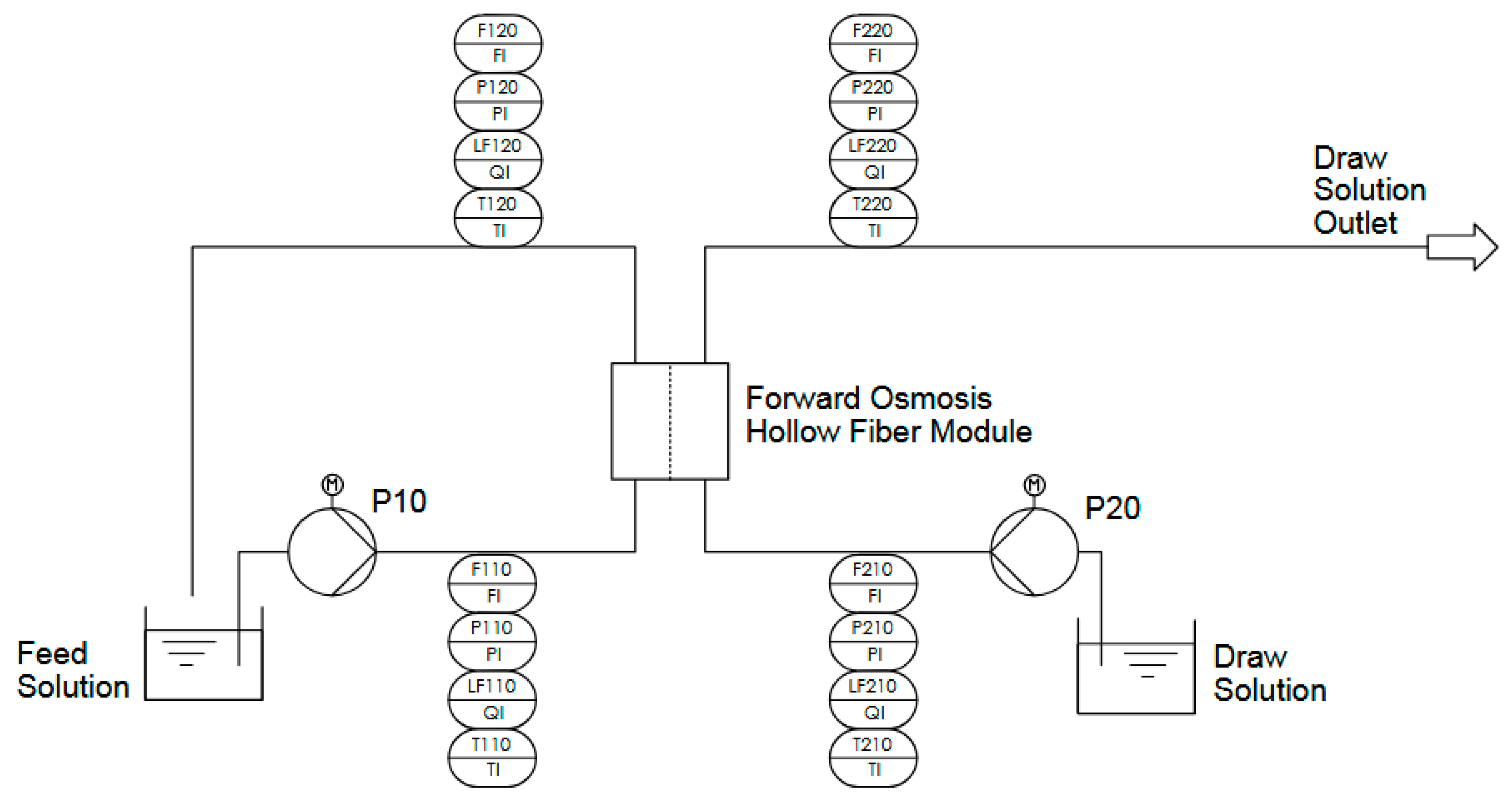
The main experimental setup (Figure 1) comprises hollow fiber FO membrane modules operated in batch mode on the FS side and in single-pass mode on the permeate side.
Both solutions are driven by RM4-30/400 magnetic centrifugal pumps (Renner, Titisee-Neustadt, Germany). Since the selective active layer is located on the lumen side of the hollow fibers, the experiment was operated in the active-layer-feed-side (ALFS) configuration. The pump performance is regulated using a frequency converter, SINIMACS V20 (Siemens, Munich, Germany). Pressure was monitored using a pressure transducer, DMP 331 (BD, Thierstein, Germany), while conductivity and temperature were recorded using an inductive conductivity transducer, CTI 500 (JUMO, Fulda, Germany), and flow was measured by a flow transducer, SM8030 (IFM, Essen, Germany).
The prototype plant features an extensive control system, including pneumatically actuated valves. Comprehensive data recording during the process captures all essential process parameters, recording them as inline measurements for subsequent data analysis. To determine key process parameters such as pressure, temperature, flow rate, pH value, and conductivity, suitable sensors are positioned at critical points throughout the entire system.
For the preliminary experiments, the OSMOMAT 3000 cryoscope from ELITechGroup (Utah, Logan, UT, USA) was used. Manual conductivity measurements were conducted using a SevenGO Duo Pro multiparameter meter from Mettler Toledo (Reinach, Switzerland) equipped with an InLab 738 conductivity cell.

2.2.2. Materials

The sweet whey used in this study was a spray-dried sweet whey powder provided by Molkerei Ammerland (Edewecht, Germany). The composition includes macronutrients such as proteins, lactose, and fats, along with various minerals as depicted in the subsequent Table 2. These characteristics make the findings of this study applicable to typical dairy industry scenarios.
In this study, the DS was prepared using “Salta Siede-Speisesalz” from Südsalz GmbH. It was chosen due to its high purity and specific chemical composition. The salt, with a chemical assay dated 13 August 2014, primarily consists of sodium chloride, constituting approximately 99.9% of its composition.
The FO process was conducted using the Aquaporin Inside® HFFO®14 module (see Table 3).
This module is specifically engineered for FO applications, featuring an advanced biomimetic design. It consists of a polyamide thin film composite (TFC) active layer integrated with aquaporin proteins, which significantly enhance its selective water permeability and rejection capabilities. The module consists of a multitude of hollow fiber membranes that contribute to its high packing density, a crucial factor in efficient osmotic separation.

2.2.3. Test Execution

Given the extensive scope of the experiments, which cannot be completed in a single day, various measures were implemented to maximize reproducibility. These measures encompass a standard test at the beginning of each experimental day and a cleaning routine at its conclusion.
Preliminary test: Prior to the main experiments, solutions with varying concentrations of dried sweet whey in the range of 5 to 40 weight-% were prepared. The osmotic pressure Π of each solution was determined using a cryoscope, and the electrical conductivity was measured using a conductivity meter. These measurements were correlated with the TR.
Standard test: A 10 min NaCl standard test according to the manufacturer’s product manual [23] was used to establish a daily reference point for water flux JW and pressure drop Δp, enabling detection of possible performance losses from membrane fouling. This involved using a 0.5 mol L−1 NaCl solution as DS and water as FS, with flow rates of 400 L h−1 for FS and 200 L h−1 for DS. This established a consistent operational point in single-pass mode. The 10 min duration was intentionally chosen as a short diagnostic window to capture near-intrinsic membrane performance (water flux and hydraulic pressure drop) while minimizing time-dependent effects such as concentration build-up and fouling. Data were evaluated after stable readings were reached, and strict rinsing/cleaning routines were applied between runs to keep the standard test as independent as possible from progressive fouling effects. The analysis of water flux JW and pressure drop Δp provided insights into the possible decline in membrane performance over the course of the experiments. Following the standard test, the system was cleaned and vented according to a rinsing routine. Prior to each testing routine, the system was filled with pure water. The respective routines are described below.
Test routine: For the experiments, 65 kg of FS comprising 7 weight-% dry sweet whey and 100 kg of the DS were prepared as per the experimental design at 20 °C. The system’s 7.5 L holdup volume was considered when preparing the FS to prevent dilution effects from previous cleaning routines. Before each experiment, the system settings were adjusted to quickly achieve the desired flow rates for FS and DS through regulating pump speeds. A 30 min duration was chosen deliberately to ensure that the measured performance parameters reflect the intrinsic operating behavior of the module and not the onset of fouling-related effects, since the objective of this study was to characterize the short-term performance window under well-defined hydrodynamic and osmotic conditions. In order to minimize any influence of fouling between runs, strict rinsing and cleaning routines were applied after each experiment.
Rinsing routine: After each test and cleaning routine, a rinsing routine was performed. This involved passing water through FS and DS in a double single-pass mode at a flow rate of 200 L h−1 for at least 10 min or until reaching a conductivity of <0.1 mS cm−1 and a pressure difference of <250 mbar on both sides of the membranes.
Cleaning routine: After each experimentation day, membranes were cleaned with P3-Ultrasil 69 NEW from Ecolab (USA). The cleaning solution was prepared at 40 °C according to the manufacturer’s instructions [24]. Each cleaning of the system was conducted for 2 h with FS and DS flow rates of 200 L h−1 in batch mode. The pH value of the cleaning solution was checked every 10 min during the cleaning process. If the pH value dropped below 11 ± 0.1, NaOH solution was added to restore the desired pH. Following the cleaning routine, a rinsing routine was conducted.
Total viable count: In this study, the efficacy of cleaning protocols was assessed by analyzing microbial contamination at three critical points: before the pretest, after the rinsing phase, and after the cleaning process. Samples were taken from the outlet at the FS-side outlet within a 10 s window at these times and immediately frozen to preserve microbial state. Microbial load was quantified by enumerating mesophilic aerobic bacteria as colony-forming units (CFUs) per mL. Microbial evaluations followed method L00.00-88/2 from the Official Collection of Analysis Methods (ASU) in compliance with § 64 LFGB [25], using the surface smear approach. To determine the bacterial count, 0.1 mL aliquots from dilution series of 10:1 to 10:3 were plated in duplicate on Chemsolute plate count agar (Huberlab, Switzerland) and incubated at 37 °C for five days. After incubation, viable colonies were counted. CFUs were calculated using the weighted arithmetic mean as outlined in Equation (9) [26]:
c ¯ = c n 1 + n 2 0.1 d
This formula calculates the weighted arithmetic mean of colony numbers c ¯ by aggregating the total bacterial count ∑c. It accounts for the number of Petri dishes at the minimal dilution level n1 and a slightly higher dilution level n2. The factor d indicates the dilution level used for initial evaluations. This method provides a detailed perspective on microbial presence in the samples.
All microbial samples were taken from the FS-side outlet effluent. The CFU results therefore represent system-level contamination rather than microorganisms attached directly to membrane surfaces.

3. Results and Discussion

3.1. Preliminary Experiment

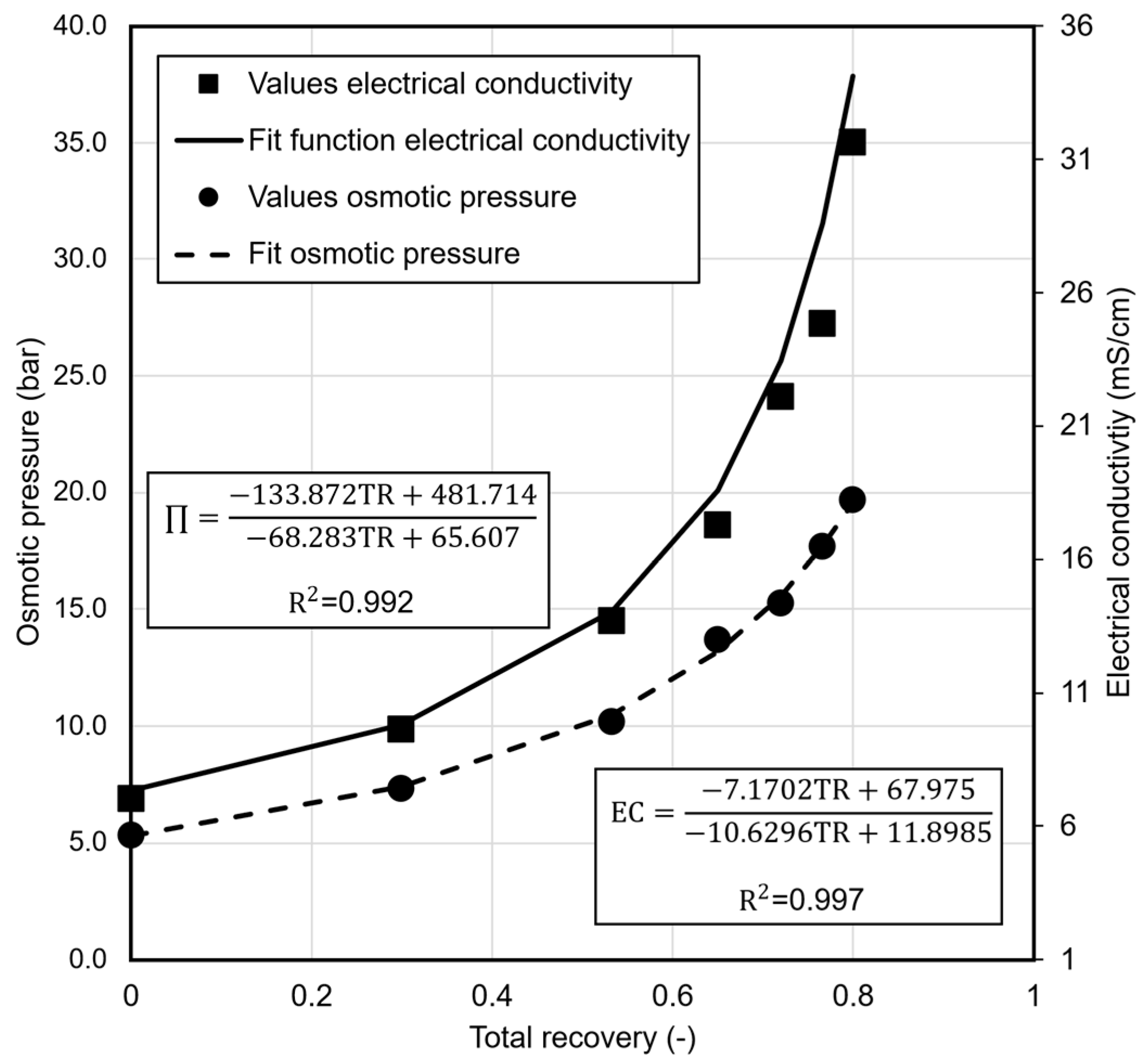
The preliminary experiment was conducted to estimate the correlation of osmotic pressure Π with conductivity and total recovery as shown in Figure 2.
The sweet whey solution has an initial osmotic pressure of approximately ΠFS = 7 bar and a conductivity of 5.7 mS cm−1 at TR = 0. At a TR of 0.5, the osmotic pressure ΠFS increases to 14.6 bar and the conductivity to 9.93 mS cm−1. At a TR of 0.8, the osmotic pressure ΠFS reaches 35 bar and the conductivity reaches 18.24 mS cm−1. Based on these correlations, the TR and thus the process progress of the subsequent batch dewatering can be determined through in-line conductivity measurement. This approach is practical for FO operation because conductivity tracks the concentration increase in real time. It therefore provides direct process feedback on the evolving driving force and the expected flux decline during batch concentration [13,27,28].

3.2. Standard Test

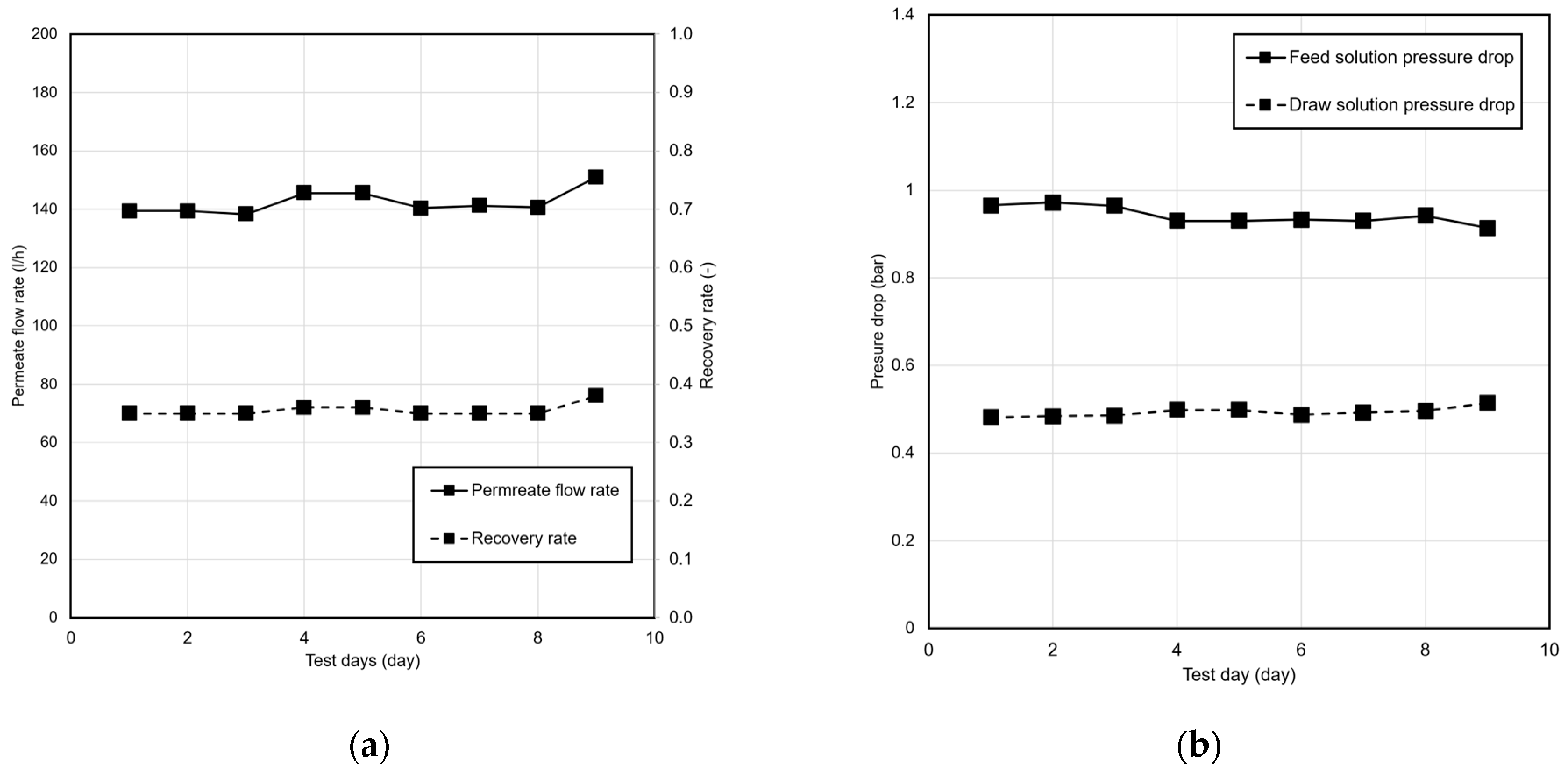
The results of the standard tests are shown in Figure 3.
The average water flux JW resulting from the standard tests was 10.3 LMH, which falls within the manufacturer’s performance specifications for new modules (9.5 to 12.5 LMH). The average RR is 35.6% (Figure 3a). Minor fluctuations across the series of tests were identified, which can be attributed to temperature variations in the FS media, caused by high ambient temperatures in the technical laboratory. For instance, temperatures exceeded 21 °C on days 4 and 5 and 22 °C on day 9 of experimentation. Had there been a decline in membrane performance due to fouling or scaling, this would have been evident from a downward trend in both water flux JW and RR. Furthermore, capillary blockage or reduced flow cross-section due to fouling would have been manifested as an increase in pressure drop. In Figure 3b, the pressure drops ΔpFS and ΔpDS over the test days are illustrated. Starting from an average pressure drop of ΔpFS = 0.94 bar and ΔpDS = 0.49 bar, no substantial changes that could have influenced the FO performance were observed. The slight decrease in FS pressure drop ΔpFS can be attributed to an increased water flux JW due to rising temperature, which consequently led to a slight increase in DS pressure drop. In summary, it can be stated that through consistent application of rinsing and cleaning routines, the original state of the membrane could be held, thus ensuring the reproducibility and comparability of the experiments. However, early-stage internal fouling cannot be fully excluded without SEM or FTIR analysis. This is acknowledged as a limitation and should be addressed in long-term studies.

3.3. Investigation of Target Parameters

3.3.1. Water Flux Jw

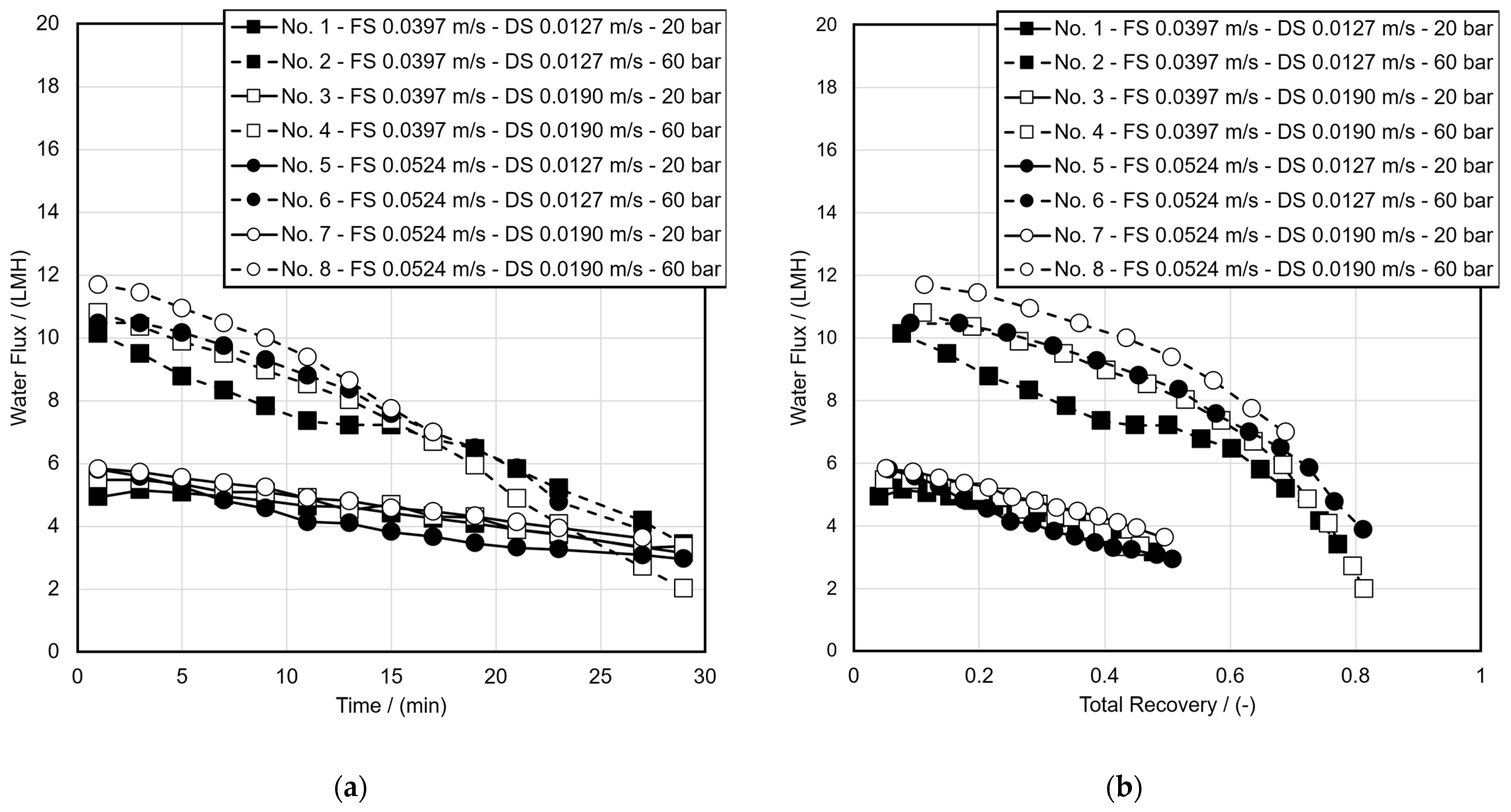
In Figure 4a, the progression of water flux JW of the eight test runs as a function of experimental duration is depicted with varying operating conditions.
The flux trends can be roughly divided into two groups. Test runs with DS operated at p = 60 bar consistently exhibit a higher water flux JW, starting at 10.1 to 11.6 LMH, whereas those with the DS operated at p = 20 bar show an initial water flux JW of 4.3 to 5.8 LMH. The consistently highest water flux JW is observed in the setting of 60 bar with the highest respective CFV for both FS and DS. Towards the end of the 30 min experiments, a water flux JW ranging from 2.1 to 4.0 LMH is observed for all test runs.
J W = A ( Δ Π Δ p )
Plotting the water flux JW against TR (Figure 4b) reveals even more pronounced differences between the factor level combinations. Here, again, two groups can be distinguished based on the osmotic pressure ΠDS. With the ΠDS at 20 bar, a TR of up to 0.5 could be achieved, whereas experiments with ΠDS = 60 bar achieved a TR exceeding 0.8. From the progression of the water flux JW as a function of TR for the highly osmotic DSs, it can be estimated that the process would come to a halt at a TR = 0.9, characterized by a rapid decline in water flux JW.
According to the Solution-Diffusion Model (SDM), the enhanced water flux JW at higher osmotic pressures ΠDS can be attributed to an increased osmotic pressure difference ΔΠ, as depicted in Equation (10).
This phenomenon has been extensively documented and corroborated in numerous studies [29,30,31,32]. An observed higher CFVFS exhibits a marginally positive impact on the water flux JW, which intensifies with increasing osmotic pressures ΠDS. CFVFS in the capillaries remains laminar, as deduced from Reynolds number calculations; thus, only a minimal performance enhancement is anticipated due to the lower mass transport resistance of the laminar boundary layer between the bulk stream and membrane [33]. The performance enhancement is predominantly present due to a lower osmotic pressure profile ΠFS along the membrane path or module path. For whey feeds, this trend is typically driven by the rapid increase in the feed osmotic pressure during dewatering. Concentration polarization further reduces the effective driving force. Several studies on whey and whey protein solutions report the same limiting mechanism and also describe that higher cross flow can reduce the tendency for reversible deposit formation through higher shear at the membrane surface [32,34].
The concentration and thus the osmotic pressure ΠFS increase towards the end of the membrane path due to dewatering. This effect diminishes the water flux JW towards the end of the membrane path, leading to a reduced observed water flux JW of the entire module. By increasing the CFVFS, the osmotic pressure ΠFS at the end of the membrane path is reduced, maintaining a high driving potential and thus increasing the observed water flux JW. This approach is validated by its interaction with the osmotic pressure ΠDS. A high osmotic pressure ΠDS enhances dewatering performance and results in a reduced driving force at the end of the membrane path. Therefore, the effect of the CFVFS is more attributable to an advantageous change in the osmotic pressure profile ΠFS along the membrane path. Similarly to CFVFS, increasing the CFVDS ensures that its osmotic pressure ΠDS remains high towards the end of the membrane path, thereby improving the driving potential and water flux JW.
These performance-enhancing effects become more pronounced when the FS and DS tend to equilibrate their osmotic pressures, i.e., at lower osmotic pressures ΠDS or higher osmotic pressures ΠFS. Given that the liquid whey solution used in its initial state exhibits a moderate osmotic pressure of ΠFS = 7 bar, it can be inferred that in scenarios of low TR, the benefit of high CFVFS for enhancing water flux JW is limited. This behavior in liquid whey was also observed by Wang [30]. Wang also demonstrated that higher CFV led to reduced membrane fouling susceptibility, attributed to the increased shear forces acting on the particles present in the whey. This phenomenon has been further explored by Tang [33] and emphasizes the need of high CFV in terms of process robustness.

3.3.2. Recovery Rate RR

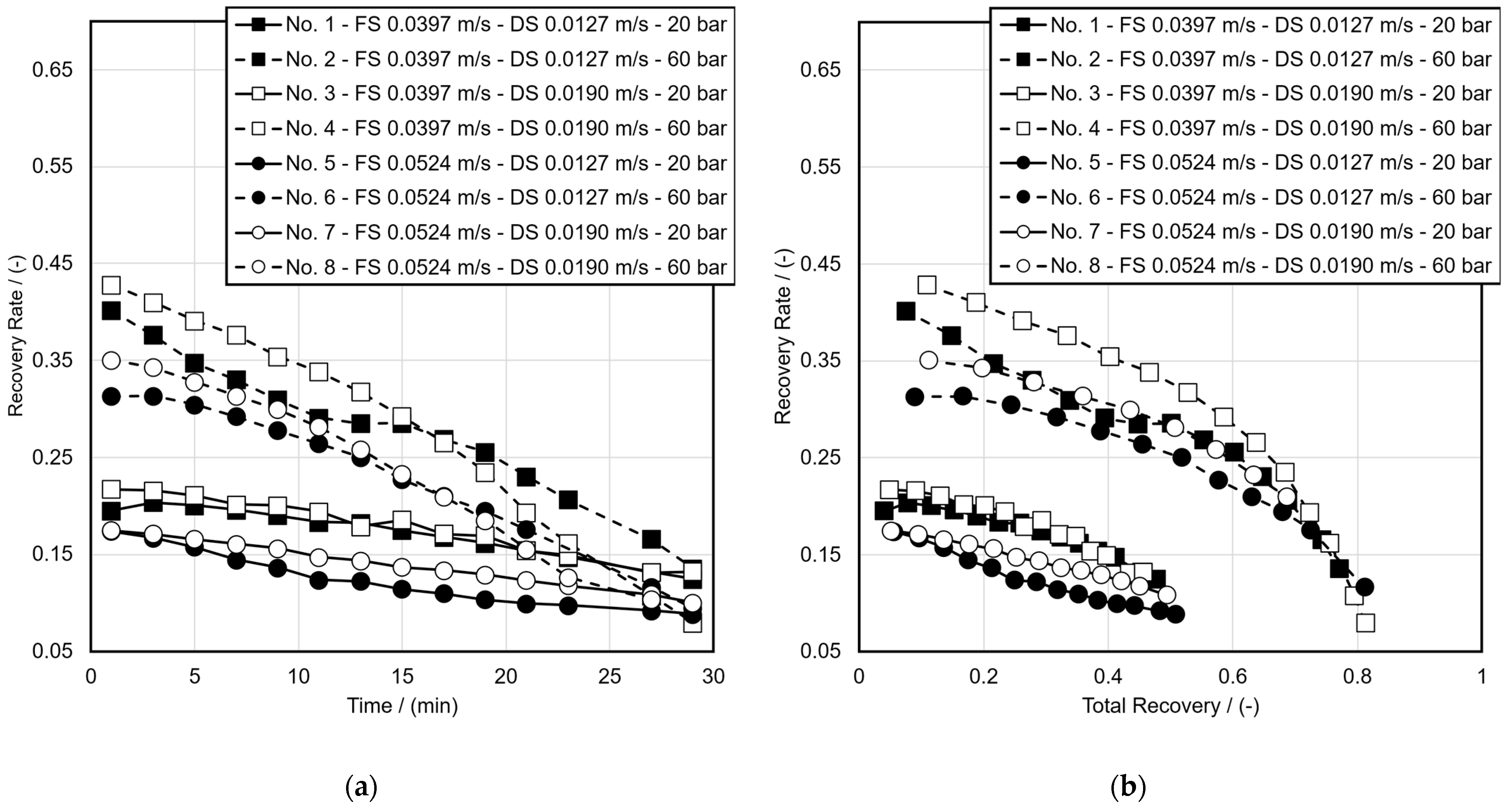
As shown in Figure 5a, the test results can again be divided into two groups based on the osmotic pressure ΠDS. At an osmotic pressure of ΠDS = 60 bar, the initial RR ranged from 0.3 to 0.45, decreasing to 0.1 to 0.15 over the course of the experiment. For ΠDS = 20 bar, initial RRs of 0.175 to 0.225 were measured, which fell to 0.075 to 0.15 after a test duration of 30 min. Within the two groups characterized by osmotic pressure Π, small differences can still be identified among the experiments and attributed to the CFVFS. Experiment runs with an increased CFVFS of 0.0397 m s−1 exhibit an RR approximately 0.05 to 0.08 higher than with an CFVFS of 0.0524 m s−1. The difference is more pronounced in Figure 5b, where the RR is depicted as a function of TR.
The previously mentioned effects, which positively influence the water flux JW, are also applicable to the RR, as it mathematically encompasses the water flux JW. Consequently, a similar trend is observed in the characteristic curves: At lower CFVFS, a consistently higher RR was noted, since the water flux JW does not increase proportionally with the rise in CFVFS. This implies that in a continuous single pass mode process, higher final concentrations can be achieved, making FO more effective. However, this effect diminishes with higher TR, i.e., higher initial concentrations of the FS. This can be attributed to the balancing of process streams. Therefore, at lower initial concentrations of the FS, a greater reduction in final concentration and osmotic pressure ΠFS at the end of the membrane path can be achieved, thereby maintaining a consistently high driving potential. Conversely, at high initial concentrations and osmotic pressures ΠFS, the driving potential is already low at the beginning of the membrane path, an effect that cannot be compensated for to the same extent by increasing the CFV. The decline in RR with increasing TR follows the same mechanism as the flux decline. The feed becomes more concentrated, viscosity rises, and the effective osmotic driving force decreases. Similar RR trends during whey concentration by FO have been reported in pilot and laboratory studies [13,28,32].

3.3.3. Pressure Drop Δp

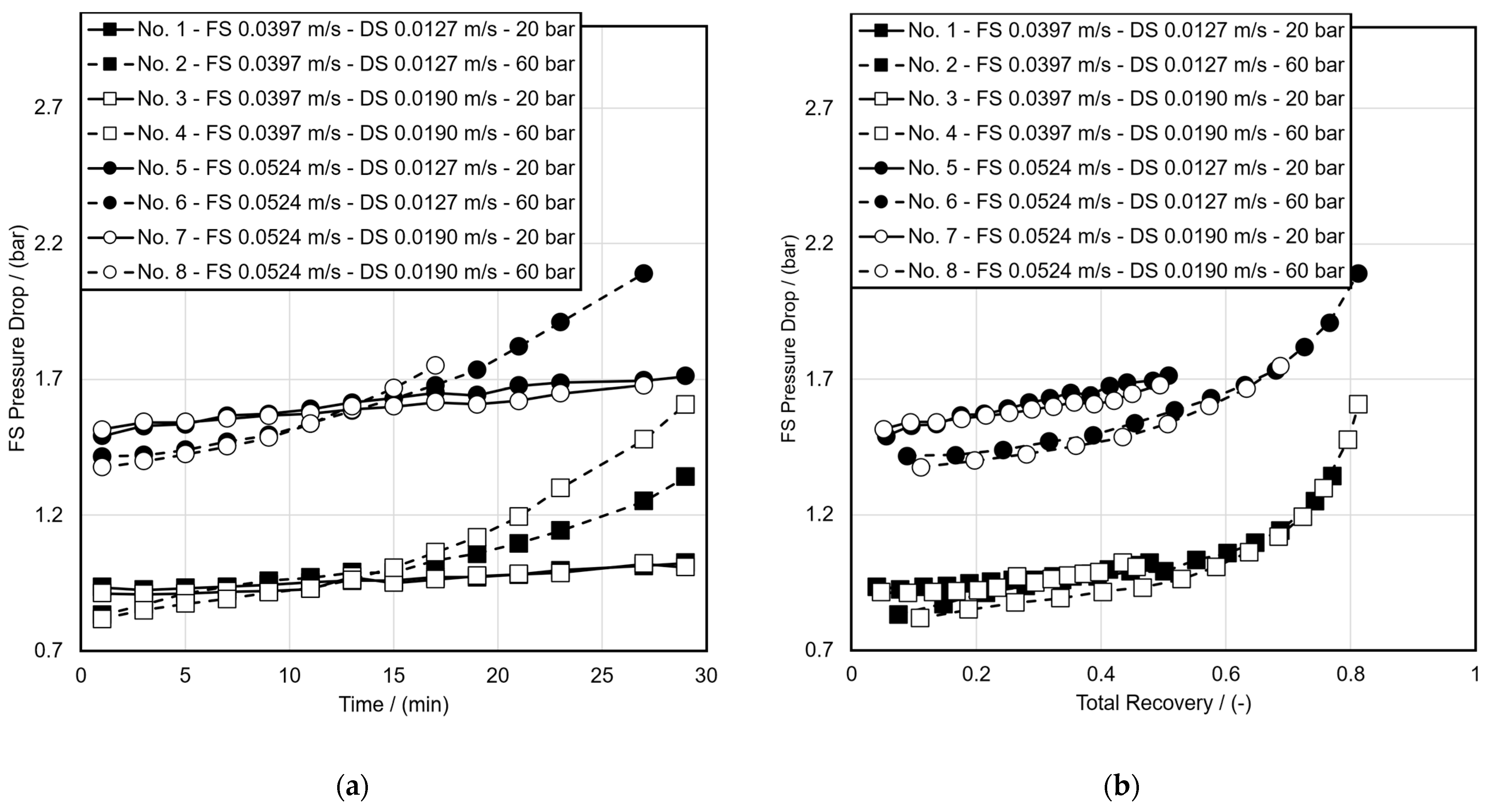
In Figure 6a, the FS-side pressure drop ΔpFS is depicted as a function of the experimental duration. It is immediately apparent that a high CFVFS is associated with a high pressure drop ΔpFS. The experiments commence with a CFVFS of 0.0524 m s−1 and an FS pressure drop ΔpFS ranging from 1.4 to 1.5 bar, increasing to over 1.7 bar during the experiment. In contrast, the pressure drop ΔpFS at a CFVFS of 0.0397 m s−1 starts at initial values of 0.8 to 0.95 bar and rises to over 1.0 bar by the end of the experiment.
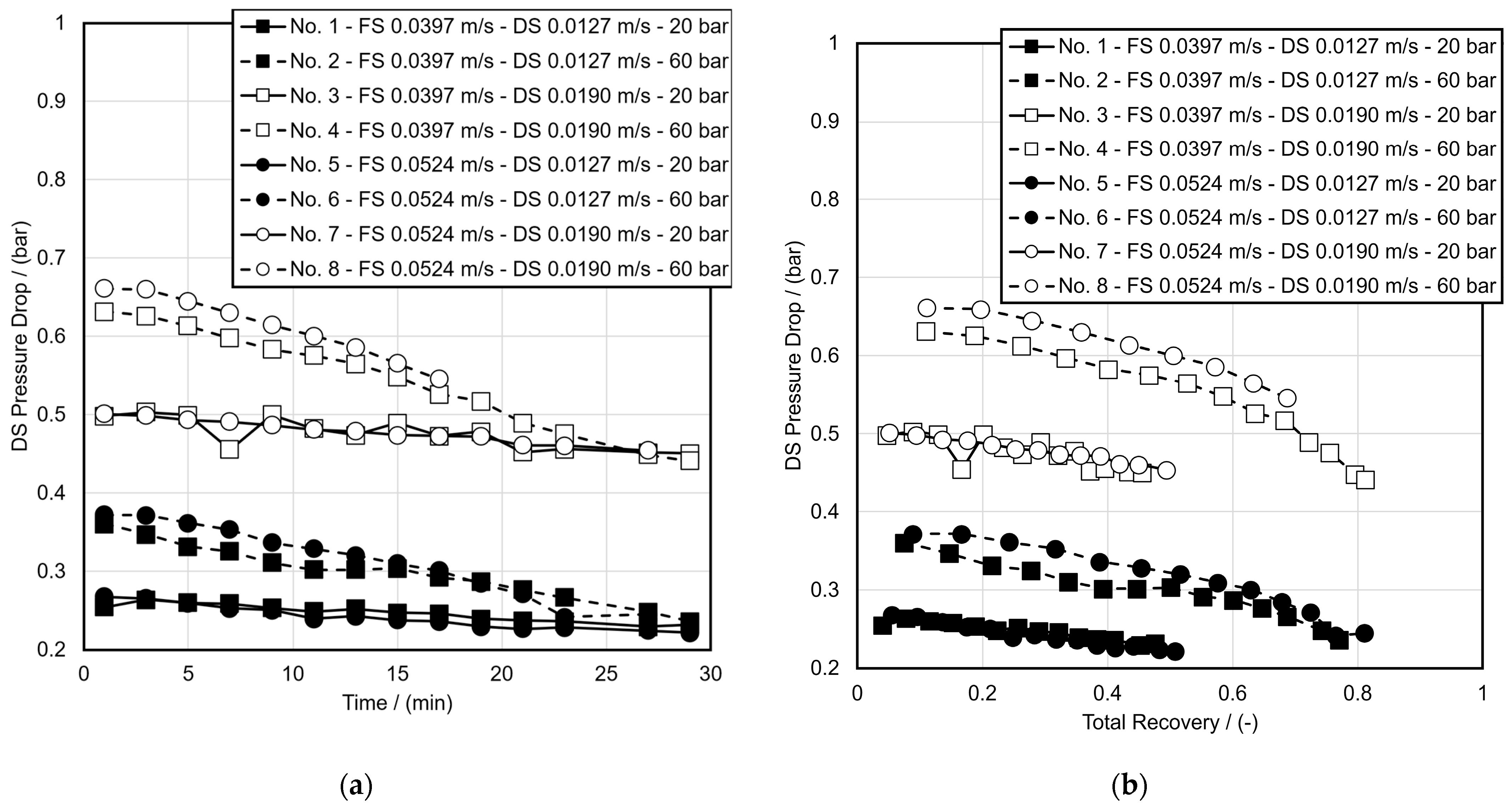
Figure 6b shows the FS-side pressure drop ΔpFS plotted against TR, providing a clearer distinction between individual experiments. It is evident that higher osmotic pressures ΠDS result in a lower pressure difference compared to lower osmotic pressures ΠDS. This difference, ranging from 0.1 to 0.15 bar, is observed at both high and low CFVFS. The CFVDS appears to have little influence on the FS-side pressure drop ΔpFS. As indicated in Bernoulli’s equation for viscous flow in real fluids (Equation (11)) [35], the CFV is squared in the energy conservation term and also contributes to the pressure drop term caused by fittings and pipe friction. Equation (11) follows the standard extended Bernoulli approach for real flows. It combines frictional losses along the flow path with local losses from fittings and valves. The quadratic dependence on velocity explains why pressure drop increases strongly at higher cross flow velocities [36,37].
C F V 1 2 2 + g h 1 + p 1 ρ 1 = C F V 2 2 2 + g h 2 + p 2 ρ 2 + ζ C F V 2 2 p 2 2 + λ L C F V 2 2 p 2 d 2
This reveals that, neglecting the geodetic height difference and assuming constant values for the pressure drop coefficient of the fittings ζ and pipe friction coefficient λ, an increase in CFV inevitably leads to a significant drop in the internal energy of the fluid and, consequently, an increase in pressure drop. The CFV2 at the end of the membrane path is determined not only by the power input of the pump but also by the water flux JW. A high water flux JW, for instance, caused by high osmotic pressures ΠDS, results in a stronger water removal from the flow system, thereby inevitably reducing the CFV and the pressure drop. This explains why experimental combinations at an osmotic pressure ΠDS = 20 bar exhibit slightly higher pressure drops ΔpFS and ΔpDS than those with DSs at ΠDS = 60 bar. This effect becomes particularly evident in Figure 7b.
In comparison to the FS-side pressure drop ΔpFS, the DS-side pressure drop ΔpDS exhibits a more pronounced influence of the osmotic pressure ΠDS. This yields four distinct groups determined by CFVDS (0.0127 vs. 0.0190 m s−1) and ΠDS (20 vs. 60 bar). For CFVDS of 0.0127 m s−1, an initial pressure drop of ΔpDS = 0.5 bar occurs for an osmotic pressure of ΠDS = 20 bar and ΔpDS = 0.7 bar for an osmotic pressure of ΠDS = 60 bar. Towards the end, a pressure drop of ΔpDS = 0.45 bar exists. For CFVDS of 0.0190 m s−1, an initial pressure drop of ΔpDS = 0.25 bar is observed for an osmotic pressure of ΠDS = 20 bar and around 0.38 bar for an osmotic pressure of ΠDS = 60 bar. Towards the end, a pressure drop of ΔpDS = 0.22 bar exists. In contrast to the FS-side pressure drop, it is evident that a higher osmotic pressure ΠDS leads to an increase in the pressure drop ΔpDS. The influence of the FS-side CFV on the DS-side pressure drop ΔpDS is not clearly visible. In Figure 7b, the distinctions in DS-side pressure drop ΔpDS across the described experimental groups, in terms of TR, are clearly marked as well.
Similarly to the pressure drop on the FS side, the pressure drop ΔpDS on the DS side can also be explained through Equation (11). There is also an increase in pressure drop ΔpDS that rises quadratically with the increase in CFV. Since the flow cross-section on the shell side of the fiber bundle is larger than that in the lumen, and the chosen volumetric flow rate of the DS is lower than that of the FS, a much lower pressure drop ΔpDS results in comparison to the FS side, as derived from Bernoulli’s equation. Contrary to the FS side, the pressure drop ΔpDS increases with rising water flux JW on the DS side, as water adds additional volume to the DS. This causes an increase in CFV along the membrane path, and the pressure difference due to friction losses increases. The stronger effect on the DS side compared to the FS-side pressure drop can be attributed to the fact that the inlet volumetric flows on the DS side are lower, and thus the relative increase in velocity is greater than the decrease in CFV on the FS.

3.3.4. Specific Energy Demand SED

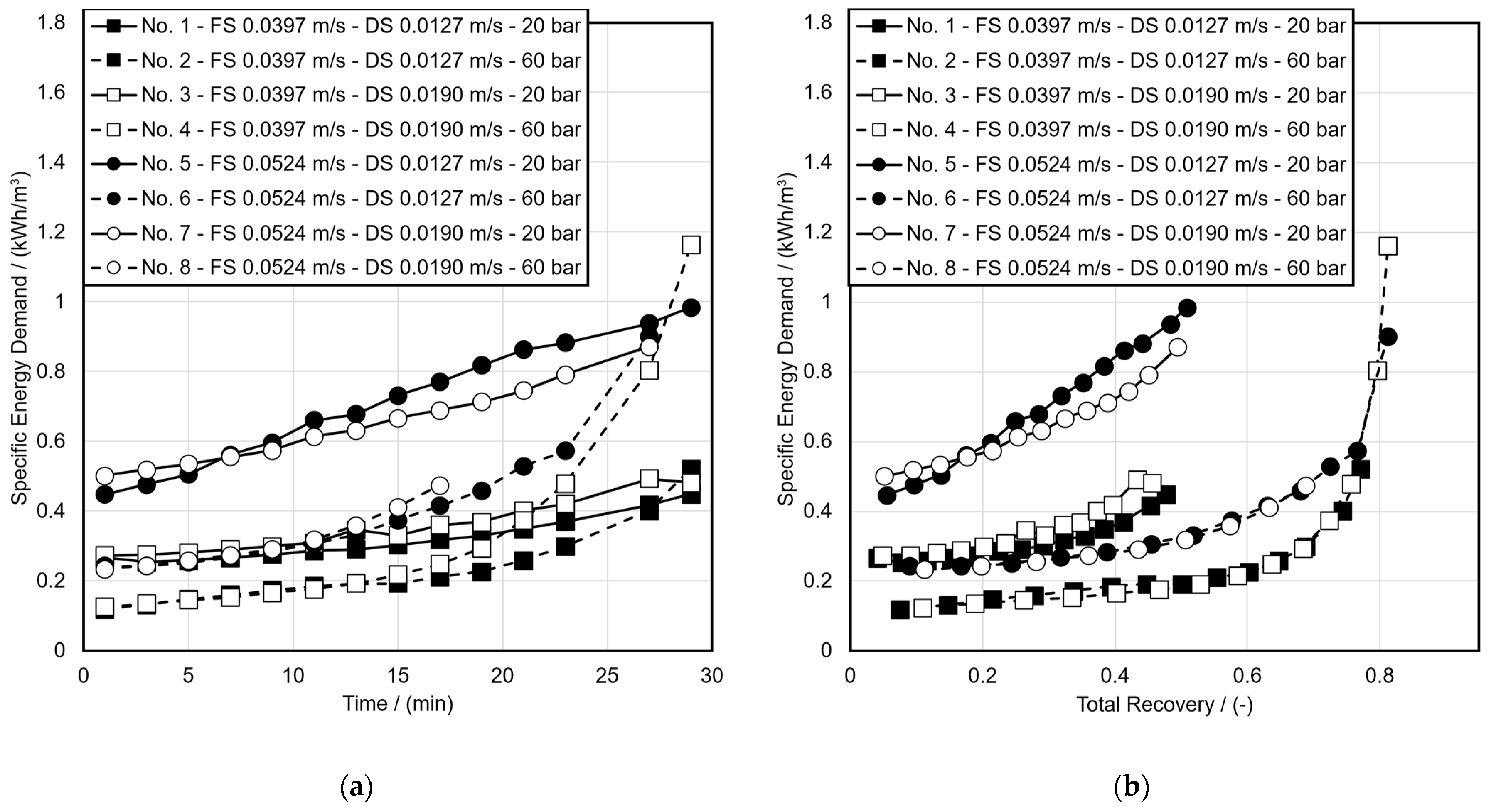
The lowest SED (Figure 8a) of approximately 0.1 kWh m−3 is observed at the beginning of the experiments with ΠDS = 60 bar and a low CFVFS = 0.0397 m s−1. The highest initial energy demand, at 0.5 kWh m−3, is found at 20 bar with a high CFVFS of 0.0524 m s−1.
The factor level combinations with osmotic pressure ΠDS = 20 bar and a low CFVFS = 0.0397 m s−1, as well as those with an osmotic pressure ΠDS = 60 bar and a high CFVFS = 0.0524 m s−1, exhibited initial specific energy requirements of approximately 0.25 kWh m−3.
The trends of SED against TR, as observed in Figure 8b, indicate that for the previously mentioned energetically favorable factor level combinations, there is only a slight initial linear increase in SED.
For DSs with an osmotic pressure ΠDS = 60 bar and low CFVFS = 0.0397 m s−1, a TR of 0.5 requires only 0.2 kWh m−3. An exponential increase in the SED becomes apparent at a TR of 0.55 to 0.6, leading to an SED exceeding 1 kWh m−3 at high TR.
For all test runs, the SED increases with experimental duration, attributed to the reduction of the driving potential during concentration. Based on these results, it can be concluded that rapid, large-scale, and energy-efficient concentration processes are preferably conducted using highly concentrated DSs at low CFVFS. Since in production-scale application FO membrane modules are installed in cascades to achieve the required membrane area for the process, a recommendation can now be made to parallelize as many modules as possible, as this would be advantageous for low CFV and, consequently, low energy demand.
A comparison of SED between FO and RO indicates that pressure-driven membrane processes typically require higher electrical pumping energy because they must overcome the full transmembrane hydraulic pressure. Reported RO specific energy values depend on feed salinity, recovery, and system efficiency, but they are commonly higher than the pumping demand observed in the present FO trials [38,39,40]. In whey-related FO studies, authors highlight FO as an energy-efficient concentration step as long as concentration polarization, fouling, and reverse solute flux remain controlled [13,41]. The results in Figure 8 therefore support the use of high draw osmotic pressure combined with low feed-side cross flow velocity when the goal is low energy demand at industrial scale.

3.4. Cleaning Efficacy

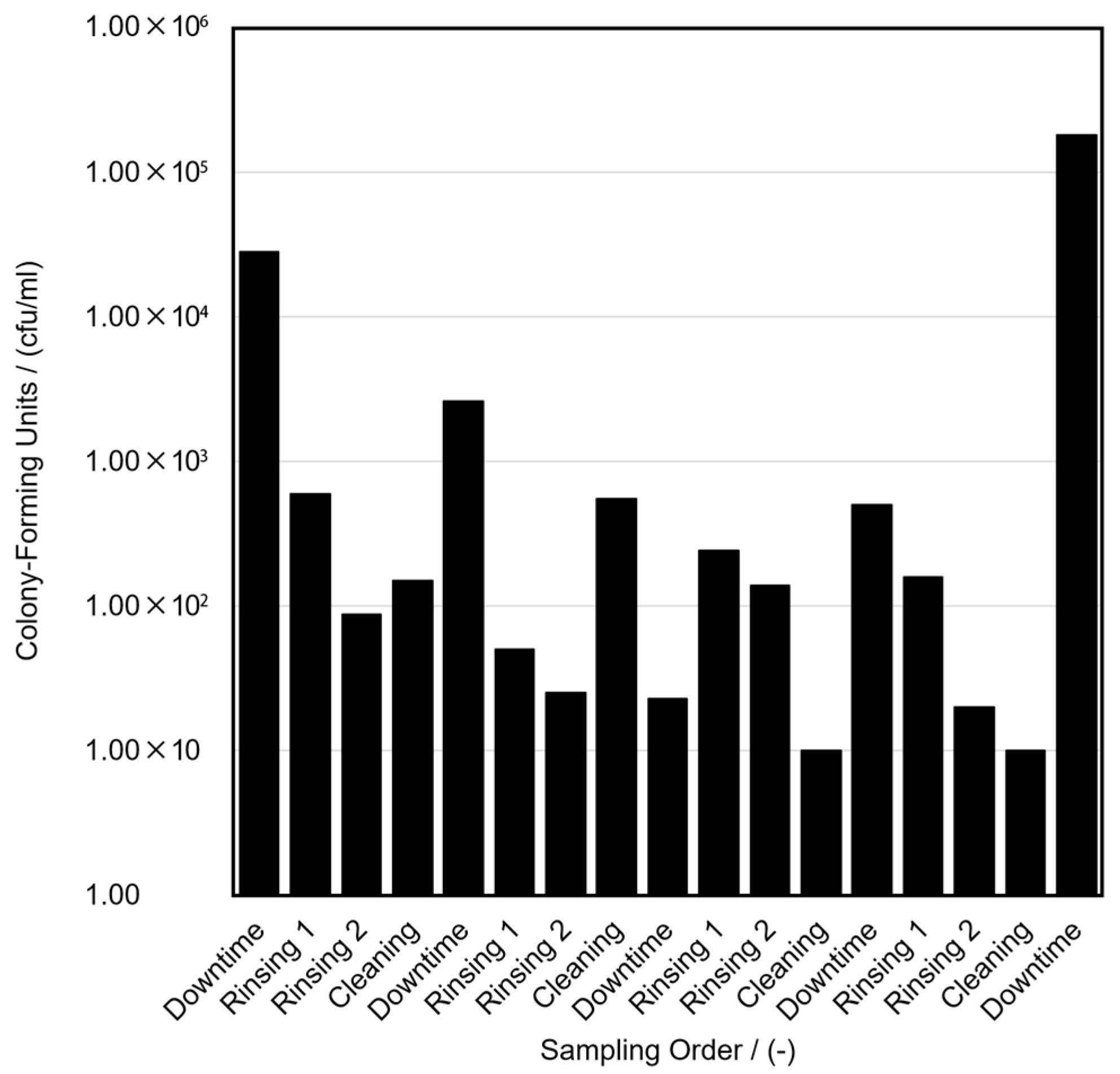
Figure 9 illustrates the measurement of microbial contamination on a test day during the execution of rinsing and cleaning protocols.
It was observed that especially after downtimes, i.e., at the beginning of a test day, a significant number of colony-forming units were detectable in the effluent. On average, 42,300 CFU mL−1 were counted at the start of a test day. After calibration, standard testing, and a trial run followed by system rinsing, the microbial load dropped to an average of 260 CFU mL−1. After another trial run and rinsing, only an average of 70 CFU mL−1 was found in the rinsing water effluent. By cleaning at the end of the test day, the microbial load could finally be reduced to below 50 CFU mL−1 on average.
The elevated microbial counts after idle periods are attributed to regrowth in residual film water and small dead-leg regions within the piping. During continuous operation, these regions are constantly flushed, which prevents microbial accumulation. Cross-contamination between runs was minimized by double rinsing until conductivity fell below 0.1 mS cm−1 and by minimizing stagnant volumes in the system.
As a reference, microbiological specifications for dried sweet whey often report total plate count limits on the order of 10,000 CFU g−1 [42]. This benchmark only serves for orientation because the present measurements refer to liquid effluent in CFU mL−1. It was found that this value was exceeded only after downtimes. Comparing the microbial load of a freshly prepared sweet whey solution from the powder used, with values of 4500 CFU mL−1, a lower load was always found after cleaning the plant than was present in the actual product.
The results demonstrate that even after shorter downtimes (max. 16 h in this study) of the production plant and even after thorough cleaning with a suitable membrane cleaner, high microbial loads invariably occur. This is due to exponential microbiological growth, where even low initial concentrations can lead to high contamination within a few hours.
It is noteworthy that rinsing with warm water can quickly reduce the microbial load by several orders of magnitude. During operation, the microbial load hardly increases as long as production continues uninterruptedly.
From these results, it can be concluded that an appropriate rinsing and cleaning routine should be conducted before each production start, even after short downtimes, to ensure microbial safety.

4. Conclusions

Regarding the first research question, CFV and DS osmotic pressure jointly shaped the energy performance envelope. DS osmotic pressure primarily determined the achievable TR, while CFV mainly governed hydraulic losses and thus SED. Using DSs of 20 bar and 60 bar resulted in TR of about 50% and above 80%, respectively. Initial water flux ranged from 4.7 to 11.6 LMH and declined to about 3 LMH toward the end of each batch as the FS concentrated and the effective driving force decreased. High draw osmotic pressure combined with low feed-side CFV minimized specific energy demand while maintaining fluxes above 8 LMH in the early to mid-concentration range. Increasing CFV further improved flux under strong osmotic pressure differences, consistent with reduced boundary layer resistance.
In response to the second research question, the results reveal a clear trade-off between high recovery and energy efficiency. As FS osmotic pressure increased during concentration, RR decreased and SED increased, particularly at higher feed-side CFVs. The data therefore provide practical operating windows and make the recovery–energy trade-offs explicit for process design and operation.
Finally, regarding the third research question, the hydraulic data support scale-up by parallelization of modules at low CFVs rather than serial operation. This configuration keeps pressure drops low while maintaining uniform hydrodynamics. Measured pressure drops were 0.8 to 2.2 bar on the FS side and 0.2 to 0.7 bar on the DS side. Across several test days, standard tests and pressure drop trends indicated stable module performance when consistent rinsing and cleaning routines were applied.
Microbial monitoring of the feed-side outlet effluent showed that rinsing and alkaline cleaning reduced colony-forming units by orders of magnitude, while regrowth after downtime remained the dominant driver of elevated counts. A complete rinsing and cleaning cycle before each production start is therefore recommended, even after short idle periods.
Long-term stability, fouling kinetics, and draw-to-product solute transfer were not quantified and require extended experiments. Future work should also validate membrane lifetime and product quality impacts, including reverse salt flux under industrial conditions, and assess whether feed or draw prefiltration is required for robust deployment.

Author Contributions

Conceptualization, B.G., M.R., F.R. and A.L.; methodology, B.G. and M.R.; investigation, B.G. and M.R.; resources, B.G. and M.R.; writing, B.G.; writing—review and editing, B.G., M.R. and F.R.; visualization, B.G.; supervision, F.R. and A.L.; project administration, M.R.; funding acquisition, B.G. and M.R. All authors have read and agreed to the published version of the manuscript.

Funding

This project is supported by the Federal Ministry for Economic Affairs and Energy (BMWE) on the basis of a decision by the German Bundestag.

Institutional Review Board Statement

Not applicable.

Informed Consent Statement

Not applicable.

Data Availability Statement

The original contributions presented in this study are included in the article. Further inquiries can be directed to the corresponding author.

Acknowledgments

During the preparation of this manuscript, the author used ChatGPT 5 for the purposes of proofreading.

Conflicts of Interest

Author Bastian Greisner was employed by the company MionTec GmbH and author Magnus Rienäcker was employed by the company ttz Bremerhaven. The remaining authors declare that the research was conducted in the absence of any commercial or financial relationships that could be construed as a potential conflict of interest.

Abbreviations

Nomenclature
AMmembrane area (m2)
cbacterial colony number
CFVcross flow velocity (m/s)
cosmosmotic active concentration (mol/L)
ddiameter (m)
gstandard gravity (9.81 m/s2)
Hheight (m)
JWwater flux (LMH, m3/m2/s)
Llength (m)
nnumber of smth., e.g., fibers, colonies
ppressure (Pa, bar, mbar)
PSytempower demand for a given system
Qvolumetric flow rate (m3/s)
Runiversal gas constant (8.314 J/mol/K)
RRrecovery rate
SEDspecific energy demand (kWh/m3)
Ttemperature (K)
TRtotal recovery
Vvolume (m3)
vflow velocity (m/s)
ζpressure loss coefficient
Πosmotic pressure (Pa)
ρdensity (kg/m3)
Subscripts
1, 2reference to locations 1, 2
DSdraw solution
Fiberfiber, lumen side
FSfeed solution
iinner
ininlet
oouter
outoutlet
Ppermeate
Shellshell side

References

  1. Boretti, A.; Rosa, L. Reassessing the Projections of the World Water Development Report. npj Clean Water 2019, 2, 15. [Google Scholar] [CrossRef]
  2. Farrukh, M.U.; Bashir, M.K.; Hassan, S.; Adil, S.A.; Kragt, M.E. Mapping the Food Security Studies in India, Pakistan and Bangladesh: Review of Research Priorities and Gaps. Glob. Food Secur. 2020, 26, 100370. [Google Scholar] [CrossRef]
  3. Mirzakulova, A.; Sarsembaeva, T.; Suleimenova, Z.; Kowalski, Ł.; Gajdzik, B.; Wolniak, R.; Bembenek, M. Whey: Composition, Processing, Application, and Prospects in Functional and Nutritional Beverages—A Review. Foods 2025, 14, 3245. [Google Scholar] [CrossRef]
  4. Gulied, M.; Logade, K.; Mutahir, H.; Shaftah, S.; Salauddin, S.; Hameed, A.; Zavahir, S.; Elmakki, T.; Shon, H.K.; Hong, S.; et al. A Review of Membrane-Based Dewatering Technology for the Concentration of Liquid Foods. J. Environ. Chem. Eng. 2023, 11, 110583. [Google Scholar] [CrossRef]
  5. Moon, A.S.; Lee, M. Energy Consumption in Forward Osmosis Desalination Compared to Other Desalination Techniques. World Acad. Sci. Eng. Technol. 2012, 65, 537–539. [Google Scholar]
  6. Cath, T.; Childress, A.E.; Elimelech, M. Forward Osmosis: Principles, Applications, and Recent Developments. J. Membr. Sci. 2006, 281, 70–87. [Google Scholar] [CrossRef]
  7. Haupt, A.; Lerch, A. Forward Osmosis Application in Manufacturing Industries: A Short Review. Membranes 2018, 8, 47. [Google Scholar] [CrossRef] [PubMed]
  8. Nasr, P.; Sewilam, H. Forward Osmosis: An Alternative Sustainable Technology and Potential Applications in Water Industry. Clean Technol. Environ. Policy 2015, 17, 2079–2090. [Google Scholar] [CrossRef]
  9. Zhao, S.; Zou, L.; Tang, C.Y.; Mulcahy, D. Recent Developments in Forward Osmosis: Opportunities and Challenges. J. Membr. Sci. 2012, 396, 1–21. [Google Scholar] [CrossRef]
  10. Wu, X.; Ng, D.; Wang, H.; Xie, Z. Making Waves: Breaking Bottlenecks in Forward Osmosis through Strategic Integration with Other Techniques for Resource Recovery. Water Res. 2025, 289, 124918. [Google Scholar] [CrossRef]
  11. Julian, H.; Lestari, P.; Wenten, I.G.; Khoiruddin, K. Optimizing Food Processing Efficiency: The Role of Forward Osmosis in Concentration. J. Eng. Technol. Sci. 2025, 57, 214–242. [Google Scholar] [CrossRef]
  12. Chen, G.Q.; Artemi, A.; Lee, J.; Gras, S.L.; Kentish, S.E. A Pilot Scale Study on the Concentration of Milk and Whey by Forward Osmosis. Sep. Purif. Technol. 2019, 215, 652–659. [Google Scholar] [CrossRef]
  13. Chen, G.Q.; Gras, S.; Kentish, S. The Application of Forward Osmosis to Dairy Processing. Sep. Purif. Technol. 2020, 246, 116900. [Google Scholar] [CrossRef]
  14. Artemi, A.; Chen, G.Q.; Kentish, S.E.; Lee, J. Pilot Scale Concentration of Cheese Whey by Forward Osmosis: A Short-Cut Method for Evaluating the Effective Pressure Driving Force. Sep. Purif. Technol. 2020, 250, 117263. [Google Scholar] [CrossRef]
  15. Francis, L.; Ogunbiyi, O.; Saththasivam, J.; Lawler, J.; Liu, Z. A Comprehensive Review of Forward Osmosis and Niche Applications. Environ. Sci. Water Res. Technol. 2020, 6, 1986–2015. [Google Scholar] [CrossRef]
  16. Abdelrasoul, A.; Doan, H.; Lohi, A.; Cheng, C.-H. Mass Transfer Mechanisms and Transport Resistances in Membrane Separation Process. In Mass Transfer—Advancement in Process Modelling; Solecki, M., Ed.; InTech: Vienna, Austria, 2015; ISBN 978-953-51-2192-3. [Google Scholar]
  17. van’t Hoff, J.H., XII. The Function of Osmotic Pressure in the Analogy between Solutions and Gases. Lond. Edinb. Dublin Philos. Mag. J. Sci. 1888, 26, 81–105. [Google Scholar] [CrossRef]
  18. Lambrechts, R.; Sheldon, M.S. Performance and Energy Consumption Evaluation of a Fertiliser Drawn Forward Osmosis (FDFO) System for Water Recovery from Brackish Water. Desalination 2019, 456, 64–73. [Google Scholar] [CrossRef]
  19. Aquaporın Inside® HFFO®14 Module. Available online: https://aquaporin.com/wp-content/uploads/2025/07/Aquaporin-Inside-HFFO14-Datasheet-2025.pdf?utm_source=chatgpt.com (accessed on 15 December 2025).
  20. Li, M. Reducing Specific Energy Consumption in Reverse Osmosis (RO) Water Desalination: An Analysis from First Principles. Desalination 2011, 276, 128–135. [Google Scholar] [CrossRef]
  21. ULTRASIL 69 NEW 26KG—Ecolab OnlineShop. Available online: https://ecolab-webshop.ch/de/sortiment/produkt/29067 (accessed on 20 February 2024).
  22. BVL L 00.00-88/2—2023-04—Beuth.De. Available online: https://www.beuth.de/de/technische-regel/bvl-l-00-00-88-2/367584340 (accessed on 5 March 2024).
  23. Aquaporin-HFFO-User-Manual-Web.Pdf?Utm_source=chatgpt.Com. Available online: https://aquaporin.com/wp-content/uploads/2024/03/Aquaporin-HFFO-User-Manual-web.pdf?utm_source=chatgpt.com (accessed on 15 December 2025).
  24. Baumgart, P.D.J.; Becker, P.D.B.; Stephan, P.D.R. Mikrobiologische Untersuchung von Lebensmitteln. Available online: https://books.google.com.sg/books?id=Ip6cCwAAQBAJ&printsec=frontcover#v=onepage&q&f=false (accessed on 5 March 2024).
  25. Corzo, B.; De La Torre, T.; Sans, C.; Ferrero, E.; Malfeito, J.J. Evaluation of Draw Solutions and Commercially Available Forward Osmosis Membrane Modules for Wastewater Reclamation at Pilot Scale. Chem. Eng. J. 2017, 326, 1–8. [Google Scholar] [CrossRef]
  26. Phuntsho, S.; Sahebi, S.; Majeed, T.; Lotfi, F.; Kim, J.E.; Shon, H.K. Assessing the Major Factors Affecting the Performances of Forward Osmosis and Its Implications on the Desalination Process. Chem. Eng. J. 2013, 231, 484–496. [Google Scholar] [CrossRef]
  27. Weerasingha, V.; Kelly, A.L.; Sheehan, J.J.; Alehosseini, A. Sustainable Utilisation of Salty Whey Generated during Cheese Manufacture: A Review. Int. J. Dairy Technol. 2025, 78, e70033. [Google Scholar] [CrossRef]
  28. Artemi, A.; Chen, G.Q.; Kentish, S.E.; Lee, J. The Relevance of Critical Flux Concept in the Concentration of Skim Milk Using Forward Osmosis and Reverse Osmosis. J. Membr. Sci. 2020, 611, 118357. [Google Scholar] [CrossRef]
  29. Zhou, Z.; Lee, J.Y.; Chung, T.-S. Thin Film Composite Forward-Osmosis Membranes with Enhanced Internal Osmotic Pressure for Internal Concentration Polarization Reduction. Chem. Eng. J. 2014, 249, 236–245. [Google Scholar] [CrossRef]
  30. Wang, Q.; Gao, X.; Zhang, Y.; Wang, J.; Xu, Y.; Ji, Z.; Wang, X.; Gao, C. Alleviation of Water Flux Decline in Osmotic Dilution by Concentration-Dependent Hydraulic Pressurization. Chem. Eng. Res. Des. 2017, 117, 593–603. [Google Scholar] [CrossRef]
  31. Bui, N.-N.; Arena, J.T.; McCutcheon, J.R. Proper Accounting of Mass Transfer Resistances in Forward Osmosis: Improving the Accuracy of Model Predictions of Structural Parameter. J. Membr. Sci. 2015, 492, 289–302. [Google Scholar] [CrossRef]
  32. Wang, Y.-N.; Wang, R.; Li, W.; Tang, C.Y. Whey Recovery Using Forward Osmosis—Evaluating the Factors Limiting the Flux Performance. J. Membr. Sci. 2017, 533, 179–189. [Google Scholar] [CrossRef]
  33. Tang, C.Y.; Kwon, Y.-N.; Leckie, J.O. Fouling of Reverse Osmosis and Nanofiltration Membranes by Humic Acid—Effects of Solution Composition and Hydrodynamic Conditions. J. Membr. Sci. 2007, 290, 86–94. [Google Scholar] [CrossRef]
  34. Oymaci, P.; Offeringa, P.E.; Borneman, Z.; Nijmeijer, K. Effect of Osmotic Pressure on Whey Protein Concentration in Forward Osmosis. Membranes 2021, 11, 573. [Google Scholar] [CrossRef] [PubMed]
  35. White, F.M. Fluid Mechanics, 8th ed.; McGraw-Hill: New York, NY, USA, 2016. [Google Scholar]
  36. Suga, Y.; Takagi, R.; Matsuyama, H. Effect of Hollow Fiber Membrane Properties and Operating Conditions on Preventing Scale Precipitation in Seawater Desalination with Vacuum Membrane Distillation. Desalination 2022, 527, 115578. [Google Scholar] [CrossRef]
  37. Imran, M.; Lau, K.K.; Ahmad, F.; Mohd Laziz, A. A Comprehensive Review of Computational Fluid Dynamics (CFD) Modelling of Membrane Gas Separation Process. Results Eng. 2025, 26, 105531. [Google Scholar] [CrossRef]
  38. Alsarayreh, A.A.; Al-Obaidi, M.A.; Al-Hroub, A.M.; Patel, R.; Mujtaba, I.M. Evaluation and Minimisation of Energy Consumption in a Medium-Scale Reverse Osmosis Brackish Water Desalination Plant. J. Clean. Prod. 2020, 248, 119220. [Google Scholar] [CrossRef]
  39. Stillwell, A.S.; Webber, M.E. Predicting the Specific Energy Consumption of Reverse Osmosis Desalination. Water 2016, 8, 601. [Google Scholar] [CrossRef]
  40. Tow, E.W.; Hartman, A.L.; Jaworowski, A.; Zucker, I.; Kum, S.; AzadiAghdam, M.; Blatchley, E.R.; Achilli, A.; Gu, H.; Urper, G.M.; et al. Modeling the Energy Consumption of Potable Water Reuse Schemes. Water Res. X 2021, 13, 100126. [Google Scholar] [CrossRef] [PubMed]
  41. Blandin, G.; Ferrari, F.; Lesage, G.; Le-Clech, P.; Héran, M.; Martinez-Lladó, X. Forward Osmosis as Concentration Process: Review of Opportunities and Challenges. Membranes 2020, 10, 284. [Google Scholar] [CrossRef] [PubMed]
  42. American Dairy Products Institute (ADPI). Dry Whey Standard v4.0; Effective 07/04/2023. Available online: https://www.adpi.org/wp-content/uploads/2023/07/Dry-Whey-Standard-v4_2023.pdf (accessed on 16 December 2025).
Figure 1. Pilot-scale FO test setup. Flow diagram of the prototype plant with Aquaporin HFFO®14, pumps, flow and pressure transmitters, temperature and conductivity probes, feed solution in batch mode, and draw solution in single-pass mode.
Purification 02 00001 g001
Figure 2. Correlation between osmotic pressure Π and electrical conductivity of sweet whey as a function of total recovery (TR). Inline conductivity can thus be used to estimate both osmotic pressure and total recovery, enabling continuous monitoring of the osmotic driving force during concentration.
Purification 02 00001 g002
Figure 3. Day-to-day standard test stability (manufacturer protocol). (a) Water flux JW and recovery rate RR vs. trial days. (b) Feed-side pressure drop ΔpFS and draw-side pressure drop and ΔpDS vs. trial days.
Purification 02 00001 g003
Figure 4. Water flux JW dynamics during 30 min whey concentration. (a) JW vs. trial time. (b) JW vs. total recovery TR.
Purification 02 00001 g004
Figure 5. Recovery rate RR dynamics during 30 min whey concentration. (a) RR vs. time. (b) RR vs. total recovery TR.
Purification 02 00001 g005
Figure 6. Feed-side hydraulic pressure drop ΔpFS during 30 min whey concentration. (a) Feed-side pressure drop ΔpFS vs. trial time. (b) Feed-side pressure drop ΔpFS vs. total recovery TR.
Purification 02 00001 g006
Figure 7. Draw solution side hydraulic pressure drop ΔpDS during 30 min whey concentration. (a) Draw-side pressure drop ΔpDS vs. trial time. (b) Feed-side pressure drop ΔpDS vs. total recovery TR.
Purification 02 00001 g007
Figure 8. Specific energy demand (SED) for pumping during 30 min whey concentration. (a) SED vs. trial time. (b) SED vs. total recovery TR.
Purification 02 00001 g008
Figure 9. Microbial control during rinsing/cleaning. Colony-forming units (CFU mL−1) by sampling order across a test day, including a sample after downtime (start of the day), after the first rinsing (1) and second rinsing (2) after the conduction of a test run and after a final cleaning (end of the day) before downtime.
Purification 02 00001 g009
Table 1. Full-factorial design of operating conditions for sweet whey FO trials. Factors and levels: feed-side CFVFS (0.0397, 0.0524 m s−1), draw-side CFVDS (0.0127, 0.0190 m s−1), and draw osmotic pressure ΠDS (20, 60 bar).
No.CFVFSCFVDSΠDS
10.0397 m s−10.0127 m s−120 bar
20.0397 m s−10.0127 m s−160 bar
30.0524 m s−10.0127 m s−120 bar
40.0524 m s−10.0127 m s−160 bar
50.0397 m s−10.0190 m s−120 bar
60.0397 m s−10.0190 m s−160 bar
70.0524 m s−10.0190 m s−120 bar
80.0524 m s−10.0190 m s−160 bar
Table 2. Physico-chemical characteristics of the sweet whey powder. Key composition and properties (dry matter, ash, lactose, protein, fat) according to the manufacturer’s data sheet.
ParameterMinimumMaximumMethod of Analysis
Ash (%)-9.0DIN 10477 (550 °C)
Protein (%)11.5-ISO 8968-1//ASU L 01.00-2
Fat content (%)-1.5ISO 1736
Lactose (%)7080ISO 5765-2
Solubility Index (mL)-0.5ADPI (mod.)
pH content6.26.8ISO 5546
Purity, scorched particles-A-BADPI (mod.)//VdLUFA C26.3
Titratable Acidity (%)-0.16ADPI
Moisture content (%)-4.0ISO 5537//ASU L 02.06
Table 3. Aquaporin HFFO®14 module—key specifications. Membrane type and geometry, nominal active area, and recommended operating window according to the manufacturer’s data sheet.
SpecificationValue
Module TypeHFFO®14
Fiber Internal Diameter (ID)0.20 mm
Membrane Area 13.813.8 m2
Water Flux11 ± 1.5 LMH
Specific Reverse Salt Flux0.15 ± 0.05 g L−1
Disclaimer/Publisher’s Note: The statements, opinions and data contained in all publications are solely those of the individual author(s) and contributor(s) and not of MDPI and/or the editor(s). MDPI and/or the editor(s) disclaim responsibility for any injury to people or property resulting from any ideas, methods, instructions or products referred to in the content.