
An Original Method to Characterize the Expansion of Thermally Self-Expandable Adhesive Thermoset Formulations Using Optical Microscopy



Abstract
1. Introduction
2. Materials and Methods
2.1. Adhesive Formulation
2.2. Curing Process
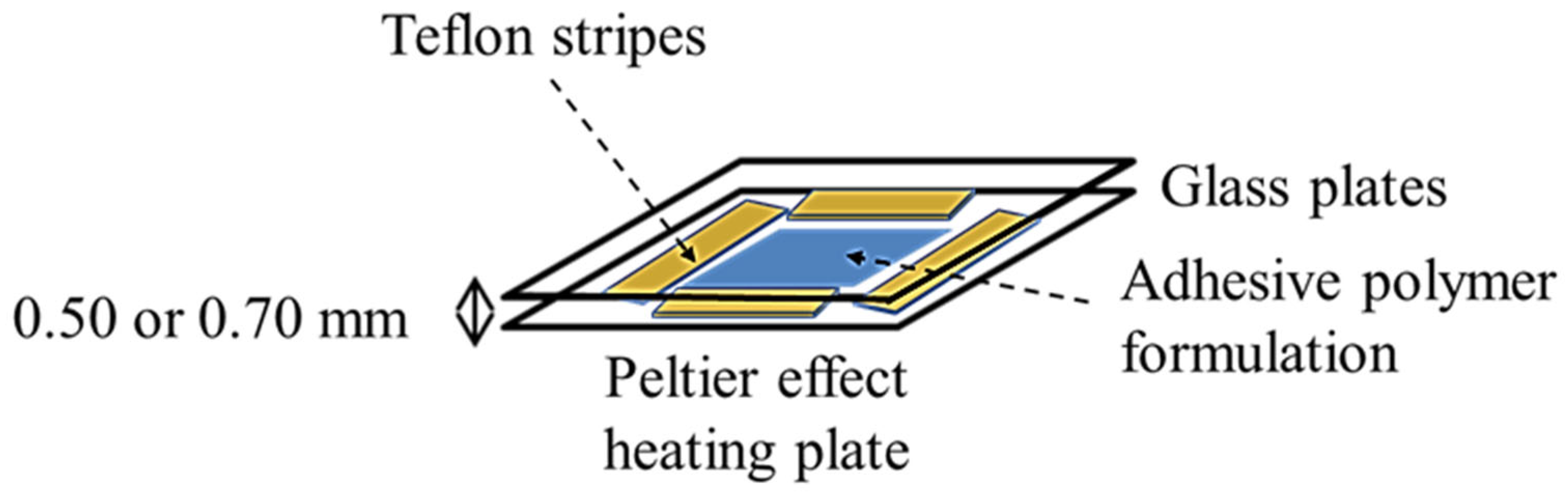
2.3. Methods and Apparatus
3. Results and Discussion
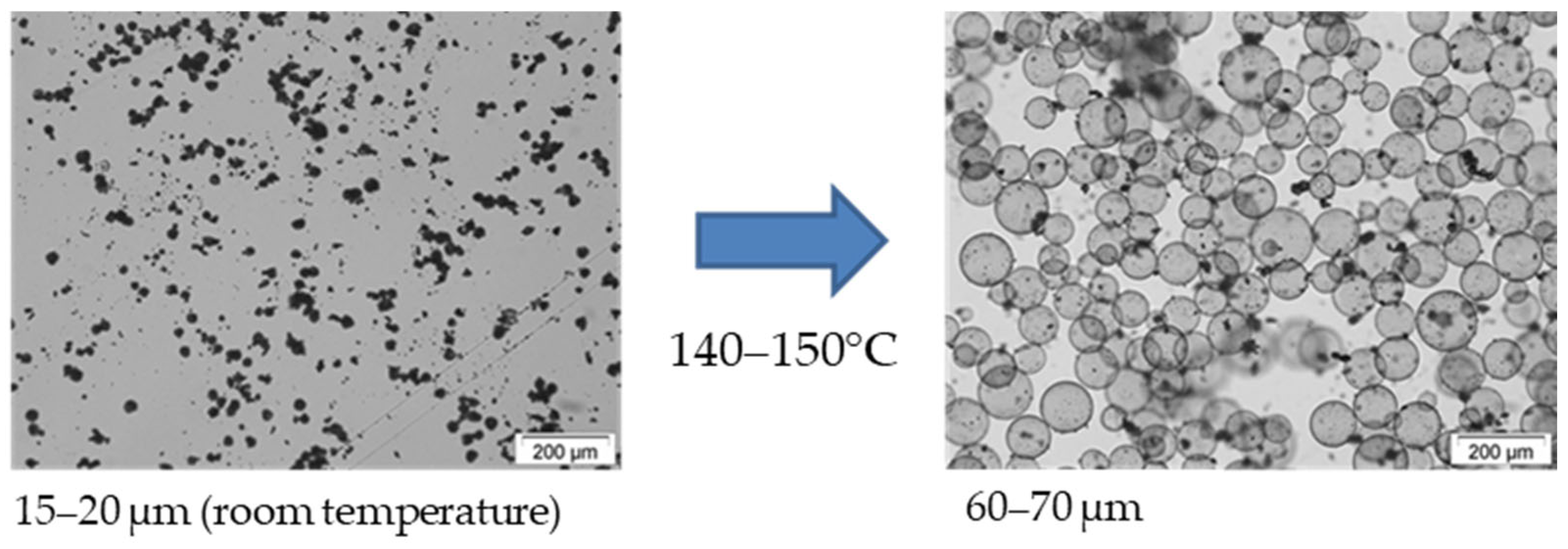
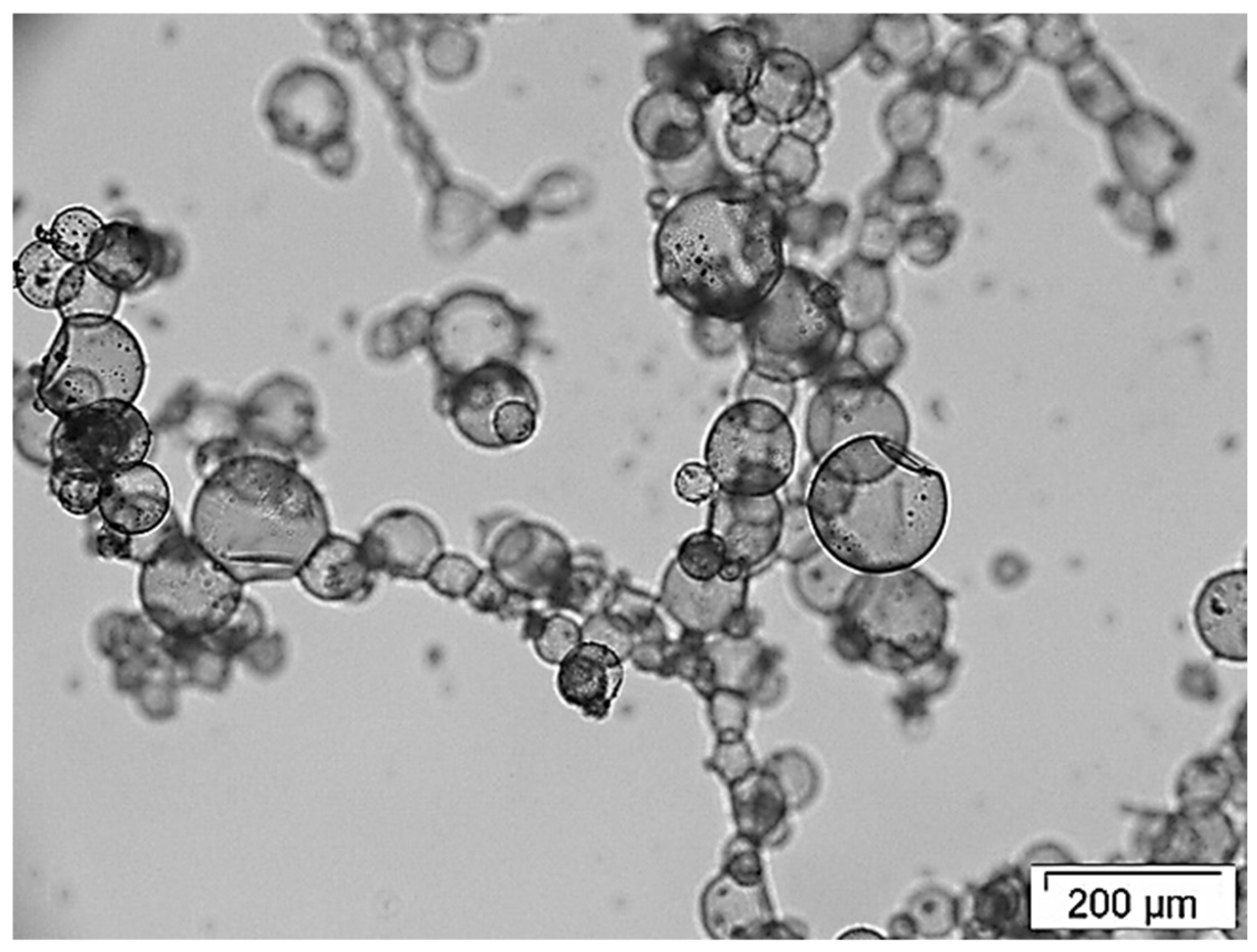
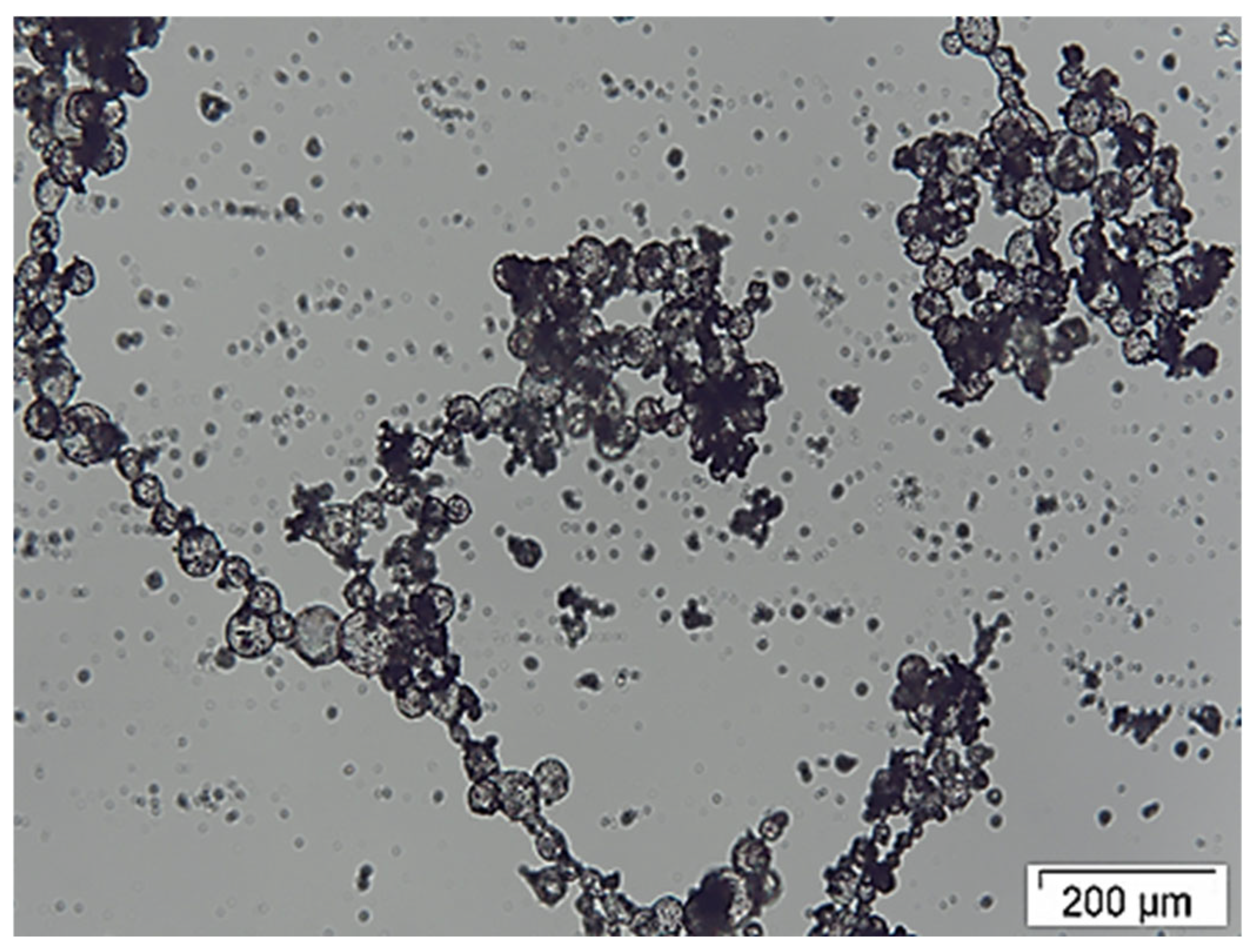
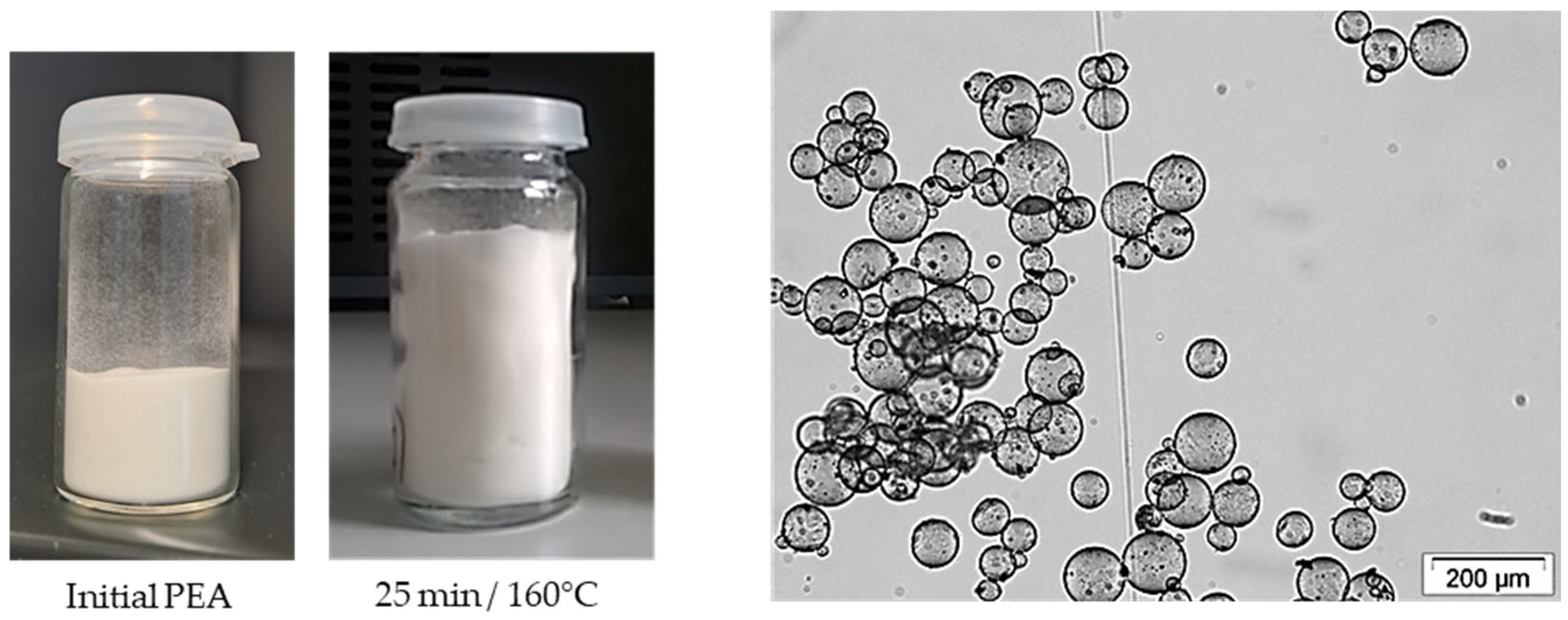
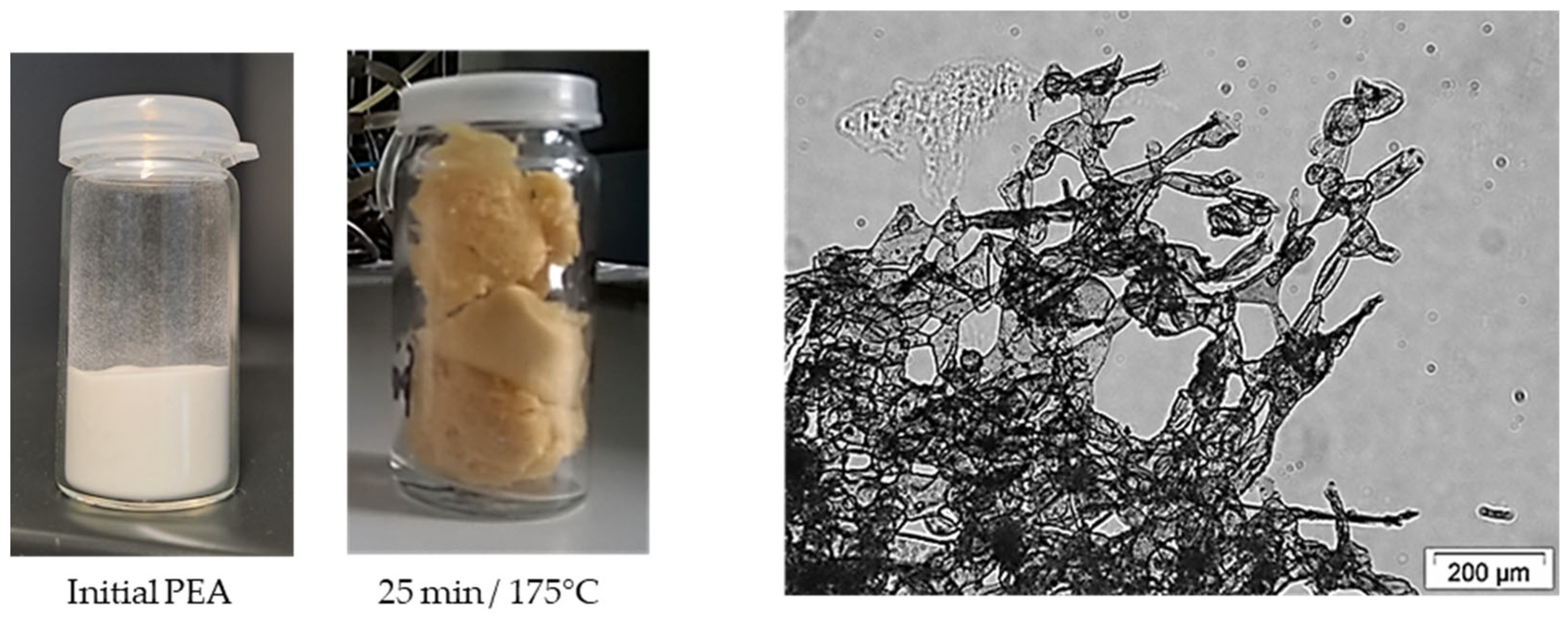
3.1. Expansion of the Physical Agent
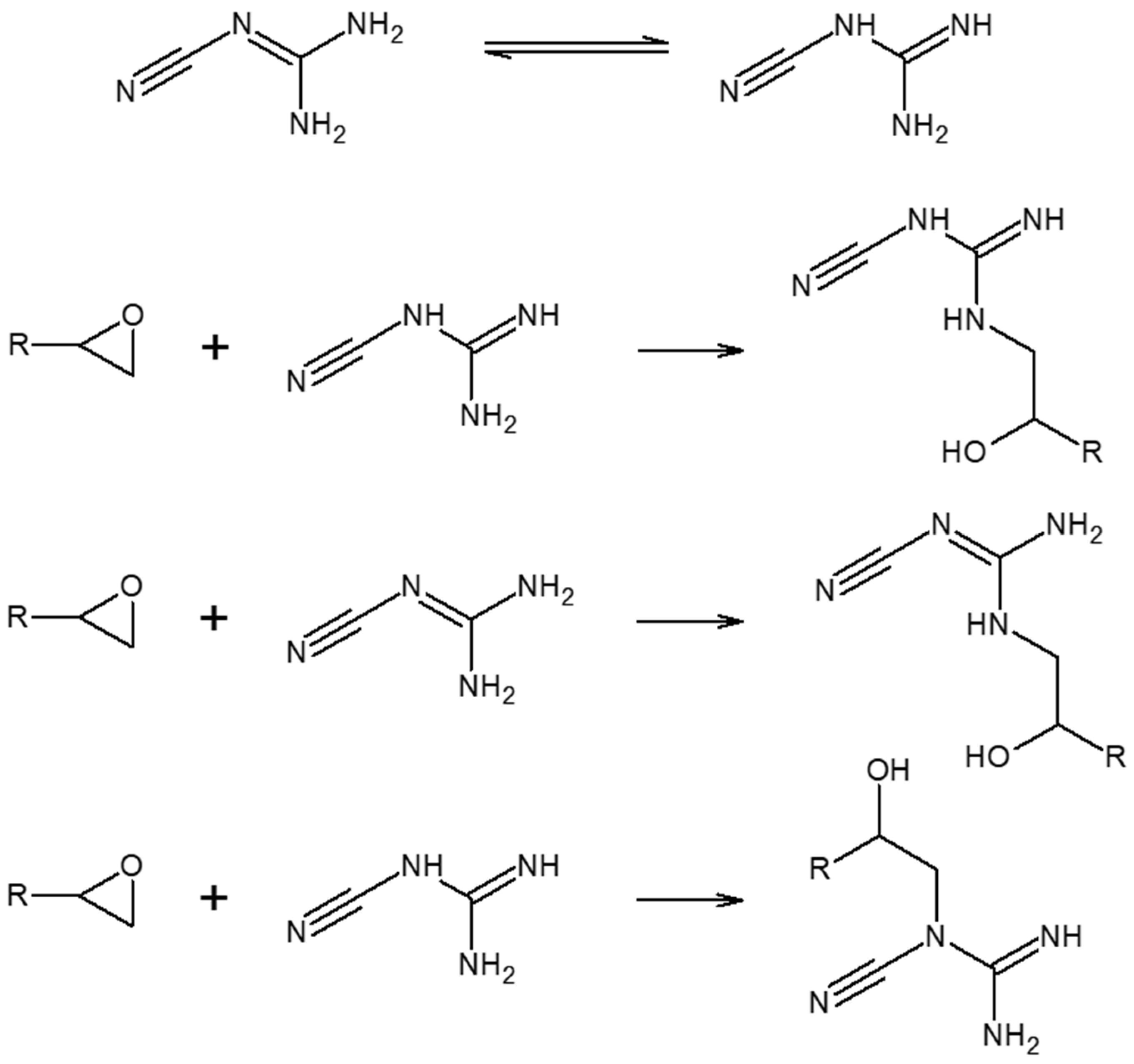
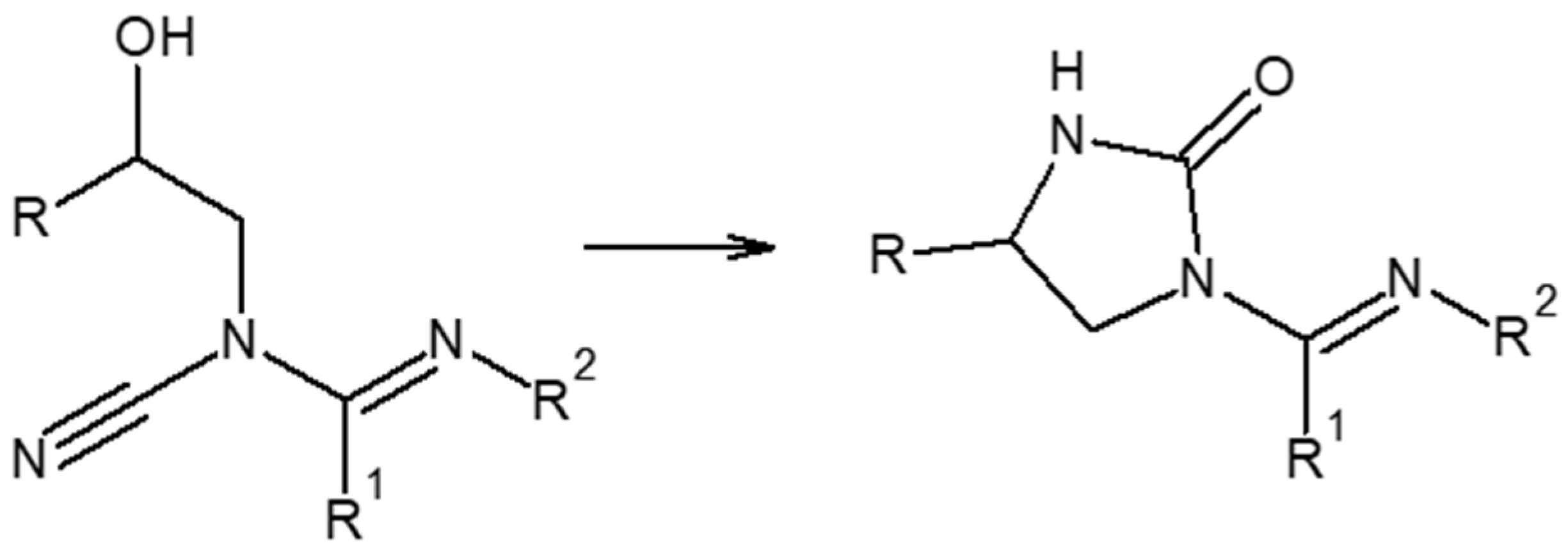
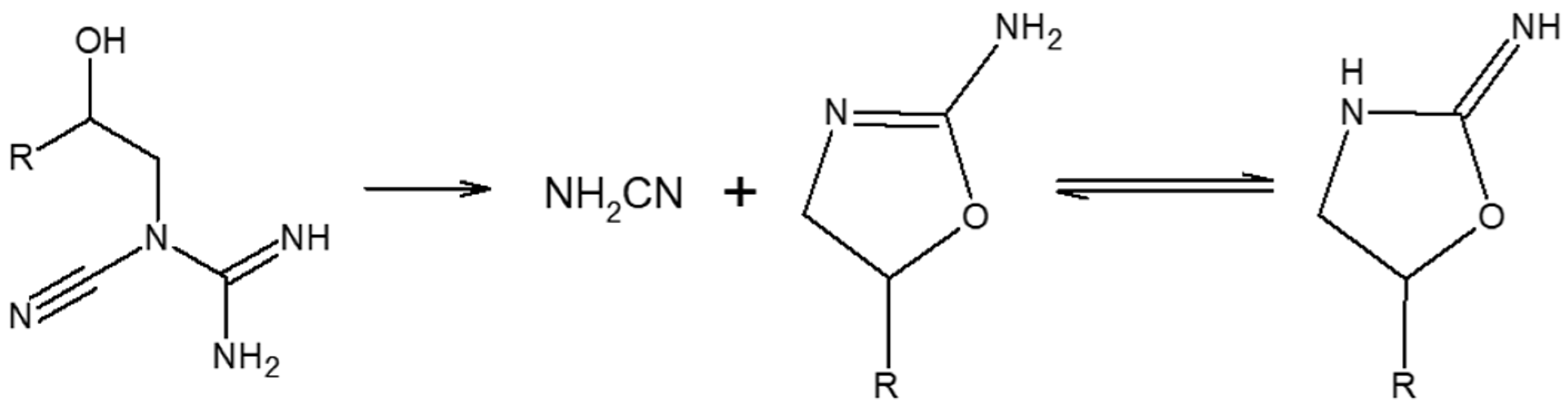
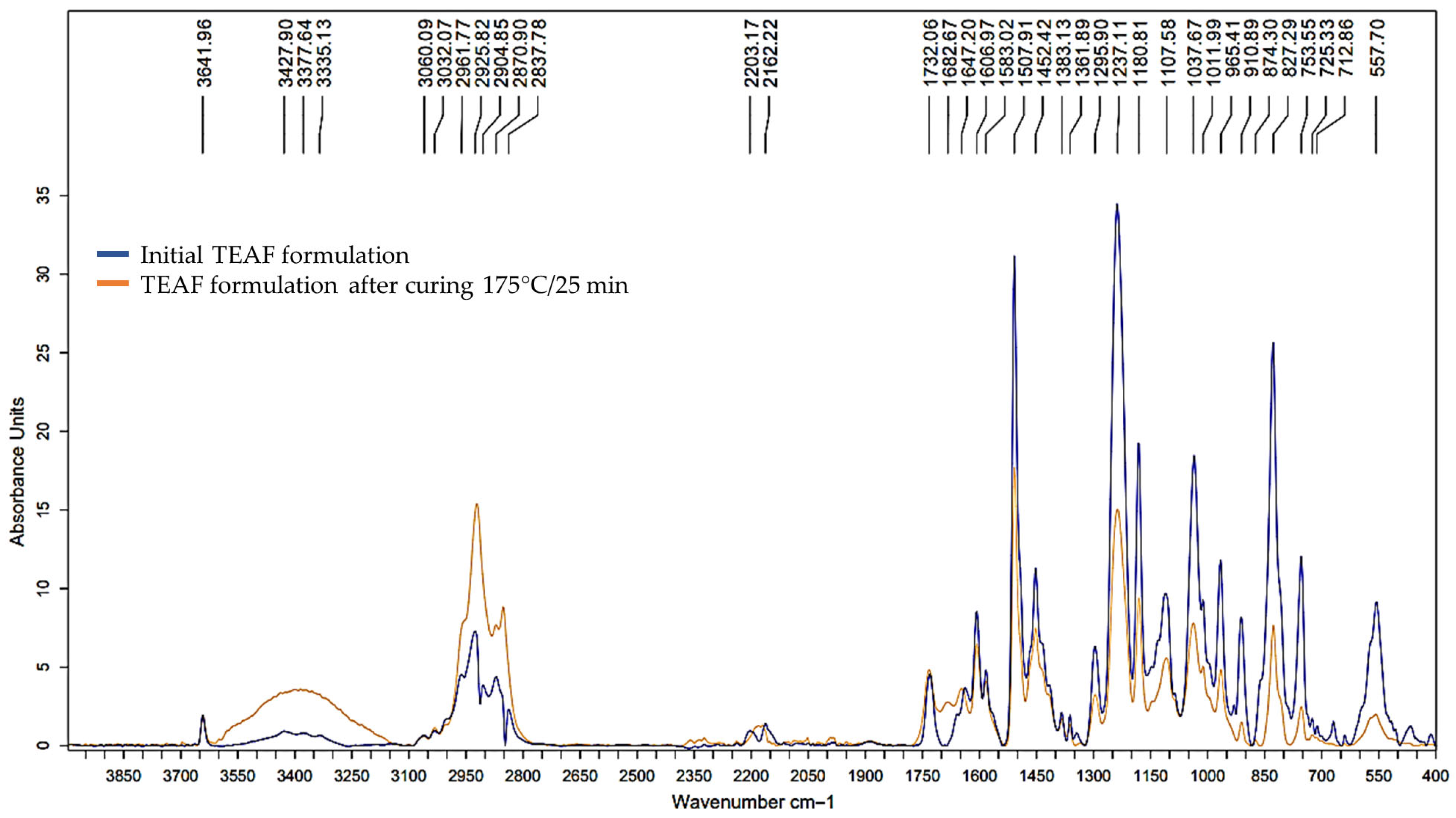
3.2. Study of the Curing of the Adhesive Formulation
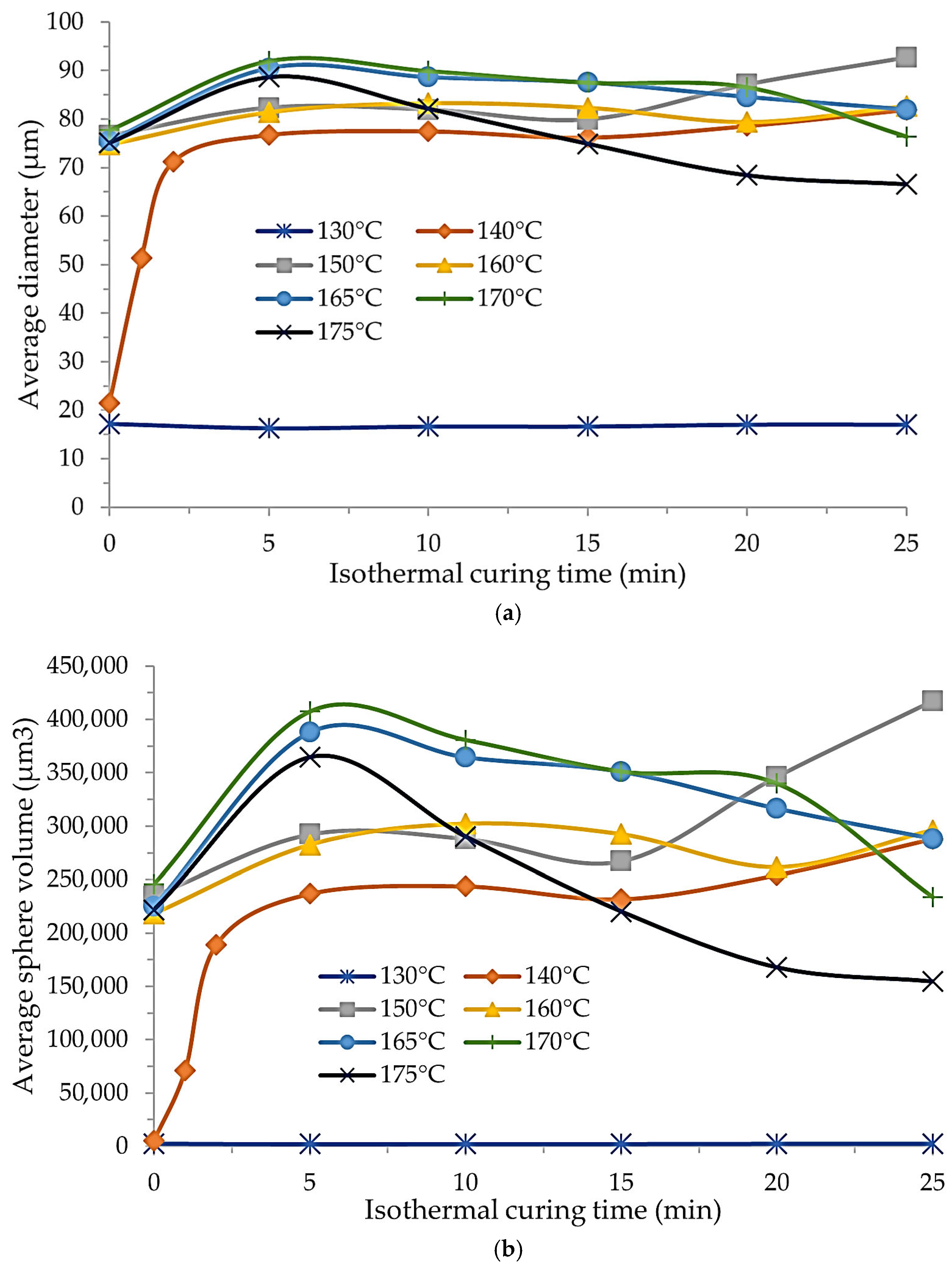
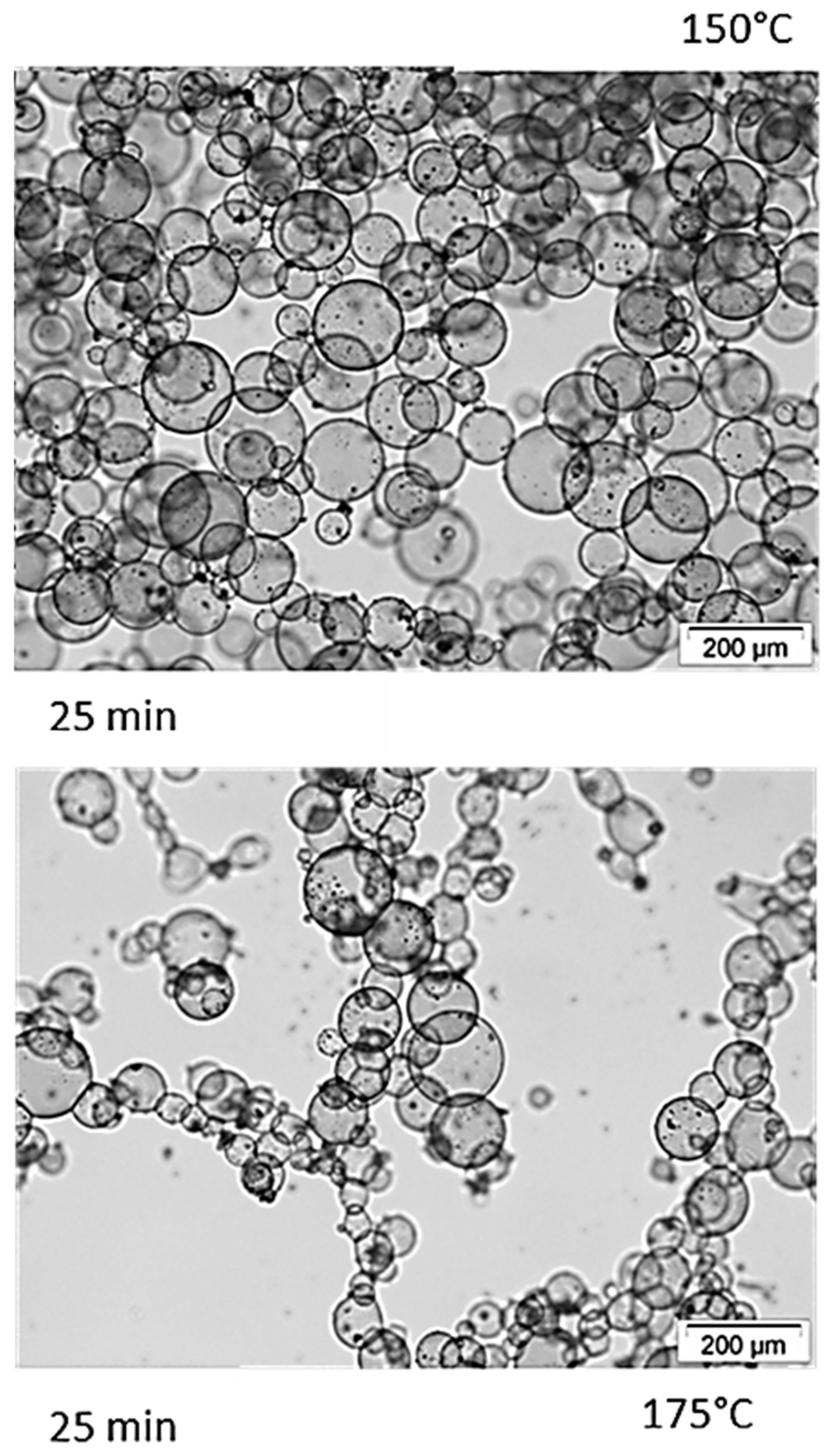
3.3. Expansion and Spreading Characterization Under Optical Microscope
4. Conclusions
Supplementary Materials
Author Contributions
Funding
Data Availability Statement
Acknowledgments
Conflicts of Interest
Abbreviations
| DSC | Differential Scanning Calorimetry |
| BADGE | Bisphenol A DiGlycidyl Ether |
| Dicy | Dicyandiamide |
| PEA | Physical Expansion Agent |
| TEAF | Thermally Expandable Adhesive Formulation with PEA |
| TEAFW | Thermally Expandable Adhesive Formulation without PEA |
| Tg | Glass transition Temperature |
References
- Meath, A.R. 19—Epoxy Resin Adhesives. In Handbook of Adhesives, 3rd ed.; Skeist, I., Ed.; Springer: New York, NY, USA, 1990; pp. 347–358. [Google Scholar]
- Chen, C.; Li, B.; Kanari, M.; Lu, D. Epoxy Adhesives. In Adhesives and Adhesive Joints in Industry Application; IntechOpen: London, UK, 2019; Volume 3, pp. 1–13. [Google Scholar]
- Barakat, A.A.; Ahmed, A.A.; Darras, B.M.; Nazzal, M.A. Towards Sustainable Metal-to-Polymer Joining: A Comparative Study on Friction Stir Welding, Self-Piercing Riveting, and Adhesive Bonding. Sustainability 2024, 16, 3664. [Google Scholar] [CrossRef]
- Choi, J.; Choi, B.; Heo, S.; Oh, Y.; Shin, S. Numerical Modeling of the Thermal Deformation During Stamping Process of an Automotive Body Part. Appl. Therm. Eng. 2018, 128, 159–172. [Google Scholar] [CrossRef]
- Dong, X.; Zhang, C.; Wang, D.; Guo, Q.; Deng, X.; Li, C. Inspection of Cracking in Stamping Parts Surfaces Using Anomaly Detection. Eng. Appl. Artif. Intell. 2025, 143, 110006. [Google Scholar] [CrossRef]
- Cavodeau, F.; Brogly, M.; Bistac, S.; Devanne, T.; Pedrollo, T.; Glasser, F. Hygrothermal Aging of an Epoxy/Dicyandiamide Structural Adhesive—Influence of Water Diffusion on the Durability of the Adhesive/Galvanized Steel Interface. J. Adhes. 2020, 96, 1027–1051. [Google Scholar] [CrossRef]
- Štěpek, J. Chapter 6—Chemical and Physical Blowing Agents. In Additives for Plastics, 1st ed.; Springer: New York, NY, USA, 1983; pp. 112–123. [Google Scholar]
- Hussein, M.S.; Leng, T.P.; Rahmat, A.R.; Zainuddin, F.; Keat, Y.C.; Suppiah, K.; Alsagayar, Z.S. The Effect of Sodium Bicarbonate as Blowing Agent on the Mechanical Properties of Epoxy. Mater. Today Proc. 2019, 16, 1622–1629. [Google Scholar] [CrossRef]
- Back, J.-H.; Hwang, J.-U.; Lee, Y.-H.; Baek, D.; Park, J.-W.; Kim, H.-J.; Kim, J.-H.; Song, H.-K.; Yoo, M.-J. Morphological Study and Mechanical Property of Epoxy-foam Adhesives Based on Epoxy Composites for Automotive Applications. Int. J. Adhes. Adhes. 2018, 87, 124–129. [Google Scholar] [CrossRef]
- Jacobs, L.J.M.; Danen, K.C.H.; Kemmere, M.F.; Keurentjes, J.T.F. Quantitative Morphology Analysis of Polymers Foamed with Supercritical Carbon Dioxide Using Voronoi Diagrams. Comput. Mater. Sci. 2007, 38, 751–758. [Google Scholar] [CrossRef]
- Lee, J.; Choi, Y.-C. Pore Structure Characteristics of Foam Composite with Active Carbon. Materials 2020, 13, 4038. [Google Scholar] [CrossRef] [PubMed]
- Gao, X.; Liu, K.; Zhao, L.; Chen, Y.; Hu, D. Thermoplastic Polyurethan Foam with Superior Expansion Ratio and Mechanical Properties by Cross-linking Modification and Supercritical Fluid Foaming. Polymer 2026, 342, 129370. [Google Scholar] [CrossRef]
- Krishnan, V.G.; Fiorucci, L.; Sarbu, A.; Drenckhan-Andreatta, W. Characterizing the Foaming Process of Polymers: Review of Experimental Methods. Adv. Colloid Interface Sci. 2025, 344, 103579. [Google Scholar] [CrossRef]
- Wu, S.; He, L.; Zhang, C.; Gong, W.; He, Y.; Luo, Y. Visualization Observation of cells Growth in Low-density Polyethylene Foaming Processes. Polym. Test. 2017, 63, 367–374. [Google Scholar] [CrossRef]
- Deng, R.; Jiang, T.; Zhang, C.; Zeng, X.; Liu, B.; Yang, J.; Li, S.; Gu, J.; Gong, W.; He, L. In-situ Visualization of the Cell Formation Process of Foamed Polypropylene Under Different Foaming Environments. Polymers 2021, 13, 1468. [Google Scholar] [CrossRef]
- Shaayegan, V.; Wang, C.; Park, C.B. Study of the Bubble Nucleation and Growth Mechanisms in High-pressure Foam Injection Molding Through in-situ Visualization. Eur. Polym. J. 2016, 76, 2–13. [Google Scholar] [CrossRef]
- Peng, X.-F.; Liu, L.-Y.; Chen, B.-Y.; Mi, H.-Y.; Jing, X. A Novel Visualization System for Observing Polymer Extrusion Foaming. Polym. Test. 2016, 52, 225–233. [Google Scholar] [CrossRef]
- Amdouni, N.; Sautereau, H.; Gérard, J.-F.; Pascault, J.-P. Epoxy Networks Based on Dicyandiamide: Effect of the Cure Cycle on Viscoelastic and Mechanical Properties. Polymers 1990, 31, 1245–1253. [Google Scholar] [CrossRef]
- Macknight, W.J.; Gilbert, M.D.; Schneider, N.S. Mechanism of the Dicyandiamide/Epoxide Reaction. Macromolecules 1991, 24, 360–369. [Google Scholar] [CrossRef]
- Raetzke, K.; Shaikh, M.Q.; Faupel, F.; Noeske, P.M. Shelf Stability of Reactive Adhesive Formulations: A Case Study for Dicyandiamide-Cured Epoxy Systems. Int. J. Adhes. Adhes. 2021, 30, 105–110. [Google Scholar] [CrossRef]
- Saunders, T.F.; Levy, M.F.; Serino, J.F. Mechanism of the Tertiary Amine-Catalyzed Dicyandiamide Cure of Epoxy Resins. J. Polym. Sci. Part A-1 Polym. Chem. 1967, 5, 1609–1617. [Google Scholar] [CrossRef]
- Zahir, S.A. The Mechanism of the Cure of Epoxide Eesins by Cyanamide and Dicyandiamide. Adv. Org. Contings Sci. Technol. 1982, 4, 83–101. [Google Scholar]
- Moffat, J.B. The Dimers of Cyanamide. J. Mol. Struct. 1983, 94, 261–265. [Google Scholar] [CrossRef]
- Wu, F.; Zhou, X.; Yu, X. Reaction Mechanism, Cure Behavior and Properties of a Multifunctional Epoxy Resin, TGDDMn with Latent Curing Agent Dicyandiamide. RCS Adv. 2018, 8, 8248–8258. [Google Scholar]



| Curing Temperature | 130 °C | 140 °C | 150 °C | 160 °C | 165 °C | 170 °C | 175 °C |
|---|---|---|---|---|---|---|---|
| 0 min | 17.16 ± 0.86 µm | 21.44 ± 0.72 µm | 76.56 ± 1.12 µm | 74.70 ± 3.43 µm | 75.45 ± 2.04 µm | 77.69 ± 2.37 µm | 75.09 ± 2.88 µm |
| 1 min | / | 51.33 ± 2.33 µm | / | / | / | / | / |
| 2 min | / | 71.20 ± 1.57 µm | / | / | / | / | / |
| 5 min | 16.24 ± 0.70 µm | 76.75 ± 2.83 µm | 82.33 ± 3.11 µm | 81.39 ± 2.86 µm | 90.78 ± 4.32 µm | 91.97 ± 4.44 µm | 88.63 ± 3.97 µm |
| 10 min | 16.61 ± 0.97 µm | 77.50 ± 2.68 µm | 81.94 ± 4.10 µm | 83.24 ± 3.16 µm | 88.63 ± 3.43 µm | 89.92 ± 4.47 µm | 82.14 ± 3.11 µm |
| 15 min | 16.61 ± 0.95 µm | 76.20 ± 3.81 µm | 79.90 ± 2.99 µm | 82.33 ± 3.48 µm | 87.52 ± 2.37 µm | 87.53 ± 3.38 µm | 74.90 ± 3.42 µm |
| 20 min | 17.00 ± 1.01 µm | 78.60 ± 2.93 µm | 87.14 ± 3.35 µm | 79.35 ± 2.97 µm | 84.54 ± 3.22 µm | 86.58 ± 4.33 µm | 68.41 ± 3.48 µm |
| 25 min | 17.00 ± 0.76 µm | 81.94 ± 3.10 µm | 92.72 ± 4.23 µm | 82.69 ± 4.13 µm | 81.94 ± 4.82 µm | 76.39 ± 6.10 µm | 66.55 ± 7.33 µm |
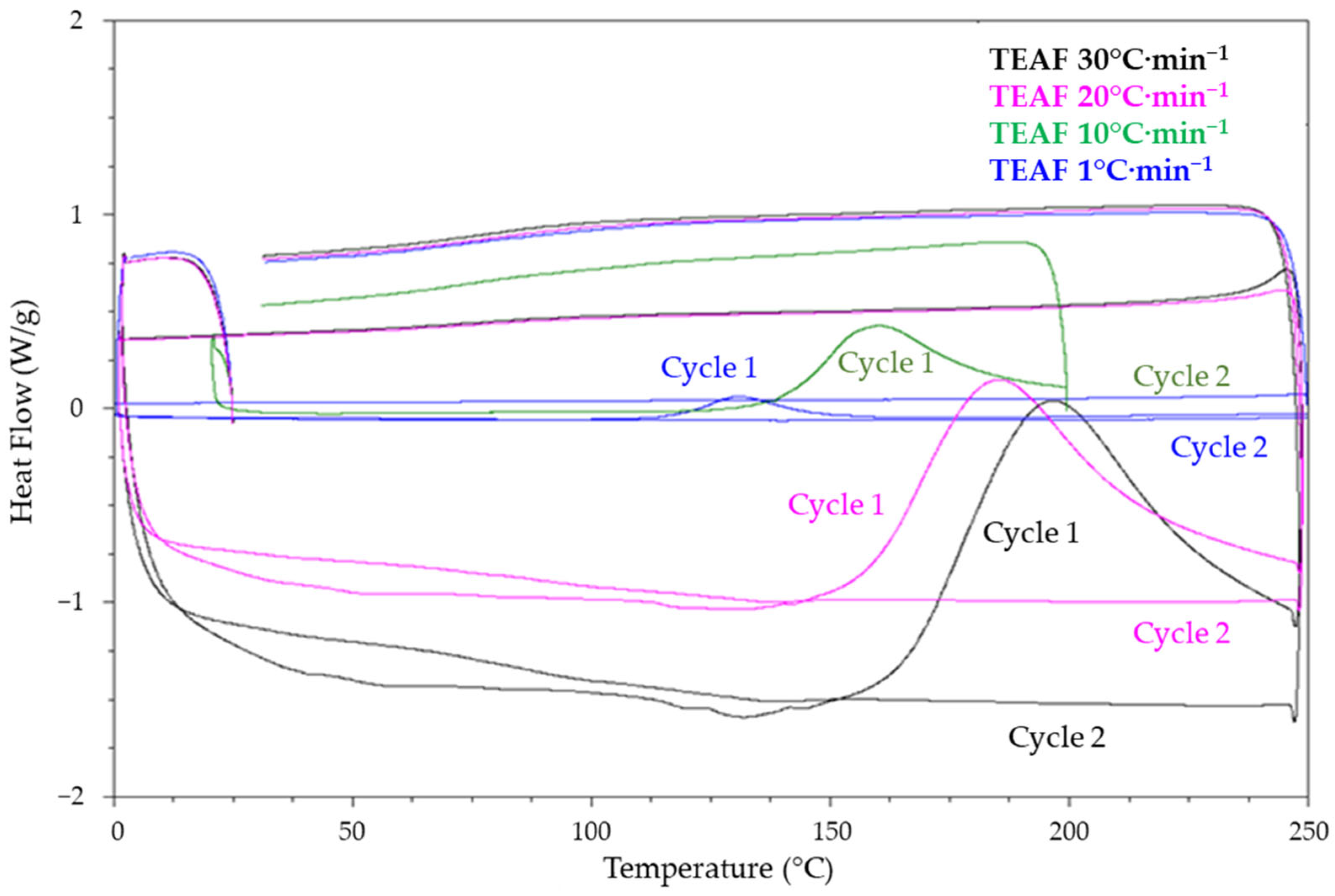
| Measured Temperature (°C) | Identification | Enthalpy of Reaction (J·g−1) | |
|---|---|---|---|
| 1 °C·min−1 | - | Tg of cured adhesive | |
| 120 | Tg of PEA | ||
| - | Expansion of PEA | ||
| 102 | Start of curing | ||
| 131 | Max of curing | 140 | |
| 169 | End of curing | ||
| 10 °C·min−1 | 49 | Tg of raw adhesive | |
| 87 | Tg of cured adhesive | ||
| 119 | Tg of PEA | ||
| 129 | Start of curing | ||
| 138 | Expansion of PEA | ||
| 160 | Max of curing | 120 | |
| 193 | End of curing | ||
| 20 °C·min−1 | 47 | Tg of raw adhesive | |
| 85 | Tg of cured adhesive | ||
| 117 | Tg of PEA | ||
| 140 | Expansion of PEA | ||
| 148 | Start of curing | ||
| 185 | Max of curing | 130 | |
| 247 | End of curing | ||
| 30 °C·min−1 | 51 | Tg of raw adhesive | |
| 88 | Tg of cured adhesive | ||
| 117 | Tg of PEA | ||
| 141 | Expansion of PEA | ||
| 154 | Start of curing | ||
| 194 | Max of curing | 120 | |
| 246 | End of curing |
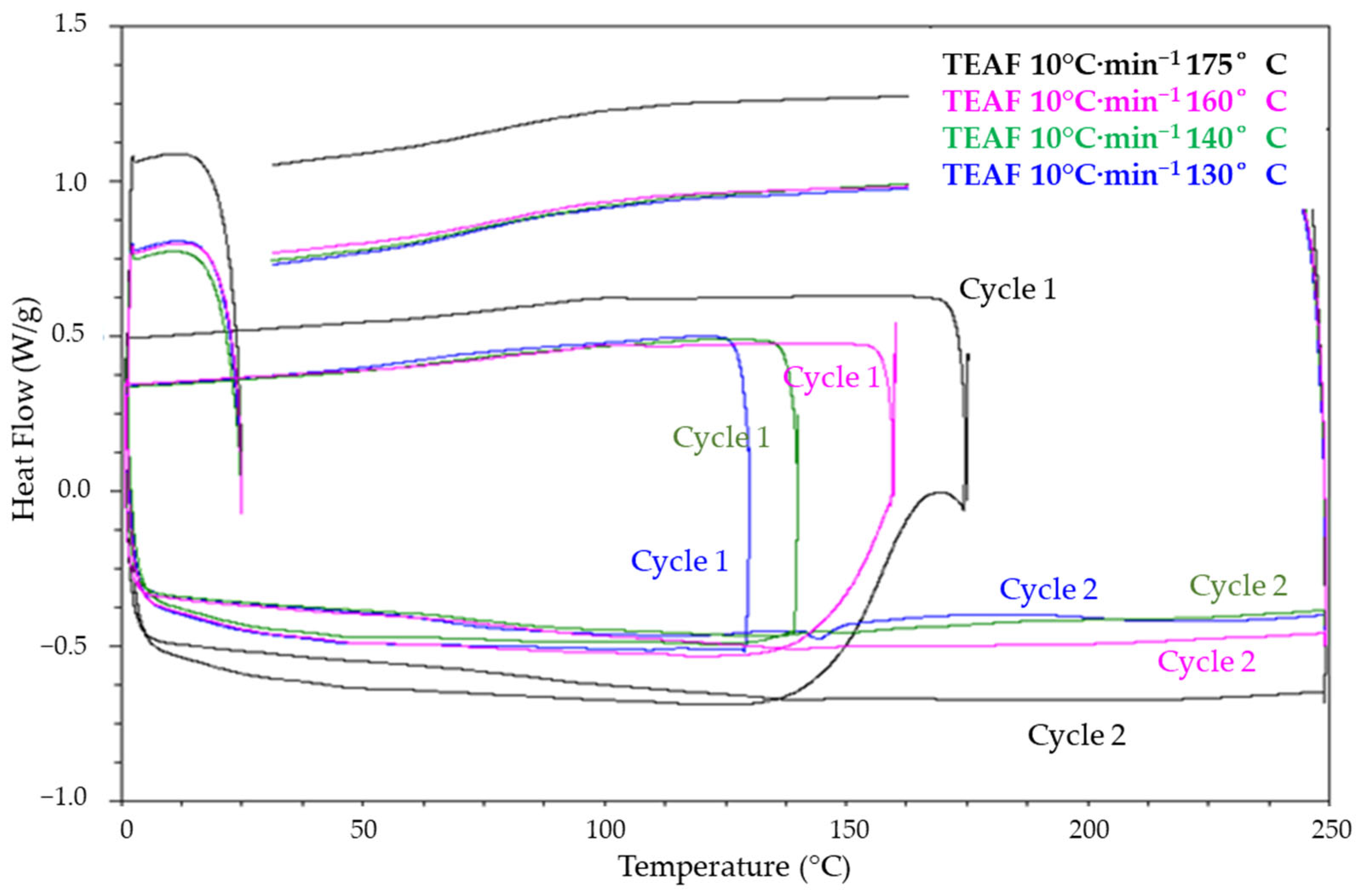
| Measured Temperature (°C) | Identification | Enthalpy of Reaction (J·g−1) | |
|---|---|---|---|
| 130 °C | 46 | Tg of cured adhesive | |
| 66 | Tg of cured adhesive | ||
| 117 | Tg of PEA | ||
| 141 (2nd cycle) | Expansion of PEA | ||
| 130 | Start of curing | ||
| After 9 min at 130 °C | Max of curing | 85 | |
| After 24 min at 130 °C | End of curing | ||
| 140 °C | 43 | Tg of raw adhesive | |
| 69 | Tg of cured adhesive | ||
| 117 | Tg of PEA | ||
| 138 | Expansion of PEA | ||
| 130 | Start of curing | ||
| After 4 min at 140 °C | Max of curing | 80 | |
| After 15 min at 140 °C | End of curing | ||
| 160 °C | 44 | Tg of raw adhesive | |
| 84 | Tg of cured adhesive | ||
| 114 | Tg of PEA | ||
| 139 | Expansion of PEA | ||
| 130 | Start of curing | ||
| After 40 s at 160 °C | Max of curing | 115 | |
| After 12 min at 160 °C | End of curing | ||
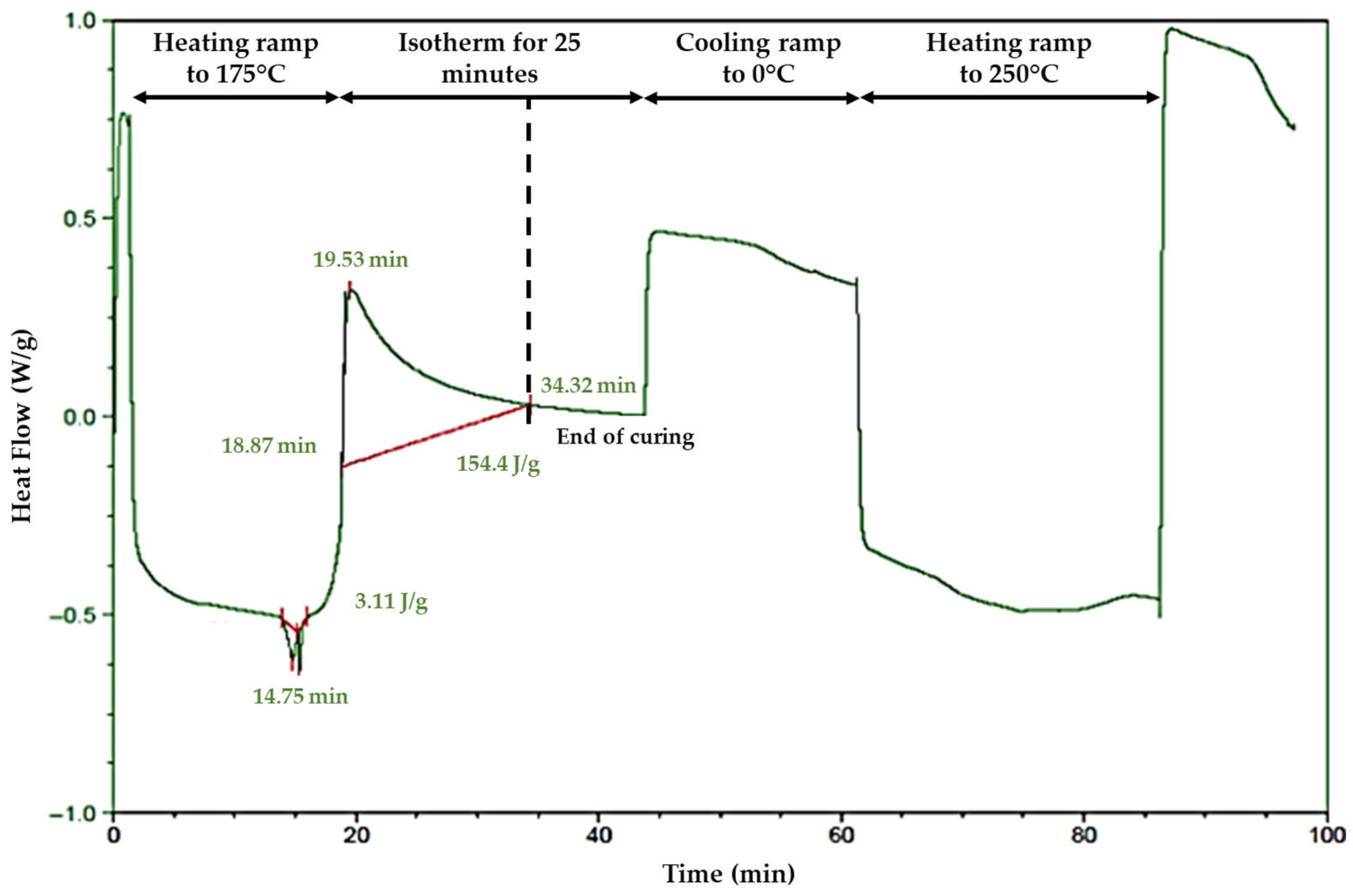
| 175 °C | 45 | Tg of raw adhesive | |
| 84 | Tg of cured adhesive | ||
| 114 | Tg of PEA | ||
| 139 | Expansion of PEA | ||
| 130 | Start of curing | ||
| 165 | Max of curing | 130 | |
| After 10 min at 175 °C | End of curing |
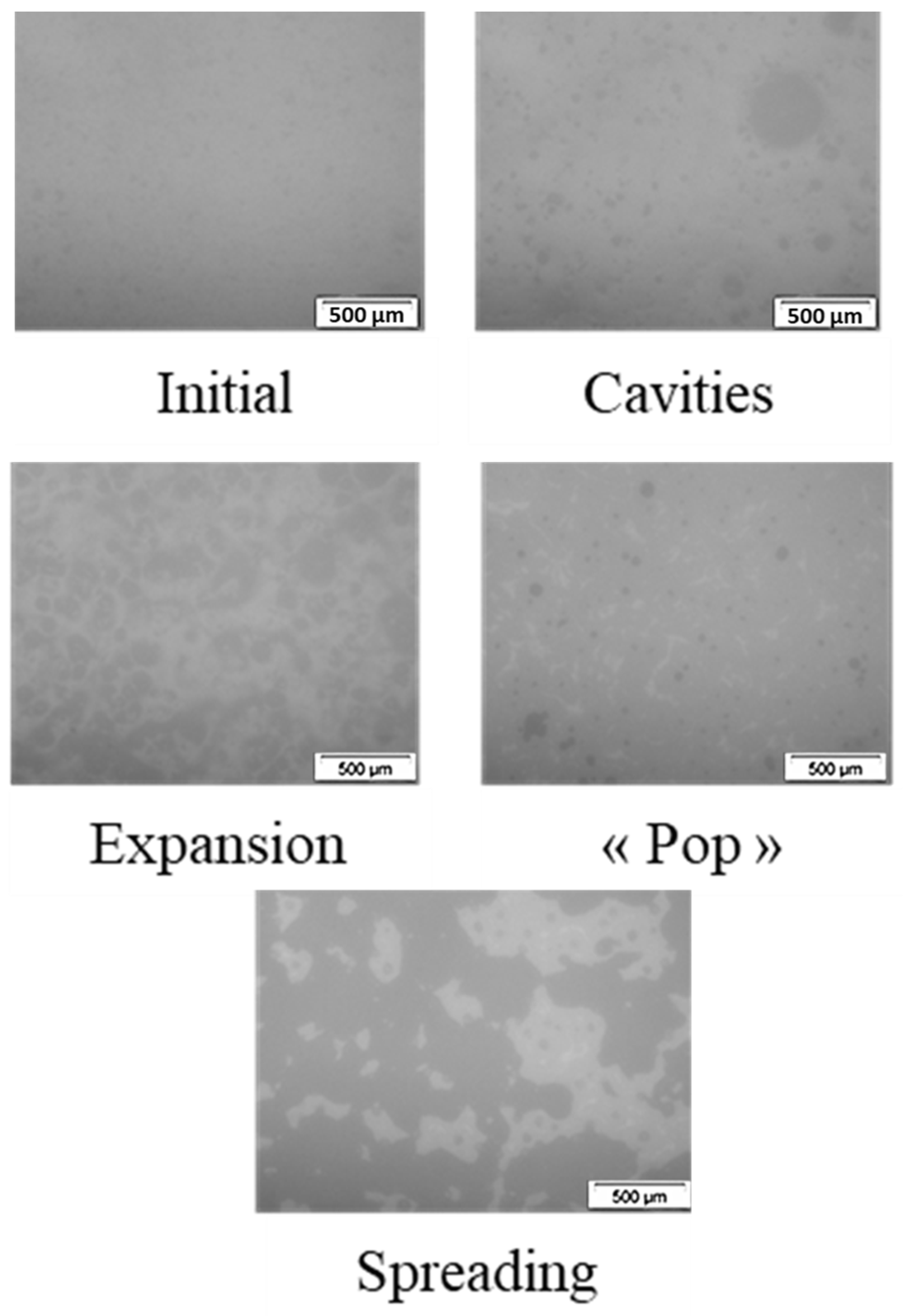
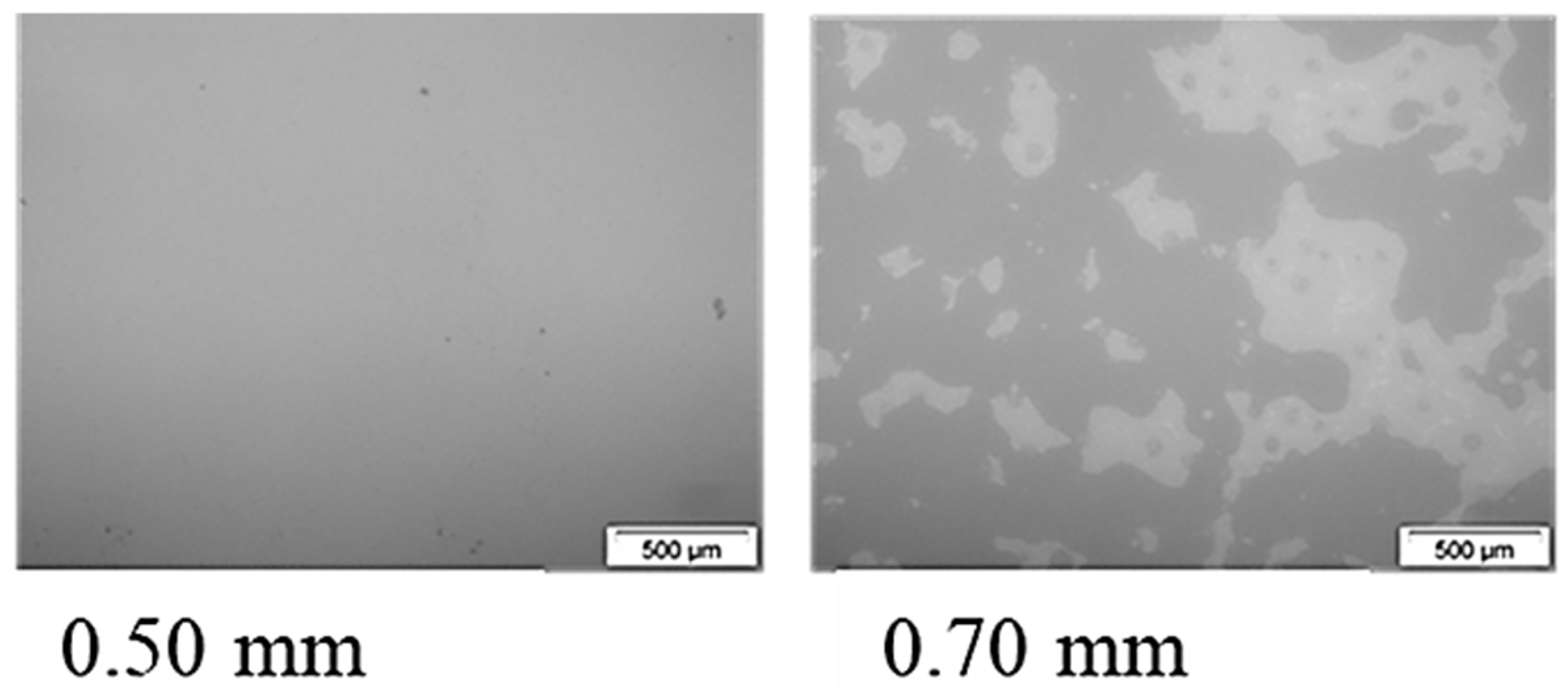
| Conditions | 0.5 mm | 0.7 mm |
|---|---|---|
| Cavities | 120 °C | 127 °C |
| Expansion | - | 143 °C |
| “Pop” | - | 165–167 °C |
| Spreading | 138–147 °C | 175 °C (t0–1 min) |
| Spreaded surface | 99.4 ± 0.5% | 56.4 ± 3.2% |
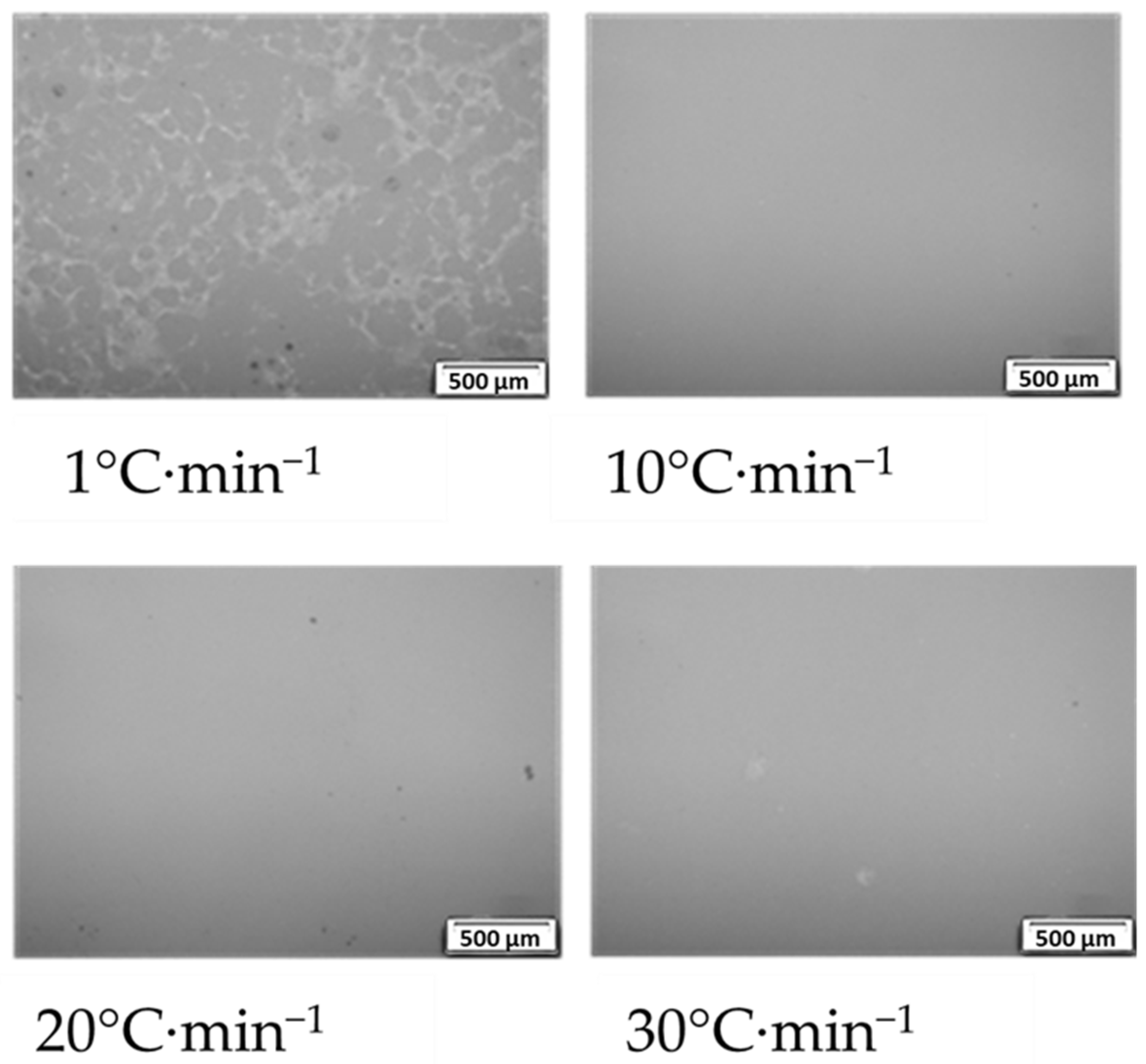
| Conditions | 1 °C·min−1 | 10 °C·min−1 | 20 °C·min−1 | 30 °C·min−1 |
|---|---|---|---|---|
| Cavities | 120 °C | 122 °C | 120 °C | 113 °C |
| Expansion | 135 °C | 149 °C | - | - |
| “Pop” | 155 °C | - | - | - |
| Spreading | 140 | 140–164 °C | 138–147 °C | 130–135 °C |
| Spreaded surface | 5.7 ± 2.1% | 99.1 ± 0.2% | 99.4 ± 0.5% | 98.8 ± 0.5% |
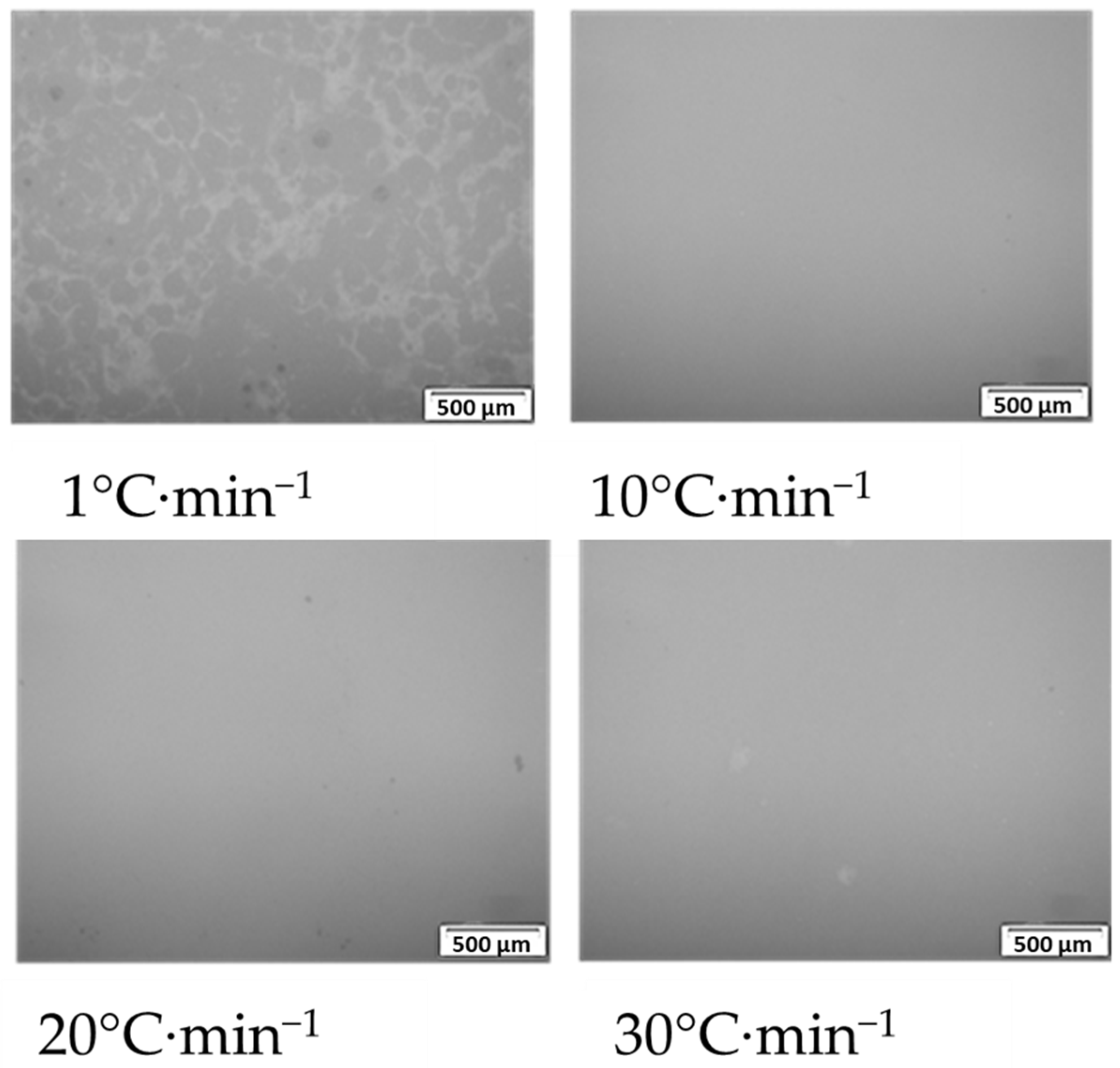
| Conditions | 1 °C·min−1 | 10 °C·min−1 | 20 °C·min−1 | 30 °C·min−1 |
|---|---|---|---|---|
| Cavities | 120 °C | 118 °C | 127 °C | 118 °C |
| Expansion | 135 °C | 146 °C | 143 °C | 150 °C |
| “Pop” | 155 °C | 155–159 °C | 165–167 °C | - |
| Spreading | - | 175 °C (40 s–4 min) | 175 °C (t0–1 min) | 148–170 °C |
| Spreaded surface | 0.9 ± 0.3% | 17.9 ± 8.6% | 56.4 ± 3.2% | 98.6 ± 0.3% |
Disclaimer/Publisher’s Note: The statements, opinions and data contained in all publications are solely those of the individual author(s) and contributor(s) and not of MDPI and/or the editor(s). MDPI and/or the editor(s) disclaim responsibility for any injury to people or property resulting from any ideas, methods, instructions or products referred to in the content. |
© 2026 by the authors. Licensee MDPI, Basel, Switzerland. This article is an open access article distributed under the terms and conditions of the Creative Commons Attribution (CC BY) license.
Share and Cite
Cavodeau, F.; Bistac, S.; Brogly, M. An Original Method to Characterize the Expansion of Thermally Self-Expandable Adhesive Thermoset Formulations Using Optical Microscopy. Adhesives 2026, 2, 10. https://doi.org/10.3390/adhesives2020010
Cavodeau F, Bistac S, Brogly M. An Original Method to Characterize the Expansion of Thermally Self-Expandable Adhesive Thermoset Formulations Using Optical Microscopy. Adhesives. 2026; 2(2):10. https://doi.org/10.3390/adhesives2020010
Chicago/Turabian StyleCavodeau, Florian, Sophie Bistac, and Maurice Brogly. 2026. "An Original Method to Characterize the Expansion of Thermally Self-Expandable Adhesive Thermoset Formulations Using Optical Microscopy" Adhesives 2, no. 2: 10. https://doi.org/10.3390/adhesives2020010
APA StyleCavodeau, F., Bistac, S., & Brogly, M. (2026). An Original Method to Characterize the Expansion of Thermally Self-Expandable Adhesive Thermoset Formulations Using Optical Microscopy. Adhesives, 2(2), 10. https://doi.org/10.3390/adhesives2020010