1. Introduction
Hydrological and hydraulic modeling workflows depend heavily on GIS-derived inputs, including watershed and sub-watershed boundaries, drainage network geometry, outlet/junction locations, and spatial parameter layers such as Manning’s roughness coefficient (
n). In practice, these inputs are often produced through multi-step, semi-manual GIS procedures that are repetitive, time-consuming, and sensitive to user choices, which complicates reproducibility and increases the risk of inconsistent outputs. Recent practice, therefore, increasingly favors the automation of workflows through scripting and tool development, where complex geoprocessing chains are encapsulated as parameterized tools that can be executed consistently across different study areas with minimal manual intervention [
1]. Alongside the methodological framework, the latest developments increasingly emphasize operationalization, whereby workflows are converted into reusable tools that minimize manual GIS operations and produce “model-ready” outputs directly. For instance, recent Python-based hydrology tools automate the otherwise laborious processes of pre-processing and formatting to provide standardized inputs for external modeling environments [
2].
In this study, a contribution to this direction is presented through two Python-based, GIS-embedded geoprocessing tools that are executed exclusively within ArcGIS Pro 3.6. The first tool, WATDYN, automates watershed/sub-watershed delineation and dynamic drainage network extraction, including outlet and confluence identification, using a DEM-driven workflow. The second tool, MRET, automates the generation of a spatially distributed Manning’s roughness coefficient (n) layer by mapping CORINE Land Cover 2018 classes to the literature-derived roughness values. Compared with existing GIS-based hydrological preprocessing approaches, which commonly rely on a sequence of separate tools and semi-manual analyst intervention, the proposed WATDYN and MRETs emphasize workflow integration, parameterization, and direct production of model-ready outputs. The proposed approach reduces analyst time and workflow fragmentation by reducing the number of steps in the process. Furthermore, it supports efficient scaling to multiple areas of interest.
2. Materials and Methods
2.1. Software Environment and Implementation Framework
The proposed geoprocessing tools were developed and executed within the ArcGIS Pro 3.6 environment using Python 3 [
3] as the core programming language. The ArcGIS Pro Python environment and its native geoprocessing interface were utilized during development, ensuring that all computational steps were performed using ArcGIS-compliant data structures and spatial processing routines. The implementation is based on ArcPy [
4], which provides programmatic access to ArcGIS Pro geoprocessing tools and supports the creation of script-based tools that integrate seamlessly into the ArcGIS Pro toolbox framework. This design approach facilitates consistent operation under the same spatial reference, geodatabase/file management conventions, and geoprocessing rules employed by ArcGIS Pro, while enabling reproducibility using parameters. Tools require a local installation of ArcGIS Pro with an active spatial analyst license, as raster-based workflows and map algebra operations are performed through the arcpy.sa module. The scripts can be executed either through the internal Python window of ArcGIS Pro or through an external code editor configured to use the ArcGIS Pro Python environment. In both cases, the tools remain strictly bound to ArcGIS Pro’s geoprocessing system, and no standalone execution outside ArcGIS Pro is assumed or supported.
The toolchain is built on ArcPy with supporting Python libraries for modular code structure and numerical post-processing. Core workflow components include “arcpy” for geoprocessing orchestration and data management, “arcpy.sa” for spatial analyst operations, and “os” for consistent path handling and organized management of intermediate outputs. Complementary data libraries such as “csv”, “pandas”, and “numpy” enable table-driven parameterization, conversion of raster to numeric arrays, and export of summarized results to tabular formats. Tools were designed following a modular geoprocessing architecture that separates user inputs, core processing, and outputs, while maintaining full compatibility with ArcGIS Pro’s execution model. Each tool is structured as a parameterized script that can be registered as a geoprocessing tool in an ArcGIS toolbox, allowing it to be invoked through the ArcGIS Pro graphical interface with validated input parameters and standardized messaging. This functional decomposition improves readability and maintainability, and it also facilitates controlled debugging, since intermediate outputs can be produced and inspected at defined processing stages. The tools are designed to accept geospatial inputs, including both vector and raster datasets, and to produce outputs in ArcGIS-compatible formats. Inputs may include raster surfaces and vector features representing points, lines, or polygons, depending on the workflow stage and user objective. Outputs similarly include derived raster datasets and vector feature classes, while optional exports to non-spatial formats (e.g., CSV and image exports) are supported when required for reporting or model parameter documentation. The generation and management of intermediate products is a deliberate component of the implementation, as complex spatial workflows often require temporary rasters and feature classes that support subsequent processing steps. These intermediate datasets are stored using a consistent naming and directory scheme to maintain traceability and minimize ambiguity between provisional and final outputs.
2.2. Overview of the Developed Tools
Two geoprocessing tools were implemented to support hydrological and hydraulic modeling workflows. Watershed Delineation and Dynamic Network Extraction (WATDYN) focuses on automating the delineation of watershed boundaries and the extraction of a dynamic drainage network, producing vector (polygon) watershed outputs and linear hydrographic network products suitable for subsequent analyses. The Manning Roughness Estimation Tool (MRET) focuses on the spatial estimation of Manning’s roughness coefficient (Manning’s
n) across a study area using land use/land cover categorization, producing spatially explicit roughness layers and associated outputs that can be used as inputs to hydraulic models. The developed tools and their capabilities are shortly presented in
Table 1.
2.3. Development and Implementation of the Watershed Delineation and Dynamic Network Extraction (WATDYN) Tool
The Watershed Delineation and Dynamic Network Extraction (WATDYN) tool provides an automated, raster-based workflow for delineating multiple watersheds/sub-watersheds and extracting the corresponding drainage network, while also identifying outlet and junction points. The tool uses a user-specified Digital Elevation Model (DEM) as its primary input and runs entirely within ArcGIS Pro, storing intermediate and final outputs in the project geodatabase to ensure consistent data management and reproducibility. The processing workflow begins with hydrological conditioning of the DEM using “Fill” to remove sinks. Based on the corrected DEM, flow direction is computed, and flow accumulation is subsequently derived to represent the upstream contributing area per cell. A user-defined threshold is then applied to extract the stream network as a binary file, which is further processed into uniquely labeled stream segments using “Stream Link”. The raster stream network is converted to vector polylines using “StreamToFeature”, producing the final drainage network feature class. For watershed delineation, WATDYN derives outlet points from stream segment endpoints and detects junctions through network intersection logic. Outlet points are then adjusted to the raster drainage structure using “SnapPourPoint”, with a user-defined snapping distance controlling the search neighbors. The snapped outlets are used as pour points in the “watershed” tool, generating a raster that is converted to polygons for vector analysis. The tool outputs the watershed/sub-watershed boundaries (raster and polygon feature class), the extracted stream network (polyline feature class), and point feature classes for outlets and junctions, while allowing user parameterization (threshold) and outlet snapping to adapt results to terrain morphology and study scale. In
Table 2, the inputs and outputs of the WATDYN tool are presented.
2.4. Development and Implementation of the Manning Roughness Estimation Tool (MRET)
The Manning Roughness Estimation Tool (MRET) is a GIS-embedded workflow for deriving a spatially distributed Manning roughness coefficient (n) layer from land-use/land-cover information. The tool operationalizes a deterministic, table-driven parameterization in which each CORINE Land Cover 2018 class code is mapped to a predefined Manning’s n value based on published roughness ranges and recommended coefficients.
The input to MRET is the CORINE 2018 raster, where land-cover classes are represented by the three-digit code stored in the attribute field “CODE_18”. During execution, MRET constructs an explicit lookup structure that defines a one-to-one correspondence between each CODE_18 value and a Manning’s n coefficient. The tool then performs schema control on the raster attribute table by verifying the presence of a dedicated numeric field “manning_N”; if the field does not exist, it is created programmatically using “AddField” to ensure that the assigned hydraulic parameter is stored alongside the categorical class information. Values are assigned by iterating through the attribute table with an UpdateCursor, reading “CODE_18” for each record and writing the corresponding coefficient to manning_N. Codes not present in the mapping are preserved as null, explicitly flagging unmapped or non-standard categories and preventing silent propagation of incorrect parameter values. The spatialization step converts the attribute-based parameterization into a continuous raster surface using the spatial analyst lookup operation. Lookup transfers the manning_N attribute values to the raster grid, producing the final Manning’s n raster that can be directly consumed by hydraulic models or GIS-based resistance analyses. In addition to the raster output, MRET supports analytical post-processing by converting the resulting raster to an array and then to a DataFrame, enabling export of a tabulated representation of Manning’s n values to CSV for summary statistics and quality control. In the following
Table 3, the inputs and outputs of the MRET are presented.
3. Results
3.1. Watershed Delineation and Dynamic Network Extraction (WATDYN)
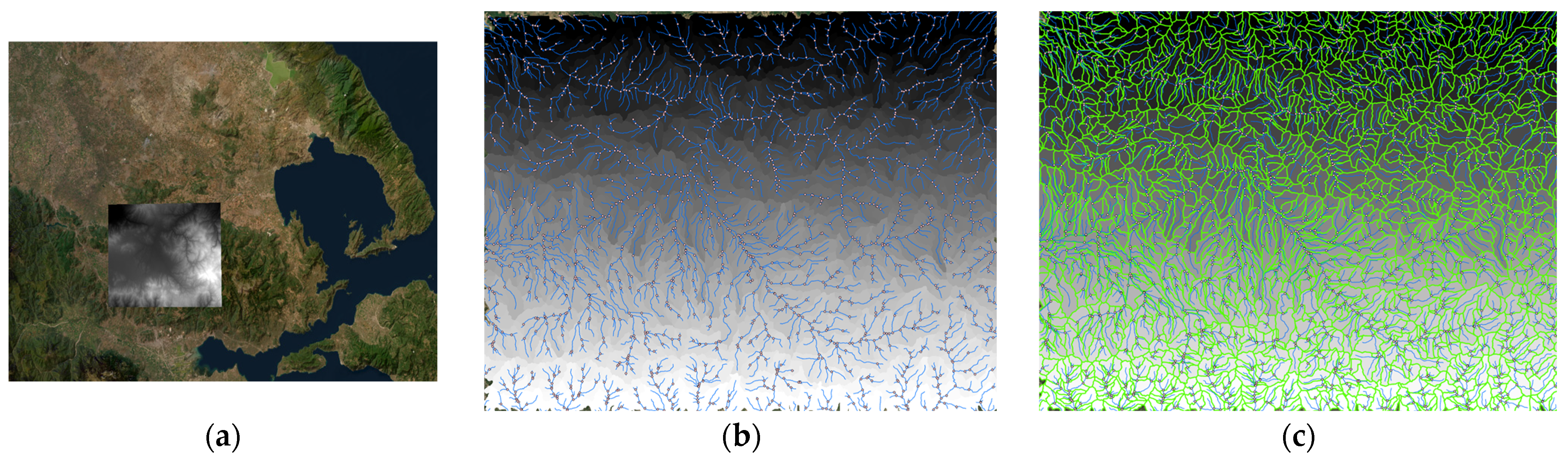
WATDYN was applied to a test area of 813.71 km
2 in the Thessaly Water District (EL08,
Figure 1a) using a 5 × 5 m DEM derived from the Hellenic Cadastre [
7]. With a flow-accumulation threshold value of 5000, the tool delineated a dense drainage configuration and produced 3249 extracted streamlines, together with the corresponding junction and outlet points. In parallel, the watershed component generated approximately 3100 sub-watershed polygons, providing a high-resolution partitioning of the study area that is appropriate for distributed hydrological preprocessing and for subsequent coupling with hydraulic parameter layers. In terms of computational performance, the full workflow was completed in approximately 2 min for the above configuration. In the resulting cropped tiles, the extracted drainage system, along with junctions and outlet points (
Figure 1b) and the sub-watershed delineation (
Figure 1c), are presented.
3.2. Manning Roughness Estimation Tool (MRET)
MRET was applied over the same Thessaly test area used for WATDYN (813.71 km
2) to derive a spatially distributed Manning’s roughness coefficient (
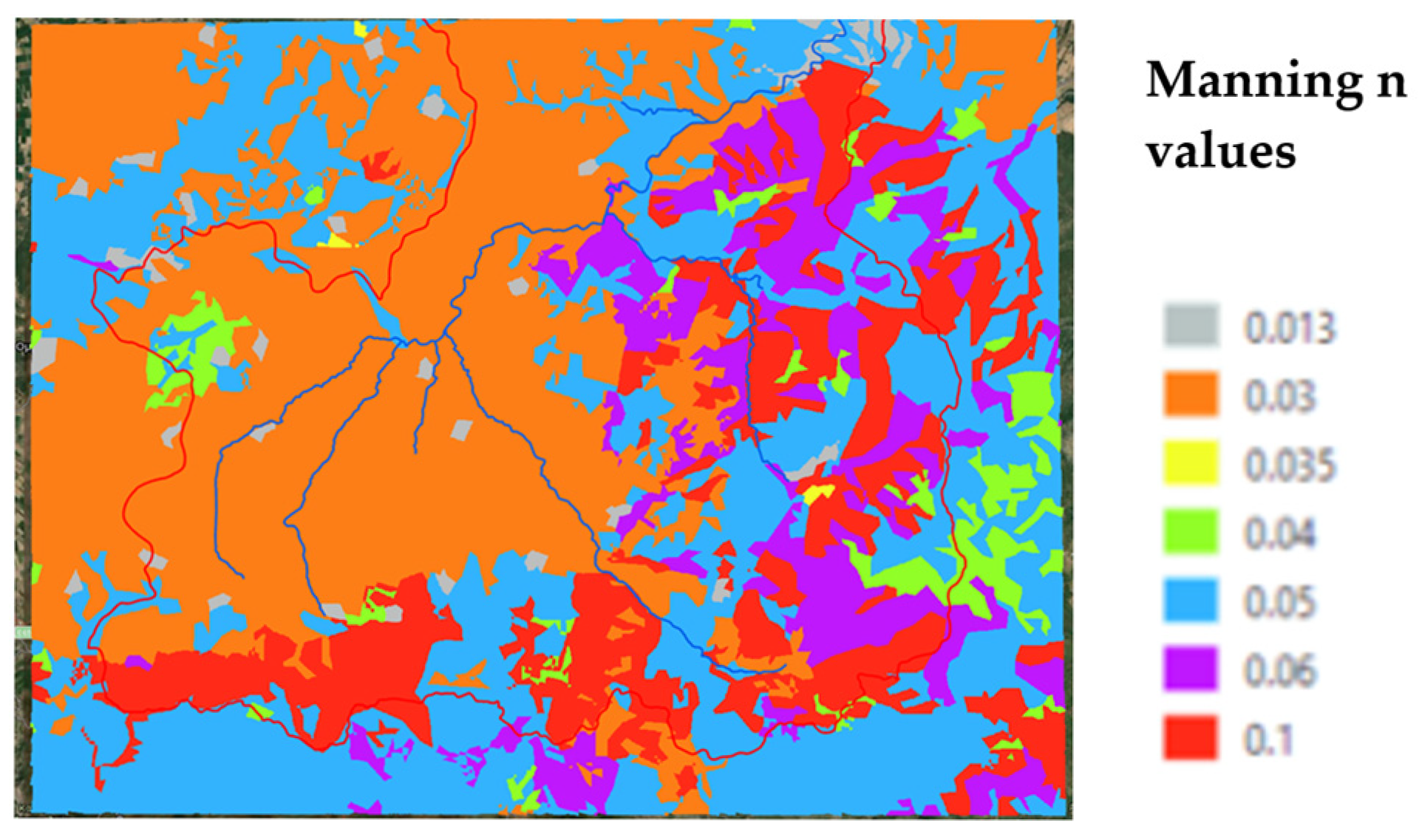
n) layer from CORINE Land Cover 2018 classes. The tool successfully produced a model-ready Manning’s n raster (stored in the project geodatabase) representing hydraulic resistance as a categorical surface based on the adopted CORINE-to-n mapping scheme. In the produced output, Manning’s n values were assigned across the study area within the discrete set of n values, reflecting the underlying land-use/land-cover heterogeneity. The resulting roughness mosaic (
Figure 2) shows coherent spatial transitions between low-resistance categories and higher-resistance categories, enabling direct use as a roughness parameter layer in subsequent hydraulic model setups. From a computational standpoint, MRET completed the full parameterization and raster generation workflow in approximately 1 min.
4. Conclusions
In this study, two Python-based, GIS-embedded geoprocessing tools executed exclusively within ArcGIS Pro to support hydrological and hydraulic modeling workflows were developed. WATDYN automates watershed/sub-watershed delineation and drainage network extraction directly from a DEM, while MRET generates a spatial Manning’s roughness coefficient (n) layer by mapping CORINE Land Cover 2018 classes to the literature-based roughness values. Application to a representative test area in Thessaly (EL08; 813.71 km2) demonstrated that both tools provide very fast preprocessing and substantially reduce the time typically required for stepwise, manual GIS operations. WATDYN produced the full set of hydrologic outputs in approximately 2 min, and MRET generated the Manning’s n parameter layer in approximately 1 min, delivering model-ready datasets directly to the ArcGIS Pro geodatabase. Beyond runtime, the main contribution is the automation and standardization of common preprocessing tasks, such as parameterized execution, which improves repeatability and minimizes user-dependent variability. The main conclusion of this study is that the proposed tools can rapidly automate key GIS preprocessing steps for hydrological and hydraulic modeling while producing standardized, model-ready outputs. The innovation lies in embedding these tasks into two parameterized ArcGIS Pro Python tools, which improve repeatability, reduce manual intervention, and support practical implementation in operational modeling workflows. Future research should focus on broader testing across different physiographic conditions and input resolutions, systematic sensitivity analysis for key parameters, and optional extensions such as additional roughness schemes or automated summary reporting per sub-watershed to further strengthen applicability in operational hydrological and hydraulic studies.
Author Contributions
Conceptualization, methodology, software, validation, formal analysis, investigation, resources, data curation, writing—original draft preparation, writing—review and editing, visualization, N.X. and E.F.; supervision, E.F. All authors have read and agreed to the published version of the manuscript.
Funding
This research received no external funding.
Institutional Review Board Statement
Not applicable.
Informed Consent Statement
Not applicable.
Data Availability Statement
Conflicts of Interest
The authors declare no conflicts of interest.
References
- Pulla, S.T.; Yasarer, H.; Yarbrough, L.D. Transforming Hydrology Python Packages into Web Application Programming Interfaces: A Comprehensive Workflow Using Modern Web Technologies. Water 2024, 16, 2609. [Google Scholar] [CrossRef]
- Xafoulis, N.; Farsirotou, E. Development and Implementation of Advanced Geoinformatics Tools for Hydrological and Hydraulic Analyses. In Proceedings of the 16th Conference of the Hellenic Hydrotechnical Association, Xanthi, Greece, 29–30 May 2025. [Google Scholar]
- van Rossum, G.; Drake, F.L. The Python Language Reference; Python Documentation Manual; Release 3.0.1; Python Software Foundation: Hampton, NH, USA, 2010; ISBN 978-1-4414-1269-0. [Google Scholar]
- Esri ArcGIS Pro. Introduction to ArcGIS Pro. Available online: https://doc.esri.com/en/arcgis-pro/latest/get-started/get-started.html (accessed on 3 March 2026).
- European Environment Agency. CORINE Land Cover 2018 (Raster 100 m), Europe, 6-Yearly—Version 2020_20u1, May 2020. 2019. Available online: https://land.copernicus.eu/en/products/corine-land-cover/clc2018 (accessed on 4 April 2026).
- Papaioannou, G.; Efstratiadis, A.; Vasiliades, L.; Loukas, A.; Papalexiou, S.; Koukouvinos, A.; Tsoukalas, I.; Kossieris, P. An Operational Method for Flood Directive Implementation in Ungauged Urban Areas. Hydrology 2018, 5, 24. [Google Scholar] [CrossRef]
- Hellenic Cadastre Digital Elevation Model (DEM), Project LSO (5 m). 2016. Available online: https://www.ktimatologio.gr (accessed on 25 February 2026).
| Disclaimer/Publisher’s Note: The statements, opinions and data contained in all publications are solely those of the individual author(s) and contributor(s) and not of MDPI and/or the editor(s). MDPI and/or the editor(s) disclaim responsibility for any injury to people or property resulting from any ideas, methods, instructions or products referred to in the content. |