
Proceeding Paper

Vulnerability Assessment of the Island Aquifer of Bozcaada (Türkiye) to Seawater Intrusion Using the GALDIT Approach †
by
Khalilullah Zulal
1,
Raquel Marijuan Cuevas
2,
Alper Baba
1,3 and
Orhan Gündüz
1,4,*
1
Department of International Water Resources, Izmir Institute of Technology, 35430 Izmir, Türkiye
2
CARTIF Technology Center, Parque Tecnológico de Boecillo, Parcela 205, 47151 Boecillo, Spain
3
Department of Civil Engineering, Izmir Institute of Technology, 35430 Izmir, Türkiye
4
Department of Environmental Engineering, Izmir Institute of Technology, 35430 Izmir, Türkiye
*
Author to whom correspondence should be addressed.
Presented at the 6th International Conference on Efficient Water Systems (EWaS6), Thessaloniki, Greece, 11–14 May 2026.
Environ. Earth Sci. Proc. 2026, 44(1), 33; https://doi.org/10.3390/eesp2026044033 (registering DOI)
Published: 26 June 2026

Abstract

Global population growth and numerous anthropogenic activities are putting increasing pressure on island aquifers. This situation is exacerbated in popular tourist destinations where seasonal population fluctuations increase water consumption. Most island aquifers are threatened by overexploitation, contamination, and seawater intrusion (SWI), which threaten these resources’ sustainability. In this study, the vulnerability of the Bozcaada Island (Türkiye) to SWI during peak seasons (summer) was assessed using the GALDIT approach. The GALDIT index takes into account six key hydrogeological characteristics, including groundwater occurrence (G), which represents the type of aquifer (confined, unconfined, or semi-confined) and influences the interface between freshwater and saline water; aquifer hydraulic conductivity (A), where higher conductivity increases the risk of SWI and determines how easily water flows; groundwater level above mean sea level (L), which indicates hydraulic pressure against SWI; distance from the coast (D), which implies higher SWI risk when close to the coast; existing intrusion status (I), which takes into account current SWI detections based on the ratio of chloride ions to bicarbonate ions in a groundwater sample; and aquifer thickness (T). Bozcaada Island hosts a large number of tourists during the summer months, when agricultural production is at its peak, with a high demand for irrigation. This significantly increases the demand for groundwater and leads to saltwater intrusion. Based on the results of the GALDIT index, the island’s groundwater reserves are heavily used throughout the summer. The GALDIT index for the summer shows that this increased groundwater abstraction intensifies the SWI problem. In summer, the island is vulnerable with 6.11 km2 of extremely high SWI, 7.88 km2 of high SWI, 7.34 km2 of moderate SWI, 7.40 km2 of low SWI and 8.50 km2 of very low SWI. This study emphasizes how urgently Bozcaada Island needs sustainable water management techniques.

1. Introduction

Globally, groundwater is a vital source of freshwater, particularly in coastal and island regions where it meets a large portion of irrigation and drinking water needs [1]. These aquifers have been overexploited in recent years due to population growth, rapid urbanization along coastlines, and increased agricultural activity [2,3]. Rising sea levels, longer droughts, and irregular rainfall due to climate change are some of the new threats to coastal groundwater [4,5]. When these human-induced and natural factors combine, they accelerate the deterioration of water quality and increase the vulnerability of coastal aquifers to seawater intrusion (SWI) [5,6]. According to [7,8,9,10], seawater intrusion is the process by which saltwater seeps into freshwater aquifers due to a disruption in the natural balance of water pressure. The boundary between fresh and saltwater is typically maintained by a natural flow towards the sea. When too much groundwater is extracted and not sufficiently replenished, water pressure decreases. As a result, heavier seawater can infiltrate further inland [11,12]. Therefore, groundwater becomes saline and is no longer suitable for industrial, agricultural, or residential use. According to [12,13,14], this can cause significant and sometimes irreversible damage to local economies and coastal habitats. For sustainable water management and planning, determining the sensitivity of coastal aquifers to seawater intrusion is crucial, as salinization can lead to detrimental effects [15]. Overall groundwater sensitivity is often mapped using models such as SINTACS [16,17]. However, current models do not adequately address the horizontal movement of seawater, as they primarily focus on surface and human-induced vertical pollution [18]. In contrast, Chachadi and Lobo-Ferreira [19] developed the GALDIT framework, an index-based approach to assess the sensitivity of coastal aquifers to seawater intrusion. According to [20], the GALDIT model combines six key factors to determine how susceptible groundwater is to salinization: (i) aquifer type, (ii) ease of water movement through it, (iii) groundwater level above sea level, (iv) distance from the coast, (v) current impact of seawater intrusion, and (vi) aquifer thickness. By processing these variables within a Geographic Information System (GIS) platform, it is possible to generate a complex map highlighting areas at risk [21]. Recent studies suggest using hydrochemical indicators such as electrical conductivity (EC), total dissolved solids (TDS), chloride–bicarbonate ratio (Cl/HCO3), and Groundwater Quality Index for Seawater Ingress (GQISWI) to verify the accuracy of mapped areas and the reliability of the GALDIT index [22]. Like many isolated coastal areas, Bozcaada Island struggles to ensure the sustainability of its freshwater resources. Due to the island’s morphology, limited natural recharge, and seasonal water pumping for agriculture and tourism, the coastal aquifer is highly vulnerable to saltwater intrusion. Despite the increasing importance of seawater intrusion, a comprehensive spatial assessment of the aquifer’s vulnerability has not yet been carried out. This study utilizes a GIS-based GALDIT approach to assess the vulnerability of Bozcaada Island’s groundwater aquifer to seawater intrusion. The study identifies the most vulnerable areas and combines spatial hydrogeological data with in-depth hydrochemical analysis, providing decision-makers with a scientific tool to assist in managing and conserving the island’s groundwater.

2. Materials and Methods

2.1. Study Area

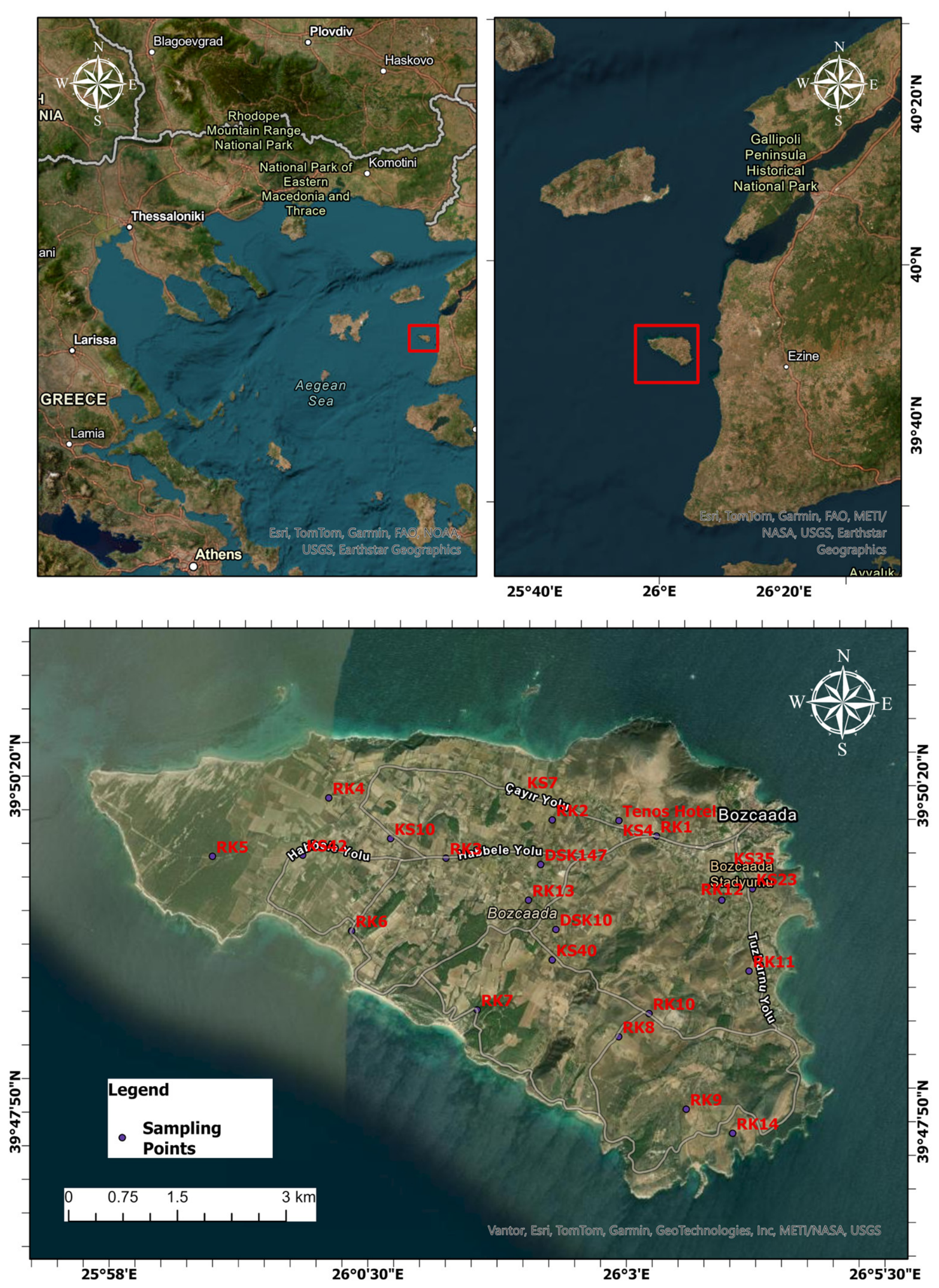
Bozcaada Island (Türkiye) is a small island in the northern Aegean Sea with a land area of 38 km2. It is a popular tourist destination and a well-known wine-growing region in the country. The island does not have any major rivers or rich vegetation. The majority of drinking water is provided through a pipeline from the mainland, and mostly, it is the groundwater, which is the main source of freshwater for agricultural irrigation. However, lately, there have been numerous instances of high saltwater intrusion and high salinity reports (Figure 1).

2.2. GALDIT Method

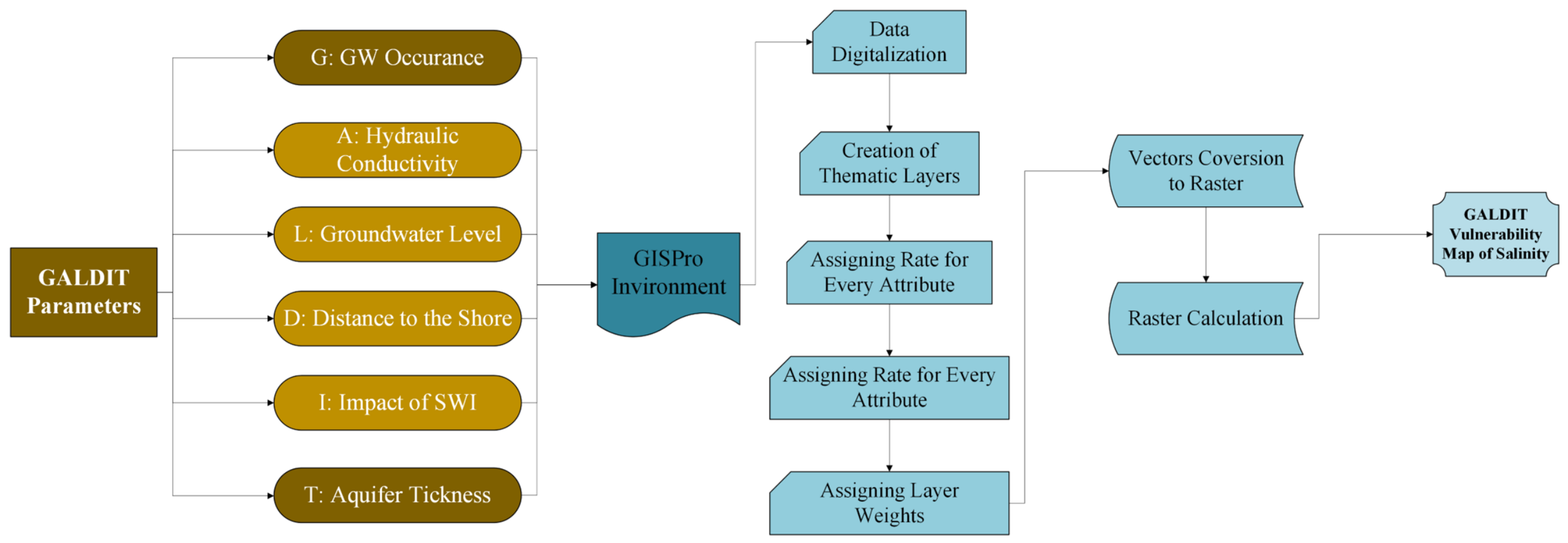
This section analyzes the vulnerability of groundwater quality to saltwater intrusion in the Bozcaada Island aquifer, for which it is necessary to develop a detailed, multi-level geodatabase. This assessment uses the GIS-based GALDIT analytical framework (Figure 2), which looks at six key hydrogeological factors: groundwater occurrence, aquifer hydraulic conductivity, groundwater level above mean sea level, distance from the shore, the current impact of seawater intrusion, and aquifer thickness [19]. The needed datasets are grouped into spatial large-scale datasets, temporal datasets, and field-validation datasets. To assess groundwater vulnerability to seawater intrusion, the researchers used six main criteria considered the most important factors influencing this process.
  • Groundwater occurrence (aquifer type) (G);
  • Aquifer hydraulic conductivity (A);
  • Depth to groundwater above sea level (L);
  • Distance from the shore (D);
  • Impact on the existing status of seawater intrusion in the area (I);
  • Thickness of the aquifer (T).
The GALDIT vulnerability class assignment includes three main components:
Indicator weights (W): Each indicator is assigned a weight from 1, meaning low influence, to 4, meaning high influence.
Rating (rank) (R): Each parameter receives a score between 2.5 and 10, depending on its characteristics. A higher score means greater vulnerability to seawater intrusion.
Decision criterion: The total score is found by multiplying each importance rating by its indicator weight, then adding all the results together.
Overall, a higher total score means a higher risk of seawater intrusion. The final GALDIT index is calculated using Equation (1):
GI =   i = 1 6 w i r i i = 1 6 w i =   G w G R + A w A R + L w L R + D w D R + I w I R + T w T R i = 1 6 w i .
then,
GI = 1 G r + 3 A r + 4 L r + 4 D r + 1 I r + 2 T i = 1 6 w i
where wi shows the weight and ri is the rating of the ith parameter.
Following this, each parameter is assigned a weight starting from 1 to 4 based on how important it is for saltwater intrusion. The value of each parameter falls into one of four categories, with scores of 2.5, 5, 7.5, or 10 (see Table 1). A higher score means the aquifer is more vulnerable to seawater intrusion.

3. Results and Discussions

Coastal groundwater vulnerability changes over time due to climate and human activities. To track these changes, hydrogeochemical data is collected throughout the year to show how the aquifer’s behavior shifts with the seasons.
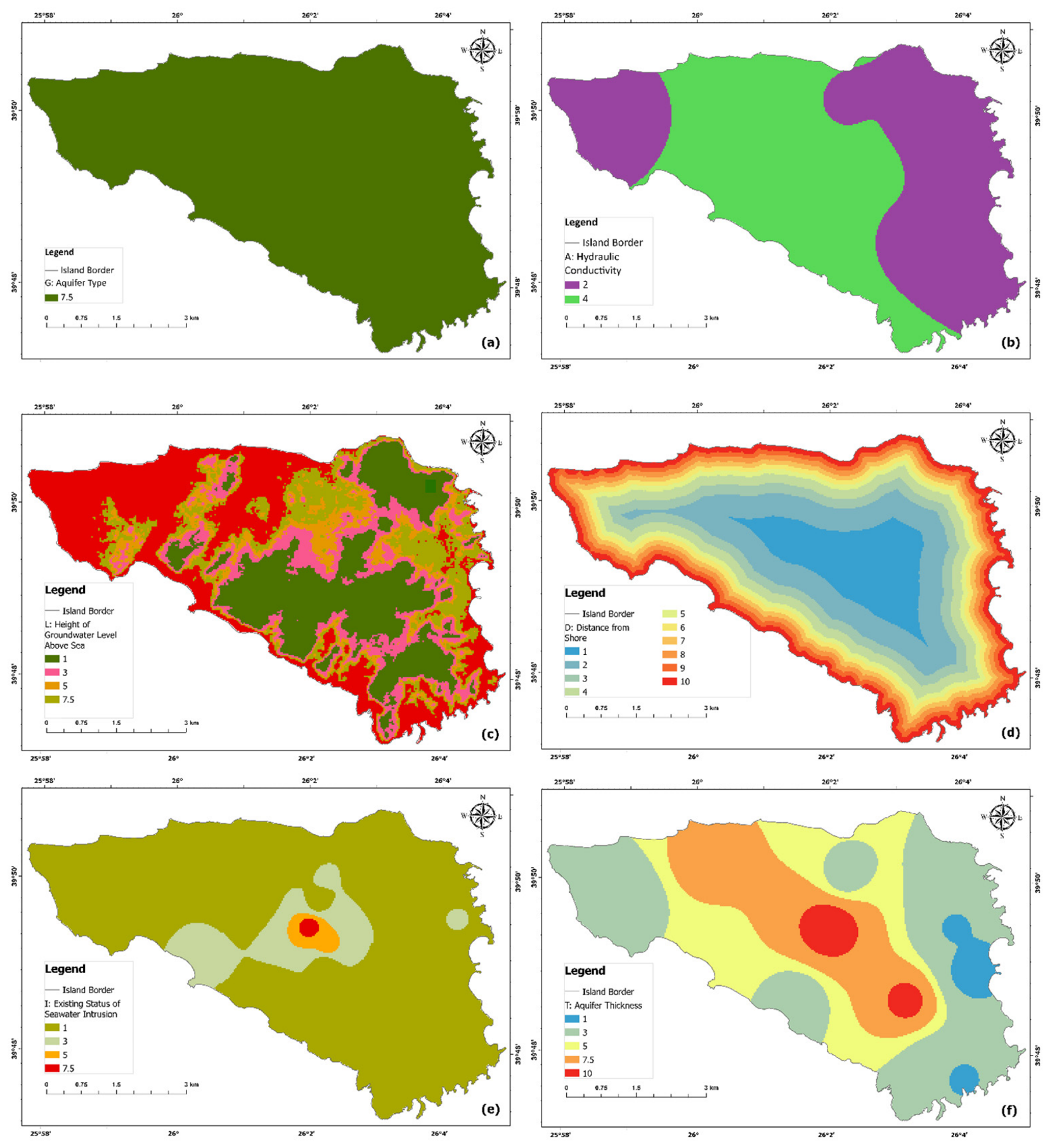
Bozcaada Island’s hydrogeological system is all unconfined, and a vulnerability rating of 7.5 is assigned. The groundwater occurrence map, which is shown in Figure 3a, indicates the entire alluvial deposit in the island’s region. Hydraulic conductivity characterizes the ability of aquifer materials to transmit water and determines the rate of groundwater flow under a specific hydraulic gradient. The pumping test is among the most effective methods for determining hydraulic conductivity values. In this study, the pumping test method was employed to obtain average hydraulic conductivity values by maintaining a constant water withdrawal rate from each well. Hydraulic conductivity readings that exceed a specific threshold indicate increased susceptibility of the coastal aquifer system. Higher hydraulic conductivity values correspond to greater aquifer vulnerability (Figure 3b). The depth to groundwater level map was generated using inverse distance weighting (IDW) interpolation with a power parameter of 2 and a search radius of 12 points. The island’s aquifer area was classified into four primary susceptibility classes based on groundwater level height above mean sea level (L), with rankings assigned from 2.5 to 10. Areas near the coast received the maximum rating value of 10, while areas farther from the coast were assigned lower rating values (Figure 3c). The distance from the shore represents the inland perpendicular distance from the beach (Figure 3d).
Generally, as the distance from the beach increases, the influence of the sea decreases. Consequently, locations situated closer to the shoreline are more susceptible to seawater intrusion. The GALDIT approach recommends using the ratio of Cl/(HCO3 + CO32) to determine the degree of seawater intrusion into coastal aquifers. Based on this combination map (Figure 3e), high-vulnerability areas are assigned a rating of 10, including most of the areas in the southern part of the study area. This component is critical for determining seawater intrusion, as it influences the extent of intrusion in coastal areas. Lobo-Ferreira et al. [20] demonstrated that greater aquifer thickness increases susceptibility to seawater intrusion. The estimated thickness of the aquifer (T) layers in the island’s aquifer, based on current lithological profiles, exceeds 10 m and is therefore assigned a rating of 10 (Figure 3f). However, when aquifer thickness is high, the overall vulnerability of the aquifer decreases.
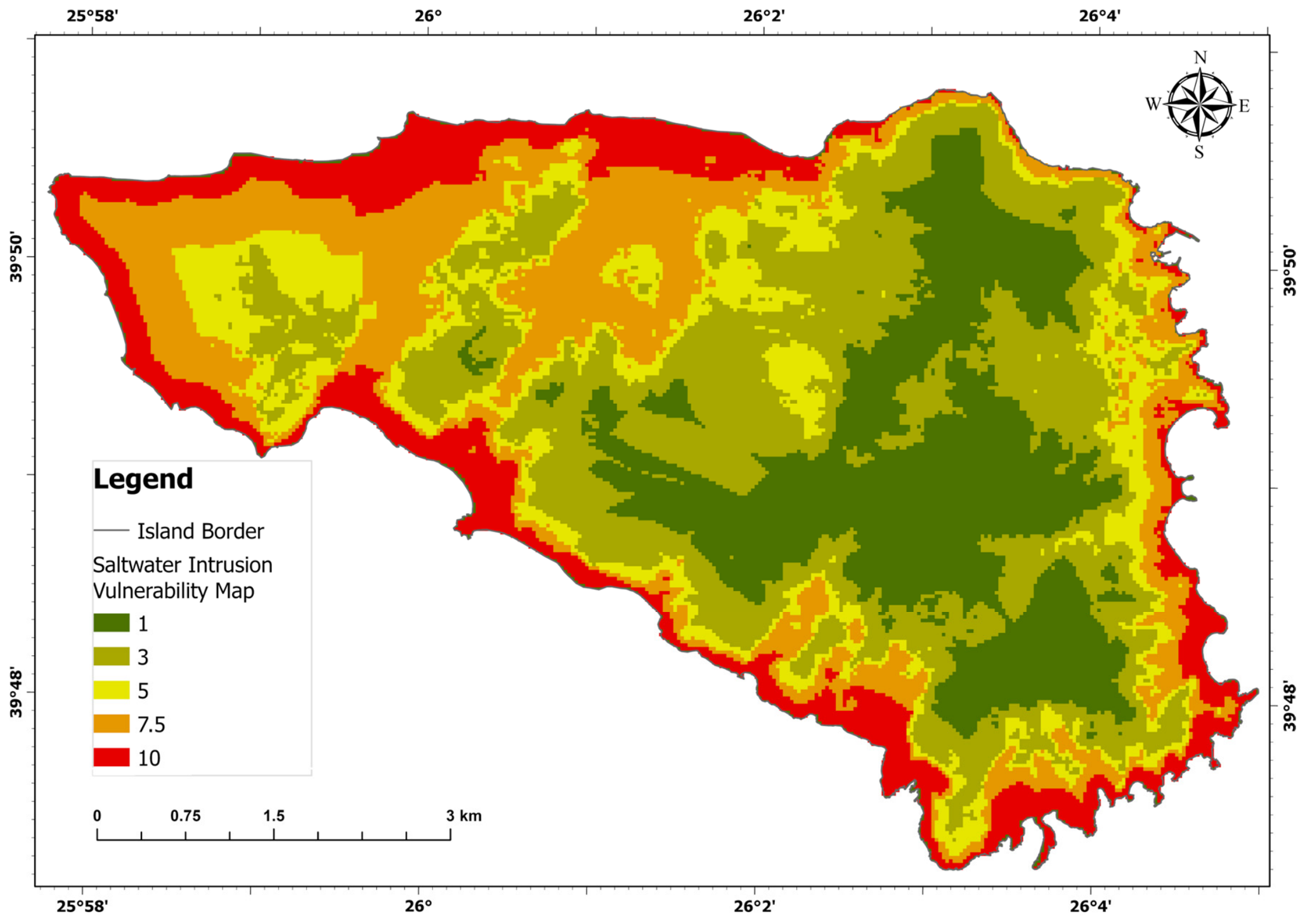
Figure 4 presents the final groundwater vulnerability map created according to the method presented in Equation (1). The generated vulnerability map is based on data collected in summer 2025 and delineates five distinct vulnerability zones:
  • Very high-vulnerability zone: This zone is located in areas immediately adjacent to the sea and constitutes a portion of the total area.
  • High-vulnerability zones: These zones encompass peripheral coastal regions and areas near the sea, with ratings between 6 and 7. They are depicted in yellow on the final analysis map.
  • Moderate-vulnerability zone: The central areas of the island exhibit moderate vulnerability to seawater intrusion, with ratings between 4 and 5. These areas are shown in light blue on the final analysis map.
  • Low-vulnerability zone: The far top part and some central parts of the island’s region have a low vulnerability to seawater intrusion, which is rated between 3 and 4 based on the GALDIT index and displayed in green on the final analysis map.
  • Very low-vulnerability zone: The green areas on the island show the regions that have the lowest vulnerability. The zone depicts that the intrusion is at its lowest and weakest and it is rated 1 in the index’s rating.

4. Conclusions

The GALDIT method was applied within the ArcGIS Pro v.3.7 environment to assess groundwater vulnerability to seawater intrusion in the Bozcaada Island aquifer. Following the preparation of all required parameters, a vulnerability map was generated by integrating six hydrogeological data layers to execute the model. The resulting map indicated that coastal areas of the Bozcaada Island, particularly the northern and southwestern parts, exhibit varying degrees of susceptibility to seawater intrusion, ranging from low to very high. Overall, the majority of the island area falls within moderate- to highly vulnerable zones according to the GALDIT index rating. To enhance the precision of future assessments, sensitivity analysis of selected parameters is recommended.

Author Contributions

Conceptualization, K.Z. and O.G.; methodology, K.Z. and O.G.; data curation, K.Z. and O.G.; formal analysis, K.Z.; writing, K.Z.; review and editing, A.B., O.G. and R.M.C.; visualization, K.Z., supervision, A.B. and O.G. All authors have read and agreed to the published version of the manuscript.

Funding

This research was funded by the HORIZON EUROPE: PRIMA Project No. 2221, implemented by Izmir Institute of Technology, Department of International Water Resources.

Institutional Review Board Statement

Not applicable.

Informed Consent Statement

Not applicable.

Data Availability Statement

The data supporting this study’s findings are available upon request from the corresponding author.

Acknowledgments

We acknowledge the support of the HORIZON EUROPE: PRIMA Project No. 2221, implemented by Izmir Institute of Technology, Department of International Water Resources.

Conflicts of Interest

Author Raquel Marijuan Cuevas was employed by the company CARTIF Technology Center. The remaining authors declare that the research was conducted in the absence of any commercial or financial relationships that could be construed as a potential conflict of interest.

References

  1. Chang, S.W.; Chung, I.M.; Kim, M.G.; Tolera, M.; Koh, G.W. Application of GALDIT in assessing the seawater intrusion vulnerability of Jeju Island, South Korea. Water 2019, 11, 1824. [Google Scholar] [CrossRef]
  2. Kim, I.H.; Chung, I.M.; Chang, S.W. Development of seawater intrusion vulnerability assessment for averaged seasonality of using modified GALDIT method. Water 2021, 13, 1820. [Google Scholar] [CrossRef]
  3. Idowu, T.E.; Jepkosgei, C.; Nyadawa, M.; Korowe, M.O.; Waswa, R.M.; Lasisi, K.H.; Kiplangat, N.; Munyi, J.; Ajibade, F.O. Integrated seawater intrusion and groundwater quality assessment of a coastal aquifer: GALDIT, geospatial and analytical approaches. Environ. Sci. Pollut. Res. 2022, 29, 36699–36720. [Google Scholar] [CrossRef]
  4. Arafa, N.A.; Salem, Z.E.; Abdeldayem, A.L.; Ghorab, M.A.; Moustafa, Y.M.; Soliman, S.A.; Farag, M.H.; Purohit, S.; Elhag, M.; Youssef, Y.M. Advancing deltaic aquifer vulnerability mapping to seawater intrusion and human impacts in Eastern Nile Delta: Insights from machine learning and hydrochemical perspective. Earth Syst. Environ. 2024, 9, 2481–2506. [Google Scholar] [CrossRef]
  5. Zghibi, A.; Merzougui, A.; Mansaray, A.S.; Mirchi, A.; Zouhri, L.; Chekirbane, A.; Msaddek, M.H.; Souissi, D.; Mabrouk-El-Asmi, A.; Boufekane, A. Vulnerability of a Tunisian coastal aquifer to seawater intrusion: Insights from the GALDIT Model. Water 2022, 14, 1177. [Google Scholar] [CrossRef]
  6. Boufekane, A.; Maizi, D.; Madene, E.; Busico, G.; Zghibi, A. Hybridization of GALDIT method to assess actual and future coastal vulnerability to seawater intrusion. J. Environ. Manag. 2022, 318, 115580. [Google Scholar] [CrossRef]
  7. Seenipandi, K.; Nainarpandian, C.; Kandathil, R.K.; Sellamuthu, S. Seawater intrusion vulnerability in the coastal aquifers of southern India—An appraisal of the GALDIT model, parameters’ sensitivity, and hydrochemical indicators. Environ. Sci. Pollut. Res. 2019, 26, 9755–9784. [Google Scholar] [CrossRef]
  8. Goswami, S.; Rai, A.K. Identifying intrusion of seawater in coastal aquifers by modified GALDIT (M-GALDIT) index. Groundw. Sustain. Dev. 2024, 25, 101173. [Google Scholar] [CrossRef]
  9. Werner, A.D.; Bakker, M.; Post, V.E.A.; Vandenbohede, A.; Lu, C.; Ataie-Ashtiani, B.; Simmons, C.T.; Barry, D.A. Seawater intrusion processes, investigation and management: Recent advances and future challenges. Adv. Water Resour. 2013, 51, 3–26. [Google Scholar] [CrossRef]
  10. Bear, J.; Cheng, A.H.D.; Sorek, S.; Ouazar, D.; Herrera, I. Seawater Intrusion in Coastal Aquifers: Concepts, Methods and Practices; Kluwer Academic: London, UK, 1999. [Google Scholar]
  11. Parizi, E.; Hosseini, S.M.; Ataie-Ashtiani, B.; Simmons, C.T. Vulnerability mapping of coastal aquifers to seawater intrusion: Review, development and application. J. Hydrol. 2019, 570, 555–573. [Google Scholar] [CrossRef]
  12. Emara, S.R.; Armanuos, A.M.; Shalby, A. Appraisal seawater intrusion vulnerability for the Moghra coastal aquifer, Egypt—Application of the GALDIT index, sensitivity analysis, and hydro-chemical indicators. Groundw. Sustain. Dev. 2024, 25, 101166. [Google Scholar] [CrossRef]
  13. Polemio, M.; Zuffianò, L.E. Review of utilization management of groundwater at risk of salinization. J. Water Resour. Plan. Manag. 2020, 146, 03120002. [Google Scholar] [CrossRef]
  14. Khazri, N.; Hzami, A.; Stoleriu, C.C.; Mihu-Pintilie, A.; Heggy, E.; Amrouni, O. Seawater intrusions for coastal aquifers are increasingly dominated by anthropogenic drivers in the Southern Mediterranean Basin. J. Hydrol. Reg. Stud. 2026, 63, 103028. [Google Scholar] [CrossRef]
  15. El Fehri, R.M.; Kouzana, L.; Dlala, M. Applied Pearson validation method to assess seawater intrusion risk by combined hydrochemical indicators and hydrogeological GALDIT tools: A case study of Monastir’s aquifer, Tunisia. Euro-Mediterr. J. Environ. Integr. 2021, 6, 20. [Google Scholar] [CrossRef]
  16. Aller, L.; Bennett, T.; Lehr, J.H.; Petty, R.J.; Hackett, G. DRASTIC: A Standardized System for Evaluating Groundwater Pollution Potential Using Hydrogeologic Settings; US Environmental Protection Agency: Washington, DC, USA, 1987. [Google Scholar]
  17. Civita, M.; De Maio, M. Assessing and mapping groundwater vulnerability to contamination: The Italian “combined” approach. Geofis. Int. 2004, 43, 513–532. [Google Scholar] [CrossRef]
  18. Chronidou, D.; Tziritis, E.; Panagopoulos, A.; Oikonomou, E.K.; Loukas, A. A modified GALDIT method to assess groundwater vulnerability to salinization—Application to Rhodope coastal aquifer (North Greece). Water 2022, 14, 3689. [Google Scholar] [CrossRef]
  19. Chachadi, A.G.; Lobo-Ferreira, J.P. Seawater intrusion vulnerability mapping of aquifers using GALDIT method. Coastin A Coast. Policy Res. Newsl. 2001, 4, 7–9. [Google Scholar]
  20. Lobo-Ferreira, J.P.; Chachadi, A.G.; Diamantino, C.; Henriques, M.J. Assessing aquifer vulnerability to seawater intrusion using GALDIT method: Part 1. Application to the Portuguese aquifer of Monte Gordo. In Proceedings of the Fourth Inter-Celtic Colloquium on Hydrology and Management of Water Resources, Guimaraes, Portugal, 4–11 July 2005; pp. 11–14. [Google Scholar]
  21. Sophiya, S.M.; Syed, T.H. Assessment of vulnerability to seawater intrusion and potential remediation measures for coastal aquifers: A case study from eastern India. Environ. Earth Sci. 2013, 70, 1197–1209. [Google Scholar] [CrossRef]
  22. Tomaszkiewicz, M.; Abou Najm, M.; El-Fadel, M. Development of a groundwater quality index for seawater intrusion in coastal aquifers. Environ. Modell. Softw. 2014, 57, 13–26. [Google Scholar] [CrossRef]
Figure 1. Study Area.
Eesp 44 00033 g001
Figure 2. Flowchart of the study.
Eesp 44 00033 g002
Figure 3. GALDIT calculated parameters. (a). G—Aquifer type, (b). A— Hydraulic conductivity, (c). L—Height of groundwater level, (d). D—Distance from the shoreline, (e). I—Existing status of saltwater intrusion, and (f). T—Aquifer thickness.
Eesp 44 00033 g003
Figure 4. Vulnerability map for saltwater intrusion according to data collected in the summer of 2025.
Eesp 44 00033 g004
Table 1. Parameter ratings.
ParametersWeightsClassificationsRangesRatings
Groundwater Occurrence (G)1Confined aquifer 10
Unconfined aquifer 7–9
Leaky aquifer 5
Bounded aquifer 2.5
Aquifer Hydraulic Conductivity (A)
[m/day]
3High>4010
Medium40–107–9
Low10–55
Very low<52.5
Groundwater Level Height
Above Sea Level (L)
[m]
4High<1.010
Medium1.0–1.57–9
Low1.5–2.05
Very low>22.5
Distance from the Shore (D)
[m]
4High<50010
Medium55–7507–9
Low750–10005
Very low>10002.5
Impact on Existing Status of Saltwater Intrusion (I) (Cl/HCO3)
[ppm]
1High>2.010
Medium1.5–2.07–9
Low1.0–1.55
Very low<1.02.5
Aquifer Thickness (T)
[m]
2High>4010
Medium40–107.5
Low10–55
Very low<52.5
Disclaimer/Publisher’s Note: The statements, opinions and data contained in all publications are solely those of the individual author(s) and contributor(s) and not of MDPI and/or the editor(s). MDPI and/or the editor(s) disclaim responsibility for any injury to people or property resulting from any ideas, methods, instructions or products referred to in the content.