Proceeding Paper

Mineral-Based PCM Composites from UAE Resources for Passive Cooling in Hot Climates †

by
Saleimah Alyammahi
*,
Jinendrika Anushi Weliwita
and
Raid Musallam
Engineering Technology & Science Division, Higher Colleges of Technology, Fujairah 4114, United Arab Emirates
*
Author to whom correspondence should be addressed.
Presented at the 3rd International Online Conference on Mineral Science (IOCMS 2026), 10–12 March 2026; Available online: https://sciforum.net/event/IOCMS2026.
Environ. Earth Sci. Proc. 2026, 43(1), 2; https://doi.org/10.3390/eesp2026043002
Published: 25 June 2026

Abstract

Passive thermal energy storage materials are effective for reducing cooling demand in hot climates. Paraffin-based phase change materials (PCMs) provide high latent heat storage but suffer from low thermal conductivity. This study investigates dolomite-enhanced paraffin PCM composites using locally sourced UAE minerals. Composites containing 5.7 wt.% and 11.4 wt.% dolomite were prepared and evaluated using controlled heating and cooling experiments with thermocouple monitoring. Results showed melting plateaus of approximately 55–60 °C for the baseline PCM, 59–64 °C for the 5.7 wt.% dolomite composite, and 56–60 °C for the 11.4 wt.% dolomite composite, while all samples exhibited stable solidification near 55–56 °C. Dolomite addition did not significantly alter phase transition temperature but slightly increased melting duration due to higher thermal mass, while maintaining stable thermal energy storage performance.

1. Introduction

Buildings in hot climates such as the United Arab Emirates (UAE) experience high cooling energy demand due to intense solar radiation and elevated ambient temperatures, creating a strong need for efficient thermal energy storage systems. Thermal energy storage (TES) helps to balance the mismatch between energy supply and demand and improve overall energy efficiency [1]. Among TES techniques, phase change materials (PCMs) have emerged as promising candidates for passive thermal management because they can store and release thermal energy during phase transitions, typically between solid and liquid phases [2]. During melting, PCMs absorb latent heat while maintaining nearly constant temperature, thereby providing a thermal buffering effect that helps regulate temperature fluctuations in engineering applications [2,3].
Paraffin-based PCMs are widely used due to their chemical stability, non-corrosive nature, and high latent heat storage capacity, making them suitable for thermal energy storage systems [2]. These materials typically exhibit melting temperatures in the range of approximately 42–68 °C, depending on the paraffin grade, which makes them particularly suitable for applications in hot climates [2]. The characteristic temperature plateau observed in heating and cooling curves corresponds to the phase change process, during which latent heat is absorbed or released while the temperature remains nearly constant [3].
Despite these advantages, paraffin PCMs suffer from inherently low thermal conductivity (approximately 0.2 W/m·K), which limits heat transfer efficiency and slows thermal response during charging and discharging cycles [4]. Previous studies have demonstrated that the incorporation of solid additives into PCM matrices can enhance heat transfer characteristics and improve structural stability. For example, composite PCMs containing conductive fillers such as graphite have shown improved heat transfer performance and reduced melting time due to increased thermal conductivity [4]. More broadly, the addition of fillers has been reported to improve the overall thermal performance of PCM systems while preserving their latent heat storage capability [1].
Numerous strategies have been investigated to overcome the low thermal conductivity of paraffin-based PCMs, including the incorporation of expanded graphite, graphite-based materials, carbon fibers, metal matrices, fins, and other high-thermal-conductivity additives. These approaches can significantly enhance heat transfer performance while preserving the latent heat storage capability of the PCM matrix. Consequently, composite PCMs have attracted considerable attention for building energy storage, solar thermal systems, and passive cooling applications [5,6,7,8].
Recent studies have highlighted the growing interest in mineral-based composite phase change materials for thermal energy storage applications. Mineral supports such as diatomite, vermiculite, kaolin, sepiolite, halloysite, attapulgite, montmorillonite, and silica-based materials have been extensively investigated to improve shape stability, thermal management, and long-term performance while maintaining desirable latent heat storage characteristics. These developments demonstrate the potential of naturally occurring minerals as sustainable components in advanced PCM systems and motivate further investigation of locally available mineral resources, including carbonate-based materials, for passive cooling applications [9,10].
In this context, the use of locally sourced mineral fillers presents a promising and sustainable approach. The northern Emirates contain abundant carbonate rock resources, including dolomite and limestone, which have potential for use as mineral fillers in PCM composites. Their incorporation into paraffin-based PCMs may support sustainable material utilization while offering potential improvements in thermal performance and mechanical stability.
Mineral-based fillers represent an attractive alternative because of their natural abundance, low environmental impact, and compatibility with large-scale applications. Carbonate minerals such as dolomite and limestone may improve the structural integrity and thermal behavior of PCM composites while utilizing locally available geological resources. In the UAE, abundant deposits of these minerals provide opportunities for developing sustainable PCM composites suitable for passive cooling and thermal energy storage applications.
In this context, the use of locally sourced mineral fillers presents a promising and sustainable approach. The northern Emirates contain abundant carbonate rock resources, including dolomite and limestone, which can be utilized as low-cost additives for PCM enhancement. Incorporating such minerals into paraffin-based PCMs not only supports sustainable material utilization but also offers potential improvements in thermal performance and mechanical stability.
Therefore, this study focuses on the development and evaluation of dolomite-enhanced paraffin PCM composites, aiming to investigate their melting and solidification behavior and assess their suitability for passive cooling applications in hot climates.

2. Methods

2.1. Materials

Paraffin wax (baseline PCM).
Dolomite powder (Provided by Stevin Rock LLC, Ras Al Khaimah, United Arab Emirates).

2.2. Sample Preparation

Three samples were prepared:
Baseline PCM (100% paraffin wax).
Paraffin + 5.7 wt.% dolomite.
Paraffin + 11.4 wt.% dolomite.
The dolomite mineral powder was first sieved using a 100 mesh (≈150 µm) stainless steel sieve to ensure uniform particle size distribution prior to composite preparation. Paraffin wax was melted in a 100 mL beaker using a hot plate. The presieved dolomite powder was then gradually added to the molten paraffin and thoroughly mixed to achieve a homogeneous composite.
Each sample had a total mass of 35 g and was tested in the same beaker to ensure consistency during thermal experiments.

2.3. Experimental Procedure

Thermal testing was conducted using:
Hot plate heating (≤90 °C).
Thermocouple placed near sample center.
Heating data recorded every 1 min.
Cooling data recorded every 2 min.

2.4. Evaluation Parameters

Melting onset temperature.
Melting plateau range.
Solidification plateau.
Time to complete melting.

3. Results and Discussion

3.1. Baseline PCM (100% Paraffin)

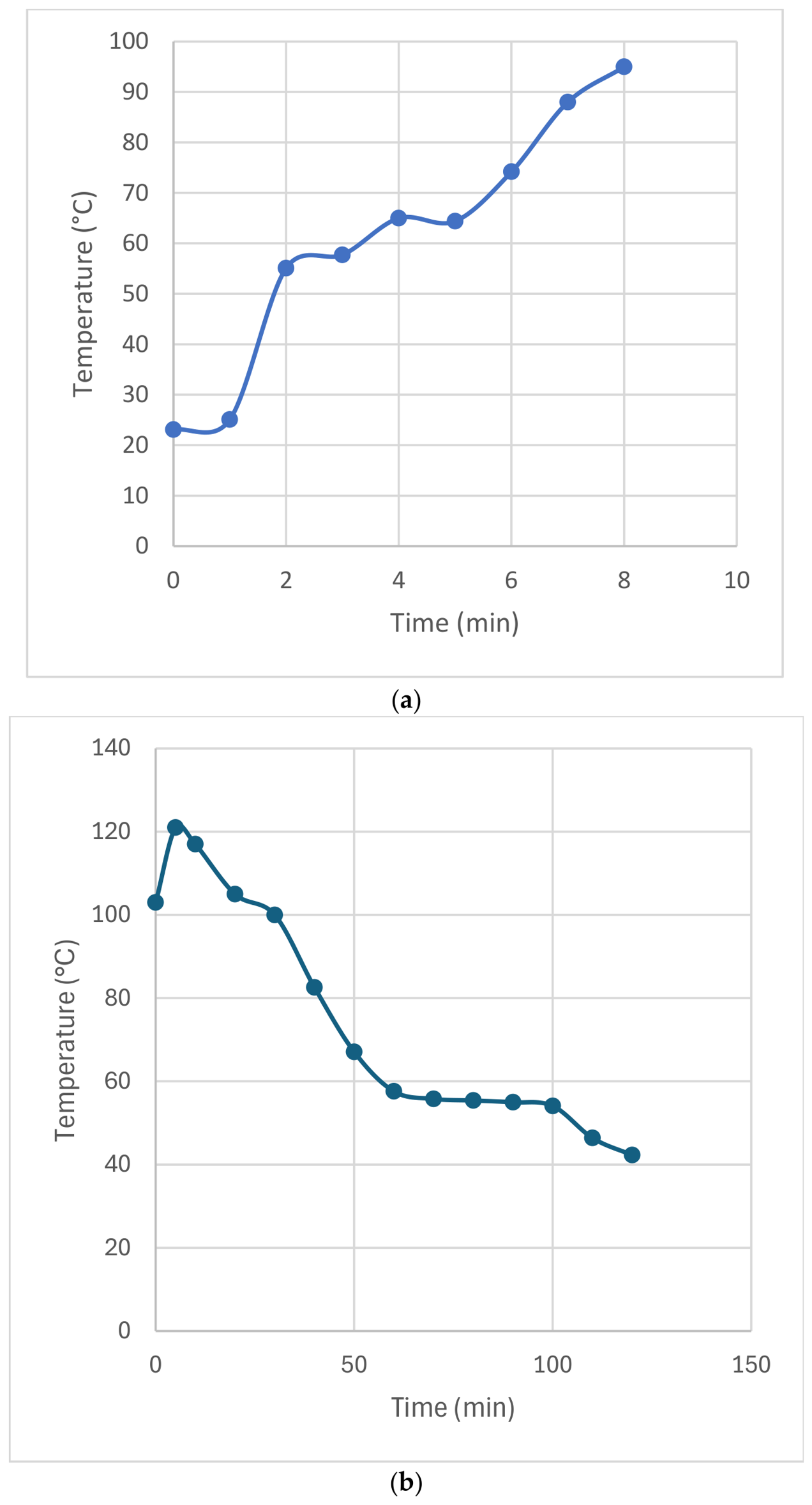
As shown in Figure 1a, temperature increased from 23 °C to ~55 °C, indicating sensible heat absorption. Melting began near 55 °C, which falls within the typical melting temperature range reported for paraffin phase change materials [2]. A plateau between 55–60 °C corresponds to the phase transition (melting) region during heating, where the PCM absorbs latent heat. Complete melting occurred in ~8–10 min under laboratory heating conditions. As shown in Figure 1b, during cooling, a stable plateau near 55 °C was observed. The temperature remained nearly constant for approximately 20 min during solidification, indicating latent heat release. Such nearly constant-temperature behavior during phase change is characteristic of latent heat storage materials [1].

3.2. Paraffin + 5.7 wt.% Dolomite

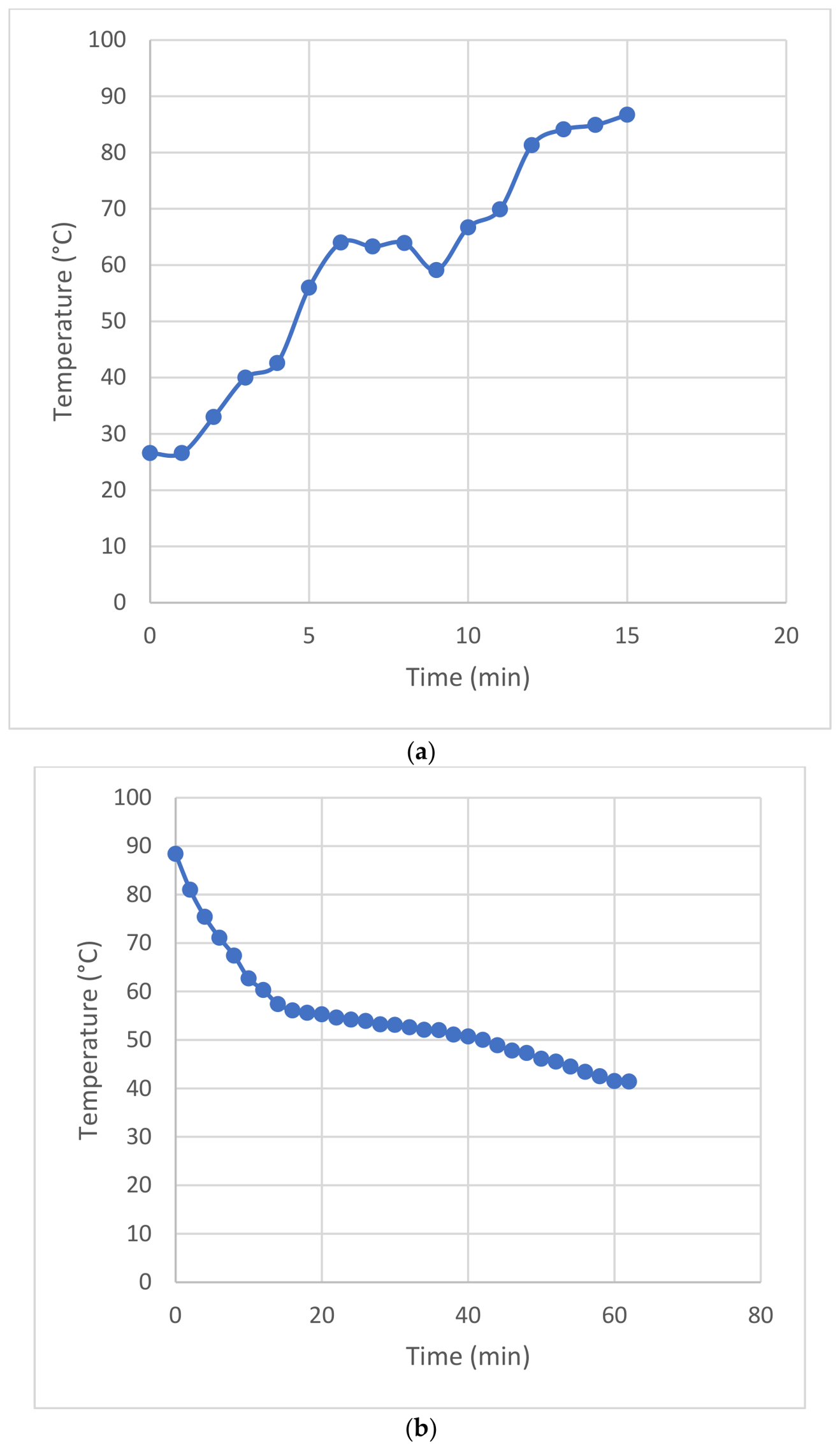
As shown in Figure 2a, the PCM composite containing 5.7 wt.% dolomite exhibited a melting onset near 56 °C, which is within the typical melting temperature range reported for paraffin phase change materials [2]. A melting plateau between 59–64 °C was observed during the heating cycle, indicating the phase transition region where latent heat is absorbed. Such plateau behavior is characteristic of phase change materials during melting [3]. A temporary temperature fluctuation was observed around minutes 8–9 during the heating cycle. This fluctuation is likely attributable to localized heat redistribution during melting, thermocouple positioning, natural convection within the molten paraffin, and the manual experimental conditions associated with hot-plate heating. Such transient variations can occur during phase transition because of non-uniform heat transfer and latent heat absorption and do not necessarily indicate a change in the intrinsic phase-change characteristics of the PCM composite.
As shown in Figure 2b, during the cooling cycle, a stable solidification plateau near 55–56 °C was recorded, corresponding to the latent heat release during the liquid-to-solid phase transition. Such temperature plateaus during solidification are characteristic of phase change materials [1]. Compared with the baseline PCM, the dolomite-enhanced composite exhibited a slightly longer melting time, which may be attributed to the increased thermal mass introduced by the mineral particles.
The phase transition temperature remained nearly unchanged, indicating that the addition of dolomite does not significantly alter the melting behavior of paraffin PCM. Similar observations have been reported in PCM systems where additives are introduced to enhance heat transfer while maintaining stable phase change properties [1,3].
The slightly higher apparent melting plateau observed for the 5.7 wt.% dolomite composite may be attributed to experimental factors such as thermocouple placement, localized heat transfer variations, or minor sample heterogeneity rather than an intrinsic effect of dolomite addition. Since the 11.4 wt.% composite did not exhibit a similar increase in melting plateau, the present results do not provide sufficient evidence to conclude that dolomite systematically increases the phase transition temperature of the paraffin matrix. Additional differential scanning calorimetry (DSC) measurements and repeated experiments are required to verify this observation and establish its re-producibility.

3.3. Paraffin + 11.4 wt.% Dolomite

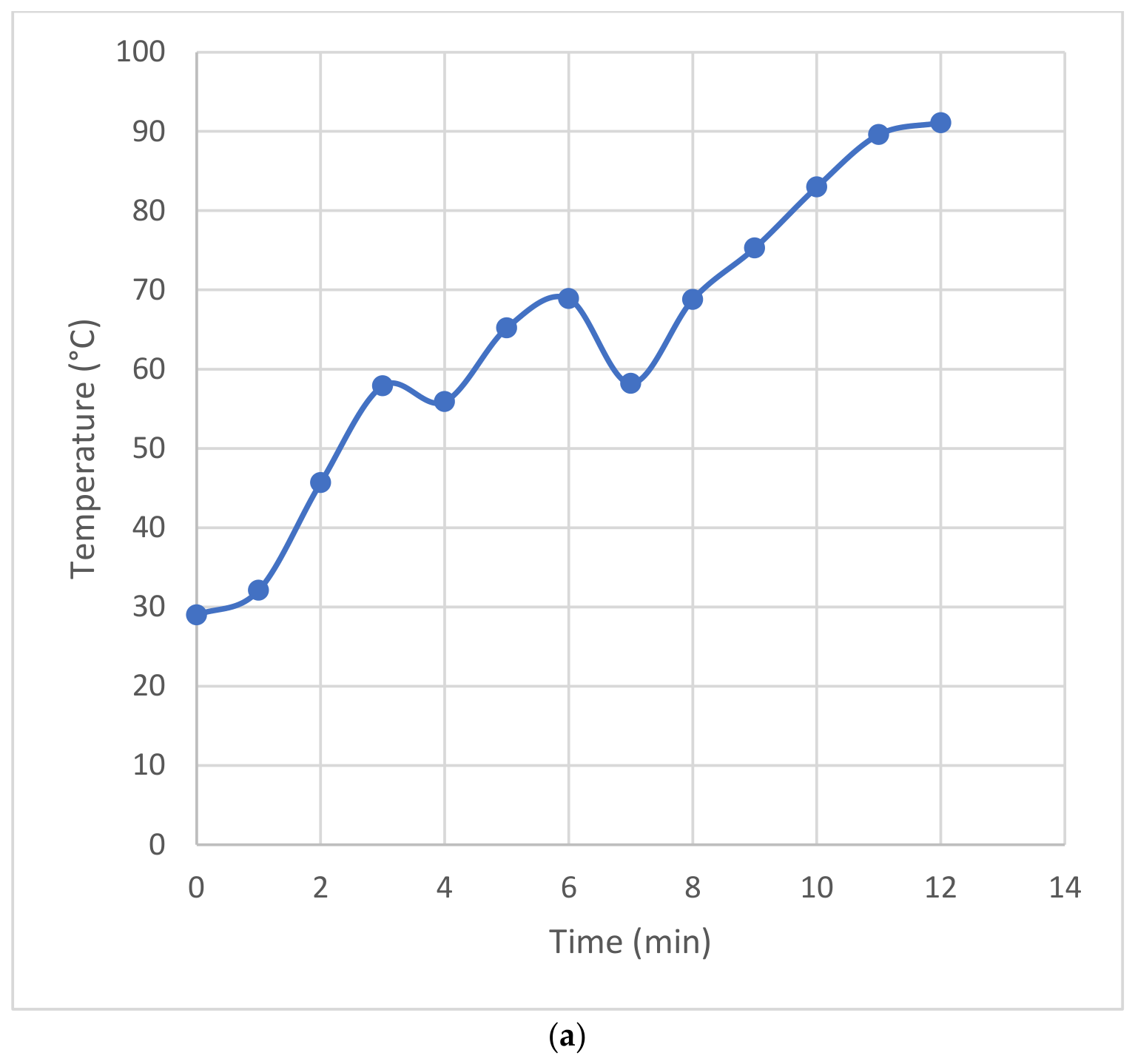
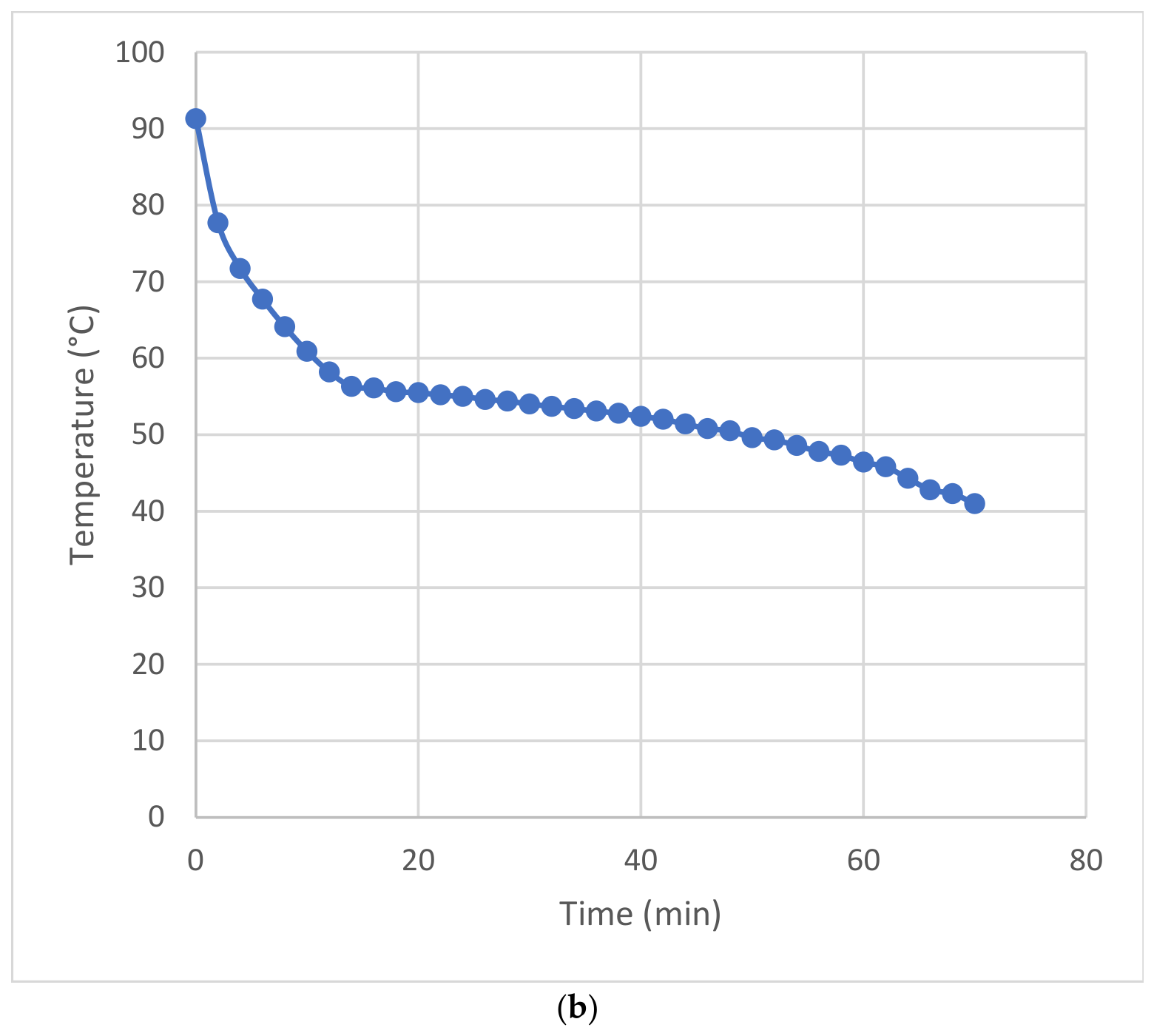
Figure 3a,b present the heating and cooling curves of 11.4 wt.% dolomite PCM composite. The PCM composite containing 11.4 wt.% dolomite exhibited a melting onset near 56–58 °C, which lies within the commonly reported melting temperature range for paraffin-based phase change materials used in thermal energy storage systems [2]. During the heating cycle, a melting plateau between approximately 56–60 °C was observed. This plateau represents the phase transition region where the PCM absorbs latent heat while maintaining nearly constant temperature, which is a characteristic behavior of phase change materials [3]. The complete melting of the composite occurred within approximately 9–10 min, indicating efficient heat absorption during the phase change process.
During the cooling cycle, a stable solidification plateau near 55–56 °C was recorded. This plateau corresponds to the release of latent heat during the liquid–to–solid phase transition, which is a characteristic behavior of paraffin-based phase change materials [1]. The phase transition temperature remained similar to that of the baseline PCM, suggesting that the addition of dolomite particles does not significantly alter the melting temperature of the paraffin matrix. The incorporation of mineral fillers such as dolomite may contribute to improved heat transfer within PCM composites while preserving the intrinsic phase change characteristics of paraffin, as reported for PCM systems containing conductive additives [1,3].

3.4. Comparative Analysis

Table 1 summarizes the thermal performance parameters of the baseline PCM and dolomite-enhanced PCM composites, including melting onset temperature, melting plateau range, solidification temperature, and time to melt.
All samples exhibited characteristic paraffin melting and solidification behavior. Although the 5.7 wt.% dolomite composite showed a slightly higher apparent melting plateau, this trend was not observed for the 11.4 wt.% composite and may reflect experimental variability rather than a systematic effect of dolomite addition. The results indicate that dolomite slightly increases the melting duration while preserving the characteristic phase transition temperature and thermal storage behavior of the paraffin matrix. These results confirm that dolomite enhances PCM stability without compromising thermal performance.

4. Conclusions

Paraffin PCM exhibited stable melting and solidification behavior near 55–60 °C. The addition of dolomite (5.7–11.4 wt.%) did not significantly alter the phase transition temperature but slightly increased the melting duration due to increased thermal mass. The composites maintained stable phase-change characteristics, indicating that locally sourced UAE dolomite has potential as a mineral filler for paraffin-based PCM composites and passive thermal energy storage applications.

Author Contributions

Conceptualization, S.A., J.A.W. and R.M.; methodology, S.A., J.A.W. and R.M.; software, S.A.; validation, S.A., J.A.W. and R.M. formal analysis, S.A., J.A.W. and R.M.; investigation, S.A., J.A.W. and R.M.; resources, S.A., data curation, S.A., writing—original draft preparation, S.A.; writing—review and editing, S.A.; visualization, S.A.; supervision, J.A.W. and R.M.; project administration, J.A.W. All authors have read and agreed to the published version of the manuscript.

Funding

This research received no external funding.

Institutional Review Board Statement

Not applicable.

Informed Consent Statement

Not applicable.

Data Availability Statement

The data presented in this study are available from the corresponding author upon reasonable request.

Acknowledgments

The authors acknowledge, Al Nakheel Stones Crushing & Trading L.L.C. Raj Stones (Raj Group) and Stevin Rock L.L.C. for providing mineral samples. Appreciation is also extended to the Higher Colleges of Technology, Fujairah Campus, for research support.

Conflicts of Interest

The authors declare no conflicts of interest.

References

  1. Kenisarin, M.; Mahkamov, K. Solar energy storage using phase change materials. Renew. Sustain. Energy Rev. 2007, 11, 1913–1965. [Google Scholar] [CrossRef]
  2. Sharma, A.; Tyagi, V.V.; Chen, C.R.; Buddhi, D. Review on thermal energy storage with phase change materials and applications. Renew. Sustain. Energy Rev. 2009, 13, 318–345. [Google Scholar] [CrossRef]
  3. Zalba, B.; Marίn, J.M.; Cabeza, L.F.; Mehling, H. Review on Thermal Energy Storage with Phase Change: Materials, Heat Transfer Analysis and Applications. Available online: https://www.sciencedirect.com/science/article/pii/S1359431102001928?via%3Dihub (accessed on 27 April 2026).
  4. Sathiyaraj, R.; Rakesh, R.; Mithran, N.; Venkatesan, M. Enhancement of heat transfer in phase change material using graphite-paraffin composites. MATEC Web Conf. 2018, 172, 02001. [Google Scholar] [CrossRef][Green Version]
  5. Pielichowska, K.; Pielichowski, K. Phase change materials for thermal energy storage. Prog. Mater. Sci. 2014, 65, 67–123. [Google Scholar] [CrossRef]
  6. Zhou, D.; Zhao, C.Y.; Tian, Y. Review on thermal energy storage with phase change materials (PCMs) in building applications. Appl. Energy 2012, 92, 593–605. [Google Scholar] [CrossRef]
  7. Agyenim, F.; Hewitt, N.; Eames, P.; Smyth, M. A review of materials, heat transfer and phase change problem formulation for latent heat thermal energy storage systems (LHTESS). Renew. Sustain. Energy Rev. 2010, 14, 615–628. [Google Scholar] [CrossRef]
  8. Farid, M.M.; Khudhair, A.M.; Razack, S.A.K.; Al-Hallaj, S. A review on phase change energy storage: Materials and applications. Energy Convers. Manag. 2004, 45, 1597–1615. [Google Scholar] [CrossRef]
  9. Cao, X.; Zhang, R.; Zhang, N.; Chen, L.; Chen, D.; Li, X. Performance improvement of lauric acid-1-hexadecanol eutectic phase change material with bio-sourced seashell powder addition for thermal energy storage in buildings. Constr. Build. Mater. 2023, 366, 130223. [Google Scholar] [CrossRef]
  10. Mu, Y.; Liao, L.; Gu, X. Photothermal Mineral-Based Composite Phase Change Materials for Direct Solar Energy Utilization: A State-of-the-Art Review. Energies 2025, 18, 1257. [Google Scholar] [CrossRef]
Figure 1. (a) Heating curve of baseline PCM. (b) Cooling curve of baseline PCM.
Eesp 43 00002 g001
Figure 2. (a) Heating curve of 5.7 wt.% dolomite PCM composite. (b) Cooling curve of 5.7 wt.% dolomite PCM composite.
Eesp 43 00002 g002
Figure 3. (a) Heating curve of 11.4 wt.% dolomite PCM composite. (b) Cooling curve of 11.4 wt.% dolomite PCM composite.
Eesp 43 00002 g003aEesp 43 00002 g003b
Table 1. Thermal Performance Comparison of PCM Samples.
SampleMelting Onset (°C)Melting Plateau (°C)Solidification (°C)Time to Melt (min)
Baseline~5555–6055–568–10
5.7% Dolomite~5659–6455–5610–12
11.4% Dolomite~56–5856–6055–5610–12
Disclaimer/Publisher’s Note: The statements, opinions and data contained in all publications are solely those of the individual author(s) and contributor(s) and not of MDPI and/or the editor(s). MDPI and/or the editor(s) disclaim responsibility for any injury to people or property resulting from any ideas, methods, instructions or products referred to in the content.