1. Introduction
Land consolidation is predominantly considered a tool that transforms fragmented land into greater plots with the aim of grouping land ownership [
1]. In recent studies, land consolidation is considered a multi-functional process that encompasses sustainable development and rural area revitalization [
2]. The process of land consolidation is very complex and encompasses different, predominantly positive, influences on agricultural land and agricultural production, including economic, social, and environmental effects [
3]. The exceptional significance of the agricultural land ownership rearrangement process lies in increasing the water regime in areas where land consolidation is planned. Land consolidation could influence certain hydrological processes such as infiltration, surface runoff, or deep percolation [
4]. Another important issue influenced by land consolidation is related to water resource management. Land consolidation could enhance possibilities for rural development planning and water resources management improvements [
5]. Flood risks should also be considered in the decision-making phase for irrigation systems and might be of higher interest than climate variability [
6]. Economic effects of land consolidation projects are related to decreased irrigation system establishment [
7], especially in areas where parcels are unshaped and small [
8]. The importance of a water regime in areas where land consolidation is planned is very high and deserves detailed identification and analysis [
9]. Concluding these findings, it is possible to state that land consolidation might be a very useful tool, not only for land ownership rearrangement but also for water regime balance establishment.
On the other hand, some activities related to land cultivation have negative effects both on land and hydrology, such as soil degradation over time and elevated stream flow [
10]. Another important source of risks is related to the environment and ecology (which includes water, soils and biology) [
11]. Hydrological processes should be considered quite sensitive because small changes may dramatically affect water yield and water resources mainly depend on planning and managing land use [
12]. Other studies stressed the relation between land consolidation, land use changes, and land use policies on hydrological response. Discounting the impacts of land use policies and changing land use practices on the hydrological response at a regional scale, there are advantages of identifying phases in policy formulation and implementation, and these are likely linked to hydrological changes [
13]. For irrigation systems, the topics of fertilizers (nitrate leaching), micropollutants such as pesticides, and heavy metals must be investigated [
14]. Studies have pointed out the complexity of hydrological processes, with their sensitivity related not only to physical changes but also to land use policies. This statement is the main point for consideration whenever land consolidation is planned in a certain area.
Considering predictions that climate change will increase both impact and frequency of water-related crises, i.e., flood and drought hazards, which cause most natural disasters worldwide, failure to adapt to incoming events is one of the greatest risks that the world is facing [
14]. The wider scope of land consolidation includes its contribution to sustainable development goals and its utilization with respect to all aspects of sustainable development [
15].
This research is conducted at the intersection of three reference points highlighted in previous conclusions about the water regime: necessity of adaptation to climate change influences on water regimes; land consolidation as a tool for water regime change and establishment in certain areas; and potential negative effects of intervention in areas for land consolidation. The case study takes place in a part of the Vojvodina region, Republic of Serbia, where, after land consolidation and irrigation system realization, some changes in groundwater level were noticed.
2. Materials and Methods
Materials for this research are based on the data obtained from measurements conducted in the field at the Vojvodina region, Republic of Serbia [
16].
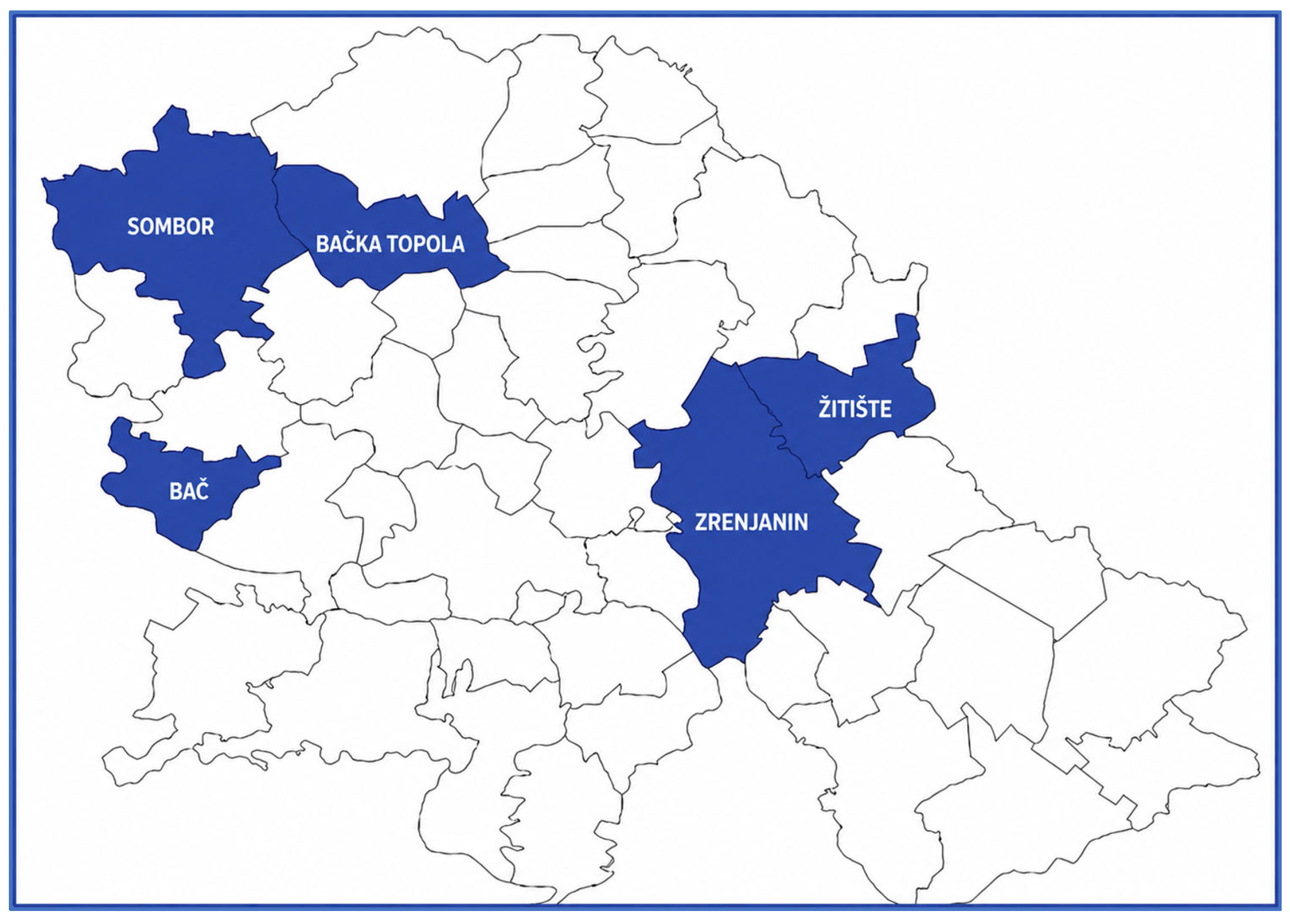
Figure 1 shows the investigated area which encompasses the northwestern, southwestern and central-eastern parts of the Vojvodina region (municipalities: Sombor and Bačka Topola, Bač, Zrenjanin and Žitište, respectively). All these municipalities are colored in
Figure 1.
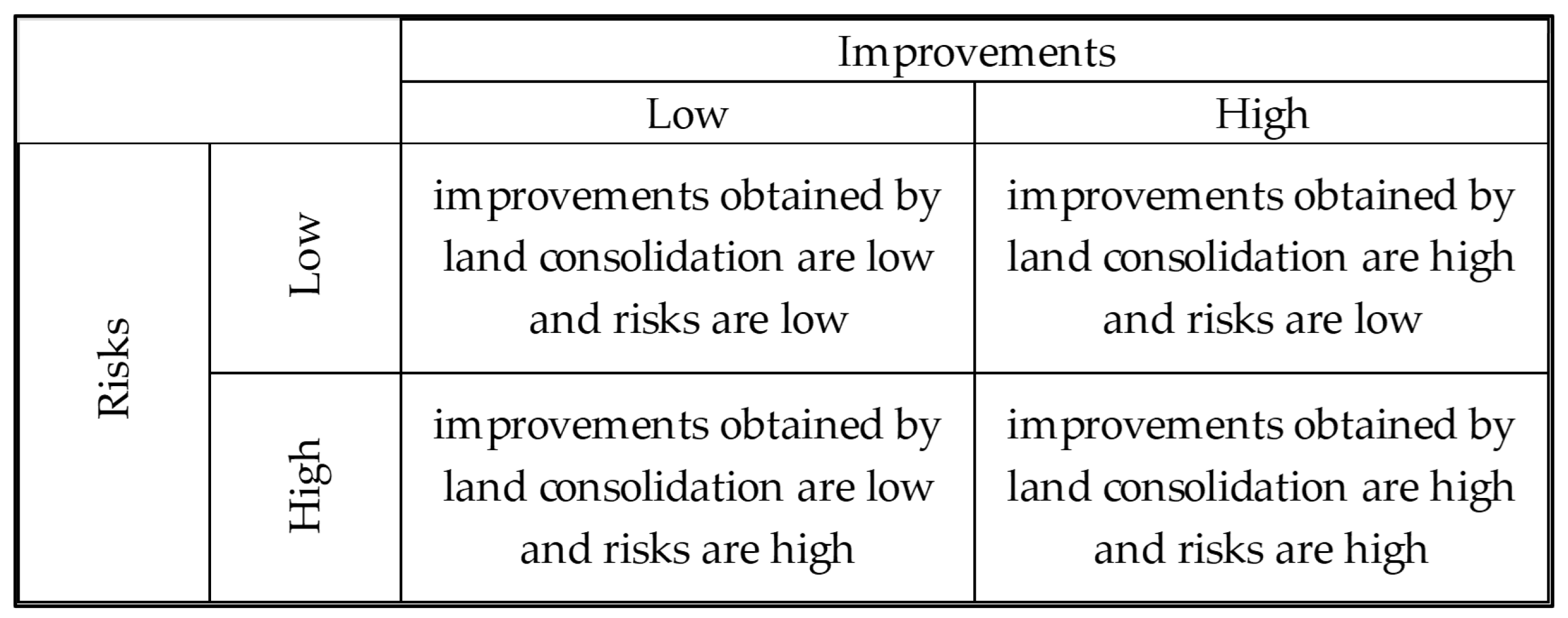
The method conducted is based on the choice of criteria according to their critical importance in agricultural land improvement, as well as their inherent risks for the considered area. The method is based on an approach that involves the analysis of each action on the hydrological system; each action is considered according to its contributions and inherent risks, as shown in
Figure 2.
The risks and improvements are ranked as “high” and “low”, resulting in four possibilities as follows.
Quadrant 1: Low risks and low improvements. There are small possible negative effects in microclimatic and hydrographic conditions in the land-consolidated area influenced by the new hydrographic system. This is the case when the natural water regime is stable for a long time and the irrigation system is well developed, and additional activities will not negatively influence the existing hydrography and/or ecosystem.
Quadrant 2: Low risks and high improvements. These activities are most favorable because the contributions of positive effects are high and the risk of negative effects of hydrology regime changes could be treated as negligible. This is the case when some imbalances exist in the agricultural area, e.g., a high groundwater regime which causes waterlogging and/or agricultural land salinization, and when the irrigation system will not cause more problems.
Quadrant 3: High risks and high improvements. These activities are most sensitive because both the contributions of positive effects are high and the risk of negative effects of the hydrology regime changes could be high. These activities should be treated with extreme caution and every additional data acquisition and analysis must be conducted. This is the case when some imbalances exist in the agricultural area, e.g., a high groundwater regime which causes waterlogging and/or agricultural land salinization, and when the irrigation system could produce additional problems like local hydrological drought [
17], micropollutants deposition, or problems related to nitrate leaching [
14].
Quadrant 4: High risks and low improvements. These activities are most undesirable because the contributions of positive effects are low and the risk of negative effects of hydrology regime changes is high. This is the case when the irrigation systems could not solve the existing problems, while also causing additional problems.
Analyses provided by the proposed method should encompass comprehensive insights into a specific area, appropriate evaluation of risks and contributions of each activity, and its proper positioning in the proposed analytical matrix. Adding the appropriate weighting coefficients to each activity might help in their evaluation. The weighting coefficient must be a function that considers the positive and negative effects of each activity.
Analysis of differences in groundwater levels before and after land consolidation is based on the statistical testing of the normal distribution [
16]. Test statistics are read as follows [
16]:
where:
- ‑
—test statistics;
- ‑
—standard deviation of groundwater depth;
- ‑
—the normal distribution for normalized parameters;
- ‑
—groundwater depth after land consolidation;
- ‑
—groundwater depth before land consolidation.
The level of significance was denoted as , i.e., .
3. Results and Discussions
From the hydrological aspect, it is important to note that the Danube River borders the municipalities of Sombor and Bač from the west and that the municipality of Zrenjanin is bordered by the Tisa River from the west. While the municipalities of Bačka Topola and Žitište have no significant natural waterflows, part of the Danube–Tisa–Danube (In Serbian: “Dunav–Tisa–Dunav”) irrigation system is present in the area.
The measurement was provided on the profiles named according to the municipality where they are located. The land consolidation projects also encompassed improvements to irrigation systems, whose additional role is to drain excess water. The results of the groundwater depth level before and after land consolidation are given in
Table 1.
According to Tatalović et al. [
16],
cm. That means that every difference in groundwater depth after and before land consolidation results in the acceptance of an alternative hypothesis, i.e., the groundwater level has been significantly lowered after land consolidation.
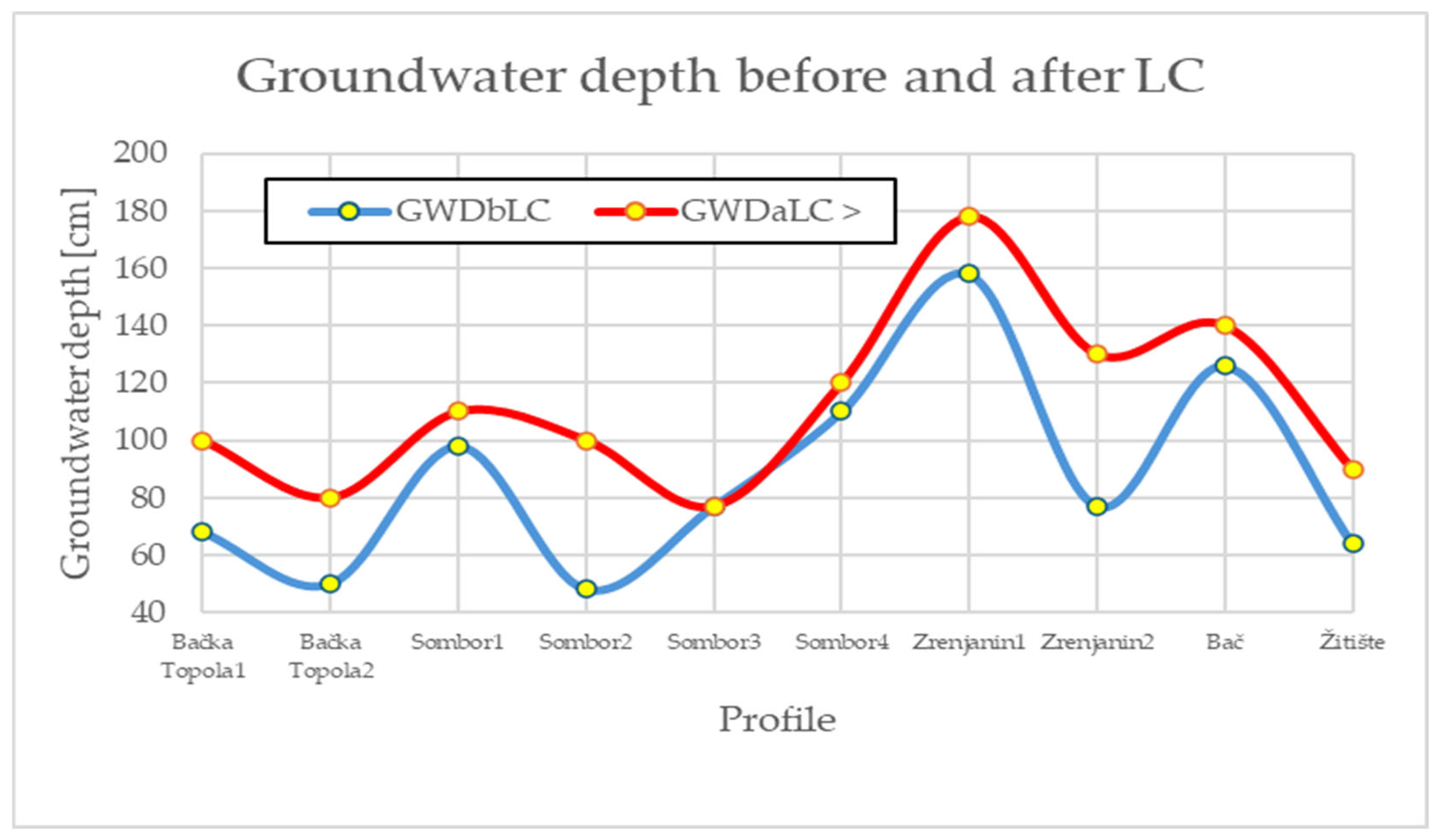
Results related to groundwater level showed that irrigation system improvement during land consolidation caused the significant lowering of groundwater level, except for one profile (Sombor 3). Bear in mind that only two measurements were provided, which is the main limitation of the research. Improving the reliability of the results requires further measurements of water-level depth of the profiles, as well as recording other important parameters such as precipitation in the considered area, the level of water in the irrigation system, the level of water in the rivers, soil moisture saturation, local temperatures, and other parameters that could influence groundwater behavior. Results obtained by groundwater level measurement showed that land consolidation, in these cases, might bring about high improvements at low risk (quadrant 2).
The depth of groundwater before and after land consolidation is graphically shown in
Figure 3.
Another domain of investigation is related to the monitoring of nitrate leaching, micropollutants, and the existence of heavy metals (which could be in quadrant 3 because land consolidation brings about high improvements, but those possibilities could also cause high risk). This monitoring shall be introduced in future research.
In this research, the cases for quadrant 1 (low improvements and low risks) and quadrant 4 (low improvements and high risks) were not identified because the land consolidation caused predominantly high improvements.
4. Conclusions
To conclude how land consolidation contributes to the domain of hydrology, it is possible to state that it predominantly makes high contributions to agricultural production, including hydrological benefits by balancing groundwater flows. Irrigation systems mitigate flood and drought circumstances by lowering the groundwater level. But this hypothesis requires additional parameters to be measured for additional refinement of the initial hypothesis. Another research is required to find out the possible effects of potentially high risks such as nitrate leaching, micropollutants, and heavy metals accumulation. The proposed method, based on the matrix given in
Figure 2, could be the starting point for land consolidation analysis related to conditions for agricultural production improvements and their associated risks. Considering that groundwater level changes after land consolidation were significant, the statistical analysis showed that only one profile (Sombor 3) was not impacted by land consolidation in terms of groundwater level. Further investigations of groundwater levels for the investigated profiles could provide the data for deeper analysis, which shall include research on the relation between the distribution of precipitation and groundwater levels.
Author Contributions
Conceptualization, B.B. and J.T.; methodology, Ž.N.; validation, B.B., J.T. and Ž.N.; formal analysis, Ž.N.; investigation, J.T.; resources, J.T.; data curation, J.T.; writing—original draft preparation, Ž.N.; writing—review and editing, B.B. and J.T.; supervision, B.B.; project administration, Ž.N. All authors have read and agreed to the published version of the manuscript.
Funding
This research received no external funding.
Institutional Review Board Statement
Not applicable.
Informed Consent Statement
Not applicable.
Data Availability Statement
The original contributions presented in this study are included in the article. Further inquiries can be directed to the corresponding author.
Conflicts of Interest
Author Žarko Nestorović was employed by the Joint Stock Company “Elektroprivreda Srbije”. The remaining authors declare that the research was conducted in the absence of any commercial or financial relationships that could be construed as a potential conflict of interest.
References
- Janus, J.; Markuszewska, I. Land consolidation—A great need to improve effectiveness. A case study from Poland. Land Use Policy 2017, 65, 143–153. [Google Scholar]
- Zhou, Y.; Li, Y.; Xu, C. Land consolidation and rural revitalization in China: Mechanisms and paths. Land Use Policy 2020, 91, 104379. [Google Scholar] [CrossRef]
- Crecente, R.; Alvarez, C.; Fra, U. Economic, social and environmental impact of land consolidation in Galicia. Land Use Policy 2002, 19, 135–147. [Google Scholar] [CrossRef]
- Bronstert, A.; Vollmer, S.; Ihringer, J. A review of the impact of land consolidation on runoff production and flooding in Germany. Phys. Chem. Earth 1995, 20, 321–329. [Google Scholar] [CrossRef]
- Pijanowski, J.M.; Wałęga, A.; Książek, L.; Strużyński, A.; Goleniowski, K.; Zarzycki, J.; Kowalik, T.; Bogdał, A.; Wyrębek, M.; Szeremeta, K. An Expert Approach to an Assessment of the Needs of Land Consolidation within the Scope of Improving Water Resource Management. Sustainability 2022, 14, 16651. [Google Scholar] [CrossRef]
- Camorani, G.; Castellarin, A.; Brath, A. Effects of land-use changes on the hydrologic response of reclamation systems. Phys. Chem. Earth Parts A/B/C 2005, 8–10, 561–574. [Google Scholar] [CrossRef]
- Arslan, F.; Sawassi, A.; Derardja, B.; Değirmenci, H.; Lamaddalena, N. The effects of land consolidation projects on pressurized irrigation system design and the cost: A case study from Türkiye. Ecohydrol. Hydrobiol. 2024, 24, 608–616. [Google Scholar]
- Kirmikil, M.; Arici, I. The role of land consolidation in the development of rural areas in irrigation areas. J. Food Agric. Environ. 2013, 11, 1150–1155. [Google Scholar]
- Muchová, Z.; Petrovič, F. Changes in the landscape due to land consolidations. Ekológia 2010, 29, 140–157. [Google Scholar] [CrossRef]
- Cuo, L. Land use/cover change impacts on hydrology in large river basins: A review. In Terrestrial Water Cycle and Climate Change: Natural and Human-Induced Impacts; American Geophysical Union: Washington, DC, USA, 2016; pp. 103–134. [Google Scholar]
- Yu, G.; Feng, J.; Che, Y.; Lin, X.; Hu, L.; Yang, S. The identification and assessment of ecological risks for land consolidation based on the anticipation of ecosystem stabilization: A case study in Hubei Province, China. Land Use Policy 2010, 27, 293–303. [Google Scholar] [CrossRef]
- Garg, V.; Aggarwal, S.P.; Gupta, P.K.; Nikam, B.R.; Thakur, P.K.; Srivastav, S.K.; Senthil Kumar, A. Assessment of land use land cover change impact on hydrological regime of a basin. Environ. Earth Sci. 2017, 76, 635. [Google Scholar] [CrossRef]
- Meijles, E.W.; Williams, A. Observation of regional hydrological response during time periods of shifting policy. Appl. Geogr. 2012, 34, 456–470. [Google Scholar] [CrossRef]
- Fernández-Cirelli, A.; Arumí, J.L.; Rivera, D.; Boochs, P.W. Environmental effects of irrigation in arid and semi-arid regions. Chil. J. Agric. Res. 2009, 69, 27–40. [Google Scholar] [CrossRef]
- Stańczuk-Gałwiaczek, M.; Sobolewska-Mikulska, K.; Ritzema, H.; van Loon-Steensma, J.M. Integration of water management and land consolidation in rural areas to adapt to climate change: Experiences from Poland and the Netherlands. Land Use Policy 2018, 77, 498–511. [Google Scholar] [CrossRef]
- Tatalović, J.; Trifković, M.; Marinković, G.; Kuburić, M.; Bojović, B. Analysis of The Impact of Land Consolidation Projects on Groundwater Level and Land Quality in The Republic of Serbia. Teh. Vjesn. 2025, 32, 361–369. [Google Scholar] [CrossRef]
- Van Loon, A.F. Hydrological drought explained. Wiley Interdiscip. Rev. Water 2025, 2, 359–392. [Google Scholar]
| Disclaimer/Publisher’s Note: The statements, opinions and data contained in all publications are solely those of the individual author(s) and contributor(s) and not of MDPI and/or the editor(s). MDPI and/or the editor(s) disclaim responsibility for any injury to people or property resulting from any ideas, methods, instructions or products referred to in the content. |