Proceeding Paper

Application of Machine Learning for Analyzing and Assessing the Suitability of Specific Habitat Conditions †

1
Faculty of Civil Engineering, University of Rijeka, Radmile Matejčić 3, 51000 Rijeka, Croatia
2
Department of Civil Engineering, Zagreb University of Applied Sciences, Avenija Većeslava Holjevca 15, 10000 Zagreb, Croatia
3
Section of Ecology, Department of Civil and Architectural Engineering, Elektroprojekt Consulting Engineers, Alexandera von Humboldta 4, 10000 Zagreb, Croatia
*
Author to whom correspondence should be addressed.
Presented at the 6th International Conference on Efficient Water Systems (EWaS6), Thessaloniki, Greece, 11–14 May 2026.
Environ. Earth Sci. Proc. 2026, 44(1), 26; https://doi.org/10.3390/eesp2026044026 (registering DOI)
Published: 24 June 2026

Abstract

The analysis of specific habitat conditions involves a systematic assessment of environmental variables such as temperature, hydrology, and vegetation, to clarify species’ ecological requirements and develop conservation strategies. Common approaches include statistical modelling, various Habitat Suitability Index (HSI) models, and GIS-based spatial analyses, which quantify factors like topography, land cover and anthropogenic pressures. Today, machine learning (ML) methods are widely applied across engineering disciplines, including water resources management. In this study, ML methods, particularly model trees, are employed to model and predict key abiotic factors relevant to fish communities. The research focuses on the bioindicator species Barbus balcanicus (brook barbel), which inhabits the middle part of the Sutla River (transboundary river basin between Croatia and Slovenia) and serves as an indicator of ecological conditions in this system. Using ML, models for water depth, water velocity, and water temperature were developed and applied together with SWAT (Soil and Water Assessment Tool) data to determine the HSI for future scenarios to support habitat assessment and water management planning.

1. Introduction

Aquatic ecosystems are among the most threatened ecosystems, facing increasing pressure from the impact of climate change (CC), hydro-morphological alterations, land-use changes, and anthropogenic impacts. Rivers, in particular, are highly dynamic systems in which physical, chemical, and biological components interact across spatial and temporal scales, directly influencing habitat quality and biodiversity. Therefore, understanding species (fish)–habitat relationships is essential for effective conservation, restoration, and sustainable water resources management [1].
The fish habitat suitability assessment represents a key tool for the conservation and management of river systems. Anthropogenic pressures, including urbanization, pollution, hydrotechnical facilities construction, and CC impact, contribute to the degradation of aquatic habitats and pose significant threats to fish diversity and population stability. A thorough understanding of habitat preferences, such as flow regime, substrate composition, water velocity, water depth, and temperature, are essential for identifying and protecting valuable ecological areas. Habitat suitability models enable the evaluation of habitat quality as well as the assessment of spatial and temporal variability, both of which are critical for the development of adaptive conservation strategies. Consequently, these models have gained increasing importance in environmental protection, particularly in supporting restoration initiatives in riverine systems [2].
In recent years, the combination of simulation and assessment methods with emerging algorithms, including machine learning (ML) and artificial intelligence (AI), has attracted significant research attention [3].
This research aims to develop ML models, with a particular focus on model trees, to predict key abiotic factors associated with bioindicator species Barbus balcanicus (brook barbel), i.e., water velocity, water depth, and water temperature, which are relevant to fish habitat suitability. The ML predicted variables are combined with outputs from the Soil and Water Assessment Tool (SWAT) model to determine the Habitat Suitability Index (HSI) for fish bioindicator species under future scenarios. By linking ML techniques with ecohydrological modelling, this research contributes to advancing habitat assessment methodologies and provides a decision-support tool for river management and conservation planning.

2. Materials and Methods

2.1. Sutla River Watershed and Biological Indicators

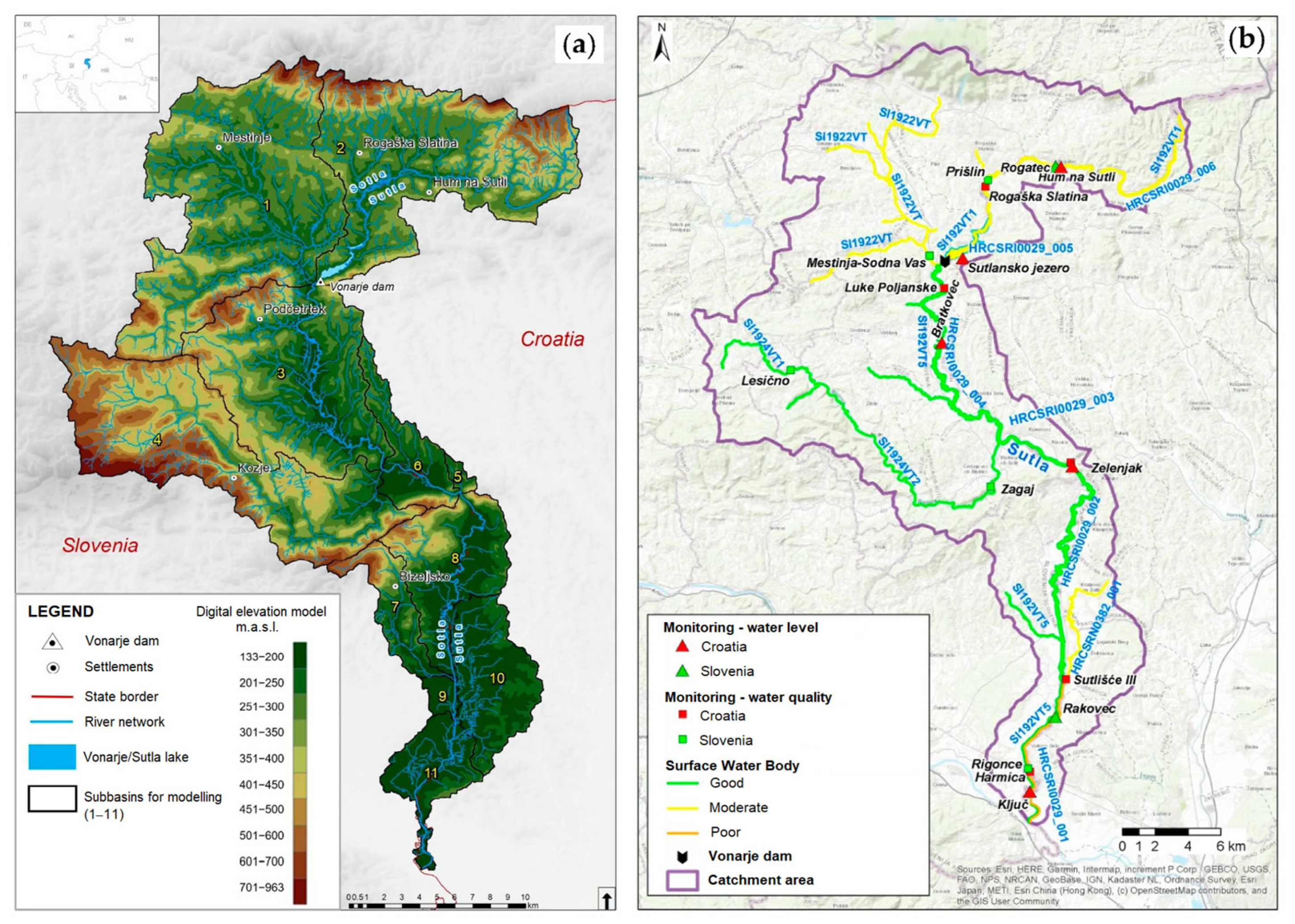
The transboundary Sutla River Basin (Figure 1a) between Slovenia and Croatia covers around 590.6 km2, with 77% of the area situated in Slovenia and 23% in Croatia. Sutlansko Lake (Vonarje Reservoir) was built in the 1980s by constructing the Vonarje dam in a natural retention area. The reservoir has a volume of 12.4 million m3, a surface area of 195 ha, and is about 6 km long. Both the retention area and the Sutla riverbed are designated as NATURA 2000 sites [4,5].
Special attention in this research is focused on the fish bioindicator, Barbus balcanicus, the brook barbel species inhabiting the watercourse’s middle part. The fundamental ecological requirements of the selected indicator fish species, brook barbel, i.e., individual stages of their development, are presented in Table 1.

2.2. Methodology

Integrated river basin management and good water status can be achieved if appropriate flow, sediment regime, and related river morphology quality are provided.
Based on the SWAT model analyses of river basin pressures under CC impact and the programme of basic and supplementary measures, altogether eight future scenarios were developed, from which two representative future scenarios were selected (FUTURE 3a2 scenario: with a reservoir for the period 2020–2050; FUTURE 3b1 scenario: without a reservoir for the period 2070–2100) [4,5]. For the selected future scenarios, SWAT simulations provided data on dissolved oxygen, as the only abiotic factor related to Table 1, and the water flow. Abiotic factors not directly modelled by SWAT, namely water depth, water velocity, and water temperature, were estimated using the M5P algorithm for induction of model trees implemented in the Weka ML tool. Model performance was evaluated using 10-fold cross-validation and standard error metrics. Prediction models were developed using the most relevant and available input variables [7]. Models obtained with ML for water depth, water velocity, and water temperature can be seen in the paper of the authors [4]. The data used for modelling are based on a continuous 20-year time series (monthly measurements) of water quality and water quantity at the Zelenjak gauging station (Figure 1b).
Using data from SWAT and ML predictions [4,5], HSI was calculated for the present and two selected future scenarios. The HSI was assessed separately for three life stages of Barbus balcanicus, fry, spawning, and adults, as presented in Table 1. Each abiotic variable (water temperature, dissolved oxygen, water depth, and water velocity) was transformed into a suitability index (SI) ranging from 0 to 1 based on the ecological requirements of each life stage according to Table 1. The overall HSI was computed as the geometric mean of individual SI values [8]. A “soft” suitability approach was applied to avoid zero-collapse of HSI values. Values slightly outside the optimal range were assigned reduced, but non-zero, suitability scores (SI = 0.3–0.7), reflecting this species’ physiological tolerance and behavioural flexibility. This approach allows for a more realistic representation of habitat suitability under natural river conditions. Optimum values were assigned as SI = 1, while values outside tolerance limits were assigned SI = 0. Habitat suitability was classified into five classes (very low, low, moderate, high, and very high) based on HSI values. Thresholds were defined as 0.0–0.2 (very low), 0.2–0.4 (low), 0.4–0.6 (moderate), 0.6–0.8 (high), and 0.8–1.0 (very high), following common practice in “soft” HSI modelling.

3. Results and Discussion

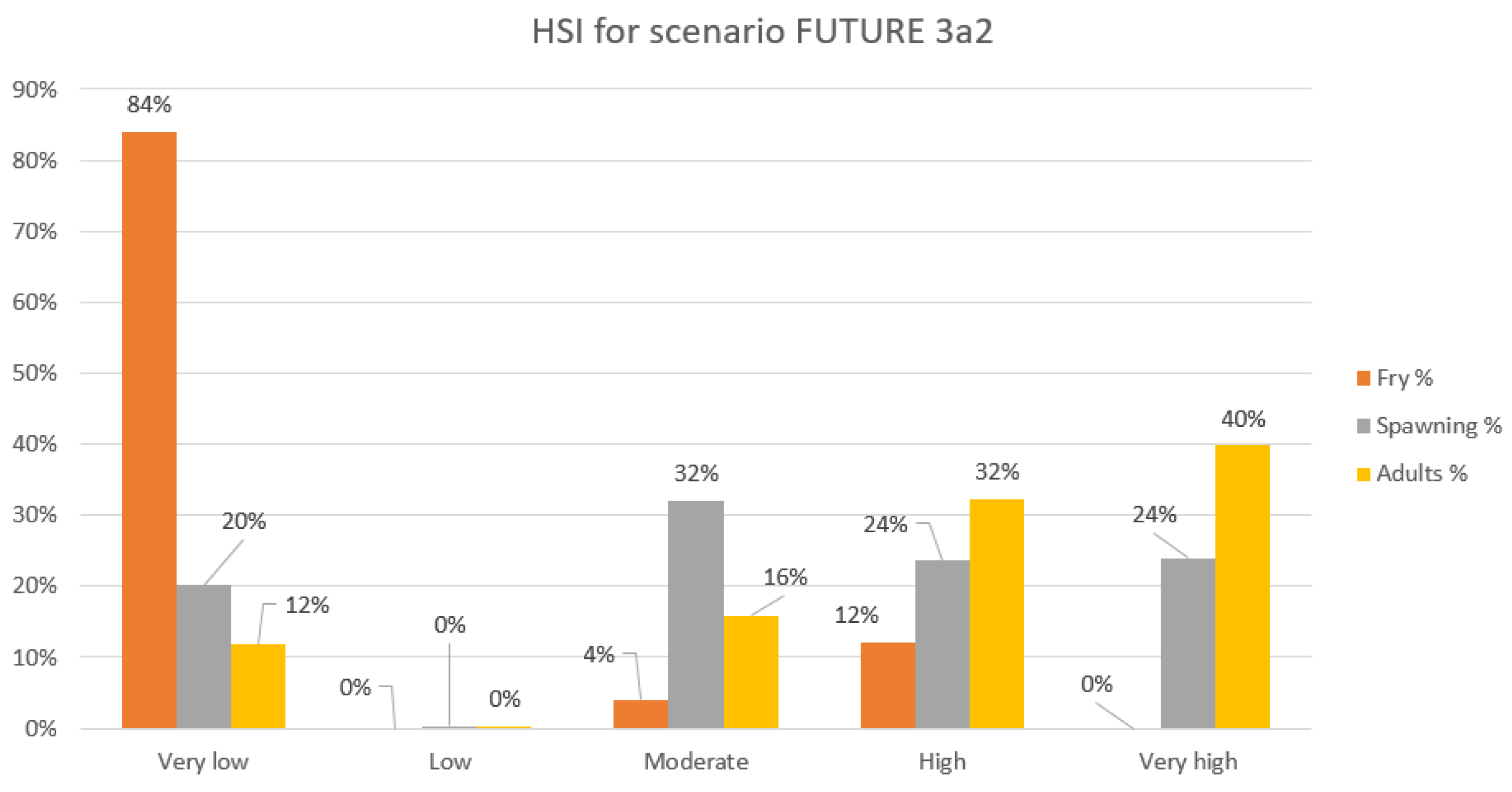
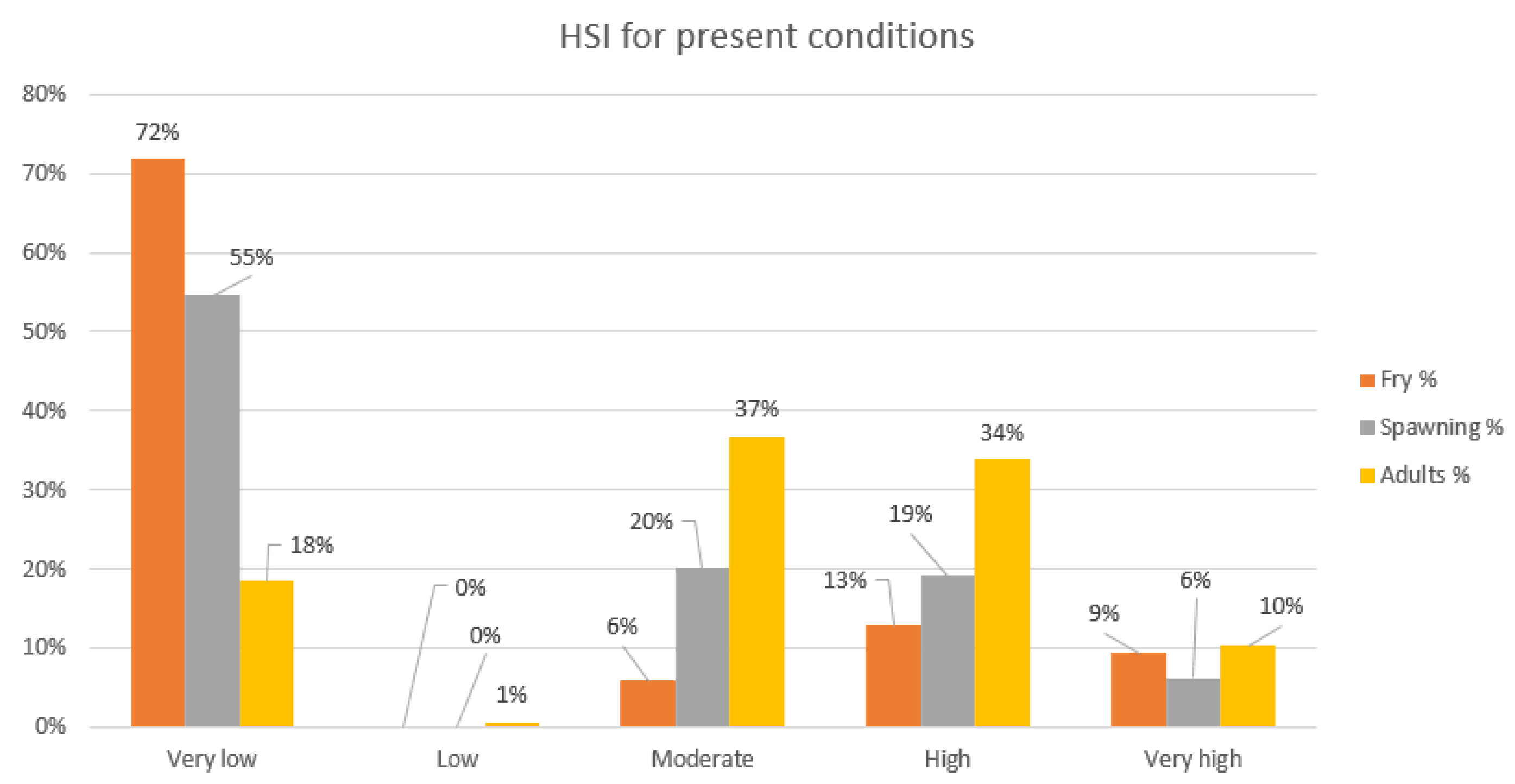
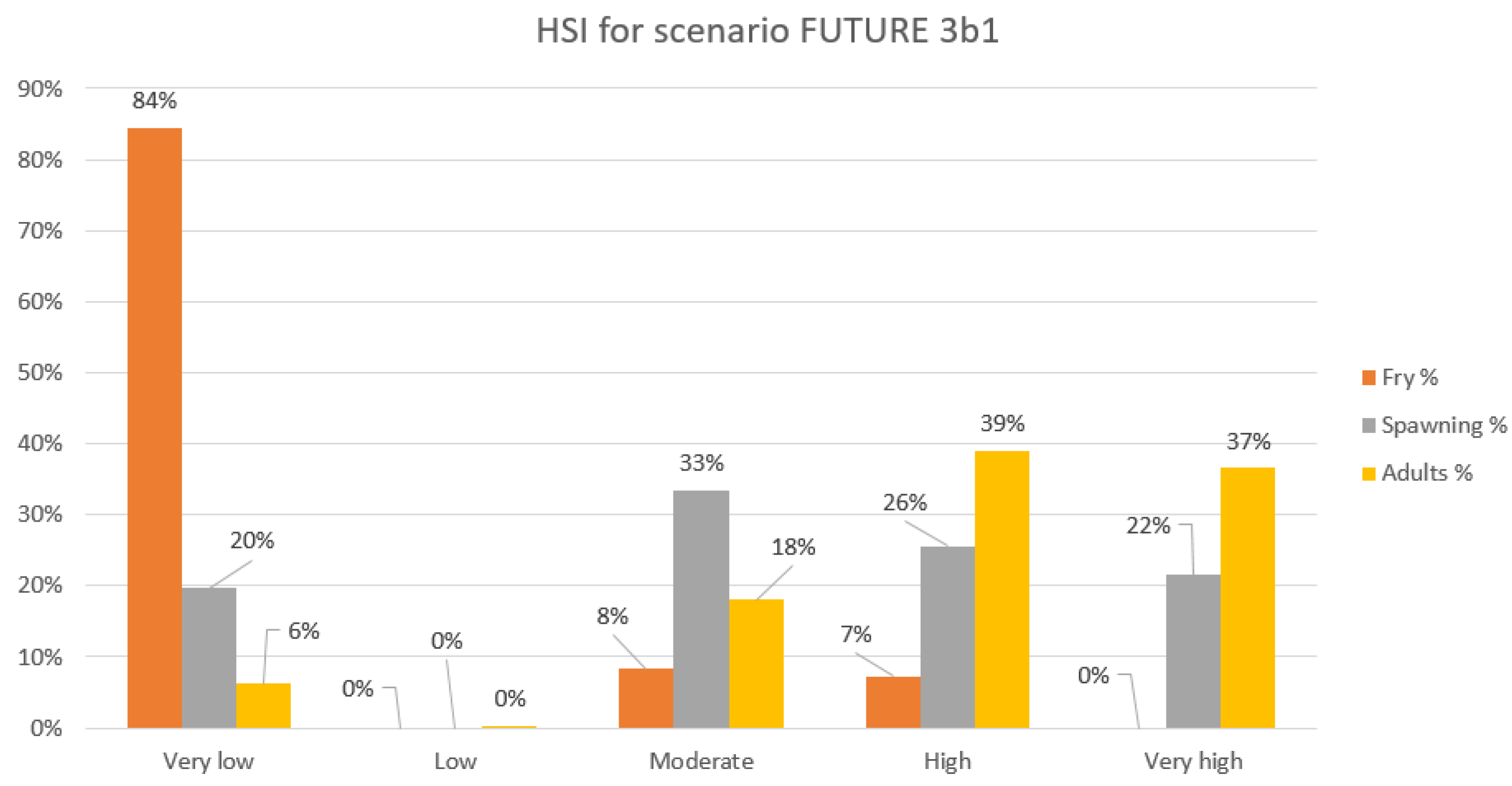
The presented methodology was applied to calculate HSI for the life stages of Barbus balcanicus under present conditions, and two selected future scenarios. HSI results for present conditions are shown in Figure 2 (hydrological monitoring data period: 2000–2022), while results for future scenarios are presented in Figure 3 (scenario FUTURE 3a2) and Figure 4 (scenario FUTURE 3b1).
Under present conditions (Figure 2), fry habitats are dominated by very low suitability, with approximately 72% of habitats falling into the “very low” class, and less than 10% classified as high or very high. Spawning habitats are more balanced, with moderate and high suitability together representing nearly 40% of available habitat, reflecting the presence of spatially restricted but ecologically important spawning sites. Adults occupy predominantly moderate-to-high suitability areas, highlighting their broader ecological tolerance and behavioural flexibility compared to early-life stages. The very low representation of “very high” habitats across all stages indicates that optimal conditions are spatially limited under present conditions [4].
Figure 3. HSI results for the scenario FUTURE 3a2.
Eesp 44 00026 g003
For the scenario FUTURE 3a2 (Figure 3), fry habitat suitability declines further, with over 83% of habitats classified as very low. Moderate-to-high suitability habitats become scarce, suggesting that early-life stages are particularly vulnerable to projected increases in temperature and alterations in flow, velocity and depth conditions. Spawning habitats experience a relative shift towards moderate and high suitability classes, but this improvement likely reflects partial suitability rather than consistently optimal conditions. Adults show an overall increase in high and very high suitability classes, with nearly 40% of the habitat classified as very high, indicating that adults may benefit from warmer temperatures and altered flow regimes, provided that dissolved oxygen remains adequate.
Figure 4. HSI results for the scenario FUTURE 3b1.
Eesp 44 00026 g004
For the scenario FUTURE 3b1 (Figure 4), a continuation of the trends is observed in the mid-century projection. Fry stage habitats remain predominantly very low (approximately 84%), while the proportion of moderate-to-high suitability habitats slightly increase for spawning and adult stages. Adult habitats maintain the highest overall suitability, with nearly 39% of habitats classified as high and 36% as very high. These patterns indicate that although adults retain access to a relatively large fraction of suitable habitat, early-life stages continue to face critical bottlenecks, which may limit spawning and long-term population persistence.
The results highlight a pronounced life-stage-specific vulnerability under both present and future conditions. Early-life stages, particularly fry, consistently occupy habitats with very low suitability, which is exacerbated under projected climate scenarios. In contrast, adult habitats remain largely suitable or even improve under warmer and altered flow regimes. This divergence emphasizes the importance of managing river habitats, within integrated water management, to maintain suitable conditions for early life stages, such as shallow, slow-flowing areas with optimal temperature and dissolved oxygen. The application of a “soft” suitability approach allows for partial habitat use under suboptimal conditions, providing a realistic representation of ecological flexibility.
It is also important to emphasize that the hydrological measurement profiles are not located exactly at the same microlocalities as the water quality monitoring stations, where samples for assessing water status related to biological indicators are collected. This may explain the occurrence of unfavourable hydrological conditions (low and very low HSI) for brook barbel even under current conditions. Alternatively, the selected profile may not be fully representative, and the remaining riverbed provides favourable hydrological and hydraulic conditions for brook barbel settlement [4].
Overall, these findings suggest that future climate-driven changes may reshape the spatial distribution of habitat suitability rather than uniformly reducing it, with early life stages representing a critical limiting factor for population sustainability.

4. Conclusions

The results show clear life-stage-specific differences in habitat suitability for the indicator species Barbus balcanicus, suggesting that projected climate-driven changes are likely to alter the spatial distribution of habitat suitability rather than cause a uniform decline across the river system. Young stage, i.e., fry, consistently experience the lowest suitability, which declines further under future scenarios, creating a critical bottleneck for spawning and population persistence. Low fry HSI values under current conditions may partly reflect mismatches between hydrological measurements and water quality monitoring locations. In contrast, adult stage habitats remain mostly moderate to highly suitable and may even improve under future climate conditions, while spawning habitats are intermediate but spatially limited. Overall, climate change is likely to shift the spatial distribution of suitable habitats rather than uniformly reduce it, with early-life stages being the most vulnerable. These findings underscore the importance of preserving shallow, low-flow areas with favourable temperature and oxygen for spawning and demonstrate how combining ML and ecohydrological modelling can support river management and conservation planning.


Author Contributions

Conceptualization, G.V., G.Ć.F., B.K. and I.V.; methodology, G.V., G.Ć.F., B.K. and I.V.; software, G.V. and G.Ć.F.; validation, G.V. and G.Ć.F.; formal analysis, G.V., G.Ć.F., B.K. and I.V.; investigation, G.V., G.Ć.F., B.K. and I.V.; resources, G.V., G.Ć.F., B.K. and I.V.; data curation, G.V. and G.Ć.F.; writing—original draft preparation, G.V., G.Ć.F., B.K. and I.V.; writing—review and editing, G.V., G.Ć.F., B.K. and I.V.; visualization, G.V., G.Ć.F., B.K. and I.V.; supervision, G.V. and B.K.; project administration, G.V.; funding acquisition, G.V. and B.K. All authors have read and agreed to the published version of the manuscript.

Funding

This research was funded by the European Union—NextGenerationEU—WaRM-CC—uniri-iz-25-27, and European Union—NextGenerationEU—WatResManDrink—uniri-iz-25-18. The views and opinions expressed are solely those of the authors and do not necessarily reflect the official stance of the European Union or the European Commission. Neither the European Union nor the European Commission can be held accountable for them.

Institutional Review Board Statement

Not applicable.

Informed Consent Statement

Not applicable.

Data Availability Statement

The data presented in this study are available on request from the corresponding author.

Acknowledgments

We thank Matjaž Glavan, from the University of Ljubljana Biotechnical Faculty, Department of Agriculture, Slovenia, for his help in interpreting the data and results of the SWAT model, which were used for FUTURE CC impact scenarios as input data for ML.

Conflicts of Interest

Author Ivan Vučković was employed by the company Elektroprojekt Consulting Engineers. The remaining authors declare that the research was conducted in the absence of any commercial or financial relationships that could be construed as a potential conflict of interest.

References

  1. Spurgeon, J.J.; Pegg, M.A.; Pope, K.L.; Xie, L. Ecosystem-specific growth responses to climate pattern by a temperate freshwater fish. Ecol. Ind. 2020, 112, 106130. [Google Scholar] [CrossRef]
  2. Kudeshova, G. Fish Habitat Suitability Evaluation Through Habitat Evaluation Procedure Modelling. Aquat. Ecosyst. Environ. Front. 2025, 3, 11–19. [Google Scholar] [CrossRef]
  3. Zhuang, J.; Wang, Y.; Lin, J.; Zhang, D.; Peng, Q.; Jin, T. Research progress and framework on the simulation and assessment of fish habitat degradation in lakes. Ecol. Indic. 2024, 158, 111461. [Google Scholar]
  4. Ćosić-Flajsig, G.; Volf, G.; Vučković, I.; Karleuša, B. Analysis of Specific Habitat Conditions for Fish Bioindicator Species Under Climate Change with Machine Learning—Case of Sutla River. Sustainability 2025, 17, 10803. [Google Scholar] [CrossRef]
  5. Ćosić-Flajsig, G.; Karleuša, B.; Glavan, M. Integrated Water Quality Management Model for the Rural Transboundary RiverBasin—A Case Study of the Sutla/Sotla River. Water 2021, 13, 2569. [Google Scholar]
  6. Mrakovčić, M. Criteria for determining sustainable flow based on fish communities. In Documentation Elektroprojekt d.d.; Elektroprojekt: Zagreb, Croatia, 2000; p. 41. [Google Scholar]
  7. Witten, I.H.; Frank, E. Data Mining: Practical Machine Learning Tools and Techniques, 2nd ed.; Elsevier: Amsterdam, The Netherlands, 2005. [Google Scholar]
  8. Brooks, R.P. Improving Habitat Suitability Index Models. Wild. Soc. Bull. 1997, 25, 163–167. [Google Scholar]
Figure 1. Transboundary Sutla River Basin [4,5]: (a) digital elevation model, hydrographic network with lakes, settlements, 11 subbasins, and the Vonarje dam location; (b) measuring stations on the River Sutla.
Eesp 44 00026 g001
Figure 2. HSI results for present conditions.
Eesp 44 00026 g002
Table 1. The fundamental ecological requirements of the selected indicator species [6].
Key Abiotic Factors Important for Fish
Biogeographical AreaLife
Stage
Water
Depth
cm
Water
Velocity
m/s
Water
Temperature
°C
Dissolved
Oxygen
mg/L
Barbus
balcanicus
brook barbel
SpawningGreater than body height
20–45
0.35–0.54–17 (14) *Above 6
<FryAbout 300.06–0.2(15) *Above 6
AdultsGreater than body height
20–45
0.35–0.54–20Above 6
* Values in parenthesis () = optimum value.
Disclaimer/Publisher’s Note: The statements, opinions and data contained in all publications are solely those of the individual author(s) and contributor(s) and not of MDPI and/or the editor(s). MDPI and/or the editor(s) disclaim responsibility for any injury to people or property resulting from any ideas, methods, instructions or products referred to in the content.