
Proceeding Paper

Spatiotemporal Evolution of Energy Consumption Carbon Emissions in Jiangsu Province Based on Nighttime Light Remote Sensing Imagery †

1
School of Energy Science and Engineering, Nanjing Tech University, Nanjing 211816, China
2
School of Geomatics Science and Technology, Nanjing Tech University, Nanjing 211816, China
*
Author to whom correspondence should be addressed.
Presented at the 1st International Online Conference on Environments, Online, 2–4 March 2026.
Environ. Earth Sci. Proc. 2026, 42(1), 8; https://doi.org/10.3390/eesp2026042008
Published: 24 June 2026
(This article belongs to the Proceedings of The 1st International Online Conference on Environments)

Abstract

Against the backdrop of global warming and the “dual carbon” goals, scientifically assessing the spatiotemporal patterns of regional carbon emissions is of great significance for formulating differentiated emission reduction policies. Taking counties of Jiangsu Province as the basic analytical unit, this study integrates NPP-VIIRS nighttime light data and energy statistical yearbook data from 2000 to 2020. An IPCC carbon emission coefficient method was adopted to construct a county-level carbon emission estimation model. Spatial autocorrelation analysis, hot spot detection, Theil–Sen trend estimation, and the Mann–Kendall significance test were comprehensively applied to systematically reveal the spatiotemporal evolution characteristics of energy consumption carbon emissions in Jiangsu Province. The results indicate that county-level carbon emissions in Jiangsu Province exhibit a stable spatial pattern of “higher in the south, lower in the north, and agglomeration along the Yangtze River,” and the total carbon emissions in the southern core area show a statistically significant increasing trend. The spatial pattern of carbon emissions has transformed from “unipolar high-intensity agglomeration” to “zonal diffusion coexisting with multi-point agglomeration.” High per capita carbon emission areas persistently cluster along the Yangtze River, whereas high-carbon-emission-intensity areas have shifted to certain counties in northern Jiangsu.

1. Introduction

Global warming has emerged as a critical environmental issue threatening sustainable human development, primarily driven by the excessive emission of greenhouse gases, particularly carbon dioxide [1]. In response, China has proposed the goals of “peaking carbon emissions before 2030 and achieving carbon neutrality by 2060.” Scientifically quantifying carbon emissions has thus become a key prerequisite for formulating emission reduction policies and promoting [2] low-carbon transitions. As a major responsible country, China’s “dual carbon” goals reflect its international commitment and align with the broader imperative of high-quality development. Satellite remote sensing-based inversion studies of air pollutants and greenhouse gas emissions conducted by Chinese scholars have provided an indispensable information and data foundation for comprehensively understanding the sources of these key atmospheric constituents and implementing precise emission reduction measures [3]. The county level represents the most fundamental administrative unit for policy implementation. However, current methods for calculating carbon emissions at this scale often suffer from insufficient data accuracy and difficulty in continuously tracking changes.
Existing studies have examined carbon emissions across multiple scales, including national, regional, municipal, and county levels. For instance, Zhang Yongnian et al. [4] investigated the spatiotemporal trends and distribution characteristics of carbon emissions across mainland China over a 14-year period. Li Lulu et al. [5] systematically assessed the spatiotemporal evolution of carbon emissions in the middle and lower reaches of the Yangtze River. Liu Shijun et al. [6] combined nighttime light data with socioeconomic statistics to explore the spatiotemporal patterns of economic development in Shaanxi Province. Li Feng et al. [7] employed spatial autocorrelation analysis and the Dagum Gini coefficient to reveal the spatial evolution characteristics and sources of regional disparities in economic resilience within the Beijing–Tianjin–Hebei region. Lin Jingna et al. [8] applied the VBANUI nighttime light regulation index threshold method to analyze urban expansion patterns in Henan Province over the past two decades. Although these studies have established a multi-scale analytical framework, certain limitations persist: first, research at the county level lacks sufficient granularity; second, traditional methods rely heavily on energy statistics that are often updated infrequently and possess limited spatial resolution.
As a major economic province in China, the spatiotemporal dynamics of carbon emissions across Jiangsu’s counties have not yet been systematically investigated. To address this research gap, this study focuses on the county-level units of Jiangsu Province. By integrating multi-source remote sensing data and spatial statistical methods for the period 2000–2020, we constructed a model for estimating carbon emissions at the county scale. The study focuses on three primary aspects: first, revealing the spatiotemporal evolution characteristics of total carbon emissions; second, analyzing regional differences in per capita carbon emissions and carbon emission intensity per unit of GDP; and third, identifying high-value and low-value agglomeration areas of carbon emissions and systematically analyzing their spatiotemporal evolution. The findings of this study are expected to provide a robust scientific basis for formulating differentiated carbon reduction policies tailored to specific counties within Jiangsu Province.

2. Materials and Methods

2.1. Overview of the Study Area

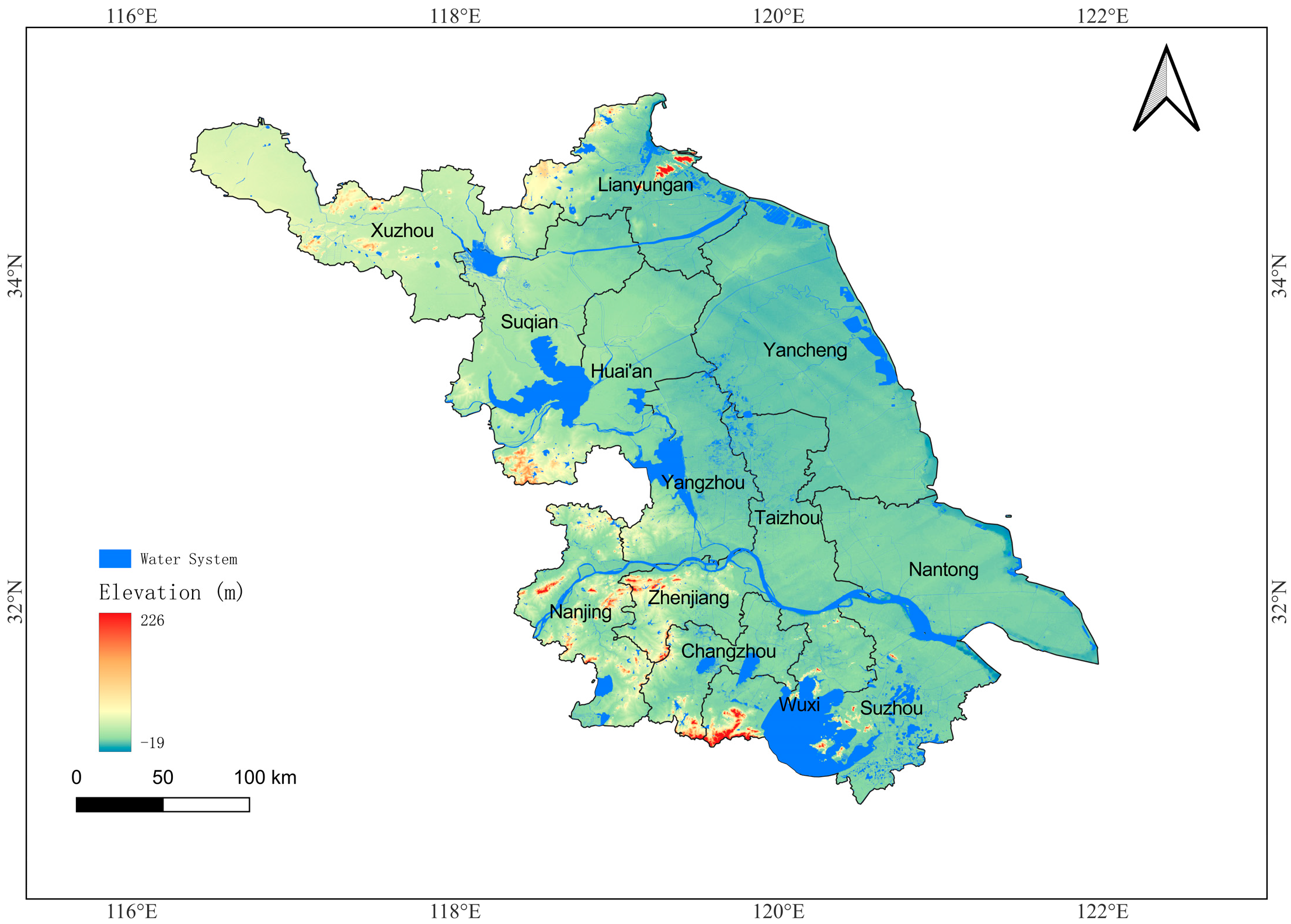
Jiangsu Province is located in the central coastal region of eastern China, spanning the Yangtze River and Huaihe River basins (Figure 1). The terrain is predominantly low-lying and flat, consisting mainly of plains, including the Subei Plain, the Huanghuai Plain, and the Yangtze River Delta, interspersed with low hills and mounds generally ranging from 0 to 600 m in elevation. The province lies within a transitional zone between subtropical monsoon and temperate monsoon climates, characterized by four distinct seasons with concurrent rainfall and heat. The average annual temperature ranges from 13.6 °C to 16.1 °C, and annual precipitation is approximately 800–1200 mm. The study area extends from 30°46′ N to 35°08′ N latitude and 116°21′ E to 121°56′ E longitude, covering a total area of 107,200 km2, accounting for approximately 1.12% of China’s total land area. The topography features a pattern described as “one part water, two parts fields, and seven parts land.” The southern region is characterized by dense water networks and numerous lakes, the eastern region comprises coastal tidal flats and port areas, the central and northern regions are dominated by plain farmland, and the northwestern region contains limited hilly terrain.
Jiangsu Province serves as a crucial pillar of China’s economic development and a pioneering region for modernization. By 2025, the province’s permanent resident population reached 85.18 million, with a gross regional domestic product (GRDP) of 14,235.15 billion yuan, representing a year-on-year increase of 5.3% at constant prices [9]. As of 2025, total energy consumption in Jiangsu is controlled within 454 million tons of standard coal equivalent (tce), coal consumption has decreased by approximately 5% compared to 2020 levels, non-fossil energy accounts for about 20% of total consumption, and renewable energy constitutes over 15% of the total energy mix [10]. It stands as one of the representative regions in China promoting high-quality development and ecological civilization [10].

2.2. Data Sources and Processing

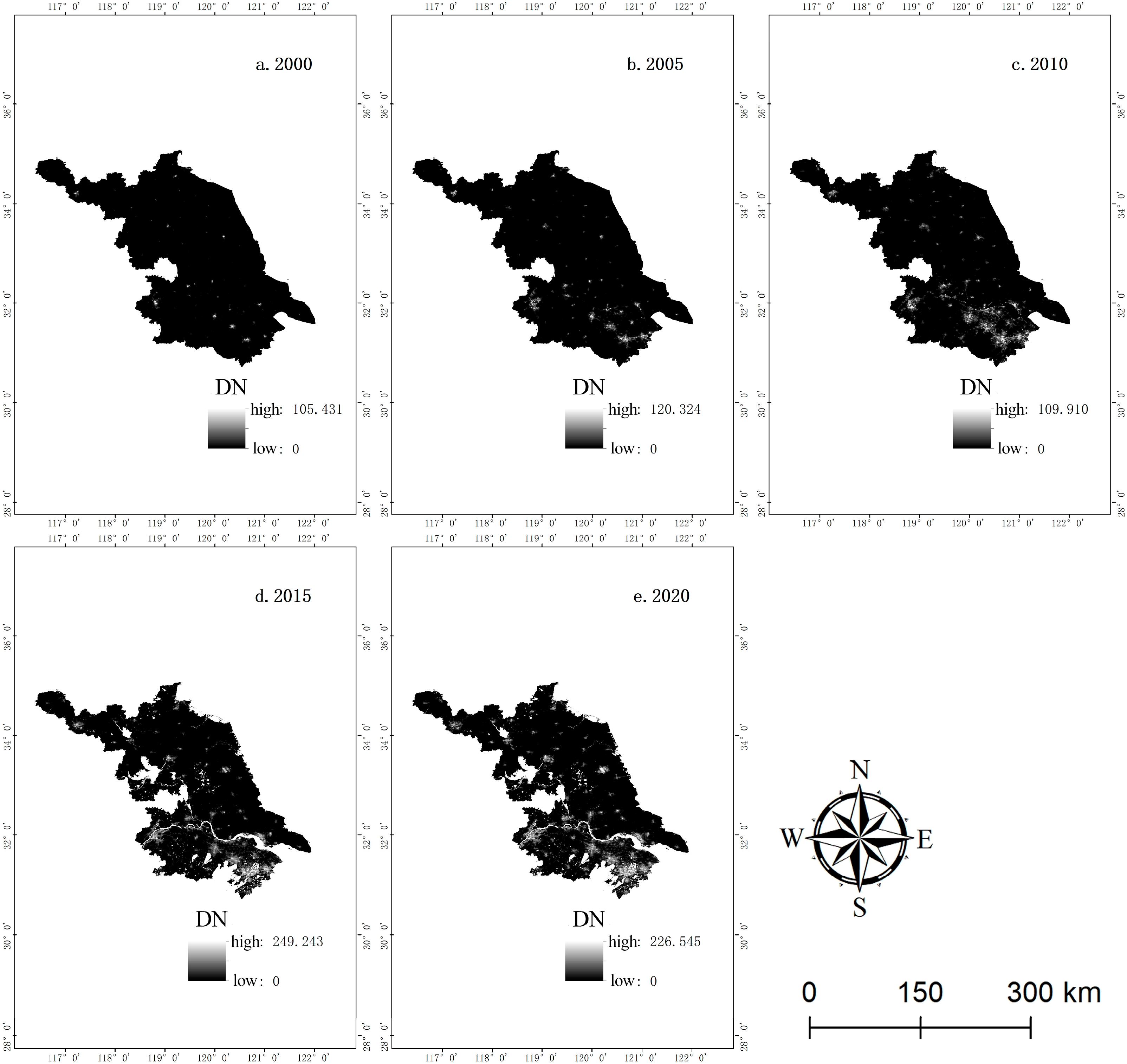
The datasets utilized in this study include: (1) Nighttime light data: NPP-VIIRS-like nighttime light remote sensing data for the period 2000–2020, obtained from the Yangtze River Delta Science Data Center (https://geodata.nnu.edu.cn/), with a spatial resolution of 500 m [10]. (2) Land use data: For the Yangtze River Delta, 30 m digital surface model data. The ALOS Global Digital Surface Model “ALOS World 3D—30 m” (AW3D30) is a high-precision global digital surface model dataset released free of charge in May 2015 by the Japan Aerospace Exploration Agency (JAXA). The data were obtained from the National Science and Technology Infrastructure Platform—National Earth System Science Data Sharing Service Platform—Yangtze River Delta Science Data Center (http://geodata.nnu.edu.cn). (3) Energy consumption data: Derived from the China Statistical Yearbook, China Energy Statistical Yearbook, and Jiangsu Statistical Yearbook [11,12,13]. All nighttime light data underwent projection transformation (Krasovsky-1940-Albers) and were resampled to a spatial resolution of 1 km × 1 km. Subsequently, the data were extracted using a mask based on the administrative boundaries of Jiangsu Province to generate a long-term time-series nighttime light dataset (Figure 2).

2.3. Research Methods

2.3.1. Estimation of Energy Consumption Carbon Emissions

This study estimates carbon dioxide (CO2) emissions based on energy consumption values derived from the energy balance sheet of Jiangsu Province. Carbon emission coefficients for various energy types in Table 1 were determined in accordance with the 2006 IPCC Guidelines for National Greenhouse Gas Inventories [14]. Considering the timeliness and availability of comprehensive energy consumption statistics, nine primary energy sources were selected to estimate CO2 emissions for Jiangsu Province from 2000 to 2019: raw coal, coke, crude oil, gasoline, kerosene, diesel, fuel oil, liquefied petroleum gas (LPG), and electricity. The CO2 emissions from energy consumption were calculated by adopting the 2006 IPCC Guidelines for National Greenhouse Gas Inventories, as shown in the following formula:
A   =   44 22   ×   Σ I = 1 8 K i E i
where A represents total carbon emissions (in 104 tons); *i* denotes the energy type; Eᵢ is the consumption of energy type *i*, measured in tons of standard coal equivalent (104 tce); and Kᵢ is the carbon emission coefficient for energy type *i* (104 tons C per 104 tce). Default values from the IPCC guidelines were adopted for Kᵢ. To align with the units used in statistical data, the original energy data expressed in joules (J) were converted to standard coal equivalents. The conversion factor adopted is 1 × 10⁴ tce = 2.9 × 10⁵ GJ. The standard coal conversion factors and carbon emission coefficients employed in this study are presented in Table 1.
To establish a relationship between nighttime light brightness values and carbon emissions from construction land, this study employed a power function model for fitting [15]. The fitting results yielded an R2 value of 0.9513, indicating good model accuracy. The finalized inversion model is:
Cₙ = 1.1999 × DN0·4564
where Cₙ represents the carbon emissions from construction land, and DN denotes the total nighttime light sum for construction land.

2.3.2. Analysis of the Spatial Pattern Evolution of Energy Consumption Carbon Emissions

Hot spot analysis (Getis–Ord Gi*) is commonly used to identify spatial agglomeration locations and states [15]. The formulas are as follows:
G i *   =   σ j = 1 n w i j x j X σ j = 1 n w i j n σ j = 1 n w i j 2 σ j = 1 n w i j 2 n 1 s
X = 1 n σ j = 1 n x i
S = 1 n σ j = 1 n x j 2 X 2
where S is the sample variance. A higher Z-score for Gᵢ* indicates a more significant spatial clustering of high values (hot spots), whereas a lower Z-score indicates a more significant clustering of low values (cold spots). n represents the number of spatial grid units; xᵢ and xⱼ are the observed values for units i and j, respectively; X is the mean of all element values within the study area; and wᵢⱼ is the spatial weight matrix established based on a k-nearest-neighbor relationship.

3. Results and Analysis

3.1. Spatial Distribution Characteristics of Energy Consumption Carbon Emissions

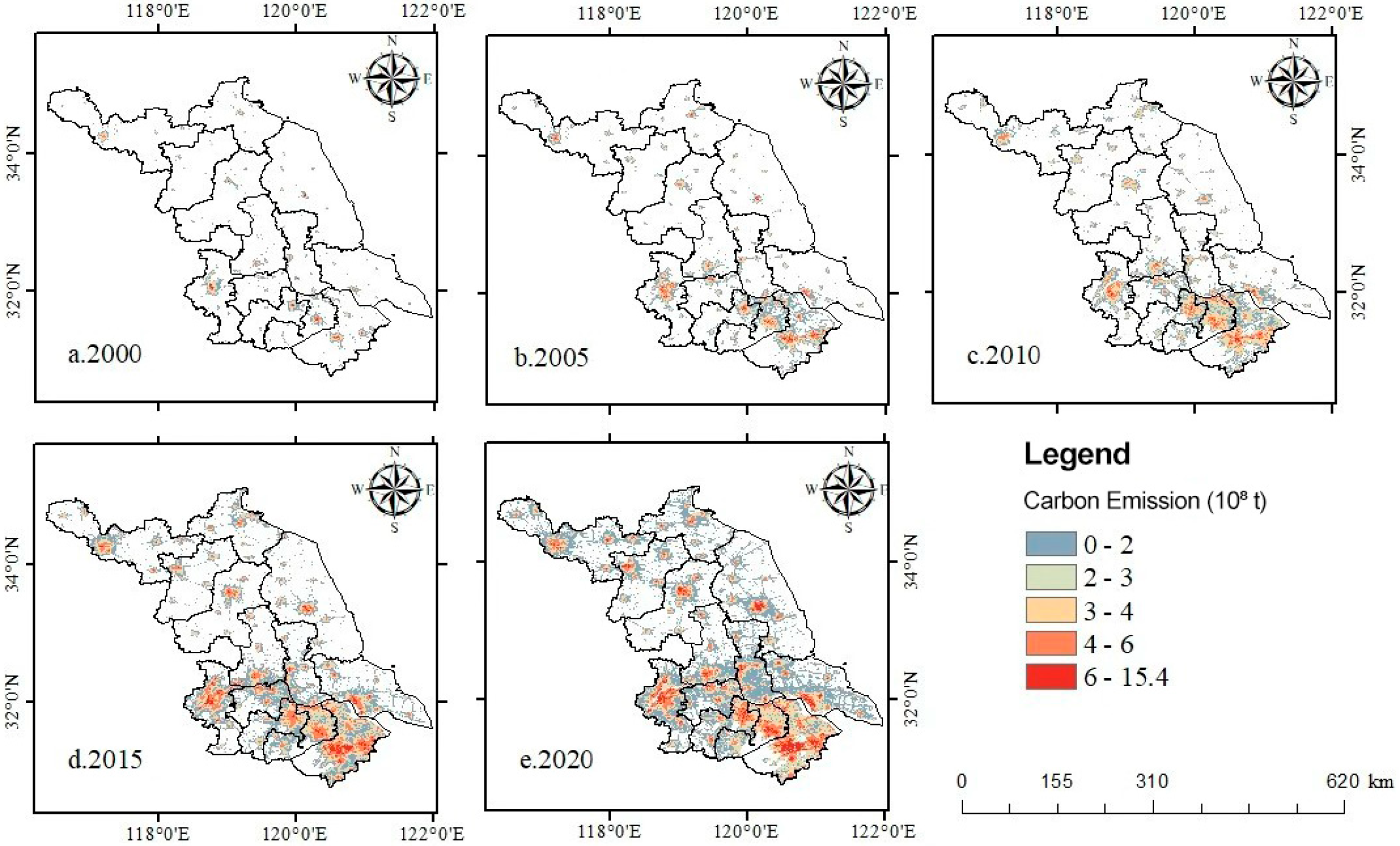
Figure 3 illustrates the simulated grid-scale spatial distribution of energy-related carbon emissions in Jiangsu Province from 2000 to 2020 based on nighttime light data. The figure reveals a pronounced zonal pattern of carbon emissions in Jiangsu during this period, characterized by “higher emissions in the south, lower emissions in the north, and agglomeration along the Yangtze River.” High-carbon-emission areas are highly concentrated in the built-up areas of southern Jiangsu and cities along the Yangtze River (e.g., Suzhou, Nanjing, Wuxi, and Changzhou), forming an east–west trending high-density emission belt that diminishes from south to north and from the riverfront toward inland areas.
In 2000, carbon emissions in Jiangsu were generally low, with high-value areas scattered in a point-like distribution across core cities in southern Jiangsu. By 2005, the density of high-carbon centers in southern Jiangsu increased and began to coalesce into contiguous patches, with emissions diffusing toward central Jiangsu (Nantong, Taizhou). By 2010, southern Jiangsu and the cities along the Yangtze had nearly merged into a continuous high-intensity emission belt, while emission centers in northern Jiangsu, such as Xuzhou, became more prominent. In 2015, the overall pattern exhibited a “dual-core” characteristic centered on Nanjing and Suzhou, with Xuzhou emerging as a new secondary center of industrial carbon emissions within the province. Although policy measures curbed emission growth in core areas, the spatial extent of high-value coverage continued to expand [16]. By 2020, the “dual-core” spatial pattern was no longer significant; owing to the high-intensity emission network across Suzhou, Wuxi, and Changzhou, the spatial pattern of industrial carbon emissions shifted toward a “single-core” configuration centered on Suzhou, extending northwestward [17]. This evolution is closely linked to Jiangsu’s “Development Along the Yangtze River” strategy [18] and the industrial relocation from southern to northern Jiangsu: southern Jiangsu, driven by foreign-invested industrialization, formed high-density energy consumption agglomerations, whereas northern Jiangsu experienced gradual growth in carbon emission centers accompanying the deployment of heavy and chemical industries.

3.2. Theil–Sen Trend Analysis and Mann–Kendall Test

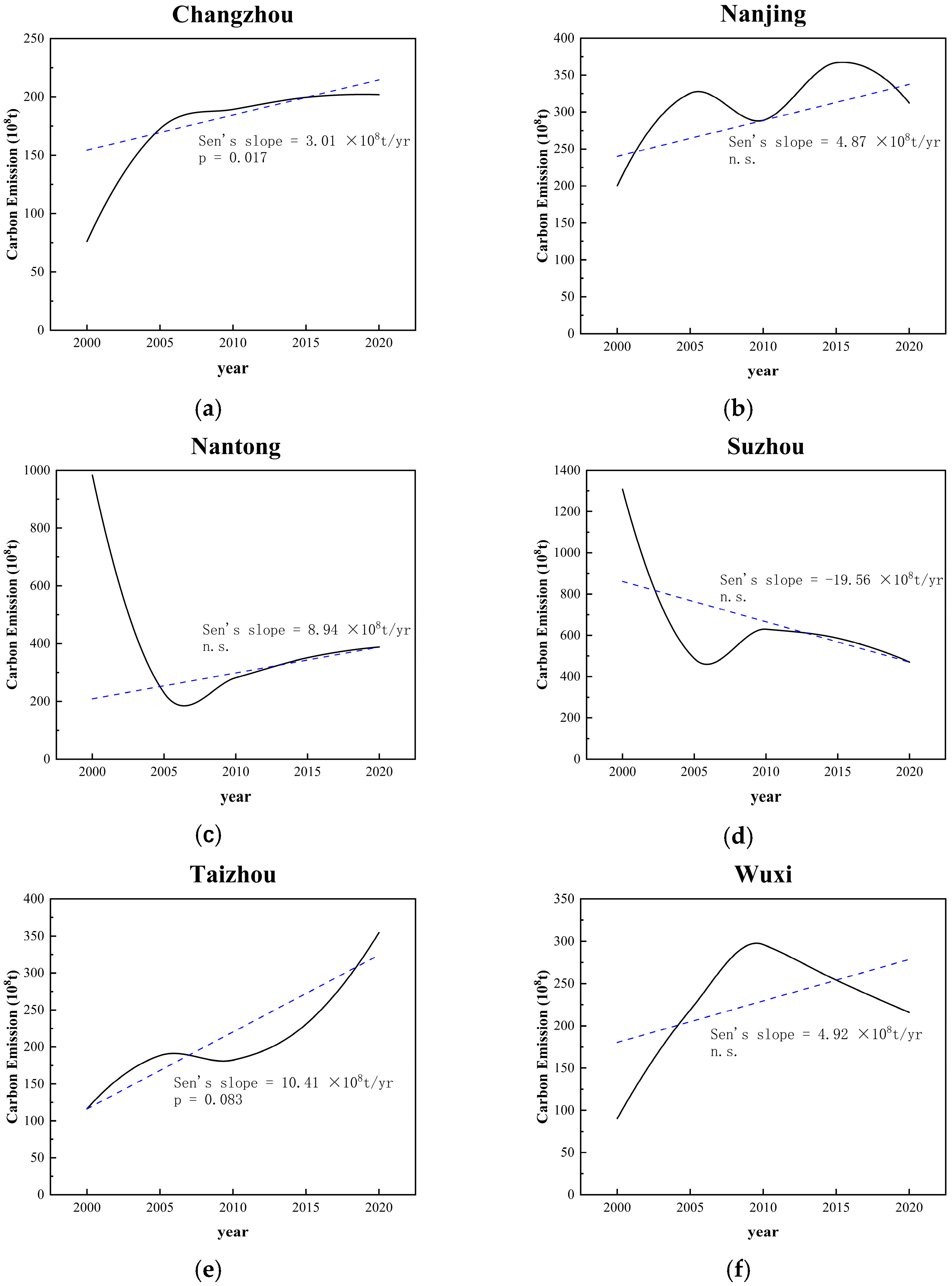
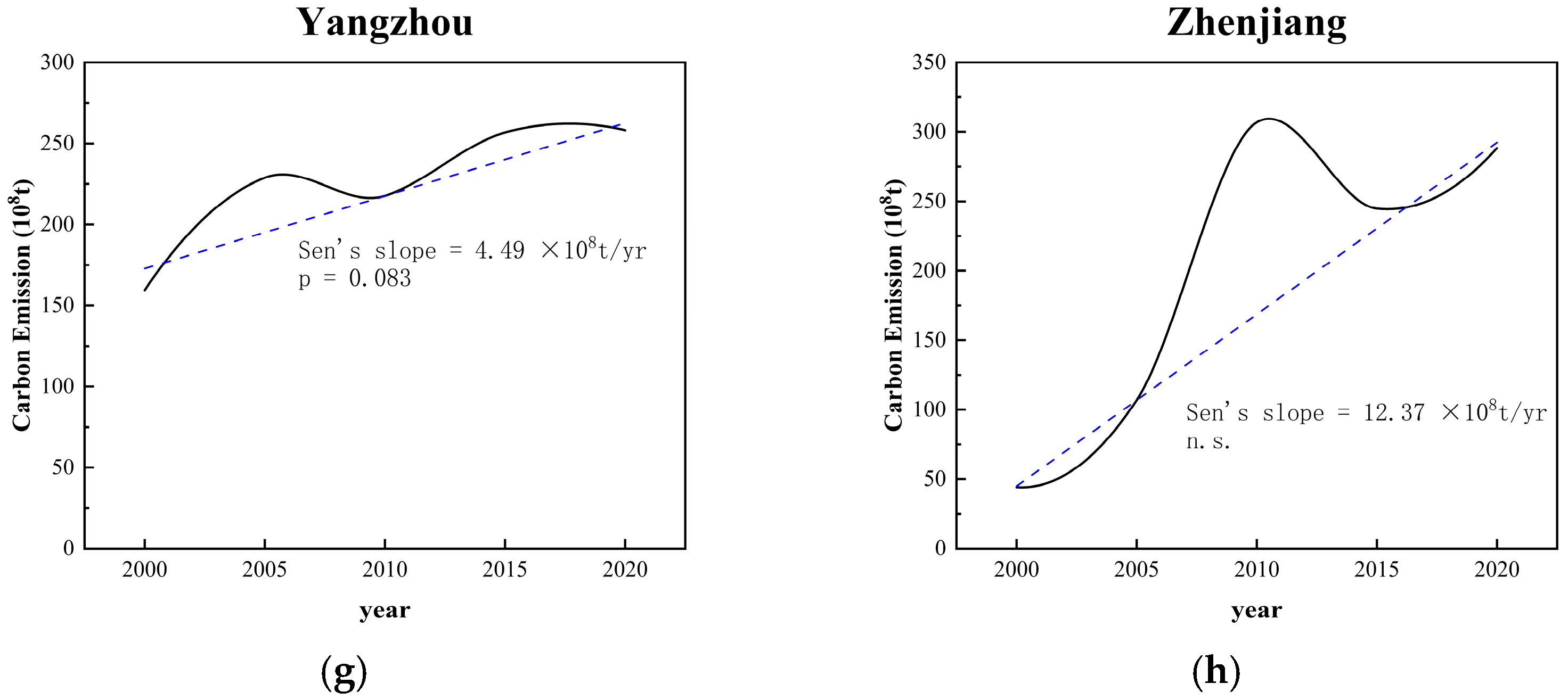
To further reveal the temporal change rate of carbon emissions in the core area of southern Jiangsu and along the Yangtze River, this study extracted the total carbon emissions of eight representative counties (Changzhou, Nanjing, Nantong, Suzhou, Taizhou, Wuxi, Yangzhou, and Zhenjiang) within this region to characterize the overall emission level of the southern part of the study area. A time-series line chart of total carbon emissions in the region from 2000 to 2020 was drawn using Origin 2024 (OriginLab Corporation, Northampton, MA, USA) software, and the long-term trend line was fitted using the Theil–Sen method (Figure 4). The Theil–Sen slope represents the average annual increment in carbon emissions, and the Mann–Kendall test was employed to evaluate the statistical significance of the trend.
The results show that carbon emissions in the southern part of the study area exhibited a significant monotonic increasing trend from 2000 to 2020 (Theil–Sen slope = 3.01 × 10⁸ t/yr, Mann–Kendall τ = 1.00, exact two-tailed p = 0.0167), indicating a statistically significant growth rate. The line chart reveals that the growth rate of carbon emissions was highest during 2000–2005, then gradually slowed down, and approached a plateau during 2015–2020. This trajectory is consistent with the actual progress of Jiangsu’s “Development Along the Yangtze River” strategy, the industrial restructuring in southern Jiangsu, and the implementation of energy conservation and emission reduction policies—early rapid aggregation of foreign-investment-driven heavy and chemical industries led to a surge in emissions, whereas after 2010 the growth momentum of emissions notably weakened due to improved energy efficiency and the phasing out of outdated capacity [18].

3.3. Spatial Distribution Differences in per Capita Energy Carbon Emissions

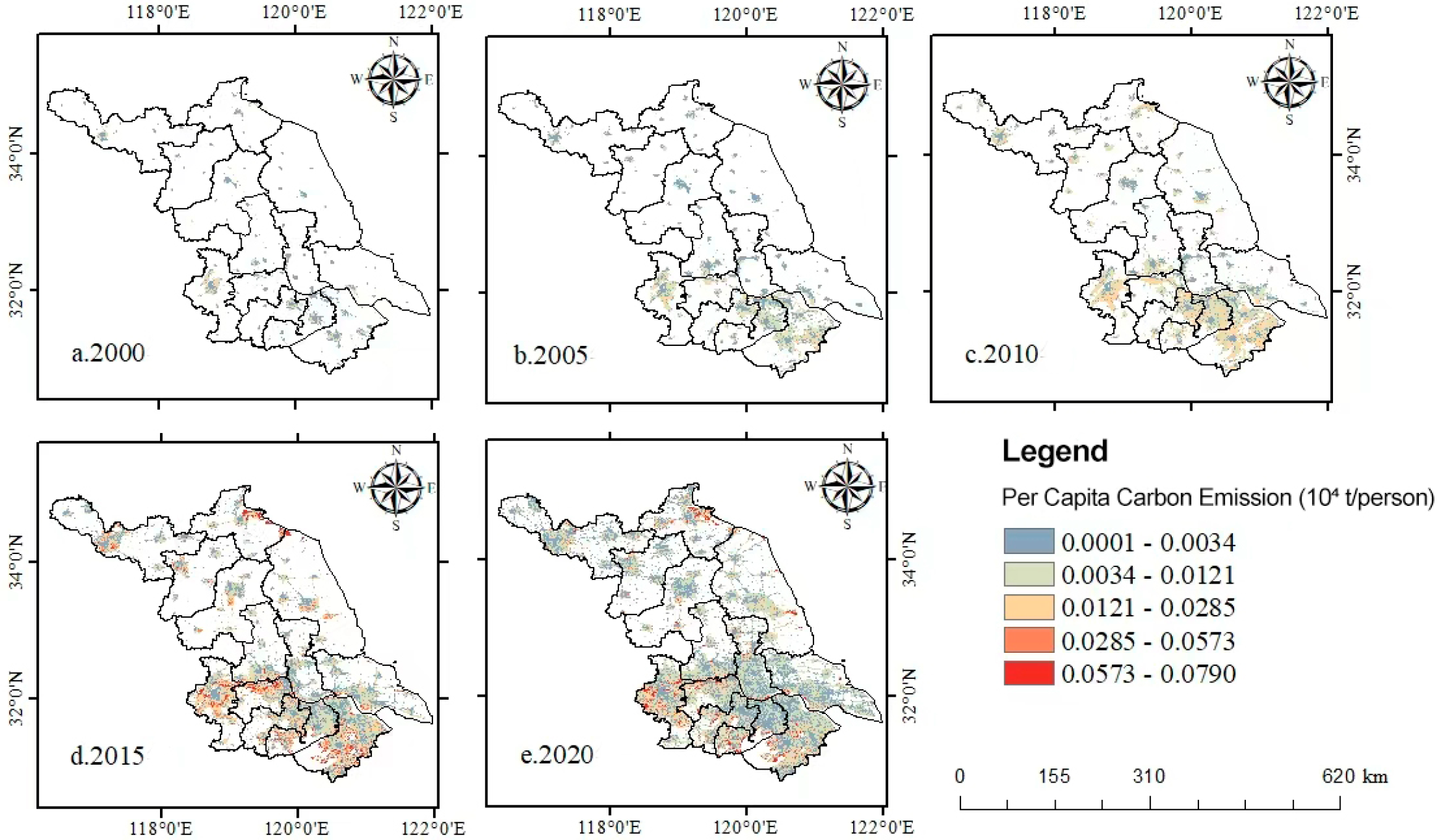
The spatial distribution of population in Jiangsu Province was derived by clipping the kilometer-grid population distribution dataset provided by the Resource and Environmental Science and Data Center of the Chinese Academy of Sciences. Overlaying the carbon emission grid with the population distribution data generated the spatial distribution map of per capita carbon emissions in Jiangsu from 2000 to 2020 (Figure 5).
Between 2000 and 2015, the coverage of per capita carbon emissions in Jiangsu gradually expanded, with the majority remaining at relatively low levels. Higher-level areas appeared sporadically, primarily concentrated in cities such as Nanjing, Zhenjiang, and Lianyungang. From 2000 to 2005, per capita carbon emissions were predominantly low, with no clear distinction between high-value and low-value areas. By 2005, per capita carbon emissions in Jiangsu grew rapidly, and initial medium-value zones began to form in Nanjing, Suzhou, and Wuxi. In 2010, per capita emissions along the Yangtze River surged, creating extensive medium-value areas. By 2015, large contiguous medium–high-value areas had formed in Nanjing, Suzhou, and Wuxi, with per capita carbon emission intensity gradually expanding northwestward and low-value areas exhibiting a dispersed distribution. By 2020, the economic belt along the Yangtze River had developed into a continuous high-value region, a mature secondary high-value center had consolidated in Xuzhou in northern Jiangsu, and the distribution of low-value areas transitioned from a scattered, point-like pattern to a more linear configuration.
Spatially, the transfer of high-carbon industries in Jiangsu exhibits clear regional gradient disparities: southern Jiangsu is characterized primarily by net outflows, northern Jiangsu by net inflows, while central Jiangsu shows limited activity in both inflow and outflow. This pattern is closely related to the industrial division and functional positioning of each region. Southern Jiangsu, acting as a “growth pole,” continues to undergo industrial restructuring, whereas northern Jiangsu has absorbed a considerable volume of high-carbon industries. This pattern explains why per capita emissions remain persistently high along the Yangtze River due to substantial economic output and dense manufacturing, while rapid development of heavy and chemical industries in northern Jiangsu has driven a sharp increase in per capita emissions there [18].

3.4. Spatial Distribution Differences in Carbon Emission Intensity

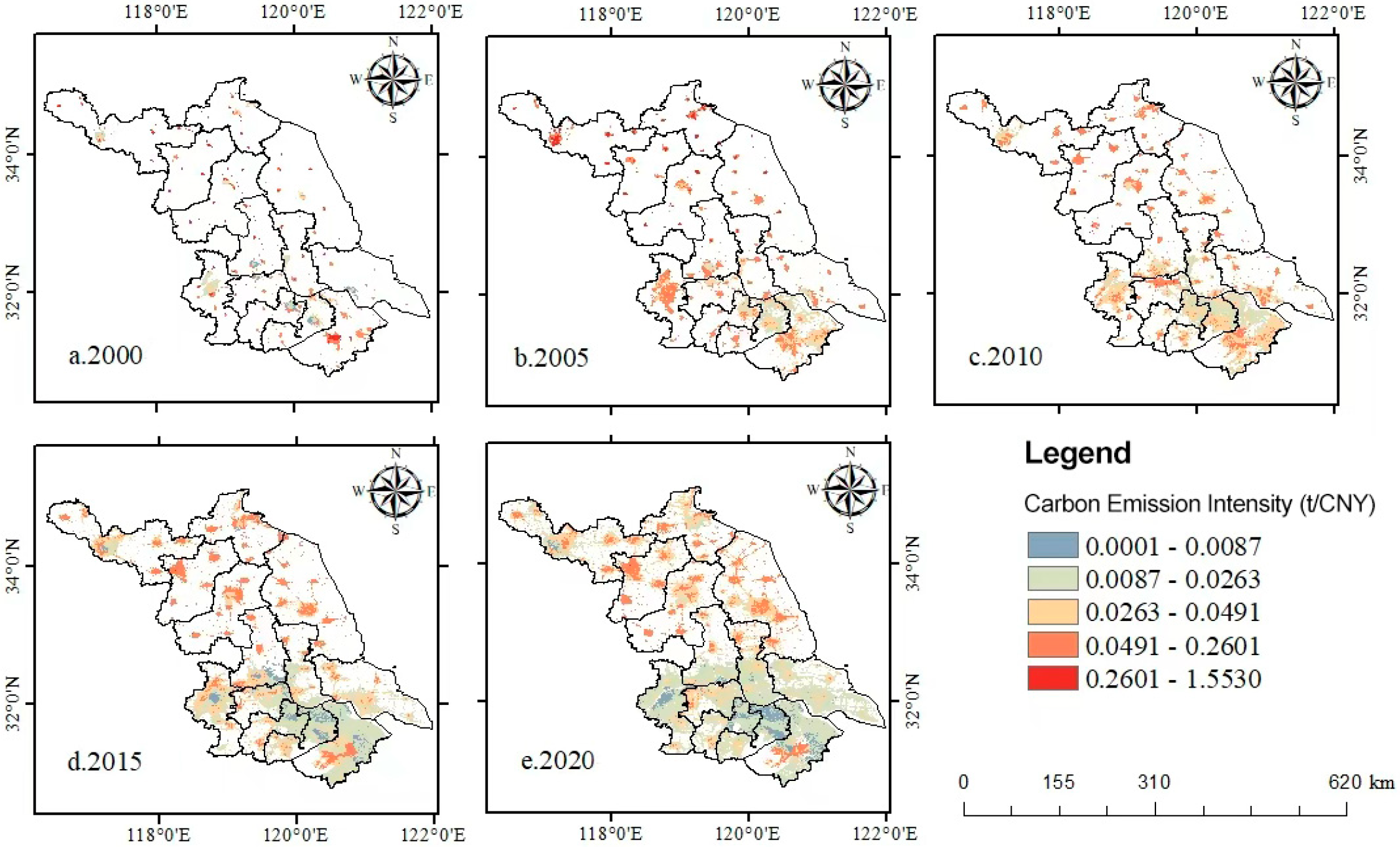
The spatial distribution of carbon emission intensity per unit of GDP in Jiangsu Province differs from that of per capita carbon emissions. As shown in Figure 6, carbon emission intensity exhibited a significant overall downward trend from 2000 to 2020, with a spatial pattern characterized by “higher in the south, lower in the north, and sustained pressure in core areas.”
In 2000, high-value areas were sporadically distributed in the urban centers of southern Jiangsu and localized parts of northern Jiangsu. Between 2005 and 2010, emission intensity declined broadly across the province, and the extent of low-value areas expanded substantially. In 2015, new contiguous zones of medium–high intensity emerged in southern Jiangsu and certain areas along the Yangtze River, potentially reflecting periodic expansion of energy-intensive industries or regional disparities in the pace of energy efficiency improvements. During 2010–2020, high-value carbon emission hot spots became notable in northern Jiangsu, which resulted from a combination of multiple factors: rising costs in the developed southern Jiangsu pushed high-carbon industries such as metallurgy, chemical engineering, and textiles to relocate northward, shifting carbon emissions along with production capacity; meanwhile, provincial policies actively promoted north–south pairing and co-building of industrial parks, accelerating the northward movement of manufacturing and correspondingly increasing energy demand and carbon emissions. Northern Jiangsu is more dependent on coal and has lower energy efficiency than southern Jiangsu [19,20]. By 2020, the pattern stabilized, exhibiting a gradient decline from south to north. The Yangtze River region maintained high emission intensity due to its massive economic scale and dense manufacturing sector, while northern Jiangsu experienced a rapid rise in emissions driven by the swift expansion of heavy and chemical industries. Together, these dynamics shape a spatial configuration of carbon emissions in Jiangsu characterized by “high emissions in the south and rising emissions in the north.” Despite technological advances in energy conservation within economically developed areas, their substantial economic scale results in higher per-unit-GDP carbon emissions compared to those in northern Jiangsu [16,17].

3.5. Spatial Distribution of Cold and Hot Spots of Energy Consumption Carbon Emissions

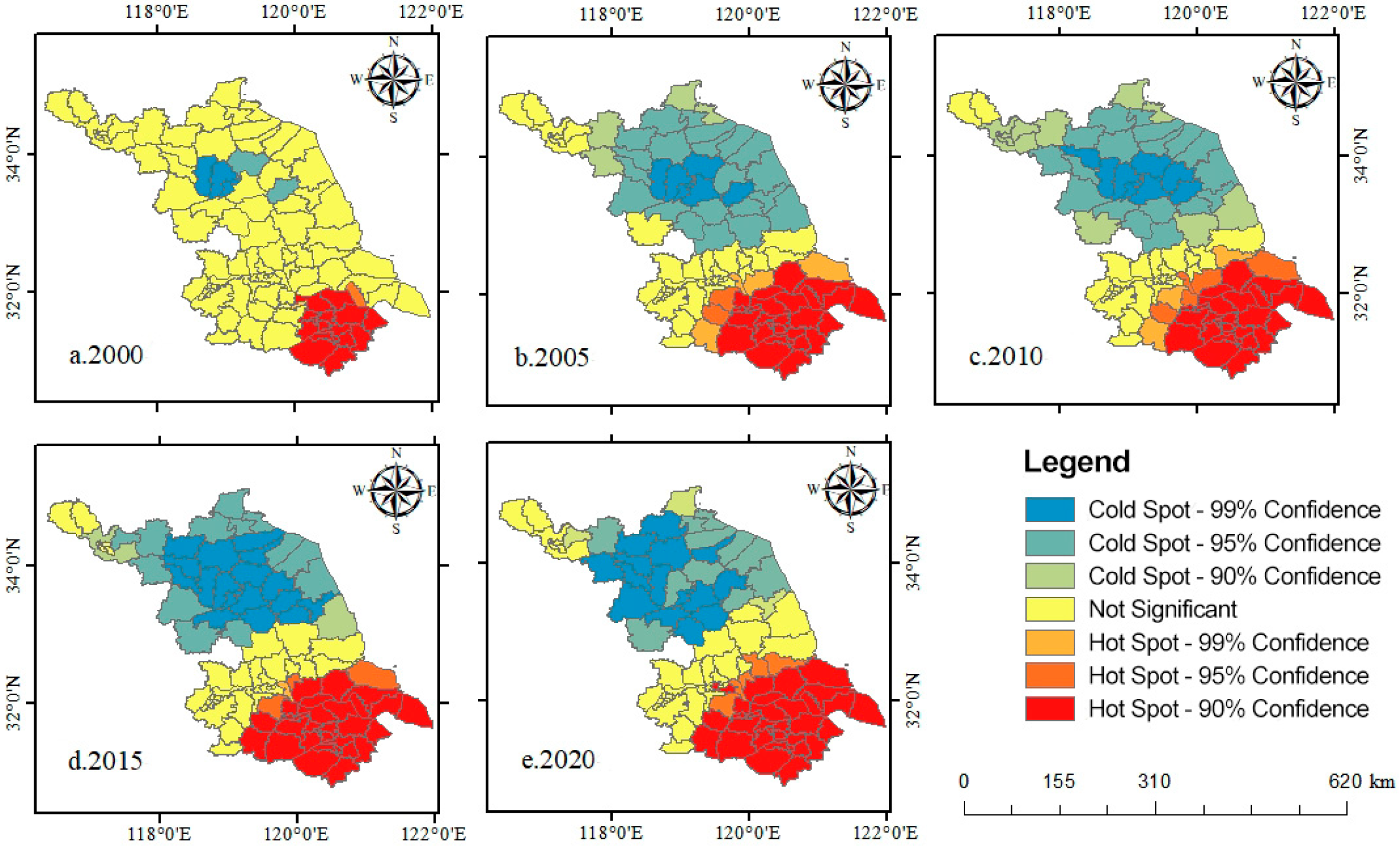
This study employed the hot spot analysis tool within the QGIS spatial analysis plugin to map the extent of cold and hot spots of energy-related carbon emissions in Jiangsu Province (Figure 7).
Hot spot areas are predominantly located in southern Jiangsu and along the Yangtze River, expanding along the river corridor over time to ultimately form a continuous, inverted “L-shaped” high-carbon-emission corridor (Nanjing–Suzhou–Nantong–coastal Yancheng). Cold spot areas are persistently concentrated in the northwestern part of Jiangsu (Suqian, northern Xuzhou, western Lianyungang), appearing as contiguous patches. In 2000, hot spots were concentrated in the urban districts of Suzhou–Wuxi–Changzhou, Nanjing, and Nantong. By 2005, they had extended to Taizhou and Yangzhou, with secondary hot spots beginning to appear in Xuzhou. By 2010, the belt along the Yangtze River was largely contiguous. By 2015, the “L-shaped” corridor had become clearly defined. The pattern of cold and hot spots remained relatively stable from 2015 to 2020, with only gradual changes observed.
This distribution pattern indicates that carbon emissions are intrinsically linked to factors such as urban economy, population, and industrial structure. Industries attract population influx, populations engage in production, and production processes accelerate energy consumption, inevitably leading to increased carbon dioxide emissions. Hot spot areas correspond to regions with dense manufacturing and port logistics industries, whereas cold spot areas correspond to traditional agricultural zones. The expansion of hot spots toward coastal areas is closely associated with Jiangsu’s coastal development strategy and the spatial layout of heavy and chemical industries [18].

3.6. Spatial Gradation of County-Level Energy Consumption Carbon Emissions

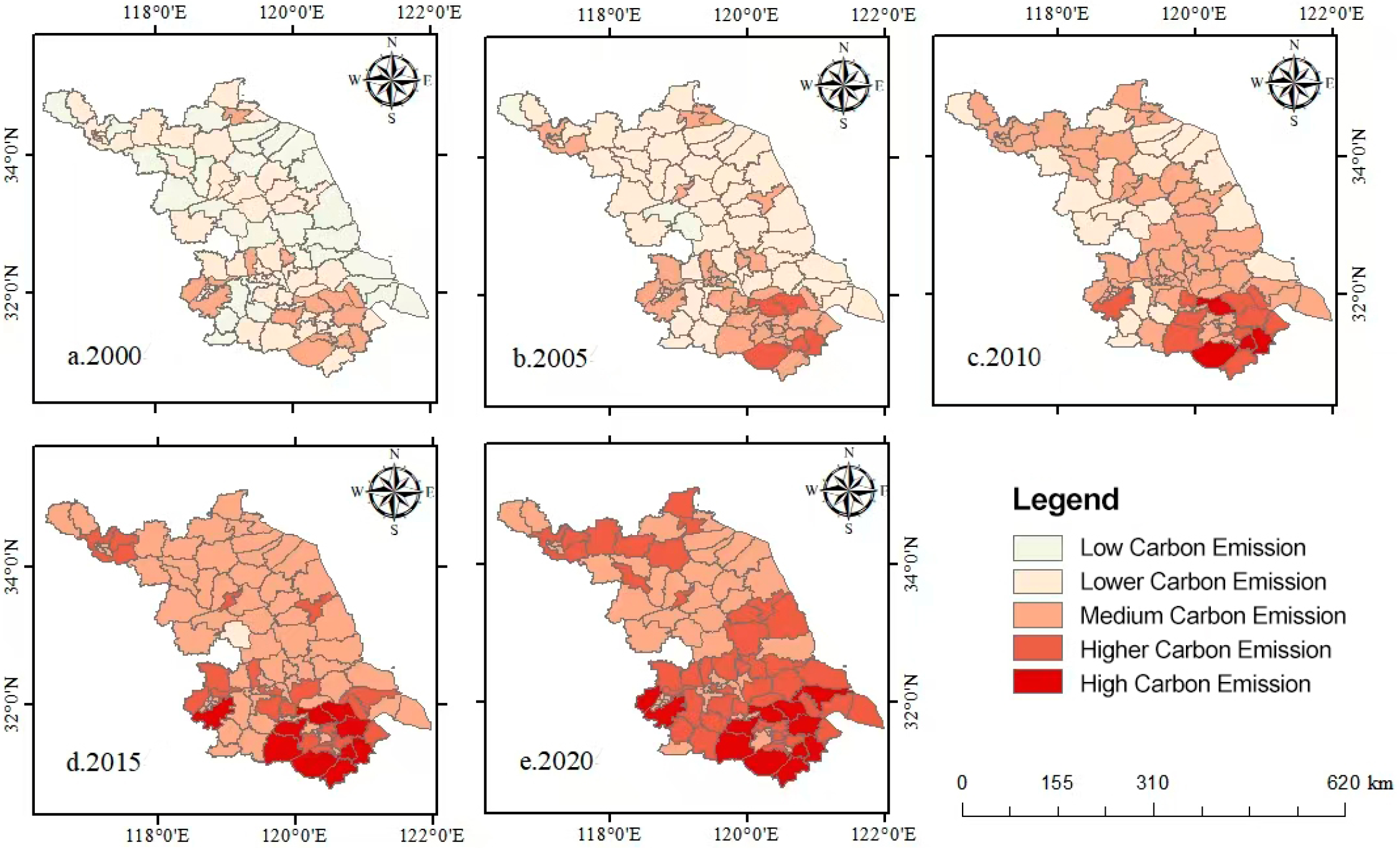
This study aggregated carbon emission grid data to the county level and classified total carbon emissions into five tiers to illustrate the spatiotemporal evolution characteristics at the county scale in Jiangsu Province: low (<200,000 t), relatively low (0.2–1.5 million t), medium (1.5–8 million t), relatively high (8–16.8 million t), and high (>16.8 million t) (Figure 8).
Between 2000 and 2010, carbon emissions in Jiangsu grew rapidly, and spatial agglomeration characteristics became increasingly evident, gradually forming a “high-emission belt along the Yangtze River.” In 2000, provincial emissions were predominantly at low and relatively low levels, with high-emission areas scattered sporadically across central cities in southern Jiangsu, such as Suzhou, Wuxi, and Nanjing. By 2005, high and relatively high emission tiers in southern Jiangsu expanded significantly and began to extend eastward and westward along both banks of the Yangtze River. By 2010, a “high-emission belt along the Yangtze River,” centered on Suzhou–Wuxi–Changzhou and extending westward to Nanjing and eastward to Nantong, had initially taken shape, with spatial agglomeration becoming increasingly pronounced. By 2015, this belt continued to expand steadily, with the number of counties in high-emission tiers continuously increasing. Concurrently, the emission tier of Xuzhou’s urban district and its surrounding areas in northern Jiangsu rose significantly, establishing an independent regional high-value center. By 2020, the spatial pattern of carbon emissions had stabilized into a gradient structure characterized by “one belt, one core”: the “belt” refers to the east–west trending high-emission zone along the Yangtze River, and the “core” refers to the high-value center in Xuzhou.

4. Discussion

4.1. Comparison with Existing Literature

At the data level, based on the traditional reliance on statistical data [21], this study incorporates NPP-VIIRS nighttime light data, substantially improving the real-time monitoring capability of the spatiotemporal evolution of carbon emissions. By taking advantage of the high-frequency updating and radiometric calibration of NPP-VIIRS, it enables a comparable analysis of long-term changes in carbon emission intensity, outperforming the traditional DMSP/OLS series in terms of data stability and temporal continuity.
At the research perspective level, Jiangsu Province is highly industrialized, urbanized, and concentrated in energy consumption. This study focuses on examining the distribution patterns of energy consumption carbon emissions, i.e., carbon emissions generated by energy use in human production and daily activities. Studies such as Wang Zheyu et al. [22] have concentrated on direct and indirect carbon emissions from land-use types. The perspective of this study facilitates the discussion of energy structure optimization and the effects of energy conservation and emission reduction policies under the “dual carbon” goals, avoiding biases caused by uncertainties in carbon coefficients of different land-use types.

4.2. Limitations and Future Prospects

  • Insufficient sectoral emission disaggregation. Due to data limitations, carbon emissions from industry, transportation, and residential activities could not be distinguished, yet their driving mechanisms differ. Future research can incorporate multi-source data to achieve sectoral decomposition of carbon emissions, providing a basis for targeted emission reductions.
  • In calculating carbon emissions, this study only considered CO2 generated from a limited set of fossil energy types. In reality, energy consumption produces carbon emissions while green vegetation absorbs carbon; carbon sources and sinks cyclically alternate and jointly sustain human production and livelihood needs. Future research should simultaneously consider both carbon sources and sinks, so as to formulate carbon emission policies better suited to the actual conditions of different regions.
  • Spatial effects were not quantified. Jiangsu has close economic and industrial connections with neighboring provinces such as Shanghai, Zhejiang, and Anhui, and carbon emissions might be influenced by cross-provincial spatial spillover effects. Future work can introduce spatial econometric models (e.g., the Spatial Durbin Model) to evaluate the influence of inter-provincial interactions on Jiangsu’s carbon emission pattern [22].
  • On the basis of studying spatiotemporal changes of carbon emissions, future research can further integrate national carbon reduction policies to project regional carbon emission patterns under different development scenarios. This can help identify potential developmental bottlenecks under low-carbon constraints, thereby enabling more targeted measures in aspects such as urban structure optimization to better promote the achievement of the “dual carbon” goals. In the future, system dynamics or computable general equilibrium (CGE) models can be employed to forecast the trajectory of Jiangsu’s carbon emissions under various policy scenarios and identify critical emission reduction nodes.
  • The time-series length of this study is 2000–2020. Although it covers the latest 20 years, it cannot trace carbon emission changes further back, which may affect a comprehensive assessment of long-term trends. Future studies can extend the time series back to 1990 or earlier to more fully capture the historical transformation process of carbon emissions.
  • This study found that carbon emissions in Jiangsu Province show a “polycentric” pattern, which is consistent with the parallel development of multiple economic centers in southern Jiangsu. Compared with provincial-scale studies, the county-level analysis reveals finer spatial heterogeneity. This study also found a “decoupling” phenomenon between the spatial patterns of per capita carbon emissions and carbon emission intensity [20]—in hot spot areas, per capita emissions are high but intensity declines rapidly, while emission intensity remains high in certain counties of northern Jiangsu. This indicates that a “two-pronged” approach is needed when designing emission reduction policies: for developed regions, the emphasis should be on optimizing the existing economic structure and continuously reducing emission intensity; for regions still in the process of industrialization, the carbon emission level of new production capacity must be strictly controlled.

5. Conclusions

  • During 2000–2020, county-level carbon emissions in Jiangsu Province exhibited an overall pattern of “higher in the south, lower in the north, and agglomeration along the Yangtze River,” with the Suzhou–Wuxi–Changzhou, Nanjing, and Nantong areas forming an inverted “L-shaped” high-carbon-emission corridor, and the carbon emission growth trend in the southern core area was statistically significant.
  • From 2000 to 2020, the spatial pattern of carbon emissions transitioned from a “unipolar high-intensity agglomeration” to a configuration marked by “zonal diffusion coexisting with multi-point agglomeration.” Hot spot areas expanded persistently along the Yangtze River and the coast, while cold spot areas remained stable in the northwestern region.
  • High per capita carbon emission areas remain consistently clustered along the Yangtze River, whereas high carbon emission intensity areas have shifted toward certain counties in northern Jiangsu, reflecting a spatial transfer of carbon footprints associated with industrial relocation.
To achieve differentiated carbon emission reductions, strategies should be formulated according to regional development stages: core areas in southern Jiangsu should prioritize optimizing existing industries and promoting clean energy development; newly developing areas in northern Jiangsu must strictly control the addition of new high-energy consumption and high-emission projects; and coastal areas can fully leverage their advantages in renewable energy such as wind and solar power.

Author Contributions

Conceptualization, X.L. and G.S.; methodology, X.L.; software, X.L.; validation, X.L. and G.S.; formal analysis, X.L.; investigation, X.L.; data curation, X.L.; writing—original draft preparation, X.L.; writing—review and editing, G.S.; visualization, X.L.; supervision, G.S.; project administration, G.S.; funding acquisition, X.L. and G.S. All authors have read and agreed to the published version of the manuscript.

Funding

This work is the result of and supported by the National College Student Innovation and Entrepreneurship Training Program (Grant No. 202510291057). This research is supported by the Science and Technology Project of Xizang Autonomous Region under Grant XZ202601ZY0171.

Data Availability Statement

The data presented in this study are openly available from public repositories. The nighttime light data can be obtained from the Defense Meteorological Satellite Program (DMSP) and the Visible Infrared Imaging Radiometer Suite (VIIRS) archives. The energy consumption and carbon emission data are sourced from the China Energy Statistical Yearbook and Jiangsu Provincial Statistical Yearbooks, which are publicly accessible.

Acknowledgments

The authors thank the program for its support.

Conflicts of Interest

The authors declare no conflicts of interest. The funder had no role in the design of the study; in the collection, analyses, or interpretation of data; in the writing of the manuscript; or in the decision to publish the results.

References

  1. Zhou, F.; Li, X.B.; Song, G.C.; Pi, G.Y.; Wang, J.F.; Li, H.J.; Zhou, T. Research Progress on Greenhouse Gas Carbon Dioxide. Shandong Chem. Ind. 2025, 54, 75–78. [Google Scholar] [CrossRef]
  2. Yang, H.L.; Yang, M. Carbon Peak and Carbon Neutrality: The Path of Energy Transformation in Chinese Modernization. Econ. Probl. 2024, 1–7. [Google Scholar] [CrossRef]
  3. Jiang, Z.; Lin, J.; He, T.L.; Jiang, F.; Jin, J.; Qin, K.; Shen, L.; Yang, P.; Zang, Z.; Zhang, L.; et al. Satellite-Based Emission Inversion for Air Pollutants and Greenhouse Gases: A Review. J. Meteorol. Res. 2025, 39, 1101–1125. [Google Scholar] [CrossRef]
  4. Zhang, Y.N.; Pan, J.H. Spatio-temporal Simulation and Differentiation Pattern of Carbon Emissions in China Based on DMSP/OLS Data. China Environ. Sci. 2019, 39, 1436–1446. [Google Scholar] [CrossRef]
  5. Li, L.L.; Xu, G.L.; Deng, G.M.; Yang, M.; Wu, Z.J.; Ling, Y.N. Analysis of Spatiotemporal Evolution Characteristics of Energy Carbon Emissions in the Middle and Lower Reaches of the Yangtze River Based on Nighttime Light Data. Energy Conserv. 2025, 44, 99–104. [Google Scholar] [CrossRef]
  6. Liu, S.J.; Xue, L. Exploring the Spatio-temporal Changes of Economic Development in Shaanxi Province Using Nighttime Light Data. Remote Sens. Inf. 2021, 36, 113–121. [Google Scholar] [CrossRef]
  7. Li, F.; Liao, S.B.; Liu, W.L. Research on Economic Resilience of Counties in the Beijing–Tianjin–Hebei Region Based on Nighttime Light Remote Sensing Data under the Impact of the Epidemic. Geomat. Spat. Inf. Technol. 2025, 48, 1–4+11. [Google Scholar] [CrossRef]
  8. Lin, J.N.; Yang, J. Study on Urban Expansion in Henan Province Based on VBANUI Nighttime Light Regulation Index. Resour. Guide 2023, 35–40. [Google Scholar] [CrossRef]
  9. National Bureau of Statistics. China Statistical Yearbook 2024; China Statistics Press: Beijing, China, 2025.
  10. Chen, Z.; Yu, B.; Yang, C.; Zhou, Y.; Yao, S.; Qian, X.; Wang, C.; Wu, B.; Wu, J. An Extended Time Series (2000–2018) of Global NPP-VIIRS-Like Nighttime Light Data from a Cross-Sensor Calibration. Earth Syst. Sci. Data 2021, 13, 889–906. [Google Scholar] [CrossRef]
  11. National Bureau of Statistics. China Statistical Yearbook 2004–2023; China Statistics Press: Beijing, China, 2024.
  12. National Bureau of Statistics. China Energy Statistical Yearbook 2004–2024; China Statistics Press: Beijing, China, 2025.
  13. Jiangsu Provincial Bureau of Statistics; Survey Office of the National Bureau of Statistics in Jiangsu. Jiangsu Statistical Yearbook 2004–2023; China Statistics Press: Beijing, China, 2024.
  14. IPCC. IPCC Guidelines for National Greenhouse Gas Inventories. Available online: http://www.ipcc-nggip.iges.or.jp (accessed on 5 February 2025).
  15. Zhang, H.L. Spatiotemporal Characteristics and Driving Forces of Carbon Emissions from Energy Consumption in China Based on DMSP/OLS Nighttime Light Data. Master’s Thesis, Lanzhou University, Lanzhou, China, 2019. [Google Scholar]
  16. Zeng, N.; Tang, W.; Xu, W.J. Coupling Coordination Evaluation of Ecological Environment Sensitivity and Socio-Economic Development in the Main Urban Area of Hangzhou. Geogr. Sci. Res. 2023, 12, 396–405. [Google Scholar] [CrossRef]
  17. Zhang, Y. Study on the Spatio-temporal Evolution of Industrial Carbon Emissions and Carbon Transfer in Jiangsu Province under Industrial Transfer. Jiangsu Sci. Technol. Inf. 2023, 40, 64–67. [Google Scholar] [CrossRef]
  18. Chen, W.; Duan, X.J.; Zuo, W.F. Development Mode and Path of the Basic Industry Belt along the Yangtze River in Jiangsu Province. Areal Res. Dev. 2005, 24, 17–20. [Google Scholar] [CrossRef]
  19. Yu, Y.Y.; Zhang, Y.Y. Decomposition and Decoupling Analysis of Influencing Factors of Industrial Carbon Emissions in Jiangsu Province. Mod. Ind. Econ. Informationization 2025, 15, 165–169. [Google Scholar] [CrossRef]
  20. Yang, X.Y.; Lin, Y.; Chen, L.G. Analysis of land-use carbon emissions and influencing factors in provincial metropolitan areas: A case study of Jiangsu. Resour. Environ. Yangtze Basin 2025, 34, 1972–1986. (In Chinese) [Google Scholar]
  21. Ma, G.B.; Lu, R.C.; Wu, B. Spatiotemporal evolution characteristics and driving mechanism of county-level land-use carbon emissions in Guangxi. Chin. J. Agric. Resour. Reg. Plan. 2025, 46, 153–166. (In Chinese) [Google Scholar]
  22. Wang, Z.Y.; Cao, P.; Han, L.; Wang, X.N. Spatiotemporal variation characteristics and influencing factors of land-use carbon emissions at the county scale: A case study of Shaanxi Province. J. Xi’an Univ. Technol. 2025, 41, 314–323+389. (In Chinese) [Google Scholar] [CrossRef]
Figure 1. Schematic map of the study area.
Eesp 42 00008 g001
Figure 2. Processed results of nighttime light data for Jiangsu Province.
Eesp 42 00008 g002
Figure 3. Simulated spatial distribution of energy consumption carbon emissions in Jiangsu Province, 2000–2020.
Eesp 42 00008 g003
Figure 4. Changing trend of total carbon emissions of representative counties in southern Jiangsu Province, 2000–2020. (a) Changzhou; (b) Nanjing; (c) Nantong; (d) Suzhou; (e) Taizhou; (f) Wuxi; (g) Yangzhou; (h) Zhenjiang.
Eesp 42 00008 g004aEesp 42 00008 g004b
Figure 5. Spatial distribution of per capita carbon emission intensity in Jiangsu Province, 2000–2020.
Eesp 42 00008 g005
Figure 6. Spatial distribution of carbon emission intensity per unit of GDP in Jiangsu Province, 2000–2020.
Eesp 42 00008 g006
Figure 7. Spatial distribution of county-level cold and hot spots of energy consumption carbon emissions in Jiangsu Province, 2000–2020.
Eesp 42 00008 g007
Figure 8. County-level spatial gradation of energy consumption carbon emissions in Jiangsu Province, 2000–2020.
Eesp 42 00008 g008
Table 1. Carbon emission coefficients for various energy types.
Energy TypeStandard Coal Conversion Factor (tce/t)Carbon Emission Coefficient (104 t C/104 tce)
Raw Coal0.71430.7559
Coke0.97140.8550
Crude Oil1.42860.5857
Gasoline1.47140.5538
Kerosene1.47140.5714
Diesel1.45710.5921
Fuel Oil1.42860.6185
LPG1.71430.5042
Electricity0.12290.2132
Disclaimer/Publisher’s Note: The statements, opinions and data contained in all publications are solely those of the individual author(s) and contributor(s) and not of MDPI and/or the editor(s). MDPI and/or the editor(s) disclaim responsibility for any injury to people or property resulting from any ideas, methods, instructions or products referred to in the content.