1. Introduction
Drought is a slow-onset natural hazard that can persist for months or years and affect multiple sectors, including agriculture, water supply, hydropower and ecosystems. In many regions of the world, including the Mediterranean, evidence from recent climatological studies indicates an increase in the frequency, duration and severity of droughts, mainly driven by climate variability and climate change [
1,
2]. Greece, located in the eastern Mediterranean, is considered particularly vulnerable to drought due to its limited water resources, strong seasonality and increasing water demand.
Drought is usually defined as a sustained deficit of water relative to normal conditions and is commonly classified into meteorological, agricultural, hydrological and socio-economic drought, depending on the affected part of the hydrological cycle and the associated impacts. A large number of quantitative drought indices have been developed in the literature; among these, the Standardized Precipitation Index (SPI), the Standardized Precipitation–Evapotranspiration Index (SPEI) and streamflow-based indices, such as the Standardized Runoff Index (SRI), are widely used because they allow comparison of drought conditions across regions and time scales [
3,
4,
5].
Recent studies in Europe and the Mediterranean have demonstrated the usefulness of SPI and SPEI for characterizing drought patterns and trends under changing climatic conditions [
1,
2]. In Greece, several works have analyzed meteorological drought using SPI and related indicators and have revealed strong spatial variability as well as an emerging tendency towards more frequent and intense dry conditions in many regions, particularly in central and southern parts of the country [
6,
7,
8]. In Thessaly, and specifically in the Pinios River Basin, droughts combined with intensive irrigation and groundwater abstractions have repeatedly stressed local water resources and have highlighted the need for robust monitoring tools and management strategies [
6,
7].
In parallel, the increasing availability of high-resolution satellite precipitation products and climate reanalysis datasets has opened new possibilities for drought assessment in regions with sparse or incomplete observation networks. The CHIRPS precipitation dataset provides quasi-global rainfall estimates at fine spatial and temporal resolution from 1981 onwards [
8], whereas the ERA5 reanalysis system offers consistent global fields of atmospheric and land-surface variables, including temperature, over several decades [
9]. When combined with conceptual water-balance models, such as the University of Thessaly monthly water-balance model (UTHBAL), which has been developed and applied in Thessaly in several hydrological and drought-related studies [
6,
10], these datasets allow a joint analysis of meteorological and hydrological drought and an improved understanding of drought propagation from precipitation deficits to streamflow reduction [
4,
11].
Motivated by the recurrent impacts of drought on irrigated agriculture and water resources in Greece—particularly in Thessaly, one of the country’s most water-stressed agricultural regions—this paper investigates the spatio-temporal characteristics of drought in the Pinios River Basin over the period October 1981–September 2002 using combined ground observations and satellite/reanalysis data. Meteorological drought is assessed using SPI and SPEI at multiple accumulation periods, derived from both ground-based and satellite/reanalysis-based datasets, while hydrological drought is described through SRI in the Ali Efenti sub-basin simulated by the calibrated UTHBAL model. The specific objectives are to: (i) compare ground-based and satellite-based drought indices, (ii) identify and describe major multi-year drought episodes in the basin, (iii) analyze the propagation of meteorological drought into hydrological drought at the sub-basin scale and (iv) discuss the implications of the results for operational drought monitoring and water-resource management in Thessaly.
3. Methods
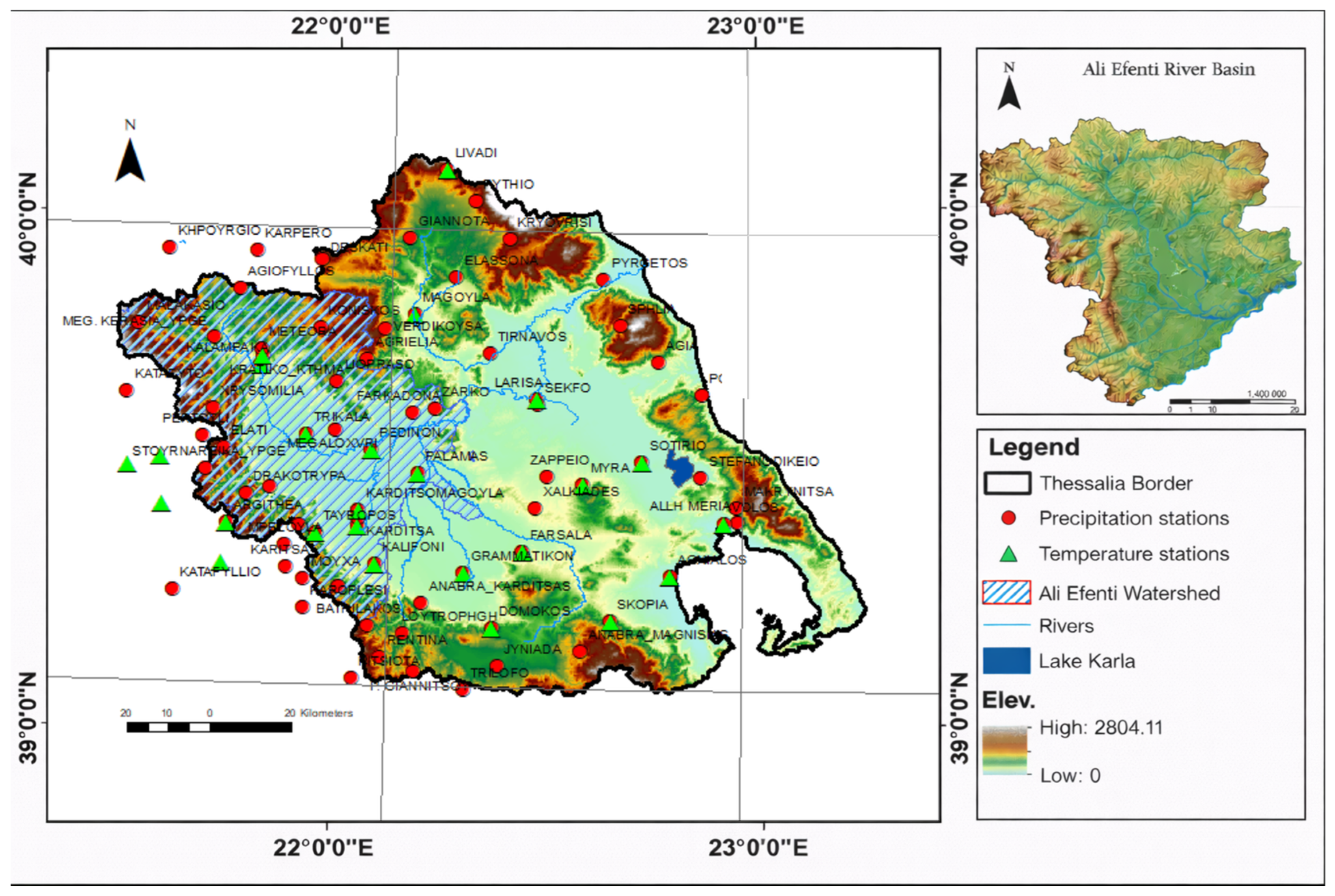
3.1. Spatial Interpolation of Ground Precipitation
The Pinios Basin was discretized into 487 square grid cells of approximately 5 km × 5 km. Monthly precipitation from ground stations was interpolated to the grid using a multiple linear regression (MLR) approach. For each month j of the October 1960–September 2002 period, a regression model of the form:
was fitted, where
is monthly precipitation at station
,
are station coordinates,
is elevation,
are monthly regression coefficients and
εs,j are residuals.
The model parameters were then used to estimate precipitation at each grid cell centroid. Model performance was evaluated using an independent-station validation approach. Specifically, the monthly MLR models were calibrated using the available station network (48 precipitation stations), and a set of 18 stations, distributed over the study area, was excluded from the fitting procedure and used only for independent validation. For these withheld stations, predicted monthly precipitation (from the gridded MLR field extracted at the station location) was compared against observations using scatter plots against the 1:1 line. In addition to the coefficient of determination (R
2), we examined whether the slope of the regression between predicted and observed values differed significantly from unity using a
t-test, and corresponding
p-values were computed at a significance level α = 0.05. The independent-station validation indicates satisfactory performance, with typical R
2 values on the order of 0.8 for the best-performing stations. Different variants of the MLR model were tested, including the use of CHIRPS precipitation as a predictor; the chosen formulation yielded satisfactory performance based on cross-validation, with annual correlation coefficients typically ranging from 0.69 to 0.87 and independent-station
values around 0.8 [
7].
Monthly temperature gridded data were created by interpolating ground-station temperature and ERA5-Land temperature onto the same grid using standard geostatistical or regression-based techniques.
3.2. Meteorological Drought Indices
3.2.1. Standardized Precipitation Index (SPI)
SPI was used to characterize meteorological drought based solely on precipitation. For each grid cell and accumulation period (i.e., 1, 3, 6, 9 and 12 months), time series of k-month aggregated precipitation were constructed and fitted with a two-parameter gamma distribution, following the original formulation of McKee et al. [
3] and the WMO guidelines. The cumulative probabilities were then transformed to the standard normal distribution to obtain SPI values, which are comparable in space and time. Months with zero precipitation were treated using the standard adjustment described in the SPI literature. Negative SPI values indicate drier-than-normal conditions, and thresholds of −1.0, −1.5 and −2.0 were adopted to identify moderate, severe and extreme drought, respectively. SPI was computed using (i) ground-based MLR precipitation and (ii) satellite-based CHIRPS precipitation interpolated to the same 5 km × 5 km grid. This allowed a direct comparison between ground-based and satellite-based SPI time series and spatial patterns over the common period October 1981–September 2002.
3.2.2. Standardized Precipitation–Evapotranspiration Index (SPEI)
SPEI was used to account for the combined effect of precipitation and atmospheric evaporative demand on drought. The monthly climatic water balance was defined as the difference between precipitation (P) and potential evapotranspiration (PET). PET was estimated with the Thornthwaite method [
5] from mean monthly temperature and latitude, an approach widely used in drought studies in Greece and the Mediterranean. The resulting monthly water-balance series was aggregated over the same accumulation periods as SPI (i.e., 1, 3, 6, 9 and 12 months).
For each grid cell and time scale, the aggregated water-balance series was fitted with a three-parameter log–logistic distribution, and the cumulative probabilities were transformed to standard normal variates using the approximation of Vicente-Serrano et al. [
3,
5], yielding SPEI values. As for SPI, negative SPEI values indicate dry conditions, and the same drought classes were used. SPEI was computed from (i) MLR-based ground precipitation and PET derived from ground/ERA5-Land temperature and (ii) CHIRPS precipitation and PET from ERA5-Land temperature, in order to compare ground-based and satellite/reanalysis-based climatic drought indices.
3.3. Hydrological Drought Index: SRI
Hydrological drought in the Ali Efenti sub-basin was described using the Standardized Runoff Index (SRI) [
4]. The method parallels SPI: monthly discharge
(observed and simulated) is used to construct an aggregated runoff series (here at the 1-month scale, SRI-1). A gamma distribution is fitted, and cumulative probabilities are transformed to standard normal variates, producing the SRI series. The SRI time series allows the identification of hydrological drought episodes (e.g., SRI ≤ −1.0, −1.5, −2.0 for moderate, severe, extreme drought, respectively) and their comparison with meteorological drought indices at different time scales.
3.4. UTHBAL Monthly Water-Balance Model
The University of Thessaly monthly water-balance model (UTHBAL) is a conceptual monthly water-balance model. The model has been developed for various discretizations of the study based, i.e., lumped, semi-distributed and fully distributed versions [
6,
10]. The lumped version of the model has been used in this study. UTHBAL simulates runoff at the basin outlet using precipitation, temperature and potential evapotranspiration as inputs [
9]. UTHBAL was developed at the University of Thessaly and has been used in Thessaly/Greece for basin-scale hydrological simulation and drought-related applications [
6,
10]. The model represents the main components of the hydrological cycle (snow accumulation and melt, soil moisture storage, surface runoff, interflow and baseflow) through a small number of conceptual reservoirs. Total precipitation is partitioned into rainfall and snowfall based on air temperature, snow storage is updated at a monthly time step, and actual evapotranspiration is computed as a function of available soil water and potential evapotranspiration, following the model structure adopted in UTHBAL applications [
10]. Excess water generates surface runoff when soil moisture exceeds a basin-scale storage capacity, while the remaining water contributes to subsurface storage and delayed outflow.
UTHBAL includes six calibration parameters controlling snowmelt, soil water capacity and the response of the fast and slow runoff components. In this study, the model was applied in the Ali Efenti sub-basin. UTHBAL was calibrated for October 1962–September 1981 and validated for October 1981–June 1994, using observed monthly discharge at the outlet. Model performance was evaluated using Nash–Sutcliffe efficiency (Eff), coefficient of determination (R2) and relative volume bias (DV). Eff values ranged from 0.82 (calibration) to 0.72 (validation), R2 values were 0.83 and 0.70, respectively, and small values of DV ranged from 0.129 (calibration) to 7.2 (validation), indicating very good performance of the model. The calibrated model was then used to extend the discharge time series, providing a continuous simulated runoff for SRI computation for the period of October 1981–September 2002.
3.5. Statistical Analysis
Meteorological drought was analyzed using basin-average SPI and SPEI time series and spatial drought maps. Drought events were identified when SPI/SPEI fell below −1.0, and were characterized in terms of duration, minimum value and inter-event periods. Spatial patterns and drought area extent were examined for various accumulated periods, but the drought indices of 3 and 9 months are presented.
The relationship between ground-based and satellite-based indices was investigated using R, Eff, MAE and RMSE at the basin-average scale and for individual grid cells. For the Ali Efenti sub-basin, correlations between SRI-1 and SPI/SPEI at different time scales (1–12 months) were computed to quantify the linkage between meteorological and hydrological drought.
4. Results and Discussion
4.1. Agreement Between Ground- and Satellite-Based Drought Indices
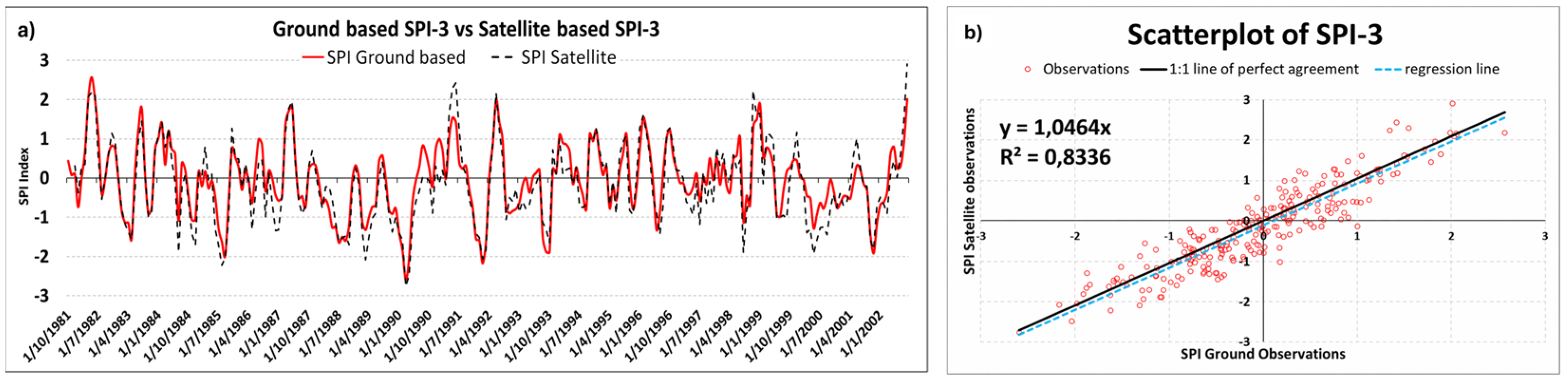
SPI and SPEI computed from ground-based and CHIRPS/ERA5-Land data show very strong temporal agreement (
Figure 2a). For basin-average SPI, Pearson correlation between ground and satellite indices ranged from 0.89 (SPI-1) to 0.94 (SPI-12). For SPEI, correlations are slightly higher, ranging between 0.91 and 0.95, respectively. Eff values were generally larger than 0.7.
Scatter plots indicate that regression lines between ground- and satellite-derived indices are close to the 1:1 line of perfect agreement, with no statistically significant differences in slope at the 5% level for most time scales (
Figure 2b). Satellite-based indices tend to be marginally more negative during drought episodes, particularly in the northern basin, indicating a small tendency to overestimate drought severity. Nevertheless, the overall agreement supports the use of CHIRPS/ERA5-Land for drought monitoring in Thessaly.
4.2. Temporal and Spatial Characteristics of Meteorological Drought
Basin-average SPI and SPEI time series for 1981–2002 reveal frequent drought episodes of varying duration and intensity. Three multi-year events stand out: 1988–1989, 1989–1990 and 2000–2001. Among these, the 1989–1990 event is clearly the most severe and spatially extensive, with SPI/SPEI-12 values being frequently below −2.0 over large parts of the basin, indicating extreme long-term drought. The 1988–1989 and 2000–2001 events are also characterized by prolonged negative anomalies, with SPI/SPEI often below −1.5 for several consecutive months. These findings are consistent with previous drought analyses for Thessaly and Greece [
1,
2].
Short accumulation periods (SPI-1, SPI-3 and SPEI-1, SPEI-3) highlight rapid onset and short-lived droughts, particularly in the warm season, whereas longer accumulation periods (6–12 months) emphasize the cumulative character of major events and their relevance to groundwater recharge and reservoir inflows. SPEI shows some differences from SPI during warm periods, reflecting the influence of PET on the climatic water balance.
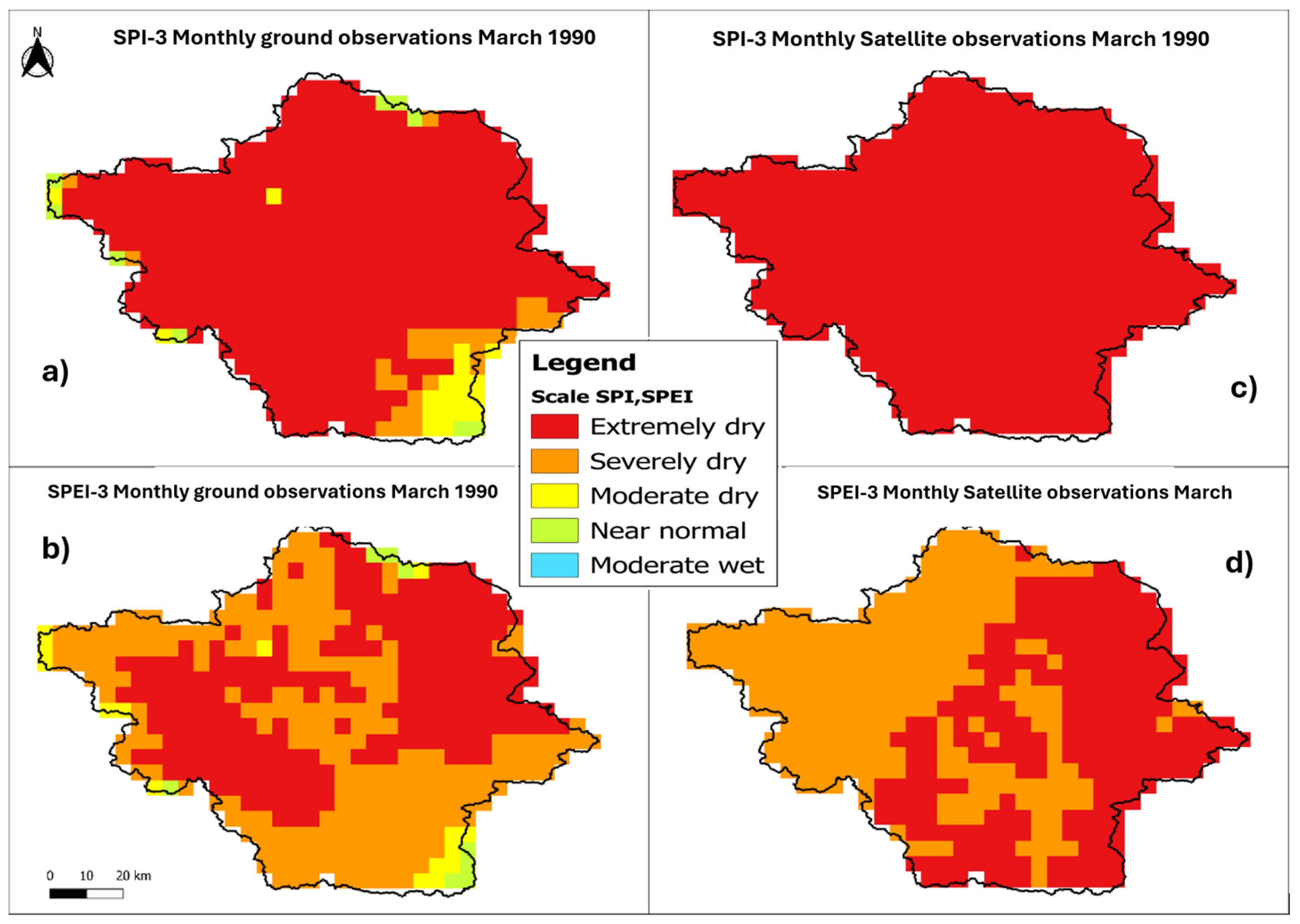
The spatial distribution of SPI-3 and SPEI-3 for key months of the 1989–1990 event (e.g., March–April 1990) shows that almost the entire Pinios River Basin is affected by severe to extreme drought conditions (
Figure 3). Ground-based indices indicate that more than 90% of the grid cells experience SPI/SPEI values below −1.5 during peak months, while CHIRPS/ERA5-Land-based indices classify nearly all cells in the severe or extreme drought classes, particularly in the northern and central parts of the basin. Similar patterns are found for 9-month indices, confirming that the 1989–1990 drought represents an extreme benchmark event in terms of both intensity and spatial coverage. Notably, SPEI exhibits slightly weaker drought conditions over the higher-elevation western part of the basin compared with SPI (
Figure 3), which is consistent with a temperature-driven signal. Because SPEI incorporates potential evapotranspiration (PET) through the climatic water balance, cooler conditions at higher elevations reduce PET and can partially offset precipitation deficits, leading to less negative SPEI values relative to SPI. This elevation-related contrast is expected to be more pronounced during warm periods and should be considered when interpreting spatial drought patterns in complex topography.
To assess SPI–SPEI agreement as a function of topography, we stratified the 5 km × 5 km grid into elevation terciles (low: 2–151 m, mid: 153–518 m, high: 520–2477 m) and compared SPI-3 and SPEI-3 during March 1990. For the ground-based indices, median SPI-3 is similar across elevation (−2.70, −2.65, −2.65), while median SPEI-3 becomes slightly less severe with elevation (−2.02, −1.99, −1.97), yielding Δ = SPEI-3 − SPI-3 of +0.65, +0.70 and +0.68, respectively. For CHIRPS/ERA5-Land indices, the SPI–SPEI offset is larger at low–mid elevations (Δ = +0.83 to +0.86) and smaller at high elevations (Δ = +0.68). Overall, these results indicate that topography (temperature and PET) contributes to localized SPI–SPEI differences.
4.3. Hydrological Drought and Management Implications
The UTHBAL model reproduces monthly runoff in the Ali Efenti sub-basin with very good performance during both calibration and validation, capturing the seasonal flow regime and inter-annual variability, including low-flow periods associated with droughts. The resulting SRI-1 series shows pronounced negative anomalies during the main meteorological drought episodes identified by SPI and SPEI, particularly in 1988–1989 and 1989–1990, confirming that these events translated into substantial hydrological drought.
Correlation analysis between SRI-1 and SPI/SPEI at different accumulation periods shows that the strongest relationships occur at intermediate time scales, around 3 months. This behavior is physically consistent with drought propagation and catchment memory. Streamflow integrates precipitation anomalies through soil moisture and catchment storage, so the hydrological response is typically better captured by SPI/SPEI computed over accumulation periods longer than one month. In Mediterranean basins, seasonal (3-month) accumulation often aligns with runoff-generation processes and the characteristic propagation time from meteorological deficits to hydrological drought, whereas 1-month indices can be dominated by short-lived events and higher noise, and longer periods (6–12 months) increasingly reflect slower storage components (e.g., groundwater/reservoir recharge) depending on basin characteristics [
11]. Ground-based SPI-3 and SPEI-3 achieve correlation coefficients of about 0.67 and 0.63, respectively, with SRI-1, while correlations with 1-month indices are weaker and those with 6–12-month indices remain significant but slightly lower. Satellite-based indices display similar patterns, albeit with slightly reduced correlations.
These results indicate that hydrological drought in the Ali Efenti sub-basin is primarily controlled by precipitation and climatic water-balance anomalies accumulated over seasonal time scales. In practical terms, SPI-3 and SPEI-3 can serve as effective early-warning indicators of streamflow drought and can be used to trigger drought preparedness and mitigation measures. The integrated framework adopted here, combining ground observations, satellites products, standardized drought indices and a conceptual water-balance model, provides a useful basis for operational drought monitoring and for stress-testing water-resource management strategies in Thessaly and similar Mediterranean basins.
The applied procedure has certain limitations. Standardized drought indices are ideally derived from long-term records (>20 years, and preferably longer), whereas the common meteorological analysis period available here (October 1981–September 2002) is at the lower bound and does not include the most recent decades. Consequently, index standardization and the resulting severity estimates may be sensitive to the limited sampling, and the results should be interpreted primarily as a basin-scale methodological comparison and event-based characterization rather than a climate-change assessment. Extending the analysis with updated station/satellite records and longer hydrological observations is planned to strengthen robustness and climate-relevance.