Automated Tsunami Hazard and Exposure Reporting Using Numerical Simulations and WebGIS Visualization †

 ,
,  ,
,  , ,
, ,  , ,
, , 
Abstract
1. Introduction
2. Materials and Methods
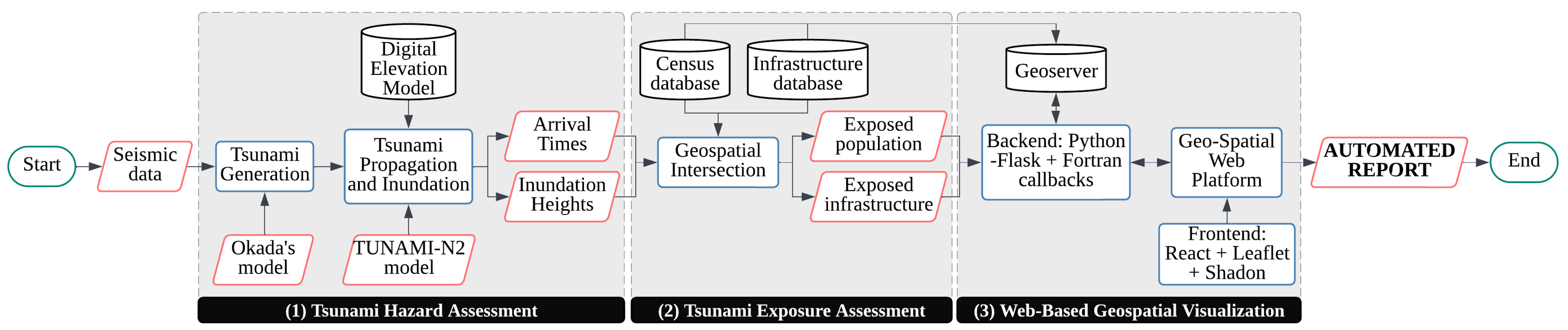
2.1. Tsunami Hazard Assessment
2.2. Tsunami Exposure Assessment
- Health facilities, including hospitals and medical centers, which are vital for emergency medical care and disaster response operations;
- Security and emergency services, such as police stations and fire stations, which play a central role in coordinating evacuation, rescue, and response activities.
2.3. Web-Based Geospatial Visualization
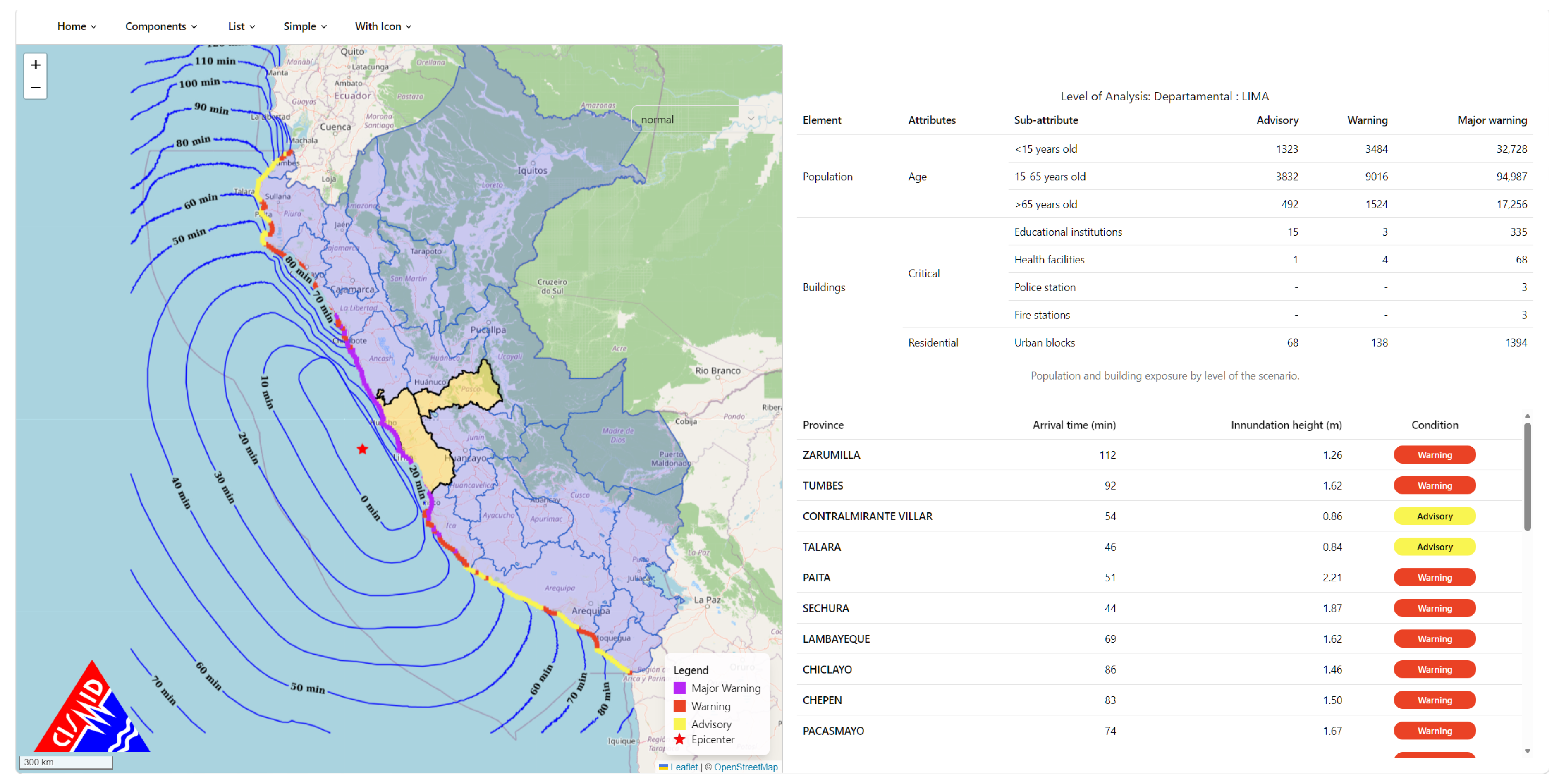
3. Results and Discussion
4. Conclusions
Author Contributions
Funding
Institutional Review Board Statement
Informed Consent Statement
Data Availability Statement
Acknowledgments
Conflicts of Interest
References
- Ruiz-Angulo, A.; Melgar, D.; de Marez, C.; Deniau, A.; Nencioli, F.; Hjörleifsdóttir, V. SWOT Satellite Altimetry Observations and Source Model for the Tsunami from the 2025 Mw 8.8 Kamchatka Earthquake. Seism. Rec. 2025, 5, 341–351. [Google Scholar] [CrossRef]
- CBS News. Tsunami risk appears to pass for U.S. after massive Russian earthquake. South American countries issue new warnings. CBS News, 30 July 2025.
- Dirección de Hidrografía y Navegación (DIHIDRONAV). Earthquake-Tsunami Bulletin (Boletín de Sismo-Tsunami). Available online: https://www.dhn.mil.pe/portal/boletin-sismo-tsunami (accessed on 6 January 2026). (In Spainsh)
- Catalan, P.A.; Gubler, A.; Cañas, J.; Zuñiga, C.; Zelaya, C.; Pizarro, L.; Valdes, C.; Mena, R.; Toledo, E.; Cienfuegos, R. Design and operational implementation of the integrated tsunami forecast and warning system in Chile (SIPAT). Coast. Eng. J. 2020, 62, 373–388. [Google Scholar] [CrossRef]
- Japan Meteorological Agency (JMA). Types of Tsunami Warning/Advisory; Japan Meteorological Agency (JMA): Tokyo, Japan, 2025.
- Centro Nacional de Alerta de Tsunamis (CNAT). Earthquake-Tsunami Report (Reporte de Sismo-Tsunami); Centro Nacional de Alerta de Tsunamis (CNAT): Callao, Peru, 2025. (In Spainsh)
- Gusiakov, V.K.; Dunbar, P.K.; Arcos, N. Twenty-Five Years (1992–2016) of Global Tsunamis: Statistical and Analytical Overview. Pure Appl. Geophys. 2019, 176, 2795–2807. [Google Scholar] [CrossRef]
- Paulik, R.; Craig, H.; Popovich, B. A National-Scale Assessment of Population and Built-Environment Exposure in Tsunami Evacuation Zones. Geosciences 2020, 10, 291. [Google Scholar] [CrossRef]
- Abdalla, R.; Esmail, M. WebGIS for Disaster Management and Emergency Response; Springer International Publishing: Cham, Switzerland, 2019. [Google Scholar] [CrossRef]
- Inocente, I.; Diaz, M.; Matsuoka, M.; Maruyama, Y.; Miura, H.; Liu, W.; Adriano, B.; Tarazona, J.C.; Zavala, C.; Salinas, J. Design and Implementation of an Open-Source Web-Based GIS System for Early Earthquake Damage Estimation in Lima, Peru. J. Disaster Res. 2025, 20, 1034–1047. [Google Scholar] [CrossRef]
- Indian National Centre for Ocean Information Services (INCOIS). Indian Tsunami Early Warning System; Indian National Centre for Ocean Information Services (INCOIS): Hyderabad, India, 2025.
- Japan Meteorological Agency (JMA). Tsunami Warnings/Advisories; Japan Meteorological Agency (JMA): Tokyo, Japan, 2025.
- National Oceanic and Atmospheric Administration (NOAA). U.S. Tsunami Warning Centers; National Oceanic and Atmospheric Administration (NOAA): Washington, DC, USA, 2025.
- Instituto Geofísico del Perú (IGP). Latest Earthquake (Último Sismo; Instituto Geofísico del Perú (IGP): Lima, Peru, 2026. (In Spainish)
- Jiménez, C. Software for Determination of Occurrence of Tsunamis (Software para determinación de ocurrencia de maremotos). Boletín Soc. Geológica Peru 2010, 104, 25–31. (In Spainish) [Google Scholar]
- Papazachos, B.C.; Scordilis, E.M.; Panagiotopoulos, D.G.; Papazachos, C.B.; Karakaisis, G.F. Global Relations Between Seismic Fault Parameters and Moment Magnitude of Earthquakes. Bull. Geol. Soc. Greece 2004, 36, 1482. [Google Scholar] [CrossRef]
- Okada, Y. Surface deformation due to shear and tensile faults in a half-space. Bull. Seismol. Soc. Am. 1985, 75, 1135–1154. [Google Scholar] [CrossRef]
- Garcia, F.; Estrada, M.; Palacios, J.; Davila, C.; Quesquen, A.; Morales, J.; Adriano, B.; Mas, E.; Koshimura, S. Parallel Computing Approach for Rapid Estimation of Tsunami Hazard and Population Exposure in Peru. J. Disaster Res. 2025, 20, 912–921. [Google Scholar] [CrossRef]
- National Institute of Statistics and Informatics (INEI). Population Estimates and Projections by Department, Province, and District, 2018–2020; Technical Report; National Institute of Statistics and Informatics (INEI): Lima, Peru, 2020.
- González-Riancho, P.; Aliaga, B.; Hettiarachchi, S.; González, M.; Medina, R. A contribution to the selection of tsunami human vulnerability indicators: Conclusions from tsunami impacts in Sri Lanka and Thailand (2004), Samoa (2009), Chile (2010) and Japan (2011). Nat. Hazards Earth Syst. Sci. 2015, 15, 1493–1514. [Google Scholar] [CrossRef]
- Cels, J.; Rossetto, T.; Dias, P.; Thamboo, J.; Wijesundara, K.; Baiguera, M.; Zoppo, M.D. Engineering surveys of Sri Lankan schools exposed to tsunami. Front. Earth Sci. 2023, 11, 1075290. [Google Scholar] [CrossRef]
- Global Alliance for Disaster Risk Reduction & Resilience in the Education Sector (GADRRRES). Comprehensive School Safety Framework 2022–2030; Technical Report; GADRRRES: Geneva, Switzerland, 2022. [Google Scholar]
- Quesquen, A.; Estrada, M.; Garcia, F.; Davila, C.; Puchoc, B.; Koshimura, S. Tsunami Hazard and Exposure Assessment in Metropolitan Lima-Callao Under Historical and Plausible Seismic Scenarios. J. Disaster Res. 2025, 20, 899–911. [Google Scholar] [CrossRef]
- Centro Peruano Japonés de Investigaciones Sísmicas y Mitigación de Desastres (CISMID). Seismic Engineering Observation Center (Centro de Observación para la Ingeniería Sísmica); Centro Peruano Japonés de Investigaciones Sísmicas y Mitigación de Desastres (CISMID): Lima, Peru, 2026. (In Spanish) [Google Scholar]
- Jimenez, C.; Moggiano, N.; Mas, E.; Adriano, B.; Koshimura, S.; Fujii, Y.; Yanagisawa, H. Seismic Source of 1746 Callao Earthquake from Tsunami Numerical Modeling. J. Disaster Res. 2013, 8, 266–273. [Google Scholar] [CrossRef]
- Melgar, D.; Williamson, A.L.; Salazar-Monroy, E.F. Differences between heterogenous and homogenous slip in regional tsunami hazards modelling. Geophys. J. Int. 2019, 219, 553–562. [Google Scholar] [CrossRef]
- Rashidi, A.; Shomali, Z.H.; Farajkhah, N.K. Tsunami Simulations in the Western Makran Using Hypothetical Heterogeneous Source Models from World’s Great Earthquakes. Pure Appl. Geophys. 2018, 175, 1325–1340. [Google Scholar] [CrossRef]
- Serra, C.S.; Martínez-Loriente, S.; Gràcia, E.; Urgeles, R.; de la Peña, L.G.; Maesano, F.E.; Basili, R.; Volpe, M.; Romano, F.; Scala, A.; et al. Sensitivity of Tsunami Scenarios to Complex Fault Geometry and Heterogeneous Slip Distribution: Case-Studies for SW Iberia and NW Morocco. J. Geophys. Res. Solid Earth 2021, 126, e2021JB022127. [Google Scholar] [CrossRef]
- Muhari, A.; Imamura, F.; Koshimura, S.; Post, J. Examination of three practical run-up models for assessing tsunami impact on highly populated areas. Nat. Hazards Earth Syst. Sci. 2011, 11, 3107–3123. [Google Scholar] [CrossRef]



| Source 1 | Depth | Informative 2 | Watch 3 | Warning 4 |
|---|---|---|---|---|
| Near field | ≤60 km | 5.0 7.0 | 7.0 7.5 | 7.5 |
| >60 km | 5.0 7.5 5 | 7.5 | - | |
| Far field | ≤60 km | 7.0 8.0 | 8.0 8.5 | 8.5 |
| >60 km | 7.0 8.5 6 | 8.5 | - |
| Alert State | Maximum Tsunami Height (m) | Action Required |
|---|---|---|
| Major Tsunami Warning | 3 | Evacuate immediately to high ground or an evacuation building. |
| Tsunami Warning | 1 3 | Evacuate immediately to high ground or an evacuation building. |
| Tsunami Advisory | 0.2 1 | Stay away from the coast and leave the water. |
Disclaimer/Publisher’s Note: The statements, opinions and data contained in all publications are solely those of the individual author(s) and contributor(s) and not of MDPI and/or the editor(s). MDPI and/or the editor(s) disclaim responsibility for any injury to people or property resulting from any ideas, methods, instructions or products referred to in the content. |
© 2026 by the authors. Licensee MDPI, Basel, Switzerland. This article is an open access article distributed under the terms and conditions of the Creative Commons Attribution (CC BY) license.
Share and Cite
Davila, C.; Quesquen, A.; Salinas, J.; Palacios, J.; Tinco, L.; Garcia, F.; Cueva, J.; Marquez, L.; Estrada, M. Automated Tsunami Hazard and Exposure Reporting Using Numerical Simulations and WebGIS Visualization. Environ. Earth Sci. Proc. 2026, 41, 6. https://doi.org/10.3390/eesp2026041006
Davila C, Quesquen A, Salinas J, Palacios J, Tinco L, Garcia F, Cueva J, Marquez L, Estrada M. Automated Tsunami Hazard and Exposure Reporting Using Numerical Simulations and WebGIS Visualization. Environmental and Earth Sciences Proceedings. 2026; 41(1):6. https://doi.org/10.3390/eesp2026041006
Chicago/Turabian StyleDavila, Carlos, Angel Quesquen, Jhianpiere Salinas, Julian Palacios, Luz Tinco, Fernando Garcia, Jean Cueva, Lorena Marquez, and Miguel Estrada. 2026. "Automated Tsunami Hazard and Exposure Reporting Using Numerical Simulations and WebGIS Visualization" Environmental and Earth Sciences Proceedings 41, no. 1: 6. https://doi.org/10.3390/eesp2026041006
APA StyleDavila, C., Quesquen, A., Salinas, J., Palacios, J., Tinco, L., Garcia, F., Cueva, J., Marquez, L., & Estrada, M. (2026). Automated Tsunami Hazard and Exposure Reporting Using Numerical Simulations and WebGIS Visualization. Environmental and Earth Sciences Proceedings, 41(1), 6. https://doi.org/10.3390/eesp2026041006