Proceeding Paper

Wildfire Damage Assessment over Eaton Canyon, California, Using Radar and Multispectral Datasets from Sentinel Satellites and Machine Learning Methods †

by
Jacques Bernice Ngoua Ndong Avele
1,* and
Viktor Sergeevich Goryainov
2,*
1
Department of Radiotechnical Systems, Saint Petersburg State Electrotechnical University, St. Petersburg 197376, Russia
2
Department of Photonics, Saint Petersburg State Electrotechnical University, St. Petersburg 197376, Russia
*
Authors to whom correspondence should be addressed.
Presented at the 2nd International Electronic Conference on Land, Session Climate Action on Land Use, Gembloux, Belgium, 4–5 September 2025.
Environ. Earth Sci. Proc. 2025, 36(1), 6; https://doi.org/10.3390/eesp2025036006
Published: 20 November 2025
(This article belongs to the Proceedings of The 2nd International Electronic Conference on Land)

Abstract

Eaton Canyon in California serves as the focal point for a comprehensive post-wildfire ecological impact assessment. This study employs an approach integrating satellite imagery from the European Space Agency’s Sentinel constellation to study an area of 271.49 km2. The data encompasses both radar and multispectral data, offering a multi-dimensional view of the affected landscape. The analysis leverages the power of the random forest algorithm. Firstly, three widely used indices—the difference normalized burn ratio (dNBR), relative burn ratio (RBR), and relative difference normalized burn ratio (RdNBR)—were calculated and compared based on their accuracy and Kappa index. Secondly, we developed a fusion approach by using all the fire indices to obtain a precise severity map by classifying the affected area into distinct severity classes. Thirdly, a separate fusion approach was developed utilizing the normalized difference vegetation index (NDVI), radar vegetation index (RVI), and modified normalized difference vegetation index (MNDVI) to analyze the distribution of vegetation before and after the wildfire. The merger proposals were developed using a combination of index values to obtain better information on the fire severity map and post-fire vegetation distribution. The results indicated an accuracy of 78% when employing the dNBR index. A higher accuracy of 81% was observed with the RBR index, while the RdNBR demonstrated an accuracy of 95%. Our approach, which combines all fire indicators, offers optimal accuracy of 99%. A percentage of 56.76% did not burn due to the topography of the canyon creating natural firebreaks. Areas classified as low severity (7.83%) showed minimal damage with minimal tree mortality. Moderate- to low-severity areas (5.83%) represented regions with partial crown burns and some tree mortality. Moderate- to high-severity areas (7.22%) showed significant tree mortality. Finally, high-severity areas (22.36%), characterized by complete tree mortality and significant loss of vegetation cover, were largely concentrated in specific sections of the canyon, likely influenced by factors such as slope and fuel type. These findings provide valuable information for post-fire ecological recovery efforts and future land management strategies in Eaton Canyon and similar fire-prone landscapes.

1. Introduction

Wildfires are a pervasive natural hazard, especially in regions with a Mediterranean climate like Southern California. Remote sensing is an essential tool for monitoring, analyzing, and restoring burned areas globally and regionally, as it provides reliable and results and enable rapid diagnostics of burned areas for post-fire damage mitigation activities (Chuvieco et al., 2003; Chuvieco, 2009; Sobrino et al., 2019) [1,2,3].
The Eaton Canyon region, nestled in the San Gabriel Mountains, is particularly prone to wildfires due to its chaparral and scrub vegetation, steep topography, and proximity to urban areas. Forest fires are extremely destructive natural phenomena that cause significant damage to communities, resulting in widespread material destruction and considerable losses [4]. The 2025 California wildfire season alone resulted in the destruction of more than 16,000 structures (as documented in CAL FIRE. 2025 Fire Season Incident Archive. https://www.fire.ca.gov/incidents/2025 (accessed on 3 March 2025)) [5], highlighting the critical imperative of having advanced tools designed to predict and mitigate the impact of wildfire damage.
The objective of our research is to develop a comprehensive methodology for mapping fire severity by integrating and comparing various fire indices with other relevant environmental indicators. For example, the of DNBR versus RDNBR is the subject of active debate as illustrated in some studies (as illustrated in Remote Sensing of Environment 2010, 114, 1896–1908) [6], and the results regarding which metric best matches field burn severity data have not been conclusive. Our proposed methodology aims to combine range values of different fore indices with additional indices, including NDVI, RVI, and MNDWI, to create a precise fire severity map and analyze post-wildfire vegetation dynamics.
Assessing the extent and severity of wildfire damage is essential for various post-fire activities, including ecological restoration, hazard mitigation, and insurance claims. Accurate forecasting of damage caused by wildfires is of paramount importance to various stakeholders, including emergency services, urban planners, and the insurance industry [7]. This forecasting capability directly influences critical decision-making processes, from immediate actions to save lives to long-term community resilience (as detailed in Proc. IEEE SmartWorld/SCALCOM/UIC/ATC/IOP/SCI) [7].

2. Materials and Methods

2.1. Data Collection and Preprocessing

The core of our research is based on the application of remote sensing techniques to assess the severity of forest fires by covering an area of 271.49 km2 and using data from Sentinel constellation (https://collections.sentinel-hub.com, accessed on 25 July 2025), which is a series of Earth observation satellites developed by the European Space Agency (ESA).
The Sentinel-2 level 2A were acquired for the periods before and after the fire. More specifically, images from the B08 (near-infrared, 842 nm) and B12 (shortwave infrared 2, 2190 nm) bands were downloaded to calculate fire severity indices. Pre-fire images were selected from a date as close as possible to the event, but prior to ignition, to ensure minimal cloud cover and atmospheric interference. And post-fire images were also selected from the earliest cloud-free images available after the fire had been contained, to capture the immediate impact of the burn.
All downloaded data has undergone initial preprocessing steps, including atmospheric correction inherent to level 2A products. Furthermore, radiometric calibration and geometric registration were verified to minimize potential errors in subsequent analyses. Finally, to ensure the integrity, areas affected by clouds and cloud shadows were masked by identifying potential cloud pixels first and then searching for dark pixels in their vicinity, considering the geometric relationship between clouds and their shadows. Table 1 shows the indices used for preprocessing of datasets.

2.2. Model Training and Hyperparameter Optimization

In order to optimize the performance of the model and avoid overfitting, a systematic hyperparameter optimization process was implemented. Through this process, the following optimal hyperparameters were identified. The “n_estimators” parameter has been set to 100, which determines the total number of decision trees built within the forest set. To avoid overfitting and manage the complexity of the model, the “max_deph” of each three was limited to 20. Other controls on the tree-growth included setting “min_sample_split” to 5, meaning that a node must contain at least five samples to be considered for spitting. Similarly, “min_samples_leaf” was set to 2, ensuring that each leaf node in a tree contains at least two samples. Bootstrapping, a technique of randomly drawing samples with replacement to build each tree, was enable by setting “bootstrap” to “True”. The dataset was split (80% train, 20% test). The “max_features” was set to “log2” to indicate that when searching for the best split at each node, only “log2(number of features)” would be considered. Finally, to correct potential imbalanced in the distribution of classes in the dataset, the “class_weight” were set to “balanced”.

2.3. Evaluation Metrics

Forest fire severity classification labels were established by discretizing a continuous range of fire severity into distinct classes. We defined specific thresholds within the severity range, where values in a particular interval are assigned to a corresponding severity class. This method of creating labels is a common practice in remote sensing to transform continuous biophysical variables into categorical data suitable for classification algorithms (as described in the book Remote Sensing of Forest Environments: Concepts and Case Studies) [8]. The model’s input variables included the values of the B08 (near-infrared) and B12 (short-wave infrared 2) bands before and after the fire. Let B 08 1 and B 12 1 the bands values from the pre-fire imagery, and B 08 2 and B 12 2 the bands values from the post-fire imagery. To capture the change induced by the forest fire, different features were calculated, such as B 08 =   B 08 2 B 08 1 and B 12 =   B 12 2 B 12 1 . These differences are important for change detection applications, as they highlight the magnitude and direction of spectral alterations cause by the fire (as illustrated in the book Remote sensing and Change Detection) [9].

3. Results and Discussion

3.1. Classification Performance

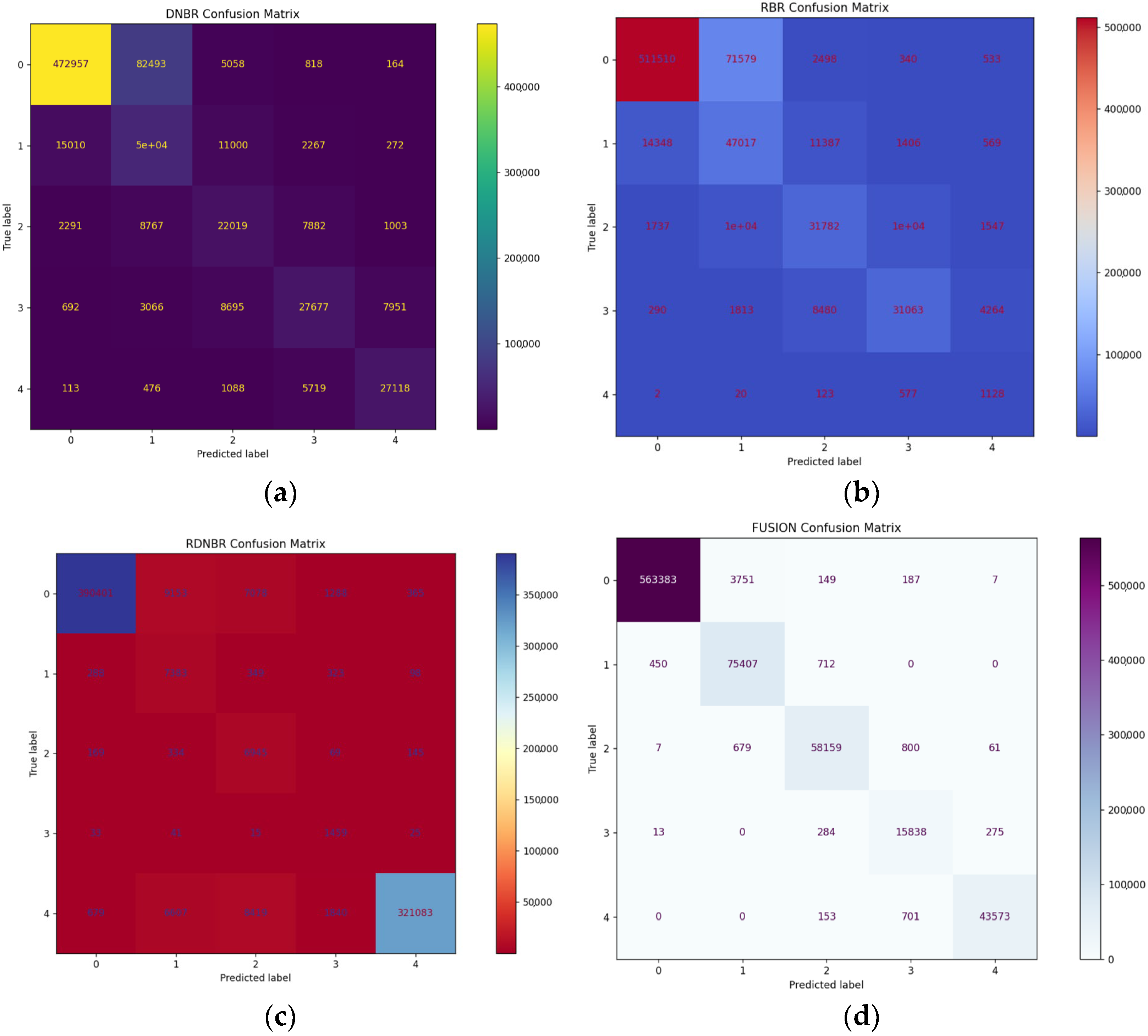
To classify the severity of burns according to the DNBR, labels are assigned based on specific ranges of DNBR values (as indicated in the Methodology for estimating burned areas and severity levels of forest fires from Sentinel-2 data. Application to October 2017 fires in the Iberian Peninsula) [10]. The classifications are D N B R < 0.1 for unburned to low severity, 0.1 < D N B R < 0.255 for low severity, 0.256 < D N B R < 0.419 for moderate-low severity, 0.420 < D N B R < 0.660 for moderate-high severity, and D N B R < 0.660 for high severity. The model gave an accuracy of 0.78%, which is significantly lower than the accuracies of 89% and 90% reported by Noumeur and Taha in their study “Predicting California Wildfire Damage to Structures Using Machine Learning: A Comparative Study of Random Forest and XGBoost” [11] when using the random forest algorithm and the XGBoost model, respectively [11]. The intermediate severity classes such as low severity, moderate-low severity, and moderate-high severity show F1-scores ranging from 0.49 to 0.60. The unburned and high severity classes provided F1-scores ranging from 0.70 to 0.99.
The RBR index was also introduced to improve the consistency and transferability of burn severity mapping between different fires and ecosystems compared to the traditional DNRB (as explained in A new metric for quantifying burn severity: The Relativized Burn Ratio. Remote Sensing, 6: 1827–1844) [12]. But specific numerical thresholds for classifying burn severity using the RBR index are often determined empirically and can vary depending on the ecosystem and fire characteristics (as documented in Quantifying burn severity in a heterogeneous landscape with a relative version of the delta Normalized Burn Ratio (dNBR)) [13]. In this case, the thresholds used for training are those developed by the United States Geological Survey (USGS) and the Monitoring Trends in Burn Severity (MTBS) program. The classification used are R B R 0.25   a n d   R B R < 0.10 for unburned to low severity, R B R 0.10   a n d   R B R < 0.27 for low severity, R B R 0.27   a n d   R B R < 0.44 for moderate-low severity, R B R 0.44   a n d   R B R < 0.66 for moderate-high severity and R B R 0.66   for high severity. The model gave an accuracy of 0.81%, which is comparable to the accuracies of 89% and 90% reported by Noumeur and Taha in their study “Predicting California Wildfire Damage to Structures Using Machine Learning: A Comparative Study of Random Forest and XGBoost” [11] when using the random forest algorithm and XGBoost model, respectively. In this case, the moderate-low and moderate-high severity classes provided a precision of 0.59 and recall of 0.57. But the high severity class provided a recall value of 0.61, which suggests that the model tried to identify a good proportion of real high severity areas.
The RDNBR was developed as a variant of the widely used DNRB; this approach was developed by Key and Benson in 2025. The main motivation for RDNBR was to correct the bias of DNBR, which results from differences in vegetation type and density prior to fire. In their 2007 work “Quantifying burn severity in a heterogeneous landscape with a relative version of the delta Normalized Burn Ratio (dNBR)” [13], Miller J.D and Thode A.E illustrated that in areas where pre-fire vegetation cover is naturally low, DNRB can produce artificially high burn severity values even with moderate fire effects. So, it was crucial for us to train our model by using the RDNBR index and analyze its accuracy compared to previous indices of fire. The classifications used are R B R < 0.209 for unburned to low severity, R B R 0.209   a n d   R B R < 0.44 for low severity, R B R 0.44   a n d   R B R < 0.660 for moderate-low severity, R B R 0660   a n d   R B R < 0.706 for moderate-high severity, and R B R 0.706   for high severity. The model gave an accuracy of 0.95%, which is also comparable to the 90% accuracy reported by Noumeur and Taha in their study “Predicting California Wildfire Damage to Structures Using Machine Learning: A Comparative Study of Random Forest and XGBoost” [11], especially when using the XGBoost. Even though the accuracy is 95%, the average F1 macro score of 0.66 reflects the difficulty in accurately classifying intermediate severity levels.
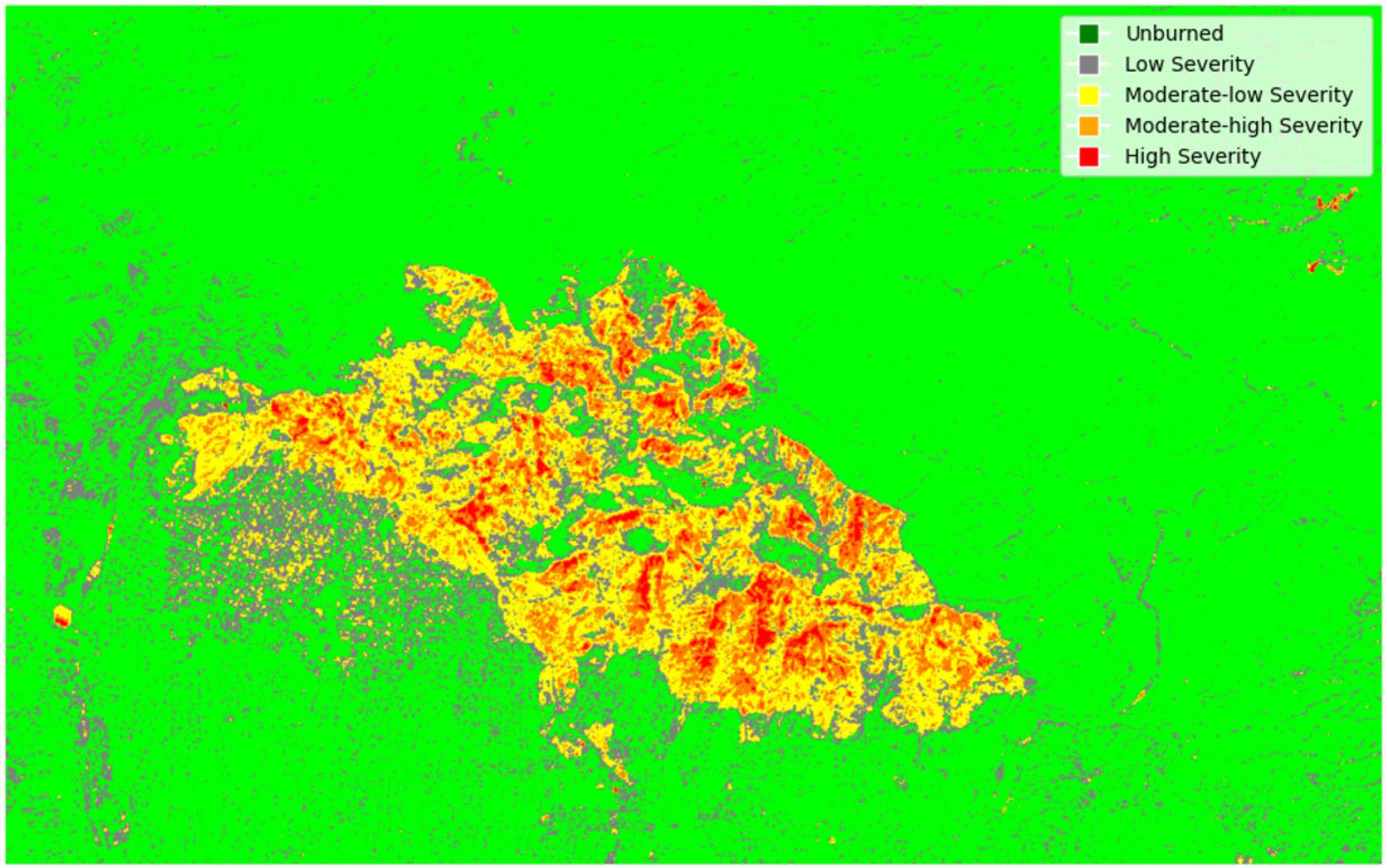
The use of burn severity indices such as DNBR, RBR, and RDNBR is the subject of intense debate within the remote sensing and fire ecology communities, as various studies have yielded inconclusive results regarding the superiority of one index over another (as documented in Remote Sensing of Environment 2010, 114, 1896–1908) [6]. However, each index has its own characteristics. Therefore, we decided to evaluate a test in which all three indices are used simultaneously, paying particular attention to the defined threshold values. The proposal approach for the fire classification were D N B R < 0.209 for unburned to low severity, R B R 0.1 , R B 0.05   a n d   R D N B R 0.15 for low severity, D N B R 0.25 , R B R < 0.2   a n d   R D N B R 0.35 for moderate-low severity, D N B R 0.4 , D N B R < 0.6 ,   R B R 0.4   a n d   R D N B R < 0.7 for moderate-high severity, and D N B R 0.6   for high severity. These approach thresholds yielded an accuracy of 99%, which is comparable to the 98.68% accuracy achieved by Seyd Teymoor Seydi in his work “Assessment of the January 2025 Los Angeles County Wildfire”, utilizing a Chebyshev-Kolmogorov–Arnold network model [14]. All confusion matrices are illustrated in Figure 1, and the fire severity map result can be seen in Figure 2.
A total of 56.76% of the area did not burn, as the canyon topography created natural firebreaks. Areas classified as low severity (7.83%) showed minimal damage and minimal tree mortality. Moderate- to low-severity areas (5.83%) represented regions with partial crown burning and some tree mortality. Moderate- to high-severity areas (7.22%) showed significant tree mortality. Finally, high-severity areas (22.36%), characterized by total tree mortality and significant canopy loss, were largely concentrated in specific sections of the canyon, likely influenced by factors such as slope and fuel type.

3.2. Post-Wildfire Vegetation Analysis

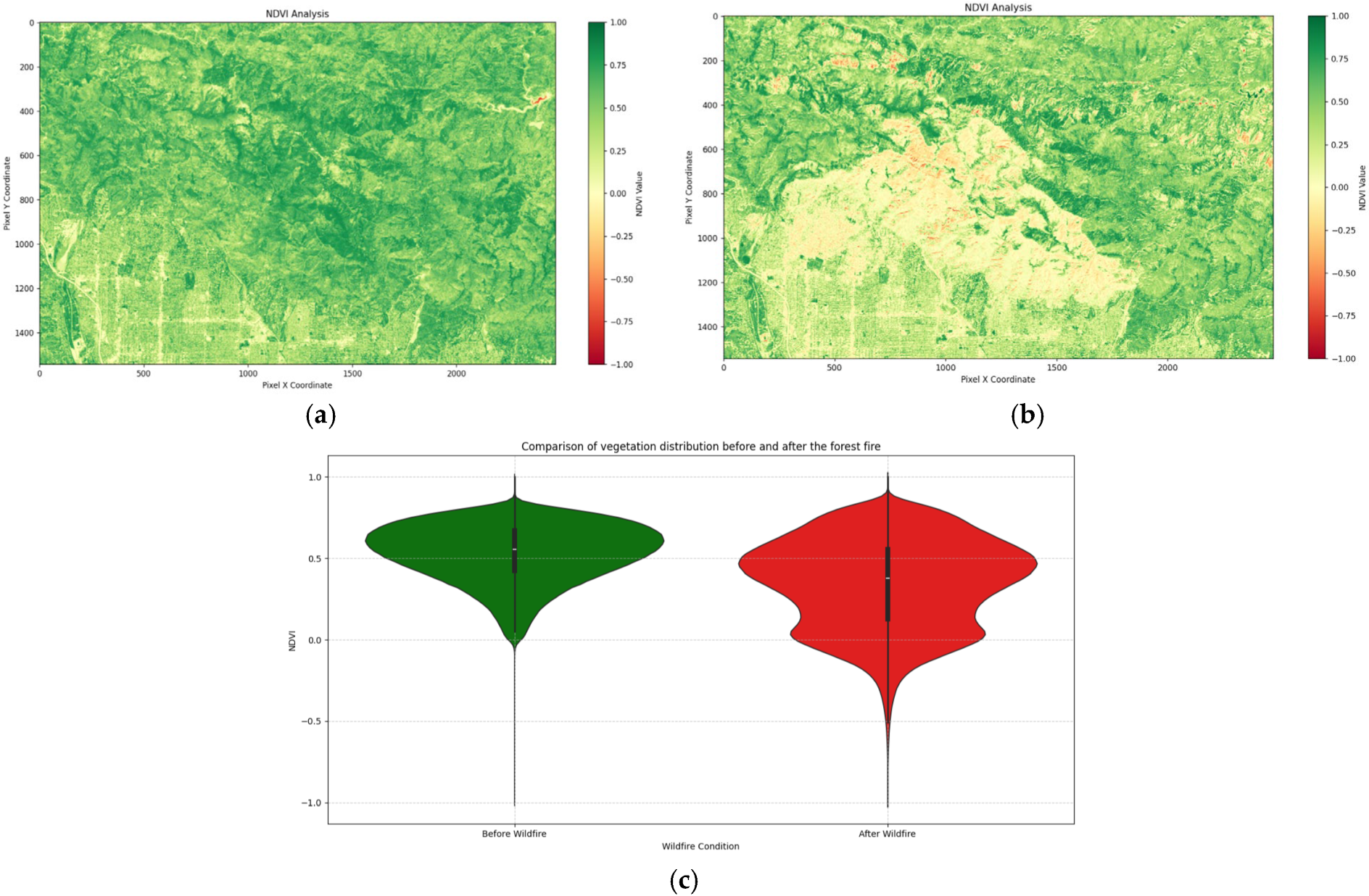
Applying a thresholding technique to the difference in normalized difference vegetation index (NDVI) values between images before and after a forest fire provides a robust method for delineating the spatial extend and severity of fire damage, as described in various remote sensing and ecology studies such as those in Remote Sensing of Vegetation: Principles, Techniques, and Applications. This approach is based on the fundamental principle that healthy vegetation exhibits high reflectance in the near-infrared (NIR) spectrum and high absorption in the red spectrum, resulting in high NDVI values. By calculating the difference in NDVI ( N D V I = N D V I p o s t N D V I p r e ), areas where vegetation health has significantly declined due to the fire are effectively highlighted. Severally burned areas, such as those observed during the Eaton Canyon fire, are characterized by very low or negative N D V I values. NDVI images before and after the Eaton Canyon are illustrated in Figure 3.
Except for that, a crucial step in our methodology involves analyzing the correlations between the NDVI, RVI, and MDNWI indices. This correlation analysis provided a better understanding of interrelationships between vegetation health, its structural characteristics, and water availability in a post-fire environment. In our methodology, MDNWI and RVI are integrated as additional features alongside the primary NDVI data. The implementation strategy involves retaining the NDVI image as the model’s “main data”.
In order words, the NDVI likely serves as the main input for defining vegetation analysis. However, the MDNWI and RVI are introduced as complementary variables to enhance the model’s predictive capabilities (as documented in Advancing Forest fire burn severity and vegetation recovery assessments using remote sensing and machine learning approaches, Volume 92, December 2025) [15].
Pre-fire vegetation health was excellent. The data are clustered on the positive side of the normalized difference vegetation index (NDVI), which measures the density and health of green vegetation. The peak concentration of data points is between 0.5 and 1 on the NDVI scale, indicating very healthy and dense vegetation, including grasses, shrubs, and fully canopy trees. The fire caused a catastrophic decline in vegetation health. Furthermore, we analyzed that the data now focus almost exclusively on the negative side of the NDVI scale. The highest concentration of data points is between −0.5 and −1.0. Values from 0 to −1.0 indicate charred vegetation and burn scars. However, the clustering near −1.0 strongly suggests extensive areas of charred tree trunks, ash, and soot, which have very low reflectivity in the near-infrared spectrum.

4. Conclusions

The results of the Eaton Canyon fire provide valuable information for post-fire ecological restoration efforts and the development of more effective land management strategies in Eaton Canyon and other fire-prone areas. Accurate mapping of fire severity allows for targeted restoration, focusing resources on the most affected areas. Understanding the influence of topography and fuel types on fire behavior, as demonstrated by unburned areas and high-intensity areas, can inform proactive measures such as strategic fuel reduction and the creation of defensible spaces. The success of the predictive model also suggests the potential for integrating these advanced analytical tools into real-time fire response and long-term ecological planning, thereby improving resilience to future wildfires.

Author Contributions

Project administration, V.S.G.; Conceptualization, J.B.N.N.A.; writing and editing, J.B.N.N.A. and V.S.G. All authors have read and agreed to the published version of the manuscript.

Funding

The study was conducted within the framework of the FSEE-2022-0016 project, which was carried out within the framework of the state task of the Ministry of Science and Higher Education of the Russian Federation.

Institutional Review Board Statement

Not applicable.

Informed Consent Statement

Informed consent was obtained from all subjects involved in the study.

Data Availability Statement

The data are contained within the article.

Conflicts of Interest

The authors declare no conflicts of interest.

References

  1. Chuvieco, E.; Riaño, D.; Van Wagtendok, J.; Morsdof, F. Fuel loads and fuel type mapping. In Wildland Fire Danger Estimation and Mapping: The Role of Remote Sensing Data; World Scientific Publishing: Singapore, 2003; pp. 119–142. [Google Scholar] [CrossRef]
  2. Chuvieco, E. Global impacts of fire. In Earth Observation of Wildland Fires in Mediterranean Ecosystems; Springer: Berlin/Heidelberg, Germany, 2009; pp. 1–10. [Google Scholar] [CrossRef]
  3. Sobrino, J.A.; Llorens, R.; Fernández, C.; Fernández-Alonso, J.M.; Vega, J.A. Relationship between soil burn severity in forest fires measured in situ and through spectral indices of remote detection. Forests 2019, 10, 457. [Google Scholar] [CrossRef]
  4. Noumeur, A.; Tohir, M.Z.M.; Said, M.S.M.; Baharudin, M.R.; Yusoff, H. Exploration of trends in Malaysian building fires and wildfires (2000–2019). J. Phys. Conf. Ser. 2024, 2885, 012103. [Google Scholar] [CrossRef]
  5. CAL FIRE. 2025 Fire Season Incident Archive. Available online: https://www.fire.ca.gov/incidents/2025 (accessed on 3 March 2025).
  6. Soverel, N.O.; Perrakis, D.D.B.; Coops, N.C. Estimating burn severity from Landsat dNBR and RdNBR indices across western Canada. Remote Sens. Environ. 2010, 114, 1896–1909. [Google Scholar]
  7. Malik, A.; Jalin, N.; Rani, S.; Singhal, P.; Jain, S.; Gao, J. Wildfire risk prediction using machine learning in San Diego. In Proceedings of the IEEE Smart-World/SCALCOM/UIC/ATC/IOP/SCI, 2021, Atlanta, GA, USA, 18–21 October 2021; pp. 622–629. [Google Scholar] [CrossRef]
  8. Wulder, M.A.; Franklin, S.E. Forest Characteristics. Available online: https://slunik.slu.se/kursfiler/SH0129/10288.1415/Wulder_Franklin_ForestCharacteristics.pdf (accessed on 25 July 2025).
  9. Owe, M.; Neale, C. Remote Sensing for Environmental Monitoring and Change Detection. Available online: https://books.google.ru/books/about/Remote_Sensing_for_Environmental_Monitor.html?id=IhJPAQAAIAAJ&redir_esc=y (accessed on 25 July 2025).
  10. Llorens, R.; Sobrino, J.A.; Fernández, C.; Fernández-Alonso, J.M.; Vega, J.A. A methodology to estimate forest fires burned areas and burn severity degrees using Sentinel-2 data. Application to the October 2017 fires in the Iberian Peninsula. Int. J. Appl. Earth Obs. Geoinf. 2021, 95, 102243. [Google Scholar] [CrossRef]
  11. Noumeur, A.; Tohir, M.Z.M. Predicting California Wildfire Damage to Structures Using Machine Learning: A Comparative Study of Random Forest and XGBoost. J. Phys. Conf. Ser. 2025, 3121, 012029. [Google Scholar] [CrossRef]
  12. Parks, S.A.; Dillon, G.K.; Miller, C. A new metric for quantifying burn severity: The Relativized Burn Ratio. Remote Sens. 2014, 6, 1827–1844. [Google Scholar] [CrossRef]
  13. Miller, J.D.; Thode, A.E. Quantifying burn severity in a heterogeneous landscape with a relative version of the delta Normalized Burn Ratio (dNBR). Remote Sens. Environ. 2007, 109, 66–80. [Google Scholar] [CrossRef]
  14. Seydi S., T. Assessment of the January 2025 Los Angeles County wildfires: A multi-modal analysis of impact, response, and population exposure. arXiv 2025, arXiv:2501.17880v1. [Google Scholar] [CrossRef]
  15. Anees, S.A.; Mehmood, K.; Luo, M.; Abuelgasim, A.; Pan, S.; Shahzad, F.; Muhammad, S.; Khan, W.R. Advancing forest fire burn severity and vegetation recovery assessments using remote sensing and machine learning approaches. Ecol. Inform. 2025, 92, 103446. [Google Scholar] [CrossRef]
Figure 1. Confusion matrix of the machine learning results: (a) difference normalized burn ratio confusion matrix; (b) relative burn ratio confusion matrix; (c) relative difference normalized burn ratio confusion matrix; and (d) fusion confusion matrix.
Eesp 36 00006 g001
Figure 2. Wildfire map classification result.
Eesp 36 00006 g002
Figure 3. NDVI images analysis: (a) NDVI images before the Eaton Canyon fire; (b) NDVI images after the Eaton Canyon fire; and (c) comparison of vegetation density before and after the wildfire.
Eesp 36 00006 g003
Table 1. Indices used for preprocessing of datasets.
Index NameAbbreviationsFormulas
Normalized difference vegetation indexNDVI(NIR − Red)/(NIR + Red)
Radar vegetation indexRVI4VH/(VV + VH)
Modified normalized difference water indexMNDWI(Green − SWIR)/(Green + SWIR)
Normalized burn ratioNBR(NIR − SWIR)/(NIR + SWIR)
Difference normalized burn ratiodNBRNBR_pre−fire − NBR_post−fire
Relative burn ratioRBR(dNBR)/(NBR_pre−fire +1.001)
Relative difference normalized burn ratioRdNBR(dNBR)/ N B R _ p r e f i r e 0.5
Disclaimer/Publisher’s Note: The statements, opinions and data contained in all publications are solely those of the individual author(s) and contributor(s) and not of MDPI and/or the editor(s). MDPI and/or the editor(s) disclaim responsibility for any injury to people or property resulting from any ideas, methods, instructions or products referred to in the content.