


Abstract
Wireless power transfer (WPT) systems are generally sensitive to variations in separation distance and coil alignment, which result in reduced power transfer efficiency and delivered power. Various approaches based on control system and active matching circuits have resulted in more complex implementations. This work, by contrast, presents a full DC–DC inductively coupled WPT system employing coupled nonlinear resonators to automatically adapt the system for variations in transfer coil separation and orientation, maintaining high transfer efficiency at a constant output power level. With entirely passive circuit components, the nonlinear resonators suppress the frequency-splitting phenomenon typical of WPT systems that leads to efficiency degradation. A class-EF power amplifier used in the transmitter experiences an approximately constant impedance, providing a constant output power while maintaining high efficiency. On the receive side, a class-E rectifier operates at a constant input power, achieving high overall efficiency without active control. An experimental demonstration delivers 5 W with a 6.12% power variation over a 1 to 9 cm distance variation and achieves a peak DC–DC efficiency of 71.6%. The response of the system to changes in coil separation is compared with a conventional linear WPT circuit, showing a constant-power and high-efficiency operation.
1. Introduction
Wireless power transfer (WPT) enables contactless energy delivery in applications spanning from consumer electronics, industrial automation, and biomedical implants to wireless EV charging [1,2,3]. WPT in the near field can be achieved using inductive power transfer, magnetically or electrically coupled resonant systems, and near-field radiative power transfer. Recent studies show that magnetically coupled resonant systems generally provide higher efficiency over moderate distances compared to electrically coupled approaches and offer higher power capability than radiative near-field systems, which have propagation losses. Conventional magnetically coupled resonant WPT links, however, suffer from efficiency and power degradation in dynamic scenarios due to sensitivity to coil separation and misalignment, resulting in strict limitations on transfer distance. Active control circuits have been employed to help mitigate the impact of the sensitivity, but maintaining both constant efficiency and power over a large range with a simple system topology remains a challenge.
In practical WPT systems, a substantial amount of the total power loss occurs in the power amplifier if the coils have moved out of the matched resonance position. WPT circuits are typically powered by a power amplifier—most commonly class-E, and its derivatives such as class-EF, or class- [4,5,6] and loaded with a rectifier or rectenna [7,8]. These amplifiers are well-known for their high efficiency in RF power applications, and are particularly suitable for WPT systems operating in the MHz range. High-efficiency switch-mode power amplifier design is critical to achieving high end-to-end system efficiency. Efficient operation with consistent power delivery requires a consistent impedance to be presented to the amplifier. However, the optimum transfer efficiency for WPT systems is only achieved at critical coupling, and distance variation changes the impedance, resulting in power and efficiency variation for the amplifier.
Several techniques have been proposed to improve the efficiency of dynamic WPT systems over distance variation. While near-field radiative power transfer systems can offer large transfer distances, the efficiency of RF sources is limited in the GHz range [9]. For both magnetically and electrically coupled resonant systems, frequency tracking offers improved efficiency but requires feedback control loops [10,11]. For magnetically coupled resonant systems, techniques such as impedance-compression networks transform large reflected-impedance variations into a smaller change, as seen by the amplifier, thereby improving output power and efficiency [12]. However, constant power and efficiency are not maintained as the coupling varies. In [13], a WPT system based on a class-EF amplifier driving an inductive link is presented, where the receive coil is deliberately de-tuned to enhance efficiency and improve power stability. Nevertheless, the delivered power still varies by up to 15% over a narrow coupling range (0.042–0.07). Load-independent class-E/EF amplifiers are employed in WPT systems to sustain high efficiency over a range of coupling conditions [5,14], but they do not deliver constant output power, complicating the design of the receive stage due to variations in incident power and limiting the application of the system. Tunable matching networks have also been used to maintain constant output power and efficiency, at the expense of increased complexity and the need for active control [15]. These limitations motivate the need for a passive method that stabilizes the impedance seen by the amplifier while maintaining the output power, thereby simplifying both circuit design and system operation by eliminating active control and matching circuitry.
Recent research has demonstrated the advantages of nonlinear resonance circuits leveraging amplitude-dependent resonance frequencies [16,17,18,19]. In particular, the amplitude-dependent resonance property was utilized to automatically shift the resonance of nonlinear resonators employed in a WPT circuit, demonstrating adaptability to changes in coupling.
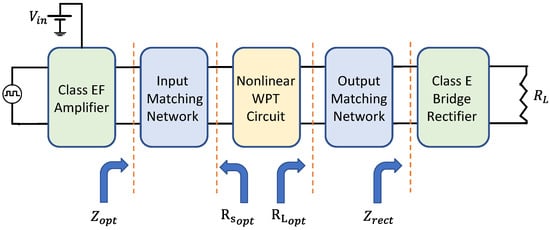
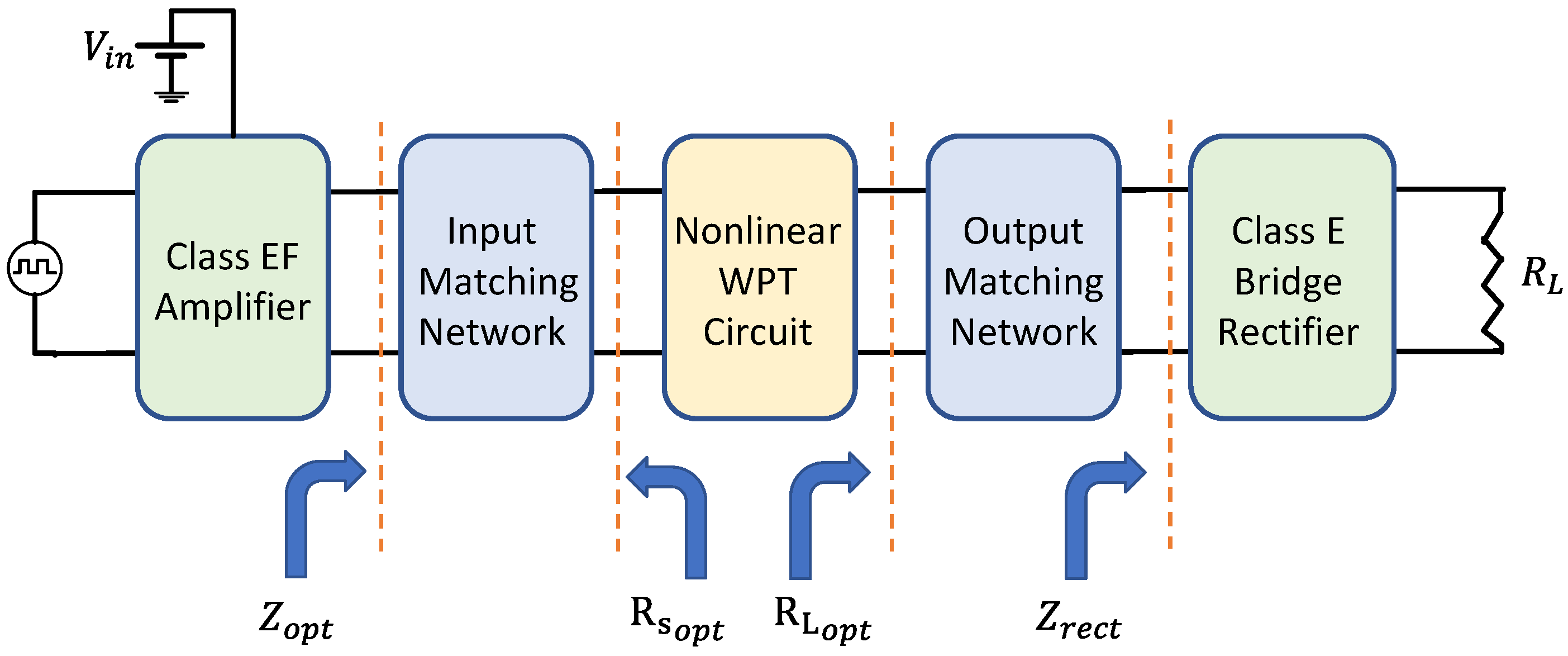
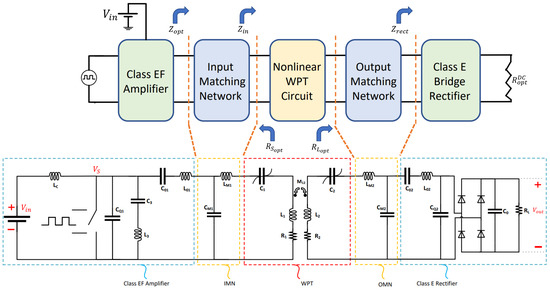
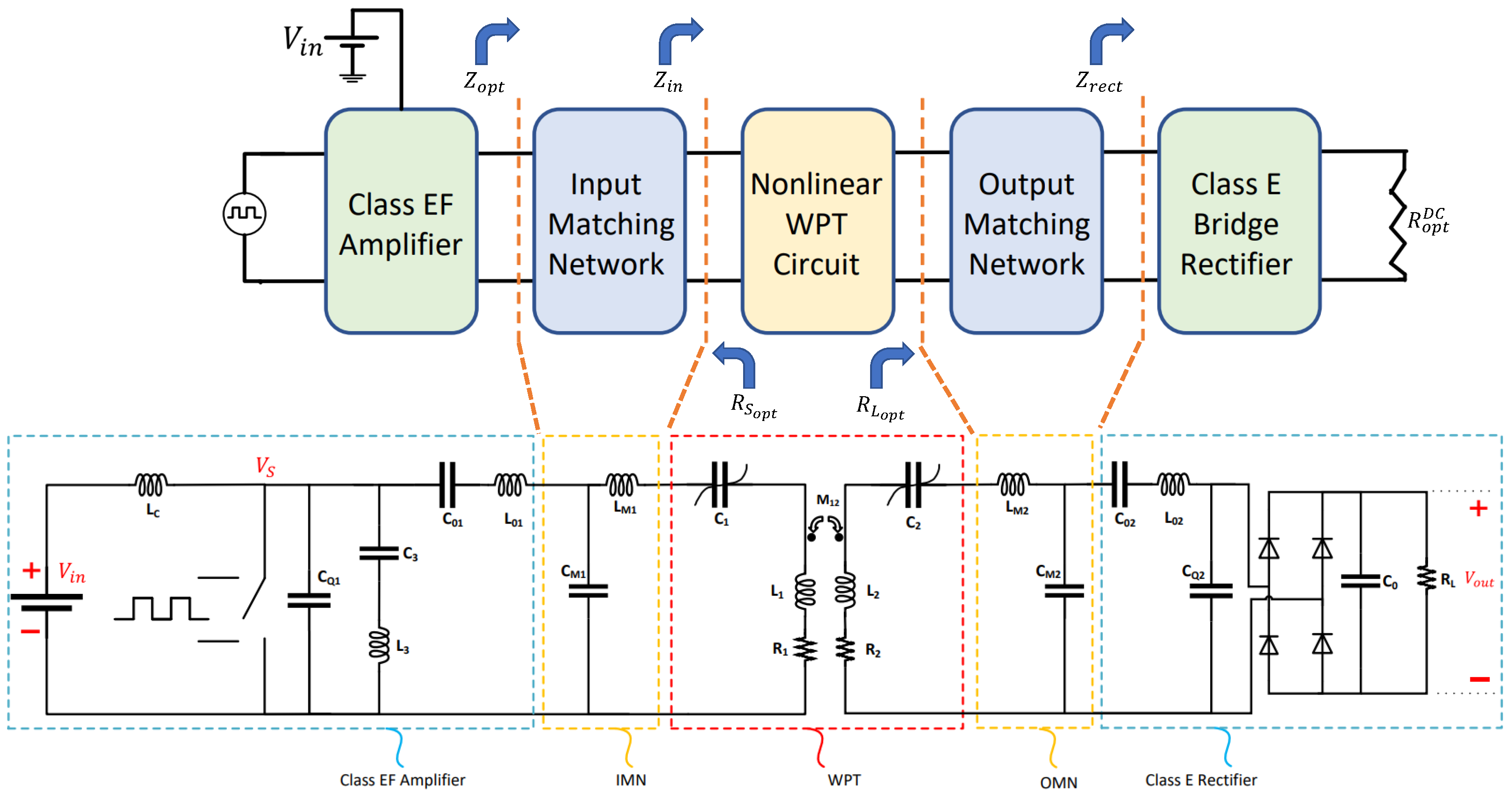
In this work, we present an inductively-coupled WPT system comprising of a class-EF amplifier, inductively coupled nonlinear resonators, and a class-E rectifier, as shown in Figure 1. The analytical design process of the nonlinear resonators is developed and discussed for specific application to a switching-amplifier-driven system. The underlying amplitude-dependent nonlinear resonance phenomenon is presented. The system maintains a constant output power and high efficiency over a coupling-factor range of 0.06–0.30, corresponding to 1 to 9 cm distance variation. The nonlinear resonance-based wireless link inherently presents a stable input impedance to the amplifier, enabling constant output power and high efficiency without active control. The switching waveform of the power amplifier is measured and discussed in the context of the WPT system. Experimental results demonstrate a nominal output power of 5 W, with only 6.12% variation over a 9 cm distance range and a peak DC-to-DC efficiency of 71.6%. To the best of the authors’ knowledge, this is the first experimental demonstration of a WPT system employing passive components that simultaneously stabilizes amplifier loading and transmitted power while maintaining end-to-end efficiency above 50%. The proposed approach can be generalized to other operating frequencies and power levels, provided that the nonlinear devices are rated to withstand the corresponding power requirements. Furthermore, this approach is not limited to a specific distance range. Therefore, integrating a nonlinear resonance-based WPT link with switch mode power amplifiers offers a robust, simplified approach to efficient wireless energy transfer in dynamic coupling conditions.
Figure 1.
Block diagram for the proposed WPT system.
2. WPT System Design
Full system design for a distance-invariant DC-to-DC WPT system requires each sub-circuit to be analyzed and characterized for operation in the system. The block diagram for such a WPT system is shown in Figure 1, where the impedances seen by each stage are modified by the input and output matching networks. To maintain the efficiency and power of the WPT system as the transmission distance changes, the system must maintain a matched resonance state at each of these sub-circuit junctions.
Given a DC supply and load, transmit and receive coils, an operating frequency, a desired output power level and a transfer range (coupling range), the power amplifier, the nonlinear resonance-based WPT circuit and the bridge rectifier can be designed to satisfy the power and efficiency requirements of the application. The procedure in this section highlights the design steps required to ensure that the impedance presented to each component remains constant for distance-invariant power and efficiency operation. First, the nonlinear resonance-based WPT sub-circuit is designed based on the operating range and the critical coupling values of the coils. Next, the amplifier and rectifier sub-circuits are designed for high-efficiency operation, based on their output/input impedances maintaining a match to the WPT sub-circuit. System-level nonlinear circuit simulation results confirm the desired performance of the design.
2.1. Nonlinear Resonance-Based WPT Sub-Circuit Design
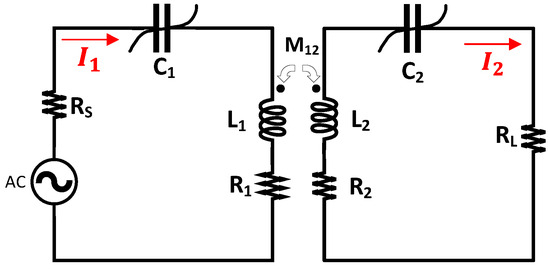
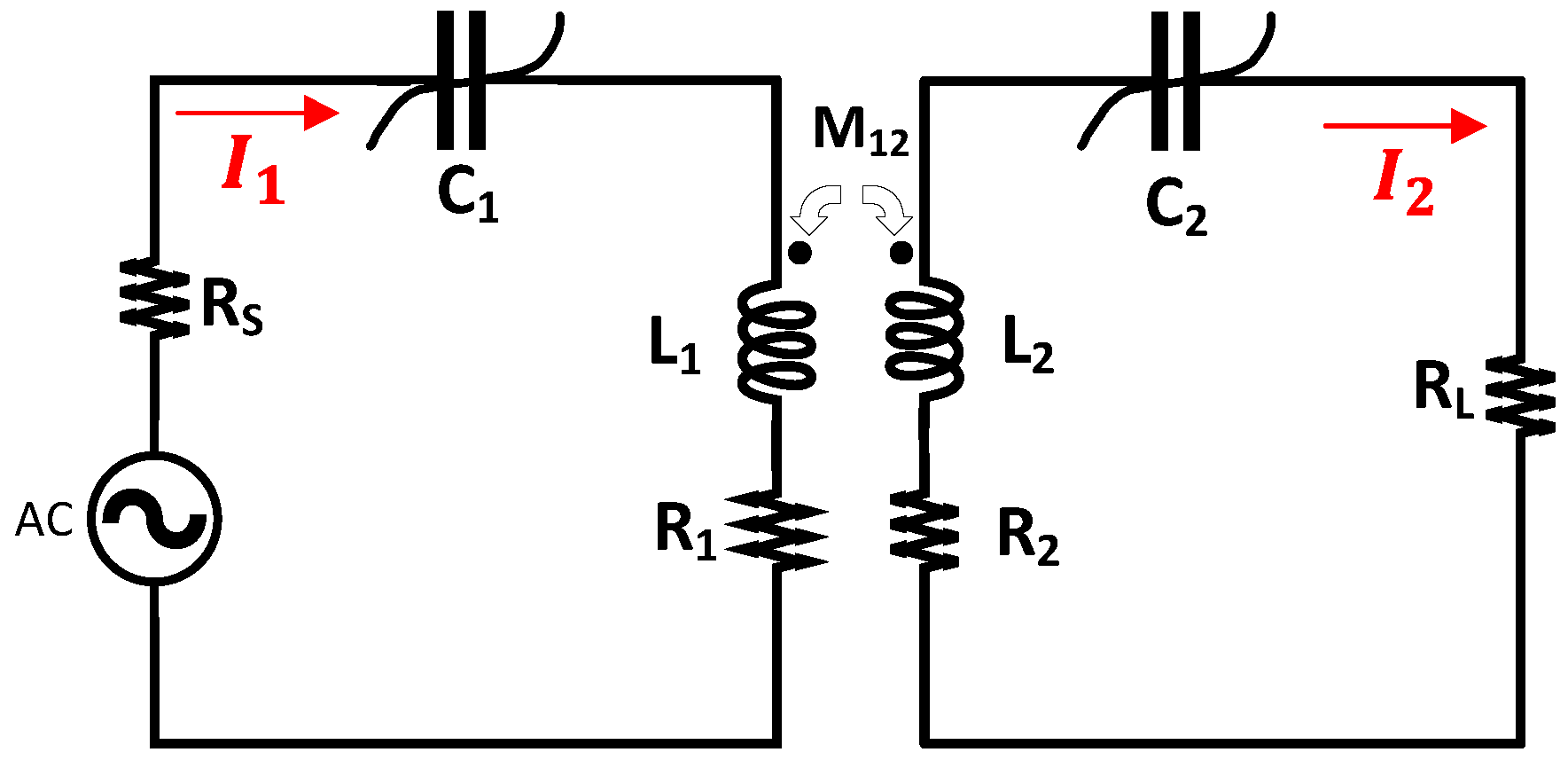
The nonlinear resonance-based WPT circuit design relies on the characterization of the nonlinear capacitors employed on both the primary and secondary resonators in the WPT link. Distance-invariant operation requires each of the nonlinear capacitors to shift the resonant frequency of each resonator based on the coupling variation between them, driven by the voltage variation that occurs. The WPT sub-circuit is shown in Figure 2, where the capacitance of each of the nonlinear capacitors and changes as a function of the voltage across them. The mutual inductance describes the coupling between the transmit coil and the receive coil , where each coil has a series resistance of and respectively. The source for the circuit is modeled as an AC voltage source with an amplitude of and a source resistance of , and the AC load for the sub-circuit is described by .
Figure 2.
WPTsub-circuit with coupled nonlinear resonators. The red arrows indicate the direction of positive current flow for and .
In this section, the theory of coupled nonlinear resonators is revisited [18], and the input impedance of the sub-circuit is derived based on the frequency domain equation approximating the circuit response to enable analytical design and facilitate the optimization of the nonlinear capacitors and . These nonlinear capacitors will then be designed by shaping their capacitance–voltage (C-V) curve to provide a constant input impedance to the source as changes. The input impedance of the coupled nonlinear resonators will then be matched to the output of the amplifier sub-circuit, resulting in constant power delivery and constant efficiency with respect to the coupling variation.
The dynamics of the sub-circuit shown in Figure 2 are described in the time domain by first approximating the voltage across the nonlinear capacitors as a third-order polynomial function of charge with constants and [16], given as
The time domain expressions describing the circuit are given by the coupled nonlinear differential equations [18],
where and denote the electric charge on the nonlinear capacitors and associated with the transmit and receive resonant circuits, respectively.
Equations (3) and (4) are approximated in the frequency domain with formulations for the nonlinearity adapted from [16] as follows:
where the nonlinear restoring force contributed by the third order terms is replaced by an equivalent effective capacitance and combined with the first order term.
The input impedance of the sub-circuit is given as
where the input impedance depends on the nonlinear capacitors and , which are interrelated through the currents , , and the coupling factor k. The efficiency of the WPT sub-circuit is defined as the ratio of output power and power available from the source , where
and
Therefore, becomes a function of both coupling factor k and the nonlinear coefficients and , which are implicit in and .
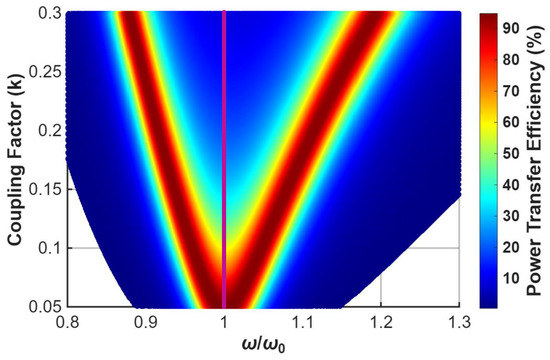
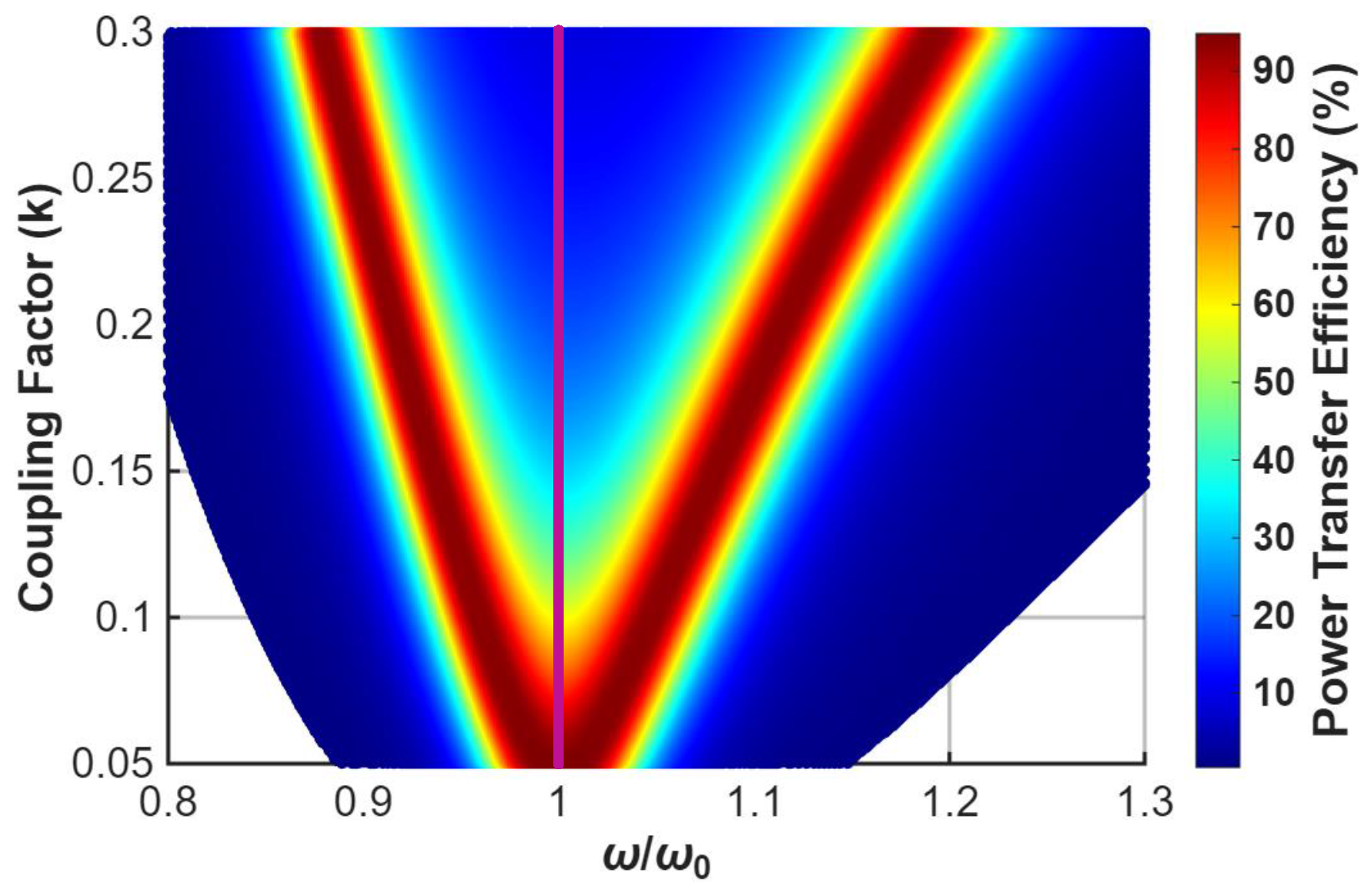
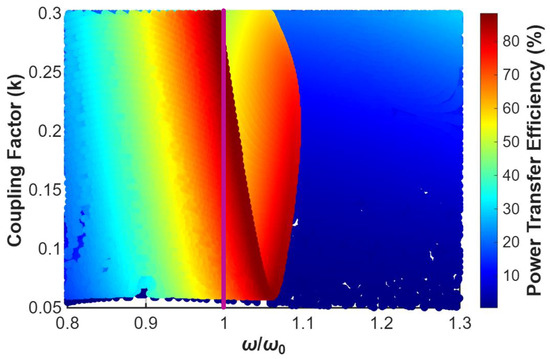
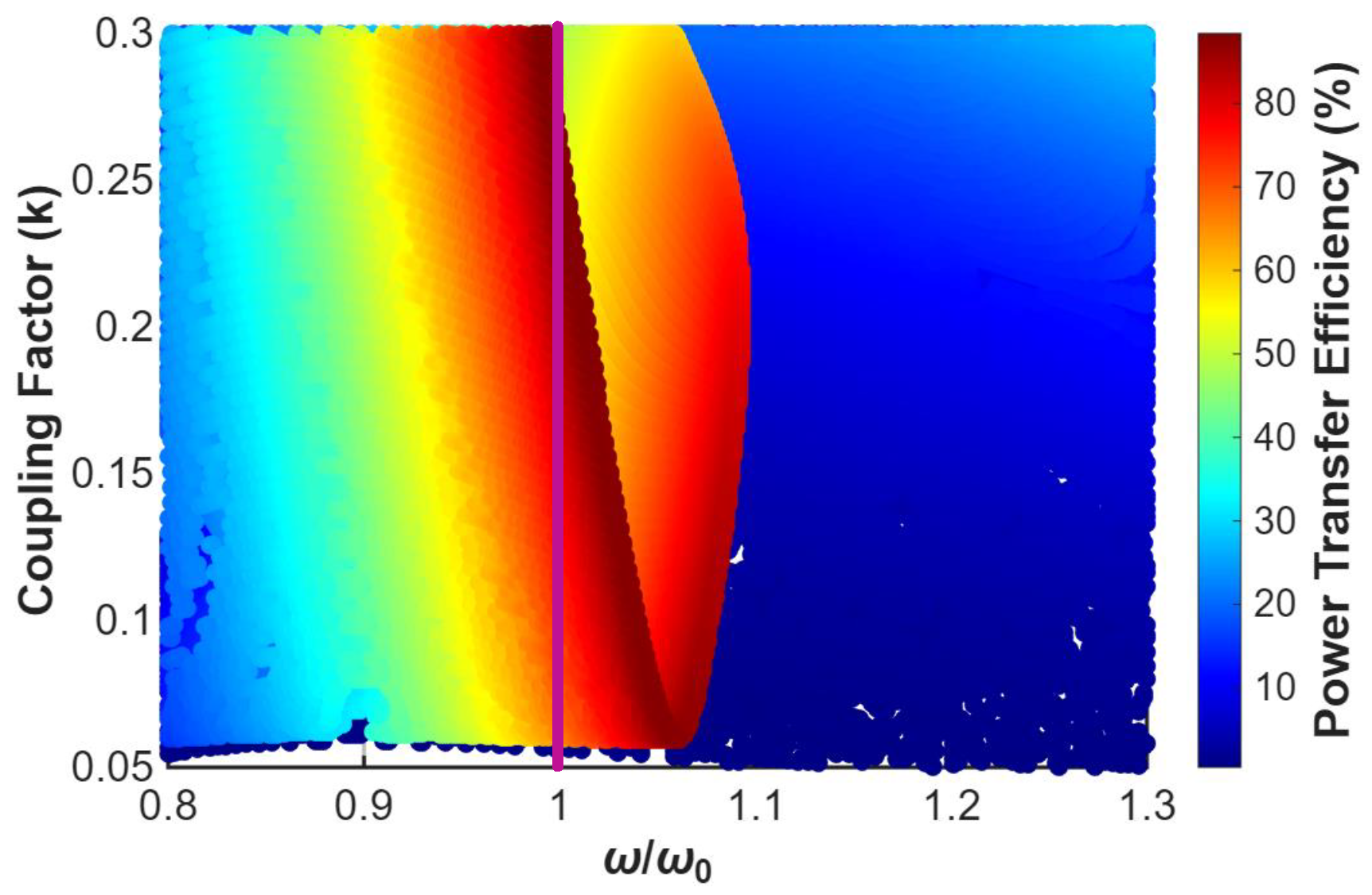
In conventional WPT circuits with linear capacitors, as coupling factor changes, bifurcation or frequency-splitting phenomena arise, as illustrated using MATLAB R2025a in Figure 3. The frequency splitting creates the V-shape observed in Figure 3, where power transfer efficiency drops at the intended operating frequency, indicated by the vertical line at . In contrast, in the distance-invariant WPT system, the coupled nonlinear resonators inherently adapt their natural resonance frequencies as the coupling factor varies due to the voltage-dependent capacitance of nonlinear capacitors. As the coupling increases, the voltage across the nonlinear capacitors decreases, resulting in an increase in the effective capacitance of the nonlinear capacitors, thus down-shifting the resonance frequency of the transmit and receive coils. Consequently, frequency splitting is suppressed over a range of coupling factors. Figure 4 illustrates the power transfer efficiency of the nonlinear resonance-based WPT sub-circuit as a function of the frequency and coupling factor. The nonlinear resonance creates the compressed V shape seen in Figure 4, where peak efficiency is maintained at a constant operating frequency, indicated by the vertical line at . Compared with its linear counterpart, the nonlinear sub-circuit maintains a high power transfer efficiency across a broader range of coupling while operating at a single frequency.
Figure 3.
Power transfer efficiency of a conventional linear WPT circuit, showing the frequency bifurcation effect of the coupled resonators. The solid purple line indicates a fixed frequency operating condition, corresponding to .
Figure 4.
Power transfer efficiency of a WPT sub-circuit with two coupled nonlinear resonators given by Equation (5), where the frequency bifurcation is suppressed by amplitude-dependent resonances. The solid purple line indicates a fixed frequency operating condition, corresponding to .
For a given pair of coupled coils and , a nominal coupling factor , and an operating frequency , the optimal coil loading conditions for maximum power transfer efficiency are described by the following expressions [20]:
where , and and are the unloaded quality factors of the coupled coils. When the transmit and receive circuits are at resonance, the system achieves maximum efficiency, as given by [21]
To maintain , the conjugate matching condition must be satisfied over the transfer range
where the left hand side of (18) is the optimum resistance given by Equation (15) and the right hand side of Equation (18) is the conjugate of Equation (11). Therefore, with both quantities purely real, this condition can be written as
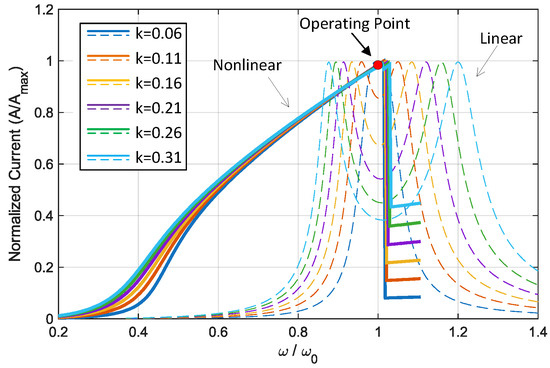
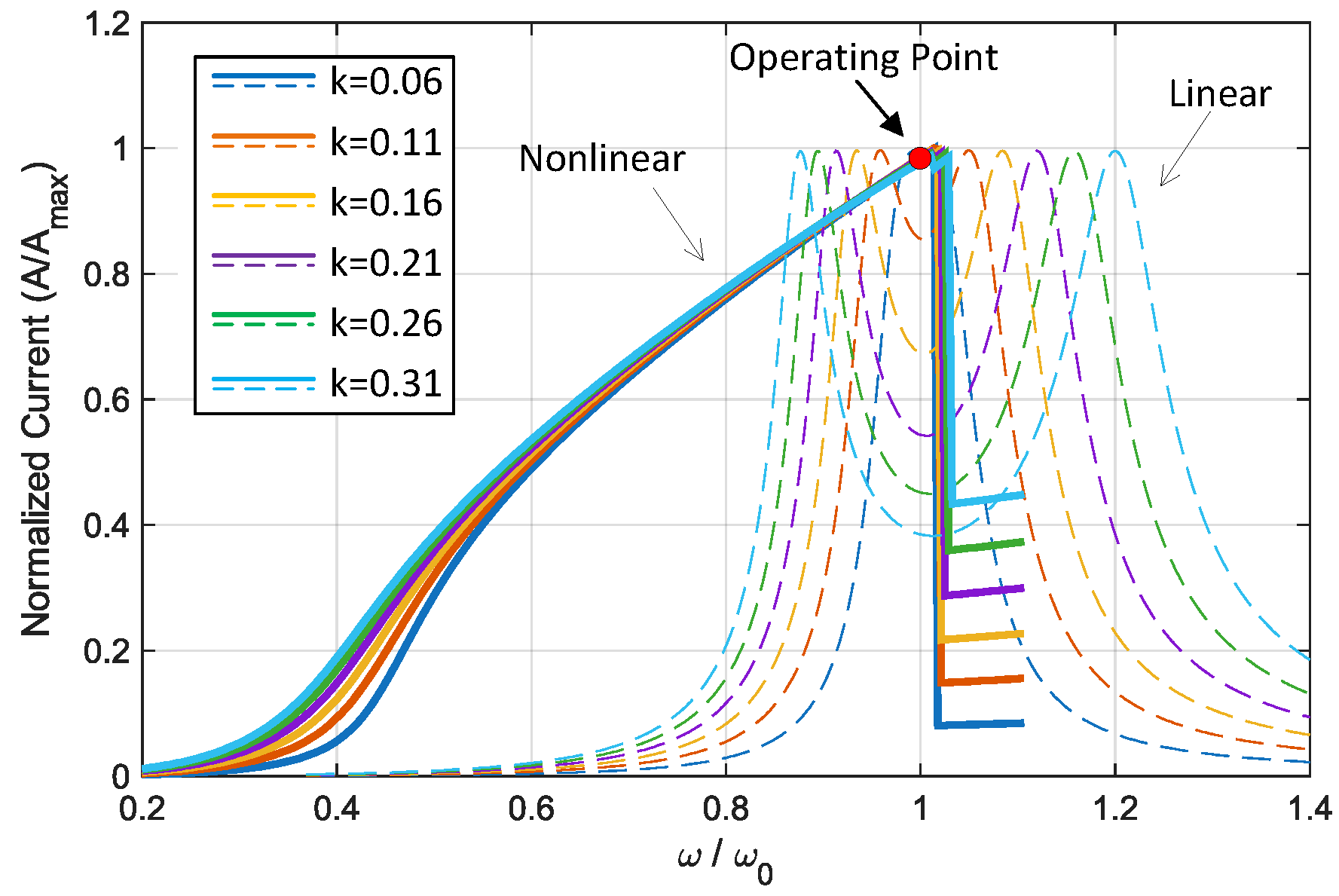
Equation (19) can be satisfied by selecting the appropriate nonlinear capacitor coefficients and of both nonlinear capacitors through MATLAB optimization, thereby shaping the C–V characteristics of both and . The C–V characteristics are obtained by defining an effective capacitance using the fundamental voltage and current components under steady-state excitation, which provides a describing-function-based representation of the nonlinear capacitors. Consequently, the source sees a constant load and delivers constant power to the nonlinear resonance-based WPT sub-circuit. Figure 5 shows the simulated output current amplitude of the designed nonlinear sub-circuit when the condition given by Equation (19) is applied to the system of equations given by Equation (5). This behavior is compared with a linear WPT circuit, using Keysight ADS Harmonic Balance. At the resonant frequency , the linear current decreases with coupling variation as a result of the frequency splitting. However, the nonlinear sub-circuit maintains constant current amplitude at all k values from 0.03 to 0.06, resulting in constant power delivered to the load and constant power transfer efficiency. The operating point is again labeled in the figure at the frequency . The asymmetric bandwidth around this operating point is shown in the figure. For frequencies below the design frequency, the sub-circuit maintains the constant power–distance behavior but with reduced power and efficiency due to reflection at the input. Operation above the design frequency fails to produce the intended response due to the nonlinear dynamics.
Figure 5.
Simulated output current amplitude of a nonlinear resonance-based WPT sub-circuit, under optimum operation condition, as a function of frequency for various coupling factors. The results are compared with a conventional linear WPT system. At the operating point, the nonlinear WPT sub-circuit maintains constant current at the output over the entire transfer range of coupling values, whereas the linear circuit experiences bifurcation.
The stability of the input impedance of the nonlinear WPT sub-circuit is critical for the design of switch-mode power amplifiers, as it enables high-efficiency operation at a constant power level. The subsequent section discusses the class-E rectifier and the class-EF amplifier design and their optimal-impedance conditions.
2.2. Amplifier and Rectifier Sub-Circuit Design
Following the design of the nonlinear WPT sub-circuit, the peripheral power electronics sub-circuits can be designed to provide the necessary power and load to the system. On the transmit side, the efficiency of switch-mode power amplifiers is maximized when an optimal impedance is presented. For the class-EF amplifier circuit shown in Figure 6, the optimal impedance for achieving maximum efficiency is defined by [22]
where denotes the amplifier output power and is the input DC voltage. According to (20), the load impedance and output power of the amplifier are interrelated, and any change in the load impedance results in power variations. Therefore, to maintain the efficiency of the amplifier and load power as the coupling factor varies, the load impedance presented to the amplifier must remain constant.
Figure 6.
Sub-circuit implementation for the DC-DC WPT system. The optimum input and output impedance for each sub-circuit stage are maintained by the nonlinear WPT sub-circuit and the subsequent matching networks.
In linear WPT circuits powered by class-EF amplifiers, as the coupling factor deviates from the critical coupling, the impedance presented to the amplifier differs from the optimal impedance. This impedance variation leads to increased power dissipation at the switching transistor due to an overlap between the switch current and voltage during the ON and OFF transition periods. The zero-voltage switching condition is lost. However, in a nonlinear WPT circuit based on coupled nonlinear resonators, the input impedance of the WPT circuit remains constant, purely real, and equal to Equation (15). The nonlinear WPT circuit has nonlinear capacitors that are optimized by adjusting the diode parameters, , and m such that a constant input impedance equal to the optimum impedance is achieved as the coupling factor varies. Input matching is then utilized to transform the constant impedance to Equation (20). Consequently, the amplifier perceives Equation (20) as the coupling changes, thereby maintaining a zero voltage switching condition. The simulated switching waveforms of linear and nonlinear WPT systems are compared in the next section.
On the receive side, a full-bridge class-E rectifier is used, as shown in Figure 6. The input impedance of a class-E full-bridge rectifier at optimum efficiency is given by [7]
and the optimum dc load is given by
The input impedance of the class-E rectifier was matched to , given by Equation (16), at all coupling factor values, providing a match to the WPT sub-circuit to maximize the efficiency. For this example, Equation (21) was derived under the assumption of ideal diode models, not accounting for diode junction capacitance or parasitics. Further circuit simulations with practical diode models can be used to more accurately determine the input impedance of the rectifier.
2.3. Full System Simulation
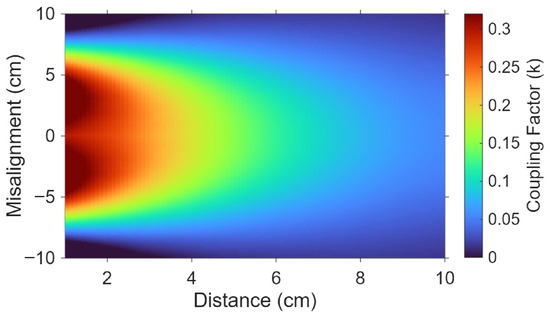
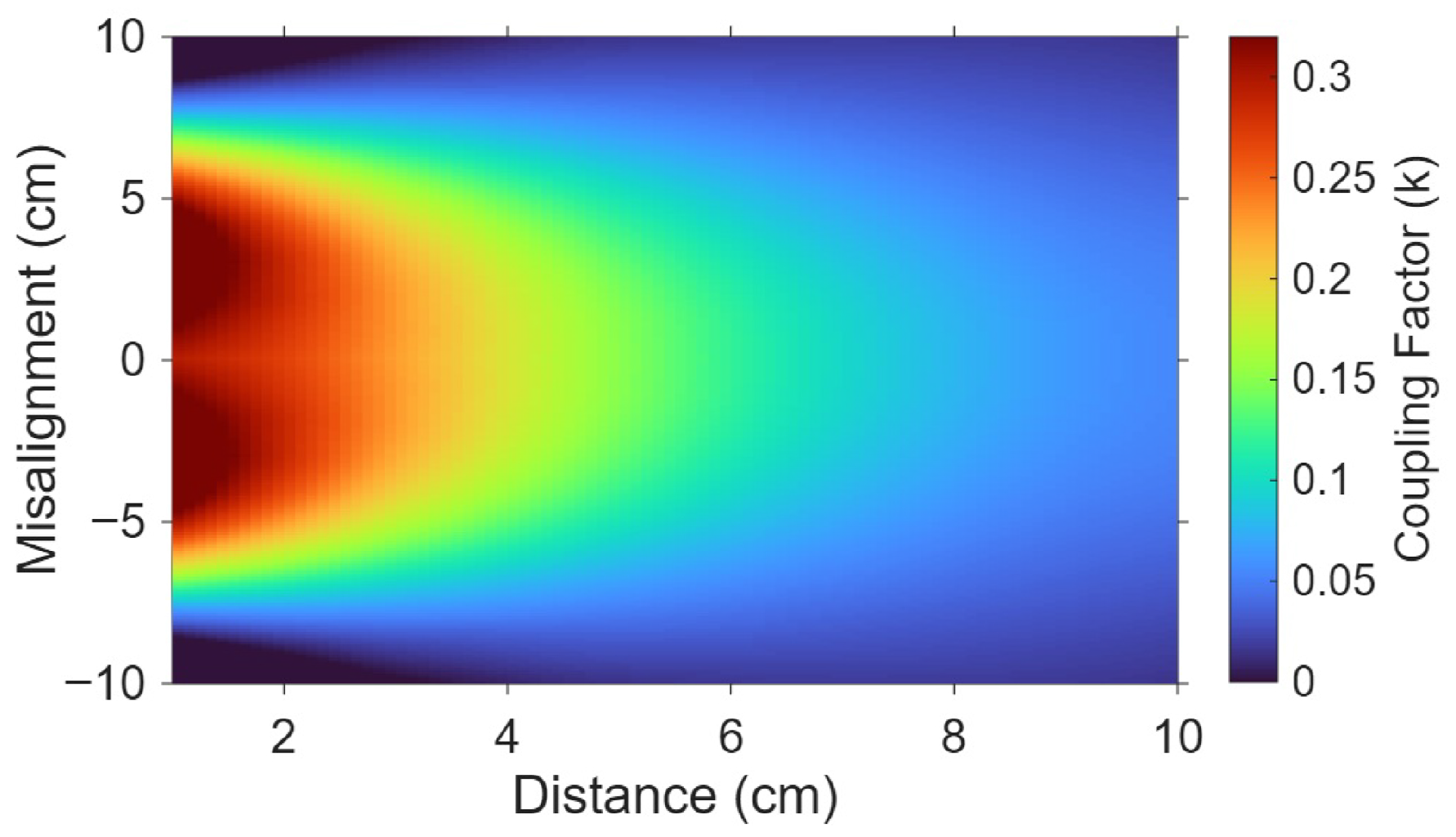
A full DC-to-DC WPT system was designed in simulation to demonstrate the distance-invariant behavior. The prototype system consists of a class-EF amplifier, nonlinear WPT sub-circuit, class-E full-bridge rectifier, and input and output matching networks. The circuit diagram is illustrated in Figure 6. For WPT systems, class-E or EF amplifier topologies can be selected. However, to avoid the breakdown of the transistor during testing, a class-EF amplifier topology was chosen. This is because the voltage across the switch is twice the supply voltage compared to that of class E, which is approximately four times the input-supply voltage. The system was designed to supply 5 W of DC power to a 50 ohm load over a coupling range of k = 0.06–0.3 and at an operating frequency of 13.56 MHz. The nonlinear capacitor-voltage relationship was implemented with ideal diode models in an anti-series configuration. The condition of Equation (19) provided the approximate solution for the and parameters following a MATLAB optimization. The coefficients and were related to ideal diode parameters (m, , ) in [16], which were then modified in further circuit optimization in Keysight ADS. The transmitter and receiver coils were spiral coils with outer diameters of 18.4 and 10 cm, respectively. The coupling versus misalignment and distance relationship between the two coils is shown in Figure 7. Furthermore, an off-the-shelf Gallium Nitride (GaN) transistor model GS61004B was used as the switching device. The DC input voltage was set to 15 V. For the rectifier, model PMEG4010EP rectifying diodes were selected due to their low parasitic inductances at MHz frequencies.
Figure 7.
Coupling factor vs distance and misalignment relationship.
The efficiency of the WPT system is defined as
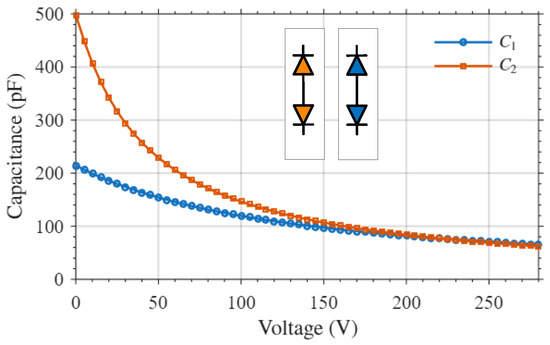
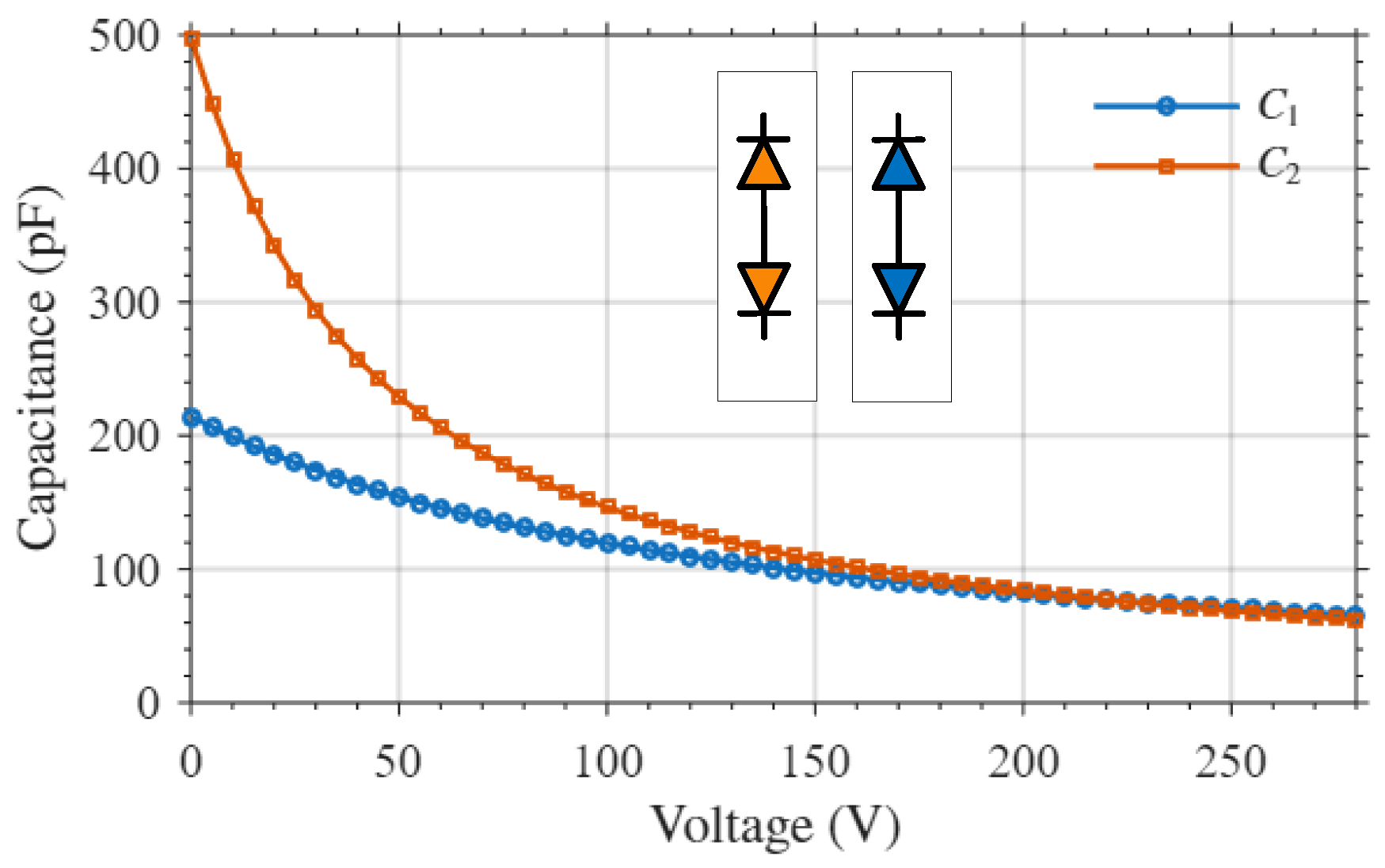
where is the input DC power and is the output DC power. The maximum achievable efficiency of the system is given by Equation (17), because the amplifier and rectifier efficiencies are ideally 100%. The C-V curves optimized in simulation, based on Equation (19), are shown in Figure 8, where the optimum impedance conditions are maintained. The two nonlinear capacitor-voltage relationships were implemented with different diode models in an anti-series configuration, shown in the inset of Figure 8.
Figure 8.
Optimized C-V curve response of the nonlinear capacitors used as and in the WPT circuit, implemented with different anti-series diodes, shown in the inset.
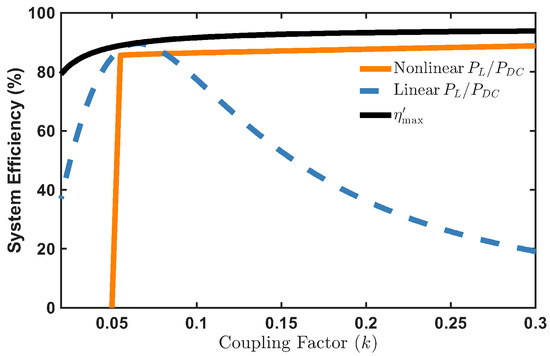
The full system simulation results show a considerable improvement in the output DC power and DC-to-DC efficiency over a wider range of coupling factors compared to the linear system, as shown in Figure 9. The theoretical maximum efficiency given the amplifier and rectifier losses is shown in comparison with the efficiencies of both the linear and nonlinear systems. The linear system achieves the maximum efficiency at a single coupling value, the critical coupling. The nonlinear system, by contrast, maintains constant efficiency for a large range starting at critical coupling. The nonlinear resonators prevent the frequency bifurcation effect from decreasing the efficiency of the nonlinear system, enabling constant power to be delivered. As a result, the proposed nonlinear system achieves distance-invariant power transfer over a range of operating distances. At the output, a power conditioning stage can be added to achieve the desired system operation, between constant voltage or constant current modes.
Figure 9.
Simulated power transfer efficiency comparison of linear and nonlinear WPT systems, where both the rectifier and amplifier losses are included and nonlinear capacitor losses are omitted. is the maximum achievable system efficiency including the amplifier and rectifier losses.
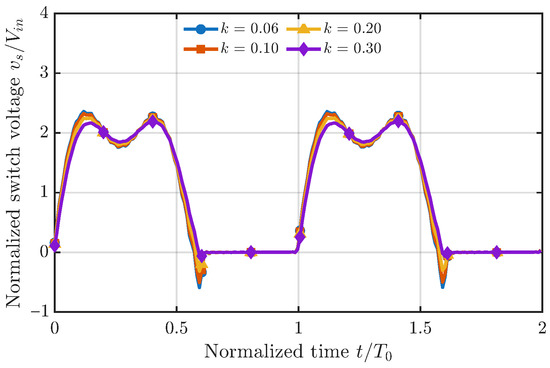
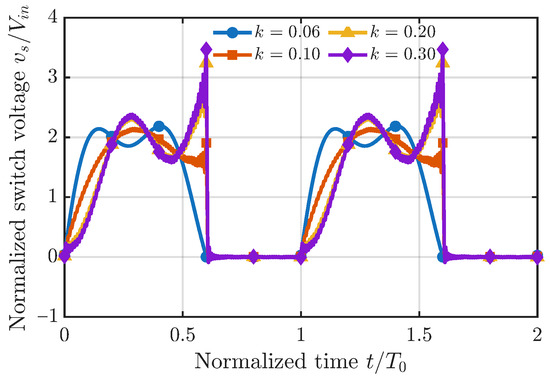
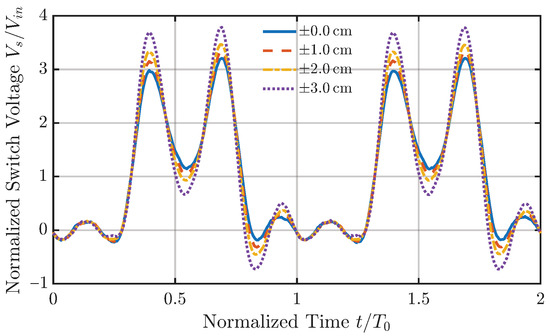
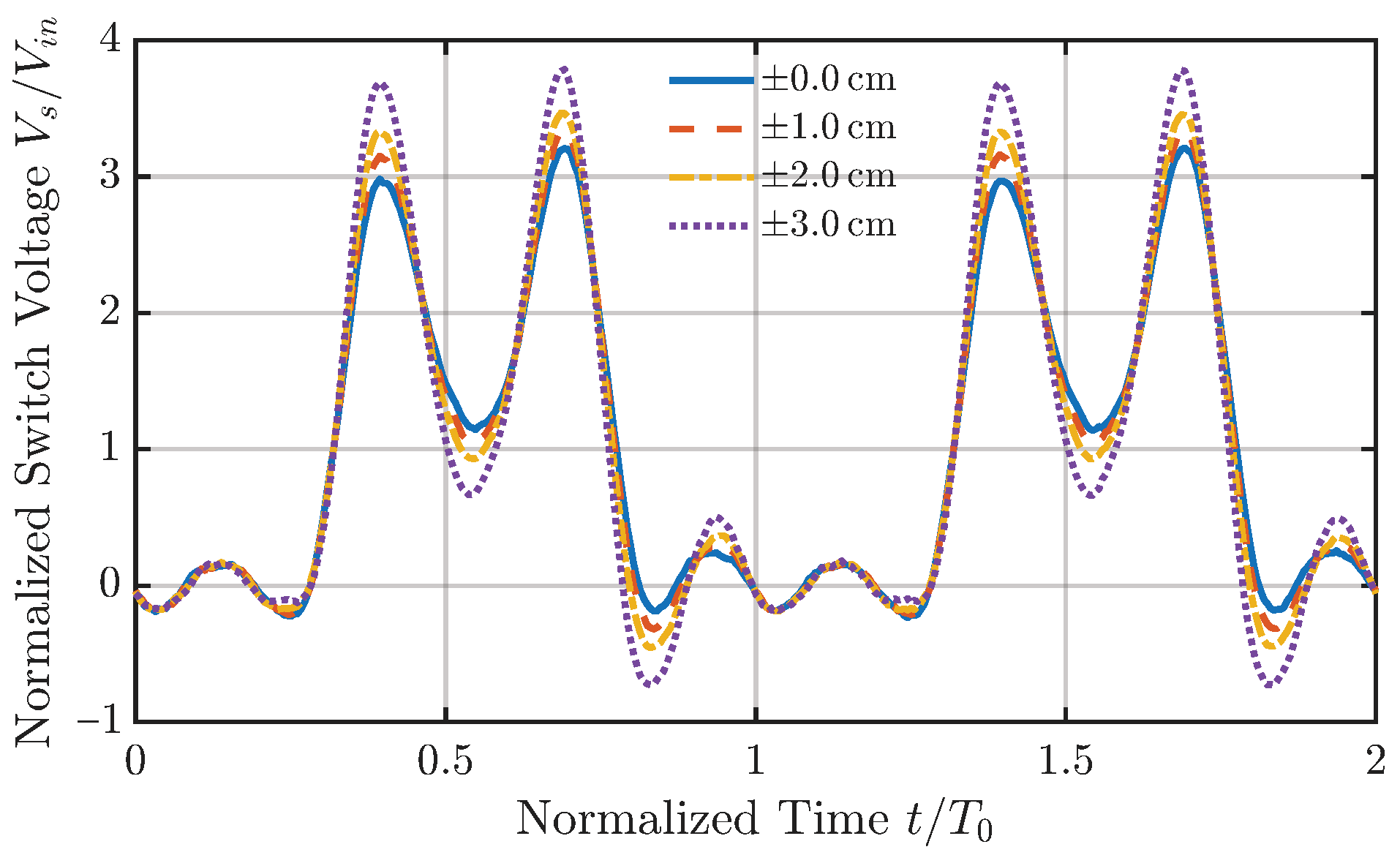
The switching waveforms across the coupling range for the distance-invariant WPT system are shown in Figure 10, where the waveforms are consistent over coupling variation. The optimum impedance condition, maintained by the shifting resonance of the nonlinear WPT sub-circuit, preserves the power and efficiency from the power amplifier by providing a constant impedance. By contrast, the switching waveforms for a comparable linear WPT system are shown in Figure 11, where the coupling variation causes a loss of zero voltage switching. This variation in the waveforms of the switching amplifier leads to a decrease in both power and efficiency.
Figure 10.
Simulated switch waveform when and are nonlinear capacitors optimized for constant input impedance. Zero voltage switching is approximately preserved as k changes.
Figure 11.
Simulated switch waveform when and are linear capacitors indicating the zero voltage switching only at the designed coupling factor of .
The nonlinear resonance-based WPT system effectively isolates the amplifier source from coupling-induced load variations, enforcing a nearly constant and purely real input impedance over a wide range of coupling factors. As a result, high efficiency and stable power delivery are sustained despite variations in coil alignment and separation. This stability at the transmitter directly benefits the receiver-side rectifier, whose input impedance is inherently sensitive to power fluctuations. By maintaining a regulated excitation condition, the proposed approach ensures reliable rectifier operation, thereby enhancing overall system performance.
3. Measurement Results
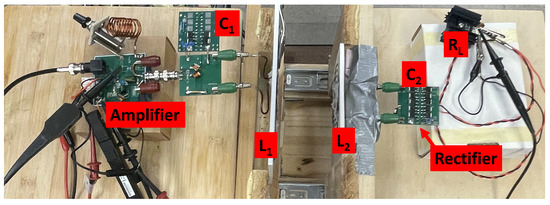
The performance of the full DC-to-DC system was experimentally verified through fabrication and measurement. The experimental setup is illustrated in Figure 12. The transmitter and receiver spiral coils were mounted on a Polylactic Acid (PLA) material to hold them in place. A square wave signal driving the gate of the switching transistor at 13.56 MHz at a duty cycle of 40% was used. The transistor output capacitance at the 15 V supply voltage was higher than the required capacitance for class EF operation; thus, no physical component was used as . The extra reactance of the transistor output capacitance was compensated for using a finite choke . Similarly, on the load side, the rectifier diode effective capacitances at the target input power level were sufficient and did not require a physical component .
Figure 12.
Measurement setup for the considered WPT circuit.
The nonlinear capacitors and were implemented using Schottky diodes, model C3D03060E. The nonlinear capacitor was implemented with two parallel anti-series diodes combined with linear ceramic capacitors for tuning its C-V curve. The nonlinear capacitor was implemented using five parallel pairs of anti-series diodes. Table 1 summarizes the circuit parameters used in the experiment and their corresponding values.
Table 1.
Circuit parameters and values used in experiment.
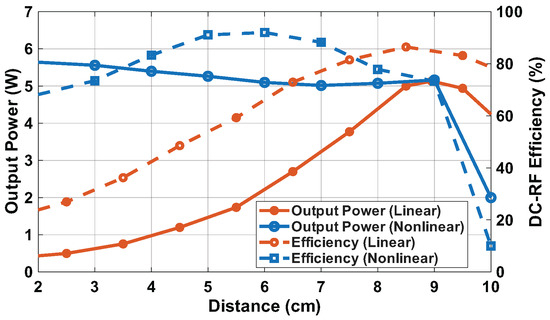
To evaluate the performance of the prototype, the nonlinear resonance-based WPT system was first compared with a linear WPT system in terms of DC-to-RF efficiency and output power over varying distances. The DC–RF efficiency is defined as the ratio of the measured RF output power delivered to the load to the input DC power supplied to the Class-EF amplifier. The RF output power is calculated from the measured voltage waveform across a 10 resistor representing the optimum load () at critical coupling (). The input DC power is obtained from the supply voltage () and current. The nonlinear WPT system achieved a DC-RF efficiency above 70% and a constant output power of 5 W across a distance range of 9 cm, as shown in Figure 13. The measured nonlinear output power remains stable, exhibiting only a 10% variation across the entire distance range, whereas the linear system delivers peak power only at the critical coupling point. The measured efficiency of the nonlinear WPT circuit remains above 70% over all distances, while the efficiency of the linear system drops significantly due to impedance mismatch. Considering instrument accuracy and measurement repeatability, the overall uncertainty in the reported efficiency is estimated to be within ±5%. These results demonstrate the advantage of coupled nonlinear resonators in achieving stable performance without the need for active control circuitry. The efficiency variation observed in the nonlinear case as the coupling factor changes is likely attributable to parasitic elements and impedance mismatches in the implemented system.
Figure 13.
Measured output power and DC-to-RF efficiency, without the rectifier, at different separations between the coils for linear WPT and nonlinear WPT circuits.
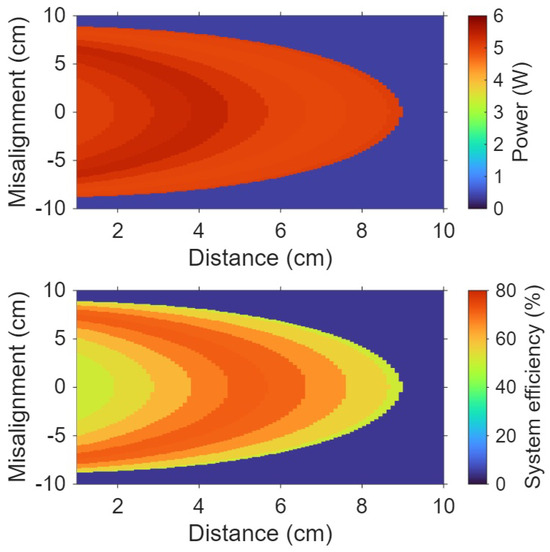
The measured full DC-to-DC system efficiency and DC power are shown in Figure 14. The system maintained a constant output power of 5 W at a separation distance of up to 9 cm under varying alignments. Furthermore, the measured system efficiency was maintained above 50%. It should be noted that due to the dynamics of the nonlinear WPT system, the output power drops sharply beyond the operation range, as shown in Figure 14. This drop in efficiency at the critical coupling point is due to the nonlinear dynamics. However, the range at which critical coupling occurs can be modified by changing the loading presented to the coils. The measured switching waveform of the class-EF amplifier at the maximum efficiency point is depicted in Figure 15. The switch waveform is close to the optimal class-EF waveform but includes extra harmonics due to non perfect impedance matching. Impedance variations are present when the alignment between the coils is changed; however, the total system efficiency remains high.
Figure 14.
Measured output DC power and DC-to-DC system efficiency at different transfer distances and misalignment for the nonlinear WPT system.
Figure 15.
Measured switch waveforms at an axial separation of 6 cm, showing consistency over misalignment.
Compared to other wireless power transfer system approaches, the work presented here demonstrates an improvement in power stability across a practical coupling factor range while utilizing no active control circuitry, as summarized in Table 2. In this work, where the frequency was fixed at 13.56 MHz, natural resonance frequency shifts introduced by the nonlinear capacitors enabled an automatic impedance match at each coupling. Furthermore, the proposed method simultaneously achieves output power stability, input impedance stability, and relatively high efficiency (peak DC-to-RF is 91.8%, peak DC-to-DC is 71.6%) without requiring active tuning, thereby offering a promising solution for dynamic WPT applications. This is in contrast to other similar works that attempt to maintain efficiency, such as [23], which operates at the same frequency. Although the load-independent class-EF amplifier maintains the efficiency, the power delivered shows variations due to the impedance variation of the WPT sub-circuit. Other similar systems, such as [15], implement a control loop based on a tuning algorithm in order to satisfy impedance matching conditions. Avoiding this additional circuitry and complexity is a significant advantage to the proposed nonlinear WPT system.
Table 2.
Comparison of similar WPT systems.
Future work may focus on the development of nonlinear capacitive elements whose C–V characteristics intrinsically match the target C–V profiles required for constant-input-impedance operation. In the present approach, these target characteristics are realized through an iterative design and selection process constrained by the C–V responses of commercially available nonlinear devices. Designing custom nonlinear capacitors with tailored C–V behavior would eliminate the need for such iterative matching and device screening, enabling a more direct implementation of the desired nonlinear response and further simplifying the overall nonlinear WPT sub-circuit design process.
4. Conclusions
This work demonstrated a DC-to-DC WPT system capable of robust operation under dynamic transfer distance variations. The proposed WPT sub-circuit employs coupled nonlinear resonators to maintain a constant input impedance and suppress frequency splitting without requiring active tuning or feedback control. Compared to its linear counterpart, which exhibits significant impedance variation with distance, the nonlinear approach provides superior robustness and is particularly well-suited for applications involving variable coupling conditions, such as biomedical implants. Therefore, the main advantages of the proposed system are (1) inherent adaptability to distance variation and misalignment, (2) power and efficiency are both maintained consistently over the operating range and (3) no complex feedback or control circuitry is necessary in the design. These advantages, unique to nonlinear resonance-based WPT, are demonstrated for the first time in a full DC–DC system, incorporating all of the necessary sub-circuits for robust and effective DC power to be delivered over a variable range. Future work may focus on extending this technique to multi-device or multi-coil configurations.
Author Contributions
Conceptualization, A.A.; methodology, A.A.; software, A.A.; validation, A.A.; formal analysis, A.A.; investigation, A.A.; resources, A.M.; data curation, A.A.; writing—original draft preparation, A.A.; writing—review and editing, A.D. and A.M.; visualization, A.A. and A.D.; supervision, A.M.; project administration, A.M.; funding acquisition, A.M. All authors have read and agreed to the published version of the manuscript.
Funding
This research received no external funding.
Institutional Review Board Statement
Not applicable.
Informed Consent Statement
Not applicable.
Data Availability Statement
The original contributions presented in this study are included in the article. Further inquiries can be directed to the corresponding authors.
Conflicts of Interest
The authors declare no conflicts of interest.
Abbreviations
The following abbreviations and symbols are used in this manuscript:
| WPT | Wireless Power Transfer |
| DC-DC | Direct Current to Direct Current |
| DC-RF | Direct Current to Radio Frequency |
| Capacitance of the nonlinear capacitor | |
| Mutual inductance between primary and secondary transfer coils | |
| Charge on the nonlinear capacitor | |
| Voltage across the nonlinear capacitor | |
| Inductance of the transfer coil | |
| Resistance of the transfer coil | |
| Source resistance | |
| Load resistance | |
| RF voltage source | |
| Current through the transfer coil | |
| , | Coefficients for the primary side nonlinear capacitor charge–voltage relationship |
| , | Coefficients for the secondary side nonlinear capacitor charge–voltage relationship |
| Source voltage amplitude (switching voltage) | |
| Frequency in radians per second | |
| t | Time |
| k | Coupling coefficient calculated as |
| Input impedance, function of k, and | |
| Maximum power available from source to a load matched to | |
| Output power delivered to | |
| Power transfer efficiency, | |
| Optimum source resistance loading for maximum | |
| Optimum load resistance loading for maximum | |
| Unloaded quality factor for the transfer coil | |
| Theoretical maximum power transfer efficiency | |
| C-V | Capacitance–voltage relationship (function) |
| Resonant frequency | |
| DC supply voltage for the amplifier | |
| Amplifier design output power | |
| Required amplifier load impedance for with | |
| RF choke inductor | |
| Transistor shunt capacitance | |
| Shunt resonator capacitance | |
| Shunt resonator inductance | |
| Amplifier harmonic filter capacitance | |
| Amplifier harmonic filter inductance | |
| IMN | Input impedance matching network |
| OMN | Output impedance matching network |
| Input matching network capacitance | |
| Input matching network inductance | |
| Output matching network capacitance | |
| Output matching network inductance | |
| Rectifier harmonic filter capacitance | |
| Rectifier harmonic filter inductance | |
| Rectifier shunt capacitance | |
| Rectifier output capacitance | |
| Ouptut DC voltage | |
| Diode junction capacitance | |
| Diode junction voltage | |
| m | Diode grading coefficient |
| Optimum rectifier input impedance | |
| Optimum DC load on the rectifier | |
| DC output power | |
| DC input power | |
| System efficiency | |
| Maximum achievable system efficiency including the amplifier | |
| and rectifier losses |
References
- Okasili, I.; Elkhateb, A.; Littler, T. A Review of Wireless Power Transfer Systems for Electric Vehicle Battery Charging with a Focus on Inductive Coupling. Electronics 2022, 11, 1355. [Google Scholar] [CrossRef] [Scilit]
- Campi, T.; Cruciani, S.; Maradei, F.; Montalto, A.; Musumeci, F.; Feliziani, M. Centralized High Power Supply System for Implanted Medical Devices Using Wireless Power Transfer Technology. IEEE Trans. Med. Robot. Bionics 2021, 3, 992–1001. [Google Scholar] [CrossRef] [Scilit]
- Kim, H.J.; Hirayama, H.; Kim, S.; Han, K.J.; Zhang, R.; Choi, J.W. Review of Near-Field Wireless Power and Communication for Biomedical Applications. IEEE Access 2017, 5, 21264–21285. [Google Scholar] [CrossRef] [Scilit]
- Sokal, N.; Sokal, A. Class E-A New Class of High-Efficiency Tuned Single-Ended Switching Power Amplifiers. IEEE J. -Solid-State Circuits 1975, 10, 168–176. [Google Scholar] [CrossRef] [Scilit]
- Aldhaher, S.; Yates, D.C.; Mitcheson, P.D. Load-Independent Class E/EF Inverters and Rectifiers for MHz-Switching Applications. IEEE Trans. Power Electron. 2018, 33, 8270–8287. [Google Scholar] [CrossRef] [Scilit]
- Ye, Z.; Lin, C.H.; Rivas-Davila, J. Class-Φ2 Power Amplifier With Resonant Gate Driver: High-Efficiency Power Amplifier for 50 MHz. IEEE Microw. Mag. 2024, 25, 88–92. [Google Scholar] [CrossRef] [Scilit]
- Ohira, T. Linear Algebra Elucidates Class-E Diode Rectifiers [Educator’s Corner]. IEEE Microw. Mag. 2022, 23, 113–122. [Google Scholar] [CrossRef] [Scilit]
- Zhou, Y.; Fan, R.; Liu, C. Low-Power Rectennas in Microwave Wireless Power Transmission. Microwave 2025, 1, 5. [Google Scholar] [CrossRef] [Scilit]
- Nepa, P.; Buffi, A. Near-field-focused microwave antennas: Near-field shaping and implementation. IEEE Antennas Propag. Mag. 2017, 59, 42–53. [Google Scholar]
- Heebl, J.D.; Thomas, E.M.; Penno, R.P.; Grbic, A. Comprehensive Analysis and Measurement of Frequency-Tuned and Impedance-Tuned Wireless Non-Radiative Power-Transfer Systems. IEEE Antennas Propag. Mag. 2014, 56, 44–60. [Google Scholar] [CrossRef] [Scilit]
- Kline, M.; Izyumin, I.; Boser, B.; Sanders, S. Capacitive Power Transfer for Contactless Charging. In 2011 Twenty-Sixth Annual IEEE Applied Power Electronics Conference and Exposition (APEC); IEEE: New York, NY, USA, 2011; pp. 1398–1404. [Google Scholar] [CrossRef] [Scilit]
- Chang, F.W.; Hsieh, P.H. A 13.56-MHz Wireless Power Transfer Transmitter with Impedance Compression Network for Biomedical Applications. In 2020 IEEE International Symposium on Circuits and Systems (ISCAS); IEEE: New York, NY, USA, 2020; pp. 1–5. [Google Scholar] [CrossRef] [Scilit]
- Zhao, Y.; Lu, M.; Li, H.; Zhang, Z.; Fu, M.; Goetz, S.M. Class E/EF Inductive Power Transfer to Achieve Stable Output under Variable Low Coupling. In 2025 IEEE Applied Power Electronics Conference and Exposition (APEC); IEEE: New York, NY, USA, 2025; pp. 3206–3211. [Google Scholar] [CrossRef] [Scilit]
- Jiang, Y.; Liang, J.; Wang, H.; Liu, Y.; Fu, M. Load-Impedance-Insensitive Design of High-Efficiency Class EF Inverters. IEEE Trans. Power Electron. 2024, 39, 1958–1962. [Google Scholar] [CrossRef] [Scilit]
- Liu, S.; Liu, M.; Han, S.; Zhu, X.; Ma, C. Tunable Class E2 DC–DC Converter with High Efficiency and Stable Output Power for 6.78-MHz Wireless Power Transfer. IEEE Trans. Power Electron. 2018, 33, 6877–6886. [Google Scholar] [CrossRef] [Scilit]
- Wang, X.; Mortazawi, A. Bandwidth Enhancement of RF Resonators Using Duffing Nonlinear Resonance for Wireless Power Applications. IEEE Trans. Microw. Theory Tech. 2016, 64, 3695–3702. [Google Scholar] [CrossRef]
- Abdelatty, O.; Wang, X.; Mortazawi, A. Position-Insensitive Wireless Power Transfer Based on Nonlinear Resonant Circuits. IEEE Trans. Microw. Theory Tech. 2019, 67, 3844–3855. [Google Scholar] [CrossRef] [Scilit]
- Chai, R.; Mortazawi, A. A Position-Insensitive Wireless Power Transfer System Employing Coupled Nonlinear Resonators. IEEE Trans. Microw. Theory Tech. 2021, 69, 1752–1759. [Google Scholar] [CrossRef] [Scilit]
- Ardila, V.; Ramírez, F.; Suárez, A. Analytical and Numerical Bifurcation Analysis of Circuits Based on Nonlinear Resonators. IEEE Trans. Microw. Theory Tech. 2021, 69, 4392–4405. [Google Scholar] [CrossRef] [Scilit]
- Chen, C.J.; Chu, T.H.; Lin, C.L.; Jou, Z.C. A Study of Loosely Coupled Coils for Wireless Power Transfer. IEEE Trans. Circuits Syst. II Express Briefs 2010, 57, 536–540. [Google Scholar] [CrossRef] [Scilit]
- Ko, W.H.; Liang, S.P.; Fung, C.D.F. Design of Radio-Frequency Powered Coils for Implant Instruments. Med. Biol. Eng. Comput. 1977, 15, 634–640. [Google Scholar] [CrossRef] [Scilit] [PubMed]
- Grebennikov, A.; Sokal, N.O.; Franco, M.J. Switchmode RF and Microwave Power Amplifiers, 2nd ed.; Engineering/Electronic Design; Academic Press: Cambridge, MA, USA, 2012. [Google Scholar]
- Arteaga, J.M.; Aldhaher, S.; Kkelis, G.; Yates, D.C.; Mitcheson, P.D. Multi-MHz IPT Systems for Variable Coupling. IEEE Trans. Power Electron. 2018, 33, 7744–7758. [Google Scholar] [CrossRef] [Scilit]
- Han, G.; Liu, Y.; Li, Q.; Xing, Z.; Zhang, Z. A 6.78-MHz Distance-Insensitive Wireless Power Transfer System with a Dual-Coupled L-type Matching Network. Rev. Sci. Instrum. 2021, 92, 054705. [Google Scholar] [CrossRef] [Scilit]

Disclaimer/Publisher’s Note: The statements, opinions and data contained in all publications are solely those of the individual author(s) and contributor(s) and not of MDPI and/or the editor(s). MDPI and/or the editor(s) disclaim responsibility for any injury to people or property resulting from any ideas, methods, instructions or products referred to in the content. |
© 2026 by the authors. Licensee MDPI, Basel, Switzerland. This article is an open access article distributed under the terms and conditions of the Creative Commons Attribution (CC BY) license.